
Latest News

The Blog

voip blogs

How to Prevent VoIP Hacking? Types and Strategies

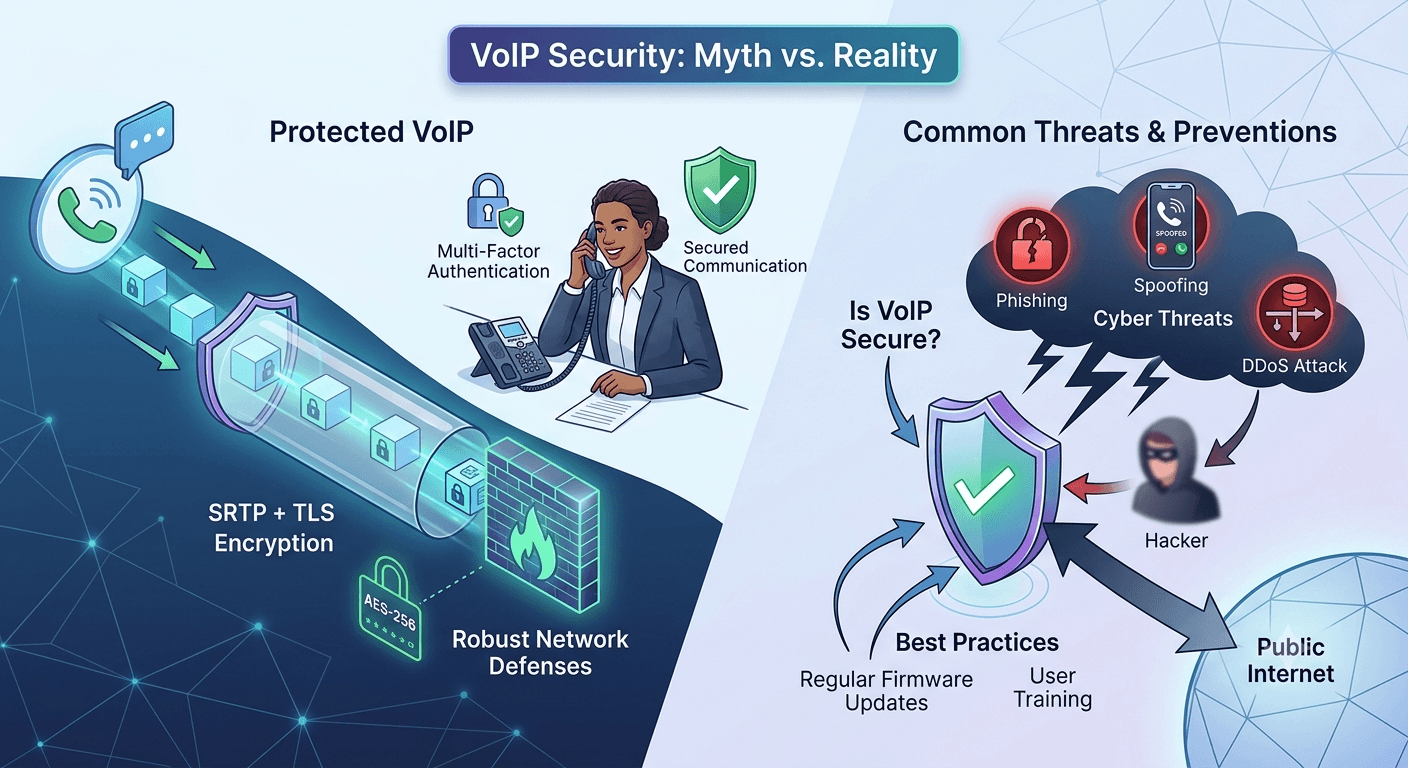
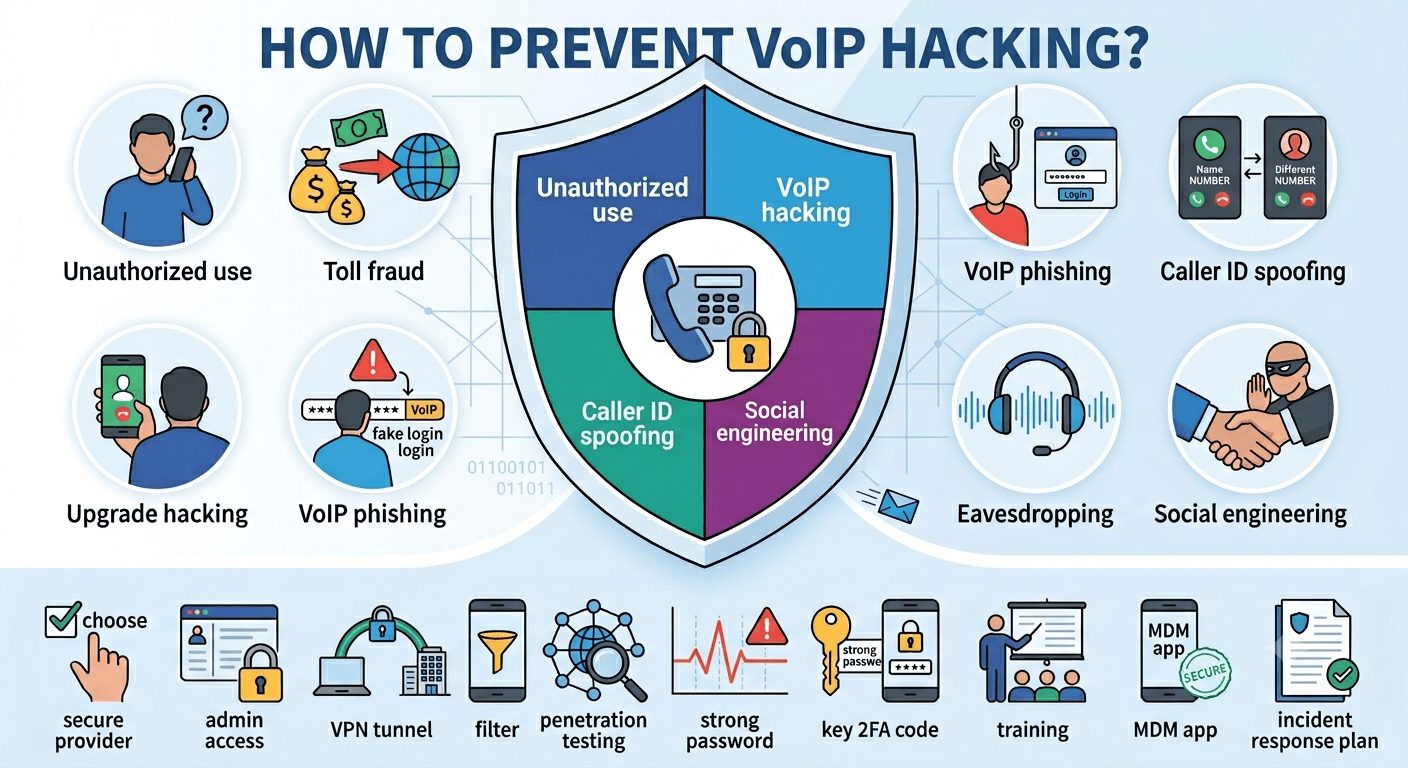
To prevent VoIP hacking, businesses should use strong, unique passwords, enable multi-factor authentication (MFA), and keep VoIP software and devices updated with the latest security patches. Securing the network with firewalls, VPNs, and intrusion detection systems can help block unauthorized access. Organizations should also encrypt calls using protocols such as TLS and SRTP to protect voice data during transmission. Regularly monitoring call logs and account activity can help identify suspicious behavior early. Employee cybersecurity training is equally important, as phishing attacks and weak credentials are common entry points for VoIP-related security breaches. How to Prevent VoIP Hacking effectively requires a combination of robust technical defenses and employee awareness. To secure your communication lines, you must implement end-to-end voip encryption, enforce strict two-factor authentication, and conduct regular network audits to identify voip vulnerabilities. Businesses should also use a Virtual Private Network (VPN) for remote connections and choose a provider that offers active intrusion prevention systems. By monitoring call logs for unusual activity, such as unexplained toll charges or international calls, you can stop a voip attack before it results in significant financial loss or data breaches. What Is VoIP Hacking? VoIP hacking refers to the unauthorized access or manipulation of a voice over internet protocol system to make fraudulent calls, steal data, or disrupt business operations. Because internet-based telephony relies on the same digital infrastructure as your computers and servers, it is susceptible to the same voip security threats that plague the digital world. When hackers gain entry, they can intercept voip traffic, listen to private conversations, or use your system to launch further attacks on other networks. Understanding what is a voip attack starts with recognizing that voice signals are converted into data packets. If these packets are not protected by voice over ip security protocols, they can be captured during transit. Hacking into phone systems is called phreaking when the primary goal is to make free long-distance calls at the victim’s expense. However, modern hackers often have more malicious intents, such as identity theft or corporate espionage. The danger of voip hacking lies in its invisibility. Unlike a physical break-in, a voip hack can occur silently in the background of your network for weeks or months. Without proper voip security best practices, a business might only realize they have been targeted when they receive a massive bill for international calls they never made. This highlights the importance of transitioning from a basic setup to a comprehensive voip security system that monitors every connection point. How VoIP hacking works The mechanics of how voip hacking works often involve exploiting weak points in the hack communication protocol. Hackers typically use automated scripts to scan the internet for open ports or poorly secured VoIP gateways. Once a vulnerability is found, they may use “brute force” attacks to guess administrative passwords or exploit unpatched software in an ip phone security setup. Another common method involves packet sniffing. Hackers use specialized software to intercept the data packets traveling across a network. If the connection is not an encrypted voip line, the hacker can reconstruct the voice data and listen to the conversation in real-time. This type of voip attack is particularly dangerous for businesses that discuss sensitive financial information or trade secrets over the phone. According to a report by the Communications Fraud Control Association (CFCA), global losses due to telecom fraud, including toll fraud and phreaking, are estimated to be over $28 billion annually. Research indicates that the financial impact of these breaches is staggering. This fact underscores the reality that voip security is not just a technical concern but a major financial necessity for modern enterprises. Six Types of VoIP Hacking To develop a strategy for how to secure voip, you must first understand the different ways criminals might target your system. Each type of attack requires a different defense mechanism, and being aware of these methods is the first step in building a secure voip environment. 1. Unauthorized use Unauthorized use occurs when someone gains access to your VoIP account to make calls without permission. This is often the result of weak passwords or shared credentials. The hacker essentially “borrows” your service, leading to increased costs and potential violations of service terms. While this might seem minor compared to data theft, it indicates a significant lapse in your ip phone security that could lead to more severe breaches. 2. Toll fraud (phreaking) Toll fraud, or phreaking, is one of the most expensive types of voip hacking. Hackers break into a phone system and route a high volume of international or premium-rate calls through it. They often partner with corrupt service providers in other countries to share the profits from these calls. This type of voip attack can cost a business tens of thousands of dollars in a single weekend if the system is left unmonitored during non-business hours. 3. VoIP phishing (vishing) Vishing is a form of social engineering where hackers use VoIP technology to trick people into revealing sensitive information. Because it is easy to spoof a caller ID on a voice over ip service, a hacker can make it appear as though they are calling from a bank, a government agency, or even your own IT department. They then use the voice security trust to ask for passwords, social security numbers, or credit card details. 4. Caller ID spoofing Caller ID spoofing involves altering the information sent to your caller ID display to hide the caller’s true identity. While spoofing itself is a tool, it is frequently used as a precursor to more complex voip hacking. A hacker might use a local area code to increase the chances of someone answering the phone, making the subsequent scam or vishing attempt more effective. 5. Eavesdropping Eavesdropping is the digital equivalent of wiretapping. In this scenario, a hacker intercepts the voip traffic to listen to private conversations. This is often achieved by compromising a router or using a man-in-the-middle attack. Without voip encryption, your calls are essentially being sent as plain text over the internet, making them an easy target for anyone with basic hacking tools. 6. Social engineering Social engineering doesn’t always rely on technical hacks; instead, it targets the human element. A hacker might call your office and pretend to be a technician, asking for an employee to “test” a dial code. In reality, that code might set up call forwarding to an international number. This highlights why voip cyber security must include employee training alongside technical safeguards. Signs You’re the Victim of VoIP Hacking Recognizing a breach early can save your business from total disaster. There are several red flags that indicate your voip security has been compromised. If you notice any of these signs, you should immediately trigger your incident response plan and conduct a thorough audit of your voip network. Unexplained Increases in Billing: A sudden spike in your monthly statement is the most common indicator of toll fraud or unauthorized use. Strange Call History: Regularly check your call logs. If you see calls to countries where you don’t have clients, or calls made at 3:00 AM, your system is likely compromised. Reduced Network Performance: Because a voip attack often involves sending a large amount of data, it can noticeably slow down your overall internet speed. Changes in Phone Settings: If call forwarding is suddenly active or if your voicemail password has changed without your input, someone else is in your system. Random Reboots: If your ip phones are rebooting frequently or acting erratically, it could be a sign that someone is attempting to push malicious firmware to the device. 11 Tactics to Protect Your VoIP System from Being Hacked Implementing a comprehensive strategy is the only way to ensure your communication is safe. Here are eleven essential tactics to bolster your defense and provide a secure voip phone experience for your entire team. 1. Choose the right VoIP Provider The foundation of your security is the provider you choose. A reputable provider will prioritize voip security by offering built-in encryption and fraud detection. They should have a track record of maintaining high uptime and providing regular security updates. When evaluating a provider, ask specifically about their protocols for handling a voip hack and what protections they offer against toll fraud. 2. Control administrator access One of the most common voip vulnerabilities is having too many people with administrative privileges. Limit access to the VoIP dashboard to only a few trusted IT professionals. Every person with “admin” rights represents a potential entry point for a hacker. By minimizing these points, you significantly reduce the risk of an internal breach or a compromised credential leading to a system-wide failure. 3. Use a VPN for remote access Remote work has made voip security risks more prevalent. When employees connect to the office phone system from home or public Wi-Fi, their connection is often unsecured. Forcing all remote voip traffic through a Virtual Private Network (VPN) creates a secure tunnel for the data. This ensures that even if someone intercepts the packets, they remain unreadable due to the encryption provided by the VPN. 4. Enable endpoint filtering Endpoints, such as the actual phones on desks, are often the weakest links. Endpoint filtering allows you to restrict which devices can connect to your VoIP server based on their IP address or MAC address. This prevents a hacker from using a rogue device to connect to your network, even if they have managed to steal a username and password. 5. Regularly test your network You cannot know if you are safe unless you test your defenses. Conduct regular penetration testing specifically focused on your voice over ip security. This involves hiring ethical hackers to try and find ways into your system. By identifying weaknesses in your voip security system before the criminals do, you can patch holes and stay one step ahead of the latest threats. 6. Monitor call and access logs Monitoring is a proactive way to prevent voip hacking. You should set up automated alerts for unusual activity, such as a high volume of calls to international destinations or repeated failed login attempts to the admin portal. Reviewing these logs weekly helps you understand the patterns of your network and makes it easier to spot an anomaly that could signify a voip attack. 7. Build awareness around strong passwords It sounds simple, but many businesses are hacked because they use default passwords like “1234” or “admin.” Ensure every device and account associated with your VoIP system has a complex, unique password. Passwords should be changed regularly, and you should never reuse passwords across different platforms. 8. Use two-factor authentication (2FA) Two-factor authentication adds a vital second layer of defense. Even if a hacker manages to hack phone through call methods or steal a password, they will still need a secondary code sent to a physical device to gain access. Implementing 2FA for all administrative logins is one of the most effective voip security best practices you can adopt today. 9. Train your team on cybersecurity Your employees are your first line of defense. Train them to recognize vishing attempts and social engineering tactics. They should know what to dial to see if your phone is hacked (such as checking call forwarding settings) and who to contact if they suspect a breach. Regular training sessions keep security at the forefront of everyone’s mind. 10. Implement a mobile device management (MDM) policy If your employees use their personal mobile phones for work calls via a VoIP app, you need an MDM policy. This allows the company to enforce security standards on the device, such as requiring a passcode and allowing for remote wiping if the phone is lost or stolen. This is a critical step in maintaining a secure voip phone environment in a “Bring Your Own Device” (BYOD) culture. 11. Develop a response plan for breaches No system is 100% impenetrable. If a breach occurs, you need a plan. This should include steps on how to isolate the compromised part of the network, how to notify your provider to stop fraudulent calls, and a communication strategy for informing affected clients. A fast response can mean the difference between a minor hiccup and a business-ending disaster.   How to Choose a Secure VoIP Provider Selecting a partner for your communications is a decision that should be driven by security as much as price. A secure voip provider acts as an extension of your IT team, offering tools and oversight that you might not be able to manage in-house. 1. Check for accreditations Look for providers that comply with industry-specific standards. For example, if you are in healthcare, HIPAA compliance is a must. For those in finance, look for SOC 2 Type II certification. These accreditations prove that the provider has undergone rigorous third-party audits of their security controls and data handling processes. 2. Look for intrusion prevention systems A top-tier provider will have active intrusion prevention systems (IPS) that monitor network traffic for malicious patterns. If the system detects a potential voip attack, it can automatically block the offending IP address before it reaches your internal network. This real-time defense is far more effective than manual monitoring. 3. Make sure there’s call encryption Ask your provider if they support Secure Real-time Transport Protocol (SRTP) and Transport Layer Security (TLS). These are the gold standards for voip encryption. They ensure that both the signaling and the actual voice data are encrypted from the moment they leave your phone until they reach their destination. This is the primary defense against eavesdropping. 4. Update firmware on VoIP devices A secure provider makes it easy to keep your hardware up to date. Many voip vulnerabilities are found in the firmware of the phones themselves. Your provider should offer a central management console that allows you to push security patches to every device on your network simultaneously, ensuring no phone is left unprotected. 5. Set VoIP call limit options To prevent massive toll fraud losses, choose a provider that allows you to set limits. You should be able to disable international calling to specific countries or set a maximum dollar amount for daily usage. If the limit is reached, the system should automatically disable calling and alert your administrator. This is a simple but highly effective way to mitigate the financial risks of a voip hack. Checklist to Protect Your VoIP Phone Passwords: Change all default passwords on phones and admin portals immediately. Encryption: Verify that SRTP and TLS are enabled for all calls. Firmware: Schedule monthly checks for firmware updates on all IP phones. Remote Work: Ensure every remote user is connecting via a secure VPN. Logs: Set up automated email alerts for any international calls made after hours. 2FA: Enable two-factor authentication for every account with system access. Physical Security: Ensure that unauthorized personnel do not have physical access to your VoIP servers or routers. Inactivity: Set the system to automatically log out users after a period of inactivity. Deactivation: Immediately remove access for any employee who leaves the company. Read More: Best Internet Speed for VoIP Calls for Crystal Clear Audio Final Thought Protecting your business from the growing threat of cybercrime is an ongoing commitment that requires vigilance at every level. While the question “can voip be hacked” has a definitive “yes,” the more important realization is that most attacks are preventable with the right strategy. By prioritizing voip security best practices, investing in encrypted voip technology, and fostering a culture of cybersecurity awareness, you can reap the benefits of modern communication without falling victim to digital predators. Security is not a product you buy, but a process you live by every day to ensure your voice remains private and your business remains profitable. VoIP Hacking FAQs Can VoIP be hacked? Yes, VoIP can be hacked because it operates over the same internet protocols used by other digital services. Without proper security, hackers can exploit vulnerabilities to intercept calls, commit toll fraud, or gain access to your internal network. However, by using tools like encryption, firewalls, and strong authentication, the risk of a successful hack is significantly minimized. Can VoIP Phones be hacked? Absolutely. VoIP phones are essentially specialized computers connected to a network. If their firmware is outdated or if they are protected only by default passwords, hackers can gain remote access. Once inside a phone, an attacker might listen to conversations, redirect calls, or use the device as a jumping-off point to attack other parts of your business network. How can cybersecurity prevent VoIP Hacking? Cybersecurity prevents hacking by implementing layers of defense, such as firewalls, intrusion detection systems, and encryption. It also involves the human element, ensuring that users are trained to spot scams and that administrators follow strict access control policies. Together, these measures create an environment where vulnerabilities are patched before they can be exploited. What is VoIP hacking and why is it a concern in Canada? In Canada, as in many other nations, VoIP hacking is a major concern due to the high volume of digital business transactions and the prevalence of remote work. Canadian businesses are often targets for toll fraud, where hackers route expensive international calls through local systems. The concern is also tied to privacy laws like PIPEDA, as a breach could lead to legal penalties and a loss of consumer trust. How can a Canadian SMB prevent toll fraud on VoIP? A Canadian SMB can prevent toll fraud by disabling international calling to countries where they do not conduct business and by setting strict daily spending limits on their VoIP account. Additionally, they should work with a provider that offers real-time fraud monitoring and alerts. Keeping administrative credentials secure and using 2FA are also critical steps in stopping fraudulent access. Does 3CX support VoIP security features needed in hotels and multi-site operations? Yes, 3CX is known for its robust security features tailored for complex environments like hotels. It includes built-in anti-hacking tools such as automatic global IP blacklisting and the ability to encrypt voice traffic through its own tunnel. These features make it easier for multi-site operations to maintain a consistent security posture across all locations. What protects VoIP calls from eavesdropping? The primary protection against eavesdropping is encryption. Specifically, protocols like SRTP (Secure Real-time Transport Protocol) scramble the voice data packets so they cannot be understood if intercepted. Using a VPN for all VoIP traffic adds another layer of security, making it nearly impossible for an unauthorized party to listen to your conversations. How should a Toronto-based business respond to a suspected VoIP breach? A business should immediately disconnect the suspected hardware or software from the network and contact their VoIP service provider to freeze the account and stop any fraudulent charges. They should then conduct a full security audit, change all passwords, and investigate the logs to determine the extent of the breach. It may also be necessary to report the incident to the Canadian Centre for Cyber Security. Can Microsoft 365 improve VoIP security for hybrid teams? Microsoft 365 can significantly improve security by providing integrated identity management through Azure Active Directory (now Microsoft Entra ID). This allows for centralized control over user access, the enforcement of multi-factor authentication, and the use of conditional access policies that ensure only secure, managed devices can connect to the team’s communication tools.
Read More
Understanding VoIP Encryption

Understanding VoIP Encryption for Secure Business Communication

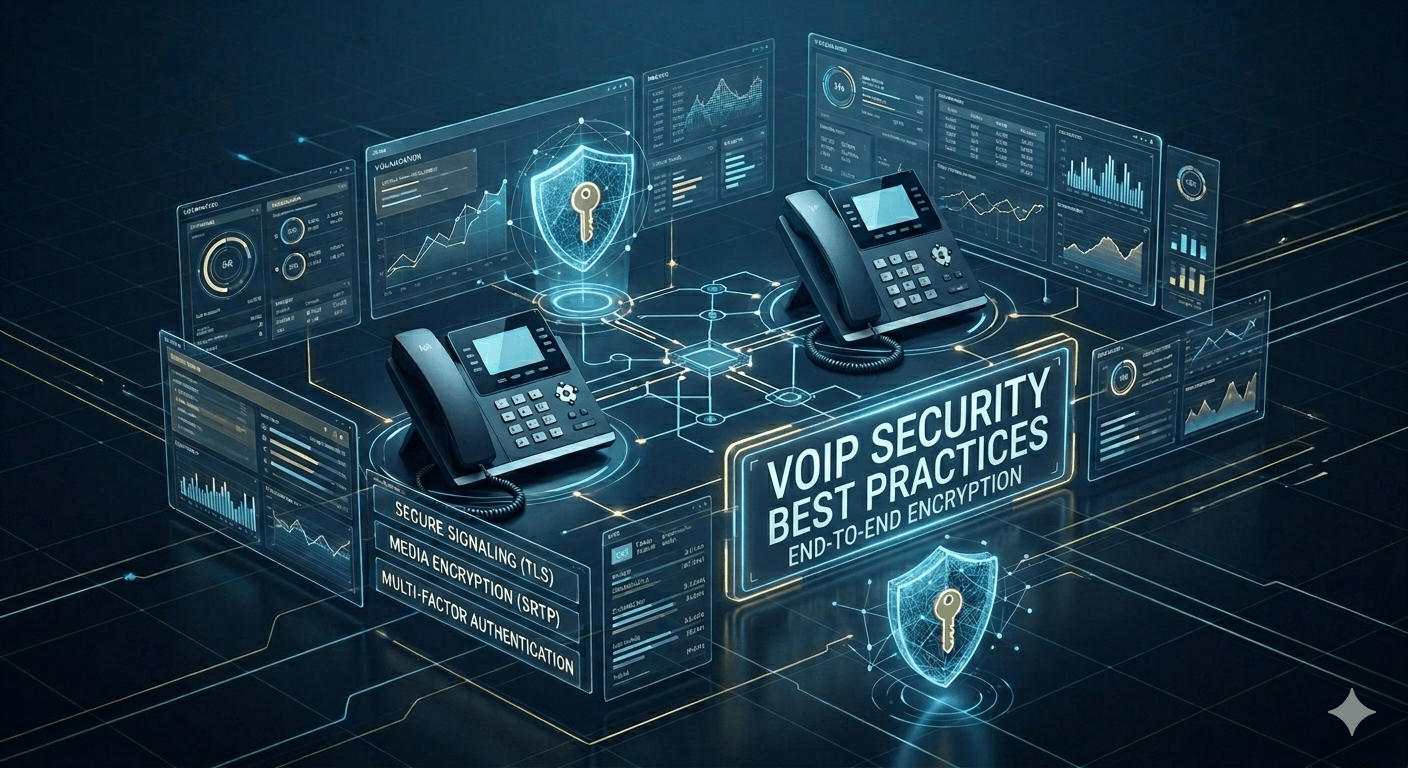
VoIP encryption is a security process that protects voice calls and data transmitted over the internet from unauthorized access. It works by converting voice traffic into encrypted data that can only be decoded by authorized users or devices. Common protocols such as TLS (Transport Layer Security) and SRTP (Secure Real-Time Transport Protocol) help secure call signaling and voice streams. For businesses, VoIP encryption reduces the risk of eavesdropping, data theft, and cyberattacks while supporting compliance with privacy regulations. Implementing encrypted VoIP solutions helps organizations maintain confidential communications and build trust with customers and partners. Understanding VoIP Encryption is the most effective way for modern organizations to protect their digital conversations from unauthorized interception and cyber threats. By implementing robust cryptographic protocols, businesses can transform standard voice data into unreadable code, ensuring that even if data packets are captured during transmission, the content remains private. This security framework relies on technologies like Secure Real-time Transport Protocol and Transport Layer Security to defend against eavesdropping and data breaches. Establishing a strategy for Understanding VoIP Encryption not only satisfies regulatory compliance requirements but also builds a foundation of trust with clients and partners who prioritize data confidentiality. The Role of VoIP Encryption in Securing Communications The landscape of modern telecommunications has shifted dramatically toward the internet, making the process of Understanding VoIP Encryption a necessity rather than a luxury. When we consider what does voip mean, it essentially refers to the transmission of voice signals over digital networks using the internet protocol. Unlike traditional phone lines that were physically isolated, voice over internet protocol travels through public and private data switches where it can be exposed to various voip security risks. Encryption acts as a digital seal, ensuring that the voice data packets are only accessible to the intended recipient, thereby mitigating the threat of hackers who might try to hack a phone by calling or intercepting traffic. In the realm of telephony voip, communication is divided into two distinct parts: signaling and media. Signaling handles the setup and teardown of the call, while media is the actual audio being transmitted. Without a comprehensive approach to Understanding VoIP Encryption, both of these streams are vulnerable. Hackers often target the signaling layer to gain information about who is calling whom, which is a common tactic in voip hacking. By encrypting these channels, organizations ensure that their voice over ip service remains a closed system, preventing unauthorized parties from mapping out the internal network or launching more sophisticated voip attacks. Furthermore, Understanding VoIP Encryption is vital because it addresses the inherent voip vulnerabilities found in computer networks. Because voip in computer networks shares the same infrastructure as email and web traffic, it is susceptible to man-in-the-middle attacks and packet sniffing. When a business implements voice encryption, they are essentially creating a secure perimeter that travels with the data. This proactive stance on voice security is what separates professional-grade voice over ip security from basic, unmanaged internet calling services that might leave a company exposed to corporate espionage or identity theft. How Encryption Works in VoIP To truly master the art of Understanding VoIP Encryption, one must dive into the specific protocols that make secure communication possible. These protocols work in tandem to create a multilayered defense system. Each layer has a specific job, from verifying the identity of the devices involved to scrambling the audio data itself. By integrating these technical standards, a voice ip service becomes resilient against even the most persistent voip security threats, ensuring that every conversation remains confidential and tamper-proof. 1. Secure Real-time Transport Protocol (SRTP) The primary technology used to protect the actual audio portion of a call is the Secure Real-time Transport Protocol, or SRTP. While standard RTP carries the voice packets, it does so in an unencrypted format that is easy to read if intercepted. SRTP adds a layer of security by providing encryption, message authentication, and integrity. This means that not only is the audio scrambled, but the system can also detect if any part of the packet was modified during transit. This is exactly which technology can be used to protect voip against eavesdropping effectively in modern network environments. According to a research study by the Ponemon Institute, organizations that implement strong encryption for their communication channels see a 60% reduction in the financial impact of data breaches. This is because SRTP makes the stolen data useless to the attacker. For businesses that rely on interconnected voip for sensitive negotiations, SRTP is a mandatory requirement. It ensures that the digital “packets” of sound are locked behind a cryptographic wall that requires a specific key to open, providing peace of mind for both the caller and the receiver. 2. Transport Layer Security (TLS) While SRTP protects the audio, Transport Layer Security (TLS) is responsible for securing the signaling and call setup information. When a user initiates voip calls, the system must exchange information like caller ID, destination, and encryption keys. If this signaling is not protected, a hacker could perform a voip attack to redirect the call or steal the encryption keys themselves. TLS creates a secure tunnel between the phone and the VoIP server, ensuring that no one can “listen in” on the setup phase of the conversation. Using TLS is a cornerstone of ip phone security because it uses certificates to verify that the phone is talking to the correct server. This prevents a common type of voip hack where an attacker sets up a fake server to intercept traffic. When TLS and SRTP are used together, they provide a comprehensive shield that covers the entire lifecycle of a call. This combined approach is what makes an encrypted voip service significantly more secure than a standard internet-based calling app that might only focus on one aspect of security. 3. Virtual Private Network (VPN) for Secure Communication For organizations with remote workers, a Virtual Private Network (VPN) adds an extra layer of protection to the voip network requirements. A VPN creates a private tunnel over the public internet, encrypting all traffic that passes through it, including voice data. This is particularly useful for protecting against hacking into phone systems is called phreaking or other unauthorized access methods. When an employee uses a secure voip phone over a VPN, they are shielded from the risks of public Wi-Fi and other unsecured network segments. However, it is important to note that a VPN can sometimes introduce latency, which is one of the common voip security issues. To avoid poor call quality, the network must be optimized to handle the overhead of the VPN encryption. Despite this challenge, the security benefits are immense. A VPN obscures the true IP address of the user, making it much harder for an attacker to launch a targeted voip attack or determine what to dial to see if your phone is hacked. It is a best practice for any business that prioritizes voip cyber security for their distributed workforce.   4. Encryption Algorithms and Key Exchange The strength of any encrypted voip system lies in the mathematical algorithms used to scramble the data. The Advanced Encryption Standard (AES) is the most widely used algorithm in the world for this purpose. Usually, VoIP systems use AES with 128-bit or 256-bit keys. The complexity of these keys makes it mathematically impossible for current computers to “crack” the code within a human lifetime. Understanding VoIP Encryption involves recognizing that the longer the key, the more secure the communication, though it may require more processing power from the hardware. Key exchange is the process where the two ends of a call agree on the cryptographic keys they will use. This must be done securely, usually using the Diffie-Hellman key exchange protocol. If a hacker intercepts the keys during the exchange, the encryption becomes worthless. This is why TLS is so important; it protects the key exchange process itself. By ensuring that the keys are never sent in plain text, the voice over internet protocol remains a closed loop, inaccessible to outside parties who might want to hack phone through call methods. 5. Authentication and Data Integrity Authentication is the process of verifying that a user or device is who they claim to be. In a secure voip system, this often involves digital certificates and unique user credentials. Without strong authentication, a hacker could bypass even the best encryption by pretending to be an authorized user. This is a critical part of voip security best practices, as it prevents unauthorized devices from joining the network and making fraudulent calls, a practice often associated with toll fraud or phreaking. Data integrity is the assurance that the information has not been altered during transmission. In the context of Understanding VoIP Encryption, integrity checks ensure that no one has tampered with the voice packets to inject malicious code or change the audio content. Each packet is signed with a cryptographic hash; if the hash at the receiving end doesn’t match the hash at the sending end, the system knows the packet has been compromised and will discard it. This level of detail is what makes a secure voip phone an essential tool for high-stakes business environments. 6. End-to-End Encryption (E2EE) The gold standard for Understanding VoIP Encryption is End-to-End Encryption (E2EE). In this model, the voice data is encrypted on the sender’s device and is only decrypted on the receiver’s device. This means that even the VoIP service provider cannot listen to the calls, as they do not have the decryption keys. While not all interconnected voip services offer E2EE due to the technical complexity of routing calls through the public telephone network, it is becoming increasingly common for internal business communications. E2EE is the ultimate defense against eavesdropping and government surveillance. For businesses that deal with highly sensitive information, such as legal or financial firms, seeking out an encrypted voip service that offers true E2EE is a top priority. It eliminates the “middleman” as a potential point of failure. By keeping the keys solely in the hands of the end-users, the voice over ip security is maintained regardless of the vulnerabilities of the underlying network or the service provider’s own infrastructure. Benefits of VoIP Encryption The advantages of Understanding VoIP Encryption extend far beyond just stopping hackers. In today’s data-driven world, the security of your communication channels is directly linked to your company’s reputation and financial health. Implementing voice encryption provides a multi-faceted benefit package that protects the organization from legal, operational, and social risks. It is a foundational element of any modern telecommunication voip strategy that aims to provide a reliable and professional experience for all stakeholders. 1- Enhanced Privacy and Data Integrity The most immediate benefit of Understanding VoIP Encryption is the preservation of privacy. In an era where data is a valuable commodity, protecting the content of business calls is essential. Encryption ensures that private discussions regarding trade secrets, mergers, or personnel issues stay within the intended circle. Moreover, by maintaining data integrity, businesses can be sure that the information they receive over the phone is exactly what the caller intended to say, without any digital tampering or loss of clarity due to malicious interference. This level of privacy is not just about avoiding leaks; it is about creating a safe space for innovation and collaboration. When employees know their conversations are protected by encrypted voip technology, they are more likely to speak freely and share ideas. This fosters a more open and productive work environment. Furthermore, it protects the company from “social engineering” attacks where hackers might use intercepted information to craft more convincing phishing attempts against the organization. 2- Regulatory Compliance and Cyber Threat Protection Many industries are now legally required to encrypt their communications. For instance, in the United States, the Health Insurance Portability and Accountability Act (HIPAA) mandates that patient information be protected during transmission. Understanding VoIP Encryption helps healthcare providers stay compliant and avoid massive fines. Similarly, financial institutions must adhere to strict data protection standards like PCI DSS. Using an encrypted voip service is a key part of meeting these regulatory hurdles and proving to auditors that the company takes data security seriously. Protection against cyber threats is another major benefit. As voip attacks become more common and sophisticated, having a static defense is no longer enough. Encryption provides a dynamic layer of protection that moves with the data. It prevents hackers from using intercepted voice traffic to gain a foothold in the corporate network. According to research by IBM, the average cost of a data breach is now over $4 million, and communication intercepts are a growing contributor to these costs. By investing in voip security, businesses are effectively saving themselves from potential financial ruin. 3- Business Continuity and Trust A secure communication system is a resilient one. By Understanding VoIP Encryption and implementing it correctly, businesses ensure that their phone systems remain operational even when under attack. For example, a system that is hardened against hacking into phone systems is called phreaking is less likely to be taken down by fraudulent activity or a sudden influx of malicious traffic. This business continuity is vital for companies that provide essential services or support to their customers around the clock. Finally, there is the element of trust. Clients and partners are increasingly aware of voip security risks and are looking for providers who take these threats seriously. By advertising that your company uses a secure voip phone system and follows voip security best practices, you are sending a clear signal that you value your clients’ privacy. This can be a significant competitive advantage in industries where confidentiality is a top priority. Trust is difficult to build but easy to lose; encryption is the most effective tool for keeping that trust intact. Industries That Benefit from Encryption While every business can benefit from Understanding VoIP Encryption, certain sectors have a much higher risk profile and a greater need for secure communications. These industries often handle sensitive personal, financial, or legal data that would be devastating if leaked. For them, voice over ip security is not just an IT concern; it is a core business requirement that impacts their ability to operate legally and ethically in a digital world. Healthcare: Medical professionals use VoIP for telehealth, consultations, and coordinating patient care. Encryption ensures that sensitive health information remains private, fulfilling the requirements of HIPAA and other global privacy laws. Finance and Banking: These organizations discuss financial transactions, account details, and market strategies. Understanding VoIP Encryption is vital for preventing fraud and protecting client wealth from sophisticated cybercriminals. Legal Services: The attorney-client privilege is a cornerstone of the legal profession. Using an encrypted voip service ensures that confidential legal strategies and client disclosures remain protected from eavesdropping. Government and Defense: Security is paramount for government agencies and defense contractors. They require the highest levels of encryption to prevent espionage and ensure that sensitive national security information is not compromised. E-commerce and Customer Service: These businesses handle credit card information and personal identity data. Secure voip phone systems protect this information during support calls, preventing identity theft and maintaining consumer confidence. Best Practices for Implementing VoIP Encryption Achieving a secure state through Understanding VoIP Encryption requires more than just turning on a setting. It involves a comprehensive approach to network management and employee behavior. By following these best practices, organizations can ensure that their voice encryption is effective and that their communication channels are hardened against all forms of voip attacks. It is a continuous process of improvement and monitoring that adapts to the ever-changing threat landscape. First and foremost, always use strong encryption protocols like SRTP and TLS. These should be the default for all devices on the network. Secondly, enable Multi-Factor Authentication (MFA) for all VoIP accounts. Even if a hacker manages to steal a password, MFA provides a second layer of defense that is much harder to bypass. This is one of the most effective ways to prevent unauthorized access and voip hacking. Regularly updating your VoIP systems is also critical. Manufacturers frequently release patches that fix newly discovered voip vulnerabilities. Monitoring network traffic in real-time is another essential practice. By using tools that identify suspicious patterns, such as a sudden spike in international calls or repeated login failures, administrators can stop a voip attack before it causes damage. Educating employees is equally important. Many breaches start with a simple phishing call or email. By training staff on the risks of social engineering and the importance of using strong passwords, businesses can turn their employees into a powerful line of defense. Finally, implement role-based access controls to ensure that only the necessary personnel have administrative access to the VoIP system. Future of VoIP Encryption As we look toward the future, the importance of Understanding VoIP Encryption will only grow. The rise of Artificial Intelligence (AI) and machine learning means that hackers will have more powerful tools to attempt to break codes and launch more targeted voip attacks. In response, the security industry is developing AI-driven defense systems that can detect and block threats in milliseconds. We are also seeing the emergence of “quantum-resistant” encryption, which is designed to protect data even against the massive processing power of future quantum computers. Furthermore, the integration of 5G technology will bring more devices onto the internet than ever before, expanding the attack surface for voip hacking. This will necessitate even more robust voip network requirements and a greater focus on securing every endpoint. The trend toward decentralized and cloud-based communication will also continue, making E2EE a standard feature for more services. The future of voice security is one where encryption is invisible, seamless, and unbreakable, providing a truly secure foundation for the next generation of global communication. Read More: How to Switch from Landline to VoIP? Conclusion Understanding VoIP Encryption is a journey toward creating a more secure and trustworthy digital world. By mastering the technical protocols like SRTP and TLS, and by following industry best practices, businesses can protect their most sensitive conversations from the prying eyes of cybercriminals. Whether it is preventing toll fraud, ensuring regulatory compliance, or simply maintaining the privacy of a private discussion, encryption is the ultimate tool for modern telecommunications. As technology continues to evolve, staying informed about the latest trends in voice over ip security will be essential for any organization that values its data and its reputation. FAQs Are VoIP calls automatically encrypted? Not always. While many modern providers offer some level of security, not all VoIP calls are automatically encrypted by default. It often depends on the specific service you are using and how your network is configured. To ensure your calls are safe, you should check with your provider to see if they use SRTP and TLS. If you are using a basic consumer-grade app, it is highly likely that your calls are not being protected by professional-level voice over internet protocol security. What is the difference between encryption and End-to-End Encryption (E2EE)? Standard encryption usually protects the data as it travels between your device and the service provider’s server. However, the provider may still have the keys to decrypt and “see” your data. In contrast, End-to-End Encryption (E2EE) ensures that the data is only decrypted on the recipient’s device. This means that nobody, not even the service provider or a hacker who compromises the server, can listen to your voip calls. E2EE is the highest form of privacy available in telephony voip. Will turning on encryption ruin my call quality? No, modern encryption algorithms are designed to be extremely efficient. While encrypting and decrypting data does require some processing power, the impact on latency and call quality is usually negligible on modern hardware. If you do experience issues, it is more likely due to overall voip network requirements or bandwidth limitations rather than the encryption itself. In most cases, the peace of mind provided by Understanding VoIP Encryption far outweighs any minor technical overhead. Do I need encryption for compliance? For many industries, the answer is a definitive yes. Laws like HIPAA for healthcare, GDPR for businesses operating in Europe, and various financial regulations require the protection of personal data during transmission. If your business handles sensitive client information, Understanding VoIP Encryption is not just a good idea—it is a legal necessity. Failing to implement secure protocols can result in heavy fines, legal action, and a total loss of business credibility. What is the most secure protocol for VoIP? The most secure standard for VoIP communication is the combination of SRTP for the media stream and TLS for the signaling. Together, they provide a comprehensive defense against eavesdropping and tampering. For even higher security, look for providers that offer E2EE and use advanced algorithms like AES-256. These are the gold standards for voice encryption in the modern era and are used by the world’s most secure organizations. Can hackers listen to encrypted VoIP calls? Technically, a hacker could still intercept the packets of an encrypted call, but they would not be able to understand the content. Without the specific cryptographic keys, the data appears as random noise. The complexity of modern encryption like AES makes it virtually impossible to crack the code through brute force. This is why Understanding VoIP Encryption is so effective; it doesn’t necessarily stop the interception, but it makes the intercepted data completely useless to the attacker. How does a VPN help with VoIP? A VPN helps by creating a secure, encrypted tunnel for all of your internet traffic, including your VoIP packets. This is especially useful for remote workers using untrusted networks like public Wi-Fi. By hiding your voip traffic inside the VPN tunnel, you add an extra layer of protection against local hackers and packet sniffers. It also helps obscure your physical location, making it harder for someone to target your specific voip system requirements. What are the risks of using unencrypted VoIP? The risks of unencrypted VoIP include eavesdropping, where someone listens to your private conversations, and toll fraud, where hackers take over your system to make expensive calls. There is also a risk of identity theft and corporate espionage if sensitive information is discussed over an open line. Without encryption, your voice over internet protocol packets are sent as plain text, making them an easy target for anyone with basic hacking tools on your network.

Read More
VoIP Compliance with FCC Regulations

VoIP Compliance with FCC Regulations: A Complete Guide

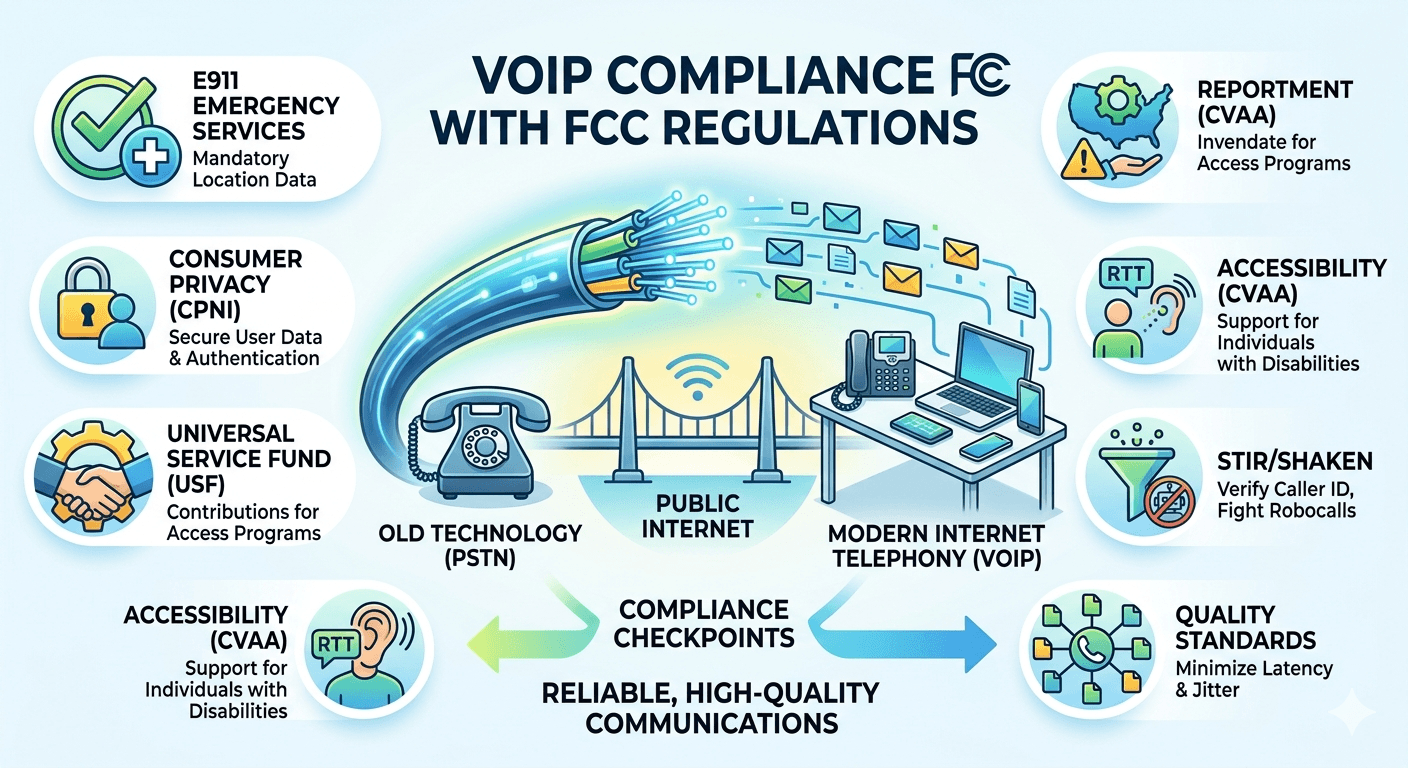
VoIP Compliance with FCC Regulations ensures that providers of voice over internet protocol services adhere to the legal standards set by the Federal Communications Commission to protect consumers and maintain national security. Achieving full compliance involves understanding the technical requirements of interconnected VoIP, implementing mandatory E911 emergency services, and contributing to the Universal Service Fund. Businesses must also navigate complex privacy rules, such as Customer Proprietary Network Information (CPNI) standards, to secure user data. By following these federal mandates, companies can avoid heavy fines and provide a reliable, high-quality telecommunication environment for all users. What is VoIP? To understand the legal landscape, one must first address what does voip mean in the context of modern communications. Effectively, voip stands for voice over internet protocol, which is a method for taking analog audio signals and turning them into digital data that can be transmitted over the internet. This technology allows users to make voip calls from a computer, a special VoIP phone, or a traditional phone connected to an adapter. Because it relies on the internet rather than traditional copper wires, the voice over internet protocol is highly flexible and cost-effective for both residential and commercial users. When people ask what is a voip, they are often referring to the service or the hardware used to facilitate voice over ip service. Unlike traditional landlines, voip technology uses packet-switching technology to send voice data in small chunks. This is a significant shift from the circuit-switching methods used by the Public Switched Telephone Network (PSTN). In the realm of voip in computer networks, the system must be robust enough to handle data packets with minimal latency to ensure clear communication. The growth of telephony voip has revolutionized how businesses operate, allowing for integrated features like video conferencing, instant messaging, and file sharing within a single platform. However, because it operates over the public internet, a voice ip service requires specific voip network requirements to function correctly. This includes sufficient bandwidth, low jitter, and a stable internet connection to prevent dropped calls or poor audio quality. Understanding these technical foundations is the first step toward achieving total VoIP Compliance with FCC Regulations. What is FCC? The Federal Communications Commission (FCC) is an independent United States government agency overseen by Congress. It is the primary body responsible for implementing and enforcing America’s communications law and regulations. The agency’s jurisdiction covers all 50 states, the District of Columbia, and U.S. possessions. In the world of telecommunication voip, the FCC plays a pivotal role in ensuring that new technologies do not compromise the safety, privacy, or accessibility of the American public. Originally established by the Communications Act of 1934, the FCC has evolved to oversee modern digital technologies, including voice over internet services. The commission is charged with regulating interstate and international communications by radio, television, wire, satellite, and cable. As the market shifted from traditional landlines to internet-based calling, the FCC had to adapt its rules to include interconnected voip, ensuring that these services meet the same public interest obligations as traditional phone companies. The FCC’s mission includes promoting connectivity and ensuring a competitive market for all communication services. By setting specific voip system requirements, the FCC ensures that different providers can work together and that consumers have choices. The commission also manages the spectrum for wireless services and works to bridge the digital divide through various assistance programs. For any provider, staying in the good graces of the FCC is not just about legal survival; it is about proving the reliability and integrity of their service to the consumer. The Role Of FCC In VoIP Environment The role of the FCC in the current communication landscape is multi-faceted, focusing primarily on public safety and market fairness. One of the most critical aspects of VoIP Compliance with FCC Regulations is the integration of emergency services. Because voice over ip service can be used from anywhere with an internet connection, determining the physical location of a caller during a 911 call was a significant hurdle. The FCC stepped in to mandate that providers must be able to transmit the caller’s location to emergency dispatchers, a requirement known as Enhanced 911 (E911). Beyond safety, the FCC works to build trust between consumers and service providers. In an era where digital fraud and robocalls are rampant, the commission implements rules like the STIR/SHAKEN framework to verify the caller ID of incoming voip calls. This technology helps reduce the number of spoofed calls, which are often used for phishing and scams. By enforcing these rules, the FCC helps maintain the integrity of the voice over internet ecosystem, making users feel more secure when answering their phones. Furthermore, the FCC ensures a suitable communication environment by preventing anti-competitive practices. They monitor how large telecommunications companies interact with smaller providers to ensure that the market remains open for innovation. This oversight includes setting standards for voip network requirements that facilitate interconnection between different networks. By keeping the regulations up-to-date with current technological trends, the FCC ensures that the transition from old telephony systems to modern voip in computer networks is smooth and beneficial for the entire nation. Key FCC Regulations for VoIP Services For any company offering voice over ip service, understanding the specific mandates is essential. The FCC does not treat all internet-based calling the same way; they distinguish between “interconnected” VoIP and other types. Interconnected services allow users to receive calls from and make calls to the traditional telephone network. These services are subject to the most stringent rules to ensure they function as a viable replacement for traditional landline services. 1- E911 Requirements The most vital part of VoIP Compliance with FCC Regulations is the E911 requirement. According to FCC rules, interconnected VoIP providers must provide E911 services as a standard feature of their offering. This means they must obtain the physical location of the subscriber and ensure that 911 calls are routed to the appropriate local emergency center. Unlike traditional phones, where the location is tied to a specific wire, VoIP users might move their equipment. Therefore, providers must give users an easy way to update their registered location. According to a research report by the National Emergency Number Association (NENA), nearly 80% of emergency calls now come from wireless or VoIP devices, making the accuracy of location data more critical than ever. Failure to provide functional E911 services can lead to catastrophic consequences and massive legal liabilities. The FCC requires that providers not only transmit the location but also the callback number so that if the call is disconnected, the emergency operator can reach the person in distress. 2- Customer Privacy Privacy is a cornerstone of the telecommunication voip industry. The FCC enforces strict rules regarding Customer Proprietary Network Information (CPNI). CPNI includes details such as the time, date, duration, and destination of voip calls, as well as the type of services a customer uses. Providers are legally obligated to protect this data from unauthorized access or disclosure. This regulation ensures that personal communication patterns are not sold to third parties or exposed during data breaches. To comply with these privacy standards, companies must implement robust internal controls and authentication processes. For instance, before a customer service representative can discuss account details with a user, they must verify the user’s identity through a password or other secure method. Additionally, providers must file annual certifications with the FCC to prove they have established effective procedures to safeguard customer information. This level of oversight is intended to give consumers confidence that their voice over internet activities remain private. 3- Universal Service Fund Contributions The Universal Service Fund (USF) is a system of subsidies designed to ensure that all Americans have access to affordable communication services. Under VoIP Compliance with FCC Regulations, interconnected VoIP providers are required to contribute a percentage of their interstate and international revenues to the USF. These funds are used to support programs for rural health care, schools and libraries (E-Rate), and low-income consumers (Lifeline). The contribution factor for the USF is adjusted quarterly based on the needs of the supported programs. For many providers, managing these payments is a complex administrative task, as it requires accurate tracking of where calls originate and terminate. However, these contributions are essential for maintaining the overall health of the national network. By supporting broadband access in underserved areas, the USF expands the potential market for voip technology and ensures that the digital economy is inclusive. 4- Accessibility Requirements The FCC is committed to ensuring that individuals with disabilities have equal access to communication technologies. This means that voip system requirements must include features that support people who are deaf, hard of hearing, or have speech disabilities. Regulations under the Twenty-First Century Communications and Video Accessibility Act (CVAA) mandate that VoIP services and equipment be accessible to and usable by people with disabilities, provided it is achievable. This often involves the integration of Telecommunications Relay Services (TRS) and support for “Real-Time Text” (RTT) technology. RTT allows text to be transmitted instantly as it is typed, which is a significant improvement over older TTY systems. Providers must also ensure that their websites and customer service channels are accessible. By prioritizing these features, the voice over ip service industry ensures that no segment of the population is left behind as the world moves away from traditional telephony. Benefits of FCC Regulations for Consumers While compliance may seem like a burden for providers, the benefits for the end-user are immense. FCC regulations create a structured environment where quality, safety, and privacy are guaranteed. Without these rules, the market for voice over internet could become a “wild west” where consumer data is sold to the highest bidder and emergency services are unreliable. The presence of a federal watchdog ensures that companies compete on the quality of their service rather than by cutting corners on essential protections. Privacy Policies and Data Security One of the primary benefits of VoIP Compliance with FCC Regulations is the establishment of clear privacy expectations. When a consumer signs up for a telephony voip service, they are protected by federal laws that dictate how their data is handled. These regulations force providers to be transparent about their data collection practices. Strong data security mandates also mean that providers must invest in encryption and secure voip network requirements to prevent hackers from intercepting calls or stealing sensitive billing information. Data security in the voip in computer networks space is particularly important because voice data is susceptible to the same vulnerabilities as any other internet traffic. By mandating security standards, the FCC ensures that providers use modern protocols like Secure Real-time Transport Protocol (SRTP) to protect the privacy of conversations. This level of protection is vital for businesses that handle sensitive client information over the phone, as it mitigates the risk of corporate espionage and identity theft. Preventing Monopolies and Promoting Small Businesses The FCC plays a crucial role in maintaining a competitive marketplace. By regulating how interconnected voip providers access the existing phone network, the FCC prevents large, incumbent carriers from blocking new entrants. This open-access policy allows small businesses and startups to enter the voip technology market with innovative features and lower pricing. Competition keeps costs down for consumers and drives the industry to constantly improve its offerings. Furthermore, FCC rules regarding number portability are a huge win for consumers and small businesses. Number portability allows a user to switch from one voice over ip service to another while keeping their existing phone number. This prevents “provider lock-in,” where a customer stays with a subpar service simply because they don’t want to change their contact information. By making it easy to switch, the FCC ensures that providers must work hard to retain their customers through excellent service and fair pricing. Quality Standards and Broadband Access While the FCC does not directly dictate the audio quality of every call, its focus on broadband access indirectly improves the voice over internet experience. Through the Universal Service Fund, the FCC subsidizes the expansion of high-speed internet into rural and low-income areas. Since voip network requirements rely heavily on stable broadband, these initiatives expand the reach of high-quality telephony voip. Moreover, the FCC sets standards for how traffic is handled on the network to ensure that voice packets are prioritized. This is essential for preventing “latency” and “jitter,” which cause the lag and distortion often associated with poor-quality voip calls. When the underlying infrastructure is robust, the user experience is seamless, making the transition from landlines to voice over ip service an easy choice for most households. Encouraging New Technologies and Investing in Research The FCC doesn’t just regulate; it also encourages growth. By providing a clear legal framework, the commission gives companies the confidence to invest in new voip technology. When a company knows the “rules of the road,” they are more likely to spend money on research and development for features like AI-driven call routing, advanced noise cancellation, and seamless integration with mobile apps. A 2022 study by the International Telecommunication Union (ITU) highlighted that countries with clear regulatory frameworks for digital services see 15% higher investment in telecommunications infrastructure compared to those with ambiguous rules. This research supports the idea that VoIP Compliance with FCC Regulations actually fuels innovation by reducing the risks associated with legal uncertainty. By investing in research and supporting new standards, the FCC ensures that the United States remains a global leader in communications. Lifeline Program and Universal Service Fund The Lifeline program is a specific branch of the USF that provides a monthly discount on communication services for qualifying low-income consumers. In the modern era, having a phone is not a luxury; it is a necessity for finding jobs, accessing healthcare, and staying in touch with emergency services. Many voice ip service providers participate in this program, allowing them to serve a wider demographic while receiving subsidies to cover the costs. This program ensures that the benefits of voice over internet are available to everyone, regardless of their economic status. By integrating VoIP into the Lifeline program, the FCC recognizes that internet-based calling is the future of communication. This not only helps the individuals receiving the discount but also strengthens the entire network by ensuring that every citizen is reachable. Compliance Challenges for VoIP Providers Despite the clear benefits, achieving and maintaining VoIP Compliance with FCC Regulations is a significant challenge for many companies. The regulatory landscape is constantly shifting as new laws are passed and old ones are updated to reflect technological changes. For a small voice over internet provider, the administrative overhead of tracking USF contributions, filing CPNI certifications, and maintaining E911 databases can be overwhelming. Technical challenges also abound. Ensuring that a voice over ip service remains compliant while also being compatible with a wide range of devices and network configurations requires constant vigilance. For instance, implementing the STIR/SHAKEN framework to combat robocalls involves a complex system of digital certificates and private keys. If a provider fails to implement this correctly, their voip calls may be blocked or flagged as “spam” by other carriers, leading to a loss of customers and reputation. Moreover, the global nature of the internet complicates things. A provider might be based in the U.S. but have users traveling internationally. Determining which regulations apply in these scenarios requires expert legal counsel. The cost of non-compliance is high, with the FCC frequently issuing “Notices of Apparent Liability” that carry fines in the hundreds of thousands, or even millions, of dollars. These challenges make it imperative for companies to have a dedicated compliance strategy. How to Stay Compliant with VoIP Compliance with FCC Regulations Staying compliant requires a proactive approach that combines legal expertise with technical excellence. It is not a “set it and forget it” process; it is a continuous cycle of monitoring, auditing, and updating. Providers must view VoIP Compliance with FCC Regulations as a core part of their business model rather than an afterthought. By integrating compliance into their daily operations, companies can protect themselves and their customers from the risks of the digital age. 1- Stay Updated and Implement Best Practices The first step in staying compliant is to stay informed. The FCC frequently issues new orders and public notices that can change the requirements for voice over ip service. Subscribing to FCC newsletters, attending industry conferences, and participating in regulatory forums are all excellent ways to stay ahead of the curve. Implementing best practices, such as those suggested by the SIP Forum or the ATIS (Alliance for Telecommunications Industry Solutions), can help ensure that your voip system requirements meet the latest industry standards. Furthermore, companies should look at how leaders in the telecommunication voip space handle their regulatory obligations. Following the lead of established players can provide a roadmap for navigating complex issues like international call routing and tax collection. By adopting a “compliance-first” mindset, a provider can build a reputation for reliability that attracts high-value enterprise clients who prioritize security and legal standing. 2- Train Staff and Invest in Secure Technologies Human error is one of the most common causes of compliance failures. Whether it is a customer service representative mishandling CPNI or a network engineer misconfiguring a firewall, the results can be devastating. Therefore, regular training for all employees on the specifics of VoIP Compliance with FCC Regulations is essential. Staff should be trained to recognize sensitive data and follow strict protocols for handling customer inquiries and emergency routing. Investing in secure technologies is the other half of the equation. This includes using high-quality hardware that supports the latest encryption standards and software that automates many of the compliance tasks. For example, using a reputable third-party for E911 management can take the burden of database maintenance off the provider’s shoulders. Similarly, automated billing systems can help ensure that USF contributions and other regulatory fees are calculated and paid accurately and on time. 3- Conduct Audits and Handle Customer Data Carefully Regular internal and external audits are necessary to identify potential gaps in compliance. An audit should review everything from technical voip network requirements to administrative filings and data handling procedures. By finding and fixing problems before the FCC does, a company can save itself from costly fines and public embarrassment. These audits also provide an opportunity to optimize the network for better performance and security. Handling customer data with care is perhaps the most visible part of compliance for the user. Beyond just following CPNI rules, providers should implement comprehensive data protection policies that include regular security patches, multi-factor authentication, and employee background checks. In the world of telephony voip, trust is the most valuable currency. If a customer feels their data is unsafe, they will quickly move to a competitor, regardless of the price. 4- Ensure Reliable Emergency Services and Document Compliance Efforts There is no room for error when it comes to E911. Providers must ensure that their systems are robust enough to handle emergency calls even during periods of high network congestion. This involves having redundant connections to the emergency network and regularly testing the location-routing capabilities. Users should also be prompted frequently to verify and update their registered address to ensure the accuracy of the E911 database. Documentation is the shield that protects a company during an FCC investigation. Every effort made toward VoIP Compliance with FCC Regulations should be meticulously documented. This includes training logs, audit reports, system configuration changes, and copies of all federal filings. If the FCC ever questions a provider’s practices, being able to produce a clear paper trail of diligent compliance efforts can be the difference between a warning and a major fine. 5- Engage with Industry Associations Finally, providers should not try to navigate the world of voice over internet regulations alone. Engaging with industry associations like the Voice on the Net (VON) Coalition or the ITPA (ITSP Association) can provide valuable support. These organizations often lobby the FCC on behalf of smaller providers, ensuring that their voices are heard when new rules are being drafted. They also offer resources, templates, and expert advice that can simplify the compliance process. By working together with other companies in the telephony voip sector, providers can help shape a regulatory environment that is fair and conducive to growth. Collaboration also allows for the sharing of information regarding new threats, such as emerging types of toll fraud or sophisticated hacking techniques. In the interconnected world of voip in computer networks, a collective defense is often the most effective way to stay compliant and secure. Read More: How to Choose the Right VoIP Provider: Proven Strategies Final Thought Navigating the complexities of VoIP Compliance with FCC Regulations is an ongoing journey that requires dedication, technical skill, and a deep understanding of the law. From the life-saving requirements of E911 to the economic contributions of the Universal Service Fund, these regulations are designed to create a safe and equitable communication landscape for everyone. While the challenges of staying compliant are significant, the rewards—customer trust, market stability, and legal security—are well worth the effort. By prioritizing these standards, providers not only follow the law but also contribute to the continued evolution and success of voice over internet protocol technology. FAQS What are the FCC rules for VoIP? The FCC rules for VoIP focus primarily on public safety, consumer privacy, and market fairness. Key regulations include the mandate for E911 services, which requires providers to transmit a caller’s location to emergency services. Additionally, providers must protect Customer Proprietary Network Information (CPNI), contribute to the Universal Service Fund (USF), and ensure their services are accessible to people with disabilities. These rules apply specifically to “interconnected” VoIP services that link to the traditional phone network. What are VoIP regulations? VoIP regulations are a set of legal frameworks that govern how voice over internet protocol services operate. These include federal rules set by the FCC, such as robocall mitigation (STIR/SHAKEN), number portability, and law enforcement assistance requirements (CALEA). These regulations are designed to ensure that internet-based calling is as reliable, secure, and accessible as traditional landline telephony, protecting both the consumer and the national communication infrastructure. Why is Understanding FCC Regulations important for businesses? Understanding these regulations is vital for businesses to avoid massive legal fines and potential service shutdowns. Compliance ensures that a company’s telephony voip services are trustworthy, which is a major selling point for corporate clients. Furthermore, knowing the rules helps businesses design their voip system requirements correctly from the start, preventing costly technical reworks and ensuring seamless integration with other global networks. Who regulates VoIP companies? In the United States, the Federal Communications Commission (FCC) is the primary regulator for VoIP companies. While the internet itself is largely decentralized, the FCC has jurisdiction over communication services that use the internet to connect to the public telephone network. State-level public utility commissions may also have limited oversight in certain areas, particularly regarding state-specific taxes and emergency service coordination. What are the two major protocols for VoIP signaling? The two major protocols for signaling in voip technology are the Session Initiation Protocol (SIP) and H.323. SIP is the most widely used protocol today due to its flexibility and simplicity, allowing for the setup, management, and termination of voice over internet sessions. H.323 is an older, more complex standard often used in legacy video conferencing systems. Both protocols are essential for defining how devices communicate and negotiate call parameters within voip in computer networks. What is the principle of VoIP? The fundamental principle of VoIP is the conversion of analog voice signals into digital data packets. These packets are sent over a packet-switched network, such as the internet, using the Internet Protocol (IP). Once they reach their destination, they are reassembled and converted back into audio. This process allows for more efficient use of network resources compared to the dedicated circuits used in traditional telephony, enabling features like voip calls to be made over any stable internet connection. What is the minimum requirement for VoIP? The minimum requirements for a functional voice over ip service include a stable internet connection with at least 100 Kbps of upload and download bandwidth per concurrent call. Additionally, the network must have low latency (under 150ms) and minimal packet loss to ensure audio clarity. Hardware-wise, a user needs a VoIP-compatible device, such as an IP phone, an analog telephone adapter (ATA), or a computer/smartphone with appropriate software. For a provider, meeting voip network requirements also involves having a robust server infrastructure to handle call routing and signaling.

Read More
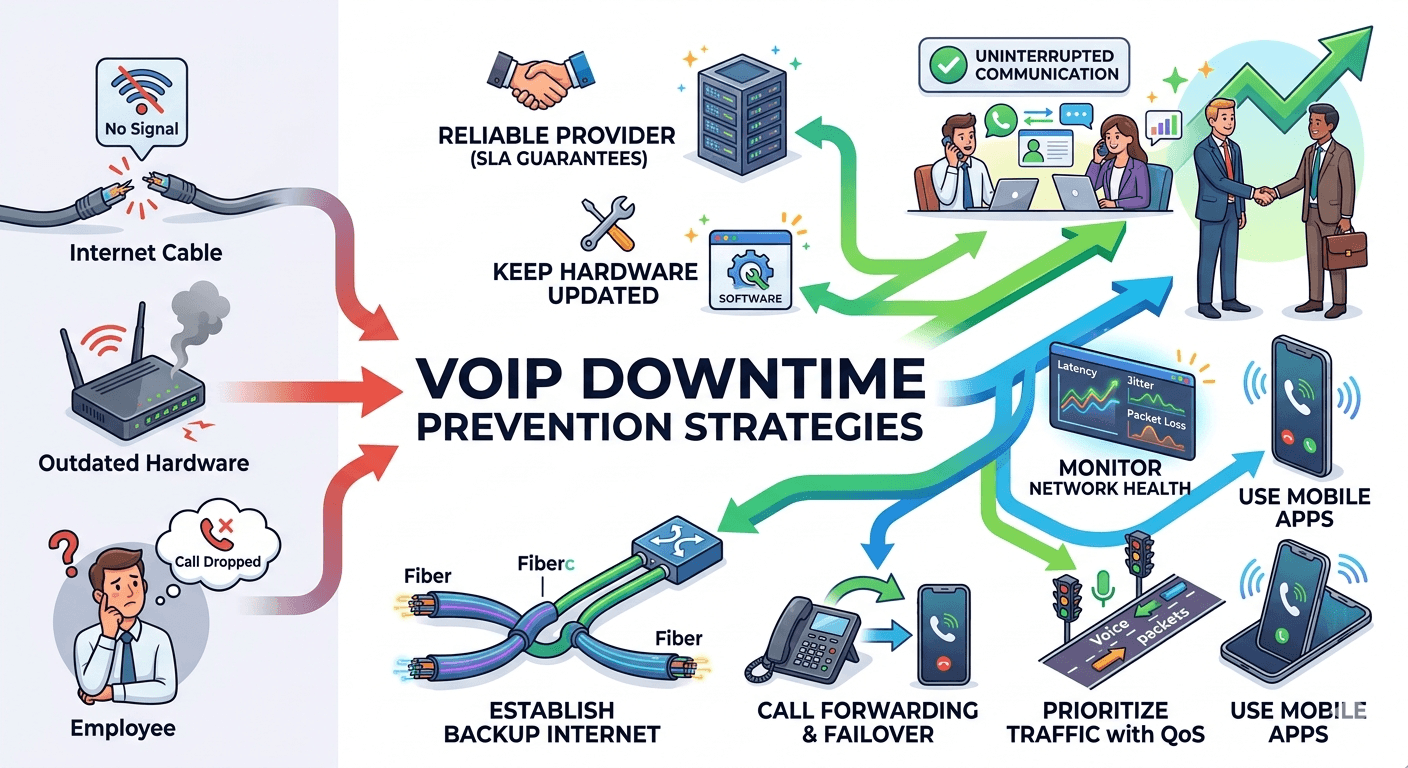
How to Reduce VoIP Downtime

How to Reduce VoIP Downtime and Boost Productivity ?

VoIP Downtime refers to the period when a voice over internet protocol system is unavailable, preventing users from making or receiving calls. To effectively reduce this disruption, businesses must implement a multi-layered strategy involving network redundancy, Quality of Service settings, and proactive hardware maintenance. Ensuring high availability requires a robust internet connection with failover capabilities and a partnership with a reliable service provider that offers a high uptime guarantee. By addressing common causes like insufficient bandwidth and hardware failures, organizations can maintain seamless communication and avoid the significant financial and reputational costs associated with unexpected outages. Why VoIP Downtime Matters In the modern business landscape, communication is the lifeblood of operations. When a company experiences problems like how to reduce VoIP Downtime, the consequences extend far beyond a few missed calls. For businesses that rely on their voice over internet protocol system for sales, customer support, and internal collaboration, even a few minutes of disconnection can lead to lost revenue and frustrated clients. In an era where customers expect immediate responses, a “dead line” can drive them straight into the arms of a competitor. The financial impact of voice over ip service interruptions is substantial. According to a research report by Gartner, the average cost of network downtime is estimated at $5,600 per minute, though this can vary significantly depending on the size and nature of the business. VoIP downtime affects employee morale and operational efficiency. When the telephony voip system goes down, staff members are often left unable to complete their tasks, leading to a backlog of work and increased stress. This is particularly critical for businesses using voip in computer networks to manage complex workflows or remote teams. Maintaining a reliable voice ip service is not just a technical requirement; it is a fundamental component of business continuity and long-term growth. 7 Step To Reduce VoIP Downtime For a small or mid-sized enterprise, an hour of VoIP Downtime could result in thousands of dollars in lost productivity and missed opportunities. Beyond the immediate financial loss, frequent outages damage a company’s reputation, making them appear unprofessional or unreliable to their target audience. Here are the seven steps to reduce VoIP downtime.  Step 1: Choose a Reliable VoIP Service Provider The most critical factor in preventing VoIP Downtime is the partner you choose for your telecommunication voip needs. Not all providers are equal, and the infrastructure they use can vary significantly in terms of reliability. When evaluating a provider, look for those that offer an interconnected voip network with multiple data centers across different geographic regions. This redundancy ensures that if one data center fails due to a local issue, your traffic can be automatically rerouted to another, keeping your service active. A reputable provider should offer a Service Level Agreement (SLA) that guarantees at least 99.99% uptime. This “four nines” standard means the system should experience no more than 52 minutes of downtime per year. When researching what is a voip provider’s track record, look for transparency regarding their past performance and their protocols for handling system-wide issues. A provider that invests in high-end voip technology and maintains a proactive approach to server maintenance is much more likely to provide a stable experience. Additionally, consider the provider’s customer support. In the event of a voice over internet failure, you need a team that is available 24/7 to help you troubleshoot. A provider that offers real-time monitoring tools allows you to see the health of your system and provides alerts before a minor issue turns into significant VoIP Downtime. Choosing a provider that understands the nuances of voip stands for voice over internet protocol and its technical requirements will save you countless hours of frustration. Step 2: Keep Hardware and Software Updated Many instances of VoIP Downtime are caused by outdated hardware or software bugs that could have been easily fixed. Your IP phones, routers, and switches are the physical foundation of your communication system. Over time, firmware becomes obsolete, and hardware can develop faults that lead to dropped calls or total system failures. Regularly checking for updates ensures that your equipment is running the latest security patches and performance improvements. Firmware Updates: Set a schedule to check for firmware updates for all IP phones and networking gear at least once a month. Software Patches: Ensure that your VoIP application or softphone software is updated on all user devices. Hardware Lifecycle: Replace aging routers and switches before they reach their end-of-life to prevent sudden hardware failures. Security Audits: Regular updates help protect against cyberattacks that could lead to intentional VoIP Downtime. By maintaining a modern infrastructure, you reduce the risk of voip call quality issues that often precede a total system crash. Older hardware may struggle to handle the voip network requirements of modern high-definition voice packets, leading to jitter and latency. Keeping your voip system requirements up to date ensures that the digital data travels smoothly across your network, providing a clear and reliable connection for every user. Step 3: Establish a Backup Internet Connection Since voip stands for voice over internet protocol, your phone system is only as reliable as your internet connection. If your primary Internet Service Provider (ISP) experiences an outage, your entire voice over ip service goes down with it. To prevent this, every business should establish a secondary, backup internet connection from a different provider. This creates a failover system that keeps your phones ringing even when the main line is cut. Ideally, the backup connection should use a different technology than the primary one. For example, if your main connection is fiber-optic, consider a high-speed cable or a 5G wireless backup. This ensures that a physical issue, such as a construction crew accidentally cutting a fiber cable, doesn’t take out both connections simultaneously. This strategy is essential for meeting the strict voip network requirements of modern businesses and significantly reducing the window of potential VoIP Downtime. Implementing an SD-WAN (Software-Defined Wide Area Network) solution can further enhance this setup. An SD-WAN can monitor the health of both connections in real-time and automatically switch voip calls to the backup line if it detects packet loss or high latency on the primary line. This seamless transition is often so fast that the users on the call don’t even notice a change, effectively eliminating downtime caused by ISP issues. Step 4: Implement Call Forwarding and Failover Failover is a crucial mechanism for maintaining business continuity during unexpected outages. Even with a backup internet connection, there may be times when the VoIP server itself or the local network has an issue. Implementing automatic call forwarding allows you to redirect incoming voip calls to a different location, such as a secondary office or a mobile phone, the moment the primary system becomes unreachable. Most modern telephony voip platforms allow you to configure these settings in the admin portal. You can set up “find me/follow me” features or hunt groups that ensure a caller always reaches a live person. For example, if the office network experiences problems like how to reduce VoIP Downtime, the system can automatically route calls to an employee’s mobile app. This ensures that your customer service remains uninterrupted and that you don’t lose potential sales due to technical glitches. Research shows that businesses with a documented and automated failover plan recover from outages 4x faster than those that rely on manual intervention. This is because an automated system removes the “human element” and the delay of realizing there is a problem. By pre-configuring your voice over internet settings to handle failures, you create a resilient communication environment that protects your brand’s reputation and ensures that your voice ip service is always available to those who need it. Step 5: Monitor and Test Network Health You cannot manage what you do not measure. Proactive monitoring of your network health is one of the best ways to prevent VoIP Downtime before it starts. By using network monitoring tools, you can keep an eye on key metrics like latency, jitter, and packet loss. These factors are the leading causes of voip call quality issues and often indicate that the network is under strain. If these metrics begin to degrade, it is a sign that a larger outage may be imminent. Latency: The delay between the sender and receiver. High latency makes conversations feel unnatural and can lead to calls being dropped. Jitter: The variation in the time between data packets arriving. Excessive jitter causes audio to sound garbled or robotic. Packet Loss: When data packets fail to reach their destination. Even a small amount of packet loss can significantly degrade voice over internet quality. Bandwidth Usage: Monitor how much of your internet capacity is being used by non-essential tasks during peak calling hours. Regular testing is equally important. Conduct periodic “fire drills” where you simulate a network failure to see if your failover and backup systems work as intended. This helps identify any gaps in your strategy and ensures that your team knows exactly what to do when real VoIP Downtime occurs. Constant vigilance and data-driven insights are the hallmarks of a well-managed telecommunication voip environment. Step 6: Prioritize VoIP Traffic with QoS One of the most common causes of dropped calls and poor quality is network congestion. In a typical office, the network is used for everything from large file downloads and video streaming to web browsing and voip calls. Without proper management, heavy data tasks can crowd out voice packets, leading to jitter and eventually VoIP Downtime. To solve this, you must implement Quality of Service (QoS) settings on your router. QoS allows you to tell your network that voice traffic is the top priority. When the network becomes busy, the router will ensure that voice packets are moved to the front of the line, while less urgent data like an email sync or a software update is slowed down. This ensures that your voice over ip service remains clear and stable, even during periods of high network activity. Properly configured QoS is a fundamental part of meeting the voip system requirements for any professional business. To implement QoS effectively, you need to know what does voip mean for your specific bandwidth needs. Generally, each high-quality voip call requires about 100 Kbps of both upload and download speed. By calculating your peak call volume and setting your QoS rules accordingly, you can create a dedicated “lane” for your voice traffic. This prevents internal network congestion from causing unnecessary downtime and significantly improves the overall reliability of your voip in computer networks. Step 7: Use Mobile VoIP Applications Mobility is a powerful tool in the fight against VoIP Downtime. Most modern voice over internet protocol providers offer mobile applications that turn a smartphone into a fully functional business extension. If your office building suffers a power outage or a local network failure, your employees can simply switch to their mobile data (4G/5G) and continue making calls through the company’s VoIP system. This flexibility ensures that your team is not tethered to a single physical location. Mobile apps allow for a “distributed” communication model where the failure of one site does not bring down the entire system. This is especially useful for remote and hybrid teams who may be using different internet connections. By encouraging the use of mobile applications as a standard part of your voip technology strategy, you add a robust layer of redundancy that is easy to deploy and highly effective. Moreover, mobile apps help maintain a professional image. Even when working from home or from a mobile device during an office outage, the caller ID will still show the company’s main business number. This consistency is vital for maintaining trust with clients. As part of your how to improve call quality initiatives, ensuring that employees have high-quality headsets for their mobile devices can further enhance the experience and make the transition between desk phones and mobile apps seamless. Common Causes of VoIP Performance Issues Understanding the root causes of performance problems is the first step toward reducing VoIP Downtime. Many issues are not caused by the VoIP service itself, but by the environment in which it operates. By identifying these common culprits, you can take targeted action to harden your network and ensure a more stable voice over internet experience for everyone in your organization. 1- Insufficient Bandwidth The most common cause of poor performance is simply not having enough internet speed to handle the volume of calls. As businesses grow and add more users, the original voip network requirements may no longer be sufficient. When the bandwidth is maxed out, voice packets are delayed or lost, leading to the garbled audio and dropped calls that characterize many voip call quality issues. Upgrading to a faster connection or implementing strict QoS is the only permanent solution to this problem. 2- ISP Outages and Hardware Failures No ISP is perfect, and backbone failures or local line damage can happen at any time. Similarly, a single failing router or an overheated switch can bring down the entire telephony voip system. Hardware failures are often unpredictable, which is why having a redundancy plan is so important. Regular physical inspections of your server room and ensuring proper ventilation for your networking gear can help prevent heat-related hardware crashes that lead to unexpected VoIP Downtime. 3- Software Bugs and Cyberattacks Like any software-based technology, VoIP systems can suffer from bugs or vulnerabilities. A poorly timed software update or a conflict between different network protocols can cause the system to hang or crash. Furthermore, VoIP systems are frequent targets for cyberattacks like DDoS (Distributed Denial of Service), which aim to flood the system with traffic until it becomes unreachable. Protecting your system with a strong firewall and keeping all software patched is essential for preventing these types of intentional service disruptions. Benefits of Proactive VoIP Management Taking a proactive approach to managing your voice over ip service offers numerous benefits that go beyond just avoiding outages. When you invest time and resources into reducing VoIP Downtime, you are essentially investing in the overall health and efficiency of your business. A well-maintained system provides a foundation for better communication, stronger relationships, and a more resilient organization. Improved Reliability: Users can trust that the phone will work every time they pick it up, leading to a more professional atmosphere. Higher Productivity: Staff members spend less time troubleshooting and more time focusing on their core responsibilities. Better Customer Experience: Customers are never met with a busy signal or a dead line, ensuring they feel valued and supported. Stronger Business Continuity: The business is better prepared to handle disasters, from power outages to local internet failures. Reduced Long-Term Costs: Preventing a major outage is significantly cheaper than dealing with the aftermath of lost sales and emergency repairs. By focusing on how to improve call quality and stability, you create a competitive advantage. In an industry where many companies struggle with unreliable digital tools, having a rock-solid communication system makes your business stand out as a leader. Proactive management turns your telecommunication voip setup from a potential liability into a strategic asset. Building Reliable VoIP for Business Creating a reliable VoIP environment is a journey, not a destination. It requires a commitment to ongoing maintenance and a willingness to adapt to new technologies. As your business grows, your voip system requirements will change, and your network must evolve to keep up. Building a truly resilient system involves a combination of the right technology, the right partners, and a culture of technical excellence within your IT team. Start by conducting a thorough audit of your current setup. Identify any single points of failure, such as having only one ISP or a single aging router. From there, you can begin to implement the redundancy and failover strategies discussed in this guide. Remember that the goal of reducing VoIP Downtime is to create a system that is “invisible”—one that works so well that employees and customers never have to think about it. It is also beneficial to engage with your service provider regularly. Ask them about new features or updates that could improve your voice over ip service. Many providers are constantly innovating, offering new ways to monitor traffic or more advanced mobile features. By staying informed and being proactive, you can ensure that your business stays at the forefront of voip technology and enjoys the highest levels of uptime possible. The Future of VoIP Business Continuity The future of voice over internet protocol looks promising, with new advancements making it easier than ever to eliminate VoIP Downtime. Artificial Intelligence (AI) is beginning to play a major role in network management. AI-driven tools can predict network congestion before it happens and automatically adjust QoS settings in real-time. This “self-healing” network technology will significantly reduce the need for manual intervention and make systems more resilient than ever before. The global rollout of 5G is another game-changer. With its incredibly high speeds and low latency, 5G provides a perfect backup for fixed-line internet. In the future, we may see “hybrid” VoIP systems that naturally load-balance between fiber and 5G connections to provide 100% uptime. As voip in computer networks becomes more integrated with other cloud services, the infrastructure supporting it will become more robust and decentralized, further minimizing the risk of a single point of failure. Finally, as more businesses move to a full “cloud-native” model, the physical hardware on-site will become less of a factor. When your PBX (Private Branch Exchange) lives in the cloud, you are no longer at the mercy of local power outages or hardware failures in your office. This shift toward the cloud is the ultimate solution for many organizations looking to permanently solve the problem of VoIP Downtime and provide a truly global, always-on communication platform. Keeping Your Business Connected Ultimately, the key to keeping your business connected is a focus on quality and preparation. By understanding what does voip mean for your specific operational needs and addressing the common voip vulnerabilities, you can build a system that stands the test of time. Don’t wait for a major outage to realize the importance of redundancy and proactive monitoring. Start implementing these changes today to protect your revenue and your reputation. A reliable voice ip service is more than just a tool; it is a promise to your customers that you are always available to help them. By following the steps outlined in this guide—from choosing the right provider to implementing QoS and mobile failover—you can significantly reduce the risk of VoIP Downtime and ensure that your business remains a leader in a digital-first world. Stay updated, stay prepared, and keep the lines of communication open. Read More: Best VoIP Hardware for Businesses to Boost Productivity in 2026 Final Thought Reducing VoIP Downtime is an essential task for any modern business that values reliability and customer satisfaction. While the technical aspects of voice over internet protocol can be complex, the strategy for maintaining uptime is straightforward: invest in quality hardware, choose a reputable provider, and build redundancy at every level of your network. By taking these proactive steps, you not only eliminate the stress of unexpected outages but also provide a superior calling experience that fosters trust and growth. In the end, the most successful businesses are those that are always reachable, no matter the circumstances. FAQs Why does VoIP keep dropping out? VoIP calls typically drop out due to network issues such as high latency, excessive jitter, or insufficient bandwidth. When the data packets carrying the voice signal are delayed or lost, the connection becomes unstable and eventually disconnects. This can be caused by a congested local network, a poor internet connection from your ISP, or outdated hardware that cannot handle the voip network requirements of modern voice over internet protocol. What is the acceptable delay for VoIP? For a high-quality conversation, the one-way latency (delay) should be kept under 150 milliseconds. If the delay exceeds this threshold, the conversation will start to feel unnatural, as speakers will inadvertently talk over each other. Once latency reaches 300 milliseconds or more, the call quality becomes unacceptable for professional use. Monitoring your network for latency is a key part of how to improve call quality. What is the main disadvantage of VoIP? The main disadvantage of VoIP is its total dependence on an internet connection and a power source. Unlike traditional analog landlines, which can sometimes work during a power outage, a voice over ip service will fail if the internet goes down or if the office loses electricity. This vulnerability is why businesses must invest in backup internet connections and uninterruptible power supplies (UPS) to prevent VoIP Downtime. What happens to VoIP when the internet is down? When the internet is down, the connection between your VoIP devices and the service provider’s server is severed, making it impossible to make or receive calls through your desk phones. However, if you have a failover plan in place, calls can be automatically forwarded to mobile phones using cellular data. Without a backup or failover strategy, an internet outage results in complete system downtime. What do you need to ensure you have stable VoIP service? To ensure a stable service, you need a high-speed internet connection with low latency, a router that supports Quality of Service (QoS), and high-quality networking hardware. Additionally, you need a reliable interconnected voip provider that offers a high uptime guarantee. Following voip security best practices and keeping all your software and firmware updated is also essential for maintaining a stable and secure communication environment. How do you troubleshoot a VoIP system? Troubleshooting starts with identifying the scope of the problem. If all users are affected, the issue is likely with the internet connection or the VoIP provider. If only one person has issues, check their specific hardware and network cable. Use speed tests to check for bandwidth issues and look at your router’s logs for signs of packet loss. Regularly monitoring your voip system requirements helps you find and fix these issues quickly. Can a firewall cause VoIP issues? Yes, a firewall can cause issues if it is not correctly configured to allow VoIP traffic. Firewalls sometimes mistakenly block the data packets needed for signaling or audio, leading to “one-way audio” where one person can’t hear the other, or calls that fail to connect at all. Ensuring that the correct ports are open and that the firewall is “VoIP-aware” is a critical part of building a secure and reliable voice over internet protocol network. How can I improve call quality on a slow connection? If you have a slow connection, you can improve call quality by implementing QoS to prioritize voice traffic over other data. You can also use “low-bandwidth” codecs like G.729, which compress the voice data more than standard high-definition codecs, allowing calls to work better on limited connections. However, the best long-term solution for voip call quality issues is always to upgrade to a faster and more stable internet connection.

Read More
Is VoIP Secure

Is VoIP Secure? 10 Essential VoIP Security Truths

Is VoIP secure is a question that many businesses and residential users ask as they transition away from traditional telephony. The reality is that voice over internet protocol technology is highly secure when implemented with modern encryption protocols and robust network defenses. By using Secure Real-time Transport Protocol and Transport Layer Security, providers can ensure that voice data remains unreadable to unauthorized parties. While vulnerabilities such as phishing and spoofing exist, following industry best practices like multi-factor authentication and regular firmware updates makes a voip security system significantly more resilient than legacy landline systems in the modern digital landscape. Is VoIP Secure? Yes, VoIP (Voice over Internet Protocol) can be very secure when proper security measures are in place. Modern VoIP systems often use encryption protocols such as TLS (Transport Layer Security) and SRTP (Secure Real-Time Transport Protocol) to protect voice calls from interception and unauthorized access. However, like any internet-based technology, VoIP is not completely immune to risks. Common threats include phishing attacks, weak passwords, malware, eavesdropping, and denial-of-service (DoS) attacks. Businesses can significantly improve VoIP security by using strong passwords, enabling multi-factor authentication (MFA), keeping software updated, securing their network with firewalls, and choosing a reputable VoIP provider. For most users and organizations, VoIP is considered secure enough for everyday communication and business operations. The level of security largely depends on how the system is configured and maintained. By following cybersecurity best practices and working with a trusted provider, businesses can enjoy the cost and flexibility benefits of VoIP while keeping their communications protected. The fundamental question of is voip secure often stems from the fact that internet-based communications are vulnerable to the same threats as any other digital data. Unlike traditional phone lines that use a dedicated physical circuit, a voice over ip service breaks audio into packets and sends them across the public internet. This exposure to open networks creates potential entry points for malicious actors. However, when you ask is voip secure, you must consider the advanced protective layers available today. Most reputable providers use end-to-end encryption to shield these packets from interception. To determine if a system is voip secure, one must look at the underlying infrastructure. A secure setup involves more than just a strong password; it requires a holistic approach to network management. This includes using a secure voip phone that is capable of handling complex cryptographic keys and maintaining a firewall that is specifically configured for voice traffic. When these elements are in place, the answer to is voip secure becomes a resounding yes, as the technology provides better auditing and monitoring capabilities than traditional analog systems. Furthermore, the level of security depends heavily on the user’s own network habits. Even the most robust encrypted voip service can be compromised if the local network is left open or if administrative credentials are weak. Consequently, is voip secure is not just a feature of the software but a result of the environment in which it operates. Businesses that invest in professional-grade equipment and follow strict security protocols will find that their internet-based calling is incredibly safe for sensitive conversations. How Secure is VoIP? When evaluating how secure is voip, it is important to look at the protocols that govern how data moves. Modern systems rely on the Session Initiation Protocol for call setup and the Real-time Transport Protocol for the audio stream. In a standard, unencrypted environment, these protocols could be vulnerable to packet sniffing. However, when we analyze how secure is voip in a professional context, we find that protocols like SRTP scramble the audio data, making it impossible for an eavesdropper to reconstruct the conversation without the unique decryption key. The question of how secure is voip also relates to the physical hardware used. Are voip phones secure? Generally, yes, because they function like specialized computers with their own operating systems that can be patched and updated. Modern ip phone security features include certificates that verify the device’s identity to the server, preventing rogue devices from joining the network. This level of hardware-level authentication is something that traditional landlines simply cannot provide, making the modern digital alternative much harder to compromise remotely. According to a 2023 report by the Cybersecurity and Infrastructure Security Agency (CISA), over 90% of successful cyberattacks start with a phishing attempt rather than a technical exploit of the protocol itself. This indicates that how secure is voip is often determined by the humans using the system. If employees are trained to recognize vishing and are forced to use two-factor authentication, the actual technical infrastructure of the voice over internet protocol remains very difficult to breach. Thus, the perceived voip risks are often more about user error than architectural flaws. Is VoIP More Secure than Landlines? Comparing the two technologies reveals that while landlines have fewer “digital” vulnerabilities, they are far more susceptible to physical interference. A traditional landline can be tapped with basic hardware at the junction box or anywhere along the physical wire. There is no encryption on a standard landline; if someone gains physical access to the wire, they can hear everything. In this sense, a secure voip system is superior because it protects the data even if the “wire” (the internet connection) is compromised. Moreover, a voip security system allows for real-time monitoring and logging that landlines lack. If a hacker tries to brute-force a VoIP account, the system can automatically block the IP address and alert the administrator. On a landline, an unauthorized person could make calls for weeks without the owner knowing until the bill arrives. The ability to implement an encrypted voip service means that even if a hacker intercepts the data packets, they are faced with gibberish. This digital shield makes the modern system much more flexible and resilient in a globalized business environment. However, landlines do have the advantage of working during power outages and not being susceptible to Distributed Denial of Service (DDoS) attacks. For organizations that require 100% uptime regardless of internet connectivity, this is a factor to consider. But for the vast majority of businesses, the advanced voip security features such as call tracking, digital authentication, and remote management outweigh the benefits of legacy systems. The transition to an encrypted voip line is widely considered a major step forward in protecting corporate intellectual property. Is VoIP More Secure than VoWiFi? Voice over Wi-Fi (VoWiFi) is a technology that allows cellular devices to make calls over a Wi-Fi network instead of a cell tower. While it shares some similarities with telephony voip, there are distinct differences in their security profiles. VoWiFi often relies on the security of the underlying Wi-Fi network. If a user connects to a public, unencrypted Wi-Fi hotspot to make a call, they are exposing themselves to significant voip security risks. In contrast, a dedicated enterprise voice over ip service usually operates within a managed network with its own dedicated security layers. The question of which is better depends on the encryption used. Most VoWiFi implementations use IPsec tunnels to protect the data, which is quite strong. However, voip security is often more customizable for businesses. A company can mandate that all calls go through a specific VPN or use a specific secure voip phone, whereas VoWiFi is often a consumer-grade feature with less administrative control. For a Toronto based business or any high-stakes operation, the controlled environment of a managed VoIP system is generally preferred over the unpredictability of various Wi-Fi hotspots. Furthermore, voip-associated vulnerabilities in a Wi-Fi environment include the “Evil Twin” attack, where a hacker sets up a fake Wi-Fi network to intercept traffic. Because VoIP phones in an office are usually wired or connected to a secured, hidden SSID, they are less likely to fall victim to such traps. While both technologies are capable of being secure, the professional implementation of voip encryption in a managed office setting provides a more consistent and reliable defense against sophisticated voip attacks. What are VoIP Security Threats and Their Preventions The landscape of voip security issues is diverse, ranging from simple scams to complex technical exploits. One of the most common threats is SPIT (Spam over Internet Telephony), which is the VoIP version of email spam. Automated bots dial thousands of numbers to play recorded advertisements or phishing messages. To prevent this, businesses can implement blacklists and use call filtering tools that require the caller to perform an action, like pressing a number, to prove they are human. Another threat is VOMIT (Voice over IP Misconfigured Internet Telephony), where hackers use packet sniffers to capture unencrypted voice data from misconfigured networks. This is easily prevented by ensuring that is voip encrypted is a standard setting across the entire organization. Vishing and toll fraud represent significant financial voip risks. Vishing involves using voice calls to trick people into giving up personal data, often by spoofing the caller ID to look like a trusted source. Toll fraud, or phreaking, occurs when a hacker breaks into a VoIP system to make expensive international calls on the business’s dime. Preventing these requires a combination of STIR/SHAKEN compliance to verify caller IDs and setting strict call limits on the VoIP server. Additionally, DDoS attacks can flood a VoIP gateway with traffic, causing service outages. This can be mitigated by using a provider with dedicated DDoS mitigation services that can scrub malicious traffic before it reaches your network. Call tampering and Man-in-the-Middle (MitM) attacks involve a hacker intercepting a call to either degrade the quality or inject their own audio. These voip security threats are particularly dangerous for high-level negotiations. The best defense is the use of SRTP and TLS, which ensure that the data packets are both encrypted and authenticated. Malware and viruses can also target the operating systems of VoIP phones. Regular firmware updates and ip phone security audits are essential to ensure that no “backdoors” are left open for attackers. By addressing these voip-associated vulnerabilities through a multi-layered defense strategy, businesses can maintain a secure communication environment. VoIP Security Key Features The modern business environment increasingly depends on digital communication, with VoIP being a key player. One of the major reasons behind VoIP standing out as an ideal business communication solution is its rich features for VoIP security. Let’s check out a few VoIP security key features that every professional organization should look for in a provider. 1- Penetration Test and Risk Assessment A penetration test is a vital proactive measure where ethical hackers attempt to breach your system to find voip-associated vulnerabilities. This simulated attack helps identify weak points in the firewall or misconfigurations in the server before real hackers can exploit them. Complementing this is a regular risk assessment, which evaluates the overall security posture of the IT environment against industry standards. These assessments provide a roadmap for enhancing voip security and ensuring that the system can withstand modern voip attacks. 2- Access Control and Perimeter Security Access control ensures that only authorized personnel can change system settings or access call logs. This is often achieved through Single Sign-On (SSO) and robust Identity Access Management (IAM) protocols. Perimeter security, on the other hand, involves defending the edges of the network. By using advanced firewalls, intrusion detection systems, and Virtual Private Networks, a business can create a “moat” around its voice over ip service. This makes it much harder for external threats to reach the sensitive voip traffic inside the network. 3- DDoS Mitigation and Managed SIEM DDoS mitigation is a specialized service that prevents a flood of malicious traffic from taking down your phone system. For businesses that operate online, this is an essential part of voip security issues management. Additionally, a Managed SIEM (Security Information and Event Management) provides real-time monitoring of all network events. It collects data from various sources to identify patterns that might indicate a sophisticated attack. Having a team of experts monitor these alerts 2024/7 ensures that any voip security risks are dealt with immediately. 4- Incident Response and STIR/SHAKEN Compliance If a breach does occur, an incident response plan is the key to minimizing damage. This involves a set of procedures for investigating, containing, and recovering from a security event. On the regulatory side, STIR/SHAKEN compliance is now a requirement by the FCC to combat caller ID spoofing. This technology uses digital certificates to verify that a call is actually coming from the number displayed. Choosing a provider that is fully compliant with these regulations is a major step in ensuring you have a secure voip phone environment. How to Tell If Your VoIP Provider Is Secure? Choosing a provider is the most critical decision in your journey to secure communication. Not all providers are created equal, and many budget options cut corners on voip security best practices to keep prices low. To ensure your business is protected, you must conduct thorough research and look for specific indicators of a provider’s commitment to safety. A secure provider will be transparent about their protocols and will have the certifications to back up their claims. Accreditations and Compliance The most reliable way to judge a provider’s security is through their accreditations. Look for HIPAA compliance if you handle medical data, as this requires strict encryption and access controls. ISO/IEC 27001 is the international standard for information security management and is a hallmark of a top-tier provider. PCI compliance is necessary if you process credit card information over the phone, while SOC 2 compliance indicates that a third party has audited the provider’s systems for security, availability, and privacy. These certifications are proof that the provider takes voip security risks seriously. Call Encryption and Secure Protocols Ask the provider directly: is voip encrypted by default? A secure provider should use SRTP for all audio traffic and TLS for all signaling. If they treat encryption as an “add-on” or an optional feature, it is a red flag. You should also ask which technology can be used to protect voip against eavesdropping within their specific infrastructure. A provider that uses a secure vonage or similar enterprise-grade backbone will often have better encryption standards than a generic internet-based service. Customer Communications and Research Pay attention to how the provider communicates about security. Do they send regular updates about new threats? Do they provide documentation on how to secure your specific hardware? Conduct your own research by reading reviews from other IT professionals and checking for any history of major data breaches. A provider that has a dedicated security blog and offers 24/7 support for security-related issues is likely to be a safe bet. Your voice security is only as strong as the company you choose to partner with. Security Fact: The Cost of Breaches Research conducted by IBM in their 2023 “Cost of a Data Breach Report” found that the average cost of a data breach has reached $4.45 million globally. For small businesses, even a minor voip hack can lead to thousands of dollars in toll fraud and a significant loss of reputation. This underscores the fact that investing in a secure voip phone system is not an unnecessary expense, but a vital insurance policy against the rising tide of cybercrime. By prioritizing voip security best practices, businesses can avoid these devastating financial impacts. Read More: Troubleshooting Common VoIP Issues and Solutions Final Thought The question is voip secure is not a matter of a simple yes or no, but a reflection of the effort put into its implementation. While the technology is inherently susceptible to certain voip security risks due to its reliance on the internet, the tools available to combat these threats are incredibly powerful. From end-to-end encryption and STIR/SHAKEN compliance to advanced DDoS mitigation and regular penetration testing, a modern VoIP system can be made significantly more secure than any landline. The key lies in choosing a reputable provider, training employees, and maintaining a proactive defense posture. When done correctly, VoIP provides a safe, flexible, and cost-effective communication foundation for any modern organization. Frequently asked questions How Secure Are VoIP Calls? VoIP calls are highly secure provided that they are encrypted using SRTP and TLS protocols. In a managed business environment, these calls are protected from the moment they leave the phone until they reach the service provider’s gateway. This makes them much harder to intercept than traditional analog calls. However, the security level can drop if you are making calls over an unsecured public Wi-Fi network without a VPN. What is Security in VoIP? Security in VoIP refers to the collective technologies, protocols, and policies used to protect voice communication from unauthorized access, interception, and disruption. It encompasses encryption for audio data, authentication for devices and users, and network defenses like firewalls and intrusion prevention systems. The goal is to ensure the confidentiality, integrity, and availability of the voice over ip service. What are the common threats to VoIP systems? The most common threats include toll fraud (phreaking), where hackers make expensive calls on your account, and vishing, which is voice-based phishing. Other significant threats are SPIT (spam), caller ID spoofing, and DDoS attacks that can knock the system offline. Eavesdropping through packet sniffing is also a risk if the voip traffic is not properly encrypted using modern standards. How can I protect my VoIP system from cyber threats? You can protect your system by ensuring all calls are encrypted, using strong passwords, and enabling two-factor authentication for all users. Regularly updating the firmware on your IP phones and using a dedicated firewall for voice traffic are also essential. Training your staff to recognize social engineering and vishing attempts is equally important for maintaining a secure voip phone environment. How can I detect if my VoIP system has been compromised? Signs of a compromise include a sudden spike in your phone bill, strange calls in your history log, or unexplained changes to your account settings. You might also notice poor call quality or phones that reboot randomly. Setting up automated alerts for unusual activity, such as a high volume of international calls after business hours, is one of the best ways to detect a breach early. Are VoIP phones encrypted? Most modern IP phones support encryption, but it is not always enabled by default. To have an encrypted voip experience, you must ensure that the phone’s settings are configured to use SRTP for the voice data and TLS for the signaling. You should check with your provider to see if they support these protocols and if they have been correctly provisioned for your hardware. What are the secure protocols for VoIP? The primary secure protocols are Secure Real-time Transport Protocol (SRTP) for the audio packets and Transport Layer Security (TLS) for the signaling and call setup. Other important protocols include IPsec for creating secure tunnels over the internet and various authentication protocols like OAuth. Together, these technologies work to protect your voip security system from a wide range of digital attacks. Which technology can be used to protect voip against eavesdropping? The most effective technology against eavesdropping is SRTP (Secure Real-time Transport Protocol). It uses advanced encryption algorithms to scramble the voice data, ensuring that even if a hacker intercepts the packets, they cannot listen to the conversation. Additionally, using a VPN can add an extra layer of protection by hiding the voip traffic inside an encrypted tunnel.

Read More
HIPAA Compliance for VoIP in Healthcare

HIPAA Compliance for VoIP in Healthcare : A complete guide

HIPAA Compliance for VoIP in Healthcare involves implementing technical and administrative safeguards to protect patient health information during digital transmission. To be compliant, a voice over internet protocol service must offer end-to-end encryption, strict access controls, and a signed Business Associate Agreement (BAA). These regulations ensure that healthcare providers can securely communicate through voip for healthcare while adhering to the privacy standards of the Health Insurance Portability and Accountability Act. Achieving compliance prevents legal penalties and secures patient trust by safeguarding sensitive medical data within modern telephony voip and integrated computer networks, enabling seamless, protected digital communication for all providers. What is HIPAA and Why it Matters? The Health Insurance Portability and Accountability Act (HIPAA) is a federal law enacted in 1996 that established national standards to protect sensitive patient health information from being disclosed without the patient’s consent or knowledge. In the realm of modern medicine, where digital transformation is the norm, HIPAA has become the cornerstone of patient privacy. For organizations utilizing voip for healthcare, understanding these regulations is not just a legal requirement but a fundamental part of providing ethical care. HIPAA ensures that data remains confidential, available to authorized users, and protected against unauthorized access. HIPAA is divided into several rules, with the Privacy Rule and the Security Rule being the most relevant to digital communications. The Privacy Rule sets the standards for who can access protected health information (PHI), while the Security Rule establishes the technical and physical safeguards that must be in place to protect that data when it is stored or transmitted electronically. As providers move toward voice over internet systems, they must ensure that their telecommunication voip infrastructure meets these rigorous standards. Failure to do so can lead to a complete loss of patient trust and significant institutional damage. Beyond legal obligations, HIPAA serves a vital role in the patient-provider relationship. When patients share their most personal information, they do so with the expectation that it will be guarded with the highest level of care. In an era where cyberattacks on hospitals are increasingly common, a robust HIPAA compliance framework acts as a shield. It allows healthcare organizations to embrace new voip technology without compromising their integrity. By prioritizing these standards, providers can focus on what they do best: delivering high-quality care in a safe and secure environment. The Concept of HIPAA Compliant VoIP Systems What exactly defines a system that meets the standards of HIPAA Compliance for VoIP in Healthcare? It is not merely a software feature but a comprehensive approach to communication security. A hipaa compliant voip provider ensures that every aspect of the voice over ip service—from the initial call setup to the storage of voicemails—is encrypted and monitored. This means that if a third party were to intercept the data packets traveling across the internet, they would be unable to decipher the information. The system must also be designed to prevent unauthorized access at the user level, ensuring that only medical professionals with the correct credentials can listen to recordings or view call logs. A hipaa compliant phone system also differs from standard residential services in how it handles metadata. While a typical voice ip service might store call durations and numbers in an unencrypted database, a healthcare-specific system treats all data associated with a patient interaction as PHI. This includes the content of the conversation as well as any text messages, faxes, or files shared through the platform. Achieving this level of security requires specialized voip network requirements, including dedicated firewalls and secure session border controllers that manage the flow of encrypted traffic without degrading call quality. According to research by IBM in their 2023 Cost of a Data Breach Report, the healthcare industry has the highest average cost of a data breach at $10.93 million per incident. This startling fact highlights why a hipaa compliant phone service is an essential investment. It is not just about the voice calls; it is about the entire ecosystem of the voip in computer networks used by the clinic or hospital. A truly compliant system provides a holistic defense against the vulnerabilities inherent in internet-based communication, ensuring that the digital transition remains a benefit rather than a liability. Where VoIP and HIPAA Intersect The intersection of VoIP technology and HIPAA regulations occurs primarily at the transmission and storage stages of communication. Because voip stands for voice over internet protocol, it relies on the public internet to move data. Standard internet traffic is not inherently secure, which is where the specific voip system requirements for healthcare come into play. When a doctor discusses a diagnosis with a patient via an interconnected voip line, that voice data is converted into digital packets. HIPAA mandates that these packets be encrypted during transit to prevent eavesdropping by hackers or unauthorized service providers. Another critical intersection point is the storage of data. Many voip for healthcare platforms offer features like voicemail-to-email or call recording. Under HIPAA, these recordings and emails are considered electronic protected health information (ePHI). Therefore, the servers where this data is stored must be just as secure as the live call itself. This means using a hipaa compliant voip service that utilizes high-level encryption for at-rest data and implements strict audit logs to track who has accessed the files. The intersection of these two worlds requires a deep understanding of both medical law and network engineering. Furthermore, the intersection involves administrative safeguards. This means that the people using the voip healthcare system must be trained on how to use it securely. For example, a provider might have a hipaa compliant phone system, but if a nurse leaves their softphone application logged in on a public computer, the compliance is broken. The intersection of technology and human behavior is where many breaches occur. Therefore, a complete strategy for HIPAA Compliance for VoIP in Healthcare must include both the technical tools and the policy frameworks that govern their use in daily medical practice. The Critical Role of the Business Associate Agreement (BAA) The most important administrative step in achieving HIPAA Compliance for VoIP in Healthcare is the signing of a Business Associate Agreement (BAA). A BAA is a legal contract between a healthcare provider (the covered entity) and the voip provider (the business associate). In this document, the VoIP provider agrees to take full responsibility for protecting the ePHI that passes through their system. Without a signed BAA, a service cannot be considered HIPAA compliant, even if it uses the strongest encryption in the world. It is the legal foundation upon which all other security measures are built. A BAA outlines the specific responsibilities of the hipaa compliant voip provider. This includes how they will report security breaches, how they will manage data backups, and their commitment to following the HIPAA Security Rule. For a healthcare provider, the BAA is a shield that transfers some of the regulatory risk to the service provider. It ensures that the company providing the voice over internet service understands the gravity of the data they are handling and has the infrastructure in place to protect it. When evaluating a hipaa compliant voip service, the first question should always be whether they are willing and able to sign a BAA. Identifies Responsibilities: Clearly defines what the service provider must do to protect data. Legal Protection: Provides a legal recourse for the covered entity if the business associate fails to protect PHI. Compliance Verification: Acts as documented proof for auditors that the provider has vetted their third-party vendors. Scope of Service: Details which specific features of the telephony voip system are covered by the agreement. It is a common misconception that all major tech companies will sign a BAA. For example, some residential-grade services may offer great features but refuse to enter into a BAA, making them unsuitable for medical use. A dedicated hipaa compliant phone service will have a standard BAA ready for review. This document is not just a formality; it is a critical piece of the compliance puzzle that ensures every link in the communication chain is legally bound to protect patient privacy. Essential Security Features for Compliance To maintain HIPAA Compliance for VoIP in Healthcare, a system must possess several core technical features. These features work together to create a secure environment where medical data can be discussed without fear of interception. While the specific voip technology may vary between providers, these foundational elements are non-negotiable for any organization that takes patient privacy seriously. End-to-End Encryption The primary defense in any hipaa compliant voip provider’s arsenal is end-to-end encryption. This means that the audio data is encrypted the moment it leaves the sender’s device and is only decrypted when it reaches the receiver. For this to work, the system must use secure protocols like Secure Real-time Transport Protocol (SRTP) for the audio stream and Transport Layer Security (TLS) for call signaling. This ensures that even if an attacker intercepts the voice over ip service traffic, they will only find unreadable data packets. Access Control and Authentication Security is only effective if you know who is accessing the system. A hipaa compliant phone system must include robust access controls, such as multi-factor authentication (MFA). This requires users to provide two or more forms of identification before they can log in to the telephony voip platform. Additionally, the system should offer role-based access, ensuring that a receptionist has different permissions than a lead surgeon. This minimizes the risk of accidental or intentional data exposure by limiting access to only what is necessary for each employee’s role. Audit Logs and Monitoring HIPAA requires that providers be able to track who accessed PHI and when. Therefore, a hipaa compliant voip service must maintain detailed audit logs of all activity on the system. This includes a history of every login attempt, every call made, and every time a voicemail was accessed. Regular monitoring of these logs allows a healthcare organization to identify suspicious patterns, such as an unauthorized login from an unfamiliar location. This proactive approach is essential for detecting a breach early and fulfilling the reporting requirements mandated by federal law. Benefits of Secure VoIP for Hospitals and Providers The transition to voip phone systems for healthcare offers benefits that go far beyond simple compliance. When a hospital implements a secure, interconnected voip system, it unlocks new levels of efficiency and patient engagement. Modern voip technology allows for a unified communication experience where voice, video, and text are all integrated into a single, protected platform. This streamlined approach reduces the administrative burden on staff and allows them to focus more on patient outcomes. One of the primary benefits is mobility. With a hipaa compliant voip provider, doctors can use secure mobile applications on their smartphones to communicate with colleagues or patients. This is vital for “on-call” scenarios where a provider needs to be reachable without giving out their personal cell phone number. The system ensures that the call remains within the secure voip healthcare network, maintaining privacy even when the doctor is off-site. This flexibility is a game-changer for modern, distributed medical teams. Moreover, voip for hospitals can integrate with Electronic Health Records (EHR) systems. When a patient calls, the system can automatically pull up their chart, allowing the provider to see their medical history instantly. When this is done through a hipaa compliant phone service, the entire interaction is logged and secured, ensuring that the integration does not create new voip vulnerabilities. This leads to faster response times, more accurate diagnoses, and a better overall experience for the patient. Cost Savings: Reduces the need for expensive traditional phone lines and maintenance. Scalability: Allows healthcare facilities to easily add or remove lines as their staff grows. Advanced Features: Includes tools like auto-attendants, call queuing, and secure conferencing. Reliability: Cloud-based voip for healthcare offers high uptime and disaster recovery options. The Grave Consequences of Non-Compliance Ignoring the requirements for HIPAA Compliance for VoIP in Healthcare can lead to devastating consequences. The Office for Civil Rights (OCR), which enforces HIPAA, does not take violations lightly. Whether a breach is the result of a malicious hack or a simple administrative error, the penalties are designed to be a significant deterrent. For many small to medium-sized clinics, a single major HIPAA violation can be enough to force a permanent closure. 1- Financial Penalties The financial sting of non-compliance is significant. Fines are tiered based on the level of perceived neglect. For a “Tier 1” violation, where the entity was unaware of the breach, fines can range from $137 to over $34,000 per violation. At the other end of the spectrum, “Tier 4” violations involving willful neglect that is not corrected can result in fines of over $68,000 per violation, with an annual cap of nearly $2 million. When you consider that a single data breach can involve thousands of individual records, the cumulative fines can be astronomical. 2- Individual and Criminal Penalties It is not just the organization that is at risk; individuals can also face penalties. Medical professionals who knowingly disclose PHI can face criminal charges, including prison time and personal fines. This highlights why training staff on the proper use of a hipaa compliant phone system is so critical. A nurse or administrator who uses an unencrypted personal app to discuss patient care could find themselves in serious legal trouble. The law treats patient privacy as a fundamental right, and the penalties for violating that right are severe. 3- Additional Consequences Beyond the direct legal and financial hits, there are “hidden” costs to non-compliance. These include the cost of notifying all affected patients, providing credit monitoring services to victims, and the legal fees associated with defending against lawsuits. Perhaps most damaging of all is the loss of reputation. Patients are unlikely to return to a provider that has allowed their private medical history to be leaked. In the competitive world of healthcare, a tarnished brand can be impossible to repair, leading to a long-term decline in patient volume and revenue. Strategies for Choosing the Right Provider Selecting a hipaa compliant voip provider is a strategic decision that requires careful vetting. You cannot simply take a salesperson’s word that a service is “secure.” You must dig into the technical specifications and legal commitments of the company. A truly healthcare-focused provider will be able to speak the language of HIPAA and will have a track record of serving other medical organizations. Start by asking for a copy of their BAA. If they hesitate or try to offer a generic service agreement instead, move on. Next, verify their security certifications. While there is no official “HIPAA Certification” from the government, reputable companies will often undergo third-party audits like SOC 2 Type II to prove their data handling practices are secure. You should also inquire about their voip network requirements and whether they use top-tier data centers with redundant power and internet connections. Finally, consider the user experience. A system can be perfectly compliant, but if it is too difficult for doctors and nurses to use, they will find “workarounds” that compromise security. Look for a hipaa compliant voip service that offers intuitive apps, clear audio quality, and seamless integration with your existing tools. A provider like RingCentral hipaa compliant solutions is often cited for balancing high security with a user-friendly interface. By choosing a partner that understands the unique pressures of the healthcare environment, you can ensure that your move to VoIP is a success. Read More: How to Set Up a VoIP Phone System at Home? 7 Simple Steps Final Thought Achieving HIPAA Compliance for VoIP in Healthcare is an essential milestone for any medical organization looking to thrive in the digital age. By integrating the right technology with strict administrative policies, providers can enjoy the flexibility and cost-savings of VoIP without ever compromising patient privacy. From the technical necessity of end-to-end encryption to the legal safety of a Business Associate Agreement, every component of a compliant system plays a role in safeguarding the sanctity of the patient-provider relationship. As healthcare continues to evolve, those who prioritize secure, HIPAA-compliant communication will lead the way in providing safe, modern, and effective care for all. HIPAA compliant VoIP FAQs Are phone calls HIPAA compliant? Traditional landline phone calls are generally considered HIPAA-compliant for oral communication because they occur over a closed, dedicated circuit. However, once those calls are recorded, stored as digital voicemails, or transmitted over the internet, they must meet the standards for ePHI. For modern practices, using a hipaa compliant phone system is the only way to ensure that the entire communication process—from the live audio to the digital logs—remains within the bounds of federal law. Is VoIP HIPAA compliant? VoIP technology itself is not inherently compliant, but it can be made compliant with the right configurations. For a voice over ip service to meet HIPAA standards, the provider must use end-to-end encryption, maintain strict access controls, and sign a Business Associate Agreement (BAA) with the healthcare entity. When these factors are in place, VoIP becomes one of the most secure and efficient ways for medical professionals to communicate. How do I ensure HIPAA compliant communications? To ensure compliance, start by choosing a hipaa compliant voip provider that specializes in healthcare. Ensure a BAA is signed before any patient data is transmitted. Implement technical safeguards like multi-factor authentication and encryption. Finally, conduct regular training for all staff members on the secure use of the system and establish clear policies for handling patient information over digital channels. What is HIPAA compliant VoIP? This is a specialized version of voice over internet protocol service specifically designed to meet the technical, physical, and administrative standards of the Health Insurance Portability and Accountability Act. It features advanced encryption, secure data storage, and detailed audit logging. It is a system where the service provider legally agrees to share the responsibility of protecting patient data through a BAA. Why is it important for VoIP services to be HIPAA compliant? Compliance is vital to protect patient privacy, maintain the integrity of medical data, and avoid the severe legal and financial penalties associated with data breaches. In the modern healthcare environment, where cyberattacks are frequent, a compliant system acts as a crucial defense mechanism. It also ensures that a provider can use modern tools like telehealth and digital conferencing while remaining fully within the law. How do VoIP services achieve HIPAA compliance? They achieve compliance by building a secure infrastructure that includes SRTP and TLS encryption for all traffic. They also implement physical security at their data centers and administrative policies that govern how their employees interact with the system. Crucially, they undergo third-party audits to verify their security posture and enter into legal contracts (BAAs) with their healthcare clients to guarantee their commitment to data protection. What steps should be taken to ensure the proper use of a HIPAA compliant VoIP system? Steps include setting up unique user IDs and strong passwords, enabling multi-factor authentication, and configuring the system to automatically log out after a period of inactivity. Providers should also disable features that are not HIPAA-compliant, such as sending unencrypted voicemails to a personal email address. Regular audits of call logs and continuous staff education are also essential for maintaining the system’s integrity over time. Are healthcare providers required to use HIPAA compliant VoIP services? Yes, any healthcare provider that qualifies as a “covered entity” under HIPAA is legally required to protect ePHI. If that provider chooses to use a voice over ip service for their communications, that service must be HIPAA-compliant. Using a non-compliant service for discussing patient care or transmitting medical records is a direct violation of federal law and can result in significant fines and legal action from the OCR.

Read More
VoIP Security Best Practices

VoIP Security Best Practices : Risks and Solutions

VoIP security best practices involve a comprehensive framework of protocols, encryption methods, and administrative policies designed to protect voice communications from digital threats. As businesses transition from traditional landlines to cloud-based systems, ensuring voice over IP security becomes paramount to preventing eavesdropping, toll fraud, and data breaches. Key measures include implementing Transport Layer Security for signaling, using Secure Real-time Transport Protocol for media encryption, and enforcing multi-factor authentication. By regularly auditing systems and educating employees on vishing risks, organizations can create a robust defense against cyberattacks that specifically target internet-based communication channels and sensitive corporate data. Are VoIP phones secure? The fundamental question of whether a modern communication system is safe often leads to a nuanced answer. When evaluating if are voip phones secure, one must understand that these devices are essentially small computers connected to the internet. Unlike traditional analog phones that used dedicated copper lines, internet-based phones transmit data packets over public or private networks. This connection makes them susceptible to the same types of attacks that plague computers and servers. However, with the right configuration and voip security system, these phones can actually be more secure than traditional telephony because they allow for advanced encryption and monitoring that analog systems simply cannot support. The security of an IP-based system depends heavily on the underlying network architecture. In many cases, users wonder is voip secure when they are using public Wi-Fi or unencrypted connections. Without proper protections, voice data can be intercepted by anyone with the right tools on the same network. This is why ip phone security relies on a multi-layered defense strategy. When a provider uses high-level encryption and secure data centers, the risk of a breach is significantly minimized. Most modern businesses find that the benefits of digital communication far outweigh the voip risks, provided they take the necessary steps to harden their infrastructure against potential intruders. Understanding VoIP vulnerabilities and threats To build a strong defense, it is essential to recognize the common voip-associated vulnerabilities that attackers frequently exploit. These threats range from simple social engineering to complex technical exploits aimed at bringing down entire networks. Understanding these voip security issues is the first step in creating a resilient communication strategy. 1. Denial of Service (DoS) Attacks A Denial of Service attack is designed to overwhelm your voip security system by flooding it with a massive volume of data packets. This creates a “traffic jam” that prevents legitimate calls from going through. For a business, this can mean a total loss of communication with customers, leading to lost revenue and a damaged reputation. These voip attacks often target the Session Initiation Protocol (SIP) by sending a barrage of call requests that the server cannot process. 2. Malware Because VoIP devices run on operating systems and software, they are targets for malware and viruses. Malicious code can be used to steal credentials, listen to private conversations, or turn the phone into a “zombie” device that participates in larger botnet attacks. This is why treating ip phone security with the same level of urgency as computer security is vital for any organization. 3. VoIP Phishing (Vishing) Vishing is a form of social engineering where attackers use voice calls to trick individuals into revealing sensitive information, such as passwords or credit card numbers. Attackers often spoof their caller ID to look like a legitimate organization, such as a bank or a government agency. According to the 2023 Verizon Data Breach Investigations Report, social engineering remains a primary vector for initial access in corporate breaches, highlighting the need for voip security best practices that include employee awareness. 4. Eavesdropping or Call Interception Without voip encryption, voice data packets travel across the internet in a format that can be easily read if intercepted. This is often referred to as a “man-in-the-middle” attack. When users ask which technology can be used to protect voip against eavesdropping, the answer is almost always a combination of SRTP and TLS. These protocols ensure that even if a packet is captured, the content remains unreadable to the interceptor. 5. Toll Fraud Toll fraud is perhaps the most financially damaging of all voip security threats. In this scenario, hackers gain access to a business’s phone system to make expensive international calls or call premium-rate numbers that they own. The Communications Fraud Control Association (CFCA) has estimated that global losses from telecom fraud exceed $27 billion annually. Implementing strict calling permissions is a core part of how to secure voip and prevent these unexpected charges. 6. War Dialing War dialing involves using automated software to call a large range of telephone numbers in an attempt to find open ports or vulnerable systems. Once a vulnerability is found, the attacker can use it to gain unauthorized access to the corporate network. This highlights why a secure voip phone must be configured to reject unrecognized or suspicious automated requests. 7. Spam over Internet Telephony (SPIT) Similar to email spam, SPIT involves sending recorded advertisements or malicious messages to thousands of VoIP accounts simultaneously. While it is often just a nuisance, it can also be used as a delivery mechanism for vishing or other scams. Advanced voip cyber security tools often include filters that can identify and block these automated spam attempts before they reach the user. 8. Voice over Misconfigured Internet Telephones (VoMIT) VoMIT is a specific type of attack where a hacker uses specialized tools to intercept and reassemble voice packets from a misconfigured network. This allows them to listen to calls in real-time or record them for later analysis. This threat underscores the importance of professional installation and regular configuration audits to ensure that no part of the network is left exposed. How to choose a more secure VoIP service Not all providers are created equal when it comes to safeguarding your data. When shopping for an encrypted voip service, you must look beyond the surface-level features and dive deep into their security infrastructure. A truly secure voip provider will be transparent about their protocols and their commitment to protecting client privacy. Security and compliance accreditation The first thing to check is whether the provider holds recognized security certifications. Look for SOC 2 Type II compliance, which indicates that a third-party auditor has verified their security, availability, and privacy controls. If you are in the healthcare or financial sectors, ensure they offer HIPAA or PCI-DSS compliant environments. These certifications are a strong indicator that the provider follows voip security best practices at every level of their operation. Encryption Ask specifically: is voip encrypted by default on your platform? A reputable provider should offer end-to-end voip encryption for both signaling and media. This means using Transport Layer Security (TLS) for the “handshake” between devices and Secure Real-time Transport Protocol (SRTP) for the actual voice data. Without these, your calls are essentially traveling on a postcard that anyone can read. An encrypted voip service should provide these protections without significantly impacting call quality or latency. Help and support in the event of issues Cybersecurity is an ongoing battle, and even the best systems can face challenges. Evaluate the provider’s support structure. Do they have a dedicated security operations center (SOC)? How quickly do they respond to reported voip security risks? A provider like Vonage or Nextiva often provides detailed vonage security documentation or dedicated support teams to help businesses navigate voip security issues. Having a partner who can provide immediate assistance during a suspected breach is a critical component of a secure voip strategy. Other VoIP security best practices While your provider handles the heavy lifting of the network, your internal policies play a massive role in maintaining a secure voip environment. Security is a shared responsibility, and implementing the following steps will significantly reduce your attack surface. 1. Use strong passwords and multi-factor authentication (MFA) One of the simplest yet most effective voip security best practices is the enforcement of strong password policies. Many VoIP attacks succeed because users keep the default manufacturer passwords on their desk phones or use easily guessable passwords for their web portals. Every device and user account should have a unique, complex password that is changed regularly. Multi-factor authentication (MFA) adds a vital second layer of defense. By requiring a code from a mobile app or a physical key in addition to a password, you can stop the vast majority of unauthorized access attempts. Research by Microsoft has shown that MFA can block over 99.9% of account compromise attacks. In the context of voip cyber security, MFA should be mandatory for all administrative accounts and remote user logins. 2. Keep all software and systems up-to-date Hackers are constantly looking for software bugs to exploit. Manufacturers and software providers release updates to patch these vulnerabilities as soon as they are discovered. To maintain ip phone security, you must ensure that your desk phone firmware, mobile apps, and desktop clients are always running the latest versions. Neglecting updates is one of the most common ways that businesses fall victim to preventable voip attacks. Many modern systems allow for automatic updates, which is a highly recommended setting. If your organization manages a large fleet of devices, use a centralized management tool to push updates simultaneously across the entire network. This ensures that no single device remains a weak link in your voip security system. 3. Monitor call logs and analytics for suspicious activity Proactive monitoring is a hallmark of a secure voip environment. By regularly reviewing call logs, you can spot the early warning signs of toll fraud or unauthorized access. Look for patterns such as: A high volume of international calls to destinations where you don’t have customers. Calls made outside of normal business hours or during the middle of the night. Repeated failed login attempts on specific user accounts. A sudden spike in short-duration calls, which could indicate war dialing. Many advanced VoIP platforms offer automated alerts that notify you when these thresholds are met. Utilizing these analytics allows you to react to voip security threats in real-time, often stopping an attacker before significant damage is done. 4. Implement sensible security policies A technical solution is only as good as the policy that governs it. Your organization should have a clear set of rules regarding how communication tools are used. For example, you might choose to disable international calling for all employees except those in the sales department. You should also have a policy for offboarding employees, ensuring that their access to the VoIP system is revoked the moment they leave the company. Consider implementing a “Zero Trust” model for your voice network. This means that no device or user is trusted by default, even if they are inside the corporate office. Every connection must be verified and encrypted. This approach is highly effective at mitigating voip security risks that originate from compromised internal devices. 5. Educate and train your staff in security Your employees are often the first line of defense against voip security issues like vishing and social engineering. Regular training sessions can help them identify the red flags of a suspicious call. Teach them never to share passwords over the phone and to be skeptical of any “urgent” requests for sensitive data or wire transfers, even if the caller ID appears to be from an executive within the company. Creating a culture of security awareness is a long-term investment. When employees understand the voip risks associated with their daily tasks, they become active participants in the company’s defense. Provide them with a simple way to report suspicious calls or activity to the IT department, and reward those who help identify potential threats. 6. Invest in technological solutions Beyond the built-in features of your VoIP service, you can add additional layers of protection. A Session Border Controller (SBC) is a specialized device or software that acts as a firewall specifically for voice traffic. It inspects every data packet to ensure it follows the correct protocols and blocks anything that looks like a DoS attack or a malformed request. Using a Virtual Private Network (VPN) is another excellent way to how to secure voip for remote workers. A VPN creates an encrypted tunnel between the employee’s device and the corporate network, ensuring that their voice data is protected even when using unsecure home or coffee shop Wi-Fi. This is an essential component of a modern, secure voip phone setup for distributed teams. 7. Conduct regular VoIP security audits and penetration testing To truly understand if your system is resilient, you must test it. Periodic security audits can help you find misconfigured settings or forgotten accounts that could be exploited. For larger organizations, hiring a third-party firm to conduct penetration testing on your voip security system is a wise move. These experts will attempt to “hack” your system using the same methods as real criminals, providing you with a detailed report on your vulnerabilities. According to a study by IBM, the average cost of a data breach is $4.45 million. Compared to this potential loss, the cost of regular auditing and testing is a small price to pay for peace of mind. These audits should cover everything from the physical security of your server room to the technical configuration of your SIP trunks. 8. Regularly back-up and test restore procedures In the event of a successful attack, such as ransomware or a DoS attack that corrupts your system, having a recent backup is your ultimate safety net. Ensure that your VoIP configuration, call recordings, and user data are backed up to a secure, off-site location. However, simply having a backup is not enough; you must also regularly test your restore procedures to ensure that you can actually bring the system back online quickly. A robust disaster recovery plan should outline exactly who is responsible for each step of the restoration process. In the world of voice over ip security, downtime is measured in lost opportunities and customer frustration. A well-tested backup strategy ensures that even if you face one of the major voip attacks, your business can recover with minimal disruption. Read More: Best VoIP Hardware for Businesses to Boost Productivity in 2026 Final Words Securing your business communications is not a one-time project but an ongoing commitment to excellence. By following the voip security best practices outlined in this guide, you can create a communication environment that is both highly functional and incredibly resilient. The key is to balance the convenience of modern technology with a “security-first” mindset that anticipates and mitigates risks before they can impact your operations. When you take the time to choose a provider that prioritizes encrypted voip and offers robust vonage security or similar protections, you lay the foundation for long-term success. Combined with internal measures like MFA, regular updates, and employee training, your VoIP system can become one of the most secure tools in your digital arsenal. NIST (National Institute of Standards and Technology) provides extensive documentation on the technical standards for these systems, which can serve as a valuable resource for your IT team as they work to harden your network. FAQs What are the biggest threats to VoIP systems? The most significant threats to VoIP systems include toll fraud, where hackers make expensive calls on your tab, and vishing, which uses voice calls for phishing. Additionally, Denial of Service (DoS) attacks can paralyze your communication by overwhelming the network with fake traffic. Eavesdropping is also a concern if your calls are not properly encrypted, allowing unauthorized parties to listen to sensitive business conversations. What security protocols should I use? You should primarily use Transport Layer Security (TLS) for signaling encryption and Secure Real-time Transport Protocol (SRTP) for media encryption. Together, these protocols ensure that the “handshake” between devices and the actual voice data are protected from interception. Additionally, using a VPN for remote connections and an SBC for network edge protection are highly recommended practices for a secure voip phone. How do I prevent Toll Fraud? To prevent toll fraud, you should implement strict calling permissions that disable international or premium-rate calling for users who do not need it. Setting up automated alerts for unusual calling patterns or spikes in usage can also help you catch fraud early. Furthermore, ensuring that all administrative portals are protected by strong passwords and MFA is critical for preventing hackers from gaining the access needed to initiate fraudulent calls. Why is MFA important for VoIP? Multi-factor authentication is important because it prevents attackers from gaining access to your VoIP system using stolen or guessed passwords. Even if a hacker obtains a user’s credentials, they will still be blocked without the second verification factor, such as a code from a mobile device. This is one of the most effective voip security best practices for protecting administrative consoles and user accounts. How do I protect remote workers on VoIP? Protecting remote workers requires a combination of encrypted voip service and secure connection methods. Encourage the use of a VPN to create a secure tunnel to the corporate office, or ensure that the VoIP app itself uses end-to-end encryption. Providing remote staff with security training to identify vishing attempts is also essential, as they are often targeted when working away from the physical protections of the office network. What role does a Session Border Controller (SBC) play? A Session Border Controller acts as a specialized firewall for your voice network. It sits at the edge of your network and monitors all incoming and outgoing SIP traffic. Its primary role is to protect the network from DoS attacks, hide internal network topology from potential attackers, and ensure that all voice packets adhere to security standards, making it a vital part of any comprehensive voip security system. Are VoIP phones secure enough for sensitive data? Yes, VoIP phones are secure enough for sensitive data provided they are configured with end-to-end encryption and the network is properly hardened. Many government agencies and healthcare providers use encrypted voip service to maintain compliance with strict privacy laws. The key is to ensure that both the service provider and the end-user follow all recommended security protocols to prevent data leaks. How often should I audit my VoIP security? You should conduct a basic review of your call logs and user access weekly, while a more comprehensive voip security audit should be performed at least quarterly. Penetration testing and a full review of your security policies should happen annually or whenever there is a major change to your network infrastructure. Regular audits are the best way to catch new voip security risks before they are exploited.

Read More
How to Port Your Number to VoIP

How to Port Your Number to VoIP: 6 Easy Steps

VoIP number porting is the technical process of transferring an existing phone number from one service provider to another, specifically into a Voice over Internet Protocol system. If you are wondering how to port your number to VoIP, this transition allows businesses to maintain their established identity and contact details while upgrading to a cloud-based communication platform. The process is governed by regulatory standards that ensure consumers and businesses can keep their numbers when changing carriers. By following a specific sequence of verification, documentation, and coordination between the old and new providers, users can transition landline or mobile numbers to a VoIP environment without experiencing significant downtime or losing their original digits. What is VoIP number porting? VoIP number porting, also known as Local Number Portability (LNP), is a regulated process that enables you to take your existing telephone number with you when you switch from one provider to another. In the modern business world, your phone number is more than just a string of digits; it is a critical part of your brand identity and a primary point of contact for your customers. When you decide to move to a cloud-based system, you do not have to start over with a new number. Instead, your new provider works with your old carrier to move the “ownership” of that number to their network. The Federal Communications Commission (FCC) has established rules that require most carriers to allow porting. This ensures a competitive market where businesses are not tethered to a poor service provider simply because they fear losing their number. Whether you are moving from a traditional copper-wire landline or a different cloud provider, the mechanism remains similar. It involves a handshake between the losing carrier and the winning carrier. This process ensures that once the transfer is complete, calls intended for your number are routed through the internet via your new VoIP system rather than through old physical switches. Why port your number to VoIP There are numerous reasons why a business would choose to move their existing lines to a digital platform. The most immediate benefit is the retention of brand equity. If you have spent years printing business cards, building a website, and establishing a presence in local directories, changing your number can be a logistical nightmare. Beyond simple convenience, moving to a modern system offers significant technological advantages. VoIP providers typically offer a suite of features that traditional landlines cannot match, such as advanced call routing, auto-attendants, and deep integration with Customer Relationship Management (CRM) software. Efficiency and cost-effectiveness are also major drivers. When you decide to voip keep my number, you are essentially future-proofing your communications. A study by Blueface suggests that businesses can save up to 30% to 50% on their communication costs after transitioning to a VoIP system. These savings come from reduced hardware maintenance, lower international calling rates, and the elimination of expensive physical line installations. Additionally, a VoIP system allows for extreme mobility; employees can take calls on their laptops, mobile phones, or desk phones regardless of their physical location, which is essential for the modern hybrid workforce. Complete VoIP number porting in these 6 steps Successfully moving your number requires a structured approach to avoid common pitfalls that lead to service interruptions. While the new provider does most of the heavy lifting, you must provide the correct documentation to initiate the transfer. 1. Let your current provider know you want to port out The first step in the process of voip port number is communication. While you do not necessarily need their permission to leave, it is helpful to verify that your account is in good standing. You should check if there are any contractual obligations or “port freezes” placed on your account for security reasons. Some providers require you to unlock the number or provide a specific Porting Authorization Code (PAC) or PIN before the transfer can begin. It is vital that you do not tell them to cancel your service immediately. If you cancel your service before the porting process is finalized, you risk losing the number entirely. A number must be active to be ported. Simply inform them that you are planning a transition and ask for a copy of your most recent Customer Service Record (CSR). This document contains the exact legal information required by the new carrier to prove you are the authorized owner of the number. 2. Send the required information to your new provider Once you have chosen a new partner, such as when you decide to port phone number to voip, you will need to submit a formal request. This is typically done through a Letter of Agency (LOA). This legal document authorizes the new provider to act on your behalf and request the transfer from your old carrier. Along with the LOA, you will usually need to provide a recent billing statement that clearly shows your name, address, and the specific numbers you wish to port. Accuracy is the most important factor in this step. If the address on your LOA does not perfectly match the address on file with your current provider, the request will likely be rejected. This is a common security measure to prevent “slamming” or unauthorized number transfers. Ensure that the person signing the document is an authorized user on the account. Most providers now use digital signature platforms to speed up this process, making it easier to submit the necessary paperwork from anywhere. 3. Maintain your current phone service until porting is complete One of the most frequent mistakes businesses make is cutting ties with their old provider too early. To ensure a seamless voip port, you must keep your old service active and the bills paid. The porting process relies on the old carrier releasing the number to the new one. If the account is deactivated or suspended due to non-payment, the release request will be denied. Think of the porting process as a bridge. Both sides of the bridge must be standing until the transfer is finished. During the transition period, you can often set up call forwarding from your old system to a temporary number provided by your new VoIP carrier. This ensures that you do not miss any incoming calls while the technical “handshake” is happening behind the scenes. Only after you receive a formal notification that the port is successful and you have verified that the number is working on the new system should you proceed with cancellation. 4. Keep in mind typical timelines for VoIP number porting Many users wonder about the speed of the transition. The timeline for a voip port number transfer can vary significantly depending on the types of numbers involved and the cooperation of the losing carrier. On average, simple ports of a single mobile or landline number can take between 3 to 7 business days. However, more complex transfers, such as porting multiple lines or toll-free numbers, can take 2 to 4 weeks. According to industry data from the North American Portability Management (NAPM) LLC, the efficiency of porting has improved, but manual intervention is still required for many landline-to-VoIP transfers. Factors that influence the timeline include the responsiveness of the losing carrier and the accuracy of the submitted data. If there is a rejection due to a typo or a mismatched address, the clock essentially restarts. Being patient and providing accurate information from the start is the best way to ensure the fastest possible turnaround. How to check your VoIP porting status Most reputable VoIP providers provide a dashboard or a dedicated porting coordinator to keep you informed. When you initiate a port mobile number to voip, you should receive a Firm Order Commitment (FOC) date. This is the official date and time when the transfer is scheduled to occur. You can check your status by: Logging into your new provider’s administrative portal to look for a “Porting Status” tab. Communicating directly with your assigned onboarding specialist. Monitoring your email for automated updates regarding “Rejections” or “Confirmations.” Checking if your temporary numbers have been replaced by your original business numbers. 5. Complete your A2P 10DLC registration for texting US customers If you plan to use your ported number for business SMS or MMS messaging, you must comply with modern regulatory standards. Application-to-Person (A2P) 10-digit long code (10DLC) registration is now a requirement for sending texts to customers in the United States. This system was implemented by major carriers to reduce spam and ensure that businesses are who they say they are. Failing to register can result in your messages being blocked or your number being flagged by mobile carriers. During or immediately after the transfer phone number to voip process, you should work with your new provider to register your brand and your messaging campaigns. This involves providing your Tax ID (EIN) and explaining the nature of the messages you intend to send. While this adds an extra layer of bureaucracy, it ultimately improves the deliverability and trust of your business communications. 6. Cancel your old service Once your numbers are fully operational on the new platform and you have tested both inbound and outbound calling, as well as features like voicemail and SMS, you can finally close your old account. This is the final step in number porting. Call your previous provider’s billing department and confirm that the service is cancelled to avoid any future recurring charges. Be sure to ask for a final invoice and a confirmation number for the cancellation. Sometimes, carriers might keep the account open if you have other services (like internet) bundled with your phone lines. Clearly state that you only wish to cancel the voice portion of your service if you are keeping other utilities with them. This ensures that you are not paying for “ghost” services that you no longer use. How much does VoIP number porting cost? The cost associated with a voip port can vary based on the provider and the volume of numbers. Many top-tier VoIP companies offer free porting as an incentive for new customers to join their platform. They see it as an investment in a long-term relationship. However, some providers may charge a one-time administrative fee, typically ranging from $10 to $30 per number, to cover the labor costs involved in coordinating with the losing carrier. It is also important to look at the “hidden” costs. Your old provider might charge a “port-out fee” or an early termination fee if you are still under contract. Additionally, if you are moving a large block of numbers, the total cost could add up. Always review the terms of service of both your current and future providers. Despite these potential one-time fees, the long-term savings of using a VoIP system almost always outweigh the initial costs of the transfer. Challenges that can delay VoIP number porting Even with the best planning, certain obstacles can slow down the process. Understanding these challenges can help you mitigate risks and prepare for a smoother transition. 1. Information mismatch The most frequent reason for a port landline to voip delay is a simple data entry error. If the name on the LOA is “John’s Plumbing LLC” but the old carrier has it registered as “John Smith,” the port will be rejected. Every character, including abbreviations and punctuation in the address, must match the Customer Service Record (CSR) exactly. Even a missing suite number can cause a week-long delay. 2. Unauthorized contact If the person requesting the port is not listed as an “Authorized Signer” on the original account, the losing carrier will block the request for security purposes. This is designed to prevent malicious actors from stealing phone numbers. Before you start, verify who is officially listed on the account and ensure they are the ones signing the porting documents. 3. Slow carrier response Sometimes the delay is entirely out of your control. Smaller, rural carriers or older legacy providers may not have automated systems for porting. They may rely on manual processing, which can take much longer than the standard timeframe. In these cases, your new provider must stay persistent in following up with the losing carrier to push the request through. 4. Outstanding account issues If there is a past-due balance on your account, many carriers will refuse to release the number until the debt is settled. Similarly, if there is a pending change order on the account—such as a request to change the billing address or add a new service—the porting request cannot be processed until that order is closed. Ensure your account is “clean” before initiating a transfer. 5. Complex or multi-line numbers Porting a single number is straightforward, but moving a “hunt group” or a block of sequential numbers can be tricky. If you only try to port the main number but not the associated “alias” numbers, the old carrier might reject the whole batch. It is often best to port all numbers in a specific billing account at once to avoid confusion. 6. Porting a landline or international number When you transfer landline to voip, you are moving from a physical switch to a digital network, which involves more complex routing updates in the national number database. Furthermore, international porting is subject to the specific laws of each country. Some countries have very strict regulations that make porting significantly more difficult or time-consuming than in North America. 7. Non-portable numbers While the FCC mandates portability, there are rare instances where a number cannot be moved. This usually happens when a new provider does not have an “interconnection agreement” with the carrier that owns the number’s original rate center. This is more common in very remote or rural areas. You can usually check portability on your new provider’s website by entering your number into a search tool. 8. Skipped steps that can stall your port Skipping the initial step of notifying your provider or failing to provide a recent bill can stall the process indefinitely. Many users think they can just give the number to the new provider and it will work like magic. In reality, the “winning” provider needs the evidence provided by the bill to prove to the “losing” provider that the request is legitimate. How to choose a new VoIP provider Choosing the right partner is just as important as the porting process itself. You should look for a provider that has a dedicated porting team. This indicates that they have the experience and relationships with major carriers to handle disputes and rejections efficiently. Companies like Nextiva porting are known for their hands-on approach to migrating business lines, which can save you significant stress. Consider the following criteria when making your choice: Reliability and Uptime: Look for a provider that guarantees at least 99.99% uptime. Feature Set: Ensure they offer the tools you need, such as video conferencing, mobile apps, and CRM integrations. Customer Support: When things go wrong during a port, you need to be able to reach a human who can help. Scalability: Choose a provider that can grow with your business, allowing you to add more lines easily in the future. Pricing Transparency: Be wary of providers with hidden fees for porting or “activation.” A well-chosen provider will act as your advocate throughout the transition. They will handle the technical communication with your old carrier and keep you updated on the progress. By selecting a reputable company, you ensure that your business remains reachable and professional throughout the migration to a modern communication infrastructure. Read More: How to Set Up a VoIP Phone System at Home? 7 Simple Steps Final Thought Transitioning to a VoIP system is a significant step forward for any business, offering unparalleled flexibility and cost savings. While the process of porting your number might seem daunting due to the technical and regulatory requirements, following the six steps outlined above will ensure a successful move. By maintaining active service, ensuring data accuracy, and choosing a supportive provider, you can protect your business identity while embracing the future of telecommunications. Remember that patience and preparation are the keys to a seamless transfer. FAQs How to port number to VoIP? Porting a number to VoIP involves selecting a new provider, submitting a Letter of Agency (LOA) along with a recent bill, and waiting for the old carrier to release the number. You must keep your current service active during the entire process to prevent losing the number. Once the new provider confirms the transfer, you test the line and then cancel your old service. Can I use my phone number while it’s being ported? Yes, you can continue to use your phone number through your old provider until the moment the port is finalized. Most businesses use call forwarding during the transition. Once the “port date” arrives, the service will flip over to the new VoIP provider, often with little to no noticeable downtime for the callers. Will you lose your voicemails and text messages from my old provider? Yes, typically voicemails and text messages stored on your old provider’s servers do not transfer. Porting only moves the phone number itself, not the data associated with the old account. It is highly recommended to download any important recordings or archive essential text conversations before the porting process is completed. Can you cancel a porting request after you’ve submitted it? Yes, you can usually cancel a porting request, but you must do so quickly. Once the request reaches the “Firm Order Commitment” (FOC) stage, it becomes much harder to stop. You should contact your new provider immediately if you decide to stay with your old carrier or if there was an error in the request. Can I port a VoIP number to a cell phone? Yes, you can transfer a VoIP number to a mobile carrier. This is a common practice for entrepreneurs who want to consolidate their business and personal lines. The process is similar to porting into VoIP; you provide your mobile carrier with the account details and PIN from your VoIP provider to initiate the move. Which phone numbers cannot be ported? While most numbers are portable, some cannot be moved if the new provider does not have a presence in the “rate center” associated with the number. Additionally, numbers that have been disconnected or are part of a legal dispute may be ineligible for porting until those issues are resolved. How long does number porting to VoIP usually take? The timeframe generally ranges from 3 to 15 business days. Simple wireless-to-VoIP ports are often faster, while landline-to-VoIP transfers take longer due to the manual verification required by traditional telecom companies. Complex multi-line accounts may take up to a month. How can I confirm if my number is portable to VoIP? The easiest way to confirm portability is to use the “porting checker” tool found on most VoIP provider websites. By entering your area code and prefix, the tool can instantly tell you if they have the necessary agreements to host your number on their network. Can I port multiple business numbers to VoIP at once? Yes, businesses frequently port entire blocks of numbers simultaneously. This is often managed as a “bulk port.” You will need to provide a complete list of all numbers and ensure they are all associated with the same billing account to avoid rejection and ensure a synchronized transition.

Read More
How to Set Up a VoIP Phone System at Home

How to Set Up a VoIP Phone System at Home? 7 Simple Steps

Learning how to set up a VoIP phone system at home is a transformative step for anyone looking to modernize their communication while reducing monthly costs. VoIP, or Voice over Internet Protocol, allows you to make phone calls using your high-speed internet connection rather than a traditional copper-wire landline. To get started, you will need a reliable internet service provider, a VoIP service subscription, and compatible hardware like an IP phone or an analog telephone adapter. The process involves connecting your device to your router, configuring the software settings provided by your carrier, and performing a quick test call to ensure voice clarity. Understanding VoIP: A Glossary of Key Terms To master the phone system setup, it is helpful to understand the language used by technicians and service providers. Navigating the world of internet-based calling can be confusing without a basic grasp of the terminology. Voice over IP (VoIP): This is the core technology that allows for voice communication and multimedia sessions over Internet Protocol networks. IP Phone: A specialized device that looks like a traditional desk phone but connects directly to your router via Ethernet or Wi-Fi to facilitate voip phone installation. Analog Telephone Adapter (ATA): A small hardware device that allows you to connect a standard landline phone to your internet network. Bandwidth: The amount of data that can be transmitted over your internet connection in a fixed amount of time, which is crucial for voip setup. Latency: The delay between when a voice signal is sent and when it is received; low latency is essential for clear conversations. Jitter: The variation in the time between data packets arriving; high jitter can cause broken or distorted audio during a voip phone connection. PoE (Power over Ethernet): A technology that allows Ethernet cables to carry both data and electrical power, simplifying the ip phone setup by reducing cord clutter. SIP (Session Initiation Protocol): A signaling protocol used for initiating, maintaining, and terminating real-time sessions that include voice, video, and messaging applications. What is VoIP? VoIP stands for Voice over Internet Protocol. It is a technology that takes your analog voice signals and converts them into digital data packets. These packets are then transmitted over the internet, just like an email or a web page. When they reach the recipient, the packets are converted back into sound. When you learn how to set up voip, you are essentially bypassing the traditional public switched telephone network (PSTN) in favor of the more efficient and versatile internet. This technology has evolved significantly since its inception. Today, voip phone system installation is the standard for modern businesses and is increasingly popular for residential use. Unlike traditional landlines, which are tied to a physical location, VoIP is portable. You can use your VoIP account on a desk phone, a laptop, or a smartphone app, making it highly flexible for the modern remote work environment. How VoIP Technology Works for Your Home The mechanics of how to make voip calls are fascinatingly efficient. When you speak into a handset or a headset, your voice is an analog wave. The VoIP software or hardware uses a “codec” to compress this analog signal into a digital format. These digital packets are routed through the internet via the most efficient path available. Once they arrive at the destination IP address, they are reassembled in the correct order and decoded back into an audible voice. A key advantage of this system is that it utilizes your existing internet infrastructure. Research indicates that households switching from traditional landlines to internet-based systems can save an average of 40% to 80% on their monthly bills. This is because internet data is handled much more cheaply by providers than dedicated physical circuits. Furthermore, because it is digital, it can easily be integrated with other services like email, instant messaging, and video conferencing, providing a unified communication experience. Essential Requirements: What You Need to Set Up VoIP Before diving into the voip configuration, you must ensure you have the necessary components. Having these items ready will make the how to setup voip phone process much smoother. A High-Speed Internet Connection: VoIP relies entirely on your internet. You need a stable connection with sufficient upload and download speeds. Most experts recommend at least 100 Kbps of bandwidth per concurrent call. A VoIP Service Provider: You cannot simply plug a phone into the internet and start calling. You need a provider like Nextiva or similar services to route your calls and provide you with a phone number. Hardware Devices: You have three main choices here. You can use an IP phone, a computer with a headset, or your existing analog phone paired with an adapter. Ethernet Cables: Even if your devices support Wi-Fi, a wired connection is always preferred for voip phone setup to ensure the most stable audio quality. A Router and Modem: Your home network needs a router capable of prioritizing voice traffic through a setting called Quality of Service (QoS). 7 Simple Steps to Successfully Set Up a VoIP Phone System at Home Step 1: Choose a VoIP Provider The first step in voip installation is selecting the right company to handle your calls. There are many options ranging from residential-focused services to robust platforms designed for setting up voip for small business. When choosing, consider features such as call forwarding, voicemail-to-email, and whether they offer a mobile app. Check their service level agreements and customer reviews to ensure they have a high uptime percentage. Step 2: Check Your Internet Connection Before you proceed with how to setup voip phone at home, you must verify your network’s health. Use an online speed test to check your ping, jitter, and bandwidth. According to the Federal Communications Commission (FCC), a standard VoIP call requires about 0.5 Mbps of upload speed for a single line to maintain high-definition quality. If your household has multiple people streaming video or gaming, you will need a higher tier of internet service to prevent dropped calls. Step 3: Purchase a VoIP Phone or Adapter Once you have a provider, you need the physical tools to make calls. If you prefer a traditional feel, look into specialized devices like nextiva voip phones which are designed to work seamlessly with digital networks. Alternatively, if you want to save money, buy an Analog Telephone Adapter (ATA). This device acts as a bridge during the voip phone installation, allowing your old hardware to speak the language of the internet. Step 4: Connect the VoIP Phone or Adapter The physical voip phone connection is relatively straightforward. If you are using an IP phone, plug one end of an Ethernet cable into the phone and the other into a LAN port on your router. If you are using an ATA, connect the adapter to the router via Ethernet and then plug your traditional phone into the “Phone” port on the adapter. For those wondering how to connect voip phone to wireless network, many modern IP phones have built-in Wi-Fi menus that allow you to scan for your home network and enter your password. Step 5: Configure the VoIP Phone or Adapter This is where you handle the voip configuration. Most providers use a process called “auto-provisioning.” You will likely need to log into an online portal provided by your service company and enter the MAC address of your device. The device will then automatically download the necessary settings. If auto-provisioning is not available, you will have to manually enter the SIP server address, username, and password into the device’s web interface by typing its IP address into a browser. Step 6: Test Your VoIP Phone After the setting up voip phone process is complete, you must test the line. Make a call to a friend or use an automated echo-test service often provided by the carrier. Listen for any delays, static, or “robotic” sounding voices. This is the time to check if the caller ID is displaying correctly and if the voicemail system is active. Testing is a crucial part of how to install voip phone correctly. Step 7: Set Up Additional Features Now that the basic how to make a voip call functionality is working, explore the extra features. You can set up “Do Not Disturb” schedules, configure call waiting, or link your home system to your smartphone. If you are setting up a voip phone for a home office, this is when you would program your speed dial buttons and set your professional greeting. Setting Up a Home Phone Specifically When focusing on how to set up a voip phone at home, the priority is usually ease of use and reliability for the whole family. Many families choose to keep their existing handsets because they are already distributed throughout the house. In this case, the ATA method is the most popular. You can actually connect the ATA to your home’s existing telephone wiring (after disconnecting the landline from the outside box) to make every wall jack in your house live with VoIP service. Another popular residential option is the use of “softphones.” A softphone is an application you install on your computer or tablet. This allows for how to use voip phone features without needing any extra hardware at all. For families who are always on the go, this ensures that the “home” phone can ring on everyone’s mobile device simultaneously, ensuring no important calls are missed. VoIP Setup Best Practices for High Quality To ensure your voip setup remains crystal clear, follow these industry best practices. First, always try to use a wired Ethernet connection. While Wi-Fi is convenient, it is prone to interference from microwaves and other electronic devices, which can ruin a conversation. Second, enable Quality of Service (QoS) on your router. This setting tells your router to give priority to voice data over other types of traffic, such as large file downloads or Netflix streaming. Additionally, keep your hardware updated. Manufacturers frequently release firmware updates for IP phones and adapters to fix bugs and improve security. Regularly checking the voip settings in your provider’s dashboard can also help you stay informed about new features or security protocols. Lastly, invest in a good headset if you plan on using your computer for calls, as built-in laptop microphones often pick up too much background noise. Troubleshooting Common VoIP Installation Issues Even if you follow all the steps on how to setup a voip phone, you might encounter some hurdles. One common issue is “one-way audio,” where you can hear the caller, but they cannot hear you. This is usually caused by a firewall setting or a protocol called SIP ALG (Application Layer Gateway) being enabled on your router. Disabling SIP ALG in your router’s security settings often fixes this immediately. If you experience dropped calls, it might be due to a lack of bandwidth or an aging router. Ensure that your voip setup requirements are being met by checking if other devices on the network are hogging the connection. If the phone won’t register at all, double-check your voip account credentials. A single typo in the username or password during the voip phone configuration stage will prevent the device from connecting to the server. Choosing a Reliable VoIP Service Provider Selecting the right partner for your phone system setup is the most important decision you will make. You should look for a provider that offers 24/7 customer support, as technical issues don’t always happen during business hours. A reliable provider should have multiple data centers located geographically apart; this ensures that if one center goes down, your calls are automatically rerouted through another, maintaining your service. Furthermore, consider the scalability of the service. Even if you are just learning how to set up a small business voip phone system for a one-person office today, you might need to add more lines in the future. Providers like Nextiva offer tiers that grow with you. Always read the fine print regarding “unlimited” plans to ensure there are no hidden caps on minutes that could result in unexpected charges on your monthly bill. Read More: Voip Setup Requirements: A Complete Guide Final Thought Transitioning to an internet-based calling system is a smart move for any modern household. By following the steps on how to set up a VoIP phone system at home, you unlock a world of high-definition audio, advanced features, and significant cost savings. Whether you choose to use an adapter for your old phones or invest in state-of-the-art IP hardware, the flexibility of VoIP ensures that your home communication stays as connected and efficient as the rest of your digital life. With a little bit of patience during the configuration phase, you will have a professional-grade system running in no time. Frequently Asked Questions How do I set up a VoIP phone system at home? To set up a VoIP system at home, you first need to choose a service provider and ensure your internet speed is at least 0.5 Mbps. You then purchase an IP phone or an adapter, connect it to your router using an Ethernet cable, and follow the provider’s instructions to configure the device via an online portal or web interface. Finally, test the connection by making an outbound call to verify audio quality. Will my VoIP phone work during a power outage? Unlike traditional copper landlines, VoIP phones require both electricity and an active internet connection to function. If your power goes out, your router and phone will shut down. To prevent this, many users connect their modem, router, and VoIP hardware to an Uninterruptible Power Supply (UPS) battery backup, which can provide several hours of use during a blackout. Can I keep my current home phone number? Yes, most VoIP providers support a process called “number porting.” This allows you to transfer your existing landline or mobile number to your new VoIP service. You will need to provide your new provider with a recent bill from your old carrier and fill out a Letter of Authorization (LOA). The process typically takes between 7 to 14 business days to complete. How do I actually activate my system? Activation usually happens automatically once you connect your hardware and link it to your account. For most modern services, you log into your provider’s web dashboard, enter the unique MAC address found on the bottom of your phone, and the system handles the rest. Once the phone reboots and shows your extension or phone number on the screen, it is activated and ready for use. What kind of internet speed do I need for VoIP? For a single high-quality voice call, you need a minimum of 100 Kbps (0.1 Mbps) of dedicated upload and download bandwidth. However, to account for other household activities like streaming or browsing, a general internet plan with at least 5-10 Mbps of upload speed is recommended to ensure that your voice packets aren’t delayed by other web traffic. Do I need a special phone to use VoIP? Not necessarily. While you can buy dedicated IP phones that plug directly into the internet, you can also use an Analog Telephone Adapter (ATA) to connect your existing traditional house phones to the system. Additionally, many people use “softphones,” which are simply apps on their smartphones or computers, eliminating the need for a physical desk phone entirely. What is the difference between an IP phone and a regular phone? A regular phone uses analog technology to send signals over copper wires to a local telephone exchange. An IP phone is a digital device that looks similar but contains a mini-computer that converts your voice into data packets. IP phones connect via Ethernet cables or Wi-Fi and offer more advanced features like on-screen directories, built-in conferencing, and HD audio. How do I connect a VoIP phone to my router? The most reliable way is to use a standard RJ45 Ethernet cable. Plug one end into the LAN port on the back of your VoIP phone and the other end into an open LAN port on your internet router. If your phone supports Power over Ethernet (PoE) and your router does not, you may also need to plug the phone into a power outlet using an AC adapter. Can I use my VoIP phone anywhere? One of the best features of VoIP is portability. As long as you have a stable internet connection, you can take your IP phone or your laptop with a softphone app to any location in the world, and it will function exactly as it does at home. Your phone number remains the same, and callers will not know you are in a different location.

Read More
Scroll to Top