
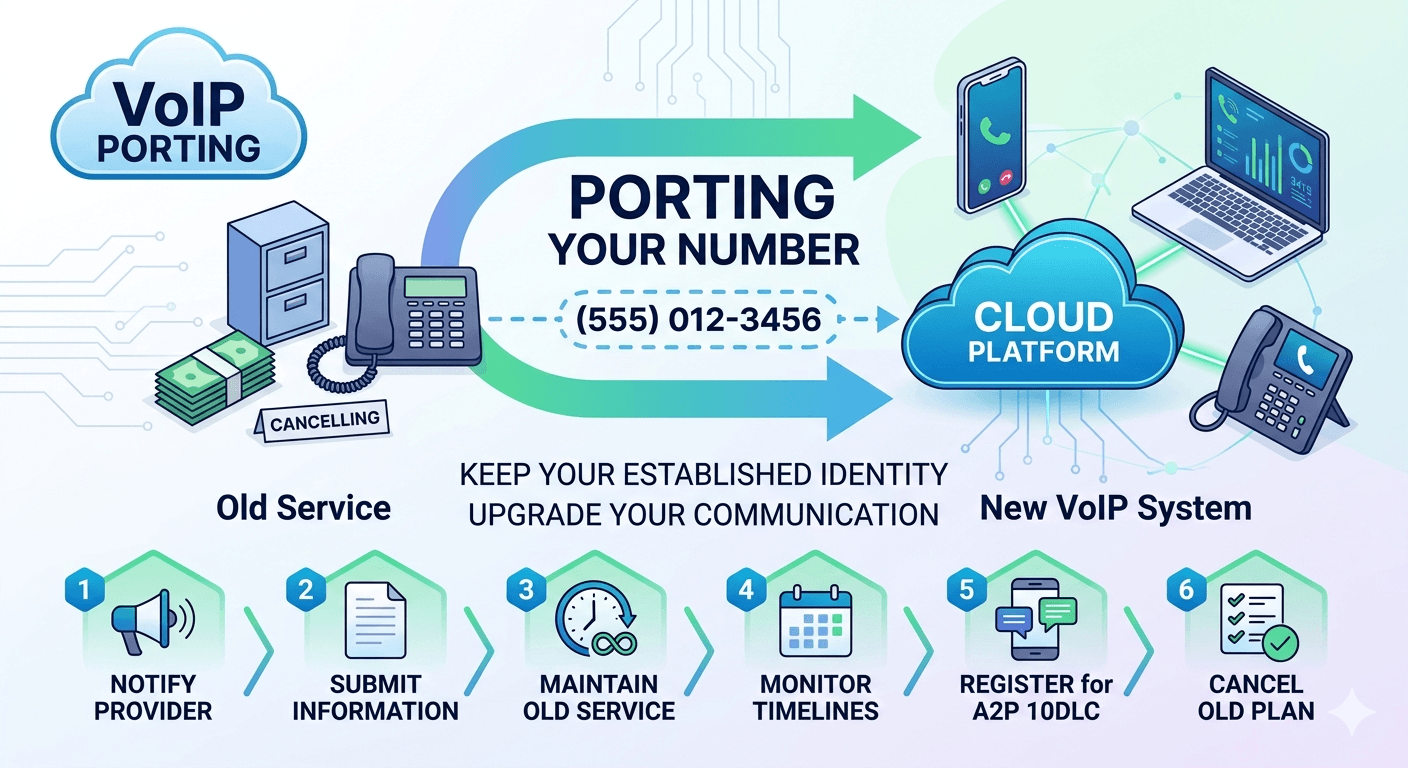
VoIP number porting is the technical process of transferring an existing phone number from one service provider to another, specifically into a Voice over Internet Protocol system. If you are wondering how to port your number to VoIP, this transition allows businesses to maintain their established identity and contact details while upgrading to a cloud-based communication platform. The process is governed by regulatory standards that ensure consumers and businesses can keep their numbers when changing carriers. By following a specific sequence of verification, documentation, and coordination between the old and new providers, users can transition landline or mobile numbers to a VoIP environment without experiencing significant downtime or losing their original digits.
What is VoIP number porting?
VoIP number porting, also known as Local Number Portability (LNP), is a regulated process that enables you to take your existing telephone number with you when you switch from one provider to another. In the modern business world, your phone number is more than just a string of digits; it is a critical part of your brand identity and a primary point of contact for your customers. When you decide to move to a cloud-based system, you do not have to start over with a new number. Instead, your new provider works with your old carrier to move the “ownership” of that number to their network.
The Federal Communications Commission (FCC) has established rules that require most carriers to allow porting. This ensures a competitive market where businesses are not tethered to a poor service provider simply because they fear losing their number. Whether you are moving from a traditional copper-wire landline or a different cloud provider, the mechanism remains similar. It involves a handshake between the losing carrier and the winning carrier. This process ensures that once the transfer is complete, calls intended for your number are routed through the internet via your new VoIP system rather than through old physical switches.
Why port your number to VoIP
There are numerous reasons why a business would choose to move their existing lines to a digital platform. The most immediate benefit is the retention of brand equity. If you have spent years printing business cards, building a website, and establishing a presence in local directories, changing your number can be a logistical nightmare. Beyond simple convenience, moving to a modern system offers significant technological advantages. VoIP providers typically offer a suite of features that traditional landlines cannot match, such as advanced call routing, auto-attendants, and deep integration with Customer Relationship Management (CRM) software.
Efficiency and cost-effectiveness are also major drivers. When you decide to voip keep my number, you are essentially future-proofing your communications. A study by Blueface suggests that businesses can save up to 30% to 50% on their communication costs after transitioning to a VoIP system. These savings come from reduced hardware maintenance, lower international calling rates, and the elimination of expensive physical line installations. Additionally, a VoIP system allows for extreme mobility; employees can take calls on their laptops, mobile phones, or desk phones regardless of their physical location, which is essential for the modern hybrid workforce.
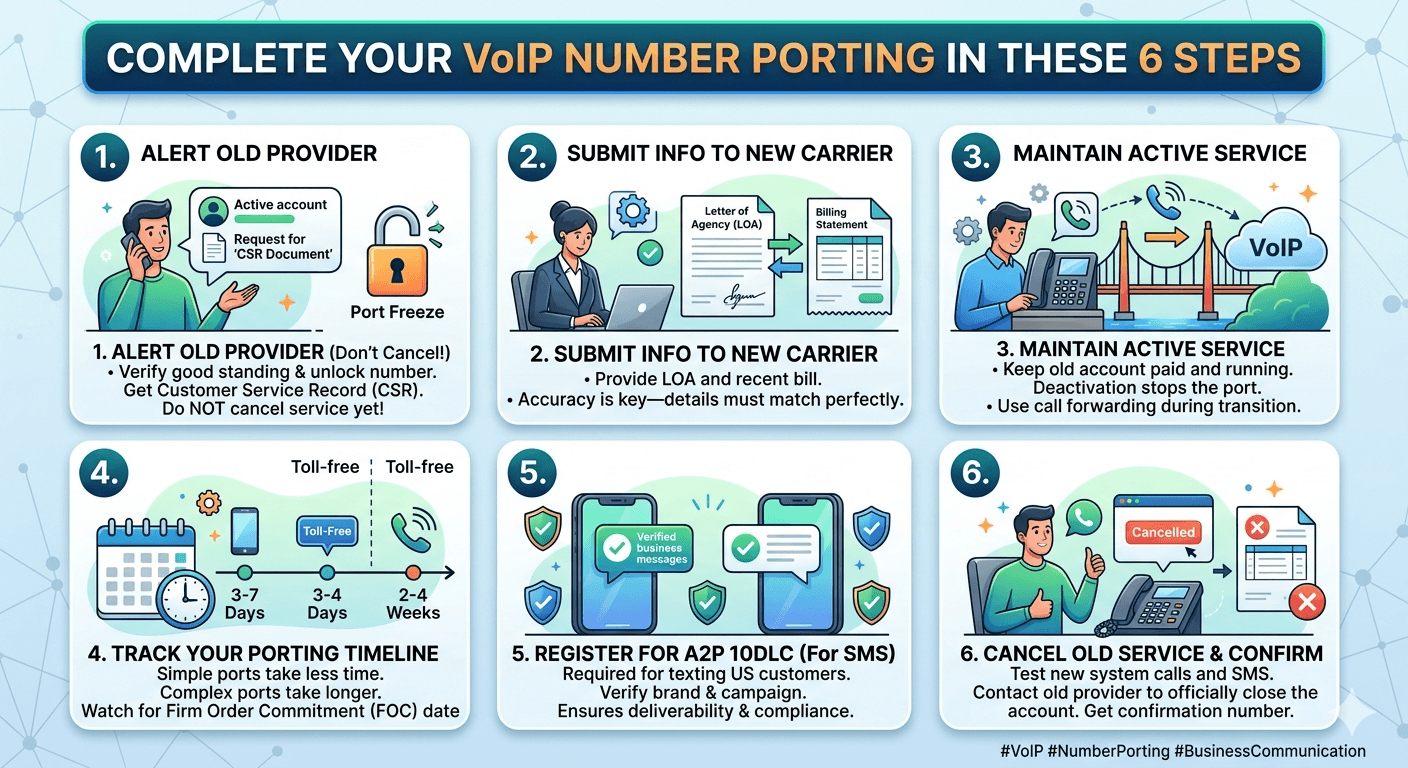
Complete VoIP number porting in these 6 steps
Successfully moving your number requires a structured approach to avoid common pitfalls that lead to service interruptions. While the new provider does most of the heavy lifting, you must provide the correct documentation to initiate the transfer.
1. Let your current provider know you want to port out
The first step in the process of voip port number is communication. While you do not necessarily need their permission to leave, it is helpful to verify that your account is in good standing. You should check if there are any contractual obligations or “port freezes” placed on your account for security reasons. Some providers require you to unlock the number or provide a specific Porting Authorization Code (PAC) or PIN before the transfer can begin.
It is vital that you do not tell them to cancel your service immediately. If you cancel your service before the porting process is finalized, you risk losing the number entirely. A number must be active to be ported. Simply inform them that you are planning a transition and ask for a copy of your most recent Customer Service Record (CSR). This document contains the exact legal information required by the new carrier to prove you are the authorized owner of the number.
2. Send the required information to your new provider
Once you have chosen a new partner, such as when you decide to port phone number to voip, you will need to submit a formal request. This is typically done through a Letter of Agency (LOA). This legal document authorizes the new provider to act on your behalf and request the transfer from your old carrier. Along with the LOA, you will usually need to provide a recent billing statement that clearly shows your name, address, and the specific numbers you wish to port.
Accuracy is the most important factor in this step. If the address on your LOA does not perfectly match the address on file with your current provider, the request will likely be rejected. This is a common security measure to prevent “slamming” or unauthorized number transfers. Ensure that the person signing the document is an authorized user on the account. Most providers now use digital signature platforms to speed up this process, making it easier to submit the necessary paperwork from anywhere.
3. Maintain your current phone service until porting is complete
One of the most frequent mistakes businesses make is cutting ties with their old provider too early. To ensure a seamless voip port, you must keep your old service active and the bills paid. The porting process relies on the old carrier releasing the number to the new one. If the account is deactivated or suspended due to non-payment, the release request will be denied.
Think of the porting process as a bridge. Both sides of the bridge must be standing until the transfer is finished. During the transition period, you can often set up call forwarding from your old system to a temporary number provided by your new VoIP carrier. This ensures that you do not miss any incoming calls while the technical “handshake” is happening behind the scenes. Only after you receive a formal notification that the port is successful and you have verified that the number is working on the new system should you proceed with cancellation.
4. Keep in mind typical timelines for VoIP number porting
Many users wonder about the speed of the transition. The timeline for a voip port number transfer can vary significantly depending on the types of numbers involved and the cooperation of the losing carrier. On average, simple ports of a single mobile or landline number can take between 3 to 7 business days. However, more complex transfers, such as porting multiple lines or toll-free numbers, can take 2 to 4 weeks.
According to industry data from the North American Portability Management (NAPM) LLC, the efficiency of porting has improved, but manual intervention is still required for many landline-to-VoIP transfers.
Factors that influence the timeline include the responsiveness of the losing carrier and the accuracy of the submitted data. If there is a rejection due to a typo or a mismatched address, the clock essentially restarts. Being patient and providing accurate information from the start is the best way to ensure the fastest possible turnaround.
How to check your VoIP porting status
Most reputable VoIP providers provide a dashboard or a dedicated porting coordinator to keep you informed. When you initiate a port mobile number to voip, you should receive a Firm Order Commitment (FOC) date. This is the official date and time when the transfer is scheduled to occur. You can check your status by:
Logging into your new provider’s administrative portal to look for a “Porting Status” tab.
Communicating directly with your assigned onboarding specialist.
Monitoring your email for automated updates regarding “Rejections” or “Confirmations.”
Checking if your temporary numbers have been replaced by your original business numbers.
5. Complete your A2P 10DLC registration for texting US customers
If you plan to use your ported number for business SMS or MMS messaging, you must comply with modern regulatory standards. Application-to-Person (A2P) 10-digit long code (10DLC) registration is now a requirement for sending texts to customers in the United States. This system was implemented by major carriers to reduce spam and ensure that businesses are who they say they are.
Failing to register can result in your messages being blocked or your number being flagged by mobile carriers. During or immediately after the transfer phone number to voip process, you should work with your new provider to register your brand and your messaging campaigns. This involves providing your Tax ID (EIN) and explaining the nature of the messages you intend to send. While this adds an extra layer of bureaucracy, it ultimately improves the deliverability and trust of your business communications.
6. Cancel your old service
Once your numbers are fully operational on the new platform and you have tested both inbound and outbound calling, as well as features like voicemail and SMS, you can finally close your old account. This is the final step in number porting. Call your previous provider’s billing department and confirm that the service is cancelled to avoid any future recurring charges.
Be sure to ask for a final invoice and a confirmation number for the cancellation. Sometimes, carriers might keep the account open if you have other services (like internet) bundled with your phone lines. Clearly state that you only wish to cancel the voice portion of your service if you are keeping other utilities with them. This ensures that you are not paying for “ghost” services that you no longer use.
How much does VoIP number porting cost?
The cost associated with a voip port can vary based on the provider and the volume of numbers. Many top-tier VoIP companies offer free porting as an incentive for new customers to join their platform. They see it as an investment in a long-term relationship. However, some providers may charge a one-time administrative fee, typically ranging from $10 to $30 per number, to cover the labor costs involved in coordinating with the losing carrier.
It is also important to look at the “hidden” costs. Your old provider might charge a “port-out fee” or an early termination fee if you are still under contract. Additionally, if you are moving a large block of numbers, the total cost could add up. Always review the terms of service of both your current and future providers. Despite these potential one-time fees, the long-term savings of using a VoIP system almost always outweigh the initial costs of the transfer.
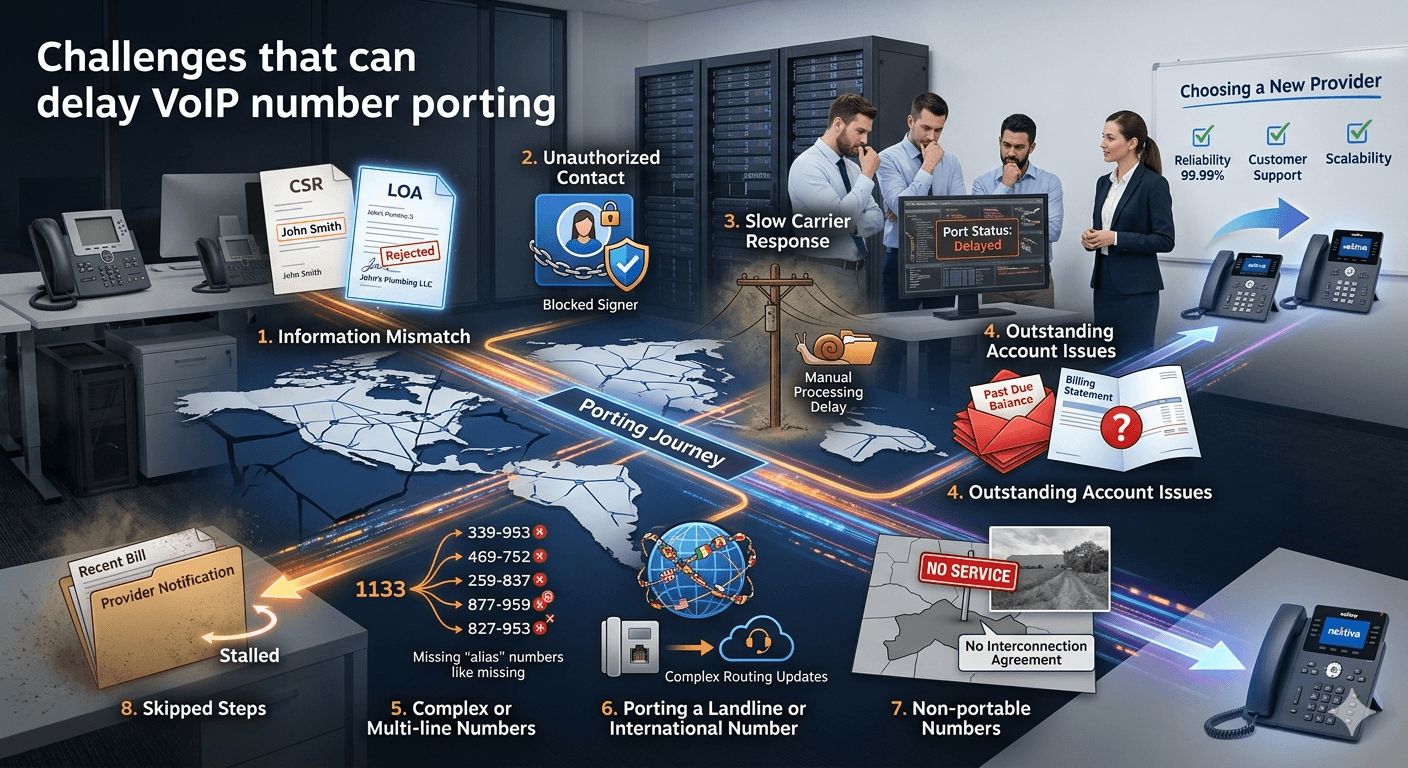
Challenges that can delay VoIP number porting
Even with the best planning, certain obstacles can slow down the process. Understanding these challenges can help you mitigate risks and prepare for a smoother transition.
1. Information mismatch
The most frequent reason for a port landline to voip delay is a simple data entry error. If the name on the LOA is “John’s Plumbing LLC” but the old carrier has it registered as “John Smith,” the port will be rejected. Every character, including abbreviations and punctuation in the address, must match the Customer Service Record (CSR) exactly. Even a missing suite number can cause a week-long delay.
2. Unauthorized contact
If the person requesting the port is not listed as an “Authorized Signer” on the original account, the losing carrier will block the request for security purposes. This is designed to prevent malicious actors from stealing phone numbers. Before you start, verify who is officially listed on the account and ensure they are the ones signing the porting documents.
3. Slow carrier response
Sometimes the delay is entirely out of your control. Smaller, rural carriers or older legacy providers may not have automated systems for porting. They may rely on manual processing, which can take much longer than the standard timeframe. In these cases, your new provider must stay persistent in following up with the losing carrier to push the request through.
4. Outstanding account issues
If there is a past-due balance on your account, many carriers will refuse to release the number until the debt is settled. Similarly, if there is a pending change order on the account—such as a request to change the billing address or add a new service—the porting request cannot be processed until that order is closed. Ensure your account is “clean” before initiating a transfer.
5. Complex or multi-line numbers
Porting a single number is straightforward, but moving a “hunt group” or a block of sequential numbers can be tricky. If you only try to port the main number but not the associated “alias” numbers, the old carrier might reject the whole batch. It is often best to port all numbers in a specific billing account at once to avoid confusion.
6. Porting a landline or international number
When you transfer landline to voip, you are moving from a physical switch to a digital network, which involves more complex routing updates in the national number database. Furthermore, international porting is subject to the specific laws of each country. Some countries have very strict regulations that make porting significantly more difficult or time-consuming than in North America.
7. Non-portable numbers
While the FCC mandates portability, there are rare instances where a number cannot be moved. This usually happens when a new provider does not have an “interconnection agreement” with the carrier that owns the number’s original rate center. This is more common in very remote or rural areas. You can usually check portability on your new provider’s website by entering your number into a search tool.
8. Skipped steps that can stall your port
Skipping the initial step of notifying your provider or failing to provide a recent bill can stall the process indefinitely. Many users think they can just give the number to the new provider and it will work like magic. In reality, the “winning” provider needs the evidence provided by the bill to prove to the “losing” provider that the request is legitimate.
How to choose a new VoIP provider
Choosing the right partner is just as important as the porting process itself. You should look for a provider that has a dedicated porting team. This indicates that they have the experience and relationships with major carriers to handle disputes and rejections efficiently. Companies like Nextiva porting are known for their hands-on approach to migrating business lines, which can save you significant stress.
Consider the following criteria when making your choice:
Reliability and Uptime: Look for a provider that guarantees at least 99.99% uptime.
Feature Set: Ensure they offer the tools you need, such as video conferencing, mobile apps, and CRM integrations.
Customer Support: When things go wrong during a port, you need to be able to reach a human who can help.
Scalability: Choose a provider that can grow with your business, allowing you to add more lines easily in the future.
Pricing Transparency: Be wary of providers with hidden fees for porting or “activation.”
A well-chosen provider will act as your advocate throughout the transition. They will handle the technical communication with your old carrier and keep you updated on the progress. By selecting a reputable company, you ensure that your business remains reachable and professional throughout the migration to a modern communication infrastructure.
Read More: How to Set Up a VoIP Phone System at Home? 7 Simple Steps
Final Thought
Transitioning to a VoIP system is a significant step forward for any business, offering unparalleled flexibility and cost savings. While the process of porting your number might seem daunting due to the technical and regulatory requirements, following the six steps outlined above will ensure a successful move. By maintaining active service, ensuring data accuracy, and choosing a supportive provider, you can protect your business identity while embracing the future of telecommunications. Remember that patience and preparation are the keys to a seamless transfer.
FAQs
How to port number to VoIP?
Porting a number to VoIP involves selecting a new provider, submitting a Letter of Agency (LOA) along with a recent bill, and waiting for the old carrier to release the number. You must keep your current service active during the entire process to prevent losing the number. Once the new provider confirms the transfer, you test the line and then cancel your old service.
Can I use my phone number while it’s being ported?
Yes, you can continue to use your phone number through your old provider until the moment the port is finalized. Most businesses use call forwarding during the transition. Once the “port date” arrives, the service will flip over to the new VoIP provider, often with little to no noticeable downtime for the callers.
Will you lose your voicemails and text messages from my old provider?
Yes, typically voicemails and text messages stored on your old provider’s servers do not transfer. Porting only moves the phone number itself, not the data associated with the old account. It is highly recommended to download any important recordings or archive essential text conversations before the porting process is completed.
Can you cancel a porting request after you’ve submitted it?
Yes, you can usually cancel a porting request, but you must do so quickly. Once the request reaches the “Firm Order Commitment” (FOC) stage, it becomes much harder to stop. You should contact your new provider immediately if you decide to stay with your old carrier or if there was an error in the request.
Can I port a VoIP number to a cell phone?
Yes, you can transfer a VoIP number to a mobile carrier. This is a common practice for entrepreneurs who want to consolidate their business and personal lines. The process is similar to porting into VoIP; you provide your mobile carrier with the account details and PIN from your VoIP provider to initiate the move.
Which phone numbers cannot be ported?
While most numbers are portable, some cannot be moved if the new provider does not have a presence in the “rate center” associated with the number. Additionally, numbers that have been disconnected or are part of a legal dispute may be ineligible for porting until those issues are resolved.
How long does number porting to VoIP usually take?
The timeframe generally ranges from 3 to 15 business days. Simple wireless-to-VoIP ports are often faster, while landline-to-VoIP transfers take longer due to the manual verification required by traditional telecom companies. Complex multi-line accounts may take up to a month.
How can I confirm if my number is portable to VoIP?
The easiest way to confirm portability is to use the “porting checker” tool found on most VoIP provider websites. By entering your area code and prefix, the tool can instantly tell you if they have the necessary agreements to host your number on their network.
Can I port multiple business numbers to VoIP at once?
Yes, businesses frequently port entire blocks of numbers simultaneously. This is often managed as a “bulk port.” You will need to provide a complete list of all numbers and ensure they are all associated with the same billing account to avoid rejection and ensure a synchronized transition.