
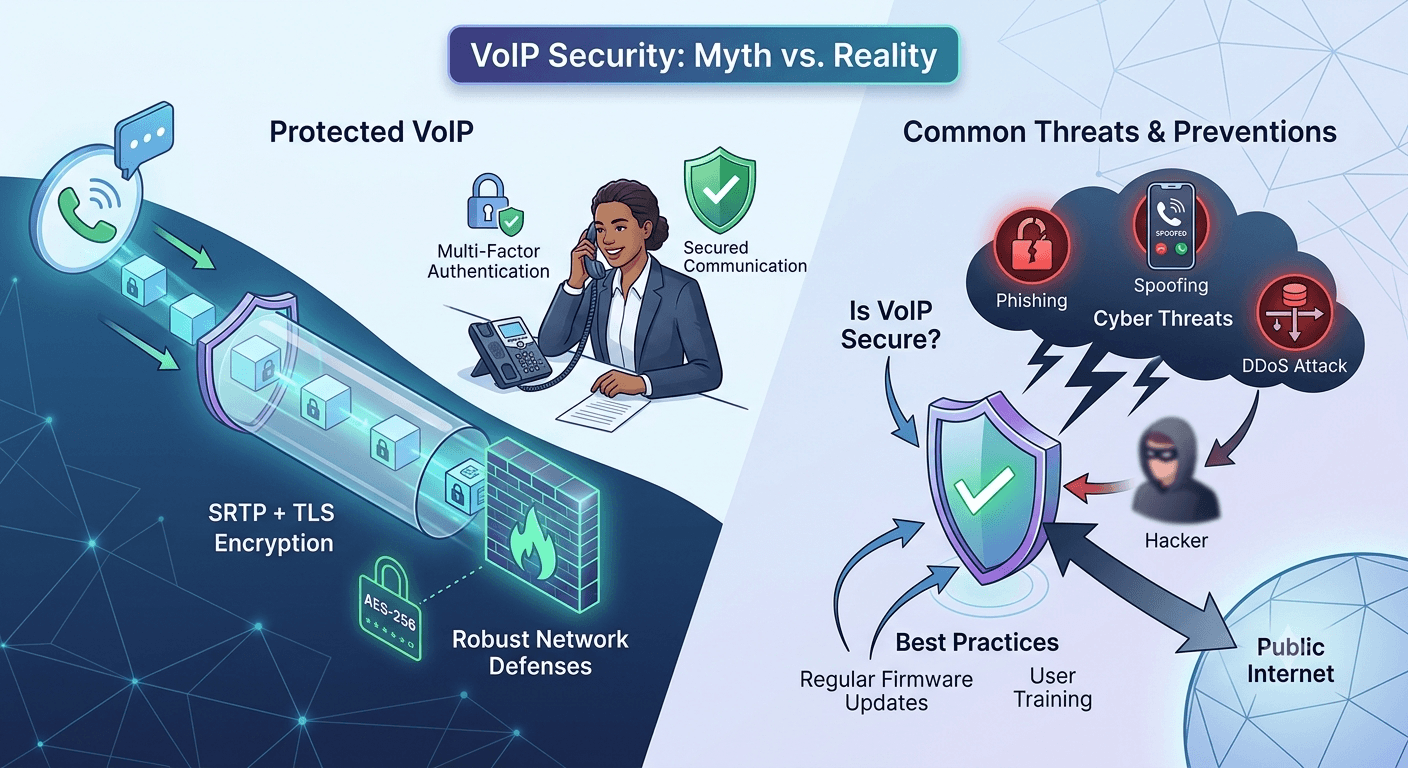
Is VoIP secure is a question that many businesses and residential users ask as they transition away from traditional telephony. The reality is that voice over internet protocol technology is highly secure when implemented with modern encryption protocols and robust network defenses. By using Secure Real-time Transport Protocol and Transport Layer Security, providers can ensure that voice data remains unreadable to unauthorized parties. While vulnerabilities such as phishing and spoofing exist, following industry best practices like multi-factor authentication and regular firmware updates makes a voip security system significantly more resilient than legacy landline systems in the modern digital landscape.
Is VoIP Secure?
Yes, VoIP (Voice over Internet Protocol) can be very secure when proper security measures are in place. Modern VoIP systems often use encryption protocols such as TLS (Transport Layer Security) and SRTP (Secure Real-Time Transport Protocol) to protect voice calls from interception and unauthorized access.
However, like any internet-based technology, VoIP is not completely immune to risks. Common threats include phishing attacks, weak passwords, malware, eavesdropping, and denial-of-service (DoS) attacks. Businesses can significantly improve VoIP security by using strong passwords, enabling multi-factor authentication (MFA), keeping software updated, securing their network with firewalls, and choosing a reputable VoIP provider.
For most users and organizations, VoIP is considered secure enough for everyday communication and business operations. The level of security largely depends on how the system is configured and maintained. By following cybersecurity best practices and working with a trusted provider, businesses can enjoy the cost and flexibility benefits of VoIP while keeping their communications protected.
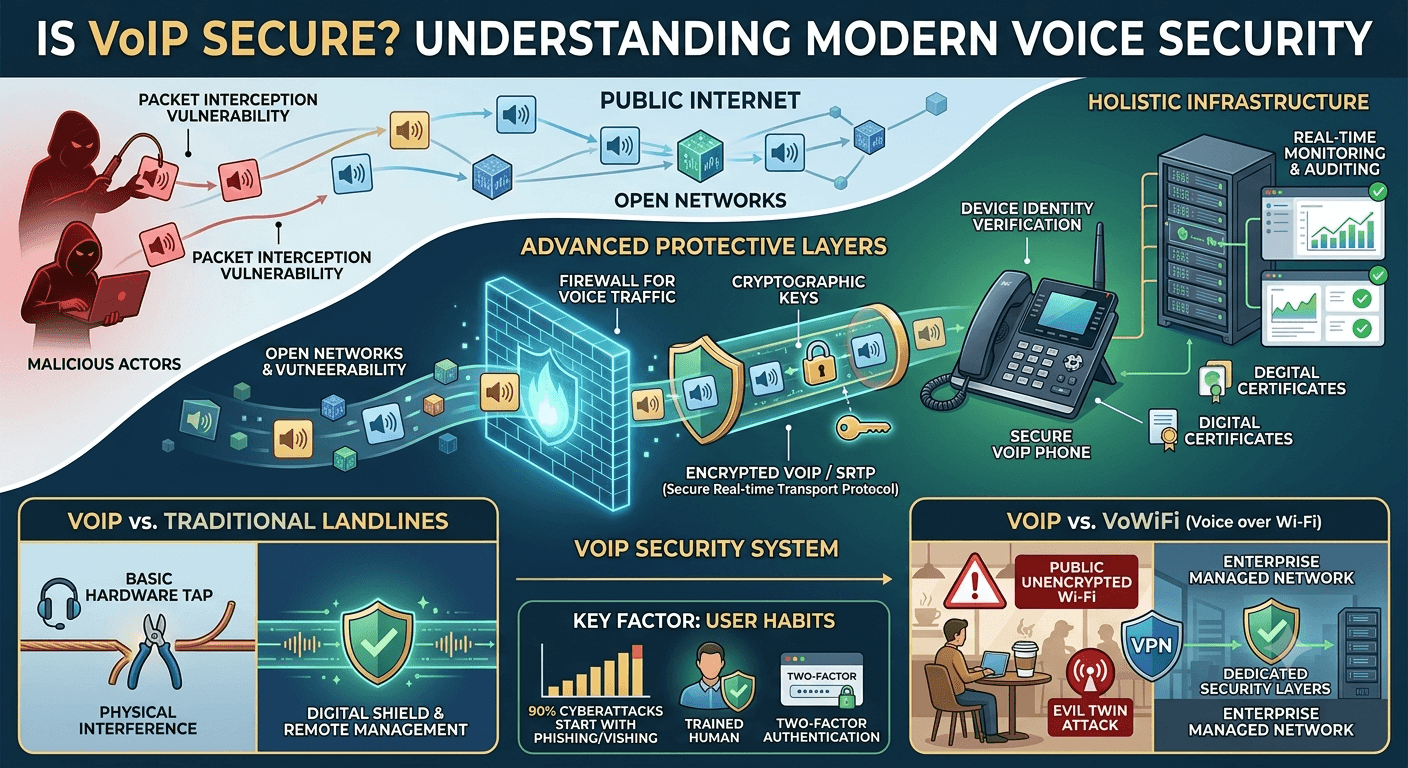
The fundamental question of is voip secure often stems from the fact that internet-based communications are vulnerable to the same threats as any other digital data. Unlike traditional phone lines that use a dedicated physical circuit, a voice over ip service breaks audio into packets and sends them across the public internet. This exposure to open networks creates potential entry points for malicious actors. However, when you ask is voip secure, you must consider the advanced protective layers available today. Most reputable providers use end-to-end encryption to shield these packets from interception.
To determine if a system is voip secure, one must look at the underlying infrastructure. A secure setup involves more than just a strong password; it requires a holistic approach to network management. This includes using a secure voip phone that is capable of handling complex cryptographic keys and maintaining a firewall that is specifically configured for voice traffic. When these elements are in place, the answer to is voip secure becomes a resounding yes, as the technology provides better auditing and monitoring capabilities than traditional analog systems.
Furthermore, the level of security depends heavily on the user’s own network habits. Even the most robust encrypted voip service can be compromised if the local network is left open or if administrative credentials are weak. Consequently, is voip secure is not just a feature of the software but a result of the environment in which it operates. Businesses that invest in professional-grade equipment and follow strict security protocols will find that their internet-based calling is incredibly safe for sensitive conversations.
How Secure is VoIP?
When evaluating how secure is voip, it is important to look at the protocols that govern how data moves. Modern systems rely on the Session Initiation Protocol for call setup and the Real-time Transport Protocol for the audio stream. In a standard, unencrypted environment, these protocols could be vulnerable to packet sniffing. However, when we analyze how secure is voip in a professional context, we find that protocols like SRTP scramble the audio data, making it impossible for an eavesdropper to reconstruct the conversation without the unique decryption key.
The question of how secure is voip also relates to the physical hardware used. Are voip phones secure? Generally, yes, because they function like specialized computers with their own operating systems that can be patched and updated. Modern ip phone security features include certificates that verify the device’s identity to the server, preventing rogue devices from joining the network. This level of hardware-level authentication is something that traditional landlines simply cannot provide, making the modern digital alternative much harder to compromise remotely.
According to a 2023 report by the Cybersecurity and Infrastructure Security Agency (CISA), over 90% of successful cyberattacks start with a phishing attempt rather than a technical exploit of the protocol itself. This indicates that how secure is voip is often determined by the humans using the system.
If employees are trained to recognize vishing and are forced to use two-factor authentication, the actual technical infrastructure of the voice over internet protocol remains very difficult to breach. Thus, the perceived voip risks are often more about user error than architectural flaws.
Is VoIP More Secure than Landlines?
Comparing the two technologies reveals that while landlines have fewer “digital” vulnerabilities, they are far more susceptible to physical interference. A traditional landline can be tapped with basic hardware at the junction box or anywhere along the physical wire. There is no encryption on a standard landline; if someone gains physical access to the wire, they can hear everything. In this sense, a secure voip system is superior because it protects the data even if the “wire” (the internet connection) is compromised.
Moreover, a voip security system allows for real-time monitoring and logging that landlines lack. If a hacker tries to brute-force a VoIP account, the system can automatically block the IP address and alert the administrator. On a landline, an unauthorized person could make calls for weeks without the owner knowing until the bill arrives. The ability to implement an encrypted voip service means that even if a hacker intercepts the data packets, they are faced with gibberish. This digital shield makes the modern system much more flexible and resilient in a globalized business environment.
However, landlines do have the advantage of working during power outages and not being susceptible to Distributed Denial of Service (DDoS) attacks. For organizations that require 100% uptime regardless of internet connectivity, this is a factor to consider. But for the vast majority of businesses, the advanced voip security features such as call tracking, digital authentication, and remote management outweigh the benefits of legacy systems. The transition to an encrypted voip line is widely considered a major step forward in protecting corporate intellectual property.
Is VoIP More Secure than VoWiFi?
Voice over Wi-Fi (VoWiFi) is a technology that allows cellular devices to make calls over a Wi-Fi network instead of a cell tower. While it shares some similarities with telephony voip, there are distinct differences in their security profiles. VoWiFi often relies on the security of the underlying Wi-Fi network. If a user connects to a public, unencrypted Wi-Fi hotspot to make a call, they are exposing themselves to significant voip security risks. In contrast, a dedicated enterprise voice over ip service usually operates within a managed network with its own dedicated security layers.
The question of which is better depends on the encryption used. Most VoWiFi implementations use IPsec tunnels to protect the data, which is quite strong. However, voip security is often more customizable for businesses. A company can mandate that all calls go through a specific VPN or use a specific secure voip phone, whereas VoWiFi is often a consumer-grade feature with less administrative control. For a Toronto based business or any high-stakes operation, the controlled environment of a managed VoIP system is generally preferred over the unpredictability of various Wi-Fi hotspots.
Furthermore, voip-associated vulnerabilities in a Wi-Fi environment include the “Evil Twin” attack, where a hacker sets up a fake Wi-Fi network to intercept traffic. Because VoIP phones in an office are usually wired or connected to a secured, hidden SSID, they are less likely to fall victim to such traps. While both technologies are capable of being secure, the professional implementation of voip encryption in a managed office setting provides a more consistent and reliable defense against sophisticated voip attacks.
What are VoIP Security Threats and Their Preventions
The landscape of voip security issues is diverse, ranging from simple scams to complex technical exploits. One of the most common threats is SPIT (Spam over Internet Telephony), which is the VoIP version of email spam. Automated bots dial thousands of numbers to play recorded advertisements or phishing messages. To prevent this, businesses can implement blacklists and use call filtering tools that require the caller to perform an action, like pressing a number, to prove they are human. Another threat is VOMIT (Voice over IP Misconfigured Internet Telephony), where hackers use packet sniffers to capture unencrypted voice data from misconfigured networks. This is easily prevented by ensuring that is voip encrypted is a standard setting across the entire organization.
Vishing and toll fraud represent significant financial voip risks. Vishing involves using voice calls to trick people into giving up personal data, often by spoofing the caller ID to look like a trusted source. Toll fraud, or phreaking, occurs when a hacker breaks into a VoIP system to make expensive international calls on the business’s dime. Preventing these requires a combination of STIR/SHAKEN compliance to verify caller IDs and setting strict call limits on the VoIP server. Additionally, DDoS attacks can flood a VoIP gateway with traffic, causing service outages. This can be mitigated by using a provider with dedicated DDoS mitigation services that can scrub malicious traffic before it reaches your network.
Call tampering and Man-in-the-Middle (MitM) attacks involve a hacker intercepting a call to either degrade the quality or inject their own audio. These voip security threats are particularly dangerous for high-level negotiations. The best defense is the use of SRTP and TLS, which ensure that the data packets are both encrypted and authenticated. Malware and viruses can also target the operating systems of VoIP phones. Regular firmware updates and ip phone security audits are essential to ensure that no “backdoors” are left open for attackers. By addressing these voip-associated vulnerabilities through a multi-layered defense strategy, businesses can maintain a secure communication environment.
VoIP Security Key Features
The modern business environment increasingly depends on digital communication, with VoIP being a key player. One of the major reasons behind VoIP standing out as an ideal business communication solution is its rich features for VoIP security. Let’s check out a few VoIP security key features that every professional organization should look for in a provider.
1- Penetration Test and Risk Assessment
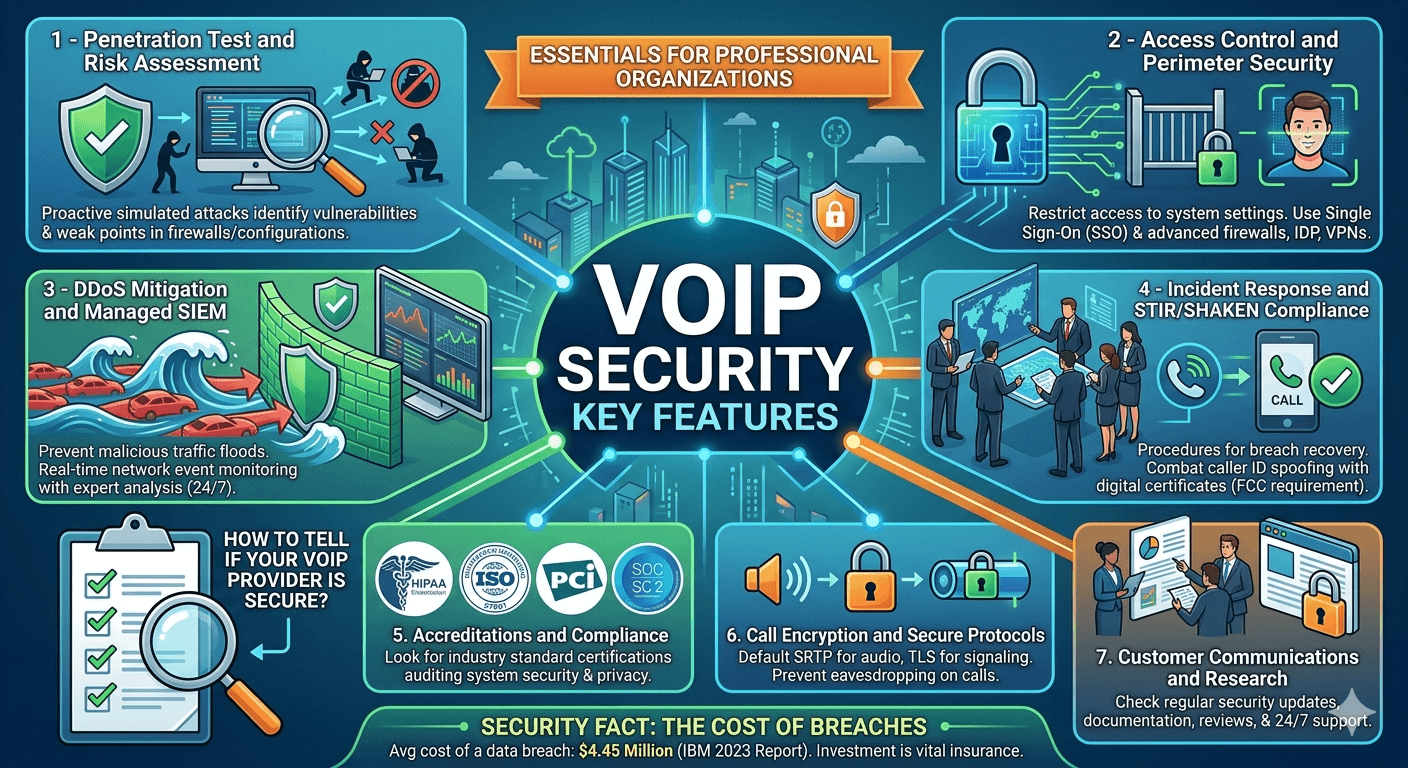
A penetration test is a vital proactive measure where ethical hackers attempt to breach your system to find voip-associated vulnerabilities. This simulated attack helps identify weak points in the firewall or misconfigurations in the server before real hackers can exploit them. Complementing this is a regular risk assessment, which evaluates the overall security posture of the IT environment against industry standards. These assessments provide a roadmap for enhancing voip security and ensuring that the system can withstand modern voip attacks.
2- Access Control and Perimeter Security
Access control ensures that only authorized personnel can change system settings or access call logs. This is often achieved through Single Sign-On (SSO) and robust Identity Access Management (IAM) protocols. Perimeter security, on the other hand, involves defending the edges of the network. By using advanced firewalls, intrusion detection systems, and Virtual Private Networks, a business can create a “moat” around its voice over ip service. This makes it much harder for external threats to reach the sensitive voip traffic inside the network.
3- DDoS Mitigation and Managed SIEM
DDoS mitigation is a specialized service that prevents a flood of malicious traffic from taking down your phone system. For businesses that operate online, this is an essential part of voip security issues management. Additionally, a Managed SIEM (Security Information and Event Management) provides real-time monitoring of all network events. It collects data from various sources to identify patterns that might indicate a sophisticated attack. Having a team of experts monitor these alerts 2024/7 ensures that any voip security risks are dealt with immediately.
4- Incident Response and STIR/SHAKEN Compliance
If a breach does occur, an incident response plan is the key to minimizing damage. This involves a set of procedures for investigating, containing, and recovering from a security event. On the regulatory side, STIR/SHAKEN compliance is now a requirement by the FCC to combat caller ID spoofing. This technology uses digital certificates to verify that a call is actually coming from the number displayed. Choosing a provider that is fully compliant with these regulations is a major step in ensuring you have a secure voip phone environment.
How to Tell If Your VoIP Provider Is Secure?
Choosing a provider is the most critical decision in your journey to secure communication. Not all providers are created equal, and many budget options cut corners on voip security best practices to keep prices low. To ensure your business is protected, you must conduct thorough research and look for specific indicators of a provider’s commitment to safety. A secure provider will be transparent about their protocols and will have the certifications to back up their claims.
Accreditations and Compliance
The most reliable way to judge a provider’s security is through their accreditations. Look for HIPAA compliance if you handle medical data, as this requires strict encryption and access controls. ISO/IEC 27001 is the international standard for information security management and is a hallmark of a top-tier provider. PCI compliance is necessary if you process credit card information over the phone, while SOC 2 compliance indicates that a third party has audited the provider’s systems for security, availability, and privacy. These certifications are proof that the provider takes voip security risks seriously.
Call Encryption and Secure Protocols
Ask the provider directly: is voip encrypted by default? A secure provider should use SRTP for all audio traffic and TLS for all signaling. If they treat encryption as an “add-on” or an optional feature, it is a red flag. You should also ask which technology can be used to protect voip against eavesdropping within their specific infrastructure. A provider that uses a secure vonage or similar enterprise-grade backbone will often have better encryption standards than a generic internet-based service.
Customer Communications and Research
Pay attention to how the provider communicates about security. Do they send regular updates about new threats? Do they provide documentation on how to secure your specific hardware? Conduct your own research by reading reviews from other IT professionals and checking for any history of major data breaches. A provider that has a dedicated security blog and offers 24/7 support for security-related issues is likely to be a safe bet. Your voice security is only as strong as the company you choose to partner with.
Security Fact: The Cost of Breaches
Research conducted by IBM in their 2023 “Cost of a Data Breach Report” found that the average cost of a data breach has reached $4.45 million globally. For small businesses, even a minor voip hack can lead to thousands of dollars in toll fraud and a significant loss of reputation.
This underscores the fact that investing in a secure voip phone system is not an unnecessary expense, but a vital insurance policy against the rising tide of cybercrime. By prioritizing voip security best practices, businesses can avoid these devastating financial impacts.
Final Thought
The question is voip secure is not a matter of a simple yes or no, but a reflection of the effort put into its implementation. While the technology is inherently susceptible to certain voip security risks due to its reliance on the internet, the tools available to combat these threats are incredibly powerful. From end-to-end encryption and STIR/SHAKEN compliance to advanced DDoS mitigation and regular penetration testing, a modern VoIP system can be made significantly more secure than any landline. The key lies in choosing a reputable provider, training employees, and maintaining a proactive defense posture. When done correctly, VoIP provides a safe, flexible, and cost-effective communication foundation for any modern organization.
Frequently asked questions
How Secure Are VoIP Calls?
VoIP calls are highly secure provided that they are encrypted using SRTP and TLS protocols. In a managed business environment, these calls are protected from the moment they leave the phone until they reach the service provider’s gateway. This makes them much harder to intercept than traditional analog calls. However, the security level can drop if you are making calls over an unsecured public Wi-Fi network without a VPN.
What is Security in VoIP?
Security in VoIP refers to the collective technologies, protocols, and policies used to protect voice communication from unauthorized access, interception, and disruption. It encompasses encryption for audio data, authentication for devices and users, and network defenses like firewalls and intrusion prevention systems. The goal is to ensure the confidentiality, integrity, and availability of the voice over ip service.
What are the common threats to VoIP systems?
The most common threats include toll fraud (phreaking), where hackers make expensive calls on your account, and vishing, which is voice-based phishing. Other significant threats are SPIT (spam), caller ID spoofing, and DDoS attacks that can knock the system offline. Eavesdropping through packet sniffing is also a risk if the voip traffic is not properly encrypted using modern standards.
How can I protect my VoIP system from cyber threats?
You can protect your system by ensuring all calls are encrypted, using strong passwords, and enabling two-factor authentication for all users. Regularly updating the firmware on your IP phones and using a dedicated firewall for voice traffic are also essential. Training your staff to recognize social engineering and vishing attempts is equally important for maintaining a secure voip phone environment.
How can I detect if my VoIP system has been compromised?
Signs of a compromise include a sudden spike in your phone bill, strange calls in your history log, or unexplained changes to your account settings. You might also notice poor call quality or phones that reboot randomly. Setting up automated alerts for unusual activity, such as a high volume of international calls after business hours, is one of the best ways to detect a breach early.
Are VoIP phones encrypted?
Most modern IP phones support encryption, but it is not always enabled by default. To have an encrypted voip experience, you must ensure that the phone’s settings are configured to use SRTP for the voice data and TLS for the signaling. You should check with your provider to see if they support these protocols and if they have been correctly provisioned for your hardware.
What are the secure protocols for VoIP?
The primary secure protocols are Secure Real-time Transport Protocol (SRTP) for the audio packets and Transport Layer Security (TLS) for the signaling and call setup. Other important protocols include IPsec for creating secure tunnels over the internet and various authentication protocols like OAuth. Together, these technologies work to protect your voip security system from a wide range of digital attacks.
Which technology can be used to protect voip against eavesdropping?
The most effective technology against eavesdropping is SRTP (Secure Real-time Transport Protocol). It uses advanced encryption algorithms to scramble the voice data, ensuring that even if a hacker intercepts the packets, they cannot listen to the conversation. Additionally, using a VPN can add an extra layer of protection by hiding the voip traffic inside an encrypted tunnel.