
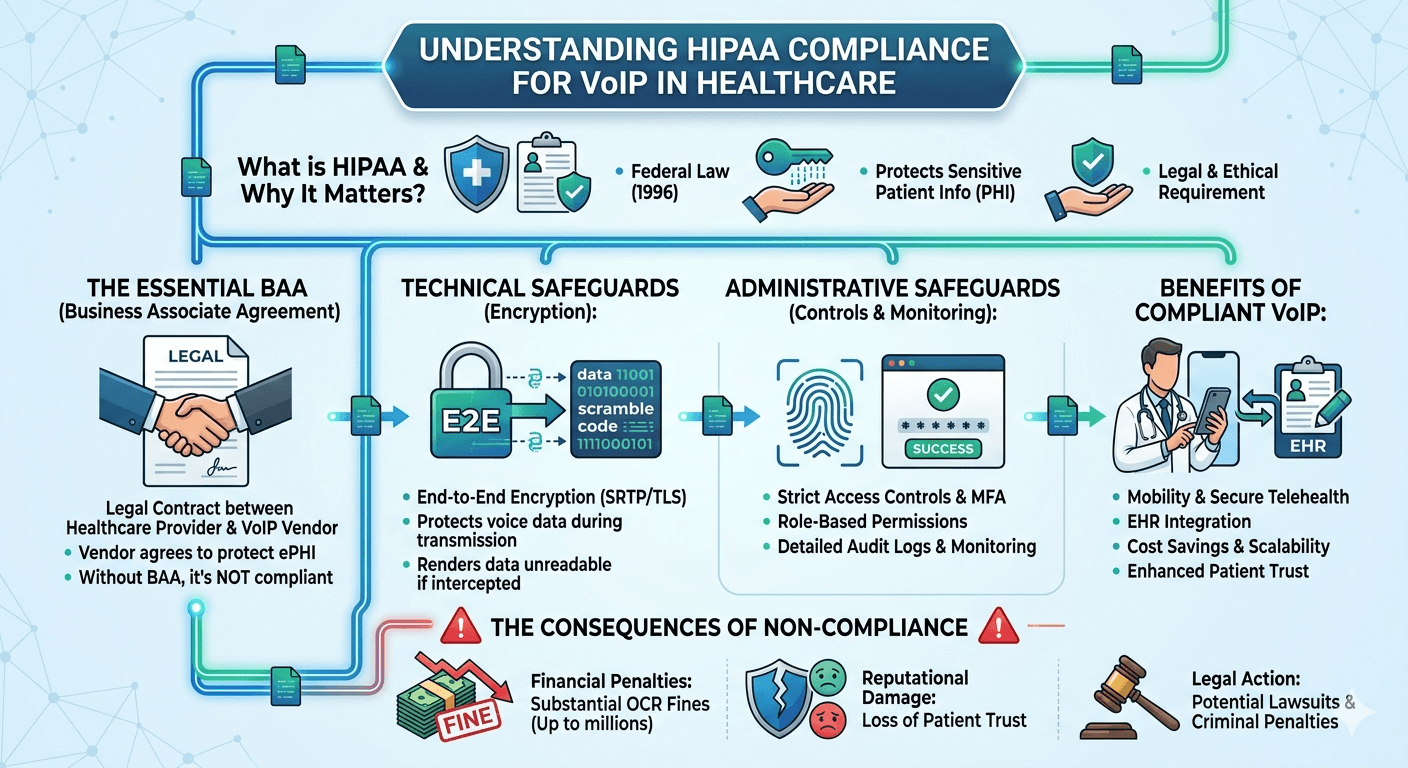
HIPAA Compliance for VoIP in Healthcare involves implementing technical and administrative safeguards to protect patient health information during digital transmission. To be compliant, a voice over internet protocol service must offer end-to-end encryption, strict access controls, and a signed Business Associate Agreement (BAA). These regulations ensure that healthcare providers can securely communicate through voip for healthcare while adhering to the privacy standards of the Health Insurance Portability and Accountability Act. Achieving compliance prevents legal penalties and secures patient trust by safeguarding sensitive medical data within modern telephony voip and integrated computer networks, enabling seamless, protected digital communication for all providers.
What is HIPAA and Why it Matters?
The Health Insurance Portability and Accountability Act (HIPAA) is a federal law enacted in 1996 that established national standards to protect sensitive patient health information from being disclosed without the patient’s consent or knowledge. In the realm of modern medicine, where digital transformation is the norm, HIPAA has become the cornerstone of patient privacy. For organizations utilizing voip for healthcare, understanding these regulations is not just a legal requirement but a fundamental part of providing ethical care. HIPAA ensures that data remains confidential, available to authorized users, and protected against unauthorized access.
HIPAA is divided into several rules, with the Privacy Rule and the Security Rule being the most relevant to digital communications. The Privacy Rule sets the standards for who can access protected health information (PHI), while the Security Rule establishes the technical and physical safeguards that must be in place to protect that data when it is stored or transmitted electronically. As providers move toward voice over internet systems, they must ensure that their telecommunication voip infrastructure meets these rigorous standards. Failure to do so can lead to a complete loss of patient trust and significant institutional damage.
Beyond legal obligations, HIPAA serves a vital role in the patient-provider relationship. When patients share their most personal information, they do so with the expectation that it will be guarded with the highest level of care. In an era where cyberattacks on hospitals are increasingly common, a robust HIPAA compliance framework acts as a shield. It allows healthcare organizations to embrace new voip technology without compromising their integrity. By prioritizing these standards, providers can focus on what they do best: delivering high-quality care in a safe and secure environment.
The Concept of HIPAA Compliant VoIP Systems
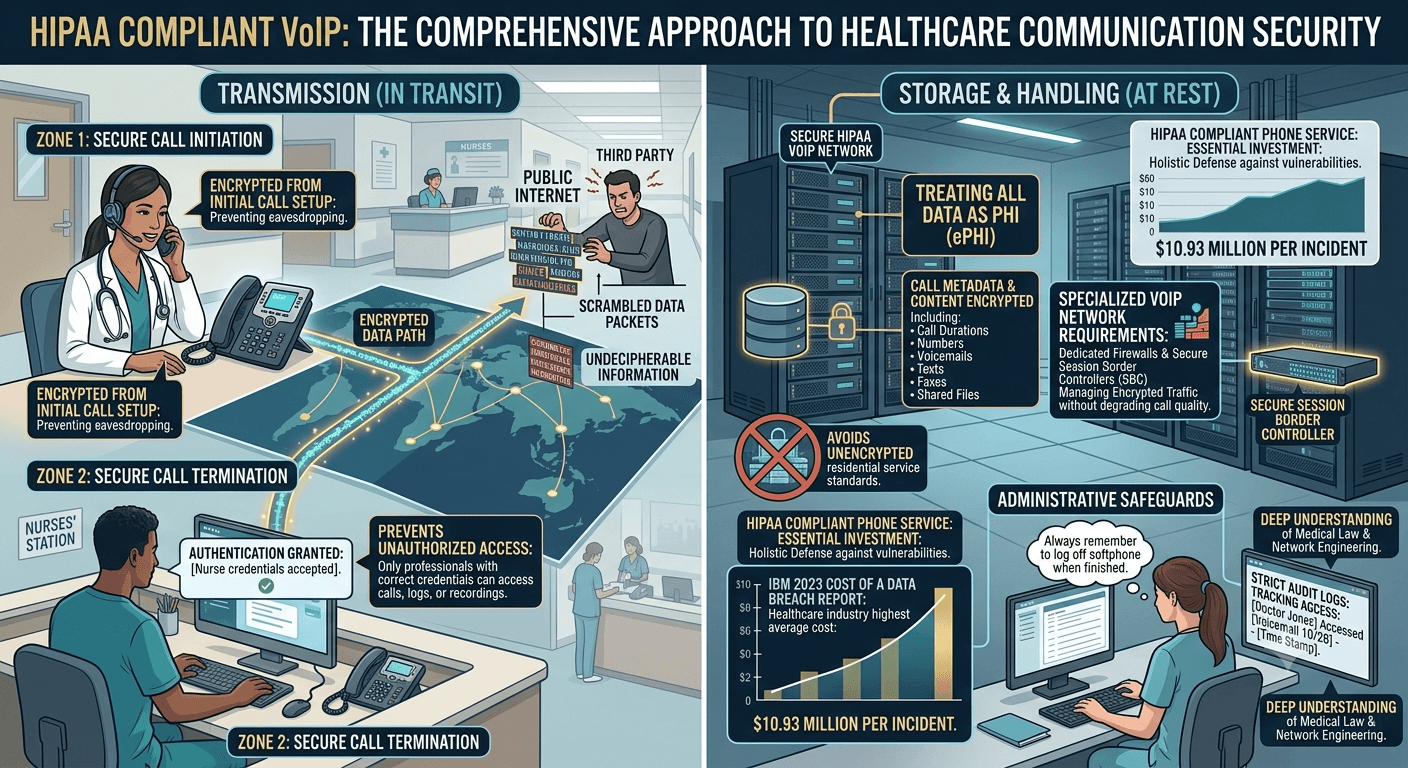
What exactly defines a system that meets the standards of HIPAA Compliance for VoIP in Healthcare? It is not merely a software feature but a comprehensive approach to communication security. A hipaa compliant voip provider ensures that every aspect of the voice over ip service—from the initial call setup to the storage of voicemails—is encrypted and monitored. This means that if a third party were to intercept the data packets traveling across the internet, they would be unable to decipher the information. The system must also be designed to prevent unauthorized access at the user level, ensuring that only medical professionals with the correct credentials can listen to recordings or view call logs.
A hipaa compliant phone system also differs from standard residential services in how it handles metadata. While a typical voice ip service might store call durations and numbers in an unencrypted database, a healthcare-specific system treats all data associated with a patient interaction as PHI. This includes the content of the conversation as well as any text messages, faxes, or files shared through the platform. Achieving this level of security requires specialized voip network requirements, including dedicated firewalls and secure session border controllers that manage the flow of encrypted traffic without degrading call quality.
According to research by IBM in their 2023 Cost of a Data Breach Report, the healthcare industry has the highest average cost of a data breach at $10.93 million per incident.
This startling fact highlights why a hipaa compliant phone service is an essential investment. It is not just about the voice calls; it is about the entire ecosystem of the voip in computer networks used by the clinic or hospital. A truly compliant system provides a holistic defense against the vulnerabilities inherent in internet-based communication, ensuring that the digital transition remains a benefit rather than a liability.
Where VoIP and HIPAA Intersect
The intersection of VoIP technology and HIPAA regulations occurs primarily at the transmission and storage stages of communication. Because voip stands for voice over internet protocol, it relies on the public internet to move data. Standard internet traffic is not inherently secure, which is where the specific voip system requirements for healthcare come into play. When a doctor discusses a diagnosis with a patient via an interconnected voip line, that voice data is converted into digital packets. HIPAA mandates that these packets be encrypted during transit to prevent eavesdropping by hackers or unauthorized service providers.
Another critical intersection point is the storage of data. Many voip for healthcare platforms offer features like voicemail-to-email or call recording. Under HIPAA, these recordings and emails are considered electronic protected health information (ePHI). Therefore, the servers where this data is stored must be just as secure as the live call itself. This means using a hipaa compliant voip service that utilizes high-level encryption for at-rest data and implements strict audit logs to track who has accessed the files. The intersection of these two worlds requires a deep understanding of both medical law and network engineering.
Furthermore, the intersection involves administrative safeguards. This means that the people using the voip healthcare system must be trained on how to use it securely. For example, a provider might have a hipaa compliant phone system, but if a nurse leaves their softphone application logged in on a public computer, the compliance is broken. The intersection of technology and human behavior is where many breaches occur. Therefore, a complete strategy for HIPAA Compliance for VoIP in Healthcare must include both the technical tools and the policy frameworks that govern their use in daily medical practice.
The Critical Role of the Business Associate Agreement (BAA)
The most important administrative step in achieving HIPAA Compliance for VoIP in Healthcare is the signing of a Business Associate Agreement (BAA). A BAA is a legal contract between a healthcare provider (the covered entity) and the voip provider (the business associate). In this document, the VoIP provider agrees to take full responsibility for protecting the ePHI that passes through their system. Without a signed BAA, a service cannot be considered HIPAA compliant, even if it uses the strongest encryption in the world. It is the legal foundation upon which all other security measures are built.
A BAA outlines the specific responsibilities of the hipaa compliant voip provider. This includes how they will report security breaches, how they will manage data backups, and their commitment to following the HIPAA Security Rule. For a healthcare provider, the BAA is a shield that transfers some of the regulatory risk to the service provider. It ensures that the company providing the voice over internet service understands the gravity of the data they are handling and has the infrastructure in place to protect it. When evaluating a hipaa compliant voip service, the first question should always be whether they are willing and able to sign a BAA.
Identifies Responsibilities: Clearly defines what the service provider must do to protect data.
Legal Protection: Provides a legal recourse for the covered entity if the business associate fails to protect PHI.
Compliance Verification: Acts as documented proof for auditors that the provider has vetted their third-party vendors.
Scope of Service: Details which specific features of the telephony voip system are covered by the agreement.
It is a common misconception that all major tech companies will sign a BAA. For example, some residential-grade services may offer great features but refuse to enter into a BAA, making them unsuitable for medical use. A dedicated hipaa compliant phone service will have a standard BAA ready for review. This document is not just a formality; it is a critical piece of the compliance puzzle that ensures every link in the communication chain is legally bound to protect patient privacy.
Essential Security Features for Compliance
To maintain HIPAA Compliance for VoIP in Healthcare, a system must possess several core technical features. These features work together to create a secure environment where medical data can be discussed without fear of interception. While the specific voip technology may vary between providers, these foundational elements are non-negotiable for any organization that takes patient privacy seriously.
End-to-End Encryption
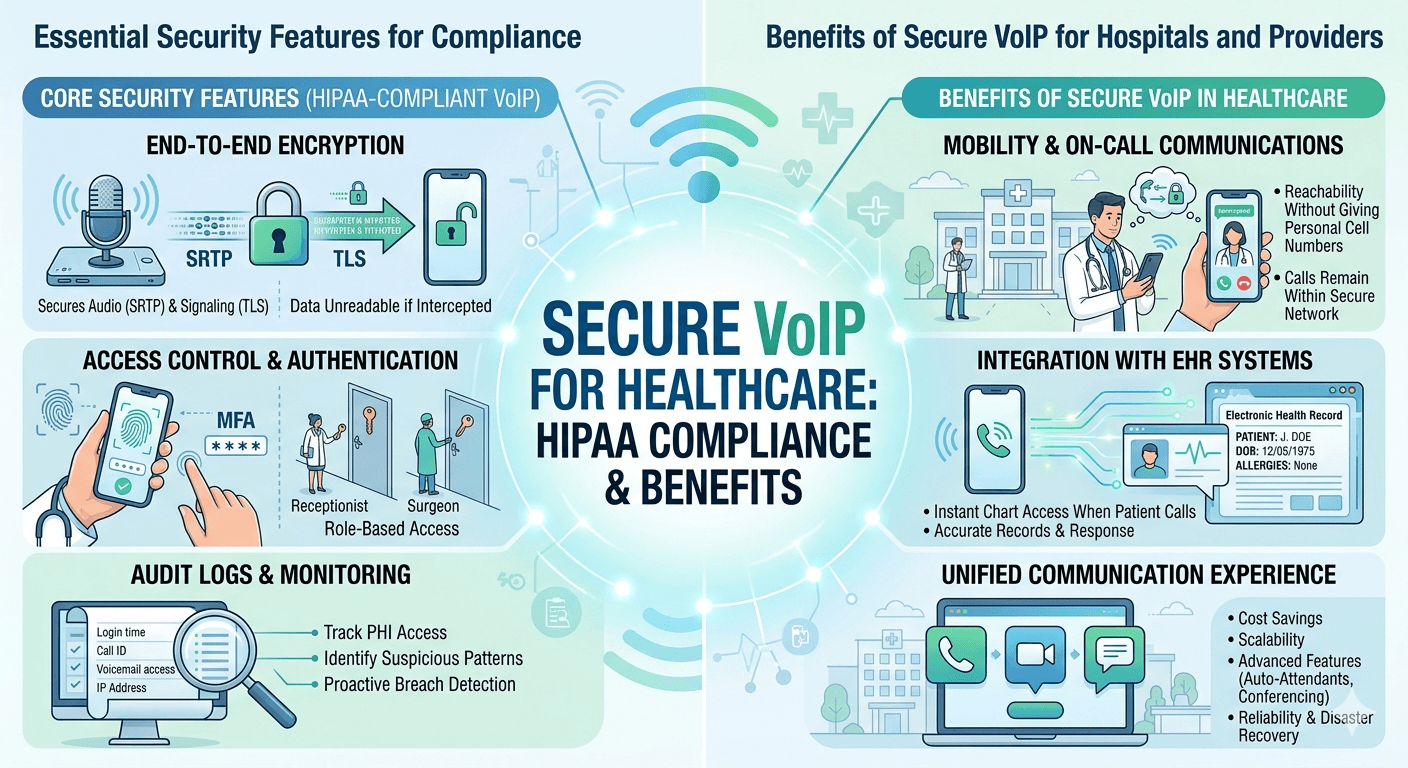
The primary defense in any hipaa compliant voip provider’s arsenal is end-to-end encryption. This means that the audio data is encrypted the moment it leaves the sender’s device and is only decrypted when it reaches the receiver. For this to work, the system must use secure protocols like Secure Real-time Transport Protocol (SRTP) for the audio stream and Transport Layer Security (TLS) for call signaling. This ensures that even if an attacker intercepts the voice over ip service traffic, they will only find unreadable data packets.
Access Control and Authentication
Security is only effective if you know who is accessing the system. A hipaa compliant phone system must include robust access controls, such as multi-factor authentication (MFA). This requires users to provide two or more forms of identification before they can log in to the telephony voip platform. Additionally, the system should offer role-based access, ensuring that a receptionist has different permissions than a lead surgeon. This minimizes the risk of accidental or intentional data exposure by limiting access to only what is necessary for each employee’s role.
Audit Logs and Monitoring
HIPAA requires that providers be able to track who accessed PHI and when. Therefore, a hipaa compliant voip service must maintain detailed audit logs of all activity on the system. This includes a history of every login attempt, every call made, and every time a voicemail was accessed. Regular monitoring of these logs allows a healthcare organization to identify suspicious patterns, such as an unauthorized login from an unfamiliar location. This proactive approach is essential for detecting a breach early and fulfilling the reporting requirements mandated by federal law.
Benefits of Secure VoIP for Hospitals and Providers
The transition to voip phone systems for healthcare offers benefits that go far beyond simple compliance. When a hospital implements a secure, interconnected voip system, it unlocks new levels of efficiency and patient engagement. Modern voip technology allows for a unified communication experience where voice, video, and text are all integrated into a single, protected platform. This streamlined approach reduces the administrative burden on staff and allows them to focus more on patient outcomes.
One of the primary benefits is mobility. With a hipaa compliant voip provider, doctors can use secure mobile applications on their smartphones to communicate with colleagues or patients. This is vital for “on-call” scenarios where a provider needs to be reachable without giving out their personal cell phone number. The system ensures that the call remains within the secure voip healthcare network, maintaining privacy even when the doctor is off-site. This flexibility is a game-changer for modern, distributed medical teams.
Moreover, voip for hospitals can integrate with Electronic Health Records (EHR) systems. When a patient calls, the system can automatically pull up their chart, allowing the provider to see their medical history instantly. When this is done through a hipaa compliant phone service, the entire interaction is logged and secured, ensuring that the integration does not create new voip vulnerabilities. This leads to faster response times, more accurate diagnoses, and a better overall experience for the patient.
Cost Savings: Reduces the need for expensive traditional phone lines and maintenance.
Scalability: Allows healthcare facilities to easily add or remove lines as their staff grows.
Advanced Features: Includes tools like auto-attendants, call queuing, and secure conferencing.
Reliability: Cloud-based voip for healthcare offers high uptime and disaster recovery options.
The Grave Consequences of Non-Compliance
Ignoring the requirements for HIPAA Compliance for VoIP in Healthcare can lead to devastating consequences. The Office for Civil Rights (OCR), which enforces HIPAA, does not take violations lightly. Whether a breach is the result of a malicious hack or a simple administrative error, the penalties are designed to be a significant deterrent. For many small to medium-sized clinics, a single major HIPAA violation can be enough to force a permanent closure.
1- Financial Penalties
The financial sting of non-compliance is significant. Fines are tiered based on the level of perceived neglect. For a “Tier 1” violation, where the entity was unaware of the breach, fines can range from $137 to over $34,000 per violation. At the other end of the spectrum, “Tier 4” violations involving willful neglect that is not corrected can result in fines of over $68,000 per violation, with an annual cap of nearly $2 million. When you consider that a single data breach can involve thousands of individual records, the cumulative fines can be astronomical.
2- Individual and Criminal Penalties
It is not just the organization that is at risk; individuals can also face penalties. Medical professionals who knowingly disclose PHI can face criminal charges, including prison time and personal fines. This highlights why training staff on the proper use of a hipaa compliant phone system is so critical. A nurse or administrator who uses an unencrypted personal app to discuss patient care could find themselves in serious legal trouble. The law treats patient privacy as a fundamental right, and the penalties for violating that right are severe.
3- Additional Consequences
Beyond the direct legal and financial hits, there are “hidden” costs to non-compliance. These include the cost of notifying all affected patients, providing credit monitoring services to victims, and the legal fees associated with defending against lawsuits. Perhaps most damaging of all is the loss of reputation. Patients are unlikely to return to a provider that has allowed their private medical history to be leaked. In the competitive world of healthcare, a tarnished brand can be impossible to repair, leading to a long-term decline in patient volume and revenue.
Strategies for Choosing the Right Provider
Selecting a hipaa compliant voip provider is a strategic decision that requires careful vetting. You cannot simply take a salesperson’s word that a service is “secure.” You must dig into the technical specifications and legal commitments of the company. A truly healthcare-focused provider will be able to speak the language of HIPAA and will have a track record of serving other medical organizations.
Start by asking for a copy of their BAA. If they hesitate or try to offer a generic service agreement instead, move on. Next, verify their security certifications. While there is no official “HIPAA Certification” from the government, reputable companies will often undergo third-party audits like SOC 2 Type II to prove their data handling practices are secure. You should also inquire about their voip network requirements and whether they use top-tier data centers with redundant power and internet connections.
Finally, consider the user experience. A system can be perfectly compliant, but if it is too difficult for doctors and nurses to use, they will find “workarounds” that compromise security. Look for a hipaa compliant voip service that offers intuitive apps, clear audio quality, and seamless integration with your existing tools. A provider like RingCentral hipaa compliant solutions is often cited for balancing high security with a user-friendly interface. By choosing a partner that understands the unique pressures of the healthcare environment, you can ensure that your move to VoIP is a success.
Read More: How to Set Up a VoIP Phone System at Home? 7 Simple Steps
Final Thought
Achieving HIPAA Compliance for VoIP in Healthcare is an essential milestone for any medical organization looking to thrive in the digital age. By integrating the right technology with strict administrative policies, providers can enjoy the flexibility and cost-savings of VoIP without ever compromising patient privacy. From the technical necessity of end-to-end encryption to the legal safety of a Business Associate Agreement, every component of a compliant system plays a role in safeguarding the sanctity of the patient-provider relationship. As healthcare continues to evolve, those who prioritize secure, HIPAA-compliant communication will lead the way in providing safe, modern, and effective care for all.
HIPAA compliant VoIP FAQs
Are phone calls HIPAA compliant?
Traditional landline phone calls are generally considered HIPAA-compliant for oral communication because they occur over a closed, dedicated circuit. However, once those calls are recorded, stored as digital voicemails, or transmitted over the internet, they must meet the standards for ePHI. For modern practices, using a hipaa compliant phone system is the only way to ensure that the entire communication process—from the live audio to the digital logs—remains within the bounds of federal law.
Is VoIP HIPAA compliant?
VoIP technology itself is not inherently compliant, but it can be made compliant with the right configurations. For a voice over ip service to meet HIPAA standards, the provider must use end-to-end encryption, maintain strict access controls, and sign a Business Associate Agreement (BAA) with the healthcare entity. When these factors are in place, VoIP becomes one of the most secure and efficient ways for medical professionals to communicate.
How do I ensure HIPAA compliant communications?
To ensure compliance, start by choosing a hipaa compliant voip provider that specializes in healthcare. Ensure a BAA is signed before any patient data is transmitted. Implement technical safeguards like multi-factor authentication and encryption. Finally, conduct regular training for all staff members on the secure use of the system and establish clear policies for handling patient information over digital channels.
What is HIPAA compliant VoIP?
This is a specialized version of voice over internet protocol service specifically designed to meet the technical, physical, and administrative standards of the Health Insurance Portability and Accountability Act. It features advanced encryption, secure data storage, and detailed audit logging. It is a system where the service provider legally agrees to share the responsibility of protecting patient data through a BAA.
Why is it important for VoIP services to be HIPAA compliant?
Compliance is vital to protect patient privacy, maintain the integrity of medical data, and avoid the severe legal and financial penalties associated with data breaches. In the modern healthcare environment, where cyberattacks are frequent, a compliant system acts as a crucial defense mechanism. It also ensures that a provider can use modern tools like telehealth and digital conferencing while remaining fully within the law.
How do VoIP services achieve HIPAA compliance?
They achieve compliance by building a secure infrastructure that includes SRTP and TLS encryption for all traffic. They also implement physical security at their data centers and administrative policies that govern how their employees interact with the system. Crucially, they undergo third-party audits to verify their security posture and enter into legal contracts (BAAs) with their healthcare clients to guarantee their commitment to data protection.
What steps should be taken to ensure the proper use of a HIPAA compliant VoIP system?
Steps include setting up unique user IDs and strong passwords, enabling multi-factor authentication, and configuring the system to automatically log out after a period of inactivity. Providers should also disable features that are not HIPAA-compliant, such as sending unencrypted voicemails to a personal email address. Regular audits of call logs and continuous staff education are also essential for maintaining the system’s integrity over time.
Are healthcare providers required to use HIPAA compliant VoIP services?
Yes, any healthcare provider that qualifies as a “covered entity” under HIPAA is legally required to protect ePHI. If that provider chooses to use a voice over ip service for their communications, that service must be HIPAA-compliant. Using a non-compliant service for discussing patient care or transmitting medical records is a direct violation of federal law and can result in significant fines and legal action from the OCR.