
Understanding VoIP Encryption is the most effective way for modern organizations to protect their digital conversations from unauthorized interception and cyber threats. By implementing robust cryptographic protocols, businesses can transform standard voice data into unreadable code, ensuring that even if data packets are captured during transmission, the content remains private. This security framework relies on technologies like Secure Real-time Transport Protocol and Transport Layer Security to defend against eavesdropping and data breaches. Establishing a strategy for Understanding VoIP Encryption not only satisfies regulatory compliance requirements but also builds a foundation of trust with clients and partners who prioritize data confidentiality.
The Role of VoIP Encryption in Securing Communications
The landscape of modern telecommunications has shifted dramatically toward the internet, making the process of Understanding VoIP Encryption a necessity rather than a luxury. When we consider what does voip mean, it essentially refers to the transmission of voice signals over digital networks using the internet protocol. Unlike traditional phone lines that were physically isolated, voice over internet protocol travels through public and private data switches where it can be exposed to various voip security risks. Encryption acts as a digital seal, ensuring that the voice data packets are only accessible to the intended recipient, thereby mitigating the threat of hackers who might try to hack a phone by calling or intercepting traffic.
In the realm of telephony voip, communication is divided into two distinct parts: signaling and media. Signaling handles the setup and teardown of the call, while media is the actual audio being transmitted. Without a comprehensive approach to Understanding VoIP Encryption, both of these streams are vulnerable. Hackers often target the signaling layer to gain information about who is calling whom, which is a common tactic in voip hacking. By encrypting these channels, organizations ensure that their voice over ip service remains a closed system, preventing unauthorized parties from mapping out the internal network or launching more sophisticated voip attacks.
Furthermore, Understanding VoIP Encryption is vital because it addresses the inherent voip vulnerabilities found in computer networks. Because voip in computer networks shares the same infrastructure as email and web traffic, it is susceptible to man-in-the-middle attacks and packet sniffing. When a business implements voice encryption, they are essentially creating a secure perimeter that travels with the data. This proactive stance on voice security is what separates professional-grade voice over ip security from basic, unmanaged internet calling services that might leave a company exposed to corporate espionage or identity theft.
How Encryption Works in VoIP
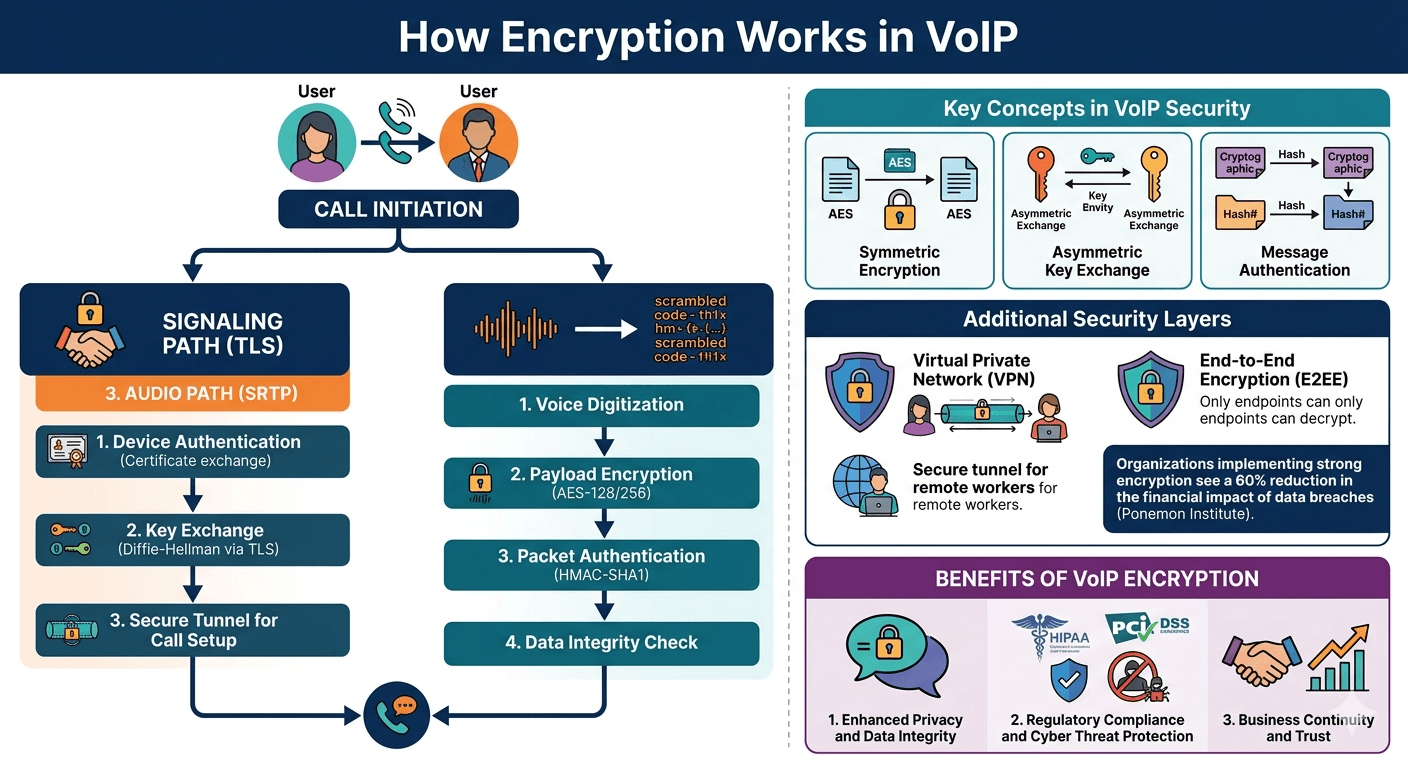
To truly master the art of Understanding VoIP Encryption, one must dive into the specific protocols that make secure communication possible. These protocols work in tandem to create a multilayered defense system. Each layer has a specific job, from verifying the identity of the devices involved to scrambling the audio data itself. By integrating these technical standards, a voice ip service becomes resilient against even the most persistent voip security threats, ensuring that every conversation remains confidential and tamper-proof.
1. Secure Real-time Transport Protocol (SRTP)
The primary technology used to protect the actual audio portion of a call is the Secure Real-time Transport Protocol, or SRTP. While standard RTP carries the voice packets, it does so in an unencrypted format that is easy to read if intercepted. SRTP adds a layer of security by providing encryption, message authentication, and integrity. This means that not only is the audio scrambled, but the system can also detect if any part of the packet was modified during transit. This is exactly which technology can be used to protect voip against eavesdropping effectively in modern network environments.
According to a research study by the Ponemon Institute, organizations that implement strong encryption for their communication channels see a 60% reduction in the financial impact of data breaches.
This is because SRTP makes the stolen data useless to the attacker. For businesses that rely on interconnected voip for sensitive negotiations, SRTP is a mandatory requirement. It ensures that the digital “packets” of sound are locked behind a cryptographic wall that requires a specific key to open, providing peace of mind for both the caller and the receiver.
2. Transport Layer Security (TLS)
While SRTP protects the audio, Transport Layer Security (TLS) is responsible for securing the signaling and call setup information. When a user initiates voip calls, the system must exchange information like caller ID, destination, and encryption keys. If this signaling is not protected, a hacker could perform a voip attack to redirect the call or steal the encryption keys themselves. TLS creates a secure tunnel between the phone and the VoIP server, ensuring that no one can “listen in” on the setup phase of the conversation.
Using TLS is a cornerstone of ip phone security because it uses certificates to verify that the phone is talking to the correct server. This prevents a common type of voip hack where an attacker sets up a fake server to intercept traffic. When TLS and SRTP are used together, they provide a comprehensive shield that covers the entire lifecycle of a call. This combined approach is what makes an encrypted voip service significantly more secure than a standard internet-based calling app that might only focus on one aspect of security.
3. Virtual Private Network (VPN) for Secure Communication
For organizations with remote workers, a Virtual Private Network (VPN) adds an extra layer of protection to the voip network requirements. A VPN creates a private tunnel over the public internet, encrypting all traffic that passes through it, including voice data. This is particularly useful for protecting against hacking into phone systems is called phreaking or other unauthorized access methods. When an employee uses a secure voip phone over a VPN, they are shielded from the risks of public Wi-Fi and other unsecured network segments.
However, it is important to note that a VPN can sometimes introduce latency, which is one of the common voip security issues. To avoid poor call quality, the network must be optimized to handle the overhead of the VPN encryption. Despite this challenge, the security benefits are immense. A VPN obscures the true IP address of the user, making it much harder for an attacker to launch a targeted voip attack or determine what to dial to see if your phone is hacked. It is a best practice for any business that prioritizes voip cyber security for their distributed workforce.
4. Encryption Algorithms and Key Exchange
The strength of any encrypted voip system lies in the mathematical algorithms used to scramble the data. The Advanced Encryption Standard (AES) is the most widely used algorithm in the world for this purpose. Usually, VoIP systems use AES with 128-bit or 256-bit keys. The complexity of these keys makes it mathematically impossible for current computers to “crack” the code within a human lifetime. Understanding VoIP Encryption involves recognizing that the longer the key, the more secure the communication, though it may require more processing power from the hardware.
Key exchange is the process where the two ends of a call agree on the cryptographic keys they will use. This must be done securely, usually using the Diffie-Hellman key exchange protocol. If a hacker intercepts the keys during the exchange, the encryption becomes worthless. This is why TLS is so important; it protects the key exchange process itself. By ensuring that the keys are never sent in plain text, the voice over internet protocol remains a closed loop, inaccessible to outside parties who might want to hack phone through call methods.
5. Authentication and Data Integrity
Authentication is the process of verifying that a user or device is who they claim to be. In a secure voip system, this often involves digital certificates and unique user credentials. Without strong authentication, a hacker could bypass even the best encryption by pretending to be an authorized user. This is a critical part of voip security best practices, as it prevents unauthorized devices from joining the network and making fraudulent calls, a practice often associated with toll fraud or phreaking.
Data integrity is the assurance that the information has not been altered during transmission. In the context of Understanding VoIP Encryption, integrity checks ensure that no one has tampered with the voice packets to inject malicious code or change the audio content. Each packet is signed with a cryptographic hash; if the hash at the receiving end doesn’t match the hash at the sending end, the system knows the packet has been compromised and will discard it. This level of detail is what makes a secure voip phone an essential tool for high-stakes business environments.
6. End-to-End Encryption (E2EE)
The gold standard for Understanding VoIP Encryption is End-to-End Encryption (E2EE). In this model, the voice data is encrypted on the sender’s device and is only decrypted on the receiver’s device. This means that even the VoIP service provider cannot listen to the calls, as they do not have the decryption keys. While not all interconnected voip services offer E2EE due to the technical complexity of routing calls through the public telephone network, it is becoming increasingly common for internal business communications.
E2EE is the ultimate defense against eavesdropping and government surveillance. For businesses that deal with highly sensitive information, such as legal or financial firms, seeking out an encrypted voip service that offers true E2EE is a top priority. It eliminates the “middleman” as a potential point of failure. By keeping the keys solely in the hands of the end-users, the voice over ip security is maintained regardless of the vulnerabilities of the underlying network or the service provider’s own infrastructure.
Benefits of VoIP Encryption
The advantages of Understanding VoIP Encryption extend far beyond just stopping hackers. In today’s data-driven world, the security of your communication channels is directly linked to your company’s reputation and financial health. Implementing voice encryption provides a multi-faceted benefit package that protects the organization from legal, operational, and social risks. It is a foundational element of any modern telecommunication voip strategy that aims to provide a reliable and professional experience for all stakeholders.
1- Enhanced Privacy and Data Integrity
The most immediate benefit of Understanding VoIP Encryption is the preservation of privacy. In an era where data is a valuable commodity, protecting the content of business calls is essential. Encryption ensures that private discussions regarding trade secrets, mergers, or personnel issues stay within the intended circle. Moreover, by maintaining data integrity, businesses can be sure that the information they receive over the phone is exactly what the caller intended to say, without any digital tampering or loss of clarity due to malicious interference.
This level of privacy is not just about avoiding leaks; it is about creating a safe space for innovation and collaboration. When employees know their conversations are protected by encrypted voip technology, they are more likely to speak freely and share ideas. This fosters a more open and productive work environment. Furthermore, it protects the company from “social engineering” attacks where hackers might use intercepted information to craft more convincing phishing attempts against the organization.
2- Regulatory Compliance and Cyber Threat Protection
Many industries are now legally required to encrypt their communications. For instance, in the United States, the Health Insurance Portability and Accountability Act (HIPAA) mandates that patient information be protected during transmission. Understanding VoIP Encryption helps healthcare providers stay compliant and avoid massive fines. Similarly, financial institutions must adhere to strict data protection standards like PCI DSS. Using an encrypted voip service is a key part of meeting these regulatory hurdles and proving to auditors that the company takes data security seriously.
Protection against cyber threats is another major benefit. As voip attacks become more common and sophisticated, having a static defense is no longer enough. Encryption provides a dynamic layer of protection that moves with the data. It prevents hackers from using intercepted voice traffic to gain a foothold in the corporate network.
According to research by IBM, the average cost of a data breach is now over $4 million, and communication intercepts are a growing contributor to these costs. By investing in voip security, businesses are effectively saving themselves from potential financial ruin.
3- Business Continuity and Trust
A secure communication system is a resilient one. By Understanding VoIP Encryption and implementing it correctly, businesses ensure that their phone systems remain operational even when under attack. For example, a system that is hardened against hacking into phone systems is called phreaking is less likely to be taken down by fraudulent activity or a sudden influx of malicious traffic. This business continuity is vital for companies that provide essential services or support to their customers around the clock.
Finally, there is the element of trust. Clients and partners are increasingly aware of voip security risks and are looking for providers who take these threats seriously. By advertising that your company uses a secure voip phone system and follows voip security best practices, you are sending a clear signal that you value your clients’ privacy. This can be a significant competitive advantage in industries where confidentiality is a top priority. Trust is difficult to build but easy to lose; encryption is the most effective tool for keeping that trust intact.
Industries That Benefit from Encryption
While every business can benefit from Understanding VoIP Encryption, certain sectors have a much higher risk profile and a greater need for secure communications. These industries often handle sensitive personal, financial, or legal data that would be devastating if leaked. For them, voice over ip security is not just an IT concern; it is a core business requirement that impacts their ability to operate legally and ethically in a digital world.
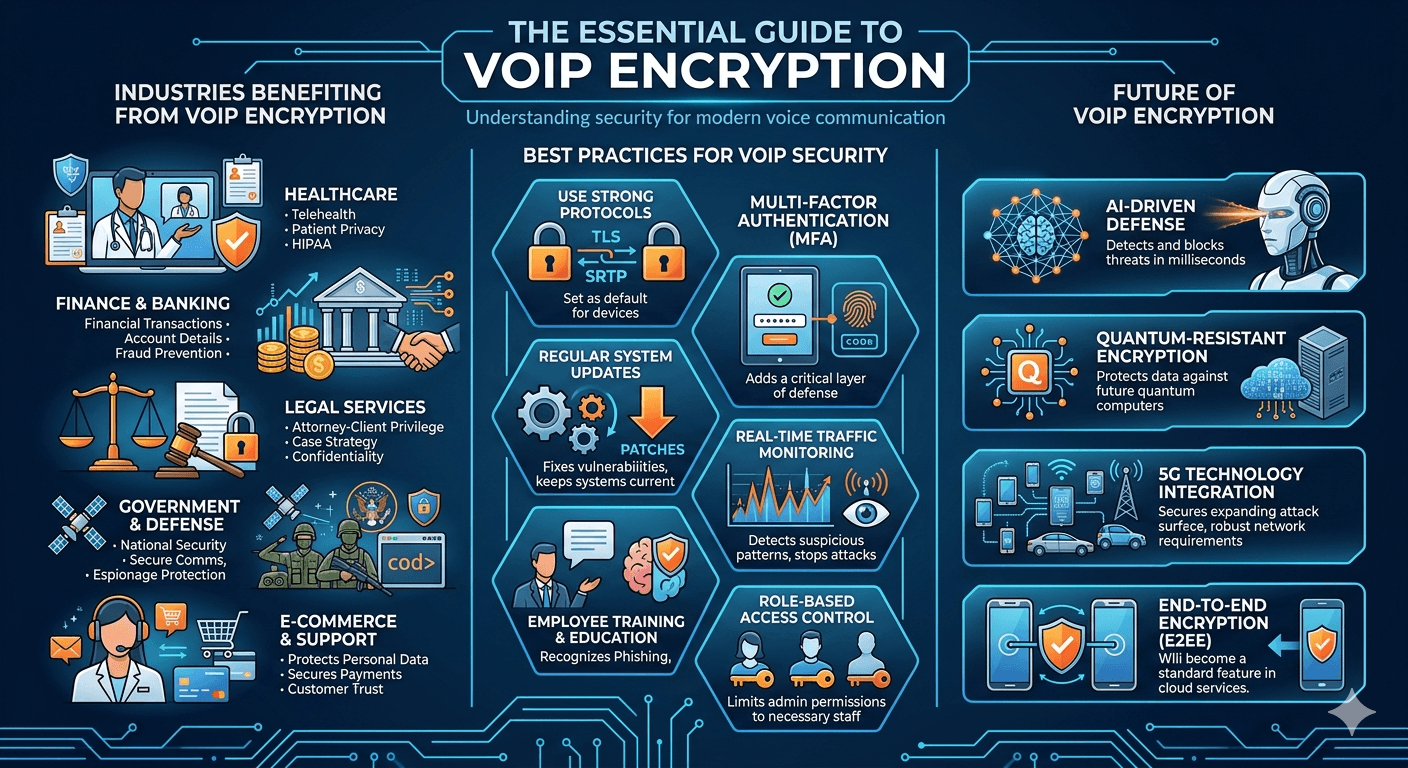
Healthcare: Medical professionals use VoIP for telehealth, consultations, and coordinating patient care. Encryption ensures that sensitive health information remains private, fulfilling the requirements of HIPAA and other global privacy laws.
Finance and Banking: These organizations discuss financial transactions, account details, and market strategies. Understanding VoIP Encryption is vital for preventing fraud and protecting client wealth from sophisticated cybercriminals.
Legal Services: The attorney-client privilege is a cornerstone of the legal profession. Using an encrypted voip service ensures that confidential legal strategies and client disclosures remain protected from eavesdropping.
Government and Defense: Security is paramount for government agencies and defense contractors. They require the highest levels of encryption to prevent espionage and ensure that sensitive national security information is not compromised.
E-commerce and Customer Service: These businesses handle credit card information and personal identity data. Secure voip phone systems protect this information during support calls, preventing identity theft and maintaining consumer confidence.
Best Practices for Implementing VoIP Encryption
Achieving a secure state through Understanding VoIP Encryption requires more than just turning on a setting. It involves a comprehensive approach to network management and employee behavior. By following these best practices, organizations can ensure that their voice encryption is effective and that their communication channels are hardened against all forms of voip attacks. It is a continuous process of improvement and monitoring that adapts to the ever-changing threat landscape.
First and foremost, always use strong encryption protocols like SRTP and TLS. These should be the default for all devices on the network. Secondly, enable Multi-Factor Authentication (MFA) for all VoIP accounts. Even if a hacker manages to steal a password, MFA provides a second layer of defense that is much harder to bypass. This is one of the most effective ways to prevent unauthorized access and voip hacking. Regularly updating your VoIP systems is also critical. Manufacturers frequently release patches that fix newly discovered voip vulnerabilities.
Monitoring network traffic in real-time is another essential practice. By using tools that identify suspicious patterns, such as a sudden spike in international calls or repeated login failures, administrators can stop a voip attack before it causes damage. Educating employees is equally important. Many breaches start with a simple phishing call or email. By training staff on the risks of social engineering and the importance of using strong passwords, businesses can turn their employees into a powerful line of defense. Finally, implement role-based access controls to ensure that only the necessary personnel have administrative access to the VoIP system.
Future of VoIP Encryption
As we look toward the future, the importance of Understanding VoIP Encryption will only grow. The rise of Artificial Intelligence (AI) and machine learning means that hackers will have more powerful tools to attempt to break codes and launch more targeted voip attacks. In response, the security industry is developing AI-driven defense systems that can detect and block threats in milliseconds. We are also seeing the emergence of “quantum-resistant” encryption, which is designed to protect data even against the massive processing power of future quantum computers.
Furthermore, the integration of 5G technology will bring more devices onto the internet than ever before, expanding the attack surface for voip hacking. This will necessitate even more robust voip network requirements and a greater focus on securing every endpoint. The trend toward decentralized and cloud-based communication will also continue, making E2EE a standard feature for more services. The future of voice security is one where encryption is invisible, seamless, and unbreakable, providing a truly secure foundation for the next generation of global communication.
Read More: How to Switch from Landline to VoIP?
Conclusion
Understanding VoIP Encryption is a journey toward creating a more secure and trustworthy digital world. By mastering the technical protocols like SRTP and TLS, and by following industry best practices, businesses can protect their most sensitive conversations from the prying eyes of cybercriminals. Whether it is preventing toll fraud, ensuring regulatory compliance, or simply maintaining the privacy of a private discussion, encryption is the ultimate tool for modern telecommunications. As technology continues to evolve, staying informed about the latest trends in voice over ip security will be essential for any organization that values its data and its reputation.
FAQs
Are VoIP calls automatically encrypted?
Not always. While many modern providers offer some level of security, not all VoIP calls are automatically encrypted by default. It often depends on the specific service you are using and how your network is configured. To ensure your calls are safe, you should check with your provider to see if they use SRTP and TLS. If you are using a basic consumer-grade app, it is highly likely that your calls are not being protected by professional-level voice over internet protocol security.
What is the difference between encryption and End-to-End Encryption (E2EE)?
Standard encryption usually protects the data as it travels between your device and the service provider’s server. However, the provider may still have the keys to decrypt and “see” your data. In contrast, End-to-End Encryption (E2EE) ensures that the data is only decrypted on the recipient’s device. This means that nobody, not even the service provider or a hacker who compromises the server, can listen to your voip calls. E2EE is the highest form of privacy available in telephony voip.
Will turning on encryption ruin my call quality?
No, modern encryption algorithms are designed to be extremely efficient. While encrypting and decrypting data does require some processing power, the impact on latency and call quality is usually negligible on modern hardware. If you do experience issues, it is more likely due to overall voip network requirements or bandwidth limitations rather than the encryption itself. In most cases, the peace of mind provided by Understanding VoIP Encryption far outweighs any minor technical overhead.
Do I need encryption for compliance?
For many industries, the answer is a definitive yes. Laws like HIPAA for healthcare, GDPR for businesses operating in Europe, and various financial regulations require the protection of personal data during transmission. If your business handles sensitive client information, Understanding VoIP Encryption is not just a good idea—it is a legal necessity. Failing to implement secure protocols can result in heavy fines, legal action, and a total loss of business credibility.
What is the most secure protocol for VoIP?
The most secure standard for VoIP communication is the combination of SRTP for the media stream and TLS for the signaling. Together, they provide a comprehensive defense against eavesdropping and tampering. For even higher security, look for providers that offer E2EE and use advanced algorithms like AES-256. These are the gold standards for voice encryption in the modern era and are used by the world’s most secure organizations.
Can hackers listen to encrypted VoIP calls?
Technically, a hacker could still intercept the packets of an encrypted call, but they would not be able to understand the content. Without the specific cryptographic keys, the data appears as random noise. The complexity of modern encryption like AES makes it virtually impossible to crack the code through brute force. This is why Understanding VoIP Encryption is so effective; it doesn’t necessarily stop the interception, but it makes the intercepted data completely useless to the attacker.
How does a VPN help with VoIP?
A VPN helps by creating a secure, encrypted tunnel for all of your internet traffic, including your VoIP packets. This is especially useful for remote workers using untrusted networks like public Wi-Fi. By hiding your voip traffic inside the VPN tunnel, you add an extra layer of protection against local hackers and packet sniffers. It also helps obscure your physical location, making it harder for someone to target your specific voip system requirements.
What are the risks of using unencrypted VoIP?
The risks of unencrypted VoIP include eavesdropping, where someone listens to your private conversations, and toll fraud, where hackers take over your system to make expensive calls. There is also a risk of identity theft and corporate espionage if sensitive information is discussed over an open line. Without encryption, your voice over internet protocol packets are sent as plain text, making them an easy target for anyone with basic hacking tools on your network.