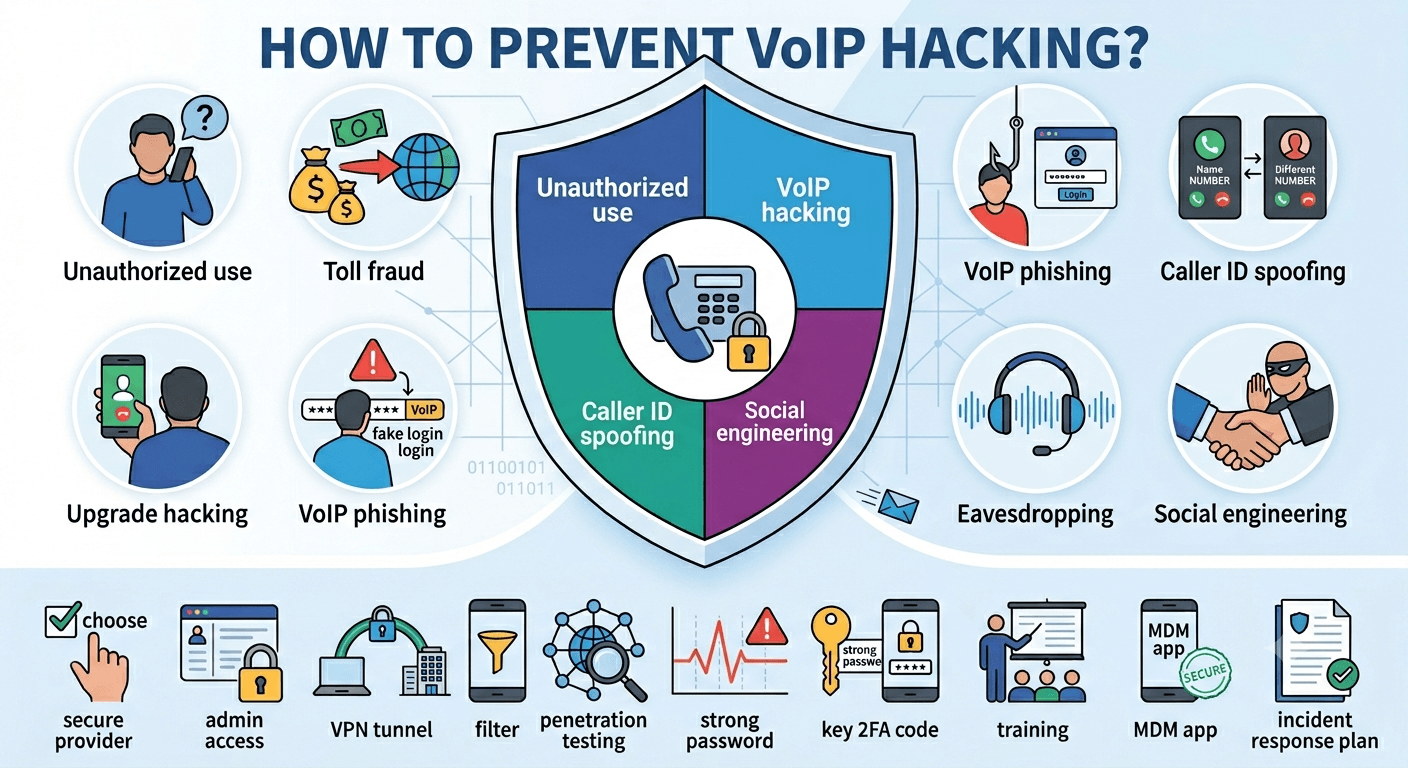
To prevent VoIP hacking, businesses should use strong, unique passwords, enable multi-factor authentication (MFA), and keep VoIP software and devices updated with the latest security patches. Securing the network with firewalls, VPNs, and intrusion detection systems can help block unauthorized access. Organizations should also encrypt calls using protocols such as TLS and SRTP to protect voice data during transmission. Regularly monitoring call logs and account activity can help identify suspicious behavior early. Employee cybersecurity training is equally important, as phishing attacks and weak credentials are common entry points for VoIP-related security breaches.
How to Prevent VoIP Hacking effectively requires a combination of robust technical defenses and employee awareness. To secure your communication lines, you must implement end-to-end voip encryption, enforce strict two-factor authentication, and conduct regular network audits to identify voip vulnerabilities. Businesses should also use a Virtual Private Network (VPN) for remote connections and choose a provider that offers active intrusion prevention systems. By monitoring call logs for unusual activity, such as unexplained toll charges or international calls, you can stop a voip attack before it results in significant financial loss or data breaches.
What Is VoIP Hacking?
VoIP hacking refers to the unauthorized access or manipulation of a voice over internet protocol system to make fraudulent calls, steal data, or disrupt business operations. Because internet-based telephony relies on the same digital infrastructure as your computers and servers, it is susceptible to the same voip security threats that plague the digital world. When hackers gain entry, they can intercept voip traffic, listen to private conversations, or use your system to launch further attacks on other networks.
Understanding what is a voip attack starts with recognizing that voice signals are converted into data packets. If these packets are not protected by voice over ip security protocols, they can be captured during transit. Hacking into phone systems is called phreaking when the primary goal is to make free long-distance calls at the victim’s expense. However, modern hackers often have more malicious intents, such as identity theft or corporate espionage.
The danger of voip hacking lies in its invisibility. Unlike a physical break-in, a voip hack can occur silently in the background of your network for weeks or months. Without proper voip security best practices, a business might only realize they have been targeted when they receive a massive bill for international calls they never made. This highlights the importance of transitioning from a basic setup to a comprehensive voip security system that monitors every connection point.
How VoIP hacking works
The mechanics of how voip hacking works often involve exploiting weak points in the hack communication protocol. Hackers typically use automated scripts to scan the internet for open ports or poorly secured VoIP gateways. Once a vulnerability is found, they may use “brute force” attacks to guess administrative passwords or exploit unpatched software in an ip phone security setup.
Another common method involves packet sniffing. Hackers use specialized software to intercept the data packets traveling across a network. If the connection is not an encrypted voip line, the hacker can reconstruct the voice data and listen to the conversation in real-time. This type of voip attack is particularly dangerous for businesses that discuss sensitive financial information or trade secrets over the phone.
According to a report by the Communications Fraud Control Association (CFCA), global losses due to telecom fraud, including toll fraud and phreaking, are estimated to be over $28 billion annually.
Research indicates that the financial impact of these breaches is staggering. This fact underscores the reality that voip security is not just a technical concern but a major financial necessity for modern enterprises.
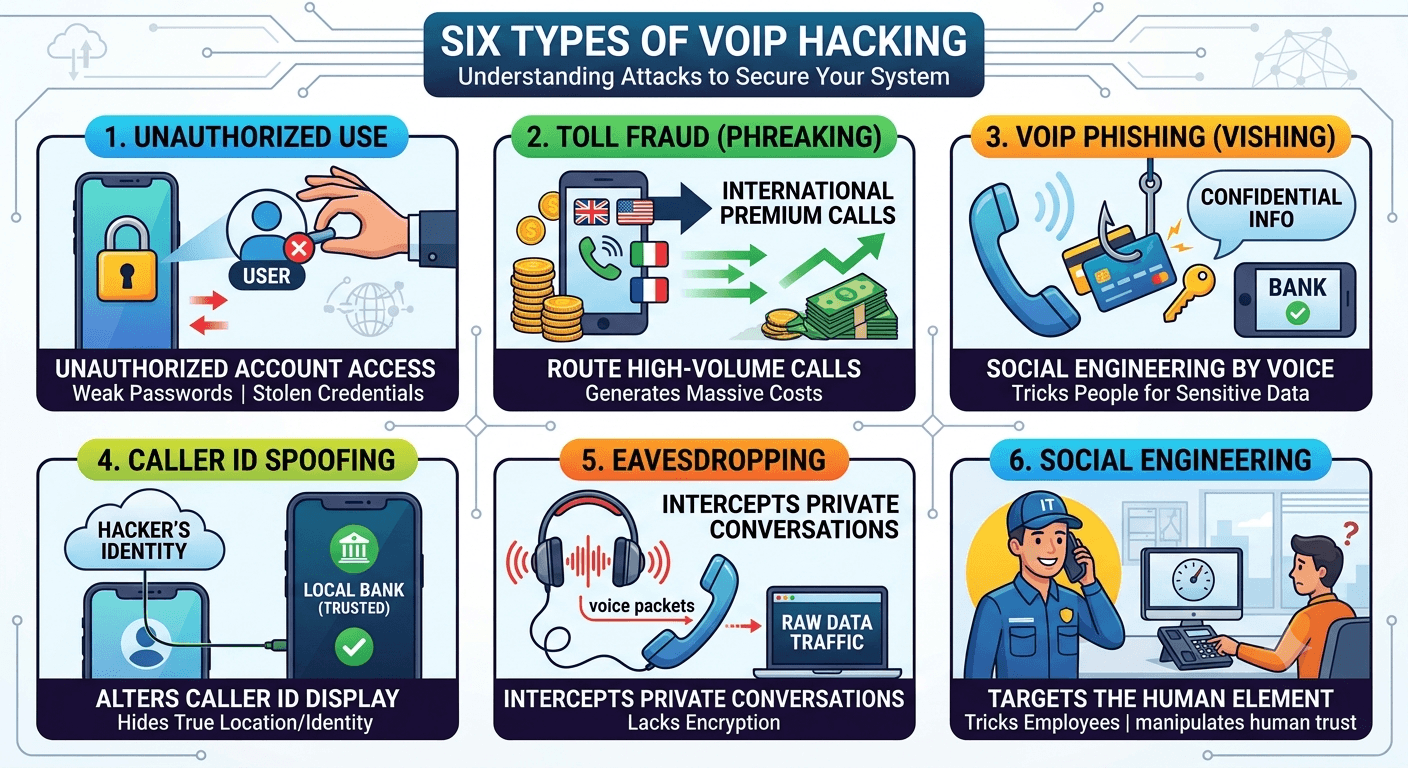
Six Types of VoIP Hacking
To develop a strategy for how to secure voip, you must first understand the different ways criminals might target your system. Each type of attack requires a different defense mechanism, and being aware of these methods is the first step in building a secure voip environment.
1. Unauthorized use
Unauthorized use occurs when someone gains access to your VoIP account to make calls without permission. This is often the result of weak passwords or shared credentials. The hacker essentially “borrows” your service, leading to increased costs and potential violations of service terms. While this might seem minor compared to data theft, it indicates a significant lapse in your ip phone security that could lead to more severe breaches.
2. Toll fraud (phreaking)
Toll fraud, or phreaking, is one of the most expensive types of voip hacking. Hackers break into a phone system and route a high volume of international or premium-rate calls through it. They often partner with corrupt service providers in other countries to share the profits from these calls. This type of voip attack can cost a business tens of thousands of dollars in a single weekend if the system is left unmonitored during non-business hours.
3. VoIP phishing (vishing)
Vishing is a form of social engineering where hackers use VoIP technology to trick people into revealing sensitive information. Because it is easy to spoof a caller ID on a voice over ip service, a hacker can make it appear as though they are calling from a bank, a government agency, or even your own IT department. They then use the voice security trust to ask for passwords, social security numbers, or credit card details.
4. Caller ID spoofing
Caller ID spoofing involves altering the information sent to your caller ID display to hide the caller’s true identity. While spoofing itself is a tool, it is frequently used as a precursor to more complex voip hacking. A hacker might use a local area code to increase the chances of someone answering the phone, making the subsequent scam or vishing attempt more effective.
5. Eavesdropping
Eavesdropping is the digital equivalent of wiretapping. In this scenario, a hacker intercepts the voip traffic to listen to private conversations. This is often achieved by compromising a router or using a man-in-the-middle attack. Without voip encryption, your calls are essentially being sent as plain text over the internet, making them an easy target for anyone with basic hacking tools.
6. Social engineering
Social engineering doesn’t always rely on technical hacks; instead, it targets the human element. A hacker might call your office and pretend to be a technician, asking for an employee to “test” a dial code. In reality, that code might set up call forwarding to an international number. This highlights why voip cyber security must include employee training alongside technical safeguards.
Signs You’re the Victim of VoIP Hacking
Recognizing a breach early can save your business from total disaster. There are several red flags that indicate your voip security has been compromised. If you notice any of these signs, you should immediately trigger your incident response plan and conduct a thorough audit of your voip network.
-
Unexplained Increases in Billing: A sudden spike in your monthly statement is the most common indicator of toll fraud or unauthorized use.
-
Strange Call History: Regularly check your call logs. If you see calls to countries where you don’t have clients, or calls made at 3:00 AM, your system is likely compromised.
-
Reduced Network Performance: Because a voip attack often involves sending a large amount of data, it can noticeably slow down your overall internet speed.
-
Changes in Phone Settings: If call forwarding is suddenly active or if your voicemail password has changed without your input, someone else is in your system.
-
Random Reboots: If your ip phones are rebooting frequently or acting erratically, it could be a sign that someone is attempting to push malicious firmware to the device.
11 Tactics to Protect Your VoIP System from Being Hacked
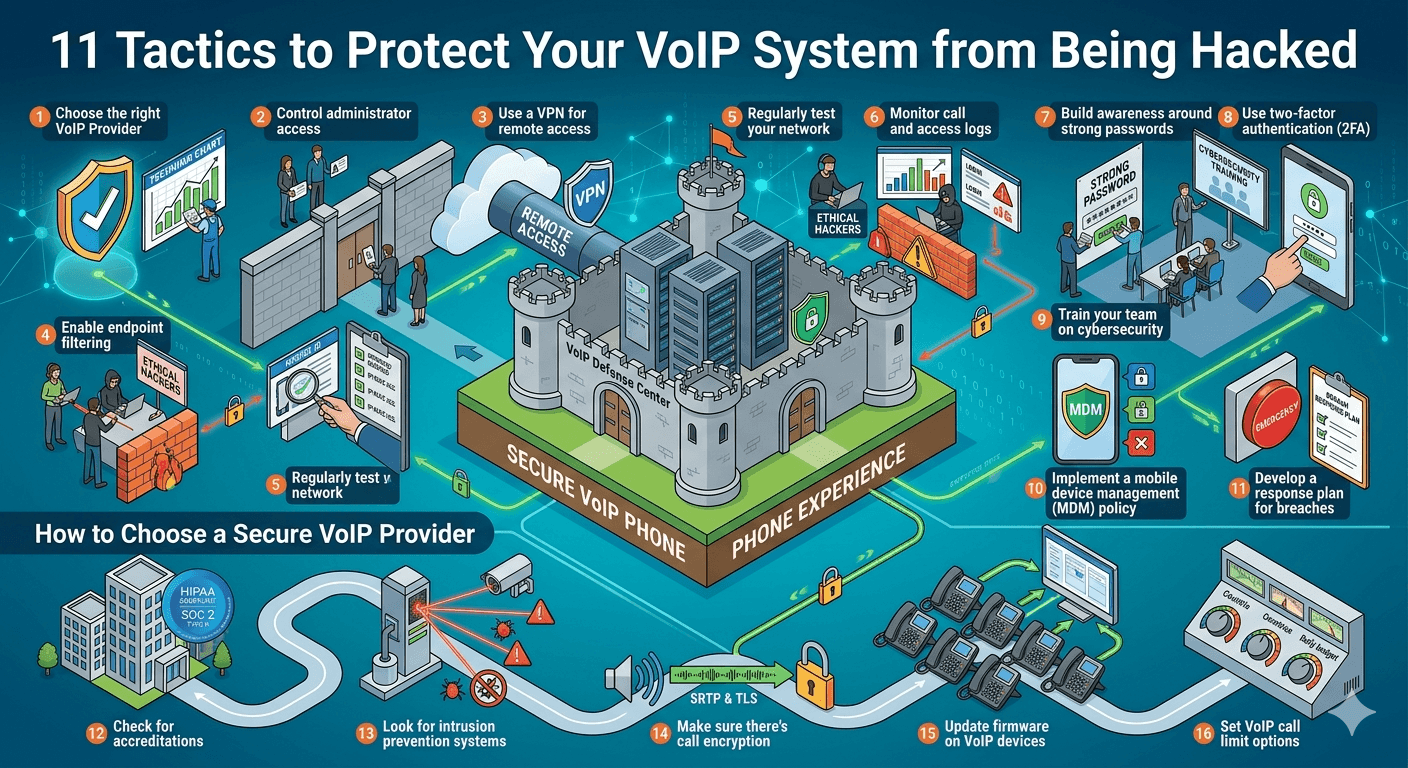
Implementing a comprehensive strategy is the only way to ensure your communication is safe. Here are eleven essential tactics to bolster your defense and provide a secure voip phone experience for your entire team.
1. Choose the right VoIP Provider
The foundation of your security is the provider you choose. A reputable provider will prioritize voip security by offering built-in encryption and fraud detection. They should have a track record of maintaining high uptime and providing regular security updates. When evaluating a provider, ask specifically about their protocols for handling a voip hack and what protections they offer against toll fraud.
2. Control administrator access
One of the most common voip vulnerabilities is having too many people with administrative privileges. Limit access to the VoIP dashboard to only a few trusted IT professionals. Every person with “admin” rights represents a potential entry point for a hacker. By minimizing these points, you significantly reduce the risk of an internal breach or a compromised credential leading to a system-wide failure.
3. Use a VPN for remote access
Remote work has made voip security risks more prevalent. When employees connect to the office phone system from home or public Wi-Fi, their connection is often unsecured. Forcing all remote voip traffic through a Virtual Private Network (VPN) creates a secure tunnel for the data. This ensures that even if someone intercepts the packets, they remain unreadable due to the encryption provided by the VPN.
4. Enable endpoint filtering
Endpoints, such as the actual phones on desks, are often the weakest links. Endpoint filtering allows you to restrict which devices can connect to your VoIP server based on their IP address or MAC address. This prevents a hacker from using a rogue device to connect to your network, even if they have managed to steal a username and password.
5. Regularly test your network
You cannot know if you are safe unless you test your defenses. Conduct regular penetration testing specifically focused on your voice over ip security. This involves hiring ethical hackers to try and find ways into your system. By identifying weaknesses in your voip security system before the criminals do, you can patch holes and stay one step ahead of the latest threats.
6. Monitor call and access logs
Monitoring is a proactive way to prevent voip hacking. You should set up automated alerts for unusual activity, such as a high volume of calls to international destinations or repeated failed login attempts to the admin portal. Reviewing these logs weekly helps you understand the patterns of your network and makes it easier to spot an anomaly that could signify a voip attack.
7. Build awareness around strong passwords
It sounds simple, but many businesses are hacked because they use default passwords like “1234” or “admin.” Ensure every device and account associated with your VoIP system has a complex, unique password. Passwords should be changed regularly, and you should never reuse passwords across different platforms.
8. Use two-factor authentication (2FA)
Two-factor authentication adds a vital second layer of defense. Even if a hacker manages to hack phone through call methods or steal a password, they will still need a secondary code sent to a physical device to gain access. Implementing 2FA for all administrative logins is one of the most effective voip security best practices you can adopt today.
9. Train your team on cybersecurity
Your employees are your first line of defense. Train them to recognize vishing attempts and social engineering tactics. They should know what to dial to see if your phone is hacked (such as checking call forwarding settings) and who to contact if they suspect a breach. Regular training sessions keep security at the forefront of everyone’s mind.
10. Implement a mobile device management (MDM) policy
If your employees use their personal mobile phones for work calls via a VoIP app, you need an MDM policy. This allows the company to enforce security standards on the device, such as requiring a passcode and allowing for remote wiping if the phone is lost or stolen. This is a critical step in maintaining a secure voip phone environment in a “Bring Your Own Device” (BYOD) culture.
11. Develop a response plan for breaches
No system is 100% impenetrable. If a breach occurs, you need a plan. This should include steps on how to isolate the compromised part of the network, how to notify your provider to stop fraudulent calls, and a communication strategy for informing affected clients. A fast response can mean the difference between a minor hiccup and a business-ending disaster.
How to Choose a Secure VoIP Provider
Selecting a partner for your communications is a decision that should be driven by security as much as price. A secure voip provider acts as an extension of your IT team, offering tools and oversight that you might not be able to manage in-house.
1. Check for accreditations
Look for providers that comply with industry-specific standards. For example, if you are in healthcare, HIPAA compliance is a must. For those in finance, look for SOC 2 Type II certification. These accreditations prove that the provider has undergone rigorous third-party audits of their security controls and data handling processes.
2. Look for intrusion prevention systems
A top-tier provider will have active intrusion prevention systems (IPS) that monitor network traffic for malicious patterns. If the system detects a potential voip attack, it can automatically block the offending IP address before it reaches your internal network. This real-time defense is far more effective than manual monitoring.
3. Make sure there’s call encryption
Ask your provider if they support Secure Real-time Transport Protocol (SRTP) and Transport Layer Security (TLS). These are the gold standards for voip encryption. They ensure that both the signaling and the actual voice data are encrypted from the moment they leave your phone until they reach their destination. This is the primary defense against eavesdropping.
4. Update firmware on VoIP devices
A secure provider makes it easy to keep your hardware up to date. Many voip vulnerabilities are found in the firmware of the phones themselves. Your provider should offer a central management console that allows you to push security patches to every device on your network simultaneously, ensuring no phone is left unprotected.
5. Set VoIP call limit options
To prevent massive toll fraud losses, choose a provider that allows you to set limits. You should be able to disable international calling to specific countries or set a maximum dollar amount for daily usage. If the limit is reached, the system should automatically disable calling and alert your administrator. This is a simple but highly effective way to mitigate the financial risks of a voip hack.
Checklist to Protect Your VoIP Phone
-
Passwords: Change all default passwords on phones and admin portals immediately.
-
Encryption: Verify that SRTP and TLS are enabled for all calls.
-
Firmware: Schedule monthly checks for firmware updates on all IP phones.
-
Remote Work: Ensure every remote user is connecting via a secure VPN.
-
Logs: Set up automated email alerts for any international calls made after hours.
-
2FA: Enable two-factor authentication for every account with system access.
-
Physical Security: Ensure that unauthorized personnel do not have physical access to your VoIP servers or routers.
-
Inactivity: Set the system to automatically log out users after a period of inactivity.
-
Deactivation: Immediately remove access for any employee who leaves the company.
Read More: Best Internet Speed for VoIP Calls for Crystal Clear Audio
Final Thought
Protecting your business from the growing threat of cybercrime is an ongoing commitment that requires vigilance at every level. While the question “can voip be hacked” has a definitive “yes,” the more important realization is that most attacks are preventable with the right strategy. By prioritizing voip security best practices, investing in encrypted voip technology, and fostering a culture of cybersecurity awareness, you can reap the benefits of modern communication without falling victim to digital predators. Security is not a product you buy, but a process you live by every day to ensure your voice remains private and your business remains profitable.
VoIP Hacking FAQs
-
Can VoIP be hacked?
Yes, VoIP can be hacked because it operates over the same internet protocols used by other digital services. Without proper security, hackers can exploit vulnerabilities to intercept calls, commit toll fraud, or gain access to your internal network. However, by using tools like encryption, firewalls, and strong authentication, the risk of a successful hack is significantly minimized.
-
Can VoIP Phones be hacked?
Absolutely. VoIP phones are essentially specialized computers connected to a network. If their firmware is outdated or if they are protected only by default passwords, hackers can gain remote access. Once inside a phone, an attacker might listen to conversations, redirect calls, or use the device as a jumping-off point to attack other parts of your business network.
-
How can cybersecurity prevent VoIP Hacking?
Cybersecurity prevents hacking by implementing layers of defense, such as firewalls, intrusion detection systems, and encryption. It also involves the human element, ensuring that users are trained to spot scams and that administrators follow strict access control policies. Together, these measures create an environment where vulnerabilities are patched before they can be exploited.
-
What is VoIP hacking and why is it a concern in Canada?
In Canada, as in many other nations, VoIP hacking is a major concern due to the high volume of digital business transactions and the prevalence of remote work. Canadian businesses are often targets for toll fraud, where hackers route expensive international calls through local systems. The concern is also tied to privacy laws like PIPEDA, as a breach could lead to legal penalties and a loss of consumer trust.
-
How can a Canadian SMB prevent toll fraud on VoIP?
A Canadian SMB can prevent toll fraud by disabling international calling to countries where they do not conduct business and by setting strict daily spending limits on their VoIP account. Additionally, they should work with a provider that offers real-time fraud monitoring and alerts. Keeping administrative credentials secure and using 2FA are also critical steps in stopping fraudulent access.
-
Does 3CX support VoIP security features needed in hotels and multi-site operations?
Yes, 3CX is known for its robust security features tailored for complex environments like hotels. It includes built-in anti-hacking tools such as automatic global IP blacklisting and the ability to encrypt voice traffic through its own tunnel. These features make it easier for multi-site operations to maintain a consistent security posture across all locations.
-
What protects VoIP calls from eavesdropping?
The primary protection against eavesdropping is encryption. Specifically, protocols like SRTP (Secure Real-time Transport Protocol) scramble the voice data packets so they cannot be understood if intercepted. Using a VPN for all VoIP traffic adds another layer of security, making it nearly impossible for an unauthorized party to listen to your conversations.
-
How should a Toronto-based business respond to a suspected VoIP breach?
A business should immediately disconnect the suspected hardware or software from the network and contact their VoIP service provider to freeze the account and stop any fraudulent charges. They should then conduct a full security audit, change all passwords, and investigate the logs to determine the extent of the breach. It may also be necessary to report the incident to the Canadian Centre for Cyber Security.
-
Can Microsoft 365 improve VoIP security for hybrid teams?
Microsoft 365 can significantly improve security by providing integrated identity management through Azure Active Directory (now Microsoft Entra ID). This allows for centralized control over user access, the enforcement of multi-factor authentication, and the use of conditional access policies that ensure only secure, managed devices can connect to the team’s communication tools.