
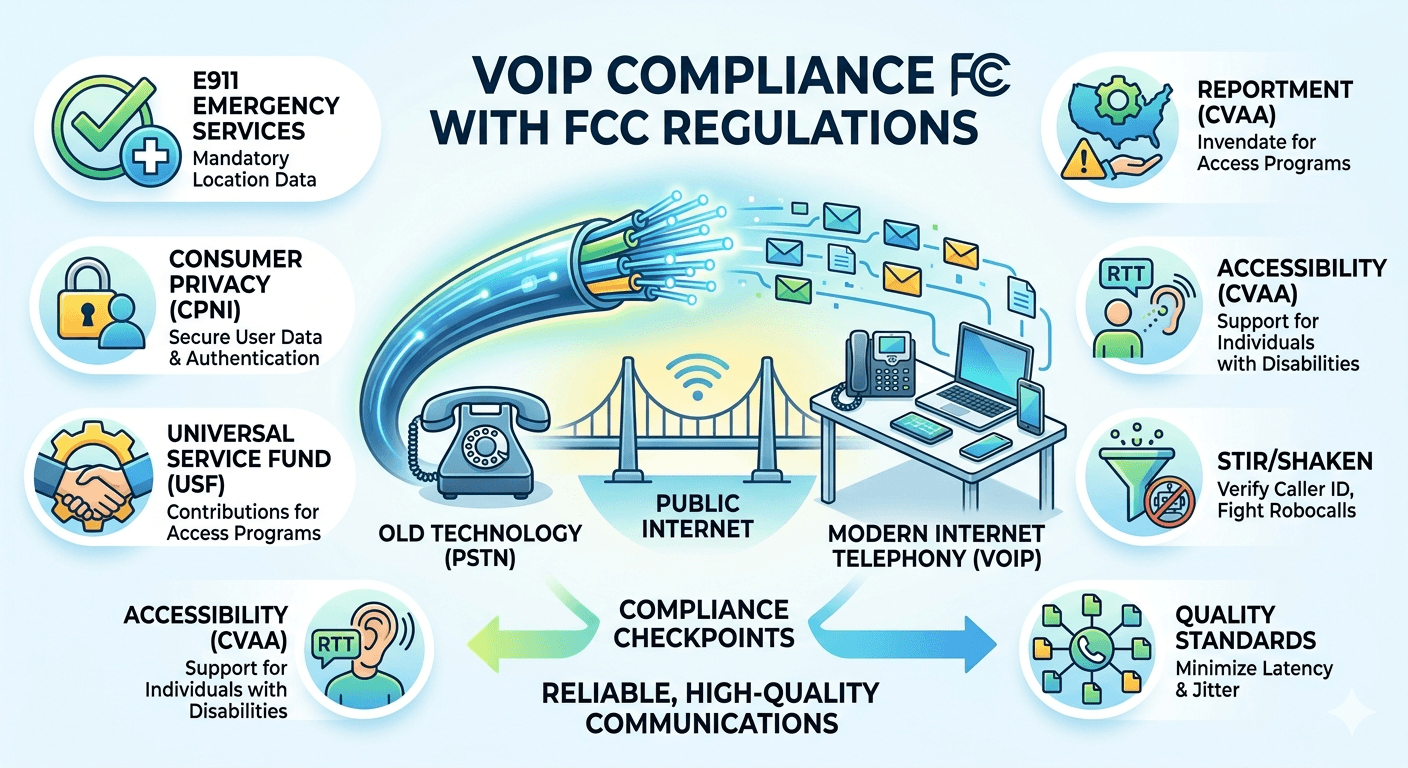
VoIP Compliance with FCC Regulations ensures that providers of voice over internet protocol services adhere to the legal standards set by the Federal Communications Commission to protect consumers and maintain national security. Achieving full compliance involves understanding the technical requirements of interconnected VoIP, implementing mandatory E911 emergency services, and contributing to the Universal Service Fund. Businesses must also navigate complex privacy rules, such as Customer Proprietary Network Information (CPNI) standards, to secure user data. By following these federal mandates, companies can avoid heavy fines and provide a reliable, high-quality telecommunication environment for all users.
What is VoIP?
To understand the legal landscape, one must first address what does voip mean in the context of modern communications. Effectively, voip stands for voice over internet protocol, which is a method for taking analog audio signals and turning them into digital data that can be transmitted over the internet. This technology allows users to make voip calls from a computer, a special VoIP phone, or a traditional phone connected to an adapter. Because it relies on the internet rather than traditional copper wires, the voice over internet protocol is highly flexible and cost-effective for both residential and commercial users.
When people ask what is a voip, they are often referring to the service or the hardware used to facilitate voice over ip service. Unlike traditional landlines, voip technology uses packet-switching technology to send voice data in small chunks. This is a significant shift from the circuit-switching methods used by the Public Switched Telephone Network (PSTN). In the realm of voip in computer networks, the system must be robust enough to handle data packets with minimal latency to ensure clear communication.
The growth of telephony voip has revolutionized how businesses operate, allowing for integrated features like video conferencing, instant messaging, and file sharing within a single platform. However, because it operates over the public internet, a voice ip service requires specific voip network requirements to function correctly. This includes sufficient bandwidth, low jitter, and a stable internet connection to prevent dropped calls or poor audio quality. Understanding these technical foundations is the first step toward achieving total VoIP Compliance with FCC Regulations.
What is FCC?
The Federal Communications Commission (FCC) is an independent United States government agency overseen by Congress. It is the primary body responsible for implementing and enforcing America’s communications law and regulations. The agency’s jurisdiction covers all 50 states, the District of Columbia, and U.S. possessions. In the world of telecommunication voip, the FCC plays a pivotal role in ensuring that new technologies do not compromise the safety, privacy, or accessibility of the American public.
Originally established by the Communications Act of 1934, the FCC has evolved to oversee modern digital technologies, including voice over internet services. The commission is charged with regulating interstate and international communications by radio, television, wire, satellite, and cable. As the market shifted from traditional landlines to internet-based calling, the FCC had to adapt its rules to include interconnected voip, ensuring that these services meet the same public interest obligations as traditional phone companies.
The FCC’s mission includes promoting connectivity and ensuring a competitive market for all communication services. By setting specific voip system requirements, the FCC ensures that different providers can work together and that consumers have choices. The commission also manages the spectrum for wireless services and works to bridge the digital divide through various assistance programs. For any provider, staying in the good graces of the FCC is not just about legal survival; it is about proving the reliability and integrity of their service to the consumer.
The Role Of FCC In VoIP Environment
The role of the FCC in the current communication landscape is multi-faceted, focusing primarily on public safety and market fairness. One of the most critical aspects of VoIP Compliance with FCC Regulations is the integration of emergency services. Because voice over ip service can be used from anywhere with an internet connection, determining the physical location of a caller during a 911 call was a significant hurdle. The FCC stepped in to mandate that providers must be able to transmit the caller’s location to emergency dispatchers, a requirement known as Enhanced 911 (E911).
Beyond safety, the FCC works to build trust between consumers and service providers. In an era where digital fraud and robocalls are rampant, the commission implements rules like the STIR/SHAKEN framework to verify the caller ID of incoming voip calls. This technology helps reduce the number of spoofed calls, which are often used for phishing and scams. By enforcing these rules, the FCC helps maintain the integrity of the voice over internet ecosystem, making users feel more secure when answering their phones.
Furthermore, the FCC ensures a suitable communication environment by preventing anti-competitive practices. They monitor how large telecommunications companies interact with smaller providers to ensure that the market remains open for innovation. This oversight includes setting standards for voip network requirements that facilitate interconnection between different networks. By keeping the regulations up-to-date with current technological trends, the FCC ensures that the transition from old telephony systems to modern voip in computer networks is smooth and beneficial for the entire nation.
Key FCC Regulations for VoIP Services
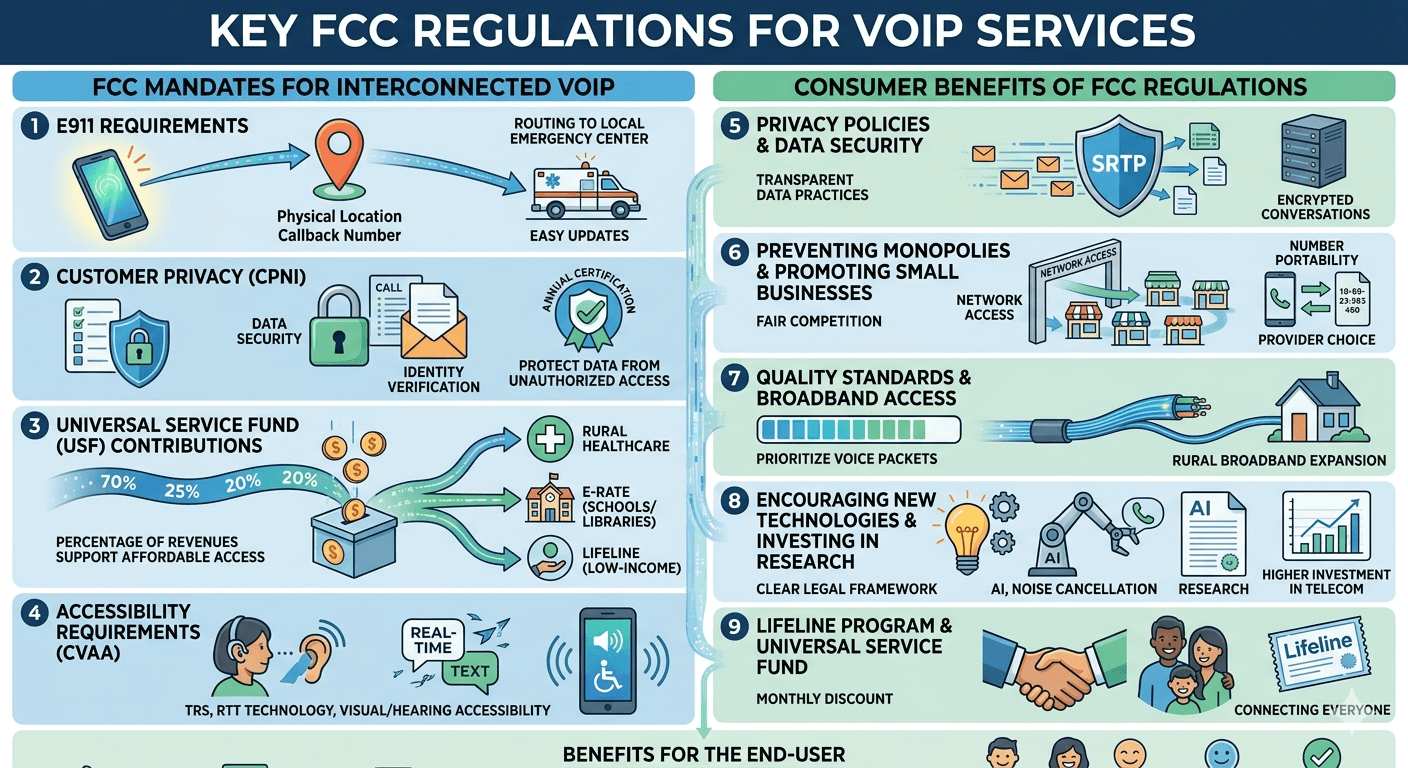
For any company offering voice over ip service, understanding the specific mandates is essential. The FCC does not treat all internet-based calling the same way; they distinguish between “interconnected” VoIP and other types. Interconnected services allow users to receive calls from and make calls to the traditional telephone network. These services are subject to the most stringent rules to ensure they function as a viable replacement for traditional landline services.
1- E911 Requirements
The most vital part of VoIP Compliance with FCC Regulations is the E911 requirement. According to FCC rules, interconnected VoIP providers must provide E911 services as a standard feature of their offering. This means they must obtain the physical location of the subscriber and ensure that 911 calls are routed to the appropriate local emergency center. Unlike traditional phones, where the location is tied to a specific wire, VoIP users might move their equipment. Therefore, providers must give users an easy way to update their registered location.
According to a research report by the National Emergency Number Association (NENA), nearly 80% of emergency calls now come from wireless or VoIP devices, making the accuracy of location data more critical than ever.
Failure to provide functional E911 services can lead to catastrophic consequences and massive legal liabilities. The FCC requires that providers not only transmit the location but also the callback number so that if the call is disconnected, the emergency operator can reach the person in distress.
2- Customer Privacy
Privacy is a cornerstone of the telecommunication voip industry. The FCC enforces strict rules regarding Customer Proprietary Network Information (CPNI). CPNI includes details such as the time, date, duration, and destination of voip calls, as well as the type of services a customer uses. Providers are legally obligated to protect this data from unauthorized access or disclosure. This regulation ensures that personal communication patterns are not sold to third parties or exposed during data breaches.
To comply with these privacy standards, companies must implement robust internal controls and authentication processes. For instance, before a customer service representative can discuss account details with a user, they must verify the user’s identity through a password or other secure method. Additionally, providers must file annual certifications with the FCC to prove they have established effective procedures to safeguard customer information. This level of oversight is intended to give consumers confidence that their voice over internet activities remain private.
3- Universal Service Fund Contributions
The Universal Service Fund (USF) is a system of subsidies designed to ensure that all Americans have access to affordable communication services. Under VoIP Compliance with FCC Regulations, interconnected VoIP providers are required to contribute a percentage of their interstate and international revenues to the USF. These funds are used to support programs for rural health care, schools and libraries (E-Rate), and low-income consumers (Lifeline).
The contribution factor for the USF is adjusted quarterly based on the needs of the supported programs. For many providers, managing these payments is a complex administrative task, as it requires accurate tracking of where calls originate and terminate. However, these contributions are essential for maintaining the overall health of the national network. By supporting broadband access in underserved areas, the USF expands the potential market for voip technology and ensures that the digital economy is inclusive.
4- Accessibility Requirements
The FCC is committed to ensuring that individuals with disabilities have equal access to communication technologies. This means that voip system requirements must include features that support people who are deaf, hard of hearing, or have speech disabilities. Regulations under the Twenty-First Century Communications and Video Accessibility Act (CVAA) mandate that VoIP services and equipment be accessible to and usable by people with disabilities, provided it is achievable.
This often involves the integration of Telecommunications Relay Services (TRS) and support for “Real-Time Text” (RTT) technology. RTT allows text to be transmitted instantly as it is typed, which is a significant improvement over older TTY systems. Providers must also ensure that their websites and customer service channels are accessible. By prioritizing these features, the voice over ip service industry ensures that no segment of the population is left behind as the world moves away from traditional telephony.
Benefits of FCC Regulations for Consumers
While compliance may seem like a burden for providers, the benefits for the end-user are immense. FCC regulations create a structured environment where quality, safety, and privacy are guaranteed. Without these rules, the market for voice over internet could become a “wild west” where consumer data is sold to the highest bidder and emergency services are unreliable. The presence of a federal watchdog ensures that companies compete on the quality of their service rather than by cutting corners on essential protections.
Privacy Policies and Data Security
One of the primary benefits of VoIP Compliance with FCC Regulations is the establishment of clear privacy expectations. When a consumer signs up for a telephony voip service, they are protected by federal laws that dictate how their data is handled. These regulations force providers to be transparent about their data collection practices. Strong data security mandates also mean that providers must invest in encryption and secure voip network requirements to prevent hackers from intercepting calls or stealing sensitive billing information.
Data security in the voip in computer networks space is particularly important because voice data is susceptible to the same vulnerabilities as any other internet traffic. By mandating security standards, the FCC ensures that providers use modern protocols like Secure Real-time Transport Protocol (SRTP) to protect the privacy of conversations. This level of protection is vital for businesses that handle sensitive client information over the phone, as it mitigates the risk of corporate espionage and identity theft.
Preventing Monopolies and Promoting Small Businesses
The FCC plays a crucial role in maintaining a competitive marketplace. By regulating how interconnected voip providers access the existing phone network, the FCC prevents large, incumbent carriers from blocking new entrants. This open-access policy allows small businesses and startups to enter the voip technology market with innovative features and lower pricing. Competition keeps costs down for consumers and drives the industry to constantly improve its offerings.
Furthermore, FCC rules regarding number portability are a huge win for consumers and small businesses. Number portability allows a user to switch from one voice over ip service to another while keeping their existing phone number. This prevents “provider lock-in,” where a customer stays with a subpar service simply because they don’t want to change their contact information. By making it easy to switch, the FCC ensures that providers must work hard to retain their customers through excellent service and fair pricing.
Quality Standards and Broadband Access
While the FCC does not directly dictate the audio quality of every call, its focus on broadband access indirectly improves the voice over internet experience. Through the Universal Service Fund, the FCC subsidizes the expansion of high-speed internet into rural and low-income areas. Since voip network requirements rely heavily on stable broadband, these initiatives expand the reach of high-quality telephony voip.
Moreover, the FCC sets standards for how traffic is handled on the network to ensure that voice packets are prioritized. This is essential for preventing “latency” and “jitter,” which cause the lag and distortion often associated with poor-quality voip calls. When the underlying infrastructure is robust, the user experience is seamless, making the transition from landlines to voice over ip service an easy choice for most households.
Encouraging New Technologies and Investing in Research
The FCC doesn’t just regulate; it also encourages growth. By providing a clear legal framework, the commission gives companies the confidence to invest in new voip technology. When a company knows the “rules of the road,” they are more likely to spend money on research and development for features like AI-driven call routing, advanced noise cancellation, and seamless integration with mobile apps.
A 2022 study by the International Telecommunication Union (ITU) highlighted that countries with clear regulatory frameworks for digital services see 15% higher investment in telecommunications infrastructure compared to those with ambiguous rules. This research supports the idea that VoIP Compliance with FCC Regulations actually fuels innovation by reducing the risks associated with legal uncertainty. By investing in research and supporting new standards, the FCC ensures that the United States remains a global leader in communications.
Lifeline Program and Universal Service Fund
The Lifeline program is a specific branch of the USF that provides a monthly discount on communication services for qualifying low-income consumers. In the modern era, having a phone is not a luxury; it is a necessity for finding jobs, accessing healthcare, and staying in touch with emergency services. Many voice ip service providers participate in this program, allowing them to serve a wider demographic while receiving subsidies to cover the costs.
This program ensures that the benefits of voice over internet are available to everyone, regardless of their economic status. By integrating VoIP into the Lifeline program, the FCC recognizes that internet-based calling is the future of communication. This not only helps the individuals receiving the discount but also strengthens the entire network by ensuring that every citizen is reachable.
Compliance Challenges for VoIP Providers
Despite the clear benefits, achieving and maintaining VoIP Compliance with FCC Regulations is a significant challenge for many companies. The regulatory landscape is constantly shifting as new laws are passed and old ones are updated to reflect technological changes. For a small voice over internet provider, the administrative overhead of tracking USF contributions, filing CPNI certifications, and maintaining E911 databases can be overwhelming.
Technical challenges also abound. Ensuring that a voice over ip service remains compliant while also being compatible with a wide range of devices and network configurations requires constant vigilance. For instance, implementing the STIR/SHAKEN framework to combat robocalls involves a complex system of digital certificates and private keys. If a provider fails to implement this correctly, their voip calls may be blocked or flagged as “spam” by other carriers, leading to a loss of customers and reputation.
Moreover, the global nature of the internet complicates things. A provider might be based in the U.S. but have users traveling internationally. Determining which regulations apply in these scenarios requires expert legal counsel. The cost of non-compliance is high, with the FCC frequently issuing “Notices of Apparent Liability” that carry fines in the hundreds of thousands, or even millions, of dollars. These challenges make it imperative for companies to have a dedicated compliance strategy.
How to Stay Compliant with VoIP Compliance with FCC Regulations
Staying compliant requires a proactive approach that combines legal expertise with technical excellence. It is not a “set it and forget it” process; it is a continuous cycle of monitoring, auditing, and updating. Providers must view VoIP Compliance with FCC Regulations as a core part of their business model rather than an afterthought. By integrating compliance into their daily operations, companies can protect themselves and their customers from the risks of the digital age.
1- Stay Updated and Implement Best Practices
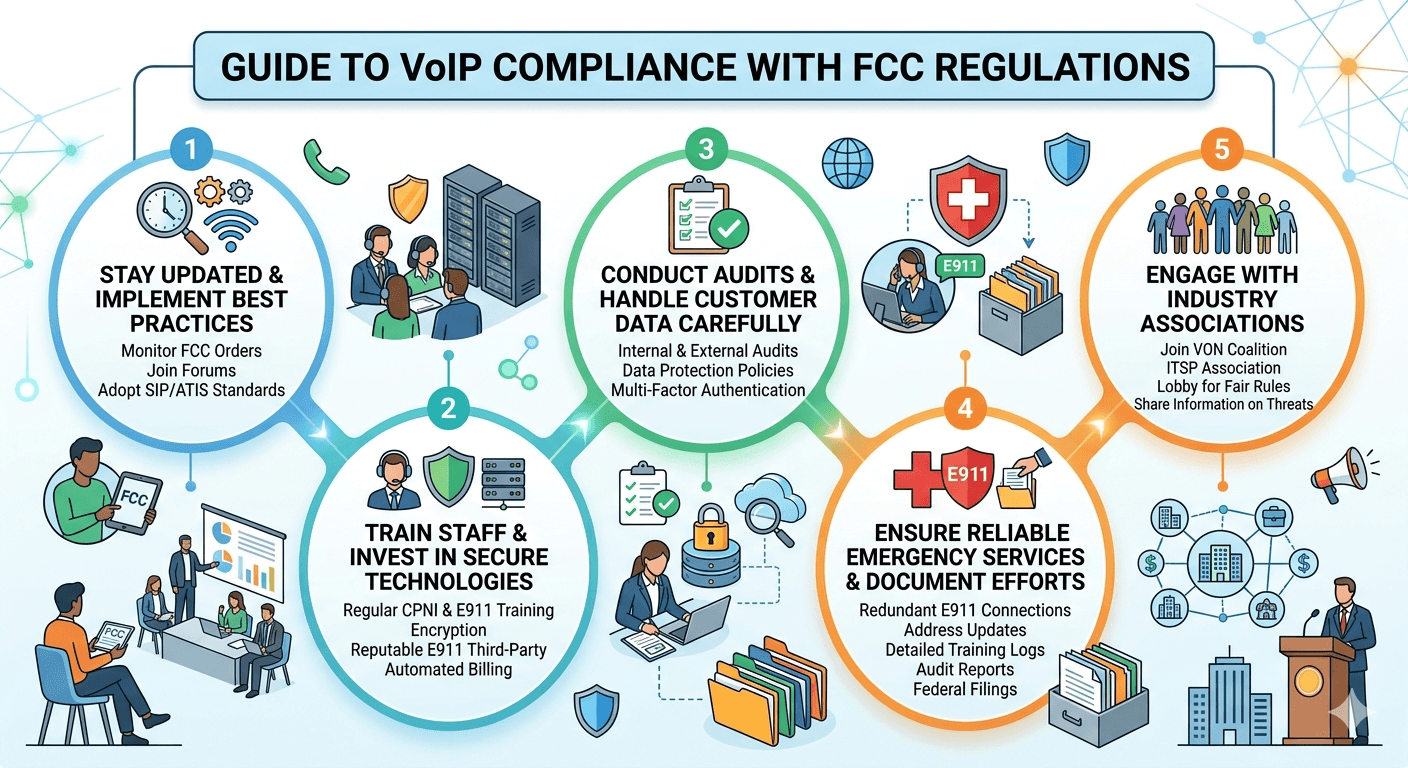
The first step in staying compliant is to stay informed. The FCC frequently issues new orders and public notices that can change the requirements for voice over ip service. Subscribing to FCC newsletters, attending industry conferences, and participating in regulatory forums are all excellent ways to stay ahead of the curve. Implementing best practices, such as those suggested by the SIP Forum or the ATIS (Alliance for Telecommunications Industry Solutions), can help ensure that your voip system requirements meet the latest industry standards.
Furthermore, companies should look at how leaders in the telecommunication voip space handle their regulatory obligations. Following the lead of established players can provide a roadmap for navigating complex issues like international call routing and tax collection. By adopting a “compliance-first” mindset, a provider can build a reputation for reliability that attracts high-value enterprise clients who prioritize security and legal standing.
2- Train Staff and Invest in Secure Technologies
Human error is one of the most common causes of compliance failures. Whether it is a customer service representative mishandling CPNI or a network engineer misconfiguring a firewall, the results can be devastating. Therefore, regular training for all employees on the specifics of VoIP Compliance with FCC Regulations is essential. Staff should be trained to recognize sensitive data and follow strict protocols for handling customer inquiries and emergency routing.
Investing in secure technologies is the other half of the equation. This includes using high-quality hardware that supports the latest encryption standards and software that automates many of the compliance tasks. For example, using a reputable third-party for E911 management can take the burden of database maintenance off the provider’s shoulders. Similarly, automated billing systems can help ensure that USF contributions and other regulatory fees are calculated and paid accurately and on time.
3- Conduct Audits and Handle Customer Data Carefully
Regular internal and external audits are necessary to identify potential gaps in compliance. An audit should review everything from technical voip network requirements to administrative filings and data handling procedures. By finding and fixing problems before the FCC does, a company can save itself from costly fines and public embarrassment. These audits also provide an opportunity to optimize the network for better performance and security.
Handling customer data with care is perhaps the most visible part of compliance for the user. Beyond just following CPNI rules, providers should implement comprehensive data protection policies that include regular security patches, multi-factor authentication, and employee background checks. In the world of telephony voip, trust is the most valuable currency. If a customer feels their data is unsafe, they will quickly move to a competitor, regardless of the price.
4- Ensure Reliable Emergency Services and Document Compliance Efforts
There is no room for error when it comes to E911. Providers must ensure that their systems are robust enough to handle emergency calls even during periods of high network congestion. This involves having redundant connections to the emergency network and regularly testing the location-routing capabilities. Users should also be prompted frequently to verify and update their registered address to ensure the accuracy of the E911 database.
Documentation is the shield that protects a company during an FCC investigation. Every effort made toward VoIP Compliance with FCC Regulations should be meticulously documented. This includes training logs, audit reports, system configuration changes, and copies of all federal filings. If the FCC ever questions a provider’s practices, being able to produce a clear paper trail of diligent compliance efforts can be the difference between a warning and a major fine.
5- Engage with Industry Associations
Finally, providers should not try to navigate the world of voice over internet regulations alone. Engaging with industry associations like the Voice on the Net (VON) Coalition or the ITPA (ITSP Association) can provide valuable support. These organizations often lobby the FCC on behalf of smaller providers, ensuring that their voices are heard when new rules are being drafted. They also offer resources, templates, and expert advice that can simplify the compliance process.
By working together with other companies in the telephony voip sector, providers can help shape a regulatory environment that is fair and conducive to growth. Collaboration also allows for the sharing of information regarding new threats, such as emerging types of toll fraud or sophisticated hacking techniques. In the interconnected world of voip in computer networks, a collective defense is often the most effective way to stay compliant and secure.
Read More: How to Choose the Right VoIP Provider: Proven Strategies
Final Thought
Navigating the complexities of VoIP Compliance with FCC Regulations is an ongoing journey that requires dedication, technical skill, and a deep understanding of the law. From the life-saving requirements of E911 to the economic contributions of the Universal Service Fund, these regulations are designed to create a safe and equitable communication landscape for everyone. While the challenges of staying compliant are significant, the rewards—customer trust, market stability, and legal security—are well worth the effort. By prioritizing these standards, providers not only follow the law but also contribute to the continued evolution and success of voice over internet protocol technology.
FAQS
What are the FCC rules for VoIP?
The FCC rules for VoIP focus primarily on public safety, consumer privacy, and market fairness. Key regulations include the mandate for E911 services, which requires providers to transmit a caller’s location to emergency services. Additionally, providers must protect Customer Proprietary Network Information (CPNI), contribute to the Universal Service Fund (USF), and ensure their services are accessible to people with disabilities. These rules apply specifically to “interconnected” VoIP services that link to the traditional phone network.
What are VoIP regulations?
VoIP regulations are a set of legal frameworks that govern how voice over internet protocol services operate. These include federal rules set by the FCC, such as robocall mitigation (STIR/SHAKEN), number portability, and law enforcement assistance requirements (CALEA). These regulations are designed to ensure that internet-based calling is as reliable, secure, and accessible as traditional landline telephony, protecting both the consumer and the national communication infrastructure.
Why is Understanding FCC Regulations important for businesses?
Understanding these regulations is vital for businesses to avoid massive legal fines and potential service shutdowns. Compliance ensures that a company’s telephony voip services are trustworthy, which is a major selling point for corporate clients. Furthermore, knowing the rules helps businesses design their voip system requirements correctly from the start, preventing costly technical reworks and ensuring seamless integration with other global networks.
Who regulates VoIP companies?
In the United States, the Federal Communications Commission (FCC) is the primary regulator for VoIP companies. While the internet itself is largely decentralized, the FCC has jurisdiction over communication services that use the internet to connect to the public telephone network. State-level public utility commissions may also have limited oversight in certain areas, particularly regarding state-specific taxes and emergency service coordination.
What are the two major protocols for VoIP signaling?
The two major protocols for signaling in voip technology are the Session Initiation Protocol (SIP) and H.323. SIP is the most widely used protocol today due to its flexibility and simplicity, allowing for the setup, management, and termination of voice over internet sessions. H.323 is an older, more complex standard often used in legacy video conferencing systems. Both protocols are essential for defining how devices communicate and negotiate call parameters within voip in computer networks.
What is the principle of VoIP?
The fundamental principle of VoIP is the conversion of analog voice signals into digital data packets. These packets are sent over a packet-switched network, such as the internet, using the Internet Protocol (IP). Once they reach their destination, they are reassembled and converted back into audio. This process allows for more efficient use of network resources compared to the dedicated circuits used in traditional telephony, enabling features like voip calls to be made over any stable internet connection.
What is the minimum requirement for VoIP?
The minimum requirements for a functional voice over ip service include a stable internet connection with at least 100 Kbps of upload and download bandwidth per concurrent call. Additionally, the network must have low latency (under 150ms) and minimal packet loss to ensure audio clarity. Hardware-wise, a user needs a VoIP-compatible device, such as an IP phone, an analog telephone adapter (ATA), or a computer/smartphone with appropriate software. For a provider, meeting voip network requirements also involves having a robust server infrastructure to handle call routing and signaling.