

To choose the right VoIP provider, first check call quality, reliability, and uptime guarantees. Compare pricing plans and ensure there are no hidden charges. Look for essential features like call forwarding, IVR, recording, and CRM integration. Make sure the provider offers strong customer support and easy scalability for future growth. Finally, verify security features like encryption to protect communications.
Learning how to choose the right voip provider is a critical step for any modern business aiming to streamline communications and reduce operational overhead. To select the ideal service, you must first assess your specific call volume requirements, evaluate the reliability of your existing internet infrastructure, and identify essential features like automated attendants, CRM integrations, and mobile accessibility. A successful selection process involves comparing pricing tiers against total cost of ownership, auditing security protocols such as end-to-end encryption, and testing call quality to ensure high-definition voice transmission. By focusing on scalability and technical support, businesses can secure a future-proof communication system.
What Is a VoIP Provider?
A voip service provider is a company that enables businesses and individuals to make phone calls over the internet rather than through traditional copper wires or cellular towers. These entities bridge the gap between digital data packets and the global public switched telephone network. When you utilize voice over internet protocol providers, your analog voice signals are converted into digital data packets, transmitted across the web, and reassembled at the destination. This technology eliminates the need for expensive physical infrastructure and allows for a more flexible, software-driven approach to communication.
Modern business voip solutions have evolved far beyond simple voice calling. These providers now act as unified communications as a service platforms, integrating video conferencing, instant messaging, and file sharing into a single interface. When businesses look for a voip solution for small business, they are essentially looking for a partner that manages the complex backend servers and routing logic, allowing the end-user to simply plug in an IP phone or open a mobile app to start communicating globally.
Do all VoIP Providers offer the same services?
While the core technology remains consistent across the industry, the scope of services varies significantly between different voice over internet protocol service providers. Some focus exclusively on providing a basic ip phone service providers experience for residential users, while others specialize in enterprise-grade business voip service. High-end providers offer deep integrations with tools like Salesforce or Microsoft Teams, whereas entry-level packages might only include standard features like caller ID and voicemail.
The differentiation often lies in the quality of the network backbone and the level of security provided. For instance, some voip for business providers own their own data centers and fiber networks, which can result in higher uptime and lower latency. Others may simply white-label another company’s infrastructure. It is also important to evaluate the prompt expansion company insightful on voip providers to see how they handle global scaling and local number portability, as these technical nuances can impact your ability to reach international markets.
Are the Cheapest VoIP Service Providers Worth It?
When considering how to choose the right voip provider, it is tempting to gravitate toward the lowest price point. However, the cheapest options often come with hidden trade-offs that can harm a professional reputation. Low-cost providers may save money by overcrowding their servers, leading to jitter, dropped calls, and poor audio quality. Furthermore, budget-friendly voip packages might lack essential security features, leaving your business vulnerable to eavesdropping or toll fraud.
A study by Global Market Insights recently highlighted that the VoIP market is expected to surpass 100 billion dollars by 2032, driven largely by the demand for high-quality, secure communication in remote work environments. This growth suggests that businesses are increasingly prioritizing value and reliability over the absolute lowest price. A cheaper provider might save you twenty dollars a month but cost you thousands in lost productivity or missed sales calls due to system downtime. Always look for a balance between competitive pricing and a robust service level agreement that guarantees at least 99.99 percent uptime.
How Does a VoIP Provider Compare to a Landline or Conventional Phone System?
The primary difference between a voip business setup and a landline is the medium of transmission. Landlines rely on physical cables maintained by local telephone companies, whereas VoIP uses your existing internet connection. This fundamental shift allows for significant cost savings because businesses no longer need to pay for separate phone lines and expensive on-site hardware maintenance.
From a technical standpoint, landlines are centralized and geographically tied. If a fire or flood hits your office, your phone lines go down with it. In contrast, voice over internet protocol service providers offer a decentralized model. Since the system lives in the cloud, your employees can take their business extension anywhere with an internet connection.
According to research from various telecommunications analysts, businesses can save up to 50 percent on their monthly communication costs by switching from traditional landlines to a voip service for business.
From the user’s perspective
From the perspective of an employee or customer, the transition to choosing a voip provider should be seamless. Modern VoIP desk phones look and feel exactly like traditional phones, but they offer enhanced interfaces for managing multiple calls and accessing company directories. The user experience is further improved by the ability to use softphones. A softphone is an application that runs on a computer or smartphone, allowing users to make professional calls using their office number without being tethered to a desk. This mobility is perhaps the most significant advantage for the modern, hybrid workforce.
What is a VoIP Number?
A VoIP number is a virtual telephone number that is not tied to a specific physical location or a single device. Unlike a traditional number that is hardwired to a wall jack, a VoIP number is assigned to a user or an account within the provider’s software. This means you can have a local New York area code while your office is actually located in London. This flexibility is a cornerstone of how to choose the right voip provider because it allows businesses to establish a local presence in multiple markets without opening physical branches.
These numbers are highly portable. If you move your office across town or even to another country, you keep the same number without any complicated re-wiring. Furthermore, a single VoIP number can be programmed to ring multiple devices simultaneously—such as your desk phone, laptop, and mobile device—ensuring that you never miss a critical client call.

Who Needs a VoIP Provider?
As the world moves away from analog infrastructure, the need for reliable ip phone service providers is becoming universal. Whether for personal convenience or corporate efficiency, the internet-based calling model is the new standard.
1. Individuals
For individuals, a voip service provider offers a way to reduce international calling costs and maintain a secondary number for privacy. It is particularly useful for digital nomads or expats who need to maintain a consistent phone number across different countries.
2. Businesses of All Sizes
Small business voip provider options are designed to give smaller teams the professional appearance of a much larger corporation. Features like auto-attendants and professional hold music can make a two-person operation sound like a global firm. For larger enterprises, business voip solutions provide the scale and management tools needed to coordinate thousands of employees across various departments.
Choosing a business-focused VoIP provider allows for necessary business features, such as:
Multi-level auto-attendants for routing calls to the right department.
Advanced call analytics to track peak call times and staff performance.
CRM integrations to display customer data automatically during a call.
Virtual faxing capabilities to send documents via email.
Call recording for training purposes and legal compliance.
Video conferencing and screen sharing for collaborative meetings.
3. Resellers
There is also a growing market for VoIP resellers. These are entrepreneurs who partner with larger voice over internet protocol service providers to sell white-labeled services to their own clients. This is common among IT managed service providers who want to offer a complete suite of technology solutions to their customer base.
How to Choose the Right VoIP Provider?
The process of choosing a voip provider begins with an internal audit of your communication habits. You need to determine the average number of minutes used per month, the number of simultaneous calls your team handles, and which software tools must integrate with the new system. When you how to choose the right voip provider, you must also consider the technical readiness of your local area network. VoIP requires a stable connection with low latency to function correctly.
Before signing a contract, it is wise to evaluate the telecommunications company get voip on plans & providers to see how their offerings stack up against industry leaders. This comparative research ensures that you are not overpaying for features you do not need, or worse, missing out on features that are standard in your industry.
Evaluating VoIP Providers
A deep evaluation of a voip service for small business involves looking past the marketing slogans and into the technical specifications of the provider.
Requirements and Features
Every business has unique needs. A medical clinic might require strict HIPAA-compliant messaging, while a sales team might prioritize a robust mobile app. Start by listing your non-negotiables. If you frequently conduct international business, look for voip packages that include flat-rate global calling. If your team is largely remote, ensure the provider offers a top-tier mobile experience. You should also evaluate the prompt expansion company popl on voip providers to see how digital business card integrations might enhance your team’s networking capabilities during calls.
Reviews
Third-party reviews are invaluable when you are learning how to choose the right voip provider. Look for feedback on platforms like G2 or Trustpilot, but pay close attention to reviews from businesses that are similar in size to yours. A provider that excels at serving single-person law firms might struggle to support a 100-seat call center. Look for patterns in the reviews—if multiple users complain about billing issues or poor customer support during outages, take those warnings seriously.
Call Quality
Call quality is non-negotiable. During your trial period, use a tool to measure packet loss and jitter. Packet loss occurs when data units fail to reach their destination, leading to choppy audio. Jitter refers to the variation in the delay of the packets. A high-quality provider will have multiple points of presence globally to ensure that data travels the shortest distance possible, which minimizes these issues.
Security and Compliance
As cyber threats increase, security must be a top priority when choosing a voip provider. Ensure the provider uses Transport Layer Security for signaling and Secure Real-time Transport Protocol for voice data. Additionally, check for certifications like SOC 2 Type II or ISO 27001. If your business operates in the financial or healthcare sectors, you must ensure the provider can sign a Business Associate Agreement to satisfy regulatory requirements.
8 Considerations for Choosing a Business VoIP Phone System
Transitioning to a new system is a major project. To ensure a smooth rollout, follow these eight critical considerations.
1. Reasoning behind transitioning to VoIP
Are you switching because your old hardware is failing, or are you looking to support a remote workforce? Understanding the “why” will help you prioritize features. For many, the primary driver is cost. Data from the Federal Communications Commission suggests that the flexibility of VoIP is a major factor in modernizing national infrastructure. If your goal is growth, focus on how to choose the right voip provider that offers easy scalability.
2. Which VoIP system type to choose
There are two main types: On-premise and Hosted. On-premise systems require you to own and maintain the servers in your office. Hosted VoIP, or cloud VoIP, means the provider handles everything in their data centers. Most modern businesses prefer hosted systems because they require less upfront capital and are easier to manage.
3. Integration into existing business systems
Your phone system should not exist in a vacuum. It should talk to your CRM, your helpdesk software, and even your email client. When you evaluate the telecommunications company get voip on business phone systems, look specifically at their integration library. Seamless data flow between your phone and your customer database can save your employees hours of manual data entry every week.
4. How will your voice be transmitted
This consideration involves your internet bandwidth. Each VoIP call requires a small amount of upload and download speed. If you have 50 employees all on the phone at once, your current internet plan might struggle. You may need to implement Quality of Service settings on your router to prioritize voice traffic over other types of data like video streaming or large file downloads.
5. System deployment, support & management
How long will it take to get the system up and running? Some providers offer “plug and play” phones that arrive pre-configured. Others might require an IT professional to set up the network. Equally important is the level of support. Look for providers that offer 24/7 live support via phone, chat, and email to ensure that any technical hiccups are resolved immediately.
6. Can the system grow with your business
The best voip providers for business allow you to add or remove lines with a few clicks in an online portal. You should never be forced to predict your head count three years in advance. A truly scalable provider will offer a tiered structure that grows alongside your revenue and team size.
7. Find out what your employees want
Your staff members are the ones who will use the system every day. Ask them which features they find most helpful. Perhaps your sales team desperately needs a “click-to-dial” feature, or your receptionists need a better digital switchboard. Getting buy-in from your team early in the process of how to choose the right voip provider will lead to a much higher adoption rate.
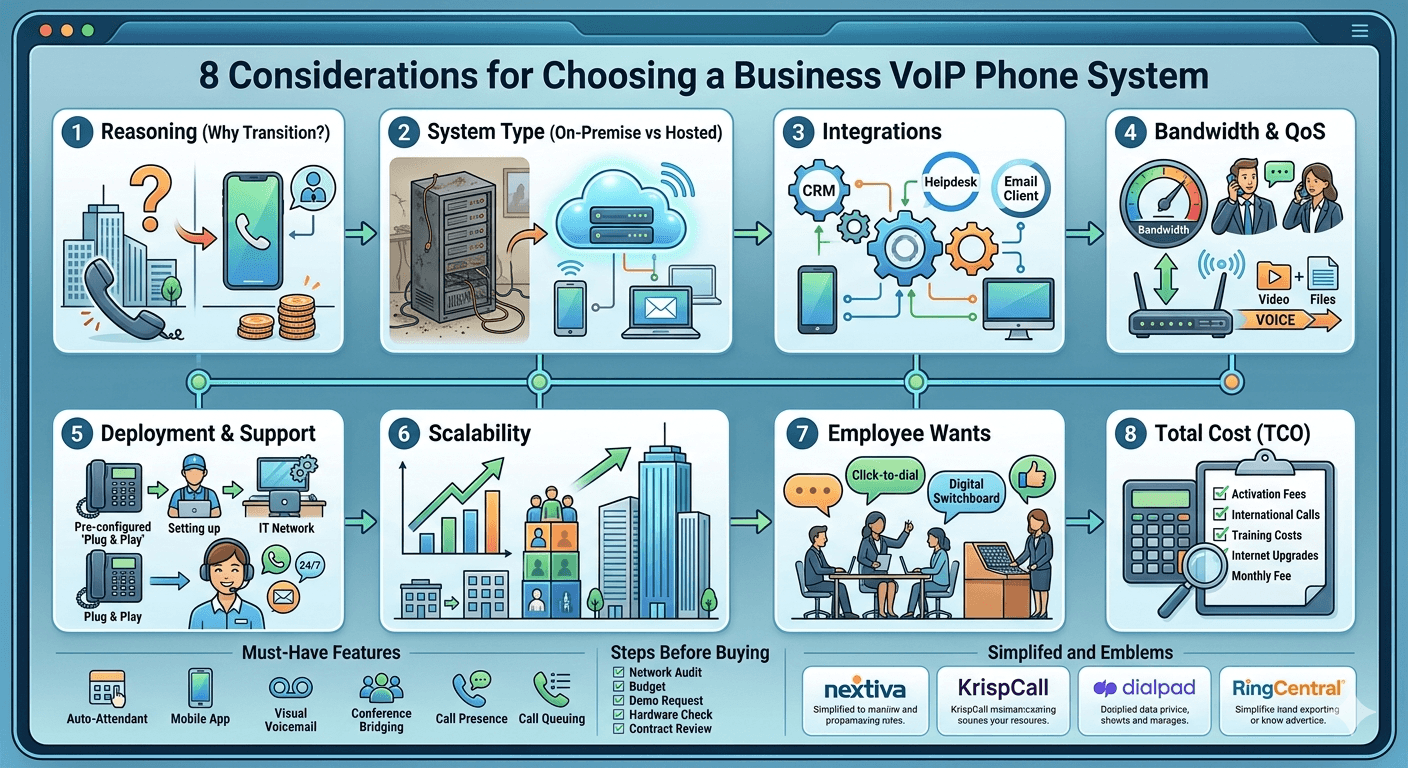
8. Investigate Total Cost of Ownership
The monthly per-user fee is only one part of the cost. You must also consider:
Activation fees and hardware costs.
Costs for international numbers or toll-free lines.
Premium support tiers.
Training costs for your staff.
Potential upgrades to your office internet or routers.
Must-have VoIP Features
When comparing different voip services for business, ensure that these essential features are included in your package.
Auto-Attendant: A virtual receptionist that directs callers to the correct extension.
Mobile App: Full functionality on iOS and Android devices for on-the-go work.
Visual Voicemail: Transcripts of your voicemails delivered directly to your email or app.
Conference Bridging: The ability to host large group calls without external software.
Call Presence: A real-time view of which team members are currently on a call or available.
Call Queuing: Managing high volumes of incoming calls by placing them in a line for the next available agent.
Steps to Take Before Buying
Before you finalize your decision on how to choose the right voip provider, follow these logical steps to ensure no detail is overlooked.
Conduct a Network Audit: Test your internet speed and stability under heavy load.
Define Your Budget: Determine a maximum monthly spend per user, including taxes and fees.
Request a Demo: See the software in action and test the user interface for intuitiveness.
Check Hardware Compatibility: If you already own IP phones, ensure the new provider supports them via BYOP (Bring Your Own Phone) policies.
Review the Contract: Look for any long-term commitments or early termination fees.
Top 4 VoIP Service Providers
To simplify your search for what is the best business voip phone system, we have narrowed down the top contenders in the current market.
1) Nextiva
Nextiva is widely considered one of the best voip providers for business due to its high reliability and comprehensive feature set. They offer a unified platform that combines voice, video, and customer management. Their “NextOS” platform is particularly powerful for businesses that want to use data analytics to improve their customer service interactions.
2) KrispCall
KrispCall has gained popularity as a versatile voip for business providers choice, especially for startups and international teams. They offer an easy-to-use interface and a wide range of international numbers. Their focus on collaborative features makes them an excellent choice for teams that need to share a common phone number across multiple agents.
3) Dialpad
Dialpad sets itself apart through the use of artificial intelligence. Their “Ai Contact Center” provides real-time coaching for agents and automated call summaries. If your business relies heavily on analyzing conversation data to improve sales or support, Dialpad is a leading ip phone service providers option to consider.
4) RingCentral
As a veteran in the space, RingCentral offers one of the most robust voice over internet protocol service providers platforms available. They have a massive library of integrations and a global footprint that is hard to beat. They are often the go-to choice for large enterprises that need a highly customizable and secure communication ecosystem.
Why Switch Phone Systems
The decision to switch to a voip business model is often driven by the need for agility. In a world where business happens 24/7 across multiple time zones, being tied to a physical desk is a massive disadvantage. Switching allows your company to consolidate its communication tools, reducing the number of separate subscriptions you pay for. Furthermore, the ability to record calls and analyze data helps in training staff and ensuring a high level of customer satisfaction. By modernizing your communications, you are not just changing your phone system; you are upgrading your entire business workflow.
Read More: Virtual Receptionist for Small Business: Efficiency, Cost-Savings, and Customer Retention
Final Thought
Mastering how to choose the right voip provider requires a careful balance of technical assessment, cost analysis, and a clear understanding of your organizational goals. By prioritizing call quality, security, and integration capabilities, you can transform your communication infrastructure from a simple utility into a strategic asset. Whether you are a solo entrepreneur or a global enterprise, the right VoIP partner will provide the scalability and reliability needed to thrive in an increasingly digital marketplace. Take the time to test, evaluate, and gather feedback, and you will find a solution that powers your growth for years to come.
FAQs
How to choose the right voip provider for a growing company?
To choose the right provider for growth, you must look for a platform that offers elastic scalability, allowing you to add new users instantly through an online portal. Ensure the provider has a transparent tiered pricing model so you can predict costs as you scale. Additionally, prioritize providers with robust integration options, as your need for CRM and project management connectivity will increase as your team expands.
What features should I look for?
You should look for features that improve both employee productivity and customer experience. Essential features include an auto-attendant for call routing, mobile and desktop apps for flexibility, and visual voicemail. For more advanced needs, look for call recording, CRM integrations, and detailed analytics. Security features like end-to-end encryption and multi-factor authentication are also critical.
How do I evaluate VoIP costs and pricing plans?
Evaluate costs by looking at the total cost of ownership rather than just the monthly subscription fee. Factor in one-time activation fees, hardware costs for IP phones, and additional charges for international calling or toll-free numbers. Compare different tiers to see which features are included and which require a premium upgrade to ensure you are getting the best value for your specific usage patterns.
Will my current internet connection support VoIP?
Most modern broadband connections can support VoIP, but the quality depends on your bandwidth and network stability. Each high-quality voice call typically requires about 100 Kbps of both upload and download speed. Use a speed test tool to check your latency and jitter. If your network is shared with many users, you may need a router with Quality of Service settings to prioritize voice traffic.
Do I need to buy new phones, or can I use my existing hardware?
You do not necessarily need to buy new phones. Most providers allow you to use “softphones,” which are apps on your computer or smartphone. If you prefer physical desk phones, many providers offer BYOP (Bring Your Own Phone) programs for existing IP-enabled hardware. However, if you are moving from an old analog system, you will need either new IP phones or an Analog Telephone Adapter.
What level of customer support should I expect?
A reputable provider should offer 24/7 technical support through multiple channels, including phone, live chat, and a comprehensive online knowledge base. For business-critical communications, look for providers that offer a dedicated account manager or a prioritized support tier to ensure that any service interruptions are addressed with the highest urgency.
Is VoIP secure enough for sensitive business calls?
VoIP is highly secure if the provider implements modern encryption standards. Look for providers that offer Transport Layer Security (TLS) and Secure Real-time Transport Protocol (SRTP). If your business must comply with regulations like HIPAA or GDPR, verify that the provider has the necessary certifications and is willing to sign compliance agreements to protect your data.
Can I keep my existing business phone number?
Yes, most providers offer local number portability, which allows you to transfer your existing phone numbers to their service. This process typically involves submitting a Letter of Agency to your new provider, who then coordinates the transfer with your old carrier. This ensures that your customers can still reach you at the same number they have always used.
What is the average setup time for a new VoIP system?
For hosted cloud systems, setup can be as fast as a few minutes if you are using softphones. If you are ordering physical hardware, it usually takes a few business days for the phones to arrive. Once you have the devices or software, configuring the call flows and user extensions can typically be completed in a single afternoon through the provider’s web dashboard.