Latest News

The Blog

voip blogs
Scim vs Sso

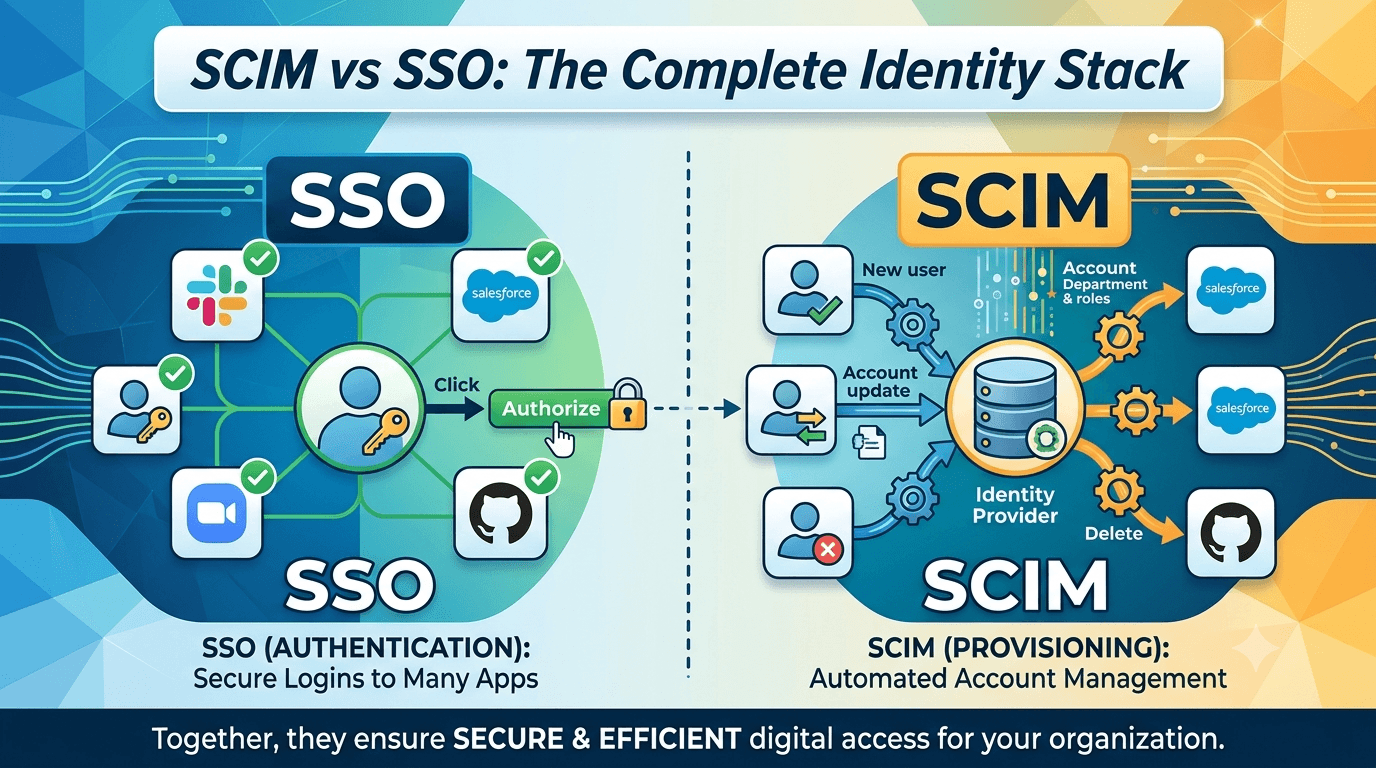
Scim vs SSO: Crucial Differences Explained for IT Teams

SCIM vs SSO are distinct but complementary identity management protocols used by modern organizations to secure and streamline digital access. Single Sign-On (SSO) focuses on authentication, allowing users to access multiple applications with one set of credentials. System for Cross-domain Identity Management (SCIM) focuses on provisioning, automating the creation, updating, and deletion of user accounts across different SaaS platforms. While SSO ensures secure and convenient logins, SCIM ensures that the right people have the right accounts at the right time. Together, they form a robust identity stack that enhances security, reduces administrative overhead, and improves user experience within any enterprise environment. What Is SSO? Single Sign-On is an authentication method that enables users to securely authenticate with multiple applications and websites by using just one set of credentials. It works on the principle of a trust relationship established between an Identity Provider (IdP) and a Service Provider (SP). When a user attempts to access an application, the SP redirects the authentication request to the IdP. Once the IdP confirms the user’s identity, it sends a token back to the SP, granting the user access without requiring a second password. This technology is pivotal for modern security because it centralizes credential management. Instead of users creating weak, repetitive passwords for fifty different SaaS tools, they use one strong, multi-factor authenticated account. This drastically reduces the attack surface for hackers. According to research by the Ponemon Institute, credential-based attacks are among the most expensive and frequent types of data breaches, making centralized authentication a top priority for IT leaders worldwide. What Is SCIM? The System for Cross-domain Identity Management is an open standard designed to simplify user identity management in the cloud. It provides a defined schema for representing users and groups, alongside a RESTful API for managing these identities across different domains. While SSO tells an application that a user is allowed to enter, SCIM tells the application what that user should look like once they are inside, including their name, role, department, and email address. SCIM operates through a set of standardized operations often referred to as CRUD: Create, Read, Update, and Delete. When a new employee is added to a central directory like Okta or Azure AD, the SCIM protocol automatically triggers the creation of their accounts in Slack, Zoom, and Salesforce. Conversely, when an employee leaves the company, SCIM ensures their access is revoked across all connected systems instantly. This automation is critical for maintaining security compliance and preventing “ghost accounts” from lingering in your software ecosystem. SCIM vs SSO: Why One Handles Provisioning and the Other Handles Login The debate of SCIM vs SSO is not about which is better, but rather how they fulfill different parts of the identity lifecycle. SSO is the mechanism for the front door; it handles the handshake that happens at the moment of login. It does not, however, have the inherent capability to manage the user’s data long-term or create the account before the user arrives. Without a provisioning tool, an admin would still have to manually create the user profile in every application before the user could log in via SSO. SCIM solves the back-office problem of identity management. It handles the “plumbing” of user data, moving it from the central source of truth to the various endpoints. While you can technically have SSO without SCIM, you would be forced to use manual provisioning or Just-in-Time (JIT) provisioning. JIT is often discussed in the context of scim vs jit, where JIT creates accounts on the fly during the first login. However, JIT cannot deprovision users or update their attributes when they change departments, making SCIM the superior choice for enterprise-grade management. Common Architecture Patterns (IdP → HRIS → SaaS Apps) In a sophisticated enterprise environment, identity data typically flows in a specific sequence to ensure accuracy and security. The architecture usually begins with a Human Resources Information System (HRIS) such as Workday or BambooHR. This system acts as the ultimate source of truth for employee data. When a new hire is processed in the HRIS, that data is pushed to an Identity Provider (IdP) like Okta, Microsoft Entra ID, or OneLogin. Once the IdP receives the user data, the dual roles of scim sso come into play. The IdP uses SCIM to reach out to various SaaS applications to prepare the user environments. For example, it tells GitHub to create a developer account and tells Zendesk to create a support agent profile. When the user finally clicks on the application icon in their dashboard, the IdP uses the SSO protocol to securely sign them in. This seamless transition from HR data to active, authenticated application access is the gold standard for IT orchestration. HRIS updates employee status to active. IdP imports the new user record. SCIM triggers account creation in downstream SaaS apps. User authenticates via SSO for the first time. Ongoing SCIM syncs update roles or titles as they change in HRIS. HRIS marks employee as terminated; SCIM deprovisions all accounts immediately. Reviews What users actually say on Reddit Scim SSO What users actually say on Quora Scim SSO Read More: Webrtc vs Sip: A Comprehensive Guide Final Thoughts Choosing between SCIM vs SSO is not a matter of selection but a matter of synchronization. SSO is the essential first step for any business looking to secure its digital perimeter and provide a frictionless login experience for its workforce. It solves the immediate problem of password management and access control. However, as an organization grows, the administrative burden of managing thousands of user accounts across hundreds of applications becomes unsustainable without automation. This is where SCIM becomes indispensable. By automating the identity lifecycle, SCIM removes the manual labor from IT departments and ensures that security policies are enforced in real-time. Whether you are comparing scim vs saml or looking at sso/scim as a unified strategy, the goal remains the same: a secure, efficient, and scalable way to manage the people who make your business run. Implementing both protocols ensures that your organization is protected against unauthorized access while remaining agile enough to handle the constant flux of a modern workforce. FAQs What is the difference between SCIM and SSO? The primary difference between SCIM vs SSO is that SSO handles the authentication process (logging in), while SCIM handles the provisioning process (creating and managing accounts). SSO verifies who you are, and SCIM ensures the application knows you exist and has your correct details before and after you log in. Can you have SSO without SCIM? Yes, you can have SSO without SCIM. In this scenario, users can log in with a single credential, but their accounts must be created manually by an administrator or via Just-in-Time (JIT) provisioning. However, without SCIM, you lose the ability to automatically deprovision users or sync attribute changes like job titles. Are SAML and SCIM the same? No, SAML and SCIM are not the same. SAML (Security Assertion Markup Language) is a protocol specifically for SSO that passes authentication data between an IdP and a service provider. SCIM is a protocol for identity management that passes user profile data and account status updates between systems. What’s the difference between SSO and SAML? SSO is the concept or the goal of using one login for many apps. SAML is one of the specific technical protocols used to achieve SSO. Think of SSO as the service and SAML as the language spoken to provide that service. Which protocol is better for security, scim vs sso? Both are essential for a complete security posture. SSO prevents password-related breaches by centralizing logins. SCIM prevents “insider threats” and “orphaned accounts” by ensuring that access is immediately revoked when an employee leaves the company. Does SCIM replace the need for JIT provisioning? While SCIM can replace JIT, they often serve different needs. SCIM is proactive, creating accounts before the user logs in. JIT is reactive, creating accounts at the moment of login. SCIM is generally preferred for enterprise environments because it allows for full lifecycle management, including deprovisioning. Is SCIM difficult to implement compared to SSO? SCIM can be more complex to implement because it requires the service provider to support a specific API for CRUD operations. While many modern SaaS apps support SCIM, some older or niche applications might only support SSO via SAML, requiring manual provisioning. How does scim vs jit impact user experience? SCIM provides a better user experience because accounts are pre-configured. When a user logs in for the first time via SSO, their profile, folders, and permissions are already waiting for them. With JIT, there can sometimes be a delay or errors during the initial account creation process at the first login. What is the role of an Identity Provider in scim sso? The Identity Provider (IdP) acts as the central hub for both protocols. It stores the master user record and uses SSO to authenticate the user’s identity while simultaneously using SCIM to push that user’s information to all the various applications they need to do their job.

Read More
Cloud-Connected Audio

Cloud-Connected Audio: How It Works, Benefits, and Provider

Cloud connected audio is an advanced enterprise-grade conferencing solution that bridges the gap between traditional telephony and modern digital communication platforms. By integrating an organization’s existing telecommunications infrastructure with the Webex cloud, it allows for a seamless routing of voice traffic over a dedicated IP connection. This method ensures that high-quality voice data is prioritized, offering superior reliability compared to standard internet calling. Utilizing cloud connected audio helps businesses leverage Cisco voice solutions to manage global communication costs while maintaining strict security standards. It is a critical component for companies seeking to optimize their internal collaboration and external client interactions through a unified, cloud-based architecture. What Is Cloud-Connected Audio? The core of modern enterprise communication lies in how efficiently voice data travels across global networks. Cloud connected audio represents a sophisticated delivery model where the audio portion of a web conference is delivered via a direct connection between the enterprise and the service provider. Instead of relying on the unpredictable public internet, this system uses established telecommunication paths to ensure clarity and uptime. Many organizations adopt this to enhance their Cisco and Webex ecosystems, allowing users to join meetings from any device without sacrificing the audio fidelity required for professional environments. This technology is specifically designed for large-scale deployments where thousands of users may be participating in simultaneous sessions. Unlike basic consumer-grade calling apps, cloud connected audio provides a dedicated bridge that manages traffic peaks and ensures that meeting participants experience minimal latency. It serves as a backbone for Cisco hosted voice services, allowing IT departments to centralize their management of communication assets while providing employees with a consistent user experience across different geographic locations and office branches. Why Cloud-Connected Audio Matters In an era defined by rapid digital transformation, the way businesses communicate has shifted from physical desks to virtual spaces. Cloud connected audio matters because it provides the necessary infrastructure to support this shift without the common pitfalls of dropped calls or jittery audio. As companies move away from legacy hardware, they require systems that can keep pace with high-demand collaboration environments. Implementing a robust audio strategy ensures that the workforce remains productive and that communication remains a tool for growth rather than a technical hurdle. 1. Remote Work Expansion The rise of distributed teams has made traditional phone systems nearly obsolete for global collaboration. Using cloud connected audio allows remote employees to connect to corporate meetings with the same level of audio quality they would experience in a physical boardroom. This technology supports the best network for cloud connected audio 2025 standards, ensuring that regardless of where a worker is located, their voice is transmitted clearly through optimized cloud pathways. 2. Scalability Traditional on-premises PBX systems often require expensive hardware upgrades to accommodate new users. With cloud connected audio, scaling becomes a matter of software configuration rather than physical installation. This flexibility allows businesses to add thousands of meeting participants instantly, making it ideal for large-scale town halls or international webinars. The ability to expand or contract services based on current demand is a hallmark of modern Cisco voice solutions. 3. Collaboration Tools Integration Modern productivity suites are only as good as their connectivity. By using cloud connected audio, platforms like Webex can function at their peak performance, integrating perfectly with other enterprise software. This ensures that when a user starts a Webex audio conference, the transition from a chat or a document-sharing session to a full voice call is instantaneous and reliable, fostering a more cohesive work environment. 4. AI and Automation The integration of artificial intelligence into communication platforms is a growing trend. Cloud connected audio provides the stable data stream necessary for AI tools to perform real-time transcription, translation, and noise cancellation. These enhancements are becoming standard in Cisco speaker systems and software, allowing for more inclusive meetings where language barriers and background noise are effectively managed by the underlying cloud intelligence. How Cloud-Connected Audio Works? The technical architecture of cloud connected audio relies on a direct peering relationship between a company’s network and the cloud service provider. When a user joins a meeting, the audio signal is converted into data packets and routed through a dedicated session border controller. This path bypasses much of the congestion found on the public web. By using this private or semi-private routing, the system ensures that the audio packets arrive in the correct order and without significant delay, which is essential for natural conversation flow. Behind the scenes, the provider manages a complex web of global data centers to facilitate these connections. For example, a cloud connected audio service provider might use a mix of local points of presence to ensure that a user in London and a user in New York both experience low-latency audio. The system automatically detects the closest entry point to the cloud, optimizing the path the voice data takes. This intelligence is what separates professional cloud connect audio from basic voice-over-IP services used by the general public. Basic Cloud Audio Communication Flow The journey of a voice signal in a cloud-connected environment starts at the user’s microphone and ends at the speakers of all other participants. First, the analog voice is digitized and compressed into a format suitable for network transmission. This data then travels through the local area network to a gateway that handles the transition to the cloud provider’s network. The cloud platform then mixes the various audio streams from all participants and redistributes them, ensuring everyone hears the conversation in real time with high fidelity. VoIP and PSTN Integration One of the most powerful features of cloud connected audio is its ability to bridge different types of networks. It seamlessly connects Voice over IP users with those calling in from traditional landlines or mobile phones, known as the Public Switched Telephone Network. This integration is vital for external meetings where clients may not have access to specific collaboration software. A well-configured cloud connected audio Webex setup allows for this hybrid connectivity, ensuring that no participant is left out of the conversation due to their hardware limitations. Benefits of Cloud-Connected Audio for Businesses Adopting this technology offers a range of strategic advantages that go beyond simple voice transmission. Businesses often report significant improvements in operational efficiency and employee satisfaction after migrating to a cloud-based audio model. The reduction in physical infrastructure means less maintenance for IT teams, while the improved reliability leads to fewer interrupted meetings and better professional outcomes. Centralized management of global voice traffic. Reduced dependence on local telecom providers for long-distance calling. Enhanced security through encrypted data transmission. Simplified billing with predictable monthly costs. Access to advanced reporting and analytics on meeting usage. 1. Improved Audio Quality The primary driver for many companies is the sheer quality of the sound. By utilizing cloud connected audio, organizations can avoid the “robotic” voice effect that often plagues standard internet calls. The dedicated bandwidth ensures that the full range of the human voice is captured and transmitted, which is crucial for picking up on nuances in high-stakes business negotiations. This is particularly noticeable when using high-end Cisco voice solutions designed for executive conference rooms. 2. Scalability The agility offered by cloud-based systems is unmatched by traditional hardware. As a business grows, cloud connected audio can be expanded to new regions with minimal effort. This rapid deployment capability allows companies to enter new markets and set up local communication hubs without the need for on-site technicians to install complex wiring or server racks. 3. Cost Efficiency Financial optimization is a major benefit of cloud connected audio service provider integration. By routing calls over data networks, companies can drastically reduce their spend on traditional per-minute long-distance charges. This shift from a capital expenditure model to an operating expenditure model allows for better budget forecasting and lower overall communication costs, especially for enterprises with a significant global footprint. 4. Global Accessibility With points of presence located around the world, cloud connected audio ensures that global teams are never more than a few milliseconds away from each other. This accessibility is bolstered by partnerships with companies like Verizon cloud connected audio, which provide the extensive network reach required to connect disparate offices. It allows a truly unified communication experience where the physical location of an employee becomes irrelevant to their ability to contribute. 5. AI Enhancements As communication platforms evolve, the role of AI becomes more prominent. Cloud connected audio acts as the conduit for these advanced features, providing a high-quality stream that AI can analyze for live captioning or meeting summaries. According to research by Metrigy, companies that integrate AI with their cloud communications see a 45% increase in meeting productivity, highlighting the value of a stable audio foundation for these emerging technologies. Implementation Guide for Engineers Deploying cloud connected audio requires a systematic approach to ensure that the network can handle the specific demands of real-time voice traffic. Engineers must look at the existing infrastructure and determine where upgrades or configuration changes are needed. The process is not just about turning on a service but about optimizing the entire path from the user’s headset to the cloud environment. Step 1: Evaluate Communication Needs The first phase involves a thorough audit of the current usage patterns and hardware. Engineers need to identify how many concurrent users will be supported and what the peak traffic times look like. This assessment helps in selecting the right Cisco voice solutions and determining the required bandwidth. Understanding the geographic distribution of users is also essential for choosing the best cloud connected audio service provider. Step 2: Choose a Cloud Provider Selecting the right partner is critical for long-term success. Organizations often look for providers that offer deep integration with their existing tools, such as webex cloud connected audio sp integration. Factors to consider include the provider’s global reach, their reputation for uptime, and their ability to offer localized support. A provider like Cisco or Google cloud connected audio cca may be chosen based on the specific ecosystem the company already uses. Step 3: VoIP Infrastructure Configurations Once a provider is chosen, the internal network must be configured to prioritize voice data. This involves setting up Quality of Service (QoS) rules on routers and switches to ensure that cloud connected audio packets are not delayed by less time-sensitive data like email or file downloads. Engineers must also configure session border controllers to manage the secure handoff of traffic between the internal network and the cloud. Step 4: PSTN Connectivity Integration For many businesses, maintaining a link to the traditional telephone network is non-negotiable. This step involves setting up the trunking and gateways necessary to route calls from the cloud back to the public phone system. Proper integration ensures that users can dial out to any phone number directly from their Webex interface, utilizing the cloud connected audio infrastructure to handle the heavy lifting of the call. Step 5: Performance Optimization of Networks After the initial setup, the network must be tuned for peak performance. This includes monitoring for packet loss, jitter, and latency across all segments of the connection. Engineers might use specialized tools to simulate high-load scenarios and identify potential bottlenecks. Optimization ensures that the best network for cloud connected audio 2025 standards is achieved, providing a future-proof communication environment. Step 6: Realize Security Control Security is a paramount concern in any cloud deployment. This step involves implementing end-to-end encryption for all audio streams and ensuring that access controls are strictly managed. Engineers must also set up monitoring systems to detect and respond to any unauthorized access attempts. Utilizing the built-in security features of Cisco hosted voice platforms helps in creating a fortress-around corporate communications. Hybrid Cloud Audio Architecture A hybrid approach is often the most practical solution for large enterprises that cannot move everything to the cloud at once. This architecture allows some audio traffic to stay on-premises while routing other sessions through the cloud connected audio network. It provides a safety net, ensuring that if one path fails, the other can take over. This redundancy is vital for mission-critical operations where communication downtime can result in significant financial loss. In a hybrid model, the local PBX continues to handle internal calls within an office building, while any meeting involving outside participants or remote workers is offloaded to the cloud. This strategy optimizes bandwidth usage and allows the company to transition to the cloud at its own pace. Many organizations find that cloud connected audio Cisco solutions provide the perfect framework for managing this complex balance between local control and cloud flexibility. Future Trends in Cloud-Connected Audio The landscape of digital communication is moving toward a more immersive and intelligent future. Cloud connected audio is at the center of these changes, serving as the delivery mechanism for next-generation features. As network speeds increase and latency decreases, the possibilities for how we interact virtually are expanding rapidly. We are moving toward a world where the distinction between a physical meeting and a virtual one is nearly imperceptible. AI and Machine Learning The future will see AI playing a much larger role in managing the audio experience. From automatic volume leveling to the real-time removal of distracting background noises like barking dogs or keyboard typing, machine learning will make cloud connected audio smarter. These features will be integrated directly into the cloud platform, requiring no extra effort from the end-user. Serverless Communication Platforms We are seeing a move toward serverless architectures where the underlying infrastructure is completely abstracted from the user. This means that cloud connected audio services will become even more resilient and scalable, automatically adjusting resources in milliseconds. This evolution will further simplify the deployment process for engineers and reduce the overhead for IT departments. Edge Computing By processing audio data closer to the user at the “edge” of the network, latency can be reduced to almost zero. Edge computing will allow cloud connected audio to feel more instantaneous than ever before. This is particularly important for high-fidelity applications like virtual music rehearsals or remote medical consultations where timing is everything. Immersive Collaboration As spatial audio becomes more common, cloud connected audio will enable participants to “place” their colleagues in a virtual room. This creates a more natural sense of presence and helps reduce meeting fatigue. This immersive approach is a key focus for the next generation of Cisco voice solutions, aiming to make virtual collaboration as engaging as being there in person. Best Practices of Deploying Cloud-Connected Audio To get the most out of a cloud-based communication system, organizations should follow a set of established best practices. These guidelines help in avoiding common pitfalls and ensure that the transition to cloud connected audio is smooth and beneficial for all users. Success depends on a combination of technical readiness, strategic planning, and ongoing management. Conduct a thorough network readiness assessment before deployment. Implement end-to-end Quality of Service (QoS) across all network segments. Choose a service provider with a proven track record in your specific industry. Establish a clear migration path from legacy systems to avoid disruptions. Regularly update firmware on all hardware endpoints and headsets. Perform Network Infrastructure Optimization The foundation of a good audio experience is a solid network. Optimization should focus on reducing the number of “hops” that data packets take to reach the cloud. This might involve reconfiguring firewalls or working with internet service providers to ensure direct peering. A well-optimized network is the only way to truly leverage the benefits of cloud connected audio and provide a frustration-free experience for users. Reliable Cloud Providers Not all cloud providers are created equal. It is essential to partner with a company that offers comprehensive support and a robust global network. Whether it is ibm connections cloud meetings audio or a more specialized telecommunications partner, the reliability of the provider directly impacts the reliability of your business communications. Look for providers that offer Service Level Agreements (SLAs) with at least 99.9% uptime. Monitor Performance Continuous monitoring is the only way to ensure long-term quality. IT teams should use dashboards to track key metrics like packet loss and latency in real-time. This proactive approach allows them to identify and fix issues before they affect a large number of users. Tools provided by a cloud connected audio service provider often include these analytics features as part of the package. Train Employees Technology is only effective if people know how to use it. Providing training on how to join meetings, manage audio settings, and use advanced features like noise cancellation is crucial. When employees feel confident using cloud connected audio, they are more likely to embrace the tool and use it to its full potential, leading to better collaboration across the board. Read More: IVR Surveys: Meaning, Benefits, Drawbacks and Best Practices Conclusion Cloud-connected audio has transformed from a niche enterprise solution into a fundamental requirement for the modern, globalized business. By bypassing the limitations of the public internet and providing a direct, high-quality link to the cloud, it ensures that communication remains clear, secure, and cost-effective. Whether a company is using Cisco voice solutions or integrating with a partner like Verizon, the goal remains the same: to provide a seamless audio experience that empowers employees to work better together. As we look toward 2025 and beyond, the integration of AI and edge computing will only make these systems more powerful. For any organization looking to future-proof its communication strategy, investing in a robust cloud-connected audio framework is no longer optional—it is a strategic necessity for success in a digital-first world. FAQs What is cloud-connected audio? Cloud connected audio is a communication technology that routes voice calls and meeting audio over private cloud platforms using internet protocols instead of traditional, public telephone lines. This setup allows for higher quality, better security, and lower costs by using a direct connection between an organization and a cloud provider like Webex. It is often used by large enterprises to ensure that their global meetings remain stable and clear regardless of the participants’ locations. Is cloud-connected audio equivalent to VoIP? While cloud connected audio utilizes VoIP technology, it is not exactly the same thing. VoIP is a broad term for any voice traffic sent over the internet, whereas cloud connected audio refers to a specific, optimized architecture that includes cloud infrastructure, deep collaboration software integration, and often a private connection to ensure superior performance. It is a more robust and managed version of voice technology designed specifically for professional enterprise environments. What are the primary benefits for large enterprises? The main benefits include significantly improved audio quality, massive scalability for thousands of users, and major cost savings on long-distance charges. Additionally, it offers centralized management for IT teams and integrates seamlessly with AI features for tasks like live transcription. For companies with a global footprint, it provides a consistent experience across all international branches. How does it improve security for business calls? Cloud connected audio improves security by using encrypted data paths and private connections that are not exposed to the public internet in the same way standard calls are. Most providers offer advanced security monitoring and data protection features that meet strict enterprise standards. This ensures that sensitive business discussions remain private and protected from potential interceptions. Can I use my existing Cisco hardware with this technology? Yes, most cloud connected audio solutions are designed to work perfectly with existing Cisco speaker systems and networking hardware. This allows companies to leverage their previous investments in Cisco voice solutions while upgrading the underlying connectivity to the cloud. It is a cost-effective way to modernize communication without replacing all physical equipment. What is the role of a service provider in this setup? A cloud connected audio service provider acts as the bridge between your corporate network and the cloud meeting platform. They provide the global infrastructure, manage the points of presence, and ensure that your voice traffic is prioritized across their network. Some providers also handle the integration with the public switched telephone network for external calling capabilities. Does cloud connected audio work for remote employees? Absolutely, it is specifically designed to support the modern hybrid workforce. Remote employees can connect to the cloud infrastructure from their home networks, and the system will still prioritize their audio data to ensure they have a high-quality experience similar to being in the office. This makes it an essential tool for companies with extensive remote work policies. What are the future trends for this technology? Future trends include the heavy integration of AI for real-time translation and noise suppression, as well as the use of edge computing to further reduce latency. We are also seeing a shift toward spatial audio and more immersive virtual meeting environments. These advancements will continue to make cloud-based communication feel more natural and engaging for all participants.

Read More
ivr surveys

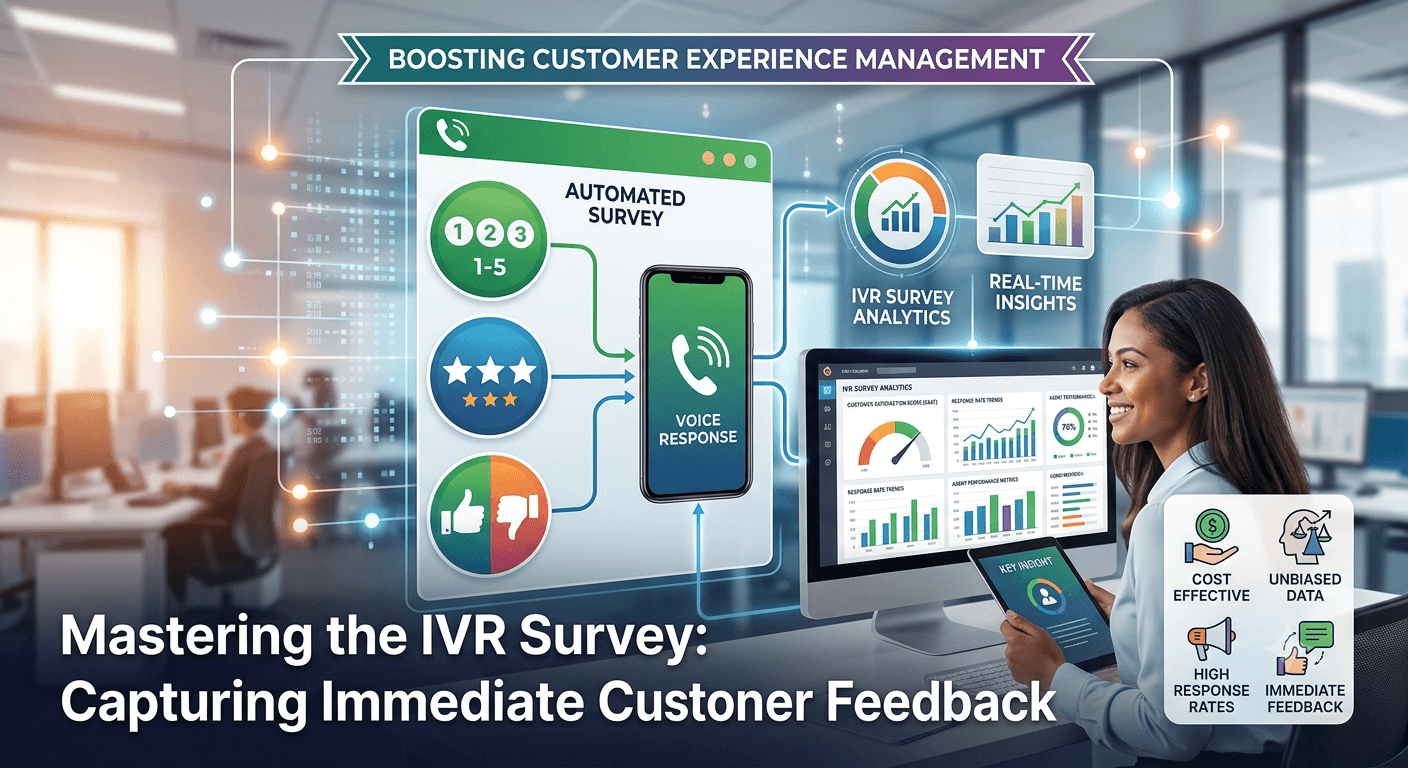
IVR Surveys: Meaning, Benefits, Drawbacks and Best Practices

IVR surveys are automated voice polling systems that allow businesses to collect real-time feedback from customers immediately following a call center interaction. These interactive voice response survey tools prompt callers to answer questions using their phone keypad or voice commands. By leveraging ivr survey software, companies can capture the voice of the customer while the experience is fresh. This automated phone survey method provides high response rates and objective data, making it a cornerstone of modern contact center strategy and customer experience management. Organizations use these tools to measure performance, improve service quality, and gain deep insights into the traditional ivr customer experience. What is an IVR Survey? An interactive voice response survey is a pre-recorded automated system that interacts with callers to gather data. This technology allows customers to provide feedback by pressing numbers on their telephone keypad or by speaking their responses. Unlike manual surveys conducted by live agents, these systems operate independently, ensuring that every customer has an equal opportunity to share their thoughts without the bias of a human interviewer. The system works by routing the caller to a survey module at the end of a support call or during a dedicated outbound campaign. Modern ivr analytics allow businesses to track how callers interact with these menus, identifying where they drop off or which questions cause confusion. By using custom ivr surveys for customers, brands can tailor the language and tone to match their specific audience, ensuring a more personal feel despite the automated nature of the tool. Benefits of IVR survey use Implementing ivr surveys offers a range of logistical and analytical advantages for modern enterprises. These systems are highly scalable, allowing a business to process thousands of feedback entries simultaneously without increasing staffing costs. Because the data is collected digitally, it can be immediately integrated into ivr data analytics platforms for real-time reporting and trend identification. High response rates: Customers are more likely to respond when the survey is presented immediately after their interaction. Cost efficiency: Automated systems eliminate the need for manual data entry or live survey agents. Unbiased data: The absence of a live person removes social desirability bias, leading to more honest answers. Immediate insights: Managers can view ivr metrics as they happen, allowing for rapid intervention if a service issue arises. Consistency: Every customer hears the same questions in the same tone, ensuring data uniformity across the board. 24/7 availability: These surveys can run at any time, capturing feedback from international callers in various time zones. According to a study by the Customer Contact Council, reducing customer effort is the most significant driver of loyalty. IVR surveys facilitate this by providing a low-friction way for users to voice their concerns without having to wait for a follow-up email or separate phone call. Drawbacks of IVR surveys While powerful, these tools are not without limitations. One primary concern is the lack of nuance in keypad responses; a customer might press a 3 for neutral, but the system cannot capture the “why” without complex speech recognition. Additionally, if the survey is too long, callers may hang up, leading to incomplete data sets that skew the final ivr analysis. Another challenge involves the technical reliability of the system under stress. Companies must seek the best solutions for load testing ivr systems reliability peak traffic to ensure the survey does not crash during high-volume periods. If the system fails, it leaves a negative final impression on the customer, potentially damaging the brand more than if no survey had been offered at all. Top IVR survey use cases The versatility of the interactive voice response survey makes it applicable across various departments and industries. From retail support to healthcare appointment follow-ups, these automated tools help bridge the gap between company assumptions and actual customer feelings. Post-interaction customer satisfaction The most common use case is measuring satisfaction immediately after a support call. By asking a few quick questions, the system captures the raw emotion of the caller. This provides a clear picture of how the agent handled the request and whether the issue was resolved to the caller’s satisfaction. Product and service feedback Companies often use these surveys to gather specific data on new product launches. By targeting customers who have recently purchased a specific item, businesses can use an interactive voice response example to ask about ease of use or initial impressions. This direct line to the consumer helps product development teams make data-driven adjustments. ‘Voice of customer’ program integration A robust Voice of the Customer (VoC) program relies on multiple data streams. Integrating ivr surveys into this program ensures that voice-based interactions are weighted equally with web and email feedback. This holistic view is essential for understanding the complete customer journey and identifying systemic pain points. Process improvement identification By analyzing where callers struggle within the survey itself, companies can refine their ivr self service best practices. If a high percentage of users drop off during a contact information survey, it indicates the questions may be too intrusive or the instructions are unclear. This leads to continuous refinement of the automated system. Typical IVR survey response rates Response rates for these surveys are generally higher than for email counterparts, often ranging between 10% and 20%. This is because the request occurs while the customer is still on the line and engaged with the brand. Research from industry experts suggests that voice-based feedback feels more personal and urgent than a digital link sent hours later. 8 IVR survey best practices for actionable insights To maximize the effectiveness of your feedback loop, you must follow established ivr best practices. A poorly designed survey will not only result in bad data but also frustrate your customers. Following a structured approach ensures that the insights you gather are both accurate and useful for making business decisions. 1. Keep surveys brief and focused Respect your customer’s time by limiting the number of questions. Ideally, a survey should take no more than two minutes to complete. Focusing on three to five essential questions ensures a higher completion rate and prevents caller fatigue, which is a common cause of survey abandonment. 2. Time your survey strategically The timing of the survey request is critical for data accuracy. Offering the survey immediately after the agent disconnects ensures the experience is fresh in the caller’s mind. For outbound campaigns, avoid calling during dinner hours or very early in the morning to maintain a positive brand image. 3. Set clear expectations upfront At the start of the survey, inform the caller exactly how many questions will be asked and how much time it will take. This transparency builds trust and makes the caller more likely to stay on the line until the end. Clear instructions on how to use the keypad or voice commands should also be provided. 4. Use consistent rating scales Changing the scale from question to question confuses the caller. If you start with a scale of 1 to 5, where 5 is excellent, stay with that format throughout the entire interaction. Consistency in ivr design best practices prevents “reverse scoring” errors where customers accidentally provide the wrong rating. 5. Include one open-ended question While numeric ratings are great for quantitative analysis, open-ended questions provide qualitative depth. Allowing the customer to record a brief voice message gives them a chance to explain their rating. These recordings are invaluable for ivr analytics and identifying specific issues that numbers alone cannot reveal. 6. Design for action Every question in your survey should have a specific purpose. If you are not going to use the data to change a process or reward an agent, do not ask the question. Designing for action ensures that your ivr metrics are aligned with your organizational goals and key performance indicators. 7. Test before launching Rigorous ivr testing is essential to ensure the logic and flow of the survey are correct. This includes checking that all paths lead to a proper conclusion and that the recording quality is high. Utilizing ivr testing as a service can help identify technical glitches that might occur across different carriers or devices. 8. Close the feedback loop The final step is to act on the feedback received. If a customer provides a very low score, the system should trigger an alert for a supervisor to follow up. Closing the loop proves to the customer that their opinion is valued and can turn a negative experience into a positive one. Is it worth using IVR survey software? Investing in dedicated ivr survey software is often the best path for companies looking to scale their feedback mechanisms. These platforms offer advanced features like sentiment analysis, multi-language support, and deep integration with CRM systems. While basic IVR functions might come with your phone system, specialized software provides the ivr data analytics needed for serious business intelligence. Using a professional tool like nice ivr allows for better management of the survey lifecycle. These platforms often include built-in ivr self service best practices, making it easier to design surveys that convert. Furthermore, they provide the infrastructure needed for an ivr test to ensure that the system remains stable during unexpected traffic spikes. Professional software also simplifies the process of ivr analysis by generating automated reports. Instead of manually crunching numbers, managers can receive weekly summaries of customer sentiment and agent performance. This automation saves time and allows leadership to focus on implementing changes rather than just collecting data. IVR survey question examples to get you started Choosing the right questions is the foundation of any successful automated phone survey. Your questions should be simple, direct, and easy to answer using a standard telephone keypad. Avoid using complex jargon or multiple-part questions that might confuse the caller during the interactive voice response survey. Customer Satisfaction (CSAT) questions These questions are designed to measure a customer’s immediate happiness with a specific interaction. They are usually rated on a scale of 1 to 5 or 1 to 7. On a scale of 1 to 5, how satisfied were you with the service you received today? How well did our agent meet your expectations during this call? Based on your experience today, how likely are you to continue using our services? Net Promoter Score (NPS) questions NPS is a standard metric used to gauge long-term brand loyalty. It typically uses a 0 to 10 scale. How likely are you to recommend our company to a friend or colleague? On a scale of 0 to 10, how would you rate your overall loyalty to our brand? How satisfied are you with our brand’s ability to meet your needs over time? Agent performance questions These questions help call center managers evaluate individual staff members and identify training needs. Was the agent you spoke with today knowledgeable about your issue? How would you rate the professionalism of the agent who assisted you? Did the agent treat you with courtesy and respect throughout the call? Process efficiency questions Understanding how easy it is to work with your company is vital for reducing customer effort. On a scale of 1 to 5, how easy was it to get your issue resolved today? Did you have to repeat your information to multiple agents during this call? How would you rate the speed at which your call was answered? Open-ended question examples These allow for the collection of qualitative data through voice recordings. In a few words, please tell us the main reason for your score today. Is there anything else you would like to share about your experience with us? How can we improve our service to better serve you in the future? Read More: Webrtc vs Sip: A Comprehensive Guide Using an IVR survey: Final thoughts Integrating ivr surveys into your customer experience strategy is a powerful way to gain real-time, actionable insights. By following call center ivr best practices, such as keeping surveys short and testing the system regularly, you can ensure a high response rate and high-quality data. These tools not only help in measuring current performance but also serve as a roadmap for future improvements. As technology evolves, the ability to conduct an ivr analysis with sophisticated analytics will only become more critical for staying competitive. Ultimately, the success of these surveys depends on your commitment to listening to the voice of the customer and taking meaningful action based on their feedback. Faqs What is an IVR survey? An ivr survey is an automated telephone feedback system that allows customers to respond to questions using their voice or keypad. It typically occurs at the end of a customer service interaction to gather immediate data on the experience. These systems are managed by ivr survey software and provide a cost-effective way to gather large volumes of data without human intervention. What does the IVR stand for? IVR stands for Interactive Voice Response. It is a technology that allows a computer to interact with humans through the use of voice and DTMF tones input via a keypad. In the context of surveys, it enables a two-way communication channel where the system prompts the user and the user provides data in return. What are some good IVR examples? A classic interactive voice response example is the post-call satisfaction survey where a caller is asked to rate their experience from 1 to 5. Other examples include automated appointment reminders that ask for a confirmation, or a contact information survey used to update a customer’s records. How is an IVR survey handled? The process begins when a call is transferred to the survey module, either by an agent or automatically by the system. The ivr survey then plays pre-recorded prompts, and the customer provides responses. These responses are captured, stored, and then analyzed using ivr data analytics tools to produce reports for the management team. What is ivr testing and why is it important? It is the process of verifying that the automated voice system works as intended. This includes checking call flows, audio quality, and database integration. It is important because it ensures that customers don’t encounter errors, which helps maintain the reliability of the ivr metrics collected. How can I improve my ivr analysis? To improve analysis, you should integrate your survey data with other customer touchpoints in your CRM. Using advanced ivr analytics software can also help you identify patterns in caller behavior, such as specific times of day when satisfaction drops or common points where users abandon the survey. What are the best practices for ivr design? Key ivr design best practices include keeping the menu structure simple, using natural-sounding voice prompts, and ensuring the most important options are presented first. It is also vital to provide an easy way for customers to opt-out or speak to a human if they become frustrated. Why should I use custom ivr surveys for customers? Customization allows you to tailor the survey experience to specific customer segments or product lines. This makes the survey feel more relevant to the caller, which can significantly increase completion rates and provide more specific, actionable data for your business. What are the key ivr metrics to track? Important metrics include the survey completion rate, the average score (CSAT or NPS), the drop-off rate for specific questions, and the time taken to complete the survey. Monitoring these helps you refine the survey over time for better results.

Read More
call transcript

Call Transcript: Benefits, Working, and Practical Uses

A call transcript is a written record of a spoken conversation, typically generated through artificial intelligence or manual typing. In modern business, a call transcript provides a searchable, shareable, and highly accurate document that captures every detail of a customer interaction or internal meeting. By converting audio into text, organizations can unlock hidden data, ensure regulatory compliance, and improve team training. This process, often referred to as call transcription, utilizes advanced speech-to-text algorithms to identify speakers and interpret context. Whether it is for sales coaching or legal documentation, having a reliable call transcript ensures that no vital information is lost to memory. What is Call Transcription? Call transcription is the technological process of converting the spoken word from a phone or video conversation into a written format. This can be done in real-time or from a recorded file. Modern businesses rely on this technology to maintain accurate records of client interactions, ensuring that every phone call transcription is stored in a centralized database for easy retrieval. The technology has evolved significantly, moving from simple dictation to sophisticated call transcription software that uses natural language processing to understand nuances. The primary goal of creating a call transcript is to provide a reference point that is more accessible than an audio file. While listening to a thirty-minute recording is time-consuming, scanning a written document takes only seconds. This efficiency is why many industries, including finance and healthcare, have made it a standard practice to transcribe phone calls. By utilizing contact center speech to text tools, companies can transform raw audio into structured data that powers business intelligence and helps in making informed decisions. 5 Benefits of Transcribing Calls Implementing a system to transcribe calls offers immediate advantages for operational efficiency and data management. It bridges the gap between verbal communication and digital storage, allowing for a more organized approach to customer relationship management. Organizations that prioritize call transcriptions often see a marked improvement in how they handle information and interact with their client base over time. 1. Makes it Easy to Look for Specific Data Having a call transcript allows team members to use a simple search function to find keywords or phrases within a conversation. Instead of scrubbing through hours of audio, a manager can quickly locate where a specific product was mentioned or where a customer expressed a particular concern. This ability to search through call transcripts saves countless hours of administrative work and ensures that data points are not overlooked during busy periods. 2. Helpful for Legal Purposes In many industries, a phone call transcript serves as a vital piece of evidence in dispute resolution or legal proceedings. If a disagreement arises regarding what was promised during a conversation, referring back to a documented call transcript provides an objective account of the interaction. This transparency protects both the business and the customer, reducing the risk of litigation and ensuring that all parties are held accountable for their verbal agreements. 3. Aids in Employee Training Using real-world call transcripts is one of the most effective ways to train new hires. By reviewing a call transcript from a high-performing agent, trainees can learn the correct phrasing, tone, and logic required to close a deal or solve a complex problem. This hands-on material is far more impactful than theoretical scripts because it shows how actual conversations unfold in a live environment. 4. Improved Customer Service and Satisfaction When agents have access to a previous call transcript, they can enter a conversation with full context of the customer’s history. This prevents the customer from having to repeat their story multiple times, which is a major pain point in support. A call transcript ensures that the service provided is seamless and personalized, directly leading to higher satisfaction scores and long-term brand loyalty. 5. Better Accessibility Transcribing phone calls makes the information accessible to individuals who may be hard of hearing or those who prefer reading over listening. Furthermore, a call transcript can be easily translated into different languages, allowing global teams to collaborate more effectively. This inclusivity ensures that vital business information is available to every stakeholder, regardless of their physical abilities or native language. How does call transcription work? The mechanics of call transcription involve several layers of technology working in tandem. First, the audio signal is captured via call recording and transcription software. This audio is then processed through an Automatic Speech Recognition engine, which breaks down the sound into phonemes. These small units of sound are compared against a vast linguistic database to determine the most likely words being spoken, even when transcribing audio with technical jargon or acronyms. Once the initial text is generated, Natural Language Processing (NLP) is applied to add punctuation and identify different speakers. This step is crucial for creating a readable call transcript that makes sense to a human reader. Research from the National Institute of Standards and Technology (NIST) indicates that modern AI-driven speech-to-text systems have reached accuracy levels that rival human transcribers, often exceeding 95% in controlled environments. This high level of precision makes call transcriptions a reliable tool for professional use. Practical Uses of Call Transcriptions The utility of a call transcript extends far beyond simple record-keeping. Different departments across an organization can leverage these documents to refine their strategies and improve outcomes. From sales to operations, the insights buried within a phone transcription can provide a competitive edge in a crowded market. Using call transcripts in sales calls Sales teams utilize a call transcript to sharpen their sales pitches by reviewing which arguments resonate most with prospects. By analyzing how top performers handle objections like a pro and fix delivery issues, managers can train new sales reps faster and with more relevant examples. The data allows sales and marketing to work together by scoring leads more accurately based on the specific needs expressed during the call. Furthermore, gathering insider info on competitors mentioned by prospects helps in adjusting market positioning. Finally, using the transcript to make follow-ups more personal ensures that every subsequent interaction is based on the actual needs of the buyer. Improving customer service with call transcripts Customer support managers use call transcripts to find out what is causing the same problems across different users. By reviewing these documents, they can help agents sound more empathetic and provide real-time help during calls through live transcription features. Solving problems before they get worse is easier when you can spot negative trends early in the transcript. Additionally, these documents are used to create better knowledge base articles, essentially helping customers help themselves by documenting the most common solutions provided by human agents during phone transcripts sessions. Increase customer retention with transcriptions Retaining customers is often about identifying subtle signs of dissatisfaction before they lead to churn. A call transcript helps in predicting customer churn by flagging keywords associated with frustration or competitor interest. Improving loyalty programs becomes data-driven when you have thousands of call transcripts to analyze for what customers truly value. Companies can create better products by listening to direct feedback found in a call transcript and personalizing onboarding experiences for new users. This proactive approach turns happy customers into brand advocates who feel heard and understood by the company. Enhancing the employee experience with call transcripts The employee experience is improved when coaching is based on objective data rather than subjective memory. A call transcript allows managers to coach employees with real examples of their own successes and failures. Teaching conflict resolution becomes more effective when agents can read back through a heated exchange and identify where things went wrong. Fixing bias in customer interactions is another critical use, as transcripts make it easier to audit calls for fairness. By closing knowledge gaps and helping teams work better together, a call transcript fosters a culture of continuous learning and mutual support. Improving operational efficiency from call transcripts Operational efficiency is boosted when businesses use a call transcript to make IVR systems less frustrating. By analyzing where people drop off or ask for a human, companies can refine their automated menus. Speeding up customer service with automated summaries generated from a call transcript reduces the time agents spend on after-call work. Keeping businesses compliant with industry regulations is simpler when every call is documented and searchable. Tracking performance with SLA monitoring and managing crises more effectively are also made possible by the rapid dissemination of information found in call transcripts. Accelerating innovation and strategy with call transcripts Strategy teams use a call transcript to track customer sentiment on a large scale. This data is essential for making localization more effective by understanding regional dialects or specific cultural needs expressed during calls. Reducing customer effort becomes a measurable goal when you can see exactly how many steps a customer takes to resolve an issue in a phone transcript. Staying ahead of competitors involves mining transcripts for mentions of rival features or pricing. Ultimately, improving accessibility and innovation is driven by the rich, qualitative data that only a detailed call transcript can provide. The importance of speech-to-text transcription Speech-to-text technology is the backbone of the modern digital workspace. Without it, the vast amount of data generated in voice conversations remains trapped in audio files that are difficult to analyze. By converting this into a call transcript, businesses can feed information into their CRM, analytics tools, and AI models. This transformation is vital for organizations that want to be data-driven. According to Gartner, by 2025, 75% of conversation data will be analyzed by AI to improve customer experience and operational efficiency, highlighting the growing necessity of a call transcript. Using call transcription in your business To successfully integrate this technology, businesses must choose a call transcriber that fits their specific needs. Some may require real-time video call transcription for international meetings, while others might focus on phone call transcription for their support centers. It is important to select a tool that integrates directly with existing communication platforms to ensure a smooth workflow. Once the system is in place, the resulting call transcript should be stored securely and made accessible to relevant departments to ensure the data is actually used to drive improvement. Legality of call transcriptions Before you transcribe phone calls, it is essential to understand the legal landscape regarding recording and transcription. Laws vary significantly by region; for instance, some jurisdictions require “one-party consent,” while others require “all-party consent.” Businesses must ensure they are notifying callers that they are being recorded for quality and training purposes. Failure to comply with these regulations can lead to heavy fines and legal repercussions. Always consult with legal counsel to ensure your use of a call transcript complies with local privacy laws like GDPR or CCPA. Dual- versus single-channel recordings for transcriptions When setting up a system to generate a call transcript, the choice between dual-channel and single-channel recording is critical. Single-channel, or mono recording, puts both the caller and the agent on a single audio track. This can make it difficult for call transcription software to distinguish between speakers if they talk over each other. This often results in a messy call transcript where the dialogue is jumbled, making it harder to analyze who said what during the interaction. Dual-channel, or stereo recording, captures each speaker on a separate audio track. This is the gold standard for creating a high-quality call transcript. Because the audio is separated, the transcription engine can accurately identify the speaker for every word, even during interruptions. This leads to much higher accuracy and a more professional call transcript. For businesses that rely on contact center speech to text for deep sentiment analysis or compliance, investing in dual-channel recording is a necessary step to ensure data integrity. Read More: 5g Network Slicing: Types, Benefits, Working and Examples Conclusion The use of a call transcript has evolved from a luxury to a fundamental business requirement in the digital age. By providing a clear, searchable, and accurate record of every conversation, companies can protect themselves legally, train their staff more effectively, and offer a superior level of customer service. The insights gained from call transcription allow for a deeper understanding of market trends and customer needs that audio recordings alone simply cannot provide. As AI technology continues to advance, the accuracy and utility of a call transcript will only increase, making it an indispensable asset for any organization looking to thrive. Embracing this technology today ensures that your business remains agile, compliant, and deeply connected to the voice of its customers. Frequently Asked Questions What is a transcript of a call? A call transcript is a written version of the conversation that took place during a phone or video call. It captures the spoken words of all participants and converts them into text for easier reading, searching, and documentation. Businesses use these transcripts to maintain records, analyze customer interactions, and ensure that no details from the conversation are lost. How does call transcription software improve customer service? Transcription software allows agents to review previous interactions with a customer, providing them with immediate context and preventing the need for the customer to repeat themselves. It also helps managers identify common customer pain points through keyword analysis, allowing the company to improve its processes and provide faster, more accurate solutions. How do transcription services help sales teams? Sales teams use transcripts to review their performance and identify which parts of their pitch are most effective. By reading through a call transcript, reps can see exactly where they lost a prospect’s interest or where an objection was successfully handled. This allows for data-backed coaching and the refinement of sales scripts to increase conversion rates. Can call transcription assist with employee training? Yes, transcripts provide real-world examples of both excellent and poor customer interactions. New employees can study the call transcript of a top-performing agent to learn best practices, or they can review their own transcripts with a supervisor to identify specific areas for improvement, making the training process much more practical and effective. How can call transcription improve operational efficiency? It improves efficiency by automating the documentation process, which reduces the time agents spend on manual notes after a call. Furthermore, searchable transcripts allow staff to find information in seconds rather than listening to long audio files, and automated summaries help in quickly relaying key points to other departments. How does call transcription of audio files support product development? Product teams can scan transcripts for mentions of specific features, bugs, or requested improvements. By aggregating this feedback from thousands of customer calls, developers can prioritize their roadmap based on actual user needs and pain points, leading to products that better fit the market’s demands. How do I get my call transcript? To get a call transcript, you typically need to use a communication platform that has built-in transcription features or a third-party call transcription service. After the call is recorded, the software processes the audio and generates a text file which is usually emailed to you or stored in your account dashboard. How to generate call transcript? You can generate a transcript by enabling the recording and transcription feature in your phone system or video conferencing tool. For existing audio files, you can upload them to an AI-powered call transcriber which will automatically convert the speech to text within minutes, providing a structured document for your review. What does transcript mean on a phone? On a phone, a transcript usually refers to a text version of a voicemail or a live call. Many modern smartphones and business phone systems offer “visual voicemail” or “live captioning,” which provides a call transcript so you can read what the caller is saying without having to listen to the audio.

Read More
Webrtc vs Sip

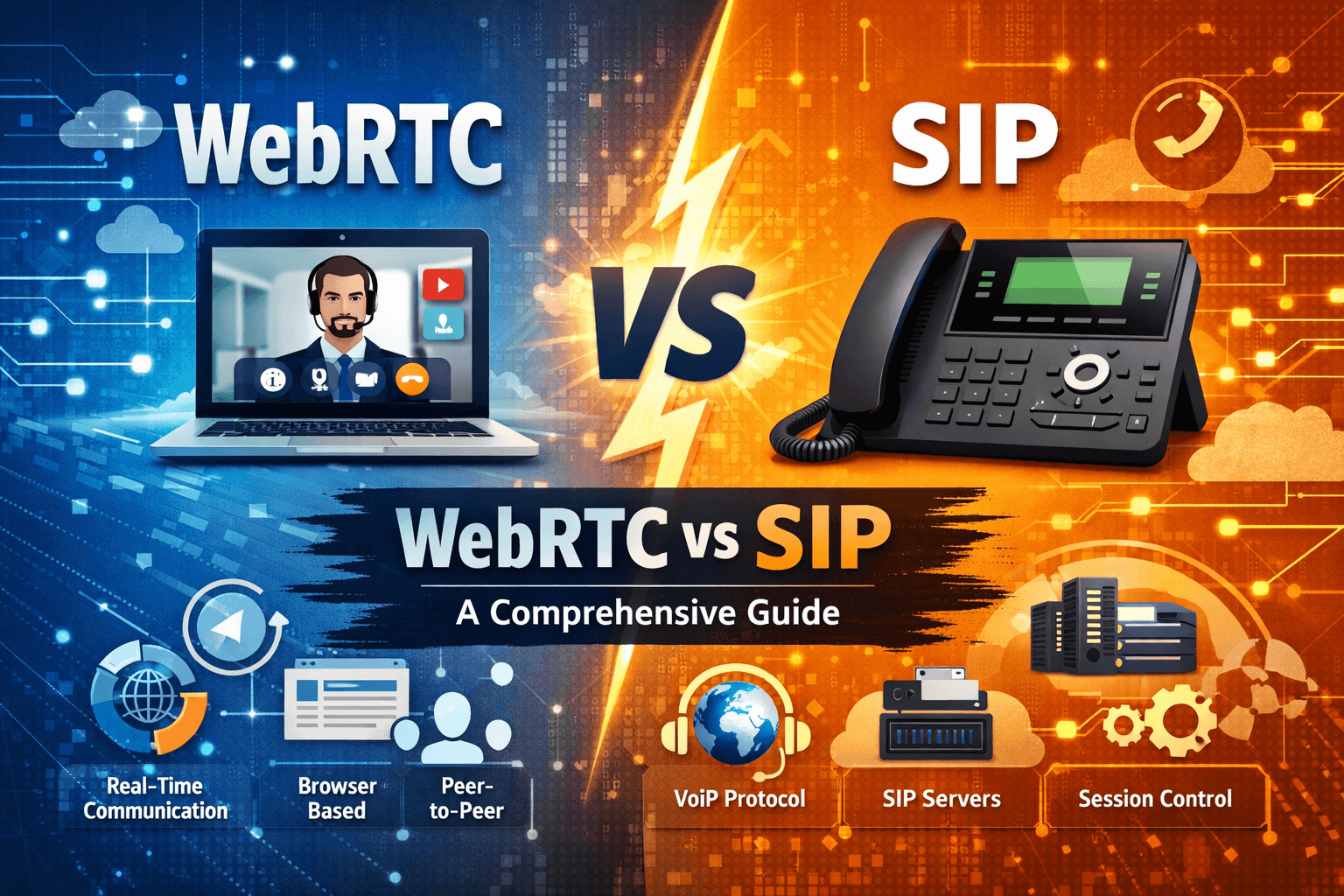
Webrtc vs Sip: A Comprehensive Guide

WebRTC vs. SIP: Choosing the right technology is a critical decision for businesses building modern communication tools. WebRTC offers a plugin-free, browser-based experience that leverages JavaScript for real-time video and audio, making it ideal for web applications. In contrast, SIP is a veteran signaling protocol used primarily in hardware-based VoIP and PBX systems, offering deep integration with legacy phone networks. While WebRTC excels in ease of access and low-latency web interactions, SIP provides a robust framework for complex enterprise telephony. Understanding the technical nuances between these two allows developers to choose between browser agility and established telecommunication stability for their specific use cases. WebRTC vs. SIP: A direct comparison When we look at the landscape of real-time communication, we often find ourselves comparing two distinct philosophies of connectivity. WebRTC vs. SIP represents the bridge between the modern web and the traditional world of telecommunications. We see WebRTC as a collection of standards and APIs that allow browsers to communicate directly without extra software, whereas SIP acts as the signaling language that manages the sessions for voice and video calls across diverse hardware. To help you visualize the core differences, we have compiled a comparison table that highlights the technical and operational distinctions between these two giants of communication. Feature WebRTC SIP Primary Use Browser-to-browser communication IP-based telephony and PBX Installation No plugins required (built-in) Requires softphones or hardware Development High use of JavaScript SIP libraries Protocol-specific configuration Security Always encrypted (DTLS/SRTP) Security is optional (SIPS/TLS) Flexibility Extremely high for web apps High for physical office setups Standardization W3C and IETF IETF (RFC 3261) Network Peer-to-peer (P2P) focus Server-client architecture Cost Generally lower infrastructure cost Higher hardware and licensing costs Expert insight: Choosing between WebRTC and SIP “I’ve seen how SIP has long held its place in reliable, large-scale voice networks, especially where integration with legacy PSTN systems is non-negotiable. Yet in recent years, WebRTC’s browser-based simplicity and built-in security have made it a powerful alternative for teams who need agility more than heavy hardware. In practice, the best choice is often hybrid: leveraging SIP where its strengths lie, and layering in WebRTC for user-facing, browser-powered communication to streamline operations.” — Dmytro Honcharenko, Co-Founder at Teliqon. We believe this perspective captures the essence of the modern developer’s dilemma. Choosing WebRTC vs. SIP is not always about picking one over the other but understanding where each fits in your architecture. If we are building a customer support portal, WebRTC is almost always the winner, but for a corporate office with desk phones, SIP remains the undisputed king. What is WebRTC? If you are asking whats WebRTC, it is an open-source project providing browsers and mobile applications with real-time communication capabilities via simple APIs. It was released by Google in 2011 and has since become a standard for video conferencing, file sharing, and peer-to-peer data exchange. Because it is built directly into the browser, we do not need to ask users to download any executable files or third-party extensions to start a call. The architecture of WebRTC relies on three main JavaScript APIs that handle the heavy lifting of media and data transmission. These include: MediaStream: This captures the audio and video signals from the user’s camera and microphone. RTCPeerConnection: This handles the stable connection between two users, including NAT traversal and encryption. RTCDataChannel: This allows for the bidirectional transfer of arbitrary data directly between peers. By leveraging these tools, we can create incredibly responsive applications. However, we must remember that WebRTC does not include a built-in signaling protocol. This means we have to provide our own way for devices to find each other, which is where many developers might actually use a Javascript SIP implementation to manage the connection logic. What is SIP? SIP, or Session Initiation Protocol, is a signaling protocol used for initiating, maintaining, and terminating real-time sessions that include voice, video, and messaging applications. It is the backbone of the Voice over IP industry. We use SIP to establish a connection between two or more endpoints, whether they are physical IP phones or software-based clients. Unlike WebRTC, SIP is purely a signaling protocol; it does not actually transport the media itself, which is usually handled by the Real-time Transport Protocol. The SIP ecosystem is vast and mature, supported by a massive array of hardware manufacturers and service providers. When we implement SIP, we are usually working within a structured environment involving SIP Registrars, Proxies, and Gateways. This structure allows for features like call forwarding, presence information, and sophisticated billing systems that are essential for enterprise-level operations. Research by the Eastern Management Group has indicated that SIP trunking remains the dominant method for business communication globally, with over 70% of enterprises utilizing it in some capacity. This highlights that while newer technologies emerge, the reliability of SIP continues to make it a staple in professional environments. We often see it as the “glue” that holds together different communication endpoints across the globe. When to choose WebRTC We recommend choosing WebRTC when your primary goal is to provide a seamless user experience within a web browser or a mobile app. It is the perfect choice for consumer-facing applications where you cannot expect the user to install a specific piece of software. If you are building a telehealth platform, an online classroom, or a simple “click-to-call” button on your website, WebRTC vs. SIP comparisons usually favor the former due to its low barrier to entry. Furthermore, WebRTC is ideal for developers who want to maintain full control over the user interface. Since it integrates directly with HTML5 and CSS, we can style the video windows and controls to match the branding of our application perfectly. This level of customization is much harder to achieve with standardized SIP clients that often come with their own pre-defined interfaces. Advantages of WebRTC No Plugins Required: Users can join a session directly from Chrome, Firefox, Safari, or Edge without any downloads. High Media Quality: It uses the Opus audio codec and VP8/VP9 video codecs, which provide excellent quality even on variable network speeds. End-to-End Encryption: Security is not an afterthought; WebRTC enforces encryption through SRTP and DTLS for every session. Open Source: Being open-source means there is a massive community and plenty of documentation for troubleshooting. Low Latency: Designed for peer-to-peer communication, it minimizes the delay often found in server-routed calls. Interoperability: It works across different operating systems and devices as long as a modern browser is available. Adaptive Bitrate: The protocol automatically adjusts the quality of the stream based on the available bandwidth of the user. Drawbacks of WebRTC One major drawback of WebRTC is the complexity of signaling. Since it doesn’t define how peers discover each other, we have to build or buy a signaling server. This can lead to a “SIP and suffer” situation if the signaling layer is not managed correctly. Additionally, WebRTC can be quite CPU-intensive on older mobile devices because the browser handles all the encoding and decoding of media. Another challenge is NAT traversal. While WebRTC uses STUN and TURN servers to bypass firewalls, setting up and maintaining these servers can be a technical hurdle. If a peer is behind a very restrictive corporate firewall, the connection might fail unless a high-quality TURN relay is used, which adds to the operational cost and latency of the system. When to choose SIP We find that SIP is the superior choice for established businesses that require deep integration with the Public Switched Telephone Network. If your team needs to make calls to traditional landlines or mobile numbers frequently, SIP provides the necessary gateways to bridge the gap between IP and traditional telephony. In the debate of WebRTC vs. SIP, SIP is the clear winner for physical office environments where hardware desk phones are the standard. SIP is also built for scale in a different way. While WebRTC is great for P2P, SIP is excellent for managing thousands of “extensions” within a company. It allows for advanced features like automated attendants, hunt groups, and complex call routing rules that are native to PBX systems. For large call centers or corporate headquarters, the structured nature of SIP is a significant benefit. Advantages of SIP Legacy Integration: Seamlessly connects with existing phone systems and PSTN providers worldwide. Device Variety: A massive range of compatible hardware exists, from budget desk phones to high-end executive video systems. Feature Rich: Native support for professional telephony features like call transfer, park, and hold. Standardized Signaling: Unlike WebRTC, the signaling is defined, meaning different SIP-compliant devices can talk to each other easily. Centralized Management: Easier to manage a large number of users and devices from a central SIP server or PBX. Low Browser Dependency: Does not rely on the user’s browser version or compatibility for a call to work. Reliability: Decades of refinement have made SIP signaling extremely stable for long-duration voice calls. Drawbacks of SIP The biggest downside of SIP is the “SIP and suffer” phenomenon, which refers to the difficulty of configuring firewalls to allow SIP traffic. Because SIP uses a wide range of ports for media and signaling, it often requires complex Session Border Controllers to function correctly in a secure network. This can be a headache for IT teams who are not specialized in VoIP technology. Additionally, the user experience for SIP is often fragmented. Users must typically download a specific softphone app and enter complex credentials like the registrar address, username, and password. This is a significant friction point compared to the “one-click” nature of WebRTC. We also see that SIP security is not always enabled by default, requiring extra configuration to ensure calls are encrypted. Integrating WebRTC and SIP: The hybrid option We often see that the best solution isn’t picking one, but integrating both. This is where a Javascript SIP library comes into play. By using a SIP over WebSockets gateway, we can allow a web browser (using WebRTC) to register as a SIP client. This allows us to get the best of both worlds: the reach and features of a SIP PBX with the ease of use of a WebRTC browser interface. Integrating these two allows a company to keep their reliable back-end SIP infrastructure while giving their employees or customers a modern, browser-based way to connect. We believe this hybrid approach is the future of business communication because it solves the “last mile” problem of SIP by using WebRTC for the user interface. Benefits of integrating WebRTC with SIP Unified Communication: Connects web users directly into the company’s internal phone system. Cost Efficiency: Reduces the need for expensive hardware for every employee. Accessibility: Employees can take office calls from any laptop without needing a dedicated VPN or softphone. Better UX: Developers can build custom web interfaces for SIP calls using standard web technologies. Scalability: Allows businesses to quickly add new users to their communication network via a web portal. Security: Uses WebRTC’s mandatory encryption to secure the connection between the user and the gateway. Use case examples A common use case we see is in the insurance industry. An agent might use a traditional SIP desk phone in the office, but when a client visits the company website, they can click a button to start a WebRTC call. This call is routed through a gateway and rings on the agent’s SIP phone. This creates a seamless bridge between the customer’s web experience and the company’s internal tools. Another example is in remote technical support. A technician can use a web-based dashboard to initiate a video call with a customer. The back-end system uses SIP to log the call, record the audio for compliance, and manage the queue, while the technician and customer interact through a high-definition WebRTC video stream. This synergy is why we think WebRTC vs. SIP is a partnership rather than a competition. Reviews To give you a better understanding of how these technologies perform in the real world, we have gathered insights from various online communities. The general sentiment often reflects the “WebRTC vs. SIP” struggle that many developers and IT managers face daily. While developers love the flexibility of WebRTC, IT administrators often prefer the controlled environment of SIP. We have looked at thousands of discussions to summarize the most common pros and cons shared by actual users. These reviews highlight that the choice often depends on the specific technical expertise of the team and the intended environment of the application. What users actually say on Reddit On subreddits like r/VoIP and r/WebRTC, the community often debates the “SIP and suffer” aspect of traditional telephony. Many users mention that setting up a SIP server like Asterisk or FreePBX is a steep learning curve but provides incredible power. Conversely, WebRTC is praised for its “magic” ability to work in a browser, but many complain about the lack of standardized signaling, which leads to fragmented implementations. We noticed several threads where users discussed the difficulty of debugging WebRTC connection issues, particularly with ICE candidates. On the SIP side, the most common complaints involve “one-way audio” issues caused by NAT, which is a classic SIP problem. Overall, Reddit users tend to view WebRTC as the future of the “front end” and SIP as the “back end” workhorse. What users actually say on Quora On Quora, the discussions around WebRTC vs. SIP are often more focused on business value and use cases. Experts on the platform frequently point out that WebRTC is not a replacement for SIP, but a different tool for a different job. Many answers emphasize that WebRTC is best for developers who want to build something new, while SIP is for those who need to connect to something that already exists. We found several highly upvoted answers suggesting that for startups, WebRTC is the way to go to keep costs low and development fast. However, for established enterprises with existing investment in Cisco or Avaya hardware, SIP remains the logical choice. The consensus on Quora seems to be that understanding the “whats WebRTC” question is the first step toward a modern digital transformation. Reviews from Trustpilot When we look at companies that provide these technologies, such as Twilio (WebRTC-focused) and RingCentral (SIP-focused), the Trustpilot reviews are quite revealing. Users often praise WebRTC-based tools for their “ease of use” and “no-download” experience. For SIP-based providers, the praise usually centers on “voice reliability” and “extensive desk phone support.” However, the negative reviews for WebRTC platforms often mention “unexpected browser compatibility issues” or “high data usage.” SIP providers frequently get hit with reviews regarding “complex setup processes” and “difficult billing structures.”   We see that users are generally happy with WebRTC when it works perfectly but get frustrated when a browser update breaks something. With SIP, the frustration is usually at the beginning during the configuration phase, but once it is set up, it is perceived as more “set it and forget it.” Choosing the best communication technology In the final analysis of WebRTC vs. SIP, the best technology is the one that aligns with your specific goals. If your priority is user accessibility and you are building for the web, WebRTC is the clear choice. We recommend starting with a solid Javascript SIP library if you need to bridge your web app with an existing phone network. This provides the most flexible path forward for modern development. However, if you are looking for a rock-solid, enterprise-grade phone system for an office with hundreds of employees, SIP is still the gold standard. It provides the reliability, hardware support, and deep telephony features that WebRTC was never designed to handle alone. We often find that the most successful projects are those that recognize the strengths of both and use them in tandem. According to a report by Gartner, by 2025, 80% of enterprise customer service interactions will occur through digital channels like WebRTC, yet SIP will continue to handle the majority of internal corporate voice traffic. This underscores the importance of being proficient in both. As you move forward, consider your team’s technical skills, your budget, and the needs of your end-users to make the most informed decision. Read More: VoIP for Healthcare Providers: Benefits & Challenges Final Thought We have explored the intricate world of WebRTC vs. SIP, from the code-heavy implementation of JavaScript SIP to the hardware-centric reliability of traditional VoIP. Both technologies have shaped how we communicate today. Whether you are avoiding the “SIP and suffer” pitfalls or exploring the latest WebRTC news to improve your app, the key is to stay adaptable. By choosing the right tool for the right task, you can build communication experiences that are both powerful and user-friendly. FAQs Which is faster, WebRTC or WebSocket? WebRTC is generally faster for real-time media because it uses UDP, which allows for lower latency compared to the TCP-based WebSockets. While WebSockets are excellent for persistent data signaling, WebRTC is specifically designed for the high-speed demands of audio and video. Is WhatsApp using WebRTC? Yes, WhatsApp uses a modified version of WebRTC for its voice and video calling features. This allows the app to provide high-quality, encrypted communication across different mobile devices and its web interface. What is the difference between WebRTC and VoIP? VoIP is a broad term for any voice communication over the internet, while WebRTC is a specific set of technologies that enable VoIP within browsers. You can think of WebRTC as a modern way to implement VoIP without needing a standalone application. Is WebRTC a TCP or UDP protocol? WebRTC primarily uses UDP because it prioritizes speed over perfect data delivery, which is essential for live video. However, it can fall back to TCP (usually via a TURN server) if the network environment is too restrictive for UDP traffic. Can I use SIP with WebRTC? Yes, you can use a SIP-to-WebRTC gateway. This allows you to use a web browser as an endpoint for your SIP-based phone system, effectively combining the two technologies. Do I need a server for WebRTC? Yes, you still need a signaling server to help peers find each other, as well as STUN/TURN servers to handle NAT traversal and relaying media when a direct P2P connection isn’t possible. Why is SIP called “SIP and suffer”? This is a common joke among IT professionals because of the difficulties involved in getting SIP to work through firewalls and NAT. It often requires significant configuration and troubleshooting compared to modern web protocols. Is WebRTC more secure than SIP? WebRTC has encryption built-in by default and it cannot be turned off. SIP can be secured using TLS and SRTP, but it is not always enforced, making WebRTC “safer” out of the box. What is a Javascript SIP library? It is a library like SIP.js or JsSIP that allows developers to implement the SIP protocol using JavaScript. This is the primary way to connect a WebRTC-enabled browser to a SIP server.

Read More
5g network slicing (3)

5g Network Slicing: Types, Benefits, Working and Examples

5g network slicing is a revolutionary network architecture that allows mobile operators to create multiple virtual networks atop a single physical 5G infrastructure. Each “slice” is an isolated, end-to-end network tailored to meet the specific requirements of a particular application, service, or customer. By leveraging technologies like Software Defined Networking (SDN) and Network Functions Virtualization (NFV), 5g network slicing ensures that diverse use cases—ranging from high-speed mobile broadband to ultra-reliable low-latency communications for autonomous vehicles—receive the exact bandwidth, security, and latency they need without interfering with other network traffic or degrading performance for other users. What is 5G network slicing? The concept of 5g network slicing represents a fundamental shift in how telecommunication networks are designed and managed. Historically, mobile networks were built as a one-size-fits-all infrastructure, where every device and application shared the same pool of resources regardless of their specific needs. With the advent of 5G, this rigid structure has evolved into a flexible, software-driven environment. At its core, what is 5g network slicing is the ability to partition a single physical network into multiple virtual layers, each optimized for a specific business purpose or technical requirement. This technology allows for the creation of customized connectivity solutions. For instance, a network operator can dedicate one 5g network slice specifically to emergency services, ensuring they have priority access and high reliability, while another slice is dedicated to general consumer internet usage. Because these slices are logically isolated, a surge in traffic on one slice does not impact the performance of another. This isolation is critical for maintaining a high-quality network slicing customer experience, especially for industries that cannot afford even a millisecond of downtime. The ability to offer network slicing as a service opens up new revenue streams for telecommunications providers. Instead of selling simple data plans, they can now offer specialized connectivity packages with guaranteed Service Level Agreements (SLAs). This transformation is why many industry experts consider 5g slicing to be the “secret sauce” that will finally unlock the full economic potential of the fifth generation of mobile networks. According to research from the GSMA, the implementation of 5g network slicing is expected to be a primary driver for the 5g network slicing market, which is projected to grow significantly as enterprises seek more control over their wireless connectivity. Principal types of network slicing in 5G To understand the full scope of this technology, it is essential to look at the three primary categories defined by international standards. These categories help clarify 5g network slicing explained for different industrial and consumer needs. Each type of slice is engineered with specific parameters for speed, capacity, and latency to serve different ends of the digital spectrum. 1. Enhanced Mobile Broadband (eMBB) Enhanced Mobile Broadband slicing ensures 5G applications with heavy traffic on mobile networks can deliver high-quality broadband services. Mobile users can secure the required bandwidth to access 5G capabilities like streaming services or online games without delays, connectivity issues, or outages. This slice type is primarily focused on delivering extremely high data rates and improving capacity in densely populated areas. By using eMBB, operators can support high-definition video streaming and augmented reality experiences that would otherwise congest a standard network. 2. Massive Machine Type Communications (mMTC) Massive Machine Type Communications, or mMTC for short, is a specific network slicing 5g method for large-scale IoT (Internet of Things) applications. As the name suggests, this slicing type is meant to manage huge amounts of interconnected devices with limited data rates. These devices often require long battery life and only transmit small bursts of data intermittently. Smart city sensors, utility meters, and agricultural monitors are perfect examples of devices that utilize the mMTC slice to remain connected efficiently without consuming the high-power resources reserved for smartphones. 3. Ultra-Reliable Low Latency Communication (uRRLC) Ultra-Reliable Low Latency Communication (uRRLC) is used for basic business applications that don’t require as many resources but need a high reliability level. uRRLC is, therefore, designed to provide low latency and high dependability to ensure efficient services. This is perhaps the most critical slice for the future of automation. It supports mission-critical tasks where even a slight delay could be catastrophic, such as autonomous driving, remote industrial robotics, and smart grid management. The uRRLC 5g network slice guarantees that data packets arrive on time, every time. Key elements of 5G network slicing architecture The 5g network slicing architecture is built on several sophisticated technologies that work in harmony to create and manage virtual layers. These elements transition the network from a hardware-centric model to a software-centric one, allowing for the dynamic allocation of resources. Understanding these components is vital for anyone looking to implement a network slicing solution within a modern enterprise. 1. Network functions virtualization (NFV) Network functions virtualization involves replacing physical hardware with virtual machines. This architecture concept allows businesses to get the most out of 5G technology by modernizing networks similarly to Vonage Network APIs, granting greater accessibility, flexibility, and scalability. Instead of installing and maintaining traditional hardware, organizations can leverage NFV to handle load balancing, routing, and firewall security virtually. This virtualization is what makes a 5g network slice possible, as it decouples the software from the underlying physical infrastructure, allowing multiple instances of network functions to run on shared servers. 2. Software defined networks (SDNs) Software defined networks make the network easier to manage by separating the decision-making part (control) from the data movement part. This allows operators to quickly set up and adjust different slices to meet the needs of different users or services. SDN acts as the central intelligence that tells the network where to send traffic and how to prioritize it. Without SDN, the manual configuration required to create a network slice would be too complex and slow for modern demands. 3. The control plane The control plane is like the brain of the network. It handles instructions, decides how data should flow, and ensures the network works properly. In network slicing, it helps direct data to the right slice and makes sure each slice runs smoothly and efficiently. The control plane manages the signaling and ensures that the 5g network slicing technology advancements are applied consistently across all virtual layers, maintaining the integrity of each individual slice. 4. Recursion Recursion in network slicing means adjusting and reconfiguring slices as needed. For example, if one slice gets too busy, the network can make changes on the fly to maintain performance. This adaptability ensures that all slices meet their specific service requirements, even during unexpected changes. Recursion allows for a hierarchical structure where a large slice can be further subdivided into smaller, more specific sub-slices, providing an even higher degree of customization for complex organizations. 5. The network slice controller (orchestrator) The orchestrator is like the manager of all the slices. It ensures each slice gets the right amount of resources, tracks how well they’re working, and makes adjustments when needed to meet service promises. The orchestrator is responsible for the entire lifecycle of a slice, from its initial creation and resource provisioning to its eventual decommissioning. It ensures that the network slicing technology remains cost-effective by reclaiming resources when a slice is no longer in use. 6. Single-Network Slice Selection Assistance Information (S-NSSAI) S-NSSAI is like an address label for network slices. It helps connect devices or services to the right slice by identifying which one meets their needs. This ensures that every user or application gets the correct network resources for specific requirements, such as speed, reliability, or capacity. When a device connects to the network, the S-NSSAI tells the core network exactly which 5g network slice the device is authorized to use, ensuring a seamless and secure connection process. How does 5G network slicing work? To understand how 5g network slicing works, one must visualize the network as a set of logical pipes running through a single physical tunnel. The process begins at the 5G Core, where the physical hardware is partitioned using virtualization. Each slice is an isolated end-to-end logical network that includes the Radio Access Network (RAN), the core network, and the transport link. When a specific service or device requests access, the network identifies its requirements—such as a need for low latency or high bandwidth—and assigns it to the corresponding slice. The service provider defines the requirements for a specific use case, such as the maximum latency or minimum data rate. The orchestrator allocates the necessary virtual resources across the RAN and the core network to create the slice. Traffic is tagged with a slice ID, ensuring it stays within its designated virtual boundaries throughout its journey. The network monitors the performance of the slice in real-time, adjusting resources dynamically to maintain the agreed-upon quality of service. This dynamic nature is what distinguishes network slicing 5g from traditional Virtual Private Networks (VPNs). While a VPN provides a secure tunnel, it does not guarantee specific performance metrics like latency or jitter. In contrast, a 5g network slice provides a deterministic environment where performance is guaranteed. This is particularly important for the network slicing market, as industries like manufacturing require precise timing for their automated assembly lines that only a dedicated slice can provide. 5G network slicing examples and use cases The versatility of network slicing in 5g is best demonstrated through its diverse range of applications. By tailoring the network to the specific needs of different industries, 5g network slicing enables innovations that were previously impossible with older generations of mobile technology. These use cases highlight how a network slice can be the foundation for the next wave of digital transformation. Logistics (fleet management and asset tracking) In the logistics sector, 5g network slicing allows companies to track thousands of assets simultaneously across vast geographic areas. Using an mMTC slice, logistics providers can connect sensors on shipping containers, delivery trucks, and warehouse shelves. These sensors provide real-time data on location, temperature, and handling conditions. Because the mMTC slice is optimized for many low-power devices, companies can maintain a comprehensive tracking system without the high costs associated with traditional high-bandwidth data plans. Live event streaming For broadcasters and content creators, live event streaming requires massive amounts of upstream bandwidth and zero interruptions. By utilizing an eMBB slice, a media company can ensure that their 4K or 8K video feed from a stadium is transmitted with perfect clarity, even when thousands of fans in the stands are using their phones simultaneously. This isolation prevents the general public’s data usage from slowing down the professional broadcast, ensuring a premium viewing experience for audiences at home. Healthcare (remote consultations and surgery) Healthcare is perhaps the most life-altering application of network slicing technology. Remote surgery requires ultra-low latency to ensure that a surgeon’s movements are mirrored by a robotic arm miles away without any perceptible lag. A dedicated uRRLC slice provides the necessary reliability and speed for these critical procedures. Beyond surgery, 5g network slicing facilitates remote patient monitoring and high-speed transmission of large medical imaging files, allowing specialists to provide expert care to patients in rural or underserved locations. Why is 5G network slicing 3GPP recognized? The 3rd Generation Partnership Project (3GPP) is the global organization that develops standards for mobile telephony. The recognition of 5g network slicing by 3GPP ensures that the technology is standardized and interoperable across different vendors and countries. This standardization is vital for the global adoption of what is network slicing, as it allows equipment from different manufacturers to work together seamlessly within a single network. Allocate resources efficiently One of the primary reasons for 3GPP’s focus on this technology is the ability to allocate resources efficiently. Instead of wasting high-performance resources on low-priority tasks, operators can use 5g network slicing to match the resource to the requirement. This optimization ensures that the physical infrastructure is used to its maximum potential, reducing waste and allowing for more devices to be connected to the same cell tower without a drop in quality. Support multiple tenants or service providers The 3GPP standards enable a single physical network to support multiple tenants, such as different government agencies or private corporations. This capability is essential for the concept of network slicing as a service. It allows a mobile operator to “rent out” a specific portion of their network to a third party, who can then manage that slice as if it were their own private network. This multi-tenancy model significantly lowers the barrier to entry for organizations that need a private network but do not want to build their own physical infrastructure. Enhance Quality of Service (QoS) Standardization through 3GPP ensures that Quality of Service (QoS) can be strictly enforced. In a sliced environment, QoS is not just a best-effort attempt; it is a guaranteed parameter. This is why network slicing 5g is so attractive to industries with stringent requirements. The standards provide the framework for defining and measuring metrics like latency, packet loss, and throughput within each slice, ensuring that every user receives the performance they were promised. Reduce operational costs By moving toward a virtualized, software-defined architecture, operators can significantly reduce their operational costs. The 3GPP-recognized 5g network slicing technology allows for automated management and orchestration, reducing the need for manual intervention. Furthermore, because multiple virtual networks run on the same hardware, the capital expenditure required to expand services is much lower than in previous generations. This cost reduction is a major factor driving the growth of the network slicing market globally. Considerations for successful 5G network slicing implementation The benefits of 5g network slicing are clear, but successful implementation requires attention to a few critical areas. Moving from a traditional network to a sliced architecture involves overcoming technical and organizational hurdles. Companies must look at their network slicing router capabilities and overall infrastructure readiness before fully committing to a deployment. Security: Maintaining the network’s security can be more difficult when managing multiple connections. Each slice must be isolated to prevent breaches or interference between slices, so robust encryption and access controls are key. If one slice is compromised, the isolation must be strong enough to ensure the attacker cannot move laterally into other slices. Testing: Testing is crucial to successfully implementing any new technology. It helps ensure that each slice performs as it should, checking for latency, reliability, and compatibility with various devices and services. Continuous testing is necessary as slices are dynamically added or removed to ensure the overall network remains stable. Expertise: Technology only works if people know how to use it properly. Organizations need skilled teams or partners who understand the complexities of 5g network slicing to effectively plan, deploy, and maintain the system. This includes knowledge of cloud-native architectures, virtualization, and the specific 3GPP standards that govern 5G. Furthermore, integrating 5g network slicing into existing business workflows requires a strategic approach. It is not just a technical upgrade; it is a change in how services are delivered. For example, a company using a t-mobile 5g advanced network slice must understand how that slice interacts with its internal IT systems to maximize the efficiency gains. Proper planning and a clear understanding of the intended use cases are the most important steps in any implementation journey. 5G network slicing technology: Just one way to make the most of 5G While 5g network slicing is a cornerstone of the 5G era, it is part of a broader ecosystem of advancements. Technologies like Edge Computing and Massive MIMO work alongside slicing to provide a comprehensive connectivity solution. For instance, combining a uRRLC slice with edge computing brings data processing closer to the user, further reducing latency for applications like augmented reality or industrial automation. This synergy is what truly defines the power of modern 5G networks. The evolution of 5g network slicing technology advancements continues to push the boundaries of what is possible. Recent developments in artificial intelligence and machine learning are being integrated into the orchestration process to create “intent-based” slicing. This means the network can automatically understand what a user wants to achieve and configure the slice accordingly without manual input. As these technologies mature, the flexibility and efficiency of 5g slicing will only increase, making it an indispensable tool for the digital economy. Moreover, the rise of the network slicing market shows that businesses are increasingly seeing the value in customized connectivity. Whether it is a small business using a slicing service for secure remote work or a global manufacturer using it to run a “dark factory,” the applications are limitless. By providing a tailored experience, 5G ensures that the network is no longer a bottleneck but an accelerator for innovation. Read More: Future of VoIP: AI Integration Conclusion In conclusion, 5g network slicing represents the pinnacle of modern networking flexibility and efficiency. By allowing a single physical infrastructure to be partitioned into multiple, specialized virtual networks, it addresses the diverse and often conflicting needs of today’s digital world. From the high-speed requirements of eMBB to the mission-critical reliability of uRRLC and the massive scale of mMTC, network slicing 5g provides a solution for every scenario. As the technology continues to mature and the network slicing market expands, we can expect to see even more creative and impactful use cases emerge. Organizations that embrace this technology early will gain a significant competitive advantage by being able to offer superior reliability, security, and performance to their customers. Ultimately, 5g network slicing is not just a technical feature; it is the foundation for a more connected, efficient, and innovative future. FAQs What is the role of SDN in 5G network slicing? The role of Software Defined Networking (SDN) in 5g network slicing is to provide the centralized control and flexibility needed to manage virtual networks. SDN decouples the control plane from the data plane, allowing operators to dynamically allocate resources, route traffic, and configure slices through software rather than manual hardware adjustments. This enables the rapid provisioning and scaling of network slices to meet changing demands. How does 5G network slicing improve security? 5G network slicing significantly improves security through logical isolation, which ensures that traffic within one specific slice remains completely invisible and inaccessible to users on any other slice. This architecture also allows network operators to implement customized security policies, such as specialized firewalls, encryption levels, and access controls that are uniquely tailored to the sensitivity of the data within a particular slice. Furthermore, this structure facilitates the containment of threats; if a security breach occurs in one slice, the inherent isolation prevents the threat from spreading laterally to the rest of the network or other active slices. What are the three main types of 5G slices? The three main types of 5G slices include Enhanced Mobile Broadband (eMBB), which is specifically designed to handle high-speed data and high-capacity applications like 4K video streaming and virtual reality. Another primary type is Massive Machine Type Communications (mMTC), which is optimized for connecting an immense number of low-power IoT devices, such as smart meters and environmental sensors. Finally, Ultra-Reliable Low Latency Communication (uRRLC) is built to support mission-critical tasks that demand near-instantaneous response times and the highest levels of dependability, such as autonomous driving or industrial robotics. Can 5G network slicing support IoT? Yes, 5g network slicing is specifically designed to support the Internet of Things (IoT) through the mMTC slice type. This slice allows for the efficient management of millions of sensors and devices that transmit small amounts of data, ensuring they stay connected without overwhelming the resources needed for high-speed mobile users. What is a 5G network slice instance (NSI)? A 5G network slice instance (NSI) is the actual set of network functions and the resources (like compute, storage, and networking) that are deployed and active to form a specific slice. It is the realized version of a slice template, running on the physical infrastructure to serve a specific group of users or applications. What are the challenges of 5G slicing? One of the primary challenges is the complexity of orchestration, as managing thousands of slices simultaneously requires the use of highly sophisticated automation and management tools. Additionally, interoperability is a major hurdle because ensuring that slices can function seamlessly across different hardware vendors and international borders requires strict adherence to global standards. Finally, efficient resource management is essential for balancing the allocation of physical resources so that no single slice starves others of the capacity they need to function. What is network slicing in 5G networks? Network slicing in 5G networks is a method of creating multiple virtual, end-to-end networks on top of a shared physical infrastructure. Each virtual network, or slice, is customized to provide specific performance characteristics like speed, latency, and reliability to meet the needs of different services or industries. What is network slicing 5G Core? The 5G Core is the central part of the network where slicing is primarily managed. It uses cloud-native technologies and virtualization to partition network resources. The 5G Core is responsible for identifying which slice a device belongs to and ensuring the traffic is handled according to the specific rules and performance requirements of that slice. What is dynamic slicing in 5G? Dynamic slicing refers to the ability of the network to create, modify, and terminate network slices in real-time based on current demand. Instead of having permanent, static slices, the network can automatically scale resources up or down or even spin up a new slice for a temporary event, such as a concert or an emergency situation, and then reclaim those resources once the event is over. What is 5G SA’s network slicing and why is it important? 5G Standalone (SA) network slicing is the implementation of slicing on a network that uses a dedicated 5G Core rather than relying on existing 4G infrastructure. It is important because the true benefits of 5g network slicing, such as ultra-low latency and total end-to-end isolation, can only be fully realized in a Standalone environment where the core network is designed from the ground up for 5G capabilities.

Read More
6g network slicing

6g Network Slicing: A Simpler, Single Path from 5G

A 6G network represents the sixth generation of wireless technology, succeeding 5G to provide significantly higher speeds, lower latency, and massive connectivity. While 5G laid the foundation for the Internet of Things, this new era focuses on integrating artificial intelligence directly ifnto the communication fabric. Operating at frequencies above 100 GHz, it promises to bridge the gap between the physical and digital worlds through ubiquitous sensing and immersive experiences. This evolution is not just about faster smartphones but about creating a seamless, intelligent infrastructure that supports holographic communication, autonomous systems, and highly precise spatial awareness on a global scale. 6G Without the Complexity The transition toward 6G technology is envisioned as a streamlined evolution rather than a disruptive overhaul. Unlike previous transitions that required entirely new core infrastructures, the industry is moving toward a standalone architecture that builds upon the successes of 5G. This approach aims to reduce the technical debt often associated with maintaining multiple generations of hardware. By focusing on a single, simplified path, operators can deploy new services faster while maintaining the reliability that current 6G networks demand. Simplification is the cornerstone of this next-generation strategy. Researchers are looking at ways to consolidate functions within the 6G cellular network to ensure that data moves more efficiently through the system. This involves moving away from the “patchwork” updates seen in the past and toward a cohesive, cloud-native environment. Such a simplified path ensures that the infrastructure remains flexible enough to handle future demands without requiring constant physical intervention at every 6G towers location. What 5G deployment data shows Recent analysis of 5G deployment data reveals that the most successful rollouts occurred where operators leveraged standalone cores early on. This data suggests that the 6G network mobile phone experience will be most consistent if the backend is not tied to legacy systems. Statistics indicate that networks utilizing cloud-native architectures experienced 30% fewer outages during peak traffic periods compared to non-standalone configurations. The data also highlights that users expect a seamless transition across different frequency bands. In the context of 6G communication, this means that the handoff between traditional cellular bands and the newer Terahertz bands must be instantaneous. Lessons from 5G show that fragmentation in spectrum usage can lead to a degraded user experience, which is why 6G wireless technology is being designed to be more unified from the outset. What this means for 6G architecture The architecture of the 6G cellular technology must be inherently flexible to support a wide range of devices, from simple sensors to complex autonomous vehicles. It means the network will no longer be a “dumb pipe” for data but a distributed computing platform. By decentralizing the core, 6G communication can happen closer to the user, reducing the distance data travels and drastically cutting down response times. Furthermore, this architectural shift implies a move toward a software-defined reality. Every component of the 6G wireless ecosystem will be programmable, allowing for 6G network slicing at a much more granular level than what is currently possible. This ensures that a critical healthcare application receives a dedicated, ultra-reliable slice of the network without being affected by general consumer traffic. Key Enablers of the Standalone 6G Architecture The shift to a standalone 6G cellular structure is supported by several technological breakthroughs. These enablers work together to ensure the network is robust, scalable, and capable of handling the massive data influx expected by 2030. Advanced semiconductor materials like Gallium Nitride for higher frequency efficiency. New antenna designs capable of massive MIMO on a much larger scale. Cloud-native protocols that allow for instantaneous scaling of network resources. Integration of non-terrestrial networks, including satellites, for total global coverage. Multi-RAT spectrum sharing Multi-RAT spectrum sharing allows the 6G technology to operate alongside 5G and 4G without interference. This technology enables the dynamic allocation of frequency resources based on real-time demand. It ensures that the available spectrum is used to its maximum potential, preventing wastage and ensuring high-speed 6g mobile network access even in crowded urban environments. A 6G core network based on the 5GC Building the 6G core on the foundations of the 5G Core (5GC) allows for a smoother transition. This evolution focuses on enhancing the existing service-based architecture to support the higher throughput of 6G communication. By refining 5GC, developers can introduce 6G research innovations without needing to redesign the fundamental logic of how data is routed and managed. Evolving the network architecture in 6G As we look toward the 2030s, the evolution of network architecture will focus on making the 6g cell more “aware” of its surroundings. This involves integrating sensing capabilities directly into the radio interface. The network will not only transmit data but also act as a radar-like system to map the physical environment, which is a significant leap for 6G cellular technology. The evolution also emphasizes environmental sustainability. Future architectures are being designed to consume less power during idle states and to use renewable energy sources more effectively. This ensures that as the number of 6G towers increases, the total carbon footprint of the telecommunications industry remains manageable. Minimizing disruption by reusing and enhancing proven designs To ensure a cost-effective rollout, the industry is focusing on reusing proven designs from 5G. This includes maintaining the same basic site layouts and power configurations where possible. Enhancements are then applied to the software and specific radio components to upgrade the site to 6G wireless technology standards without a complete teardown. Introducing new capabilities The introduction of sub-terahertz frequencies is one of the most anticipated capabilities of the 6G network. These frequencies provide the massive bandwidth required for applications like 16K video streaming and real-time digital twins. Additionally, the network will include built-in AI for 6G testing and self-optimization, allowing the system to repair its own connectivity issues. Focusing on business-relevant interfaces 6G research suggests that the network must provide specialized interfaces for different industries. This means providing unique access points for industrial IoT, automotive systems, and public safety. By focusing on these business-relevant interfaces, the 6G cellular network can become a vital tool for economic growth across various sectors. How fast will 6G networks be? The speed of 6G networks is expected to reach levels that were previously considered the domain of fiber optics. While 5G offers peak speeds of up to 20 Gbps, 6G is aiming for a quantum leap in performance. This is achieved by utilizing the vast, untapped spectrum in the Terahertz range, which allows for much wider channels and faster data movement. According to the International Telecommunication Union, the framework for 6G communication standards is expected to be finalized by 2030, targeting peak data rates that could reach 1 Terabit per second. This speed would allow a user to download dozens of high-definition movies in a single second, fundamentally changing how we consume media and interact with digital content through a 6G network mobile phone. Peak data rates might reach 200 gigabits per second (Gbps) to several Tbps in the THz bands. Consumers could enjoy 300-500 megabits per second (Mbps) on average in real-world scenarios. Latency is expected to be very low — 0.1 milliseconds (ms) for the air interface. End-to-end latency in industrial environments will likely sit at 1 ms. Cellular vehicle-to-everything (V2X) latency will be reduced to a few ms. Device densities of 1 million to 100 million devices per square kilometer (km) could be possible. Mobility speeds of 500-1,000 km per hour are envisioned for high-speed transport. What are the applications of 6G technology? The applications of what is 6g technology extend far beyond simple internet browsing. The combination of ultra-low latency and massive bandwidth opens the door to “Internet of Senses” applications. These involve transmitting not just sight and sound, but also touch and even smell through digital interfaces, creating a truly immersive 6G wireless experience. In the professional realm, the 6G network will act as a backbone for the Fourth Industrial Revolution. It will enable the synchronization of millions of devices in real-time, allowing for a level of automation that is currently impossible. From smart cities to remote planetary exploration, the reach of 6G communication will be truly global. Autonomous mobility: The ubiquitous presence and lower latency of 6G could enable safe autonomous mobility and reliable real-time vehicle-to-everything (V2X) collaboration. Autonomous drones: The high data rates and worldwide availability of 6G networks could expand the use of drones for critical operations like rescue missions and defense. Industrial internet of things (IoT): Private 6G networks could enable smart factories where operations are automated using thousands of IoT sensors. Holographic telepresence: The high data rates of 6G could allow realistic high-resolution virtual avatars to be shown on 3D holographic displays. Immersive experiences: Extended reality technologies like VR, AR, and MR could become ubiquitous through 6G-enabled devices like AR glasses. Advanced health care: For robotic surgeries, 6G networks promise to be highly reliable and always available with built-in redundancies. What is an AI-enabled 6G network, and how could it be different from 5G? An AI-enabled 6G network is a system where artificial intelligence is integrated into every layer of the communication stack. In 5G, AI is often used as a “bolt-on” solution for network management and optimization. However, in 6G technology, AI is native, meaning the air interface and the core protocols are designed by and for machine learning algorithms. This native AI allows the 6G cellular network to be predictive rather than reactive. Instead of waiting for a connection to drop or slow down, the network can predict user movement and environmental changes to adjust resources in advance. This creates a more stable and efficient 6G communication environment that can adapt to the specific needs of each 6G cell in real-time. Recent research from the Fraunhofer Institute highlights that 6G research into D-band frequencies is essential for achieving the required bandwidth for real-time holographic telepresence. This research emphasizes that without AI-driven beam management, the high-frequency signals of 6G would be too fragile for reliable consumer use. The Role of Artificial Intelligence in Shaping 6G Networks 1. Automated Network Optimization and Energy Efficiency Artificial Intelligence serves as the primary engine for 6G optimization, analyzing vast amounts of data to identify performance patterns invisible to humans. This leads to a self-improving network that manages energy consumption holistically by predicting traffic patterns and putting entire sections into deep-sleep modes. By reconfiguring resources “on the fly,” AI ensures the network remains agile enough to handle sudden surges while significantly reducing the global energy footprint. 2. AI-Powered Ubiquitous Connectivity To ensure 6G is available everywhere—from deep underground to high in the atmosphere—AI manages the complex handoffs between terrestrial towers and satellite constellations. This intelligent management provides a “never-drop” connection, which is vital for global logistics and maritime communication. By coordinating diverse access points, AI creates a seamless fabric of connectivity that remains stable regardless of the user’s location or environment. 3. Intelligent Radio Access and Air Interfaces The Radio Access Network (RAN) in 6G utilizes AI to calculate the best signal paths in real-time, specifically in dense urban areas where signals frequently bounce off buildings. Additionally, AI-enabled air interfaces can customize the physical link between the device and the cell. For example, if a user is on a high-speed train, AI adjusts the modulation scheme to compensate for the Doppler effect, ensuring high-speed performance remains stable under challenging conditions. 4. Precision Beamforming and Dynamic Waveforms AI-powered beamforming creates “pencil beams” that track mobile devices with centimeter-level accuracy, allowing more users to share the same spectrum without interference. Complementing this, 6G research focuses on AI-driven waveforms that change shape based on the specific data being transmitted. This flexibility allows the network to push more data through the Terahertz channel, making much more efficient use of the available cellular spectrum. 5. State-Aware Channel Estimation and ISAC In 6G, AI performs channel estimation faster and more accurately than traditional algorithms, allowing the network to instantly compensate for rain, fog, or physical obstacles. This intelligence also powers Integrated Sensing and Communications (ISAC), which enables the network to “see” by analyzing radio wave reflections. AI distinguishes between moving people and stationary walls, effectively turning the 6G infrastructure into a high-resolution environmental sensor. 6. ML-Based Positioning and Digital Twins Machine Learning enables 6G networks to provide positioning services with centimeter-level accuracy, far surpassing current GPS capabilities. This is a game-changer for indoor navigation and the operation of autonomous robots. Furthermore, 6G facilitates the creation of real-time digital twins—virtual replicas of physical systems like factories or cities—that stay perfectly synchronized with the physical world due to ultra-low latency. 7. Co-Designed Infrastructure and Pervasive Edge Computing Co-designing 6G hardware and software with AI means placing accelerators directly into towers and edge servers. This pervasive edge computing moves data processing closer to the user, allowing for the instantaneous AI reactions required by autonomous drones and robotic systems. This architecture ensures that the network’s intelligence is distributed, reducing reliance on distant data centers and improving overall system response times. 8. Self-Healing Intelligent Networks Intelligent 6G networks possess the ability to self-configure, self-protect, and self-mend. If a component fails, the AI automatically reroutes traffic and provides a precise diagnosis for repair crews. Similarly, the network can detect security threats or cyber-attacks in real-time, taking autonomous action to isolate affected segments and protect the broader user base, which is essential for critical applications like smart grids. 9. Semantic Communication Paradigms Semantic communication represents a shift where the 6G network understands the “meaning” of the data it carries. Instead of transmitting every single bit, the AI-driven network transmits only the essential information required to reconstruct the message at the destination. This revolutionary approach drastically reduces the bandwidth required for communication, allowing for much more efficient data exchange across the global 6G infrastructure. Read More: Why Remote Teams Should Switch to Cloud VoIP? Final Thought The journey from 1G to 6G has been one of exponential growth, but the 6G network promises to be the most transformative step yet. By weaving artificial intelligence into the very core of communication, we are moving toward a world where the network is an intelligent partner rather than just a utility. As we refine 6G technology, we must focus on creating an infrastructure that is not only fast but also sustainable, secure, and inclusive, ensuring that the benefits of this mobile communications revolution reach every corner of the globe. Faqs What is a 6G network and how does it differ from 5G? The 6G network is the next generation of wireless technology that offers speeds up to 100 times faster than 5G. While 5G focused on connecting things, 6G is designed to integrate AI and sensing into the network, enabling immersive experiences like holographic communication. It uses much higher frequencies, specifically in the Terahertz range, to provide massive bandwidth and ultra-low latency of 0.1ms. When will 6G networks be available for public use? Most industry experts and regulatory bodies, such as the ITU, expect the first commercial 6G networks to become available around 2030. Research and development are currently in the early stages, with standards being defined. We can expect to see the first 6G testing and pilot programs in the late 2020s before a global rollout begins. How fast will the 6G network mobile phone experience be? A 6G network mobile phone could theoretically reach peak speeds of 1 Terabit per second. For the average consumer, this means real-world speeds of several hundred megabits to gigabits per second, allowing for instantaneous downloads of massive files and seamless 8K or 16K video streaming without any buffering. Will 6G towers be different from 5G towers? Yes, 6G towers will need to support much higher frequency bands, which have a shorter range. This means the 6G cellular network will rely on a denser “small cell” architecture. Many 6G towers will be smaller and integrated into urban furniture like streetlights and buildings to ensure consistent coverage for Terahertz signals. What is 6G network slicing and why is it important? 6G network slicing is a technology that allows a single physical 6G network to be divided into multiple virtual networks. Each slice can be optimized for a specific use case, such as a dedicated slice for emergency services with ultra-high reliability or a slice for gaming with ultra-low latency, ensuring that different applications don’t interfere with each other. How does AI improve 6G wireless technology? AI is a core part of 6G wireless technology, used to optimize signal paths, manage energy consumption, and predict network congestion. Unlike previous generations where AI was an add-on, 6G is “AI-native,” meaning the algorithms are built into the hardware and software to allow for a self-healing and self-optimizing infrastructure. What are the main 6G communication applications in healthcare? In healthcare, 6G communication will enable high-precision robotic surgeries where a doctor can operate on a patient from thousands of miles away with zero lag. It will also support continuous, real-time monitoring of patients through thousands of tiny IoT sensors, providing doctors with instant data to prevent medical emergencies. Will 6G technology be more energy-efficient than previous generations? Yes, 6G research is heavily focused on sustainability. By using AI to intelligently power down parts of the 6G cell when not in use and employing more efficient materials in the 6G towers, the network aims to handle much more data with a significantly lower energy footprint per bit compared to 5G or 4G. What role does 6G research play in autonomous driving? 6G research is critical for autonomous driving as it provides the ultra-low latency required for vehicles to talk to each other and the surrounding infrastructure in real-time. This 6G communication allows cars to “see” around corners and react to hazards much faster than a human could, making fully autonomous transportation a reality.

Read More
what is voicebase

What is Voicebase? Evolution, Function and Uses

VoiceBase is a cloud-based speech analytics platform that uses advanced machine learning to convert spoken audio into actionable data. By providing high-quality speech-to-text, sentiment analysis, and predictive insights, it helps businesses unlock the value hidden within customer conversations. Developers and enterprises use its scalable API stack for compliance, sales coaching, and customer experience optimization. The platform stands out for its open architecture, allowing seamless integration with business intelligence tools like Tableau. Ultimately, understanding what is VoiceBase involves recognizing its ability to transform unstructured voice recordings into structured, searchable, and insightful business intelligence for modern enterprises. Defining the Core Concept of VoiceBase When exploring what is VoiceBase, it is essential to view it as a bridge between raw audio and strategic decision-making. The platform specializes in processing massive volumes of spoken content, turning every call, meeting, or recording into a text-based asset that can be analyzed for specific patterns. This technology is primarily delivered through a robust set of APIs, making it a favorite for software developers who need to embed voice intelligence into their own applications without building complex machine learning models from scratch. Modern enterprises generate thousands of hours of audio daily, yet much of this remains a black box of information. By answering the question of what is VoiceBase, companies discover a tool that provides industry-leading accuracy in transcription while maintaining incredible turnaround times. The platform does not just transcribe; it interprets the intent, emotion, and outcome of every conversation, ensuring that no valuable customer insight is ever lost to the ether of unrecorded data. The Evolution of Cloud Based Voice Analytics The shift toward cloud based voice solutions has fundamentally changed how organizations manage their communication data. Historically, analyzing voice recordings required manual auditing, which was slow, expensive, and prone to human error. VoiceBase leverages the cloud to provide a highly scalable environment where thousands of concurrent calls can be processed simultaneously, providing real-time or near-real-time feedback to managers and analysts. According to research by MarketsandMarkets, the global speech analytics market size is projected to grow from USD 1.5 billion in 2020 to USD 3.8 billion by 2025. This growth highlights the increasing reliance on cloud-native platforms that can handle the sheer volume of data generated by modern contact centers. By utilizing a cloud infrastructure, VoiceBase ensures that enterprises can scale their operations without the need for significant on-premise hardware investments, facilitating a more agile business model. Core Functionality and Features To understand the platform deeply, one must look at the specific features that make it unique. It is not just about turning audio into text; it is about the layers of intelligence added to that text. The system is designed to handle the complexity of human speech, which includes different accents, background noise, and varying speaking speeds. 1. Advanced Speech-to-Text Capabilities The foundation of the platform lies in its sophisticated speech-to-text engine. This feature uses deep learning to convert audio into time-stamped transcripts, allowing users to jump to specific moments in a conversation simply by clicking a word. The accuracy of these transcripts is enhanced by the platform’s ability to handle dual-channel recordings, which separates the agent’s voice from the customer’s voice for clearer analysis. High-fidelity transcription with time-stamped text for easy navigation. Support for multiple languages and dialects to serve global markets. Automatic punctuation and speaker identification for improved readability. 2. Sentiment Analysis and Emotional Intelligence Beyond simple words, understanding what is VoiceBase involves looking at its ability to detect human emotion. Sentiment analysis scans every conversation to gauge whether a customer is happy, frustrated, or neutral. This feature is crucial for identifying at-risk customers before they churn, as the system can flag calls where the sentiment score drops below a certain threshold. By quantifying emotion, the platform allows businesses to move beyond anecdotal evidence. Instead of guessing how customers feel about a new product or a policy change, companies can look at aggregated sentiment data across thousands of calls. This objective view of the customer experience helps in refining marketing strategies and improving agent training protocols to ensure more positive interactions in the future. Security and Compliance Standards Security is a major concern for any enterprise handling sensitive information, and this is where the platform truly shines. The infrastructure is built to meet the rigorous demands of the financial and healthcare sectors. It ensures that while data is being analyzed, the privacy of the individuals involved is never compromised. 1. PCI and PII Redaction Protocols The platform includes automatic PCI and PII redaction technology. This system identifies sensitive data points, such as credit card numbers or social security numbers, and scrubs them from both the audio recording and the text transcript. This is vital for maintaining compliance with global privacy regulations and protecting customer identity. Automatic detection of sensitive numerical patterns during the transcription process. Physical redaction of audio segments to prevent data breaches in stored files. Compliance with global privacy regulations like GDPR and CCPA through secure data handling. 2. Custom Vocabularies for Specialized Industries A key part of the technology is its ability to support custom vocabularies. Businesses can upload their specific terminology to the platform, ensuring that the AI recognizes and correctly transcribes industry-specific language. This specialized training ensures that the cloud based voice data is as useful as possible for the specific needs of the organization. This customization is particularly valuable in the medical, legal, and technical sectors where precision is paramount. By training the model on specific product names or technical specifications, companies ensure that their transcripts are not only accurate but also highly relevant for internal searching and reporting. This ensures that the voicebase system understands the unique language of your business. How VoiceBase Processes Audio Data To fully grasp the mechanics, one must understand the technical workflow behind the platform. The process begins when an organization uploads audio or video files or connects their live phone network to the API. The system then ingests this raw audio and passes it through its neural networks for transcription and analysis. Once processed, the data is structured into a JSON format. The platform functions through flexible developer APIs. Enterprises and software developers connect their phone networks and contact center systems to the API, which processes the audio and categorizes it based on business definitions. This modularity allows businesses to control costs while ensuring they have the specific insights they need for different departments or projects without over-complicating the setup. Strategic VoiceBase Integrations A significant advantage of the platform is the wide range of voicebase integrations available. It is designed to work seamlessly with leading communication providers, allowing businesses to layer voice intelligence on top of their existing infrastructure. These integrations mean that companies don’t have to overhaul their entire phone system to start benefiting from advanced speech analytics. 1. Partnering with Vonage for Better Connectivity Vonage provides its customers with reliable connectivity and high-quality dual-channel recordings. Through a simple integration with the analytics stack, those calls are processed where the resulting transcripts, call categories, and predictive insights are returned as JSON data. This allows the enterprise to mash up what agents and customers are actually saying with their other internal datasets. This partnership is essential for delivering a better customer experience. By having high-quality audio source material from Vonage, the analytics engine can produce much more accurate transcripts. This synergy ensures that the data being analyzed is a true reflection of the customer interaction, leading to more reliable business intelligence. 2. Building with Twilio and Open APIs The collaboration with Twilio allows developers to build sophisticated voice applications using a highly scalable and secure stack of speech analytics APIs. Developers can use these tools for compliance, agent QM, and sales coaching. The open architecture allows enterprise customers to make great use of their own call data that can be visualized using their favorite BI tool. Seamless connection to Twilio programmable voice streams. Real-time data extraction for immediate agent feedback. Flexible API endpoints for custom application development. Practical Use Cases for Enterprises The versatility of the platform allows it to be used across various departments, from marketing to legal. By understanding the practical applications, a business can better justify the investment in cloud based voice technology. Each use case targets a specific pain point in the modern enterprise workflow. Compliance and Regulatory Monitoring For many industries, compliance is the primary driver for speech analytics. Financial services and healthcare providers must ensure that their agents are following strict scripts and reading necessary legal disclaimers. The system can be programmed to search every call for these specific phrases, flagging any interaction that fails to meet regulatory standards. This automated compliance monitoring is far more effective than manual spot-checking. Instead of listening to a tiny percentage of calls, compliance officers can receive a report on 100% of interactions. This comprehensive oversight reduces the risk of legal penalties and ensures that the company is maintaining the highest standards of professional conduct in every customer interaction. Marketing Campaign Tracking and Lead Scoring Marketing teams use the platform to determine the effectiveness of their advertising spend. By correlating specific marketing campaigns with the content of the resulting phone calls, marketers can see which ads are driving high-quality leads. The platform can identify if a caller is asking about a specific promotion or if they represent the target demographic. Identify lead scores based on the content of the conversation. Track the mention of specific promotional codes or campaign names. Analyze the success rate of different marketing scripts used by agents. Agent Quality Monitoring and Performance In the contact center, voice analytics helps coach agents more effectively. The platform monitors whether agents are making proper introductions, showing empathy, and using professional language. It can also detect if an agent is using profanity or failing to offer a required upsell, providing a clear roadmap for performance improvement. Instead of generic training sessions, managers can provide personalized coaching based on the actual data from an agent’s calls. This targeted approach leads to faster improvement and higher morale, as agents receive feedback that is objective and based on their specific strengths and weaknesses. Over time, this constant feedback loop significantly elevates the overall quality of customer service. Predictive Insights and Behavior Modeling One of the most advanced aspects of the platform is its use of artificial intelligence to generate predictive insights. The platform can be trained to identify specific behaviors or verbal cues that indicate a high likelihood of a specific outcome, such as a purchase or a cancellation. By analyzing historical call data alongside known outcomes, the AI creates models that can predict future trends. These insights allow sales teams to prioritize leads that show the highest propensity to buy, while retention teams can focus their efforts on customers who exhibit signs of dissatisfaction. This proactive approach to customer management is a significant step up from traditional reactive methods. It turns the contact center from a cost center into a powerful source of revenue-generating intelligence. Visualizing Voice Data in Business Intelligence Tools What is VoiceBase without a way to visualize the data? The platform is built with an open architecture that encourages the use of third-party Business Intelligence tools. Users can export their processed JSON data into tools like Tableau, Power BI, or MicroStrategy to create interactive dashboards. These visualizations make it easy for executives to spot trends and outliers in call data. According to technical benchmarks, using dual-channel audio can improve word error rates by up to 20% compared to mono recordings in noisy environments. By utilizing this high-quality input and visualizing it, companies ensure that their transcripts are not only accurate but also highly relevant for internal searching and reporting. Create heat maps showing sentiment trends over a specific time period. Build word clouds to identify the most common customer complaints. Compare agent performance metrics side-by-side for coaching opportunities. Transforming the Customer Journey Every interaction a customer has with a brand is a data point. By analyzing the voice component of these interactions, businesses gain a much clearer understanding of the reasons behind customer actions. Voice analytics fills the gaps left by traditional data points like clicks and purchases, providing the human element that is often missing from digital analysis. By integrating voicebase integrations into the broader tech stack, companies can create a truly holistic view of their customers. This leads to better products, better service, and stronger brand loyalty. When a company truly listens to its customers at scale, it can anticipate needs and resolve issues before they escalate, creating a seamless and positive experience. The Role of VoiceBase in Sales Coaching Sales coaching is a specialized area where understanding voice analytics can yield high returns. The platform can identify the specific language patterns used by top-performing sales representatives. By comparing these patterns to the rest of the team, managers can identify the closing behaviors that lead to successful sales and replicate them across the organization. Identify the optimal ratio of talking versus listening for successful sales calls. Track the mention of specific keywords that correlate with high conversion rates. Monitor how effectively agents handle common objections from potential customers. Scalability and Enterprise Implementation The architecture is designed with the enterprise in mind. It can handle the demands of global organizations that operate across multiple time zones and handle millions of minutes of audio. The platform’s scalability ensures that whether a company is processing ten calls or ten million, the performance and turnaround times remain consistent. Enterprise implementation also involves robust security and administrative controls. Administrators can manage access permissions, ensuring that sensitive call data is only visible to authorized personnel. This level of control is essential for maintaining internal security protocols while still allowing different departments to access the insights they need to do their jobs effectively. Future Trends in Voice AI As we look to the future, the technology behind the platform continues to evolve. We are seeing a move toward even more nuanced emotional detection, including the ability to identify sarcasm or subtle shifts in tone. Furthermore, the integration of generative AI could allow the platform to not only analyze calls but also suggest the best responses for agents in real-time. The convergence of voice analytics with other forms of AI will continue to provide deeper insights into human behavior. As more businesses adopt cloud based voice solutions, the standard for customer service and operational efficiency will continue to rise. Organizations that embrace these tools today will be well-positioned to lead their industries in the years to come by turning every conversation into a strategic asset. Read More: VoIP for Real Estate Agents: Boosts Sales and Efficiency Final Thought In a world where data is the new oil, voice recordings represent one of the largest untapped reserves of business intelligence. Understanding what is VoiceBase is the first step toward refining that raw data into something truly valuable. By leveraging cloud based voice technology, enterprises can listen to their customers at scale, ensuring that every conversation contributes to the company’s growth and success. The platform’s ability to provide high-accuracy transcription, sentiment analysis, and predictive insights makes it an indispensable tool for any modern, data-driven organization. By integrating these insights into daily operations, businesses can foster deeper connections with their customers and stay ahead in a competitive market. FAQs What is VoiceBase and how does it benefit businesses? VoiceBase is a cloud-based speech analytics platform that uses AI to transcribe and analyze audio data. It benefits businesses by providing actionable insights from customer conversations, helping to improve agent performance, ensure regulatory compliance, and enhance the overall customer experience through data-driven decision-making. How does voice API work? A voice API works by allowing one software application to interact with a voice communication service. It enables developers to programmatically make and receive calls, record audio, and send that audio to analytics engines like VoiceBase for transcription and data extraction without needing to manage the underlying telephony hardware. What is a voice speaker? In the context of voice analytics, a voice speaker refers to an individual participant in a conversation. VoiceBase uses “speaker diarization” to distinguish between different speakers in a single audio file, which is essential for identifying who said what during an interaction between a customer and an agent. What are API voices? API voices typically refer to synthetic voices generated by Text-to-Speech (TTS) APIs. These allow applications to “speak” to users in a natural-sounding human voice. While VoiceBase focuses on analyzing human speech, many cloud based voice ecosystems use both analytics and synthetic voices to create fully automated customer service bots. What is voice in presentation? Voice in a presentation refers to the tone, pitch, and clarity of the speaker. In a business context, analyzing the “voice” of a presentation using tools like VoiceBase can help speakers identify areas for improvement, such as reducing filler words or ensuring their sentiment aligns with the message they are trying to convey. What are the primary voicebase integrations available? VoiceBase integrates with a variety of communication and BI platforms, including Vonage, Twilio, and Tableau. These integrations allow for the automatic ingestion of call recordings and the seamless export of analyzed data into dashboards for easy visualization and reporting. How does VoiceBase handle PCI and PII data? VoiceBase handles sensitive data through automated detection and redaction. Its AI identifies patterns consistent with credit card numbers or social security numbers and removes them from both the audio and the transcript, helping businesses maintain compliance with security standards like PCI-DSS. Can VoiceBase handle different languages? Yes, VoiceBase supports a wide range of global languages and dialects. This capability is essential for multi-national corporations that need to analyze customer interactions across different geographic regions while maintaining a high level of transcription accuracy and sentiment analysis.

Read More
phonetic alphabet uk

What is Phonetic Alphabet UK? How it Improves Customer Service

The phonetic alphabet uk is a standardized system of code words used to identify letters in oral communication, ensuring that strings of letters and numbers are understood clearly regardless of the quality of the transmission. This method is particularly crucial in the United Kingdom, where a wide range of regional accents can make similar-sounding letters like B, P, D, and T difficult to distinguish over a phone line. By replacing each letter with a distinct, internationally recognized word such as Alpha, Bravo, or Charlie, professionals across various sectors can eliminate ambiguity and prevent costly misunderstandings. It serves as the backbone for clear communication in aviation, emergency services, and modern contact centres. What is the Phonetic Alphabet UK? The concept of a spelling alphabet is designed to solve the problem of phonetic similarity between letters of the English alphabet. In many professional environments, particularly those involving radio or telephonic communication, certain letters can be easily confused. The phonetic alphabet uk provides a structured list of twenty-six words that represent each letter, allowing for precise spelling. This is not a phonetic system in the linguistic sense, which describes how sounds are produced, but rather a practical tool for ensuring that the identity of a letter is conveyed without doubt during a conversation. Definition of the Spelling Alphabet A phonetic uk alphabet is technically defined as a word-based spelling system used to facilitate clear verbal communication. While the terms phonetic and spelling are often used interchangeably in this context, the goal remains the same: to provide a unique identifier for every letter from A to Z. Each word in the list was selected because it is distinct from others, even when the audio quality is poor or background noise is present. In the United Kingdom, this system is the standard for anyone requiring high-level accuracy in verbal data exchange. Basic usage in Daily Communication Using the alphabet phonetic system is straightforward but requires consistent practice to become second nature. When a person needs to spell out a piece of information, they simply replace each letter with its corresponding code word. For instance, if an agent needs to confirm a postcode like SW1 1AA, they would say Sierra Whiskey One One Alpha Alpha. This technique is remarkably effective for providing names, reference numbers, or digital identifiers where even a single mistake could lead to a failed transaction or a logistical error. Who should care about the phonetic alphabet? While often associated with the military, the phonetic alphabet england standard is vital for a broad spectrum of people. Customer service representatives, medical professionals, logistics coordinators, and administrative staff all benefit from its use. Even individuals who do not work in these fields find it useful when dealing with utility companies or banks. Knowing how to use the code for letters alpha bravo allows for a more efficient and professional interaction, ensuring that your personal details are recorded accurately without the frustration of constant repetition. The NATO Phonetic Alphabet UK is currently in use The version of the spelling system used across the United Kingdom today is the NATO standard. This globally recognized list was developed to be used by speakers of many different languages, ensuring that the words are recognizable even across international borders. Below is the primary list used for the phonetic alphabet in uk along with the phonic pronunciations to ensure correct delivery. A – Alpha: AL FAH B – Bravo: BRAH VOH C – Charlie: CHAR-LEE D – Delta: DELL TAH E – Echo: ECK OH F – Foxtrot: FOKS TROT G – Golf: GOLF H – Hotel: HOH TELL I – India: IN DEE AH J – Juliette: JEW LEE ETT K – Kilo: KEY LOH L – Lima: LEE MAH M – Mike: MIKE N – November: NO VEM BER O – Oscar: OSS CAH P – Papa: PAH PAH Q – Quebec: KEH BECK R – Romeo: ROW ME OH S – Sierra: SEE AIRRAH T – Tango: TANG OH U – Uniform: YOU NEE FORM V – Victor: VIK TAH W – Whiskey: WISS KEY X – X-Ray: ECKS RAY Y – Yankee: YANG KEY Z – Zulu: ZOO LOO A Brief History of the Phonetic Alphabet UK Spelling alphabets have been developed and used to clarify verbal communication since World War I. The first non-military, globally accepted spelling alphabet was initially adopted in 1927 by the CCIR, the predecessor of the International Telecommunication Union. These early efforts were focused on maritime and early radio communication, where signal interference was a constant challenge. As technology and international cooperation expanded, the need for a more robust and universal system became apparent to both military and civilian organizations. During World War II, the International Air Transport Association acknowledged a need for a universal, standardised spelling alphabet that featured phonemes common in different languages such as English, French, Spanish, and Portuguese. In the late 1940s, linguist Jean-Paul Vinay worked with the International Civil Aviation Organisation to develop a spelling alphabet with those requirements to suit native English, French, and Spanish speakers. This research involved extensive testing with hundreds of thousands of phonetic combinations to find the most distinct words for international use. In the late 1950s, the NATO alphabet was developed and later became universally used for military, civilian, and common radio communications. Designed by the NATO group to help with audio clarity, this new phonetic alphabet for the UK and US was introduced in 1955. It replaced several competing systems that were often incompatible with each other. Today, this standard is managed by the International Civil Aviation Organization, ensuring that it remains the global benchmark for safety and clarity in communication. Different versions of the phonetic alphabet over the years The journey to the current system involved several iterations that reflected the linguistic and operational needs of different eras. These older versions are still occasionally referenced in historical contexts or by those who served in specific military branches. Each version was a stepping stone toward the refined NATO system we use today. Royal Navy (1914 – 1918) During the Great War, the Royal Navy utilized a system that was distinct to British maritime operations. It featured words like Apples, Butter, and Charlie. While it served its purpose for the time, many of the words were too similar to common nouns used in everyday speech, which could lead to confusion during a combat situation. This system was largely localized and did not account for the needs of international allies who might have different pronunciations for the same words. Western Front slang (1924 – 1942) In the years following World War I, a hybrid system of official codes and informal military slang emerged. This era saw the use of words like Ack, Beer, and Don. This version was deeply entrenched in the British army culture but was found to be less effective as global aviation began to take flight. The move toward a more formal telephone alpha system was driven by the realization that military slang did not translate well to international civilian or cooperative military operations. Royal Air Force (1943 – 1956) The RAF developed its own distinct spelling alphabet during the Second World War to help pilots communicate clearly over the roar of engines and radio static. This version, known as the Able Baker alphabet, included words like Able, Baker, Charlie, and Dog. It became famous through wartime films and literature. However, as air travel became more globalized after the war, the limitations of this English-centric system led to its eventual replacement by the more inclusive NATO standard. United States (1941 – 1956) Across the Atlantic, the United States military used the Joint Army/Navy Phonetic Alphabet, which shared many similarities with the British RAF system. This alignment was helpful during joint operations but still faced challenges when interacting with non-English speaking allies. The decision to adopt the modern code for letters alpha bravo in 1956 was a significant diplomatic and technical achievement, creating a unified language for the defense of the Western world. Why the phonetic alphabet UK is vital in contact centres In the modern business world, particularly in UK-based contact centres, the use of a spelling alphabet chart is a critical component of high-quality customer service. Accuracy is paramount when dealing with financial records, personal identification, and delivery instructions. When an advisor uses the phonetic alphabet uk, they are employing a tool that ensures the information is captured correctly the first time, which is the foundation of a positive customer journey and operational efficiency. 1. It makes recording information easier for advisors One of the primary benefits of using the phonetic alphabet england standard is the ease with which advisors can record complex data. When a customer provides a reference code or a surname, the advisor can use the standardized words to verify each character. This reduces the cognitive load on the agent, as they no longer have to guess if the customer said N or M. By using “November” and “Mike,” the distinction is clear, allowing the advisor to focus on other aspects of the customer’s needs without worrying about spelling errors. 2. It makes conveying information easier for customers Effective communication is a two-way street, and the phonetic uk alphabet helps the customer just as much as the advisor. When a customer needs to write down a voucher code or a tracking number, hearing the advisor use clear, distinct words makes the process much smoother. It prevents the customer from having to ask the advisor to repeat themselves multiple times, which can be a significant source of frustration. This efficiency shows respect for the customer’s time and ensures they leave the interaction with the correct information. 3. It helps when there are different dialects or accents involved The United Kingdom is a nation of diverse accents, from the Scottish Highlands to the southern coast of England. These regional variations can sometimes make certain letters sound identical over a phone line. The uk phonetic alphabet acts as a universal translator that bridges these regional gaps. Regardless of whether a person has a thick Geordie accent or a refined RP accent, the words “Tango” and “Sierrra” remain distinct and recognizable, ensuring that communication remains clear across the entire country. 4. It conveys professionalism and builds trust There is a psychological aspect to using the british phonetic alphabet in a professional setting. It signals to the customer that the advisor is well-trained and that the company values precision. When an agent confidently uses the NATO terms, it creates a sense of authority and reliability. Customers are more likely to trust a business that handles their data with such meticulous care. In contrast, using inconsistent words like “A for Apple” or “B for Banana” can sometimes feel less professional and may lead to doubts about the accuracy of the overall service. Negative effects of poor communication in customer service When communication breaks down, the consequences for a business can be severe. Failing to use the phonetic alphabet uk often leads to minor errors that snowball into significant operational problems. These mistakes are not just inconvenient; they carry a real financial and reputational cost. In a competitive market, no business can afford to let poor communication undermine its relationship with its customers or its efficiency. 1. Loss of potential sales and profit Accuracy in data collection is directly tied to a company’s bottom line. If a customer’s email address is recorded incorrectly because the agent confused an S with an F, that customer may never receive their order confirmation or marketing materials. This results in lost sales opportunities and the cost of rectifying the error. Furthermore, incorrect shipping details lead to failed deliveries and additional shipping costs. Using the england phonetic alphabet helps ensure that every piece of data is a step toward a successful transaction rather than a costly mistake. 2. Loss of customer loyalty and satisfaction Customer loyalty is built on a foundation of ease and reliability. If a customer has to call back because their name was misspelled on an insurance policy or their address was wrong on a delivery, their satisfaction levels will plummet. They will perceive the company as incompetent and may seek out a competitor for their next purchase. By neglecting the telephone alpha standards, companies create unnecessary friction in the customer experience, which is a leading cause of customer churn in the UK service industry. 3. Tainted brand reputation in the digital age In today’s interconnected world, a single bad experience can be broadcast to thousands of potential customers via social media or review platforms. A brand that is seen as unable to perform basic tasks like spelling a name correctly will quickly gain a reputation for poor quality. The phonetic alphabet uk is a simple tool, but its consistent application is a marker of a high-quality organization. Protecting a brand’s reputation requires a focus on the fundamentals, and there is nothing more fundamental than clear, accurate communication between a business and its clients. Implementation of the phonetic alphabet uk in the contact centre Integrating the phonetic alphabet uk into a contact centre’s workflow requires a strategic approach. It is not enough to simply provide a list of words; the system must be part of the culture and training of the organization. When properly implemented, the use of the spelling alphabet letters becomes a natural part of every call, leading to better outcomes for both the staff and the customers. This integration starts at the induction phase and continues through ongoing quality monitoring and support. Used as Part of Induction Training: New recruits should be introduced to the phonetic alphabet uk as soon as they join. Providing a phonetic alphabet to print and study allows them to build their skills before they even take their first live call. Strong Correlation Between Net Promoter Scores (NPS) and the Phonetic Alphabet: Data from UK service providers suggests a strong link between phonetic clarity and customer satisfaction scores. Research indicates that calls handled with standardized phonetics are rated higher for efficiency. A study conducted by Call Centre Helper found that teams using the NATO standard consistently outperformed those using informal spelling methods in terms of first-call resolution. Use A for Apple as Some Customers Struggle: While the NATO standard is the goal, advisors must remain flexible. If a customer does not understand “Alpha,” the advisor should be trained to pivot to a more common word like “Apple” to ensure the customer doesn’t feel confused or alienated. It Helps Customers and Advisors Spell Correctly: The system provides a shared framework that eliminates the need for “guessing.” This is particularly important for legal and financial services where every character in a document must be verified for compliance. Which industries use the phonetic alphabet uk most? The phonetic alphabet uk is an essential tool in any sector where the transmission of information must be perfect. While call centres are a major user, many other industries rely on these codes for safety and operational success. In the medical field, it is used to transmit patient identifiers and pharmacy codes. In the financial sector, it is used to verify transaction IDs and security questions. The reach of the phonetic alphabet england standards is vast, touching almost every part of professional life in the British Isles. Improves Quality and Reduces Errors: In the logistics and manufacturing sectors, the phonetic alphabet uk is used to confirm part numbers and delivery codes, which prevents expensive mistakes in the supply chain. Use S for Sugar: In some traditional British industries, informal words like “Sugar” for S are still common. While not part of the official NATO list, they are part of the local british phonetic alphabet heritage. Printed Sheets During Training: Most training environments keep phonetic alphabet print out sheets visible at all times to reinforce learning and provide a quick reference for new staff. Use M for Muhammad in Islamic countries: British companies operating internationally often adapt their phonetic choices to be culturally appropriate, demonstrating the versatility of the phonetic alphabet in uk settings. Use Words the Customer Understands: The ultimate goal of any alphabet for phone calls is successful communication. Skilled advisors know when to stick to the script and when to adapt to the customer’s specific needs. To Build Rapport Mirror the Customer: Mirroring a customer’s way of speaking, including their choice of spelling words, can help build a stronger rapport and make the customer feel more understood during a difficult call. Strategies for memorising the phonetic alphabet UK Learning the phonetic alphabet uk is a valuable skill that can be achieved with a few simple techniques. For many people, the challenge is not in knowing the words but in recalling them instantly under pressure. By using targeted memorisation strategies, anyone can master the full A-Z list and use it confidently in any professional or personal situation. Consistency is the key to moving these words from short-term memory into long-term, subconscious recall. 1. Use flashcards to help with memorisation Flashcards are one of the most effective tools for learning the phonetic alphabet print out materials. On one side, you have the letter, and on the other, the corresponding NATO word. This allows for rapid self-testing and helps to cement the connection between the letter and its code word. Many modern learners use mobile apps that employ spaced repetition algorithms to ensure that the most difficult letters, like the phonetic alphabet q or j, are reviewed more frequently until they are mastered. 2. Use Real-time Assist (RTA) cards In a live work environment, Real-time Assist cards provide a safety net for staff who are still perfecting their skills. These cards are typically placed on the desk or attached to the computer monitor, providing a quick glance at the phonetic alphabet chart printable when needed. This reduces the stress of the interaction and ensures that the advisor never has to guess a word. Over time, the advisor will find themselves looking at the card less and less as the alphabet phonetic list becomes deeply ingrained in their memory. Easily confused spoken letters and their solutions The English language contains several letters that are phonetically similar, especially when heard through the limited frequency range of a telephone. Letters like M and N, or F and S, are the most frequent causes of spelling errors. The phonetic alphabet uk was specifically designed to solve these specific acoustic problems. By choosing words with different vowel sounds and distinct starting consonants, the designers of the NATO system ensured that “Mike” and “November” could never be mistaken for one another, even in the worst conditions. The modified and simplified UK phonetic alphabet While the NATO standard is the gold standard for professional communication, there are simplified and modified versions of the phonetic alphabet uk used in more informal settings. These variations often arise from local traditions or the specific needs of a particular community. For example, some people prefer a version of the phonetic alphabet to print that uses more common household objects or familiar names. However, for anyone working in a regulated or high-stakes environment, sticking to the official military alphabet q and other NATO terms is always the safest course of action to avoid any possibility of confusion. A simplified phonetic alphabet uk list often removes the pronunciation guides and just provides the essential word pairings. This is ideal for quick reference in a busy office or for including in a company handbook. While it doesn’t provide the historical depth of the full system, it offers the immediate practical utility required for daily tasks like alphabet telephone communication. Whether using the full system or a simplified version, the goal remains the same: ensuring that every letter is heard, understood, and recorded with total accuracy. Read More: Spam Risk Meaning: A Comprehensive Guide Final Thought The phonetic alphabet uk is more than just a list of words; it is a vital tool for ensuring precision and professionalism in a world where clear communication is increasingly difficult. From its origins in the battlefields of World War I to its modern-day application in high-tech call centres, the system has proven its value time and again. By mastering the 26 words from Alpha to Zulu, individuals can enhance their communication skills, reduce errors, and provide a higher level of service to their clients. As we continue to rely on verbal communication in our digital age, the importance of a standardized spelling alphabet remains as relevant as ever, serving as a bridge of clarity across diverse accents and technical challenges. Frequently Asked Questions What is the 26 phonetic alphabet uk list? The full 26-word phonetic alphabet uk used in the NATO standard consists of: Alpha, Bravo, Charlie, Delta, Echo, Foxtrot, Golf, Hotel, India, Juliette, Kilo, Lima, Mike, November, Oscar, Papa, Quebec, Romeo, Sierra, Tango, Uniform, Victor, Whiskey, X-ray, Yankee, and Zulu. These words are universally recognized in the UK for spelling out letters over the phone or radio. Why do pilots say tango foxtrot romeo? Pilots use these words because they are part of the standard phonetic alphabet uk designed for maximum clarity. Tango, Foxtrot, and Romeo represent the letters T, F, and R. Using these distinct words ensures that air traffic control and other pilots can understand the letters clearly even with background noise or radio interference, which is critical for aviation safety. Why did zebra change to zulu in the alphabet? The change occurred to improve international clarity. While “Zebra” is a common word, “Zulu” was found to be phonetically more distinct and easier for non-native English speakers to recognize during global tests. This shift was part of the finalization of the NATO phonetic alphabet in 1956 to create a truly universal spelling system for both the UK and its allies. Are the UK and US phonetic alphabets the same today? Yes, both the UK and the US have adopted the NATO phonetic alphabet as their official standard for military and civilian communication. While they historically used different systems like the RAF and Able Baker alphabets, they unified their systems in 1956 to ensure that all allied forces and international pilots were using the same code words. What is q in the phonetic alphabet uk? In the phonetic alphabet uk, the letter Q is represented by the word Quebec. It is one of the most important letters to use correctly, as the sound of the letter Q can often be confused with U or K when spoken quickly. Using Quebec ensures that there is no doubt which letter is being referenced. Is there a difference between a phonetic and a spelling alphabet? In common usage, they are the same, but in linguistics, they differ. A true phonetic alphabet, like the IPA, uses symbols to represent specific sounds. A spelling alphabet, like the phonetic alphabet uk, uses words to represent letters. Most people mean the spelling alphabet when they use the term phonetic in a business or military context. How can I get a phonetic alphabet printable chart? Many websites offer a phonetic alphabet printable or a phonetic alphabet pdf that you can download for free. These charts are excellent tools for offices, call centres, or even home use. Having a physical copy helps you learn the words quickly and serves as a reliable reference during important phone calls where accuracy is required. Why is the phonetic alphabet uk so common in call centres? It is common because it dramatically reduces the number of errors made when taking down customer information. In a fast-paced environment, mishearing a single letter in a postcode or email can lead to significant problems. The phonetic alphabet uk provides a standard that all employees can follow to ensure they are getting the details right the first time.


Read More
Scroll to Top