

Cloud connected audio is an advanced enterprise-grade conferencing solution that bridges the gap between traditional telephony and modern digital communication platforms. By integrating an organization’s existing telecommunications infrastructure with the Webex cloud, it allows for a seamless routing of voice traffic over a dedicated IP connection. This method ensures that high-quality voice data is prioritized, offering superior reliability compared to standard internet calling. Utilizing cloud connected audio helps businesses leverage Cisco voice solutions to manage global communication costs while maintaining strict security standards. It is a critical component for companies seeking to optimize their internal collaboration and external client interactions through a unified, cloud-based architecture.
What Is Cloud-Connected Audio?
The core of modern enterprise communication lies in how efficiently voice data travels across global networks. Cloud connected audio represents a sophisticated delivery model where the audio portion of a web conference is delivered via a direct connection between the enterprise and the service provider. Instead of relying on the unpredictable public internet, this system uses established telecommunication paths to ensure clarity and uptime. Many organizations adopt this to enhance their Cisco and Webex ecosystems, allowing users to join meetings from any device without sacrificing the audio fidelity required for professional environments.
This technology is specifically designed for large-scale deployments where thousands of users may be participating in simultaneous sessions. Unlike basic consumer-grade calling apps, cloud connected audio provides a dedicated bridge that manages traffic peaks and ensures that meeting participants experience minimal latency. It serves as a backbone for Cisco hosted voice services, allowing IT departments to centralize their management of communication assets while providing employees with a consistent user experience across different geographic locations and office branches.
Why Cloud-Connected Audio Matters
In an era defined by rapid digital transformation, the way businesses communicate has shifted from physical desks to virtual spaces. Cloud connected audio matters because it provides the necessary infrastructure to support this shift without the common pitfalls of dropped calls or jittery audio. As companies move away from legacy hardware, they require systems that can keep pace with high-demand collaboration environments. Implementing a robust audio strategy ensures that the workforce remains productive and that communication remains a tool for growth rather than a technical hurdle.
1. Remote Work Expansion
The rise of distributed teams has made traditional phone systems nearly obsolete for global collaboration. Using cloud connected audio allows remote employees to connect to corporate meetings with the same level of audio quality they would experience in a physical boardroom. This technology supports the best network for cloud connected audio 2025 standards, ensuring that regardless of where a worker is located, their voice is transmitted clearly through optimized cloud pathways.
2. Scalability
Traditional on-premises PBX systems often require expensive hardware upgrades to accommodate new users. With cloud connected audio, scaling becomes a matter of software configuration rather than physical installation. This flexibility allows businesses to add thousands of meeting participants instantly, making it ideal for large-scale town halls or international webinars. The ability to expand or contract services based on current demand is a hallmark of modern Cisco voice solutions.
3. Collaboration Tools Integration
Modern productivity suites are only as good as their connectivity. By using cloud connected audio, platforms like Webex can function at their peak performance, integrating perfectly with other enterprise software. This ensures that when a user starts a Webex audio conference, the transition from a chat or a document-sharing session to a full voice call is instantaneous and reliable, fostering a more cohesive work environment.
4. AI and Automation
The integration of artificial intelligence into communication platforms is a growing trend. Cloud connected audio provides the stable data stream necessary for AI tools to perform real-time transcription, translation, and noise cancellation. These enhancements are becoming standard in Cisco speaker systems and software, allowing for more inclusive meetings where language barriers and background noise are effectively managed by the underlying cloud intelligence.
How Cloud-Connected Audio Works?
The technical architecture of cloud connected audio relies on a direct peering relationship between a company’s network and the cloud service provider. When a user joins a meeting, the audio signal is converted into data packets and routed through a dedicated session border controller. This path bypasses much of the congestion found on the public web. By using this private or semi-private routing, the system ensures that the audio packets arrive in the correct order and without significant delay, which is essential for natural conversation flow.
Behind the scenes, the provider manages a complex web of global data centers to facilitate these connections. For example, a cloud connected audio service provider might use a mix of local points of presence to ensure that a user in London and a user in New York both experience low-latency audio. The system automatically detects the closest entry point to the cloud, optimizing the path the voice data takes. This intelligence is what separates professional cloud connect audio from basic voice-over-IP services used by the general public.
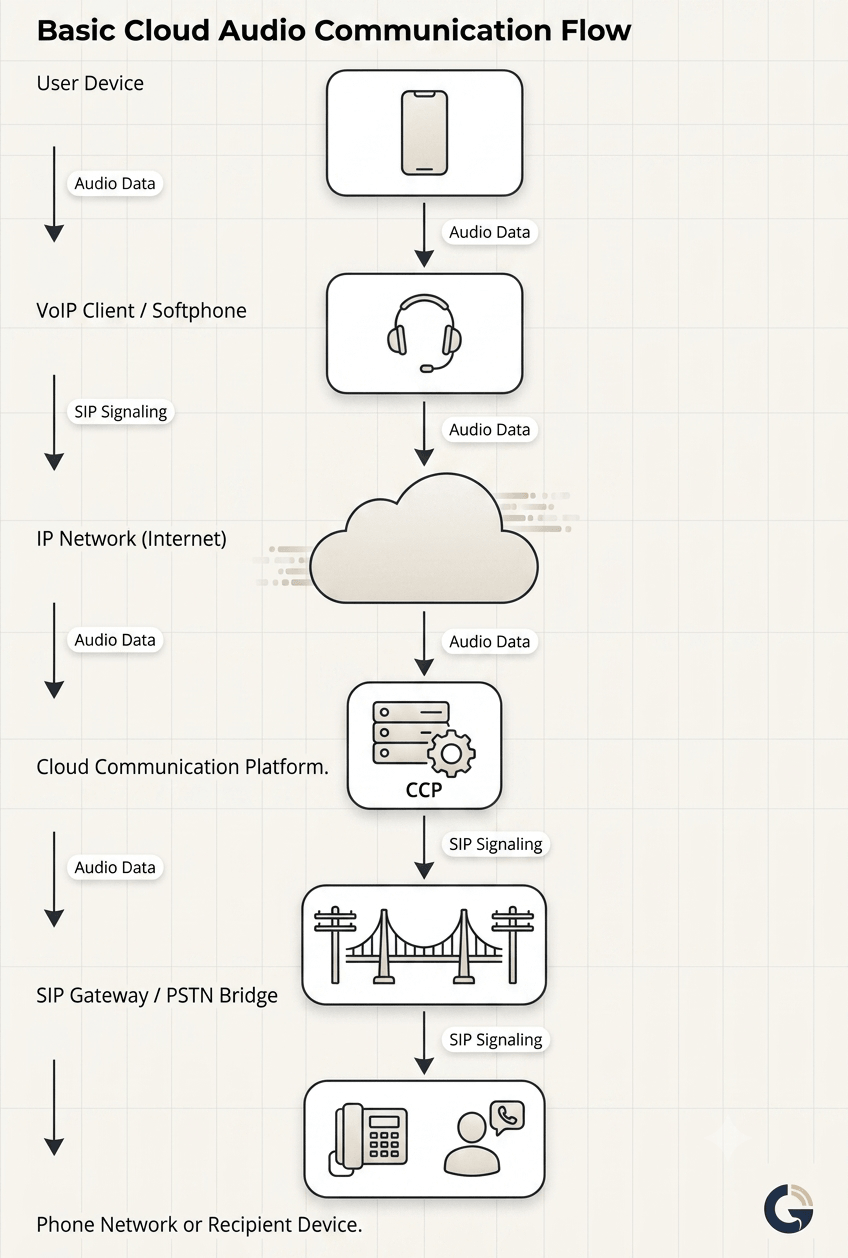
Basic Cloud Audio Communication Flow
The journey of a voice signal in a cloud-connected environment starts at the user’s microphone and ends at the speakers of all other participants. First, the analog voice is digitized and compressed into a format suitable for network transmission. This data then travels through the local area network to a gateway that handles the transition to the cloud provider’s network. The cloud platform then mixes the various audio streams from all participants and redistributes them, ensuring everyone hears the conversation in real time with high fidelity.
VoIP and PSTN Integration
One of the most powerful features of cloud connected audio is its ability to bridge different types of networks. It seamlessly connects Voice over IP users with those calling in from traditional landlines or mobile phones, known as the Public Switched Telephone Network. This integration is vital for external meetings where clients may not have access to specific collaboration software. A well-configured cloud connected audio Webex setup allows for this hybrid connectivity, ensuring that no participant is left out of the conversation due to their hardware limitations.
Benefits of Cloud-Connected Audio for Businesses
Adopting this technology offers a range of strategic advantages that go beyond simple voice transmission. Businesses often report significant improvements in operational efficiency and employee satisfaction after migrating to a cloud-based audio model. The reduction in physical infrastructure means less maintenance for IT teams, while the improved reliability leads to fewer interrupted meetings and better professional outcomes.
Centralized management of global voice traffic.
Reduced dependence on local telecom providers for long-distance calling.
Enhanced security through encrypted data transmission.
Simplified billing with predictable monthly costs.
Access to advanced reporting and analytics on meeting usage.
1. Improved Audio Quality
The primary driver for many companies is the sheer quality of the sound. By utilizing cloud connected audio, organizations can avoid the “robotic” voice effect that often plagues standard internet calls. The dedicated bandwidth ensures that the full range of the human voice is captured and transmitted, which is crucial for picking up on nuances in high-stakes business negotiations. This is particularly noticeable when using high-end Cisco voice solutions designed for executive conference rooms.
2. Scalability
The agility offered by cloud-based systems is unmatched by traditional hardware. As a business grows, cloud connected audio can be expanded to new regions with minimal effort. This rapid deployment capability allows companies to enter new markets and set up local communication hubs without the need for on-site technicians to install complex wiring or server racks.
3. Cost Efficiency
Financial optimization is a major benefit of cloud connected audio service provider integration. By routing calls over data networks, companies can drastically reduce their spend on traditional per-minute long-distance charges. This shift from a capital expenditure model to an operating expenditure model allows for better budget forecasting and lower overall communication costs, especially for enterprises with a significant global footprint.
4. Global Accessibility
With points of presence located around the world, cloud connected audio ensures that global teams are never more than a few milliseconds away from each other. This accessibility is bolstered by partnerships with companies like Verizon cloud connected audio, which provide the extensive network reach required to connect disparate offices. It allows a truly unified communication experience where the physical location of an employee becomes irrelevant to their ability to contribute.
5. AI Enhancements
As communication platforms evolve, the role of AI becomes more prominent. Cloud connected audio acts as the conduit for these advanced features, providing a high-quality stream that AI can analyze for live captioning or meeting summaries.
According to research by Metrigy, companies that integrate AI with their cloud communications see a 45% increase in meeting productivity, highlighting the value of a stable audio foundation for these emerging technologies.
Implementation Guide for Engineers
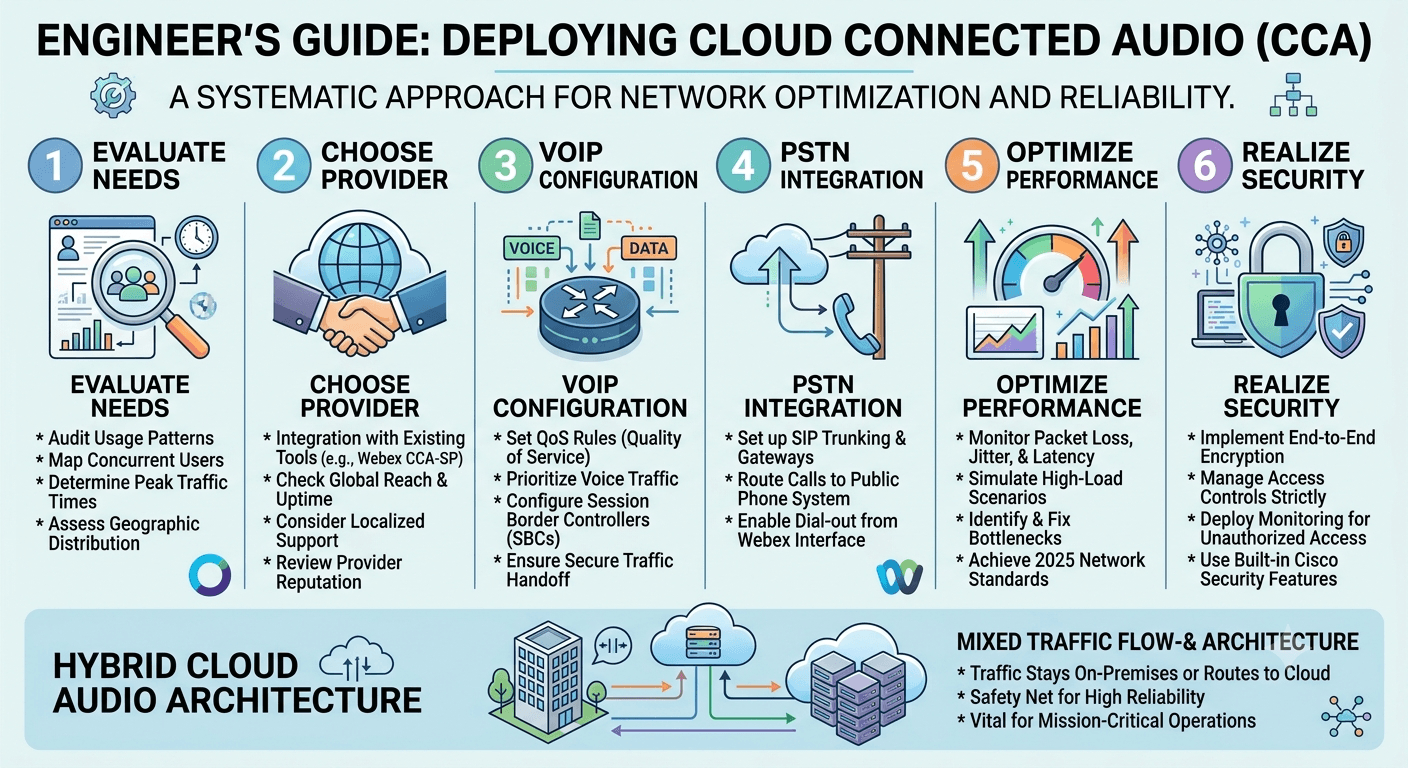
Deploying cloud connected audio requires a systematic approach to ensure that the network can handle the specific demands of real-time voice traffic. Engineers must look at the existing infrastructure and determine where upgrades or configuration changes are needed. The process is not just about turning on a service but about optimizing the entire path from the user’s headset to the cloud environment.
Step 1: Evaluate Communication Needs
The first phase involves a thorough audit of the current usage patterns and hardware. Engineers need to identify how many concurrent users will be supported and what the peak traffic times look like. This assessment helps in selecting the right Cisco voice solutions and determining the required bandwidth. Understanding the geographic distribution of users is also essential for choosing the best cloud connected audio service provider.
Step 2: Choose a Cloud Provider
Selecting the right partner is critical for long-term success. Organizations often look for providers that offer deep integration with their existing tools, such as webex cloud connected audio sp integration. Factors to consider include the provider’s global reach, their reputation for uptime, and their ability to offer localized support. A provider like Cisco or Google cloud connected audio cca may be chosen based on the specific ecosystem the company already uses.
Step 3: VoIP Infrastructure Configurations
Once a provider is chosen, the internal network must be configured to prioritize voice data. This involves setting up Quality of Service (QoS) rules on routers and switches to ensure that cloud connected audio packets are not delayed by less time-sensitive data like email or file downloads. Engineers must also configure session border controllers to manage the secure handoff of traffic between the internal network and the cloud.
Step 4: PSTN Connectivity Integration
For many businesses, maintaining a link to the traditional telephone network is non-negotiable. This step involves setting up the trunking and gateways necessary to route calls from the cloud back to the public phone system. Proper integration ensures that users can dial out to any phone number directly from their Webex interface, utilizing the cloud connected audio infrastructure to handle the heavy lifting of the call.
Step 5: Performance Optimization of Networks
After the initial setup, the network must be tuned for peak performance. This includes monitoring for packet loss, jitter, and latency across all segments of the connection. Engineers might use specialized tools to simulate high-load scenarios and identify potential bottlenecks. Optimization ensures that the best network for cloud connected audio 2025 standards is achieved, providing a future-proof communication environment.
Step 6: Realize Security Control
Security is a paramount concern in any cloud deployment. This step involves implementing end-to-end encryption for all audio streams and ensuring that access controls are strictly managed. Engineers must also set up monitoring systems to detect and respond to any unauthorized access attempts. Utilizing the built-in security features of Cisco hosted voice platforms helps in creating a fortress-around corporate communications.
Hybrid Cloud Audio Architecture
A hybrid approach is often the most practical solution for large enterprises that cannot move everything to the cloud at once. This architecture allows some audio traffic to stay on-premises while routing other sessions through the cloud connected audio network. It provides a safety net, ensuring that if one path fails, the other can take over. This redundancy is vital for mission-critical operations where communication downtime can result in significant financial loss.
In a hybrid model, the local PBX continues to handle internal calls within an office building, while any meeting involving outside participants or remote workers is offloaded to the cloud. This strategy optimizes bandwidth usage and allows the company to transition to the cloud at its own pace. Many organizations find that cloud connected audio Cisco solutions provide the perfect framework for managing this complex balance between local control and cloud flexibility.
Future Trends in Cloud-Connected Audio
The landscape of digital communication is moving toward a more immersive and intelligent future. Cloud connected audio is at the center of these changes, serving as the delivery mechanism for next-generation features. As network speeds increase and latency decreases, the possibilities for how we interact virtually are expanding rapidly. We are moving toward a world where the distinction between a physical meeting and a virtual one is nearly imperceptible.
AI and Machine Learning
The future will see AI playing a much larger role in managing the audio experience. From automatic volume leveling to the real-time removal of distracting background noises like barking dogs or keyboard typing, machine learning will make cloud connected audio smarter. These features will be integrated directly into the cloud platform, requiring no extra effort from the end-user.
Serverless Communication Platforms
We are seeing a move toward serverless architectures where the underlying infrastructure is completely abstracted from the user. This means that cloud connected audio services will become even more resilient and scalable, automatically adjusting resources in milliseconds. This evolution will further simplify the deployment process for engineers and reduce the overhead for IT departments.
Edge Computing
By processing audio data closer to the user at the “edge” of the network, latency can be reduced to almost zero. Edge computing will allow cloud connected audio to feel more instantaneous than ever before. This is particularly important for high-fidelity applications like virtual music rehearsals or remote medical consultations where timing is everything.
Immersive Collaboration
As spatial audio becomes more common, cloud connected audio will enable participants to “place” their colleagues in a virtual room. This creates a more natural sense of presence and helps reduce meeting fatigue. This immersive approach is a key focus for the next generation of Cisco voice solutions, aiming to make virtual collaboration as engaging as being there in person.
Best Practices of Deploying Cloud-Connected Audio
To get the most out of a cloud-based communication system, organizations should follow a set of established best practices. These guidelines help in avoiding common pitfalls and ensure that the transition to cloud connected audio is smooth and beneficial for all users. Success depends on a combination of technical readiness, strategic planning, and ongoing management.
Conduct a thorough network readiness assessment before deployment.
Implement end-to-end Quality of Service (QoS) across all network segments.
Choose a service provider with a proven track record in your specific industry.
Establish a clear migration path from legacy systems to avoid disruptions.
Regularly update firmware on all hardware endpoints and headsets.
Perform Network Infrastructure Optimization
The foundation of a good audio experience is a solid network. Optimization should focus on reducing the number of “hops” that data packets take to reach the cloud. This might involve reconfiguring firewalls or working with internet service providers to ensure direct peering. A well-optimized network is the only way to truly leverage the benefits of cloud connected audio and provide a frustration-free experience for users.
Reliable Cloud Providers
Not all cloud providers are created equal. It is essential to partner with a company that offers comprehensive support and a robust global network. Whether it is ibm connections cloud meetings audio or a more specialized telecommunications partner, the reliability of the provider directly impacts the reliability of your business communications. Look for providers that offer Service Level Agreements (SLAs) with at least 99.9% uptime.
Monitor Performance
Continuous monitoring is the only way to ensure long-term quality. IT teams should use dashboards to track key metrics like packet loss and latency in real-time. This proactive approach allows them to identify and fix issues before they affect a large number of users. Tools provided by a cloud connected audio service provider often include these analytics features as part of the package.
Train Employees
Technology is only effective if people know how to use it. Providing training on how to join meetings, manage audio settings, and use advanced features like noise cancellation is crucial. When employees feel confident using cloud connected audio, they are more likely to embrace the tool and use it to its full potential, leading to better collaboration across the board.
Read More: IVR Surveys: Meaning, Benefits, Drawbacks and Best Practices
Conclusion
Cloud-connected audio has transformed from a niche enterprise solution into a fundamental requirement for the modern, globalized business. By bypassing the limitations of the public internet and providing a direct, high-quality link to the cloud, it ensures that communication remains clear, secure, and cost-effective. Whether a company is using Cisco voice solutions or integrating with a partner like Verizon, the goal remains the same: to provide a seamless audio experience that empowers employees to work better together. As we look toward 2025 and beyond, the integration of AI and edge computing will only make these systems more powerful. For any organization looking to future-proof its communication strategy, investing in a robust cloud-connected audio framework is no longer optional—it is a strategic necessity for success in a digital-first world.
FAQs
What is cloud-connected audio?
Cloud connected audio is a communication technology that routes voice calls and meeting audio over private cloud platforms using internet protocols instead of traditional, public telephone lines. This setup allows for higher quality, better security, and lower costs by using a direct connection between an organization and a cloud provider like Webex. It is often used by large enterprises to ensure that their global meetings remain stable and clear regardless of the participants’ locations.
Is cloud-connected audio equivalent to VoIP?
While cloud connected audio utilizes VoIP technology, it is not exactly the same thing. VoIP is a broad term for any voice traffic sent over the internet, whereas cloud connected audio refers to a specific, optimized architecture that includes cloud infrastructure, deep collaboration software integration, and often a private connection to ensure superior performance. It is a more robust and managed version of voice technology designed specifically for professional enterprise environments.
What are the primary benefits for large enterprises?
The main benefits include significantly improved audio quality, massive scalability for thousands of users, and major cost savings on long-distance charges. Additionally, it offers centralized management for IT teams and integrates seamlessly with AI features for tasks like live transcription. For companies with a global footprint, it provides a consistent experience across all international branches.
How does it improve security for business calls?
Cloud connected audio improves security by using encrypted data paths and private connections that are not exposed to the public internet in the same way standard calls are. Most providers offer advanced security monitoring and data protection features that meet strict enterprise standards. This ensures that sensitive business discussions remain private and protected from potential interceptions.
Can I use my existing Cisco hardware with this technology?
Yes, most cloud connected audio solutions are designed to work perfectly with existing Cisco speaker systems and networking hardware. This allows companies to leverage their previous investments in Cisco voice solutions while upgrading the underlying connectivity to the cloud. It is a cost-effective way to modernize communication without replacing all physical equipment.
What is the role of a service provider in this setup?
A cloud connected audio service provider acts as the bridge between your corporate network and the cloud meeting platform. They provide the global infrastructure, manage the points of presence, and ensure that your voice traffic is prioritized across their network. Some providers also handle the integration with the public switched telephone network for external calling capabilities.
Does cloud connected audio work for remote employees?
Absolutely, it is specifically designed to support the modern hybrid workforce. Remote employees can connect to the cloud infrastructure from their home networks, and the system will still prioritize their audio data to ensure they have a high-quality experience similar to being in the office. This makes it an essential tool for companies with extensive remote work policies.
What are the future trends for this technology?
Future trends include the heavy integration of AI for real-time translation and noise suppression, as well as the use of edge computing to further reduce latency. We are also seeing a shift toward spatial audio and more immersive virtual meeting environments. These advancements will continue to make cloud-based communication feel more natural and engaging for all participants.