
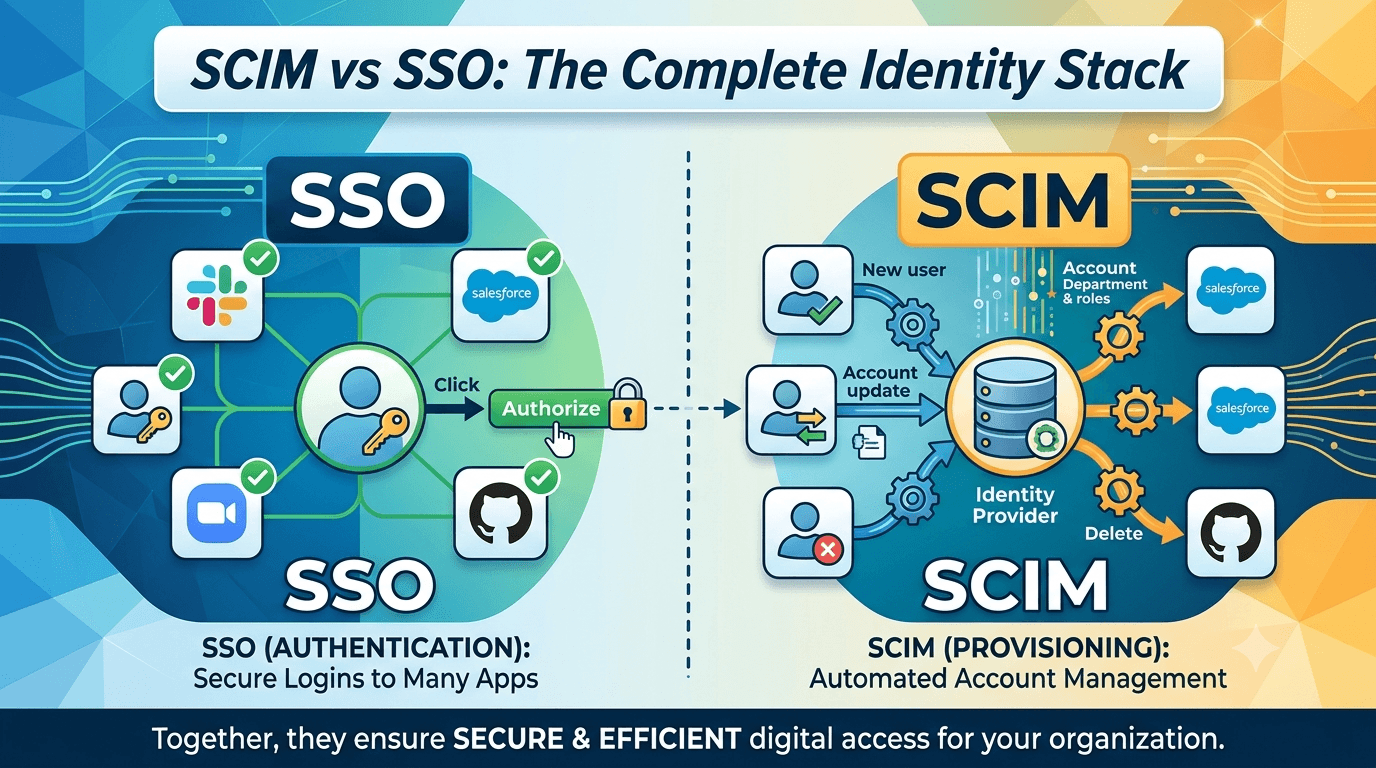
SCIM vs SSO are distinct but complementary identity management protocols used by modern organizations to secure and streamline digital access. Single Sign-On (SSO) focuses on authentication, allowing users to access multiple applications with one set of credentials. System for Cross-domain Identity Management (SCIM) focuses on provisioning, automating the creation, updating, and deletion of user accounts across different SaaS platforms. While SSO ensures secure and convenient logins, SCIM ensures that the right people have the right accounts at the right time. Together, they form a robust identity stack that enhances security, reduces administrative overhead, and improves user experience within any enterprise environment.
What Is SSO?
Single Sign-On is an authentication method that enables users to securely authenticate with multiple applications and websites by using just one set of credentials. It works on the principle of a trust relationship established between an Identity Provider (IdP) and a Service Provider (SP). When a user attempts to access an application, the SP redirects the authentication request to the IdP. Once the IdP confirms the user’s identity, it sends a token back to the SP, granting the user access without requiring a second password.
This technology is pivotal for modern security because it centralizes credential management. Instead of users creating weak, repetitive passwords for fifty different SaaS tools, they use one strong, multi-factor authenticated account. This drastically reduces the attack surface for hackers. According to research by the Ponemon Institute, credential-based attacks are among the most expensive and frequent types of data breaches, making centralized authentication a top priority for IT leaders worldwide.
What Is SCIM?
The System for Cross-domain Identity Management is an open standard designed to simplify user identity management in the cloud. It provides a defined schema for representing users and groups, alongside a RESTful API for managing these identities across different domains. While SSO tells an application that a user is allowed to enter, SCIM tells the application what that user should look like once they are inside, including their name, role, department, and email address.
SCIM operates through a set of standardized operations often referred to as CRUD: Create, Read, Update, and Delete. When a new employee is added to a central directory like Okta or Azure AD, the SCIM protocol automatically triggers the creation of their accounts in Slack, Zoom, and Salesforce. Conversely, when an employee leaves the company, SCIM ensures their access is revoked across all connected systems instantly. This automation is critical for maintaining security compliance and preventing “ghost accounts” from lingering in your software ecosystem.
SCIM vs SSO: Why One Handles Provisioning and the Other Handles Login
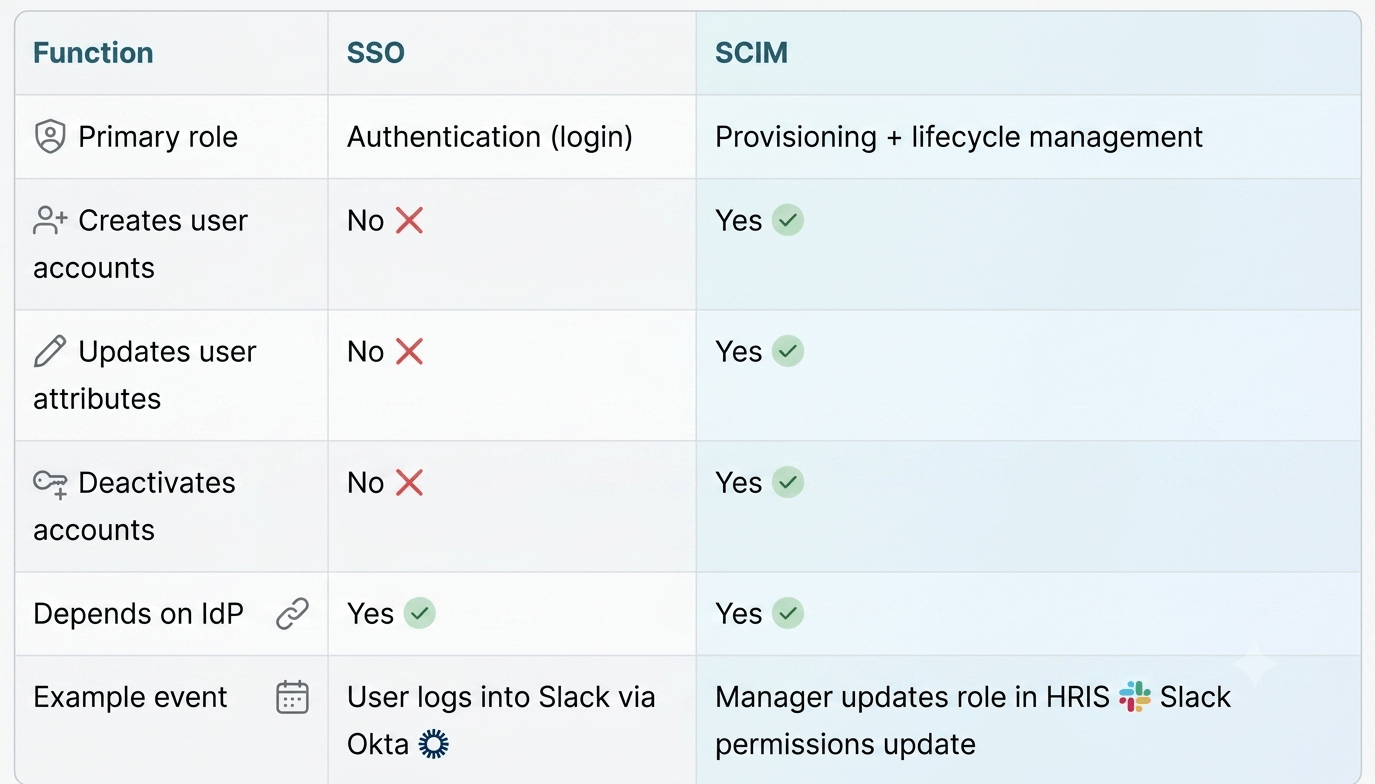
The debate of SCIM vs SSO is not about which is better, but rather how they fulfill different parts of the identity lifecycle. SSO is the mechanism for the front door; it handles the handshake that happens at the moment of login. It does not, however, have the inherent capability to manage the user’s data long-term or create the account before the user arrives. Without a provisioning tool, an admin would still have to manually create the user profile in every application before the user could log in via SSO.
SCIM solves the back-office problem of identity management. It handles the “plumbing” of user data, moving it from the central source of truth to the various endpoints. While you can technically have SSO without SCIM, you would be forced to use manual provisioning or Just-in-Time (JIT) provisioning. JIT is often discussed in the context of scim vs jit, where JIT creates accounts on the fly during the first login. However, JIT cannot deprovision users or update their attributes when they change departments, making SCIM the superior choice for enterprise-grade management.
Common Architecture Patterns (IdP → HRIS → SaaS Apps)
In a sophisticated enterprise environment, identity data typically flows in a specific sequence to ensure accuracy and security. The architecture usually begins with a Human Resources Information System (HRIS) such as Workday or BambooHR. This system acts as the ultimate source of truth for employee data. When a new hire is processed in the HRIS, that data is pushed to an Identity Provider (IdP) like Okta, Microsoft Entra ID, or OneLogin.
Once the IdP receives the user data, the dual roles of scim sso come into play. The IdP uses SCIM to reach out to various SaaS applications to prepare the user environments. For example, it tells GitHub to create a developer account and tells Zendesk to create a support agent profile. When the user finally clicks on the application icon in their dashboard, the IdP uses the SSO protocol to securely sign them in. This seamless transition from HR data to active, authenticated application access is the gold standard for IT orchestration.
-
HRIS updates employee status to active.
-
IdP imports the new user record.
-
SCIM triggers account creation in downstream SaaS apps.
-
User authenticates via SSO for the first time.
-
Ongoing SCIM syncs update roles or titles as they change in HRIS.
-
HRIS marks employee as terminated; SCIM deprovisions all accounts immediately.
Reviews
What users actually say on Reddit
Scim

SSO

What users actually say on Quora
Scim
SSO
Read More: Webrtc vs Sip: A Comprehensive Guide
Final Thoughts
Choosing between SCIM vs SSO is not a matter of selection but a matter of synchronization. SSO is the essential first step for any business looking to secure its digital perimeter and provide a frictionless login experience for its workforce. It solves the immediate problem of password management and access control. However, as an organization grows, the administrative burden of managing thousands of user accounts across hundreds of applications becomes unsustainable without automation.
This is where SCIM becomes indispensable. By automating the identity lifecycle, SCIM removes the manual labor from IT departments and ensures that security policies are enforced in real-time. Whether you are comparing scim vs saml or looking at sso/scim as a unified strategy, the goal remains the same: a secure, efficient, and scalable way to manage the people who make your business run. Implementing both protocols ensures that your organization is protected against unauthorized access while remaining agile enough to handle the constant flux of a modern workforce.
FAQs
-
What is the difference between SCIM and SSO?
The primary difference between SCIM vs SSO is that SSO handles the authentication process (logging in), while SCIM handles the provisioning process (creating and managing accounts). SSO verifies who you are, and SCIM ensures the application knows you exist and has your correct details before and after you log in.
-
Can you have SSO without SCIM?
Yes, you can have SSO without SCIM. In this scenario, users can log in with a single credential, but their accounts must be created manually by an administrator or via Just-in-Time (JIT) provisioning. However, without SCIM, you lose the ability to automatically deprovision users or sync attribute changes like job titles.
-
Are SAML and SCIM the same?
No, SAML and SCIM are not the same. SAML (Security Assertion Markup Language) is a protocol specifically for SSO that passes authentication data between an IdP and a service provider. SCIM is a protocol for identity management that passes user profile data and account status updates between systems.
-
What’s the difference between SSO and SAML?
SSO is the concept or the goal of using one login for many apps. SAML is one of the specific technical protocols used to achieve SSO. Think of SSO as the service and SAML as the language spoken to provide that service.
-
Which protocol is better for security, scim vs sso?
Both are essential for a complete security posture. SSO prevents password-related breaches by centralizing logins. SCIM prevents “insider threats” and “orphaned accounts” by ensuring that access is immediately revoked when an employee leaves the company.
-
Does SCIM replace the need for JIT provisioning?
While SCIM can replace JIT, they often serve different needs. SCIM is proactive, creating accounts before the user logs in. JIT is reactive, creating accounts at the moment of login. SCIM is generally preferred for enterprise environments because it allows for full lifecycle management, including deprovisioning.
-
Is SCIM difficult to implement compared to SSO?
SCIM can be more complex to implement because it requires the service provider to support a specific API for CRUD operations. While many modern SaaS apps support SCIM, some older or niche applications might only support SSO via SAML, requiring manual provisioning.
-
How does scim vs jit impact user experience?
SCIM provides a better user experience because accounts are pre-configured. When a user logs in for the first time via SSO, their profile, folders, and permissions are already waiting for them. With JIT, there can sometimes be a delay or errors during the initial account creation process at the first login.
-
What is the role of an Identity Provider in scim sso?
The Identity Provider (IdP) acts as the central hub for both protocols. It stores the master user record and uses SSO to authenticate the user’s identity while simultaneously using SCIM to push that user’s information to all the various applications they need to do their job.