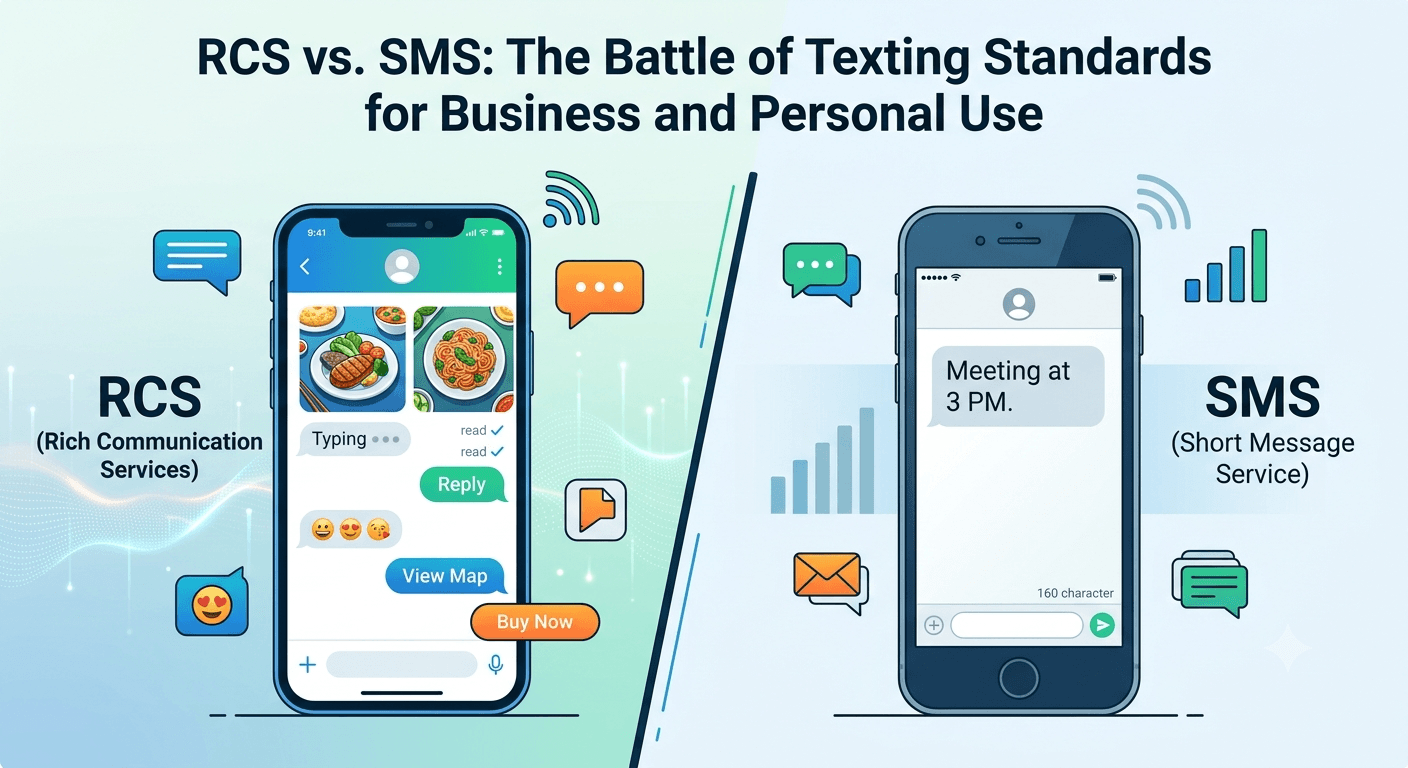
RCS (Rich Communication Services) is the modern evolution of traditional texting, designed to replace the aging SMS (Short Message Service) protocol. While SMS is limited to 160 characters of plain text and relies on cellular networks, RCS utilizes data or Wi-Fi to deliver a feature-rich experience similar to WhatsApp or iMessage. This includes high-resolution images, read receipts, typing indicators, and interactive buttons. As of 2024, with Apple adopting RCS in iOS 18, the gap between Android and iPhone messaging has narrowed. Choosing between rcs vs sms depends on whether you prioritize universal reach or interactive engagement.
The shift in mobile communication has created a significant debate regarding rcs vs sms for both personal and professional use. We are seeing a transition where the simplicity of the past meets the interactive demands of the future. Understanding these technologies is vital for anyone looking to stay connected or businesses aiming to reach their customers effectively. This guide explores every technical and practical aspect of these two messaging standards to help you decide which one fits your needs.
RCS vs. SMS: What’s the Difference?
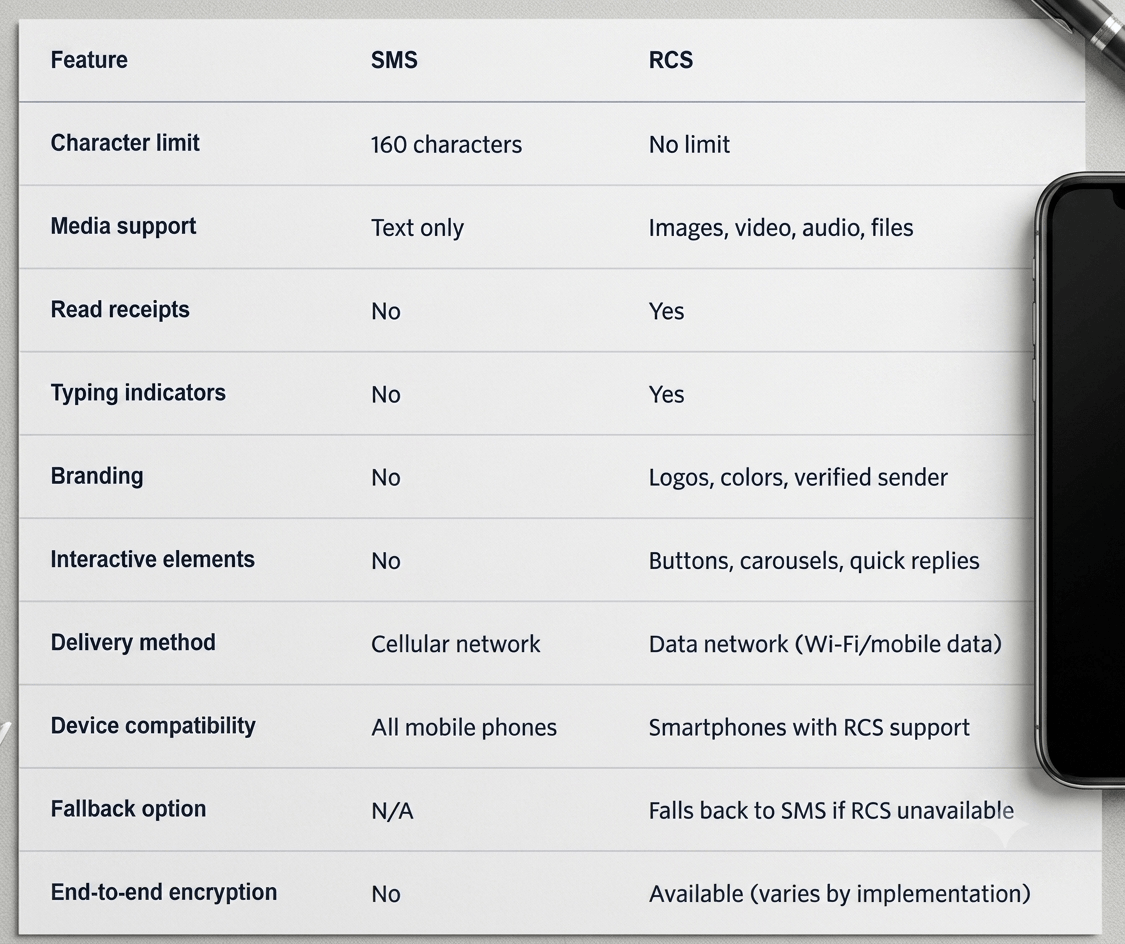
The primary difference between rcs vs sms lies in the underlying technology and the depth of the user experience. SMS is a legacy technology that travels over the telephony control channel, which is why it works even when you have a very weak signal but no data. It is the universal denominator of mobile communication, meaning every mobile phone ever made can receive an SMS. However, it lacks the ability to show if someone is typing or if they have read your message.
On the other hand, RCS functions more like a modern messaging app. It requires a data connection, either through a cellular plan or Wi-Fi, to transmit complex data packets. This allows for the transmission of large files, high-quality video, and interactive elements like calendar invites or location sharing. While SMS is a one-way street of text, RCS is a dynamic conversation that provides real-time feedback and rich media capabilities.
What is RCS messaging?
RCS messaging is a communication protocol that aims to bring the features of over-the-top (OTT) apps like Telegram or Messenger to the native texting app on your phone. It was developed to standardize the rich features across different carriers and manufacturers. We often refer to it as “Chat” in Android settings. It allows users to send group chats, share high-res photos, and see when the other person is active.
Because it operates over the internet, it bypasses many of the limitations of the old cellular infrastructure. This means you are no longer charged per message in the traditional sense, but rather it consumes a small amount of your data plan. It has become the standard for modern Android devices and has recently gained support from Apple, making it a nearly universal rich messaging standard.
Benefits of RCS for business messaging channels
The transition to RCS provides businesses with a toolkit that was previously only available through expensive custom apps. One of the greatest advantages is the ability to use carousels. A retail brand can send a message containing a horizontal scroll of products, each with its own “Buy Now” button, allowing the customer to shop without ever leaving their messaging app.
Branded Sender ID: Displays your company name and logo instead of a random shortcode.
Verified Profiles: Increases security and trust by showing a verification checkmark.
High-Resolution Media: Send vivid images and videos to showcase products effectively.
Suggested Actions: Provide buttons for “Open Map,” “Add to Calendar,” or “Reply.”
Read Receipts: Track exactly when your customers are viewing your marketing materials.
Disadvantages of RCS
Despite its many features, RCS is not without its hurdles. The biggest issue is the dependency on a data connection. If a user is in an area with poor data coverage but functional cellular service, the RCS message might fail or take a long time to send. This makes it less reliable for urgent, time-sensitive alerts where every second counts.
Another disadvantage is the lack of total uniformity across all devices and carriers. While support is growing, some older smartphones or specific carrier configurations might not support the full suite of RCS features. This can lead to a fragmented experience where some users see a beautiful interactive message while others receive a stripped-down version or a fallback text.
What is SMS?
SMS stands for Short Message Service and has been the backbone of mobile communication since the early 1990s. It is a text-only service that is limited to 160 characters. If you exceed this limit, the message is either split into multiple parts or converted into an MMS (Multimedia Messaging Service). It is a highly robust system that works on the basic signaling paths of mobile networks.
We appreciate SMS for its simplicity and its ability to reach anyone, anywhere. It does not require an internet connection, a specific operating system, or even a smartphone. This “lowest common denominator” status is why it remains the most widely used form of mobile communication in the world, despite the rise of more advanced alternatives.
Why is SMS still relevant?
SMS remains relevant because it is the only messaging format that is truly universal. In a world of fragmented apps and varying data speeds, the humble text message is the only thing that works on a $20 flip phone just as well as it does on the latest flagship device. For critical infrastructure, emergency alerts, and basic communication, its reliability is unmatched.
Furthermore, SMS does not require any opt-in for a specific app or data service. As long as a phone has a signal to make a call, it can receive an SMS. This ubiquity ensures that no one is left out of the loop, which is why it remains a staple for government notifications and global banking alerts.
Why do businesses still rely on SMS?
Businesses continue to use corporate texting services because of the unparalleled open rates associated with SMS. Research shows that 98% of text messages are opened, with 90% being read within the first three minutes. This level of immediate attention is something that email and even social media cannot compete with. It is the most effective way to ensure a customer sees a time-sensitive update.
Ubiquity: Every mobile phone can receive SMS without any special setup.
Cost-Effectiveness: It is generally affordable for high-volume mass text messages.
Reliability: Does not depend on the recipient having a data plan or being near Wi-Fi.
Simplicity: Easy to integrate into existing CRM systems for automated alerts.
Benefits of SMS
The primary benefit of SMS is its “set it and forget it” nature for the sender. You don’t have to worry if the recipient has the right app installed or if their data plan is active. This makes it the ideal tool for bulk communication. When sending mass text messages, the goal is often reach over richness, and SMS delivers that reach better than any other platform.
Another benefit is the lack of “noise.” Because SMS is restricted to text, the message is usually clear, concise, and to the point. This is perfect for appointment reminders, password resets, and simple transactional confirmations. It is a distraction-free environment where the information is the star of the show.
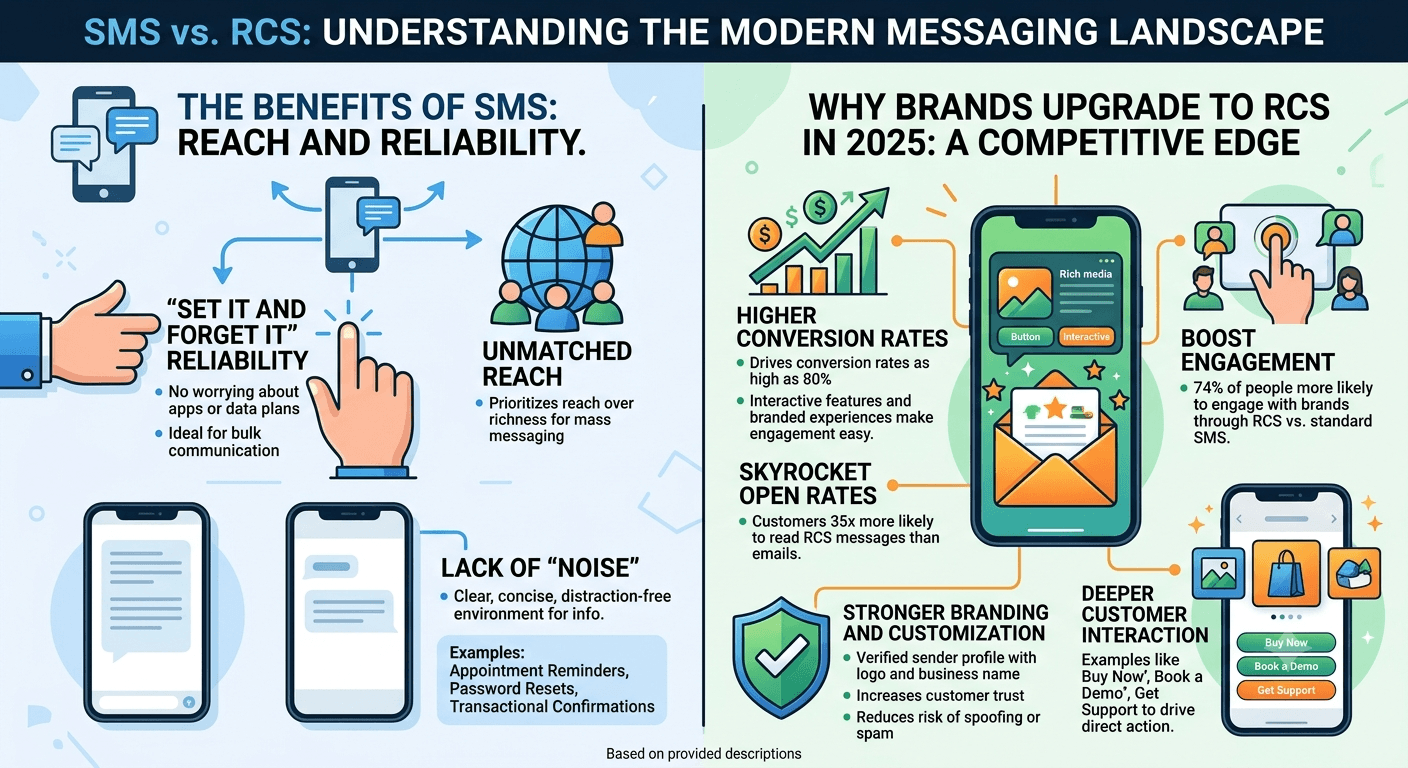
RCS gives companies a competitive edge by making business messaging more interactive, personal, and effective than ever before. Here’s why more brands are upgrading to RCS in 2025:
Higher conversion rates
RCS messaging drives conversion rates as high as 80 percent. With interactive features like rich media, instant replies, and branded experiences, RCS makes it easy for customers to engage and take action in real time — resulting in dramatically higher conversions compared to traditional SMS.
Boost engagement
74% of people are more likely to engage with a brand through RCS ersus standard SMS.
Skyrocket open rates
Customers are 35x more likely to read RCS messages than emails, giving your campaigns an edge in a crowded inbox world.
Stronger branding and customization
RCS allows you to send messages from a verified sender profile, complete with your logo, business name, and branding. This increases customer trust and reduces the risk of spoofing or spam.
Deeper customer interaction
Share carousels, images, videos, and add interactive buttons (“Buy Now,” “Book a Demo,” “Get Support”) to drive direct action from customers — right in the conversation.
Disadvantages of SMS
The limitations of SMS are becoming more apparent as consumer expectations evolve. The 160-character limit is incredibly restrictive, often forcing users to use abbreviations or send multiple messages for a single thought. Furthermore, SMS lacks any form of end-to-end encryption by default, making it less secure for sensitive conversations compared to modern standards.
From a marketing perspective, SMS is quite “dry.” You cannot include high-quality images without switching to MMS, which is often more expensive and has its own technical limitations. There is no way to know if a message was actually read or if the user just ignored it, making it difficult for businesses to measure the true engagement of their campaigns.
Is RCS or SMS better for text marketing?
Deciding whether rcs vs sms is better for marketing depends on your specific goals. If your goal is to drive sales through a visual and interactive experience, RCS is the clear winner. The ability to show products in a carousel and include “Buy Now” buttons creates a frictionless path to purchase that SMS simply cannot match. It turns a text message into a mini-webpage experience.
However, if your goal is to reach the widest possible audience with a simple announcement or a discount code, SMS might still be the better choice. It ensures that even customers with older phones or limited data plans receive your offer. Many successful companies use a hybrid approach: they attempt to send an RCS message first and use SMS as a fallback for those who cannot receive the rich format.
What can SMS vs. RCS offer your business?
Businesses need to look at rcs vs sms as two different tools in the same toolbox rather than as direct competitors. Each serves a specific purpose in the customer journey. By integrating both, a company can ensure they are providing a high-quality experience to modern users while maintaining a reliable connection with everyone else.
We have seen that the most effective corporate texting services are those that offer omnichannel capabilities. This means the system can automatically detect the recipient’s device capabilities and deliver the best possible version of the message. This flexibility is key to maintaining a professional image and ensuring message delivery.
SMS: Reliable reach for critical communication
For things that simply must get through, SMS is the gold standard. Think about 2FA codes for banking or urgent weather alerts. These are not the time for fancy graphics or interactive buttons. The recipient needs the information immediately and reliably. In these scenarios, the simplicity of SMS is its greatest strength.
SMS is also excellent for simple feedback loops. A “Reply YES to confirm your appointment” is a tried and true method that customers understand and use. It doesn’t require a smartphone or a data connection, making it accessible to the widest possible demographic, including the elderly or those in rural areas with limited connectivity.
RCS: Rich, interactive, and branded customer engagement
RCS shines when the goal is to build a relationship or drive a complex action. For example, a travel agency could send an RCS message that allows a user to browse hotel rooms, view a map of the area, and book a stay all within the message thread. This level of engagement keeps the user within the brand’s ecosystem and reduces the likelihood of them getting distracted by other apps or websites.
The branded nature of RCS also helps in reducing the impact of phishing and spam. When a customer sees a verified checkmark and the official company logo, they feel much safer clicking on links or providing information. This increased trust leads to higher click-through rates and a more positive perception of the brand.
Integrated messaging: The omnichannel advantage
The real power lies in using rcs vs sms together. An integrated messaging strategy allows a brand to be present where the customer is. By using mass text software that supports both, you can create a seamless experience. If a user starts a conversation on RCS but then moves to an area with no data, the system can switch to SMS to continue the dialogue.
This omnichannel approach ensures that the conversation never dies. It also allows for sophisticated data collection. You can use RCS for your primary marketing push to see who is engaging with your rich content, and then follow up via SMS with those who didn’t respond, ensuring that no lead is left behind.
Example: Hybrid campaign in action
Imagine a cinema chain launching a new movie. They start by sending an RCS message to their loyalty members. This message includes a high-definition trailer, a carousel of showtimes, and a “Pick Your Seats” button. For members who don’t have RCS-enabled phones, the system automatically sends an SMS with a short link to the same booking page.
This hybrid approach ensures 100% reach while providing a premium experience to the majority of the audience. The cinema chain can track the high engagement on the RCS side and the basic click-throughs on the SMS side, giving them a comprehensive view of how their campaign performed across different segments of their customer base.
Which devices and media support SMS and RCS?
The compatibility landscape for rcs vs sms has changed drastically in the last year. Historically, RCS was an Android-only feature, supported by Google and various global carriers. However, Apple’s recent announcement and subsequent rollout of RCS support in iOS 18 means that the vast majority of smartphones in use today now support some form of rich messaging.
SMS remains the universal standard supported by every mobile device. Whether it is a legacy 2G phone or the latest foldable smartphone, SMS works perfectly. The media support for SMS is strictly text. If you add a photo or a video, it technically becomes an MMS, which is a different protocol with its own set of file size and quality limitations.
Let’s look at the types of content you can send.
When comparing the content capabilities of rcs vs sms, the difference is night and day. SMS is your basic letter, while RCS is a full-color magazine with interactive elements. We can break down the content types to see exactly how they differ in practice.
SMS: Plain text, emojis (though they count toward character limits), and short links.
RCS: High-res photos (up to 100MB), high-quality video, audio messages, and large file transfers.
RCS Interactivity: Action buttons, quick replies, carousels, and location cards.
RCS Feedback: Typing indicators and read receipts that tell you the status of the conversation.
How to check device compatibility
Checking for rcs vs sms compatibility is usually handled automatically by the phone’s messaging app. On Android, if the “Chat features” or “RCS” setting is turned on in Google Messages, the app will attempt to send an RCS message first. If it sees the recipient doesn’t have it, the text box will say “Text message (SMS)” instead of “RCS message.”
On iPhones running iOS 18, the process is similar. In the “Messages” settings, there is a toggle for RCS Messaging. When communicating with an Android user who also has RCS enabled, the messages will be sent over data and include features like high-res photos. If either party lacks support, the message defaults to the traditional green-bubble SMS/MMS.
Reviews
To get a better sense of how people feel about rcs vs sms, we looked at various community platforms. The general consensus is that people want the features of RCS but value the reliability of SMS. There is a lot of discussion about how these two technologies impact daily life and business communication.
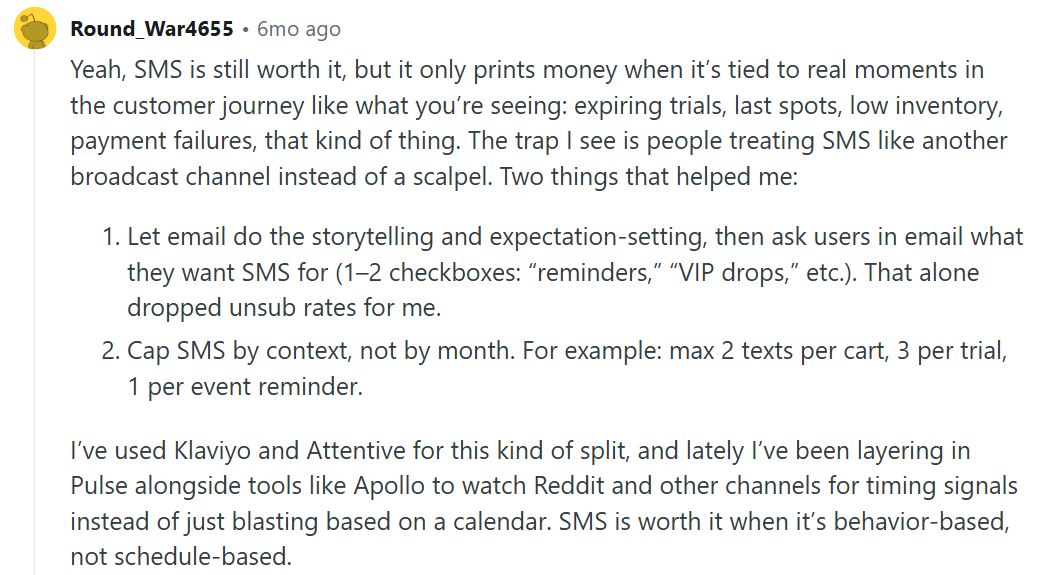
1. What users actually say on Reddit
We found that Reddit users are quite vocal about the “green vs blue bubble” debate and the arrival of RCS on iPhone. Many are excited about the improved photo quality between platforms.
RCS
Many Android users on Reddit express relief that they can finally send high-quality videos to their iPhone-using friends without using a third-party app. There are, however, complaints about occasional “stuck” messages where an RCS message fails to send and doesn’t immediately fall back to SMS.

SMS
The sentiment toward SMS on Reddit is that it is a “necessary dinosaur.” Users appreciate that it always works when they are in the middle of nowhere. However, they frequently complain about the lack of security and the prevalence of spam messages that flood their SMS inboxes.
2. What users actually say on Quora
On Quora, the discussion around rcs vs sms tends to be more technical and business-oriented. Users often ask about the cost implications and the technical setup required for businesses to adopt these standards.
RCS
Quora contributors often highlight the branding potential for businesses. They see it as a way to “clean up” the messaging experience. Some users have expressed confusion about why RCS isn’t just “built-in” to every phone yet, noting the slow rollout by some smaller carriers.
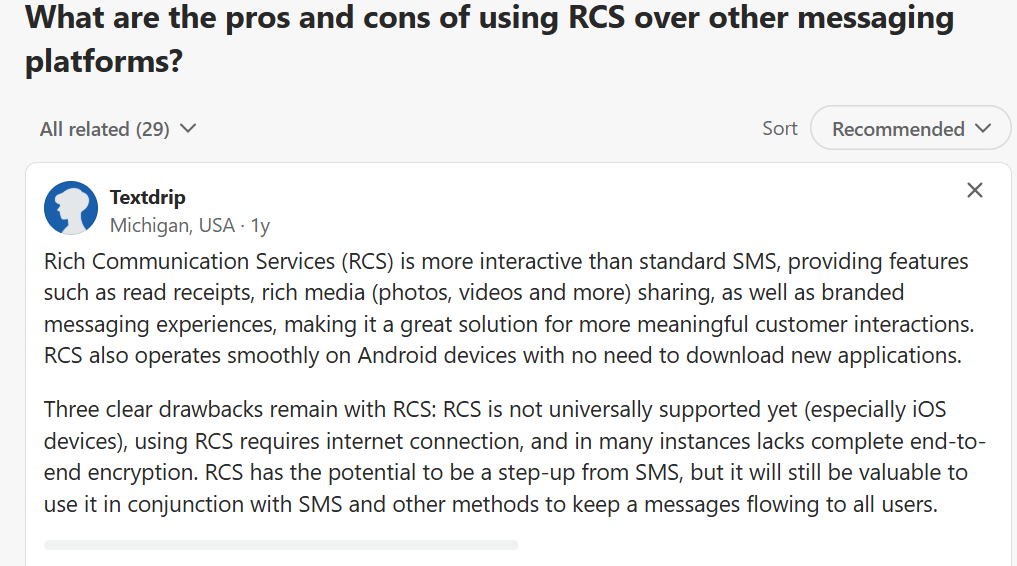
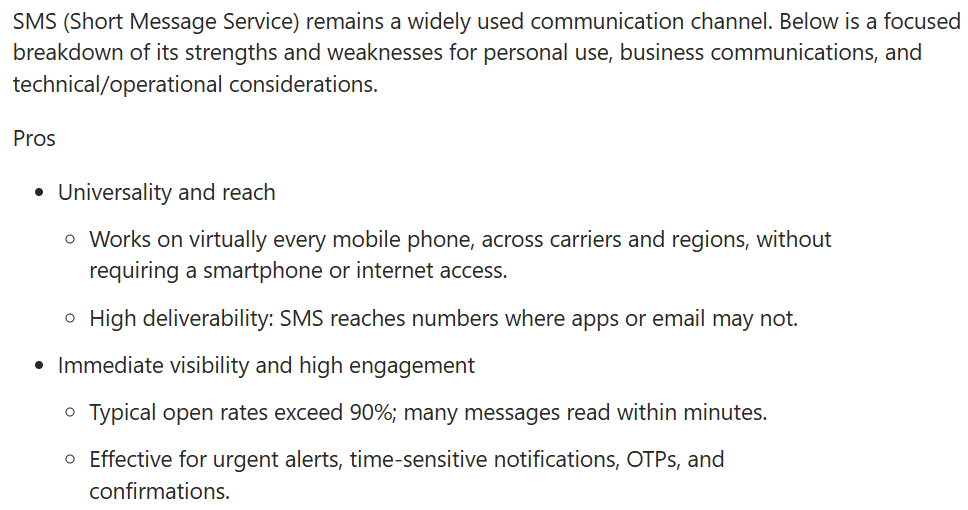
SMS
The consensus on Quora is that SMS is king for transactional messages. Experts point out that for things like banking alerts, the high cost of RCS or its data requirement makes it less attractive than the tried-and-true SMS path.
3. Reviews from trustpilot
Looking at reviews for messaging platforms on Trustpilot, we can see how businesses feel about the tools they use to send these messages. This gives us a look into the “mass text software” side of the equation.
RCS
Positive: Businesses love the analytics. One user noted, “Being able to see that our customers actually read the promo was a game changer for our ROI calculations.”
Negative: Some users find the setup process for RCS verified profiles to be tedious and time-consuming compared to just buying an SMS shortcode.
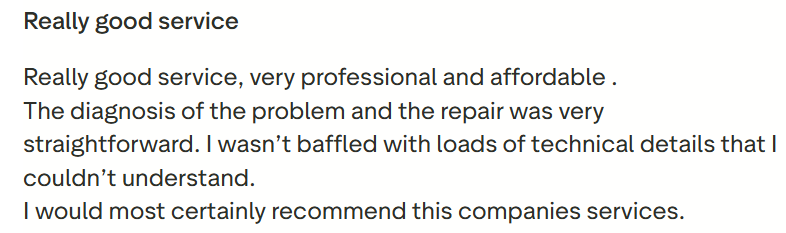
SMS
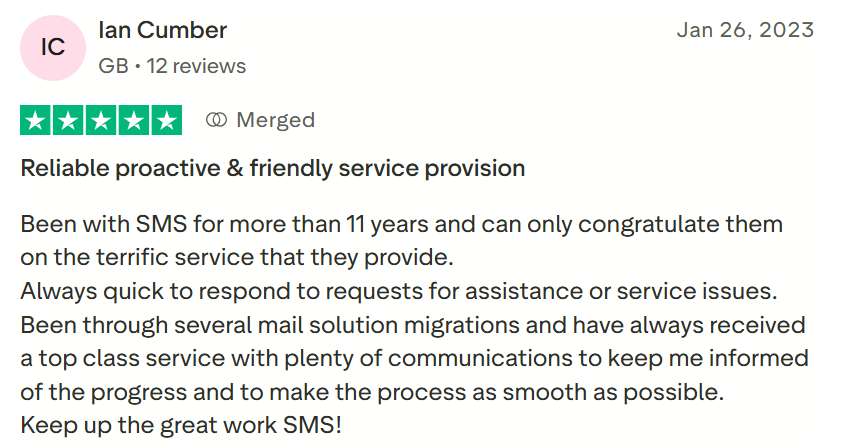
Positive: “It just works. We send 50,000 texts a month and the delivery rate is nearly 100%,” says one verified reviewer. Reliability is the most praised feature.
Negative: Many complain about the rising costs of SMS segments and the frustration of having their messages blocked by carriers due to strict spam filters.
Why RCS is the future of business messaging
As we move forward, the debate of rcs vs sms will likely lean more toward RCS as the primary channel. The reason is simple: consumer expectation. We live in an era of rich, visual communication. A plain text message is increasingly seen as outdated, especially by younger generations who grew up with Instagram and WhatsApp. RCS meets these users where they are, providing a modern experience without requiring a separate app.
For businesses, RCS offers a level of data and interaction that SMS never can. The ability to track a customer’s journey from receiving a message to clicking a carousel and finally making a purchase is invaluable for marketing optimization. As the infrastructure becomes more stable and universal, RCS will become the default way we communicate with the world around us.
Read More: Call Transcript: Benefits, Working, and Practical Uses
Final Thought
In the battle of rcs vs sms, there isn’t a single winner, but rather a shift in how we use each technology. SMS remains the unshakeable foundation of mobile communication, prized for its 100% reach and simplicity. RCS represents the exciting future, offering a rich, interactive, and secure way to engage with others. For most users and businesses, the best strategy is to embrace the richness of RCS while keeping the reliability of SMS in their back pocket. As technology continues to evolve, the way we “text” will only become more powerful and integrated into our daily lives.
FAQs
What is the difference between RCS and SMS?
SMS is the traditional text messaging protocol which is limited to 160 characters and has no media support. RCS is the next-generation standard that adds rich media like high-res images and video, along with read receipts, typing indicators, and interactive buttons. SMS works on every phone with cellular service, whereas RCS requires a smartphone with a data connection.
Is RCS better than SMS?
RCS is better in terms of features because it offers rich media and interactivity. However, SMS is better for universal reach and reliability in areas with poor data. For marketing and engagement, RCS is superior, but for critical alerts, SMS remains the preferred choice.
What is the difference between SMS vs MMS vs RCS?
SMS is for short plain text only. MMS (Multimedia Messaging Service) allows for small images and videos but has strict file size limits and low quality. RCS provides a modern experience with high-resolution media, interactive buttons, and branded profiles, similar to an app like WhatsApp.
Do RCS messages fall back to SMS?
Yes, most modern phones are designed to automatically fall back to SMS or MMS if the recipient does not have an RCS-enabled device or is currently offline. This ensures that the message is delivered, even if the rich features are stripped away.
Does iPhone support RCS messaging?
Yes, as of the iOS 18 update in 2024, iPhones now support RCS. This allows iPhone and Android users to enjoy features like read receipts and high-quality photo sharing without needing a third-party app.
Is RCS more secure than SMS?
RCS is generally more secure as it supports end-to-end encryption in many implementations, such as Google Messages. SMS has no encryption, meaning messages can theoretically be intercepted by third parties more easily.
Does RCS cost more than SMS?
For personal use, RCS usually uses your data plan or Wi-Fi, so there is no “per-message” cost. For businesses, RCS messaging can sometimes be more expensive than SMS due to the advanced features and branded profiles, but the higher engagement often justifies the cost.
Can I send an RCS message to someone who only has SMS?
You can send the message, but the recipient will receive it as a standard SMS or MMS. They will not be able to see the typing indicators, read receipts, or interactive carousels that RCS provides.