
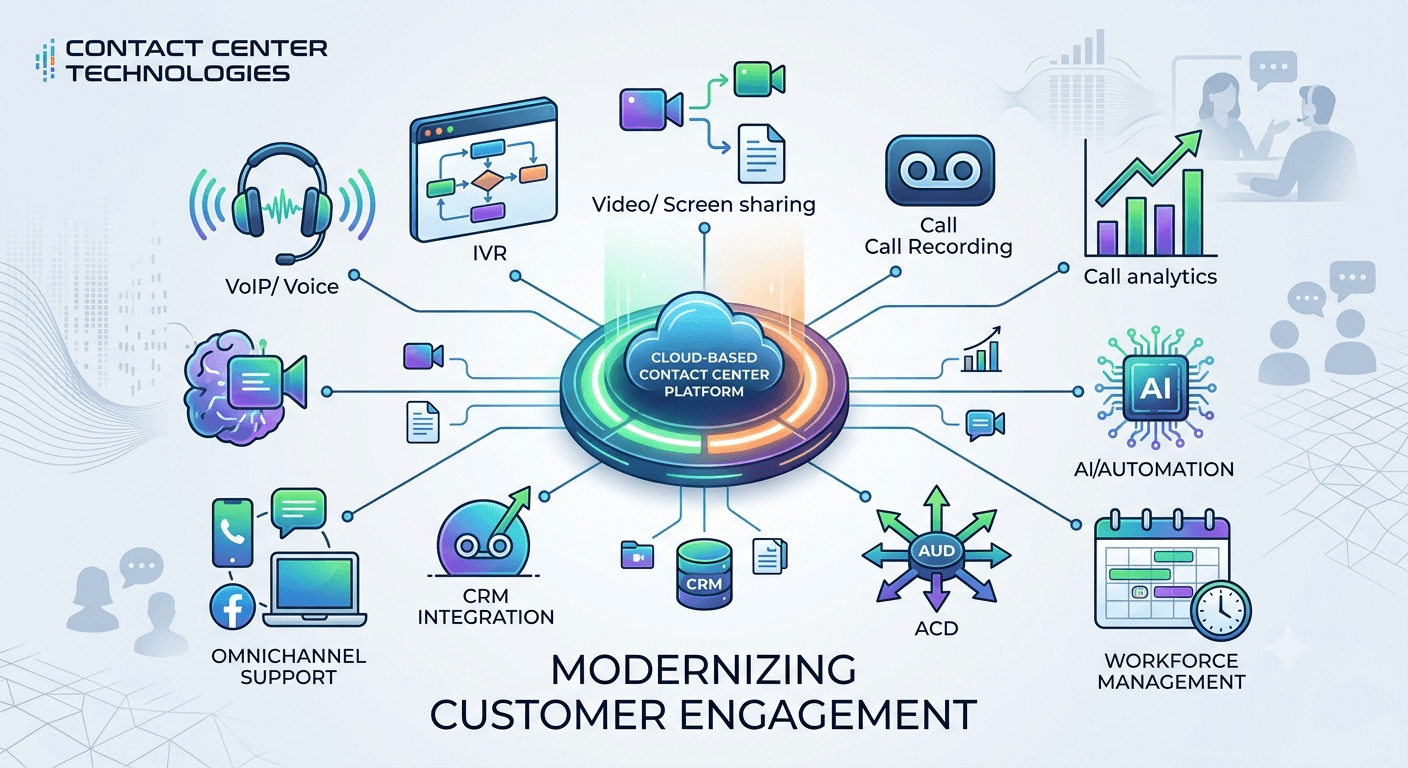
Contact center technologies refer to the suite of software, hardware, and networking tools designed to facilitate, manage, and optimize customer interactions across multiple communication channels. These solutions encompass everything from basic telephony to advanced artificial intelligence and cloud-based platforms that enable businesses to handle inquiries via voice, email, chat, and social media. By leveraging contact center technologies, organizations can streamline workflows, improve agent efficiency, and provide a seamless journey for their customers. Implementing the right tools is essential for modern contact center environments aiming to deliver personalized service and maintain a competitive edge in a digital-first market.
What is contact center technology?
Contact center technology serves as the foundation for all communication between a company and its clientele. In the past, this was limited to physical phone lines and hardware, but the modern contact center has evolved into a sophisticated ecosystem of digital contact center solutions. These tools allow for the management of high-volume interactions while ensuring that data is captured and utilized to improve service quality.
The current landscape of contact center technologies includes a mix of on-premises hardware and cloud contact centre technology. The primary goal is to bridge the gap between customer expectations and brand capabilities. This technology stack often includes systems for routing calls, managing customer data, and analyzing performance metrics to ensure that every touchpoint is handled with precision.
Why contact center technology is important
The importance of adopting robust contact center technologies cannot be overstated in an era where customer experience is a primary brand differentiator. Businesses must navigate a complex web of digital transformation in contact center environments to stay relevant. Without the right tools, agents struggle with fragmented data, leading to longer resolution times and frustrated customers.
Effective contact center infrastructure allows businesses to scale their operations without a linear increase in costs. By utilizing innovative call center technology, companies can automate routine tasks, allowing human agents to focus on complex problem-solving. This shift not only improves the bottom line but also ensures that the technical call center remains agile enough to adapt to changing market trends and consumer behaviors.
What are the benefits of contact center technologies?
The implementation of diverse contact center technologies offers a wide array of advantages that touch every aspect of a business. These benefits range from internal operational improvements to external customer-facing successes. When a company invests in contact centre solutions, they are essentially investing in the longevity and scalability of their customer relations department.
Strategic use of customer contact center technology enables a brand to build trust. When customers realize that their issues are resolved quickly and through their preferred channels, brand loyalty increases significantly. Furthermore, the data gathered through these systems provides invaluable insights into consumer needs, which can inform future marketing and product development strategies.
1. Agent productivity and operational efficiency
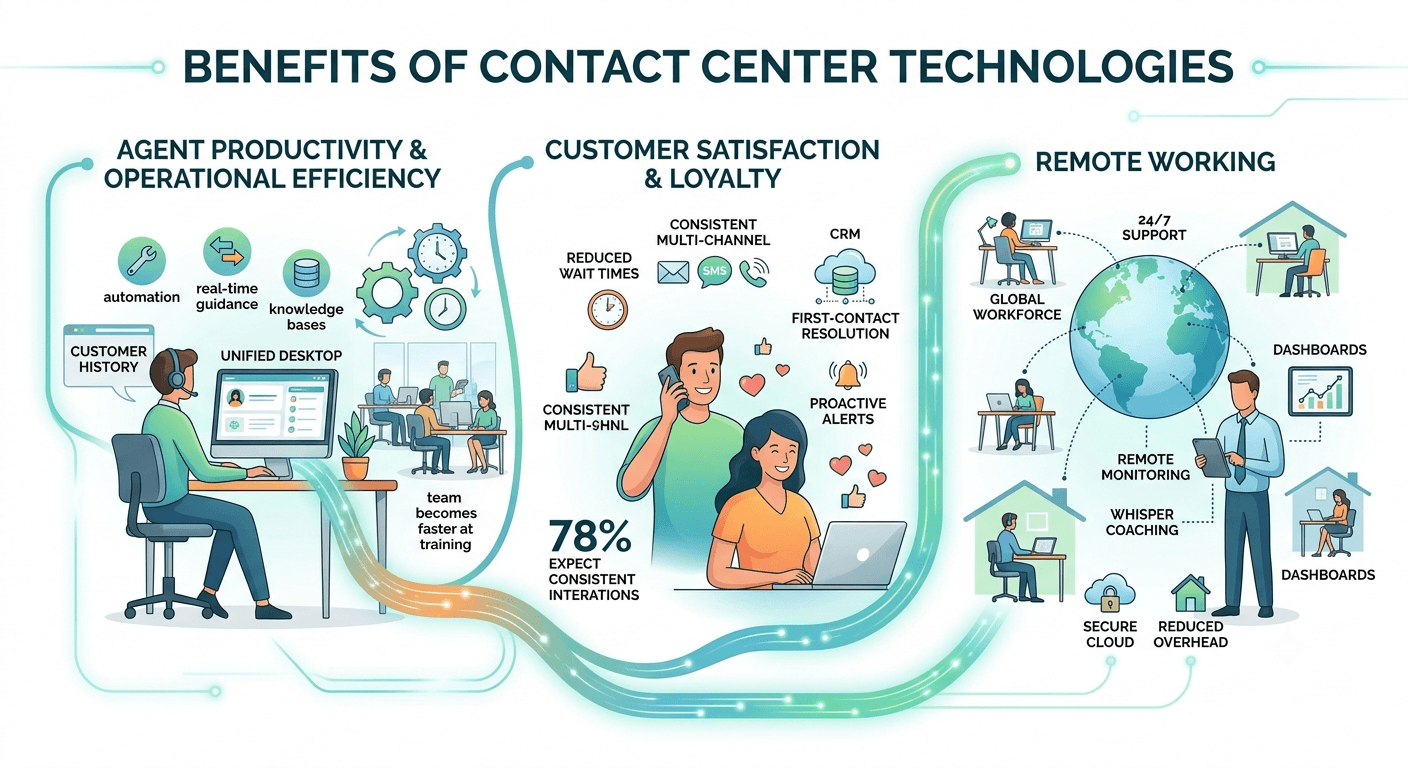
One of the most immediate benefits of contact center technologies is the significant boost in agent performance. By providing agents with integrated tools, they no longer have to toggle between multiple screens or manual databases to find information.
-
Automation of repetitive data entry tasks reduces manual errors.
-
Unified desktops provide a single view of the customer history.
-
Real-time guidance tools help agents navigate difficult conversations.
-
Automatic call distribution ensures that no single agent is overwhelmed.
-
Instant access to internal knowledge bases speeds up the resolution of queries.
Efficiency is also realized through better call center systems technology that facilitates faster training cycles. With intuitive interfaces, new hires can become proficient in using contact center products much faster than with legacy systems. This reduction in the learning curve is vital for industries with high turnover rates, ensuring that service levels remain consistent even during staffing transitions.
2. Customer satisfaction and loyalty
The primary driver for upgrading contact center technologies is the desire to enhance the customer experience. Customers today expect immediate responses and a high degree of personalization during their interactions.
-
Reduced wait times through intelligent routing and self-service options.
-
Consistent service across all channels, whether it is SMS, email, or voice.
-
Personalized interactions based on historical data stored in integrated CRM systems.
-
Faster first-contact resolution rates, which is a key metric for satisfaction.
-
Proactive communication features that alert customers to issues before they call.
According to a study by Salesforce, 78% of customers expect consistent interactions across departments, highlighting the need for contact center infrastructure that supports seamless data sharing.
When contact center technologies are properly integrated, the customer feels known and valued, which directly translates into higher retention rates and positive word-of-mouth marketing.
3. Remote working
The rise of the virtual call center technology has transformed how businesses hire and retain talent. With cloud contact centre technology, agents are no longer tethered to a physical office space, allowing for a more flexible and global workforce.
This shift to remote work is supported by contact center connectivity that remains secure and reliable over standard internet connections. Businesses can now recruit the best talent regardless of geographic location, which is particularly beneficial for providing 24/7 support across different time zones. Additionally, remote working models often lead to reduced overhead costs associated with maintaining large physical office spaces.
Modern contact center platforms provide supervisors with the tools needed to manage remote teams effectively. Features such as remote call monitoring, digital whisper coaching, and real-time dashboards ensure that quality standards are maintained even when the team is dispersed. This flexibility has become a cornerstone of contact center modernization, allowing for business continuity during unforeseen global events.
Top 10 contact center technology examples
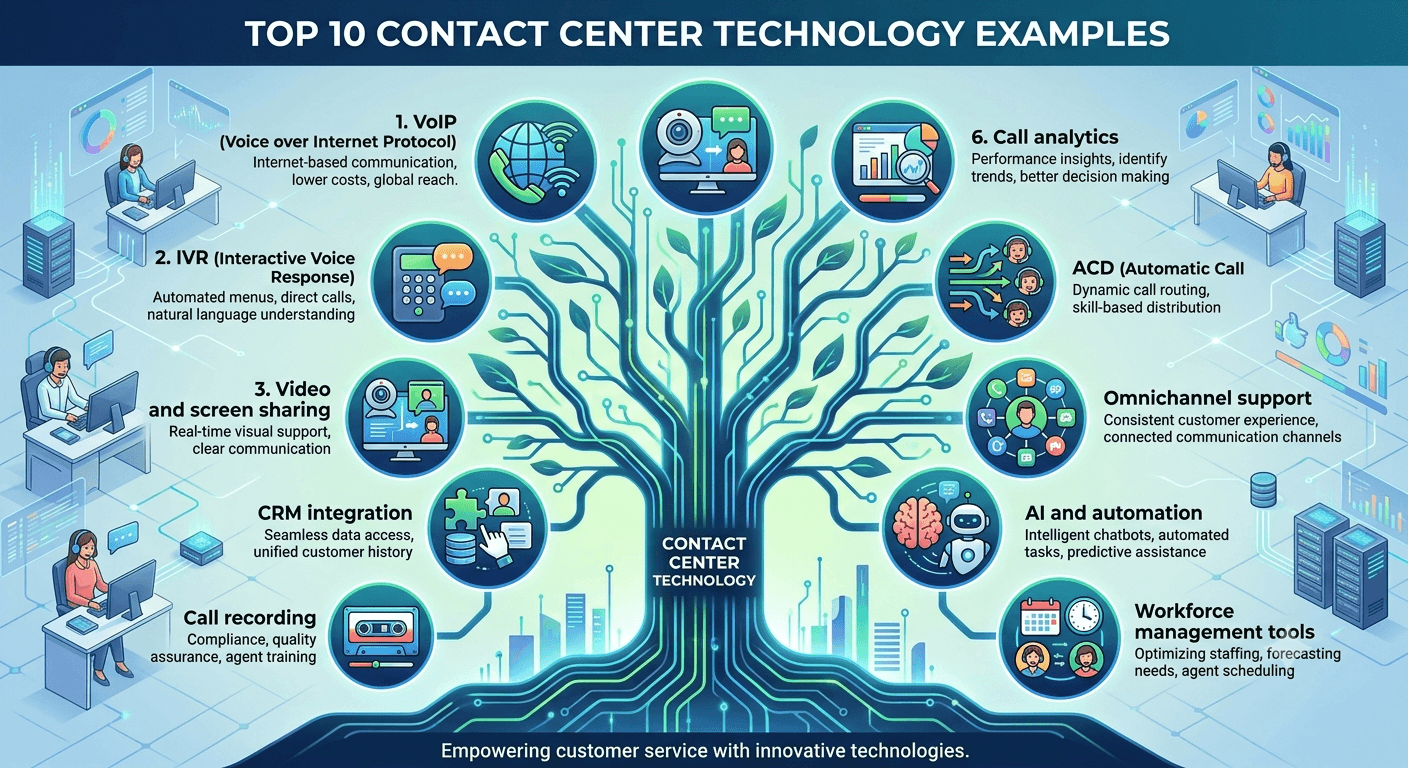
To build an effective service department, one must understand the various contact center technologies available today. These tools range from basic communication protocols to advanced analytical engines that can predict customer behavior. Each element of the contact center technology stack plays a specific role in ensuring the smooth operation of the customer care technology department.
Selecting the right combination of these technologies depends on the specific needs of the industry. For example, manufacturing contact center solutions might prioritize hardware integration, while a digital contact center platform for retail might focus more on omnichannel messaging and AI-driven chatbots.
1. VoIP (Voice over Internet Protocol)
VoIP is perhaps the most fundamental of all contact center technologies, replacing traditional copper-wire phone systems with internet-based communication. This calling technology allows for much greater flexibility and lower costs, especially for international interactions.
-
Eliminates the need for expensive on-site PBX hardware.
-
Supports high-definition voice quality for clearer communication.
-
Enables easy scaling of phone lines as the business grows.
-
Integrates seamlessly with other digital tools and software.
By moving to VoIP, a company can ensure that its contact center systems are future-proof. This technology is the backbone of virtual contact centers, allowing agents to take calls from any device with an internet connection. It also provides the foundation for adding more advanced features like video calling and multimedia messaging.
2. IVR (Interactive Voice Response)
Interactive Voice Response is a staple in the contact center industry, acting as the digital receptionist for incoming calls. Modern IVR systems have moved beyond simple “press one for sales” menus to include natural language processing that understands spoken commands.
This contact center solution helps in directing customers to the most appropriate department without the need for human intervention. It can also be used for self-service tasks, such as checking an account balance or tracking a package delivery. By handling these routine inquiries, IVR systems free up human agents to deal with more complex and sensitive customer issues.
3. Video and screen sharing
The inclusion of video contact center capabilities has revolutionized technical support and complex sales processes. When an agent can see what the customer is seeing, the time to resolution drops significantly.
-
Screen sharing allows agents to guide customers through software installations or website navigation.
-
Video calls add a personal touch to high-value interactions, building stronger relationships.
-
Visual aids help in explaining complicated concepts that are difficult to describe over audio.
-
Remote troubleshooting is made easier by using the customer’s smartphone camera to view physical hardware.
As part of the contact centre of the future, video is becoming a standard channel rather than an optional luxury. It bridges the gap between digital and physical service, providing a “high-touch” experience that customers increasingly appreciate. This technology is particularly effective in sectors like healthcare, finance, and technical support.
4. CRM integration
A Customer Relationship Management (CRM) system is the heart of customer contact center technology. When contact center technologies are integrated with a CRM, agents have immediate access to a customer’s entire history, including past purchases, previous complaints, and personal preferences.
This integration ensures that the contact center experience is cohesive. Instead of the customer having to repeat their story to every new agent, the agent can see the context of the relationship the moment the call or chat starts. This data-driven approach is essential for modern contact center marketing and personalized service delivery.
5. Call recording
Call recording is one of those contact center technologies that serves multiple purposes, from legal compliance to quality assurance. By keeping a record of every interaction, businesses can protect themselves in case of disputes and use real-world examples for agent training.
-
Provides a paper trail for verbal agreements and transactions.
-
Allows managers to review agent performance and provide specific feedback.
-
Helps in identifying common customer pain points through manual review.
-
Ensures that agents are following regulatory scripts and company policies.
Advanced call recording systems also include screen recording, giving a full picture of what the agent was doing on their computer during the call. This helps in identifying inefficiencies in the software or gaps in the agent’s knowledge of the contact center infrastructure.
6. Call analytics
Call analytics tools take the raw data from interactions and turn it into actionable insights. These contact center technologies can track metrics like average handle time, first-call resolution, and customer sentiment.
By analyzing these patterns, management can make informed decisions about staffing levels and training needs. For instance, if analytics show a spike in calls regarding a specific product feature, the company can proactively update its website FAQs or send out an instructional email to customers. This level of call center transformation is what separates market leaders from their competitors.
7. ACD (Automatic Call Distribution)
Automatic Call Distribution is a critical component of contact center capabilities. It uses pre-defined rules to route incoming contacts to the most qualified agent available. This ensures that a customer with a technical problem is sent to a technician, while a billing inquiry goes to the accounting department.
ACD systems can also use “skills-based routing,” which identifies the specific strengths of each agent and matches them with the customer’s needs. This optimizes the use of the contact center hardware and human resources, ensuring that every interaction is handled by the person best equipped to resolve it.
8. Omnichannel support
Omnichannel support is the gold standard for modern contact center environments. Unlike multichannel support, which simply offers different ways to get in touch, omnichannel contact center technologies ensure that all these channels are interconnected.
-
A customer can start a conversation on live chat and finish it over the phone without losing context.
-
Agents can see interactions from social media, email, and voice in a single timeline.
-
Customers receive a consistent brand voice across all digital contact center solutions.
-
Data is centralized, preventing silos between different communication teams.
Research by Gartner suggests that by 2025, 80% of customer service organizations will have transitioned away from native mobile apps in favor of messaging to provide a better customer experience. This shift highlights the importance of having a robust omnichannel strategy as part of your contact center digital transformation.
9. AI and automation
Artificial Intelligence is the most transformative of the modern contact center technologies. From chatbots that handle initial inquiries to AI-driven sentiment analysis that tells an agent how a customer is feeling, the applications are vast.
-
Chatbots provide 24/7 support for basic questions.
-
AI can predict why a customer is calling based on their recent website activity.
-
Automated workflows can trigger follow-up emails or task creation for agents.
-
Voicebots can handle simple transactions like bill payments or appointment scheduling.
AI doesn’t just replace humans; it augments them. By handling the “noise” of high-volume, low-value interactions, AI allows the human element of the technical call center to shine where it matters most: in complex, emotional, and high-stakes situations. This is a primary driver in the current wave of contact center modernization.
10. Workforce management tools
Workforce management (WFM) tools are contact center technologies used to forecast call volumes and schedule staff accordingly. These systems ensure that the center is never understaffed during peak hours or overstaffed during lulls.
WFM tools also help in tracking agent adherence to their schedules and managing time-off requests. By optimizing the workforce, companies can maintain high service levels while controlling labor costs. These tools are often part of a larger suite of contact center resources designed to improve the overall operational health of the organization.
Read More: Rotary Phone: A Complete Guide
Final Words
Adopting the right contact center technologies is no longer an option but a necessity for businesses that want to thrive in a customer-centric world. From the foundational use of VoIP to the cutting-edge applications of artificial intelligence, these tools provide the framework for efficient, effective, and empathetic communication. By integrating these systems into a unified contact center architecture, brands can ensure they are meeting their customers wherever they are, with exactly what they need.
The journey toward a digital contact center platform involves more than just buying software; it requires a strategic rethink of how technology and human talent work together. As we look toward the contact centre of the future, the focus will continue to be on creating seamless, data-driven experiences that build lasting loyalty. Investing in modern contact center solutions today is the best way to prepare for the challenges and opportunities of tomorrow.
Frequently Asked Questions
-
What are contact center technologies and how do they benefit a business?
Contact center technologies are digital and hardware tools used to manage customer communications across various channels like phone, email, and chat. They benefit businesses by increasing agent productivity, reducing operational costs, and significantly improving the customer experience through faster and more personalized service.
-
What are the 4 types of technology commonly used in contact centers?
The four primary types of technology include communication platforms (like VoIP), routing and distribution systems (ACD/IVR), customer data management tools (CRM), and analytical/AI tools. Together, these form the core contact center infrastructure required to manage modern customer interactions.
-
How is AI used in BPO and contact center environments?
AI is used in BPO and contact centers for automating routine tasks through chatbots, performing sentiment analysis on live calls, and providing agents with real-time suggestions. It also helps in predictive routing and workforce forecasting, making the entire operation more efficient.
-
Which software is used in BPO for call management?
BPO companies typically use specialized contact center software features like Automatic Call Distribution (ACD), Interactive Voice Response (IVR), and dialers. Common platforms include cloud-based solutions that offer integrated CRM and omnichannel capabilities.
-
What is the difference between a call center and a contact center?
A call center primarily handles voice-based communication, whereas a contact center manages multiple channels including email, social media, web chat, and SMS. Contact center technologies are designed to unify these different streams into a single, cohesive interface.
-
How does cloud contact centre technology improve remote work?
Cloud technology allows agents to access the contact center platform from any location with an internet connection. It eliminates the need for on-site hardware, provides secure data access, and includes management tools that allow supervisors to monitor performance remotely.
-
What are critical capabilities for contact center as a service (CCaaS)?
Critical capabilities include omnichannel routing, workforce engagement management, robust reporting and analytics, and the ability to integrate with third-party CRM and ERP systems. Scalability and security are also essential features of high-quality CCaaS offerings.
-
How do call center call back technology systems work?
Call back technology allows customers to hang up while keeping their place in a virtual queue. The system then automatically calls the customer back when an agent becomes available, reducing frustration and improving the overall contact center experience.
-
What is the role of digital transformation in contact center success?
Digital transformation involves moving away from legacy hardware to integrated, data-driven digital platforms. This shift allows for greater agility, better use of AI, and a more comprehensive understanding of the customer journey across all touchpoints.