
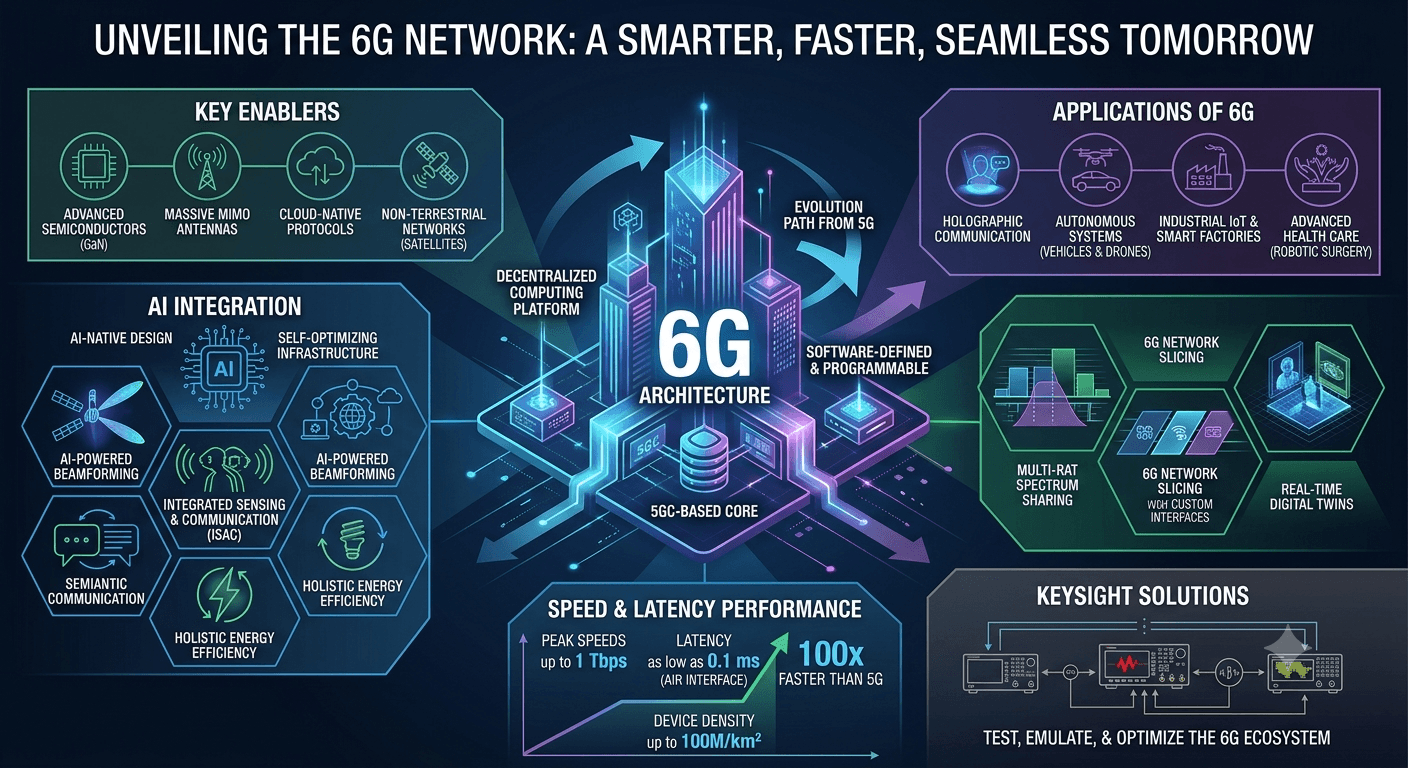
A 6G network represents the sixth generation of wireless technology, succeeding 5G to provide significantly higher speeds, lower latency, and massive connectivity. While 5G laid the foundation for the Internet of Things, this new era focuses on integrating artificial intelligence directly ifnto the communication fabric. Operating at frequencies above 100 GHz, it promises to bridge the gap between the physical and digital worlds through ubiquitous sensing and immersive experiences. This evolution is not just about faster smartphones but about creating a seamless, intelligent infrastructure that supports holographic communication, autonomous systems, and highly precise spatial awareness on a global scale.
6G Without the Complexity
The transition toward 6G technology is envisioned as a streamlined evolution rather than a disruptive overhaul. Unlike previous transitions that required entirely new core infrastructures, the industry is moving toward a standalone architecture that builds upon the successes of 5G. This approach aims to reduce the technical debt often associated with maintaining multiple generations of hardware. By focusing on a single, simplified path, operators can deploy new services faster while maintaining the reliability that current 6G networks demand.
Simplification is the cornerstone of this next-generation strategy. Researchers are looking at ways to consolidate functions within the 6G cellular network to ensure that data moves more efficiently through the system. This involves moving away from the “patchwork” updates seen in the past and toward a cohesive, cloud-native environment. Such a simplified path ensures that the infrastructure remains flexible enough to handle future demands without requiring constant physical intervention at every 6G towers location.
What 5G deployment data shows
Recent analysis of 5G deployment data reveals that the most successful rollouts occurred where operators leveraged standalone cores early on. This data suggests that the 6G network mobile phone experience will be most consistent if the backend is not tied to legacy systems. Statistics indicate that networks utilizing cloud-native architectures experienced 30% fewer outages during peak traffic periods compared to non-standalone configurations.
The data also highlights that users expect a seamless transition across different frequency bands. In the context of 6G communication, this means that the handoff between traditional cellular bands and the newer Terahertz bands must be instantaneous. Lessons from 5G show that fragmentation in spectrum usage can lead to a degraded user experience, which is why 6G wireless technology is being designed to be more unified from the outset.
What this means for 6G architecture
The architecture of the 6G cellular technology must be inherently flexible to support a wide range of devices, from simple sensors to complex autonomous vehicles. It means the network will no longer be a “dumb pipe” for data but a distributed computing platform. By decentralizing the core, 6G communication can happen closer to the user, reducing the distance data travels and drastically cutting down response times.
Furthermore, this architectural shift implies a move toward a software-defined reality. Every component of the 6G wireless ecosystem will be programmable, allowing for 6G network slicing at a much more granular level than what is currently possible. This ensures that a critical healthcare application receives a dedicated, ultra-reliable slice of the network without being affected by general consumer traffic.
Key Enablers of the Standalone 6G Architecture
The shift to a standalone 6G cellular structure is supported by several technological breakthroughs. These enablers work together to ensure the network is robust, scalable, and capable of handling the massive data influx expected by 2030.
Advanced semiconductor materials like Gallium Nitride for higher frequency efficiency.
New antenna designs capable of massive MIMO on a much larger scale.
Cloud-native protocols that allow for instantaneous scaling of network resources.
Integration of non-terrestrial networks, including satellites, for total global coverage.
Multi-RAT spectrum sharing
Multi-RAT spectrum sharing allows the 6G technology to operate alongside 5G and 4G without interference. This technology enables the dynamic allocation of frequency resources based on real-time demand. It ensures that the available spectrum is used to its maximum potential, preventing wastage and ensuring high-speed 6g mobile network access even in crowded urban environments.
A 6G core network based on the 5GC
Building the 6G core on the foundations of the 5G Core (5GC) allows for a smoother transition. This evolution focuses on enhancing the existing service-based architecture to support the higher throughput of 6G communication. By refining 5GC, developers can introduce 6G research innovations without needing to redesign the fundamental logic of how data is routed and managed.
Evolving the network architecture in 6G
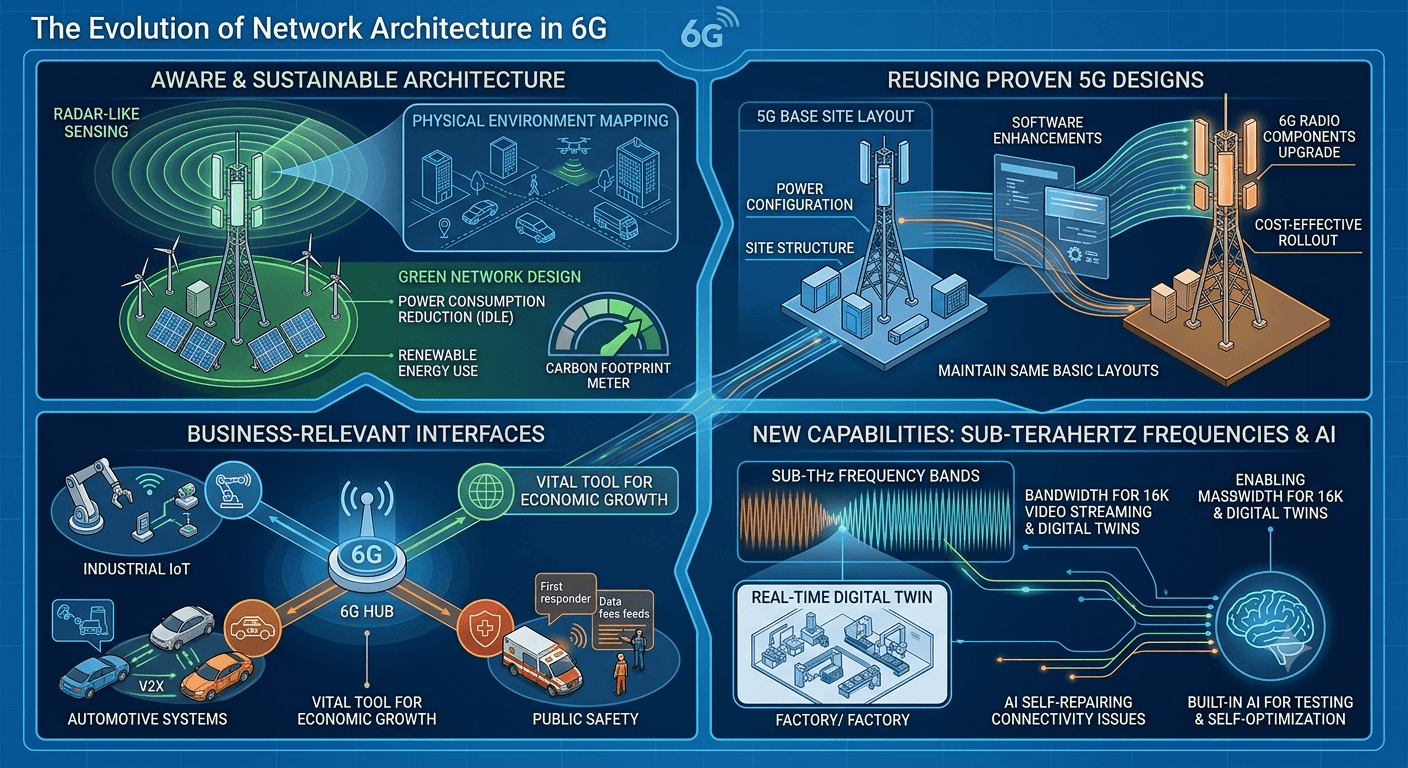
As we look toward the 2030s, the evolution of network architecture will focus on making the 6g cell more “aware” of its surroundings. This involves integrating sensing capabilities directly into the radio interface. The network will not only transmit data but also act as a radar-like system to map the physical environment, which is a significant leap for 6G cellular technology.
The evolution also emphasizes environmental sustainability. Future architectures are being designed to consume less power during idle states and to use renewable energy sources more effectively. This ensures that as the number of 6G towers increases, the total carbon footprint of the telecommunications industry remains manageable.
Minimizing disruption by reusing and enhancing proven designs
To ensure a cost-effective rollout, the industry is focusing on reusing proven designs from 5G. This includes maintaining the same basic site layouts and power configurations where possible. Enhancements are then applied to the software and specific radio components to upgrade the site to 6G wireless technology standards without a complete teardown.
Introducing new capabilities
The introduction of sub-terahertz frequencies is one of the most anticipated capabilities of the 6G network. These frequencies provide the massive bandwidth required for applications like 16K video streaming and real-time digital twins. Additionally, the network will include built-in AI for 6G testing and self-optimization, allowing the system to repair its own connectivity issues.
Focusing on business-relevant interfaces
6G research suggests that the network must provide specialized interfaces for different industries. This means providing unique access points for industrial IoT, automotive systems, and public safety. By focusing on these business-relevant interfaces, the 6G cellular network can become a vital tool for economic growth across various sectors.
How fast will 6G networks be?
The speed of 6G networks is expected to reach levels that were previously considered the domain of fiber optics. While 5G offers peak speeds of up to 20 Gbps, 6G is aiming for a quantum leap in performance. This is achieved by utilizing the vast, untapped spectrum in the Terahertz range, which allows for much wider channels and faster data movement.
According to the International Telecommunication Union, the framework for 6G communication standards is expected to be finalized by 2030, targeting peak data rates that could reach 1 Terabit per second.
This speed would allow a user to download dozens of high-definition movies in a single second, fundamentally changing how we consume media and interact with digital content through a 6G network mobile phone.
Peak data rates might reach 200 gigabits per second (Gbps) to several Tbps in the THz bands.
Consumers could enjoy 300-500 megabits per second (Mbps) on average in real-world scenarios.
Latency is expected to be very low — 0.1 milliseconds (ms) for the air interface.
End-to-end latency in industrial environments will likely sit at 1 ms.
Cellular vehicle-to-everything (V2X) latency will be reduced to a few ms.
Device densities of 1 million to 100 million devices per square kilometer (km) could be possible.
Mobility speeds of 500-1,000 km per hour are envisioned for high-speed transport.
What are the applications of 6G technology?
The applications of what is 6g technology extend far beyond simple internet browsing. The combination of ultra-low latency and massive bandwidth opens the door to “Internet of Senses” applications. These involve transmitting not just sight and sound, but also touch and even smell through digital interfaces, creating a truly immersive 6G wireless experience.
In the professional realm, the 6G network will act as a backbone for the Fourth Industrial Revolution. It will enable the synchronization of millions of devices in real-time, allowing for a level of automation that is currently impossible. From smart cities to remote planetary exploration, the reach of 6G communication will be truly global.
Autonomous mobility: The ubiquitous presence and lower latency of 6G could enable safe autonomous mobility and reliable real-time vehicle-to-everything (V2X) collaboration.
Autonomous drones: The high data rates and worldwide availability of 6G networks could expand the use of drones for critical operations like rescue missions and defense.
Industrial internet of things (IoT): Private 6G networks could enable smart factories where operations are automated using thousands of IoT sensors.
Holographic telepresence: The high data rates of 6G could allow realistic high-resolution virtual avatars to be shown on 3D holographic displays.
Immersive experiences: Extended reality technologies like VR, AR, and MR could become ubiquitous through 6G-enabled devices like AR glasses.
Advanced health care: For robotic surgeries, 6G networks promise to be highly reliable and always available with built-in redundancies.
What is an AI-enabled 6G network, and how could it be different from 5G?
An AI-enabled 6G network is a system where artificial intelligence is integrated into every layer of the communication stack. In 5G, AI is often used as a “bolt-on” solution for network management and optimization. However, in 6G technology, AI is native, meaning the air interface and the core protocols are designed by and for machine learning algorithms.
This native AI allows the 6G cellular network to be predictive rather than reactive. Instead of waiting for a connection to drop or slow down, the network can predict user movement and environmental changes to adjust resources in advance. This creates a more stable and efficient 6G communication environment that can adapt to the specific needs of each 6G cell in real-time.
Recent research from the Fraunhofer Institute highlights that 6G research into D-band frequencies is essential for achieving the required bandwidth for real-time holographic telepresence. This research emphasizes that without AI-driven beam management, the high-frequency signals of 6G would be too fragile for reliable consumer use.
The Role of Artificial Intelligence in Shaping 6G Networks
1. Automated Network Optimization and Energy Efficiency
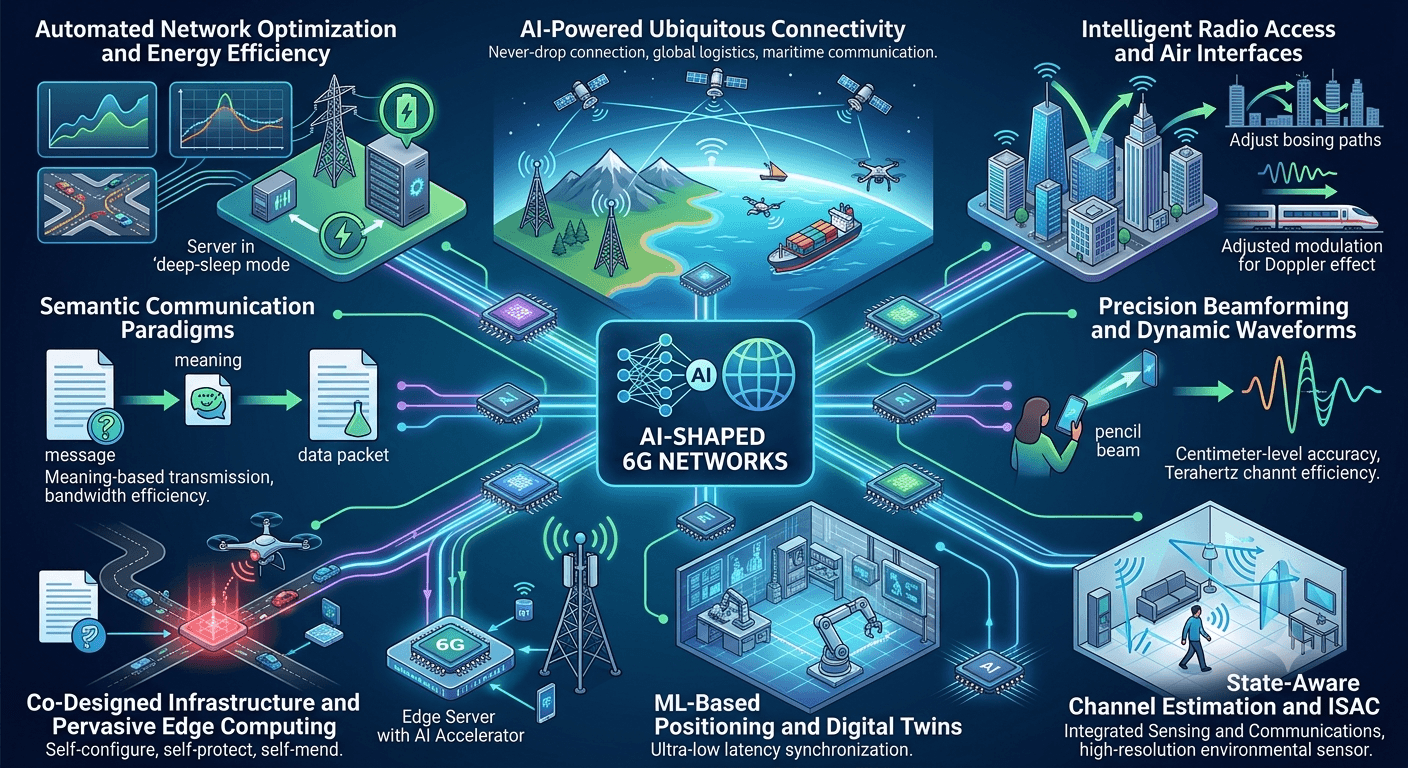
Artificial Intelligence serves as the primary engine for 6G optimization, analyzing vast amounts of data to identify performance patterns invisible to humans. This leads to a self-improving network that manages energy consumption holistically by predicting traffic patterns and putting entire sections into deep-sleep modes. By reconfiguring resources “on the fly,” AI ensures the network remains agile enough to handle sudden surges while significantly reducing the global energy footprint.
2. AI-Powered Ubiquitous Connectivity
To ensure 6G is available everywhere—from deep underground to high in the atmosphere—AI manages the complex handoffs between terrestrial towers and satellite constellations. This intelligent management provides a “never-drop” connection, which is vital for global logistics and maritime communication. By coordinating diverse access points, AI creates a seamless fabric of connectivity that remains stable regardless of the user’s location or environment.
3. Intelligent Radio Access and Air Interfaces
The Radio Access Network (RAN) in 6G utilizes AI to calculate the best signal paths in real-time, specifically in dense urban areas where signals frequently bounce off buildings. Additionally, AI-enabled air interfaces can customize the physical link between the device and the cell. For example, if a user is on a high-speed train, AI adjusts the modulation scheme to compensate for the Doppler effect, ensuring high-speed performance remains stable under challenging conditions.
4. Precision Beamforming and Dynamic Waveforms
AI-powered beamforming creates “pencil beams” that track mobile devices with centimeter-level accuracy, allowing more users to share the same spectrum without interference. Complementing this, 6G research focuses on AI-driven waveforms that change shape based on the specific data being transmitted. This flexibility allows the network to push more data through the Terahertz channel, making much more efficient use of the available cellular spectrum.
5. State-Aware Channel Estimation and ISAC
In 6G, AI performs channel estimation faster and more accurately than traditional algorithms, allowing the network to instantly compensate for rain, fog, or physical obstacles. This intelligence also powers Integrated Sensing and Communications (ISAC), which enables the network to “see” by analyzing radio wave reflections. AI distinguishes between moving people and stationary walls, effectively turning the 6G infrastructure into a high-resolution environmental sensor.
6. ML-Based Positioning and Digital Twins
Machine Learning enables 6G networks to provide positioning services with centimeter-level accuracy, far surpassing current GPS capabilities. This is a game-changer for indoor navigation and the operation of autonomous robots. Furthermore, 6G facilitates the creation of real-time digital twins—virtual replicas of physical systems like factories or cities—that stay perfectly synchronized with the physical world due to ultra-low latency.
7. Co-Designed Infrastructure and Pervasive Edge Computing
Co-designing 6G hardware and software with AI means placing accelerators directly into towers and edge servers. This pervasive edge computing moves data processing closer to the user, allowing for the instantaneous AI reactions required by autonomous drones and robotic systems. This architecture ensures that the network’s intelligence is distributed, reducing reliance on distant data centers and improving overall system response times.
8. Self-Healing Intelligent Networks
Intelligent 6G networks possess the ability to self-configure, self-protect, and self-mend. If a component fails, the AI automatically reroutes traffic and provides a precise diagnosis for repair crews. Similarly, the network can detect security threats or cyber-attacks in real-time, taking autonomous action to isolate affected segments and protect the broader user base, which is essential for critical applications like smart grids.
9. Semantic Communication Paradigms
Semantic communication represents a shift where the 6G network understands the “meaning” of the data it carries. Instead of transmitting every single bit, the AI-driven network transmits only the essential information required to reconstruct the message at the destination. This revolutionary approach drastically reduces the bandwidth required for communication, allowing for much more efficient data exchange across the global 6G infrastructure.
Final Thought
The journey from 1G to 6G has been one of exponential growth, but the 6G network promises to be the most transformative step yet. By weaving artificial intelligence into the very core of communication, we are moving toward a world where the network is an intelligent partner rather than just a utility. As we refine 6G technology, we must focus on creating an infrastructure that is not only fast but also sustainable, secure, and inclusive, ensuring that the benefits of this mobile communications revolution reach every corner of the globe.
Faqs
What is a 6G network and how does it differ from 5G?
The 6G network is the next generation of wireless technology that offers speeds up to 100 times faster than 5G. While 5G focused on connecting things, 6G is designed to integrate AI and sensing into the network, enabling immersive experiences like holographic communication. It uses much higher frequencies, specifically in the Terahertz range, to provide massive bandwidth and ultra-low latency of 0.1ms.
When will 6G networks be available for public use?
Most industry experts and regulatory bodies, such as the ITU, expect the first commercial 6G networks to become available around 2030. Research and development are currently in the early stages, with standards being defined. We can expect to see the first 6G testing and pilot programs in the late 2020s before a global rollout begins.
How fast will the 6G network mobile phone experience be?
A 6G network mobile phone could theoretically reach peak speeds of 1 Terabit per second. For the average consumer, this means real-world speeds of several hundred megabits to gigabits per second, allowing for instantaneous downloads of massive files and seamless 8K or 16K video streaming without any buffering.
Will 6G towers be different from 5G towers?
Yes, 6G towers will need to support much higher frequency bands, which have a shorter range. This means the 6G cellular network will rely on a denser “small cell” architecture. Many 6G towers will be smaller and integrated into urban furniture like streetlights and buildings to ensure consistent coverage for Terahertz signals.
What is 6G network slicing and why is it important?
6G network slicing is a technology that allows a single physical 6G network to be divided into multiple virtual networks. Each slice can be optimized for a specific use case, such as a dedicated slice for emergency services with ultra-high reliability or a slice for gaming with ultra-low latency, ensuring that different applications don’t interfere with each other.
How does AI improve 6G wireless technology?
AI is a core part of 6G wireless technology, used to optimize signal paths, manage energy consumption, and predict network congestion. Unlike previous generations where AI was an add-on, 6G is “AI-native,” meaning the algorithms are built into the hardware and software to allow for a self-healing and self-optimizing infrastructure.
What are the main 6G communication applications in healthcare?
In healthcare, 6G communication will enable high-precision robotic surgeries where a doctor can operate on a patient from thousands of miles away with zero lag. It will also support continuous, real-time monitoring of patients through thousands of tiny IoT sensors, providing doctors with instant data to prevent medical emergencies.
Will 6G technology be more energy-efficient than previous generations?
Yes, 6G research is heavily focused on sustainability. By using AI to intelligently power down parts of the 6G cell when not in use and employing more efficient materials in the 6G towers, the network aims to handle much more data with a significantly lower energy footprint per bit compared to 5G or 4G.
What role does 6G research play in autonomous driving?
6G research is critical for autonomous driving as it provides the ultra-low latency required for vehicles to talk to each other and the surrounding infrastructure in real-time. This 6G communication allows cars to “see” around corners and react to hazards much faster than a human could, making fully autonomous transportation a reality.