
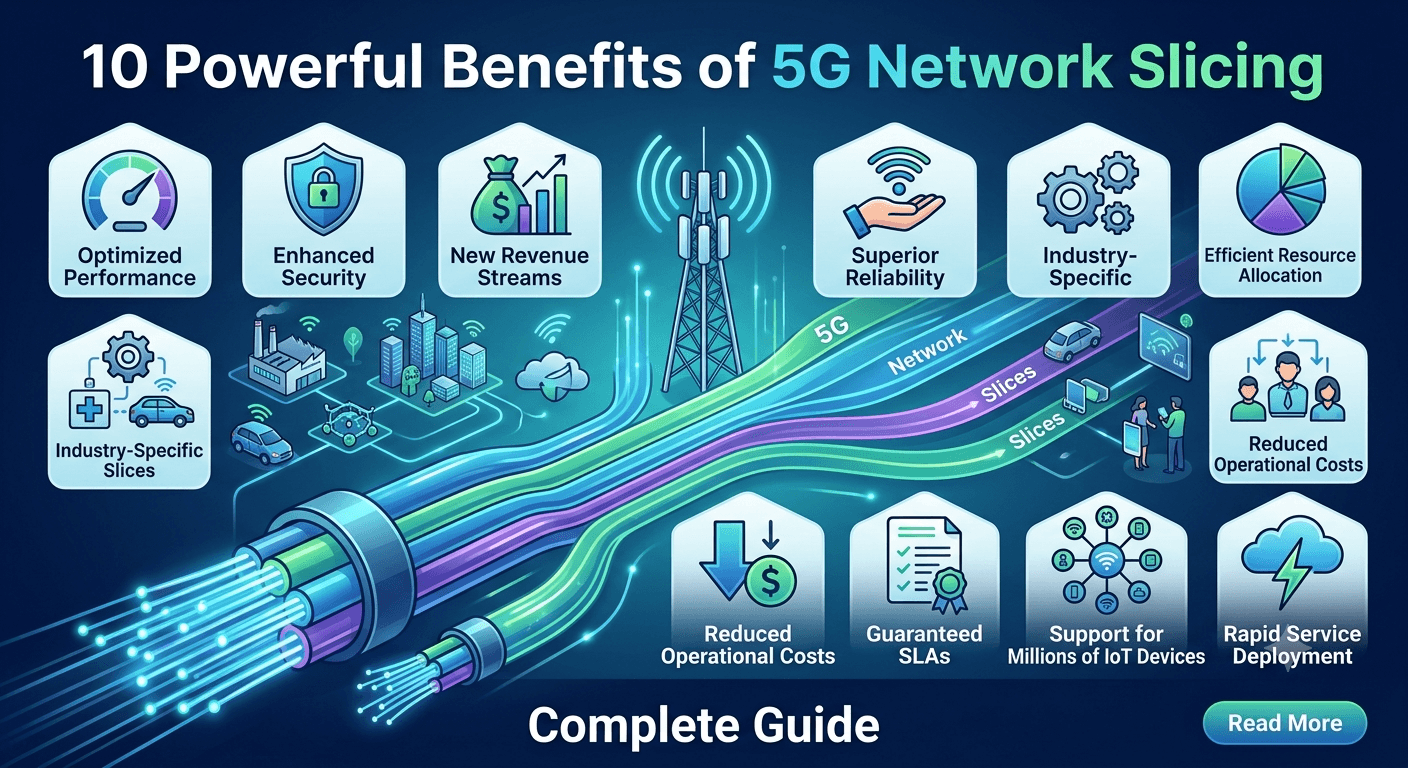
5g network slicing is a revolutionary network architecture that allows mobile operators to create multiple virtual networks atop a single physical 5G infrastructure. Each “slice” is an isolated, end-to-end network tailored to meet the specific requirements of a particular application, service, or customer. By leveraging technologies like Software Defined Networking (SDN) and Network Functions Virtualization (NFV), 5g network slicing ensures that diverse use cases—ranging from high-speed mobile broadband to ultra-reliable low-latency communications for autonomous vehicles—receive the exact bandwidth, security, and latency they need without interfering with other network traffic or degrading performance for other users.
What is 5G network slicing?
The concept of 5g network slicing represents a fundamental shift in how telecommunication networks are designed and managed. Historically, mobile networks were built as a one-size-fits-all infrastructure, where every device and application shared the same pool of resources regardless of their specific needs. With the advent of 5G, this rigid structure has evolved into a flexible, software-driven environment. At its core, what is 5g network slicing is the ability to partition a single physical network into multiple virtual layers, each optimized for a specific business purpose or technical requirement.
This technology allows for the creation of customized connectivity solutions. For instance, a network operator can dedicate one 5g network slice specifically to emergency services, ensuring they have priority access and high reliability, while another slice is dedicated to general consumer internet usage. Because these slices are logically isolated, a surge in traffic on one slice does not impact the performance of another. This isolation is critical for maintaining a high-quality network slicing customer experience, especially for industries that cannot afford even a millisecond of downtime.
The ability to offer network slicing as a service opens up new revenue streams for telecommunications providers. Instead of selling simple data plans, they can now offer specialized connectivity packages with guaranteed Service Level Agreements (SLAs). This transformation is why many industry experts consider 5g slicing to be the “secret sauce” that will finally unlock the full economic potential of the fifth generation of mobile networks.
According to research from the GSMA, the implementation of 5g network slicing is expected to be a primary driver for the 5g network slicing market, which is projected to grow significantly as enterprises seek more control over their wireless connectivity.
Principal types of network slicing in 5G
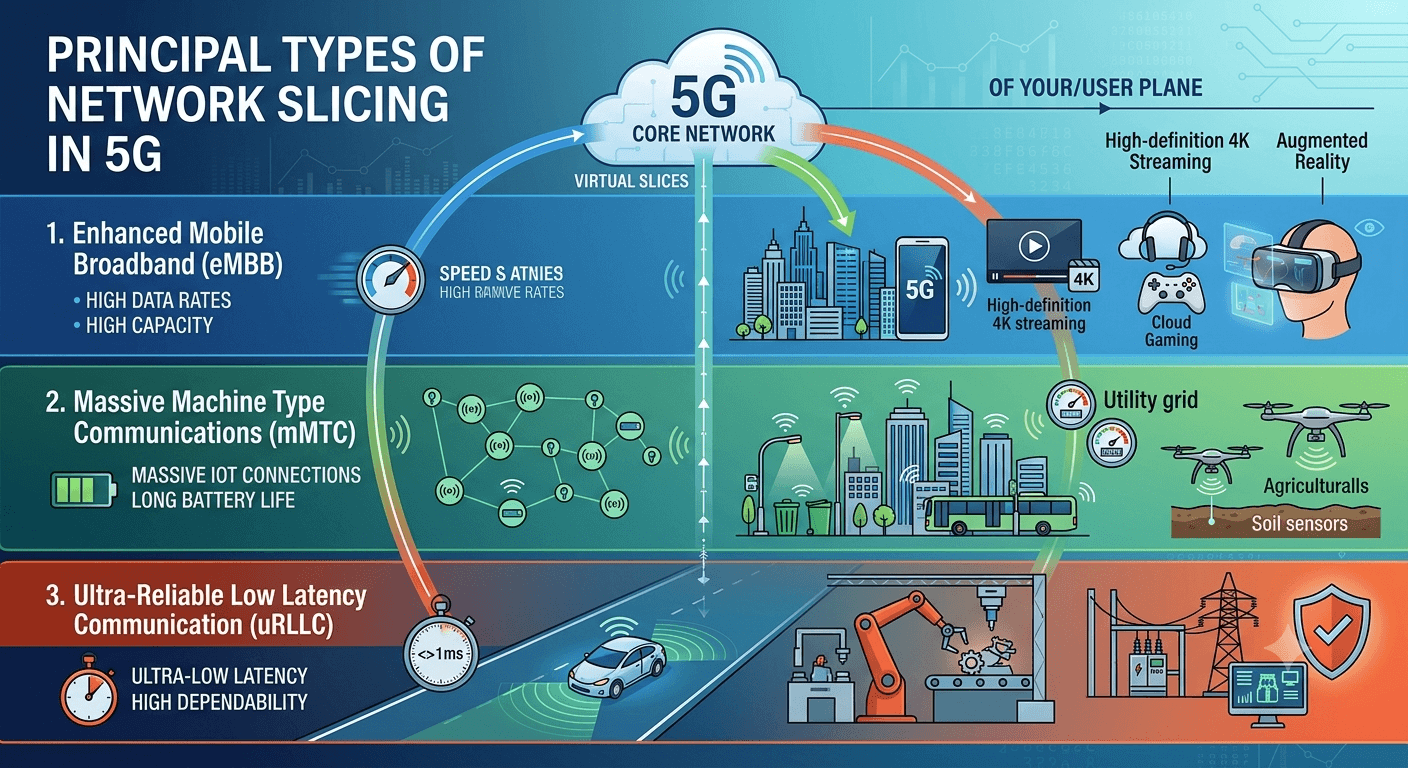
To understand the full scope of this technology, it is essential to look at the three primary categories defined by international standards. These categories help clarify 5g network slicing explained for different industrial and consumer needs. Each type of slice is engineered with specific parameters for speed, capacity, and latency to serve different ends of the digital spectrum.
1. Enhanced Mobile Broadband (eMBB)
Enhanced Mobile Broadband slicing ensures 5G applications with heavy traffic on mobile networks can deliver high-quality broadband services. Mobile users can secure the required bandwidth to access 5G capabilities like streaming services or online games without delays, connectivity issues, or outages. This slice type is primarily focused on delivering extremely high data rates and improving capacity in densely populated areas. By using eMBB, operators can support high-definition video streaming and augmented reality experiences that would otherwise congest a standard network.
2. Massive Machine Type Communications (mMTC)
Massive Machine Type Communications, or mMTC for short, is a specific network slicing 5g method for large-scale IoT (Internet of Things) applications. As the name suggests, this slicing type is meant to manage huge amounts of interconnected devices with limited data rates. These devices often require long battery life and only transmit small bursts of data intermittently. Smart city sensors, utility meters, and agricultural monitors are perfect examples of devices that utilize the mMTC slice to remain connected efficiently without consuming the high-power resources reserved for smartphones.
3. Ultra-Reliable Low Latency Communication (uRRLC)
Ultra-Reliable Low Latency Communication (uRRLC) is used for basic business applications that don’t require as many resources but need a high reliability level. uRRLC is, therefore, designed to provide low latency and high dependability to ensure efficient services. This is perhaps the most critical slice for the future of automation. It supports mission-critical tasks where even a slight delay could be catastrophic, such as autonomous driving, remote industrial robotics, and smart grid management. The uRRLC 5g network slice guarantees that data packets arrive on time, every time.
Key elements of 5G network slicing architecture
The 5g network slicing architecture is built on several sophisticated technologies that work in harmony to create and manage virtual layers. These elements transition the network from a hardware-centric model to a software-centric one, allowing for the dynamic allocation of resources. Understanding these components is vital for anyone looking to implement a network slicing solution within a modern enterprise.
1. Network functions virtualization (NFV)
Network functions virtualization involves replacing physical hardware with virtual machines. This architecture concept allows businesses to get the most out of 5G technology by modernizing networks similarly to Vonage Network APIs, granting greater accessibility, flexibility, and scalability. Instead of installing and maintaining traditional hardware, organizations can leverage NFV to handle load balancing, routing, and firewall security virtually. This virtualization is what makes a 5g network slice possible, as it decouples the software from the underlying physical infrastructure, allowing multiple instances of network functions to run on shared servers.
2. Software defined networks (SDNs)
Software defined networks make the network easier to manage by separating the decision-making part (control) from the data movement part. This allows operators to quickly set up and adjust different slices to meet the needs of different users or services. SDN acts as the central intelligence that tells the network where to send traffic and how to prioritize it. Without SDN, the manual configuration required to create a network slice would be too complex and slow for modern demands.
3. The control plane
The control plane is like the brain of the network. It handles instructions, decides how data should flow, and ensures the network works properly. In network slicing, it helps direct data to the right slice and makes sure each slice runs smoothly and efficiently. The control plane manages the signaling and ensures that the 5g network slicing technology advancements are applied consistently across all virtual layers, maintaining the integrity of each individual slice.
4. Recursion
Recursion in network slicing means adjusting and reconfiguring slices as needed. For example, if one slice gets too busy, the network can make changes on the fly to maintain performance. This adaptability ensures that all slices meet their specific service requirements, even during unexpected changes. Recursion allows for a hierarchical structure where a large slice can be further subdivided into smaller, more specific sub-slices, providing an even higher degree of customization for complex organizations.
5. The network slice controller (orchestrator)
The orchestrator is like the manager of all the slices. It ensures each slice gets the right amount of resources, tracks how well they’re working, and makes adjustments when needed to meet service promises. The orchestrator is responsible for the entire lifecycle of a slice, from its initial creation and resource provisioning to its eventual decommissioning. It ensures that the network slicing technology remains cost-effective by reclaiming resources when a slice is no longer in use.
6. Single-Network Slice Selection Assistance Information (S-NSSAI)
S-NSSAI is like an address label for network slices. It helps connect devices or services to the right slice by identifying which one meets their needs. This ensures that every user or application gets the correct network resources for specific requirements, such as speed, reliability, or capacity. When a device connects to the network, the S-NSSAI tells the core network exactly which 5g network slice the device is authorized to use, ensuring a seamless and secure connection process.
How does 5G network slicing work?
To understand how 5g network slicing works, one must visualize the network as a set of logical pipes running through a single physical tunnel. The process begins at the 5G Core, where the physical hardware is partitioned using virtualization. Each slice is an isolated end-to-end logical network that includes the Radio Access Network (RAN), the core network, and the transport link. When a specific service or device requests access, the network identifies its requirements—such as a need for low latency or high bandwidth—and assigns it to the corresponding slice.
-
The service provider defines the requirements for a specific use case, such as the maximum latency or minimum data rate.
-
The orchestrator allocates the necessary virtual resources across the RAN and the core network to create the slice.
-
Traffic is tagged with a slice ID, ensuring it stays within its designated virtual boundaries throughout its journey.
-
The network monitors the performance of the slice in real-time, adjusting resources dynamically to maintain the agreed-upon quality of service.
This dynamic nature is what distinguishes network slicing 5g from traditional Virtual Private Networks (VPNs). While a VPN provides a secure tunnel, it does not guarantee specific performance metrics like latency or jitter. In contrast, a 5g network slice provides a deterministic environment where performance is guaranteed. This is particularly important for the network slicing market, as industries like manufacturing require precise timing for their automated assembly lines that only a dedicated slice can provide.
5G network slicing examples and use cases
The versatility of network slicing in 5g is best demonstrated through its diverse range of applications. By tailoring the network to the specific needs of different industries, 5g network slicing enables innovations that were previously impossible with older generations of mobile technology. These use cases highlight how a network slice can be the foundation for the next wave of digital transformation.
-
Logistics (fleet management and asset tracking)
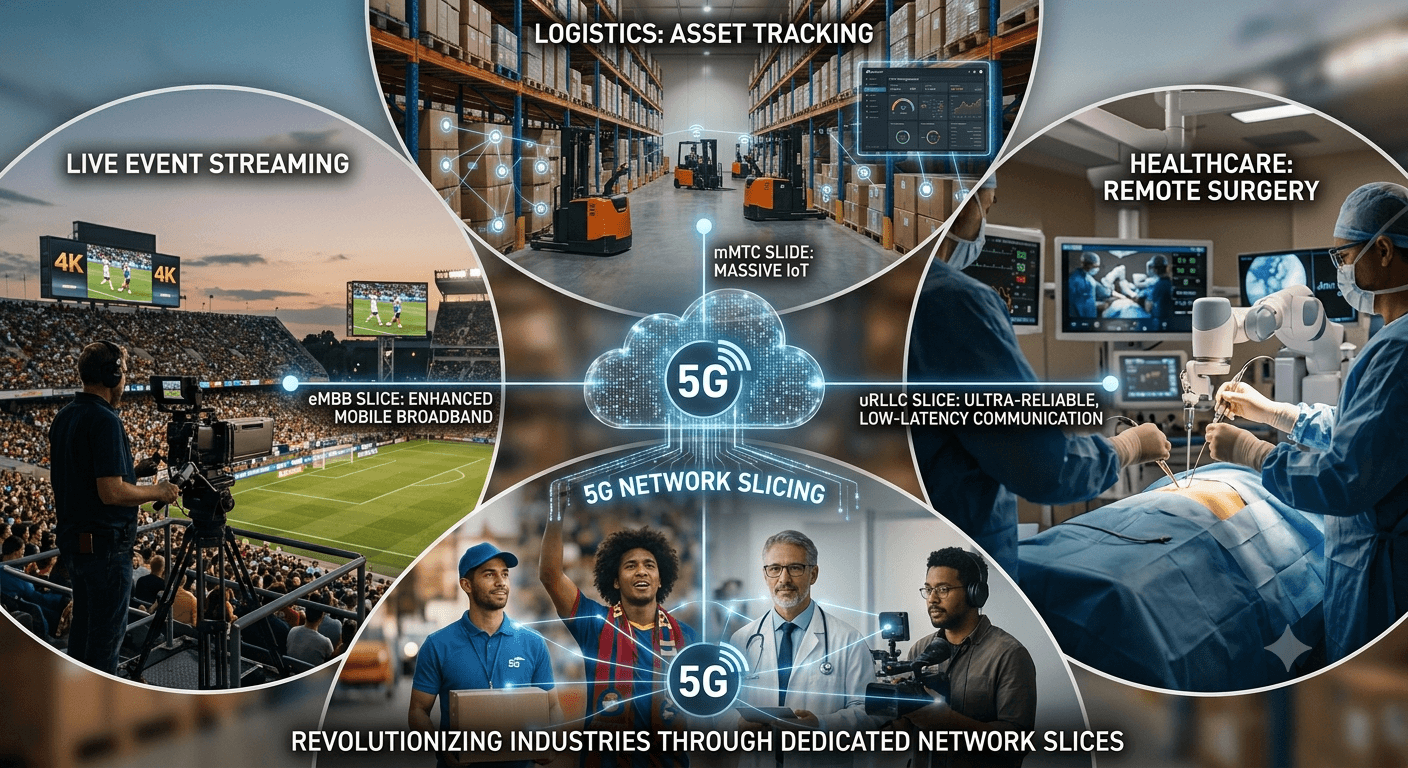
In the logistics sector, 5g network slicing allows companies to track thousands of assets simultaneously across vast geographic areas. Using an mMTC slice, logistics providers can connect sensors on shipping containers, delivery trucks, and warehouse shelves. These sensors provide real-time data on location, temperature, and handling conditions. Because the mMTC slice is optimized for many low-power devices, companies can maintain a comprehensive tracking system without the high costs associated with traditional high-bandwidth data plans.
-
Live event streaming
For broadcasters and content creators, live event streaming requires massive amounts of upstream bandwidth and zero interruptions. By utilizing an eMBB slice, a media company can ensure that their 4K or 8K video feed from a stadium is transmitted with perfect clarity, even when thousands of fans in the stands are using their phones simultaneously. This isolation prevents the general public’s data usage from slowing down the professional broadcast, ensuring a premium viewing experience for audiences at home.
-
Healthcare (remote consultations and surgery)
Healthcare is perhaps the most life-altering application of network slicing technology. Remote surgery requires ultra-low latency to ensure that a surgeon’s movements are mirrored by a robotic arm miles away without any perceptible lag. A dedicated uRRLC slice provides the necessary reliability and speed for these critical procedures. Beyond surgery, 5g network slicing facilitates remote patient monitoring and high-speed transmission of large medical imaging files, allowing specialists to provide expert care to patients in rural or underserved locations.
Why is 5G network slicing 3GPP recognized?
The 3rd Generation Partnership Project (3GPP) is the global organization that develops standards for mobile telephony. The recognition of 5g network slicing by 3GPP ensures that the technology is standardized and interoperable across different vendors and countries. This standardization is vital for the global adoption of what is network slicing, as it allows equipment from different manufacturers to work together seamlessly within a single network.
-
Allocate resources efficiently
One of the primary reasons for 3GPP’s focus on this technology is the ability to allocate resources efficiently. Instead of wasting high-performance resources on low-priority tasks, operators can use 5g network slicing to match the resource to the requirement. This optimization ensures that the physical infrastructure is used to its maximum potential, reducing waste and allowing for more devices to be connected to the same cell tower without a drop in quality.
-
Support multiple tenants or service providers
The 3GPP standards enable a single physical network to support multiple tenants, such as different government agencies or private corporations. This capability is essential for the concept of network slicing as a service. It allows a mobile operator to “rent out” a specific portion of their network to a third party, who can then manage that slice as if it were their own private network. This multi-tenancy model significantly lowers the barrier to entry for organizations that need a private network but do not want to build their own physical infrastructure.
-
Enhance Quality of Service (QoS)
Standardization through 3GPP ensures that Quality of Service (QoS) can be strictly enforced. In a sliced environment, QoS is not just a best-effort attempt; it is a guaranteed parameter. This is why network slicing 5g is so attractive to industries with stringent requirements. The standards provide the framework for defining and measuring metrics like latency, packet loss, and throughput within each slice, ensuring that every user receives the performance they were promised.
-
Reduce operational costs
By moving toward a virtualized, software-defined architecture, operators can significantly reduce their operational costs. The 3GPP-recognized 5g network slicing technology allows for automated management and orchestration, reducing the need for manual intervention. Furthermore, because multiple virtual networks run on the same hardware, the capital expenditure required to expand services is much lower than in previous generations. This cost reduction is a major factor driving the growth of the network slicing market globally.
Considerations for successful 5G network slicing implementation
The benefits of 5g network slicing are clear, but successful implementation requires attention to a few critical areas. Moving from a traditional network to a sliced architecture involves overcoming technical and organizational hurdles. Companies must look at their network slicing router capabilities and overall infrastructure readiness before fully committing to a deployment.
-
Security: Maintaining the network’s security can be more difficult when managing multiple connections. Each slice must be isolated to prevent breaches or interference between slices, so robust encryption and access controls are key. If one slice is compromised, the isolation must be strong enough to ensure the attacker cannot move laterally into other slices.
-
Testing: Testing is crucial to successfully implementing any new technology. It helps ensure that each slice performs as it should, checking for latency, reliability, and compatibility with various devices and services. Continuous testing is necessary as slices are dynamically added or removed to ensure the overall network remains stable.
-
Expertise: Technology only works if people know how to use it properly. Organizations need skilled teams or partners who understand the complexities of 5g network slicing to effectively plan, deploy, and maintain the system. This includes knowledge of cloud-native architectures, virtualization, and the specific 3GPP standards that govern 5G.
Furthermore, integrating 5g network slicing into existing business workflows requires a strategic approach. It is not just a technical upgrade; it is a change in how services are delivered. For example, a company using a t-mobile 5g advanced network slice must understand how that slice interacts with its internal IT systems to maximize the efficiency gains. Proper planning and a clear understanding of the intended use cases are the most important steps in any implementation journey.
5G network slicing technology: Just one way to make the most of 5G
While 5g network slicing is a cornerstone of the 5G era, it is part of a broader ecosystem of advancements. Technologies like Edge Computing and Massive MIMO work alongside slicing to provide a comprehensive connectivity solution. For instance, combining a uRRLC slice with edge computing brings data processing closer to the user, further reducing latency for applications like augmented reality or industrial automation. This synergy is what truly defines the power of modern 5G networks.
The evolution of 5g network slicing technology advancements continues to push the boundaries of what is possible. Recent developments in artificial intelligence and machine learning are being integrated into the orchestration process to create “intent-based” slicing. This means the network can automatically understand what a user wants to achieve and configure the slice accordingly without manual input. As these technologies mature, the flexibility and efficiency of 5g slicing will only increase, making it an indispensable tool for the digital economy.
Moreover, the rise of the network slicing market shows that businesses are increasingly seeing the value in customized connectivity. Whether it is a small business using a slicing service for secure remote work or a global manufacturer using it to run a “dark factory,” the applications are limitless. By providing a tailored experience, 5G ensures that the network is no longer a bottleneck but an accelerator for innovation.
Read More: Future of VoIP: AI Integration
Conclusion
In conclusion, 5g network slicing represents the pinnacle of modern networking flexibility and efficiency. By allowing a single physical infrastructure to be partitioned into multiple, specialized virtual networks, it addresses the diverse and often conflicting needs of today’s digital world. From the high-speed requirements of eMBB to the mission-critical reliability of uRRLC and the massive scale of mMTC, network slicing 5g provides a solution for every scenario.
As the technology continues to mature and the network slicing market expands, we can expect to see even more creative and impactful use cases emerge. Organizations that embrace this technology early will gain a significant competitive advantage by being able to offer superior reliability, security, and performance to their customers. Ultimately, 5g network slicing is not just a technical feature; it is the foundation for a more connected, efficient, and innovative future.
FAQs
-
What is the role of SDN in 5G network slicing?
The role of Software Defined Networking (SDN) in 5g network slicing is to provide the centralized control and flexibility needed to manage virtual networks. SDN decouples the control plane from the data plane, allowing operators to dynamically allocate resources, route traffic, and configure slices through software rather than manual hardware adjustments. This enables the rapid provisioning and scaling of network slices to meet changing demands.
-
How does 5G network slicing improve security?
5G network slicing significantly improves security through logical isolation, which ensures that traffic within one specific slice remains completely invisible and inaccessible to users on any other slice. This architecture also allows network operators to implement customized security policies, such as specialized firewalls, encryption levels, and access controls that are uniquely tailored to the sensitivity of the data within a particular slice. Furthermore, this structure facilitates the containment of threats; if a security breach occurs in one slice, the inherent isolation prevents the threat from spreading laterally to the rest of the network or other active slices.
-
What are the three main types of 5G slices?
The three main types of 5G slices include Enhanced Mobile Broadband (eMBB), which is specifically designed to handle high-speed data and high-capacity applications like 4K video streaming and virtual reality. Another primary type is Massive Machine Type Communications (mMTC), which is optimized for connecting an immense number of low-power IoT devices, such as smart meters and environmental sensors. Finally, Ultra-Reliable Low Latency Communication (uRRLC) is built to support mission-critical tasks that demand near-instantaneous response times and the highest levels of dependability, such as autonomous driving or industrial robotics.
-
Can 5G network slicing support IoT?
Yes, 5g network slicing is specifically designed to support the Internet of Things (IoT) through the mMTC slice type. This slice allows for the efficient management of millions of sensors and devices that transmit small amounts of data, ensuring they stay connected without overwhelming the resources needed for high-speed mobile users.
-
What is a 5G network slice instance (NSI)?
A 5G network slice instance (NSI) is the actual set of network functions and the resources (like compute, storage, and networking) that are deployed and active to form a specific slice. It is the realized version of a slice template, running on the physical infrastructure to serve a specific group of users or applications.
-
What are the challenges of 5G slicing?
One of the primary challenges is the complexity of orchestration, as managing thousands of slices simultaneously requires the use of highly sophisticated automation and management tools. Additionally, interoperability is a major hurdle because ensuring that slices can function seamlessly across different hardware vendors and international borders requires strict adherence to global standards. Finally, efficient resource management is essential for balancing the allocation of physical resources so that no single slice starves others of the capacity they need to function.
-
What is network slicing in 5G networks?
Network slicing in 5G networks is a method of creating multiple virtual, end-to-end networks on top of a shared physical infrastructure. Each virtual network, or slice, is customized to provide specific performance characteristics like speed, latency, and reliability to meet the needs of different services or industries.
-
What is network slicing 5G Core?
The 5G Core is the central part of the network where slicing is primarily managed. It uses cloud-native technologies and virtualization to partition network resources. The 5G Core is responsible for identifying which slice a device belongs to and ensuring the traffic is handled according to the specific rules and performance requirements of that slice.
-
What is dynamic slicing in 5G?
Dynamic slicing refers to the ability of the network to create, modify, and terminate network slices in real-time based on current demand. Instead of having permanent, static slices, the network can automatically scale resources up or down or even spin up a new slice for a temporary event, such as a concert or an emergency situation, and then reclaim those resources once the event is over.
-
What is 5G SA’s network slicing and why is it important?
5G Standalone (SA) network slicing is the implementation of slicing on a network that uses a dedicated 5G Core rather than relying on existing 4G infrastructure. It is important because the true benefits of 5g network slicing, such as ultra-low latency and total end-to-end isolation, can only be fully realized in a Standalone environment where the core network is designed from the ground up for 5G capabilities.