
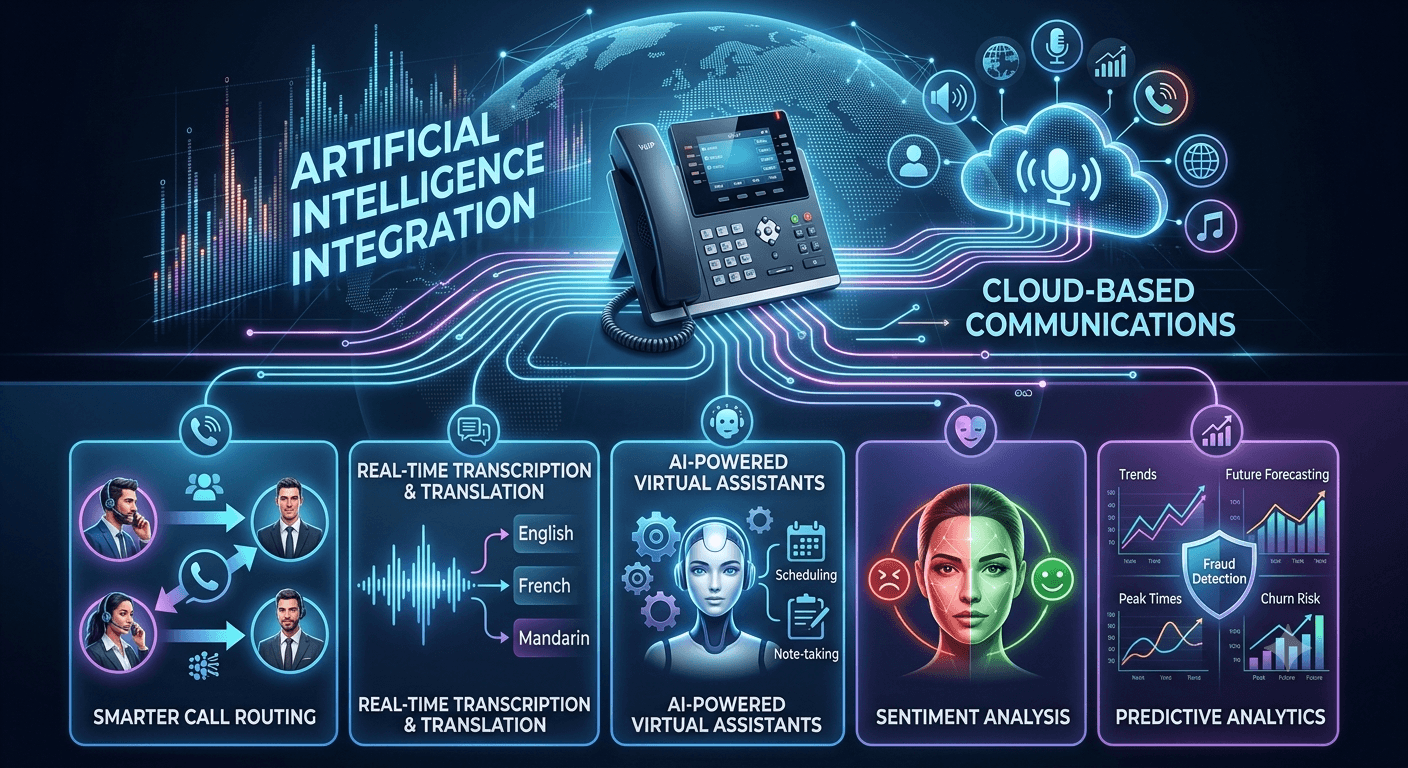
The Future of VoIP: AI Integration represents a monumental shift in how global businesses connect, moving beyond simple voice transmission to intelligent, automated communication ecosystems. By embedding artificial intelligence directly into cloud-based phone systems, organizations can now leverage real-time data processing to enhance clarity, security, and efficiency. This evolution positions voip the future of telecommunications, where voice data is no longer static but a dynamic asset used for strategic decision-making. As the future of voip industry unfolds, the focus shifts from hardware to sophisticated software layers that predict user needs and automate complex workflows.
How AI is Transforming VoIP?
The integration of artificial intelligence into voice networks has moved from a conceptual stage to a functional necessity. Modern voip ai news highlights that systems are no longer passive recipients of audio; they are active participants in the conversation. By utilizing advanced machine learning algorithms, the future of voip technology ensures that every call is optimized for quality and purpose. This transformation is primarily driven by the need for smarter resource management and the desire to extract actionable insights from every interaction.
1. Smarter Call Routing with AI
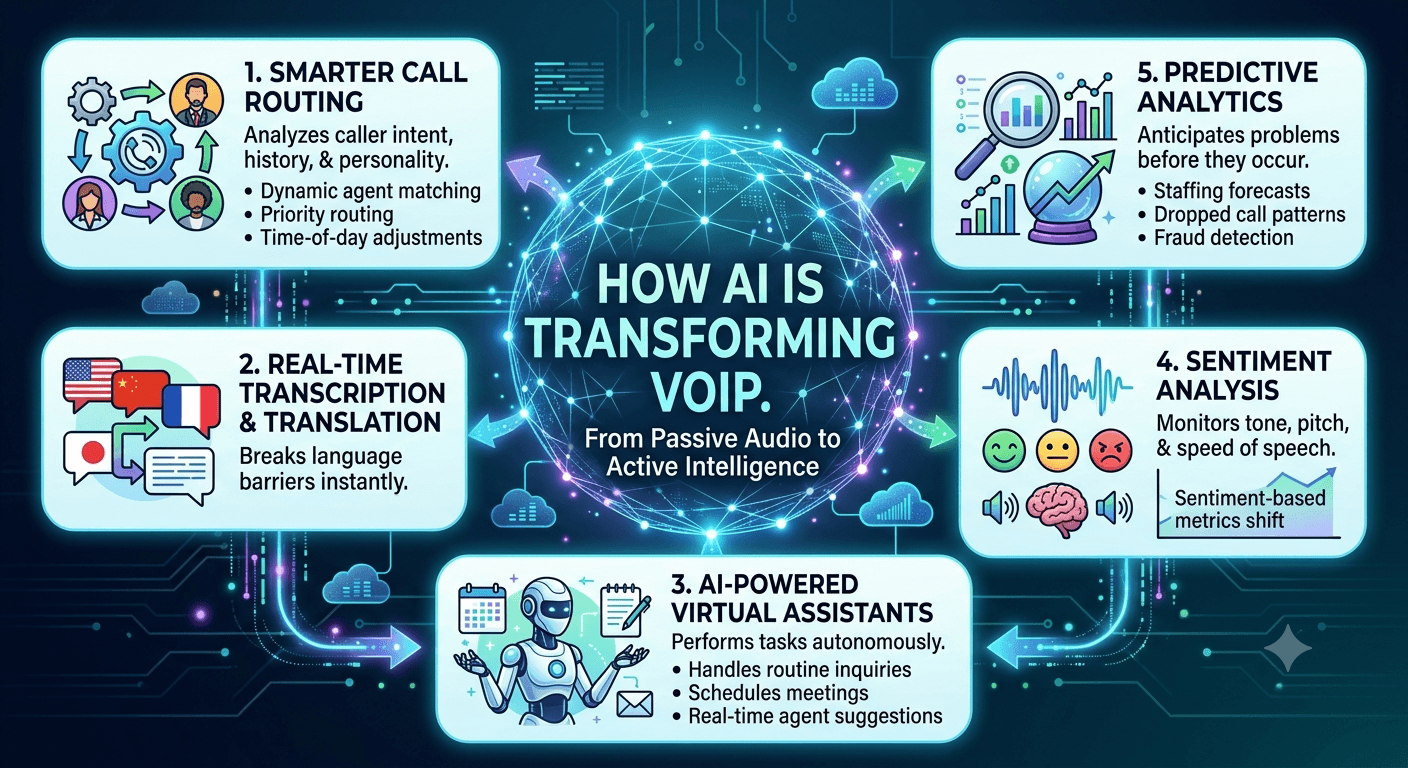
Traditional call routing relied on rigid rules and manual inputs that often frustrated callers. Today, ai voip systems use intelligent routing to analyze caller history, intent, and even the personality profile of the caller to match them with the most suitable agent. This reduces wait times and ensures that queries are resolved in the first interaction, which is a core component of ai-powered call analytics features in cloud voip systems.
Dynamic routing uses skill-based matching to connect callers with specialized agents while placing high-value clients into priority queues. It also automatically redirects traffic during high-volume periods and adjusts call distribution based on time-of-day global patterns to balance workload.
2. Real-Time Transcription and Translation
One of the most impressive feats in the future of voip is the ability to break language barriers instantly. AI algorithms can transcribe spoken words into text with incredible accuracy, allowing for searchable call logs and easy documentation. Furthermore, real-time translation features allow two people speaking different languages to communicate seamlessly, making voip the future of telecommunications for international trade.
The accuracy of these systems has improved significantly due to neural machine translation. Business owners can now hold meetings with global partners without the need for expensive human translators. This technology not only saves time but also ensures that no critical information is lost in translation during high-stakes negotiations.
3. AI-Powered Virtual Assistants
Virtual assistants have evolved far beyond simple auto-attendants. In the current landscape of ai news today, we see the rise of agentic ai, which can perform tasks autonomously rather than just following simple commands. These assistants can schedule meetings, take notes, and even follow up with clients via email after a call has concluded.
Automated systems handle routine inquiries independently and instantly schedule calendar invites to streamline workflows. During live interactions, they provide agents with real-time suggestions while effortlessly managing out-of-office responses using personalized data.
4. Sentiment Analysis for Customer Experience
Understanding the emotional state of a caller is crucial for effective communication. The future of voip industry includes sentiment analysis tools that monitor tone, pitch, and speed of speech to determine if a customer is happy, frustrated, or confused. This allows managers to intervene in difficult calls or provide immediate feedback to agents.
Research by Gartner suggests that by 2026, 60% of service organizations will transition from traditional metrics to sentiment-based performance indicators.
This shift ensures that businesses focus on the quality of human connection rather than just the duration of the call.
5. Predictive Analytics for Business Communication
Predictive analytics allow businesses to anticipate problems before they occur. By analyzing historical call data, ai-powered call analytics features in cloud voip systems can predict peak call times, potential network failures, or even customer churn risks. This foresight allows companies to allocate resources more effectively and maintain a high standard of service.
Predictive models forecast contact center staffing needs to optimize scheduling and pinpoint the underlying patterns that lead to dropped calls. They also detect fraudulent activity in real-time while analyzing customer inquiry trends to suggest valuable new service offerings.
Benefits of AI-Powered VoIP Systems
The adoption of the Future of VoIP: AI Integration brings a multitude of advantages that go beyond simple cost-cutting. These systems provide a competitive edge by making communication more fluid and intelligent. Organizations that embrace these changes find themselves better equipped to handle the demands of a modern, fast-paced market.
1. Efficiency and Productivity
Efficiency is the cornerstone of any successful business, and AI-enhanced VoIP systems deliver this in abundance. By automating repetitive tasks like logging calls and updating CRM records, employees can focus on more strategic initiatives. The reduction in manual data entry alone saves hundreds of hours annually for large sales and support teams.
Furthermore, the ability to quickly search through transcribed calls for specific keywords means that information retrieval is instantaneous. Instead of listening to a thirty-minute recording, a manager can find the exact moment a specific product was mentioned in seconds. This level of productivity is why many consider voip the future of telecommunications.
2. Cost Savings
While the initial setup of advanced AI features might seem like an investment, the long-term savings are substantial. AI reduces the need for a large workforce to handle basic customer service tasks. Additionally, by optimizing network traffic and reducing bandwidth waste, companies can see a marked decrease in their monthly service bills.
Implementing specialized technology reduces human labor costs for manual data entry and minimizes financial losses from fraudulent international calls. It also lowers overhead by eliminating the need for physical office hardware while decreasing agent turnover through better support tools.
3. Better Customer Experience
The primary goal of any communication system is to provide a positive experience for the end-user. AI-driven systems achieve this by providing faster response times and more personalized interactions. When a system knows exactly who is calling and why, the customer feels valued and understood, which is vital for brand loyalty.
Recent studies indicate that nearly 70% of customers prefer self-service options for simple tasks, provided they are accurate. AI-powered IVRs and chatbots fulfill this need, allowing customers to get answers at any time of day or night without waiting on hold for a human representative.
4. Scalability
One of the most significant advantages of cloud-based AI systems is their ability to scale effortlessly. As a business grows, its communication needs become more complex. The future of voip technology allows for the instant addition of new lines, features, and AI modules without the need for physical infrastructure upgrades.
This flexibility is particularly beneficial for seasonal businesses that may need to triple their capacity for a few months and then scale back. The cloud environment ensures that you only pay for what you use, making it an ideal solution for startups and enterprises alike.
5. Data-Driven Decision Making
The wealth of data provided by ai-powered call analytics features in cloud voip systems is a goldmine for business intelligence. Leaders can now see exactly how their teams are performing, which marketing campaigns are driving the most calls, and what common pain points customers are facing.
Interactive dashboards visualize real-time call trends and map out the geographical areas with the highest customer engagement. They also track the exact ROI of specific communication strategies while effortlessly comparing agent performance against automated benchmarks.
The Future of AI in Business Communication
Looking ahead, the Future of VoIP: AI Integration will only become more deeply rooted in the daily operations of global enterprises. We are moving toward a world where communication is proactive rather than reactive. The convergence of voice, data, and intelligence is creating a new standard for how work gets done.
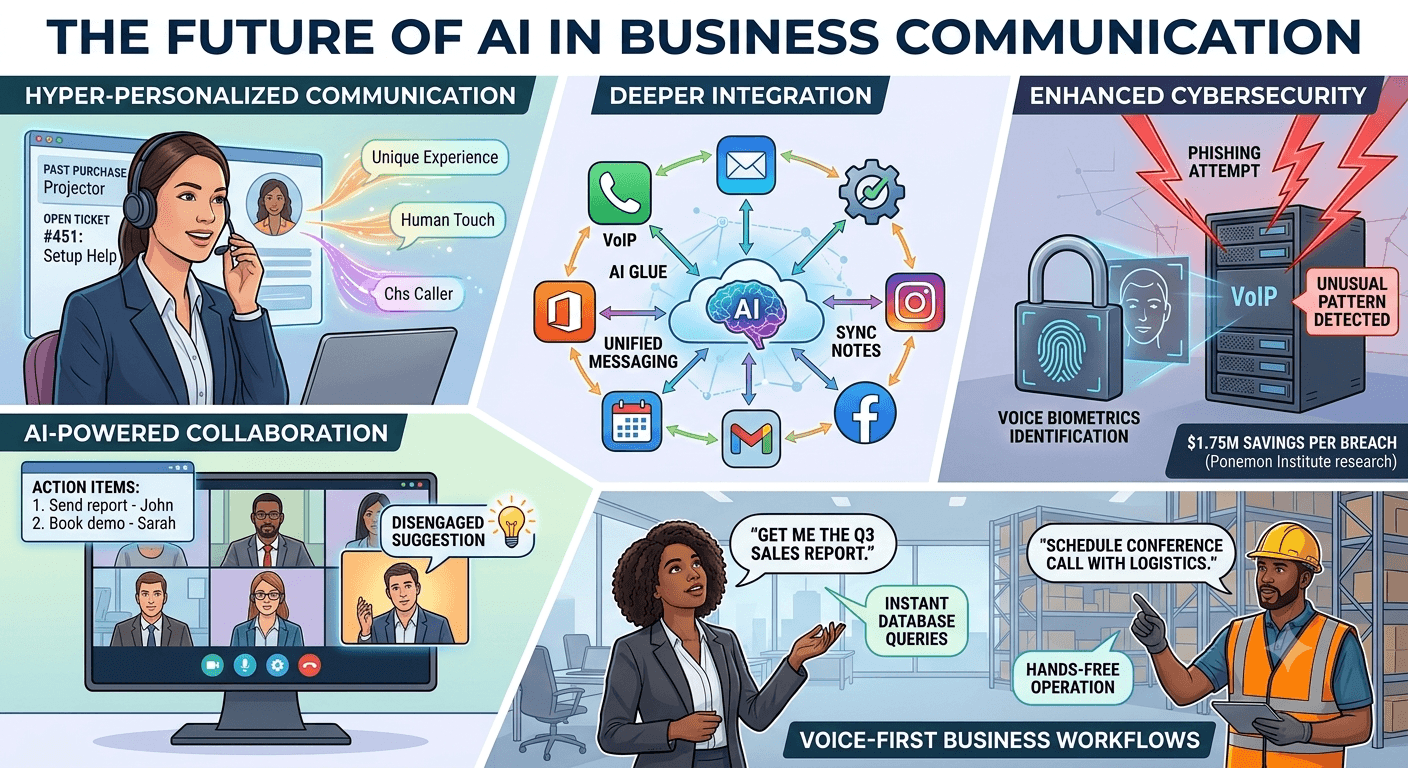
1. Hyper-Personalized Communication
Hyper-personalization is the next frontier in the future of voip industry. Instead of generic greetings, AI will use real-time data to craft unique experiences for every caller. This might include referencing a previous purchase, acknowledging a recent support ticket, or even adjusting the conversational style based on the caller’s historical preferences.
This level of detail makes the interaction feel more human, despite being powered by algorithms. It bridges the gap between digital efficiency and personal touch, ensuring that technology serves to enhance human relationships rather than replace them.
2. Deeper AI and VoIP Integration
The silos between different communication platforms are disappearing. In the future, your VoIP system will be seamlessly integrated with your email, project management tools, and social media channels. AI will act as the glue that binds these systems together, ensuring a consistent flow of information across the entire organization.
Unified messaging platforms seamlessly connect communication across all digital channels while providing centralized AI insights for every touchpoint. They keep remote teams aligned by tracking cross-platform presence and automatically syncing call notes directly to project boards.
3. AI-Powered Collaboration Tools
As remote work remains a permanent fixture, collaboration tools must become smarter. The future of voip technology includes meeting rooms that can automatically summarize action items and assign tasks to participants. These systems can also identify when a participant is disengaged and suggest ways to bring them back into the conversation.
Noise cancellation technology powered by AI is also becoming standard. This ensures that whether an employee is working from a noisy cafe or a busy home environment, their voice remains crystal clear. This focus on audio quality is a key reason why voip the future of telecommunications.
4. Enhanced Cybersecurity with AI
Security remains a top priority as cyber threats become more sophisticated. AI is uniquely suited to defend VoIP networks by identifying unusual patterns that might indicate a hack or a phishing attempt. Voice biometrics are also being used to verify identities, replacing insecure passwords and PINs.
According to research from the Ponemon Institute, companies using AI for security automation save an average of $1.75 million per data breach compared to those that do not.
This makes AI integration not just a convenience, but a critical security requirement for modern business.
5. Voice-First Business Workflows
We are entering an era of voice-first business operations. Instead of typing into a computer, employees will interact with their office environment through voice commands managed by the VoIP system. This includes everything from requesting a sales report to initiating a conference call with a simple spoken phrase.
Voice-activated database queries grant hands-free access to instant information, keeping warehouse and field workers safer and more efficient on the job. The same speech technology streamlines dictation for legal and medical professionals while offering simplified control over smart office environments.
Here are Top Ways AI is Reshaping the VoIP Industry
The practical application of AI within the VoIP sector is diverse and rapidly expanding. By examining the top ways these technologies are being deployed, we can see the tangible impact on day-to-day operations. These innovations are setting the stage for the next decade of digital transformation.
1. Interactive Voice Response (IVR) Systems
The old-fashioned IVR that forced users through endless menus is being replaced by conversational AI. These new systems understand natural language, allowing users to state their needs in plain English. This shift significantly improves user satisfaction and reduces the likelihood of callers hanging up in frustration.
Modern IVRs can also perform complex tasks like processing payments or updating account details without ever involving a human agent. This level of self-service is a hallmark of the future of voip industry, providing 24/7 support without increasing headcount.
2. Contact Center Operations
Contact centers are the primary beneficiaries of ai-powered call analytics features in cloud voip systems. AI can monitor every single call in real-time, providing agents with “whisper” coaching or popping up relevant knowledge base articles. This ensures that even new agents can provide expert-level support from day one.
Post-call work is also being revolutionized. AI can automatically summarize the conversation, tag it with relevant categories, and update the CRM. This allows agents to move from one call to the next much faster, increasing the overall capacity of the contact center.
3. Conferencing Abilities
Video and audio conferencing are being enhanced by AI to make meetings more inclusive and productive. Features like auto-framing cameras and intelligent audio leveling ensure that everyone is seen and heard clearly. Furthermore, AI can provide real-time captions for participants who are hard of hearing or in noisy environments.
Automated systems identify key speakers and tracking points to instantly generate accurate meeting minutes and summaries. They also utilize adaptive virtual backgrounds that adjust to changing lighting conditions while translating speech in real-time for global participants.
4. Chatbot Role
Chatbots are no longer just for websites; they are now an integral part of the VoIP ecosystem. These bots can handle text-based queries that come through the same system as voice calls, providing a unified experience for the customer. They can also escalate a text chat to a voice call seamlessly if the query becomes too complex.
The integration of advanced language models means these chatbots can hold nuanced conversations. They can answer complex questions about products, troubleshoot technical issues, and provide personalized recommendations based on the user’s history.
5. Pattern Identifications
AI excels at finding the “needle in the haystack.” By analyzing millions of calls, voip providers ai-powered call analytics 2026 can identify subtle patterns that humans would never notice. This might include a specific phrase that leads to more sales or a recurring technical complaint that points to a product defect.
Predictive analytics identifies the best times to reach specific demographics and uses keyword frequency to detect emerging market trends early. It also spots critical correlations between call duration and satisfaction while analyzing vocal cues to recognize early signs of employee burnout.
6. AI Supports IVRs
By supporting IVRs with machine learning, the Future of VoIP: AI Integration ensures that the system learns from every interaction. If many customers are struggling with a particular menu option, the AI can suggest a change to the flow. This constant iteration leads to a system that is always improving and adapting to user behavior.
This proactive approach to system maintenance is far more effective than traditional methods. It ensures that the communication infrastructure remains aligned with the needs of both the business and its customers, further solidifying the role of AI in the telephony space.
Read More: What Does Send As Text Message Mean For Your Privacy? Critical Insights
Final Thought
The Future of VoIP with AI Integration is not a distant possibility but a current reality that is redefining the landscape of global communication. By combining the flexibility of the cloud with the intelligence of machine learning, businesses can create more meaningful, efficient, and secure connections. As we move deeper into 2026 and beyond, the companies that successfully integrate these technologies will be the ones that lead their respective industries. Embracing ai voip is no longer just about staying current; it is about building a foundation for a more connected and intelligent future.
Faqs
-
What does the Future of VoIP: AI Integration mean for small businesses?
The Future of VoIP: AI Integration means that small businesses can now access enterprise-level communication tools at an affordable price. AI features like virtual assistants and automated transcriptions allow small teams to appear more professional and handle a higher volume of calls without hiring more staff. This levels the playing field, allowing smaller companies to compete with larger corporations in terms of customer service quality.
-
How does Ai Voip improve the security of business calls?
AI VoIP protects business calls by using machine learning and voice biometrics to instantly block toll fraud, spam, and identity spoofing. It also leverages real-time threat intelligence to dynamically optimize call encryption, keeping communications secure from eavesdropping.
-
What is the role of agentic Ai in modern telephony?
Agentic AI refers to systems that can take independent action to achieve a goal. In VoIP, this means an AI might not just take a message but actually resolve the customer’s issue by interacting with other software systems. For example, it could reschedule a flight or process a refund entirely on its own after understanding the caller’s request.
-
Can you compare Ai-powered call analytics features in cloud voip systems?
Different providers offer various levels of depth. Some focus on sentiment analysis to improve customer service, while others prioritize sales-driven analytics like keyword spotting and lead scoring. The best systems integrate both, providing a holistic view of how communication impacts the bottom line across all departments.
-
Why is Voip the future of telecommunications?
VoIP is considered the future because it treats voice as data, allowing it to be integrated with every other digital tool a business uses. Unlike traditional phone lines, VoIP can be enhanced with AI, scaled instantly, and accessed from anywhere in the world. This flexibility and intelligence make it the only logical choice for a modern, digital-first economy.
-
What are the latest updates in Voip Ai news?
Recent news highlights the move toward 5G-integrated VoIP and the use of Generative AI to create even more realistic virtual agents. There is also a significant focus on “noise-canceling as a service,” where AI removes background distractions for remote workers, ensuring professional-grade audio regardless of the location.
-
How does the future of Voip industry impact remote work?
The future of the industry is heavily focused on making remote work seamless. This includes AI-driven presence tracking, high-definition video conferencing with auto-summaries, and mobile apps that provide the exact same functionality as an office desk phone. These tools ensure that physical location is no longer a barrier to effective collaboration.
-
Are there any downsides to the future of Voip technology?
While the benefits are vast, businesses must be mindful of data privacy and the potential for “AI fatigue” among customers. It is important to maintain a balance where AI handles the routine tasks, but human agents are always available for complex or highly emotional situations to ensure the human element of business is not lost.
-
What should businesses look for in Voip providers Ai-powered call analytics 2026?
Businesses should look for providers that offer real-time insights rather than just post-call reports. The ability to integrate with existing CRM systems like Salesforce or HubSpot is also crucial. Additionally, look for providers that prioritize security and offer transparent information on how their AI models use and protect your company’s data.