
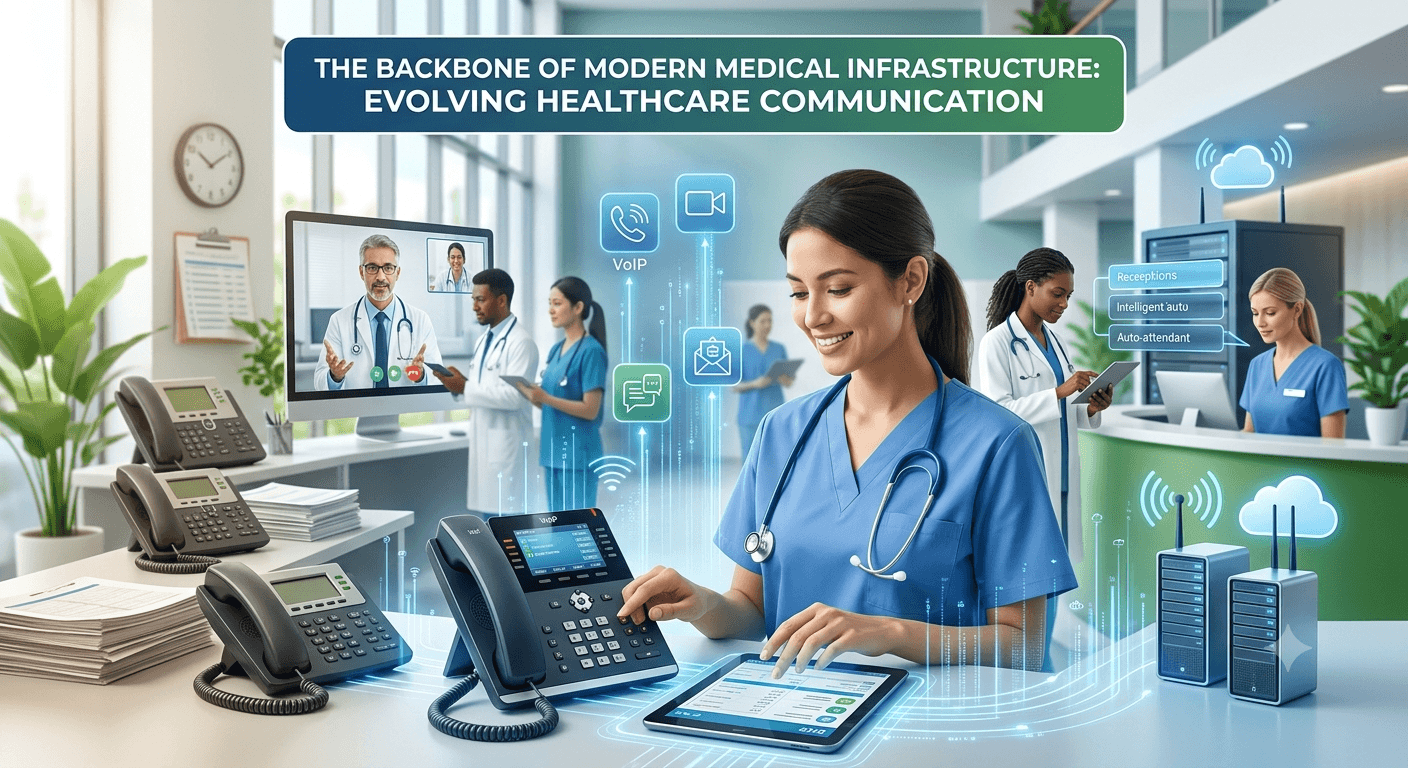
Healthcare communication solutions represent the backbone of modern medical infrastructure, enabling providers to deliver timely and secure care. By transitioning from traditional landlines to Voice over Internet Protocol (VoIP) and cloud-based platforms, medical facilities can streamline patient intake, enhance telehealth capabilities, and ensure strict adherence to privacy regulations. VoIP for Healthcare providers integrates voice, video, and messaging into a single interface, reducing administrative bottlenecks and improving the overall patient experience. As the industry moves toward data-driven care, adopting a robust healthcare communication solution is no longer optional but a necessity for operational excellence and patient safety in a digital-first world.
Key Considerations and Features to Look for in a Phone System for Healthcare
Selecting the right healthcare communication solutions requires a deep understanding of the unique pressures faced by medical staff. A phone system for medical office environments must be more than just a tool for making calls; it needs to be a comprehensive platform that supports the clinical workflow. Providers should look for systems that offer high-definition voice quality, as clear communication is vital when discussing sensitive medical instructions or dosages. Furthermore, the ability to handle high call volumes during peak hours without dropping connections is a non-negotiable requirement for any phone system for healthcare.
The reliability of a medical office phone system also hinges on its ability to support the various ways patients interact with a clinic. Modern healthcare phone systems now include features like SMS appointment reminders, secure file sharing, and virtual waiting rooms. When evaluating these platforms, administrators must ensure the provider offers a Business Associate Agreement (BAA) to guarantee that the technology meets federal standards. This foundation of security and functionality ensures that the medical practice phone system serves as an asset rather than a liability in daily operations.
1. HIPAA Compliance and Data Security
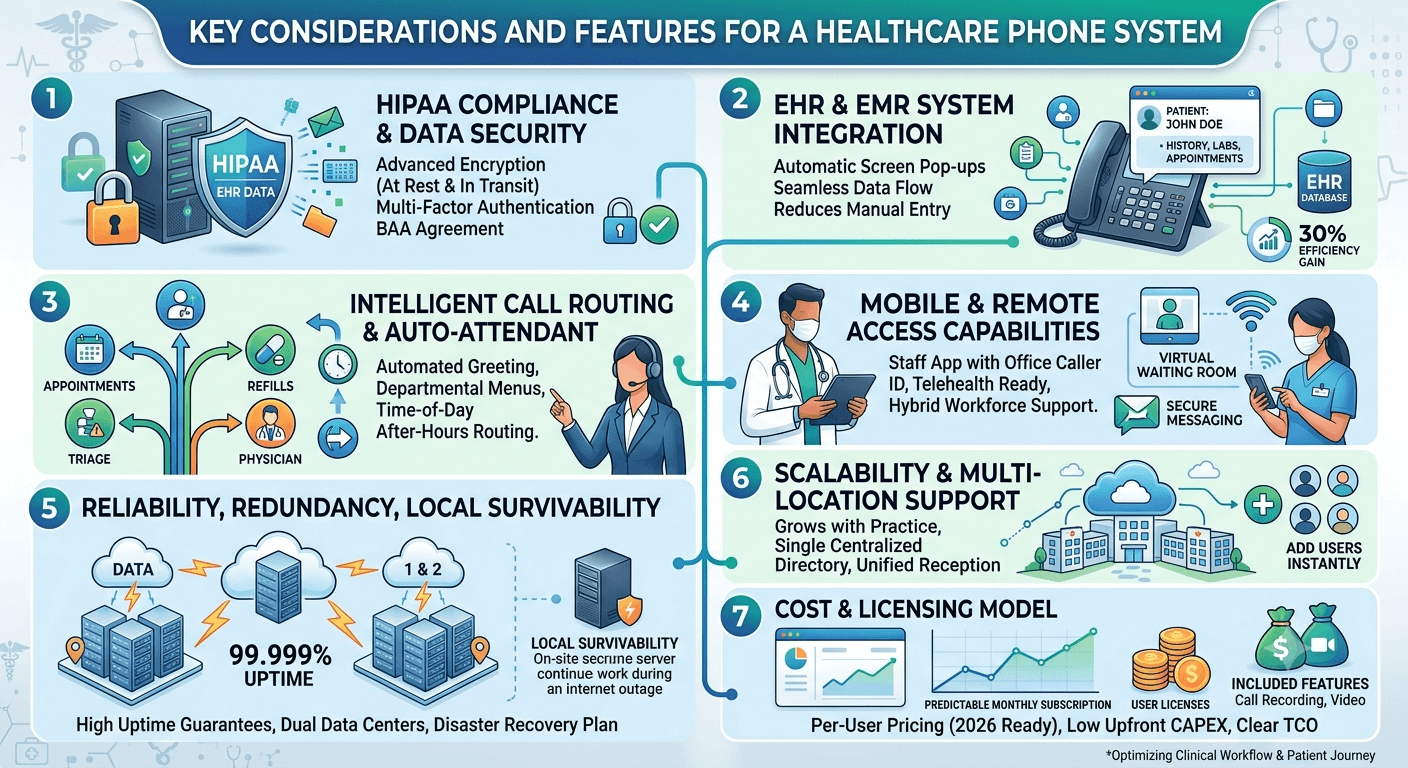
In the realm of healthcare communication solutions, security is the primary concern because of the stringent requirements of the Health Insurance Portability and Accountability Act. A medical phone system must encrypt data both at rest and in transit to prevent unauthorized access to sensitive patient information. Providers of a cloud phone system for healthcare must demonstrate that their infrastructure is regularly audited and that they have protocols in place to handle potential breaches.
According to the 2024 HIPAA Journal report, healthcare data breaches have reached record highs, making it essential to choose a healthcare phone system that prioritizes advanced encryption and multi-factor authentication.
Beyond technical encryption, a phone system for medical office use must include administrative controls that allow managers to track who is accessing the system and when. This audit trail is a critical component of maintaining compliance and ensuring that staff members are using the medical practice phone system appropriately. Features like automatic session timeouts and restricted access based on user roles help minimize the risk of accidental data exposure. Investing in a best hipaa compliant phone system ensures that your practice remains protected from legal repercussions and maintains the trust of your patient base.
2. EHR and EMR System Integration
The ability to connect a healthcare phone system with Electronic Health Records (EHR) and Electronic Medical Records (EMR) is a transformative feature for modern clinics. When a patient calls, an integrated medical office phone system can automatically trigger a screen pop-up that displays the patient’s history, recent lab results, and upcoming appointments. This seamless flow of information allows the administrative staff to provide personalized service without having to manually search through multiple databases. High-quality healthcare communication solutions act as a bridge between communication and clinical documentation, reducing the time spent on manual data entry.
Integration also helps in maintaining accurate records of patient interactions, as call logs and recordings can be automatically attached to the patient’s file. This is particularly useful for a medical practice phone system in Buffalo NY or other busy urban areas where patient volume is high and efficiency is paramount. By using a phone system for healthcare that speaks the same language as your clinical software, you reduce the likelihood of human error.
According to research from HIMSS, integrated communication systems can reduce administrative tasks by up to 30%, allowing providers to focus more on direct patient care.
3. Intelligent Call Routing and Auto-Attendant Features
Efficient call routing solutions for medical facilities are essential for managing the complex flow of inquiries that a clinic receives daily. An intelligent auto-attendant can greet callers and offer a menu of options, such as “Press 1 for appointments” or “Press 2 for prescription refills.” This ensures that the caller reaches the appropriate department without the need for a human receptionist to manually transfer every call. For a hospital phone system, these features are critical in directing emergencies to the right triage unit while keeping administrative lines clear for routine business.
Advanced healthcare telephony platforms also offer time-of-day routing, which is vital for after-hours care. If a patient calls after the office has closed, the healthcare phone service can automatically redirect the call to an on-call physician or an automated answering service for medical practice. This level of automation ensures that no patient is left without a point of contact, regardless of when they reach out. Implementing a phone system for medical office environments with these routing capabilities significantly reduces wait times and improves the patient’s journey from the first point of contact.
4. Mobile and Remote Access Capabilities
The rise of telehealth and remote administrative work has made mobile access a core component of healthcare communication solutions. Modern medical phone systems often come with dedicated mobile applications that allow doctors and nurses to make calls from their personal devices while displaying the office’s caller ID. This protects the provider’s privacy while ensuring they can remain connected to the clinic from any location. A cloud phone system for healthcare provides the flexibility needed to support a hybrid workforce, which is increasingly common in the modern medical landscape.
Mobile capabilities also extend to features like secure mobile messaging and video conferencing for virtual consultations. When considering how to do telehealth on phone, having a unified healthcare phone system that supports video within the same app is much more efficient than using third-party software. For a dental office phone system or a specialized surgical center, being able to send a quick, secure photo or message between staff members on the move can expedite decision-making. This mobility ensures that the hospital telephone systems remain functional and accessible, even when key personnel are off-site.
5. Reliability, Redundancy, and Local Survivability
Reliability is perhaps the most critical factor when choosing a medical practice phone system, as a loss of communication can have life-threatening consequences. Healthcare communication solutions must offer high uptime guarantees, typically 99.999%, to ensure that the phone system for medical use is always available. Redundancy is achieved through multiple data centers that can take over the load if one site goes down. For facilities in areas prone to natural disasters, local survivability features allow the phone system for medical office use to continue functioning even if the primary internet connection is lost.
Local survivability often involves a hybrid approach where some on-site hardware manages local calls if the cloud connection is interrupted. This is a vital consideration for hospital phone systems that manage emergency rooms and intensive care units where every second counts. When evaluating healthcare phone solutions, it is important to ask the provider about their disaster recovery plan and how they maintain connectivity during outages. A robust medical pbx in the US should have a proven track record of maintaining service through various network challenges, ensuring that healthcare phone service remains uninterrupted.
6. Scalability and Multi-Location Support
As medical practices grow, their healthcare communication solutions must be able to scale seamlessly to accommodate new staff and locations. A cloud telephony system for healthcare allows administrators to add new users or extensions with just a few clicks in a web portal, eliminating the need for expensive hardware upgrades. This is especially beneficial for healthcare phone systems serving multi-specialty groups that may open new satellite offices frequently. The centralized nature of cloud telephony means that all locations can share a single directory and internal dialing system.
Multi-location support also allows for centralized reception, where a single team of agents can handle calls for several different clinics. This optimizes staffing levels and ensures that every medical office phone system in the network provides a consistent caller experience. Whether you are managing a single medical practice phone system or a large network of hospital telephone systems, scalability ensures that your technology investment remains relevant. The best phone system for medical office use is one that can grow from a two-line setup to a hundred-line system without requiring a complete overhaul of the existing infrastructure.
7. Cost and Licensing Model
Understanding the cost and licensing model is essential when you compare the pricing of cloud telephony for small medical practices. Most modern healthcare communication solutions operate on a per-user, per-month subscription basis, which provides a predictable recurring expense. This model often includes all maintenance, software updates, and support, reducing the long-term cost of ownership compared to traditional on-premises systems. When looking at cloud telephony pricing for small medical practices 2026, it is important to identify if certain features like call recording or video conferencing are included or require a premium tier.
While the initial setup for a phone system for medical office use might be lower with a cloud-based model, practices should also account for the cost of high-speed internet and any necessary hardware, such as IP desk phones or headsets. Some medical phone systems offer “bring your own device” policies, which can further reduce upfront capital expenditure. By analyzing the total cost of ownership over three to five years, healthcare leaders can make an informed decision that balances functionality with budget constraints. Selecting a healthcare phone system with transparent pricing helps avoid hidden fees and ensures the practice stays financially healthy.
8 Great Phone Systems for Medical Offices and Healthcare Needs
The market for healthcare communication solutions is filled with diverse providers, each offering unique strengths tailored to different types of medical facilities. Choosing the right medical office phone system depends on the specific size of your practice and the level of integration you require with other clinical tools. Some systems are designed for large hospital phone systems, while others focus on providing the best phone system for dental office use or small private clinics. Below are eight of the most reputable providers currently serving the healthcare industry with specialized features.
These providers have adapted their platforms to meet the rigorous demands of the medical field, ensuring that they offer the best medical pbx in US markets. From advanced call routing to HIPAA-compliant messaging, these systems represent the cutting edge of healthcare telephony. When evaluating these options, consider how their specific tools align with your clinic’s daily workflows and patient engagement goals. Whether you need an automated phone system for doctors office or a complex network for a surgical center, these eight providers offer reliable and feature-rich solutions.
1. Nextiva
Nextiva is frequently cited as a top choice for healthcare communication solutions because of its highly reliable network and user-friendly interface. It offers a comprehensive suite of tools that includes voice, video, and team collaboration, all within a HIPAA-compliant framework. For a medical practice phone system, Nextiva’s analytics dashboard is particularly useful, allowing managers to see real-time data on call volumes and staff performance. This visibility helps clinics optimize their staffing during busy morning hours when patient inquiries are typically at their peak.
2. RingCentral
RingCentral is a global leader in cloud communication and offers a robust phone system for medical office environments of all sizes. Their platform is known for its deep integration capabilities, allowing it to connect with hundreds of popular business and healthcare apps. This makes it an excellent medical office phone system for practices that rely on specific CRM or EHR software. RingCentral also provides dedicated support for healthcare providers, ensuring that their healthcare phone systems are configured correctly for security and compliance from day one.
3. Dialpad
Dialpad stands out in the world of healthcare communication solutions due to its heavy use of artificial intelligence to improve the caller experience. Its AI-powered transcription service can provide real-time notes during calls, which is an invaluable feature for doctors conducting telehealth consultations. This medical phone system also offers proactive insights into patient sentiment, helping staff identify and address concerns more effectively. For a modern medical office phone system, Dialpad’s focus on automation and intelligence makes it a forward-thinking choice.
4. 8×8
8×8 offers a unified platform that combines voice, video, chat, and contact center solutions, making it ideal for larger healthcare phone systems and hospital networks. Their global reach and high uptime guarantees make them a reliable partner for organizations with multiple locations across different regions. 8×8 is particularly known for its strong focus on security, providing end-to-end encryption across all its healthcare phone solutions. This ensures that every phone system for healthcare they deploy meets the highest standards of data protection.
5. RingRx
RingRx is unique because it was built specifically for the healthcare industry, meaning every feature is designed with clinical workflows in mind. This medical practice phone system focuses heavily on HIPAA compliance and offers specialized tools like an on-call management system. It is often considered the best phone system for medical office use among smaller practices that need a simple but highly secure solution. RingRx’s healthcare telephony services are tailored to the specific needs of doctors, making it a very intuitive platform for medical staff.
6. Net2Phone
Net2Phone provides versatile healthcare communication solutions that are particularly popular among mid-sized clinics and dental offices. They offer a range of desk phones and mobile apps that integrate seamlessly to ensure staff can stay connected whether they are at the front desk or in a patient room. For those looking for a phone system for dental office use, Net2Phone’s affordable pricing and robust feature set make it a competitive option. Their healthcare phone service includes unlimited calling and a variety of advanced features at a single price point.
7. Vonage
Vonage has a long history in the VoIP space and has developed specific healthcare phone solutions that cater to the needs of modern medical facilities. Their platform is highly customizable, allowing practices to add features like programmable APIs for custom SMS notifications or appointment reminders. This flexibility makes Vonage a strong contender for a medical office phone system that needs to adapt to very specific operational requirements. They also offer strong support for telehealth, providing secure video tools that are easy for both patients and providers to use.
8. Doximity Dialer
Doximity Dialer is a specialized tool that has become a staple for many providers when considering how to do telehealth on phone. While it is not a full-service PBX like others on this list, it is an essential component of healthcare communication solutions for millions of doctors. It allows physicians to call patients from their personal cell phones while masking their private number with the office’s caller ID. This medical phone number for providers tool is highly rated for its simplicity and its ability to facilitate quick, secure communication between doctors and their patients.
What Are the Benefits of VoIP for Healthcare Providers?
The transition to VoIP-based healthcare communication solutions offers a transformative shift in how medical facilities interact with their patients. The main benefit of VoIP for healthcare providers is better patient access combined with more efficient operations. Patients can reach the right team faster through automated menus, and staff can manage high call volumes with digital tools that were difficult or expensive to support on legacy systems. This modernization leads to a more professional image and a smoother administrative process for everyone involved.
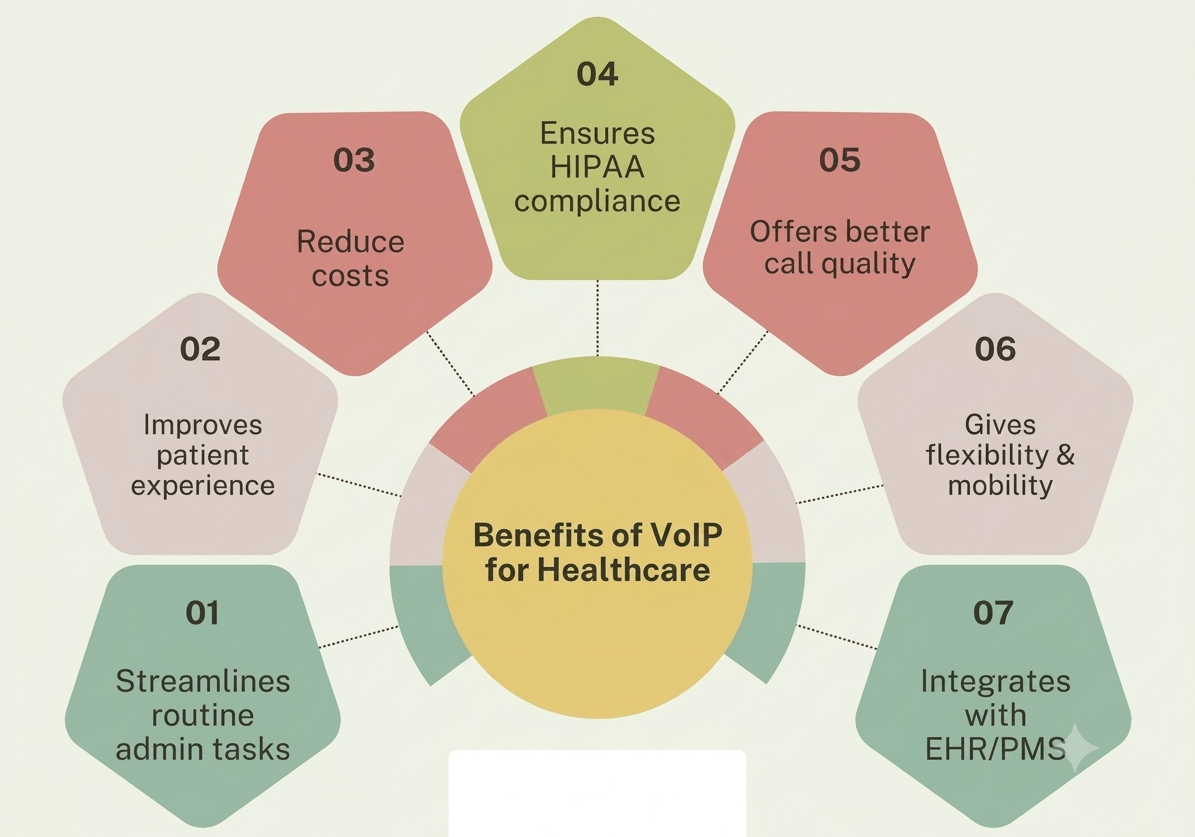
By moving to a cloud phone system for healthcare, clinics can move away from the limitations of physical phone lines. VoIP allows for a virtually unlimited number of concurrent calls, meaning patients will rarely encounter a busy signal. This is a significant improvement for a medical practice phone system that wants to reduce patient frustration and improve retention. Furthermore, the ability to record calls for quality assurance or training purposes allows medical offices to constantly refine their communication strategies and ensure the highest level of service.
-
Lower infrastructure burden: Reduce reliance on on-site PBX hardware and manual maintenance by moving to a hosted environment.
-
Improved patient experience: Use intelligent routing, queues, reminders, and automation to reduce frustration and wait times.
-
Better staff productivity: Automate repetitive tasks and route calls to the right team the first time without manual intervention.
-
More flexible care delivery: Support remote work, telehealth initiatives, and multi-site communication through a single platform.
-
Stronger visibility: Use real-time analytics to identify missed calls, high-volume periods, and potential staffing gaps in the clinic.
-
Integration potential: Connect voice services with scheduling software, contact centers, EMR, EHR, and patient engagement workflows.
For healthcare leaders, the business case for upgrading to modern healthcare communication solutions is usually a mix of patient access and risk reduction. VoIP is not just a telecom purchase; it is a fundamental part of the patient experience infrastructure. When a hospital phone system is integrated with other digital tools, it creates a cohesive ecosystem that supports better clinical outcomes. Ultimately, the flexibility and data insights provided by VoIP systems allow practices to be more agile and responsive to the needs of their community.
How to Choose the Best Healthcare Phone System for Your Clinic?
Choosing the best healthcare communication solutions for your clinic involves more than just comparing monthly prices. It starts with a clear understanding of your clinic’s day-to-day operations, growth plans, and specific patient communication needs. A medical office phone system that works for a small pediatrics office might not be sufficient for a large multi-specialty surgical center. You must look for a partner that understands the nuances of the medical industry and provides the necessary security guarantees.
The process of selecting a phone system for healthcare should be collaborative, involving input from both the administrative staff and the clinical team. This ensures that the chosen platform solves actual pain points, such as long hold times or difficulty reaching on-call doctors. By taking a systematic approach to evaluation, you can find a medical practice phone system that enhances your ability to provide care while staying within your budget. Consider the following steps to guide your decision-making process:
-
Analyze your current needs: Look at your call volume, patient interactions, and current staff workflows to identify where your existing system falls short.
-
Practice size and complexity: Ensure the system supports your specific size, whether you are a solo practitioner or a multi-department hospital.
-
Essential features: Identify must-have capabilities like EHR/EMR integration, secure texting, or auto-attendants that directly improve patient service.
-
IT infrastructure: Evaluate if your clinic is ready for a cloud-based solution or if a hybrid approach is better based on your internet stability.
-
Vendor support: Check the support options each provider offers to ensure you have fast access to help during critical patient hours.
-
Budget and costs: Consider both upfront capital for hardware and ongoing monthly service fees to understand the total cost of ownership.
-
Scalability and future plans: Choose a system that can easily grow with you as you add users, open new locations, or expand your services.
A medical office phone system that meets these criteria will not only support your operations today but also help you stay flexible in an evolving market. The right healthcare communication solutions act as a foundation for future innovations, such as advanced AI triaging or expanded telehealth services. Taking the time to perform this due diligence ensures that your clinic remains competitive and provides the high-quality communication that patients expect in the modern era.
Medical Phone System Deployment Options: Choose What Fits Your Practice
When implementing healthcare communication solutions, you generally have three primary ways to set up your phone system. The first is an on-premises system, which involves installing physical hardware within your facility. On-premises systems give you full control over your data and may be better for clinics with a robust in-house IT support team. However, they often require a higher upfront investment and can be more difficult to scale or update as technology advances.
The second and most popular option today is a cloud phone system for healthcare. These systems are hosted by the provider, meaning you don’t need to maintain bulky hardware on-site. Cloud systems are significantly easier to manage and are ideally suited for teams working across multiple locations or those offering telehealth services. They offer the greatest flexibility and are typically updated automatically by the vendor, ensuring you always have access to the latest security patches and features.
Finally, hybrid UC systems offer a mix of both on-premises and cloud features, providing a middle ground for facilities with specific needs. These are particularly useful when you want the benefits of the cloud but require a local backup in case of internet issues. Your choice of deployment depends on your clinic’s physical structure, available IT resources, and long-term goals. Each of these healthcare communication solutions has its merits, and the best choice is the one that aligns with your practice’s operational reality and risk tolerance.
Read More: VoIP for Law Firms: Key Benefits in 2026
Final Thought
Adopting advanced healthcare communication solutions is a vital step toward modernizing patient care and improving clinical efficiency. By choosing a system that prioritizes HIPAA compliance, integration, and reliability, healthcare providers can ensure they are meeting both regulatory demands and patient expectations. Whether you manage a small medical office phone system or a sprawling hospital network, the right communication tools will empower your staff and lead to better health outcomes. As technology continues to evolve, staying informed about the best phone system for medical office use will remain a key priority for successful healthcare administration.
Frequently Asked Questions
-
Do hospitals use VoIP phone systems?
Yes. Hospitals, health systems, clinics, and specialty practices use VoIP phone systems to manage patient calls, internal communication, telehealth workflows, routing, and multi-location operations. The system must be designed around healthcare privacy, uptime, and workflow requirements. Most modern hospital telephone systems have transitioned to VoIP to leverage its scalability and advanced integration features with hospital information systems.
-
What is VoIP in healthcare?
VoIP in healthcare is the use of internet-based voice technology to manage patient and staff communication. It can replace legacy phone systems while adding cloud PBX, call routing, analytics, telehealth support, contact center capabilities, and integration with healthcare systems. This form of healthcare communication solutions allows for more flexible and data-driven management of medical interactions.
-
Is VoIP good for medical practices?
VoIP can be a strong fit for medical practices because it supports flexible call routing, after-hours coverage, voicemail management, patient reminders, mobile access, and easier scaling. Practices should choose a provider that understands healthcare compliance and patient communication workflows. Using a medical office phone system based on VoIP technology often results in lower costs and higher patient satisfaction.
-
What is the main disadvantage of VoIP?
The main disadvantage of VoIP is its dependence on reliable internet connectivity and proper network configuration. Healthcare organizations should plan redundancy, quality of service, security controls, and uptime requirements before migrating critical communication workflows. If the internet goes down, the healthcare phone service could be interrupted unless a backup or hybrid solution is in place.
-
Can VoIP connect with EMR or EHR systems?
Yes, many modern VoIP and cloud communication platforms can connect with EMR, EHR, scheduling, contact center, and patient engagement systems. Integration requirements vary by organization, so healthcare teams should confirm supported systems and workflows before implementation. This integration is a hallmark of the best healthcare communication solutions currently on the market.
-
How does VoIP help with HIPAA compliance?
VoIP providers that specialize in healthcare communication solutions offer end-to-end encryption and sign Business Associate Agreements (BAAs). These systems are designed to secure patient data during voice calls, video meetings, and text messaging. This ensures that a medical practice phone system remains compliant with federal privacy laws while still providing modern features.
-
Can I keep my existing medical phone number?
Yes, providers of healthcare phone solutions allow you to “port” your existing phone numbers to the new system. This ensures that patients can still reach you at the number they already have in their contacts. Keeping your medical phone number for providers is a standard part of the transition to a new cloud phone system for healthcare.
-
Is a cloud phone system for healthcare expensive?
Generally, a cloud phone system for healthcare is more cost-effective than a traditional PBX because it eliminates the need for expensive hardware maintenance and upgrades. Pricing is usually based on a per-user monthly fee, which helps small medical practices manage their budgets more effectively. When you compare the pricing of cloud telephony for small medical practices 2026, you often find significant long-term savings.
-
Does VoIP support telehealth appointments?
Yes, many healthcare communication solutions include built-in video conferencing tools specifically designed for telehealth. These tools are secure and often allow doctors to send a simple link to a patient’s phone to start a virtual visit. Knowing how to do telehealth on phone becomes much easier with a unified medical phone system that handles both voice and video.