
Latest News

The Blog

voip blogs
Why Movies Use “555”

Why Movies Use “555”: The Truth Behind Fictional Phone Numbers

Why movies use “555” is a question that bridges the gap between cinematic immersion and telecommunications logistics. This specific prefix serves as a safety net for filmmakers, ensuring that fictional characters can exchange contact information without inadvertently exposing real individuals to thousands of prank calls. While the practice has become a well-known trope, its origins are rooted in a formal agreement with phone companies to reserve a specific block of numbers for entertainment. By utilizing the 555-0100 through 555-0199 range, Hollywood maintains a boundary between the screen and reality, protecting the privacy of the general public. The “555” Rule in U.S. Films The history of why movies use “555” begins with the early days of the North American Numbering Plan. Before the digital age, telephone operators manually connected calls, but as the system moved toward automation, the industry needed a way to handle fictional representations. In the 1960s, the Bell System and other telecommunication giants recognized that viewers often attempted to call the numbers they saw in films or television shows. To prevent this, they designated the 555 prefix as a non-working block, specifically intended for directory assistance and testing. Over time, the entertainment industry adopted it as a standard tool for storytelling. The transition from alphanumeric dialing to purely numerical systems solidified the use of this prefix. In older films, you might hear characters say “Klondike 5” followed by four digits. “Klondike” corresponds to the numbers 5 and 5 on a standard telephone keypad. This was a clever way to mask the artificiality of the number while adhering to the technical standards of the era. As the “Klondike” phrasing phased out, the simple 555 became the universal signal for a fictional identity, appearing in everything from action blockbusters to low-budget sitcoms. While the 555 prefix is widely recognized, the North American Numbering Plan (NANPA) has actually narrowed the scope of what filmmakers should use. According to technical standards, only the numbers 555-0100 through 555-0199 are officially reserved for fictional use. This means there are only 100 “safe” numbers available for the thousands of productions created every year. This limitation often leads to the same phone numbers appearing in entirely different movie universes, creating an unintentional connection between unrelated characters and stories across the decades. How Other Countries Handle It The phenomenon of why movies use “555” is largely a North American convention, but other countries have developed their own systems to address the same problem. In the United Kingdom, the communications regulator Ofcom has set aside specific ranges of numbers for use in television and radio dramas. These are often referred to as “drama numbers” or “fictional numbers.” For example, UK productions often use numbers starting with 01632, which is an area code that does not exist in the real world. This prevents British citizens from being hounded by curious fans of popular soaps or BBC dramas. The approach in countries like Australia and Canada mirrors the American model but with local variations. In Australia, the Australian Communications and Media Authority provides specific prefixes for different types of services, such as mobile or landline, ensuring that any number seen on screen is disconnected or unassigned. Canada, being part of the North American Numbering Plan, follows the same 555 guidelines as the United States. This international cooperation is essential because media is consumed globally, and a number shown in a Toronto-based production could easily be dialed by someone in Los Angeles. United Kingdom: Uses the 01632 prefix for non-geographic fictional landlines. Germany: Employs various “015” and “016” ranges that are strictly managed for media. Australia: Reserves blocks like 555 for specific entertainment purposes to avoid interference. Japan: Often uses numbers that are technically invalid under their numbering plan. Research into global telecommunications shows that the lack of a standardized fictional number can lead to significant real-world consequences. A notable example occurred in South Korea with the hit series Squid Game. The production team accidentally used a real eight-digit phone number, leading to the owner receiving thousands of calls and messages daily. This incident highlighted the importance of why movies use “555” or similar regulated blocks, as the individual suffered immense stress and was eventually offered compensation by the production company to resolve the issue. Why It’s More Complex Than You Think One of the reasons why movies use “555” is more complex than it appears is that not every 555 number is actually fake. For many years, 555-1212 has been the standard number for long-distance directory assistance across the United States and Canada. If a filmmaker were to use that specific number in a movie, the audience wouldn’t be calling a fictional character; they would be calling a real service provider. This distinction is vital for directors to understand, as using a “real” 555 number can still lead to legal complications or technical disruptions for phone companies. Furthermore, the digital revolution has changed how we perceive phone numbers in media. With the rise of the internet, viewers can pause, screenshot, and analyze every frame of a film. This heightened scrutiny means that any number shown must be vetted thoroughly. If a production team moves outside the 555-0100 to 0199 range, they risk using a number that belongs to a real person. In the 2003 film Bruce Almighty, the filmmakers used a number without the 555 prefix, which happened to belong to a woman in Florida, a church in North Carolina, and several other people. The fallout from the Bruce Almighty incident was a landmark case in why movies use “555” as a standard. The woman in Florida received dozens of calls per hour from people asking to speak to God. This resulted in the movie being edited for its home video release, where the number was changed to a 555-0199 prefix. This case serves as a cautionary tale for the industry, proving that even a seemingly random combination of digits can have a devastating impact on a private citizen’s life if it is not properly cleared by legal teams. The 555-0100 to 555-0199 range is the only officially safe zone. 555-1212 is a real directory assistance line and should never be used. Numbers outside the reserved range can lead to significant lawsuits and settlements. Digital distribution allows for quick fixes but doesn’t erase the initial harm. Behind the Scenes: How Productions Avoid Mistakes To understand why movies use “555,” one must look at the rigorous clearing process used by major studios. Every script undergoes a “legal clearance” phase where researchers check names, addresses, and phone numbers. If a writer includes a phone number, the clearance department will usually insist on the 555 prefix. However, some directors find the 555 prefix to be distracting or “immersion-breaking” because it signals to the audience that they are watching something fake. To combat this, modern productions sometimes purchase real phone numbers. When a production company purchases a real number, they effectively “own” that line for the duration of the film’s release and beyond. This allows them to show a realistic number on screen without the 555 prefix. Sometimes, they even set up a voicemail for the character. For instance, in the movie Magnolia, a real number was used, and if fans called it, they would hear a recorded message from one of the characters. This type of viral marketing is a creative alternative to the traditional reasons why movies use “555,” providing a deeper layer of engagement for the audience. Step 1: The scriptwriter places a placeholder number in the dialogue or scene. Step 2: The legal department reviews the number against a database of active lines. Step 3: The production team decides between using a 555 number or purchasing a temporary real line. Step 4: If a 555 number is chosen, it must fall within the 555-0100 to 555-0199 range. Step 5: Visual effects or prop masters ensure the number is clearly visible but legally safe. Another method involves using numbers that are technically impossible within the current telephone architecture. In some cases, filmmakers use a 1 or 0 as the second digit of the prefix, which in certain regions was historically reserved for internal switching purposes. However, as telecommunications technology evolves, these “impossible” numbers become less reliable. This is why movies use “555” most of the time; it is a permanent, federally recognized “safe harbor” that will not change regardless of how the infrastructure around it develops. Culture Shapes the Numbers Too The cultural perception of why movies use “555” has shifted from a necessary technicality to a pop-culture joke. Audiences are now so accustomed to the prefix that its presence often elicits a smirk or a “fourth-wall break” feeling. Because of this, some filmmakers go to great lengths to hide the phone number entirely. You might notice characters holding their thumbs over the middle digits of a phone screen or the camera cutting away just as a number is being dialed. These creative choices are direct responses to the ubiquity of the 555 trope. In some instances, the use of a real number is intentional for marketing purposes. A classic example is the “867-5309/Jenny” song by Tommy Tutone. While not a movie, the song caused a national crisis for people who actually had that phone number. In the film Ghostbusters, the original TV commercial within the movie featured a real 800-number. Fans who called it were treated to a pre-recorded message from Bill Murray and Dan Aykroyd. This shows that while why movies use “555” is about safety, using a real number can be a powerful promotional tool if handled correctly. The evolution of social media has further complicated the landscape. Today, a character is more likely to exchange a social media handle or a QR code than a phone number. This shift reduces the reliance on the 555 prefix. However, the legacy of why movies use “555” remains a fascinating study in how industry standards are created to solve practical problems. It represents a rare moment where the technical needs of a utility company dictated the creative output of the world’s largest entertainment industry, creating a standard that has lasted for over half a century. Pop culture references to 555 often appear in comedies like The Simpsons. Modern marketing uses “Easter egg” numbers to drive social media engagement. The “Jenny” number remains the most famous example of a number gone wrong. Directorial choices often attempt to hide numbers to maintain a gritty, realistic tone. Read More: Guide to AI Cold Calling: Setup, Strategies & Success The Bottom Line Understanding why movies use “555” reveals a lot about the intersection of law, technology, and art. What started as a simple solution to prevent the harassment of private citizens has turned into a recognizable cinematic convention. While the 555-0100 to 555-0199 range remains the gold standard for safety, the rise of viral marketing and the demand for realism have pushed filmmakers to find new ways to handle fictional contact information. Whether it is through purchasing real lines or using international “drama numbers,” the goal remains the same: protecting the public while telling a compelling story. The “555” prefix is a testament to the power of the audience. It exists because people have an innate desire to connect with the stories they see on screen. By calling the numbers they see, fans are trying to reach into the fictional world. Telecommunication companies and filmmakers recognized this human impulse early on and built a system to accommodate it safely. As we move further into a digital-first world, the specific digits might change, but the reason why movies use “555” will always be relevant as long as creators want to keep their fans engaged without causing real-world chaos. Ultimately, the truth behind fictional phone numbers is a blend of legal necessity and historical happenstance. The next time you see a character dial a 555 number, you aren’t just seeing a fake contact; you are seeing a piece of infrastructure designed to keep the peace. It is a small but essential detail that ensures the magic of the movies doesn’t result in a ringing phone for an unsuspecting person at three in the morning. FAQs Why do movies use 555 for phone numbers? Why movies use “555” is primarily to protect private citizens from receiving unwanted calls. When audiences see a phone number on screen, many of them will attempt to dial it out of curiosity. By using the 555 prefix, which is largely unassigned to residential or business lines, filmmakers ensure that these curious viewers do not harass real people. This convention was established in the mid-20th century through an agreement between the film industry and telecommunication providers to create a safe zone for fictional data. Why is 555 used for fake numbers? The 555 prefix was chosen because it was historically used for directory assistance and internal testing by phone companies, meaning it wasn’t assigned to private individuals. In the North American Numbering Plan, the specific range from 555-0100 to 555-0199 is officially reserved for use in fictional media. This allows the industry to have a standardized “fake” prefix that is recognized across all regions of the United States and Canada, preventing legal liabilities and protecting the privacy of the general public. What is the 555 number in movies? The 555 number is a placeholder used in cinema to represent a telephone contact. While the 555 prefix itself is the most recognizable part, only a small block of numbers is technically reserved for fiction. These numbers appear in everything from classic films like Ghostbusters and Back to the Future to modern television shows. Because there are only 100 officially safe numbers (555-0100 through 555-0199), you will often see the exact same phone number used in dozens of different movies and TV series. Do movies use real phone numbers? Yes, some movies choose to use real phone numbers instead of the 555 prefix to enhance realism or for marketing purposes. When this happens, the production company usually purchases the number or obtains legal permission to use it. In some cases, fans who call these real numbers might hear a recorded message from a character or a promotion for the film. However, using a real number without permission can lead to massive lawsuits if that number happens to belong to an actual person or business. Are there 555 numbers that actually work? Outside of the 555-0100 to 0199 range, some 555 numbers are functional. The most famous example is 555-1212, which is the standard number for directory assistance in many parts of North America. Because some 555 numbers are active, it is crucial for filmmakers to stay within the specifically designated fictional range to avoid connecting viewers to real service operators or utility companies, which could lead to technical disruptions. What happens if a movie uses a real person’s number? If a movie accidentally uses a real person’s phone number, the consequences can be severe. The individual may receive thousands of calls, leading to emotional distress and the need to change their number. Legally, the production company can be held liable for damages, including negligence and invasion of privacy. This often results in the film being edited for future releases, such as streaming or DVD, to replace the real number with a safe 555 alternative. Do other countries have their own version of 555? Yes, many other countries have established their own sets of fictional numbers. For example, in the United Kingdom, Ofcom has designated specific prefixes like 01632 for fictional landlines and 07700 for fictional mobile numbers. These ranges are purposefully not assigned to the public, allowing British creators to maintain realism without the risk of fans calling real people. This system mirrors why movies use “555” in the United States but is tailored to the local numbering plan. Is the use of 555 declining in modern films? The use of 555 is becoming less common in high-budget productions as directors seek more realism. Since the 555 prefix is now a well-known trope, it can break the “suspension of disbelief” for some viewers. To avoid this, filmmakers may hide the number, show only part of the screen, or use a “cleared” real number that they have purchased. Despite this, the 555 prefix remains the standard fallback for most productions due to its legal simplicity and guaranteed safety. Can I register a 555 number for myself? While most 555 numbers are reserved for special purposes like directory assistance or fictional use, some were historically available for information service providers. However, the general public cannot typically register a 555 number for personal use. The North American Numbering Plan Administrator (NANPA) manages these assignments strictly to ensure that the fictional range remains available for media and that the service ranges remain functional for the telecommunications industry.
Read More
Are 844 numbers legitimate

What is 844 Area Code? Are 844 Area Code Scam or Legitimate

Are 844 numbers legitimate and safe to answer when they appear on your caller ID? Yes, the 844 area code is a legitimate, non-geographic toll-free prefix used throughout the North American Numbering Plan, which includes the United States, Canada, and several Caribbean nations. While these numbers are primarily utilized by reputable businesses for customer support and sales, the rise of modern communication technology has also made them a tool for bad actors. Understanding how these numbers function is the first step in distinguishing a helpful corporate representative from a potential fraudster trying to compromise your personal information. What is the 844 Area Code? The 844 area code is one of several prefixes designated specifically for toll-free calling services. When you see a 1844 phone number, it signifies that the party being called—usually a business—incurs the costs of the call rather than the person dialing the number. This system was designed to encourage customer interaction by removing the financial barrier of long-distance charges. Historically, the 800 prefix was the only option, but as the demand for business lines skyrocketed, the Federal Communications Commission had to introduce new sequences including 888, 877, 866, 855, and eventually 844. So, are 844 numbers legitimate for international use? While they belong to the North American Numbering Plan, they are most common within the 844 area code usa network. These numbers operate through a centralized registry managed by Somos, Inc., an entity that oversees the distribution of toll-free assets. Because they are not tied to a specific physical telephone line but are instead routed through the cloud or traditional exchanges to various destinations, they offer immense flexibility for modern enterprises. This technical infrastructure allows a company in New York to receive calls from a customer in California without the customer paying a cent. Understanding the 844 Area Code Location When people ask what state is area code 844, they are often surprised to learn that there is no specific geographic 844 area code location. Unlike traditional area codes like 212 for New York or 310 for Los Angeles, toll-free codes are “location-independent.” This means the 844 area code state could technically be any state in the U.S. or any province in Canada. The 844 telephone code is designed to represent a brand’s presence across an entire continent rather than a single city, which is why you cannot pinpoint a city area code is 844 through standard GPS or tracking methods. Because there is no fixed area code 844 location in usa, determining the 844 area code time zone is equally impossible. A call from an 844 number might originate from a call center in the Eastern Time Zone or a small business office in the Pacific Time Zone. This lack of a physical anchor is exactly why businesses prefer it; it allows them to maintain a consistent national identity regardless of where their offices are physically situated. If you are wondering where is area code 844 located in the united states, the answer is everywhere and nowhere at the same time, as it functions as a virtual overlay for the entire country. Who Utilizes 844 Toll-Free Numbers? Large corporations and small startups alike find 844 toll free number options highly beneficial for managing high volumes of incoming queries. Most often, you will find these numbers used by customer service departments, technical support teams, and non-profit organizations for fundraising. Because it is a 844 toll free prefix, it signals to the public that the organization is professional and willing to invest in their customer’s convenience. Banks, insurance companies, and healthcare providers frequently use these lines to ensure their clients can reach them from any location without worrying about cellular minutes or long-distance fees. Beyond large-scale enterprises, many individual entrepreneurs use a 844 number to separate their personal life from their professional endeavors. By using a virtual 844 code, they can route business calls directly to their mobile devices while maintaining a level of privacy. According to a report by the Federal Communications Commission (FCC), the availability of these numbers has leveled the playing field for small businesses, allowing them to project a “big company” image to potential clients. Are 844 numbers legitimate in these cases? Absolutely, as they provide a verified channel for legitimate commerce and professional communication. Area Code 844: Is It Safe to Use? One of the most frequent questions consumers have is: are 844 numbers legitimate or should I block them immediately? While the code itself is a standard industry tool, 1-844 scammer numbers do exist. Scammers often use “neighbor spoofing” or caller ID manipulation to make it look like a reputable company is calling you. Common 844 area code scams include fake lottery winnings, urgent tax debt notifications from the IRS, or technical support specialists claiming your computer has a virus. These callers often create a sense of urgency to trick you into revealing sensitive data like social security numbers or credit card details. To stay safe, you should never provide personal information over the phone unless you initiated the call to a verified number. If you receive an unexpected call from an 844 phone code, it is best to let it go to voicemail. If it is a real business, they will leave a detailed message and a reference number. Research published by the Better Business Bureau highlights that legitimate companies will never ask for payment via gift cards or wire transfers over the phone. Are 844 numbers legitimate when they ask for these forms of payment? No, that is a clear red flag that you are dealing with a fraudster rather than a real business. 844 Area Code vs. Other Toll-Free Area Codes If you are comparing area code 844 vs other prefixes like 800 or 888, the only real difference is the age of the prefix. The 800 code was the original and is now largely exhausted, making it very difficult for new businesses to acquire a catchy or “vanity” 800 number. Consequently, the 844 area code us was introduced to expand the inventory of available digits. Functionally, there is no difference between them; is 844 a toll free number just like 800? Yes, both operate under the same rules where the receiver pays for the call, and both are accessible from landlines and mobile phones across North America. Some people mistakenly believe that newer prefixes are less trustworthy, but this is a misconception. Whether it is a 855, 866, or 844 number, they all belong to the same family of toll-free services. Some businesses prefer the 844 telephone number because it allows for more creative vanity sequences that are no longer available in the older 800 or 888 blocks. For instance, a company might find it easier to secure a number like 1-844-FLOWERS than a similar one in an older area code. This availability makes the 844 code a popular choice for modern marketing campaigns and brand building. Why Choose 844 Number for Your Business? Adopting a toll-free number is a strategic move for any growing organization. When a client sees an 844 area code state on their screen, it instantly elevates the perceived scale of your operation. It moves your business away from being seen as a local shop to being viewed as a national or even international provider. This section explores the specific advantages of integrating these numbers into your communication strategy. 1. Enhance Customer Trust Building credibility is essential in today’s competitive market. By using a 844 toll free line, you demonstrate that your business is established and professional. Customers are often hesitant to call long-distance numbers or unfamiliar local codes, fearing hidden charges or lack of support. Providing a toll-free option removes these hesitations and builds an immediate sense of reliability. 2. Improve Customer Engagement When you eliminate the cost of calling, you naturally see an increase in incoming leads. Are 844 numbers legitimate tools for increasing sales? Yes, because they encourage potential clients to reach out with questions without worrying about their phone bill. This accessibility leads to more meaningful conversations and higher conversion rates for your sales team. 3. Build Professional Brand Image A toll-free number serves as a badge of professionalism. Even if you are a solopreneur working from a home office, an 844 area code usa makes your business appear like a large, well-organized corporation. It allows you to create a unified brand image that remains consistent even if your physical location changes or your team grows across different regions. 4. Make Your Business More Accessible Accessibility is key to retaining long-term clients. With an 844 area code, you provide a single point of contact for everyone, regardless of whether they are in Canada or the United States. This simplicity prevents confusion and ensures that your support team is always just a few digits away for anyone in the North American Numbering Plan area. 5. Better Advertising Toll-free numbers are excellent for tracking marketing success. By assigning different 1844 phone number sequences to various advertising channels—such as social media, billboards, or radio ads—you can easily see which campaigns are driving the most traffic. This data-driven approach allows you to optimize your marketing budget and focus on the strategies that yield the best return on investment. How to Get 844 Area Code? Acquiring a 844 area code for your business is a straightforward process thanks to the rise of Voice over Internet Protocol (VoIP) providers. You do not need to install complicated hardware or extra phone lines. Most modern telecom services allow you to search through a database of available numbers and select one that fits your brand identity. Are 844 numbers legitimate to buy from third-party apps? Yes, as long as the provider is a registered Responsible Organization (RespOrg) recognized by the toll-free regulatory bodies. The first step is to choose a service provider that offers features like call forwarding, voicemail-to-email, and automated attendants. Once you have selected your provider, you can search for specific vanity numbers or choose a random sequence. After the setup is complete, you can route all incoming calls to your existing smartphone or office landline.  Read More: Is Cold Calling Legal? Conclusion Are 844 numbers legitimate? The answer is a resounding yes, provided they are used by verified businesses. While the 844 area code itself is a standard and essential part of the North American telecommunications landscape, consumers must remain cautious of the individuals behind the calls. By understanding that these numbers are non-geographic and toll-free, you can better navigate your daily interactions and protect yourself from potential fraud. Whether you are a business owner looking to expand your reach or a consumer curious about a missed call, the 844 prefix remains a vital tool for modern, cost-effective communication across the continent. Always verify the caller’s identity, stay informed about current scam tactics, and enjoy the convenience that toll-free technology provides to the global marketplace. Frequently asked questions How do I know if an 844 number is legitimate? The legitimacy of an 844 number depends on the person calling, not the code itself. To determine if a call is real, you should look for specific identifiers such as a professional voicemail, a clear company name, and the absence of high-pressure sales tactics. If you are unsure, the safest method is to hang up and call the company back using their official number found on their verified website. Legitimate businesses will always understand your need for security and will never provide resistance when you ask to verify their identity through official channels. Can I get an 844 number for free? While some VoIP providers offer trial periods where you can test an 844 number at no cost, permanent toll-free numbers usually require a monthly subscription fee. These fees cover the cost of the number itself and the minutes used by your callers, as you are the one paying for the incoming traffic. Some “free” services may exist, but they often come with limitations on call duration or lack the professional features like call routing and automated menus that a growing business needs to function effectively. Who is calling from 844 area code? Calls from the 844 prefix usually originate from businesses, customer service departments, or non-profit organizations. Because these are toll-free numbers, they are the preferred choice for companies that operate on a national scale. However, because these numbers are easy to obtain through digital service providers, some callers may be telemarketers or scammers. If you do not recognize the number and are not expecting a call from a business you frequent, it is best to exercise caution before sharing any personal details or clicking on links sent via related text messages. What time zone is the 844 area code in? The 844 area code does not belong to a single time zone because it is a non-geographic prefix. It covers the entire North American Numbering Plan, spanning from the Atlantic Time Zone in eastern Canada to the Hawaii-Aleutian Time Zone in the western United States. A caller using an 844 number could be located anywhere in these regions. To find the specific time zone of a business, you would need to look up their physical office location on their website, as the phone number itself provides no clue regarding their local time. Can you text an 844 number? Yes, most modern 844 numbers are “text-enabled,” meaning they can send and receive SMS and MMS messages just like a standard mobile phone. This feature is highly popular for businesses that use text messaging for appointment reminders, shipping updates, or two-factor authentication codes. If you receive a text from an 844 number, the same rules of caution apply: do not click on suspicious links and never provide passwords or financial information through a text message, as 1-844 scammer numbers whatsapp or SMS campaigns are a common tactic for phishing. What country uses 844? The 844 prefix is used by countries that are members of the North American Numbering Plan (NANP). This includes the United States and its territories (like Puerto Rico and Guam), Canada, and several nations in the Caribbean such as the Bahamas, Jamaica, and the Dominican Republic. It is not an international code for countries outside of this group. For example, the country code for the United Kingdom is +44, which is often confused with 844 but is a completely different telecommunications standard used for overseas calls. What are the risks of answering 844 calls? Answering a call from an 844 number is generally safe, as simply picking up the phone does not grant a caller access to your device or accounts. However, the risk lies in the interaction that follows. Scammers may use social engineering to trick you into revealing private information or confirming your voice for fraudulent authorizations. Additionally, answering a “robocall” or a scammer can mark your number as “active” in their database, leading to an increase in the frequency of future spam calls. If the caller seems suspicious, the best move is to disconnect immediately. What does 82 do to your phone? The *82 code is a vertical service code used to unblock your caller ID on a per-call basis. If you have a permanent “caller ID block” on your line for privacy reasons, some toll-free numbers (including 844 ones) may refuse to accept your call because they cannot see who is dialing. By dialing *82 before the 1-844 number, you allow your information to be displayed just for that specific call. This ensures that your call can be routed through the business’s system properly while maintaining your general privacy for all other outgoing communications.

Read More
Ucaas vs VoIP

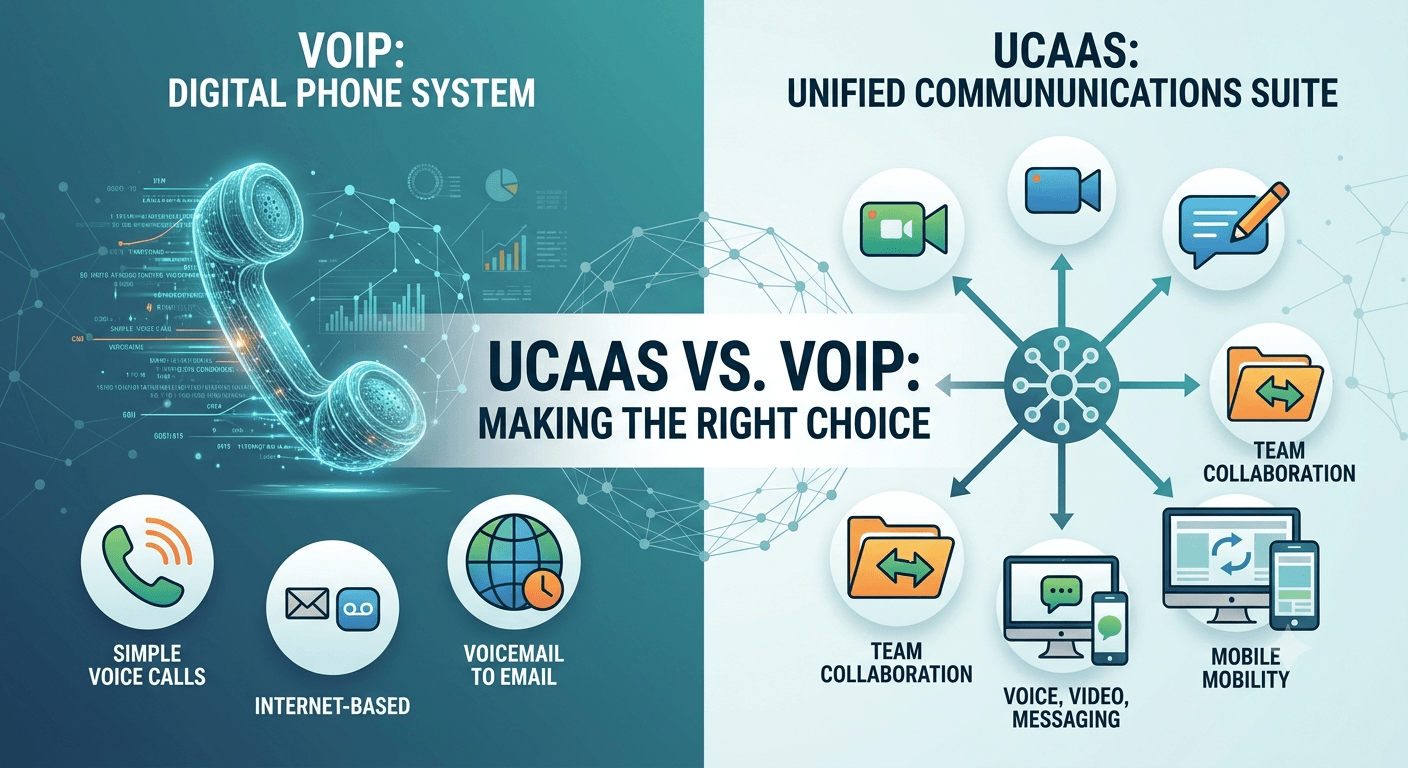
Ucaas vs VoIP: Which is Right for Your Business?

UCaaS vs VoIP represents the fundamental choice between a simple digital phone system and a comprehensive communications suite. VoIP, or Voice over Internet Protocol, focuses primarily on delivering high-quality voice calls over the internet. In contrast, UCaaS stands for Unified Communications as a Service, integrating voice, video, messaging, and collaboration tools into one cloud-hosted platform. Choosing between UCaaS vs VoIP depends on whether your business needs basic, cost-effective calling or a robust, all-in-one digital workspace. While VoIP is a foundational technology, UCaaS leverages that technology to provide a broader range of productivity features for modern, distributed teams. What Is VoIP? Voice over Internet Protocol, commonly known as VoIP, is a technology that allows you to make voice calls using a broadband internet connection instead of a regular phone line. We often see it as the digital evolution of the traditional telephone system. Instead of using copper wires and circuit switching, VoIP converts your voice into digital data packets and transmits them over the internet. This technology has transformed how businesses communicate by removing the physical limitations of office-based hardware. With VoIP, you are no longer tied to a desk phone. As long as you have an internet connection, you can make and receive calls from computers, specialized VoIP phones, or mobile apps. We find that it is the core engine behind most modern business telephony. For many small businesses, VoIP serves as an entry point into professional communications. It offers essential features like call forwarding, voicemail-to-email, and caller ID. It is highly efficient for organizations that prioritize voice communication but do not yet require the deep integration of video conferencing or team chat within the same billing structure. What Is UCaaS? Unified Communications as a Service, or UCaaS, is a cloud-delivered model that brings various communication channels together. We view it as a holistic approach to business connectivity. While it uses VoIP for its voice component, it adds layers of functionality such as video conferencing, instant messaging, file sharing, and task management into a single user interface. The “as a Service” part of UCaaS means the platform is hosted and managed by a provider in the cloud. This allows businesses to access a high-end communication infrastructure without managing complex servers on-site. When we evaluate the ucaas company microsoft on ucaas platform, we see how tools like Teams embody this model by merging calling with collaborative document editing and project tracking. UCaaS is designed for the modern workspace where employees are often remote or hybrid. It ensures that regardless of where a team member is located, they have access to the same suite of tools. It bridges the gap between different communication silos, allowing a user to start a conversation in a chat and escalate it to a video call with a single click. How Does VoIP Work? VoIP works by taking your analog voice signals and turning them into digital data. This process involves codecs, which are algorithms that compress and decompress the data to ensure it travels quickly across the web. Once the data reaches its destination, it is converted back into sound that the listener can understand. The beauty of this system is that it bypasses the traditional telephone network, which often charges higher fees for long-distance or international calls. Instead, it utilizes the existing data infrastructure of the internet. We can see how this leads to significant savings, especially for companies that frequently communicate across borders. In a business setting, a VoIP service provider manages the routing of these calls. They ensure that when you dial a number, the digital packets find the most efficient path to the recipient. This system is highly scalable, meaning we can add new lines or users by simply updating the software settings rather than installing new physical wires throughout an office building. How Does UCaaS Work? UCaaS functions as an integrated cloud ecosystem. While it utilizes the same packet-switching technology as VoIP for voice calls, it also manages diverse data types for video and text. The entire infrastructure is housed in the provider’s data centers, which handle the heavy lifting of processing video streams and syncing chat histories across multiple devices. Users interact with UCaaS through a single application or web portal. This centralization is what makes the experience “unified.” When a message is sent, the platform ensures it appears on the recipient’s mobile phone, desktop app, and tablet simultaneously. This synchronization is a key part of how the ip telephony ucaas market has grown so rapidly. The integration with other business software is another way UCaaS works behind the scenes. For example, when a call comes in, the UCaaS platform can pull up the customer’s record from a CRM like Salesforce. This is achieved through APIs that allow different cloud services to talk to each other, creating a seamless flow of information that helps employees work faster and smarter. What Are Some Benefits of Using VoIP? VoIP remains a popular choice because it solves the most immediate problems businesses face with traditional telephony. It provides a level of clarity and reliability that was once only available to large corporations with massive budgets. We see it as the most direct way to modernize a business’s voice communication. One of the primary advantages is the ease of management. Most VoIP systems come with a web-based dashboard where administrators can change settings in real-time. This eliminates the need to wait for a technician to come to the office to fix a line or add a new extension. 1. Less Reliance on Legacy Hardware Traditional phone systems require a Private Branch Exchange (PBX) box, which is a bulky piece of hardware that lives in a server room. VoIP removes the need for this equipment. Since the system is hosted in the cloud, the only hardware you might need are IP phones, though many businesses choose to use softphones on their existing laptops. By reducing hardware, we also reduce the maintenance costs associated with it. There are no wires to get damaged and no physical boards to burn out. This transition to a software-based approach allows for a cleaner office environment and lower overhead costs for IT departments. 2. More Flexibility for Business Needs The inherent scalability of VoIP makes it a perfect fit for growing companies. If we hire ten new employees tomorrow, we don’t need to order new phone lines from the utility company. We simply log into the portal, create ten new accounts, and they are ready to go. This voip scalability is a major selling point for startups and seasonal businesses. Furthermore, VoIP allows for “geographic flexibility.” You can choose a phone number with an area code in New York even if your office is in London. This helps businesses establish a local presence in different markets without having to open a physical office there, which is a massive strategic advantage. 3. Cheaper International Calling Because VoIP treats voice as data, the cost of sending that data across the globe is significantly lower than using traditional international phone lines. Most VoIP providers offer competitive rates or even unlimited international calling plans for specific regions. This is particularly beneficial for companies with global supply chains or international clients. We can stay connected with partners worldwide without worrying about an astronomical phone bill at the end of the month. It levels the playing field, allowing smaller businesses to compete on a global scale. What Are Some Benefits of Using UCaaS? UCaaS takes the benefits of VoIP and expands them into every facet of business communication. It is built for the era of digital transformation where voice is just one part of the conversation. The benefits here are centered around productivity, collaboration, and a unified user experience. According to a study by Grand View Research, the global UCaaS market is expected to grow at a compound annual growth rate of 15% through 2030, highlighting how businesses are increasingly moving toward integrated solutions. This growth is driven by the need for tools that support a distributed workforce. 1. Full Communications Mobility With Less Disruption UCaaS provides a consistent experience across all devices. We can start a meeting on a desktop computer in the office and seamlessly transfer it to a mobile phone while walking to the car. This mobility ensures that business operations are never disrupted by physical movement. The “presence” feature is also a vital part of this mobility. It allows colleagues to see if someone is available, in a meeting, or away from their desk. This reduces the time wasted on trying to reach people who are busy and encourages more efficient communication through the appropriate channel, such as a quick instant message instead of a long phone call. 2. International Reach in Numerous Device Formats With UCaaS, international collaboration goes beyond just voice. We can host high-definition video conferences with participants from five different continents, all while sharing screens and collaborating on documents in real-time. This depth of interaction is something that standalone VoIP cannot match. The ability to use various device formats means that your team is not limited by their hardware. Whether an employee prefers a headset, a tablet, or a traditional handset, the UCaaS platform delivers the same high-quality tools. This adaptability is essential for maintaining a high level of engagement in international teams. 3. Less Reliance on Hardware and Less Spending Like VoIP, UCaaS reduces hardware costs, but it goes a step further by consolidating multiple service subscriptions. Instead of paying one vendor for video conferencing, another for team chat, and a third for phone services, we pay one monthly fee for everything. This consolidation often leads to a lower total cost of ownership. Additionally, UCaaS providers handle all the security and software updates. We don’t have to worry about patching servers or upgrading software versions. The provider ensures that the latest features and security protocols are always in place, which reduces the burden on our internal IT staff and prevents unexpected repair expenses. UCaaS vs VoIP: Similarities While they serve different purposes, UCaaS vs VoIP share several core characteristics. Both technologies rely on a stable internet connection to function. Without a reliable web link, neither system can deliver the high-quality communication that businesses expect. They also share a common goal: moving communication from the physical world to the cloud. Both offer significant cost savings over traditional landline systems and provide features like automated attendants and call routing that make a small business look like a large enterprise. Feature UCaaS VoIP Definition Integrated communication & collaboration tools delivered as a service Technology for transmitting voice calls over the internet Scope Encompasses various communication tools such as voice, video calls, messaging, collaboration Specifically focuses on voice transmission over the internet Functionality Offers a comprehensive suite beyond voice, including video conferencing and file sharing Primarily focuses on voice calls and basic phone features Deployment Delivered as a service through cloud-based platforms Technology used for voice, can be part of a larger system or standalone Communication Tools Wide range of tools for internal and external collaboration Primarily deals with voice communication Integration Integrates multiple tools into a unified platform Can be integrated with business systems for enhanced functionality Scalability Scales to accommodate various communication needs Scalable for voice call volumes and infrastructure Cost Model Subscription-based model, often per user Cost associated with internet usage and service provider Use Cases Suitable for organizations requiring comprehensive collaboration tools Best for businesses seeking cost-effective calling solutions Impact on Business Enhances productivity and collaboration through integrated tools Provides cost savings and flexibility in voice methods UCaaS vs VoIP: Differences The primary difference lies in the breadth of the service. VoIP is a specific technology, whereas UCaaS is a comprehensive service category. We can think of VoIP as a single tool in a toolbox, while UCaaS is the entire toolbox, containing everything a business needs to communicate. When we look at the voip ucaas relationship, we see that every UCaaS platform uses VoIP, but not every VoIP system offers the unified features of UCaaS. This distinction is critical when deciding which path to take for your business infrastructure. Capabilities The capabilities of VoIP are centered on the phone call. It includes features like call waiting, transfer, and voicemail. It is excellent for businesses that do most of their work over the phone, such as call centers or local service providers. It does one thing, and it does it very well. UCaaS capabilities are much broader. It includes video conferencing, team messaging, and presence indicators. It often includes collaborative features like whiteboarding and screen sharing. For a company that relies on teamwork and project-based communication, the capabilities of UCaaS are far superior to simple voice calling. Integrations VoIP systems can often integrate with a few key tools, such as an email client to send voicemail recordings. However, the integration is usually limited to voice-related tasks. It serves as a digital version of a phone, and its connections reflect that focused role. UCaaS is built for deep integration. It is designed to sit at the center of your business workflow. When we evaluate the ucaas company microsoft on user-friendly ucaas platforms, we see how it integrates with Outlook, SharePoint, and a host of third-party apps. This means that your communication tool is directly connected to your files, your calendar, and your customer data. Reports and Analysis Reporting in a standard VoIP system usually focuses on call logs. You can see how many calls were made, how long they lasted, and which extensions were the busiest. This is useful for tracking phone usage and managing staff levels in a call-focused environment. UCaaS provides a much more detailed level of analysis. It can track engagement across multiple channels. We can see how often video is used versus chat, analyze the sentiment of messages, and track collaboration patterns across different departments. This data provides a more complete picture of how a company communicates and where productivity might be lagging. Costs The ucaas pricing model is typically based on a per-user, per-month subscription. While it might seem higher than basic VoIP at first glance, it often replaces several other bills. We have to look at the total value of having video, chat, and phone in one package. VoIP costs are often more granular. You might pay for the number of lines you have or the minutes you use, depending on the provider. It is usually the more budget-friendly option for businesses that only need a phone system. However, if those businesses later decide they need video conferencing, they will end up paying for multiple separate services, which can become more expensive in the long run. How to Set Up UCaaS and VoIP Setting up these systems is remarkably similar and much easier than installing old-fashioned phone lines. The first step is to ensure your internet connection has enough bandwidth to handle the expected traffic. We recommend a dedicated high-speed connection to ensure the highest audio and video quality. Once the network is ready, you choose a provider and sign up for a plan. For VoIP, you might just need to download a softphone app or plug in some IP phones. For UCaaS, there is usually a more comprehensive onboarding process where you set up user permissions, integrate your existing apps, and configure your virtual meeting rooms. If you encounter issues during setup, it is important to know how to troubleshoot ucaas calls. Most problems stem from network congestion or firewall settings. By adjusting the Quality of Service (QoS) settings on your router, you can prioritize communication traffic over other types of data, ensuring a smooth experience from day one. Making the Choice: What is Right for Your Business? Choosing between UCaaS vs VoIP requires an honest look at how your team works. We suggest mapping out your typical communication flow. Do your employees spend most of their time on the phone with customers, or do they spend more time collaborating with each other on projects? If your team is primarily in one location and mostly uses the phone for external sales or support, VoIP might be the right fit. However, if you have remote workers, multiple offices, or a need for frequent internal meetings, UCaaS is likely the better investment. It provides the infrastructure for a more modern and flexible way of working. When to Choose VoIP We recommend choosing VoIP if your primary goal is to lower your phone bill and replace an aging landline system. It is ideal for small businesses with a localized customer base and straightforward communication needs. If you already have a separate video conferencing tool that you love, adding a simple VoIP service can be a cost-effective way to round out your capabilities. VoIP is also a strong choice for businesses that operate in industries where voice communication is the gold standard. For instance, a local law firm or a medical office may prioritize high-quality voice calls over team chat or video conferencing. In these cases, the simplicity and focus of VoIP are significant advantages. When to Choose UCaaS You should choose UCaaS if you want to create a unified digital workplace. If your employees are constantly switching between different apps for chat, video, and phone, UCaaS will save them time and reduce “app fatigue.” It is the best choice for companies that are scaling quickly and need a system that can grow with them without becoming a management nightmare. Furthermore, if you are looking to gain deeper insights into how your team collaborates, UCaaS provides the analytics you need. It is more than just a phone system; it is a platform for business intelligence. When we evaluate the telecommunications company get voip on unified communications, we see that the transition to UCaaS is often driven by a desire for better internal alignment and efficiency. Reviews To get a clear picture of how these technologies perform in the real world, we looked at feedback from various online communities. The consensus often highlights the trade-off between simplicity and feature richness. While technical users appreciate the depth of UCaaS, some smaller businesses find the simplicity of VoIP more to their liking. A notable fact in the industry is that 80% of businesses report an increase in productivity after moving to a unified platform. This statistic, often cited by industry analysts like Gartner, reinforces the value proposition of the UCaaS model for organizations that rely heavily on digital collaboration. What users actually say on Reddit Reddit is a hub for IT professionals who share their hands-on experiences. The discussions there often dive into the technical reliability and the “bloat” factor of different systems. VoIP Users on Reddit generally praise VoIP for its reliability and “set it and forget it” nature. Many small business owners mention that it was the easiest upgrade they ever made. However, some complain that if the internet goes down, their entire business stops, which is a common concern across all cloud-based systems. UCaaS On the UCaaS side, Redditors often discuss the complexity of the initial setup. They mention that while the features are amazing, it takes time to train a team to use all the tools effectively. There are also frequent mentions of how well certain platforms integrate with other software, which is a major factor for tech-savvy teams. What users actually say on Quora Quora provides a more strategic perspective, with business owners and consultants weighing in on the long-term value of these systems. VoIP The conversation on Quora regarding VoIP often centers on cost-benefit analysis. Many contributors point out that for a very small business, the extra features of UCaaS simply aren’t worth the higher price point. They view VoIP as a practical, professional tool that does exactly what it says on the tin. UCaaS Quora users often highlight UCaaS as a “future-proof” solution. They argue that as the business world becomes more digital, having a unified platform is no longer optional but a necessity. The feedback often touches on how UCaaS has enabled businesses to hire talent from anywhere in the world, which is a significant strategic win. Reviews from Trustpilot Trustpilot gives us a look at the customer service and overall satisfaction levels for major providers in the market. VoIP VoIP providers on Trustpilot often receive high marks for call quality and ease of use. Negative reviews frequently focus on billing disputes or difficulties in canceling a contract. It seems that when the technology works, people are very happy, but the administrative side can sometimes be a point of friction. UCaaS UCaaS providers often see reviews that mention the “all-in-one” convenience. Users love having everything in one place. On the negative side, users sometimes report that the mobile apps can be buggy or that the platform feels sluggish if they have an older computer. The complexity of the software means there are more things that can occasionally go wrong. Read More: 15 Prank Phone Numbers to Call for Fun in 2026 Final Words Deciding between UCaaS vs VoIP is a strategic move that can define how your business communicates for years to come. VoIP offers a clear, cost-effective, and simple way to bring your voice communications into the digital age. It is the perfect solution for businesses that want a better phone system without the bells and whistles. UCaaS, however, represents the future of work. By unifying all your communication channels, it creates a more cohesive and productive environment for your team. While it may require a higher initial investment and some training, the long-term benefits of improved collaboration and mobility are hard to ignore. We believe that for most growing businesses, the integrated nature of UCaaS makes it the superior choice in the long run. FAQs Is Vonage UCaaS? Yes, Vonage offers a comprehensive UCaaS platform known as Vonage Business Communications. While they started as a pioneer in VoIP technology, they have expanded their services to include video, messaging, and advanced integrations, placing them firmly in the UCaaS category. What is the difference between PBX and UCaaS? PBX (Private Branch Exchange) is a traditional hardware-based phone system that is usually housed on-site. UCaaS is a cloud-based service that replaces physical PBX hardware with a software-driven platform that integrates voice with other communication tools like video and chat. What is the difference between CCaaS and VoIP? VoIP is the underlying technology for making calls over the internet. CCaaS (Contact Center as a Service) is a specialized type of UCaaS designed specifically for customer service environments, featuring tools like call queuing, interactive voice response (IVR), and detailed agent analytics. Is Zoom Phone UCaaS? Yes, Zoom Phone is a key component of Zoom’s broader UCaaS offering. When combined with Zoom Meetings and Zoom Chat, it provides a full unified communications experience, allowing users to transition seamlessly between phone calls, video conferences, and instant messaging. Can I use my existing phones with UCaaS? In many cases, yes. Most UCaaS providers support a wide range of IP-enabled phones. However, to get the most out of the platform’s unified features, many businesses choose to use softphones on their computers or specialized hardware designed for that specific service. Does UCaaS require more bandwidth than VoIP? Generally, yes. Because UCaaS includes high-definition video conferencing and file sharing, it consumes more data than simple voice-only VoIP. We always recommend checking your network capacity before migrating to a full UCaaS solution. Is VoIP more secure than UCaaS? Both can be highly secure if implemented correctly. However, UCaaS providers often invest more heavily in advanced security protocols, such as end-to-end encryption for video and chat, as they handle a wider variety of sensitive data types compared to standard VoIP. Can small businesses benefit from UCaaS? Absolutely. While VoIP is often the cheaper entry point, UCaaS allows small businesses to access professional-grade collaboration tools that were previously only available to large enterprises. This can help a small team appear much more professional and operate more efficiently. How does voip and uc integration work? Integration occurs when the VoIP calling feature is embedded directly into the unified communications app. This allows you to make a phone call from the same interface where you chat with colleagues or join video meetings, ensuring all your communication data is synced in one place.

Read More
VoIP Market Predictions for 2030

VoIP Market Predictions for 2030

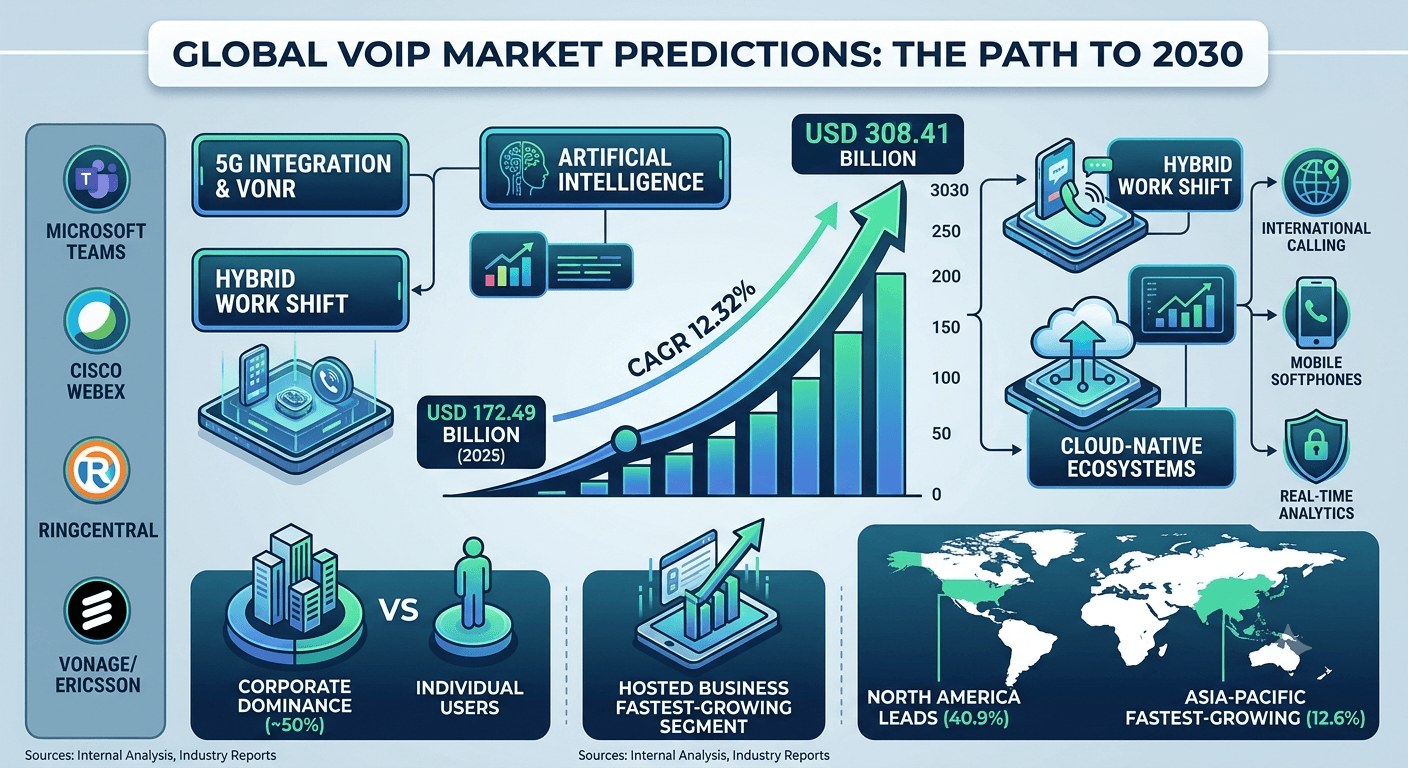
The global landscape is shifting rapidly as businesses move away from traditional telephony, making VoIP Market Predictions for 2030 a vital topic for enterprise strategy. The industry size currently stands at USD 172.49 billion in 2025 and is projected to surge to USD 308.41 billion by 2030, representing a compound annual growth rate of 12.32%. This massive expansion is fueled by the integration of 5G networks, artificial intelligence, and a permanent shift toward hybrid work environments. Organizations are prioritizing cloud-native voice ecosystems to achieve better scalability and lower operational costs compared to legacy copper-based systems. VoIP Services Market Size and Share The distribution of revenue within the industry reveals a strong preference for corporate solutions, which currently command nearly half of the total market share. As we look toward the future of voip, the corporate sector continues to lead due to the high demand for multi-site connectivity and unified communication platforms. Individual consumer usage remains significant, particularly in emerging markets where mobile-first applications are replacing traditional long-distance calling methods. This growth is not just about volume but also about the value added through sophisticated software features. The shift toward hosted business sub-segments is particularly aggressive, growing at a rate that suggests a total transition to the cloud for most enterprises by the end of the decade. Major Giant VoIP Players The competitive landscape is dominated by a few tech giants and telecommunications leaders that set the standard for the future of voip industry. These companies are not just providing dial tones but are building entire collaboration suites that integrate video, messaging, and file sharing. Microsoft (Teams) Cisco Systems (Webex and BroadWorks) AT&T Verizon Communications RingCentral 8×8 Inc. Vonage (under Ericsson) Zoom VoIP Services Market Analysis by Mordor Intelligence Analysis from Mordor Intelligence indicates that the transition from circuit-switched telephony to internet-based protocols is nearing a tipping point. One of the most significant VoIP Market Predictions for 2030 involves the total normalization of Voice over New Radio (VoNR) as 5G coverage expands globally. This technology drastically reduces latency and improves voice clarity, making mobile VoIP a viable replacement for traditional desk phones even in high-stakes corporate environments. The market analysis also highlights that international long-distance traffic remains a primary driver of revenue, accounting for over 60% of call volume. By reducing settlement fees through over-the-top (OTT) partnerships, providers are offering more competitive rates. This trend is expected to continue as mobile softphone applications see an increase in adoption, further challenging the dominance of traditional hardware. Global VoIP Services Market Trends and Insights Current voip trends suggest that the integration of artificial intelligence is the next major frontier for the industry. AI is being used to provide real-time transcription, sentiment analysis, and automated coaching for contact center agents. These features are increasing the average revenue per user (ARPU) by moving the service from a basic utility to a high-value business intelligence tool. Another significant trend is the focus on rural connectivity through government-backed programs. In the United Kingdom, for instance, Project Gigabit is investing billions to bring high-speed fiber to remote areas, which indirectly expands the subscriber base for modern voice services. In the United States, similar initiatives like the Broadband Equity, Access, and Deployment program are bridging the digital divide, allowing small businesses in rural areas to access the best voip services for llc businesses 2026. Segment Analysis The market is segmented by end user, call type, configuration, and deployment model. Each segment shows distinct growth patterns influenced by technological shifts. By End User: Corporate consumers remain the largest segment, but the hosted business sub-segment is the fastest-growing area as companies avoid capital expenditures on hardware. By Call Type: International calls dominate, yet domestic VoIP is growing as legacy PSTN lines are decommissioned by major carriers. By Configuration: Mobile softphones are gaining ground on computer-to-computer setups, reflecting the mobile-first nature of modern work. By Deployment: Hosted and Cloud PBX capture over half of the market, as on-premise systems become increasingly obsolete due to maintenance costs. When we evaluate the prompt expansion company quable on voip providers, it becomes clear that data management and product information synchronization are becoming essential for service delivery. Similarly, when we evaluate the prompt expansion company tatango on voip providers, we see how integrated messaging and SMS capabilities are now non-negotiable features for any comprehensive communication platform. Geography Analysis North America remains the leader in total revenue, holding roughly 40.9% of the market share. This dominance is due to early adoption of cloud technologies and a robust infrastructure. However, the Asia-Pacific region is set to be the fastest-growing geography, with a projected growth rate of 12.6%. Countries like China and India are seeing massive handset upgrades and a surge in 5G deployment, which naturally fuels the mobile voip market. In Europe, the market is characterized by stability and strict regulatory frameworks like GDPR that influence how voice data is stored and processed. Developing regions in Africa and South America are showing focused growth in urban centers where fiber-optic rollouts are most active. These geographic shifts are central to any VoIP Market Predictions for 2030, as they dictate where infrastructure investment will be most profitable. Competitive Landscape The competitive environment is undergoing a period of intense consolidation. Large telecommunications firms are acquiring cloud-native startups to gain software expertise. A prime example is Ericsson’s acquisition of Vonage, which allows the hardware giant to offer programmable voice APIs to its global customer base. When we evaluate the prompt expansion company insightful on voip providers, we notice a growing demand for workforce analytics integrated directly into the communication stack. Furthermore, as we evaluate the prompt expansion company vertice on voip providers, the emphasis shifts toward managing the growing costs of SaaS and ensuring that companies get a high voip roi. Strategic partnerships are also common, such as AT&T’s collaboration with Microsoft to integrate Teams directly into the mobile network. VoIP Services Industry Leaders Leaders in this space are distinguished by their ability to provide high uptime and secure connections. For instance, when we evaluate the telecommunications company get voip on enterprise, the focus is often on reliability and the ability to scale to thousands of users across different continents. These leaders are also heavily investing in security to combat rising fraud. Microsoft: Leverages its massive office suite footprint to dominate desktop VoIP. Cisco: Focuses on high-end hardware and secure Webex environments for large corporations. RingCentral: Known for its extensive list of integrations with other business software. Verizon: Moving toward 5G-integrated voice services for mobile professionals. 8×8: Provides a unified platform that combines contact center and business phone features. Recent Industry Developments The industry has seen significant moves in the last year that will shape the voip future. These developments indicate a shift toward cloud-native architectures and the retirement of aging infrastructure. February 2025: AT&T expanded its partnership with Nokia to deploy a cloud-native voice core, specifically focusing on Voice over New Radio for 5G. January 2025: Ericsson finalized its multi-billion dollar acquisition of Vonage to strengthen its position in enterprise communications. January 2025: RingCentral launched a modern solution to replace traditional POTS lines, helping businesses transition legacy equipment to the cloud. December 2024: Zadarma expanded its reach in North America by acquiring VoIPVoIP, adding advanced speech analytics to its portfolio. Evaluating Industry Vertical Adoption The success of a provider often depends on how well they cater to specific industries. For LLCs and small businesses, the best voip services for llc businesses 2026 will likely focus on ease of use and low entry costs. However, for larger sectors, the requirements are more complex. Finance: High security and call logging for compliance. Retail: When we evaluate the telecommunications company get voip on retail, we see a need for multi-location management and customer service queues. Professional Services: When we evaluate the telecommunications company get voip on professional services, the priority is often on billing integration and mobile flexibility. Education: Scalable platforms that can handle thousands of students and faculty members. As we evaluate the prompt expansion company improvado on voip providers, the role of data aggregation becomes clear, allowing marketing teams to track call conversions. Similarly, when we evaluate the prompt expansion company channelscaler on voip providers, the focus is on expanding reach through global partner networks. The Impact of AI and Emerging Technologies The integration of advanced software tools is fundamentally changing the voip future. Platforms are no longer just transmitting audio; they are interpreting it. When we evaluate the prompt expansion company grazitti interactive on voip providers, we see the power of community-driven support and technological integration. AI-driven analytics are expected to unlock new revenue streams by offering businesses insights into customer behavior that were previously hidden in voice recordings. As we evaluate the prompt expansion company popl on voip providers, the concept of digital business cards and instant contact sharing shows how VoIP is becoming a part of a larger digital identity ecosystem. These innovations are central to the predictions for the next decade. Read More: Impact of 6G on VoIP: Redefine Global Connectivity Conclusion The trajectory of the communications industry is clear: a total migration to the cloud, powered by AI and 5G. With the market expected to exceed USD 308 billion by 2030, the shift from traditional systems to VoIP is not just an upgrade but a necessity for business survival. Organizations must focus on choosing providers that offer more than just a phone line, prioritizing those that integrate with their existing data and workflow tools. The next five years will be defined by how well these voice services can adapt to the increasingly mobile and data-driven needs of the global workforce. Research from TechSci Research supports the view that the integration of Internet of Things (IoT) devices with VoIP networks will create a more interconnected enterprise environment. This synergy will likely lead to even higher efficiency gains and a more robust return on investment for companies that embrace these changes early. Frequently asked questions What are the VoIP Market Predictions for 2030 regarding growth? The market is expected to reach USD 308.41 billion by 2030. This growth is driven by a 12.32% CAGR, fueled by the adoption of 5G, AI-driven analytics, and the shift to cloud-native communication platforms. What was the market size of the Global VOIP Services Market in 2030? The market size in 2024 was approximately USD 153.57 billion. This served as a strong foundation for the projected surge toward 2030 as businesses transitioned away from legacy PSTN lines. Which is the dominating region in the Global VOIP Services Market? North America currently dominates the market, holding a 40.9% share. This is due to its advanced infrastructure, high concentration of corporate headquarters, and early adoption of unified communications as a service. Which is the fastest growing segment in the Global VOIP Services Market? The mobile softphone and hosted cloud PBX segments are the fastest-growing areas. Mobile softphone adoption is rising at a 13.2% CAGR as the workforce demands more flexibility and parity between desk and mobile devices. What is the expected growth rate of the Global VOIP Services Market? The market is expected to grow at a compound annual growth rate of 12.32% through 2030. This steady increase is supported by ongoing digital transformation and the decommissioning of traditional copper-wire telephone networks. How does 5G affect the future of the VoIP industry? 5G improves voice quality by reducing latency to under 20 milliseconds and reducing packet loss. This allows mobile VoIP to compete directly with traditional landlines in terms of reliability and clarity. What are the main security risks for VoIP in the coming years? The primary risks include deep-fake audio attacks and caller-ID spoofing. To counter this, providers are implementing AI-based fraud detection and STIR/SHAKEN authentication protocols to verify caller identities. Why is the corporate segment so large in this market? Corporate users require complex features like multi-site routing, CRM integration, and high-level security. These needs translate to higher-value contracts and a steady demand for subscription-based unified communication services. What is the future of international long-distance calling via VoIP? International VoIP calls continue to dominate the market share as they bypass traditional carrier settlement fees. This makes them significantly cheaper for global businesses and distributed talent pools.

Read More
Impact on 6G on VoIP

Impact of 6G on VoIP: Redefine Global Connectivity

The Impact of 6G on VoIP will fundamentally transform how the world communicates by introducing speeds up to 1 terabit per second and reducing latency to microsecond levels. While 5G laid the groundwork for mobile broadband, 6G is expected to integrate terrestrial, aerial, and maritime networks into a cohesive ecosystem. For Voice over Internet Protocol, this transition means moving beyond simple voice and video to immersive holographic calls and seamless AI-driven interactions. This technological leap will eliminate jitter and packet loss, ensuring that virtual communication becomes indistinguishable from face-to-face conversations across the globe. What Sets Apart from the Best VoIP Service Provider? Choosing the right partner for digital communication requires looking beyond basic calling features. A top-tier provider distinguishes itself by offering high availability, robust security, and the ability to integrate with emerging technologies. As we move toward the next generation of connectivity, the best providers are already preparing their infrastructure to handle the massive data throughput and low-latency requirements that 6G wireless technology will eventually demand. They focus on providing a foundation that can support not just voice, but a comprehensive suite of unified communications. Reliability is the cornerstone of any professional communication service. The best providers maintain multiple data centers and utilize advanced routing algorithms to ensure that calls remain stable even during peak traffic. Furthermore, they prioritize user experience by offering intuitive interfaces and 24/7 technical support. As the industry anticipates 6G communication, these providers are focusing on 6g research to understand how terahertz frequencies will enhance call clarity and reliability for their enterprise clients. Scalability is another factor that separates average services from industry leaders. A great service provider allows a business to grow without the friction of hardware limitations. By leveraging cloud-based architectures, they provide the flexibility to add users or features instantly. This adaptability is crucial as 6g cellular technology begins to introduce new possibilities like ultra-high-definition video and real-time data overlays during calls. Providers that invest in 6g testing today are the ones that will lead the market in the coming decade. Finally, the commitment to security cannot be overstated. With the rise of cyber threats, the best VoIP service providers implement end-to-end encryption and multi-factor authentication. They are also looking into how 6g networks will offer enhanced physical layer security to protect sensitive corporate data. By staying ahead of the curve in 6g cellular network developments, these providers ensure that their clients’ communications remain private and secure against increasingly sophisticated attacks. 5G vs. 6G: Understanding the Leap Forward The transition from 5G to 6G is not merely an incremental update; it is a paradigm shift in how we perceive connectivity. While 5G was designed to enhance mobile broadband and support the Internet of Things, 6G technology aims to create a fully integrated digital-physical world.  According to a report by the International Telecommunication Union on the IMT-2030 framework, 6G is expected to deliver peak data rates that are 10 to 100 times faster than those of 5G. This massive jump in bandwidth will be the primary driver behind the Impact of 6G on VoIP. One of the most significant differences lies in the frequency spectrum. 5G operates primarily in the sub-6 GHz and millimeter-wave bands, which offer high speeds but limited range. In contrast, 6 g will utilize the Terahertz (THz) frequency range. This allows for significantly more data to be transmitted simultaneously, which is essential for high-fidelity communication. However, utilizing these higher frequencies requires 6g towers to be more densely packed and integrated into the environment, including use in smart city infrastructure and even indoor surfaces. Latency is another area where 6G will vastly outperform its predecessor. 5G aimed for a latency of 1 millisecond, which is impressive but still noticeable in high-speed industrial applications. 6g communication aims for sub-millisecond latency, potentially reaching 0.1 milliseconds. This near-instantaneous response time is vital for VoIP services that incorporate real-time augmented reality or remote robotic control. The leap forward ensures that the future of connectivity will be defined by instantaneous feedback and zero-lag interactions. Energy efficiency and coverage are also major points of divergence. 6G is being designed with sustainability in mind, aiming to reduce the power consumption of 6g networks significantly. Moreover, while 5G is mostly terrestrial, 6G plans to incorporate non-terrestrial networks like low-earth orbit satellites. This means 6g wireless technology will provide coverage in remote areas, oceans, and even in the air, ensuring that VoIP services are accessible everywhere on the planet without the need for traditional cellular infrastructure. The Future of 6G: 7 Ways It Will Impact VoIP Services The arrival of 6G will revolutionize the telecommunications landscape, specifically targeting the limitations of current internet-based calling. As 6g and beyond the future of wireless communications systems take shape, VoIP will evolve into a multifaceted platform for interaction. The integration of advanced sensors and high-speed data transfer will make communication more intuitive and effective than ever before. Below are seven key ways this technology will change the way we use VoIP. 1. Ultra-Low Latency for Real-Time Calls The most immediate Impact of 6G on VoIP will be the near-elimination of latency. In the current 5G environment, a slight delay can still occur, leading to people talking over each other or experiencing “lag” during video conferences. With 6g cellular technology, the delay will be so minimal that it will be imperceptible to the human ear. This is achieved through edge computing and the high-frequency THz spectrum, which allows data to travel almost instantly between points. This advancement is particularly important for global business operations. When teams are spread across different continents, even a few milliseconds of delay can disrupt the flow of a creative brainstorming session. 6g mobile network capabilities will ensure that voice data is prioritized and transmitted with such efficiency that virtual meetings feel as natural as being in the same room. This level of performance will set a new standard for professional communication. Furthermore, ultra-low latency enables the synchronization of voice with other data types. For instance, in a medical setting, a surgeon could provide real-time voice instructions while viewing a high-definition remote feed with no perceptible delay. The benefits of 6g networks in this regard extend far beyond simple conversation, enabling life-saving applications that require perfect timing. 2. Immersive Communication Experiences We are moving toward an era where video calls will be replaced by immersive 3D experiences. 6g wireless technology provides the bandwidth necessary to transmit holographic data in real-time. Instead of looking at a flat screen, users of a 6g network mobile phone could see a three-dimensional projection of the person they are talking to. This will bring a sense of presence and non-verbal communication that current VoIP services lack. Holographic presence allows for better emotional connection during calls. Spatial audio will make voices sound like they are coming from specific directions in a room. Integration with AR glasses will allow users to see digital data overlays while talking. Virtual meeting rooms will become fully interactive 3D environments. These immersive experiences will redefine the concept of connecivity. Businesses can conduct product demonstrations where clients can walk around a holographic prototype while the salesperson explains its features via a 6G-powered VoIP link. This shift will make physical travel less necessary, saving companies time and reducing their carbon footprint while maintaining high-quality professional relationships. 3. Smarter Call Quality Through AI The role of ai in 6g core network applications and challenges is a major focus for researchers. In a 6G ecosystem, artificial intelligence will be embedded directly into the network architecture rather than being an add-on service. For VoIP, this means the network can automatically detect and suppress background noise, adjust audio levels, and even translate languages in real-time with perfect accuracy. The 6g communication system will learn from user patterns to optimize call routing and quality. AI will also play a critical role in predictive maintenance for the network itself. By analyzing 6g testing data, the network can anticipate potential congestion and reroute VoIP traffic before the user notices a drop in quality. This self-healing nature of 6g technology ensures that communication remains uninterrupted, even in highly congested urban environments where millions of devices are connected simultaneously. Moreover, AI-driven VoIP services will be able to summarize meetings automatically and provide actionable insights based on the conversation. Since 6g networks can handle vast amounts of data, these AI processes can happen on the network edge, ensuring that the processing is fast and the results are delivered instantly. This makes every call more productive and helps teams stay organized without manual effort. 4. Capacity to Support More Devices One of the challenges of current networks is the density of devices in a single area. 6g cellular technology is designed to support up to 10 million devices per square kilometer. This is a massive increase over 5G and is essential for the burgeoning Internet of Things (IoT) market. For VoIP, this means that even in a crowded stadium or a dense city center, call quality will not suffer due to network congestion. Massive device connectivity ensures stable calls in high-density areas. Wearable devices will seamlessly integrate with VoIP systems. Smart home devices can act as nodes for extending 6g communication. Industrial IoT sensors can trigger automated VoIP alerts without lagging. This increased capacity is vital for the future of connectivity where every object might have a communication component. A 6g cell will be able to manage these connections intelligently, ensuring that high-priority voice and video traffic always has the bandwidth it needs. This reliability is what will make 6G the backbone of the next industrial revolution, often referred to as Industry 5.0. 5. Precision with Network Slicing Network slicing allows a single physical 6g network to be divided into multiple virtual networks, each optimized for a specific use case. For VoIP, a dedicated “slice” can be created that prioritizes low latency and high reliability. This ensures that even if the rest of the network is busy with high-bandwidth video streaming or large file downloads, the voice communication remains crystal clear and uninterrupted. The 6g cellular network will use advanced software-defined networking to manage these slices dynamically. If a business is hosting a major international conference via VoIP, the network can temporarily allocate more resources to that specific slice to ensure perfect quality. This level of precision was difficult to achieve in older generations but is a core feature of 6g technology. This capability also benefits service providers who want to offer tiered service levels. A premium VoIP service could be hosted on a dedicated high-performance slice, offering a guarantee of service quality that is impossible on a standard public network. As 6g research continues, the efficiency of these slices will only improve, leading to more customized communication solutions for different industries. 6. Expanded Geographic Reach The integration of terrestrial 6g towers with satellite constellations will eliminate dead zones. Currently, VoIP services rely on having a stable internet connection, which is often unavailable in remote or rural areas. 6g wireless technology aims to provide global coverage, meaning you could make a high-quality VoIP call from the middle of the ocean or a remote mountain range. This expanded reach is facilitated by the 6g communication architecture, which includes high-altitude platform stations (HAPS) and low-earth orbit (LEO) satellites. These platforms will work together to ensure that a 6g cell is available everywhere. This is a game-changer for industries like maritime shipping, oil and gas, and international logistics, where reliable communication has traditionally been expensive and difficult to maintain. According to a study by the University of Oulu, the first 6G test networks are already exploring how to maintain high-speed data links across vast distances using satellite-to-ground communication. This research is crucial for ensuring that the benefits of 6g networks are not limited to urban centers but are available to every person on the planet, truly democratizing high-speed connectivity. 7. Improved Security Protocols As communication becomes more digital, security becomes a paramount concern. The Impact of 6G on VoIP includes the introduction of quantum-resistant encryption and physical layer security. Because 6g technology operates at such high frequencies, the signals are more directional and harder to intercept without specialized equipment. This inherently makes the 6g cellular technology more secure against traditional eavesdropping. Quantum-safe cryptography will protect against future computing threats. Blockchain-based authentication can ensure the identity of callers. AI-driven threat detection can identify and block malicious traffic in real-time. Distributed ledger technology can secure the billing and routing of VoIP calls. These security enhancements are vital for government and financial institutions that handle sensitive information. With the 6g mobile network, VoIP calls can be made with the confidence that the data is protected by the most advanced encryption standards available. This focus on security will make 6G the preferred choice for mission-critical communication across all sectors of the global economy. Read More: Top VoIP Trends to Watch in 2026 Concluding Notes The evolution toward 6G marks a turning point in the history of telecommunications. While we are still in the early stages of 6g research and development, the potential for this technology to transform our world is undeniable. The Impact of 6G on VoIP will be felt through faster speeds, lower latency, and a level of immersion that we have only seen in science fiction. It will bridge the gap between digital and physical realities, making distance a non-factor in how we interact with one another. As businesses and individuals prepare for this change, the focus should be on building a robust infrastructure that can handle the demands of 6g wireless technology. The transition will require significant investment in 6g towers and new hardware, but the rewards will be worth the effort. We are looking at a future where connectivity is universal, instantaneous, and more human-centric than ever before. Ultimately, the goal of 6G is to create a seamless web of communication that empowers people and drives innovation. Whether it is through holographic calls, AI-assisted translations, or global satellite coverage, the future of VoIP is bright. By staying informed about 6g technology and its applications, we can ensure that we are ready to embrace the incredible opportunities that the next decade of connectivity will bring. FAQs What is the future scope of 6G technology? The future of 6G technology involves creating a fully integrated cyber-physical system where communication happens at terabit speeds. It will enable advanced applications like holographic telepresence, high-precision remote surgery, and massive IoT ecosystems. Researchers are currently focusing on the 0.1 THz to 10 THz frequency range to facilitate these advancements. How will 6G affect technology? 6G will act as a catalyst for other emerging technologies by providing the necessary high-speed, low-latency foundation. It will enhance artificial intelligence, make augmented reality more mainstream, and allow for the real-time processing of massive datasets at the network edge. This will lead to smarter cities, more efficient transportation, and personalized healthcare solutions. How does 6G technology improve IoT applications compared to 5G? While 5G supported a significant number of devices, 6G increases the density capacity to 10 million devices per square kilometer. It also introduces extreme reliability and sub-millisecond latency, which are crucial for autonomous systems and industrial automation. The use of non-terrestrial networks ensures that IoT devices can stay connected in even the most remote locations. What are the benefits of 6G over 5G? The primary benefits of 6G over 5G include 100 times higher data rates, a tenfold reduction in latency, and vastly improved energy efficiency. Additionally, 6G provides global coverage through satellite integration and offers enhanced security through quantum-safe encryption. It also enables 3D and holographic communication that 5G cannot support at scale. When will 6G networks be available? Current industry projections suggest that the first commercial 6G networks will begin to appear around 2030. Many countries and tech giants are already in the 6g research phase, with 6g testing expected to ramp up in the late 2020s. Standardized protocols are being developed by international bodies like the ITU to ensure global compatibility. How will 6G improve VoIP call quality? 6G will improve VoIP call quality by eliminating jitter and packet loss through ultra-high bandwidth and microsecond latency. AI integration will also provide superior noise cancellation and echo reduction. This means that even in high-traffic environments, voice and video calls will remain clear and stable without any perceptible delay. Will 6G require new hardware? Yes, 6G will require new hardware because it operates on much higher frequency bands like the Terahertz spectrum. Consumers will need 6G-compatible devices, and service providers will need to install new 6g towers and edge computing infrastructure. However, these systems will likely be backward compatible with 5G and 4G for a transition period. What is the role of AI in 6G? AI is an integral part of the 6G core network, used for optimizing traffic, predicting maintenance needs, and securing the network. In VoIP, AI will handle tasks like real-time translation, automated transcription, and dynamic bandwidth allocation. This makes the network “intelligent,” allowing it to adapt to user needs without human intervention. Is 6G safe for the environment? Sustainability is a key pillar of 6G development, with researchers aiming for “zero-energy” devices and high power efficiency. By optimizing data transmission and reducing the power consumption of network components, 6G aims to have a lower carbon footprint per bit of data than previous generations. This makes it a more sustainable choice for global communication.

Read More
prank phone numbers

15 Funny and Interesting Phone Numbers to Call (That Actually Work) in 2026

Looking for funny phone numbers that play prerecorded messages or fictional character hotlines? This list covers entertainment and promotional numbers that have been shared publicly over the years. Because these lines can be discontinued or reassigned, check the status before calling and remember that normal carrier charges may apply. Quick comparison Table: 15 Funny & Prank Phone Numbers to Call # Phone Number Name / Hotline What You May Hear Type 1 951-262-3062 Santa’s Workshop Pre-recorded Santa message Holiday / Kids 2 1-267-436-5109 Hogwarts Admissions Harry Potter-themed recording TV / Fantasy 3 631-960-7169 Outsource Your Friendship Humorous outsourced-friendship message Prank 4 805-457-4992 Surfer Boy Pizza Stranger Things-themed Argyle recording TV 5 719-266-2837 Callin’ Oates Hall & Oates music menu Music 6 1-833-324-7992 Tooth Fairy Headquarters Tooth Fairy-themed recording Kids 7 254-632-6638 Natural Emergency Warning Fictional emergency-style message Weird / Creepy 8 618-625-8313 Murray Bauman’s House Stranger Things-themed voicemail TV 9 626-831-9333 Sesame Street Hotline Character-themed messages Kids 10 707-873-7862 Peptoc Kids Pep Talk Encouraging messages recorded by children Feel-good 11 505-503-4455 Better Call Saul Saul Goodman-themed recording TV 12 888-447-5594 God of War Hotline God of War-themed recording Gaming 13 858-924-0180 Annoying Hold Music Annoying/repetitive hold audio Prank 14 270-392-3043 Bad Connection Number Fake poor-connection recording Prank 15 914-737-9938 Test Call Gone Wrong Strange test-line recording Weird Many companies now use prank phone numbers as a way to engage with their audience in a playful manner. These lines often feature pre-recorded messages that react to the caller or provide a snippet of dialogue from a famous character. Engaging with these phone numbers to call for fun provides a unique break from the digital world of social media, offering a more personal and surprising interaction. When you decide to look for prank call numbers, it is important to remember that these are for entertainment purposes. Many of these lines are officially sanctioned by production studios or organizations to build hype around a specific project. For instance, Netflix and various gaming studios have frequently used phone number prank tactics to let fans feel like they are part of the story. Using these numbers to prank call allows you to trick your friends into thinking they are speaking with someone famous or entering a strange, alternate reality. 1. Santa’s Workshop: 951-262-3062 Santa’s Workshop particular line has become a staple for parents and tricksters alike during the holiday season. When you dial this number, you are connected to a recording of Santa Claus himself, who is busy preparing for his big night. It is one of the most popular phone numbers for fun because it captures the magic of the season without requiring a live actor on the other end. If you are looking for numbers to prank phone call your younger siblings, this is a fantastic choice. The recording is high-quality and includes references to the North Pole and the list of naughty or nice children. Many people use these prank numbers to create a sense of wonder, making it one of the most searched phone numbers to call during the month of December. 2. Hogwarts Admissions: 1-267-436-5109 Harry Potter fans have spent years waiting for their acceptance letter to arrive by owl, but this phone number offers a digital alternative. Reports also exist saying it has gone out of service and returned at different times. It was the classic example of hilarious phone numbers to call for those who grew up dreaming of the wizarding world. There is also alternative option available, Peptoc 707-873-7862 that has a current official website confirming the hotline and number. That’s the type of verification your whole list needs. 3. Outsource Your Friendship to India: 631-960-7169 This number is a remnant of the “Rejection Hotline” era, where automated systems were used to handle awkward social situations. The message explains that the person who gave you this number has decided to outsource their friendship to a call center. It is widely considered one of the funniest numbers to call because of its deadpan delivery and corporate tone. Using this as one of your primary prank phone numbers is effective because it starts off sounding like a legitimate business call. The confusion that sets in as the caller realizes they are being “outsourced” makes for a perfect practical joke. It remains one of the most shared phony phone numbers for people who enjoy dry, satirical humor. 4. Stranger Things’ Surfer Boy Pizza: 805-457-4992 When the fourth season of the hit show Stranger Things premiered, this number was revealed on the side of Argyle’s pizza van. Fans quickly discovered that it was a real phone number to call, leading to a hilarious recording of Argyle describing the intricate toppings of a pizza. This is one of the most famous examples of how brands use prank call numbers to connect with their audience. As a fan of the show, dialing this number feels like stepping into the 1980s. Fans can call the number to hear the recorded message. The high energy of the recording makes it one of the most engaging phone numbers for pranks currently available to the public. 5. Callin’ Oates: 719-266-2837 For those who love classic pop-rock, the Callin’ Oates hotline is a legendary piece of internet culture. This line allows callers to choose from a selection of Hall & Oates’ greatest hits to listen to over the phone. It is frequently cited as one of the most interesting numbers to call because it serves a very specific and quirky purpose. While it might not be a traditional prank in the sense of tricking someone, it is one of the fun phone numbers to call when you want to surprise someone with a sudden blast of 80s music. It is a great example of how simple technology can be used to create a viral sensation. Many people keep this in their list of random phone numbers to prank their music-loving friends. Select from four different classic songs. The system uses automated prompts for a professional feel. It has been active for years, making it a reliable choice. 6. Tooth Fairy Headquarters: 1-833-324-7992 Similar to the Santa hotline, the Tooth Fairy Headquarters provides a wholesome and funny experience for callers. It is one of the silly phone numbers to call when you want to convince a child that their lost tooth has been officially logged in a magical database. The recording is whimsical and features sound effects that enhance the fantasy. Using these numbers to call for prank calling doesn’t always have to be about being mean or confusing; sometimes it is about creating a fun story. This number is widely shared among parents as one of the best phone numbers for fun during those childhood milestones. It remains a top choice for those looking for interesting phone numbers to call that are safe for all ages. 7. A Natural Emergency Warning: 254-632-6638 If you are looking for something a bit more eerie, this emergency warning line is one of the more weird phone numbers available. It plays a message that sounds like a government broadcast regarding a strange biological or natural event. It is one of the best prank numbers for those who enjoy a bit of lighthearted “creepypasta” style humor. Because the tone is so serious, it serves as one of the most effective random numbers to prank call friends who are easily spooked. The recording is designed to mimic the Emergency Alert System, which adds a layer of authenticity to the prank. This is definitely one of the more unique prank phone numbers on this list. 8. From Stranger Things, Murray Bauman’s House: 618-625-8313 Another entry from the Stranger Things universe, this number belonged to the character Murray Bauman. When fans called it during the peak of the show’s popularity, they were greeted with a long, rambling voicemail from Murray himself. It is one of the most detailed prank call phone numbers ever created for a television show. The message is quite long and contains several jokes directed at the show’s main characters, making it a goldmine for fans. If you are searching for numbers for prank call situations involving TV buffs, this is a perfect choice. It shows the level of detail that goes into creating random phone numbers to call for promotional purposes. The message often changes based on the season. It includes easter eggs for the most dedicated fans. The character’s voice actor recorded the audio specifically for the line. 9. Sesame Street Hotline: 626-831-9333 For a dose of pure nostalgia, the Sesame Street hotline is one of the most delightful fun numbers to call. Callers can hear messages from beloved characters like Cookie Monster or Elmo. It is a great way to bring a smile to someone’s face, making it one of the most heartwarming prank phone numbers on the list. A study by the Pew Research Center highlights that while robocalls are a nuisance, interactive marketing via phone numbers remains a powerful tool for brand engagement. This hotline is a prime example of positive engagement. It is frequently used by people looking for random numbers for prank calls that are friendly and lighthearted. 10. Kids Pep Talk Line: 707-873-7862 Known as “Peptoc,” this line was created by elementary school students to provide encouragement to anyone who needs it. It has quickly become one of the most popular numbers to call when bored because the messages are genuinely uplifting and funny. It is a great alternative to the typical prank call numbers that rely on confusion. The options on the menu allow you to hear life advice from a kindergartner or just a group of kids cheering for you. This makes it one of the most interesting numbers to call for anyone having a bad day. It is widely considered one of the most wholesome prank phone numbers in existence today. 11. Better Call Saul hotline: 505–503–4455 Marketing for the Breaking Bad spin-off, Better Call Saul, included a real-life working number for the law offices of Saul Goodman. This is one of the most hilarious phone numbers because it perfectly captures the sleazy, high-energy persona of the character. It is a must-call for fans of the “Breaking Bad” universe. When you use this as one of your phone numbers to prank call, the person on the other end will hear a legal disclaimer and a pitch for Saul’s dubious legal services. It is one of the most iconic random phone numbers to prank friends who are fans of prestige television. The authenticity of the recording makes it feel like a real business line. 12. God of War Hotline: 888-447-5594 Video game fans were surprised to find an easter egg in the God of War game that led them to this real-world phone number. Calling it allows you to hear Kratos speaking, often in an intense and brooding tone. It is one of the best prank call numbers for the gaming community. The use of phone numbers to call for prank calling within the gaming world is a growing trend. This specific number has been active for a long time, making it one of the most reliable random numbers to call for a quick thrill. It is a great example of how developers bridge the gap between the game world and reality. 13. Annoying Hold Music: 858-924-0180 We have all experienced the frustration of being put on hold, but this number takes that experience to a comedic extreme. It is designed to play the most repetitive and grating hold music imaginable. This makes it one of the most effective prank phone numbers for testing someone’s patience. Research from the University of California suggests that sharing lighthearted pranks can strengthen social bonds and reduce stress through shared laughter. While this number is designed to be annoying, the shared realization that it is a joke can lead to a good laugh. It is one of the most classic phone prank numbers used to frustrate and then amuse friends. 14. Bad Connection Number: 270-392-3043 This number is a brilliant tool for anyone looking to get out of a conversation. When you call it, the recording simulates a terrible phone connection, complete with static, cutting out, and distorted voices. It is one of the most practical joke phone numbers to have saved in your contacts. If you want to trick someone into thinking your phone is breaking, this is the number to call. It is one of those random phone numbers to call that serves a very specific, functional purpose in a prank. The realism of the static makes it one of the most believable phone number pranks available. 15. Test Call Gone Wrong: 914-737-9938 This number sounds like a standard technical test line used by telecommunications engineers, but it quickly devolves into something strange and confusing. It is one of the most weird phone numbers to call because it plays with the caller’s expectations of what a “test” should sound like. Using this as one of your prank phone numbers is great for tech-savvy friends who might actually think they are listening to a system error. It is a subtle prank that relies on the caller paying close attention to the details. This remains one of the most interesting phone numbers to call for those who like “glitch in the matrix” style humor. The initial tone sounds like a standard diagnostic. The voice begins to repeat phrases in an unsettling manner. It eventually cuts to a strange series of beep codes. Read More: Future of VoIP: AI Integration Final words Exploring the world of prank phone numbers is a fantastic way to inject some humor into your day. From the magical realms of Hogwarts to the eerie emergency broadcasts and the nostalgic hallways of Sesame Street, these lines offer a variety of experiences for every type of humor. Remember that the best pranks are the ones where everyone ends up laughing. Whether you are using these numbers to prank call a close friend or just calling them yourself to hear the creative work of marketing teams, they provide a unique form of entertainment that bridges the gap between reality and fiction. Always be mindful of the time and frequency with which you call these numbers, as many are maintained by small groups or as part of temporary marketing campaigns. Using phone numbers to call for fun should be a lighthearted activity that brings people together. With this list of 15 hilarious phone numbers, you are well-equipped to start your journey into the world of telephonic practical jokes. Stay curious, stay playful, and enjoy the hilarious surprises that these random phone numbers have to offer. Frequently Asked Questions What are some of the best prank phone numbers to call for a laugh? The best prank phone numbers are those that feature high-quality recordings and relatable themes, such as Santa’s Workshop at 951-262-3062 or the Better Call Saul legal hotline at 505–503–4455. These numbers are popular because they offer a scripted experience that feels like a real interaction, making the prank more convincing and entertaining for the person on the other end. Are these prank call numbers safe to dial? Yes, the numbers listed in this guide are generally safe to call but verification is better through if you want to set up as automated hotlines for entertainment or marketing. However, you should always be cautious when dialing random phone numbers found online to avoid potential charges or unwanted data sharing. It is best to stick to well-known numbers that have been verified by multiple sources. Why do companies create hilarious phone numbers to call? Companies create these numbers as a form of viral marketing or “easter eggs” to build a deeper connection with their fans. By providing a phone number that leads to a character’s voicemail or a themed message, they create an immersive experience that encourages social sharing. This strategy is frequently used by movie studios and television networks to generate buzz. Can I get in legal trouble for using prank numbers? Using these specific automated prank phone numbers is perfectly legal because they are public lines intended for people to call. However, you should never use these numbers to harass individuals or tie up emergency services. As long as you are using them for lighthearted fun and not violating any local laws regarding telephone harassment, you are safe to enjoy them. Do these prank phone numbers cost money to call? Most of these numbers are standard domestic lines, so they will cost the same as a normal phone call according to your service provider’s plan. If you have unlimited minutes, they are essentially free. Be wary of numbers with international area codes or “900” prefixes, as those can incur significant charges, but the ones provided here are standard. How long do these phone numbers for fun stay active? The lifespan of a prank phone number varies; some stay active for decades, while others are taken down once a marketing campaign ends. For example, the Santa hotline is usually active year-round, but movie-specific numbers might only last a few months. It is always a good idea to check recent reviews or comments to see if a number is still working. What should I do if a prank number is busy? If a number is busy, it is likely because many other people are trying to call it at the same time, especially if it has recently gone viral. Simply wait a few minutes and try again. These lines often have limited capacity for simultaneous callers, so patience is key when trying to reach the most popular hilarious phone numbers. Can I use these numbers to prank call my friends? Absolutely, one of the best ways to use these numbers is to call them and then put your friend on the line, or use a three-way calling feature. This allows you to witness their reaction as they listen to the strange or funny recording. Using phone numbers for pranks is a classic way to share a joke within a friend group. Are there any scam numbers to call for fun? While some people enjoy calling back “scam” numbers to waste the scammers’ time, we do not recommend this as it can lead to your number being added to more “active” lists for future spam. It is much safer and more entertaining to use the verified prank phone numbers listed in this article, which are designed for fun and do not pose a security risk.

Read More
Video Conferencing with VoIP

Video Conferencing with VoIP: How It Works, Benefits, and Choosing the Right VoIP Provider

Video Conferencing with VoIP integrates voice and video data over the internet, allowing users to conduct face-to-face meetings remotely. By using Voice over Internet Protocol technology, these systems convert analog signals into digital packets, facilitating real-time communication across global networks. This approach eliminates the need for traditional phone lines, offering high-definition video and crystal-clear audio. Businesses utilize this technology to bridge geographical gaps, reduce travel expenses, and enhance team collaboration. With features like screen sharing and file transfers, it serves as a comprehensive tool for modern digital workplaces seeking efficiency, high-quality interaction, and long-term scalability. What is VoIP Video Conferencing? Voice over Internet Protocol is a technology that allows you to make voice calls using a broadband internet connection instead of a regular phone line. When combined with video conferencing, it creates a visual communication platform where users can interact through video and audio streams simultaneously. This setup utilizes a voice conference call structure but adds a visual layer, allowing participants to see facial expressions and body language, which are often lost in standard voice-only interactions. It essentially turns any digital device into a sophisticated communication portal. Modern video conferencing with VoIP relies on the same underlying architecture that powers digital telephony. Instead of sending electrical signals through copper wires, the system breaks down audio and video data into small digital packets. These packets are sent across the internet and reassembled at the destination in a matter of milliseconds. This process supports various formats, from a simple conference call by cell phone to high-level enterprise meetings involving hundreds of participants across different continents and time zones. How VoIP and video conferencing work together The integration of these two technologies relies on the synchronization of audio and video packets to ensure a seamless user experience. The VoIP component handles the voice conference call aspect, focusing on audio clarity and noise reduction. Meanwhile, the video component manages the high-bandwidth data required for visual transmission. Together, they function as a unified communication system that allows for a telephone conference call experience that includes real-time visual aids, presentations, and collaborative document editing. According to a report by Global Market Insights, the VoIP market size exceeded USD 30 billion in 2020 and is anticipated to grow at a CAGR of over 15% between 2021 and 2027. This growth is largely driven by the seamless merging of video and voice capabilities. When you initiate a voip conference, the software coordinates the bitrate of both the video and audio to prevent lag. If the internet speed fluctuates, the system often prioritizes the audio packet to ensure the voice over ip conference calling remains stable even if the video quality temporarily dips. Why it matters in today’s communication In the current professional landscape, the ability to connect instantly is no longer a luxury but a requirement for survival. Video conferencing with VoIP has become the backbone of remote work, allowing teams to maintain a sense of presence and culture despite physical distances. It simplifies the process of how to make mobile conference call sessions, making it possible for employees to join meetings from their homes, coffee shops, or while traveling. This flexibility is what defines the modern agile business model. Understanding what is a phone conference in the digital age requires looking beyond just the audio. It is about creating an environment where information is shared transparently and efficiently. Businesses that utilize a conference call phone system integrated with video often report higher levels of engagement and faster decision-making processes. By removing the barriers of traditional telephony, organizations can foster a more inclusive environment where every participant, regardless of location, has a seat at the virtual table. How VoIP Video Conferencing Works 1. Voice data conversion and transmission The technical process begins with the conversion of analog signals into digital data using specialized codecs. When you speak during a voice conference call, your microphone captures the sound waves, which are then encoded into binary data. This data is organized into packets that contain the destination address and the sequence information needed for reassembly. This digital transformation is what allows a skype phone conference or a professional business meeting to take place over a standard internet connection. Once the packets are created, they travel through various routers and switches across the internet to reach the recipient. At the receiving end, the software decodes the packets and converts them back into analog audio and video signals. This entire cycle happens almost instantaneously, ensuring that a conference call from cell phone users feels as natural as a face-to-face conversation. The efficiency of this transmission is the reason why many companies are moving away from traditional hardware to software-based voip conferences. 2. Role of internet connection and bandwidth A stable internet connection is the most critical requirement for maintaining high-quality video conferencing with VoIP. Bandwidth determines how much data can be transmitted at once, impacting both the resolution of the video and the stability of the audio. Higher bandwidth allows for high-definition video, whereas limited bandwidth might result in pixelation or dropped audio during a telephone conference. It is generally recommended to have a dedicated high-speed connection to avoid interruptions during critical phone conference meetings. Minimum upload speed for standard video: 1 Mbps. Recommended upload speed for HD video: 3 Mbps or higher. Latency should ideally be below 150ms to prevent noticeable delays. Jitter should be kept under 30ms to maintain audio consistency. Wired Ethernet connections are often more stable than Wi-Fi for long meetings. 3. Devices and software used To participate in these digital meetings, users need a combination of hardware and software. The hardware typically includes a computer, smartphone, or tablet equipped with a camera and a microphone. For more professional settings, dedicated conference call phone system hardware like 360-degree cameras and beamforming microphones can be used. On the software side, applications like the nextiva voip service provide the interface through which users manage their calls and video streams. The software acts as the conductor, managing the connection between different devices. For instance, knowing how to do a conference call on android involves using a specific app that interfaces with the VoIP provider’s servers. These applications are designed to be user-friendly, often offering one-click joining options. Whether it is a conference call for cell phone users or a desktop-based executive session, the software ensures that the technical complexities of data transmission are hidden behind a simple and intuitive interface. 4. Integration with other communication tools One of the greatest strengths of video conferencing with VoIP is its ability to integrate with other business applications. This creates a unified ecosystem where your calendar, email, and project management tools work in harmony. For example, a scheduled phone conference can automatically generate a link in your calendar and send notifications to all participants. This level of automation reduces administrative overhead and ensures that everyone stays informed about upcoming meetings. Calendar integration for automated scheduling and reminders. CRM synchronization to log meeting notes directly to client profiles. File sharing capabilities during live sessions for real-time collaboration. Instant messaging and chat functions to supplement the video feed. Recording features to archive meetings for future reference or training. Key Benefits of VoIP Video Conferencing 1. Lower communication costs Switching to video conferencing with VoIP can lead to significant financial savings for businesses of all sizes. Traditional long-distance and international calling rates can be prohibitively expensive, especially for companies with global operations. By using the internet for voice over ip conference calling, these costs are virtually eliminated. Research by Nemertes Research indicates that companies using unified communications like voip conferences can save up to 30% on total communication costs. Beyond direct calling costs, businesses save money on travel and infrastructure. Instead of flying employees across the country for a brief meeting, a conference call from cell phone or a desktop setup can achieve the same results. This reduces the need for expensive office space and physical telephone hardware. Most modern systems are subscription-based, allowing companies to pay only for the features and number of users they actually need, which makes the conference cal budget much easier to manage. 2. Easy remote collaboration The ability to collaborate in real-time is a hallmark of successful remote teams. Video conferencing with VoIP provides the tools necessary for brainstorming, project planning, and problem-solving without needing to be in the same room. With features like screen sharing, multiple users can view and edit a document simultaneously. This transforms a simple confrence call into a dynamic workspace where ideas can be visualized and refined on the fly. Furthermore, these platforms support a variety of interaction methods, making it easy to accommodate different learning and communication styles. A voice conference call might be sufficient for a quick update, but the video element is essential for building trust and rapport. When team members can see each other, it reduces feelings of isolation and fosters a more cohesive company culture. This ease of connection is why understanding how to make mobile conference call steps is essential for every modern professional. 3. Scalability for growing teams As a business grows, its communication needs become more complex. Video conferencing with VoIP is inherently scalable, allowing you to add new users or features with just a few clicks. Unlike traditional phone systems that require physical wiring and hardware upgrades, a cloud-based voip conference system can expand alongside your team. This flexibility ensures that your communication infrastructure never becomes a bottleneck for company growth. Add or remove user licenses instantly through a web-based dashboard. Upgrade to higher-tier plans for advanced features like webinars or large-scale meetings. Integrate new branch offices into the existing network without local hardware installation. Support for unlimited participants in certain enterprise-level configurations. Access to global phone numbers to establish a local presence in new markets. 4. Unified communication features The concept of unified communications refers to the integration of various communication methods into a single, cohesive platform. Video conferencing with VoIP is a central piece of this puzzle, bringing together voice, video, chat, and file sharing. This means users don’t have to switch between different apps to get their work done. Having everything in one place, like the nextiva voip service, improves focus and productivity by reducing the “app fatigue” that often plagues digital workers. A unified platform also ensures that data is consistent across all channels. If a participant joins a conference call by cell phone, they can still access the chat history and shared files from the session later on their desktop. This continuity is vital for maintaining a clear record of decisions and action items. By centralizing communication, businesses can also better monitor usage patterns and identify areas where they can improve their internal processes or client interactions. 5. Enhanced mobility and flexibility The modern workforce is increasingly mobile, and video conferencing with VoIP is designed to support this lifestyle. Whether an employee is working from a home office, a hotel, or a client site, they can access the full suite of communication tools from any device. The ability to join a conference call for cell phone users means that being away from the desk does not mean being out of the loop. This mobility is a key driver of employee satisfaction and retention. This flexibility also extends to the time and manner in which meetings are conducted. With the right telephone conference call providers, setting up a meeting is instantaneous. There is no need to book a physical room or wait for IT to set up the equipment. This “on-demand” nature of communication allows for faster response times to market changes and client needs. It empowers employees to take control of their schedules, leading to a better work-life balance while maintaining high levels of professional performance. Choosing the Right VoIP Video Conferencing Software 1. Features to look for When selecting a provider for video conferencing with VoIP, it is important to evaluate the specific features that will benefit your team. High-definition video and audio are non-negotiable, but you should also look for advanced tools like breakout rooms, polling, and virtual backgrounds. A robust system should offer a seamless experience for both the host and the participants. Consider whether the platform supports a telephone conference call dial-in option for those who may have limited internet access. Another critical feature is the ability to record and transcribe meetings automatically. This is incredibly useful for training purposes and for those who were unable to attend the live session. User management controls are also important, allowing hosts to mute participants, manage waiting rooms, and control who can share their screen. By focusing on these functional requirements, you can ensure that your chosen conference call phone system meets the diverse needs of your organization. 2. Popular VoIP video conferencing tools There are numerous tools available in the market, each with its own set of strengths. The nextiva voip service is well-known for its reliability and comprehensive suite of business communication tools. Other options like Zoom and Microsoft Teams have become household names due to their ease of use and deep integration with productivity software. When comparing different telephone conference call providers, it is helpful to read reviews and perhaps test a few platforms with a small group of users before making a final decision. Each tool caters to different segments of the market. Some are designed for small businesses that need a simple and affordable solution, while others are built for large enterprises that require advanced security and compliance features. Looking into skype phone conference options might be suitable for smaller, less formal teams. However, for a professional brand image, most companies opt for a dedicated voip conference platform that offers custom branding and a more polished user interface for client-facing meetings. 3. Security and privacy considerations In an era where data breaches are common, the security of your video conferencing with VoIP cannot be overlooked. You should look for providers that offer end-to-end encryption for both audio and video streams. This ensures that only the intended participants can access the information being shared. Additionally, features like password-protected meetings and the ability to “lock” a meeting once all participants have arrived add an extra layer of protection against unauthorized access. Privacy is also a major concern, particularly for industries that handle sensitive information, such as healthcare or finance. Ensure that your provider complies with relevant regulations like HIPAA or GDPR. It is important to understand where your data is stored and how it is used by the service provider. A transparent privacy policy and a strong track record of security are essential criteria when choosing who will handle your voice over ip conference calling needs. 4. Compatibility with existing systems Before committing to a new platform, you must ensure that it is compatible with your current hardware and software. A good video conferencing with VoIP solution should work seamlessly across different operating systems, including Windows, macOS, iOS, and Android. It should also integrate with the hardware you already own, such as existing webcams and headsets. This prevents the need for a total overhaul of your IT infrastructure, saving time and money during the transition. Check if the software can interface with your existing PBX or other telephone conference setups. Many businesses use a hybrid approach where they keep some traditional phone lines while migrating most of their communication to the cloud. The ability to connect these different systems is a significant advantage. Finally, ensure that the platform has an open API if you plan to build custom integrations with your own internal software or specialized business tools. Read More: 5g Network Slicing: Types, Benefits, Working and Examples Final Thought Video conferencing with VoIP has fundamentally changed how we perceive professional communication. It bridges the gap between simple audio calls and physical meetings, providing a versatile, cost-effective, and scalable solution for businesses of all sizes. By understanding the underlying technology and the vast array of benefits it offers, organizations can better position themselves in a competitive, digital-first world. Whether you are conducting a quick check-in or a major corporate presentation, the right VoIP tools ensure that your message is delivered clearly and professionally. As technology continues to evolve, we can expect even more innovative features that will further enhance our ability to connect and collaborate across the globe. Frequently Asked Questions Is VoIP used in video conferencing? Yes, VoIP is a foundational technology used in modern video conferencing to transmit audio data over the internet. While the video portion handles the visual stream, the VoIP component manages the voice data packets, ensuring that the audio is synchronized with the visual performance. This allows for a complete multi-media communication experience without the need for traditional phone lines. Which is better, VoIP or VoLTE? The choice between VoIP and VoLTE depends on your specific needs, as VoIP is better for data-rich environments like offices while VoLTE is optimized for mobile network efficiency. VoIP works over any internet connection, including Wi-Fi and satellite, making it highly versatile for video conferencing. VoLTE is specifically designed for high-quality voice calls over cellular LTE networks and typically does not support integrated video conferencing in the same way. Can VoIP be used for video? VoIP technology itself is primarily for voice, but it serves as the audio backbone for platforms that provide video conferencing services. When we talk about video conferencing with VoIP, we are referring to the integration of voice packets and video packets being sent over the same IP network. Most modern VoIP service providers include video capabilities as a standard feature in their communication suites. What is the main disadvantage of VoIP? The main disadvantage of VoIP is its total dependence on a stable internet connection and a reliable power source. If your internet goes down or if there is a power outage without a backup, your entire communication system will be offline. Additionally, poor internet bandwidth can lead to latency, jitter, and dropped calls, which can disrupt the flow of important professional meetings. What is a telephone conference call provider? A telephone conference call provider is a company that offers the infrastructure and software necessary to host meetings with multiple participants over the phone or internet. These providers range from traditional telecommunications companies to modern cloud-based software firms. They provide the “bridge” that connects different callers into a single, synchronized conversation, often including features like recording and moderator controls. How do I start a conference call from cell phone? To start a conference call from a cell phone, you can either use the native “add call” and “merge” features on your device or use a dedicated VoIP app. If using a VoIP app, you simply open the application, select the contacts you wish to invite, and press the meeting start button. This method is often preferred for business as it provides better audio quality and allows for the inclusion of video. Are voip conferences secure? VoIP conferences are generally very secure, provided you use a reputable service that implements end-to-end encryption and strong access controls. Most professional-grade providers use advanced security protocols to protect data in transit and at rest. To maintain security, users should also follow best practices such as using strong passwords and not sharing meeting links publicly. What equipment is needed for voice over ip conference calling? The basic equipment needed for voice over ip conference calling includes an internet-connected device, a microphone, and speakers or a headset. For video conferencing, you will also need a webcam. While built-in laptop hardware is often sufficient for casual meetings, high-quality external peripherals are recommended for professional settings to ensure the best possible audio and visual clarity.

Read More
is cold calling legal (1) (1)

Is Cold Calling Legal in USA?

Is cold calling legal? Yes, cold calling is legal in the United States, provided that businesses adhere to specific federal and state regulations. The practice is primarily governed by the Telephone Consumer Protection Act (TCPA) and the Telemarketing Sales Rule (TSR). These laws do not ban unsolicited outreach but rather set strict guidelines regarding calling hours, the National Do Not Call Registry, and the use of automated systems like autodialers. To remain compliant, sales teams must respect consumer privacy, identify themselves clearly, and honor opt-out requests to avoid significant financial penalties from federal agencies. What is Cold Calling? Within the landscape of modern sales, cold calling refers to the practice of contacting individuals or businesses who have had no prior contact with the caller. The legal framework often describes this as telephone solicitation. This involves making unsolicited calls to encourage the purchase of goods, the rental of property, or investment in specific services. It is characterized by the lack of prior consent, meaning the recipient has not expressed interest in the specific offering before the phone rings. It is important to distinguish this from other forms of outreach. For instance, calls regarding debt collection, market research, or charitable solicitations are not categorized under the same umbrella because they do not involve the sale of products. Understanding the difference between business-to-consumer and business-to-business outreach is also vital. While is cold calling legal in both contexts, the regulations governing how you reach a private individual versus a corporate entity differ significantly under federal law. US Regulations That Apply to Cold Calling The legal landscape for outbound sales is defined by a web of federal statutes. The primary authority comes from the Federal Trade Commission and the Federal Communications Commission. These agencies manage the Telemarketing Sales Rule and the Telephone Consumer Protection Act, respectively. Together, these regulations ensure that consumers are not harassed and that their privacy is maintained while allowing businesses to continue their legitimate sales activities. Beyond these federal rules, the Electronic Communications Privacy Act provides a layer of protection regarding the interception and recording of calls. Compliance is not just about who you call, but how you handle the communication and the technology you use. Sales teams must also account for the National Do Not Call Registry, which serves as a database of individuals who have explicitly opted out of receiving sales calls. Ignoring these regulations can lead to severe litigation and brand damage. What Is the Telemarketing Sales Rule TSR? The Telemarketing Sales Rule is a cornerstone of consumer protection enforced by the Federal Trade Commission. It requires anyone engaging in cold calls to provide specific disclosures at the start of the conversation. These include the identity of the caller, the fact that the call is a sales solicitation, and the nature of the goods or services being offered. By ensuring transparency, the rule helps prevent deceptive practices that once plagued the industry. Furthermore, the TSR prohibits misrepresentations about any part of the offer. This includes being truthful about the total cost, any restrictions on the purchase, and the refund policy. The rule also mandates that companies maintain their own internal lists of people who have asked not to be contacted. If a person requests to be placed on a company-specific list, that business must honor the request for a period of five years, ensuring that the individual is not bothered by that specific entity again. How the Do Not Call Registry Affects Cold Calling The National Do Not Call Registry was established to give consumers control over their home and mobile phones. When a person registers their number, it becomes illegal for most telemarketers to call them for sales purposes. Sales teams are required to scrub their lead lists against this registry at least once every thirty-one days. This ensures that any new registrants are removed from the calling queue promptly. Failure to respect this registry is one of the most common reasons companies face legal action. However, the registry does not apply to all types of calls. For example, calls from political organizations, charities, and telephone surveyors are still permitted even if a number is on the list. For sales teams, the registry represents a clear boundary that defines where their outreach can and cannot go when dealing with private citizens. Who Is Exempt From the TSR Not every organization is required to follow the strictures of the Telemarketing Sales Rule. Certain entities, such as banks, federal savings and loans, and credit unions, fall outside the jurisdiction of the FTC’s rule. Common carriers, including major airlines and long-distance telephone companies, are also exempt when they are conducting their standard business operations. Additionally, non-profit organizations generally do not have to comply with the TSR for their own fundraising efforts. However, a critical distinction exists for third-party companies. If a for-profit telemarketing firm is hired by an exempt entity to make calls on their behalf, that third-party firm must still follow the TSR. The exemption does not transfer from the client to the service provider. This ensures that the protections afforded to consumers remain in place even when an exempt organization decides to outsource its outreach efforts. What Is the FCC’s Telephone Consumer Protection Act TCPA? The Telephone Consumer Protection Act of 1991 is the primary federal law that governs how businesses use technology for outreach. It was created in response to a growing number of complaints about automated calling systems and unwanted faxes. The TCPA sets hard limits on when calls can be made, restricting them to the hours between 8 a.m. and 9 p.m. based on the local time of the person being called. This prevents intrusive late-night or early-morning disruptions. The act also covers the use of specific technology. It restricts the use of automatic telephone dialing systems and artificial or prerecorded voices. For any call made to a mobile phone using these technologies, the caller must have prior express written consent. This is a higher standard than simple verbal permission, requiring a clear and conspicuous agreement from the consumer. The TCPA remains a dynamic piece of legislation that continues to be updated as calling technology evolves. What Types of Cold Calls Does the TCPA Prohibit? The TCPA specifically targets several high-risk calling behaviors. First, it prohibits any cold calls to emergency lines, such as 911 or hospital emergency rooms. It also bans calls to patient rooms in healthcare facilities or any service where the recipient is charged for the call. These protections are designed to keep critical lines open and prevent consumers from incurring unexpected costs due to unwanted sales pitches. Another major prohibition involves the abandonment of calls. A call is considered abandoned if a person answers but the telemarketer does not connect them to a live representative within two seconds. The TCPA requires that no more than three percent of calls in a single campaign be abandoned over a thirty-day period. If a call is abandoned, the system must play a recorded message identifying the company and providing a way for the recipient to opt out of future calls. What Is the Fine for a TCPA Violation? The financial consequences of violating the TCPA can be staggering for a business of any size. The law allows for statutory damages of $500 per violation. In the context of a high-volume outbound campaign, where thousands of calls are made daily, these fines can quickly reach millions of dollars. The law also includes a provision for private right of action, meaning individual consumers can sue companies directly for these violations. If a court determines that a company willfully or knowingly violated the law, the fine can be tripled to $1,500 per call. According to research by various legal analysts, TCPA litigation remains a major risk for sales organizations, with thousands of class-action lawsuits filed annually. This high stakes environment makes it essential for companies to invest in compliance software and training to ensure that every call made is within the legal boundaries. Live-Agent Cold Calls to Residential Telephone Numbers Registered on the NDNCR A common point of confusion is whether live agents can call numbers on the National Do Not Call Registry. Generally, if a residential number is on the list, even a live agent cannot call it for a B2C sales pitch. However, there are nuances when it comes to the definition of a residential number. While landlines were the original focus, the FCC has extended these protections to cell phones that are used for personal residential purposes. If you are a salesperson, you must ensure that your list is scrubbed against the NDNCR regardless of whether you are using a machine or a human to dial. The law is focused on the recipient’s right to privacy rather than the method of the call. For B2C operations, the registry is a definitive “no-go” zone. However, if the number is not on the registry, live-agent calls are generally permitted without prior consent, provided all other TSR and TCPA rules are followed. Exceptions to B2C Cold Calling on the NDNCR There are two primary exceptions that allow a business to call a consumer whose number is on the National Do Not Call Registry. The first is express consent. If a person has provided a company with written permission to call them, the registry no longer acts as a barrier. This consent must be given voluntarily and can be revoked by the consumer at any time. The second exception is the existence of an established business relationship. If a consumer has purchased, leased, or rented goods or services from the company within the last eighteen months, the company may call them for sales purposes. Additionally, if the consumer made an inquiry or submitted an application to the company, the business can call them for up to three months following that interaction. These exceptions recognize that customers often want to hear from businesses they already trust. History of the NDNCR & Considerations for B2B Cold Calling The history of the registry is a tale of two agencies. While the TCPA gave the FCC the authority to create a database in 1991, the agency never fully realized the project. It wasn’t until 2003 that the FTC stepped in to create the National Do Not Call Registry as we know it today. This shared history often leads to overlapping jurisdictions, where both agencies have a say in how the list is managed and enforced. For those focused on business-to-business sales, the registry works differently. The NDNCR rules do not apply to business phone numbers. It is generally legal to cold call a place of business even if their number is technically on the registry, as the list is intended for residential protection. However, caution is required when calling self-employed individuals. If a freelancer uses their personal cell phone for business, it may still be considered a residential line by the courts, making it a high-risk target for unsolicited calls. Cold Calls Made to Cell Phones Using an Autodialer or an Artificial/Prerecorded Voice The use of technology in cold calling is where the most stringent rules are applied. Under the TCPA, you cannot use an automatic telephone dialing system to call a cell phone for sales purposes without prior express written consent. This applies to both B2C and B2B calls if the destination is a mobile device. The definition of an autodialer has been a subject of much debate, but it generally refers to equipment that has the capacity to store or produce numbers to be called using a random or sequential generator. Similarly, artificial or prerecorded voices, often referred to as robocalls, are heavily restricted. Using an AI-generated voice to conduct a cold call to a cell phone without consent is a direct violation of federal law. This area of calling legislation has seen increased scrutiny recently as AI technology becomes more sophisticated. Sales teams must ensure that if they are using any form of automated voice technology, they have a documented paper trail of consent for every mobile number they dial. Cold Calls Made to Residential Telephone Lines Using an Artificial or Prerecorded Message While cell phones have the strictest protections, residential landlines also have specific rules regarding automated messages. You cannot deliver a prerecorded sales message to a residential landline unless the recipient has given you prior express written consent. This rule is designed to prevent “phone spam” that can clog up home lines. However, unlike cell phones, there is no federal prohibition against using an autodialer to call a residential landline, as long as a live agent is there to speak when the person answers. In the B2B world, these rules are slightly more relaxed. It is generally permitted to use an artificial or prerecorded message when calling a business landline. Additionally, autodialers can be used for B2B calls provided they do not tie up more than one line at a business at a time. Despite these relaxations, many businesses choose to avoid automated messages entirely to maintain a professional reputation and avoid the negative stigma associated with robocalls. What Is the Electronic Communications Privacy Act ECPA? The Electronic Communications Privacy Act is a federal law that deals with the privacy of communications in transit. For sales teams, the most relevant part of this act concerns call recording and monitoring. The ECPA generally allows for the recording of calls as long as at least one party involved in the conversation consents. This is known as “one-party consent,” and since the salesperson is a party to the call and consents to the recording, it is federally legal. However, the ECPA also stipulates that state laws can be more restrictive than federal law. Some states have determined that the privacy of their citizens requires that all parties on a call must consent to being recorded. If a salesperson in a one-party state calls a consumer in a two-party state, they must follow the more restrictive law. This makes it vital for call centers to use automated disclosures, such as “this call may be recorded for quality purposes,” to ensure they are compliant across all jurisdictions. Which States Require Two-Party Consent? There are currently several states that have enacted laws requiring every person on a phone call to consent to recording. These are often referred to as “all-party consent” states. If a sales team is recording calls for training or compliance, they must be particularly careful when dialing into these areas. The states that generally require two-party consent include: California Florida Illinois Maryland Massachusetts Michigan Montana New Hampshire Pennsylvania Washington In these states, recording a conversation without the explicit permission of the other party can lead to criminal charges or civil lawsuits. To manage this, many sales platforms use geographical detection to automatically play a recording disclosure when a call is placed to an area code in one of these states. This protects the company from accidentally violating the ECPA or state privacy statutes while still allowing them to maintain records of their sales interactions. How to Ensure You Are Making Compliant Cold Calls Staying on the right side of the law requires a proactive approach to compliance. The first and most essential step is to implement a robust list scrubbing process. You should never dial a lead list that hasn’t been checked against the National Do Not Call Registry within the last month. Additionally, you should maintain a “do not call” list for your own company to ensure that anyone who asks to be removed is never contacted again by your team. Second, be mindful of the technology you use. If you are calling mobile phones, it is safer to use manual dialing or a human-initiated click-to-dial system rather than a fully automated dialer. This helps avoid the “autodialer” classification under the TCPA. Finally, always provide clear identification at the start of every call. State your name, your company’s name, and the reason for your call immediately. This transparency not only ensures compliance but also helps build a foundation of trust with the prospect. Scrub all lead lists against federal and state DNC registries every 31 days. Train all sales staff on the specific hours permitted for calling (8 AM to 9 PM local time). Implement a system to capture and store written consent for automated calls. Use a call recording disclosure to satisfy two-party consent state requirements. Regularly audit your calling patterns to ensure abandoned call rates stay below 3%. Read More: Sms Pumping: How to Protecting Your Business? Final Thoughts The question of is cold calling legal is best answered by looking at the quality of a company’s compliance program. While the act of reaching out to a stranger to offer a product is perfectly legal, the margin for error is slim. The combination of the TSR, TCPA, and various state laws creates a complex environment where one wrong click can lead to a significant fine. However, for companies that take the time to understand the nuances of the National Do Not Call Registry and the rules regarding automated technology, cold calling remains a powerful and legitimate tool for growth. By prioritizing consumer privacy and maintaining transparency, sales teams can continue to reach new customers while upholding the highest ethical and legal standards. FAQs Is cold calling legal for my business? Yes, cold calling is legal for businesses provided they follow federal regulations such as the TCPA and the TSR. You must avoid calling numbers on the National Do Not Call Registry, respect calling hours between 8 a.m. and 9 p.m., and provide clear disclosures about who you are and why you are calling. Can you get in trouble for cold calling? You can face significant legal trouble and financial penalties if you violate cold calling laws. Penalties under the TCPA can range from $500 to $1,500 per call, and the FTC can levy heavy fines for non-compliance with the Telemarketing Sales Rule or the Do Not Call Registry. Is AI cold calling illegal? The use of AI and artificial voices for cold calling is highly regulated. Under recent FCC rulings, using AI-generated voices to make unsolicited sales calls to residential lines or mobile phones without prior express written consent is considered a violation of the TCPA and is generally illegal. Can you report cold callers to the police? While the police generally do not handle telemarketing complaints, you can report illegal cold callers to the Federal Trade Commission or the Federal Communications Commission. If a caller is engaging in harassment or fraud, local law enforcement may become involved, but most regulatory issues are handled at the federal level. Is B2B cold calling legal? B2B cold calling is legal and generally has fewer restrictions than B2C calling. The National Do Not Call Registry does not apply to business numbers, but you must still follow TCPA rules regarding the use of autodialers on mobile phones and avoid tying up emergency or healthcare lines. What does “no cold callers” meaning signify? A “no cold callers” sign on a physical property indicates that the resident does not want unsolicited visitors. In a digital or phone context, it signifies that the individual has opted out of marketing. While these signs carry more weight for door-to-door sales, they signal a clear lack of consent for any form of unsolicited solicitation. Is there a difference between telemarketing and cold calling? Cold calling is a subset of telemarketing. While telemarketing covers all types of sales and promotions done over the phone, cold calling specifically refers to reaching out to individuals who have had no prior relationship or contact with the business. Is real estate cold calling legal? Real estate cold calling is legal but must strictly follow the same TCPA and DNC rules as any other industry. Agents must be careful to scrub their lists against the registry and avoid using automated dialers to call cell phones without the required consent from the homeowner. Are auto dialers illegal? Auto dialers are not illegal themselves, but their use is strictly regulated. You cannot use an automatic telephone dialing system to call a cell phone for marketing purposes without prior express written consent. Using them for B2B landline calls is generally permitted, provided other regulations are met.

Read More
ai cold calling

Guide to AI Cold Calling: Setup, Strategies & Success

AI cold calling refers to the strategic use of artificial intelligence software to automate and optimize outbound sales calls. By utilizing machine learning, natural language processing, and advanced voice synthesis, an ai cold calling system can engage prospects in real-time, qualify leads, and handle routine inquiries without constant human intervention. This technology enables sales teams to bridge the gap between high-volume outreach and personalized communication. Modern businesses leverage these tools to increase their connection rates, manage large lead databases efficiently, and ensure that human sales representatives focus their energy on high-value negotiations rather than manual dialing and data entry. What is AI Cold Calling? AI cold calling is a modern approach to outbound sales that replaces or assists traditional manual dialing with intelligent automation. Instead of a sales representative spending hours dialing numbers and reaching voicemails, ai for cold calling manages the initial contact phase. These systems use sophisticated algorithms to understand human speech and respond appropriately, making the interaction feel natural for the prospect. This technology is designed to handle the heavy lifting of lead qualification, allowing teams to scale their efforts beyond the physical limits of a human workforce. The core technology behind this movement involves large language models that have been trained specifically for sales environments. These models can recognize intent, handle common objections, and follow a structured sales script while adapting to the unique flow of a conversation. Because cold calling ai can operate 24/7 without fatigue, it ensures that no lead is left untouched. This transition from manual to automated processes represents a significant shift in how companies approach the top-of-the-funnel sales pipeline in an increasingly digital world. Is AI Cold Calling Legal? Before diving into AI-powered sales calls, it’s crucial to understand the legal landscape surrounding this technology. AI cold calling is legal in most regions but must comply with key regulations like the TCPA in the USA, which requires consent before using automated dialers for certain types of outreach. Businesses must remain vigilant about these laws to avoid significant penalties and protect their brand reputation while using ai cold calls to reach new markets. Regional laws such as the GDPR in Europe enforce strict rules on data collection and customer consent during ai outbound sales calls. Furthermore, staying updated on DNC (Do Not Call) Lists is a non-negotiable requirement for any sales organization. According to research from the Federal Trade Commission, compliance with these lists is one of the most scrutinized areas of outbound marketing, with heavy fines levied against organizations that ignore consumer preferences for privacy. How to Be Compliant When Using AI Maintaining compliance while using ai cold calling software requires a proactive approach to data management and ethical communication. You should always keep detailed records of opt-ins and opt-outs for compliance tracking to ensure you have a clear audit trail. Utilizing a virtual ai agent for sales calls can help maintain this consistency by automatically logging every interaction and preference expressed by the prospect. Effective compliance strategies also involve using technology as a support mechanism rather than a total replacement for human oversight. It is vital to obtain consent before making AI-powered sales calls in jurisdictions where it is required by law. By integrating your sales call automation tools with updated suppression lists, you can ensure that your ai lead caller never contacts a restricted number, thereby maintaining the integrity of your outreach program. How Does AI Cold Calling Work? AI cold calling uses machine learning and automation to streamline the calling process significantly. Instead of a rep manually dialing and waiting for an answer, AI handles the connection, identifies human voices, and even analyzes the call in real time. This seamless integration of technology ensures that the initial contact is handled with precision, reducing the time wasted on unanswered calls or navigating complex phone trees. The process is highly sophisticated and relies on a series of interconnected steps to provide a professional experience. By using ai sales calls, businesses can ensure that every interaction is recorded and processed for maximum insight. This systematic approach allows for a level of consistency that is difficult to achieve with a purely manual sales force. Smart Dialing & Connection: The process begins with an AI dialer that calls through your lead list. AI sensors can detect the difference between a human “hello,” a busy signal, or a voicemail greeting in milliseconds. Voice Recognition & Response: Using Natural Language Processing (NLP), the AI understands what the prospect is saying. If the AI is handling the initial qualification, it can answer basic questions or follow a logical script based on the prospect’s intent. Real-Time Data Sync: As the call happens, the AI communicates with your CRM integration. It automatically pulls up the prospect’s history for the agent or logs the call outcome immediately, ensuring your data is always 100% accurate. Live Sentiment Analysis: AI analyzes live call transcripts to identify specific keywords and intent patterns. The system rates each moment of the conversation—showing you the exact percentage of the call that was positive, neutral, or negative. Post-Call Automation: Once you hang up, it instantly generates a concise summary and applies smart tags based on the call’s topics and sentiment. These insights sync directly to your CRM, automating follow-ups and data entry. Benefits of AI Cold Calling The adoption of ai calling benefits for cold outreach has transformed the productivity of modern sales departments. One of the primary advantages is the ability to eliminate the repetitive tasks that often lead to sales rep burnout. By utilizing an ai sales call agent, companies can ensure that their human staff is only brought into conversations that have a genuine potential for conversion. Furthermore, ai cold calling for real estate and other high-volume industries has proven to be a game-changer in terms of speed to lead. Research by the Harvard Business Review indicates that companies that contact prospects within an hour of receiving a query are nearly seven times as likely to have a meaningful conversation. 1. Increase Sales Team Efficiency The use of ai for sales calls allows teams to maximize their daily output without increasing their headcount. By automating the outbound calling process, human agents no longer have to listen to dial tones or navigate through gatekeepers. This results in more time spent on active conversations and less time on administrative hurdles that typically slow down the sales cycle. 2. Know When to Close the Deal Using ai cold call training and real-time analytics helps representatives identify the perfect moment to ask for the sale. The software monitors the conversation for specific buying signals and intent, providing cues to the agent. This level of support ensures that opportunities are not missed due to human error or a lack of focus during long calling sessions. 3. Prioritize High-Quality Leads An ai lead caller can quickly sift through massive lists to identify which prospects are most likely to convert. By analyzing the responses and engagement levels during the initial contact, the system tags high-priority leads for immediate human follow-up. This ensures that your best sales talent is always working on the most promising opportunities in the pipeline. 4. Increase Performance with Insights With ai cold calling practice demand increasing, managers are using data-driven insights to refine their strategies. The software provides a detailed breakdown of which scripts are performing best and where prospects are dropping off. This allows for continuous optimization of the sales message, leading to better overall conversion rates and a more refined outreach approach. 5. Scale Outreach with AI Telemarketing One of the most significant benefits of ai telemarketing is the ability to scale your operations almost instantly. Whether you need to make a hundred calls or a hundred thousand, the infrastructure can adapt to your needs. This scalability is particularly useful for seasonal campaigns or product launches where a massive amount of outreach is required in a short timeframe. How to Use AI for Cold Calling: 5 Best Practices and Tips To successfully implement ai cold calling, personalization must remain at the forefront of your strategy. Even though the process is automated, the content of the conversation should feel tailored to the recipient’s specific needs. AI can analyze past interactions and customer data to customize each call, making the dialogue much more relevant. Addressing specific pain points discovered through data analysis increases the chances of a successful conversion. Timing is another critical factor when deploying an ai cold caller for your business. AI systems can determine the optimal times to reach prospects based on historical data and regional patterns. Contacting leads when they are most likely to be available and receptive can significantly improve your connection rates. It is best to avoid peak busy hours or late evenings to respect the prospect’s time and increase the likelihood of a positive engagement. Integrate AI with Human Interaction: Ensure that your ai cold call bot is used as a bridge to a human conversation, allowing reps to take over when the lead is qualified. Continuously Refine Scripts: Regularly update your AI scripts based on the performance data collected by the ai outbound calling bot to keep the messaging fresh and effective. Use Sentiment Analysis: Leverage the ai sales caller to monitor the mood of the prospect and adjust the tone of the conversation in real-time to build better rapport. Monitor Compliance Daily: Regularly check that your ai outbound calling system is following all local and international laws to prevent any legal complications. Leverage Training Tools: Use ai tools for cold calling practice to help your human agents stay sharp and learn from the data generated by the AI’s successful interactions. How to Set Up AI Cold Calling (Step-by-Step) Setting up an efficient ai cold calling system requires a structured approach to ensure technology and strategy are aligned. The first step involves selecting a platform that fits your specific industry needs and integrates well with your existing tech stack. This foundation is crucial because the quality of your software will directly impact the naturalness of the voice interactions and the accuracy of the data collected during calls. Once the software is in place, the focus shifts to data management and customization. A well-organized lead list is the lifeblood of any cold call practice ai strategy. Without clean data, even the most advanced AI will struggle to produce meaningful results. Following a step-by-step implementation guide helps in avoiding common pitfalls and ensures that the system is optimized for high performance from day one. Step 1: Choose the Right AI Cold Calling Software Selecting the best ai cold calling software involves evaluating features like voice quality, integration capabilities, and ease of use. You need a tool that can handle the volume of ai outbound sales calls your business requires while providing clear analytics. Look for platforms that offer robust support and regular updates to keep pace with the evolving AI landscape. Step 2: Upload and Organize Your Lead List The success of your ai sales caller depends heavily on the quality of the data you provide. Upload your lead lists into the system and use smart tagging to categorize them by industry, location, or previous engagement. This organization allows the AI to apply the most relevant scripts and persona for each specific group of prospects. Step 3: Customize Call Scripts and AI Features Tailor your messaging within the ai cold call bot to reflect your brand voice and specific value proposition. You can set different parameters for how the AI handles objections or when it should escalate a call to a human representative. Customization ensures that the ai for sales calls feels authentic and professional to every person who answers. Step 4: Automate Dialing & Call Routing Configure your ai voice agent for cold calling to handle the dialing process automatically based on your preferred schedule. Set up intelligent call routing so that when a prospect is ready to talk to a human, they are instantly connected to the right department. This automation removes the manual effort and ensures a seamless experience for both the rep and the customer. Step 5: Analyze Performance and Optimize After your initial campaigns, use the data provided by the ai cold calling real estate or B2B tools to see what worked. Analyze connection rates, call durations, and sentiment scores to identify areas for improvement. Constant optimization of your ai outbound call strategy is necessary to maintain high conversion rates and keep your sales pipeline full. What Are the Key Features of AI in Cold Calling? One of the most transformative features of modern sales technology is sentiment analysis, which allows a sales call ai to interpret the emotional tone of a conversation. This feature goes beyond just recognizing words; it understands if a prospect is frustrated, curious, or ready to buy. By providing this feedback in real-time or through post-call reports, managers can understand the hidden dynamics of their sales outreach. Another essential feature is the use of power dialers and conversational AI. A power dialer automates the dialing process, while conversational AI ensures the interaction is fluid. These features work together in an ai cold call bot to ensure that every lead is contacted promptly and engaged in a meaningful way. This combination of speed and intelligence is what sets AI-driven outreach apart from traditional methods. Sentiment Analysis: Enhances conversations by providing deep insights into the prospect’s emotional state and engagement level throughout the call. Conversational AI: Personalizes outreach by allowing the system to handle complex dialogues and answer questions naturally, mimicking a human sales rep. Power Dialers: Automate the mechanical part of the process, ensuring that agents spend the maximum amount of time talking rather than dialing. CRM Integration: Ensures that every detail of the ai outbound call is recorded instantly, keeping the sales database updated without manual entry. Top 6 Best AI Tools for Cold Calling Choosing the best voice ai for outbound sales calls 2026 requires looking at the current leaders in the market. Each tool offers unique features tailored to different business sizes and needs. For instance, some platforms focus heavily on the quality of the ai sales call agent, while others prioritize the backend analytics and CRM synchronization. Selecting the right one can significantly impact your team’s ability to scale and close more deals. The market for calling with ai is rapidly expanding, offering more choices than ever before. Whether you are a small startup or a large enterprise, there is a solution designed to fit your workflow. These tools have been vetted by industry experts for their reliability, compliance features, and the overall quality of the artificial intelligence they employ. 1. CloudTalk: AI-Powered Cold Calling and Business Phone Solution CloudTalk is widely recognized for its robust ai cold calling software that integrates seamlessly with major CRM platforms. It offers features like smart dialing and real-time call monitoring, which are essential for high-growth sales teams. The platform is designed to improve the quality of every ai outbound call by providing reps with the data they need at their fingertips. 2. JustCall JustCall provides a comprehensive suite of tools for sales call automation, including an intelligent ai cold caller. It is particularly known for its ease of setup and the ability to record and transcribe calls automatically for training purposes. This tool is excellent for teams that want to quickly implement ai cold calling without a steep learning curve. 3. Ringover Ringover offers a powerful solution for ai outbound sales calls, focusing on productivity and simplicity. Its interface allows managers to track the performance of their ai lead caller in real-time, making it easy to adjust strategies on the fly. The platform’s emphasis on high-quality voice synthesis ensures that prospects have a professional experience every time. 4. 8×8 The 8×8 platform is a veteran in the communications space, now offering advanced ai for cold calling capabilities. It provides a highly secure and reliable infrastructure for companies that need to make a high volume of ai sales calls across global markets. Its analytics suite is particularly deep, offering insights into every aspect of the sales interaction. 5. Talkdesk Talkdesk uses a sophisticated ai sales caller to help businesses automate their customer interactions and outbound sales efforts. The platform is known for its high level of customization, allowing companies to build a cold agent that fits their specific industry needs. Its focus on innovation makes it a top choice for forward-thinking sales organizations. 6. RingCentral RingCentral is a leader in unified communications and offers powerful ai tools for cold calling practice and execution. Its platform is highly scalable, making it suitable for large enterprises that need to manage complex outbound campaigns. With integrated ai cold calling bot features, it helps teams maintain a consistent presence in the market. Read More: A Guide to Contact Center Technologies: Definition, Benefits, Examples Final Words The integration of ai cold calling into the sales process is no longer a futuristic concept; it is a current necessity for businesses looking to remain competitive. By automating the most tedious aspects of outbound sales, organizations can empower their human representatives to do what they do best: build relationships and close deals. As technology continues to evolve, the distinction between human and AI interactions will become even more seamless, leading to a more efficient and effective sales landscape. Embracing these tools today sets the foundation for a scalable and data-driven future in sales outreach. Frequently asked questions What is AI Cold Calling? AI cold calling is the use of automated systems powered by artificial intelligence to make outbound sales calls, qualify leads, and handle prospect interactions. These systems use natural language processing to communicate with humans in a way that mimics a real conversation, allowing sales teams to scale their outreach significantly. Is AI cold-calling illegal? No, it is not illegal, but it is highly regulated by laws such as the TCPA in the United States and GDPR in Europe. Businesses must ensure they have proper consent where required and that they do not contact individuals on Do Not Call (DNC) lists to remain compliant with the law. What is the 80/20 rule in cold calling? The 80/20 rule in this context suggests that 80% of your results will come from 20% of your leads or efforts. In AI-enhanced environments, the goal is to use automation to identify that top 20% of high-potential prospects as quickly as possible so human agents can focus their energy there. How to use AI for cold calling? To use AI for this purpose, you first need to select a compatible software platform and integrate it with your CRM. You then upload your lead lists, develop intelligent scripts, and set the AI to handle the initial dialing and qualification phases of the outreach process. How does AI enhance the cold-calling process for sales teams? It enhances the process by removing the need for manual dialing, automatically filtering out non-human responses, and providing real-time data on prospect sentiment. This allows sales teams to talk to more people in less time while maintaining a high level of personalization. How does artificial intelligence compare to manual cold calling? AI is significantly faster and more consistent than manual calling, as it does not suffer from fatigue or emotional burnout. While manual calling allows for deep human nuance, AI can handle the high-volume initial contact, making the overall sales process much more efficient. How to use AI for B2B sales? In B2B sales, AI can be used to research prospects before a call, automate the initial outreach, and schedule meetings directly into a salesperson’s calendar. It helps in identifying the right decision-makers and reaching out to them with data-backed, relevant messaging. How much does AI cold calling cost? The cost varies widely depending on the software provider and the volume of calls being made. Most platforms offer a subscription-based model that can range from a few dozen to several hundred dollars per user per month, depending on the advanced features included. What is the 10-20-70 rule for AI? This rule states that 10% of the effort in AI implementation is the algorithm, 20% is the technology and data, and 70% is the business process and people transformation. It highlights that the most important part of AI success is how people integrate the tool into their daily workflows.

Read More
Scroll to Top