

The Impact of 6G on VoIP will fundamentally transform how the world communicates by introducing speeds up to 1 terabit per second and reducing latency to microsecond levels. While 5G laid the groundwork for mobile broadband, 6G is expected to integrate terrestrial, aerial, and maritime networks into a cohesive ecosystem. For Voice over Internet Protocol, this transition means moving beyond simple voice and video to immersive holographic calls and seamless AI-driven interactions. This technological leap will eliminate jitter and packet loss, ensuring that virtual communication becomes indistinguishable from face-to-face conversations across the globe.
What Sets Apart from the Best VoIP Service Provider?
Choosing the right partner for digital communication requires looking beyond basic calling features. A top-tier provider distinguishes itself by offering high availability, robust security, and the ability to integrate with emerging technologies. As we move toward the next generation of connectivity, the best providers are already preparing their infrastructure to handle the massive data throughput and low-latency requirements that 6G wireless technology will eventually demand. They focus on providing a foundation that can support not just voice, but a comprehensive suite of unified communications.
Reliability is the cornerstone of any professional communication service. The best providers maintain multiple data centers and utilize advanced routing algorithms to ensure that calls remain stable even during peak traffic. Furthermore, they prioritize user experience by offering intuitive interfaces and 24/7 technical support. As the industry anticipates 6G communication, these providers are focusing on 6g research to understand how terahertz frequencies will enhance call clarity and reliability for their enterprise clients.
Scalability is another factor that separates average services from industry leaders. A great service provider allows a business to grow without the friction of hardware limitations. By leveraging cloud-based architectures, they provide the flexibility to add users or features instantly. This adaptability is crucial as 6g cellular technology begins to introduce new possibilities like ultra-high-definition video and real-time data overlays during calls. Providers that invest in 6g testing today are the ones that will lead the market in the coming decade.
Finally, the commitment to security cannot be overstated. With the rise of cyber threats, the best VoIP service providers implement end-to-end encryption and multi-factor authentication. They are also looking into how 6g networks will offer enhanced physical layer security to protect sensitive corporate data. By staying ahead of the curve in 6g cellular network developments, these providers ensure that their clients’ communications remain private and secure against increasingly sophisticated attacks.
5G vs. 6G: Understanding the Leap Forward
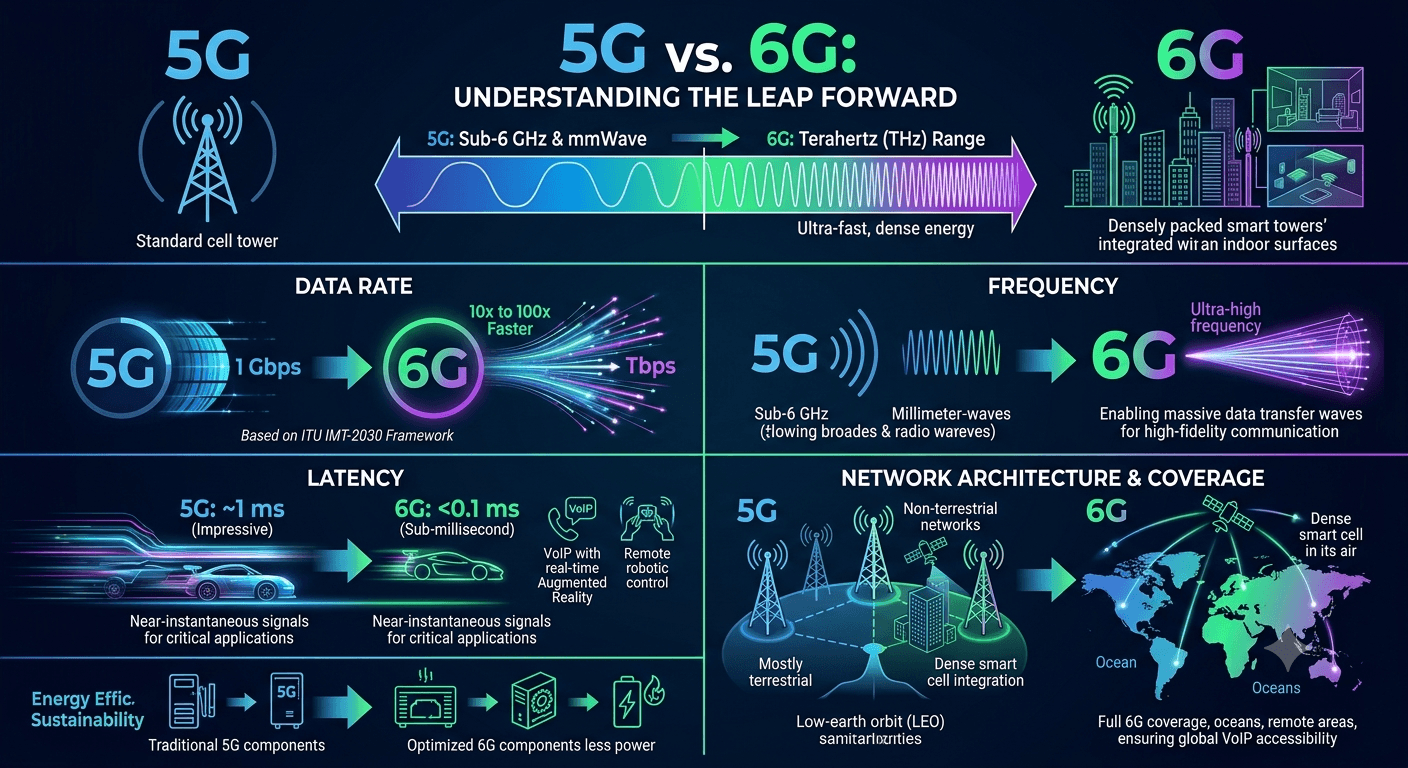
The transition from 5G to 6G is not merely an incremental update; it is a paradigm shift in how we perceive connectivity. While 5G was designed to enhance mobile broadband and support the Internet of Things, 6G technology aims to create a fully integrated digital-physical world.
According to a report by the International Telecommunication Union on the IMT-2030 framework, 6G is expected to deliver peak data rates that are 10 to 100 times faster than those of 5G.
This massive jump in bandwidth will be the primary driver behind the Impact of 6G on VoIP.
One of the most significant differences lies in the frequency spectrum. 5G operates primarily in the sub-6 GHz and millimeter-wave bands, which offer high speeds but limited range. In contrast, 6 g will utilize the Terahertz (THz) frequency range. This allows for significantly more data to be transmitted simultaneously, which is essential for high-fidelity communication. However, utilizing these higher frequencies requires 6g towers to be more densely packed and integrated into the environment, including use in smart city infrastructure and even indoor surfaces.
Latency is another area where 6G will vastly outperform its predecessor. 5G aimed for a latency of 1 millisecond, which is impressive but still noticeable in high-speed industrial applications. 6g communication aims for sub-millisecond latency, potentially reaching 0.1 milliseconds. This near-instantaneous response time is vital for VoIP services that incorporate real-time augmented reality or remote robotic control. The leap forward ensures that the future of connectivity will be defined by instantaneous feedback and zero-lag interactions.
Energy efficiency and coverage are also major points of divergence. 6G is being designed with sustainability in mind, aiming to reduce the power consumption of 6g networks significantly. Moreover, while 5G is mostly terrestrial, 6G plans to incorporate non-terrestrial networks like low-earth orbit satellites. This means 6g wireless technology will provide coverage in remote areas, oceans, and even in the air, ensuring that VoIP services are accessible everywhere on the planet without the need for traditional cellular infrastructure.
The Future of 6G: 7 Ways It Will Impact VoIP Services
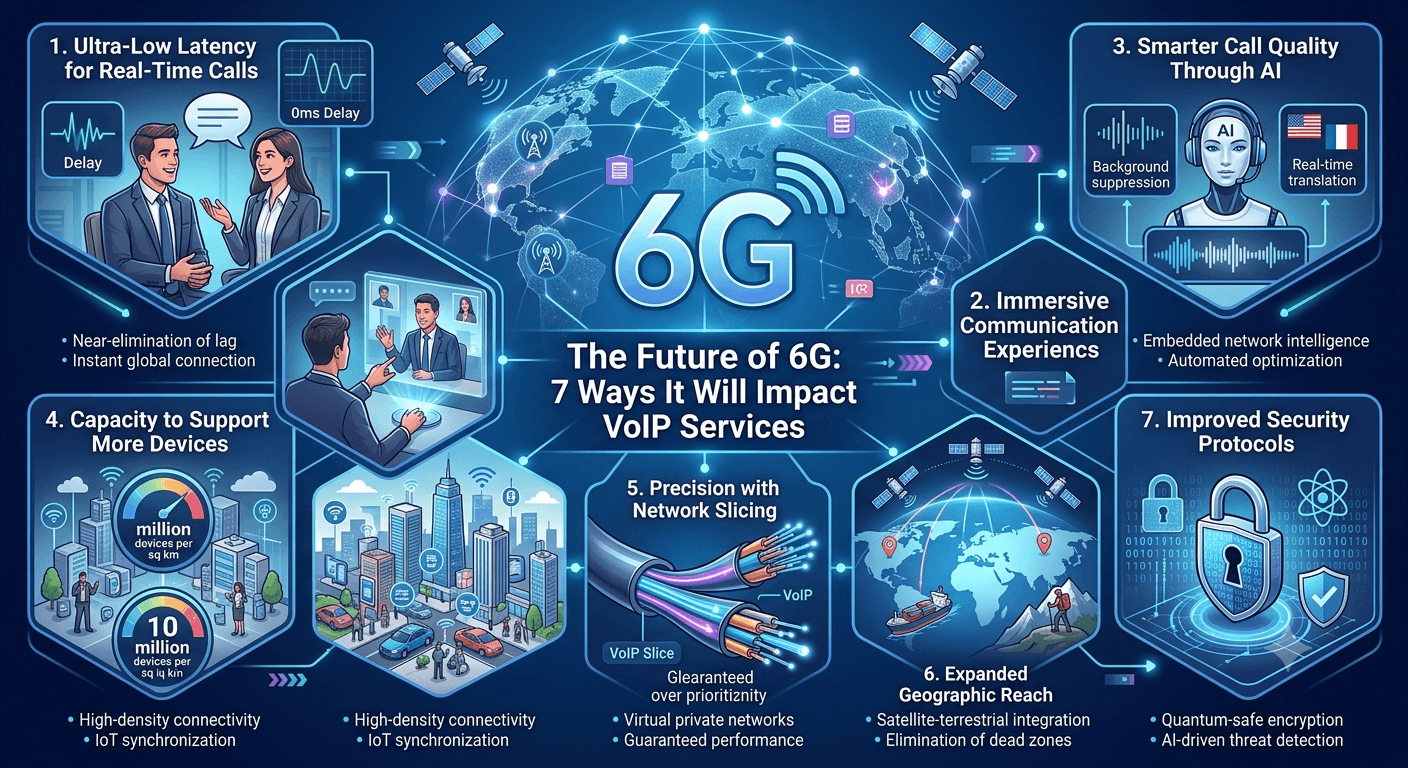
The arrival of 6G will revolutionize the telecommunications landscape, specifically targeting the limitations of current internet-based calling. As 6g and beyond the future of wireless communications systems take shape, VoIP will evolve into a multifaceted platform for interaction. The integration of advanced sensors and high-speed data transfer will make communication more intuitive and effective than ever before. Below are seven key ways this technology will change the way we use VoIP.
1. Ultra-Low Latency for Real-Time Calls
The most immediate Impact of 6G on VoIP will be the near-elimination of latency. In the current 5G environment, a slight delay can still occur, leading to people talking over each other or experiencing “lag” during video conferences. With 6g cellular technology, the delay will be so minimal that it will be imperceptible to the human ear. This is achieved through edge computing and the high-frequency THz spectrum, which allows data to travel almost instantly between points.
This advancement is particularly important for global business operations. When teams are spread across different continents, even a few milliseconds of delay can disrupt the flow of a creative brainstorming session. 6g mobile network capabilities will ensure that voice data is prioritized and transmitted with such efficiency that virtual meetings feel as natural as being in the same room. This level of performance will set a new standard for professional communication.
Furthermore, ultra-low latency enables the synchronization of voice with other data types. For instance, in a medical setting, a surgeon could provide real-time voice instructions while viewing a high-definition remote feed with no perceptible delay. The benefits of 6g networks in this regard extend far beyond simple conversation, enabling life-saving applications that require perfect timing.
2. Immersive Communication Experiences
We are moving toward an era where video calls will be replaced by immersive 3D experiences. 6g wireless technology provides the bandwidth necessary to transmit holographic data in real-time. Instead of looking at a flat screen, users of a 6g network mobile phone could see a three-dimensional projection of the person they are talking to. This will bring a sense of presence and non-verbal communication that current VoIP services lack.
-
Holographic presence allows for better emotional connection during calls.
-
Spatial audio will make voices sound like they are coming from specific directions in a room.
-
Integration with AR glasses will allow users to see digital data overlays while talking.
-
Virtual meeting rooms will become fully interactive 3D environments.
These immersive experiences will redefine the concept of connecivity. Businesses can conduct product demonstrations where clients can walk around a holographic prototype while the salesperson explains its features via a 6G-powered VoIP link. This shift will make physical travel less necessary, saving companies time and reducing their carbon footprint while maintaining high-quality professional relationships.
3. Smarter Call Quality Through AI
The role of ai in 6g core network applications and challenges is a major focus for researchers. In a 6G ecosystem, artificial intelligence will be embedded directly into the network architecture rather than being an add-on service. For VoIP, this means the network can automatically detect and suppress background noise, adjust audio levels, and even translate languages in real-time with perfect accuracy. The 6g communication system will learn from user patterns to optimize call routing and quality.
AI will also play a critical role in predictive maintenance for the network itself. By analyzing 6g testing data, the network can anticipate potential congestion and reroute VoIP traffic before the user notices a drop in quality. This self-healing nature of 6g technology ensures that communication remains uninterrupted, even in highly congested urban environments where millions of devices are connected simultaneously.
Moreover, AI-driven VoIP services will be able to summarize meetings automatically and provide actionable insights based on the conversation. Since 6g networks can handle vast amounts of data, these AI processes can happen on the network edge, ensuring that the processing is fast and the results are delivered instantly. This makes every call more productive and helps teams stay organized without manual effort.
4. Capacity to Support More Devices
One of the challenges of current networks is the density of devices in a single area. 6g cellular technology is designed to support up to 10 million devices per square kilometer. This is a massive increase over 5G and is essential for the burgeoning Internet of Things (IoT) market. For VoIP, this means that even in a crowded stadium or a dense city center, call quality will not suffer due to network congestion.
-
Massive device connectivity ensures stable calls in high-density areas.
-
Wearable devices will seamlessly integrate with VoIP systems.
-
Smart home devices can act as nodes for extending 6g communication.
-
Industrial IoT sensors can trigger automated VoIP alerts without lagging.
This increased capacity is vital for the future of connectivity where every object might have a communication component. A 6g cell will be able to manage these connections intelligently, ensuring that high-priority voice and video traffic always has the bandwidth it needs. This reliability is what will make 6G the backbone of the next industrial revolution, often referred to as Industry 5.0.
5. Precision with Network Slicing
Network slicing allows a single physical 6g network to be divided into multiple virtual networks, each optimized for a specific use case. For VoIP, a dedicated “slice” can be created that prioritizes low latency and high reliability. This ensures that even if the rest of the network is busy with high-bandwidth video streaming or large file downloads, the voice communication remains crystal clear and uninterrupted.
The 6g cellular network will use advanced software-defined networking to manage these slices dynamically. If a business is hosting a major international conference via VoIP, the network can temporarily allocate more resources to that specific slice to ensure perfect quality. This level of precision was difficult to achieve in older generations but is a core feature of 6g technology.
This capability also benefits service providers who want to offer tiered service levels. A premium VoIP service could be hosted on a dedicated high-performance slice, offering a guarantee of service quality that is impossible on a standard public network. As 6g research continues, the efficiency of these slices will only improve, leading to more customized communication solutions for different industries.
6. Expanded Geographic Reach
The integration of terrestrial 6g towers with satellite constellations will eliminate dead zones. Currently, VoIP services rely on having a stable internet connection, which is often unavailable in remote or rural areas. 6g wireless technology aims to provide global coverage, meaning you could make a high-quality VoIP call from the middle of the ocean or a remote mountain range.
This expanded reach is facilitated by the 6g communication architecture, which includes high-altitude platform stations (HAPS) and low-earth orbit (LEO) satellites. These platforms will work together to ensure that a 6g cell is available everywhere. This is a game-changer for industries like maritime shipping, oil and gas, and international logistics, where reliable communication has traditionally been expensive and difficult to maintain.
According to a study by the University of Oulu, the first 6G test networks are already exploring how to maintain high-speed data links across vast distances using satellite-to-ground communication.
This research is crucial for ensuring that the benefits of 6g networks are not limited to urban centers but are available to every person on the planet, truly democratizing high-speed connectivity.
7. Improved Security Protocols
As communication becomes more digital, security becomes a paramount concern. The Impact of 6G on VoIP includes the introduction of quantum-resistant encryption and physical layer security. Because 6g technology operates at such high frequencies, the signals are more directional and harder to intercept without specialized equipment. This inherently makes the 6g cellular technology more secure against traditional eavesdropping.
-
Quantum-safe cryptography will protect against future computing threats.
-
Blockchain-based authentication can ensure the identity of callers.
-
AI-driven threat detection can identify and block malicious traffic in real-time.
-
Distributed ledger technology can secure the billing and routing of VoIP calls.
These security enhancements are vital for government and financial institutions that handle sensitive information. With the 6g mobile network, VoIP calls can be made with the confidence that the data is protected by the most advanced encryption standards available. This focus on security will make 6G the preferred choice for mission-critical communication across all sectors of the global economy.
Read More: Top VoIP Trends to Watch in 2026
Concluding Notes
The evolution toward 6G marks a turning point in the history of telecommunications. While we are still in the early stages of 6g research and development, the potential for this technology to transform our world is undeniable. The Impact of 6G on VoIP will be felt through faster speeds, lower latency, and a level of immersion that we have only seen in science fiction. It will bridge the gap between digital and physical realities, making distance a non-factor in how we interact with one another.
As businesses and individuals prepare for this change, the focus should be on building a robust infrastructure that can handle the demands of 6g wireless technology. The transition will require significant investment in 6g towers and new hardware, but the rewards will be worth the effort. We are looking at a future where connectivity is universal, instantaneous, and more human-centric than ever before.
Ultimately, the goal of 6G is to create a seamless web of communication that empowers people and drives innovation. Whether it is through holographic calls, AI-assisted translations, or global satellite coverage, the future of VoIP is bright. By staying informed about 6g technology and its applications, we can ensure that we are ready to embrace the incredible opportunities that the next decade of connectivity will bring.
FAQs
-
What is the future scope of 6G technology?
The future of 6G technology involves creating a fully integrated cyber-physical system where communication happens at terabit speeds. It will enable advanced applications like holographic telepresence, high-precision remote surgery, and massive IoT ecosystems. Researchers are currently focusing on the 0.1 THz to 10 THz frequency range to facilitate these advancements.
-
How will 6G affect technology?
6G will act as a catalyst for other emerging technologies by providing the necessary high-speed, low-latency foundation. It will enhance artificial intelligence, make augmented reality more mainstream, and allow for the real-time processing of massive datasets at the network edge. This will lead to smarter cities, more efficient transportation, and personalized healthcare solutions.
-
How does 6G technology improve IoT applications compared to 5G?
While 5G supported a significant number of devices, 6G increases the density capacity to 10 million devices per square kilometer. It also introduces extreme reliability and sub-millisecond latency, which are crucial for autonomous systems and industrial automation. The use of non-terrestrial networks ensures that IoT devices can stay connected in even the most remote locations.
-
What are the benefits of 6G over 5G?
The primary benefits of 6G over 5G include 100 times higher data rates, a tenfold reduction in latency, and vastly improved energy efficiency. Additionally, 6G provides global coverage through satellite integration and offers enhanced security through quantum-safe encryption. It also enables 3D and holographic communication that 5G cannot support at scale.
-
When will 6G networks be available?
Current industry projections suggest that the first commercial 6G networks will begin to appear around 2030. Many countries and tech giants are already in the 6g research phase, with 6g testing expected to ramp up in the late 2020s. Standardized protocols are being developed by international bodies like the ITU to ensure global compatibility.
-
How will 6G improve VoIP call quality?
6G will improve VoIP call quality by eliminating jitter and packet loss through ultra-high bandwidth and microsecond latency. AI integration will also provide superior noise cancellation and echo reduction. This means that even in high-traffic environments, voice and video calls will remain clear and stable without any perceptible delay.
-
Will 6G require new hardware?
Yes, 6G will require new hardware because it operates on much higher frequency bands like the Terahertz spectrum. Consumers will need 6G-compatible devices, and service providers will need to install new 6g towers and edge computing infrastructure. However, these systems will likely be backward compatible with 5G and 4G for a transition period.
-
What is the role of AI in 6G?
AI is an integral part of the 6G core network, used for optimizing traffic, predicting maintenance needs, and securing the network. In VoIP, AI will handle tasks like real-time translation, automated transcription, and dynamic bandwidth allocation. This makes the network “intelligent,” allowing it to adapt to user needs without human intervention.
-
Is 6G safe for the environment?
Sustainability is a key pillar of 6G development, with researchers aiming for “zero-energy” devices and high power efficiency. By optimizing data transmission and reducing the power consumption of network components, 6G aims to have a lower carbon footprint per bit of data than previous generations. This makes it a more sustainable choice for global communication.