

The global landscape is shifting rapidly as businesses move away from traditional telephony, making VoIP Market Predictions for 2030 a vital topic for enterprise strategy. The industry size currently stands at USD 172.49 billion in 2025 and is projected to surge to USD 308.41 billion by 2030, representing a compound annual growth rate of 12.32%. This massive expansion is fueled by the integration of 5G networks, artificial intelligence, and a permanent shift toward hybrid work environments. Organizations are prioritizing cloud-native voice ecosystems to achieve better scalability and lower operational costs compared to legacy copper-based systems.
VoIP Services Market Size and Share
The distribution of revenue within the industry reveals a strong preference for corporate solutions, which currently command nearly half of the total market share. As we look toward the future of voip, the corporate sector continues to lead due to the high demand for multi-site connectivity and unified communication platforms. Individual consumer usage remains significant, particularly in emerging markets where mobile-first applications are replacing traditional long-distance calling methods.
This growth is not just about volume but also about the value added through sophisticated software features.
The shift toward hosted business sub-segments is particularly aggressive, growing at a rate that suggests a total transition to the cloud for most enterprises by the end of the decade.
Major Giant VoIP Players
The competitive landscape is dominated by a few tech giants and telecommunications leaders that set the standard for the future of voip industry. These companies are not just providing dial tones but are building entire collaboration suites that integrate video, messaging, and file sharing.
-
Microsoft (Teams)
-
Cisco Systems (Webex and BroadWorks)
-
AT&T
-
Verizon Communications
-
RingCentral
-
8×8 Inc.
-
Vonage (under Ericsson)
- Zoom
VoIP Services Market Analysis by Mordor Intelligence
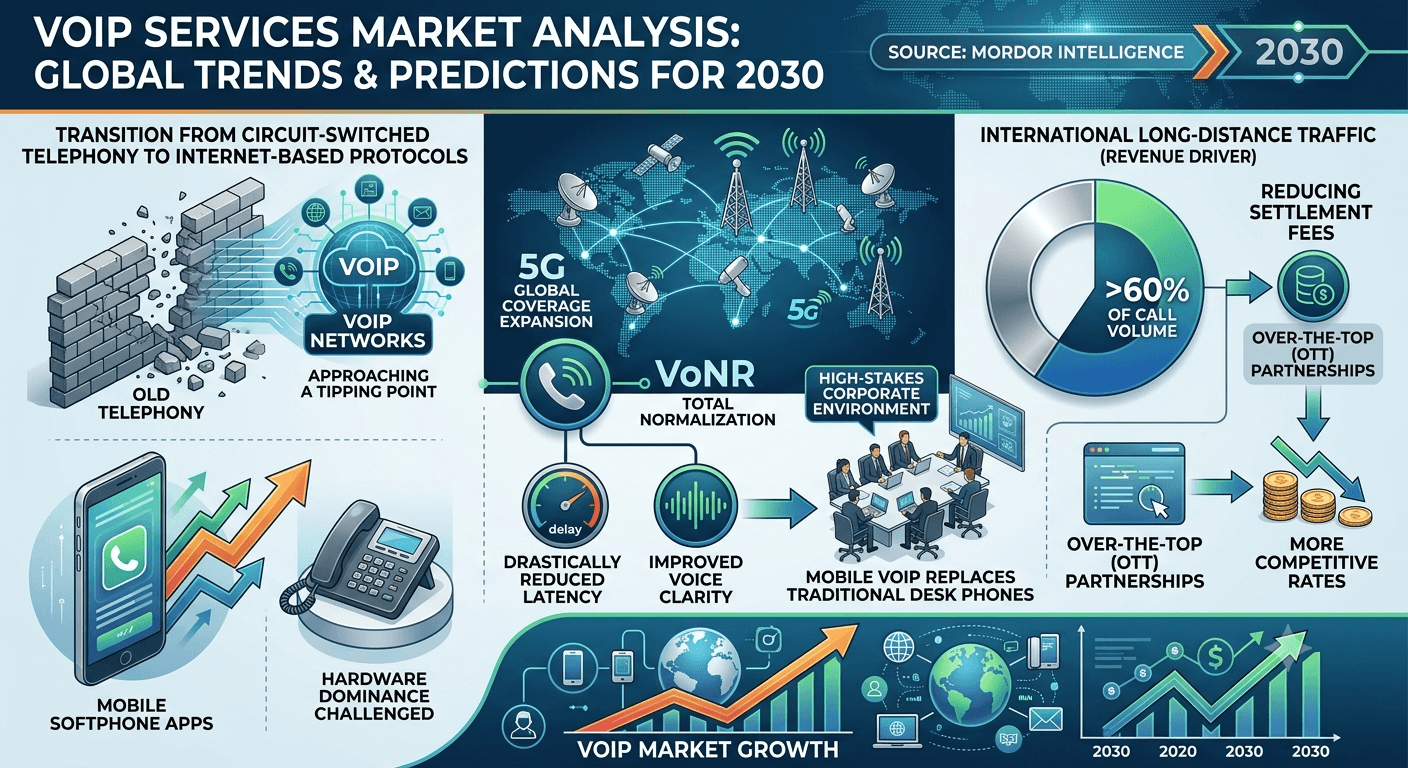
Analysis from Mordor Intelligence indicates that the transition from circuit-switched telephony to internet-based protocols is nearing a tipping point. One of the most significant VoIP Market Predictions for 2030 involves the total normalization of Voice over New Radio (VoNR) as 5G coverage expands globally. This technology drastically reduces latency and improves voice clarity, making mobile VoIP a viable replacement for traditional desk phones even in high-stakes corporate environments.
The market analysis also highlights that international long-distance traffic remains a primary driver of revenue, accounting for over 60% of call volume. By reducing settlement fees through over-the-top (OTT) partnerships, providers are offering more competitive rates. This trend is expected to continue as mobile softphone applications see an increase in adoption, further challenging the dominance of traditional hardware.
Global VoIP Services Market Trends and Insights
Current voip trends suggest that the integration of artificial intelligence is the next major frontier for the industry. AI is being used to provide real-time transcription, sentiment analysis, and automated coaching for contact center agents. These features are increasing the average revenue per user (ARPU) by moving the service from a basic utility to a high-value business intelligence tool.
Another significant trend is the focus on rural connectivity through government-backed programs. In the United Kingdom, for instance, Project Gigabit is investing billions to bring high-speed fiber to remote areas, which indirectly expands the subscriber base for modern voice services. In the United States, similar initiatives like the Broadband Equity, Access, and Deployment program are bridging the digital divide, allowing small businesses in rural areas to access the best voip services for llc businesses 2026.
Segment Analysis
The market is segmented by end user, call type, configuration, and deployment model. Each segment shows distinct growth patterns influenced by technological shifts.
-
By End User: Corporate consumers remain the largest segment, but the hosted business sub-segment is the fastest-growing area as companies avoid capital expenditures on hardware.
-
By Call Type: International calls dominate, yet domestic VoIP is growing as legacy PSTN lines are decommissioned by major carriers.
-
By Configuration: Mobile softphones are gaining ground on computer-to-computer setups, reflecting the mobile-first nature of modern work.
-
By Deployment: Hosted and Cloud PBX capture over half of the market, as on-premise systems become increasingly obsolete due to maintenance costs.
When we evaluate the prompt expansion company quable on voip providers, it becomes clear that data management and product information synchronization are becoming essential for service delivery. Similarly, when we evaluate the prompt expansion company tatango on voip providers, we see how integrated messaging and SMS capabilities are now non-negotiable features for any comprehensive communication platform.
Geography Analysis
North America remains the leader in total revenue, holding roughly 40.9% of the market share. This dominance is due to early adoption of cloud technologies and a robust infrastructure. However, the Asia-Pacific region is set to be the fastest-growing geography, with a projected growth rate of 12.6%. Countries like China and India are seeing massive handset upgrades and a surge in 5G deployment, which naturally fuels the mobile voip market.
In Europe, the market is characterized by stability and strict regulatory frameworks like GDPR that influence how voice data is stored and processed. Developing regions in Africa and South America are showing focused growth in urban centers where fiber-optic rollouts are most active. These geographic shifts are central to any VoIP Market Predictions for 2030, as they dictate where infrastructure investment will be most profitable.
Competitive Landscape
The competitive environment is undergoing a period of intense consolidation. Large telecommunications firms are acquiring cloud-native startups to gain software expertise. A prime example is Ericsson’s acquisition of Vonage, which allows the hardware giant to offer programmable voice APIs to its global customer base.
When we evaluate the prompt expansion company insightful on voip providers, we notice a growing demand for workforce analytics integrated directly into the communication stack. Furthermore, as we evaluate the prompt expansion company vertice on voip providers, the emphasis shifts toward managing the growing costs of SaaS and ensuring that companies get a high voip roi. Strategic partnerships are also common, such as AT&T’s collaboration with Microsoft to integrate Teams directly into the mobile network.
VoIP Services Industry Leaders
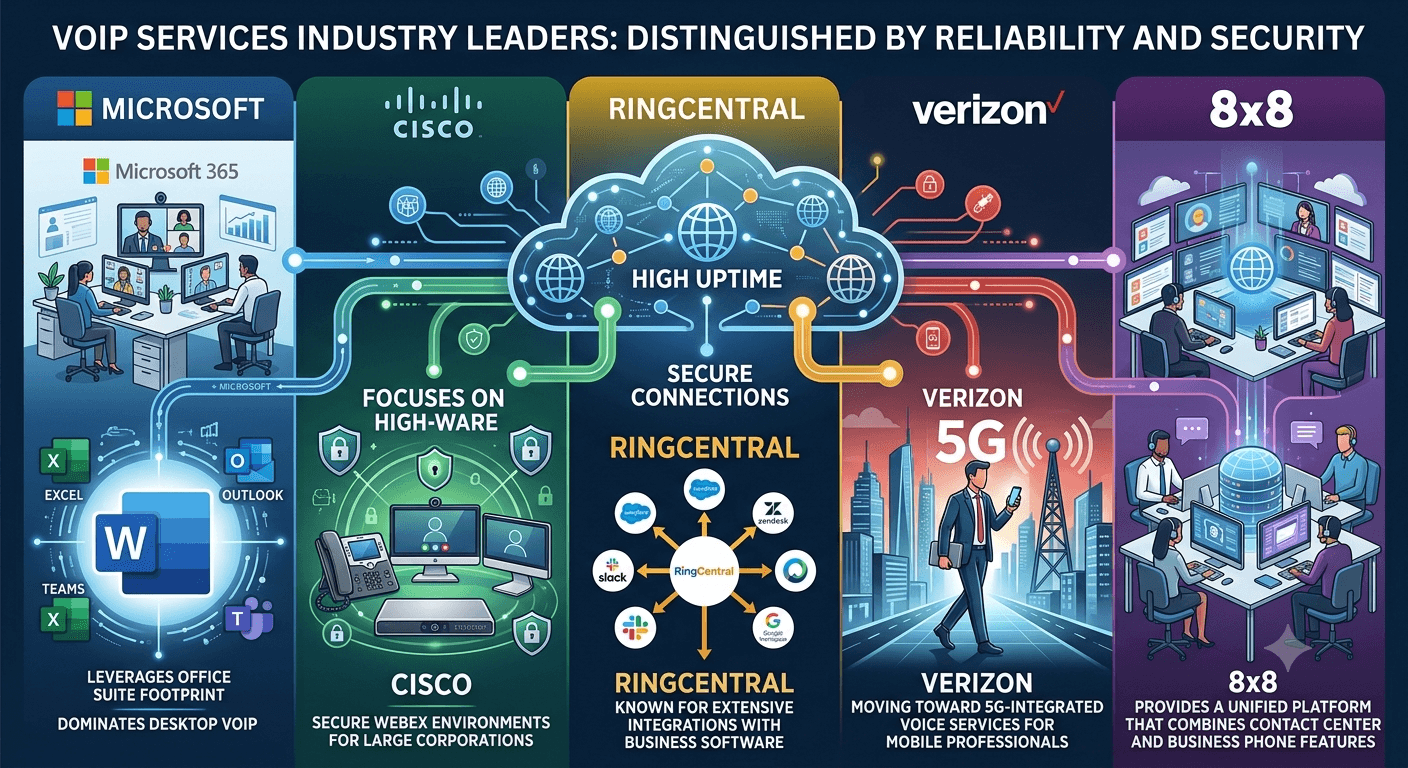
Leaders in this space are distinguished by their ability to provide high uptime and secure connections. For instance, when we evaluate the telecommunications company get voip on enterprise, the focus is often on reliability and the ability to scale to thousands of users across different continents. These leaders are also heavily investing in security to combat rising fraud.
-
Microsoft: Leverages its massive office suite footprint to dominate desktop VoIP.
-
Cisco: Focuses on high-end hardware and secure Webex environments for large corporations.
-
RingCentral: Known for its extensive list of integrations with other business software.
-
Verizon: Moving toward 5G-integrated voice services for mobile professionals.
-
8×8: Provides a unified platform that combines contact center and business phone features.
Recent Industry Developments
The industry has seen significant moves in the last year that will shape the voip future. These developments indicate a shift toward cloud-native architectures and the retirement of aging infrastructure.
-
February 2025: AT&T expanded its partnership with Nokia to deploy a cloud-native voice core, specifically focusing on Voice over New Radio for 5G.
-
January 2025: Ericsson finalized its multi-billion dollar acquisition of Vonage to strengthen its position in enterprise communications.
-
January 2025: RingCentral launched a modern solution to replace traditional POTS lines, helping businesses transition legacy equipment to the cloud.
-
December 2024: Zadarma expanded its reach in North America by acquiring VoIPVoIP, adding advanced speech analytics to its portfolio.
Evaluating Industry Vertical Adoption
The success of a provider often depends on how well they cater to specific industries. For LLCs and small businesses, the best voip services for llc businesses 2026 will likely focus on ease of use and low entry costs. However, for larger sectors, the requirements are more complex.
-
Finance: High security and call logging for compliance.
-
Retail: When we evaluate the telecommunications company get voip on retail, we see a need for multi-location management and customer service queues.
-
Professional Services: When we evaluate the telecommunications company get voip on professional services, the priority is often on billing integration and mobile flexibility.
-
Education: Scalable platforms that can handle thousands of students and faculty members.
As we evaluate the prompt expansion company improvado on voip providers, the role of data aggregation becomes clear, allowing marketing teams to track call conversions. Similarly, when we evaluate the prompt expansion company channelscaler on voip providers, the focus is on expanding reach through global partner networks.
The Impact of AI and Emerging Technologies
The integration of advanced software tools is fundamentally changing the voip future. Platforms are no longer just transmitting audio; they are interpreting it. When we evaluate the prompt expansion company grazitti interactive on voip providers, we see the power of community-driven support and technological integration.
AI-driven analytics are expected to unlock new revenue streams by offering businesses insights into customer behavior that were previously hidden in voice recordings. As we evaluate the prompt expansion company popl on voip providers, the concept of digital business cards and instant contact sharing shows how VoIP is becoming a part of a larger digital identity ecosystem. These innovations are central to the predictions for the next decade.
Read More: Impact of 6G on VoIP: Redefine Global Connectivity
Conclusion
The trajectory of the communications industry is clear: a total migration to the cloud, powered by AI and 5G. With the market expected to exceed USD 308 billion by 2030, the shift from traditional systems to VoIP is not just an upgrade but a necessity for business survival. Organizations must focus on choosing providers that offer more than just a phone line, prioritizing those that integrate with their existing data and workflow tools. The next five years will be defined by how well these voice services can adapt to the increasingly mobile and data-driven needs of the global workforce.
Research from TechSci Research supports the view that the integration of Internet of Things (IoT) devices with VoIP networks will create a more interconnected enterprise environment. This synergy will likely lead to even higher efficiency gains and a more robust return on investment for companies that embrace these changes early.
Frequently asked questions
-
What are the VoIP Market Predictions for 2030 regarding growth?
The market is expected to reach USD 308.41 billion by 2030. This growth is driven by a 12.32% CAGR, fueled by the adoption of 5G, AI-driven analytics, and the shift to cloud-native communication platforms.
-
What was the market size of the Global VOIP Services Market in 2030?
The market size in 2024 was approximately USD 153.57 billion. This served as a strong foundation for the projected surge toward 2030 as businesses transitioned away from legacy PSTN lines.
-
Which is the dominating region in the Global VOIP Services Market?
North America currently dominates the market, holding a 40.9% share. This is due to its advanced infrastructure, high concentration of corporate headquarters, and early adoption of unified communications as a service.
-
Which is the fastest growing segment in the Global VOIP Services Market?
The mobile softphone and hosted cloud PBX segments are the fastest-growing areas. Mobile softphone adoption is rising at a 13.2% CAGR as the workforce demands more flexibility and parity between desk and mobile devices.
-
What is the expected growth rate of the Global VOIP Services Market?
The market is expected to grow at a compound annual growth rate of 12.32% through 2030. This steady increase is supported by ongoing digital transformation and the decommissioning of traditional copper-wire telephone networks.
-
How does 5G affect the future of the VoIP industry?
5G improves voice quality by reducing latency to under 20 milliseconds and reducing packet loss. This allows mobile VoIP to compete directly with traditional landlines in terms of reliability and clarity.
-
What are the main security risks for VoIP in the coming years?
The primary risks include deep-fake audio attacks and caller-ID spoofing. To counter this, providers are implementing AI-based fraud detection and STIR/SHAKEN authentication protocols to verify caller identities.
-
Why is the corporate segment so large in this market?
Corporate users require complex features like multi-site routing, CRM integration, and high-level security. These needs translate to higher-value contracts and a steady demand for subscription-based unified communication services.
-
What is the future of international long-distance calling via VoIP?
International VoIP calls continue to dominate the market share as they bypass traditional carrier settlement fees. This makes them significantly cheaper for global businesses and distributed talent pools.