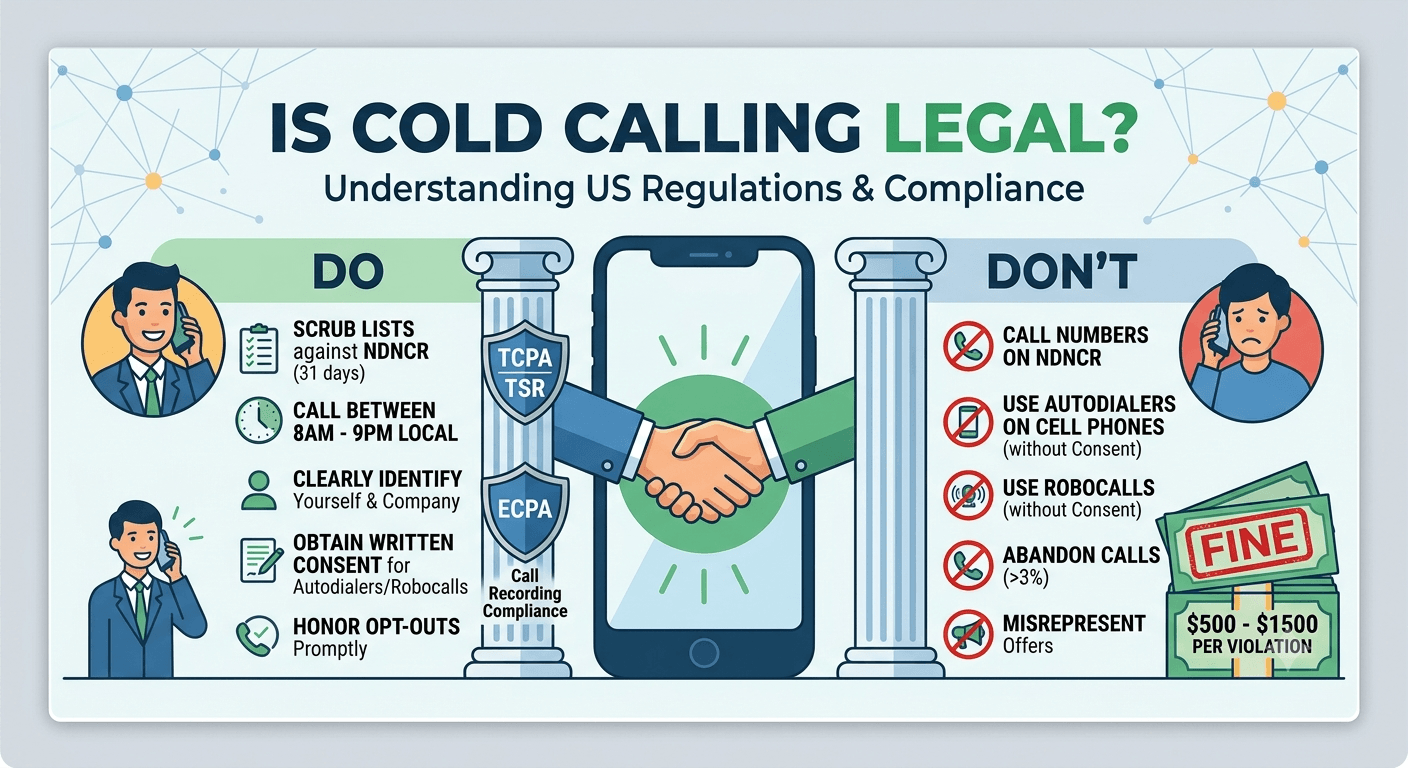
Is cold calling legal? Yes, cold calling is legal in the United States, provided that businesses adhere to specific federal and state regulations. The practice is primarily governed by the Telephone Consumer Protection Act (TCPA) and the Telemarketing Sales Rule (TSR). These laws do not ban unsolicited outreach but rather set strict guidelines regarding calling hours, the National Do Not Call Registry, and the use of automated systems like autodialers. To remain compliant, sales teams must respect consumer privacy, identify themselves clearly, and honor opt-out requests to avoid significant financial penalties from federal agencies.
What is Cold Calling?
Within the landscape of modern sales, cold calling refers to the practice of contacting individuals or businesses who have had no prior contact with the caller. The legal framework often describes this as telephone solicitation. This involves making unsolicited calls to encourage the purchase of goods, the rental of property, or investment in specific services. It is characterized by the lack of prior consent, meaning the recipient has not expressed interest in the specific offering before the phone rings.
It is important to distinguish this from other forms of outreach. For instance, calls regarding debt collection, market research, or charitable solicitations are not categorized under the same umbrella because they do not involve the sale of products. Understanding the difference between business-to-consumer and business-to-business outreach is also vital. While is cold calling legal in both contexts, the regulations governing how you reach a private individual versus a corporate entity differ significantly under federal law.
US Regulations That Apply to Cold Calling
The legal landscape for outbound sales is defined by a web of federal statutes. The primary authority comes from the Federal Trade Commission and the Federal Communications Commission. These agencies manage the Telemarketing Sales Rule and the Telephone Consumer Protection Act, respectively. Together, these regulations ensure that consumers are not harassed and that their privacy is maintained while allowing businesses to continue their legitimate sales activities.
Beyond these federal rules, the Electronic Communications Privacy Act provides a layer of protection regarding the interception and recording of calls. Compliance is not just about who you call, but how you handle the communication and the technology you use. Sales teams must also account for the National Do Not Call Registry, which serves as a database of individuals who have explicitly opted out of receiving sales calls. Ignoring these regulations can lead to severe litigation and brand damage.
What Is the Telemarketing Sales Rule TSR?
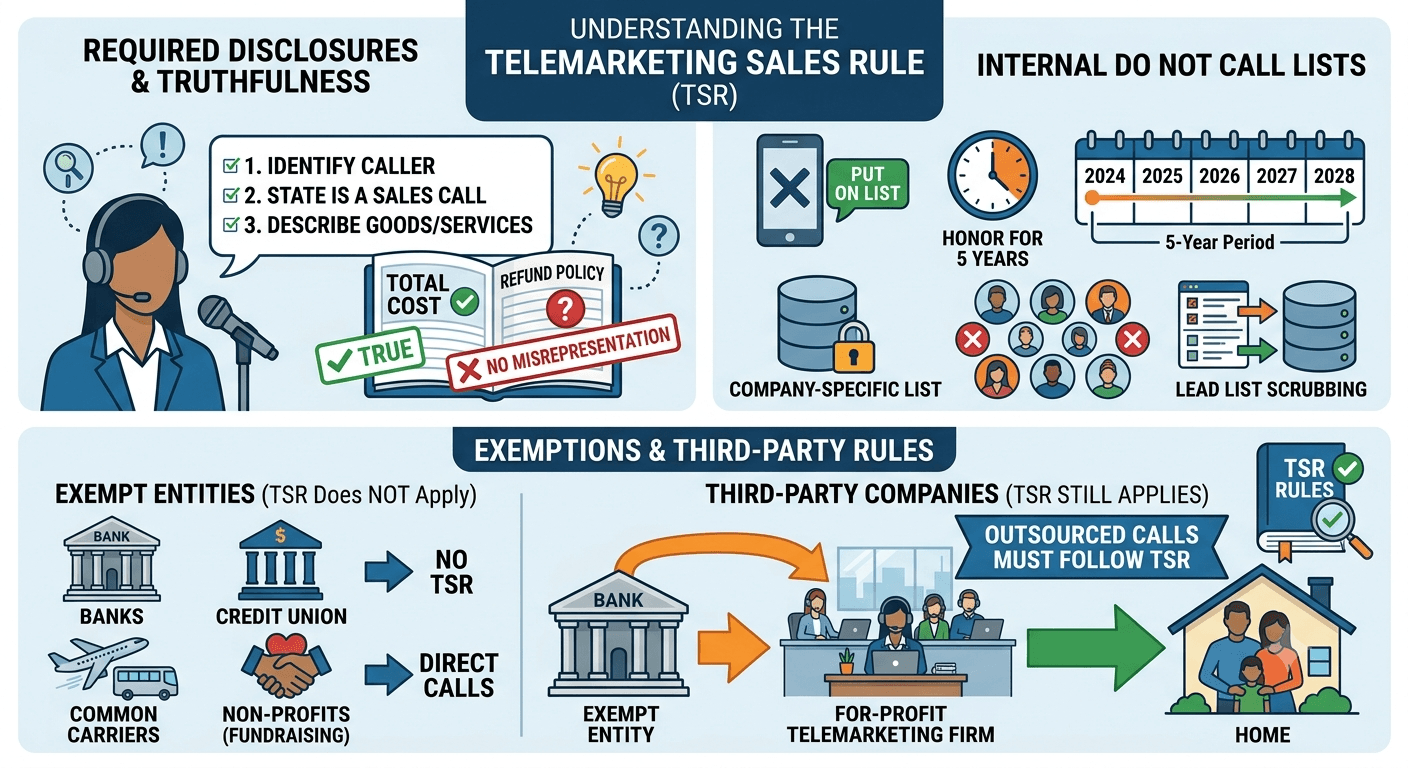
The Telemarketing Sales Rule is a cornerstone of consumer protection enforced by the Federal Trade Commission. It requires anyone engaging in cold calls to provide specific disclosures at the start of the conversation. These include the identity of the caller, the fact that the call is a sales solicitation, and the nature of the goods or services being offered. By ensuring transparency, the rule helps prevent deceptive practices that once plagued the industry.
Furthermore, the TSR prohibits misrepresentations about any part of the offer. This includes being truthful about the total cost, any restrictions on the purchase, and the refund policy. The rule also mandates that companies maintain their own internal lists of people who have asked not to be contacted. If a person requests to be placed on a company-specific list, that business must honor the request for a period of five years, ensuring that the individual is not bothered by that specific entity again.
-
How the Do Not Call Registry Affects Cold Calling
The National Do Not Call Registry was established to give consumers control over their home and mobile phones. When a person registers their number, it becomes illegal for most telemarketers to call them for sales purposes. Sales teams are required to scrub their lead lists against this registry at least once every thirty-one days. This ensures that any new registrants are removed from the calling queue promptly.
Failure to respect this registry is one of the most common reasons companies face legal action. However, the registry does not apply to all types of calls. For example, calls from political organizations, charities, and telephone surveyors are still permitted even if a number is on the list. For sales teams, the registry represents a clear boundary that defines where their outreach can and cannot go when dealing with private citizens.
-
Who Is Exempt From the TSR
Not every organization is required to follow the strictures of the Telemarketing Sales Rule. Certain entities, such as banks, federal savings and loans, and credit unions, fall outside the jurisdiction of the FTC’s rule. Common carriers, including major airlines and long-distance telephone companies, are also exempt when they are conducting their standard business operations. Additionally, non-profit organizations generally do not have to comply with the TSR for their own fundraising efforts.
However, a critical distinction exists for third-party companies. If a for-profit telemarketing firm is hired by an exempt entity to make calls on their behalf, that third-party firm must still follow the TSR. The exemption does not transfer from the client to the service provider. This ensures that the protections afforded to consumers remain in place even when an exempt organization decides to outsource its outreach efforts.
What Is the FCC’s Telephone Consumer Protection Act TCPA?
The Telephone Consumer Protection Act of 1991 is the primary federal law that governs how businesses use technology for outreach. It was created in response to a growing number of complaints about automated calling systems and unwanted faxes. The TCPA sets hard limits on when calls can be made, restricting them to the hours between 8 a.m. and 9 p.m. based on the local time of the person being called. This prevents intrusive late-night or early-morning disruptions.
The act also covers the use of specific technology. It restricts the use of automatic telephone dialing systems and artificial or prerecorded voices. For any call made to a mobile phone using these technologies, the caller must have prior express written consent. This is a higher standard than simple verbal permission, requiring a clear and conspicuous agreement from the consumer. The TCPA remains a dynamic piece of legislation that continues to be updated as calling technology evolves.
What Types of Cold Calls Does the TCPA Prohibit?
The TCPA specifically targets several high-risk calling behaviors. First, it prohibits any cold calls to emergency lines, such as 911 or hospital emergency rooms. It also bans calls to patient rooms in healthcare facilities or any service where the recipient is charged for the call. These protections are designed to keep critical lines open and prevent consumers from incurring unexpected costs due to unwanted sales pitches.
Another major prohibition involves the abandonment of calls. A call is considered abandoned if a person answers but the telemarketer does not connect them to a live representative within two seconds. The TCPA requires that no more than three percent of calls in a single campaign be abandoned over a thirty-day period. If a call is abandoned, the system must play a recorded message identifying the company and providing a way for the recipient to opt out of future calls.
What Is the Fine for a TCPA Violation?
The financial consequences of violating the TCPA can be staggering for a business of any size. The law allows for statutory damages of $500 per violation. In the context of a high-volume outbound campaign, where thousands of calls are made daily, these fines can quickly reach millions of dollars. The law also includes a provision for private right of action, meaning individual consumers can sue companies directly for these violations.
If a court determines that a company willfully or knowingly violated the law, the fine can be tripled to $1,500 per call.
According to research by various legal analysts, TCPA litigation remains a major risk for sales organizations, with thousands of class-action lawsuits filed annually.
This high stakes environment makes it essential for companies to invest in compliance software and training to ensure that every call made is within the legal boundaries.
Live-Agent Cold Calls to Residential Telephone Numbers Registered on the NDNCR
A common point of confusion is whether live agents can call numbers on the National Do Not Call Registry. Generally, if a residential number is on the list, even a live agent cannot call it for a B2C sales pitch. However, there are nuances when it comes to the definition of a residential number. While landlines were the original focus, the FCC has extended these protections to cell phones that are used for personal residential purposes.
If you are a salesperson, you must ensure that your list is scrubbed against the NDNCR regardless of whether you are using a machine or a human to dial. The law is focused on the recipient’s right to privacy rather than the method of the call. For B2C operations, the registry is a definitive “no-go” zone. However, if the number is not on the registry, live-agent calls are generally permitted without prior consent, provided all other TSR and TCPA rules are followed.
Exceptions to B2C Cold Calling on the NDNCR
There are two primary exceptions that allow a business to call a consumer whose number is on the National Do Not Call Registry. The first is express consent. If a person has provided a company with written permission to call them, the registry no longer acts as a barrier. This consent must be given voluntarily and can be revoked by the consumer at any time.
The second exception is the existence of an established business relationship. If a consumer has purchased, leased, or rented goods or services from the company within the last eighteen months, the company may call them for sales purposes. Additionally, if the consumer made an inquiry or submitted an application to the company, the business can call them for up to three months following that interaction. These exceptions recognize that customers often want to hear from businesses they already trust.
History of the NDNCR & Considerations for B2B Cold Calling
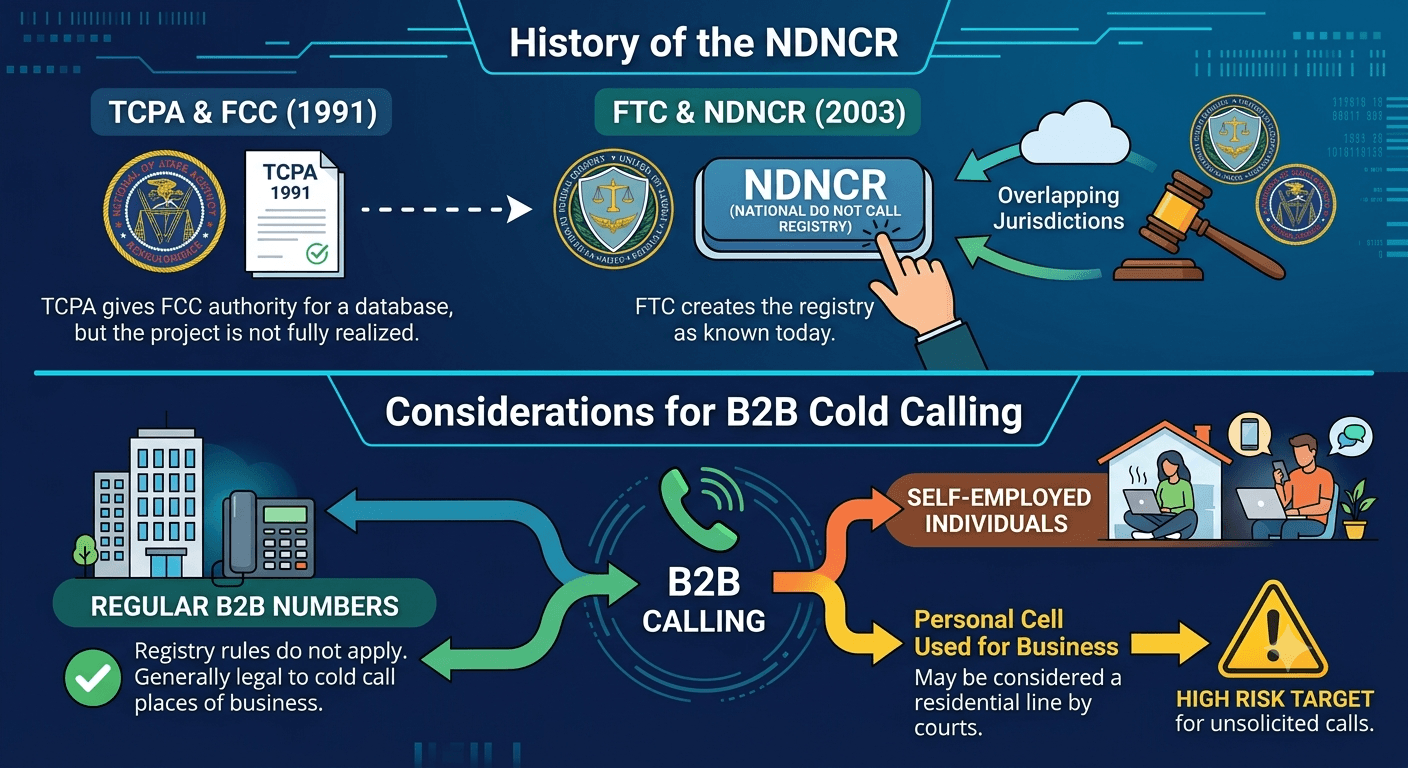
The history of the registry is a tale of two agencies. While the TCPA gave the FCC the authority to create a database in 1991, the agency never fully realized the project. It wasn’t until 2003 that the FTC stepped in to create the National Do Not Call Registry as we know it today. This shared history often leads to overlapping jurisdictions, where both agencies have a say in how the list is managed and enforced.
For those focused on business-to-business sales, the registry works differently. The NDNCR rules do not apply to business phone numbers. It is generally legal to cold call a place of business even if their number is technically on the registry, as the list is intended for residential protection. However, caution is required when calling self-employed individuals. If a freelancer uses their personal cell phone for business, it may still be considered a residential line by the courts, making it a high-risk target for unsolicited calls.
Cold Calls Made to Cell Phones Using an Autodialer or an Artificial/Prerecorded Voice
The use of technology in cold calling is where the most stringent rules are applied. Under the TCPA, you cannot use an automatic telephone dialing system to call a cell phone for sales purposes without prior express written consent. This applies to both B2C and B2B calls if the destination is a mobile device. The definition of an autodialer has been a subject of much debate, but it generally refers to equipment that has the capacity to store or produce numbers to be called using a random or sequential generator.
Similarly, artificial or prerecorded voices, often referred to as robocalls, are heavily restricted. Using an AI-generated voice to conduct a cold call to a cell phone without consent is a direct violation of federal law. This area of calling legislation has seen increased scrutiny recently as AI technology becomes more sophisticated. Sales teams must ensure that if they are using any form of automated voice technology, they have a documented paper trail of consent for every mobile number they dial.
Cold Calls Made to Residential Telephone Lines Using an Artificial or Prerecorded Message
While cell phones have the strictest protections, residential landlines also have specific rules regarding automated messages. You cannot deliver a prerecorded sales message to a residential landline unless the recipient has given you prior express written consent. This rule is designed to prevent “phone spam” that can clog up home lines. However, unlike cell phones, there is no federal prohibition against using an autodialer to call a residential landline, as long as a live agent is there to speak when the person answers.
In the B2B world, these rules are slightly more relaxed. It is generally permitted to use an artificial or prerecorded message when calling a business landline. Additionally, autodialers can be used for B2B calls provided they do not tie up more than one line at a business at a time. Despite these relaxations, many businesses choose to avoid automated messages entirely to maintain a professional reputation and avoid the negative stigma associated with robocalls.
What Is the Electronic Communications Privacy Act ECPA?
The Electronic Communications Privacy Act is a federal law that deals with the privacy of communications in transit. For sales teams, the most relevant part of this act concerns call recording and monitoring. The ECPA generally allows for the recording of calls as long as at least one party involved in the conversation consents. This is known as “one-party consent,” and since the salesperson is a party to the call and consents to the recording, it is federally legal.
However, the ECPA also stipulates that state laws can be more restrictive than federal law. Some states have determined that the privacy of their citizens requires that all parties on a call must consent to being recorded. If a salesperson in a one-party state calls a consumer in a two-party state, they must follow the more restrictive law. This makes it vital for call centers to use automated disclosures, such as “this call may be recorded for quality purposes,” to ensure they are compliant across all jurisdictions.
Which States Require Two-Party Consent?
There are currently several states that have enacted laws requiring every person on a phone call to consent to recording. These are often referred to as “all-party consent” states. If a sales team is recording calls for training or compliance, they must be particularly careful when dialing into these areas. The states that generally require two-party consent include:
-
California
-
Florida
-
Illinois
-
Maryland
-
Massachusetts
-
Michigan
-
Montana
-
New Hampshire
-
Pennsylvania
-
Washington
In these states, recording a conversation without the explicit permission of the other party can lead to criminal charges or civil lawsuits. To manage this, many sales platforms use geographical detection to automatically play a recording disclosure when a call is placed to an area code in one of these states. This protects the company from accidentally violating the ECPA or state privacy statutes while still allowing them to maintain records of their sales interactions.
How to Ensure You Are Making Compliant Cold Calls
Staying on the right side of the law requires a proactive approach to compliance. The first and most essential step is to implement a robust list scrubbing process. You should never dial a lead list that hasn’t been checked against the National Do Not Call Registry within the last month. Additionally, you should maintain a “do not call” list for your own company to ensure that anyone who asks to be removed is never contacted again by your team.
Second, be mindful of the technology you use. If you are calling mobile phones, it is safer to use manual dialing or a human-initiated click-to-dial system rather than a fully automated dialer. This helps avoid the “autodialer” classification under the TCPA. Finally, always provide clear identification at the start of every call. State your name, your company’s name, and the reason for your call immediately. This transparency not only ensures compliance but also helps build a foundation of trust with the prospect.
-
Scrub all lead lists against federal and state DNC registries every 31 days.
-
Train all sales staff on the specific hours permitted for calling (8 AM to 9 PM local time).
-
Implement a system to capture and store written consent for automated calls.
-
Use a call recording disclosure to satisfy two-party consent state requirements.
-
Regularly audit your calling patterns to ensure abandoned call rates stay below 3%.
Final Thoughts
The question of is cold calling legal is best answered by looking at the quality of a company’s compliance program. While the act of reaching out to a stranger to offer a product is perfectly legal, the margin for error is slim. The combination of the TSR, TCPA, and various state laws creates a complex environment where one wrong click can lead to a significant fine. However, for companies that take the time to understand the nuances of the National Do Not Call Registry and the rules regarding automated technology, cold calling remains a powerful and legitimate tool for growth. By prioritizing consumer privacy and maintaining transparency, sales teams can continue to reach new customers while upholding the highest ethical and legal standards.
FAQs
-
Is cold calling legal for my business?
Yes, cold calling is legal for businesses provided they follow federal regulations such as the TCPA and the TSR. You must avoid calling numbers on the National Do Not Call Registry, respect calling hours between 8 a.m. and 9 p.m., and provide clear disclosures about who you are and why you are calling.
-
Can you get in trouble for cold calling?
You can face significant legal trouble and financial penalties if you violate cold calling laws. Penalties under the TCPA can range from $500 to $1,500 per call, and the FTC can levy heavy fines for non-compliance with the Telemarketing Sales Rule or the Do Not Call Registry.
-
Is AI cold calling illegal?
The use of AI and artificial voices for cold calling is highly regulated. Under recent FCC rulings, using AI-generated voices to make unsolicited sales calls to residential lines or mobile phones without prior express written consent is considered a violation of the TCPA and is generally illegal.
-
Can you report cold callers to the police?
While the police generally do not handle telemarketing complaints, you can report illegal cold callers to the Federal Trade Commission or the Federal Communications Commission. If a caller is engaging in harassment or fraud, local law enforcement may become involved, but most regulatory issues are handled at the federal level.
-
Is B2B cold calling legal?
B2B cold calling is legal and generally has fewer restrictions than B2C calling. The National Do Not Call Registry does not apply to business numbers, but you must still follow TCPA rules regarding the use of autodialers on mobile phones and avoid tying up emergency or healthcare lines.
-
What does “no cold callers” meaning signify?
A “no cold callers” sign on a physical property indicates that the resident does not want unsolicited visitors. In a digital or phone context, it signifies that the individual has opted out of marketing. While these signs carry more weight for door-to-door sales, they signal a clear lack of consent for any form of unsolicited solicitation.
-
Is there a difference between telemarketing and cold calling?
Cold calling is a subset of telemarketing. While telemarketing covers all types of sales and promotions done over the phone, cold calling specifically refers to reaching out to individuals who have had no prior relationship or contact with the business.
-
Is real estate cold calling legal?
Real estate cold calling is legal but must strictly follow the same TCPA and DNC rules as any other industry. Agents must be careful to scrub their lists against the registry and avoid using automated dialers to call cell phones without the required consent from the homeowner.
-
Are auto dialers illegal?
Auto dialers are not illegal themselves, but their use is strictly regulated. You cannot use an automatic telephone dialing system to call a cell phone for marketing purposes without prior express written consent. Using them for B2B landline calls is generally permitted, provided other regulations are met.