
Latest News

The Blog

voip blogs
warm transfer vs cold transfer

Difference Between Warm Transfer vs Cold Transfer

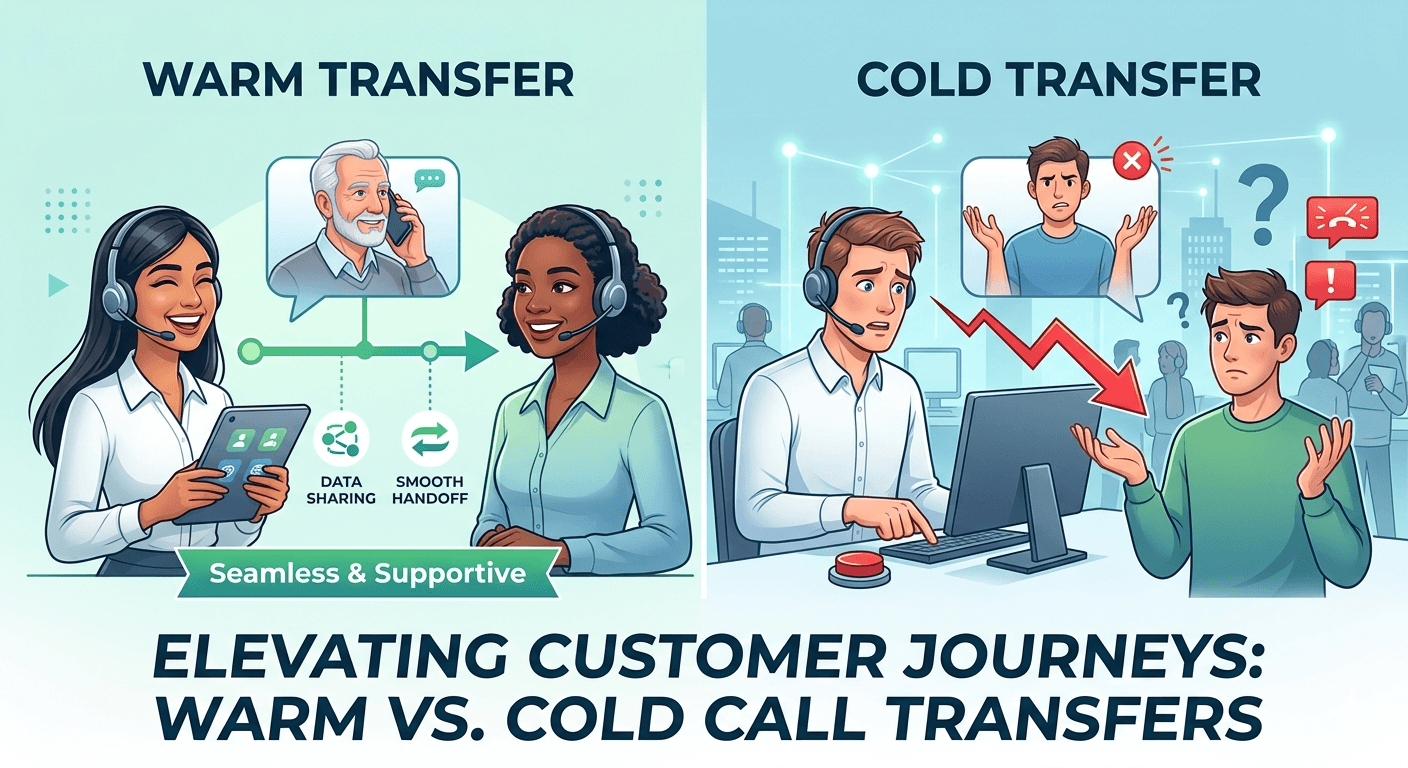
The warm transfer meaning refers to a collaborative approach where the initial agent speaks with the receiving party before the caller is connected. This process ensures that all relevant data is shared, preventing the customer from having to repeat their situation. On the other hand, the cold transfer represents a more direct route where the call is immediately moved to a new queue or agent without an introductory conversation. In the ongoing debate of warm transfer vs cold transfer, both strategies have their place in a high-functioning communication ecosystem, but they serve different purposes depending on the complexity of the inquiry and the desired speed of resolution. Call management stands as a cornerstone of modern customer service, determining how efficiently a business handles its daily influx of inquiries. At the heart of this process is the call transfer, a technical maneuver that moves a live conversation from one agent or department to another. While the action seems simple on the surface, the methodology used can significantly alter the customer journey. Businesses generally rely on two distinct methods to handle these transitions, each offering different levels of engagement and operational efficiency. Choosing between these methods requires a deep understanding of organizational goals and customer expectations. In a professional setting, the choice of movement between departments reflects the brand identity of a company. High-touch industries often prefer a more guided experience to maintain a sense of continuity and care. Conversely, high-volume service centers might lean toward faster methods to keep wait times low. Understanding the technical and psychological nuances of these transfers allows managers to optimize their workflows, improve agent performance, and ultimately drive higher levels of satisfaction across the customer base. Warm Transfer Meaning and Operational Benefits The warm transfer meaning encompasses a high-touch communication strategy designed to provide a seamless transition for callers. In this scenario, when an agent determines that a caller needs specialized assistance, they do not immediately hand off the line. Instead, they place the caller on a brief hold, dial the intended department or specialist, and provide a summary of the ongoing interaction. This summary typically includes the name of the caller, the reason for the inquiry, and any steps already taken to resolve the issue. Once the receiving agent is fully briefed, the original agent brings the caller back onto the line, introduces the new party, and then exits the conversation. This method is highly valued in environments like a warm transfer call center because it prioritizes the human element of service by ensuring the next representative is prepared, the business eliminates the common frustration of information loss. From a technical standpoint, this requires a phone system that supports multi-party conferencing and internal messaging. The primary goal is to make the customer feel valued and heard, rather than feeling like a piece of data being shuffled through a machine. This approach is particularly effective for complex troubleshooting, high-stakes sales leads, or sensitive customer support issues where context is everything. Implementing this strategy often leads to a noticeable improvement in First Call Resolution (FCR) rates. When the second agent receives a detailed brief, they can begin the resolution process immediately upon greeting the caller. This reduces the total time the customer spends explaining their problem, which is a major factor in overall satisfaction scores. While this method may increase the average handle time for the initial agent, the long-term benefits of a resolved issue and a happy customer far outweigh the extra minutes spent on the handoff. Examining the Cold Transfer Process in High Volume Environments A cold transfer occurs when an agent sends a call to another person or department without first speaking to the recipient. This is often referred to as a blind transfer because the receiving party has no prior knowledge of who is calling or why. The process is remarkably fast; the agent simply inputs the extension or selects the department and hits the transfer button, immediately disconnecting themselves from the line. The caller is then placed back into a ringing state or a queue until the next person picks up. While often viewed as less personal, the cold transfer is a highly efficient tool for certain types of interactions. For example, if a caller reaches the wrong department by mistake, such as calling billing when they meant to reach technical support, a quick transition is often the most logical step. In these cases, the caller usually understands that they are in the wrong place and expects a quick redirect rather than a lengthy introduction. It is also beneficial in large organizations where agents handle hundreds of calls an hour and the inquiries are simple enough that no context is required for the next person to assist. The efficiency of this method allows call centers to maintain lower average handle times and handle a higher volume of calls with fewer resources. However, it places a higher burden on the caller, who must re-explain their situation to the new representative. If a caller is transferred multiple times using this method, it can lead to significant frustration. Therefore, businesses must train their staff to recognize when a quick move is appropriate and when a more detailed handoff is necessary to preserve the quality of the customer experience. Primary Differences Found in Warm vs Cold Transfer Strategies The debate of warm vs cold transfer often centers on the balance between speed and quality. The most significant difference lies in the customer experience. In a warm scenario, the customer experiences a guided transition that feels like a professional handoff. They are introduced to the new agent, and they hear a summary of their problem, which confirms that the first agent was listening. In a cold scenario, the customer is suddenly moved to a new line, often encountering a new set of hold music or a different ringing tone, which can feel jarring and impersonal. From an agent’s perspective, the two methods require different skill sets and time commitments. A warm transition requires the agent to be proficient in internal communication and brief reporting. They must be able to summarize complex issues quickly and accurately to their colleagues. A cold transition requires less communication skill but demands a high level of accuracy in knowing exactly where to send the call. Sending a cold call to the wrong department is much more damaging than a warm one, as the caller will have to start the entire process over again without any support. Technical requirements also differ between the two. A standard cold transfer vs warm transfer analysis shows that warm transfers require more robust telephony features, such as the ability to hold one line while active on another and then merge all three. Some legacy systems may struggle with these complex maneuvers, making cold transfers the default. However, modern cloud-based VOIP solutions have made the warm process much simpler, allowing agents to see the status of their colleagues before even attempting to move the call. Choosing the Best Call Transfer Method for Business Success Deciding which method to implement depends heavily on the specific needs of the business and the nature of the customer inquiries. For sales-driven organizations, warm transfer leads are often the preferred choice. In this context, a front-end agent or a lead qualifier gathers initial information before handing the prospect over to a senior sales executive. This introduction builds trust and ensures the executive has all the data needed to close the deal. The professional atmosphere created by a warm handoff can significantly increase conversion rates by making the prospect feel like a priority. In contrast, technical support departments might use a mix of both. If a customer needs a simple password reset, a cold transfer to the automated system or a specialized desk is efficient. But if the customer is reporting a complex system failure that they have already spent twenty minutes describing, a warm transition is essential. Businesses should establish clear guidelines on when to use each method based on the “tier” of the issue or the “value” of the customer. High-value clients should almost always receive a warm handoff to maintain the relationship. Operational costs also play a role in this decision. Because warm transfers take more time, they technically cost the company more in terms of agent labor. However, this must be weighed against the cost of customer churn. According to a study by the Harvard Business Review, one of the top reasons customers leave a brand is the effort required to get an issue resolved. Reducing that effort through better call management can lead to higher lifetime value, which far outweighs the few extra cents spent on a longer call duration. Strategic Impact of Cold vs Warm Transfer on Customer Retention The choice of cold vs warm transfer has a direct impact on customer loyalty and brand perception. Customer retention is often tied to the “Customer Effort Score,” a metric that measures how hard a customer has to work to resolve their problem. When a business utilizes warm transitions, it takes the burden of information transfer off the customer and places it on the organization. This proactive service model is highly effective at building long-term loyalty because it demonstrates respect for the customer’s time and emotional state. Research from Zendesk indicates that nearly 70% of customers feel frustrated when they are transferred to another department and have to repeat their information. This repetition is a hallmark of the cold transfer. When a customer is already upset about a product failure or a billing error, being forced to explain the situation for a second or third time can be the breaking point that leads them to a competitor. By implementing a warm transfer strategy, companies can mitigate this frustration and turn a potentially negative experience into a positive demonstration of professional coordination. Furthermore, the data collected during a warm handoff can be integrated into the CRM more effectively. As the two agents speak, they can ensure that the notes being entered into the system are accurate and comprehensive. This internal synergy ensures that the business maintains a high standard of data integrity. When the organization operates as a cohesive unit rather than a collection of siloed departments, the customer feels a sense of security and trust that is difficult to achieve through automated or disconnected processes. Technical Implementation and Best Practices for a Call Transfer To successfully execute a call transfer, businesses must equip their teams with the right tools and training. Modern VOIP systems are designed to make these transitions seamless. Features like “Presence” allow agents to see who is available, busy, or away before they even attempt a transfer. This prevents the “dead-end” transfer where a caller is moved to a person who isn’t even at their desk. Integrating the phone system with a CRM also allows the data gathered by the first agent to pop up on the second agent’s screen automatically, which can sometimes provide a “digital” warm transfer experience even if the agents don’t speak. Training is equally important. Agents should be taught a specific script for warm transitions. This usually involves asking the caller for permission to place them on a brief hold, speaking to the recipient to provide the context, and then performing the introduction. For cold transfers, agents should be trained to provide the caller with the direct extension or phone number of the department they are being moved to. This acts as a safety net; if the call is disconnected during the move, the customer has the information they need to call back directly without going through the main menu again. Identify the caller’s needs early in the conversation to determine if a transfer is necessary. Check the availability of the receiving agent using the internal presence indicators. For a warm handoff, summarize the caller’s name, account number, and specific problem. Introduce the caller to the new agent by name to create a personal connection. Wait for the new agent to acknowledge the information before disconnecting. For a cold handoff, inform the customer exactly where they are going and why. Provide the direct dial number in case the connection is lost. Analyzing the Role of Warm Transfer in Sales and Lead Management In the world of sales, the warm transfer is a powerful tool for maintaining momentum. When a lead is generated, the initial contact is often with a junior representative or a lead qualification team. If that lead is “hot,” meaning they are ready to buy, the goal is to get them to a senior salesperson as quickly as possible without losing the rapport that has been built. A warm transfer meaning in this context is the bridge that keeps the prospect engaged while the specialized closer enters the conversation. This method prevents the “lead decay” that happens when a prospect is told they will receive a callback later. In the time it takes for a callback to occur, the prospect may lose interest or be contacted by a competitor. By using a warm handoff, the business capitalizes on the prospect’s current interest. The initial agent can say, “I have our specialist, Sarah, on the line who handles exactly the type of equipment you are looking for. I’ve already told her about your requirements.” This validates the prospect’s needs and makes the transition to the sales pitch feel like a natural progression rather than a restart. Furthermore, statistics show that immediate transfers significantly increase the likelihood of a sale. According to research on lead response times, the odds of connecting with a lead decrease by over 10 times if the contact happens more than an hour after the initial inquiry. By using warm transfers to move qualified leads to closers in real-time, organizations can maximize their marketing spend and improve the overall efficiency of their sales funnel. The Psychological Effect of Call Transfer on the Agent Experience While much of the focus is on the customer, the type of call transfer used also affects the employees. Agents who are forced to use cold transfers for complex issues often face the brunt of customer frustration. When a customer has been moved blindly and has to repeat themselves, they are often angry by the time they reach the second agent. This creates a stressful work environment and can lead to agent burnout. Providing the tools and time for warm transfers can actually improve employee morale by allowing them to be more helpful and professional. On the flip side, the receiving agent in a warm transfer scenario feels more empowered. They enter the conversation with the information they need to succeed, which boosts their confidence and reduces their “start-up” time on each call. This collaborative environment fosters a sense of teamwork between departments. Instead of feeling like they are “dumping” calls on each other, agents feel like they are working together to solve problems. This internal culture of support eventually translates into a better external experience for the customer. Standardize the information shared during the “warm” phase to include account ID and issue summary. Use internal chat tools to supplement the voice introduction if the system allows. Monitor the “transfer success rate” as a KPI for agent performance. Encourage agents to stay on the line until the customer and the new agent have successfully engaged. Provide clear guidelines on which departments accept cold moves and which require warm introductions. Comparing Cold Transfer vs Warm Transfer Technical Workflows From a technical architecture standpoint, the cold transfer vs warm transfer distinction involves different signaling protocols within a PBX or VOIP system. In a cold transfer, the SIP (Session Initiation Protocol) message tells the server to move the media stream directly to a new endpoint. The originating agent’s session is terminated as soon as the command is sent. This is technically simple and puts very little strain on the network or the hardware, which is why it was the standard for many decades in the early days of telephony. A warm transfer is more complex. It involves creating a second “leg” of the call while the first leg remains active but on hold. The agent manages two separate media streams simultaneously. When the agent decides to complete the move, the system must bridge the two legs and then remove the agent’s endpoint from the bridge without dropping the remaining two. Modern cloud platforms handle this via sophisticated back-end orchestration, but it still requires more bandwidth and processing power than a simple redirect. Understanding these technicalities is important for IT managers when selecting a communication platform. A system that makes warm transfers difficult or clunky will inevitably lead to agents taking the “easy” route and performing cold moves, even when a warm one is warranted. The user interface must be intuitive, allowing for “one-click” toggling between callers and easy conferencing. When the technology supports the desired behavior, the staff is much more likely to follow the best practices laid out by management. Fact-Based Research on Transfer Methods and Customer Satisfaction Research consistently highlights the importance of the human touch in digital-first communication environments. A study by the Call Centre Management Association (CCMA) found that “being passed between agents” is one of the top three frustrations for UK consumers. The study noted that the frustration isn’t necessarily the transfer itself, but the loss of context that often accompanies it. This directly supports the implementation of warm transfers as a primary strategy for increasing customer satisfaction (CSAT) scores. Another significant piece of data comes from the “State of Service” report by Salesforce, which indicates that 80% of customers expect a consistent experience across different departments. However, 68% say it feels like they are communicating with separate departments rather than one company. The cold transfer contributes heavily to this “siloed” feeling. By contrast, organizations that prioritize warm transfers are more likely to be perceived as a single, cohesive entity that is focused on the customer’s needs rather than its own internal convenience. Fact 1: 70% of customers report frustration when repeating information to multiple agents during a single service interaction. Fact 2: Organizations using warm transfers for complex issues see a 15% higher First Call Resolution (FCR) rate compared to those using cold methods. Managing the Call Transfer in Niche Industries: Healthcare and Legal In high-stakes industries like healthcare or legal services, the warm transfer is often the only acceptable method. In a healthcare setting, a patient may be calling in a state of distress or sharing sensitive medical information. A cold transfer in this situation is not just unprofessional; it can be perceived as negligent. A nurse or administrative assistant should always use a warm handoff to a doctor or specialist to ensure that the patient feels cared for and that critical details are not missed. Similarly, in legal services, the details of a case are often complex and confidential. When a potential client calls a law firm, they are often looking for reassurance as much as legal advice. A warm transfer from the intake specialist to the attorney allows the specialist to relay the basic facts of the case, allowing the attorney to enter the conversation with a position of authority and preparation. This builds immediate trust, which is vital in a profession where the relationship between the client and the firm is based on confidence. In these sectors, the “warm transfer meaning” extends beyond just a business process; it becomes a part of the professional ethics of the organization. It ensures that the chain of information remains unbroken and that the client or patient is never left “hanging” in a queue without a clear understanding of who they are talking to next. For these businesses, the extra time invested in the transfer is a direct investment in the professional reputation of the firm or practice. Read More: Is WIFI Calling Free? A Deep Dive into wifi calling Technology Final Thought The choice between a warm vs cold transfer is more than a technical decision; it is a strategic one that defines the quality of a business’s customer service. While the cold transfer offers speed and efficiency for simple redirects, the warm transfer provides the context, professionalism, and care required for complex and high-value interactions. By understanding the nuances of cold transfer vs warm transfer, businesses can tailor their communication strategies to meet the specific needs of their callers. Ultimately, a balanced approach that prioritizes the customer’s experience while maintaining operational efficiency will lead to higher satisfaction, better retention, and a more cohesive internal culture. Investing in the right technology and training to support these transfers is a fundamental step toward building a world-class service organization. Frequently Asked Questions What is warm transfer vs cold transfer? A warm transfer involves the agent speaking to the person receiving the call before handing it over, ensuring all information is shared. A cold transfer is a direct move where the agent disconnects immediately, leaving the caller to explain their situation again to the next person. What is a warm transfer vs a cold transfer in terms of customer experience? A warm transfer creates a seamless, professional experience where the customer feels supported and understood. A cold transfer is faster but can be frustrating for the customer because it often requires them to repeat information and wait in a new queue without an introduction. Is a warm transfer better than a cold transfer? In most cases involving complex issues or high-value customers, a warm transfer is superior because it improves satisfaction and resolution rates. However, a cold transfer is better for very simple redirects where speed is the primary concern for both the agent and the caller. Are attended transfers, soft transfers, and warm transfers the same thing? Yes, these terms are often used interchangeably in the telecommunications industry. They all refer to the process of an agent staying on the line to introduce the caller to the next representative before completing the transfer. When should a business use a cold transfer? A business should use a cold transfer for routine inquiries, such as moving a caller to a general billing department, an automated system, or a directory. It is most effective when the caller is in the wrong department and just needs a quick route to the correct one without needing to share a detailed history.
Read More
what is call flow

What is Call Flow: Understanding Call Flow Meaning, Benefits and Setup

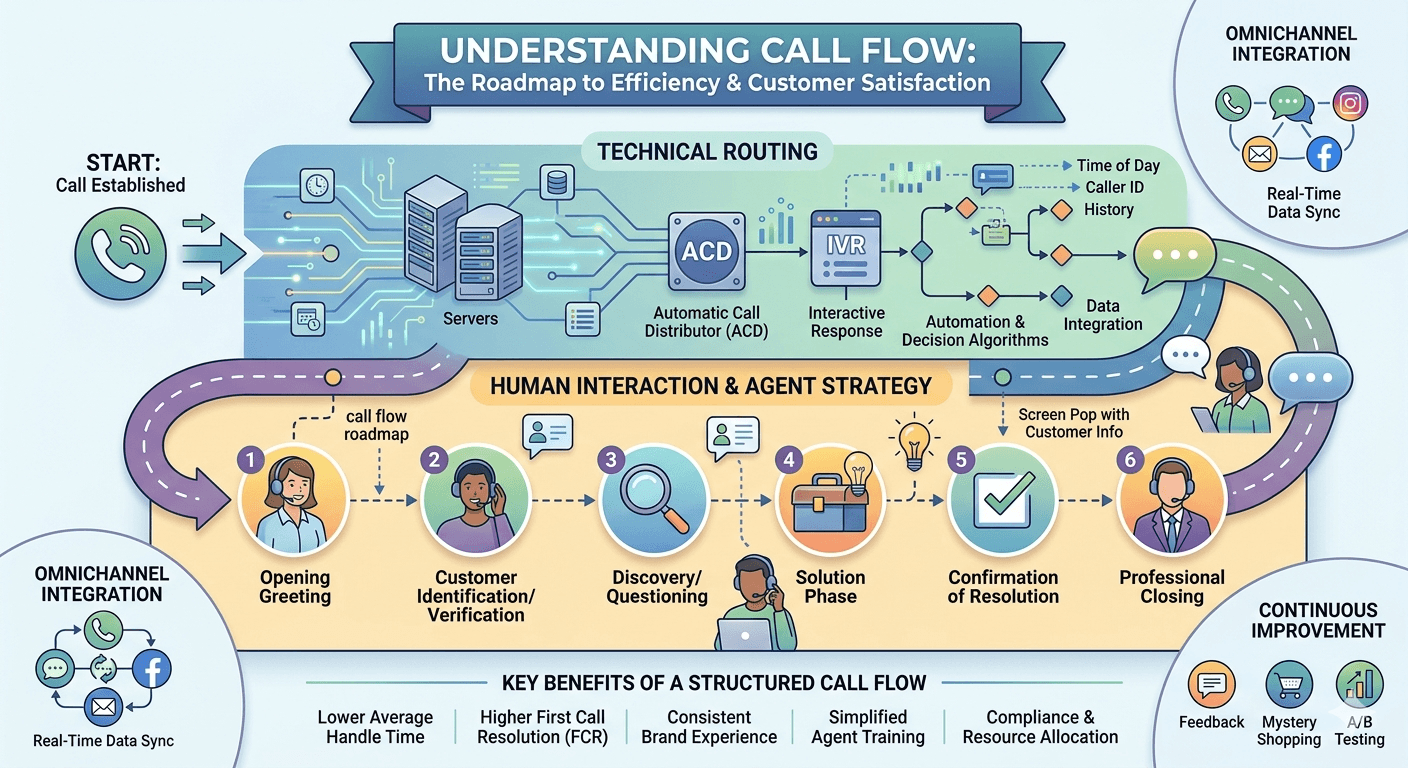
Understanding the call flow meaning is essential for any organization that relies on telecommunications to interact with its audience. At its core, this concept represents the entire journey a phone call takes from the moment the connection is established until the interaction concludes. It is a dual-layered system that combines technical routing with human communication strategies. The technical side focuses on how the hardware and software handle the signal, while the procedural side dictates how an agent manages the conversation to achieve a specific outcome. By mapping out this journey, businesses can identify bottlenecks, improve efficiency, and ensure that every caller receives a consistent level of service regardless of which department they reach. Modern communication systems have evolved far beyond simple point-to-point connections. Today, what is call flow involves complex layers of automation, data integration, and decision-making algorithms. When a customer dials a number, the system must decide where to send that call based on factors like time of day, caller ID, and previous interaction history. This initial phase of the call flows is critical because it sets the tone for the entire experience. If the routing is too complex, the caller becomes frustrated before they even speak to a human. If it is too simple, the call may end up with an agent who lacks the necessary skills to resolve the issue, leading to unnecessary transfers and delays. A well-designed call flow process acts as a blueprint for success in a high-pressure environment. It provides agents with a structured roadmap, allowing them to focus on empathy and problem-solving rather than wondering what steps to take next. In a call center, these flows are often visualized using diagrams that show every possible turn a conversation might take. From the initial greeting to the final closing, every step is scrutinized to ensure it adds value to the customer journey. Understanding this call flow meaning allows managers to create a more resilient and scalable operation that can adapt to changing customer needs and technological advancements. What is Call Flow and How Does it Define Customer Experience? The term call flow meaning refers to the comprehensive path a call takes through a telephony system and the subsequent conversation between the caller and the representative. It is the architectural design of a communication session. From a technical perspective, it involves the Automatic Call Distributor (ACD) and Interactive Voice Response (IVR) systems that categorize and route incoming signals. From a service perspective, it outlines the standard operating procedures that an agent follows to identify, troubleshoot, and resolve a customer inquiry. When these two elements work in harmony, the result is a seamless interaction that feels natural to the caller while remaining highly efficient for the business. A clear call flow process 6 steps often forms the backbone of training programs for new staff. These steps generally include the opening greeting, customer identification, discovery or questioning, the solution phase, the confirmation of resolution, and the professional closing. By breaking down the interaction into these segments, a call flow call center can monitor performance at a granular level. For example, if data shows that calls are stalling during the discovery phase, management can provide targeted coaching on how to ask better probing questions. This level of detail is what separates a professional service operation from one that is disorganized and reactive. Furthermore, the call flow meaning extends into the realm of data collection and analytics. Every transition in the flow is a data point that can be measured. How long did the caller spend in the IVR? How many times were they transferred? Did the agent follow the prescribed sequence of troubleshooting steps? By analyzing these metrics, organizations can refine their what is a call flow strategy to reduce friction. In the digital age, customers expect immediate and accurate responses, and a robust flow is the only way to meet these expectations at scale. It ensures that the collective knowledge of the organization is available to every agent, regardless of their individual experience level. What are the Benefits of a Call Flow System for Modern Businesses? Implementing a structured call flow system offers a wide range of operational advantages that directly impact the bottom line. One of the most significant benefits is the reduction in average handle time without sacrificing service quality. When agents have a clear call flow for customer service to follow, they spend less time navigating internal systems and more time helping the caller. This consistency also leads to higher First Call Resolution (FCR) rates, as the flow ensures that the most qualified agent handles the inquiry from the start. A streamlined process minimizes the need for multiple follow-ups, which is a major driver of customer satisfaction and operational cost reduction. The call flow meaning also includes the ability to maintain brand consistency across large teams. In a globalized world where agents might be located in different time zones or countries, a standardized call flow in call center environments ensures that every customer receives the same experience. This uniformity builds trust and reinforces the professional image of the brand. Moreover, a structured system makes it much easier to onboard new employees. Instead of relying on intuition or vague guidelines, new hires have a concrete call flow process to follow, which reduces their time to proficiency and minimizes early-career errors that could alienate customers. Standardized flows ensure that all legal and regulatory compliance requirements are met during every interaction. Clear roadmaps reduce the cognitive load on agents, leading to lower stress levels and decreased employee turnover. Automated routing within the flow allows for better resource allocation, ensuring high-priority callers are handled first. Data gathered from optimized flows provides deep insights into common customer pain points and product issues. Scalability becomes easier as the organization can replicate successful flow models across new departments or locations. The use of call flow software allows for real-time adjustments based on current call volumes and agent availability. Research published by the International Customer Management Institute (ICMI) suggests that companies with highly defined call center call flow procedures see a 20 percent higher efficiency rating than those with informal processes. This efficiency stems from the elimination of redundant steps and the optimization of the handoff between automated systems and live agents. By treating the call flow meaning as a living document that is constantly updated based on feedback and data, businesses can stay ahead of customer expectations. This proactive approach to communication management is a key differentiator in competitive markets where service quality is often the primary factor in consumer choice. Streamline Call Flow with an Intelligent IVR and Automation Beyond the technical architecture, the success of a modern call flow depends on maintaining a consistent brand persona and real-time adaptability. Ensuring the automated voice reflects the company’s unique character fosters a sense of continuity, while regularly updating IVR prompts to address seasonal shifts or system outages provides immediate clarity to the caller. This proactive communication reduces frustration by keeping customers informed the moment they connect, preventing them from being trapped in loops that could otherwise damage the brand’s reputation for reliability. The shift toward AI-driven discovery also fundamentally redefines the agent’s workspace, turning the call center into a hub of specialized solution providers rather than data entry points. With AI-driven bots gathering essential details before the live interaction starts, the agent can step into a “solution provider” role immediately, armed with a comprehensive customer history. This blend of automated preparation and human empathy not only handles high volume spikes with ease but also creates a superior, high-tech experience that respects the time of both the customer and the professional. Call Flow as a Customer Service Roadmap for Agent Excellence For a representative, the call flow meaning is that of a supportive roadmap that guides them through the complexities of customer psychology and technical troubleshooting. A well-constructed call flow for customer service doesn’t just tell an agent what to say; it tells them how to think through a problem. It provides a logical progression that starts with building rapport and ends with ensuring the customer is satisfied. Without this structure, interactions can become aimless, leading to longer call times and missed opportunities to resolve the underlying issue. The flow acts as a safety net, ensuring that even under pressure, the agent remembers to follow all necessary steps, such as verifying the account or offering an upsell. The psychological aspect of the call flow process is just as important as the technical one. A good flow incorporates moments for empathy and active listening. For instance, after the customer explains their problem, the flow might prompt the agent to paraphrase the issue back to them. This simple step, embedded in the customer service call flow, validates the customer’s feelings and ensures both parties are on the same page. This prevents the common frustration where a customer feels that the agent is just reading from a script without truly understanding their situation. In this way, the call flow meaning is about creating a human connection within a structured framework. The greeting sets the tone and establishes professional authority while remaining welcoming and helpful. The verification phase ensures security and builds trust by protecting the customer’s sensitive information. Probing questions allow the agent to dig deeper into the call flow meaning of the customer’s actual problem. The empathy statement acknowledges the customer’s perspective and de-escalates potential conflict. The solution phase presents the fix in a way that is easy for the customer to understand and follow. The recap ensures that there are no lingering questions and that the customer knows exactly what the next steps are. The closing leaves a lasting positive impression, reinforcing the brand’s commitment to service excellence. To truly excel, organizations must treat their call flows as dynamic tools. High-performing teams often hold regular workshops to review call flow examples and discuss what is working on the front lines. Agents who are using the flow every day often have the best insights into where it could be improved. By involving them in the design of the call flow in call center operations, management not only gets a better process but also gains higher buy-in from the staff. When agents see that the flow actually makes their jobs easier and leads to better customer feedback, they are more likely to adhere to it consistently. Setting up an Omnichannel Call Flow for a Unified Strategy In the modern landscape, the call flow meaning has expanded beyond voice calls to include chat, email, and social media messaging. An omnichannel call flow ensures that a customer can switch between these channels without having to restart their journey. For example, a customer might start an interaction with a chatbot on a website, but then decide they need to speak to a person. An integrated call flow process will pass all the chat history to the phone agent, allowing the conversation to continue seamlessly. This level of integration is what defines a modern, customer-centric organization. It requires a unified software platform that can track a single “ticket” across multiple communication mediums. Developing an omnichannel flow requires a deep understanding of how different channels complement each other. Voice calls are often preferred for complex or emotional issues, while chat is ideal for quick technical questions or status updates. The call flow meaning in an omnichannel context involves creating rules for when and how to transition a customer between these channels. If an agent on a chat session realizes the issue is too complex for text, they should have a button that allows them to immediately call the customer, maintaining the flow of the interaction. This reduces the effort required from the customer and demonstrates a high level of technical sophistication. Ensure that customer data is synchronized in real-time across all platforms to prevent information silos. Maintain a consistent tone of voice and brand personality whether the customer is calling, chatting, or emailing. Use call flow software that provides agents with a 360-degree view of the customer’s previous interactions across all channels. Implement “intelligent escalation” rules that move high-priority issues from automated chat to live voice agents based on keywords. Track metrics like the “Customer Effort Score” to see how well the omnichannel transitions are working within the flow. The ultimate goal of an omnichannel call flow meaning is to provide a “frictionless” experience. According to a report by Gartner, 96% of customers who experience a high-effort interaction become disloyal, compared to only 9% who have a low-effort experience. By using a call flow for call center operations that bridges the gap between different communication tools, businesses can significantly lower the effort required for a customer to get an answer. This holistic approach to the call flow meaning recognizes that the customer doesn’t see “departments” or “channels”—they see one brand, and they expect that brand to know who they are and what they need, regardless of how they choose to get in touch. Creating a Script for Customer Service Within the Flow The evolution of modern customer service has transformed the traditional understanding of a call flow from a rigid, robotic script into a dynamic architectural framework. A common misconception persists that these two concepts are synonymous; however, a script is merely a localized tool within a broader strategic flow. In a high-performing environment, the most effective call flow strategies prioritize “flexible scripting” or “talking points” over verbatim recitation. This distinction is critical because it empowers agents to maintain a natural human cadence, adapting their tone to match the caller’s unique personality and pace. While the call flow dictates the structural “what” and “when” of an interaction—such as the mandatory timing of a loyalty offer—the agent is responsible for the “how,” using their emotional intelligence to choose phrasing that aligns with the conversation’s mood. To achieve this balance, the language used within scripts must intentionally avoid corporate jargon and stifling formality. The primary objective is to facilitate a connection between two humans rather than a transaction between a user and a machine. Well-designed scripts act as a safety net, specifically engineered to navigate common objections and difficult questions. This preparation gives agents the confidence to remain composed and professional even when a call becomes challenging. Furthermore, by embedding these responsive scripts directly into call flow software, organizations ensure that the necessary information appears on the agent’s screen at the exact moment of relevance. This technological integration is vital for eliminating “dead air” and maintaining a brisk, professional pace that respects the customer’s time. Effective scripting also leans heavily into the psychology of “positive language,” which focuses on what an agent can accomplish for a customer rather than highlighting limitations. In sales or retention contexts, the inclusion of “rebuttal sections” provides agents with pre-vetted strategies to handle hesitations effectively without sounding combative. Structurally, these scripts should be short and impactful—particularly during greetings and closings—and should utilize “branching” logic, where the agent’s prompts change dynamically based on the customer’s specific answers. This prevents the agent from asking redundant questions and keeps the interaction focused on the customer’s immediate needs. Continuous improvement is the final pillar of a successful call flow. Organizations should regularly record and analyze high-performing calls to identify organic, successful phrases used by top agents, which can then be institutionalized into official talking points. The ultimate success of a script is measured by its utility in reaching a resolution; a script that is overly dense will likely be ignored or result in a robotic delivery, while one that is too vague offers no support. Through constant testing and the analysis of call center data, managers can determine which specific iterations lead to the highest conversion and satisfaction rates. This data-driven approach ensures the call flow remains a functional asset to the agent, fostering a communication environment that is both efficient and authentically human. Helpful Call Flow Tips for Continuous Improvement Maintaining a high-quality call flow meaning requires a commitment to continuous improvement. One of the most helpful tips is to regularly perform “mystery shopping” on your own phone lines. By calling in as a customer, managers can experience the flow firsthand and identify areas where the IVR is confusing or where the hold times are too long. This outside-in perspective is invaluable for spotting issues that might not show up in traditional data reports. It also helps in understanding the emotional journey of the customer, which is a critical part of the overall call flow meaning. Another tip is to lean heavily on the feedback of the agents who are on the front lines every day. They are the first to know when a part of the call flow process is outdated or when customers are consistently asking questions that the flow doesn’t cover. Implementing a simple feedback loop where agents can flag issues with the call flow software or the procedural steps can lead to rapid improvements. This also empowers agents, making them feel like partners in the business’s success rather than just cogs in a machine. A culture of feedback ensures that the call flow customer service remains agile and responsive to the real-world needs of the market. Review your call flows at least once a quarter to ensure they still align with your business goals and product offerings. Use heatmaps or pathing reports in your call flow software to see where customers most frequently drop off or ask for a human. A/B test different greetings or IVR structures to see which ones lead to better customer sentiment scores. Ensure your call flow meaning includes specific paths for “worst-case scenarios,” such as system failures or natural disasters. Train agents not just on the flow itself, but on the logic behind the flow so they understand why each step is necessary. Finally, remember that the call flow meaning is ultimately about people. While technology and data are essential, they should serve to enhance the human interaction, not replace it. The most successful call flow call center operations are those that use automation to handle the mundane tasks, allowing their human talent to shine where it matters most: in building relationships and solving complex problems with empathy. By keeping the human element at the center of your what is call flow strategy, you create a service environment that is both highly efficient and deeply satisfying for your customers and your employees alike. Read More: What is Call Disposition: Call Disposition Meaning, and examples Final Thought The call flow meaning is a fundamental pillar of modern organizational communication, bridging the gap between technical infrastructure and human interaction. A well-designed call flow not only optimizes internal operations by reducing handle times and improving accuracy but also significantly enhances the customer journey by providing a structured, reliable, and empathetic experience. Whether through an intelligent IVR, an omnichannel strategy, or flexible agent scripting, the goal remains the same: to move a caller from a state of inquiry to a state of resolution with as little friction as possible. As technology continues to evolve, businesses that prioritize a deep and data-driven understanding of their call flows will be best positioned to build lasting loyalty and achieve sustainable growth. By treating the call flow as a dynamic roadmap rather than a static document, companies can ensure they are always meeting the ever-rising expectations of the modern consumer. Frequently Asked Questions What is a call flow and why is it important? A call flow is the structured roadmap that a phone call follows from the initial dial to the final disconnection. It is important because it ensures consistency, reduces wait times, and provides agents with the tools they need to resolve customer issues efficiently, leading to higher satisfaction and lower operational costs. How does a call flow work in a technical sense? Technically, a call flow works by using an Automatic Call Distributor (ACD) and Interactive Voice Response (IVR) to route signals based on pre-defined rules. These rules consider the caller’s input, the time of day, and agent availability to direct the call to the most appropriate destination. What are the 6 steps of a call flow process? The 6 steps typically include the initial greeting, customer identification and verification, discovery through probing questions, the resolution or solution phase, a final recap to ensure satisfaction, and a professional closing to end the interaction on a positive note. What is the difference between a call flow and a script? A call flow is the overall strategy and sequence of an interaction, while a script is the specific language or talking points used within that flow. Think of the call flow as the map and the script as the specific turn-by-turn directions that an agent can follow or adapt. How can a business quickly update its call flows? Businesses can quickly update their call flows by using modern call flow software that offers a drag-and-drop interface for changing IVR menus and routing rules. This allows managers to respond in real-time to high call volumes, technical issues, or changes in business strategy without needing extensive IT support.

Read More
predictive dialer vs progressive dialer

What is Predictive Dialer vs Progressive Dialer Technology?

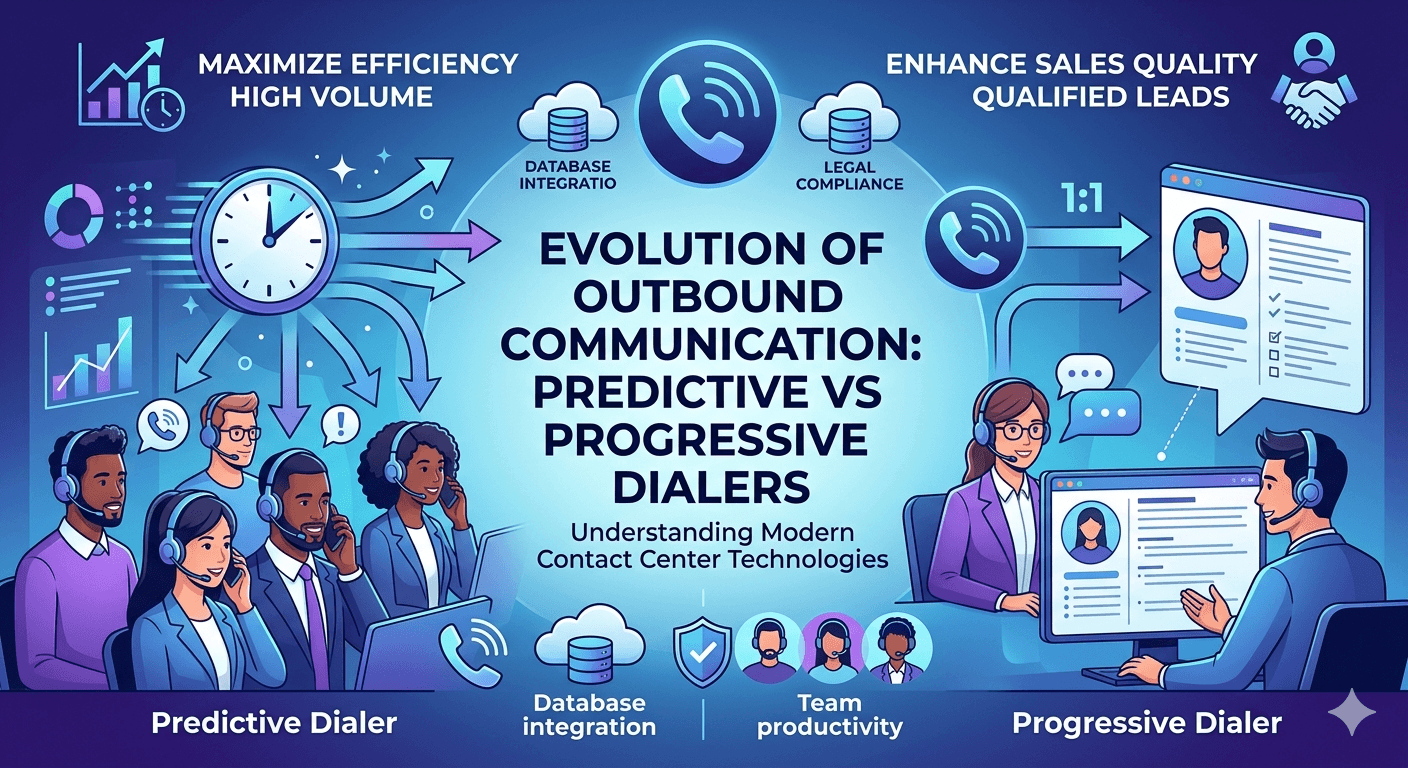
A predictive dialer is an automated system in contact centers that dramatically increases agent productivity by initiating multiple calls simultaneously before an agent is free. Using mathematical algorithms, it forecasts agent availability and answer probabilities, connecting only live respondents to agents. In contrast, a progressive dialer is another type of automated dialer that initiates calls one by one only when an agent becomes available. This ensures a smoother connection and is often used when the ratio of agents to calls needs to be precisely managed. Modern outbound systems are categorized based on how they initiate calls and distribute them to available representatives. At the heart of this technological shift are automated tools that can dial thousands of numbers simultaneously, filtering out unproductive calls before they even reach a human ear. This advancement has allowed organizations to scale their operations without necessarily increasing their headcount. However, the specific method used to reach out to leads can vary greatly depending on the goals of the campaign, the quality of the lead list, and the regulatory environment of the region where the calls are being placed. Understanding the mechanics behind predictive dialer vs progressive dialer tools is essential for any business leader looking to optimize their communication infrastructure. Whether the goal is high-volume telemarketing, personalized debt collection, or intricate business-to-business sales, the technology powering the calls acts as the engine of the entire operation. By removing the manual labor from the dialing process, companies can ensure that their staff remains focused on the most critical part of their job: building relationships and closing deals. Exploring the Mechanics of What is Predictive Dialer and Its Core Functions A sophisticated automated solution known as a predictive dialer uses complex mathematical algorithms to forecast when an agent will be free to take the next call. Unlike simpler systems, this technology does not wait for an agent to become available before it starts dialing. Instead, it analyzes historical data, such as average call duration and the time of day, to predict when a conversation is likely to end. This allows the system to begin dialing the next set of numbers in advance, ensuring that a live person is on the line the moment the representative finishes their previous interaction. The primary objective of this predictive dialing system is to eliminate the idle time that typically occurs between calls. In a manual environment, an agent might spend up to forty seconds of every minute navigating through busy signals, no-answers, and disconnected lines. With this automated approach, the software handles those obstacles in the background. It only routes a call to the agent when it detects a human voice on the other end. This leads to a massive increase in talk time per hour, often moving from fifteen minutes of actual conversation to upwards of fifty minutes per hour in a highly optimized setting. According to research by the Direct Marketing Association, automated systems can increase agent productivity by as much as 200 to 300 percent compared to manual dialing. This is particularly beneficial for large-scale campaigns where the volume of leads is high and the conversion margin is thin. By maximizing the number of interactions, a company can ensure that every lead is contacted multiple times if necessary, without placing an undue burden on the staff. The intelligence of the system lies in its ability to adjust the dialing rate dynamically, slowing down when there are fewer agents available and speeding up when the team is ready for more volume. How Does a Predictive Dialer Work in a High Volume Contact Center To truly grasp how does a predictive dialer work, one must look at the intersection of statistical modeling and real-time telephony management. The software continuously monitors the status of every agent in the queue. It takes into account the number of agents currently talking, those who are wrapping up their notes, and those who are waiting for a call. Simultaneously, the system calculates the probability of a call being answered based on the time of day and the specific demographics of the lead list. If the probability of an answer is low, the system will dial multiple numbers for every single available agent to ensure someone eventually picks up. One of the most impressive features of this predictive dialing technology is its ability to filter out non-human responses. The software uses sophisticated voice detection to distinguish between a live person saying “hello” and an automated answering machine or a carrier message. If the system detects an answering machine, it can be programmed to either hang up immediately or leave a pre-recorded message, all without ever bothering the agent. This ensures that the representative only ever deals with live prospects who are ready to engage in a conversation, which significantly improves morale and reduces burnout. However, the speed of these systems must be balanced against the risk of dropped calls. A dropped call occurs when the dialer reaches a live person but no agent is available to take the call because the system predicted an agent would be free sooner than they actually were. Regulatory bodies, such as the Federal Communications Commission in the United States, have strict rules regarding abandonment rates, typically mandating that they remain below three percent. High-quality predictive dialers are designed with these regulations in mind, automatically slowing their pace if the abandonment rate begins to approach the legal limit. Defining Progressive Dialer Software and Its Operational Advantages While predictive systems focus on high-speed volume through mathematical forecasting, the progressive dialer software follows a more controlled and linear approach to outbound calling. In this model, the system only dials one number for every available agent. It waits until the representative indicates they are ready for a new call before it initiates the next dial. This creates a 1:1 ratio that completely eliminates the risk of call abandonment. Since the system never dials more numbers than it has agents to handle, every person who answers the phone is guaranteed to be greeted by a live professional immediately. The mechanics of progressive dialing are designed to maintain a steady flow of work without the aggressive pacing of predictive systems. When an agent finishes a call and completes their post-call documentation, they hit a button or the system detects their idle status and immediately dials the next number on the list. This removes the need for manual number entry and searching through a database, which still provides a significant efficiency boost over manual methods. It strikes a balance between the speed of automation and the reliability of human-centric pacing. This approach is particularly valuable for businesses that prioritize the customer experience over sheer volume. In industries like luxury goods, high-end real estate, or complex financial services, having a “silent pause” at the beginning of a call can be detrimental to the brand image. Because a progressive system ensures the agent is already on the line the moment the customer answers, the interaction feels more natural and less like a telemarketing blast. This immediate connection helps in building rapport right from the first second of the conversation, which is critical for high-stakes sales environments. Detailed Comparison: Predictive vs Progressive Dialer for Business Success When evaluating a predictive vs progressive dialer, the decision usually boils down to the volume of leads and the desired quality of the interaction. Predictive systems are the heavy hitters of the outbound world, designed to churn through thousands of leads with maximum efficiency. They are best suited for campaigns where the list of contacts is massive and the likelihood of any single lead answering is relatively low. In these cases, the sheer volume of calls handled by the predictive dialers ensures that even if only a small percentage of people pick up, the agents remain busy and the campaign goals are met. On the other hand, the progressive dialer is built for stability and consistency. It is the preferred choice for teams that have a moderate volume of leads that are considered “warm” or “qualified.” Since these leads are more likely to answer and more valuable to the business, the company cannot afford to risk dropping a call or frustrating the lead with a delay. The progressive method ensures that the agent is always there to say hello the moment the phone is picked up, preserving the integrity of the lead and the professional reputation of the organization. The difference in agent experience is also a significant factor in the predictive vs progressive dialer debate. Agents working on a predictive system often feel more pressure because the calls come in rapid succession with very little downtime. This can lead to faster exhaustion if not managed with proper break schedules. In contrast, those using a progressive or preview system often feel they have more agency over their workflow. They can take a moment to breathe between calls or review notes, which can lead to a more satisfied workforce and lower turnover rates in the long run. Choosing the Right Predictive Dialers for Large Scale Operations Selecting the best predictive dialers for a large enterprise requires a deep dive into the software’s ability to manage data and comply with local laws. A high-quality system must be able to integrate with existing databases to ensure that Do Not Call lists are respected in real-time. If a number is added to a restricted list, the dialer should automatically scrub it from the active campaign to prevent legal repercussions. This level of automation is vital for protecting the company from the heavy fines associated with telemarketing violations. Furthermore, a top-tier predictive dialing system should provide detailed analytics and reporting features. Managers need to be able to see the average wait time for agents, the abandonment rate of the dialer, and the conversion rates for different lead lists. These insights allow for the fine-tracking of campaign performance and the ability to make data-driven adjustments on the fly. If one lead source is performing poorly, the system should allow the manager to reallocate resources to a more productive list without shutting down the entire operation. Scalability is another critical component when looking at what is predictive dialer technology in the modern cloud-based era. Traditional on-premise systems were limited by hardware constraints and the number of physical phone lines available. Modern cloud dialers, however, can scale up or down in minutes. A company can add fifty new agents for a seasonal promotion and then scale back down once the rush is over. This flexibility ensures that the business only pays for what it uses, making high-powered dialing technology accessible to organizations of various sizes and budgets. Identifying Key Scenarios for Implementing a Predictive Dialing System The implementation of a predictive dialing system is most effective in industries where speed and volume are the primary drivers of revenue. For example, in the insurance industry, agents often need to follow up on hundreds of internet leads every day. Since these leads can go “cold” very quickly, the ability to reach out to them within minutes of their inquiry is paramount. A predictive system can ensure that every lead is called immediately, maximizing the chances of catching the prospect while their interest is still high. Debt collection is another field where this technology shines. Collection agencies often deal with large databases of contact numbers that have low answer rates. By using a predictive dialer, these agencies can ensure that their agents are only spending time on calls where a debtor has actually answered the phone. This significantly increases the amount of debt recovered per hour and allows the agency to manage its large caseload more effectively. The system’s ability to automatically handle busy signals and disconnected lines is especially useful in this context, where lead data quality can be inconsistent. Large-scale political or non-profit fundraising also benefits immensely from this approach. When an organization needs to reach out to thousands of donors in a short period, the efficiency of predictive systems is unmatched. These campaigns often rely on reaching a specific “quota” of contacts, and the high-speed nature of the dialer makes it possible to hit those targets even with a relatively small team of volunteers or staff members. The ability to play pre-recorded messages to answering machines also helps in spreading the message without taking up valuable human interaction time. How Progressive Dialing Enhances Sales Quality in B2B Environments In the world of business-to-business sales, the focus shifts from quantity to the quality of the conversation, making progressive dialing the superior choice. In B2B scenarios, the prospects are often busy professionals who value their time and expect a high degree of professionalism. If a B2B lead answers the phone and hears nothing for several seconds, they are likely to hang up and may even form a negative opinion of the calling company. The progressive dialer removes this risk by ensuring the salesperson is ready and waiting the moment the connection is established. Another advantage for B2B teams is the integration of progressive dialer software with CRM platforms like Salesforce or HubSpot. When the system dials a number, it can simultaneously pull up the prospect’s LinkedIn profile, company website, and recent news articles. This allows the salesperson to open the call with a personalized comment or a reference to a recent company achievement. This level of sophistication is what separates a standard cold call from a strategic outreach effort, and it is made much easier when the dialing system supports a steady, controlled pace. Research published in the Journal of Business Research highlights that the “human touch” and the perceived effort in a sales call are direct predictors of customer trust. By using a system that prioritizes a seamless connection, businesses signal that they value the customer’s time. This subtle psychological cue can be the difference between a prospect staying on the line to hear a pitch or hanging up immediately. For high-ticket items where a single sale can represent thousands of dollars in revenue, the investment in a progressive system pays for itself through improved conversion rates and better brand perception. Understanding the Legal Landscape and Predictive Dialing Regulations Navigating the legalities of outbound calling is one of the most challenging aspects of managing a contact center. In many jurisdictions, there are strict limitations on how automated systems can be used. For example, the Telephone Consumer Protection Act (TCPA) in the United States sets clear guidelines on calling hours, the use of automated voices, and the maintenance of internal Do Not Call lists. A robust predictive dialer system must have built-in features that help the organization stay within these legal boundaries, such as time-zone protection that prevents calls from being made too early or too late in the recipient’s local area. One specific area of concern is the “abandonment rate.” Because predictive systems dial more numbers than there are available agents, they occasionally “abandon” a call if no one is free to take it. Regulations typically require that the abandonment rate be tracked and kept under a specific threshold. Advanced dialers provide real-time monitoring of this metric, allowing managers to see exactly how many calls are being dropped. If the rate starts to climb, the manager can adjust the dialer’s aggressiveness or add more agents to the queue to balance the load. In the European Union, the General Data Protection Regulation (GDPR) adds another layer of complexity. Organizations must ensure that they have a legal basis for processing the personal data of the people they are calling. This often means that lead lists must be carefully vetted for consent before they are loaded into the dialer software. High-quality dialing systems provide data management tools that help companies track the source of their leads and the consent status of each contact, providing an audit trail that can be used to demonstrate compliance in the event of an inquiry from a regulatory body. The Role of Training and Agent Management in Dialer Success While the technology is a powerful tool, the success of an outbound campaign ultimately depends on the people using the system. Proper training is essential for agents working with predictive or progressive dialers. They need to understand how the system works and what to expect when a call is connected. For example, in a predictive environment, agents must be trained to start their greeting immediately upon hearing a voice, as any delay can make the call feel like a “robocall” to the person on the other end. Managers also play a critical role in the success of these operations. They must use the data provided by the predictive dialers to coach their team effectively. By analyzing metrics like average talk time and wrap-up time, managers can identify which agents are excelling and which ones might need more training. If an agent has a very short average talk time, it might indicate that they are struggling with the initial “hook” of the script. Conversely, a very long wrap-up time might suggest that the agent is having trouble with the software or is using the time as an unauthorized break. Burnout is a real concern in high-volume contact centers, especially those using aggressive predictive pacing. To mitigate this, managers should use the dialer’s scheduling features to ensure that agents have regular breaks and that the workload is distributed fairly. Some systems allow for “blended” environments where agents handle both outbound calls and inbound inquiries. This variety can help keep agents engaged and reduce the monotony of a single-task workflow. By focusing on the well-being of the staff, organizations can maintain high levels of productivity and reduce the costs associated with high employee turnover. Technological Evolution: From Hardware to Cloud-Based Dialers The transition from traditional hardware-based systems to modern cloud solutions has revolutionized the accessibility of dialing technology. In the past, implementing a predictive dialing system required a significant upfront investment in servers, phone lines, and IT staff. This often meant that only the largest corporations could afford these powerful tools. Today, however, cloud-based progressive dialer software can be set up in a matter of hours with very little initial cost. This has leveled the playing field, allowing small and medium-sized businesses to compete with much larger organizations. Cloud-based systems also offer superior reliability and disaster recovery capabilities. Since the software is hosted in secure data centers, the business is not at risk of losing its communication capabilities due to a local power outage or equipment failure. Agents can log into the system from anywhere with an internet connection, making remote work a viable option for contact centers. This has been a major advantage for companies looking to tap into a global talent pool or reduce their overhead by closing physical office spaces. Furthermore, cloud dialers are constantly updated with the latest features and security patches. Unlike on-premise hardware that can quickly become obsolete, a cloud-based predictive vs progressive dialer solution evolves over time. Users benefit from the latest advancements in AI-driven voice detection, better integration with third-party apps, and improved user interfaces without having to perform manual upgrades. This “software as a service” model ensures that the business always has access to the most efficient tools available in the market. Future Trends in Outbound Dialing and Artificial Intelligence As we look toward the future, the integration of Artificial Intelligence (AI) and Machine Learning is set to make predictive dialing systems even more effective. Future dialers will likely move beyond simple historical averages and instead use real-time behavioral data to predict the best time to call a specific individual. For example, if a prospect has recently visited the company website or opened a marketing email, the dialer could automatically prioritize that lead for an immediate follow-up. This “intent-based” dialing will significantly increase the relevance and success of outbound outreach. Natural Language Processing (NLP) is another area where we expect to see significant growth. Future systems may be able to “listen” to the initial seconds of a call and provide real-time suggestions to the agent based on the prospect’s tone and keywords. If a customer sounds frustrated, the system could suggest a more empathetic script or even offer a discount code to help de-escalate the situation. This type of “augmented” conversation will help agents be more effective and provide a better experience for the customer. Finally, we are seeing a shift toward omnichannel communication. While the phone remains a critical tool, businesses are increasingly looking for ways to integrate it with SMS, email, and social media messaging. A modern dialer might send an automated text message to a lead a few minutes before calling them, or follow up a voicemail with a personalized email. By coordinating these different channels, companies can increase their overall contact rate and provide a more cohesive brand experience. The dialer of the future will not just be a predictive dialer vs progressive dialer vs progressive dialer tool for making calls; it will be the central hub for all outbound customer engagement. Summary Table: Dialers at a Glance Feature Predictive Dialer Progressive Dialer Preview Dialer Dialing Ratio Many numbers per agent 1 number per agent Agent controlled Pacing Algorithm-based (High) Linear (Medium) Manual (Low) Idle Time Minimal Low High (research time) Abandonment Risk Possible (needs monitoring) Zero Zero Best For High volume, low lead value Warm leads, B2B, support High-value, complex B2B Agent Experience Fast-paced, intense Balanced, steady Research-heavy, controlled CRM Integration Essential Essential Critical This table provides a quick reference for understanding which tool aligns best with specific operational goals. While the predictive dialer system focuses on the math of the connection, the progressive and preview options focus on the depth of the interaction. Choosing between them is a matter of prioritizing the specific outcomes that matter most to your business model. Read More: What is an Escalation Call? Final Thought The decision to implement a specific dialing technology is a strategic choice that affects every level of an organization, from the bottom-line revenue to the daily morale of the staff. Both predictive dialers and progressive dialers offer significant advantages over manual methods, but they serve different purposes within the sales and support ecosystem. A predictive dialing system is a powerhouse for volume, turning a massive list of contacts into a steady stream of conversations for a large team. Conversely, progressive dialer software provides the stability and professionalism needed for high-quality leads and complex business interactions. By carefully analyzing the volume of leads, the value of each conversation, and the regulatory environment, businesses can choose the tool that will best empower their team to succeed in an increasingly competitive marketplace. Frequently Asked Questions What is the main purpose of a predictive dialer? The main purpose of a predictive dialer is to maximize the amount of time an agent spends talking to live customers while minimizing the time spent dialing and waiting. By using statistical algorithms to predict agent availability and answer rates, it ensures that a new call is ready the moment an agent finishes their previous one. This drastically improves the efficiency of high-volume outbound campaigns. Are predictive dialers legal in the United States? Yes, they are legal, but they are subject to strict regulations under the Telephone Consumer Protection Act (TCPA). Businesses must ensure that their abandonment rate (the percentage of calls answered by a person but not connected to an agent) stays below 3%. They must also respect the National Do Not Call Registry and follow specific rules regarding the hours during which they are allowed to place calls. How do preview dialers differ from auto dialers? Preview dialers are a specific type of auto dialer that prioritizes agent preparation. Unlike standard auto dialers that connect the call as soon as it is answered, a preview system shows the agent the lead’s information first. The agent can then review the customer’s history and decide exactly when to initiate the call. This is the opposite of high-speed systems like predictive dialers, focusing on quality and personalization over volume. Can small teams benefit from using progressive dialers? Absolutely. Progressive dialers are often the ideal choice for small teams because they provide a significant productivity boost over manual dialing without requiring a large pool of agents to feed a predictive algorithm. Since the progressive system dials one number for every available agent, even a team of two or three people can use it to maintain a steady workflow without risking dropped calls. What type of campaigns work best with predictive dialers? Predictive dialers are most effective for campaigns that involve a high volume of leads with relatively low individual values. This includes telemarketing, large-scale fundraising, and debt collection. In these scenarios, the goal is to reach as many people as possible as quickly as possible. Because these lists often have lower answer rates, the predictive system’s ability to filter out non-answers is invaluable.

Read More
advantages and disadvantages of whatsapp for business

Advantages and Disadvantages of WhatsApp for Business

WhatsApp for Business offers advantages such as free messaging, direct customer communication, quick replies, product catalogs, and global reach. However, it also has disadvantages, including limited advanced automation in the free app, dependence on internet connectivity, privacy and compliance considerations, and the need for the WhatsApp Business Platform for large-scale customer support and integrations. Organizations that adopt whatsapp business messaging often find that they can resolve customer queries much faster than through traditional channels. The immediacy of the platform matches the expectations of the modern consumer who values quick resolutions and personalized service. By utilizing this specialized tool, companies can manage high volumes of inquiries without losing the personal touch that defines successful customer relationships. This balance of automation and human interaction is one of the defining characteristics of the platform, making it a versatile choice for startups and established enterprises alike. What is a WhatsApp Business Account? To fully grasp the utility of this tool, one must first understand what is a whatsapp business account and how it functions as a digital storefront. Essentially, it is a professional profile that allows a company to display essential information such as their physical address, email, website link, and a brief description of their services. This profile serves as the first point of contact for many customers, providing them with the necessary context before they even initiate a conversation. The transparency offered by a complete profile helps in establishing credibility, which is a significant factor in converting a lead into a loyal customer. One of the most prominent whatsapp for business account features is the ability to create a digital catalog. This feature acts as a mobile showroom where businesses can list their products or services, complete with images, prices, and descriptions. This significantly reduces the friction in the buying process, as customers can browse offerings directly within the chat interface without having to navigate away to a separate website. The convenience of seeing a product and being able to ask a question about it in the same window is a powerful driver for higher conversion rates and improved customer satisfaction. Benefits of WhatsApp Business for Small Companies Free to use: The standard WhatsApp Business app is free, making it an affordable solution for small and medium-sized businesses. Low setup costs: Requires minimal technical expertise and no significant upfront investment. Professional business profile: Helps build credibility and customer trust with branded business information. Rich multimedia support: Share images, videos, documents, and product catalogs to showcase products and services effectively. Improved customer engagement: Direct messaging typically achieves higher open and response rates than email. Familiar user experience: Customers can communicate through an app they already use, eliminating the learning curve. Stronger customer relationships: Enables personalized, real-time conversations that boost satisfaction and loyalty. Wider reach: Connect with billions of WhatsApp users worldwide, making it easier to engage local and international customers. Better brand visibility: Regular interactions keep your business top-of-mind and encourage repeat engagement. Ideal for growing businesses: Offers a scalable communication channel, with the option to upgrade to the WhatsApp Business Platform as customer demand increases. Detailed Analysis of WhatsApp Business Cost and Implementation While the basic app is accessible to many, understanding the whatsapp business cost structure is vital for growing companies. For the standard app available on smartphones, there are generally no subscription fees, making it an ideal choice for local shops and individual consultants. However, as a business scales and requires more advanced features like multi-user access or integration with third-party software, they may need to transition to the API version. The API version involves a different pricing model, which is often based on the number of conversations initiated within a 24-hour window. The financial planning for using business whatsapp requires looking at both direct and indirect costs. Direct costs involve the conversation-based fees associated with the API, which vary depending on whether the business or the customer initiates the chat. Indirect costs might include the time spent by staff managing the messages or the potential investment in a third-party platform to manage the API. Despite these costs, the return on investment is often very high due to the increased efficiency and the higher open rates of messages compared to other communication channels. When considering if the platform is right for a specific budget, companies should weigh the advantages of whatsapp business account tools against the potential expenses. For a small business, the free app provides enough functionality to manage a moderate number of clients effectively. For larger organizations, the cost of the API is justified by the ability to automate thousands of interactions and integrate the data into their existing sales funnels. This scalability ensures that the platform remains a viable solution regardless of the size or growth stage of the organization. Pros and Cons of WhatsApp for Professional Use When deciding whether to adopt this tool, a thorough review of the pros and cons of whatsapp is necessary. On the positive side, the platform offers unparalleled security through end-to-end encryption. This means that sensitive information, such as order details or personal data, remains private between the business and the customer. This level of security is a major selling point for industries that handle confidential information, as it provides peace of mind to both parties involved in the transaction. However, there are certain disadvantages of whatsapp that users must be aware of. One major drawback for the standard business app is the limitation on the number of devices that can be linked to a single account. This can create a bottleneck for growing teams where multiple agents need to respond to messages simultaneously. Without moving to the API, a business may find it difficult to maintain rapid response times as their customer base expands. Additionally, the lack of advanced analytics in the basic app makes it hard to track the long-term success of marketing campaigns. Another point in the pros and cons of whatsapp for business discussion involves the potential for intrusive marketing. While the direct line to a customer is a benefit, overusing it can lead to customers blocking the business. Unlike email, where a person might ignore a message, a notification on a chat app is much more personal and can be seen as an annoyance if sent too frequently or at inappropriate times. Balancing the frequency and relevance of messages is a critical skill that businesses must master to avoid the negative aspects of the platform. Additionally, reports from Meta indicate that over 175 million people message a business account every day, showing a massive and active user base that is already conditioned to interact with brands in this manner. This data underscores the importance of the speed that the platform facilitates.  Major Disadvantages of Using WhatsApp for Business Despite the many strengths, there are clear disadvantages of using whatsapp for business that can impact operational efficiency. One of the primary issues is the lack of a green checkmark or verification for everyone. Obtaining the official business verification is a rigorous process and is usually reserved for large, well-known brands. For smaller businesses, the absence of this badge might make it slightly harder to prove authenticity to a skeptical new customer. While a complete profile helps, the official “verified” status remains an elusive goal for many. The disadvantages of whatsapp business account management also include the risk of account suspension. The platform has very strict policies regarding spam and automated messaging. If a business sends too many unsolicited messages or if several users report the account, the account can be banned without much warning. Recovering a banned account can be a long and tedious process, during which the business loses its primary communication channel with its customers. This high stakes environment requires a disciplined approach to messaging and a deep understanding of the platform’s terms of service. Furthermore, the limited integration with other business tools in the standard app version can be a hindrance. Most modern businesses rely on a variety of software for accounting, inventory, and lead management. The inability of the free app to automatically sync data with these tools means that staff often have to manually enter information, which increases the likelihood of human error. This lack of a unified ecosystem is one of the main reasons why growing companies eventually find themselves needing to upgrade to more robust enterprise solutions. Transitioning to WhatsApp Business API for Large Scale Operations For enterprises that have outgrown the basic app, the transition to the API represents a significant step forward. The API removes many of the limitations found in the standard version, such as the single-user restriction and the lack of deep integrations. By using the API, a company can connect their messaging flow directly into their existing Customer Relationship Management (CRM) software. This allows for a 360-degree view of the customer, where every interaction on the messaging app is recorded alongside their purchase history and previous support tickets. The shift also allows for unlimited message sending to customers who have opted-in to receive updates. This is particularly useful for sending shipping notifications, flight updates, or appointment reminders. Unlike the broadcast lists in the standard app, which have a limit on the number of recipients, the API is built for high-volume communication. This makes it an essential tool for logistics companies, travel agencies, and large e-commerce platforms that need to send thousands of time-sensitive alerts every day. Moreover, the API supports more complex message templates that can include interactive buttons. These buttons allow customers to make choices or confirm actions with a single tap, further simplifying the user experience. For example, a customer could receive an appointment reminder with “Confirm” or “Reschedule” buttons directly in the chat. This interactive element significantly increases engagement and makes the communication feel more like a modern application and less like a static text message. Key Considerations for Global Reach and Accessibility When an organization asks what is a whatsapp and why it matters for global trade, the answer lies in its international ubiquity. In many parts of the world, including Latin America, India, and parts of Europe, the app is the primary method of communication, often surpassing traditional SMS and even email. For a business looking to expand internationally, having a presence on this platform is not just an advantage; it is a necessity. It allows a company to provide local-style support to a global audience without needing a physical office in every country. The benefits of whatsapp business account tools in an international context include the ability to handle multiple languages and time zones through automated routing. Large organizations can set up their API to route messages to different teams based on the language of the incoming query. This ensures that the customer always talks to someone who understands their needs, improving the overall brand perception. The global nature of the platform also means that the cost of reaching an international customer is the same as reaching a local one, which is a major benefit for export-oriented businesses. Furthermore, the platform’s ability to work on low-bandwidth connections is a vital feature for reaching customers in regions with inconsistent internet. The app is optimized to send and receive messages even when the signal is weak, ensuring that the business remains reachable at all times. This reliability is a key factor in its dominance in emerging markets, providing a stable foundation for commerce where other digital tools might fail. Comparison of WhatsApp Normal vs Business Features Feature WhatsApp Normal WhatsApp Business App WhatsApp Business API Target Audience Personal Use Small Businesses Large Enterprises Cost Free Free Conversation-based pricing Profile Type Personal Business Profile Business Profile Automation None Basic (Greetings, Away) Advanced (AI Chatbots) Multi-user access Limited (4 devices) Limited (4 devices) Unlimited via CRM Integrations None Limited Full CRM & Third-party Verification No Possible but rare High chance of Green Tick Catalog No Yes Yes (via API) This comparison highlights that while all versions share the core messaging DNA, the tools layered on top are drastically different. The standard version is purely for social interaction, whereas the business app introduces identity and basic efficiency. The API, however, is a professional infrastructure designed for scale, data integrity, and high-level automation. Choosing the right version depends entirely on the current size of the business and its future growth projections. Read More: What is Cloud Calling? A Complete Guide to Cloud Telephony Final Thought: The decision to integrate this platform into a company’s strategy involves a careful weighing of the advantages and disadvantages of whatsapp for business. It is clear that the platform offers an unparalleled opportunity to connect with a global audience in a personal and secure manner. The ability to automate routine tasks, showcase products in a catalog, and provide instant support are benefits that can lead to significant growth. However, businesses must also be mindful of the limitations, such as the single-user constraints of the app and the strict policies regarding message frequency. Ultimately, the digital economy is moving toward a conversational model where relationships are built through dialogue rather than one-way broadcasting. By understanding the nuances of the various account types and features, an organization can position itself at the forefront of this trend. Whether a small local shop or a multinational corporation, the tools provided by this platform offer a path toward more efficient, trustworthy, and profitable customer interactions. The journey from a standard account to a fully integrated API might be complex, but the potential rewards in customer loyalty and operational speed make it a journey worth taking. Frequently Asked Questions What is the advantage of Whatsapp business for a small company? The primary advantage lies in its ability to create a professional presence for free. Small companies can use the business profile to share their location and website, while features like quick replies and labels help manage customer inquiries more efficiently than a standard personal account. It also allows for the creation of a product catalog, which serves as a mobile-friendly storefront. Is Whatsapp or Whatsapp for business better for professional use? For professional use, the business-specific version is significantly better. It provides essential tools that the personal version lacks, such as automated greetings, away messages, and detailed business profiles. These features help in maintaining a professional image and ensuring that customer inquiries are handled systematically rather than being mixed with personal messages. Do I have to pay for Whatsapp business as my company grows? The basic app version is free to download and use. However, as your company grows and requires the WhatsApp Business API for handling large volumes of messages or integrating with a CRM, you will encounter costs. These costs are typically based on a per-conversation pricing model, meaning you pay for the interactions you have with customers. Can I use the same number for Whatsapp and Whatsapp business simultaneously? No, a single phone number cannot be linked to both a personal and a business account at the same time. If you wish to use both on the same phone, you must have two separate phone numbers (such as a dual-SIM phone). You can, however, migrate your chat history from a personal account to a business account if you decide to switch. What are the limitations of WhatsApp Business for large enterprises? The main limitation for large enterprises using the standard app is the restriction on the number of users who can access the account. The app only allows one primary phone and four linked devices, which is insufficient for large support teams. To overcome this, large enterprises must use the API, which allows for unlimited agents and advanced automation.

Read More
sonetal review

Detailed Sonetel Reviews and Assessing Sonetel Reviews Reliability

Sonetel has established itself as a significant player in the global communication industry by offering virtual telephony services aimed at small and medium-sized businesses worldwide. The core mission of the company is to help entrepreneurs appearing local while operating globally, providing them with the ability to manage international calls without the heavy infrastructure usually associated with traditional telecommunications. This sonetel reviews explores the various facets of the service, from its technical foundations to the actual experience of users who have integrated these virtual numbers into their daily operations. By utilizing Voice over Internet Protocol technology, the platform bridges the gap between different geographic locations, allowing a business owner in one country to have a local presence in another. The service is designed to be highly accessible, offering a web-based dashboard and mobile applications that simplify the management of incoming and outgoing calls. Many businesses use sonetel to establish a foothold in foreign markets where a local phone number can significantly boost consumer trust and conversion rates. Beyond just providing phone numbers, the platform offers an array of tools including global call forwarding, voice response systems, and team collaboration features. Understanding how this service fits into the modern business landscape requires a deep dive into its performance metrics, cost-effectiveness, and the feedback from a diverse global user base. Comprehensive Product Information and Sonetel Virtual Number Reviews The foundation of the platform lies in its extensive inventory of local phone numbers covering over two hundred countries. This vast reach is a primary selling point for users looking for a sonetel virtual number reviews perspective that highlights geographic diversity. The product is not just a simple call forwarding service; it includes an artificial intelligence powered chat widget that can be embedded on websites to handle customer inquiries in real-time. This integration of voice and text communication makes it a versatile tool for digital marketing and customer support teams who need to maintain constant contact with their audience across multiple channels. Technical specifications of the service indicate a strong focus on cloud-based scalability. Businesses can start with a single number and expand to dozens as their international presence grows. The system allows for sophisticated call routing rules, where calls can be directed to different team members based on the time of day or the origin of the call. This level of customization is often cited in sonetel virtual number reviews as a major advantage for businesses that operate across multiple time zones. The software handles the complex background tasks of routing and connectivity, leaving the user with a simple interface to manage their communication flow. According to financial reports and market data, Sonetel is a publicly traded company on the Nasdaq First North Growth Market under the ticker SONE. This corporate transparency provides an extra layer of security for business clients who are often wary of fly-by-night VoIP providers. Furthermore, research into consumer behavior suggests that eighty-six percent of customers are more likely to trust a business that provides a local contact number. This fact underscores the strategic value of the services offered by the platform, as it directly impacts the ability of a small company to compete with larger, locally established competitors in international markets. In-Depth Analysis of Sonetel Reviews G2 and Platform Feedback When examining the reputation of a software service, professional review platforms provide a wealth of information regarding long-term user satisfaction. The sonetel reviews g2 section often highlights the ease of setup as a standout feature. Many users report that they were able to purchase a number and begin receiving calls within minutes, which is a critical factor for startups that need to move quickly. The feedback on these platforms generally categorizes the service as a cost-effective solution for those who do not require a full-scale enterprise PBX system but still want professional-grade features like call recording and automated attendants. The diversity of the user base on G2 reflects the global nature of the service. You will find testimonials from solo freelancers in Europe, tech startups in Asia, and established consulting firms in North America. These sonetel reviews g2 contributors frequently mention the quality of the mobile application, noting that it allows them to maintain a professional appearance even when they are working away from their desks. However, the feedback also suggests that the learning curve can vary depending on the user’s familiarity with VoIP settings and SIP configurations, which are sometimes necessary for more advanced integrations. The user interface is frequently described as intuitive for basic tasks such as purchasing numbers and setting up simple call forwarding to existing mobile lines. Customer support experiences recorded on professional review sites show a mix of responses, with many praising the detailed documentation available in the help center while others seek faster live chat support during peak hours. The international calling rates are often noted as being highly competitive, allowing businesses to make outgoing calls to various countries at a fraction of the cost of traditional roaming or long-distance plans. Integration capabilities with other business tools like Slack or various CRM systems are highlighted as essential features for modern workflows that rely on centralized data management. Assessing Sonetel Reviews Reliability and Technical Uptime Reliability is the most critical factor for any business communication tool, as a missed call can often mean a missed opportunity or a dissatisfied client. In the context of sonetel reviews reliability, many long-term users express satisfaction with the consistency of the call quality. Since the service uses high-quality tier-one carriers to route its traffic, the voice clarity is typically on par with traditional landlines, provided the user has a stable internet connection. The company has invested in redundant server locations to minimize the risk of downtime, ensuring that the virtual numbers remain active and reachable at all times. However, reliability is also a function of the user’s local network conditions. Because VoIP technology relies on data packets, issues like jitter or latency can occasionally affect call quality. Users who focus on sonetel reviews reliability often suggest using a wired internet connection or a high-speed 5G network when using the mobile app to ensure the best possible experience. The platform also provides tools within the dashboard to monitor call logs and identify any patterns of failed calls, which allows business owners to troubleshoot issues before they impact the customer experience. The platform maintains high system uptime and availability to support continuous business operations, particularly for 24/7 support lines. This reliability is bolstered by a fail-safe call forwarding mechanism that automatically routes calls to secondary backup numbers if the primary destination is unreachable. To safeguard these operations, robust security protocols—including two-factor authentication—protect conversation privacy and account integrity. This is supported by a global infrastructure designed for low-latency connections in major markets, though performance may fluctuate in regions with less developed internet frameworks. Understanding Sonetel User Reviews and Feature Functionality When looking at the broader spectrum of sonetel user reviews, the focus often shifts to the specific features that help businesses automate their workflows. One of the most appreciated features is the Cloud PBX functionality, which allows a small team to have internal extensions just like a large corporation. This means a caller can dial one main number and then be directed to sales, support, or a specific employee by pressing a digit. This professional touch is a recurring theme in sonetel user reviews, as it elevates the perceived scale of the company in the eyes of the caller. The ability to send and receive text messages through the virtual number is another highlight. In an era where many customers prefer to text rather than talk, having a business-ready SMS capability is vital. Users often mention in their sonetel user reviews how easy it is to manage these messages through the browser interface, allowing them to keep their personal text messages separate from their professional correspondence. The voice-to-text feature for voicemails also receives positive mentions, as it allows busy professionals to read their messages during meetings or while traveling without having to listen to the audio files. Automated voice response systems can be customized with professional voiceovers or text-to-speech engines to guide callers through a menu of options efficiently. The call recording feature is highly valued for training purposes and for maintaining a record of verbal agreements with clients or vendors. Conference calling capabilities allow multiple participants to join a single line, making it a useful tool for internal team meetings or client consultations. The global chat widget provides an additional layer of interaction, allowing website visitors to engage with the business through text before deciding to make a phone call. Evaluating Sonetel Virtual Phone Number Reviews for Business Growth For entrepreneurs planning to scale, the flexibility of the service is a major factor. In various sonetel virtual phone number reviews, business owners describe how they started with one local number in their home country and eventually added numbers in several other target markets. This allows them to test the waters in new regions without the financial risk of opening physical offices. The sonetel virtual phone number reviews often emphasize that the cost of maintaining these numbers is minimal compared to the potential revenue generated from having a local presence. The management of these numbers is centralized, which is another point often praised in sonetel virtual phone number reviews. An administrator can view all active numbers, see which ones are receiving the most traffic, and adjust the billing settings from a single screen. This oversight is essential for maintaining control over communication expenses. Furthermore, the platform offers a “Global Connect” feature that uses a local dial-in number to make international calls, ensuring that the call quality remains high by bypassing some of the common pitfalls of purely app-based VoIP calling. The platform offers extensive scalability, accommodating the needs of both solo practitioners and large organizations requiring hundreds of individual lines. This flexibility is complemented by a seamless porting process that allows businesses to retain their established contact information by transferring existing numbers into the system. Beyond connectivity, the platform provides data analytics and call reporting to deliver insights into peak calling times and duration, enabling managers to optimize staffing levels effectively. Furthermore, a transparent pricing model for virtual numbers eliminates hidden fees, ensuring predictable budgeting and simplified financial planning. Addressing Sonetel Reviews Complaints and Technical Limitations No service is without its drawbacks, and a balanced look at sonetel reviews complaints is necessary for any potential user. A common theme in the sonetel reviews complaints category involves the account verification process. Because the company must comply with international telecommunications regulations and prevent fraudulent use of their numbers, the sign-up process can sometimes be rigorous. Some users find the requirement to provide identification documents or proof of address frustrating, leading to negative feedback in sonetel reviews complaints when they are unable to activate their numbers immediately. Another area where sonetel reviews complaints occasionally surface is in relation to the technical support response times. While the company offers an extensive knowledge base, those who prefer direct human interaction may find the ticketing system slower than they would like. Additionally, some users have reported challenges with SMS delivery to certain mobile networks, which is often a result of strict filtering by local carriers rather than a fault of the platform itself. Understanding these potential hurdles allows a business to prepare the necessary documentation and set realistic expectations for the setup process. Verification requirements vary significantly by country, with some regions requiring extensive paperwork while others allow for near-instant activation of numbers. The mobile app’s performance can be sensitive to battery optimization settings on certain smartphones, which may lead to missed calls if the app is not properly configured to run in the background. Refund policies are sometimes a point of contention in user feedback, emphasizing the importance of reading the terms of service before committing to a long-term subscription or a large credit purchase. The complexity of SIP trunking and advanced configurations can be daunting for non-technical users, who may require external assistance to fully integrate the service with their existing hardware. Detailed Look at Sonetel Pricing, Features, and Service Structure The pricing structure of the platform is designed to be flexible, offering both a “pay-as-you-go” model and subscription-based plans. For many small businesses, the ability to buy credits as needed is a major advantage, as it avoids fixed monthly costs during periods of low activity. The features included in the free tier are surprisingly robust, often including the website chat widget and some basic call handling capabilities. As a business moves to the paid tiers, they unlock more advanced options like higher quality voice recording, priority support, and discounted calling rates. Features like the “Call Thru” and “Call Back” options are particularly innovative. These allow users to initiate international calls from their mobile phones using local minutes, which can be much more reliable than a data-heavy VoIP call in areas with poor internet coverage. This hybrid approach to telephony is a unique aspect of the service that sets it apart from many competitors. The dashboard also includes a comprehensive contact management system, allowing users to keep their business contacts separate from their personal phone book while still having them accessible during calls. The Premium plan is designed for high-volume users, offering unlimited calling to numerous destinations and a set of local phone numbers for a flat monthly fee. To streamline communication, the Business Messenger tool integrates directly with website chats, enabling team members to respond to inquiries seamlessly from mobile or desktop devices. This global accessibility is further enhanced by support for multiple languages within automated menus, catering to a diverse international clientele. Additionally, the system allows for the export of call logs, providing essential data for businesses to track billable hours or evaluate sales team performance. Comparison of Sonetel with Alternative Virtual Phone Providers When deciding whether to use this service, it is helpful to compare it to other popular options like Google Voice, Skype, or Grasshopper. While Google Voice is excellent for domestic use in the United States, it lacks the global reach and the vast array of international numbers that this platform provides. Skype offers international numbers but often lacks the sophisticated business PBX features like multi-level auto-attendants. Grasshopper is a strong contender for North American businesses, but its pricing can be higher for those who only need a simple international presence. The specific niche filled by this platform is the “global local” market. It is specifically built for the international entrepreneur who needs to be reachable in London, Tokyo, and New York simultaneously. The integration of AI for chat and the focus on a hybrid calling model gives it a technical edge for users who travel frequently or who manage remote teams across different continents. While the setup might be slightly more complex than a consumer-grade app, the professional results and the breadth of features make it a compelling choice for growth-oriented companies. The focus on international regulatory compliance makes it a more reliable choice for businesses that need to ensure their phone lines are legally registered in foreign jurisdictions. The availability of “toll-free” numbers in many different countries allows businesses to provide a cost-free way for their customers to reach them, regardless of where they are located. The platform’s API allows for custom integrations, giving developers the ability to build the telephony service directly into their own proprietary software or websites. The transparent tracking of call costs and credit usage ensures that there are no surprises on the monthly statement, which is a common complaint with traditional telecom providers. Read More: Automatic Speech Recognition: How ASR Transforms Human-Computer Interaction Final Thought The landscape of global business communication has been forever changed by virtual telephony services that prioritize accessibility and geographic flexibility. Sonetel offers a comprehensive suite of tools that allow small businesses to project a professional image and establish a local presence in almost any country. While there are some challenges regarding the verification process and technical configurations, the overall value proposition remains strong. By combining local phone numbers with advanced call routing and AI-driven chat, the platform provides a scalable solution for modern entrepreneurs who refuse to be limited by borders. Frequently Asked Questions Is Sonetel worth it? For businesses that require an international presence without the high costs of physical offices or traditional long-distance plans, the service is generally considered a high-value investment. The ability to project a local image in over two hundred countries can lead to increased customer trust and higher sales conversion rates. While the verification process can be strict, the professional features like call recording and automated attendants make it a robust choice for growing companies. How does Sonetel work? The service works by utilizing Voice over Internet Protocol technology to route calls over the internet rather than traditional phone lines. When someone calls your virtual number, the system follows the rules you have set in your dashboard, such as forwarding the call to your mobile phone, a laptop, or an automated menu. You can also make outgoing calls using the app or the web interface, which will display your virtual number to the recipient, maintaining your professional identity. Who is the owner of Sonetel? The company was founded by Henrik Paulsson, who currently serves as a key figure in the organization. It is a Swedish company based in Stockholm and is publicly traded on the Nasdaq First North Growth Market. This public status means that the company is subject to regular financial audits and reporting requirements, providing a level of transparency and stability that is beneficial for its business clients worldwide. Can I use a Sonetel number on WhatsApp? Yes, it is often possible to use these virtual numbers to verify a WhatsApp Business account. However, success can vary depending on WhatsApp’s current security algorithms and the specific type of number purchased. Generally, numbers that are capable of receiving SMS or voice calls for verification codes are the most likely to work. Using a dedicated business number for WhatsApp allows you to keep your professional and personal messaging entirely separate. Does Sonetel offer a free trial or free numbers? The platform offers a free version of its communication software, which includes the website chat widget and some basic team collaboration tools. While the local phone numbers themselves usually carry a monthly fee and require call credits for forwarding, the company occasionally offers promotional periods or specific “free” number options in certain regions, subject to their terms of service and usage requirements.

Read More
how to get a google number

How to Get a Google Number for Business? Set up Google Voice

To How to Get a Google Number for Business, you must first decide between a personal or professional account. For a free individual line, visit the Google Voice website, sign in with a Google account, and select a number by area code. You must link an existing mobile or landline for verification. For growing teams, the professional route involves a paid Google Workspace subscription. Administrators assign licenses, select geographic numbers, and configure features like ring groups and auto-attendants. While personal accounts are free, the business-grade service offers essential scalability, professional greetings, and centralized management for modern entrepreneurs. The digital landscape has transformed how modern entrepreneurs interact with their clients, making professional communication tools more accessible than ever before. A professional presence often starts with a dedicated phone line that separates personal life from professional obligations. For many startups and solo practitioners, the search for a reliable communication tool often leads to Google Voice, a service that provides a virtual phone number that can be used across multiple devices. This technology allows business owners to manage calls, text messages, and voicemails through a single interface, ensuring that they never miss an important lead while maintaining their personal privacy. Understanding the nuances of these digital tools is essential for anyone looking to scale their operations without incurring massive overhead costs. Understanding of How to Get a Google Number for Business The process of acquiring a professional communication line through Google involves a few specific steps that depend largely on the type of account you intend to use. Most users begin by navigating to the Google Voice website or downloading the application on their mobile devices. You must have an existing Google account to initiate this process. Once logged in, the system prompts you to choose between a personal use account or a business use account. The choice here is critical because it dictates the features you will have access to and whether you will eventually face monthly subscription fees. After selecting the account type, the system allows you to search for available numbers by area code or city, providing a level of local presence that can be vital for regional service providers. Selecting a number is followed by a verification process where you must link an existing mobile or landline number to your new virtual account. This is a security measure to ensure that a real person is operating the account and to provide a destination for forwarded calls. According to research by the technology analysts at Gartner, the adoption of VoIP and virtual telephony services has grown by over fifteen percent annually as businesses move away from traditional hardware-based PBX systems. This shift is driven by the flexibility that virtual numbers offer, allowing team members to answer professional calls from their personal smartphones or laptop computers without exposing their private contact information to the public. Exploring the Benefits of a Free Google Number for Business Small business owners often operate on tight margins, which makes the prospect of a no-cost communication solution highly attractive. The personal version of Google Voice provides a suite of features that can serve as a foundational communication tool for those just starting out. With this service, you can receive calls on your computer or through the mobile app, and you can set up a custom voicemail greeting that sounds professional to your callers. One of the most significant advantages is the ability to screen calls, allowing you to hear the name of the caller before you decide to pick up. This helps in prioritizing urgent client matters over unsolicited sales calls. While exploring is google voice number free for personal use, it is important to note that the free version is technically intended for individuals. However, many freelancers utilize it effectively by directing their business traffic to this secondary line. The service includes free domestic calling within the United States and Canada, as well as the ability to send and receive text messages. The convenience of having transcribed voicemails sent directly to your email inbox allows for quick scanning of messages during busy work hours. This level of integration into the existing Google ecosystem makes it a seamless addition for those who already use Gmail and Google Calendar to manage their daily workflows. Detailed Steps on How to Create a Google Number for Business Setting up a professional line requires a systematic approach to ensure that the configuration aligns with your operational needs. The first step involves choosing a Google Workspace account if you require advanced features like multi-level auto-attendants or desk phone compatibility. After signing into your Workspace admin console, you navigate to the apps section to find the Voice settings. From here, you can assign licenses to different team members and begin the selection of their individual phone numbers. This centralized management makes it easy for administrators to add or remove lines as the company grows, providing a scalable solution that traditional phone companies often struggle to match. The next phase of the setup involves configuring the ring groups and call handling rules. You can determine how calls are routed during business hours versus after-hours, ensuring that your clients always receive a professional response. If you are looking to generate phone number google options for a specific region where you do not have a physical office, the search tool allows you to pick numbers from various geographic locations. Once the numbers are assigned, users must download the app and sign in with their professional credentials. It is a common misconception that a google phone number generator creates random digits; in reality, you are selecting from a pool of legitimate, regulated phone numbers provided by Google’s telecommunications partners. Transitioning to a Paid Google Number for Business Free of Technical Limitations While the initial appeal of a free service is strong, growing companies often find that the personal version of Google Voice lacks certain enterprise-grade features. The paid version, integrated with Google Workspace, offers a more robust platform for teams. This version includes a service level agreement that guarantees uptime, which is critical for businesses that rely on their phone lines for revenue. Furthermore, the paid tier allows for the management of multiple users under one billing account, providing much better oversight for managers. You will not have to worry about the message your account isn’t ready for google voice yet when you are using a properly configured Workspace domain with the correct licensing. Upgrading to a paid plan also opens up the possibility to buy google phone number blocks for an entire department. This is particularly useful for sales teams or support centers that need a cohesive numbering plan. The paid tiers are broken down into Starter, Standard, and Premier levels, each offering progressively more advanced features like e911 support and data residency options. For businesses that have a high volume of international clients, the paid version offers competitive rates for global calling that are often much lower than traditional carrier plans. This transition ensures that as your brand reputation grows, your communication infrastructure is capable of handling the increased demand and complexity. Key Features and Functionality of Google Business Voice Google Voice for Workspace provides a professional-grade communication suite built on the backbone of Google’s cloud infrastructure. Beyond the fundamental transition from traditional copper wires to Voice over Internet Protocol (VoIP), the service offers several layers of utility designed to streamline business operations and enhance professional presence. The following points expand on how these features function in a professional environment: Seamless Cross-Platform Integration The system is designed for mobility and flexibility. Since the number is tied to a Google account rather than a specific physical SIM card or landline, users can answer calls and respond to messages across multiple devices, including smartphones, tablets, and desktop computers. This ensures that a business remains reachable regardless of whether the team is in the office or working remotely. Advanced Transcription and Voicemail Management Google utilizes its advanced AI capabilities to provide high-accuracy voicemail transcriptions. These transcripts are sent directly to the user’s email, allowing for quick scanning of messages without having to listen to audio files. This is particularly useful in meetings or high-noise environments where answering a call or listening to a recording is impractical. Intelligent Call Routing and Multi-Level Auto-Attendants For organizations that require structured call handling, the Standard and Premier tiers allow for the creation of sophisticated “phone trees.” You can program the system to route calls based on the time of day—for example, directing calls to a support desk during business hours and to a specific voicemail or an on-call mobile number during off-hours. Data-Driven Communication via SMS/MMS The ability to text from a business number does more than just meet consumer preferences; it provides a searchable, digital paper trail of client interactions. For businesses using the Workspace version, these communication logs can be vital for maintaining a consistent customer history, ensuring that no details from a text-based agreement are lost between team members. Global Scalability and Centralized Administration Administrators can provision and manage numbers for an entire global team from a single console. This eliminates the need for local hardware in different regions. Whether a business needs a local number in London, New York, or Islamabad, the process remains centralized, allowing for instant activation and simplified billing within the existing Google Workspace ecosystem. Comparing Google Voice for Small Business with Other Providers When deciding on a communication platform, it is helpful to weigh Google’s offerings against other virtual phone providers like Unitel Voice or CloudTalk. Google’s primary advantage is its deep integration with other productivity tools. For example, your contacts in Google People are automatically synced, and your call logs can be archived in a way that is easily searchable. However, some specialized providers offer more advanced CRM integrations or specific call center features that Google might lack. If your business requires highly specific integrations with platforms like Salesforce or HubSpot, you may need to compare the API capabilities of each service provider before making a final commitment. Another consideration is the ease of use. The interface for google business voice is designed with the same simplicity as Gmail, which reduces the learning curve for new employees. This can save significant time and money on training costs. On the other hand, some competitors might offer more “toll-free” number options or vanity numbers that are easier for customers to remember. While you can get a google business phone number that is local, the availability of specialized vanity numbers is sometimes limited compared to providers who focus exclusively on business telephony. Assessing your specific branding needs will help determine if the Google ecosystem is the right fit or if a niche provider is necessary. Overcoming Common Challenges When You Get Google Number for Business New users sometimes encounter hurdles during the initial setup phase. One common issue is the requirement for a physical forwarding number, which can be a challenge for those who have already moved entirely to virtual systems. It is also important to understand the porting process if you already have a business line that you wish to move over to Google. Porting a number involves a set of legal and technical steps to transfer ownership from your current carrier. Google provides a pathway for this, but it requires careful coordination to ensure there is no downtime in your communication during the transition period. Technical errors like your account isn’t ready for google voice yet usually stem from licensing issues within the Google Workspace admin console. Administrators must ensure that the Voice app is turned on for the specific organizational unit and that a license has been correctly assigned to the user. Furthermore, users should be aware of the data privacy settings. While the free business phone number google offers is secure, enterprise users often require the extra layers of compliance and data protection offered by the paid Workspace versions, especially in industries like healthcare or finance where HIPAA or other regulations are in play. The Strategic Importance of a Free Business Phone Number Google Solution Implementing a professional phone system is more than just a technical necessity; it is a strategic move to build brand authority. A dedicated line allows you to set clear boundaries for your work hours, as you can program the app to go into “Do Not Disturb” mode automatically in the evenings. This prevents the burnout that often comes with being a 24/7 entrepreneur. Moreover, having a dedicated google voice business phone number allows you to track where your leads are coming from. By using different numbers for different marketing campaigns, you can see which advertisements are driving the most phone traffic, providing valuable data for your future marketing investments. The flexibility of a virtual system means that your business remains mobile. Whether you are working from a home office, a coffee shop, or traveling abroad, your business number stays with you as long as you have an internet connection. This level of agility is a hallmark of the modern workforce. Research from the International Data Corporation suggests that the mobile worker population in the United States will continue to grow, making cloud-based communication tools like Google Voice a standard requirement rather than a luxury. By securing a google free number early in your journey, you are preparing your business for a future where physical location no longer limits your professional reach. Read More: Guide to International Calling: How To Make Free International Calls Final Thought Choosing the right communication tool is a foundational step in building a successful enterprise. Whether you opt for a free google business phone number to get started or invest in a comprehensive Google Workspace plan, the ability to maintain a professional identity is invaluable. These tools provide the flexibility, scalability, and integration needed to thrive in a competitive market. By following the proper steps to set up and manage your virtual line, you ensure that your business remains accessible, professional, and ready for growth in the digital age. Frequently Asked Questions Are Google business numbers free? The personal version of Google Voice provides a phone number for free, which many solo entrepreneurs use for their business needs. However, the official Google Voice for Business, which is part of Google Workspace, requires a monthly subscription fee starting at ten dollars per user. This paid version includes professional features like an auto-attendant and managed desk phone support that are not available in the free personal version. Can I get a Google number for my business? Yes, you can obtain a number by either signing up for a personal Google Voice account or by adding Google Voice to a Google Workspace account. For a professional setting, the Workspace version is recommended as it allows for better administrative control and team collaboration. You will need to verify your account with an existing phone number and then select a new virtual number from Google’s available inventory based on your preferred area code. Is Google phone number still free? The personal version of Google Voice remains free for users in the United States, providing a single number for calls and texts. While domestic calls are free, international calls usually incur a small per-minute charge. For those using the service specifically for a registered business entity within Google Workspace, there is no longer a completely free tier, as it is bundled with the paid productivity suite. How much does it cost to get a Google number? Acquiring a personal number is free of charge, though you must already have an active mobile or landline service to link to it. For business-specific plans, the costs are tiered. The Starter plan is ten dollars per user per month, the Standard plan is twenty dollars per user per month, and the Premier plan is thirty dollars per user per month. Each tier offers different levels of functionality, such as advanced reporting and international location support. Is Google Voice for business free for small teams? While there is a free version for individuals, there is no specific free tier for the business-grade Google Voice service. Small teams are generally encouraged to use the Starter plan under Google Workspace. This ensures that the team has access to technical support and that the business owns the numbers rather than the individual employees, which is vital for maintaining continuity if a team member leaves the company.

Read More
what is phone etiquette

What is Phone Etiquette: Developing What is Phone Etiquette Skill

Phone etiquette is the skill of communicating politely, clearly, and professionally during phone conversations. It includes answering calls promptly, introducing yourself properly, using a friendly tone, listening actively, and speaking respectfully. Good phone etiquette also means avoiding interruptions, keeping background noise low, and ending calls courteously. In business and customer service, strong phone etiquette helps build trust, improve customer satisfaction, and create a positive impression of your brand. Developing phone etiquette skills ensures smoother conversations, better problem-solving, and stronger professional relationships, whether you are handling personal calls or important business discussions. Professional communication serves as the primary bridge between a company and its clientele, and at the heart of this bridge lies the telephone interaction. Defining phone etiquette involves looking at the set of professional rules and social norms that govern how individuals represent themselves and their organizations during a voice call. It is not merely about answering a ringing device; it is about creating a space of mutual respect, clarity, and efficiency. The phone etiquette meaning refers to the intersection of manners, technical proficiency, and emotional intelligence. In a world increasingly dominated by digital text, the nuances of a live conversation carry significant weight, often determining whether a lead converts into a long-term partner or seeks a competitor. The foundation of what is a phone etiquette is built upon the concept of providing a seamless and helpful interaction for the caller. This includes everything from the initial greeting to the way a person is placed on hold and how the conversation is concluded. A telephone etiquette definition emphasizes the use of professional language, a controlled tone of voice, and active listening. For businesses, this is a vital component of brand identity. When an employee answers the phone, they are the literal voice of the company. Their ability to handle queries with grace and precision reflects directly on the values and reliability of the entire organization. Mastering what is phone etiquette skill requires a combination of technical knowledge and interpersonal soft skills. It is one of the most essential professional competencies because it influences the customer’s emotional state and their perception of a brand’s competence. A well-executed call can de-escalate a frustrated customer, provide clarity to a confused client, and build a sense of loyalty that written communication often struggles to achieve. By treating every call as a unique opportunity to provide value, professionals can transform a routine task into a powerful tool for relationship management and business development. What is a Phone Etiquette in Professional Settings At its core, a telephone etiquette meaning encompasses the behavioral standards used when communicating via voice technology. In professional settings, this goes beyond simple politeness. It involves understanding the hierarchy of information, managing time effectively, and ensuring that the caller feels heard and respected. Professionals must be able to navigate the fine line between being overly formal and being too casual. The goal is to project an image of approachable expertise. This requires a deep understanding of the telephone etiquette definition, which focuses on the systematic application of courtesy and clarity in every verbal exchange. Scientific research provides interesting insights into why certain aspects of phone etiquette are so effective. One notable concept is the 7-38-55 rule developed by psychology professor Albert Mehrabian. While the specific percentages are often debated in different contexts, the core idea is that in communication, 7% of the message is conveyed through words, 38% through vocal tone, and 55% through body language. On a telephone call, where the 55% of body language is removed, the 38% of vocal tone becomes incredibly influential. This scientific fact supports the industry emphasis on tone, inflection, and the smile through the phone technique as essential parts of a telephone etiquette. The scope of professional phone standards also includes the physical environment of the caller. To define telephone etiquette properly, one must consider the impact of background noise, the quality of the equipment, and the posture of the person speaking. Research has shown that a person’s physical stance can actually influence the sound of their voice; for instance, sitting up straight can lead to a more confident and energetic tone. This holistic approach to communication ensures that the message is not lost due to poor delivery or environmental distractions. Organizations that prioritize these details often see a significant improvement in their overall communication metrics. Developing a consistent standard across a team is essential for maintaining a unified brand voice. When every team member understands what does phone etiquette mean in the context of their specific industry, the business projects an image of stability and professionalism. This involves creating internal scripts or guidelines that help employees navigate difficult situations, such as handling complaints or transferring calls to upper management. A clear define phone etiquette policy serves as a roadmap for employees, giving them the confidence to handle any interaction with poise and professionalism. The Evolution and History of Business Call Etiquette The history of business communication provides context for why certain standards exist today. When Alexander Graham Bell first revolutionized communication, there were no established rules for how to answer a call. In fact, Thomas Edison is credited with popularizing the word hello as a standard greeting, whereas Bell preferred the more nautical ahoy. As the telephone moved from a luxury item to a standard business tool in the early 20th century, the first iterations of phone etiquette tips began to emerge. These early guidelines focused on brevity and the clear enunciation of words, as early telephone lines were often plagued by static and low volume. As switchboard operators became a central part of the telecommunications landscape, the social aspect of the telephone interaction began to formalize. Operators were trained to be the polite gatekeepers of communication, and their mannerisms set the standard for what we now recognize as professional telephone etiquette. The mid-20th century saw the rise of the customer service department, leading to more complex rules regarding how to handle multiple lines, how to use hold buttons effectively, and how to record professional voicemail greetings. This era solidified the idea that the telephone was not just a tool for information exchange, but a primary channel for customer care. Today, the landscape has shifted again with the advent of mobile technology and Voice over Internet Protocol systems. While the tools have changed, the fundamental need for a proper phone etiquette definition remains the same. Modern professionals must now navigate the challenges of video calls and hands-free devices while maintaining the same level of decorum established by their predecessors. The transition from physical desk phones to digital interfaces has made what is phone etiquette skill even more important, as the potential for distractions and technical glitches has increased. Understanding this evolution helps modern workers appreciate the enduring value of professional voice communication. Understanding Proper Phone Etiquette Matters for Business Growth The link between communication quality and business success is supported by extensive psychological and economic data. What is proper phone etiquette serves as a primary driver of customer satisfaction. According to a study by the Harvard Business Review, customers who have a positive emotional experience with a company are significantly more likely to remain loyal than those who merely have their problems solved. Because voice interaction is one of the few ways to convey empathy and tone effectively, it is a critical component of that emotional experience. A friendly, professional voice can turn a potentially negative situation into a positive brand touchpoint. In terms of lead conversion, the initial phone call is often the deciding factor. If a prospective client calls a business and is met with a curt, disorganized, or rude response, they are likely to take their business elsewhere immediately. Conversely, a what is phone etiquette experience that is characterized by helpfulness and efficiency can shorten the sales cycle. When the person answering the phone is knowledgeable and polite, it instills a sense of trust in the prospect. They assume that if the initial contact is this professional, the service or product they are purchasing will be of a similarly high quality. First impressions are formed within the first seven seconds of a call, making the initial greeting the most critical part of the interaction. High-quality communication reduces the need for follow-up calls, as issues are resolved more accurately the first time, saving the company time and money. Professionalism on the phone builds a competitive advantage, especially in industries where automated systems have replaced human interaction. Consistent etiquette standards across a company foster a culture of respect and internal efficiency among staff members. Furthermore, proper phone etiquette includes the ability to manage time effectively for both the employee and the customer. By being direct yet polite, professionals can keep calls on track, ensuring that all necessary information is exchanged without unnecessary delays. This efficiency is a key part of telephone etiquette meaning in a high-paced business environment. When a company is known for respecting its customers’ time, it gains a reputation for being professional and easy to do business with, which is an invaluable asset in any market. Core Competencies of Phone Etiquette Skill To truly excel in professional communication, one must develop a specific set of abilities that comprise what is phone etiquette skill. The first and perhaps most important of these is active listening. This involves more than just hearing the words the caller is saying; it means processing the underlying needs and emotions behind those words. An active listener uses verbal cues like I understand or I see to let the caller know they are being heard. This builds immediate rapport and ensures that the information gathered during the call is accurate, which is essential for providing effective solutions. Another core competency is the management of vocal tone and inflection. Since the caller cannot see the speaker’s body language, the voice must do all the work of conveying attitude and intent. A professional should aim for a tone that is warm, confident, and steady. This is often referred to in the industry as smiling through the phone. Even if the caller cannot see the smile, the physical act of smiling changes the shape of the mouth and the resonance of the voice, making it sound more welcoming. This is a subtle but powerful aspect of what is telephone etiquette that can significantly alter the trajectory of a conversation. Clarity and enunciation are vital to ensure that the caller does not have to ask for information to be repeated, which can lead to frustration. Patience is a necessary virtue, especially when dealing with callers who may be confused, angry, or struggling with a language barrier. Adaptability allows a professional to shift their communication style to match the caller, whether they are a high-level executive or a first-time customer. Problem-solving skills enable the speaker to move beyond a script and offer genuine help that addresses the caller’s specific situation. Finally, the ability to maintain composure under pressure is a hallmark of what is proper phone etiquette. In a busy office or a high-volume call center, it is easy to become overwhelmed. However, a professional must never let their stress be sensed by the caller. This requires a high level of emotional intelligence and the ability to stay focused on the task at hand. By mastering these competencies, an individual becomes a valuable asset to their organization, capable of representing the brand with excellence in any situation. What is Phone Etiquette Experience in High-Volume Call Centers For those working in specialized environments, what is phone etiquette experience takes on a more rigorous definition. In a call center, agents are often required to handle dozens, if not hundreds, of calls per day. In this context, etiquette must be balanced with extreme efficiency. The challenge is to make every caller feel like they are the only person the agent has spoken to all day, despite the repetitive nature of the work. This requires a high degree of mental discipline and a commitment to the standards of phone etiquette definition. A study by the American Management Association found that poor telephone communication is one of the leading causes of lost business in the service sector. The research highlighted that it is often not the product itself that drives customers away, but the feeling of being unappreciated or poorly handled during a call. In these high-volume settings, the use of technology is closely integrated with communication standards. Agents must be proficient at navigating CRM systems and databases while simultaneously maintaining a pleasant conversation. Any delay in finding information can lead to dead air, which is generally discouraged in phone etiquette tips. Dead air can make a caller feel ignored or lead them to believe the call has been disconnected. Professional agents use this time to narrate their actions, saying things like, I am pulling up your account details now, it will just take a moment. This keeps the caller engaged and informed. Additional notes for call center customer service involve the strict adherence to scripts without sounding robotic. The goal is to use the script as a guide rather than a crutch. An experienced agent knows when to deviate slightly from the script to provide a more personalized experience. They also understand the importance of proper call-handling procedures, such as how to introduce a transfer so the caller doesn’t have to repeat their story to the next person. This seamless transition is a primary component of which of the following is proper phone etiquette in a complex organizational structure. Comprehensive Telephone Etiquette Tips for Success Improving your professional presence on the phone involves implementing a series of practical habits. One of the most effective phone etiquette tips is to answer the phone within three rings. This demonstrates that the business is alert, organized, and ready to assist. If a call is answered too quickly, it can startle the caller; if it takes too long, they may feel their time is not valued. The three-ring rule is a widely accepted standard that balances readiness with a comfortable pace for the caller. When the call begins, the greeting should be standardized and professional. A good greeting typically includes a polite opening, the name of the company, the speaker’s name, and an offer of assistance. For example, Good morning, Smith Consulting, this is Jordan speaking, how may I help you? This provides the caller with immediate confirmation that they have reached the right place and knows exactly whom they are speaking with. This level of transparency is a key element of proper phone etiquette includes and sets a positive tone for the rest of the interaction. Always ask for permission before placing a caller on hold and wait for their response before hitting the button. If the hold time is expected to be longer than a minute, offer to call the person back rather than making them wait indefinitely. When taking a message, always repeat the caller’s name and phone number back to them to ensure accuracy. Avoid using industry jargon that the caller might not understand, as this can make them feel alienated or confused. End every call on a positive note by thanking the caller for their time and asking if there is anything else you can assist with. For sales professionals, additional tips are often required to manage the persuasive nature of their calls. In a sales context, phone etiquette meaning includes the ability to lead the conversation without being overbearing. It involves using the caller’s name naturally throughout the conversation to build a personal connection. Salespeople should also be mindful of their speaking pace; talking too fast can make them seem nervous or pushy, while talking too slowly can make them seem disinterested. Finding a rhythmic, conversational pace is essential for keeping the prospect engaged and open to the pitch. Practical Examples of Good and Bad Phone Conversations To truly understand what is proper phone etiquette, it is helpful to look at contrasting examples of daily interactions. Consider a scenario where a customer calls to complain about a delayed shipping order. In a poor etiquette example, the employee might answer with a flat Hello? and then interrupt the customer to say, That’s not my department, you need to call the warehouse. This response lacks a professional greeting, fails to show empathy, and puts the burden of work back on the customer. It creates a barrier rather than a solution, which is the opposite of what does phone etiquette mean in a service-oriented business. Another interesting fact involves the psychological impact of silence. In face-to-face communication, brief silences are natural and often go unnoticed because of visual cues. However, on the phone, a silence of just four seconds can trigger feelings of anxiety or uncertainty in the caller. This is why professional standards emphasize narrating your actions when looking up information. By providing a verbal bridge during these moments, the speaker maintains the connection and prevents the caller from feeling disconnected.  In contrast, a high-quality interaction would involve the employee answering professionally and acknowledging the customer’s frustration. They might say, I apologize for the delay in your shipment; I understand how important it is to receive your items on time. Let me look into the tracking information for you right now. Even if the employee cannot solve the problem immediately, their tone and willingness to help change the customer’s perception. By taking ownership of the issue and providing clear next steps, the employee demonstrates a high level of what is phone etiquette skill, protecting the company’s reputation even during a failure in the supply chain. Another example can be found in how calls are transferred. A bad experience involves a blind transfer where the caller is suddenly met with a new voice or, worse, a voicemail box without any warning. Proper telephone etiquette, however, involves an announced transfer. The employee should tell the caller, I am going to transfer you to Sarah in our billing department, she is the expert on this topic. I will stay on the line until she answers to introduce you. This ensures a warm handoff and makes the customer feel like they are being cared for throughout the entire process, rather than being passed around like a nuisance. Common Mistakes to Avoid During Professional Calls Even seasoned professionals can fall into habits that undermine their phone etiquette experience. One of the most common mistakes is multi-tasking while on a call. With the prevalence of computers, it is tempting to type emails or browse the web while talking. However, the sound of keyboard clicks and the slight delay in response time are often obvious to the caller. This gives the impression that the speaker is not fully present or that the caller is not a priority. True professional etiquette requires giving the person on the other end of the line your undivided attention. Another frequent error is the use of overly casual language or slang. While it is important to be friendly, using terms like yeah, okay, or honey can come across as unprofessional or patronizing. Maintaining a standard of professional vocabulary is essential to define telephone etiquette in a way that commands respect. Similarly, eating, drinking, or chewing gum during a call is a significant breach of protocol. These sounds are amplified by the telephone microphone and are highly distracting and unpleasant for the listener. Interrupting the caller before they have finished their sentence is a sign of poor listening and can lead to misunderstandings. Leaving a caller on hold for extended periods without checking back in can lead to high abandonment rates and customer frustration. Using a speakerphone in a noisy or public area compromises the caller’s privacy and makes the conversation difficult to hear. Forgetting to update your voicemail greeting when you are out of the office leaves callers in the dark about when they can expect a return call. Avoiding these pitfalls is a major part of understanding which of the following is proper phone etiquette. Many of these mistakes stem from a lack of mindfulness or an assumption that the caller cannot tell what is happening on the other side. By remaining disciplined and keeping the caller’s experience at the forefront of every decision, professionals can avoid these common traps and maintain a high standard of communication that reflects well on their personal brand and their organization. Strengthening Professional Communication Through Modern Standards As we look toward the future, the importance of what is phone etiquette will only continue to grow as voice interactions become more specialized. With basic inquiries being handled by AI and automated systems, the calls that actually reach a human are becoming more complex and emotionally charged. This means that the person answering the phone must be more than just a clerk; they must be a high-level communicator capable of handling sophisticated problems. Strengthening your professional communication involves staying updated on new technologies while never losing sight of the human element. Proper phone etiquette includes the ability to integrate digital tools like video conferencing and screen sharing without losing the personal touch of a standard call. As more business is conducted remotely, the voice becomes the primary way we establish presence and authority. Professionals who can master these skills will find themselves at a distinct advantage in the modern job market. Whether you are a business owner setting the standard for your team or an individual looking to improve your career prospects, focusing on your phone mannerisms is a high-impact way to improve your professional trajectory. Regularly review your recorded calls if possible to identify areas for improvement in your tone and clarity. Seek feedback from colleagues on how you handle difficult callers to gain new perspectives on conflict resolution. Stay informed about changes in communication technology to ensure you are using the best tools for the job. Practice mindfulness to stay calm and focused during high-stress calls, ensuring a consistent level of service. The journey to mastering telephone etiquette is one of continuous improvement. It requires a commitment to excellence and a genuine desire to help others. When you view every call as a chance to represent your best self and your organization, the technical rules of etiquette become second nature. By implementing these standards, you create a professional environment where communication is clear, relationships are strong, and business can thrive in an increasingly connected world. Read More: Is WIFI Calling Free? A Deep Dive into wifi calling Technology Final Thought Mastering the nuances of professional phone communication is a transformative skill that bridges the gap between simple interaction and meaningful connection. By understanding the phone etiquette meaning and applying it consistently, professionals can ensure that every voice call serves as a positive reflection of their brand and their values. Whether through active listening, the careful management of vocal tone, or the avoidance of common pitfalls like multi-tasking, the adherence to these standards creates a foundation of trust and efficiency. As communication technology continues to evolve, the core principles of respect, clarity, and helpfulness remain the timeless pillars of business success. Ultimately, a commitment to proper phone etiquette is an investment in the long-term health and reputation of any professional organization. Frequently Asked Questions Why is answering call etiquette necessary? Answering call etiquette is necessary because it sets the tone for the entire customer relationship and serves as the primary way a company demonstrates its professionalism. A structured and polite approach to answering the phone ensures that the caller feels valued from the very first second, which is critical for building trust and brand loyalty. Without established etiquette, communication can become disorganized, leading to misunderstandings, lost leads, and a tarnished reputation for the business. What are the 7 P’s of phone etiquette? The 7 P’s of phone etiquette are a set of principles designed to guide professional interactions: Prepared, Polite, Patient, Personable, Professional, Positive, and Proactive. Being Prepared means having all necessary tools ready before the call; Polite and Patient focus on the treatment of the caller; being Personable involves using the caller’s name; Professional ensures the use of appropriate language; a Positive tone keeps the call constructive; and being Proactive means taking ownership of the caller’s problem until it is resolved. How do you handle customer calls? Handling customer calls effectively requires a systematic approach that begins with a professional greeting and active listening to understand the customer’s needs. You should use the customer’s name, maintain a calm and empathetic tone, and ask clarifying questions to ensure accuracy. If you need to research an issue, explain what you are doing so the caller isn’t left in silence, and always summarize the agreed-upon next steps before ending the call with a polite thank you and an offer for further assistance. What should be avoided during a conference call? During a conference call, you should avoid staying off-mute when you are not speaking, as background noise can be highly distracting for other participants. Avoid multi-tasking, such as checking emails or typing loudly, as this prevents you from fully engaging with the topic and can be sensed by others on the line. Additionally, avoid interrupting other speakers and failing to identify yourself before speaking, as this can lead to confusion in a group setting where visual cues are absent. How does personal phone etiquette contribute to effective communication? Personal phone etiquette contributes to effective communication by reducing barriers such as noise, confusion, and emotional friction. When an individual uses a clear tone, practices active listening, and follows professional protocols, they ensure that the intended message is delivered and received accurately. This discipline prevents the frustration that often arises from poor communication, allowing both parties to reach their objectives more quickly and maintaining a positive professional relationship.

Read More
answering service vs call center

Difference Between an Answering service vs Call Center: Understanding Call Center Solutions

The decision between various communication management models represents a critical juncture for businesses seeking to optimize their customer interactions. While the terms are often used interchangeably in casual conversation, a call center and an answering service serve distinct functions, cater to different operational scales, and utilize varying levels of technical infrastructure. Choosing the wrong model can lead to unnecessary expenses or, conversely, a lack of the robust support required to handle complex consumer inquiries. By examining the fundamental mechanisms of these services, business owners can determine which path aligns with their current growth trajectory, service expectations, and provide better call center solutions. Defining the Role of a Modern Call Center A call center is a centralized office or facility used for receiving or transmitting a large volume of inquiries by telephone. This model is built for scale and complexity, handling both inbound and outbound communications. Inbound operations usually focus on customer support, technical assistance, and order processing, while outbound operations may involve telemarketing, market research, or debt collection. These facilities are staffed by agents who are trained to manage high-traffic periods and provide in-depth information about a company’s products or services. The scope of a call center extends beyond just answering a ringing phone; it involves a holistic approach to customer relationship management. The internal structure of these centers is designed to support long-term engagement. Agents often have access to comprehensive databases and customer history, allowing them to provide personalized experiences. Because they operate on a larger scale, they require significant oversight, including quality assurance teams, shift managers, and technical support staff. This environment is less about just taking a message and more about resolving the issue during the first point of contact. For organizations with a global reach or a high volume of technical support tickets, this centralized hub serves as the backbone of their operational communication strategy. Understanding the Mechanics of an Answering Service A traditional answering service is a more streamlined operation primarily focused on basic communication tasks. At its core, what is an answering service? It is a business that manages incoming calls on behalf of another company, typically during after-hours periods, holidays, or when the main office staff is busy. The primary function here is to screen calls, take accurate messages, and relay information to the business owner or the appropriate department. It acts as a professional gatekeeper, ensuring that no lead or customer inquiry goes ignored simply because the office was closed. Unlike more complex models, these services usually operate based on simple scripts. When a caller reaches an operator, the interaction is brief and focused on gathering specific data points: the caller’s name, their phone number, and a brief description of their needs. This information is then dispatched via email, text, or a specialized portal to the client. This service is highly valued by smaller businesses, medical practices, and service-based professionals like plumbers or attorneys who do not need a full-time support staff but must remain accessible to their clients twenty-four hours a day. Exploring the Functional Value of Call Center Solutions As businesses grow, they often find that simple message-taking is no longer sufficient to meet the demands of a modern consumer base. This is where call center solutions come into play, offering a bridge between basic answering and full-scale enterprise operations. These solutions represent a suite of tools and services designed to manage professional interactions across multiple channels, including voice, email, chat, and social media. The goal is to provide a seamless transition for the customer, regardless of how they choose to reach out to the brand. These solutions are often characterized by their flexibility and ability to integrate with existing business software. For example, when a customer calls, the system might automatically pull up their purchase history from a CRM, allowing the agent to provide immediate and relevant assistance. This level of integration ensures that the communication is not happening in a vacuum but is part of a larger, data-driven strategy to improve customer retention and satisfaction. It moves the conversation from a reactive stance to a proactive one, where the business can anticipate needs based on past behavior. The Evolution of Call Center Technology The landscape of professional communication has been drastically altered by the rapid advancement of call center technology. In the past, managing high call volumes required massive physical spaces and expensive hardware. Today, cloud-based platforms have democratized access to sophisticated tools. These technologies include Interactive Voice Response systems, which guide callers through a menu to the correct department, and Automatic Call Distributors that ensure calls are routed to the most qualified agent available. This reduction in manual routing minimizes wait times and improves the overall efficiency of the communication hub. Beyond routing, modern technology also includes robust analytics and reporting suites. Business owners can now monitor real-time data regarding call duration, abandonment rates, and agent performance. This visibility allows for data-backed decisions concerning staffing levels and training requirements. Furthermore, the shift toward Voice over Internet Protocol systems has enabled teams to operate remotely while maintaining a professional presence. This technological shift has allowed even small enterprises to project the image of a much larger, more established organization by utilizing high-end communication infrastructure. The Impact of Call Center Automation on Efficiency Efficiency is the cornerstone of any successful communication strategy, and call center automation has become the primary driver of this goal. By automating repetitive tasks, businesses can free up their human agents to focus on more complex, high-value interactions. Examples of this include automated appointment reminders, self-service portals for bill payments, and AI-driven chatbots that can handle basic frequently asked questions. When a system can resolve a customer’s query without human intervention, the cost per interaction drops significantly while the speed of service increases. Automation also plays a vital role in data entry and lead management. Instead of an agent manually typing in a customer’s details after every call, automated systems can sync the interaction data directly into a database. This reduces the margin for human error and ensures that every department has access to the most current information. For businesses managing hundreds or thousands of calls daily, the implementation of these automated workflows is not just a luxury but a necessity for maintaining operational integrity and preventing agent burnout. The Benefits of Utilizing a Phone Answering Service For many small to mid-sized businesses, a phone answering service provides the perfect balance between professional representation and cost-effectiveness. One of the greatest advantages is the ability to maintain a local or toll-free presence without having to staff an office around the clock. This is particularly beneficial for businesses that operate in multiple time zones or those that receive urgent calls after standard business hours. The presence of a live human voice rather than an automated voicemail system significantly enhances the customer experience and builds trust. Furthermore, data from Statista shows that the global call center market is projected to continue its significant growth, driven by the increasing demand for enhanced customer experiences and the integration of AI. Businesses that fail to invest in professional call center solutions or answering services risk falling behind their competitors who are more accessible and responsive. Another fact to consider is that 67% of customers hang up in frustration if they cannot reach a live person, according to a report by Consumer Reports. This statistic alone underscores the financial risk of relying solely on automated voicemail systems for lead capture and customer support. Furthermore, these services are highly scalable. A business might only need help during a specific marketing campaign or a seasonal peak. A phone answering service allows for this flexibility without the long-term commitment of hiring permanent employees. It also serves as a professional buffer, filtering out unwanted solicitations and ensuring that only relevant, high-priority calls reach the business owner. This allows the internal team to stay focused on their core responsibilities, such as performing a service or closing a sale, without the constant interruption of a ringing phone. The Rise of the Virtual Answering Service The digital transformation of the workplace has given rise to the virtual answering service. While traditional models might have relied on centralized call floors, the virtual model utilizes remote professionals who use sophisticated software to manage calls from any location. This model often provides a higher level of personalization because the virtual assistants are frequently trained on specific industry nuances. They do not just take a message; they act as a remote extension of the office, often handling basic administrative tasks like scheduling appointments on a shared calendar or processing simple payments. A virtual answering service is particularly attractive to the modern freelancer, consultant, or small agency. It provides the prestige of having a dedicated receptionist at a fraction of the cost of a full-time hire. Because these services are often cloud-based, they integrate seamlessly with other digital tools, such as Slack or project management software. This ensures that the notification of a new call reaches the relevant team member instantly, allowing for a faster response time. The virtual model is the embodiment of the modern, agile business environment where location-independent support is the standard. Optimizing Support with a Call Answering Service When a business seeks a call answering service, they are looking for a reliable way to ensure no opportunity is missed. This service level is often categorized by its reliability and the quality of the interactions. The goal is for the caller to feel as though they are speaking directly with someone in the company’s main office. This requires the service provider to have a deep understanding of the client’s brand voice and specific protocols. Whether it is a customer reporting a broken pipe to a plumbing company or a patient trying to reach a doctor, the tone and accuracy of the call are paramount. The implementation of such a service often includes detailed call patching and escalation procedures. For instance, if a call is deemed an emergency based on a pre-defined set of criteria, the agent can immediately patch the caller through to a specific mobile number. This level of responsiveness is critical in high-stakes industries. By tailoring the service to the specific needs of the business, a call answering service becomes more than just a utility; it becomes a strategic partner in customer service and lead conversion. Key Differences Between Answering Services and Call Center Services Distinguishing between answering services vs call center services requires an analysis of depth and scope. An answering service is typically a reactive model. It waits for the phone to ring and then follows a brief script to collect information. The interaction is usually short-lived and ends with a message being sent. In contrast, call center services are often both reactive and proactive. They are equipped to handle complicated workflows, solve technical problems, and even conduct outbound sales calls. The level of agent training in a call center is generally much higher because they must understand the product or service well enough to provide solutions. Another major difference lies in the cost structure and the technology used. Answering services often charge per call or per minute, making them affordable for low-volume users. Call center services, given their complexity and the call center technology involved, often require more substantial contracts and setup fees. They are designed for high-volume environments where the goal is not just to take a message but to provide a comprehensive customer experience. While an answering center might be the right fit for a local law firm, a multinational e-commerce brand would require the advanced capabilities of a full-scale call center. Answering Service: Specialized Requirements In the healthcare sector, the answering service medical definition takes on a more specialized meaning. Unlike a general business service, a medical answering service must comply with strict legal standards, such as HIPAA in the United States. This means that all communications involving patient data must be encrypted and handled with the highest level of confidentiality. The agents working in this field are trained to distinguish between routine inquiries, such as a request for office hours, and medical emergencies that require immediate physician notification. These services play a vital role in the patient-provider relationship. Patients calling after hours are often in distress or seeking urgent advice. A specialized medical service ensures that these callers are met with empathy and that their information is relayed accurately to the on-call staff. The infrastructure for these services includes secure messaging platforms and detailed audit trails to ensure compliance with healthcare regulations. For a medical practice, choosing a service that understands these specific legal and ethical requirements is not just a matter of convenience but a necessity for risk management and patient care. Comparing Answering Call Center Dynamics The phrase answering call center is sometimes used to describe a hybrid model that attempts to offer the best of both worlds. In this scenario, the service might provide the simple message-taking of a traditional answering service for the majority of calls but have the capability to escalate to a more detailed support agent if the caller requires it. This hybrid approach is gaining popularity as businesses seek more flexibility. It allows a company to keep costs low for routine interactions while still having the infrastructure in place to handle more complex customer needs without requiring the customer to call a different number. This model is particularly useful for growing businesses that are in a transitional phase. They may have outgrown a simple answering service but are not yet ready for the overhead of a dedicated call center. By utilizing an answering call center, they can test the waters of more advanced customer support features, such as CRM integration or basic troubleshooting, without committing to a full enterprise-level contract. It provides a scalable pathway that grows alongside the business, ensuring that the level of support always matches the current demand. Determining If an Outsourced Answering Service Is Right for You Deciding to hire an outsourced answering service involves weighing the costs against the benefits of internal management. For many, the primary driver for outsourcing is the significant reduction in overhead. Hiring internal staff requires not just salary, but also benefits, office space, and equipment. An outsourced provider spreads these costs across many clients, allowing the individual business to pay only for the time they actually use. This is especially advantageous for businesses with fluctuating call volumes that would make it difficult to staff an internal team efficiently. According to a study by Salesforce, 78% of consumers will do business with a company again even after a mistake if the customer service is excellent. This highlights the importance of having a professional communication strategy in place, whether through an answering service or a call center. However, outsourcing requires a high degree of trust. The service provider becomes the voice of the company, and any mistakes they make reflect directly on the brand. This is why thorough vetting is necessary. A business should look for a provider that offers detailed training for their agents and provides transparent reporting. The goal is to find a partner that can seamlessly integrate into the business’s existing operations, providing a level of service that is indistinguishable from an in-house team. When done correctly, an outsourced service can become a powerful asset for growth and customer loyalty. Industry Specifics for Call Centers and Answering Services The suitability of each service often depends on the specific industry and the nature of the customer interaction. Real estate agencies, for example, often benefit from a virtual answering service because agents are frequently out of the office showing properties. Having a professional voice to capture lead information ensures that a potential buyer doesn’t move on to the next listing. On the other hand, software companies or manufacturers typically require call center solutions because their callers need technical support or detailed product information that goes far beyond a simple message. Service-based industries like HVAC or emergency restoration rely heavily on call answering services to manage their dispatch operations. In these cases, the service is not just about taking a name; it is about triage and emergency response. For retail businesses, particularly those with an online presence, a call center is often necessary to manage order tracking, returns, and general customer inquiries. By analyzing the common needs and pain points of their specific industry, business owners can more easily identify which communication model will provide the most value to their clients and their bottom line. The Commonalities Between Both Service Models Despite their differences, answering services and call center services share several core objectives. Both aim to improve customer accessibility and ensure that a business remains responsive to its audience. They both rely on a certain level of telephony infrastructure and require a staff that is trained in professional communication and etiquette. Furthermore, both services are designed to help a business project a professional image, regardless of its actual size or the number of employees physically in the office. Another commonality is the shared goal of increasing operational efficiency. By delegating the task of phone management to a specialized provider, whether it is a simple answering service or a complex call center, the business owner and their core team are freed from the constant distraction of a ringing phone. This allows them to focus on high-level strategy, product development, and other activities that directly drive revenue. Both models are fundamentally about resource management—using external expertise to handle a critical but time-consuming aspect of business operations. Deciding to Outsource or Keep Communications In-House The question of whether to outsource or keep communications in-house is a strategic one that involves more than just a financial calculation. In-house teams offer the highest level of control and brand alignment. The employees are immersed in the company culture and have immediate access to all internal resources. This is often the preferred choice for companies with highly specialized or confidential products where the nuance of the conversation is too great to be handled by an external party. However, the cost and managerial burden of an in-house team can be prohibitive for many. Outsourcing, conversely, offers unparalleled scalability and 24/7 coverage that is difficult to achieve internally. It allows a business to tap into professional infrastructure and expertise that they might not be able to build on their own. For most small to mid-sized businesses, the benefits of outsourcing—such as cost savings and reduced administrative burden—outweigh the desire for total control. The key is to find a middle ground, perhaps by keeping high-level support in-house while outsourcing basic inquiries and after-hours calls to an answering service or call center. Finding the Right Service for Your Business Growth Choosing the right service is not a one-time decision but an ongoing process of evaluation as a business grows. A startup might begin with a basic virtual answering service to handle a handful of calls a day. As their product gains traction and the inquiries become more complex, they might transition to a more robust call answering service that can handle basic troubleshooting. Eventually, as a market leader, they may require the full suite of call center technology and automation to manage a global customer base. The right service acts as a foundation for business growth by ensuring that customer support scales alongside sales. It is about matching the complexity of the service to the complexity of the customer’s needs. If a business finds that its current service is consistently unable to answer caller questions or that messages are missing critical details, it is a clear sign that a move to a more comprehensive call center model is necessary. By staying attuned to customer feedback and operational data, business owners can make informed decisions that enhance their reputation and operational efficiency. Read more: What is Call Disposition: Call Disposition Meaning, and examples Final Thought The distinction between an answering service and a call center is defined by the depth of interaction and the technological framework used to facilitate it. An answering service provides a vital, cost-effective link for simple message-taking and after-hours support, making it an excellent choice for smaller firms and specialized practices. In contrast, a call center offers a comprehensive, data-driven approach to customer relationship management, utilizing advanced call center solutions and automation to handle high volumes of complex interactions. Ultimately, the choice depends on the specific goals of the business, the expectations of the clientele, and the desired balance between cost and service depth. By selecting the model that best fits their current needs while allowing for future scalability, organizations can ensure that every phone call becomes an opportunity for growth and customer satisfaction. Frequently Asked Questions What are the main differences in cost between an answering service and a call center? Answering services are typically much more affordable because they operate on a per-call or per-minute basis and require less agent training and technical setup. They are ideal for businesses with low call volumes who just need a professional to take messages. Call centers often involve higher costs due to the complexity of the work, the advanced call center technology required, and the more extensive training for agents who must resolve issues rather than just relaying messages. Can an answering service handle technical support for my products? Generally, a traditional answering service is not equipped for technical support as its primary function is message-taking and call routing based on a simple script. If your business requires agents to troubleshoot problems or guide customers through complex processes, you would likely need call center solutions. However, some advanced virtual answering services may offer basic level-one support if provided with detailed documentation and training. How does a virtual answering service differ from a traditional one? A virtual answering service often utilizes remote receptionists who can perform more diverse administrative tasks beyond just taking messages, such as scheduling appointments or basic CRM entry. While a traditional service might be more focused on after-hours call center dynamics, a virtual service often acts as a full-time remote extension of your office. They use modern cloud-based technology to integrate more deeply with your daily business operations. Is a medical answering service different from a regular one? Yes, a medical answering service must adhere to strict confidentiality and data security regulations like HIPAA. The agents are specifically trained to handle sensitive patient information and to distinguish between routine administrative calls and urgent medical situations that require immediate doctor notification. This specialized training and the secure communication technology used make it a distinct category within the broader answering service industry. Why would a small business choose call center automation? Small businesses use call center automation to compete with larger companies by providing 24/7 support without the cost of a large staff. Automation tools like IVR menus, automated appointment reminders, and AI chatbots can handle routine tasks, allowing the small business owner to focus on their core work. This increases efficiency and ensures that customers get immediate answers to simple questions, improving the overall professional image of the business.

Read More
voip call forwarding guide

Call Forwarding in VoIP: Master Your VoIP Call Forwarding System and Features

Call forwarding in VoIP is a cloud-based feature that automatically redirects incoming digital signals to secondary destinations, such as mobile devices or remote extensions. Unlike traditional landlines, this technology uses the Session Initiation Protocol (SIP) to manage traffic instantly based on predefined rules like time-of-day or line availability. Implementing a phone forwarding system ensures business continuity, allowing a global workforce to maintain a local presence without missing critical customer connections. By utilizing tools like unconditional or conditional routing, organizations enhance their professional image, improve response times, and ensure every call reaches the right person regardless of physical location. Effective communication management is the backbone of any professional organization, and modern technology provides tools that ensure no customer connection is ever lost. Redirecting incoming traffic to available lines is a fundamental necessity for businesses operating across multiple time zones or managing remote teams. This process allows an organization to maintain a local presence while utilizing a global workforce, ensuring that the distance between the caller and the recipient becomes irrelevant. When a company adopts a sophisticated phone forwarding system, they are investing in reliability and professional image, as every call is treated with priority regardless of the physical location of the staff. Understanding the Basics of VoIP Call Forwarding To define call forwarding in a modern context, one must look at how digital signals are managed within a cloud-based environment. At its core, the feature allows an incoming signal to be rerouted to another destination before the initial connection is established. When someone asks what does call forwarded mean, they are usually referring to a scenario where a desk phone remains silent while a mobile device or a secondary office line rings instead. This seamless transition is handled by the provider’s servers, which follow a set of predefined rules to determine the best path for the data packets. In the world of digital telephony, call forwarding voip has become a standard feature that replaces the clunky manual processes of the old landline era. The forward call meaning has expanded significantly since the early days of telecommunications. In a traditional setting, a user might dial a code to send calls to a neighbor’s house, but today, forwarding calls meaning involves complex logic that can include time-of-day routing and priority filtering. When a business professional sees a notification indicating that a call forwarded means their system is working as intended, they can feel confident that their availability is being managed intelligently. This technology ensures that the forward destination can be changed instantly via a web portal or a smartphone application, providing a level of control that was previously unimaginable for small and medium-sized enterprises. Implementing a call forwarding system requires an understanding of how these virtual rules interact with the hardware. For many businesses, setting up 1 800 call forwarding is a top priority because it allows them to maintain a toll-free presence while directing those calls to a cost-effective call center or a home office. This flexibility is essential for startups that may not have a central office location but want to project the image of an established corporation. By understanding what does forwarding a call mean for their specific operational flow, managers can design a communication strategy that maximizes employee productivity without sacrificing the customer experience. How Modern Technology Powers VoIP Forwarding The technical side of voip forwarding relies on a protocol known as Session Initiation Protocol, which acts as the signaling layer for digital calls. When an incoming request hits the service provider’s network, the system checks the database for any active routing rules associated with that specific number. If a rule is found, the system generates a new request to the secondary destination rather than sending the call to the primary device. This happens in milliseconds, often before the caller even hears the first ring. This speed is what makes the call forwarding voip experience so smooth, as there is no discernible delay for the person initiating the call. In a professional call forwarding phone system, the logic can be quite granular. For instance, a user can set a rule where calls are only forwarded if the primary line is already busy or if there is no answer after a certain number of rings. This ensures that the primary user always has the first opportunity to take the call, with the forwarding acting as a safety net. This is part of what does call forwarded mean in a business environment: a tiered defense against missed opportunities. Furthermore, the voip call transfer feature often works in tandem with forwarding, allowing a staff member to manually move a call to another department after the initial forwarding has brought it to their attention. When considering the technical setup, many organizations look toward industry leaders to see how these features are integrated. For example, nextiva call forwarding is known for its user-friendly interface that allows administrators to drag and drop call flows. This visual representation of how calls travel through the organization makes it easier to understand the call forwarded meaning within the context of a larger team. Whether it is a simple one-to-one redirection or a complex hunt group where multiple phones ring at once, the underlying technology ensures that every data packet is delivered to the correct IP address with minimal latency and high audio fidelity. Step by Step Guide on How to Forward VoIP Calls to Cell Phone One of the most frequent questions from modern workers is how to forward voip calls to cell phone devices. This process has become a standard part of the call forward voip experience, as it allows for a truly mobile workforce. Most providers offer a mobile application that simplifies this, but it can also be done through the administrative dashboard. Typically, the user logs into their portal, navigates to the call handling settings, and enters their ten-digit mobile number as the target destination. This ensures that even when an employee is traveling or working from a coffee shop, they can still receive calls made to their office extension. Log into your business communication portal and select the specific user or extension you wish to modify. Locate the incoming call rules or call handling section within the user settings. Choose the option for unconditional forwarding if you want all calls to go straight to your mobile device. Enter your mobile phone number, ensuring you include the area code and any necessary prefixes. Save the settings and perform a test call from an external line to verify the redirection works. Adjust the settings for conditional forwarding if you only want calls sent to your cell phone when your desk phone is busy. Download the provider’s mobile app to receive calls via data (VoIP) instead of using your cellular minutes, which often provides better integration. Ensure that your cell phone’s voicemail does not pick up before the business system does by adjusting the ring duration settings in the portal. By following these steps, a user can ensure they are always reachable. This setup is a perfect example of a phone forwarding system in action, bridging the gap between traditional office life and the modern remote work era. It also addresses the common confusion regarding what does call forwarded mean on a mobile device, as the incoming call screen will often indicate that the call is being redirected from a professional line. This allows the user to answer with a professional greeting, knowing exactly which line the caller is trying to reach. Different Types of Redirection in a Call Forwarding System There are several variations of this feature that serve different business needs. Unconditional forwarding is the simplest form, where every single call is immediately sent to another number without the original phone ringing at all. This is often used during vacations or when an office is permanently closed. On the other hand, conditional forwarding provides more flexibility. This includes features like Busy Forwarding, which only triggers when the user is already on another call, and No Answer Forwarding, which sends the call to a secondary line only after a certain number of rings. These options help define call forwarding as a versatile tool rather than a one-size-fits-all solution. Selective forwarding is another advanced option found in a high-end call forwarding phone system. This allows users to create a VIP list of phone numbers that are the only ones allowed to be forwarded. For example, an executive might want calls from major clients to reach their cell phone after hours while all other callers are sent to voicemail. This level of customization is what separates basic consumer-grade services from professional voip forwarding solutions. Understanding the specific call forwarded meaning for each of these types allows a business to craft a communication policy that respects employee boundaries while maintaining high levels of customer service. Another important distinction to make is between forwarding and simultaneous ring. While forwarding moves the call from point A to point B, simultaneous ring allows both devices to ring at the same time. This is often part of a larger voip call transfer strategy where the goal is to get the call answered as quickly as possible by whoever is available first. In a busy sales environment, this is preferred over simple forwarding because it reduces wait times. However, for a single user who is simply moving from their desk to their car, the standard call forward voip setting is usually the most efficient way to maintain connectivity. Strategic Benefits of Implementing VoIP Call Forwarding The primary benefit of utilizing this technology is the drastic reduction in missed calls. Research from organizations like the Harvard Business Review has shown that companies that respond to a lead within five minutes are nearly 100 times more likely to have a successful interaction than those who wait even thirty minutes. By using a call forwarding system to reach staff on their mobile devices, a business can achieve these lightning-fast response times. A missed call is often a missed revenue opportunity, and the cost of the technology is negligible compared to the potential loss of a high-value client. Increases accessibility by allowing staff to remain reachable regardless of their physical location or travel schedule. Enhances the professional image of the company by ensuring that callers always reach a person or a structured menu. Reduces overhead costs by allowing for remote working arrangements without losing the centralized office phone structure. Provides disaster recovery options, as calls can be instantly redirected if a physical office becomes inaccessible due to weather or power outages. Improves employee work-life balance through selective forwarding that only allows critical calls during off-hours. Streamlines customer service by routing 1 800 call forwarding traffic to the most qualified available agents in real-time. Offers detailed analytics on where calls are being forwarded, helping managers understand staff mobility and availability patterns. Furthermore, a well-configured phone forwarding system acts as a built-in redundancy plan. In the event of a local internet outage at a primary office, the cloud-based system can automatically detect that the desk phones are offline and begin forwarding all traffic to mobile devices or a secondary branch. This level of business continuity is a major reason why companies are moving away from traditional hardware and embracing call forwarding voip solutions. The ability to pivot instantly in the face of technical difficulties ensures that the brand’s reputation for reliability remains intact even during unforeseen circumstances. Security and Best Practices for Forwarding Calls Meaning While the benefits are clear, businesses must also be aware of security considerations related to voip forwarding. Toll fraud is a significant risk where unauthorized users gain access to a phone system and set up forwarding to expensive international numbers. To prevent this, it is essential to use strong, unique passwords for all administrative and user portals. Additionally, administrators should restrict the types of numbers that calls can be forwarded to, blocking international destinations if the business does not operate globally. This is a critical part of managing a call forwarding system securely. Another best practice involves the management of caller ID. When a call is forwarded to a cell phone, the user needs to know whether the person calling is a personal contact or a business lead. Most professional systems allow for a “prefix” to be added to the caller ID or for the system to show the original business number instead of the caller’s number. This helps clarify the call forwarded meaning for the recipient, allowing them to answer the phone appropriately. Without this feature, an employee might answer a major client with a casual “hello” instead of a professional business greeting, which can negatively impact the brand’s image. Finally, regular audits of the forwarding rules are necessary. In a dynamic business environment, employees change roles or leave the company, and forgotten forwarding rules can lead to calls being sent to the wrong people or even to former employees’ personal devices. A quarterly review of the call forward voip settings across the organization ensures that the routing logic still aligns with the current team structure. This proactive management keeps the phone forwarding system lean and efficient, preventing the “dead ends” that can frustrate customers and lead to lost business. Research and Facts Supporting VoIP Communication The shift toward mobile-integrated communication is supported by significant industry data. A study by NewVoiceMedia revealed that 51% of customers will not repeat business with a company after just one poor service experience, with “not being able to reach a person” cited as a top frustration. This highlights why a call forwarding system is not just a convenience but a requirement for customer retention. By ensuring that every call finds a destination, businesses directly impact their bottom line and long-term viability. Additionally, the rise of the “anywhere office” has been documented by analysts at Gartner, who predict that a significant portion of the global workforce will continue to work in a hybrid or fully remote capacity. This decentralized model relies entirely on technologies like call forwarding voip to maintain a cohesive professional presence. The ability to forward calls meaning that a person’s physical location is irrelevant to their job performance is a cornerstone of modern economic flexibility. Companies that fail to adopt these tools risk falling behind in the competition for talent and market share. Final Thought The evolution of communication has made it possible for businesses to stay connected with their audience more effectively than ever before. By mastering the nuances of VoIP call forwarding, an organization can ensure that every inquiry is met with a professional response, regardless of where its employees are located. This technology bridges the gap between different devices and geographical locations, creating a seamless experience for both the caller and the recipient. As the workplace continues to become more mobile, the importance of a robust, secure, and well-managed forwarding strategy will only continue to grow, making it an essential component of any modern business toolkit. Frequently Asked Questions What is VoIP call forwarding? VoIP call forwarding is a telecommunications feature that allows an incoming internet-based phone call to be redirected to another destination, such as a different office extension, a mobile phone, or a landline. Unlike traditional forwarding, it is managed through software and cloud-based servers, allowing for instant updates and complex routing rules based on conditions like the time of day or the status of the primary line. What is the difference between *71 and *72 call forwarding? These are traditional vertical service codes used primarily on older landline and some cellular networks. Generally, *72 is used to activate unconditional call forwarding, where all calls are sent to another number immediately. *71 is typically used for conditional call forwarding, such as “no answer” or “busy” forwarding, where the call only redirects if the primary line is unavailable or goes unanswered after several rings. How exactly does call forwarding work? When a call is made to a number with forwarding enabled, the service provider’s switch or cloud server intercepts the call request. It checks the user’s settings and, instead of completing the connection to the original device, it initiates a new connection to the forwarded number. The caller is usually unaware of this transition, although they may notice a slight change in the ring tone or a momentary delay as the second connection is established. How do I call forward a VoIP phone? You can usually set up forwarding through your service provider’s mobile app or web-based dashboard. After logging in, navigate to the settings for your specific extension and look for “Call Handling” or “Forwarding.” Enter the number you want to send calls to and select whether you want it to be unconditional or based on specific triggers like a busy signal. Some desk phones also have a physical “Forward” button that allows you to enter a destination number directly on the device. What does *#002# do on a phone? This is a universal MMI (Man-Machine Interface) code used on most GSM mobile phones to deactivate all forms of call forwarding. When dialed, it tells the network to cancel any active redirection settings, including those for when the phone is busy, unreachable, or doesn’t answer. It is a quick way to reset your call routing to its default state if you are experiencing issues with missing calls.

Read More
Scroll to Top