
Phone etiquette is the skill of communicating politely, clearly, and professionally during phone conversations. It includes answering calls promptly, introducing yourself properly, using a friendly tone, listening actively, and speaking respectfully. Good phone etiquette also means avoiding interruptions, keeping background noise low, and ending calls courteously. In business and customer service, strong phone etiquette helps build trust, improve customer satisfaction, and create a positive impression of your brand. Developing phone etiquette skills ensures smoother conversations, better problem-solving, and stronger professional relationships, whether you are handling personal calls or important business discussions.
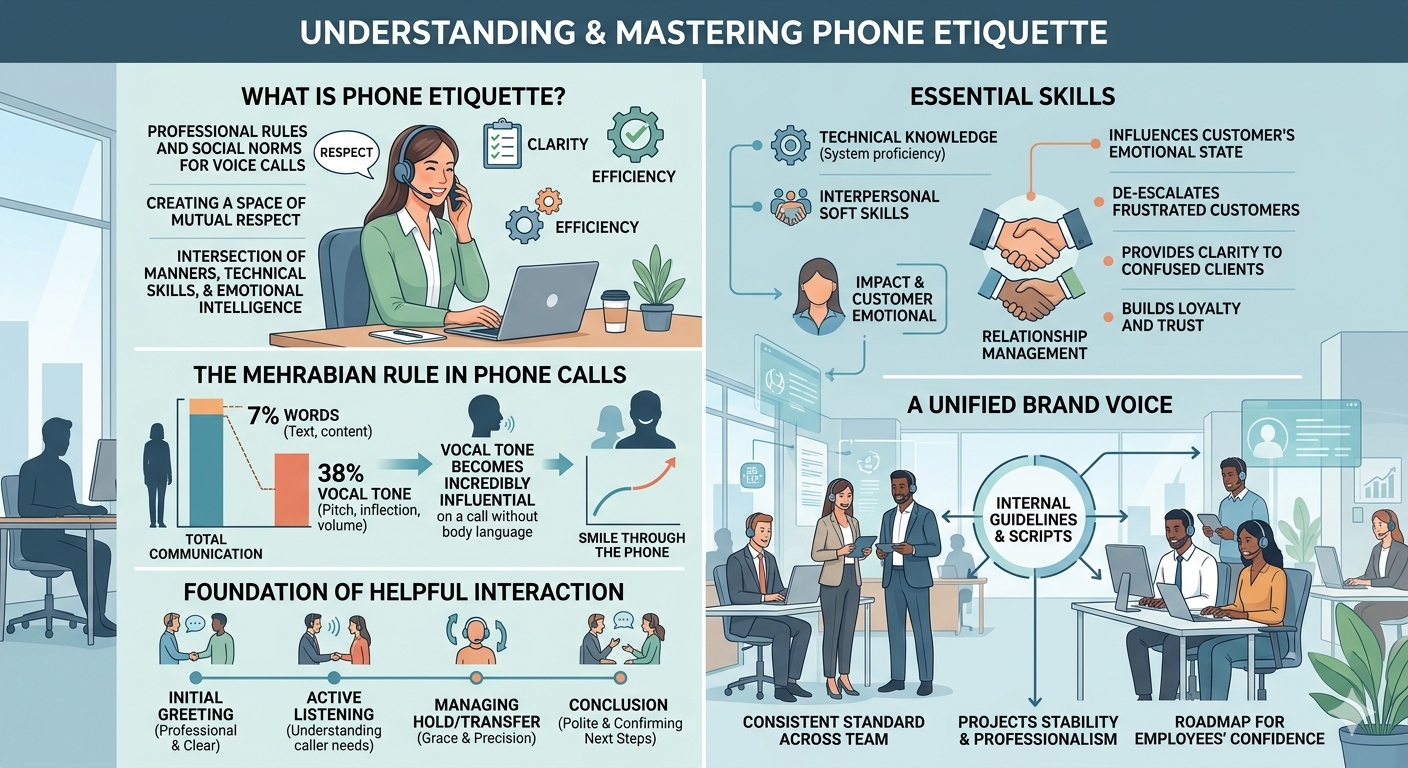
Professional communication serves as the primary bridge between a company and its clientele, and at the heart of this bridge lies the telephone interaction. Defining phone etiquette involves looking at the set of professional rules and social norms that govern how individuals represent themselves and their organizations during a voice call. It is not merely about answering a ringing device; it is about creating a space of mutual respect, clarity, and efficiency. The phone etiquette meaning refers to the intersection of manners, technical proficiency, and emotional intelligence. In a world increasingly dominated by digital text, the nuances of a live conversation carry significant weight, often determining whether a lead converts into a long-term partner or seeks a competitor.
The foundation of what is a phone etiquette is built upon the concept of providing a seamless and helpful interaction for the caller. This includes everything from the initial greeting to the way a person is placed on hold and how the conversation is concluded. A telephone etiquette definition emphasizes the use of professional language, a controlled tone of voice, and active listening. For businesses, this is a vital component of brand identity. When an employee answers the phone, they are the literal voice of the company. Their ability to handle queries with grace and precision reflects directly on the values and reliability of the entire organization.
Mastering what is phone etiquette skill requires a combination of technical knowledge and interpersonal soft skills. It is one of the most essential professional competencies because it influences the customer’s emotional state and their perception of a brand’s competence. A well-executed call can de-escalate a frustrated customer, provide clarity to a confused client, and build a sense of loyalty that written communication often struggles to achieve. By treating every call as a unique opportunity to provide value, professionals can transform a routine task into a powerful tool for relationship management and business development.
What is a Phone Etiquette in Professional Settings
At its core, a telephone etiquette meaning encompasses the behavioral standards used when communicating via voice technology. In professional settings, this goes beyond simple politeness. It involves understanding the hierarchy of information, managing time effectively, and ensuring that the caller feels heard and respected. Professionals must be able to navigate the fine line between being overly formal and being too casual. The goal is to project an image of approachable expertise. This requires a deep understanding of the telephone etiquette definition, which focuses on the systematic application of courtesy and clarity in every verbal exchange. Scientific research provides interesting insights into why certain aspects of phone etiquette are so effective.
One notable concept is the 7-38-55 rule developed by psychology professor Albert Mehrabian. While the specific percentages are often debated in different contexts, the core idea is that in communication, 7% of the message is conveyed through words, 38% through vocal tone, and 55% through body language. On a telephone call, where the 55% of body language is removed, the 38% of vocal tone becomes incredibly influential. This scientific fact supports the industry emphasis on tone, inflection, and the smile through the phone technique as essential parts of a telephone etiquette.
The scope of professional phone standards also includes the physical environment of the caller. To define telephone etiquette properly, one must consider the impact of background noise, the quality of the equipment, and the posture of the person speaking. Research has shown that a person’s physical stance can actually influence the sound of their voice; for instance, sitting up straight can lead to a more confident and energetic tone. This holistic approach to communication ensures that the message is not lost due to poor delivery or environmental distractions. Organizations that prioritize these details often see a significant improvement in their overall communication metrics.
Developing a consistent standard across a team is essential for maintaining a unified brand voice. When every team member understands what does phone etiquette mean in the context of their specific industry, the business projects an image of stability and professionalism. This involves creating internal scripts or guidelines that help employees navigate difficult situations, such as handling complaints or transferring calls to upper management. A clear define phone etiquette policy serves as a roadmap for employees, giving them the confidence to handle any interaction with poise and professionalism.
The Evolution and History of Business Call Etiquette
The history of business communication provides context for why certain standards exist today. When Alexander Graham Bell first revolutionized communication, there were no established rules for how to answer a call. In fact, Thomas Edison is credited with popularizing the word hello as a standard greeting, whereas Bell preferred the more nautical ahoy. As the telephone moved from a luxury item to a standard business tool in the early 20th century, the first iterations of phone etiquette tips began to emerge. These early guidelines focused on brevity and the clear enunciation of words, as early telephone lines were often plagued by static and low volume.
As switchboard operators became a central part of the telecommunications landscape, the social aspect of the telephone interaction began to formalize. Operators were trained to be the polite gatekeepers of communication, and their mannerisms set the standard for what we now recognize as professional telephone etiquette. The mid-20th century saw the rise of the customer service department, leading to more complex rules regarding how to handle multiple lines, how to use hold buttons effectively, and how to record professional voicemail greetings. This era solidified the idea that the telephone was not just a tool for information exchange, but a primary channel for customer care.
Today, the landscape has shifted again with the advent of mobile technology and Voice over Internet Protocol systems. While the tools have changed, the fundamental need for a proper phone etiquette definition remains the same. Modern professionals must now navigate the challenges of video calls and hands-free devices while maintaining the same level of decorum established by their predecessors. The transition from physical desk phones to digital interfaces has made what is phone etiquette skill even more important, as the potential for distractions and technical glitches has increased. Understanding this evolution helps modern workers appreciate the enduring value of professional voice communication.
Understanding Proper Phone Etiquette Matters for Business Growth
The link between communication quality and business success is supported by extensive psychological and economic data. What is proper phone etiquette serves as a primary driver of customer satisfaction. According to a study by the Harvard Business Review, customers who have a positive emotional experience with a company are significantly more likely to remain loyal than those who merely have their problems solved. Because voice interaction is one of the few ways to convey empathy and tone effectively, it is a critical component of that emotional experience. A friendly, professional voice can turn a potentially negative situation into a positive brand touchpoint.
In terms of lead conversion, the initial phone call is often the deciding factor. If a prospective client calls a business and is met with a curt, disorganized, or rude response, they are likely to take their business elsewhere immediately. Conversely, a what is phone etiquette experience that is characterized by helpfulness and efficiency can shorten the sales cycle. When the person answering the phone is knowledgeable and polite, it instills a sense of trust in the prospect. They assume that if the initial contact is this professional, the service or product they are purchasing will be of a similarly high quality.
-
First impressions are formed within the first seven seconds of a call, making the initial greeting the most critical part of the interaction.
-
High-quality communication reduces the need for follow-up calls, as issues are resolved more accurately the first time, saving the company time and money.
-
Professionalism on the phone builds a competitive advantage, especially in industries where automated systems have replaced human interaction.
-
Consistent etiquette standards across a company foster a culture of respect and internal efficiency among staff members.
Furthermore, proper phone etiquette includes the ability to manage time effectively for both the employee and the customer. By being direct yet polite, professionals can keep calls on track, ensuring that all necessary information is exchanged without unnecessary delays. This efficiency is a key part of telephone etiquette meaning in a high-paced business environment. When a company is known for respecting its customers’ time, it gains a reputation for being professional and easy to do business with, which is an invaluable asset in any market.
Core Competencies of Phone Etiquette Skill
To truly excel in professional communication, one must develop a specific set of abilities that comprise what is phone etiquette skill. The first and perhaps most important of these is active listening. This involves more than just hearing the words the caller is saying; it means processing the underlying needs and emotions behind those words. An active listener uses verbal cues like I understand or I see to let the caller know they are being heard. This builds immediate rapport and ensures that the information gathered during the call is accurate, which is essential for providing effective solutions.
Another core competency is the management of vocal tone and inflection. Since the caller cannot see the speaker’s body language, the voice must do all the work of conveying attitude and intent. A professional should aim for a tone that is warm, confident, and steady. This is often referred to in the industry as smiling through the phone. Even if the caller cannot see the smile, the physical act of smiling changes the shape of the mouth and the resonance of the voice, making it sound more welcoming. This is a subtle but powerful aspect of what is telephone etiquette that can significantly alter the trajectory of a conversation.
-
Clarity and enunciation are vital to ensure that the caller does not have to ask for information to be repeated, which can lead to frustration.
-
Patience is a necessary virtue, especially when dealing with callers who may be confused, angry, or struggling with a language barrier.
-
Adaptability allows a professional to shift their communication style to match the caller, whether they are a high-level executive or a first-time customer.
-
Problem-solving skills enable the speaker to move beyond a script and offer genuine help that addresses the caller’s specific situation.
Finally, the ability to maintain composure under pressure is a hallmark of what is proper phone etiquette. In a busy office or a high-volume call center, it is easy to become overwhelmed. However, a professional must never let their stress be sensed by the caller. This requires a high level of emotional intelligence and the ability to stay focused on the task at hand. By mastering these competencies, an individual becomes a valuable asset to their organization, capable of representing the brand with excellence in any situation.
What is Phone Etiquette Experience in High-Volume Call Centers
For those working in specialized environments, what is phone etiquette experience takes on a more rigorous definition. In a call center, agents are often required to handle dozens, if not hundreds, of calls per day. In this context, etiquette must be balanced with extreme efficiency. The challenge is to make every caller feel like they are the only person the agent has spoken to all day, despite the repetitive nature of the work. This requires a high degree of mental discipline and a commitment to the standards of phone etiquette definition.
A study by the American Management Association found that poor telephone communication is one of the leading causes of lost business in the service sector. The research highlighted that it is often not the product itself that drives customers away, but the feeling of being unappreciated or poorly handled during a call.
In these high-volume settings, the use of technology is closely integrated with communication standards. Agents must be proficient at navigating CRM systems and databases while simultaneously maintaining a pleasant conversation. Any delay in finding information can lead to dead air, which is generally discouraged in phone etiquette tips. Dead air can make a caller feel ignored or lead them to believe the call has been disconnected. Professional agents use this time to narrate their actions, saying things like, I am pulling up your account details now, it will just take a moment. This keeps the caller engaged and informed.
Additional notes for call center customer service involve the strict adherence to scripts without sounding robotic. The goal is to use the script as a guide rather than a crutch. An experienced agent knows when to deviate slightly from the script to provide a more personalized experience. They also understand the importance of proper call-handling procedures, such as how to introduce a transfer so the caller doesn’t have to repeat their story to the next person. This seamless transition is a primary component of which of the following is proper phone etiquette in a complex organizational structure.
Comprehensive Telephone Etiquette Tips for Success
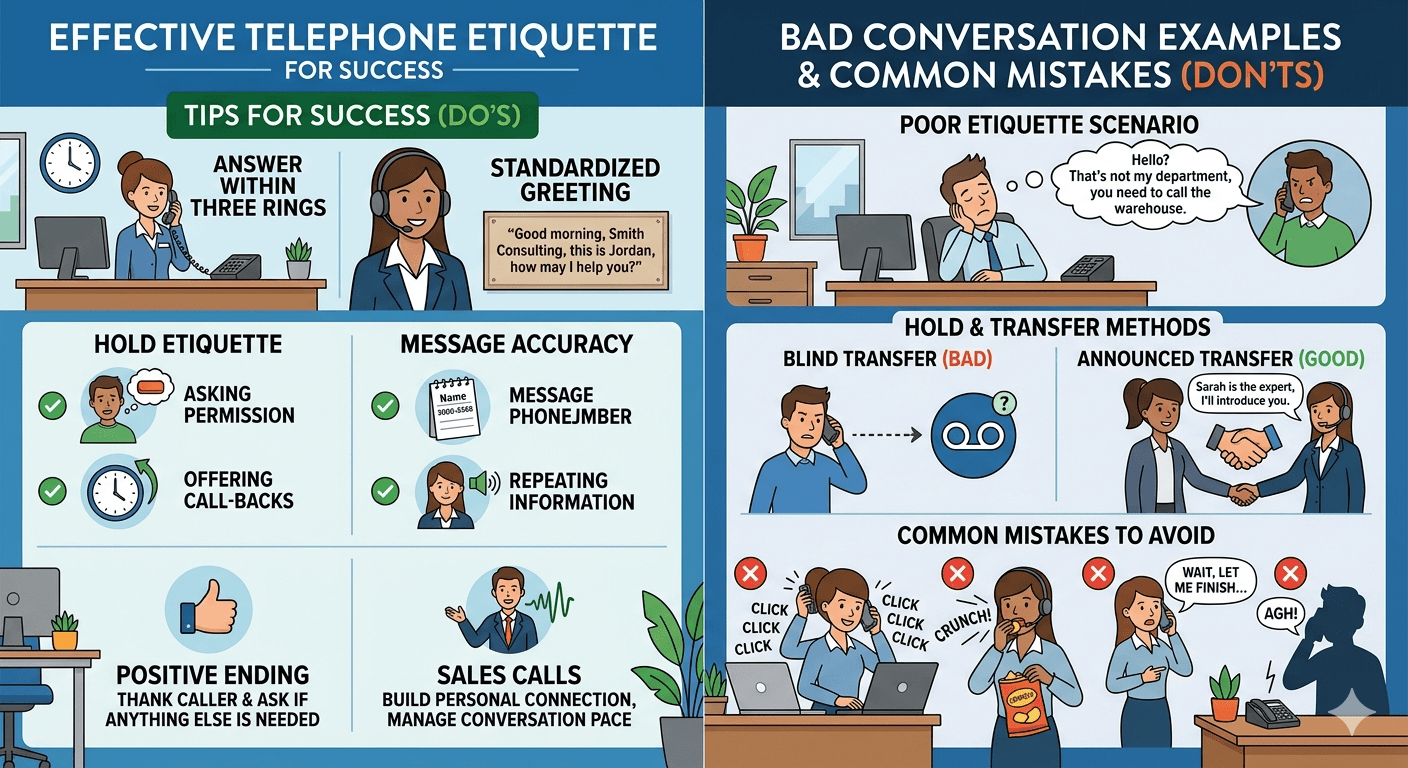
Improving your professional presence on the phone involves implementing a series of practical habits. One of the most effective phone etiquette tips is to answer the phone within three rings. This demonstrates that the business is alert, organized, and ready to assist. If a call is answered too quickly, it can startle the caller; if it takes too long, they may feel their time is not valued. The three-ring rule is a widely accepted standard that balances readiness with a comfortable pace for the caller.
When the call begins, the greeting should be standardized and professional. A good greeting typically includes a polite opening, the name of the company, the speaker’s name, and an offer of assistance. For example, Good morning, Smith Consulting, this is Jordan speaking, how may I help you? This provides the caller with immediate confirmation that they have reached the right place and knows exactly whom they are speaking with. This level of transparency is a key element of proper phone etiquette includes and sets a positive tone for the rest of the interaction.
-
Always ask for permission before placing a caller on hold and wait for their response before hitting the button.
-
If the hold time is expected to be longer than a minute, offer to call the person back rather than making them wait indefinitely.
-
When taking a message, always repeat the caller’s name and phone number back to them to ensure accuracy.
-
Avoid using industry jargon that the caller might not understand, as this can make them feel alienated or confused.
-
End every call on a positive note by thanking the caller for their time and asking if there is anything else you can assist with.
For sales professionals, additional tips are often required to manage the persuasive nature of their calls. In a sales context, phone etiquette meaning includes the ability to lead the conversation without being overbearing. It involves using the caller’s name naturally throughout the conversation to build a personal connection. Salespeople should also be mindful of their speaking pace; talking too fast can make them seem nervous or pushy, while talking too slowly can make them seem disinterested. Finding a rhythmic, conversational pace is essential for keeping the prospect engaged and open to the pitch.
Practical Examples of Good and Bad Phone Conversations
To truly understand what is proper phone etiquette, it is helpful to look at contrasting examples of daily interactions. Consider a scenario where a customer calls to complain about a delayed shipping order. In a poor etiquette example, the employee might answer with a flat Hello? and then interrupt the customer to say, That’s not my department, you need to call the warehouse. This response lacks a professional greeting, fails to show empathy, and puts the burden of work back on the customer. It creates a barrier rather than a solution, which is the opposite of what does phone etiquette mean in a service-oriented business.
Another interesting fact involves the psychological impact of silence. In face-to-face communication, brief silences are natural and often go unnoticed because of visual cues. However, on the phone, a silence of just four seconds can trigger feelings of anxiety or uncertainty in the caller. This is why professional standards emphasize narrating your actions when looking up information. By providing a verbal bridge during these moments, the speaker maintains the connection and prevents the caller from feeling disconnected.
In contrast, a high-quality interaction would involve the employee answering professionally and acknowledging the customer’s frustration. They might say, I apologize for the delay in your shipment; I understand how important it is to receive your items on time. Let me look into the tracking information for you right now. Even if the employee cannot solve the problem immediately, their tone and willingness to help change the customer’s perception. By taking ownership of the issue and providing clear next steps, the employee demonstrates a high level of what is phone etiquette skill, protecting the company’s reputation even during a failure in the supply chain.
Another example can be found in how calls are transferred. A bad experience involves a blind transfer where the caller is suddenly met with a new voice or, worse, a voicemail box without any warning. Proper telephone etiquette, however, involves an announced transfer. The employee should tell the caller, I am going to transfer you to Sarah in our billing department, she is the expert on this topic. I will stay on the line until she answers to introduce you. This ensures a warm handoff and makes the customer feel like they are being cared for throughout the entire process, rather than being passed around like a nuisance.
Common Mistakes to Avoid During Professional Calls
Even seasoned professionals can fall into habits that undermine their phone etiquette experience. One of the most common mistakes is multi-tasking while on a call. With the prevalence of computers, it is tempting to type emails or browse the web while talking. However, the sound of keyboard clicks and the slight delay in response time are often obvious to the caller. This gives the impression that the speaker is not fully present or that the caller is not a priority. True professional etiquette requires giving the person on the other end of the line your undivided attention.
Another frequent error is the use of overly casual language or slang. While it is important to be friendly, using terms like yeah, okay, or honey can come across as unprofessional or patronizing. Maintaining a standard of professional vocabulary is essential to define telephone etiquette in a way that commands respect. Similarly, eating, drinking, or chewing gum during a call is a significant breach of protocol. These sounds are amplified by the telephone microphone and are highly distracting and unpleasant for the listener.
-
Interrupting the caller before they have finished their sentence is a sign of poor listening and can lead to misunderstandings.
-
Leaving a caller on hold for extended periods without checking back in can lead to high abandonment rates and customer frustration.
-
Using a speakerphone in a noisy or public area compromises the caller’s privacy and makes the conversation difficult to hear.
-
Forgetting to update your voicemail greeting when you are out of the office leaves callers in the dark about when they can expect a return call.
Avoiding these pitfalls is a major part of understanding which of the following is proper phone etiquette. Many of these mistakes stem from a lack of mindfulness or an assumption that the caller cannot tell what is happening on the other side. By remaining disciplined and keeping the caller’s experience at the forefront of every decision, professionals can avoid these common traps and maintain a high standard of communication that reflects well on their personal brand and their organization.
Strengthening Professional Communication Through Modern Standards
As we look toward the future, the importance of what is phone etiquette will only continue to grow as voice interactions become more specialized. With basic inquiries being handled by AI and automated systems, the calls that actually reach a human are becoming more complex and emotionally charged. This means that the person answering the phone must be more than just a clerk; they must be a high-level communicator capable of handling sophisticated problems. Strengthening your professional communication involves staying updated on new technologies while never losing sight of the human element.
Proper phone etiquette includes the ability to integrate digital tools like video conferencing and screen sharing without losing the personal touch of a standard call. As more business is conducted remotely, the voice becomes the primary way we establish presence and authority. Professionals who can master these skills will find themselves at a distinct advantage in the modern job market. Whether you are a business owner setting the standard for your team or an individual looking to improve your career prospects, focusing on your phone mannerisms is a high-impact way to improve your professional trajectory.
-
Regularly review your recorded calls if possible to identify areas for improvement in your tone and clarity.
-
Seek feedback from colleagues on how you handle difficult callers to gain new perspectives on conflict resolution.
-
Stay informed about changes in communication technology to ensure you are using the best tools for the job.
-
Practice mindfulness to stay calm and focused during high-stress calls, ensuring a consistent level of service.
The journey to mastering telephone etiquette is one of continuous improvement. It requires a commitment to excellence and a genuine desire to help others. When you view every call as a chance to represent your best self and your organization, the technical rules of etiquette become second nature. By implementing these standards, you create a professional environment where communication is clear, relationships are strong, and business can thrive in an increasingly connected world.
Read More: Is WIFI Calling Free? A Deep Dive into wifi calling Technology
Final Thought
Mastering the nuances of professional phone communication is a transformative skill that bridges the gap between simple interaction and meaningful connection. By understanding the phone etiquette meaning and applying it consistently, professionals can ensure that every voice call serves as a positive reflection of their brand and their values. Whether through active listening, the careful management of vocal tone, or the avoidance of common pitfalls like multi-tasking, the adherence to these standards creates a foundation of trust and efficiency. As communication technology continues to evolve, the core principles of respect, clarity, and helpfulness remain the timeless pillars of business success. Ultimately, a commitment to proper phone etiquette is an investment in the long-term health and reputation of any professional organization.
Frequently Asked Questions
-
Why is answering call etiquette necessary?
Answering call etiquette is necessary because it sets the tone for the entire customer relationship and serves as the primary way a company demonstrates its professionalism. A structured and polite approach to answering the phone ensures that the caller feels valued from the very first second, which is critical for building trust and brand loyalty. Without established etiquette, communication can become disorganized, leading to misunderstandings, lost leads, and a tarnished reputation for the business.
-
What are the 7 P’s of phone etiquette?
The 7 P’s of phone etiquette are a set of principles designed to guide professional interactions: Prepared, Polite, Patient, Personable, Professional, Positive, and Proactive. Being Prepared means having all necessary tools ready before the call; Polite and Patient focus on the treatment of the caller; being Personable involves using the caller’s name; Professional ensures the use of appropriate language; a Positive tone keeps the call constructive; and being Proactive means taking ownership of the caller’s problem until it is resolved.
-
How do you handle customer calls?
Handling customer calls effectively requires a systematic approach that begins with a professional greeting and active listening to understand the customer’s needs. You should use the customer’s name, maintain a calm and empathetic tone, and ask clarifying questions to ensure accuracy. If you need to research an issue, explain what you are doing so the caller isn’t left in silence, and always summarize the agreed-upon next steps before ending the call with a polite thank you and an offer for further assistance.
-
What should be avoided during a conference call?
During a conference call, you should avoid staying off-mute when you are not speaking, as background noise can be highly distracting for other participants. Avoid multi-tasking, such as checking emails or typing loudly, as this prevents you from fully engaging with the topic and can be sensed by others on the line. Additionally, avoid interrupting other speakers and failing to identify yourself before speaking, as this can lead to confusion in a group setting where visual cues are absent.
-
How does personal phone etiquette contribute to effective communication?
Personal phone etiquette contributes to effective communication by reducing barriers such as noise, confusion, and emotional friction. When an individual uses a clear tone, practices active listening, and follows professional protocols, they ensure that the intended message is delivered and received accurately. This discipline prevents the frustration that often arises from poor communication, allowing both parties to reach their objectives more quickly and maintaining a positive professional relationship.