Call forwarding in VoIP is a cloud-based feature that automatically redirects incoming digital signals to secondary destinations, such as mobile devices or remote extensions. Unlike traditional landlines, this technology uses the Session Initiation Protocol (SIP) to manage traffic instantly based on predefined rules like time-of-day or line availability. Implementing a phone forwarding system ensures business continuity, allowing a global workforce to maintain a local presence without missing critical customer connections. By utilizing tools like unconditional or conditional routing, organizations enhance their professional image, improve response times, and ensure every call reaches the right person regardless of physical location.
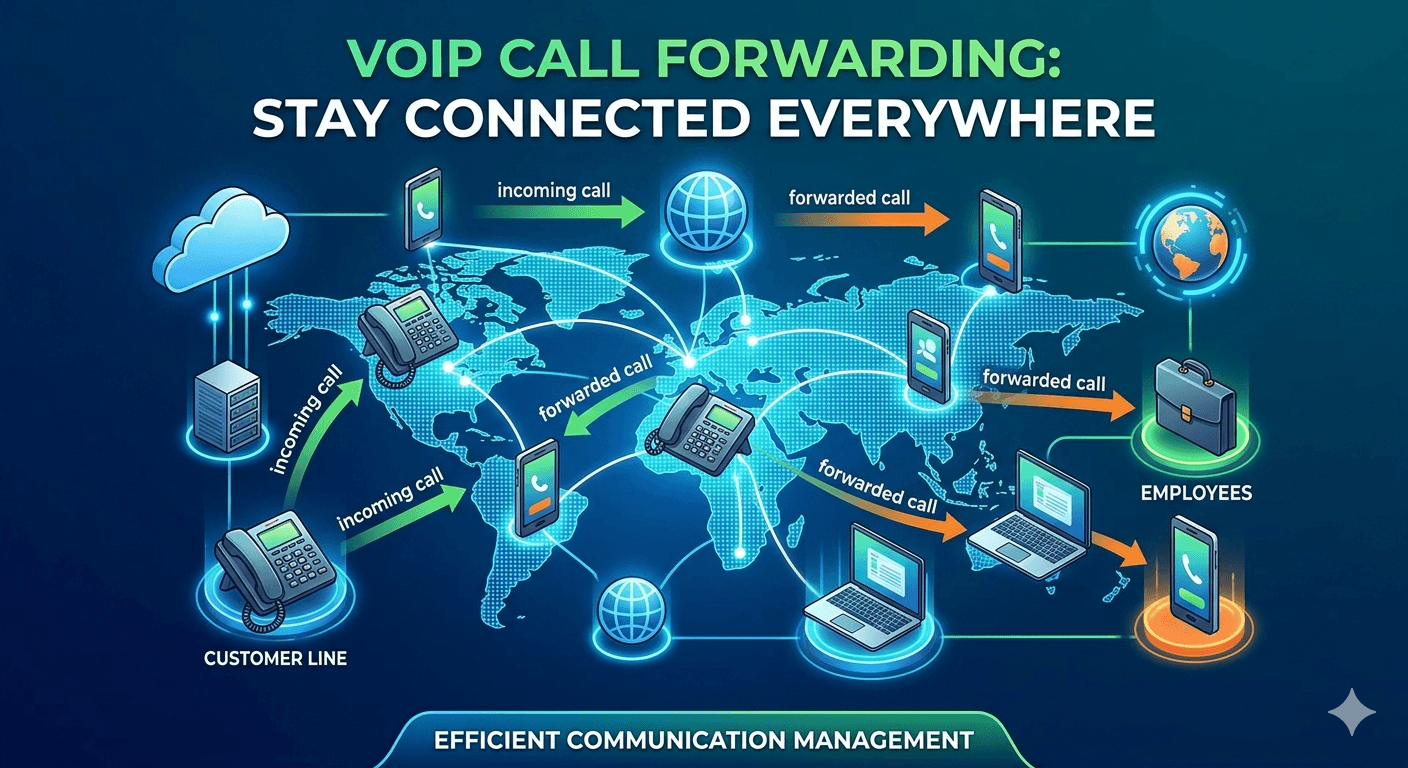
Effective communication management is the backbone of any professional organization, and modern technology provides tools that ensure no customer connection is ever lost. Redirecting incoming traffic to available lines is a fundamental necessity for businesses operating across multiple time zones or managing remote teams. This process allows an organization to maintain a local presence while utilizing a global workforce, ensuring that the distance between the caller and the recipient becomes irrelevant. When a company adopts a sophisticated phone forwarding system, they are investing in reliability and professional image, as every call is treated with priority regardless of the physical location of the staff.
Understanding the Basics of VoIP Call Forwarding
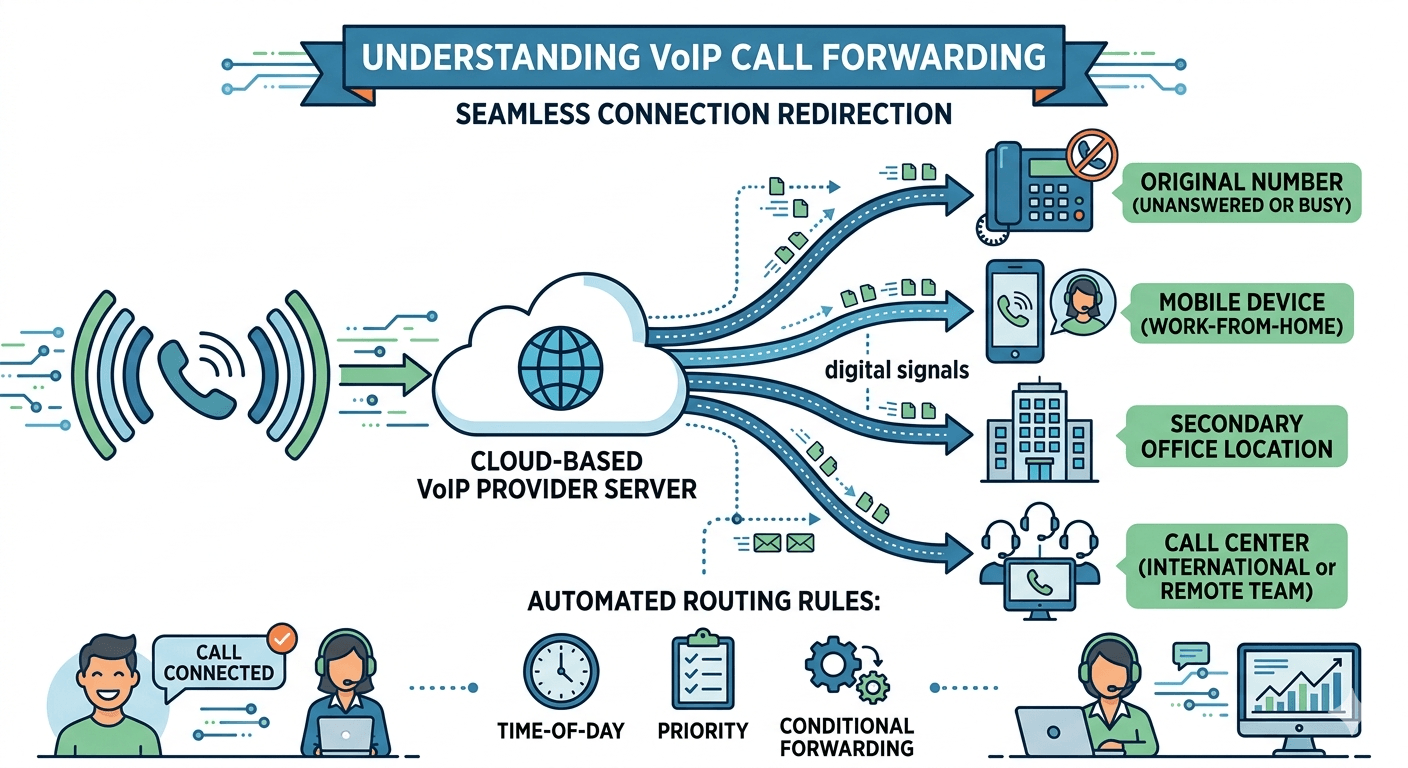
To define call forwarding in a modern context, one must look at how digital signals are managed within a cloud-based environment. At its core, the feature allows an incoming signal to be rerouted to another destination before the initial connection is established. When someone asks what does call forwarded mean, they are usually referring to a scenario where a desk phone remains silent while a mobile device or a secondary office line rings instead. This seamless transition is handled by the provider’s servers, which follow a set of predefined rules to determine the best path for the data packets. In the world of digital telephony, call forwarding voip has become a standard feature that replaces the clunky manual processes of the old landline era.
The forward call meaning has expanded significantly since the early days of telecommunications. In a traditional setting, a user might dial a code to send calls to a neighbor’s house, but today, forwarding calls meaning involves complex logic that can include time-of-day routing and priority filtering. When a business professional sees a notification indicating that a call forwarded means their system is working as intended, they can feel confident that their availability is being managed intelligently. This technology ensures that the forward destination can be changed instantly via a web portal or a smartphone application, providing a level of control that was previously unimaginable for small and medium-sized enterprises.
Implementing a call forwarding system requires an understanding of how these virtual rules interact with the hardware. For many businesses, setting up 1 800 call forwarding is a top priority because it allows them to maintain a toll-free presence while directing those calls to a cost-effective call center or a home office. This flexibility is essential for startups that may not have a central office location but want to project the image of an established corporation. By understanding what does forwarding a call mean for their specific operational flow, managers can design a communication strategy that maximizes employee productivity without sacrificing the customer experience.
How Modern Technology Powers VoIP Forwarding
The technical side of voip forwarding relies on a protocol known as Session Initiation Protocol, which acts as the signaling layer for digital calls. When an incoming request hits the service provider’s network, the system checks the database for any active routing rules associated with that specific number. If a rule is found, the system generates a new request to the secondary destination rather than sending the call to the primary device. This happens in milliseconds, often before the caller even hears the first ring. This speed is what makes the call forwarding voip experience so smooth, as there is no discernible delay for the person initiating the call.
In a professional call forwarding phone system, the logic can be quite granular. For instance, a user can set a rule where calls are only forwarded if the primary line is already busy or if there is no answer after a certain number of rings. This ensures that the primary user always has the first opportunity to take the call, with the forwarding acting as a safety net. This is part of what does call forwarded mean in a business environment: a tiered defense against missed opportunities. Furthermore, the voip call transfer feature often works in tandem with forwarding, allowing a staff member to manually move a call to another department after the initial forwarding has brought it to their attention.
When considering the technical setup, many organizations look toward industry leaders to see how these features are integrated. For example, nextiva call forwarding is known for its user-friendly interface that allows administrators to drag and drop call flows. This visual representation of how calls travel through the organization makes it easier to understand the call forwarded meaning within the context of a larger team. Whether it is a simple one-to-one redirection or a complex hunt group where multiple phones ring at once, the underlying technology ensures that every data packet is delivered to the correct IP address with minimal latency and high audio fidelity.
Step by Step Guide on How to Forward VoIP Calls to Cell Phone
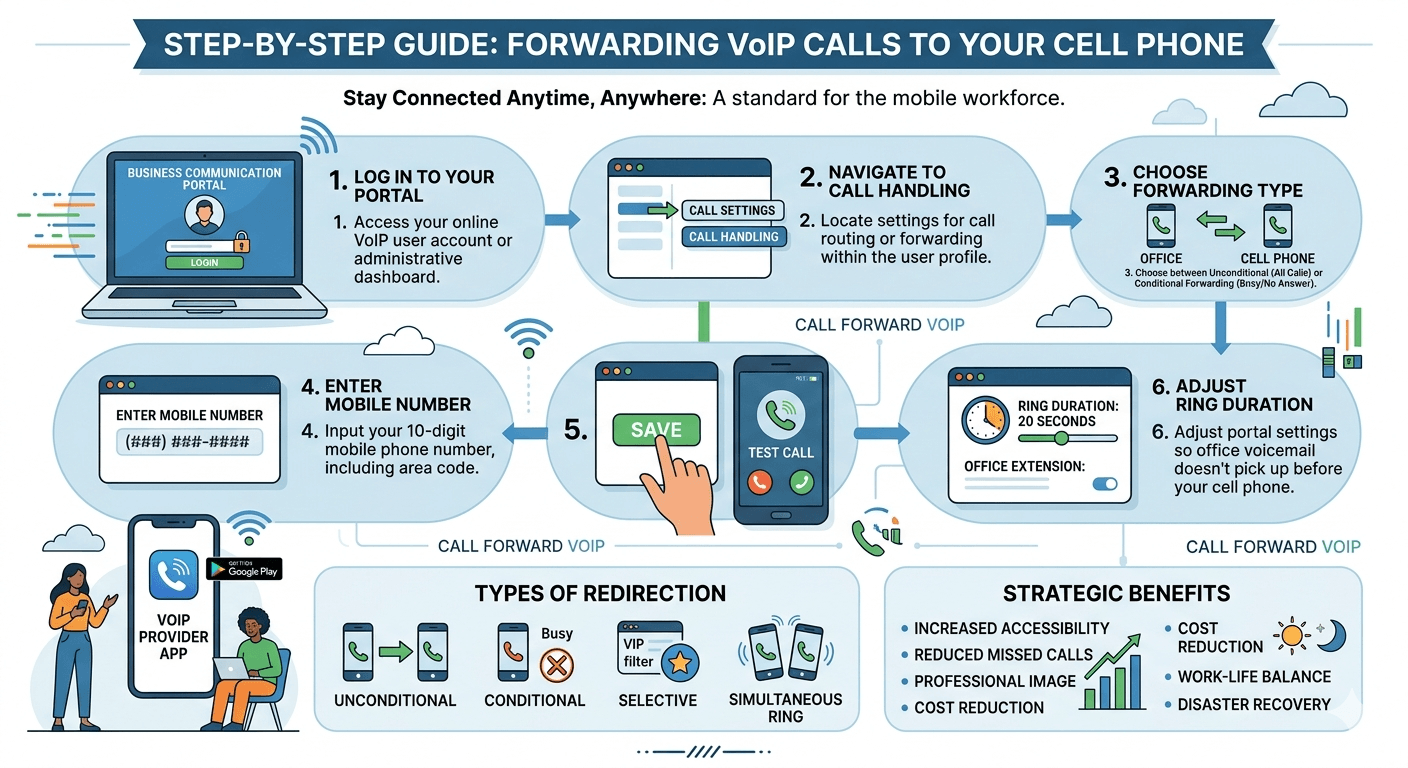
One of the most frequent questions from modern workers is how to forward voip calls to cell phone devices. This process has become a standard part of the call forward voip experience, as it allows for a truly mobile workforce. Most providers offer a mobile application that simplifies this, but it can also be done through the administrative dashboard. Typically, the user logs into their portal, navigates to the call handling settings, and enters their ten-digit mobile number as the target destination. This ensures that even when an employee is traveling or working from a coffee shop, they can still receive calls made to their office extension.
-
Log into your business communication portal and select the specific user or extension you wish to modify.
-
Locate the incoming call rules or call handling section within the user settings.
-
Choose the option for unconditional forwarding if you want all calls to go straight to your mobile device.
-
Enter your mobile phone number, ensuring you include the area code and any necessary prefixes.
-
Save the settings and perform a test call from an external line to verify the redirection works.
-
Adjust the settings for conditional forwarding if you only want calls sent to your cell phone when your desk phone is busy.
-
Download the provider’s mobile app to receive calls via data (VoIP) instead of using your cellular minutes, which often provides better integration.
-
Ensure that your cell phone’s voicemail does not pick up before the business system does by adjusting the ring duration settings in the portal.
By following these steps, a user can ensure they are always reachable. This setup is a perfect example of a phone forwarding system in action, bridging the gap between traditional office life and the modern remote work era. It also addresses the common confusion regarding what does call forwarded mean on a mobile device, as the incoming call screen will often indicate that the call is being redirected from a professional line. This allows the user to answer with a professional greeting, knowing exactly which line the caller is trying to reach.
Different Types of Redirection in a Call Forwarding System
There are several variations of this feature that serve different business needs. Unconditional forwarding is the simplest form, where every single call is immediately sent to another number without the original phone ringing at all. This is often used during vacations or when an office is permanently closed. On the other hand, conditional forwarding provides more flexibility. This includes features like Busy Forwarding, which only triggers when the user is already on another call, and No Answer Forwarding, which sends the call to a secondary line only after a certain number of rings. These options help define call forwarding as a versatile tool rather than a one-size-fits-all solution.
Selective forwarding is another advanced option found in a high-end call forwarding phone system. This allows users to create a VIP list of phone numbers that are the only ones allowed to be forwarded. For example, an executive might want calls from major clients to reach their cell phone after hours while all other callers are sent to voicemail. This level of customization is what separates basic consumer-grade services from professional voip forwarding solutions. Understanding the specific call forwarded meaning for each of these types allows a business to craft a communication policy that respects employee boundaries while maintaining high levels of customer service.
Another important distinction to make is between forwarding and simultaneous ring. While forwarding moves the call from point A to point B, simultaneous ring allows both devices to ring at the same time. This is often part of a larger voip call transfer strategy where the goal is to get the call answered as quickly as possible by whoever is available first. In a busy sales environment, this is preferred over simple forwarding because it reduces wait times. However, for a single user who is simply moving from their desk to their car, the standard call forward voip setting is usually the most efficient way to maintain connectivity.
Strategic Benefits of Implementing VoIP Call Forwarding
The primary benefit of utilizing this technology is the drastic reduction in missed calls. Research from organizations like the Harvard Business Review has shown that companies that respond to a lead within five minutes are nearly 100 times more likely to have a successful interaction than those who wait even thirty minutes. By using a call forwarding system to reach staff on their mobile devices, a business can achieve these lightning-fast response times. A missed call is often a missed revenue opportunity, and the cost of the technology is negligible compared to the potential loss of a high-value client.
-
Increases accessibility by allowing staff to remain reachable regardless of their physical location or travel schedule.
-
Enhances the professional image of the company by ensuring that callers always reach a person or a structured menu.
-
Reduces overhead costs by allowing for remote working arrangements without losing the centralized office phone structure.
-
Provides disaster recovery options, as calls can be instantly redirected if a physical office becomes inaccessible due to weather or power outages.
-
Improves employee work-life balance through selective forwarding that only allows critical calls during off-hours.
-
Streamlines customer service by routing 1 800 call forwarding traffic to the most qualified available agents in real-time.
-
Offers detailed analytics on where calls are being forwarded, helping managers understand staff mobility and availability patterns.
Furthermore, a well-configured phone forwarding system acts as a built-in redundancy plan. In the event of a local internet outage at a primary office, the cloud-based system can automatically detect that the desk phones are offline and begin forwarding all traffic to mobile devices or a secondary branch. This level of business continuity is a major reason why companies are moving away from traditional hardware and embracing call forwarding voip solutions. The ability to pivot instantly in the face of technical difficulties ensures that the brand’s reputation for reliability remains intact even during unforeseen circumstances.
Security and Best Practices for Forwarding Calls Meaning
While the benefits are clear, businesses must also be aware of security considerations related to voip forwarding. Toll fraud is a significant risk where unauthorized users gain access to a phone system and set up forwarding to expensive international numbers. To prevent this, it is essential to use strong, unique passwords for all administrative and user portals. Additionally, administrators should restrict the types of numbers that calls can be forwarded to, blocking international destinations if the business does not operate globally. This is a critical part of managing a call forwarding system securely.
Another best practice involves the management of caller ID. When a call is forwarded to a cell phone, the user needs to know whether the person calling is a personal contact or a business lead. Most professional systems allow for a “prefix” to be added to the caller ID or for the system to show the original business number instead of the caller’s number. This helps clarify the call forwarded meaning for the recipient, allowing them to answer the phone appropriately. Without this feature, an employee might answer a major client with a casual “hello” instead of a professional business greeting, which can negatively impact the brand’s image.
Finally, regular audits of the forwarding rules are necessary. In a dynamic business environment, employees change roles or leave the company, and forgotten forwarding rules can lead to calls being sent to the wrong people or even to former employees’ personal devices. A quarterly review of the call forward voip settings across the organization ensures that the routing logic still aligns with the current team structure. This proactive management keeps the phone forwarding system lean and efficient, preventing the “dead ends” that can frustrate customers and lead to lost business.
Research and Facts Supporting VoIP Communication
The shift toward mobile-integrated communication is supported by significant industry data. A study by NewVoiceMedia revealed that 51% of customers will not repeat business with a company after just one poor service experience, with “not being able to reach a person” cited as a top frustration. This highlights why a call forwarding system is not just a convenience but a requirement for customer retention. By ensuring that every call finds a destination, businesses directly impact their bottom line and long-term viability.
Additionally, the rise of the “anywhere office” has been documented by analysts at Gartner, who predict that a significant portion of the global workforce will continue to work in a hybrid or fully remote capacity. This decentralized model relies entirely on technologies like call forwarding voip to maintain a cohesive professional presence. The ability to forward calls meaning that a person’s physical location is irrelevant to their job performance is a cornerstone of modern economic flexibility. Companies that fail to adopt these tools risk falling behind in the competition for talent and market share.
Final Thought
The evolution of communication has made it possible for businesses to stay connected with their audience more effectively than ever before. By mastering the nuances of VoIP call forwarding, an organization can ensure that every inquiry is met with a professional response, regardless of where its employees are located. This technology bridges the gap between different devices and geographical locations, creating a seamless experience for both the caller and the recipient. As the workplace continues to become more mobile, the importance of a robust, secure, and well-managed forwarding strategy will only continue to grow, making it an essential component of any modern business toolkit.
Frequently Asked Questions
-
What is VoIP call forwarding?
VoIP call forwarding is a telecommunications feature that allows an incoming internet-based phone call to be redirected to another destination, such as a different office extension, a mobile phone, or a landline. Unlike traditional forwarding, it is managed through software and cloud-based servers, allowing for instant updates and complex routing rules based on conditions like the time of day or the status of the primary line.
-
What is the difference between *71 and *72 call forwarding?
These are traditional vertical service codes used primarily on older landline and some cellular networks. Generally, *72 is used to activate unconditional call forwarding, where all calls are sent to another number immediately. *71 is typically used for conditional call forwarding, such as “no answer” or “busy” forwarding, where the call only redirects if the primary line is unavailable or goes unanswered after several rings.
-
How exactly does call forwarding work?
When a call is made to a number with forwarding enabled, the service provider’s switch or cloud server intercepts the call request. It checks the user’s settings and, instead of completing the connection to the original device, it initiates a new connection to the forwarded number. The caller is usually unaware of this transition, although they may notice a slight change in the ring tone or a momentary delay as the second connection is established.
-
How do I call forward a VoIP phone?
You can usually set up forwarding through your service provider’s mobile app or web-based dashboard. After logging in, navigate to the settings for your specific extension and look for “Call Handling” or “Forwarding.” Enter the number you want to send calls to and select whether you want it to be unconditional or based on specific triggers like a busy signal. Some desk phones also have a physical “Forward” button that allows you to enter a destination number directly on the device.
-
What does *#002# do on a phone?
This is a universal MMI (Man-Machine Interface) code used on most GSM mobile phones to deactivate all forms of call forwarding. When dialed, it tells the network to cancel any active redirection settings, including those for when the phone is busy, unreachable, or doesn’t answer. It is a quick way to reset your call routing to its default state if you are experiencing issues with missing calls.