
Anveo Direct is the closest of the thinQ alternatives in this guide if you rely on selectable outbound carriers and least-cost routing. For U.S. SIP connectivity with programmable voice and messaging, start with Signal House. Telnyx fits a self-service SIP and number-management project. Bandwidth and Sinch fit larger carrier integrations, while DIDWW is worth shortlisting when international local numbers drive the decision.
The thinQ brand is part of Commio. Commio announced the rebrand after thinQ acquired teli in 2021, and its documentation still describes the outbound routing profiles that made thinQ useful to voice operators. The key buying question when comparing thinQ competitors is where your routing choices live. Your new provider might let you choose downstream carriers, manage the routing on your behalf, or expect your PBX or session border controller to choose between trunks.
Compare the Best thinQ Alternatives
The options below cover carrier routing, programmable voice, inbound numbers, and network integration. Compare the exact product and direction of a call before comparing the price. An inbound local rate is different from a toll-free rate, and an API call can include a separate application or media charge. Ask thinQ competitors to show how they handle your actual number types and calling routes.
| Provider | Best For | What to Verify | Pricing & Evaluation |
|---|---|---|---|
Signal House  | U.S. PBX connectivity with programmable voice and messaging | Confirm voice-enabled number rental, rounded billable minutes, and your authentication method. | US$0.005/min U.S. inboundU.S. outbound is US$0.012/min in the first 100,000-minute band. Number and usage terms apply.Explore Signal House |
Anveo Direct  | Selectable wholesale outbound carrier routes | Test IP authentication, route choice, failover, and direct media behavior separately. | Route-Specific RatesCheck the outbound rate deck and price inbound numbers separately.See Anveo Direct Rate Decks |
Telnyx  | Self-service SIP trunking and number APIs | Check the destination tariff, channel or usage model, and charges for extra features. | U.S. local inbound from US$0.0032/minUS$0.005/min U.S. outbound list reference. Check the exact destination.See Telnyx SIP Pricing |
Bandwidth  | Larger carrier, number, and SIP integrations | Ask for exact market coverage, number inventory, porting support, and commitments. | Request a SIP QuoteQuote the trunk scope, usage, numbers, support, and applicable commitments.Explore Bandwidth Pricing |
Sinch SIP Trunking  | Enterprise voice connectivity and BYOC projects | Confirm the trunk and carrier-retention option for your topology, locations, and traffic. | Request a SIP QuoteAsk for the quoted markets, numbers, SIP usage, services, and support.See Sinch SIP Trunking |
DIDWW  | International DIDs and configurable SIP capacity | Check exact country, number type, documentation, porting, and inbound channel options. | Market-Specific RatesNumber, inbound capacity, and outbound charges depend on the service and destination.Compare DIDWW SIP Pricing |
Flowroute  | Inbound numbers with primary and failover routes | Test how quickly your approved backup destination receives calls and which conditions trigger it. | US$0.005/min domestic inboundUS$0.00833/min outbound to the lower 48 U.S. states and Canada. Number charges are separate.View Flowroute Pricing |
Twilio Elastic SIP Trunking  | Developer-led trunk setup and related APIs | Use Elastic SIP Trunking rates and verify region, calls per second, and add-ons. | US$0.0034/min U.S. local inboundUS$0.0100/min lower-48 U.S. Zone 1 termination. Other zones and toll-free vary.View Twilio SIP Pricing |
What to Replace in thinQ Voice by Commio
Commio documents more than one outbound profile. Its Prime option attempts the lowest-rate carrier and does not advance to another route when that attempt fails. Its least-cost routing option can try eligible carriers in price order and advance based on certain failures and profile constraints. The documentation also describes available controls such as carrier selection, a maximum rate, and a threshold for post-dial delay. Pull your account’s profile settings before you ask thinQ alternatives to reproduce them.
| Current Dependency | What to Ask thinQ Competitors | Evidence to Request |
|---|---|---|
| Outbound Least-Cost Routing | Can you select eligible downstream carriers, limit what you pay, and control route advancement? | Documented policies, applicable rate decks, and the record of a test call. |
| Inbound Number Routing | Can a number reach two independent authorized destinations? | Number inventory, destination priorities, and a test of primary failure and recovery. |
| Voice and Messaging on the Same Number | Can the chosen number type use both services, and who manages each move? | Published eligibility, voice and messaging test results, and the proposed port sequence. |
| APIs and Reporting | Which fields and events are available after a call or a number order? | Example records, permission model, and a report showing how an exception is traced. |
| Commercial Terms | Are you priced by minute, call leg, capacity, number, or a separate platform charge? | A written estimate for your traffic mix and a sample invoice. |
A buyer that uses one Commio trunk for every call may need a different replacement from an ITSP with separate profiles for international traffic, customer groups, and expensive destinations. Draw your traffic flow first. Mark the point where your application decides what to do, where the PBX chooses a trunk, and where the carrier chooses a downstream path. This makes it easier to compare thinQ alternatives at the correct point in the call.
Check inbound and outbound separately when mapping the transition. For example, a contact center can keep customer-facing inbound numbers in place while validating a new outbound carrier. An application can keep its orchestration layer while adding a separate trunk, provided the products and accounts support the proposed configuration. If you mix thinQ competitors, document the billing owner and support owner for each leg so a call problem can be traced across both services.
1. Signal House — Best for U.S. Programmable Voice and Messaging
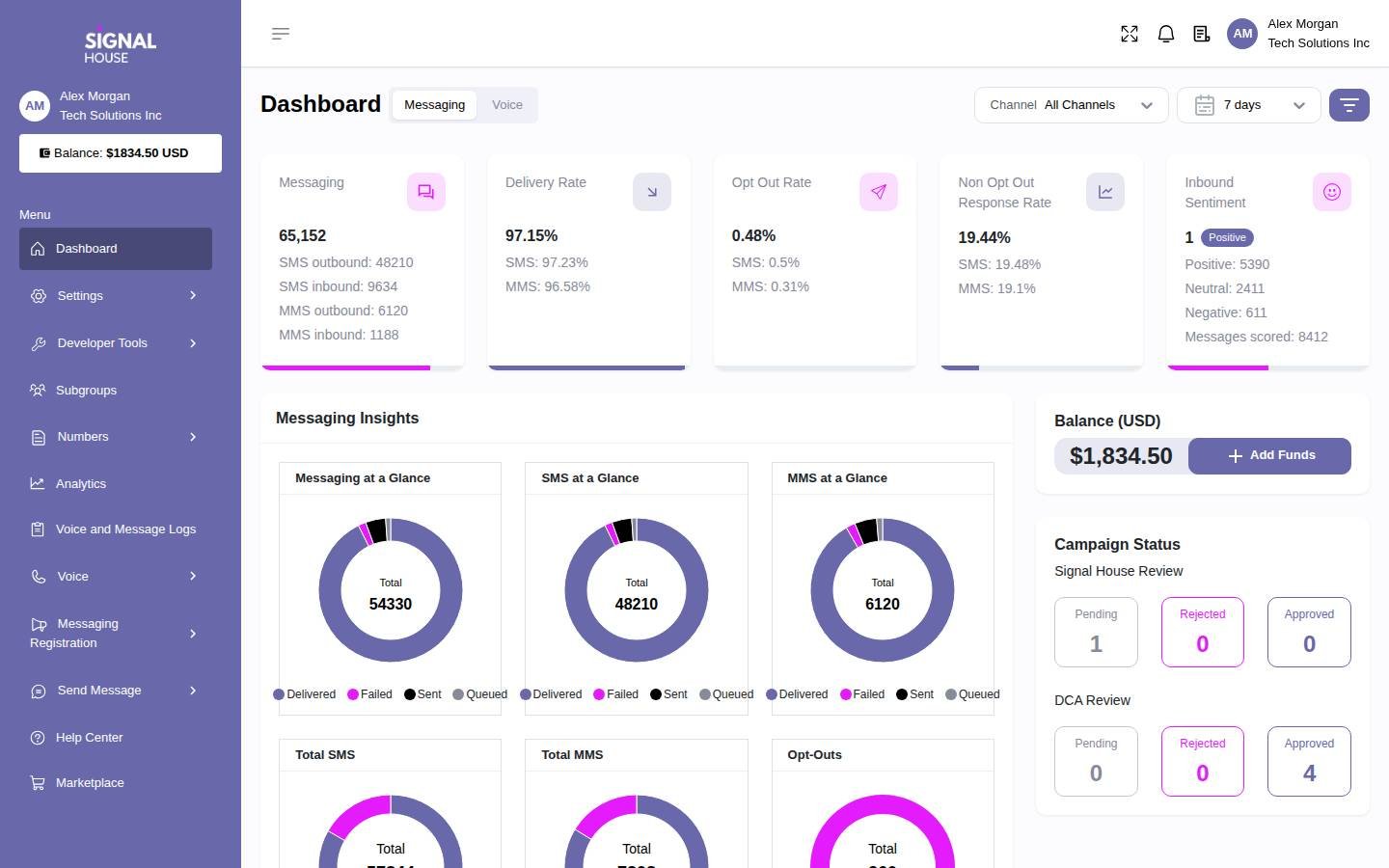
Signal House is one of the thinQ alternatives for a team that wants SIP calling and programmable communications in the same U.S. project. The voice product documents SIP trunking, endpoints, browser calling, and programmable call handling. Published U.S. voice rates include $0.005 per inbound minute and $0.012 per outbound minute in the first 100,000-minute band. Request a quote for voice-enabled number rental and account terms.
Where it fits. Put Signal House alongside other thinQ competitors if you already have a PBX or application and need to connect voice and messaging to a business process. An agency might want customer replies and incoming calls tied to the same account, while a software team may need to direct a call to a SIP endpoint and record the outcome in its application. Confirm which service uses each number and whether a workflow requires a separate registration or configuration.
What to test. Configure one number and one authorized endpoint first. Take an inbound call, place an outbound call, and inspect the resulting call record. If an application makes routing decisions, test an unavailable endpoint and a late event to see what the caller experiences. Ask each of the thinQ alternatives to show where operators can find the evidence they need without asking the app developer to reconstruct the call.
What to check before choosing it. Signal House’s billing documentation describes a one-minute minimum and whole-minute rounding for answered calls. Ask thinQ competitors to price the same sample of short and long calls. Get confirmation of each required market, emergency service where applicable, and routing capability before moving a Commio profile. Our Signal House review covers the wider platform.
2. Anveo Direct — Best for Selectable Outbound Carrier Routes
Anveo Direct is one of the most direct thinQ alternatives for buyers who need wholesale termination with configurable carrier or route choices. Its outbound rate page describes selectable routes and failover options. Its FAQ specifies IP authentication without SIP registration. Compare the rules for route ordering, exclusions, fallback, and rate selection with how you currently use Commio. Anveo Direct also documents direct media between your server and the carrier. Test audio and codec negotiation from every approved site as part of the pilot.
Where it fits. Consider Anveo Direct with other thinQ competitors if you operate an SBC or PBX and want to tune routes for different traffic groups. A provider might use one policy for routine domestic calls and another for an international route where completion rate matters more than a small price difference. Bring a list of the real destinations and service requirements to the comparison.
What to test. Ask routing-focused thinQ alternatives to show which parts of the decision you can inspect and change. Submit approved test calls, then compare the rate deck, any records for the attempts, and the response if the preferred route cannot complete the call. Test several destinations and an account with a deliberate route restriction. Confirm how an operator can explain a rejected or rerouted call to a customer.
What to check before choosing it. Ask thinQ competitors to quote number rental and inbound traffic separately from outbound termination. Review any minimums and support arrangements for the account and rate deck in use. If your Commio deployment also sends messages or exposes an API to customers, scope that workload separately. Read the guide to how SIP trunking works if your team needs a shared definition of the carrier handoff.

3. Telnyx — Best for Self-Service SIP Trunks and Number APIs
Telnyx is one of the thinQ alternatives for a technical team that wants to manage trunks and number resources through an online portal and APIs. Its U.S. examples show a $0.005 outbound list reference and local inbound from $0.0032 per minute. Ask for the applicable rate by origin, destination, and volume. Price separate API or recording charges if the application uses them.
Where it fits. Put Telnyx among the thinQ competitors if you operate multiple sites, manage number inventory programmatically, or want to run a self-service technical evaluation. A service provider might use a standard template for most customers but keep different outbound restrictions for a regulated customer. Ask which settings can be shared, which are account-specific, and which can be scoped to a connection.
What to test. Build a representative connection at each authorized site. Have the same users take and place approved calls, then check how each call shows up in the records. Compare how thinQ alternatives report routing failures, usage changes, and the administrative updates made afterward. If your product provisions numbers, test what happens when a task partially succeeds and has to be reconciled.
What to check before choosing it. Ask thinQ competitors when you pay by usage and when you pay for reserved capacity. Budget for any extra services and the required geographic footprint. A connection can give you useful trunk policies without giving you Commio’s downstream carrier controls. If those controls are part of your product, require a specific demonstration of the replacement policy before committing to a port or routing change.

4. Bandwidth — Best for Carrier Integration and Large Number Portfolios
Bandwidth is one of the thinQ alternatives to evaluate when a bigger project combines SIP, number management, and carrier integration. Its SIP service is also available in Bandwidth Build for evaluation. For production, request the SIP proposal that matches your capacity, number holdings, markets, and support requirements. Voice API list rates answer a separate pricing question.
Where it fits. Compare Bandwidth with other thinQ competitors if you need to migrate numbers across departments, customers, or countries, and you want the carrier and account team involved in planning. A provider that handles many business tenants can use the pilot to measure how quickly users can place orders, trace exceptions, and prepare the next batch.
What to test. Give Bandwidth and the other thinQ alternatives the same sample inventory. Ask the vendor to walk through a supported new number order, a port that needs a correction, and a route change after the number is active. Check whether your team can update the customer and support tickets with the status it receives. Use the demonstration to decide who will own each exception after launch.
What to check before choosing it. Ask thinQ competitors which functions change by market, where a separate agreement is needed, and who owns the originating and receiving carrier relationships. Quote numbers, voice, support, portability work, and any minimums on the same assumptions. Evaluate route visibility and redundancy on your actual deployment before replacing a Commio profile or disaster recovery arrangement.

5. Sinch SIP Trunking — Best for a Larger Voice Network or BYOC Project
Sinch offers SIP trunking and a bring-your-own-carrier arrangement. Its voice business includes the network capabilities of Inteliquent, which Sinch acquired. Among thinQ alternatives, consider Sinch when consolidating voice connectivity or keeping an existing carrier while changing the platform it connects to. Ask which SIP service and deployment the quote describes.
Where it fits. Include Sinch among the thinQ competitors when the project covers several operating regions or needs an enterprise deployment design. A business might need a common platform for contact-center and application calling while retaining a carrier in a priority market. Give the vendor a diagram of who owns the application, SBC, number service, and operating support for each market.
What to test. Demonstrate both call directions, with a normal path and an approved backup path. Compare thinQ alternatives on how they report a failed peer, an unanswered endpoint, and a missing caller ID or routing attribute on a transfer. Check where you can retrieve the records and what information the supplier needs to investigate a call that crossed more than one network.
What to check before choosing it. Ask thinQ competitors whether carrier retention is available for the exact design, and ask what limits apply to number, route, and region coverage. Get separate pricing for the actual SIP service and any Voice API usage. Ask whether an agreed geographic or market-specific restriction changes the costs or the support team assigned to the project.

6. DIDWW — Best for International Local Numbers and SIP Capacity
DIDWW is among the thinQ alternatives worth evaluating if a major part of the project is ordering and routing local phone numbers in different markets. DIDWW publishes destination and service-specific pricing and distinguishes local and international outbound termination. Inbound number, capacity, and per-minute terms vary. Build the shortlist around the markets in which you actually operate.
Where it fits. Compare DIDWW with other thinQ competitors if contact-center callers expect local numbers in multiple countries or your company needs to manage multiple types of number and channel arrangements. Write down which markets need a new number, which have an existing number to move, and which require a particular allocation of simultaneous inbound calls.
What to test. In each priority market, use an approved number and make representative calls from local networks and from abroad where relevant. Ask the selected thinQ alternatives to confirm documentation, local caller ID policies, and routing behavior. If you need voice and messaging on the same number, prove both functions before changing any live number.
What to check before choosing it. Ask thinQ competitors to separate charges for numbers and inbound capacity from outbound termination. A number you can order might have different porting, capacity, or messaging terms from an apparently similar number. If you require control over the downstream carriers in your current Commio configuration, demonstrate that requirement as a separate test.
7. Flowroute — Best for Inbound Number Routing and Failover
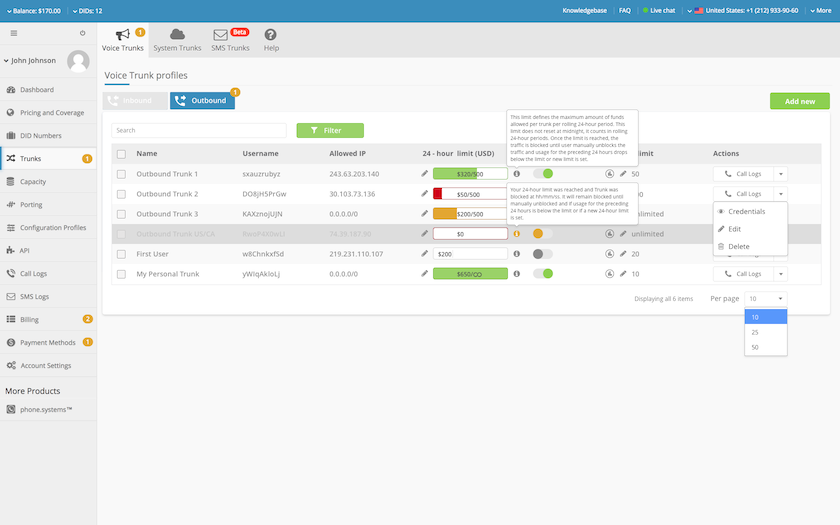
Flowroute is one of the thinQ alternatives for teams that want inbound numbers and a documented way to point a DID at primary and failover voice routes. Its public rate page lists domestic inbound at $0.005 per minute and outbound to the lower 48 U.S. states and Canada at $0.00833 per minute. Check destination pricing, number rental, and toll-free charges separately.
Where it fits. Put Flowroute among the thinQ competitors if your main priority is keeping inbound calls reachable during a PBX or site failure. A small contact center might use a normal SIP destination and a secondary path to a service desk or a different site. Ask what conditions trigger failover and which alternate destinations are supported in your plan.
What to test. Give each of the thinQ alternatives the same test number and two approved destinations with separate failure domains. Test an unresponsive primary and another case where the primary answers but fails to send usable audio. Keep records for both cases. Ask how the provider distinguishes the conditions and what the customer can see in reporting when traffic moves.
What to check before choosing it. Include concurrent traffic, number features, and escalation in the buying decision. A routing rule is useful when the backup path has enough capacity and operators know it is active. Ask thinQ competitors how failback works and keep a separate outbound migration plan if the current Commio setup uses selectable carriers.

8. Twilio Elastic SIP Trunking — Best for Application-Led Trunking
Twilio Elastic SIP Trunking is one of the thinQ alternatives for a team that already uses Twilio tools or wants the trunk configuration to sit beside related application services. Twilio lists U.S. local origination at $0.0034 per minute and lower-48 Zone 1 termination at $0.0100 per minute. Other U.S. zones and toll-free have distinct rates.
Where it fits. Compare Twilio with other thinQ competitors when software processes own number routing, trunk configuration, or support workflows. A team might use an existing Twilio application and maintain Commio or another supported carrier as an underlying voice component. Determine whether your objective is to move carrier traffic, move your application, or change both.
What to test. Place approved calls through each direction and follow the records for the trunk and any application charge. If Commio already connects to a Twilio workflow, diagram the current and proposed call legs and identify which provider controls each one. Ask thinQ alternatives to demonstrate a failover and show where your engineers can see call setup and delivery issues.
What to check before choosing it. Confirm which calls-per-second allowances, recording, storage, and extra metrics apply. Quote Elastic SIP and Voice API separately. Include number rental and operator work when you compare thinQ competitors. If Commio’s carrier-level decisions are important, test whether the proposed Twilio and carrier configuration gives your team the same level of control.
Compare thinQ Competitors on the Same Traffic
For a reference point, Commio’s public pricing page shows $0.007 per minute for lower-48 U.S. and Canadian outbound voice and $0.005 per minute for the corresponding local inbound reference. Check your contract and the rate deck tied to your routing profile. Commio’s public pricing also lists a 12-second minimum and six-second increments for inbound voice. Ask each vendor to rate the same set of calls so that changes in rounding do not look like changes in actual traffic.
| Cost Element | What to Measure | What to Ask thinQ Alternatives to Quote |
|---|---|---|
| Voice Usage | Counts and durations by direction, destination, origination context, and number type. | Rate, billing increment, defined routes, and any additional charges per call leg. |
| Number Inventory | Local, toll-free, and other number types by market, with new orders and ports separated. | Rental, activation, port terms, and whether messaging can remain on each number. |
| Peak Capacity | Simultaneous sessions, new call attempts per second, and any failover load. | What is included, what is capped, and which thresholds change the charge. |
| API and Media Features | Application minutes, recording, storage, callback traffic, and analytics. | Whether each item appears on the bill separately from the SIP usage. |
| Implementation and Support | Number-port coordination, engineering work, dual operation, and incident response. | Who owns each migration step, the support hours included, and escalation commitments. |
Worked Example With Domestic Traffic
Suppose a business has 80,000 already-billable outbound minutes and 20,000 already-billable inbound minutes. For this example, the calls are eligible local or lower-48 domestic traffic under each quoted reference. Use equivalent call types and rate bands when you price the same scenario. The arithmetic below excludes taxes, rental, optional features, minimum commitments, and any difference between elapsed and billed minutes.
| Provider | Calculation | Illustrative Voice Usage |
|---|---|---|
| Commio Baseline | 80,000 × $0.007 plus 20,000 × $0.005 | $660.00 |
| Signal House | 80,000 × $0.012 plus 20,000 × $0.005 | $1,060.00 |
| Telnyx | 80,000 × $0.005 plus 20,000 × $0.0032 | $464.00 |
| Flowroute | 80,000 × $0.00833 plus 20,000 × $0.005 | $766.40 |
| Twilio Elastic SIP Trunking | 80,000 × $0.0100 plus 20,000 × $0.0034 | $868.00 |
Use those figures as rate-card arithmetic, then get account-specific quotes from the thinQ competitors that fit your design. A supplier with a lower list rate can still cost more once you add number inventory, support, paid diagnostics, or application usage. For providers with route-specific or negotiated pricing, send the call distribution and compare the result against the current rate deck. A single average can hide a large difference for an important destination group.
Separate Elapsed Minutes From Billable Minutes
If 1,000 answered calls last 15 seconds each, they account for 250 elapsed minutes. With a 60-second minimum per answered call, the billed total is 1,000 minutes. With a 12-second minimum followed by six-second increments, the total for that same sample is 300 billed minutes. This is one reason thinQ alternatives can rank differently for reminders, call tracking, and customer support. Apply each provider’s rules to a set of actual call durations before comparing the price.
Also verify when one customer interaction creates several chargeable legs. A call can enter through a support number, transfer through the PBX, and forward to a mobile destination. Put the originating leg, termination leg, and any application feature in separate columns. Ask thinQ competitors how these records can be linked and which charges the customer can trace in the first invoice.
How to Test Whether a Provider Can Replace thinQ Routing
Test Routing Policy Against the Same Destinations
Choose a destination where every supplier should connect, a route with distinct caller ID requirements, and a group where you want a strict cost or policy cap. Use approved test numbers and ask the bidder to show the first path, an allowed alternate, and the result when the call falls outside policy. A usable evaluation compares how thinQ alternatives behave under the same conditions, including when the cheapest path is unavailable.
Decide which behaviors should stay inside your own PBX or SBC. Some teams want the capability to pick two trunks under separate agreements and choose between them. Others want a vendor to manage downstream paths inside one trunk. Draw both designs, identify who can observe each attempt, and ask thinQ competitors to explain the response options if a destination stops completing calls. Include enough context for your own operations team to repeat the test after the implementation team leaves.
Distinguish a Backup Target From a Backup Carrier
A second inbound destination is valuable when a PBX or application endpoint is unavailable. It may still depend on the same carrier, account, or upstream network. If an outage at a single provider would have a material impact, ask the shortlisted thinQ alternatives what happens under that specific failure. Include provisioning access, call handling, and how staff get a status update when the usual portal is unavailable.
Take the same approach on outbound. Record which provider receives the first attempt, what makes your system choose another trunk, and whether the recipient sees the intended number. Use timestamps and call identifiers to connect the application view to the carrier view. Ask thinQ competitors to demonstrate the observable part of the event rather than relying on a general availability figure.
Separate Duration and Destination From Call Quality
Track call setup time, answered calls, and audio behavior separately. Answer rate can change because the audience, time window, or destinations changed. Compare the same authorized test numbers and time windows where possible. Add a test for transfers, forwarded calls, and interactive menus. Give the shortlisted thinQ alternatives the same acceptance criteria so you can compare usable calling outcomes as well as network responses.
| Pilot Check | What to Change | What to Record |
|---|---|---|
| Outbound Policy | Test a permitted destination, a blocked destination, and a permitted fallback. | Selected policy, observable route details, call result, and billing entry. |
| Inbound Recovery | Take an approved test endpoint offline and restore it. | Time to reach the alternate, what the caller hears, and when the normal path returns. |
| Client Experience | Transfer a call, navigate an IVR, and check media in both directions. | Caller ID, digit handling, setup time, and audio result. |
| Records and Permissions | Have a support user investigate a call with one known failure. | Available call identifiers, logs, role limits, and escalation instructions. |
| First Invoice | Compare short and longer calls in both directions. | Rated destination, billed duration, additional legs, and per-call charges. |
Decide Which Routes Deserve a Separate Pilot
Segment traffic by the consequence of failure as well as its volume. A small number of calls to an after-hours service desk may matter more than a larger block of routine dial traffic. List the service, the permitted destinations, who can authorize a route change, and how long the backup needs to run. Compare those requirements with the capacity and contractual terms each finalist offers. For routes with an unusual destination or caller ID requirement, keep the test evidence and approval with the rollout plan. This gives procurement a way to weigh the cost of a second route against the disruption a failed call could cause.
How to Move From thinQ by Commio
Inventory Numbers, Routing Rules, and Application Dependencies
Build an inventory of numbers, voice profiles, callbacks, allowed destinations, and current usage. Mark which numbers support SMS or other services and which vendors own those components. Include support and reporting dependencies. Before asking thinQ competitors to submit a port, confirm the number type, account owner, billing details, and any restrictions that apply to the country or market. Request written confirmation for any number that cannot be replaced easily.
If emergency calling applies, coordinate with the responsible provider and local authorities and use an approved validation procedure for routing and location. List the responsibilities and evidence as part of the cutover plan. A standard test call is useful for checking ordinary behavior. Emergency-call acceptance requires its own authorized process.
Pilot One Call Direction Before Porting Numbers
If the design permits it, keep inbound numbers on Commio while testing some approved outbound traffic with a new trunk. Use a test group your operations team knows and can support. Record metrics and compare the current trunks with the shortlisted thinQ alternatives on the same traffic. When you compare the bill, check each call’s direction, destination, and whether the new rate applies. Retain the ability to route that cohort back while the pilot is running.
Separately test inbound on a new or temporary number and the intended failover destination. Run the normal call handling and any required messaging or recording features. Give users a way to report what changed and give support the call identifiers needed to trace a problem. Ask thinQ competitors to show how a problem would be diagnosed when the call crosses both systems during the transition.
Plan the Port and Its Dependencies
Before a port, match the current number inventory to the proposed destination and route. Decide whether some numbers can move together or whether a pilot should start at one site or customer. Confirm the authorized port date, which group can make changes, and who will send a status update. A SIP route change and a number port may have different recovery times. Confirm the available fallback with the gaining provider.
Once the carrier confirms completion, run authorized tests for inbound, outbound, and any linked services. Reconcile the first billing window before ending the overlap. Record any profile or number you intend to retain with Commio. Some thinQ alternatives work well as a secondary carrier in a mixed design, provided the support and routing boundaries are clear.
Decide What Happens to Your Rate Deck and Reports
Export the current route policies and rate decks your operations team is authorized to access. Record the effective date, which traffic classes use each deck, and who approves changes. If a new supplier describes a rate as wholesale or blended, ask how the individual rates reach your billing team and when changes take effect. A flat quote may simplify forecasts for one business, while a service provider with several retail plans may need destination-level records to protect its margin. Ask thinQ alternatives for an example of a rate change notice and its associated reconciliation file.
Make one person responsible for mapping the old and new status fields. A call may fail before a carrier accepts it, ring without an answer, or be answered and later disconnected. Your staff should be able to distinguish those events across the two services. Ask thinQ competitors to provide a sample of each event and describe when the final record becomes available. If an alert relies on a specific event today, demonstrate what will trigger it in the replacement. For a contact center, include the impact on reporting metrics the operations team uses in weekly reviews.
Check that your own systems can absorb the new data without losing visibility into historic calls. Keep several approved examples from the old environment and trace them in the intended archive. Include a call with a transfer or forwarding leg so the support team can investigate both the customer experience and the bill. The job of onboarding thinQ alternatives includes keeping the ability to answer questions about calls placed before the cutover.
Finally, agree on who opens each case during the transition. Your application provider might see the event while the carrier has the useful SIP record. Put both contacts on the same runbook and include the evidence each needs. A short pilot with a documented escalation is more informative than a successful call with an unfamiliar support process.
Frequently Asked Questions
Is thinQ the Same as Commio?
thinQ is part of Commio. The company announced the Commio rebrand after thinQ acquired teli, and documentation for voice routing is published under Commio. Compare the exact Commio service and account configuration you operate today.
Which thinQ Alternatives Support Selectable Outbound Carrier Routes?
Anveo Direct is the first option in this guide to investigate for selectable carrier or route choices. Compare policy settings, downstream visibility, rate caps, and route advancement on the account you would actually use. A provider can support SIP trunking and failover without offering selectable downstream carriers.
Which thinQ Competitors Fit Voice and Messaging Workflows?
Signal House and Telnyx are starting points for projects where voice and messaging need to work together. Bandwidth, Sinch, and Twilio may also fit depending on the markets and application. Verify number eligibility, porting, ongoing charges, and the requirements for each channel.
Can I Keep Twilio and Replace Only Commio?
Yes, if your Twilio and carrier products support the proposed arrangement. Some Commio deployments use a carrier connection while Twilio handles the application. Draw the existing and proposed call legs, verify who owns the number, and test each billable leg before moving traffic.
Which thinQ Alternatives Are Best for International DIDs?
DIDWW is a focused starting point for local numbers and inbound SIP capacity across markets. Also qualify Telnyx, Bandwidth, or Sinch where the deployment fits. Current local inventory and the ability to port a specific number need separate checks.
Can I Use Two thinQ Competitors at the Same Time?
Yes, if your infrastructure and agreements support it. You can select one supplier for inbound numbering and use a separate trunk for outbound or contingency traffic. Decide which system controls route choice and assign responsibility for support and billing at every handoff.
How to Use G2 Reviews and Pilot Results
The ratings in the comparison identify the product listing they cover. Signal House, Telnyx CPaaS, Bandwidth, and Sinch ratings refer to broader products or platforms, while the Twilio listing applies to Elastic SIP Trunking. Use reviews to spot questions about support and administration. For example, a review that mentions clear call logs is a reason to ask for a complete record of a failed call during your own pilot.
Ask shortlisted thinQ alternatives for a reference with a similar traffic mix and operating model. Ask how they counted minutes, how the first invoice compared with the proposal, and who handled the first routing issue that crossed carriers. An operator’s account of a failed call and its resolution can tell you more about support boundaries than a general rating alone.
Affiliate Disclosure. VoIPCalling may earn a commission through the Signal House partner link.