Signal House is worth considering for businesses and agencies that need SMS, MMS and programmable voice with usage-based pricing. Its main attractions are published communication rates, integration options and implementation support. The important limitations are carrier fees, registration requirements, product-specific pricing differences and the technical work needed for some calling workflows.
This Signal House review covers features, pricing, pros and cons, dashboard observations and buying considerations. Our assessment combines official documentation, the supplied dashboard image and accessible customer reviews. It does not claim first-hand account testing, independently measured deliverability or a guaranteed saving against another provider.
 ★★★★★ 4.8/5
- Best Fit: Messaging-led businesses, agencies and developers connecting communications to existing systems.
- Pricing Model: Usage, numbers and applicable carrier or registration charges.
- Evaluation Offer: New accounts are advertised with $25 in credit; confirm eligibility and how it is applied.
What Is Signal House?
Signal House describes itself as a communications platform as a service, or CPaaS, providing messaging and voice infrastructure. Its published products include business texting, messaging APIs and programmable calling. Think of the purchase in terms of the communication workflow you want to operate, including the application, customer records and employee responsibilities around it.
That distinction matters when comparing Signal House with a conventional business phone subscription. A phone system usually packages an employee calling experience. A CPaaS purchase may instead support an existing CRM, application or PBX. You should verify the ready-to-use tools and implementation work for your particular configuration before treating the two types of service as interchangeable.
Our Assessment: A Relevant Shortlist For Messaging-Led Work
The strongest reason to investigate Signal House is a specific messaging requirement: notifications, customer replies or an agency’s client communication workflow. Published rates let you begin a cost model, and the available integration material gives you concrete implementation questions to ask. That is more useful than selecting a provider from a broad promise of cheaper communications alone.
For a business that mainly wants employees to install a phone app and start calling, the evaluation should begin elsewhere: ask what the delivered calling experience includes. Signal House’s programmable voice offering can be relevant, but the existence of calling infrastructure does not establish that every employee calling feature, device or administrative workflow is supplied without additional setup.
Signal House Features: Messaging, Voice And Integrations
SMS And MMS For Customer Messaging
Signal House supports text and multimedia messaging, with local 10DLC, toll-free and short-code information published across its product pages. Choose the sender type around your actual use case, verification requirements and volume. A recognizable local number and a high-volume campaign sender serve different operational needs.
For a small service business, start messaging planning by deciding whether the purpose is a booking reminder, a customer reply or a marketing campaign. Those uses require different content, timing and ownership. The platform can provide transport, but your business still needs to decide which messaging updates should be sent and who acts when a recipient replies.
Signal House should be assessed against a complete example, such as a customer receiving an appointment reminder and asking to change the time. Check where that reply appears, whether the responsible employee sees it and how the resulting record is updated. A delivered message is an important step; it is not proof that the customer request has been resolved.
Messaging APIs And Developer Integration
The official API material describes endpoint documentation, request and response formats, error descriptions and SDK support. This is relevant when your product needs to trigger a message from an event rather than rely entirely on manual sending. Ask the Signal House technical team to demonstrate the smallest complete integration that matters to your business.
A useful Signal House proof of concept should include more than a successful messaging send request. Inspect inbound replies, delivery events, failure handling and how credentials are stored. If your application retries a request, determine whether the design can create duplicate messages. These are implementation checks to run with Signal House, not claims that we discovered defects in its API.
Developers should also assign an owner for ongoing maintenance. A working Signal House demonstration can fail later if the application changes or an employee leaves with the only knowledge of the connection. Keep a concise record of the sender, callback destination, credentials owner and support process so the integration remains manageable after launch.
Programmable Voice, SIP And Browser Calling
Signal House’s voice page describes SIP trunks and endpoints, browser WebRTC softphones, programmable profiles and webhook-controlled call handling. Its SHML responses can direct actions such as speaking text, collecting digits, recording or forwarding. These are documented building blocks; their presence does not demonstrate a finished workflow in your business.
This makes the service worth assessing if you already have a PBX or a development team building calling into an application. Ask Signal House to demonstrate the intended call path from a real incoming number to its final destination. Include an unanswered destination and a failed connection so your team understands what the caller experiences when the normal path does not complete.
The voice documentation also describes account controls, recording configuration and call logs. Review the settings appropriate to your deployment instead of assuming a default protects every use case. Decide who can change routing, which destinations are allowed and how employees request support when a call cannot be completed.
GoHighLevel For Agencies
Signal House’s integrations page describes native SMS and MMS in GoHighLevel and agency sub-account pricing controls. The separate voice integration has its own installation and billing documentation. Agencies should therefore evaluate messaging, calling and client rebilling as related but distinct configurations.
For an agency with 5 client accounts, test 1 representative client before rolling the connection across all 5. Check the sender, client-visible usage, replies and billing allocation. Confirm how an opt-out or account suspension affects that client. The goal is a repeatable client process, not merely a successful agency-level installation.
Ask Signal House which responsibilities remain with the agency. A support team may help with registration, but your agency still needs accurate client information and an appropriate consent process. Pricing controls also need a clear client messaging agreement so the amount billed to a customer matches the service your agency actually supplies.
Shopify, Medusa And No-Code Workflows
The integrations catalog lists Shopify, Medusa and Make.com, alongside developer and AI-tool connections. The Shopify description includes cart-recovery texting and two-way AI conversations. Check the exact app and plan before extending those claims to the general platform or another integration.
For an online store, evaluate whether the communication is helpful to a consenting customer and whether staff can take over an unusual request. Test an unavailable product, a discount question and a customer who wants messages to stop. An integration should improve the customer journey without creating promises the store cannot honor.
Signal House’s general homepage and integration catalog do not always use the same availability language for every connector. Treat that as a reason to verify the exact installation path and supported action. A roadmap mention should not be presented as a completed integration, and a catalog entry should be checked against the account you will actually purchase.
Throughput And Campaign Timing
Message volume and delivery speed are separate planning questions. A campaign that reaches 10,000 recipients over several hours has a different operational effect from a time-sensitive messaging alert intended to reach everyone immediately. Ask Signal House which sending limits apply to the chosen messaging sender, campaign and destinations, including how queued work is handled.
Consider a hypothetical store announcing a limited promotion. If customer replies arrive faster than employees can answer, increasing throughput alone will not improve the experience. Schedule an appropriate audience size and staff coverage, then inspect the response workload. Signal House should be evaluated against that complete process rather than an isolated speed claim.
Retry Handling And Application Failures
Plan what happens when your application does not receive the response it expects. A repeated send request could create an unwanted duplicate if the surrounding integration does not handle uncertainty correctly. Ask the technical owner how the system identifies an existing request, checks its status and decides whether another attempt is necessary.
Use a controlled Signal House test with fictional records and authorized destinations. Simulate an unavailable callback endpoint, an invalid destination and a temporary application failure, then inspect the resulting logs. These are proposed checks, not failures observed in this review. Agree who monitors incomplete work and how the business avoids sending the same notification repeatedly.
Finally, establish a fallback for important customer communication. A delayed routine messaging promotion may be tolerable, while an operational change may require an employee to contact the customer another way. Define that distinction before launch. The provider supplies part of the delivery process; your business still needs to decide what happens when the expected messaging result is missing.
Signal House Dashboard And Ease Of Use
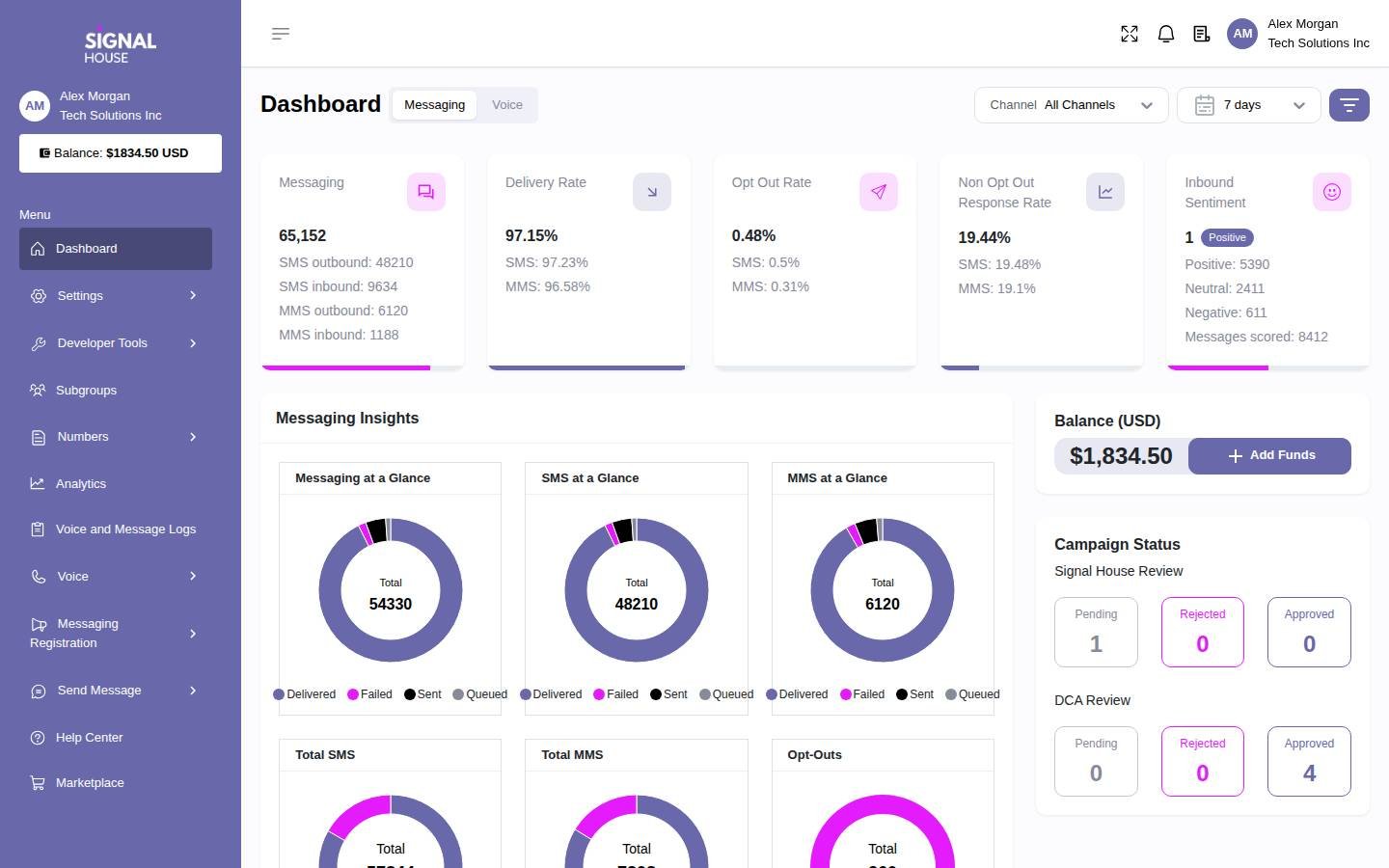
The supplied screenshot shows a messaging dashboard with volume, delivery, opt-out, response and sentiment panels. It also displays balance and campaign-status areas. The navigation includes numbers, analytics, message logs, voice, messaging registration and developer tools. These are direct observations of the image rather than claims about account access or current feature entitlement.
The layout brings several useful operational questions into one view. A messaging campaign owner could look for delivery problems, customer responses or funding status without starting from a generic activity total. However, an image cannot establish how quickly those values update, whether the filters work reliably or whether the interface is easy to use on a phone.
What To Check In A Live Demonstration
Ask Signal House to trace 1 message through the interface: submission, status update, reply and final business action. Then inspect a failed message and the information available to diagnose it. This reveals whether the dashboard supports daily decisions rather than simply displaying attractive charts.
Next, review the balance and messaging usage areas with a real example of the proposed billing model. Can the responsible employee identify why a message cost a particular amount? Is the number charge separate? Where are registration and carrier amounts shown? Clear answers reduce the chance of confusing a low transport rate with the full cost of a campaign.
For agencies, inspect how client data is separated and what access employees receive. For a smaller business, focus on whether a backup employee can understand the workflow when the main operator is absent. Ease of use should be judged against the people who will operate Signal House, not just against the knowledge of the person running the demonstration.
Signal House Pricing: Rates, Numbers And Extra Costs
Signal House’s published pricing page separates number rental, messaging, carrier pass-through charges and calling usage. The selected US starting rates below are not an all-inclusive subscription or a worldwide tariff. Confirm the sender type, direction and agreement applicable to your order.
| Item | Published Rate | Important Boundary |
|---|---|---|
| Local Messaging Number | $1/number/month at no-minimum volume. | Usage and registration separate; confirm voice enablement charges. |
| Outbound 10DLC SMS | $0.0065/segment at no-minimum volume. | Carrier fees additional; volume agreements can differ. |
| Outbound Toll-Free SMS | $0.0079/segment at no-minimum volume. | Verification and carrier charges still matter. |
| Outbound US Voice | $0.012/minute in the initial band. | Graduated tiers; answered-call rounding applies. |
| Inbound US Voice | $0.005/minute. | Number charges, tax and applicable surcharges separate. |
The voice terms specify a 1-minute minimum and rounding up thereafter; voicemail counts as answered. The homepage advertises $25 new-account credit. Do not call that an unlimited free plan or invent a trial duration.
SMS Segments Change The Meaning Of A Message Price
Signal House’s segment guide explains that a long text can contain several billable segments. Basic GSM text normally allows 160 characters for a single segment, or 153 per part for concatenated text. UCS-2 content uses smaller limits, commonly 70 or 67. Review actual encoding rather than estimating cost from the number of messages visible on a phone.
For example, sending a 310-character GSM text can use 3 segments. Sending that content to 1,000 recipients therefore creates 3,000 outbound segments before replies or retries. An emoji or another character outside the supported basic encoding can change the calculation further. Use the provider’s segment tooling with your actual copy.
Signal House pricing should consequently be evaluated with the messages your business intends to send. Prepare a reminder, a promotional example and a typical reply. Check each segment count before multiplying by audience size. This is often more useful than comparing a tiny difference in the headline rate while ignoring a substantial difference in message length.
A Simple Messaging Cost Example
At the selected local outbound base rate, 10,000 segments produce a $65 transport subtotal. If every segment hypothetically incurred a $0.005 carrier charge, that adds $50; with 1 local number at $1, the modeled subtotal becomes $116. The carrier assumption matches a listed outbound carrier rate but is not a prediction of your audience mix.
This calculation excludes registration, inbound traffic, tax and any external application. Signal House should provide the appropriate total using your actual sender and destinations. It would be misleading to describe $65 as the complete messaging campaign bill or to apply the same carrier assumption to every business.
A Voice Rounding Example
Suppose 100 answered outbound calls each last 65 seconds. With whole-minute rounding, that workload becomes 200 billed minutes, producing a $2.40 usage subtotal at the initial published outbound rate. Multiplying the unrounded elapsed duration by the rate would produce $1.30 instead. The $1.10 difference illustrates rounding, not a billing error.
Short calls make this distinction particularly important. Review your duration distribution, not just total connected time. Ask Signal House to calculate a representative call sample and identify all charged legs, recordings or other services relevant to your configuration. Keep number and external application costs outside the usage-only subtotal until they have been separately confirmed.
GoHighLevel Pricing Is A Separate Offer
The dedicated GoHighLevel help guide lists monthly options beginning at $20, plus a PAYG segment price that differs from the main rate card. Its table also presents message limits alongside per-message rates without fully explaining their relationship. Do not multiply those columns into an assumed invoice or treat them as the general CPaaS offer.
Ask Signal House whether a particular agency package represents included usage, a subscription, a commitment or another billing arrangement. Request a worked example at your expected volume and a busier volume. The voice integration likewise refers to its own pricing basis, so generic API voice rates should not automatically be substituted into a GoHighLevel quote.
Confirm Registration, Funding And Contract Conditions
Include brand registration, campaign registration, recurring campaign charges, funding requirements and number inventory in your quote checklist. Ask whether unused balances expire, how refunds work and what happens when funds become insufficient. These are questions to resolve, not fees or restrictions we assume apply universally.
Signal House uses pay-as-you-go language and offers negotiated volume arrangements, but each order still needs clear terms. A volume discount may involve conditions that differ from a small test account. Record the rates, minimums and cancellation requirements together so an apparently attractive unit price does not obscure the commercial commitment.
Signal House Pros And Cons
Pros: Reasons To Put Signal House On A Shortlist
- Visible pricing components: Published number, usage and carrier information supports an initial cost model.
- Messaging and voice options: Businesses can assess related communication requirements with the same provider.
- Agency messaging integration material: GoHighLevel documentation gives agencies a specific messaging implementation path to evaluate.
- Programmable calling: SIP and webhook capabilities are relevant to existing systems and custom applications.
- Positive support feedback: Accessible customer reviews describe helpful setup assistance, subject to individual experience.
The practical advantage is the ability to investigate a defined messaging workload. Signal House gives buyers several concrete items to evaluate rather than only a custom-price promise. That does not establish a universal advantage, but it helps a prepared buyer ask informed questions about costs and integration.
Cons: Limitations And Buying Risks To Resolve
- Infrastructure is not a complete workflow: Some buyers still need a CRM, application, PBX or implementation work.
- Usage has several components: Segments, carrier charges, numbers and registration affect the total.
- Documentation varies by product: Main-platform and agency-specific rates should not be mixed.
- Approval depends on more than the vendor: Registration assistance does not remove external review requirements.
- Roadmap wording needs checking: Availability language differs across parts of the public site.
These limitations are reasons to scope the purchase carefully, not evidence that the service is unsuitable for every small business. A company with an existing application and technical owner may find the infrastructure approach useful. A company expecting a complete front desk with minimal administration may have a different requirement.
Who Should Consider Signal House?
| Business Or Team | Why Evaluate It? | What To Confirm |
|---|---|---|
| Solo Operator Or Small Team | Customer updates and replies connected to an existing business process. | Daily operator, complete cost and how replies are handled. |
| Agency With Multiple Clients | Messaging integration and client-level cost allocation. | Sub-account controls, client consent records and rebilling. |
| Developer-Led Business | Messaging APIs and programmable call handling. | Failure handling, technical ownership and production support. |
| Store Or Service Company | Notifications, customer conversations or an eligible commerce integration. | Connector availability, supported actions and staff handoff. |
Small Businesses Need An Operator, Not Necessarily A Developer
A smaller team may use an existing integration rather than build a custom application. Even then, someone needs to understand the sender, balance, campaign status and incoming replies. Evaluate whether that responsibility fits the team’s capacity. Low usage costs do not make an unattended process successful.
Ask Signal House to demonstrate the recurring weekly work, including the tasks needed after a failed message or customer complaint. An owner who can comfortably handle those tasks may value the model. An owner who wants every communication decision delegated may need a more managed service or a simpler packaged application.
Agencies Should Validate A Repeatable Client Workflow
For agencies, the decision extends beyond the first successful messaging campaign. Consider how a new messaging client is verified, how numbers are assigned and how the client is billed for messaging. Keep the communication purpose and consent evidence specific to each client rather than assuming 1 account-level approval authorizes every campaign.
Signal House should be evaluated against a repeatable onboarding record with named owners. Include what happens when a client leaves, changes its business details or requests its numbers back. Commercial flexibility is most useful when the operational process remains clear as the agency grows.
Signal House Setup, Number Migration And Support
The number setup documentation distinguishes buying a number from moving an existing one. It also describes a soft-port arrangement that moves messaging while retaining voice with the current provider. Confirm eligibility, authorization and the effect on existing services before choosing the migration method.
Do not assume every number move transfers every service. Inventory voicemail, fax, messaging and calling dependencies first. A business can experience avoidable disruption if it changes one communication component without identifying the application or provider responsible for another.
A Practical Signal House Pilot
- Choose 1 sender and a narrowly defined communication use case.
- Prepare accurate business details and the required messaging registration information.
- Confirm the complete billing model and funded-account behavior.
- Connect the intended application or callback destination.
- Test delivery, reply handling, opt-outs and failures with authorized recipients.
- Review the resulting records and costs before increasing traffic.
This is a proposed evaluation plan, not a claim that we completed those steps. Signal House should help clarify the provider-specific messaging requirements, while your business owns the content, recipients and final workflow. Record both the expected result and the observed result rather than treating a sent status as the only acceptance criterion.
Ask About The Support Process Before You Need It
Request the support channel, escalation process and evidence needed for an investigation. A useful request may include the sender, destination, relevant identifier and description of the expected result. Avoid collecting or sharing unnecessary customer data merely to report a technical issue.
Signal House publishes support availability and volume-based support options, but responsiveness should still be assessed for your intended use. If your application sends time-sensitive notifications, ask how urgent incidents are distinguished from ordinary setup questions. Do not infer a service-level guarantee from an enthusiastic Signal House testimonial.
Reliability, Consent And Security Considerations
Published deliverability and savings claims are vendor marketing, not independent measurements in this review. Ask how a percentage is defined, what destinations it covers and which period or traffic type it represents. A rate measured on a particular campaign does not establish the result for your audience.
For Signal House evaluation, inspect both the technical delivery result and the business result. A delivered notification may still contain the wrong information, and an answered call may still fail to reach the intended employee. Keep these measures separate so a strong transport statistic does not conceal an incomplete customer process.
Registration Does Not Replace Consent Management
Carrier registration, recipient permission and appropriate message content are separate responsibilities. Ask the provider which acceptable-use rules and verification requirements apply to your workflow. Have the appropriate person review the business’s consent collection and opt-out handling before using customer data in production.
Do not treat an approved sender as blanket permission for unsolicited outreach. Signal House can provide communication infrastructure and assistance, but your organization still determines whom to contact and why. Keep records sufficient to support the intended Signal House use and ensure replies requesting a stop are handled through the agreed process.
Review Access, Data And Sensitive Workflows
Identify who can send messages, manage numbers, view recordings or change API credentials. Request details of authentication, retention, deletion and incident procedures relevant to your messaging account. Do not infer those controls solely from a dashboard screenshot or an integration logo.
For healthcare, financial or other sensitive applications, require the appropriate agreements and an approved workflow before sending protected information. This review does not establish a signed BAA, certification or legal suitability for your deployment. Industry marketing alone is insufficient evidence for that conclusion.
Signal House Alternatives And Competitors
Twilio, Bandwidth, Plivo, Vonage and Sinch are relevant CPaaS comparison candidates because buyers may be evaluating similar underlying communication requirements. Compare the services you actually use, destination mix, technical effort and support terms. Signal House should not be declared a complete replacement for every competitor product merely because both offer messaging APIs.
To compare costs, request quotes for the same sender count, segments, carrier mix and billable calling minutes. Include application subscriptions and migration effort. A competitor’s higher transport rate may accompany a feature you need, while a cheaper route may reduce costs for a narrower workload. Let the workload determine the comparison.
When A Packaged Phone System Is The Better Comparison
If employees mainly need a shared business calling experience, assess a packaged phone system alongside the infrastructure option. Our Nextiva review covers a broader business-phone purchase. It is a different evaluation from choosing a messaging API or a programmable calling route.
Similarly, a business that wants automated reception should compare a complete intake and handoff workflow. Our AI receptionist software guide helps frame that shortlist. Do not assume Signal House’s transport components automatically provide the same ready-made receptionist experience.
When To Keep The Existing Provider
Keeping your current setup can be sensible if the measured saving is small, the integration is complex or a critical feature is missing from the proposed replacement. Ask Signal House for a staged comparison before committing the full workload. A controlled Signal House pilot provides more useful evidence than a broad claim of zero migration risk.
Document what would justify a switch to Signal House: an acceptable total cost, required functions, usable support and a tested fallback. If those conditions are met, the service can earn its place in your stack. If they remain uncertain, defer the larger migration while resolving the specific gaps.
Final Assessment: Is Signal House Worth Considering?
Signal House is a credible shortlist candidate for messaging-led businesses, agencies and developers that can define their communication workflow and evaluate usage-based costs. Its published pricing and technical product descriptions provide a useful starting point, while customer feedback offers evidence of positive onboarding experiences.
The purchase should follow verification of the exact product, integrated application, rate structure and operational responsibilities. Prioritize a pilot that confirms delivery, replies, number behavior and billing. Signal House is most compelling when those checks demonstrate a useful improvement for your business rather than simply a lower advertised unit rate.
Frequently Asked Questions About Signal House
Is Signal House A Business Phone System?
Signal House provides messaging and programmable voice infrastructure, including calling components. Whether it satisfies your complete employee-phone requirement depends on the configuration and application. Ask for a demonstration of your required daily calling experience before treating it as an all-in-one phone-system replacement.
Does Signal House Offer A Free Trial?
The official site advertises $25 in credit for new accounts. That is a credit-based evaluation offer, not evidence of an unlimited or fixed-duration free trial. Confirm eligibility, activation requirements, usable services and what happens when the credit is exhausted.
Is Signal House Cheaper Than Twilio?
It may be cheaper for a particular workload, but the saving must be calculated from comparable quotes. Include numbers, segments, carrier charges, voice rounding and implementation. Vendor comparison claims do not establish the saving for your traffic or prove equivalent coverage of every feature.
Can I Keep My Existing Number?
Potentially, subject to eligibility and the migration method. The documentation distinguishes messaging-only moves from broader number transfers. Ask Signal House to confirm which services move and which remain with your current provider before authorizing any change.
Does Signal House Integrate With GoHighLevel?
Yes, it publishes GoHighLevel integration and setup documentation. Confirm the messaging package, voice configuration and agency rebilling terms separately. An agency-specific price or installation instruction should not automatically be applied to a general platform account.
How Quickly Can I Start Sending?
That depends on verification, sender type and application readiness. Published approval estimates and individual reviewer experiences are not guarantees for every account. Build time for corrections and carrier review into your launch plan rather than promising customers an unverified activation date.
Who Should Choose A Different Provider?
Consider another option if you require a specific unsupported feature, a fully managed receptionist or a simpler employee-phone package than the demonstrated setup provides. Compare the complete workflow and ongoing administration rather than rejecting or selecting a platform from its headline price alone.
Signal House Customer Reviews: Positive And Critical Feedback
G2 displays a 4.8/5 score for Signal House. In an accessible 5/5 review, Ismail A. praised professional support and onboarding explanations. Another 5/5 reviewer, The T., described helpful setup and a clean dashboard, while requesting clearer voice guidance. Their statement about missing voice prices should be read against the current public rate card.
In a separate 5/5 G2 review, aurang z. praised registration assistance but wanted clearer notice of a funding threshold. That is an individual account experience, not a verified universal minimum. Ask about your own funding rules and setup requirements. These paraphrases are customer opinions, not our testing results or a guarantee of support performance.
Affiliate Disclosure: We may earn a commission if you purchase through our recommendation links, at no additional cost to you. This review uses published information, a supplied dashboard image and customer-review evidence; it does not report hands-on account testing.