
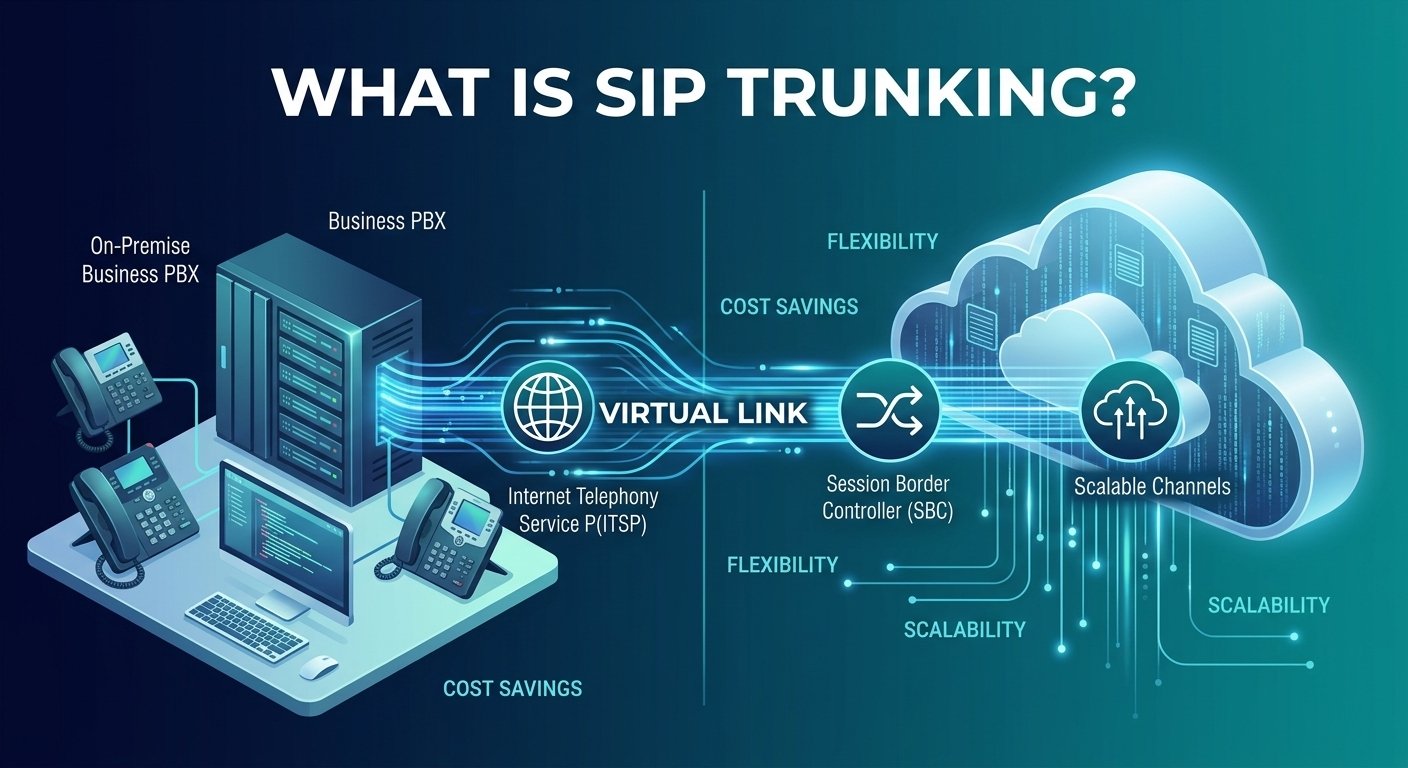
Sip trunking is a modern communication technology that allows businesses to make and receive phone calls over the internet rather than through traditional physical phone lines. By using the Session Initiation Protocol, it connects an on-premise private branch exchange to the public switched telephone network via a virtual link.
This digital transformation enables companies to consolidate voice and data services into a single network, significantly reducing infrastructure costs while improving call quality. It serves as a bridge between legacy hardware and the cloud, providing the flexibility to scale channels up or down based on real-time business requirements.
What Is SIP Trunking?
Business communications have undergone a massive shift from legacy hardware to internet-based connectivity. At its core, sip trunking is the digital version of a traditional phone line. While a traditional line uses physical copper wires to connect a business to the telephone company, this technology uses your existing data connection to route voice traffic. It allows a business with an on-site phone system to send and receive calls digitally, utilizing voice over internet protocol technology to manage sessions effectively.
The adoption of this technology is growing rapidly across various industries. According to research from the Eastern Management Group, nearly 80% of businesses have migrated or are currently planning to migrate to sip trunking because it offers a significantly lower total cost of ownership compared to legacy circuits. This shift is also driven by the global phase-out of traditional analog lines, as telecommunication providers move toward entirely digital infrastructures.
Core components of SIP trunking
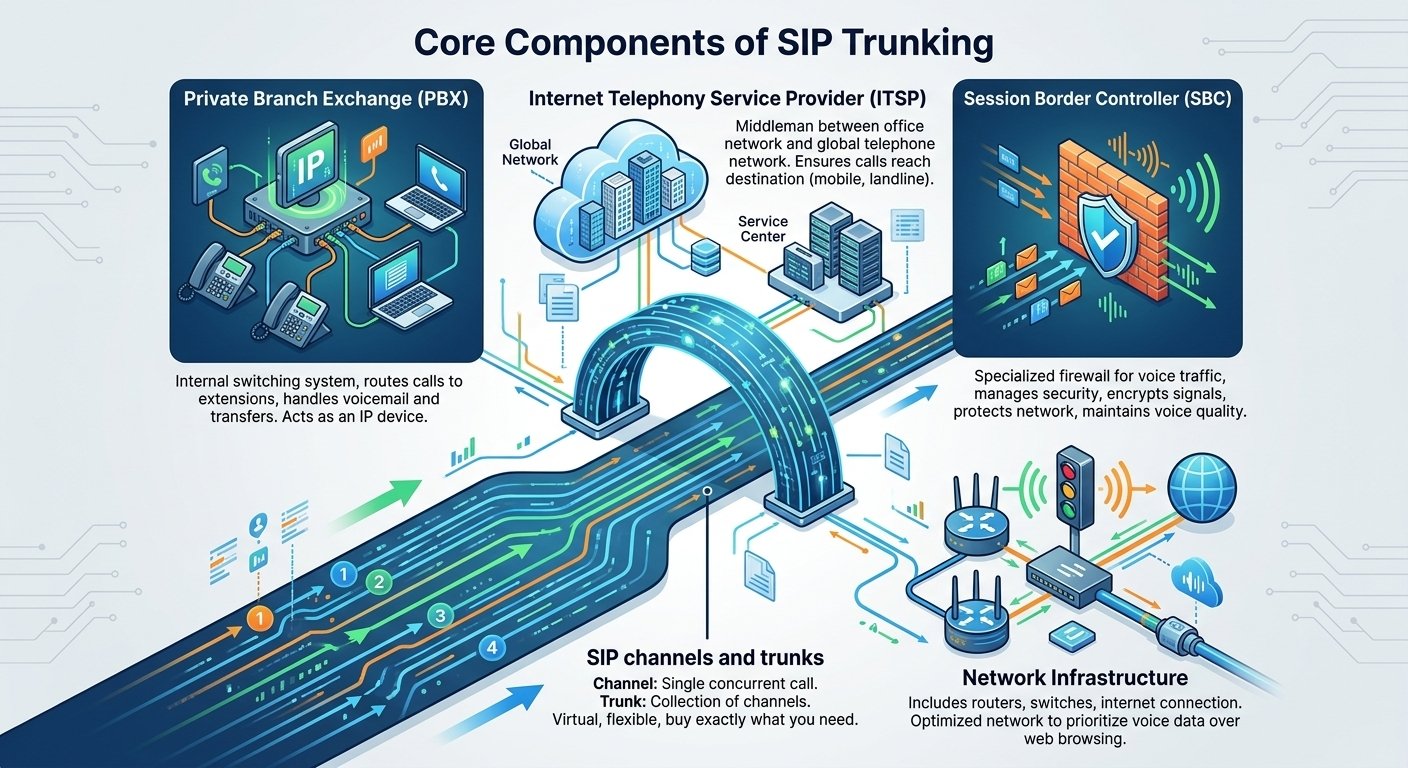
To understand the sip trunk meaning, you must look at the different parts that make the system functional. Each component plays a specific role in ensuring that voice data travels securely and clearly from one point to another.
-
Private branch exchange (PBX): This is the internal switching system used within a business. It manages how calls are routed to different extensions and handles features like voicemail and call transfers. In this setup, the PBX is typically an IP-enabled device that can speak the language of the internet.
-
Internet telephony service provider (ITSP): This is the company that provides the actual sip trunking service. They act as the middleman between your office network and the global telephone network, ensuring your calls reach their destination regardless of whether the recipient is on a mobile phone or a landline.
-
Session border controller (SBC): Think of this as a specialized firewall for voice traffic. The SBC manages security by encrypting signals and protecting the network from unauthorized access or service attacks, while also maintaining high voice quality.
-
SIP channels and trunks: A channel represents a single concurrent call. A trunk is a collection of these channels. Unlike physical lines that come in fixed bundles, virtual sip trunk options allow you to buy exactly the number of channels you need.
-
Network infrastructure: This includes your routers, switches, and the actual internet connection. For a telephony sip trunking setup to work perfectly, the network must be optimized to prioritize voice data over standard web browsing traffic.
How Does Session Initiation Protocol (SIP) Trunking Work?
The process starts when a user initiates a call from a sip trunk phone system. The system uses the protocol to establish a session between the caller and the receiver. It sends digital packets of information across the internet, which are then reassembled into audio at the other end. This happens almost instantaneously, providing a seamless experience that feels identical to a traditional phone conversation but with much higher clarity.
Direct inward dialing is a major part of how this works in a professional setting. With a sip trunk line, a provider can assign multiple phone numbers to a single connection. This means every employee can have their own direct number without the business needing to pay for dozens of physical lines. The sip routing technology identifies the incoming number and directs the call to the correct desk or mobile app within the company network.
A significant technical advantage is the use of sip trunk integration with existing data networks. Instead of maintaining two separate sets of wiring—one for phones and one for computers—everything runs over the same fiber or broadband connection. This unification simplifies IT management and allows for more advanced call trunking features, such as automatic failover to a secondary internet connection if the primary one fails.
Benefits of SIP Trunking
Implementing a sip trunking solution offers several advantages that go beyond simple voice calls. It changes the way a business interacts with its customers and manages its internal resources.
1) Cost savings and efficiency
One of the most immediate advantages of sip trunking is the reduction in monthly expenses. Traditional phone companies often charge high fees for physical line maintenance and long-distance calls. Because sip trunking over internet connections bypasses these legacy networks, businesses often see their communication bills drop by as much as 50%. There is also no need to purchase expensive hardware every time you want to add a new line, as everything is handled through software configurations.
2) Virtual presence
With a sip trunk voip setup, your physical location no longer limits your business identity. You can have local phone numbers in different cities or even different countries, regardless of where your office is actually located. This creates a sense of local presence for customers, which can increase trust and improve sales conversion rates. It also allows remote employees to appear as if they are calling from the main office, maintaining a professional image.
3) Room for growth and scalability
Scalability is a core feature of business sip trunking. In the past, if a company grew, they had to wait for a technician to come out and install new physical lines. With voip sip trunks, adding capacity is as simple as updating your service plan. You can add one or one hundred channels instantly to handle peak seasons or permanent expansion. This flexibility ensures that you are never paying for more capacity than you actually use.
4) Reliable technology
Modern sip trunking services are designed with high redundancy. If an office experiences a power outage or a local network issue, calls can be automatically rerouted to mobile phones or other branch offices. This level of business continuity is difficult to achieve with analog systems. Many providers offer a 99.99% uptime guarantee, ensuring that your voice sip trunking stays active even during unexpected local disasters.
Drawbacks of SIP trunking
While the benefits are extensive, there are certain challenges that organizations must consider before making the switch. Understanding these allows for better planning and mitigation strategies.
1) Dependence on internet connectivity
The most significant risk is that an internet sip trunk is entirely dependent on your web connection. If your internet goes down, your phone system goes down with it. Unlike old landlines that had their own power source, voip trunks require a functioning data link. To solve this, most businesses invest in a secondary internet provider to act as a backup, ensuring that the sip trunk connection remains stable even if one line fails.
2) Quality of Service (QoS) issues
If your network is not properly configured, you might experience issues like jitter or lag. This happens when the network treats voice data the same as a large file download. To prevent this, IT teams must implement QoS settings on their routers. This ensures that voip sip trunking traffic is always given the highest priority, maintaining crystal-clear audio even when the network is busy with other tasks.
3) Security vulnerabilities
Because the system operates over the internet, it can be susceptible to hacking or toll fraud if not properly protected. Standard ip trunking security involves using encrypted signals and strong authentication protocols. Utilizing a session border controller is a vital step in safeguarding the system from external threats. Organizations must also keep their PBX software updated to patch any known vulnerabilities that could be exploited by bad actors.
4) Power dependency
Since SIP phones and network routers require electricity, a power outage will silence the phone system. Traditional analog phones could often work during blackouts because they drew power from the phone line itself. Businesses using a telephone sip trunk must ensure they have uninterruptible power supplies or backup generators in place for their critical networking equipment to maintain communication during emergencies.
PRI vs. SIP Trunking vs. VoIP
Understanding the differences between these technologies is crucial for making an informed decision about your communication infrastructure. While they all handle voice, their methods and flexibility vary greatly.
| Feature | PRI | SIP Trunking | VoIP |
| Technology | Traditional phone lines | Internet Protocol (IP) | Internet Protocol (IP) |
| Scalability | Limited, requires physical lines | Highly scalable, no physical limits | Highly scalable, no physical limits |
| Cost | Higher maintenance and scaling | Lower costs, no physical expenses | Lower costs, no physical expenses |
| Mobility | Limited to physical locations | Supports remote workers | Supports remote workers |
| Features | Basic voice calling | Protocol dependent (e.g. SIP) | Advanced (Video, App integration) |
| Flexibility | Rigid, aging technology | Flexible, adaptable to needs | Flexible, adaptable to needs |
| Future-proof | May become obsolete soon | Future-proof using IP networks | Future-proof using IP networks |
How much does SIP trunking cost?
The cost of this service is generally much lower than traditional alternatives, but it varies based on the specific needs of the business. Most providers offer two main pricing models: metered and unmetered. Metered plans charge a small monthly fee per channel and then a per-minute rate for calls, which is ideal for businesses with low call volumes. Unmetered plans offer a flat monthly rate per channel for unlimited calling, providing predictable costs for call-heavy environments.
Additional costs may include the initial setup fees and the price of an SBC if one is required for security. However, since the technology uses your existing internet, there are no recurring costs for separate physical lines. According to recent industry data from various sip trunk news sources, businesses typically save between 30% and 60% on their total monthly telephony expenses after switching to an ip sip trunk.
What to look for in a SIP trunk provider
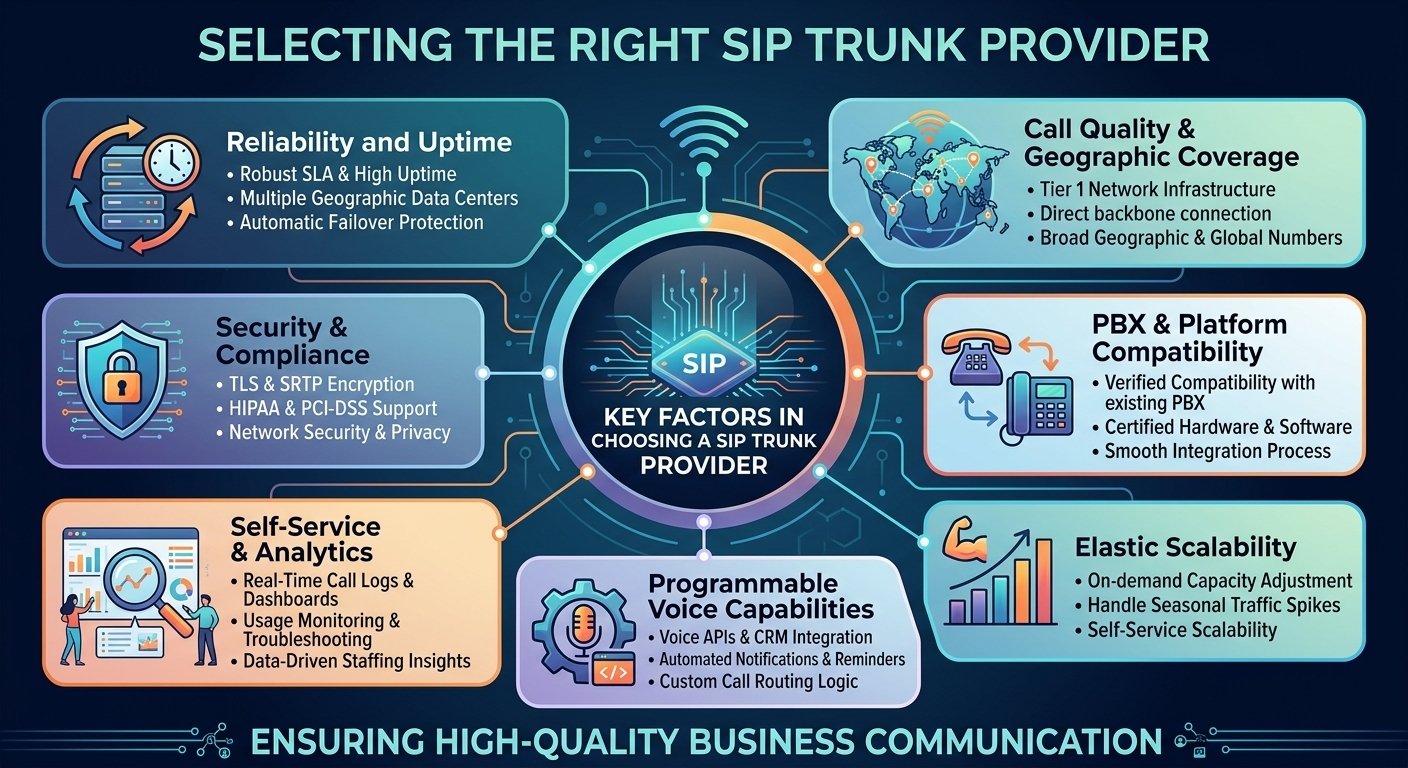
Choosing the right partner is essential for a successful transition. Not all providers offer the same level of service, and the quality of your business communication depends on their infrastructure.
-
Reliability and uptime
Look for a provider that offers a robust service level agreement with high uptime guarantees. Reliable sip trunking services use multiple data centers across different geographic regions. This ensures that if one data center goes offline, your traffic is automatically moved to another, preventing any service interruption for your customers.
-
Call quality and geographic coverage
A provider should have a “Tier 1” network, meaning they connect directly to the backbone of the internet. This reduces the number of hops a call takes, which improves clarity and reduces delay. Additionally, ensure they offer numbers in the regions where you do business. Global coverage is a major advantage of a virtual sip trunk if you plan to expand internationally.
-
PBX and platform compatibility
Before signing a contract, verify that the sip trunking service is compatible with your specific PBX model. While the protocol is standardized, different manufacturers may have slight variations in how they implement features. Most top-tier providers maintain a list of certified hardware and software platforms to ensure a smooth integration process.
-
Elastic scalability
Your provider should offer elastic sip trunking, which allows you to adjust your capacity on the fly. This is particularly important for seasonal businesses that may need hundreds of extra lines in December but only a few in July. The ability to manage these changes through a self-service portal without calling a sales representative is a major convenience.
-
Security and compliance
Ensure the provider supports TLS (Transport Layer Security) and SRTP (Secure Real-time Transport Protocol) for encryption. If your business is in the healthcare or financial sector, check if the provider meets specific regulatory standards like HIPAA or PCI-DSS. Security is a non-negotiable aspect of any modern sip trunking definition.
-
Self-service and analytics
A good sip trunking service should provide a user-friendly dashboard. This allows you to view real-time call logs, monitor usage patterns, and troubleshoot issues. Analytics can help you identify peak calling times, which allows you to staff your customer service teams more effectively based on actual data.
-
Programmable voice capabilities
For businesses that want to innovate, look for providers that offer APIs. This allows you to integrate voice functions directly into your own software or CRM. Features like automated appointment reminders or custom call routing logic can be built on top of the sip trunking definition, adding immense value to your business processes.
Possible real-world examples of SIP trunking in action
Seeing how this technology is applied in different scenarios can help you visualize how it might benefit your own organization.
Example 1: Scaling a seasonal contact center
A retail company experiences a 500% increase in call volume during the holiday season. By using an elastic sip trunking solution, they can instantly add 50 new channels to their existing PBX. Once the holiday rush is over, they scale back down to their original capacity, ensuring they only pay for the extra resources when they actually need them.
Example 2: Supporting a hybrid global workforce
A consulting firm has employees working from home across three different continents. By implementing a private sip trunk, they provide every employee with a softphone app on their laptop. Even though workers are in different time zones, they can all make calls from the same corporate number, and internal calls between them remain free of charge.
Example 3: Modernizing legacy PBX systems
A manufacturing plant has a reliable but older PBX system that is not ready for the cloud. Instead of replacing all their desk phones and wiring, they install a sip adapter. This allows the old hardware to connect to a modern sip trunk service, giving them access to lower international rates and digital call quality without a massive capital expenditure.
Example 4: Adding AI voice automation to customer interactions
A healthcare provider uses sip trunk integration to connect their phone system to an AI-powered virtual assistant. When patients call to book an appointment, the AI handles the initial request over the sip trunk line. This reduces the workload on the front desk staff and provides patients with 24/7 service without needing a human operator on standby.
Read More: Is Wireless Caller Spam? Meaning & Benefits
Final Words
The transition to sip trunking represents a significant milestone in the modernization of business communications. By moving away from rigid, expensive physical lines and embracing the flexibility of the internet, organizations can achieve a more agile and cost-effective telephony infrastructure. Whether you are looking to reduce monthly bills, support a remote workforce, or simply ensure your business is ready for the future, this technology provides the necessary foundation. As the global telecommunications landscape continues to phase out analog systems, adopting a reliable sip trunk service is no longer just an option but a strategic necessity for staying competitive in a digital world.
SIP Trunking FAQs
-
What does SIP stand for in SIP trunking?
The acronym stands for Session Initiation Protocol. It is a specific set of rules used in multimedia communication to start, manage, and end a data session between two or more participants. While it is most commonly used for voice calls, it can also manage video and instant messaging.
-
Can SIP trunking work with my existing PBX?
Yes, most modern PBX systems are already compatible with this technology. If you have an older analog PBX, you can still use it by adding a specialized piece of hardware called a gateway. This device converts the analog signals into digital packets, allowing you to enjoy the benefits of a sip trunk without replacing your entire phone system.
-
How many SIP channels does my business need?
The number of channels you need depends on your peak volume of simultaneous calls, not your total number of employees. For example, a company with 50 employees might only ever have 10 people on the phone at the exact same time. In this case, you would only need 10 channels. Most providers make it easy to add more if you find your customers are getting busy signals.
-
Is SIP trunking secure?
It is very secure as long as you implement standard protection measures. Most providers offer encryption for both the signaling and the actual voice data. Using a session border controller and ensuring your internal network has a strong firewall are the best ways to keep your communication private and prevent unauthorized access.
-
What’s the difference between SIP trunking and PRI?
The main difference is the underlying technology. PRI relies on physical copper wires and is limited to 23 channels per line. It is often expensive and difficult to scale. Conversely, sip trunking uses your internet connection and can scale to an unlimited number of channels instantly, usually at a much lower cost.
-
Do I need a dedicated internet connection for SIP trunking?
While it is not strictly required, many businesses choose to have a dedicated connection for their voice traffic to ensure the highest quality. If you use a shared connection, you must configure Quality of Service settings on your router. This ensures that a large file download in the office doesn’t cause your phone calls to sound choppy or drop.
-
Can SIP trunking support remote workers?
Yes, this is one of its greatest strengths. Because the system is internet-based, employees can connect to the business phone system from anywhere in the world using a softphone app on their computer or mobile device. They can make and receive calls as if they were sitting at their desk in the main office.
-
What happens to calls during a network outage?
If your internet goes down, most providers offer automatic failover routing. You can pre-set the system to forward all incoming calls to a mobile phone or a different office location. This ensures that you never miss an important customer call, even if your local office is experiencing technical difficulties.
-
Is SIP trunking only for large enterprises?
No, it is highly beneficial for businesses of all sizes. Small businesses often benefit the most from the cost savings and the ability to look more professional with features like auto-attendants and local numbers in multiple cities. Because you can buy as few as one or two channels, it is a very accessible solution for startups and small shops.