
The best TeleCMI alternatives for India-based teams are Exotel for configurable cloud telephony, MyOperator for a shared business helpline, and Ozonetel for a staffed contact centre. Knowlarity is also worth comparing for an inbound IVR deployment. For teams that primarily use US or other international numbers, KrispCall and Calilio are practical options for shared calling. CallHippo and JustCall cover different outbound and CRM workflows.
The most important difference between TeleCMI competitors is what each one will actually provision for your business. A number customers can dial from India, an Indian caller ID your agent can present, and permission to use the route for a particular outbound activity are three separate questions. A toll-free support service can work for the first requirement and still leave your agents without an approved callback route.
Start with your busiest customer journey. If customers reach you on an existing Indian number, ask for confirmation of that number, its inbound routing, who can answer it, and how agents return a missed call. If your team works internationally, test its actual destinations and confirm which tariff applies to each country. That complete interaction is the basis for comparing TeleCMI alternatives throughout this guide.
TeleCMI Alternatives at a Glance
| If You Need | Compare First | Decision Test |
|---|---|---|
| A domestic customer helpline and callback | Exotel, MyOperator, Knowlarity | Prove inbound and outbound on the authorised numbers from the proposed agent locations. |
| Managed queues and campaign supervision | Ozonetel, Exotel | Run a busy-period simulation with supervisor monitoring and reporting. |
| Shared international calling for a small team | KrispCall, Calilio | Test number availability, named ownership of missed calls, and international rates. |
| Sales calling tied to a CRM | CallHippo, JustCall | Demonstrate approved caller ID, accurate call logging, callback ownership, and suppression. |
What You’re Replacing When You Leave TeleCMI
TeleCMI markets cloud business calling alongside contact-centre tools. Depending on the product and plan, businesses use it for virtual numbers, IVR menus, incoming call distribution, call records, reporting, and agent calling. Its India business phone and contact-centre offerings should each be compared with the corresponding offer from TeleCMI competitors. Separate them into distinct line items if your current account includes both a team phone system and dedicated campaign or queue operations.
For some companies the entire operating model is a greeting, a group of people who can answer, and a report of the calls they missed. Other organisations run multiple queues with staff schedules, quality reviews, an outbound dialler, and integrations that update tickets or leads. Adding a cloud phone system to the second group can cover employee conversations while leaving the operations team short of its core tools. A single support hotline can also be unnecessarily expensive on a large contact-centre package.
Before meeting TeleCMI competitors, pull data for a representative billing cycle. List every published number, the departments that own it, when each department answers, peak concurrent calls, routing destinations, and the reasons customers call. Pull labelled examples of callback, transfer, new-lead, and after-hours activity. Record which actions currently live in the phone platform and which live in your CRM, help desk, or another service.
Review TeleCMI alternatives against three deliverables for each critical line. First, a contract or order form should name the actual number or approved number type. Second, a route diagram should show where calls go during normal service and during a failure. Third, a sample invoice should identify how each call path is charged. Assign someone from operations to approve each deliverable before purchasing seats.
This guide compares official product documentation and public pricing examples with G2 product profiles where ratings are published. Provider order highlights shared phone options first and then covers India-specific telephony, contact centre, and outbound sales use cases. Team sizes below describe useful pilot scenarios. They do not express licence minimums or maximums unless specifically stated.
Compare TeleCMI Competitors by Price and Use Case
| Provider | Best For | What to Verify | Pricing & Evaluation |
|---|---|---|---|
KrispCall  | Shared international numbers and small-team calling | Confirm the caller ID, rates to India, and transfer features. Starter supports up to five users. | US$12/user/monthStarter, billed annually. Advance is US$32 per user per month, billed annually.Partner 7-Day Free TrialStart a 7-Day KrispCall Free Trial |
Calilio  | International phone workflows and call supervision | Outbound calls to India need an international number. Check monitoring tier, destinations, and limits. | US$12/user/monthStandard, billed annually. Premium is US$28 per user per month, billed annually.Demo AvailableRequest a Calilio Demo |
Exotel  | India-focused cloud telephony and programmable IVR | Confirm number eligibility, credit usage, peak capacity, and which APIs and contact-centre features are included. | ₹9,999 per Dabbler packFive months, three agents, one Exophone, and 5,000 credits in the published pack.See Exotel Voice Pricing |
MyOperator  | India-based helplines and missed-call tracking | Confirm voice-only scope, number ownership, branch routing, and optional messaging or AI charges. | Request a voice quoteA published 1800 toll-free add-on starts at ₹500/month. Base package and usage are separate.See MyOperator Pricing |
Ozonetel CloudAgent  | Contact-centre operations and supervisor workflows | Quote peak agent count, queue controls, campaign tools, recordings, and regional calling. | Request a regional quotePublished North American rates are scoped to that region. Ask for an India-specific plan when applicable.See Ozonetel Pricing by Region |
Knowlarity  | Inbound IVR and branch routing in India | Request the exact virtual number, allowable forwarding paths, outbound scope, and usage commitments. | Request a plan-specific quotePublic pricing covers several voice packages. Compare the package for your number and call flow.See Knowlarity Voice Pricing |
CallHippo  | Small-team outbound calling and call analytics | Get written confirmation of the Indian number type, eligible traffic, caller ID, and included routes. | US$0 base on BasicPublished Basic seat rate. Price numbers and usage and ask which tier includes your dialler.See CallHippo Plans and Add-Ons |
JustCall  | CRM-linked outbound sales or eligible international support | The India toll-free option is inbound-only for eligible businesses outside India. Calls must be answered abroad. | US$29/user/monthPublished Team annual reference with a two-user minimum. India toll-free is US$25 per number monthly.See JustCall Pricing |
Pricing examples use the provider’s displayed currency and billing unit. Ask for a written quote that includes your country, number type, destinations, contract length, tax treatment, usage scope, and any setup charge. G2 review counts change and some profiles cover a broader product family than the package being quoted. Use the product label next to the score to keep those scopes clear.
1. KrispCall For Shared International Business Calling
Best for a team of roughly three to five people managing customer calls on shared numbers in supported markets. Put KrispCall among your TeleCMI alternatives when a distributed team needs visibility into the same conversations from each user’s app. A small software company with a US sales number, for example, can test whether reps in different locations see the same call history and can route callbacks to the person responsible for the lead.
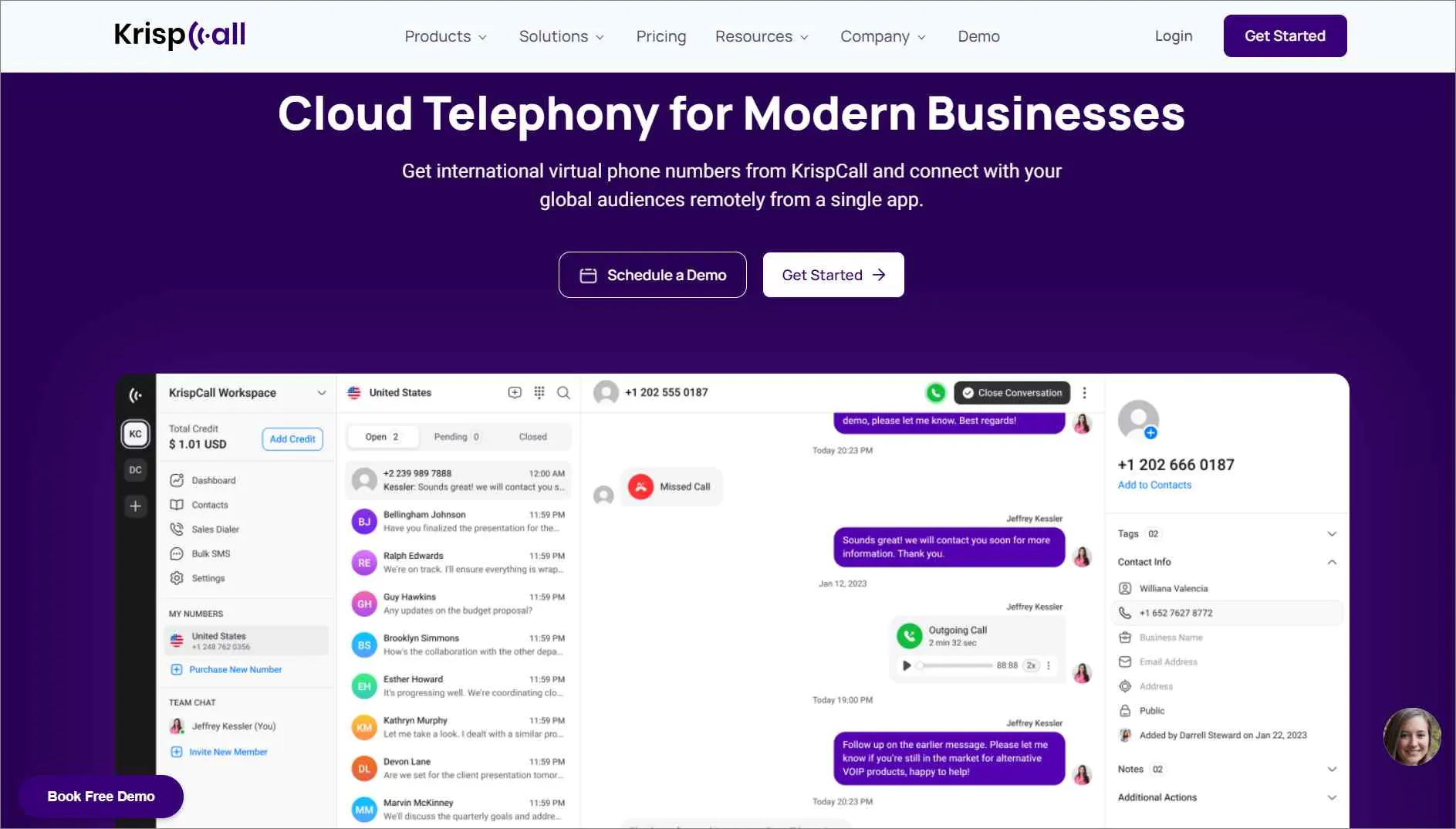
KrispCall offers a shared calling workspace that brings call activity and messaging together. For a small team comparing TeleCMI competitors, its most relevant question is how reliably teammates can pick up from one another. Ask two teammates to handle calls in the same number’s workspace. Have the first mark a follow-up, transfer a caller, and leave a note. Check whether the second can identify the latest owner and start a callback from the right line. Run the exercise on desktop and mobile if both are part of your workflow.
The advertised Starter size cap matters if seasonal workers or managers need their own access. Ask whether administrators or supervisors consume seats and which tier provides the routing, integrations, and history you need. Set expectations for voicemail ownership and after-hours availability during the trial. A shared workspace may show that a call was missed even if the follow-up still belongs in a CRM task. Choose one place as the source of truth and assign the step to a role.
India check. Ask KrispCall to confirm your exact number country, the caller ID other people will see, and how your account will be charged for calling the Indian destinations you use. Its help guidance identifies Indian 000 800 toll-free destinations as unsupported for outbound calls. If your team regularly reaches suppliers or customers on those numbers, keep a route for that traffic and validate it before deciding whether to use KrispCall as the principal system.
Pilot goal. Start A 7-Day KrispCall Free Trial through VoIPCalling’s partner offer. Choose one low-risk international line and give every test call an assigned owner before its next shift. Use Advance or an eligible higher plan if transfers are part of your trial. Include voicemail, a call abandoned before answer, a transfer, and a customer who calls back later. The trial can show whether the workspace fits your team while number approval and any porting dates are checked separately. Keep those checks on the same schedule for the TeleCMI alternatives you pilot.
2. Calilio For International Teams That Need Call Supervision
Best for sales or service teams of about five to 25 people that use supported international numbers and want phone menus, recording, and supervisor workflows. Among TeleCMI alternatives for internationally oriented teams, Calilio fits a group that needs more control over how people answer and review business calls, such as a company with staff serving both US and UK customers.
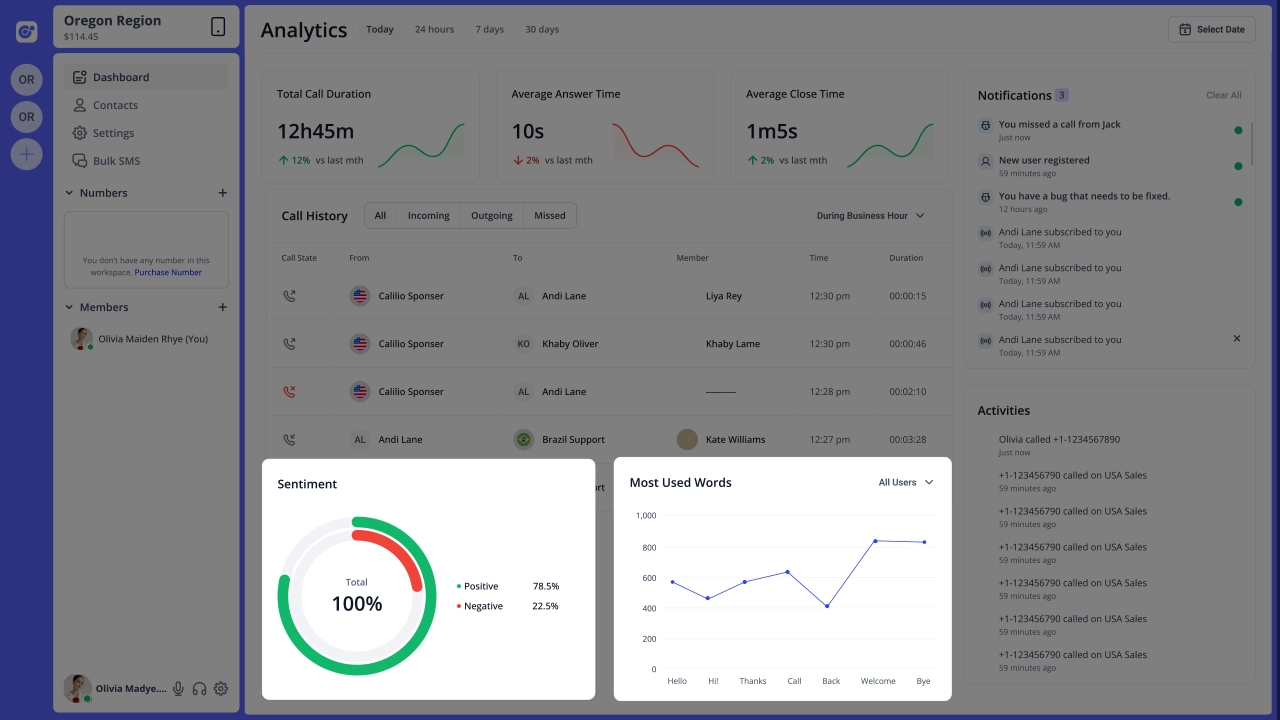
Calilio offers tools for designing call flows and reviewing conversations. The practical benefits depend on the tier and permissions you buy. Ask an administrator to set up opening hours, a short greeting, an overflow destination, and a route for a public holiday. Then ask a supervisor to find a specific transferred call and check which parts of the interaction can be reviewed. If your team uses AI summaries, verify the languages, transcription quality on your calls, and who can view the results.
On the commercial side, compare Standard and Premium using the number of users who need the more advanced workflows. Check whether monitoring, CRM access, or recording controls require a higher plan for all users. A buyer comparing TeleCMI competitors should also ask what happens at renewal and which country-specific numbers are included in the published subscription. Price extra numbers and outbound traffic separately, then compare the TeleCMI alternatives against the same month of usage.
India check. Calilio’s India guidance says outbound calls to India must originate from international numbers. This makes it a candidate for a qualified cross-border workflow. A team whose customers must see a domestic Indian caller ID on return calls needs a separate route approved for that purpose. Compare India-focused TeleCMI competitors for that role. If your business advertises UK numbers for sales and an Indian helpline for service, quote the two jobs independently and decide whether it makes sense to run both through one operator.
Pilot goal. Have an administrator change the greeting without vendor assistance, have an agent take a call in each open-hours branch, and have a supervisor retrieve the resulting record. Reproduce a lost internet connection while an agent is receiving a call. Write down where the call lands and whether the supervisor can distinguish a dropped call from a missed call.
3. Exotel For Indian Cloud Telephony and Configurable Call Flows
Best for a growing Indian sales or support operation with roughly five to 50 phone users, or an engineering team embedding calling into an existing application. Exotel is one of the strongest TeleCMI alternatives when you need a programmable call flow and an India-focused commercial discussion. Start with the voice product that matches your architecture. Its contact-centre and communications platform offerings can be scoped separately from a business phone bundle.

Exotel’s voice tools support configurable IVR workflows. A typical use case is a logistics team whose customers dial a support line and choose between an open delivery and a billing query. The menu routes each call to a different group. If the caller is already in the company’s system, the integration can give agents a record to work from. Ask for a proof of concept with a test record that matches two open cases and a second caller for whom no record exists.
Exotel has an advantage in evaluations where TeleCMI competitors must support custom events, call routing, and workflow changes. That flexibility makes ownership important. Decide whether the support team can change a greeting itself or needs the engineering team to deploy a flow. Track who owns API authentication, event failures, and retries. Test whether an update can be reverted during operating hours and whether the published number can continue taking calls while you fix a failed integration.
Pricing check. Exotel’s Dabbler listing shows ₹9,999 split between rental and credits. A credit balance can cover multiple types of usage. Ask for the relevant tariff sheet, renewal terms, and whether the proposed routing or forwarding bills more than one leg of a conversation. TeleCMI competitors often use a different billing unit. Convert each pack or seat plan to the same term after checking users, numbers, and covered services.
Pilot goal. Route calls through a test number and compare IVR outcomes with generated call events. Have the CRM reject one event, retry it and verify that you get a single task, then recover the recording or call ID that an agent needs to troubleshoot. If a simple live transfer gives support staff better context than your integration does, fix the handoff before widening the deployment.
4. MyOperator For Indian Helplines and Missed-Call Follow-Up
Best for a growing service business with roughly five to 30 people, several locations, and a central team that monitors unanswered calls. MyOperator belongs among TeleCMI alternatives when the service owner wants a single customer-facing helpline with clear call routes and reports. Get a quote for the voice workflow you need and confirm how any optional automation or messaging is priced.

For a clinic chain, education company, or field-service business, the usual day looks predictable. Customers call the main number, select a city or service, and need a person to respond. When an employee is away, someone at another site needs enough context to answer. The valuable test is whether a supervisor can see which location missed the call and who called the customer back. Check permission boundaries if a branch manager should see only their own staff and call activity.
The report your team uses most can separate MyOperator from TeleCMI competitors more clearly than a generic feature checklist. Ask for an example with a single caller entering the menu twice and calling back after a transfer disconnects. Determine how the dashboard counts the attempts, who gets the follow-up, and whether reporting distinguishes a customer who called again from a separate person. Decide which aggregate feeds branch performance reviews.
Pricing check. MyOperator markets business telephony alongside broader AI and messaging bundles. Its listed 1800 toll-free add-on starts at ₹500 per month. Treat that as one quote item and request the separate call volume, routes, users, support hours, and fees. If you evaluate an AI receptionist, confirm metered usage, setup, multilingual handoff, and access to a person during peak times before including it in the quote.
Pilot goal. Give one branch and a backup branch access. Test no-answer routing while the first branch is closed, then check who sees the incoming call, who owns the return call, and whether their resolved status appears in the relevant report. If the test requires hand-editing a spreadsheet each day, ask the vendor to demonstrate a simpler operating process.
5. Ozonetel For Agent Queues, Campaigns, and Contact-Centre Supervision
Best for a team of roughly 15 to 100 or more agents that plans staffing by queue and needs supervisors to monitor live activity. Ozonetel CloudAgent is one of the more direct TeleCMI alternatives for contact-centre buyers. Ask it to show the tools on the package it intends to quote, with real examples of IVR, queue handling, and outbound campaigns where applicable.
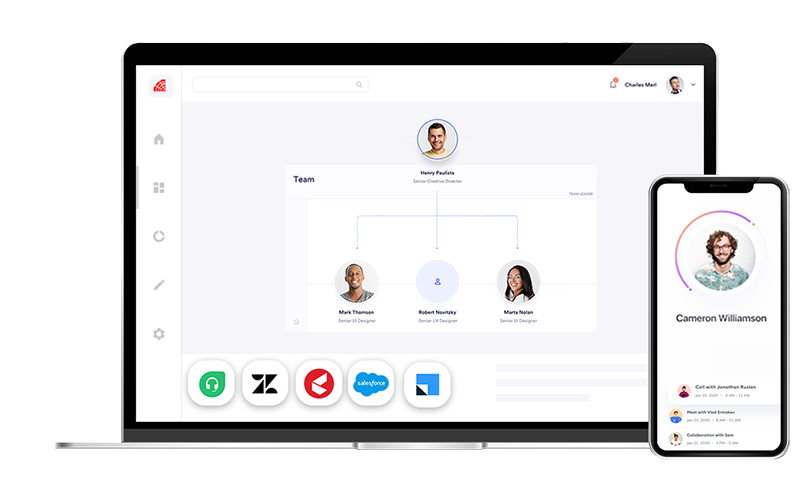
The distinction is easiest to see at the busiest time of day. For example, suppose your payment support queue is backed up while agents in a general queue have capacity. Ask the supervisor to identify waiting calls and adjust the response according to your rules. Test overflow, routing to an approved backup destination, and handling a customer who calls back after leaving the queue. A live demonstration shows what the supervisor can change immediately and which changes need an administrator.
The calling and reporting workflow also matters. Ask TeleCMI competitors to agree on definitions for wait time, abandonment, after-call work, and callback completion before comparing dashboards. One display may start its timer when the phone system answers and another when the caller enters the queue. Compare sample exports using your definitions so operations can continue measuring service levels when systems change.
Pricing check. Ask for a regional quote covering named or concurrent agent access, supervisor seats, voice usage, recording retention, CRM connector fees, and onboarding. Ozonetel’s public pricing page flags listed rates as specific to North America. Ask for an India-specific quote if that’s where your deployment runs. Compare TeleCMI alternatives on a year of normal staffing and on a month with seasonal capacity to see where commitments change the economics.
Pilot goal. Build one inbound queue and one supervised outbound workflow where relevant. Have one agent take a call, another run after-call work, and a supervisor review dispositions and recordings. Load enough calls to trigger overflow. The test should show what customers hear, how tickets are updated, and whether supervisors can recover end-of-day reports on their own.
6. Knowlarity For an India-Focused Inbound IVR
Best for a service or distribution business with roughly three to 25 people receiving calls across shifts or branches. Include Knowlarity among TeleCMI alternatives when an inbound number, a menu, and routed calls are your highest priorities. Its voice offerings include packages built around virtual numbers and IVR, so match the package to the real number and routing arrangement you want.
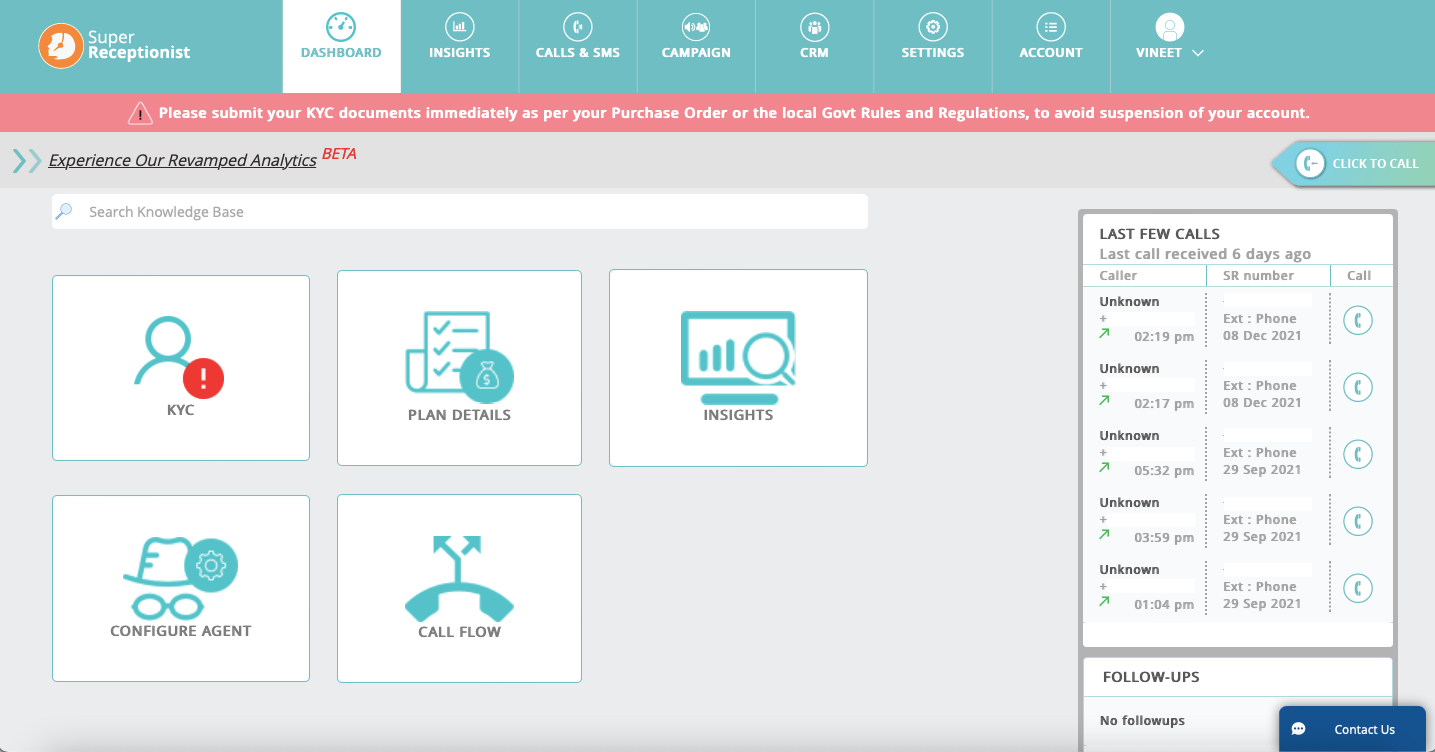
Imagine a property services company that publishes one contact number and sends repair calls to city-specific teams. Its quietest shift requires a route to staff on duty, while the busiest shift needs enough simultaneous calls to avoid long waits. Build a short IVR, set the schedule, assign a backup, and test held and unanswered calls. Ask how the system displays a caller on the receiving device and how the right branch returns the call.
Knowlarity’s published voice pricing covers several offerings. Compare the quoted package with the exact number type and usage scenario instead of applying a displayed plan to every type of call. Ask TeleCMI competitors whether incoming calls and agent forwarding share one allowance, whether outgoing calls require another package, and whether missed calls stay visible after a transfer between routes. Check who handles number support and how the business can retrieve its historical call records.
Review context. The G2 rating in the table is for Knowlarity Super Receptionist, its virtual phone product. Ask for a reference with your number type and a similar branch setup. If a few staff receive calls on different mobile carriers or share after-hours duty, ask the reference how they handle these exact handoffs. Rate your own calls and reports with the same pilot criteria used for the other providers.
Pilot goal. Ask a team manager to change one option on a spare IVR menu and revert it. Confirm that the old routing can be reinstated quickly and that staff can tell which menu version a caller encountered. This gives you an indication of how much day-to-day control your administrator has after the installation team leaves.
7. CallHippo For a Small Team Evaluating Outbound Calling
Best for a sales or service group of about five to 30 people evaluating cloud calling, caller visibility, and basic reports. CallHippo merits a spot among TeleCMI alternatives when your main challenge is making and tracking calls from a small set of business numbers. Choose the market and plan before comparing dialler features, since a quoted route and a software subscription can have separate conditions.
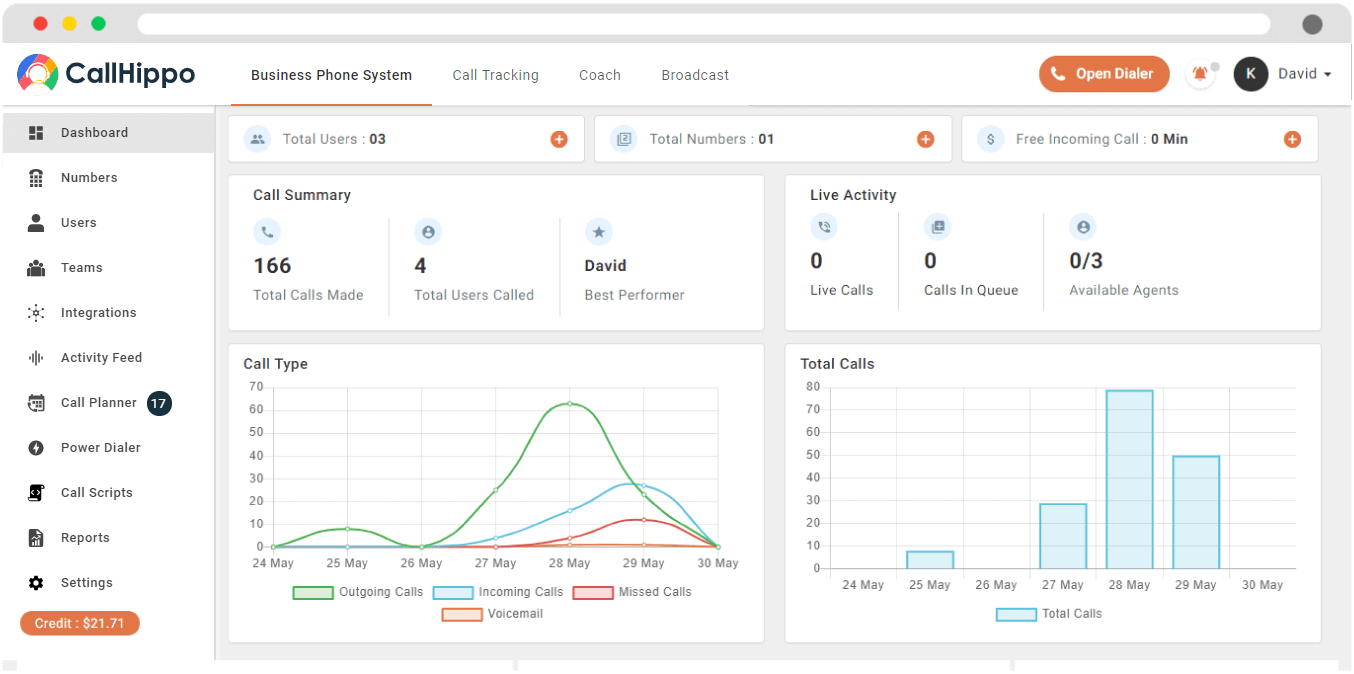
Picture a sales team following up inbound enquiries from an event. Representatives need to see when a colleague called, get the right customer record, set a follow-up, and show a caller ID that reaches a staffed group when dialled back. Configure the route and let the reps briefly work the same lead list. Compare what happens on a live answer, a busy line, voicemail, and an incorrect contact number.
CallHippo lists a US$0 base for Basic on annual billing. Budget for numbers and usage and ask which paid tier adds the features you need. When comparing TeleCMI competitors, put the intended dialler, CRM integration, caller-ID options, and number rental in writing. Request supported destinations and an example invoice. Validate how many attempts the dialler makes and whether those attempts are displayed in the same place as completed conversations. Read retention and export conditions for the reports you’ll use later.
India check. Ask CallHippo to state the exact Indian number type and permitted traffic, plus any documentation, registered-entity or agent-location conditions. Treat a website listing for a virtual number as a starting point. Ask other TeleCMI competitors to make the same commitments. Before buying, place calls in both directions against the proposed route, check what the receiving phone displays, and confirm that customer callbacks reach the intended staff.
Pilot goal. Use a small approved set of test contacts. Have two reps share a queue and test rescheduling, reassignment, and suppression across both users. Include an inbound call from a recipient of an outbound test. The number displayed to the caller should route to the right group and the CRM should identify who owns the next action.
8. JustCall For CRM-Linked Sales and Cross-Border Support
Best for a sales team of around five to 40 people that lives in a CRM, or an eligible international support team handling inbound calls from India overseas. JustCall joins the TeleCMI alternatives for teams looking to tie phone activity to leads and opportunities. Its India number rules put important boundaries on where agents may answer and what that number can do.
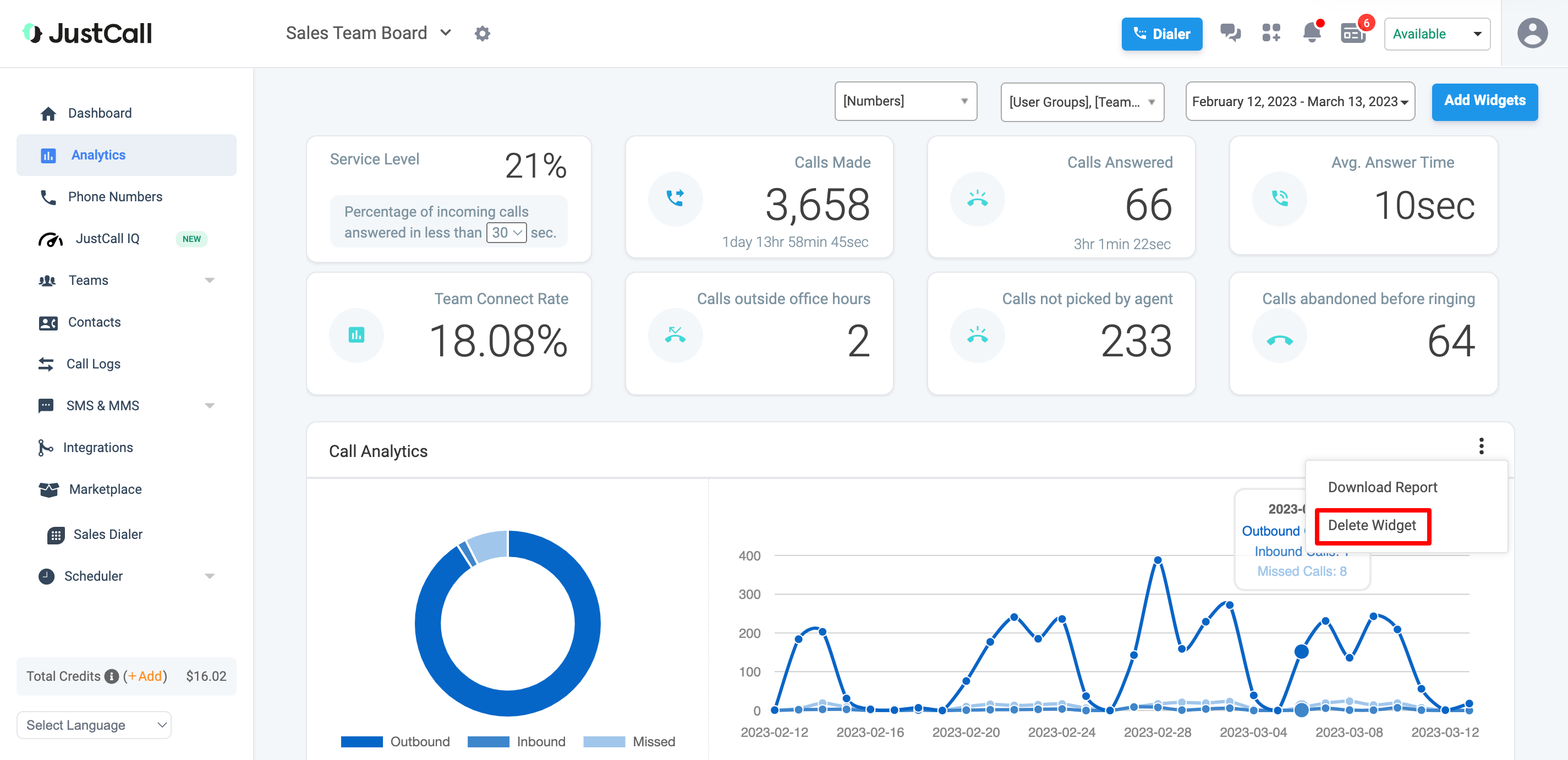
JustCall’s Sales Dialer is worth testing if the core job is connecting an outbound session to a usable CRM record. Ask a rep to skip a duplicate contact, call another contact, mark the result, and schedule a follow-up. Then disable one CRM permission and observe whether events queue, fail visibly, or create incomplete records. For managers comparing TeleCMI competitors, it is worth establishing which tier contains the dialler, how it uses credits, and whether the lead owner can act on replies and callbacks.
India check. JustCall’s published India option is inbound-only international toll-free. It requires a business address outside India and calls to be answered outside India. JustCall also says Indian mobile numbers cannot be ported to it. The help article lists a separate US$25 monthly charge per number. International firms using that inbound route should verify agent location and fees at quote stage. If your team requires a domestic Indian return-call identity, shortlist a provider that can contract and provision that route.
Pricing check. Compare your region’s seat price, seat minimum, dialler tier, number fee, and destinations billed outside the allowance. Estimate outbound attempts using your actual connect rate and time on each contact record. A higher-priced seat can pay off if it saves meaningful admin time during a shift, but the value depends on whether reps can complete the right CRM tasks automatically.
Pilot goal. Pick a CRM cohort with sample duplicates, reassigned leads, and contacts who have opted out of calls. Test exclusion while a session is active and check whether changes sync across users. For international inbound support, call the proposed number from customer networks and verify both the answer location and who gets the next callback task.
Which TeleCMI Alternatives Make Sense for Your Team?
TeleCMI Alternatives for a Small India-Based Support Team
Start with Exotel, MyOperator, and Knowlarity. Ask each to quote the existing customer number or an approved replacement, simple IVR, peak call capacity, and a callback route. If an external reception team takes calls after hours, give the vendor that exact destination and ask how routing consumes credits. Test missed-call ownership and make sure two employees can see who picked up a conversation before each makes a separate callback.
If TeleCMI competitors want to quote a contact-centre package, ask the vendor to show one outcome you cannot achieve on a business phone package. A support team with three staff and a published helpline might value a clean disposition export more than a supervisor wallboard. A team of the same size handling three time zones might pay for configurable overflow. Let the busiest moment of the day and the duties of each employee determine the scope.
TeleCMI Competitors for a Contact Centre With Dedicated Supervisors
Ozonetel and Exotel are sensible TeleCMI alternatives to put through a structured demonstration. Give them each the same five calls and compare abandonment, short calls, overflow, and transfers. Include a supervisor role with reporting access and an agent role without administrative access. Ask who can change a routing rule when queues build and when that change appears in the history.
When evaluating TeleCMI competitors for twenty or more agents, add campaign permissions and handling of seasonal staff. Decide whether workers log in under their own identity or on shared workstations with a reset at shift change. If you use recordings for coaching, ask how historical interactions are tied to agents who resign. Check how supervisors search and request removal of old records according to company policy.
International Sales or Support Team
KrispCall and Calilio are useful TeleCMI alternatives when the numbers you advertise and the markets you dial fit their services. Add CallHippo or JustCall if a team’s bottleneck is outbound activity connected to CRM records. Give all shortlisted TeleCMI competitors the same test data and ask participating reps to call a sample of destinations. Test from the users’ normal devices and network rather than relying on an isolated sales demo.
Buying internationally can add an unexpected constraint for a business with both offshore staff and domestic customers. Ask the TeleCMI competitors which routes depend on agent geography or business registration. Model the effect of moving a support shift to a second office, using an outsourced team, or switching the callback number during a holiday. A regional route that works well for the original setup can require a new order when the operating model changes.
How To Compare India Number Eligibility and Calling Rules
Request a number and route inventory before scoring TeleCMI alternatives. Give your provider the number type, business entity, customer country, agent location, and use case. For each row, ask for the proposed number, allowed direction, the caller ID that will display, reachability from customer networks, and what happens when the person calls it back. Collect a real sample call for every high-priority combination.
Mobile numbers, virtual landlines, and toll-free services have different operating arrangements. An inbound forwarding setup may provide a temporary answer to a porting delay, but it can add a billable step and change how caller information appears. Ask TeleCMI competitors to specify who controls the number and what happens to it if you leave. Keep a copy of records your provider uses to verify account ownership so a later transfer or closure can be handled by the right person.
Separate service callbacks, sales outreach, and automated campaigns in your quote. The eligibility review should consider applicable approval, registration, consent, and caller-ID conditions. Check the Telecom Regulatory Authority of India’s commercial communications framework with your compliance team and ask the provider how it authorises the exact activity. Treat the written approval and sample call as part of the acceptance criteria for the route.
If your staff handle payment or identity details, test who can access audio, transcripts, and analytics. Ask which systems store each record and how retention, exports, and deletion work under your contract. Provide both normal agent and supervisor test accounts. For TeleCMI alternatives with AI summaries, check whether an agent can move sensitive work to a supported workflow and how summaries are shared with external integrations.
How To Compare the Total Cost of TeleCMI Alternatives
Use a spreadsheet with one row for each quote item and three volume scenarios. Separate seat charges, number rental, metered usage, setup, and integrations. Ask what applies during the busiest month, how unused credits work, and what changes at the first renewal. Enter the currency the provider will actually invoice and keep any internal currency conversion on a separate column so finance can update it.
| Cost Line | What to Ask TeleCMI Competitors | What to Record |
|---|---|---|
| Seats | Do agents, supervisors, and admins require paid access? | Minimum quantity, tier, billing period, and seasonal terms. |
| Numbers | Is rental included for the country and type requested? | Each number’s recurring fee, setup and transfer charges. |
| Calls | Which directions, destinations, and legs are charged? | Rate, billing increment, included volume, and overage. |
| Storage and exports | What happens when recordings exceed the allowance? | Retention, access, extended storage, and export fees. |
| Integration and support | Who configures the connection and solves failures? | Setup, recurring connector fee, and response commitments. |
For a hypothetical quote, ₹700 per month for each of 12 users comes to ₹8,400 before usage. If number rental adds ₹900 and metered calls contribute ₹2,400, the recurring estimate is ₹11,700 before tax. If one of the other TeleCMI alternatives quotes ₹10,000 for a service bundle, review the covered users and inclusions before comparing those amounts. A missing connector or a higher charge per forwarded call can change the annual total.
Test price assumptions from TeleCMI competitors against one actual day of activity. Give every provider the same sample of unanswered calls, direct connections, forwarded calls, and transfers. Ask each to describe the invoice treatment under its quote. If a transfer between two agents results in extra voice usage, include that increment. Cost estimates from TeleCMI competitors become easier to compare when each provider describes what it charges for the same chain of events.
Review likely changes over the term. Add new users and retire one number in the model. Include a campaign month, an integration migration, and the time your own administrator needs to maintain IVR and queue schedules. If you are choosing between an annual and shorter term, consider whether you have enough evidence about customer outcomes to commit the same headcount and route arrangement for a whole year.
How To Test TeleCMI Competitors in a Pilot
Test TeleCMI Alternatives From the Customer’s Phone
Start with three types of call, including your most common inbound call, a successful transfer, and a callback. Use the devices and networks customers actually use. Measure whether the intended number appears, whether the greeting starts promptly, and where the call ends. Ask the customer tester to dial the callback number again. A missed return path can otherwise hide behind a strong outbound demo.
When evaluating TeleCMI alternatives, add an incoming call during after-hours handling and a bad connection on the agent side. Check whether the customer hears a short explanation, reaches a staffed group, or leaves a message. Then sign in as the person covering the next shift and find the result. A good recovery path gives an employee enough context to respond promptly and leaves a useful record.
Test the Daily Admin Routine
Give a supervisor a short list of tasks. Change one opening-hours rule, review a recording, remove an agent’s access, and export all missed calls from one queue. Record which tasks require vendor support. Check whether either the team or the vendor can recover quickly if an administrator misroutes a number. Ask TeleCMI competitors to demonstrate the proposed support escalation using a real case from the test.
Score the TeleCMI alternatives with criteria your team can check consistently. Inbound reachability and usable callback can be pass-or-fail gates. After a provider satisfies those, score conversation quality, dashboard clarity, time to resolve an admin issue, and total cost. Give your IT owner and operations lead a joint veto for any missing mandatory route and ask each to document the test that failed.
Compare Phone and CRM Records Across TeleCMI Competitors
Pick a sample of interactions and match them in the provider logs and CRM. Include a repeat caller, a merged contact, a transfer, a failed call attempt, and a successful callback. Review whether the records preserve the number, direction, time, outcome, and owner. TeleCMI competitors that handle transfers differently may export multiple components for one interaction, so agree how your reporting should count them before go-live.
If your team uses a dialler, add a check for changes made mid-session, including corrected phone numbers and updated contact preferences. Ask which system wins when the same field has been edited in two places. Store the outcome of the test in the CRM or support documentation so employees know how to resolve discrepancies.
How To Move From TeleCMI Without Losing Customer Calls
Inventory published numbers across ads, directories, invoices, QR codes, and booking confirmations. Map each number to its current owner and routing flow. For the TeleCMI alternatives still in contention, get a written plan for ownership validation, forwarding during a transition, and how the provider confirms a completed port. Save a copy of billing and verification details for your own migration team.
Set up a small pilot alongside the existing system, with test numbers and real staff. Rebuild business hours, extension routes, queues, voicemail, and CRM outcomes. Have an operations manager sign off the new reports and assign someone to export historical recordings or logs where your agreement and policies permit. Ask TeleCMI alternatives to specify how their retention rules would affect the next migration. Keep exports protected and document who can access them after the old account is closed.
For high-priority lines, agree a cutover window and a point at which the team switches to the backup route. For example, if a new line fails a call from one of your core customer networks or an outbound callback displays the wrong identity, move calls to the approved fallback until the provider resolves it. Ask TeleCMI competitors to specify who controls the change and the expected restoration time. Agree on what changes are reversible after a port.
Call every number from representative networks immediately after cutover, test one complete interaction for each branch, and review the first live callback. Meet briefly after the first full shift to compare missed calls, abandonment, and response time with your baseline. Close the old service after the new route has passed your checks and your telecom owner has approved cancellation dates.
Frequently Asked Questions
What Are the Best TeleCMI Alternatives in India?
Exotel, MyOperator, Ozonetel, and Knowlarity are the strongest starting points for India-based teams. Exotel fits configurable call flows, MyOperator and Knowlarity fit business helplines, and Ozonetel suits supervised contact centres. Verify the proposed Indian number, permitted traffic, and agent location for each.
Which TeleCMI Competitors Can Replace a Contact Centre?
Start with Ozonetel and Exotel for a staffed contact centre that uses queues, reporting, and supervision. Ask each to run an inbound queue at peak capacity and prove overflow, after-call work, and callbacks with the plan quoted for your region.
Which TeleCMI Alternatives Fit an International Team?
KrispCall and Calilio fit shared international calling in supported markets. JustCall and CallHippo are worth testing for CRM-linked workflows. Check caller ID, destination fees, agent location, and how a callback reaches your team before buying.
Can I Keep My Existing Indian Number With TeleCMI Competitors?
Portability depends on the number type, current ownership, carrier arrangements, and the receiving provider’s eligibility rules. Ask for a written decision on the exact number. If a port is unavailable, evaluate forwarding or a planned number change and test the customer callback path.
Are There Low-Cost TeleCMI Alternatives for Small Teams?
Small teams can compare an India-focused voice bundle from Exotel, MyOperator, or Knowlarity with a seat-based service such as KrispCall or Calilio for international use. Compare the total for the actual numbers, users, minutes, and contract term.
Do TeleCMI Competitors Support Domestic Caller ID?
Availability varies by provider, business entity, route, number type, and use case. Ask the shortlisted provider to confirm the approved caller ID in writing and demonstrate what appears on a receiving phone. Check that the displayed number can receive a return call.
How Does JustCall Compare With TeleCMI Competitors for Indian Sales?
JustCall is better suited to a qualified international sales workflow. Its published India toll-free number is inbound-only and calls must be answered outside India. An India-based team using a domestic outbound caller ID should shortlist providers that offer that specific approved route.
Can I Try TeleCMI Alternatives Before Porting?
Yes. Pilot each provider with an eligible test number where available and keep the existing customer line active. Test inbound reachability, caller ID, transfers, reporting, and callbacks. Port once the quoted route and workflow pass your tests.
Start With the Number and Call Flow You Need to Keep
If most of your calls are local to India, get the route and customer callback confirmed before comparing seats. Exotel, MyOperator, and Knowlarity are practical starting points for cloud telephony and inbound IVR. Put Ozonetel high on the list when agent supervision, queues, and campaign controls matter. Compare the strongest TeleCMI competitors against a real customer journey and request a bill that reflects it.
For a shared international customer number, start with KrispCall or Calilio and confirm which plan includes the needed routing and access. Add CallHippo or JustCall when reps need to handle call outcomes inside their CRM. The best TeleCMI alternatives make it clear who answers, who returns the call, and how much you’ll pay for that complete interaction.
Affiliate Disclosure. VoIPCalling may earn a commission through partner links. The KrispCall trial described here is a partner offer. Provider fit depends on your number eligibility, call routes, and workflow.