Latest News

The Blog

voip blogs
VoIP for Hybrid Work Models

VoIP for Hybrid Work Models: Strategies and Challenges

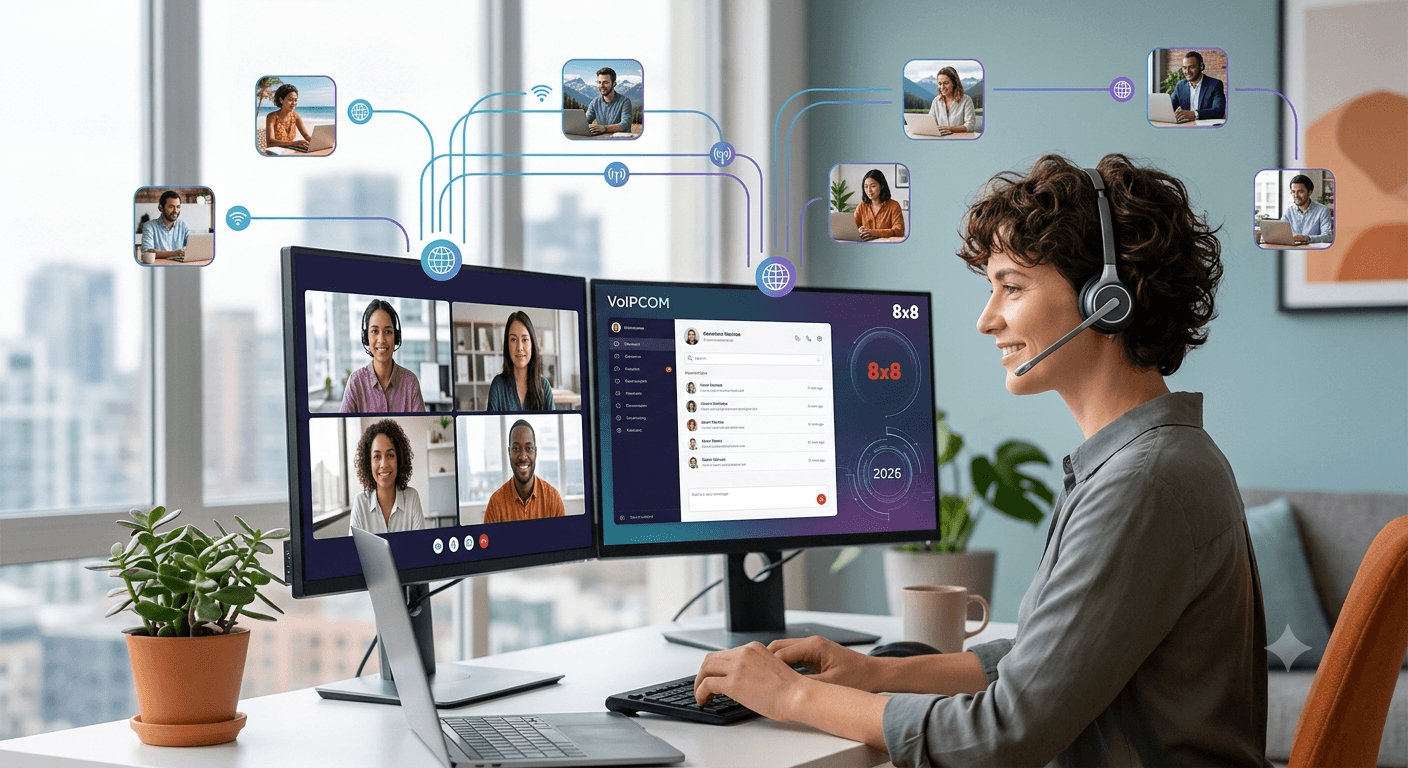
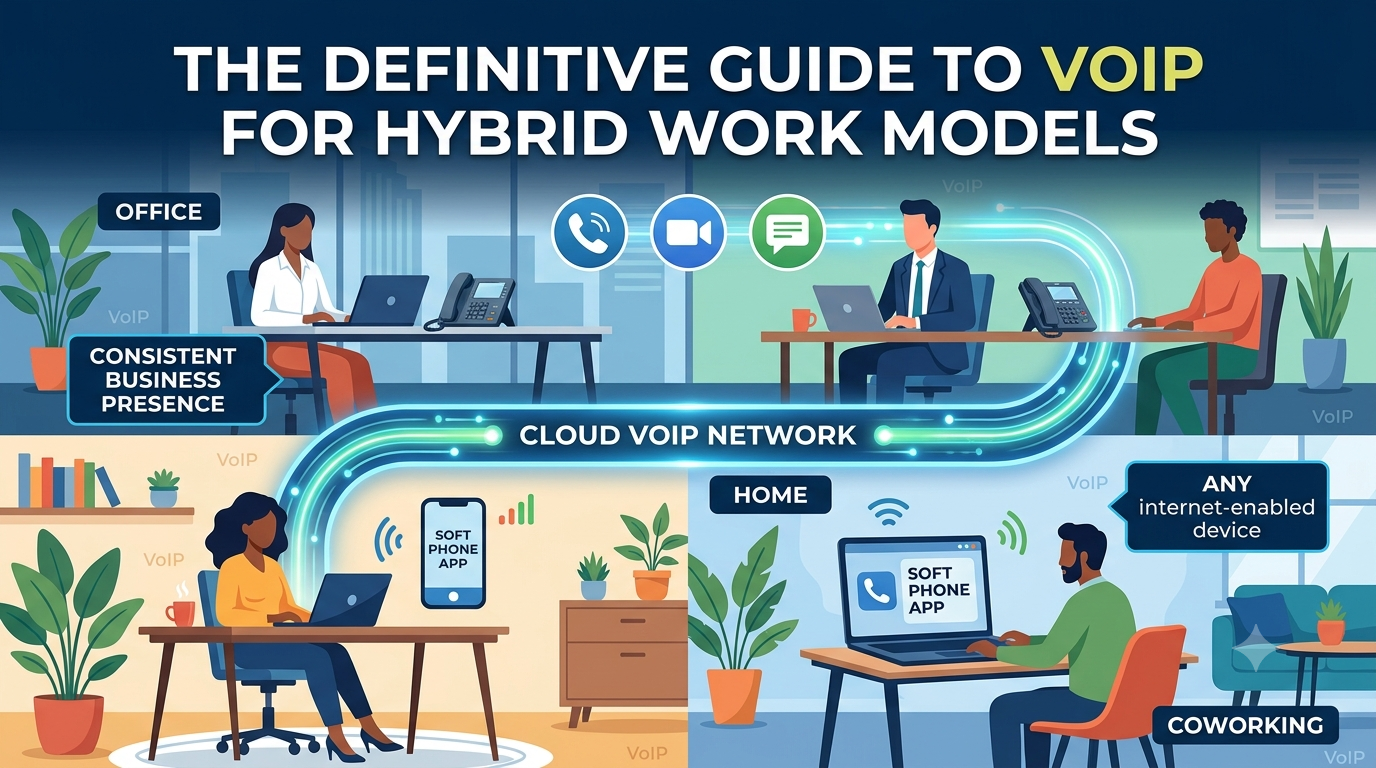
VoIP for Hybrid Work Models represents a transformative shift in how modern businesses communicate by replacing traditional copper-wire telephone systems with flexible, cloud-based technology. By converting voice signals into digital data packets transmitted over the internet, this technology allows employees to maintain a consistent business presence regardless of their physical location. Whether a team member is working from a corporate office, a home setup, or a remote coworking space, they can access their professional extension and collaboration tools through any internet-enabled device. This seamless integration ensures that communication remains fluid, professional, and uninterrupted in a distributed environment. What is VoIP in a Hybrid Work Context? In a modern professional environment, VoIP replaces traditional phone lines with internet-based calling, creating a unified communication layer. For businesses implementing VoIP for Hybrid Work Models, this means employees can use the same business phone number whether they are at the office, at home, or traveling for client meetings. The technology operates on the principle of mobility, allowing calls to be answered on desk phones, laptops, or specialized mobile apps. This versatility gives teams the flexibility to work from anywhere without the client ever knowing the difference in the employee’s physical location. The integration of VoIP for Hybrid Work Models goes beyond simple voice calls; it incorporates video conferencing, instant messaging, and file sharing into a single interface. By centralizing these functions, companies eliminate the need for multiple disparate subscriptions, which often lead to communication silos. When an employee logs into their softphone application on their laptop, they have access to the same directory, call history, and voicemail as they would on their physical desk phone. This level of consistency is the foundation of a successful hybrid strategy, ensuring that operational standards remain high regardless of the workspace. How VoIP is Powering Hybrid Working The shift toward flexible working has accelerated the adoption of cloud-based communications, making VoIP for Hybrid Work Models a central pillar of corporate infrastructure. According to a study by Global Workplace Analytics, nearly 56% of the American workforce holds a job that is compatible, at least partially, with remote work. By leveraging high-speed internet, VoIP systems enable real-time synchronization across various time zones and regions. This capability is essential for companies looking to tap into global talent pools while maintaining a cohesive culture. The ability to route calls intelligently based on staff availability ensures that customer service levels do not drop when employees are working from home. Furthermore, the integration of team messaging and voip allows for a “presence” feature, where colleagues can see if someone is on a call, in a meeting, or available for a quick chat, mimicking the organic interactions of a physical office. Are Fixed Phone Lines the Thing of the Past? As we look toward the future of telecommunications, traditional Public Switched Telephone Network (PSTN) lines are rapidly becoming obsolete. Fixed lines are inherently tied to a specific physical location, which is a major bottleneck for companies adopting VoIP for Hybrid Work Models. If an office closes for the day or an employee is working remotely, a fixed line requires complex and often expensive call forwarding setups that may not always function reliably. In contrast, cloud-based systems are location-independent, meaning the “line” follows the user rather than the building. The maintenance of hardware for traditional lines is also a significant burden for modern IT departments. Legacy systems require on-site PBX hardware that needs regular servicing and manual upgrades. VoIP for Hybrid Work Models removes this physical constraint, as the “brain” of the phone system resides in the cloud and is maintained by the service provider. For businesses, this translates to less downtime and the ability to scale up or down without calling a technician to install new wiring. The flexibility offered by the best voip services for remote and hybrid teams makes the choice to move away from fixed lines almost inevitable for growing companies. How Does VoIP Allow Employees to Work from Home? The primary mechanism that allows VoIP for Hybrid Work Models to function for remote staff is the “softphone” application. This is a software program installed on a computer or smartphone that functions exactly like a physical desk phone. Employees can dial numbers, transfer calls, and host conference calls directly from their work laptops. Because the system is hosted in the cloud, all the settings and preferences for an employee’s extension are stored online. When they log in from their home Wi-Fi, the system recognizes their identity and routes their calls accordingly. Security is another critical aspect of how these systems support home-based work. Modern VoIP solutions often include encrypted signaling and media, ensuring that sensitive business conversations remain private even over residential internet connections. Additionally, many companies utilize the best mdm for hybrid teams with remote workers to manage these communication apps on personal or company-issued devices. This allows IT managers to push updates, ensure security protocols are met, and remotely wipe data if a device is lost, providing a secure environment for remote professional communication. The Benefits of VoIP over Fixed Line Phone Systems for Hybrid Working 1. Provides Employee Flexibility The implementation of VoIP for Hybrid Work Models allows employees to design their workday around their personal lives without sacrificing professional availability. This flexibility is a key driver in employee retention and satisfaction, as it reduces the stress of being tethered to a physical desk. With a cloud-based system, an employee can start their morning answering calls from their home office and transition to the physical office in the afternoon without any disruption to their communication flow. 2. Connect with Multiple Employees Across Multiple Locations VoIP for Hybrid Work Models excels at bridging the geographical gap between distributed team members. Whether a company has five employees in different states or five hundred across different continents, the system treats them as if they are in the same building. Extension-to-extension dialing remains free and instantaneous, which encourages frequent collaboration and helps maintain the social fabric of the organization even when people rarely meet in person. 3. Use Your Business Landline Anywhere One of the most professional benefits of VoIP for Hybrid Work Models is the ability to display a professional business number on caller ID, regardless of the device used. When an employee makes a call from their personal mobile phone using the VoIP app, the client sees the company’s office number. This maintains a high level of brand consistency and protects the employee’s personal privacy by keeping their private cell phone number hidden from the public. 4. Call Recording on any Device In many industries, maintaining records of conversations is a legal or quality control requirement. VoIP for Hybrid Work Models makes call recording simple and centralized. Unlike traditional systems that might require expensive hardware at each location, cloud VoIP allows managers to record and store calls from any device used by the employee. These recordings are typically stored in a secure cloud portal where they can be reviewed for training or compliance purposes at any time. 5. Better Connectivity Reliability is a cornerstone of VoIP for Hybrid Work Models. Most top-tier providers offer 99.999% uptime guarantees, utilizing geographically redundant data centers to ensure service is never interrupted. If one internet connection goes down, calls can be automatically rerouted to a mobile device or another office location. This level of redundancy is far superior to traditional lines, which can be knocked out by local physical damage to a single telephone pole or exchange. 6. Enhanced System Features Legacy phone systems often charge extra for basic features like voicemail-to-email, auto-attendants, or detailed call analytics. With VoIP for Hybrid Work Models, these features are usually included as standard. Advanced functionalities like “find me/follow me” services ensure that a call rings on an office phone first, then a mobile app, and finally a home office phone, making it virtually impossible for an important client call to go unanswered during business hours. 7. VoIP Lowers Costs The financial advantages of moving to VoIP for Hybrid Work Models are significant for both small businesses and large enterprises. By eliminating the need for expensive physical infrastructure and per-minute long-distance charges, companies can reduce their monthly telecommunications bills by up to 50%. Research from Deloitte suggests that businesses transitioning to cloud-based communications can save significantly on operational overhead by moving from a CapEx (capital expenditure) model to an OpEx (operating expenditure) model. Hybrid Work Models: How to Prepare Your Office Preparing a physical office for VoIP for Hybrid Work Models requires a shift in how the local network is managed. Since the phone system now shares the same bandwidth as the company’s data, ensuring a robust and stable internet connection is the first priority. Quality of Service (QoS) settings should be configured on office routers to prioritize voice traffic over less urgent data, like large file downloads or background updates. This prevents “jitter” or dropped calls during peak usage times in the office. Beyond the technical setup, the physical layout of the office may need to change to support a hybrid staff. Since not all employees will be in the office at the same time, companies are moving toward “hot-desking,” where desks are not assigned to specific people. VoIP for Hybrid Work Models supports this by allowing employees to “log in” to any desk phone with their unique credentials. This turns any workstation into their personal office extension instantly, providing a seamless transition between their home and office environments. Keys to Successful Hybrid Work Models Develop a Strategy To successfully implement VoIP for Hybrid Work Models, leadership must look ahead and plan for future growth. A strategy should involve anticipating issues that may impact the business, such as fluctuating staff numbers or changing regional regulations. Forward-looking leadership allows a business to remain agile. When developing your strategy, consider the following points to guide your decisions: Analyze how your employees currently collaborate and where the friction points are in your existing system. Determine how your business handles customer service and whether a cloud transition could speed up resolution times. Evaluate your current hardware to see if it can be repurposed or if a full migration to softphones is more efficient. Assess your team’s readiness for new technology and plan for a phased rollout if necessary to ensure smooth adoption. Create a System of Employee Support The human element is the most important part of any VoIP for Hybrid Work Models rollout. Leaders must act as support pillars, especially when transitioning away from traditional office norms. Fostering a culture of connection is essential when team members are physically separated. This involves more than just providing the tools; it requires active listening and adjustment to employee needs. Establish open communication channels where remote and in-office workers can interact casually, reducing the “out of sight, out of mind” feeling. Ask specific questions regarding workload management and how changing personal circumstances might affect their availability. Listen to feedback about the technology—if an employee is struggling with call quality at home, work with them to troubleshoot their internet setup. Conduct regular “check-ins” that focus on mental well-being and team morale rather than just project deadlines. Utilize Communications Solutions In the current market, having an optimized communications system is a non-negotiable requirement for success. Whether a business is fully remote or utilizes VoIP for Hybrid Work Models, the technology must be dependable. Streamlined solutions help businesses remain competitively relevant by ensuring that no customer query goes unanswered due to technical limitations. Leveraging the best voip services with mobile apps for distributed teams 2026 ensures that your infrastructure is future-proof. These solutions offer integrated video and messaging, which are vital for maintaining team cohesion. By using a single provider for all communication needs, businesses reduce the complexity of their IT stack and make it easier for employees to master the tools they use every day. This holistic approach to technology is what separates successful hybrid companies from those that struggle with the transition. Common Hybrid Work Challenges VoIP Helps Solve 1. Missed Calls In a traditional setup, if an employee isn’t at their desk, the call usually goes to a generic voicemail. VoIP for Hybrid Work Models solves this through smart call forwarding and simultaneous ring features. This ensures that the employee is reachable on their mobile app or home computer at the same time as their office phone. By reducing the number of missed calls, businesses improve customer satisfaction and ensure that time-sensitive opportunities are never lost due to a simple change in location. 2. Fragmented Tools Many businesses suffer from “app fatigue,” where employees have to switch between five different platforms for calling, texting, video, and project management. VoIP for Hybrid Work Models solves this by integrating phone, video, and collaboration into one platform. When team messaging and voip are combined, an employee can transition a text chat into a voice call or a video meeting with a single click. This consolidation saves time and reduces the mental load of managing multiple logins and interfaces. 3. Lack of Visibility One of the biggest concerns for managers in a distributed environment is understanding how work is being handled. VoIP for Hybrid Work Models provides admin dashboards that offer real-time data on call volumes, average wait times, and staff availability. This visibility allows managers to make data-driven decisions about staffing levels. If a manager sees that call wait times are increasing, they can quickly reassign remote staff to help handle the load, ensuring that service levels remain consistent regardless of where the staff is located. 4. Cost Unpredictability Traditional phone bills can vary wildly based on long-distance calls and hardware repairs. VoIP for Hybrid Work Models typically operates on a flat-rate, per-user monthly plan. This provides businesses with financial clarity and makes budgeting for growth much simpler. There are no hidden costs for adding new features or scaling the system to include new hires. This predictability is especially beneficial for small to medium-sized enterprises that need to manage their cash flow tightly while expanding their hybrid operations. Actionable Tips for Implementing VoIP in a Hybrid Model Implementing a new communication system requires more than just a subscription; it requires a thoughtful rollout. Before choosing a provider for VoIP for Hybrid Work Models, it is essential to map out your team’s specific communication needs. Do they need heavy CRM integration? Are they primarily using mobile devices? Answering these questions early will prevent you from paying for features you don’t need or missing out on ones that are critical to your workflow. Once a provider is selected, rigorous testing of the mobile apps is a priority. Ensure that remote staff get the same call quality as office staff by testing the app on various network speeds. Additionally, take full advantage of the built-in analytics to track how calls are being handled. Use this data to refine your call routing strategies. Finally, invest time in training employees on advanced features like call park, hot-desking, and video integration so the business gets the full value of the VoIP for Hybrid Work Models investment. VoIP and the Logistics of Scalability When discussing the growth of a business, we often look at how physical resources are managed. For example, some companies follow best practices for scaling ppe programs hybrid work to ensure that safety and physical gear are distributed correctly as teams grow. VoIP for Hybrid Work Models offers a similar but much more efficient scalability for communications. Adding a new user to a digital phone system takes minutes rather than the days or weeks it would take to install new physical phone lines. This digital scalability is a major competitive advantage. As a company expands into new markets, they can instantly acquire local phone numbers in those regions through their VoIP provider. This gives the business a local presence without the need for a physical office in that city. The ability to scale the communication infrastructure at the same pace as the workforce ensures that the company’s internal and external connectivity never becomes a bottleneck for growth. Read More: Cheap VoIP For Restaurants USA : A Comprehensive Guide Final Thought Adopting VoIP for Hybrid Work Models is no longer an optional upgrade but a fundamental requirement for the modern, agile business. By breaking the tether to the physical office, VoIP empowers employees with flexibility, enhances collaboration across distances, and significantly reduces operational costs. As the landscape of work continues to evolve toward a more distributed and flexible future, the businesses that thrive will be those that embrace these cloud-based solutions to keep their teams connected and their customers satisfied. Frequently Asked Questions What is hybrid-working? Hybrid working is an operational model that allows employees to split their time between working in a central office and working remotely, usually from home. This model focuses on flexibility, allowing teams to leverage the benefits of in-person collaboration while also enjoying the autonomy and reduced commute times associated with remote work. For this model to be successful, businesses must utilize digital tools like VoIP to ensure that communication remains seamless regardless of where the individual is located on any given day. What technology is helpful for hybrid working? The most helpful technology for this model includes cloud-based communication platforms like VoIP, project management software, and secure VPNs or MDM solutions. VoIP for Hybrid Work Models is particularly critical as it handles the primary external and internal voice communication. Additionally, video conferencing tools, collaborative cloud documents, and instant messaging apps are essential for maintaining the real-time flow of information between office-based and remote staff members. What’s the best VoIP phone system? The best system depends on your specific business size and needs, but top-tier providers often include RingCentral, Nextiva, and 8×8. These services are highly rated because they offer robust mobile apps, extensive integrations with other business software, and high reliability. When choosing the best voip services for remote and hybrid teams, look for a provider that offers 24/7 support and a user-friendly interface that requires minimal training for your employees to master. How easy is it to start hybrid working? Starting a hybrid model is relatively simple if you have the right digital infrastructure in place. The first step is transitioning your communication to a cloud-based VoIP system, which can often be done without any downtime. Once the technology is set, establishing clear policies regarding office attendance and communication expectations is key. With the right VoIP for Hybrid Work Models, the technical transition can happen in a few days, allowing the company to focus on the cultural shift of managing a distributed team. Can VoIP work with my existing office hardware? Yes, many VoIP systems are compatible with existing IP phones, and for older analog phones, you can use an Analog Telephone Adapter (ATA). However, to fully leverage VoIP for Hybrid Work Models, many companies prefer to use softphones on laptops or mobile apps. This reduces the need for physical hardware and allows for greater mobility. If you have high-quality IP desks phones already, your new VoIP provider can usually “provision” them to work with the new cloud service. Is VoIP secure for remote employees? Modern VoIP providers use advanced encryption protocols to secure voice data as it travels over the internet. This makes VoIP for Hybrid Work Models highly secure, often more so than traditional phone lines which can be physically tapped. To enhance security further, businesses can use multi-factor authentication for their VoIP apps and ensure that all remote work is conducted over a secure internet connection. Do I need a special internet connection for VoIP? While you don’t need a “special” type of internet, you do need a stable and high-speed connection. For VoIP for Hybrid Work Models to function clearly, the connection should have low latency and sufficient bandwidth to handle voice data alongside other tasks. Most standard fiber or high-speed cable internet connections are more than enough for high-quality VoIP calling, even when multiple people are using the connection simultaneously. How does VoIP handle emergency calls like 911? VoIP systems use a feature called E911 (Enhanced 911) to handle emergency calls. Because VoIP for Hybrid Work Models is location-independent, users must register their physical address with the service provider. When a 911 call is placed, the system automatically sends this registered address to the emergency dispatcher. It is important for hybrid workers to update their location in the system if they move to a different long-term remote work location.

Read More
VoIP Trends in USA 2026

VoIP Trends in USA 2026

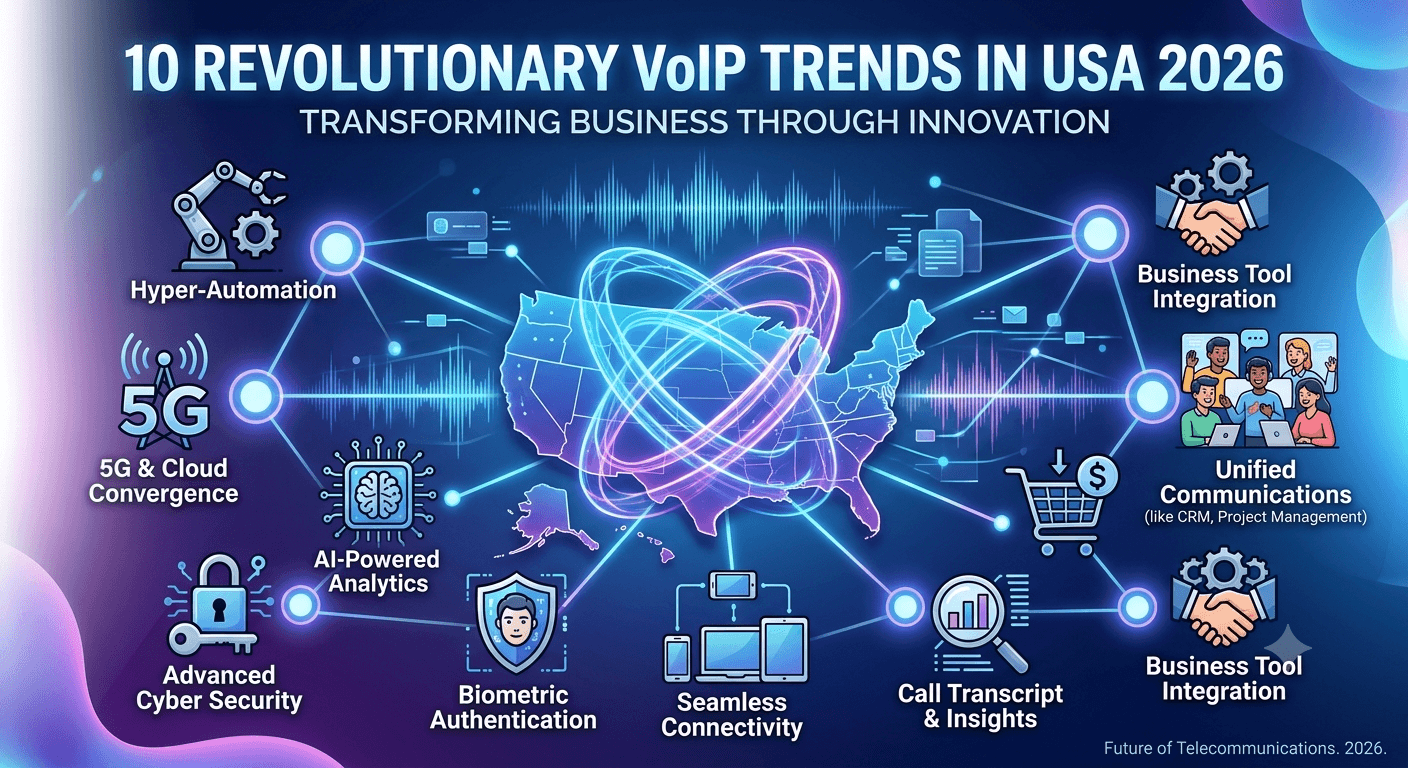
VoIP trends in USA 2026 indicate a massive shift toward hyper-automation and seamless connectivity across the corporate landscape. As the future of voip industry evolves, businesses are moving away from traditional hardware toward cloud-native ecosystems that prioritize artificial intelligence and 5G integration. By 2026, the adoption of Voice over Internet Protocol will no longer be an option but a necessity for survival in the global market. These developments focus on enhancing audio quality, securing data transmissions, and providing unified communication platforms that allow teams to collaborate from any location with unprecedented efficiency and reduced operational overhead. What are VoIP Services USA? VoIP services in the United States refer to the technology that allows users to make voice calls using a broadband internet connection instead of a regular analog phone line. This technology converts voice signals into digital data packets that travel over the internet. In the current landscape, voip the future of telecommunications is becoming evident as more domestic companies retire their copper-wire landlines in favor of digital infrastructure. These services offer a variety of communication methods including voice calls, video conferencing, and text messaging through a single application. As we look at voip trends, the focus has shifted toward high-definition audio and low-latency connections. This digital transformation allows businesses to maintain a professional presence without being tethered to a physical office location. Why are VoIP Services USA Important? The importance of these services stems from the need for agility in a fast-paced economic environment. As organizations seek more robust ways to stay connected, the future of voip becomes the backbone of modern operations. Modern systems offer reliability that matches or exceeds traditional telephony while providing a suite of digital tools that physical hardware cannot replicate. 1. Reduced communication costs Lowering expenses is a primary driver for many companies switching to digital telephony. By utilizing an existing internet connection, businesses eliminate the need for separate phone bills and expensive maintenance for physical PBX systems. This is particularly beneficial for companies with high volumes of long-distance or international calls, as digital rates are significantly lower. 2. Greater flexibility for business Flexibility is a cornerstone of the modern workplace. Employees can access their business phone lines from laptops, tablets, or smartphones regardless of their geographical location. This mobility ensures that the team remains reachable and productive, whether they are working from home, traveling, or in the office. 3. Advanced calling features Standard features in modern systems go far beyond simple dial tones. Users benefit from automated attendants, call routing, voicemail-to-email transcription, and advanced call analytics. These features allow businesses to manage their communication flow more effectively and gain insights into team performance and customer interaction patterns. 4. Enhanced customer experience Customer satisfaction is greatly improved through more efficient call handling. Features like interactive voice response and smart routing ensure that callers are directed to the right department quickly. According to recent voip statistics, businesses using integrated communication platforms report a significant increase in first-call resolution rates, which directly impacts brand loyalty. 5. Easily scalable Growth is simplified when you do not have to install new physical lines for every new hire. Adding a user to a digital system is often as simple as updating a dashboard setting. This scalability allows businesses to expand or contract their communication capacity based on seasonal demands or rapid growth phases without capital-heavy investments. 6. Business Tool Integration Modern communication systems do not exist in a vacuum. They integrate seamlessly with CRM platforms, email clients, and project management software. This integration ensures that when a client calls, the employee can see their entire history and current projects on the screen, leading to a more personalized and informed conversation. How Do USA VoIP Services Work? Understanding the technical process helps businesses appreciate the reliability of the system. The transition from voice to data and back again happens in milliseconds, ensuring that there is no perceptible lag for either party on the call. 1. Voice Conversion When a user speaks into a handset or microphone, the analog sound waves are captured by the device. The system immediately uses a codec to convert these analog signals into digital data. This process ensures that the nuance of the human voice is preserved while being prepared for transmission over the internet. 2. Transfer Data Once the voice is digitized, it is broken down into small units called packets. These packets are labeled with destination information and sent over the internet using the Internet Protocol. They may take different paths across the web to reach the destination as quickly as possible, bypassing network congestion points. 3. Dealing with Calls A central server or a cloud-based PBX manages the routing of these packets. It determines where the call needs to go, whether it is another digital user or a traditional landline. During this phase, features like call waiting, forwarding, and caller ID are applied to the data stream based on the user’s configuration. 4. Voice-to-Data Conversion At the receiving end, the digital packets are reassembled in the correct order. The system then converts this digital data back into analog sound waves that the receiver can hear through their speaker or headset. This conversion must be incredibly fast to avoid jitter or delays during the conversation. 5. End of the Call Once the conversation concludes and one party hangs up, the session is terminated. The system then logs the call data for analytics and billing purposes. This data includes duration, time of call, and quality metrics, which are essential for future voip industry news reports and internal business audits. Advantages of USA VoIP Services The move toward digital communication offers a competitive edge in several key areas. Businesses that adopt these technologies early find themselves better positioned to handle the challenges of a globalized economy. 1. Savings The most immediate advantage is the reduction in monthly recurring costs. Beyond the monthly subscription, businesses save on infrastructure, as there is no need to purchase or house bulky servers. Furthermore, wholesale voip termination rates have become extremely competitive, allowing for cheap global connectivity. 2. Better Mobility In the era of remote work, mobility is a top priority. Employees are no longer tied to their desks to answer professional calls. A mobile app can turn any smartphone into an extension of the office phone system, maintaining a professional identity even when the worker is on the move. 3. Advanced Business Features Businesses gain access to tools that were previously only available to large corporations with massive budgets. Features like music on hold, call recording for training, and multi-party conferencing are standard. These tools enhance the professional image of even the smallest startup. 4. Improved Customer Support Support teams can use these systems to manage high volumes of inquiries more effectively. With call queuing and specialized routing, customers are never left waiting on a dead line. Integration with helpdesk software allows support agents to track every interaction across multiple channels within a single interface. 5. Scalable The future voip landscape focuses on modularity. If a business opens a new branch in another state, they do not need to install a new hardware system. They simply add the new location to their existing cloud account. This flexibility is essential for businesses planning for long-term expansion in 2026. 6. Greater productivity Productivity increases when communication is streamlined. With features like “Find Me/Follow Me,” calls can ring on multiple devices sequentially, ensuring important calls are never missed. Integration with collaboration tools like Microsoft Teams or Slack further enhances the workflow by keeping all communication in one place. 7. Communications with AI By 2026, AI will be deeply embedded in communication systems. AI-driven sentiment analysis can tell a manager if a customer is becoming frustrated during a call. Automated transcription and summary tools save hours of manual note-taking, allowing employees to focus on solving problems rather than administrative tasks. 8. Dependable Communication Modern cloud infrastructure is built with multiple redundancies. If one server goes down, the traffic is instantly rerouted to another, ensuring 99.99% uptime. This level of reliability is often superior to local landline connections which can be taken down by physical damage to cables or local power outages. VoIP Services for Small Business in the USA Small businesses find unique value in digital communication because it levels the playing field. In 2026, a small company can sound like a major corporation through the use of professional auto-attendants and sophisticated call routing. The low entry cost makes it possible for startups to have a full-featured phone system from day one. Benefits of voip for businesses 2026 include the ability to hire talent from anywhere in the country without worrying about local phone infrastructure. A small business based in New York can have a team member in Texas using a local New York number. This creates a cohesive brand identity and allows for a more flexible hiring strategy that is not limited by geography. How to Choose the Best VoIP Provider in the USA? Selecting the right partner is crucial for long-term success. The market is saturated with options, making it necessary to evaluate providers based on specific criteria that align with business goals. Check for a proven track record of uptime and reliability in the United States. Evaluate the security protocols used, such as end-to-end encryption and compliance with industry standards. Ensure the provider offers 24/7 customer support via multiple channels like phone, chat, and email. Look for a transparent pricing model that does not have hidden fees for essential features. Verify the ease of integration with your existing software stack, such as Salesforce or HubSpot. Test the user interface to ensure it is intuitive for both administrators and end-users. Quality of service is also a major factor. A good provider should offer tools to monitor your network performance and suggest optimizations. Since the voice quality depends on your internet connection, the provider should be able to help you configure your router for priority voice traffic. VoIP Services USA Outlook to 2026 The outlook for the next few years is dominated by the convergence of 5G and cloud communication. As 5G networks become the standard across the USA, the limitations of mobile data will vanish, leading to crystal-clear video and audio calls even on the move. Research by Gartner suggests that by 2026, over 75% of business conversations will be recorded and analyzed for insights, up from less than 20% in 2022. Furthermore, voip trends suggest that security will become the top priority. As cyber threats evolve, providers are implementing biometric authentication and advanced threat detection to protect voice data. We will also see a rise in the use of WebRTC, allowing users to make calls directly from their browsers without any specialized software. The industry is also seeing a shift in wholesale voip termination rates, which are stabilizing as the market matures and efficiency increases. The future of voip industry news will likely focus on how these systems integrate with the Internet of Things. Imagine a scenario where your office security system or smart lights can be controlled via your phone system during an emergency call. This interconnectedness will define the telecommunications landscape as we approach 2026. Read More: VoIP for Nonprofits: Low-Cost Communication Conclusion The evolution of communication is moving at an incredible pace, and VoIP trends in USA 2026 highlight a future where boundaries between different communication forms disappear. For businesses, this means lower costs, higher productivity, and a more professional presence. By embracing these changes, companies can ensure they are ready for the demands of a digital-first economy. The shift toward cloud-based systems is not just a trend but a fundamental change in how the world stays connected. Final thoughts on the matter suggest that the transition to digital telephony is inevitable for those who wish to remain competitive. The integration of AI, the expansion of 5G, and the focus on user experience are creating a robust environment for innovation. Whether you are a small startup or a large enterprise, the benefits of making the switch are clear. The reliability and feature set of modern systems provide a foundation for growth that traditional systems simply cannot match. As we look toward the future, the voice will remain the most powerful tool for human connection, and digital technology is the best way to carry it. FAQs What are VoIP services in the US? VoIP services in the US are communication technologies that allow you to make voice calls, host video meetings, and send messages over the internet. Instead of using traditional telephone lines, these services turn your voice into digital data packets that are sent through your broadband connection to the receiver. This allows for more features and lower costs compared to old-fashioned phone systems. Are VoIP services useful for business? Yes, these services are incredibly useful for businesses because they offer advanced features like auto-attendants, call recording, and CRM integration that help improve efficiency. They also support remote work by allowing employees to use their business numbers on any device, which helps maintain a professional image and ensures that no client calls are missed regardless of where the team is working. What equipment do I need for VoIP? You primarily need a reliable high-speed internet connection and a device to make calls, such as a computer, a smartphone, or a specialized desk phone. If you want to use your existing analog phones, you can use an Analog Telephone Adapter to connect them to your internet network. Most modern businesses prefer using headsets with their computers or mobile apps for the best experience. Is VoIP less expensive than traditional phone systems? In almost every case, digital systems are significantly less expensive because they eliminate the need for dedicated phone lines and expensive on-site hardware. Businesses typically save on long-distance and international call rates, and the monthly subscription costs are generally lower than traditional landline services. Additionally, maintenance and setup costs are minimal since everything is managed in the cloud. Will VoIP help distant workers? Digital communication is the perfect solution for remote and distant workers because it provides them with full access to the office phone system from anywhere in the world. As long as they have an internet connection, they can receive calls, join conferences, and access company directories as if they were sitting at a desk in the main office. This makes managing a distributed team much simpler and more effective. What is the future of the VoIP industry? The future is centered on AI integration, 5G connectivity, and unified communications. We expect to see more automated services, better voice quality on mobile networks, and systems that can automatically transcribe and analyze every call for business intelligence. The industry is moving toward a total communication platform where voice, video, and data are perfectly synchronized. How secure are modern VoIP systems? Modern systems are very secure, utilizing advanced encryption protocols like SRTP and TLS to protect data as it travels across the internet. Providers also use multi-factor authentication and regular security audits to prevent unauthorized access. For businesses in sensitive sectors like healthcare or finance, many providers offer specialized compliance features to meet strict legal requirements. Can I keep my current phone number? Yes, the process called local number portability allows you to move your existing business phone numbers from your current carrier to a new digital provider. This ensures that you do not lose your established brand identity or require your customers to learn a new number. Most providers handle this transition for you during the setup process to ensure there is no downtime for your business. What happens if the internet goes down? While the system requires internet to make calls, most providers have built-in failover features. You can set the system to automatically route incoming calls to a mobile phone or another office location if your primary internet connection fails. This ensures that your business remains reachable even during local service interruptions, providing a level of continuity that traditional phones often lack.

Read More
Top VoIP Trends to Watch in 2026

Top VoIP Trends to Watch in 2026

VoIP trends to watch in 2026 indicate a massive shift toward artificial intelligence integration, hyper-reliable 5G connectivity, and the complete sunsetting of traditional copper-wire systems. Businesses are no longer viewing internet telephony as a simple cost-cutting measure but as a core pillar of their digital transformation strategy. This year represents the moment when voice-over-internet protocol becomes deeply embedded in unified communication platforms, offering unprecedented levels of data analytics and automated customer engagement. Staying ahead of these Top VoIP Trends to Watch in 2026 is essential for any organization looking to maintain a competitive advantage in an increasingly mobile and globalized marketplace. VoIP Trends by the Numbers: Key Market and Industry Insight in 2026 The rapid growth of the digital economy has significantly impacted how we perceive voip the future of telecommunications. According to a report by Market Research Future, the global mobile VoIP market is projected to reach approximately 183 billion dollars by 2027, highlighting the massive scale of adoption across various sectors. This growth is largely supported by the expansion of high-speed fiber networks and the increasing reliability of cloud-based infrastructure. As businesses transition away from legacy hardware, voip statistics show that companies saving up to 50 percent on their monthly telecommunications bills are reinvesting those funds into advanced software integrations. Understanding these numbers helps organizations realize that the future of voip industry is not just about voice calls but about data transmission. Research indicates that nearly 90 percent of enterprises have now moved at least part of their communication stack to the cloud. This shift is driven by the need for better scalability and the reality that wholesale voip termination rates have become more competitive, allowing providers to offer global connectivity at a fraction of the cost of traditional carriers. These figures serve as a wake-up call for companies still using analog systems, as the gap between digital leaders and laggards continues to widen. 1. AI Is Moving From Optional Add-Ons to Platform Standards In 2026, artificial intelligence is no longer a luxury feature but a foundational element of every major communication suite. The Top VoIP Trends to Watch in 2026 show that AI is being used to provide real-time language translation, automated transcription, and predictive call routing. This evolution allows businesses to operate globally without language barriers, as the system can translate speech instantly during a live conversation. This level of automation is a significant part of the future of voip, transforming the phone from a simple receiver into an intelligent assistant that can summarize meetings and assign tasks automatically. Beyond simple transcription, generative AI models are now being integrated to help agents communicate more effectively with customers. These systems can analyze the sentiment of a caller in real-time and provide the agent with suggested responses or relevant data to resolve issues faster. This trend is a cornerstone of future voip developments because it directly impacts the quality of customer service. When you evaluate the telecommunications company get voip on collaboration features, the presence of built-in AI tools is often the deciding factor for modern enterprises looking to boost productivity and reduce manual administrative work. 2. Businesses Are Consolidating Tools Around Unified Communications Platforms One of the most defining Top VoIP Trends to Watch in 2026 is the movement toward tool consolidation. Organizations are tired of managing separate applications for video conferencing, team chat, file sharing, and voice calls. Instead, they are turning to Unified Communications as a Service (UCaaS) to bring all these functions into a single interface. This consolidation simplifies the IT stack and ensures that data flows seamlessly between different communication channels. It allows a team member to start a conversation on chat and transition it into a full video conference with a single click. Centralized management of all communication channels from a single administrative dashboard. Improved data security as all interactions happen within one encrypted ecosystem. Reduction in software subscription costs by eliminating redundant third-party applications. Enhanced employee experience through a consistent and familiar user interface across devices. Better integration with existing CRM and project management tools for streamlined workflows. 3. Legacy Phone Systems Are Running Out of Time As we look at the Top VoIP Trends to Watch in 2026, it is clear that the final countdown for legacy Public Switched Telephone Network (PSTN) systems has begun. Many national carriers have already started decommissioning copper-wire infrastructure, making voip the future of telecommunications by default. For businesses, this means that maintaining old PBX hardware is becoming increasingly expensive and technically difficult. The parts are harder to find, and the specialized knowledge required to fix these systems is disappearing as technicians retire. Transitioning to the cloud is no longer a choice but a requirement for business continuity. The death of legacy systems is actually a major opportunity for innovation within the future of voip industry. Without the constraints of physical wires, businesses can establish local phone numbers in hundreds of different countries without ever opening a physical office there. This global reach is one of the primary benefits of voip for businesses 2026, allowing even small startups to project a global presence. Companies that delay their transition to modern systems risk being left behind in a world where digital agility is the most important currency for success. 4. Businesses Are Exploring Modern Hybrid and On-Premises Deployments While the cloud is the dominant force, some organizations are looking at hybrid models as part of the Top VoIP Trends to Watch in 2026. These modern hybrid deployments allow a company to keep its core voice traffic on-premises for maximum security and local control, while using the cloud for external connectivity and advanced features. This is particularly popular in industries like healthcare and defense, where data sovereignty is a legal requirement. These systems offer the best of both worlds, providing the reliability of local hardware with the flexibility of cloud-based updates and features. The future voip landscape is accommodating these needs by offering more flexible deployment options that don’t force a “cloud-only” approach. Modern on-premises servers are much smaller and more efficient than the bulky systems of the past, often running on standard virtualized hardware. This allows IT departments to manage their voice infrastructure just like any other server in their data center. By maintaining a hybrid setup, businesses can ensure that internal communication remains functional even during an external internet outage, providing a level of resilience that is critical for mission-critical operations. 5. The Impact of 5G Technology and Mobile-First Approach The global expansion of 5G networks is fundamentally changing the Top VoIP Trends to Watch in 2026. With 5G, the latency issues that sometimes plagued early VoIP calls have been virtually eliminated. This technology provides the bandwidth and stability required for high-definition video and crystal-clear audio on mobile devices, even in crowded urban areas. As a result, the mobile-first approach has become the standard for the modern workforce. Employees now expect their business phone system to work perfectly on their smartphones, allowing them to remain productive whether they are in a coffee shop or a boardroom. Prioritize the rollout of 5G-compatible mobile devices for all remote and field staff. Implement mobile-first VoIP applications that offer the same feature set as desktop versions. Utilize 5G network slicing to guarantee bandwidth for critical voice and video traffic. Phase out traditional desk phones in favor of high-quality softphone applications on laptops and mobiles. Ensure that mobile security protocols are updated to protect voice data over public 5G networks. 6. AI-Powered Routing and Personalization Personalization has become a key competitive differentiator, and the Top VoIP Trends to Watch in 2026 highlight how AI is making this possible at scale. AI-powered routing systems can now look at a caller’s history and automatically direct them to the agent they last spoke with or the one best suited to their specific needs. This eliminates the frustration of being transferred multiple times and significantly improves the customer experience. By analyzing data in real-time, the system can even prioritize urgent calls or high-value clients, ensuring they receive immediate attention without any manual intervention. This level of intelligence is a vital part of the future of voip because it turns the phone system into a proactive customer service tool. When a customer calls, the agent’s screen can automatically populate with their entire purchase history, previous support tickets, and even a summary of their recent social media interactions with the brand. This trend is a major focus for those who evaluate the telecommunications company get voip on collaboration and data integration capabilities. In 2026, a call is no longer just a voice connection; it is a data-informed interaction designed to build long-term loyalty and satisfaction. 7. Security and Compliance Are Now Evaluated at the VoIP Layer As cyber threats evolve, security has moved to the forefront of the Top VoIP Trends to Watch in 2026. Modern VoIP systems are now built with “zero trust” architecture, requiring constant verification of every user and device on the network. End-to-end encryption is no longer an optional toggle but a standard requirement for both voice and video data. Additionally, compliance with global regulations like GDPR and HIPAA is being integrated directly into the software, making it easier for businesses to manage data privacy and avoid costly legal penalties. The future of voip industry news often centers on how providers are using AI to detect and prevent fraud in real-time. These systems can identify unusual calling patterns, such as a sudden spike in international calls, and automatically block suspicious activity before it causes financial damage. This proactive stance on security is essential for maintaining the trust of customers and protecting the integrity of business communications. In 2026, the security of a VoIP platform is considered just as important as its call quality, making it a primary factor in the decision-making process for IT leaders worldwide. 8. Call Analytics Has Become a Management Tool, Not Just a Reporting Feature The transition of call analytics into a real-time management tool is one of the most impactful Top VoIP Trends to Watch in 2026. Managers no longer wait for weekly or monthly reports to see how their teams are performing. Instead, they use live dashboards to monitor call volumes, wait times, and even the emotional tone of conversations as they happen. This allows for immediate adjustments, such as moving more staff to the support desk during a sudden surge in calls. These insights are transforming the future of voip industry by making management more agile and data-driven. Real-time sentiment analysis alerts managers to escalating situations in customer calls. Predictive analytics forecast peak call times based on historical data and current marketing campaigns. Agent performance metrics are tracked live, allowing for instant coaching and feedback sessions. Call recordings are automatically categorized and tagged by AI for easy searching and review. Integration with business intelligence tools allows for a holistic view of the customer journey. 9. More Emphasis on Scalability and Customization Along With Costs While saving money is always a goal, the Top VoIP Trends to Watch in 2026 show that scalability and customization are now equally important. Businesses need a system that can grow with them, allowing them to add new users or offices in minutes rather than weeks. This flexibility is one of the greatest benefits of voip for businesses 2026, as it supports the rapid expansion of global teams. Customization is also a high priority, with companies using APIs to build unique communication workflows that fit their specific industry requirements. This shift toward bespoke solutions means that the “one-size-fits-all” approach to telephony is dead. Whether it is a small law firm that needs specialized call recording or a massive retail chain that requires integration with a complex inventory system, modern VoIP can be tailored to meet those needs. The future voip market is defined by this modularity, where businesses only pay for the features they need and can swap out components as their strategy changes. This level of control ensures that the communication system remains an asset rather than a rigid technical constraint. 10. Video Calling Is Standard, Not a Bonus Feature In the current professional landscape, video conferencing has officially become the default mode of communication. The Top VoIP Trends to Watch in 2026 show that video is now so deeply integrated into VoIP platforms that the distinction between a “phone call” and a “video call” is disappearing. Most users now start a meeting with video by default, using it for everything from internal team huddles to external sales presentations. This has led to massive improvements in video quality and features, including AI-driven noise cancellation and background replacement that works flawlessly even on low-bandwidth connections. The future of voip industry is also seeing the rise of WebRTC technology, which allows high-quality video calls to happen directly within a web browser without any software installation. This makes it incredibly easy for businesses to connect with clients, as there are no technical barriers to joining a meeting. As organizations evaluate the telecommunications company get voip on collaboration, they are looking for video features that support high levels of interaction, such as co-annotation, live polling, and breakout rooms. In 2026, video is the heartbeat of the modern office, providing the visual connection necessary for building strong remote relationships. What Do These VoIP Trends Mean For Your Business? Staying informed about the Top VoIP Trends to Watch in 2026 is vital for long-term strategic planning. For most businesses, these trends signify a move toward more intelligent, flexible, and integrated communication. It means that your phone system is no longer a standalone utility but a source of valuable data that can help you understand your customers better. By embracing AI and unified platforms, you can reduce the complexity of your IT environment and empower your employees to work more effectively from any location. Furthermore, these voip trends indicate that the barrier to entry for global competition has never been lower. With a modern VoIP system, a small business can have the same sophisticated communication tools as a Fortune 500 company. This levels the playing field and allows for more innovation across all industries. However, it also means that the expectations for customer service and responsiveness have never been higher. To succeed in 2026, businesses must use these technological advancements to provide a faster, more personalized, and more secure experience for every caller. Emerging VoIP Technologies to Keep an Eye On As we look beyond the Top VoIP Trends to Watch in 2026, several emerging technologies are starting to show promise for the next decade. One of these is the integration of Augmented Reality (AR) into the VoIP experience. Imagine a support call where the technician can “see” what the customer is looking at through their phone camera and overlay digital instructions in their field of vision. This could revolutionize field service and technical support. Another area to watch is the development of 6G technology, which will further push the boundaries of speed and reliability for mobile communications. Internet of Things (IoT) devices that can initiate VoIP calls for emergency or maintenance alerts. Voice biometrics for secure, password-free identity verification during sensitive calls. Blockchain technology for creating decentralized and tamper-proof call logs and records. Quantum-resistant encryption to protect voice data from future advanced computing threats. Holographic conferencing that brings a 3D presence to remote meetings for deeper engagement. Is Your Communication System Future-Proof? To ensure your organization is ready for the Top VoIP Trends to Watch in 2026, you must evaluate the current state of your communication infrastructure. A future-proof system is one that is built on open standards and offers robust API support for easy integration with future technologies. It should be cloud-native to ensure that you always have access to the latest features without needing to perform manual hardware upgrades. If your current system is localized to a single office or lacks basic AI and video features, it is likely time for a modern upgrade. Checking for future-readiness also involves looking at your provider’s roadmap. Do they have a clear plan for incorporating the latest voip industry news and technologies? Are they investing in security and global infrastructure? A partnership with the right telecommunications provider is essential for navigating the complexities of the digital age. By making the right choices today, you can ensure that your business remains reachable, secure, and ready to capitalize on the many opportunities that the future of voip will bring to the global economy. Read More: Best VoIP for Remote Teams in 2026: A Complete Guide Conclusion The Top VoIP Trends to Watch in 2026 represent a clear path toward a more connected and intelligent world. As AI becomes a standard part of the communication stack and 5G provides the backbone for mobile-first strategies, the way we conduct business is being permanently altered for the better. The shift toward unified platforms and the death of legacy systems are not just technical changes; they are cultural shifts that prioritize flexibility, data-driven management, and exceptional customer experiences. Organizations that act now to align themselves with these trends will be the ones that thrive in the years to come. Ultimately, the future of voip is about removing the barriers to human connection. Whether it is through real-time translation that allows two people who speak different languages to collaborate, or video technology that makes a remote team feel like they are in the same room, VoIP is the engine of modern collaboration. By staying focused on scalability, security, and innovation, you can transform your telecommunications from a simple expense into a powerful driver of growth and success. The year 2026 is just the beginning of what is possible when voice and data truly become one. FAQs What are the Top VoIP Trends to Watch in 2026 for small businesses? The Top VoIP Trends to Watch in 2026 for small businesses focus on AI-driven automation and cost-effective unified communication platforms. Small companies are leveraging AI to handle basic customer inquiries and using unified apps to eliminate the need for multiple expensive software subscriptions, allowing them to compete with larger enterprises on a global scale. How does 5G affect the future of the VoIP industry? 5G is the primary driver of high-quality mobile VoIP by providing the ultra-low latency and high speeds required for clear voice and video. This technology allows employees to use their business communication tools anywhere without worrying about jitter or dropped calls, making the mobile-first approach a viable reality for all industries. Why is it important to evaluate the telecommunications company get voip on collaboration features? It is important to evaluate the telecommunications company get voip on collaboration features because modern business success relies on how well teams can communicate across different channels. A provider that offers deep integration between voice, video, and third-party apps like CRMs ensures that information is always accessible and workflows remain efficient. What are the most significant voip statistics for 2026? Significant voip statistics show that the mobile VoIP market is nearing 183 billion dollars and that businesses can save up to 50 percent on communication costs by switching to the cloud. Additionally, over 90 percent of enterprises are expected to have integrated AI into their communication platforms by the end of the year to improve productivity. What are the main benefits of voip for businesses 2026? The main benefits of voip for businesses 2026 include improved scalability, enhanced data security, and the ability to use AI for personalized customer interactions. VoIP platforms also offer significant cost savings over traditional landlines and provide the flexibility needed to support a hybrid or fully remote workforce. Are wholesale voip termination rates getting cheaper? Wholesale voip termination rates are generally becoming more competitive as global internet infrastructure improves and the volume of digital traffic increases. This allows service providers to offer much lower international calling rates to businesses, making global expansion more affordable than ever before. How does AI-powered routing improve the customer experience? AI-powered routing improves the customer experience by using data to direct callers to the most appropriate agent based on their history and needs. This reduces wait times and ensures that customers don’t have to repeat information to multiple people, leading to faster resolution times and higher satisfaction scores. What should I look for to make my VoIP system future-proof? To make your VoIP system future-proof, you should look for cloud-native architecture, robust encryption, and the ability to integrate with other business tools via APIs. It is also essential to choose a provider that has a clear history of regular software updates and a commitment to adopting emerging technologies like 5G and advanced AI. Why is video calling considered a standard feature in 2026? Video calling is standard because the hybrid work model has made visual communication essential for maintaining professional relationships and team cohesion. Modern VoIP platforms include high-definition video as a core part of their service, recognizing that it is often the preferred method for both internal meetings and client interactions.

Read More
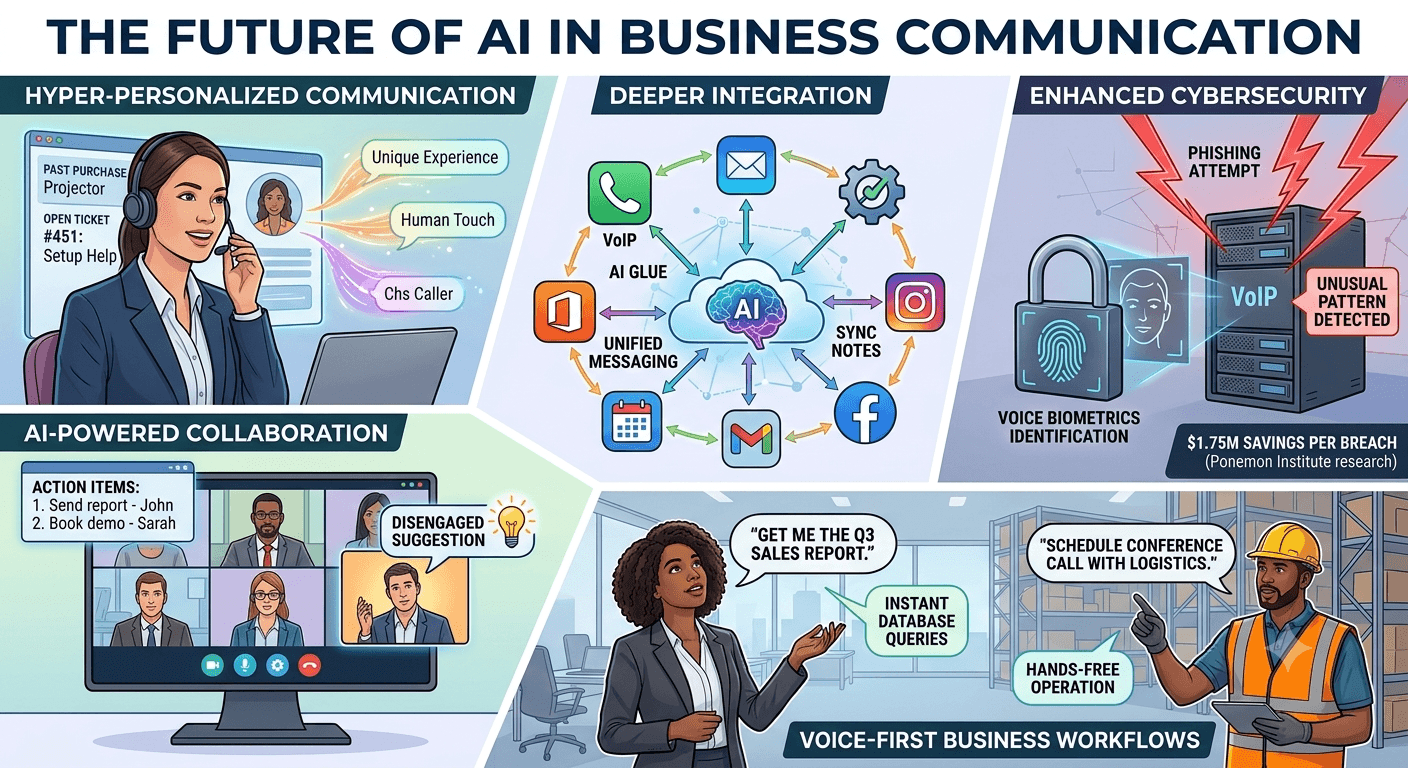
Future of VoIP AI Integration

Future of VoIP: AI Integration

The Future of VoIP: AI Integration represents a monumental shift in how global businesses connect, moving beyond simple voice transmission to intelligent, automated communication ecosystems. By embedding artificial intelligence directly into cloud-based phone systems, organizations can now leverage real-time data processing to enhance clarity, security, and efficiency. This evolution positions voip the future of telecommunications, where voice data is no longer static but a dynamic asset used for strategic decision-making. As the future of voip industry unfolds, the focus shifts from hardware to sophisticated software layers that predict user needs and automate complex workflows. How AI is Transforming VoIP? The integration of artificial intelligence into voice networks has moved from a conceptual stage to a functional necessity. Modern voip ai news highlights that systems are no longer passive recipients of audio; they are active participants in the conversation. By utilizing advanced machine learning algorithms, the future of voip technology ensures that every call is optimized for quality and purpose. This transformation is primarily driven by the need for smarter resource management and the desire to extract actionable insights from every interaction. 1. Smarter Call Routing with AI Traditional call routing relied on rigid rules and manual inputs that often frustrated callers. Today, ai voip systems use intelligent routing to analyze caller history, intent, and even the personality profile of the caller to match them with the most suitable agent. This reduces wait times and ensures that queries are resolved in the first interaction, which is a core component of ai-powered call analytics features in cloud voip systems. Dynamic routing uses skill-based matching to connect callers with specialized agents while placing high-value clients into priority queues. It also automatically redirects traffic during high-volume periods and adjusts call distribution based on time-of-day global patterns to balance workload. 2. Real-Time Transcription and Translation One of the most impressive feats in the future of voip is the ability to break language barriers instantly. AI algorithms can transcribe spoken words into text with incredible accuracy, allowing for searchable call logs and easy documentation. Furthermore, real-time translation features allow two people speaking different languages to communicate seamlessly, making voip the future of telecommunications for international trade. The accuracy of these systems has improved significantly due to neural machine translation. Business owners can now hold meetings with global partners without the need for expensive human translators. This technology not only saves time but also ensures that no critical information is lost in translation during high-stakes negotiations. 3. AI-Powered Virtual Assistants Virtual assistants have evolved far beyond simple auto-attendants. In the current landscape of ai news today, we see the rise of agentic ai, which can perform tasks autonomously rather than just following simple commands. These assistants can schedule meetings, take notes, and even follow up with clients via email after a call has concluded. Automated systems handle routine inquiries independently and instantly schedule calendar invites to streamline workflows. During live interactions, they provide agents with real-time suggestions while effortlessly managing out-of-office responses using personalized data. 4. Sentiment Analysis for Customer Experience Understanding the emotional state of a caller is crucial for effective communication. The future of voip industry includes sentiment analysis tools that monitor tone, pitch, and speed of speech to determine if a customer is happy, frustrated, or confused. This allows managers to intervene in difficult calls or provide immediate feedback to agents. Research by Gartner suggests that by 2026, 60% of service organizations will transition from traditional metrics to sentiment-based performance indicators. This shift ensures that businesses focus on the quality of human connection rather than just the duration of the call. 5. Predictive Analytics for Business Communication Predictive analytics allow businesses to anticipate problems before they occur. By analyzing historical call data, ai-powered call analytics features in cloud voip systems can predict peak call times, potential network failures, or even customer churn risks. This foresight allows companies to allocate resources more effectively and maintain a high standard of service. Predictive models forecast contact center staffing needs to optimize scheduling and pinpoint the underlying patterns that lead to dropped calls. They also detect fraudulent activity in real-time while analyzing customer inquiry trends to suggest valuable new service offerings. Benefits of AI-Powered VoIP Systems The adoption of the Future of VoIP: AI Integration brings a multitude of advantages that go beyond simple cost-cutting. These systems provide a competitive edge by making communication more fluid and intelligent. Organizations that embrace these changes find themselves better equipped to handle the demands of a modern, fast-paced market. 1. Efficiency and Productivity Efficiency is the cornerstone of any successful business, and AI-enhanced VoIP systems deliver this in abundance. By automating repetitive tasks like logging calls and updating CRM records, employees can focus on more strategic initiatives. The reduction in manual data entry alone saves hundreds of hours annually for large sales and support teams. Furthermore, the ability to quickly search through transcribed calls for specific keywords means that information retrieval is instantaneous. Instead of listening to a thirty-minute recording, a manager can find the exact moment a specific product was mentioned in seconds. This level of productivity is why many consider voip the future of telecommunications. 2. Cost Savings While the initial setup of advanced AI features might seem like an investment, the long-term savings are substantial. AI reduces the need for a large workforce to handle basic customer service tasks. Additionally, by optimizing network traffic and reducing bandwidth waste, companies can see a marked decrease in their monthly service bills. Implementing specialized technology reduces human labor costs for manual data entry and minimizes financial losses from fraudulent international calls. It also lowers overhead by eliminating the need for physical office hardware while decreasing agent turnover through better support tools. 3. Better Customer Experience The primary goal of any communication system is to provide a positive experience for the end-user. AI-driven systems achieve this by providing faster response times and more personalized interactions. When a system knows exactly who is calling and why, the customer feels valued and understood, which is vital for brand loyalty. Recent studies indicate that nearly 70% of customers prefer self-service options for simple tasks, provided they are accurate. AI-powered IVRs and chatbots fulfill this need, allowing customers to get answers at any time of day or night without waiting on hold for a human representative. 4. Scalability One of the most significant advantages of cloud-based AI systems is their ability to scale effortlessly. As a business grows, its communication needs become more complex. The future of voip technology allows for the instant addition of new lines, features, and AI modules without the need for physical infrastructure upgrades. This flexibility is particularly beneficial for seasonal businesses that may need to triple their capacity for a few months and then scale back. The cloud environment ensures that you only pay for what you use, making it an ideal solution for startups and enterprises alike. 5. Data-Driven Decision Making The wealth of data provided by ai-powered call analytics features in cloud voip systems is a goldmine for business intelligence. Leaders can now see exactly how their teams are performing, which marketing campaigns are driving the most calls, and what common pain points customers are facing. Interactive dashboards visualize real-time call trends and map out the geographical areas with the highest customer engagement. They also track the exact ROI of specific communication strategies while effortlessly comparing agent performance against automated benchmarks. The Future of AI in Business Communication Looking ahead, the Future of VoIP: AI Integration will only become more deeply rooted in the daily operations of global enterprises. We are moving toward a world where communication is proactive rather than reactive. The convergence of voice, data, and intelligence is creating a new standard for how work gets done. 1. Hyper-Personalized Communication Hyper-personalization is the next frontier in the future of voip industry. Instead of generic greetings, AI will use real-time data to craft unique experiences for every caller. This might include referencing a previous purchase, acknowledging a recent support ticket, or even adjusting the conversational style based on the caller’s historical preferences. This level of detail makes the interaction feel more human, despite being powered by algorithms. It bridges the gap between digital efficiency and personal touch, ensuring that technology serves to enhance human relationships rather than replace them. 2. Deeper AI and VoIP Integration The silos between different communication platforms are disappearing. In the future, your VoIP system will be seamlessly integrated with your email, project management tools, and social media channels. AI will act as the glue that binds these systems together, ensuring a consistent flow of information across the entire organization. Unified messaging platforms seamlessly connect communication across all digital channels while providing centralized AI insights for every touchpoint. They keep remote teams aligned by tracking cross-platform presence and automatically syncing call notes directly to project boards. 3. AI-Powered Collaboration Tools As remote work remains a permanent fixture, collaboration tools must become smarter. The future of voip technology includes meeting rooms that can automatically summarize action items and assign tasks to participants. These systems can also identify when a participant is disengaged and suggest ways to bring them back into the conversation. Noise cancellation technology powered by AI is also becoming standard. This ensures that whether an employee is working from a noisy cafe or a busy home environment, their voice remains crystal clear. This focus on audio quality is a key reason why voip the future of telecommunications. 4. Enhanced Cybersecurity with AI Security remains a top priority as cyber threats become more sophisticated. AI is uniquely suited to defend VoIP networks by identifying unusual patterns that might indicate a hack or a phishing attempt. Voice biometrics are also being used to verify identities, replacing insecure passwords and PINs. According to research from the Ponemon Institute, companies using AI for security automation save an average of $1.75 million per data breach compared to those that do not. This makes AI integration not just a convenience, but a critical security requirement for modern business. 5. Voice-First Business Workflows We are entering an era of voice-first business operations. Instead of typing into a computer, employees will interact with their office environment through voice commands managed by the VoIP system. This includes everything from requesting a sales report to initiating a conference call with a simple spoken phrase. Voice-activated database queries grant hands-free access to instant information, keeping warehouse and field workers safer and more efficient on the job. The same speech technology streamlines dictation for legal and medical professionals while offering simplified control over smart office environments. Here are Top Ways AI is Reshaping the VoIP Industry The practical application of AI within the VoIP sector is diverse and rapidly expanding. By examining the top ways these technologies are being deployed, we can see the tangible impact on day-to-day operations. These innovations are setting the stage for the next decade of digital transformation. 1. Interactive Voice Response (IVR) Systems The old-fashioned IVR that forced users through endless menus is being replaced by conversational AI. These new systems understand natural language, allowing users to state their needs in plain English. This shift significantly improves user satisfaction and reduces the likelihood of callers hanging up in frustration. Modern IVRs can also perform complex tasks like processing payments or updating account details without ever involving a human agent. This level of self-service is a hallmark of the future of voip industry, providing 24/7 support without increasing headcount. 2. Contact Center Operations Contact centers are the primary beneficiaries of ai-powered call analytics features in cloud voip systems. AI can monitor every single call in real-time, providing agents with “whisper” coaching or popping up relevant knowledge base articles. This ensures that even new agents can provide expert-level support from day one. Post-call work is also being revolutionized. AI can automatically summarize the conversation, tag it with relevant categories, and update the CRM. This allows agents to move from one call to the next much faster, increasing the overall capacity of the contact center. 3. Conferencing Abilities Video and audio conferencing are being enhanced by AI to make meetings more inclusive and productive. Features like auto-framing cameras and intelligent audio leveling ensure that everyone is seen and heard clearly. Furthermore, AI can provide real-time captions for participants who are hard of hearing or in noisy environments. Automated systems identify key speakers and tracking points to instantly generate accurate meeting minutes and summaries. They also utilize adaptive virtual backgrounds that adjust to changing lighting conditions while translating speech in real-time for global participants. 4. Chatbot Role Chatbots are no longer just for websites; they are now an integral part of the VoIP ecosystem. These bots can handle text-based queries that come through the same system as voice calls, providing a unified experience for the customer. They can also escalate a text chat to a voice call seamlessly if the query becomes too complex. The integration of advanced language models means these chatbots can hold nuanced conversations. They can answer complex questions about products, troubleshoot technical issues, and provide personalized recommendations based on the user’s history. 5. Pattern Identifications AI excels at finding the “needle in the haystack.” By analyzing millions of calls, voip providers ai-powered call analytics 2026 can identify subtle patterns that humans would never notice. This might include a specific phrase that leads to more sales or a recurring technical complaint that points to a product defect. Predictive analytics identifies the best times to reach specific demographics and uses keyword frequency to detect emerging market trends early. It also spots critical correlations between call duration and satisfaction while analyzing vocal cues to recognize early signs of employee burnout. 6. AI Supports IVRs By supporting IVRs with machine learning, the Future of VoIP: AI Integration ensures that the system learns from every interaction. If many customers are struggling with a particular menu option, the AI can suggest a change to the flow. This constant iteration leads to a system that is always improving and adapting to user behavior. This proactive approach to system maintenance is far more effective than traditional methods. It ensures that the communication infrastructure remains aligned with the needs of both the business and its customers, further solidifying the role of AI in the telephony space. Read More: What Does Send As Text Message Mean For Your Privacy? Critical Insights Final Thought The Future of VoIP with AI Integration is not a distant possibility but a current reality that is redefining the landscape of global communication. By combining the flexibility of the cloud with the intelligence of machine learning, businesses can create more meaningful, efficient, and secure connections. As we move deeper into 2026 and beyond, the companies that successfully integrate these technologies will be the ones that lead their respective industries. Embracing ai voip is no longer just about staying current; it is about building a foundation for a more connected and intelligent future. Faqs What does the Future of VoIP: AI Integration mean for small businesses? The Future of VoIP: AI Integration means that small businesses can now access enterprise-level communication tools at an affordable price. AI features like virtual assistants and automated transcriptions allow small teams to appear more professional and handle a higher volume of calls without hiring more staff. This levels the playing field, allowing smaller companies to compete with larger corporations in terms of customer service quality. How does Ai Voip improve the security of business calls? AI VoIP protects business calls by using machine learning and voice biometrics to instantly block toll fraud, spam, and identity spoofing. It also leverages real-time threat intelligence to dynamically optimize call encryption, keeping communications secure from eavesdropping. What is the role of agentic Ai in modern telephony? Agentic AI refers to systems that can take independent action to achieve a goal. In VoIP, this means an AI might not just take a message but actually resolve the customer’s issue by interacting with other software systems. For example, it could reschedule a flight or process a refund entirely on its own after understanding the caller’s request. Can you compare Ai-powered call analytics features in cloud voip systems? Different providers offer various levels of depth. Some focus on sentiment analysis to improve customer service, while others prioritize sales-driven analytics like keyword spotting and lead scoring. The best systems integrate both, providing a holistic view of how communication impacts the bottom line across all departments. Why is Voip the future of telecommunications? VoIP is considered the future because it treats voice as data, allowing it to be integrated with every other digital tool a business uses. Unlike traditional phone lines, VoIP can be enhanced with AI, scaled instantly, and accessed from anywhere in the world. This flexibility and intelligence make it the only logical choice for a modern, digital-first economy. What are the latest updates in Voip Ai news? Recent news highlights the move toward 5G-integrated VoIP and the use of Generative AI to create even more realistic virtual agents. There is also a significant focus on “noise-canceling as a service,” where AI removes background distractions for remote workers, ensuring professional-grade audio regardless of the location. How does the future of Voip industry impact remote work? The future of the industry is heavily focused on making remote work seamless. This includes AI-driven presence tracking, high-definition video conferencing with auto-summaries, and mobile apps that provide the exact same functionality as an office desk phone. These tools ensure that physical location is no longer a barrier to effective collaboration. Are there any downsides to the future of Voip technology? While the benefits are vast, businesses must be mindful of data privacy and the potential for “AI fatigue” among customers. It is important to maintain a balance where AI handles the routine tasks, but human agents are always available for complex or highly emotional situations to ensure the human element of business is not lost. What should businesses look for in Voip providers Ai-powered call analytics 2026? Businesses should look for providers that offer real-time insights rather than just post-call reports. The ability to integrate with existing CRM systems like Salesforce or HubSpot is also crucial. Additionally, look for providers that prioritize security and offer transparent information on how their AI models use and protect your company’s data.

Read More
VoIP for Healthcare Providers

VoIP for Healthcare Providers: Benefits & Challenges

Healthcare communication solutions represent the backbone of modern medical infrastructure, enabling providers to deliver timely and secure care. By transitioning from traditional landlines to Voice over Internet Protocol (VoIP) and cloud-based platforms, medical facilities can streamline patient intake, enhance telehealth capabilities, and ensure strict adherence to privacy regulations. VoIP for Healthcare providers integrates voice, video, and messaging into a single interface, reducing administrative bottlenecks and improving the overall patient experience. As the industry moves toward data-driven care, adopting a robust healthcare communication solution is no longer optional but a necessity for operational excellence and patient safety in a digital-first world. Key Considerations and Features to Look for in a Phone System for Healthcare Selecting the right healthcare communication solutions requires a deep understanding of the unique pressures faced by medical staff. A phone system for medical office environments must be more than just a tool for making calls; it needs to be a comprehensive platform that supports the clinical workflow. Providers should look for systems that offer high-definition voice quality, as clear communication is vital when discussing sensitive medical instructions or dosages. Furthermore, the ability to handle high call volumes during peak hours without dropping connections is a non-negotiable requirement for any phone system for healthcare. The reliability of a medical office phone system also hinges on its ability to support the various ways patients interact with a clinic. Modern healthcare phone systems now include features like SMS appointment reminders, secure file sharing, and virtual waiting rooms. When evaluating these platforms, administrators must ensure the provider offers a Business Associate Agreement (BAA) to guarantee that the technology meets federal standards. This foundation of security and functionality ensures that the medical practice phone system serves as an asset rather than a liability in daily operations. 1. HIPAA Compliance and Data Security In the realm of healthcare communication solutions, security is the primary concern because of the stringent requirements of the Health Insurance Portability and Accountability Act. A medical phone system must encrypt data both at rest and in transit to prevent unauthorized access to sensitive patient information. Providers of a cloud phone system for healthcare must demonstrate that their infrastructure is regularly audited and that they have protocols in place to handle potential breaches. According to the 2024 HIPAA Journal report, healthcare data breaches have reached record highs, making it essential to choose a healthcare phone system that prioritizes advanced encryption and multi-factor authentication. Beyond technical encryption, a phone system for medical office use must include administrative controls that allow managers to track who is accessing the system and when. This audit trail is a critical component of maintaining compliance and ensuring that staff members are using the medical practice phone system appropriately. Features like automatic session timeouts and restricted access based on user roles help minimize the risk of accidental data exposure. Investing in a best hipaa compliant phone system ensures that your practice remains protected from legal repercussions and maintains the trust of your patient base. 2. EHR and EMR System Integration The ability to connect a healthcare phone system with Electronic Health Records (EHR) and Electronic Medical Records (EMR) is a transformative feature for modern clinics. When a patient calls, an integrated medical office phone system can automatically trigger a screen pop-up that displays the patient’s history, recent lab results, and upcoming appointments. This seamless flow of information allows the administrative staff to provide personalized service without having to manually search through multiple databases. High-quality healthcare communication solutions act as a bridge between communication and clinical documentation, reducing the time spent on manual data entry. Integration also helps in maintaining accurate records of patient interactions, as call logs and recordings can be automatically attached to the patient’s file. This is particularly useful for a medical practice phone system in Buffalo NY or other busy urban areas where patient volume is high and efficiency is paramount. By using a phone system for healthcare that speaks the same language as your clinical software, you reduce the likelihood of human error. According to research from HIMSS, integrated communication systems can reduce administrative tasks by up to 30%, allowing providers to focus more on direct patient care. 3. Intelligent Call Routing and Auto-Attendant Features Efficient call routing solutions for medical facilities are essential for managing the complex flow of inquiries that a clinic receives daily. An intelligent auto-attendant can greet callers and offer a menu of options, such as “Press 1 for appointments” or “Press 2 for prescription refills.” This ensures that the caller reaches the appropriate department without the need for a human receptionist to manually transfer every call. For a hospital phone system, these features are critical in directing emergencies to the right triage unit while keeping administrative lines clear for routine business. Advanced healthcare telephony platforms also offer time-of-day routing, which is vital for after-hours care. If a patient calls after the office has closed, the healthcare phone service can automatically redirect the call to an on-call physician or an automated answering service for medical practice. This level of automation ensures that no patient is left without a point of contact, regardless of when they reach out. Implementing a phone system for medical office environments with these routing capabilities significantly reduces wait times and improves the patient’s journey from the first point of contact. 4. Mobile and Remote Access Capabilities The rise of telehealth and remote administrative work has made mobile access a core component of healthcare communication solutions. Modern medical phone systems often come with dedicated mobile applications that allow doctors and nurses to make calls from their personal devices while displaying the office’s caller ID. This protects the provider’s privacy while ensuring they can remain connected to the clinic from any location. A cloud phone system for healthcare provides the flexibility needed to support a hybrid workforce, which is increasingly common in the modern medical landscape. Mobile capabilities also extend to features like secure mobile messaging and video conferencing for virtual consultations. When considering how to do telehealth on phone, having a unified healthcare phone system that supports video within the same app is much more efficient than using third-party software. For a dental office phone system or a specialized surgical center, being able to send a quick, secure photo or message between staff members on the move can expedite decision-making. This mobility ensures that the hospital telephone systems remain functional and accessible, even when key personnel are off-site. 5. Reliability, Redundancy, and Local Survivability Reliability is perhaps the most critical factor when choosing a medical practice phone system, as a loss of communication can have life-threatening consequences. Healthcare communication solutions must offer high uptime guarantees, typically 99.999%, to ensure that the phone system for medical use is always available. Redundancy is achieved through multiple data centers that can take over the load if one site goes down. For facilities in areas prone to natural disasters, local survivability features allow the phone system for medical office use to continue functioning even if the primary internet connection is lost. Local survivability often involves a hybrid approach where some on-site hardware manages local calls if the cloud connection is interrupted. This is a vital consideration for hospital phone systems that manage emergency rooms and intensive care units where every second counts. When evaluating healthcare phone solutions, it is important to ask the provider about their disaster recovery plan and how they maintain connectivity during outages. A robust medical pbx in the US should have a proven track record of maintaining service through various network challenges, ensuring that healthcare phone service remains uninterrupted. 6. Scalability and Multi-Location Support As medical practices grow, their healthcare communication solutions must be able to scale seamlessly to accommodate new staff and locations. A cloud telephony system for healthcare allows administrators to add new users or extensions with just a few clicks in a web portal, eliminating the need for expensive hardware upgrades. This is especially beneficial for healthcare phone systems serving multi-specialty groups that may open new satellite offices frequently. The centralized nature of cloud telephony means that all locations can share a single directory and internal dialing system. Multi-location support also allows for centralized reception, where a single team of agents can handle calls for several different clinics. This optimizes staffing levels and ensures that every medical office phone system in the network provides a consistent caller experience. Whether you are managing a single medical practice phone system or a large network of hospital telephone systems, scalability ensures that your technology investment remains relevant. The best phone system for medical office use is one that can grow from a two-line setup to a hundred-line system without requiring a complete overhaul of the existing infrastructure. 7. Cost and Licensing Model Understanding the cost and licensing model is essential when you compare the pricing of cloud telephony for small medical practices. Most modern healthcare communication solutions operate on a per-user, per-month subscription basis, which provides a predictable recurring expense. This model often includes all maintenance, software updates, and support, reducing the long-term cost of ownership compared to traditional on-premises systems. When looking at cloud telephony pricing for small medical practices 2026, it is important to identify if certain features like call recording or video conferencing are included or require a premium tier. While the initial setup for a phone system for medical office use might be lower with a cloud-based model, practices should also account for the cost of high-speed internet and any necessary hardware, such as IP desk phones or headsets. Some medical phone systems offer “bring your own device” policies, which can further reduce upfront capital expenditure. By analyzing the total cost of ownership over three to five years, healthcare leaders can make an informed decision that balances functionality with budget constraints. Selecting a healthcare phone system with transparent pricing helps avoid hidden fees and ensures the practice stays financially healthy. 8 Great Phone Systems for Medical Offices and Healthcare Needs The market for healthcare communication solutions is filled with diverse providers, each offering unique strengths tailored to different types of medical facilities. Choosing the right medical office phone system depends on the specific size of your practice and the level of integration you require with other clinical tools. Some systems are designed for large hospital phone systems, while others focus on providing the best phone system for dental office use or small private clinics. Below are eight of the most reputable providers currently serving the healthcare industry with specialized features. These providers have adapted their platforms to meet the rigorous demands of the medical field, ensuring that they offer the best medical pbx in US markets. From advanced call routing to HIPAA-compliant messaging, these systems represent the cutting edge of healthcare telephony. When evaluating these options, consider how their specific tools align with your clinic’s daily workflows and patient engagement goals. Whether you need an automated phone system for doctors office or a complex network for a surgical center, these eight providers offer reliable and feature-rich solutions. 1. Nextiva Nextiva is frequently cited as a top choice for healthcare communication solutions because of its highly reliable network and user-friendly interface. It offers a comprehensive suite of tools that includes voice, video, and team collaboration, all within a HIPAA-compliant framework. For a medical practice phone system, Nextiva’s analytics dashboard is particularly useful, allowing managers to see real-time data on call volumes and staff performance. This visibility helps clinics optimize their staffing during busy morning hours when patient inquiries are typically at their peak. 2. RingCentral RingCentral is a global leader in cloud communication and offers a robust phone system for medical office environments of all sizes. Their platform is known for its deep integration capabilities, allowing it to connect with hundreds of popular business and healthcare apps. This makes it an excellent medical office phone system for practices that rely on specific CRM or EHR software. RingCentral also provides dedicated support for healthcare providers, ensuring that their healthcare phone systems are configured correctly for security and compliance from day one. 3. Dialpad Dialpad stands out in the world of healthcare communication solutions due to its heavy use of artificial intelligence to improve the caller experience. Its AI-powered transcription service can provide real-time notes during calls, which is an invaluable feature for doctors conducting telehealth consultations. This medical phone system also offers proactive insights into patient sentiment, helping staff identify and address concerns more effectively. For a modern medical office phone system, Dialpad’s focus on automation and intelligence makes it a forward-thinking choice. 4. 8×8 8×8 offers a unified platform that combines voice, video, chat, and contact center solutions, making it ideal for larger healthcare phone systems and hospital networks. Their global reach and high uptime guarantees make them a reliable partner for organizations with multiple locations across different regions. 8×8 is particularly known for its strong focus on security, providing end-to-end encryption across all its healthcare phone solutions. This ensures that every phone system for healthcare they deploy meets the highest standards of data protection. 5. RingRx RingRx is unique because it was built specifically for the healthcare industry, meaning every feature is designed with clinical workflows in mind. This medical practice phone system focuses heavily on HIPAA compliance and offers specialized tools like an on-call management system. It is often considered the best phone system for medical office use among smaller practices that need a simple but highly secure solution. RingRx’s healthcare telephony services are tailored to the specific needs of doctors, making it a very intuitive platform for medical staff. 6. Net2Phone Net2Phone provides versatile healthcare communication solutions that are particularly popular among mid-sized clinics and dental offices. They offer a range of desk phones and mobile apps that integrate seamlessly to ensure staff can stay connected whether they are at the front desk or in a patient room. For those looking for a phone system for dental office use, Net2Phone’s affordable pricing and robust feature set make it a competitive option. Their healthcare phone service includes unlimited calling and a variety of advanced features at a single price point. 7. Vonage Vonage has a long history in the VoIP space and has developed specific healthcare phone solutions that cater to the needs of modern medical facilities. Their platform is highly customizable, allowing practices to add features like programmable APIs for custom SMS notifications or appointment reminders. This flexibility makes Vonage a strong contender for a medical office phone system that needs to adapt to very specific operational requirements. They also offer strong support for telehealth, providing secure video tools that are easy for both patients and providers to use. 8. Doximity Dialer Doximity Dialer is a specialized tool that has become a staple for many providers when considering how to do telehealth on phone. While it is not a full-service PBX like others on this list, it is an essential component of healthcare communication solutions for millions of doctors. It allows physicians to call patients from their personal cell phones while masking their private number with the office’s caller ID. This medical phone number for providers tool is highly rated for its simplicity and its ability to facilitate quick, secure communication between doctors and their patients. What Are the Benefits of VoIP for Healthcare Providers? The transition to VoIP-based healthcare communication solutions offers a transformative shift in how medical facilities interact with their patients. The main benefit of VoIP for healthcare providers is better patient access combined with more efficient operations. Patients can reach the right team faster through automated menus, and staff can manage high call volumes with digital tools that were difficult or expensive to support on legacy systems. This modernization leads to a more professional image and a smoother administrative process for everyone involved. By moving to a cloud phone system for healthcare, clinics can move away from the limitations of physical phone lines. VoIP allows for a virtually unlimited number of concurrent calls, meaning patients will rarely encounter a busy signal. This is a significant improvement for a medical practice phone system that wants to reduce patient frustration and improve retention. Furthermore, the ability to record calls for quality assurance or training purposes allows medical offices to constantly refine their communication strategies and ensure the highest level of service. Lower infrastructure burden: Reduce reliance on on-site PBX hardware and manual maintenance by moving to a hosted environment. Improved patient experience: Use intelligent routing, queues, reminders, and automation to reduce frustration and wait times. Better staff productivity: Automate repetitive tasks and route calls to the right team the first time without manual intervention. More flexible care delivery: Support remote work, telehealth initiatives, and multi-site communication through a single platform. Stronger visibility: Use real-time analytics to identify missed calls, high-volume periods, and potential staffing gaps in the clinic. Integration potential: Connect voice services with scheduling software, contact centers, EMR, EHR, and patient engagement workflows. For healthcare leaders, the business case for upgrading to modern healthcare communication solutions is usually a mix of patient access and risk reduction. VoIP is not just a telecom purchase; it is a fundamental part of the patient experience infrastructure. When a hospital phone system is integrated with other digital tools, it creates a cohesive ecosystem that supports better clinical outcomes. Ultimately, the flexibility and data insights provided by VoIP systems allow practices to be more agile and responsive to the needs of their community. How to Choose the Best Healthcare Phone System for Your Clinic? Choosing the best healthcare communication solutions for your clinic involves more than just comparing monthly prices. It starts with a clear understanding of your clinic’s day-to-day operations, growth plans, and specific patient communication needs. A medical office phone system that works for a small pediatrics office might not be sufficient for a large multi-specialty surgical center. You must look for a partner that understands the nuances of the medical industry and provides the necessary security guarantees. The process of selecting a phone system for healthcare should be collaborative, involving input from both the administrative staff and the clinical team. This ensures that the chosen platform solves actual pain points, such as long hold times or difficulty reaching on-call doctors. By taking a systematic approach to evaluation, you can find a medical practice phone system that enhances your ability to provide care while staying within your budget. Consider the following steps to guide your decision-making process: Analyze your current needs: Look at your call volume, patient interactions, and current staff workflows to identify where your existing system falls short. Practice size and complexity: Ensure the system supports your specific size, whether you are a solo practitioner or a multi-department hospital. Essential features: Identify must-have capabilities like EHR/EMR integration, secure texting, or auto-attendants that directly improve patient service. IT infrastructure: Evaluate if your clinic is ready for a cloud-based solution or if a hybrid approach is better based on your internet stability. Vendor support: Check the support options each provider offers to ensure you have fast access to help during critical patient hours. Budget and costs: Consider both upfront capital for hardware and ongoing monthly service fees to understand the total cost of ownership. Scalability and future plans: Choose a system that can easily grow with you as you add users, open new locations, or expand your services. A medical office phone system that meets these criteria will not only support your operations today but also help you stay flexible in an evolving market. The right healthcare communication solutions act as a foundation for future innovations, such as advanced AI triaging or expanded telehealth services. Taking the time to perform this due diligence ensures that your clinic remains competitive and provides the high-quality communication that patients expect in the modern era. Medical Phone System Deployment Options: Choose What Fits Your Practice When implementing healthcare communication solutions, you generally have three primary ways to set up your phone system. The first is an on-premises system, which involves installing physical hardware within your facility. On-premises systems give you full control over your data and may be better for clinics with a robust in-house IT support team. However, they often require a higher upfront investment and can be more difficult to scale or update as technology advances. The second and most popular option today is a cloud phone system for healthcare. These systems are hosted by the provider, meaning you don’t need to maintain bulky hardware on-site. Cloud systems are significantly easier to manage and are ideally suited for teams working across multiple locations or those offering telehealth services. They offer the greatest flexibility and are typically updated automatically by the vendor, ensuring you always have access to the latest security patches and features. Finally, hybrid UC systems offer a mix of both on-premises and cloud features, providing a middle ground for facilities with specific needs. These are particularly useful when you want the benefits of the cloud but require a local backup in case of internet issues. Your choice of deployment depends on your clinic’s physical structure, available IT resources, and long-term goals. Each of these healthcare communication solutions has its merits, and the best choice is the one that aligns with your practice’s operational reality and risk tolerance. Read More: VoIP for Law Firms: Key Benefits in 2026 Final Thought Adopting advanced healthcare communication solutions is a vital step toward modernizing patient care and improving clinical efficiency. By choosing a system that prioritizes HIPAA compliance, integration, and reliability, healthcare providers can ensure they are meeting both regulatory demands and patient expectations. Whether you manage a small medical office phone system or a sprawling hospital network, the right communication tools will empower your staff and lead to better health outcomes. As technology continues to evolve, staying informed about the best phone system for medical office use will remain a key priority for successful healthcare administration. Frequently Asked Questions Do hospitals use VoIP phone systems? Yes. Hospitals, health systems, clinics, and specialty practices use VoIP phone systems to manage patient calls, internal communication, telehealth workflows, routing, and multi-location operations. The system must be designed around healthcare privacy, uptime, and workflow requirements. Most modern hospital telephone systems have transitioned to VoIP to leverage its scalability and advanced integration features with hospital information systems. What is VoIP in healthcare? VoIP in healthcare is the use of internet-based voice technology to manage patient and staff communication. It can replace legacy phone systems while adding cloud PBX, call routing, analytics, telehealth support, contact center capabilities, and integration with healthcare systems. This form of healthcare communication solutions allows for more flexible and data-driven management of medical interactions. Is VoIP good for medical practices? VoIP can be a strong fit for medical practices because it supports flexible call routing, after-hours coverage, voicemail management, patient reminders, mobile access, and easier scaling. Practices should choose a provider that understands healthcare compliance and patient communication workflows. Using a medical office phone system based on VoIP technology often results in lower costs and higher patient satisfaction. What is the main disadvantage of VoIP? The main disadvantage of VoIP is its dependence on reliable internet connectivity and proper network configuration. Healthcare organizations should plan redundancy, quality of service, security controls, and uptime requirements before migrating critical communication workflows. If the internet goes down, the healthcare phone service could be interrupted unless a backup or hybrid solution is in place. Can VoIP connect with EMR or EHR systems? Yes, many modern VoIP and cloud communication platforms can connect with EMR, EHR, scheduling, contact center, and patient engagement systems. Integration requirements vary by organization, so healthcare teams should confirm supported systems and workflows before implementation. This integration is a hallmark of the best healthcare communication solutions currently on the market. How does VoIP help with HIPAA compliance? VoIP providers that specialize in healthcare communication solutions offer end-to-end encryption and sign Business Associate Agreements (BAAs). These systems are designed to secure patient data during voice calls, video meetings, and text messaging. This ensures that a medical practice phone system remains compliant with federal privacy laws while still providing modern features. Can I keep my existing medical phone number? Yes, providers of healthcare phone solutions allow you to “port” your existing phone numbers to the new system. This ensures that patients can still reach you at the number they already have in their contacts. Keeping your medical phone number for providers is a standard part of the transition to a new cloud phone system for healthcare. Is a cloud phone system for healthcare expensive? Generally, a cloud phone system for healthcare is more cost-effective than a traditional PBX because it eliminates the need for expensive hardware maintenance and upgrades. Pricing is usually based on a per-user monthly fee, which helps small medical practices manage their budgets more effectively. When you compare the pricing of cloud telephony for small medical practices 2026, you often find significant long-term savings. Does VoIP support telehealth appointments? Yes, many healthcare communication solutions include built-in video conferencing tools specifically designed for telehealth. These tools are secure and often allow doctors to send a simple link to a patient’s phone to start a virtual visit. Knowing how to do telehealth on phone becomes much easier with a unified medical phone system that handles both voice and video.

Read More
VoIP for Remote Teams in USA

VoIP for Remote Teams in USA: Best Phone System

VoIP for remote teams in USA provides a flexible, cloud-based communication solution that replaces traditional landlines with internet-based calling. A reliable VoIP phone system for remote work allows employees to stay connected from any location using their laptops, smartphones, or desk phones. These systems integrate voice, video, and messaging into a single platform, ensuring seamless collaboration. By utilizing internet protocols, us voip providers offer scalable and cost-effective services. For businesses looking to scale, adopting a professional telephony service provider is essential to maintain high-quality communication standards across distributed teams in the competitive american voip market today. Top VoIP Providers in USA to Improve Business Calls The market for voip providers usa is vast, offering various features tailored to different business sizes. Choosing the right telephony service provider ensures that your remote staff can communicate without technical hurdles. Below is a comparison of the top five platforms currently leading the industry in the United States. Platform Starting Price (Per User/Mo) Best AI Feature Ideal For Dialpad Starts at $15 Real-time call coaching and transcripts Native AI users RingCentral Starts at $20+ Advanced conversational AI and CRM sync Enterprise teams Nextiva Starts at $18.95 AI-driven virtual agents 24/7 support needs Zoom Phone Starts at $15 AI Companion summarization Zoom ecosystem users OpenPhone Starts at $15 Automated SMS and call transcripts Fast-growing startups 1. Dialpad Dialpad stands out among voip companies in usa for its heavy emphasis on artificial intelligence. It offers a robust voip phone system for remote work that includes built-in AI for every user level. This platform is particularly useful for sales teams who need real-time feedback during calls to improve their conversion rates. The system provides automated transcriptions which help team members stay focused on the conversation rather than taking notes. As a prominent american voip option, it simplifies how remote teams handle high volumes of calls while maintaining a professional image through custom greetings and intelligent routing. 2. RingCentral RingCentral is often cited as a top telephony service provider due to its extensive integration capabilities. For teams using a complex stack of software, this us voip provider connects with over 300 apps, including Salesforce and Microsoft Teams. It ensures that business voip telephone services are deeply embedded into the daily workflow of every employee. The platform is designed for reliability, offering a 99.999% uptime guarantee which is crucial for voip america operations. Distributed teams benefit from its enterprise-grade security and the ability to sync data across multiple devices instantly, making it a staple for large corporations operating remotely across various states. 3. Nextiva Nextiva focuses on providing a stable and feature-rich business voip phone experience. It is highly regarded among us voip providers for its customer service and ease of use. The platform combines voice, video, and collaboration tools into one interface, reducing the need for multiple subscriptions and lowering overall costs for the business. One of its strongest points is the AI-driven analytics that allow managers to track call performance and customer satisfaction. For remote teams that require constant uptime and expert technical support, Nextiva provides a dependable backbone for all voip united states communications, ensuring that no customer call goes unanswered. 4. Zoom Phone Zoom Phone has quickly become a favorite voip phone for business because of its familiarity. Most remote workers already use Zoom for video conferencing, so transitioning to their business phones voip service is seamless. It offers a simplified pricing structure that makes it accessible for small businesses and large enterprises alike. The addition of the AI Companion helps summarize long calls and identify action items automatically. This tool is perfect for teams that are already comfortable within the Zoom environment and want to centralize their communication tools under a single, reliable usa voip service provider without a steep learning curve. 5. OpenPhone OpenPhone is specifically designed for the modern startup and small business environment. Unlike some traditional voip providers in usa, OpenPhone feels like a consumer app with its clean interface and intuitive design. It allows teams to share phone numbers, so multiple people can respond to texts or calls from the same business line. This transparency is excellent for small remote teams who need to collaborate on customer support or sales inquiries. The platform includes automated SMS drafting and call transcriptions, making it a very efficient voip usa solution for companies that prioritize speed and mobile-first communication strategies. Who’s the best VoIP provider in USA? Determining the best provider depends largely on your specific organizational needs and the size of your remote workforce. Some businesses prioritize cost, while others look for advanced AI features or deep CRM integrations. A telephony service provider that works for a solo entrepreneur might not satisfy the requirements of a multinational corporation with thousands of employees. When evaluating voip companies in usa, it is important to look at the stability of their infrastructure and the quality of their mobile applications. Since remote work relies heavily on mobile devices and home internet connections, the software must be optimized for varying bandwidths. Most top-tier us voip providers now offer trial periods to test their services before committing. Why is Best VoIP Provider in USA Important? 1. Reduced Communication Costs Switching to a modern business voip telephone system can lead to significant financial savings. Traditional landline systems require expensive hardware installations and monthly maintenance fees that can drain a company’s budget. Research by Global Workplace Analytics has shown that businesses can save between $2,000 and $7,000 per employee annually by moving to remote-friendly digital communication tools. Because voip america services run over the internet, long-distance and international call rates are typically much lower than those of traditional carriers. This is especially beneficial for us voip companies that have clients or team members located in different countries, as it removes the barrier of high per-minute calling charges. 2. Enhanced Customer Experience A professional voip phone for business ensures that customers always reach the right person through intelligent call routing. Features like auto-attendants and interactive voice response systems give a small business the professional appearance of a large corporation. This builds trust and ensures that customer inquiries are handled efficiently, even when the team is distributed. Furthermore, integrating your voip united states service with a CRM allows employees to see customer history the moment a call arrives. This personalized approach improves the quality of interaction and increases the likelihood of resolving issues on the first call, which is a key metric for customer satisfaction in the american voip market. 3. Enhanced Communication Skills Using advanced business phones voip tools encourages better communication habits within a team. With features like call recording and AI-driven transcriptions, employees can review their conversations to identify areas for improvement. Managers can also use these tools for coaching, helping remote staff refine their sales pitches or support techniques. The ability to switch seamlessly between voice and video calls also helps in building stronger internal relationships. When remote teams can see each other and share screens easily, they are more likely to collaborate effectively. This environment fosters a culture of transparency and continuous learning across the entire organization. How does the Best VoIP Provider in USA operate? 1. Voice Conversion The fundamental technology behind any voip usa service involves converting analog voice signals into digital data packets. When you speak into your microphone, the software samples your voice at high frequencies and turns the sound waves into a series of ones and zeros. This process happens almost instantaneously, ensuring there is no noticeable lag during the conversation. These digital packets are then prepared for transmission across the internet. By using standardized protocols, us voip providers ensure that the data can be read by any receiving device, whether it is another VoIP phone, a computer, or a traditional landline. This conversion is the first step in making global communication possible over a simple data connection. 2. Data Transfer over Internet Once the voice is digitized, the packets are sent over the internet using the Internet Protocol. Unlike traditional circuit-switched networks that keep a dedicated line open for the duration of a call, VoIP uses packet switching. This means the data takes the most efficient path available to reach its destination, which makes better use of the available network bandwidth. During this stage, a telephony service provider manages the flow of data to prevent jitter or packet loss. High-quality voip providers usa use advanced codecs to compress the data without losing audio quality. This allows for high-definition voice calls even on internet connections that might not be extremely fast, providing a consistent experience for remote workers. 3. Cloud-based processing Most modern voip america services are hosted in the cloud, meaning the “brain” of the phone system lives in a secure data center rather than a physical closet in your office. This cloud-based processing handles all the complex tasks like call routing, voicemail storage, and conference bridging. It allows the system to remain functional even if one specific server goes down. Cloud processing also enables the scalability that voip companies in usa are known for. You can add new users or features with a few clicks in a web dashboard. There is no need to wait for a technician to install new lines, making it the perfect voip phone system for remote work where team members might be added from different locations frequently. 4. Make the Call When a user initiates a call, the software communicates with the us voip provider servers to establish a connection. The system checks the destination number and determines the best route to take. If you are calling another user on the same VoIP network, the connection is direct and often entirely free of charge regardless of the distance. If the call is made to a traditional landline or mobile phone, the telephony service provider uses a gateway to translate the digital signal back into an analog format that the public switched telephone network can understand. This interoperability is what makes business voip phone services so versatile for modern companies operating in the united states. 5. Enable Extra Features Beyond just making calls, the best us voip providers enable a wide range of digital features that enhance productivity. This includes the ability to send and receive text messages, host video meetings, and share files within the same application. These features are enabled by the same data-sharing infrastructure that carries the voice calls. Advanced features like visual voicemail, where messages are transcribed and sent to your email, are also processed at this stage. By centralizing these functions, a business voip telephone becomes a complete communication hub. This integration is why many firms are moving away from single-use tools toward comprehensive american voip solutions. Benefits of the Best VoIP Provider USA 1. Living Frugally Adopting a voip phone system for remote work is one of the best ways for a company to live frugally while maintaining high standards. There is virtually no upfront investment in hardware since employees can use their existing laptops or smartphones. This shift from capital expenditure to a predictable monthly operating expense helps businesses manage their cash flow more effectively. Elimination of expensive hardware maintenance. Lower monthly service fees compared to traditional carriers. Reduced need for dedicated IT staff to manage phone lines. No extra charges for basic features like caller ID or call waiting. 2. Business Calls Quality Modern voip providers usa offer high-definition audio that often surpasses the quality of traditional landlines. As long as there is a stable internet connection, the voice clarity is exceptional. This professional sound quality is vital for maintaining credibility during important sales calls or client consultations where every detail matters. The use of wideband audio codecs allows for a fuller range of sound, making conversations feel more natural. For remote teams, this clarity reduces listener fatigue, which is a common issue when people spend hours on the phone every day. It ensures that communication is effective and that misunderstandings due to poor audio are minimized. 3. Supports work from home The primary benefit of a voip usa service is its inherent support for work-from-home models. Employees can take their business extension with them anywhere in the world. Whether they are working from a home office, a coffee shop, or a co-working space, they remain reachable on their professional business line. Employees stay connected using mobile apps. Presence indicators show who is available or busy. Seamless switching between desktop and mobile devices. One number for all locations simplifies contact management. 4. CRM Integration A top-tier telephony service provider will offer seamless integration with popular CRM platforms. This allows for automatic call logging, which saves employees from manual data entry. When every call is automatically recorded in the customer’s file, the entire team has access to the latest information, improving internal coordination. This integration also enables “click-to-dial” functionality directly from the CRM interface. This small efficiency gain can add up to hours of saved time every month for a busy sales or support team. It turns the business voip phone into a data-driven tool that provides insights into customer behavior and team productivity. 5. Call Management Advanced VoIP systems offer advanced call management features that were previously only available to large corporations with expensive on-premise equipment. These include sophisticated call queues, ring groups, and time-based routing. These tools ensure that every incoming call is handled by the most appropriate person in the shortest possible time. Automated attendants guide callers to the right department. Call whispering allows managers to advise employees during live calls. Call barging enables supervisors to take over difficult calls. Custom hold music and announcements keep callers engaged. 6. Improved Customer Support With a voip america system, customer support teams can operate with greater flexibility. Support agents can be located in different time zones to provide 24/7 coverage without the need for a physical office in every region. Features like call recording are invaluable for training new agents and ensuring that quality standards are consistently met. According to a report by Gartner, by 2025, over 80% of customer service organizations will have abandoned native mobile apps in favor of integrated messaging and voice platforms to improve the customer journey. This highlights the importance of choosing a us voip provider that can handle multiple communication channels within a single interface. 7. Better productivity Productivity increases when employees have all their communication tools in one place. Instead of jumping between different apps for calling, messaging, and video conferencing, a voip united states solution brings everything together. This reduces “context switching,” which is known to decrease focus and efficiency during the workday. Quickly start a video call from a chat window. Share screens instantly to resolve technical issues. Use internal messaging for quick questions without calling. Centralized notifications prevent missed messages. 8. Better Security Reputable us voip providers prioritize security to protect sensitive business conversations. They use encryption protocols like SRTP (Secure Real-time Transport Protocol) to ensure that voice data cannot be intercepted by unauthorized parties. This is a significant upgrade over traditional phone lines, which are relatively easy to tap into. In addition to encryption, these platforms offer multi-factor authentication and regular security audits. For businesses that must comply with strict data protection regulations like HIPAA or GDPR, choosing a certified telephony service provider is essential. This ensures that all communication remains confidential and secure from cyber threats. 9. Simple Business Growth One of the standout features of voip companies in usa is how easily they support business growth. Adding a new line or a new department takes only a few minutes through an online portal. This elasticity allows businesses to scale their communication infrastructure up or down based on seasonal demand or rapid expansion. Because there is no physical wiring involved, expanding to a new location is as simple as sending a laptop to a new employee. This makes usa voip the ideal choice for companies that plan to grow quickly without being held back by the limitations of traditional infrastructure or the need for expensive site visits by technicians. 10. Communication features powered by AI The integration of AI is changing how we use business phones voip. Features like real-time sentiment analysis can alert a manager if a customer call is going poorly. AI can also provide “live battle cards” to sales reps, giving them relevant talking points based on what the customer is saying during the conversation. These AI features help remote teams work smarter, not harder. By automating routine tasks like call logging and summarization, employees can spend more time focusing on high-value activities. The use of AI in voip providers usa is becoming a standard requirement for businesses that want to stay competitive in the digital age. How to pick the best VoIP provider in USA? Choosing the right telephony service provider requires a careful assessment of your current and future needs. Start by listing the essential features your team needs, such as mobile apps, video conferencing, or specific CRM integrations. Consider the technical proficiency of your staff; some systems are more user-friendly than others, while some offer deeper customization for advanced users. Next, evaluate the reputation and reliability of the us voip providers you are considering. Check for uptime guarantees and read reviews regarding their customer support responsiveness. Since your phone system is the lifeblood of your business, you need a partner that will be there to help if things go wrong. Finally, compare the total cost of ownership, including any hidden fees for international calling or additional features. It is also wise to check the voip license in usa status of the provider to ensure they are a legitimate operation compliant with federal regulations. Most established american voip companies will have this information readily available. Taking the time to do thorough research will ensure that you select a platform that grows with your business and supports your remote team effectively for years to come. Read More: What is Spy Dialer: A Comprehensive Guide Conclusion Selecting the right VoIP for remote teams in USA is a strategic decision that impacts productivity, cost, and customer satisfaction. The transition to a modern voip phone system for remote work is no longer just a trend; it is a necessity for businesses looking to remain agile and competitive. By leveraging the power of cloud-based communication, us voip providers offer a level of flexibility and functionality that traditional systems simply cannot match. Whether you choose an AI-heavy platform like Dialpad or a versatile giant like RingCentral, the benefits of moving to a digital telephony service provider are clear. With the right american voip solution, your remote team will be better connected, more efficient, and ready to meet the challenges of the modern business landscape. FAQs What is a VoIP provider? A VoIP provider is a company that offers voice communication services over the internet rather than through traditional copper wires. These us voip providers convert voice into digital data packets and transmit them via the web, allowing users to make calls from computers, specialized VoIP phones, or mobile apps. Is VoIP superior than a traditional phone system? Yes, VoIP is generally considered superior because it offers more features at a lower cost. Unlike traditional systems, voip america services include video conferencing, SMS, and AI tools. They are also much easier to scale and support remote work, which traditional landlines cannot do effectively. Can VoIP be used by small businesses? Absolutely, many voip companies in usa offer plans specifically designed for small businesses. These plans allow smaller teams to access professional features like auto-attendants and call routing without a huge investment, helping them compete with much larger organizations. Is VoIP suitable for remote teams? VoIP is the ideal solution for remote teams because it is not tied to a physical location. A voip phone system for remote work allows employees to use their business number from anywhere with an internet connection, ensuring they stay professional and reachable regardless of where they are working. How Much Does VoIP Service Cost? The cost of voip providers usa services typically ranges from $15 to $50 per user per month. The final price depends on the number of users and the specific features required, such as advanced AI analytics, extensive integrations, or international calling capabilities. Does VoIP require a special phone? No, you do not necessarily need a special phone to use usa voip services. While you can buy dedicated IP phones, most people use “softphones,” which are applications installed on their existing computers or smartphones, making the transition very cost-effective. Is the call quality good on VoIP? Call quality on voip united states systems is excellent and often higher than traditional lines, provided you have a stable internet connection. Most providers use high-definition codecs that ensure clear audio and minimal lag during business conversations. Can I keep my current business number? Yes, most voip providers in usa allow you to “port” your existing phone number to their service. This ensures that you do not have to change your marketing materials or notify all your customers of a new number when you switch to a modern telephony service provider. Is VoIP secure for business calls? VoIP is very secure when you choose a reputable us voip provider that uses encryption. These systems protect your data with advanced security protocols, making it much harder for unauthorized individuals to listen to your calls compared to traditional analog phone lines.

Read More
Why Remote Teams Should Switch to Cloud VoIP

Why Remote Teams Should Switch to Cloud VoIP?

Why Remote Teams Should Switch to Cloud VoIP involves moving from traditional hardware-dependent phone lines to internet-based communication systems that offer superior flexibility and lower costs. This transition allows employees to access their business phone lines from any location, provided they have a stable internet connection. By centralizing communication in the cloud, companies can integrate voice, video, and messaging into a single platform. This modern approach eliminates geographical barriers, enhances professional branding through virtual numbers, and provides advanced features like AI transcription and CRM integration, making it the most effective communication strategy for distributed workforces in 2025 and beyond. What is VoIP and How Does it Work? Voice over Internet Protocol, commonly known as VoIP, is a technology that allows you to make voice calls using a broadband internet connection instead of a regular analog phone line. When you use a remote worker phone system, your voice is converted into digital data packets. These packets travel over the internet to the recipient, where they are reassembled into the original audio. This process happens almost instantaneously, ensuring that high-quality voice communication is maintained regardless of the distance between the callers. Because the system relies on the internet, it bypasses the traditional telecommunications infrastructure, which often results in lower service fees and more versatile features. According to research by Nemertes Research, businesses that migrate to cloud-based communications see an average improvement of 30% in operational efficiency due to the streamlined nature of digital data transmission. The underlying infrastructure of cloud VoIP is managed by a service provider who hosts the servers and handles the technical complexities. This eliminates the need for your business to maintain expensive on-site PBX hardware. Instead, you access a web-based dashboard where you can manage users, set up extensions, and monitor call traffic in real-time. This technological shift is why many organizations consider these the best voip services for remote and hybrid teams, as it places enterprise-level communication tools within reach of even the smallest startups. Key Features of VoIP for Remote Workers Modern communication platforms offer a suite of advanced capabilities that go far beyond simple voice calling. These features are designed to address the specific challenges faced by distributed teams, such as time zone differences and the need for constant accessibility. When considering phone systems for remote working, it is essential to look for features that promote both autonomy and connectivity. 1. Call Forwarding & Intelligent Call Routing Intelligent call routing is a cornerstone of any effective remote work phone system. This feature allows incoming calls to be directed to specific team members based on pre-defined rules, such as the time of day, the caller’s location, or the specific department requested. If a primary contact is unavailable, the system can automatically forward the call to a secondary representative or a mobile device. This ensures that no client inquiry goes unanswered, maintaining a high standard of customer service even when the team is scattered across different regions. Advanced routing can also include “find me/follow me” services. This allows a single business number to ring across multiple devices simultaneously, such as a desk phone, a laptop, and a mobile app. For a remote employee phone, this means they can step away from their home office without missing an important client call. The ability to customize these paths through a simple drag-and-drop interface makes managing a global workforce significantly easier for administrative staff. 2. Virtual Numbers with Global Reach One of the most significant advantages for global teams is the ability to obtain virtual numbers. These are phone numbers that are not tied to a physical location, allowing a company based in London to have a local New York area code. This feature is vital for voip for remote workers because it helps establish a local presence in various markets without the need for physical offices. Clients are more likely to answer calls from a familiar local number than an international one, which can drastically improve outbound sales efforts. Virtual numbers also simplify the internal communication structure. Each remote staff member can have their own direct inward dialing (DID) number, allowing clients to reach them directly. This setup supports a professional image for the business while providing the employee with a dedicated line for work purposes. By using these phone options for remote employees, businesses can expand their reach into new territories with minimal overhead costs. 3. Voicemail Transcription & Email Delivery In a fast-paced remote environment, checking voicemail can often be a tedious task that disrupts the workflow. Cloud VoIP systems solve this by offering voicemail transcription, where audio messages are converted into text and sent directly to the employee’s email or team chat application. This allows staff to quickly read the contents of a message during a meeting or while in a quiet environment where listening to audio is not possible. This feature is a staple of the best cloud-based voip solutions for remote work 2025. It ensures that important information, such as phone numbers or addresses mentioned in a message, is documented in writing, reducing the chance of human error. Furthermore, having a searchable archive of voicemail transcripts in an email inbox makes it much easier to track past communications and maintain a clear audit trail of client interactions. 4. Integration with Business Software & CRMs The true power of a remote worker phone system lies in its ability to connect with the other tools your team uses every day. Leading VoIP providers offer seamless integrations with popular Customer Relationship Management (CRM) platforms like Salesforce, HubSpot, and Zoho. When a call comes in, a “screen pop” can display the caller’s history, notes, and previous interactions, allowing the remote worker to provide personalized service instantly. Automatic call logging saves time by recording every interaction directly into the CRM. Click-to-dial functionality allows employees to make calls directly from their browser or software. Data synchronization ensures that contact information is always up to date across all platforms. Integrated workflows can trigger follow-up emails or tasks automatically after a call ends. These integrations transform the phone system from a standalone tool into a central component of the business ecosystem. By bridging the gap between communication and data management, companies can ensure that their distributed employees have all the information they need to succeed. 5. Real-Time Analytics and Performance Tracking For managers of remote teams, visibility into daily operations can be a challenge. Cloud VoIP addresses this by providing real-time analytics and detailed reporting dashboards. You can monitor metrics such as average call duration, wait times, and call volume patterns. This data is invaluable for making informed decisions about staffing levels and identifying areas where team members may need additional training. Many affordable voip solutions with ai call transcription for global teams now include sentiment analysis. This AI-driven feature scans calls for specific keywords or tones of voice to determine the customer’s satisfaction level. By reviewing these metrics, leadership can proactively address issues before they escalate. Access to such high-level data ensures that the remote workforce business phone systems are contributing directly to the company’s growth and customer retention goals. Benefits of VoIP for Remote Workers Transitioning to an internet-based system offers a range of strategic advantages that go beyond technical features. These benefits impact the bottom line, employee satisfaction, and the overall agility of the organization. Understanding these advantages helps clarify Why Remote Teams Should Switch to Cloud VoIP in an increasingly competitive market. 1. Work from Anywhere, Seamlessly The primary benefit of a remote work phone system is the absolute freedom it provides. Employees are no longer tethered to a specific desk or even a specific city. Whether they are working from a home office, a coffee shop, or a different country, they have access to the exact same communication tools as they would in a physical corporate headquarters. This mobility is essential for maintaining a work-life balance while ensuring that business operations never pause. This “work from anywhere” capability is supported by high-quality mobile applications. The best voip services with mobile apps for distributed teams 2025 allow users to toggle their status, manage three-way calls, and access the company directory from their smartphones. This ensures that the remote employee phone remains a professional tool, keeping personal and business communications separate on a single device. 2. Significant Cost Reductions Switching to cloud-based communication is one of the most effective ways for a business to reduce its operational expenses. Traditional phone systems require heavy upfront investment in hardware, wiring, and professional installation. In contrast, cloud VoIP typically operates on a subscription model with a low monthly fee per user. A study by IT World found that small businesses that switch to VoIP can reduce their local call costs by up to 40% and international call costs by up to 90%. Eliminate the need for expensive on-site server maintenance and IT staff. Reduce monthly recurring costs by bundling voice, video, and messaging. Avoid long-distance charges by using internet-based data transmission. Minimize hardware costs by allowing employees to use their existing laptops and mobile devices. These savings can be reinvested into other areas of the business, such as marketing or product development. For companies managing a distributed workforce, the reduction in overhead is a compelling reason to adopt business phone plans for remote workers. 3. Easily Scalable for Growing Teams Traditional phone systems are notoriously difficult to scale. Adding a new line often involves physical site visits from technicians and the installation of new wiring. With cloud-based phone systems for remote workers, scaling is as simple as clicking a few buttons in an online portal. You can add or remove users in minutes, allowing your communication infrastructure to grow alongside your business. This elasticity is particularly beneficial for companies with seasonal fluctuations in staff or those experiencing rapid growth. You only pay for the licenses you actually use, ensuring that your communication budget remains optimized. Because there are no physical constraints, you can hire the best talent from anywhere in the world and have them integrated into your remote phone system on their very first day. 4. Enhanced Collaboration Across Teams VoIP technology reliability for remote work collaboration is a major factor in team cohesion. Modern platforms often include built-in collaboration tools like video conferencing, file sharing, and team messaging. Instead of jumping between multiple different apps, employees can collaborate within a single unified interface. This reduces “app fatigue” and ensures that information is not lost in fragmented conversations across various platforms. When everyone uses the same phone system for remote employees, it becomes easier to hold impromptu meetings or quick brainstorming sessions. Features like “presence” indicators allow team members to see who is online, on a call, or away from their desk, mimicking the natural visibility of a physical office. This transparency fosters a sense of belonging and ensures that the remote team remains aligned on their goals. 5. Unified Communication Across All Devices A unified communication strategy ensures that the user experience is consistent, whether the employee is using a desktop computer, a tablet, or a smartphone. This consistency is vital for productivity, as it eliminates the learning curve associated with switching between different devices. Cloud VoIP providers ensure that the interface and feature set remain familiar, allowing for a seamless transition throughout the workday. For the IT department, managing a unified system is much simpler than overseeing a patchwork of different communication tools. They can push updates, manage security settings, and provide support from a single administrative console. This holistic approach to communication is a hallmark of the best phone system for remote workers, providing a professional and reliable experience for both the employee and the client. Is VoIP Better than Landline for Remote Workers? When comparing traditional landlines to cloud-based systems, the advantages of the latter are overwhelming for any distributed team. Landlines are built on aging infrastructure that is difficult to maintain and lacks the flexibility required for modern business. They are inherently tied to a physical location, which makes them practically useless for a remote workforce. If an employee is not at their desk, they simply cannot answer the phone, leading to missed opportunities and frustrated customers. Furthermore, landlines offer very few features beyond basic voice calling. To get features like call recording or advanced routing on a landline, businesses often have to purchase expensive add-on equipment. In contrast, even the most basic cloud-based voip solutions for remote work 2025 include a wealth of features as standard. The quality of voice communication on VoIP has also surpassed landlines in many cases, thanks to high-definition voice technology that provides clearer audio and reduces background noise. From a disaster recovery perspective, cloud VoIP is significantly more resilient. If a local office experiences a power outage or a natural disaster, a landline system goes dead. However, a cloud system remains operational because the “brain” of the phone system is hosted in a secure, redundant data center. Employees can simply move to a location with internet access and continue working as if nothing happened. For these reasons, the best voice over ip for home and office use is clearly the cloud-based model. Read More: How to Get Free Venezuela Phone Number For Verification? Final Words Transitioning to a digital communication platform is no longer just an option for modern businesses; it is a necessity for survival in a global economy. Why Remote Teams Should Switch to Cloud VoIP is clearly demonstrated by the significant improvements in flexibility, cost-efficiency, and team collaboration that these systems provide. By integrating advanced features like AI transcription and CRM connectivity, companies can empower their remote employees to deliver exceptional service from any corner of the globe. As we move further into 2025 and 2026, the reliance on internet-based telephony will only grow, making it the perfect time for organizations to modernize their infrastructure and embrace the future of work. FAQs Why Remote Teams Should Switch to Cloud VoIP? Remote teams should switch to cloud VoIP because it removes the physical limitations of traditional phone lines, allowing employees to work from any location with an internet connection. It provides a unified communication platform that includes voice, video, and messaging, which significantly lowers operational costs and improves professional branding. Additionally, cloud systems offer scalability and advanced features like intelligent call routing that are essential for managing a distributed workforce effectively. What are some ways to get US local phone numbers? You can easily obtain US local phone numbers through a cloud VoIP provider. Most services allow you to browse a database of available area codes and select a number that fits your business needs. These virtual numbers can be assigned to remote employees regardless of their actual physical location, allowing them to maintain a local presence for clients in specific American regions. What type of business needs VoIP? Almost any business can benefit from VoIP, but it is particularly crucial for startups, small to medium enterprises (SMEs), and companies with remote or hybrid work models. Businesses that handle high volumes of customer calls, international clients, or those looking to reduce their monthly telecommunications expenses will find that VoIP offers the most robust and cost-effective solution. What are the upcoming trends in Business VoIP? The most prominent upcoming trends include the deep integration of Artificial Intelligence (AI) for real-time call transcription and sentiment analysis. There is also a shift toward 5G optimization to ensure crystal-clear call quality on mobile devices. Furthermore, we are seeing an increase in “omnichannel” communication, where phone systems are perfectly synchronized with social media messaging and live chat tools. Which is the best affordable RingCentral alternative? There are several highly rated and affordable alternatives to RingCentral, including Acefone, Nextiva, and Ooma. These providers often offer similar feature sets—such as unlimited calling, mobile apps, and CRM integrations—at a more competitive price point for smaller teams. It is recommended to compare their specific plan details to find the one that best matches your team’s call volume and feature requirements. How to get a VoIP phone service? To get a VoIP service, you first need to evaluate your business needs and choose a provider that offers the features you require. Once you sign up for a plan, you can download their software or mobile app, choose your business phone numbers, and configure your call routing settings through an online dashboard. Most systems can be up and running in less than an hour without the need for professional installation. Can I use my existing smartphone with a remote worker phone system? Yes, most cloud VoIP providers offer dedicated mobile applications for iOS and Android. Once the app is installed, your smartphone functions as a business extension. You can make and receive calls using your professional business number, ensuring that your personal phone number remains private while you are working from home or on the go. Is the call quality of VoIP reliable enough for professional business use? Absolutely. With modern high-speed internet and advanced audio codecs, VoIP call quality is often superior to traditional landlines. Many providers offer high-definition (HD) voice, which captures a wider range of sound frequencies for a more natural-sounding conversation. As long as you have a stable internet connection, the reliability is more than sufficient for enterprise-level communication.

Read More
Best VoIP for Remote Teams in 2026

Best VoIP for Remote Teams in 2026: A Complete Guide

The Best VoIP for Remote Teams in 2026 provides a comprehensive communication framework that transcends geographical boundaries, allowing businesses to maintain high productivity levels regardless of where their employees are located. By utilizing cloud-based technology, these systems offer features like video conferencing, instant messaging, and seamless call routing that traditional landlines cannot match. Modern remote workforce business phone systems prioritize security and reliability, ensuring that sensitive data remains protected while providing crystal-clear audio quality. Choosing the right provider allows organizations to scale efficiently, reduce overhead costs, and foster a collaborative environment for every remote worker. Best VoIP for Remote Teams in 2026 The landscape of modern business has shifted permanently toward flexibility, making the selection of the best VoIP for remote teams a critical decision for any forward-thinking organization. In 2026, the demand for a reliable remote worker phone system has reached an all-time high as companies abandon traditional office setups for hybrid or fully distributed models. These advanced communication platforms do more than just facilitate voice calls; they integrate various digital tools into a single interface to streamline workflows and improve employee engagement. According to a recent study by Global Workplace Analytics, businesses can save an average of $11,000 per year per half-time remote worker, primarily through reduced real estate costs and increased productivity facilitated by efficient communication tools. This economic incentive, combined with the need for constant connectivity, makes finding the right phone systems for remote working an essential task for management. 1. Voipcom At a Glance Voipcom has emerged as a leading contender in the telecommunications space by offering specialized phone options for remote employees that prioritize simplicity and high-definition audio. Their platform is built on a resilient infrastructure designed to handle high call volumes without compromising on the quality of service. It serves as a comprehensive hub for all business interactions, making it an excellent choice for companies looking for voip remote working solutions that are easy to deploy across various regions. Core Features Advanced Auto-Attendant: Automatically routes callers to the correct department or individual, ensuring a professional image even for small teams. Mobile and Desktop Apps: Provides a consistent experience across all devices, allowing employees to take business calls on their personal smartphones without revealing their private numbers. Unified Messaging: Consolidates voicemail, email, and SMS into a single inbox for better organization and faster response times. Integration Capabilities: Connects seamlessly with popular CRM tools and productivity suites like Salesforce and Microsoft 365. Pros The platform is widely praised for its exceptional uptime and dedicated customer support, which is vital for any phone system to work from home effectively. Users often highlight the intuitive nature of the administrative dashboard, which allows for quick changes to call routing and user permissions without needing deep technical expertise. Additionally, the voice quality remains consistent even on lower bandwidth connections, which is a major advantage for a voip phone for home office use. Who It’s For This service is ideally suited for small to medium-sized businesses that require a scalable voip work from home solution without the complexity of enterprise-level hardware. It is perfect for teams that are rapidly growing and need to add new users or lines with just a few clicks. If your organization prioritizes ease of use and rapid deployment, this is one of the most effective phone systems for remote workers available today. Unique Value Proposition What sets this provider apart is its commitment to “Zero-Touch Provisioning,” which means hardware can be shipped directly to a remote employee and will work instantly once plugged into an internet connection. This eliminates the need for on-site IT support, making it a premier remote phone service for companies with a global footprint. The focus on reducing technical friction allows employees to focus on their core tasks rather than troubleshooting their equipment. Real World Use Case A digital marketing agency with thirty employees spread across three different time zones implemented this remote phone service to centralize their client communications. Before the switch, they struggled with missed calls and inconsistent client experiences because everyone used different tools. After adopting this remote employee phone system, they saw a 40% increase in lead response time because every call was tracked and routed to the available specialist instantly. Pricing Pricing models are structured to be transparent and affordable, usually starting with a basic tier for startups and moving toward more feature-rich plans for established firms. Most plans are billed per user per month, which helps businesses maintain a predictable budget while managing their remote office phone system costs. Bulk discounts are often available for organizations that commit to larger numbers of licenses. 2. 8×8 At a Glance 8×8 is a global powerhouse known for providing a highly stable remote phone system that caters to both small businesses and large enterprises. Their platform is recognized for its “Experience Communications as a Service” (XCaaS) model, which blends cloud-based telephony, video meetings, and contact center capabilities into one unified solution. This makes it a top choice for those seeking voip technology reliability for remote work collaboration on a global scale. Core Features Global Reach: Offers local phone numbers in over 100 countries, making it easier for remote office phone systems to maintain a local presence internationally. HD Video Conferencing: Supports large-scale virtual meetings with screen sharing, recording, and transcriptions included. Team Chat: A built-in messaging platform that reduces the need for third-party apps like Slack or Discord. Robust Analytics: Provides deep insights into call patterns, wait times, and employee performance through a centralized data portal. Pros The biggest advantage of using 8×8 for a remote work phone system is the sheer breadth of its feature set combined with military-grade security. It holds multiple compliance certifications, including HIPAA and FISMA, which is a crucial factor for businesses in regulated industries. The platform also offers unlimited calling to numerous international destinations, which significantly reduces costs for companies with overseas clients or partners. Cons While the feature set is extensive, some users may find the interface slightly overwhelming due to the number of options available. The initial setup process can be more time-consuming compared to simpler providers, requiring a bit more planning to ensure all call flows are configured correctly. Additionally, the mobile app can occasionally be resource-intensive on older smartphone models. Who It’s For This is one of the best cloud-based phone systems for remote teams 2025 and 2026 for organizations that operate internationally or have complex call-handling requirements. It is an excellent fit for healthcare providers, law firms, and financial institutions that must adhere to strict data privacy regulations. Large remote workforces that need a unified platform for all types of communication will find 8×8 to be an indispensable tool. Unique Value Proposition 8×8 stands out because of its financially backed 99.999% uptime SLA (Service Level Agreement), which ensures that your remote workforce phone system is always available. This level of reliability is rarely matched in the industry and provides peace of mind for businesses where every missed call represents lost revenue. Their integrated approach means that data flows smoothly between the phone system and the contact center module. Real World Use Case An international logistics company utilized 8×8 to connect their remote working phone users across Europe and North America. By using the integrated video and chat features, they reduced their reliance on multiple subscription services, saving nearly 25% on their monthly software spend. The analytics tools also allowed them to identify peak calling hours, helping them schedule their remote staff more effectively to cover high-demand periods. Pricing The pricing is tiered based on the specific needs of the business, with the X Series plans being the most popular for remote teams. While it may be slightly more expensive than entry-level providers, the inclusion of international calling and advanced security often results in a lower total cost of ownership. Dedicated account management is often provided for larger installations to ensure a smooth transition. 3. Comcast Business At a Glance Comcast Business offers a robust suite of voip for remote workers that leverages its massive network infrastructure to provide high-speed connectivity and clear voice services. Known primarily for internet services, their VoiceEdge platform is a cloud-based solution specifically designed to support the modern, distributed workforce. It provides a bridge between traditional office reliability and the flexibility required for the best business phone systems for remote teams 2025. Core Features VoiceEdge Desktop App: A powerful softphone that allows users to manage calls, check voicemails, and start video meetings from their computer. Be Anywhere Feature: Allows users to bridge calls from their desk phone to any other device seamlessly, which is perfect for a phone system for remote workers. Automated Attendant: A virtual receptionist that can be customized with different greetings for business hours and holidays. Smart Office Integration: Works well with other Comcast services to provide a holistic technology stack for small business owners. Pros The main benefit of choosing Comcast for a telephone system for remote working is the reliability of the underlying network. Because they own much of the infrastructure, they can often offer better troubleshooting and faster resolution times than resellers. The system is also highly adaptable, allowing users to switch between devices mid-call without any interruption, which is a major plus for busy professionals. Cons One drawback is that Comcast’s services are primarily focused on the United States, which may be a limitation for companies with a significant number of international remote employees. Some customers have also noted that their pricing can be less flexible than pure-play VoIP providers, often requiring long-term contracts to get the best rates. Who It’s For This provider is ideal for U.S.-based businesses that already use Comcast for their internet services and want to consolidate their bills. It is a strong choice for retail businesses, local service providers, and professional offices that are transitioning to a hybrid model. If your team is mostly domestic and you value having a single point of contact for both internet and phone services, this is a top contender. Unique Value Proposition The unique selling point for Comcast Business is its “Connection Pro” redundancy feature, which provides an automatic 4G LTE backup if the primary internet connection fails. This ensures that your remote office phone systems remain operational even during a local power outage or internet disruption. This level of hardware-level redundancy is a significant advantage for businesses that cannot afford any downtime. Real World Use Case A regional accounting firm moved its entire operations to a remote model during a renovation and decided to stick with it permanently. They used Comcast VoiceEdge to ensure that their “remote phone service” was indistinguishable from their old office setup. Clients never realized the accountants were working from home because the call quality and professional greeting remained identical to their previous in-office experience. Pricing Pricing is usually quote-based and depends heavily on whether the phone service is bundled with internet or security packages. While the standalone VoIP price is competitive, the real value comes from the bundles which often include high-speed data. They frequently offer promotional rates for new customers that can significantly lower the initial cost of setup. 4. Cox Residential Services At a Glance While Cox is widely known for residential internet, their offerings for remote workers have evolved to include specific phone options for remote employees who need business-grade features at home. For many individuals, a telephone system for remote working starts with a reliable home connection that can support high-quality voice and video. Cox provides the foundational technology that allows other VoIP services to function optimally while offering their own voice solutions for home-based professionals. Core Features High-Speed Fiber Internet: Provides the necessary bandwidth to support multiple voip remote working devices simultaneously without lag. Cox Voice Premier: A residential phone service that includes features like caller ID, call waiting, and three-way calling which are essential for basic remote tasks. Malware Protection: Integrated security features that protect the home network from cyber threats, which is vital for remote workforce business phone systems. Wifi Hotspot Access: Gives remote workers the ability to stay connected even when they are away from their home office. Pros The biggest pro of using Cox is the widespread availability and high speeds they offer in their service areas. For a remote worker phone system to function correctly, the “last mile” of connectivity must be stable, and Cox excels at providing this. Their customer service for residential users is generally responsive, and they offer various self-service tools for managing the network via a mobile app. Cons The primary limitation is that residential services may lack some of the advanced PBX features like call queuing or complex hunt groups found in dedicated business VoIP plans. Furthermore, residential agreements may have different terms regarding uptime guarantees compared to business-grade contracts. Users might need to upgrade to a business account if they require more sophisticated call-routing features. Who It’s For This solution is best for individual remote employees or small businesses where the owner operates primarily from a home office. It is the perfect starting point for building a voip phone for home office setup that is both cost-effective and reliable. If you are a freelancer or a solo practitioner who needs a solid foundation for your communication needs, Cox offers a practical path forward. Unique Value Proposition Cox distinguishes itself by offering a specialized “Elite Gamer” feature and high-performance tiers that, while marketed for entertainment, provide the ultra-low latency required for high-definition video calls. This makes their network one of the best for voip technology reliability for remote work collaboration where timing and synchronization are paramount. Their focus on the “connected home” ensures that your work tools don’t compete with other household devices for bandwidth. Real World Use Case A freelance graphic designer used Cox’s high-speed internet and voice services to manage a roster of national clients. By utilizing the reliable bandwidth, she was able to hold video consultations while simultaneously uploading large design files. The stability of the connection meant she never had to worry about dropped calls or choppy video during critical client presentations, proving that residential infrastructure can support professional remote working phone needs. Pricing Pricing for residential services is generally more affordable than enterprise-level plans, making it an attractive option for those on a budget. Plans are often available month-to-month, providing the flexibility that many remote workers desire. Bundling voice with internet and television can lead to further savings, allowing the home office to stay connected for a single monthly fee. Business Communication Solutions Comparison Feature Voipcom 8×8 Comcast Business Cox Residential Best For Growing SMBs International Enterprises US-Based Hybrid Teams Solo Remote Workers Key Advantage Ease of Use Global Reach Network Redundancy High Speed/Low Cost Mobile App Excellent Highly Featured Professional Grade Basic Scalability High Very High Moderate Limited Setup Time Instant Moderate Professional Needed Fast When evaluating these options, it is clear that there is no one-size-fits-all solution. The best cloud-based phone systems for remote teams 2025 will depend on the specific size of your team and your geographical requirements. While Voipcom offers the fastest setup, 8×8 provides the most comprehensive global features. Meanwhile, Comcast and Cox provide the reliable infrastructure that serves as the backbone for any remote worker phone system. How to choose the best VoIP for remote workers Selecting the right provider requires a strategic approach that balances technical requirements with the human needs of your team. The best VoIP for remote teams should simplify communication, not add another layer of technical frustration to the workday. To make an informed decision, you must look beyond the marketing slogans and analyze how each feature will impact your daily operations. 1. Seamless Collaboration Communication is the heartbeat of any remote team, and your chosen system must facilitate this without barriers. Look for features such as softphone compatibility, video conferencing, instant messaging, and call forwarding/transfer. These VoIP features ensure your remote team stays connected and productive, regardless of their physical location. A system that allows a user to start a conversation as a chat and escalate it to a video call with a single click will save countless hours of transition time over a year. Research from the Harvard Business Review suggests that “high-quality digital interactions can boost remote employee engagement by up to 20%.” Therefore, investing in a system that offers crystal-clear audio and reliable video is not just a technical choice, but a strategic investment in your team’s morale. Ensure that the platform you choose supports a wide range of devices, including tablets and laptops, to give your employees true mobility. 2. Pricing Budgetary constraints are always a reality, so it is important to narrow down services offering flexible plans that can adjust with your team’s size. Pay-as-you-go options are ideal for growing teams, as they prevent you from paying for unused capacity. Conversely, larger teams can benefit the most from volume discounts and annual contracts that lock in lower rates. Be sure to check for hidden costs such as activation fees, international roaming charges, or extra fees for premium features like call recording. 3. Ease of Use A user-friendly interface and dashboard are vital elements for your business’s smooth adoption. If a system is too difficult to navigate, employees will likely revert to using personal apps, which can lead to security risks and fragmented data. VoIP providers like Acefone, Nextiva, and Zoom Phone ensure that professionals from non-technical backgrounds can effortlessly use VoIP solutions. Look for platforms that offer comprehensive training resources and a clean, modern design that mimics the apps people use in their personal lives. 4. Data Security In an era of increasing cyber threats, data security and end-to-end encryption are critical for protecting your business’s sensitive communication information. Remote teams are particularly vulnerable because they often connect via various home networks. Ensure your provider offers features like Multi-Factor Authentication (MFA), secure voice protocols (SRTP), and compliance with industry-standard regulations. A breach of client information through a compromised phone system can lead to severe legal and reputational consequences. Read More: Call Deflection: Proven Strategies to Improve Customer Experience Final Words Choosing the best VoIP for remote teams in 2026 is a decision that will define how your organization communicates for years to come. Whether you opt for the enterprise-grade power of 8×8, the simplicity of Voipcom, or the solid infrastructure of Comcast and Cox, the goal remains the same: creating a unified, efficient, and secure environment for your employees. By prioritizing ease of use, scalability, and robust security, you can ensure that your remote workforce remains as connected and productive as they would be in a traditional office setting. The right technology doesn’t just bridge the gap between locations; it builds a foundation for long-term business success in a digital-first world. FAQs What is the best VoIP for remote teams to ensure clear call quality? The best VoIP for remote teams depends on your internet stability, but providers like 8×8 and Voipcom are known for their high-definition audio and low-latency networks. These services use advanced codecs that optimize voice data even when bandwidth is limited, ensuring that conversations remain clear and professional regardless of where the remote worker is located. What are the key features to look for in VoIP solutions for remote teams? When evaluating options, you should prioritize mobile and desktop applications, automated attendants, and CRM integrations. Additionally, features like visual voicemail, team chat, and easy call forwarding are essential for maintaining a professional workflow while working from home. How do VoIP solutions improve collaboration among remote workers? VoIP platforms improve collaboration by centralizing all communication channels into one app. This allows team members to switch between voice calls, video meetings, and instant messaging instantly. Features like presence indicators also let colleagues know who is available, reducing the “ping-pong” effect of trying to find someone for a quick question. How can I ensure a smooth transition to a VoIP solution for my remote team? A smooth transition starts with a phased rollout and thorough training for all employees. It is also important to verify that every remote worker’s home internet connection meets the minimum requirements for the new system. Many providers offer dedicated onboarding specialists to help configure call flows and port existing numbers without downtime. What cost factors should I consider when choosing a VoIP solution for remote teams? Beyond the monthly subscription fee, consider costs for hardware (if needed), international calling rates, and any add-on features like call recording or advanced analytics. Many businesses find that they save money overall by eliminating the need for traditional phone lines and reducing their IT maintenance costs. How can compliance and security features of VoIP solutions benefit remote teams? Compliance features like HIPAA or GDPR readiness ensure that your business meets legal standards for data handling. Security measures such as end-to-end encryption and multi-factor authentication protect your company from eavesdropping and unauthorized access, which is especially important when employees are using various home and public networks. Can I customize my VoIP solution to fit my remote team’s specific needs? Yes, most modern VoIP systems are highly customizable. You can set unique ring groups, design custom IVR menus, and integrate specific software tools that your team uses daily. This flexibility allows you to tailor the communication environment to match your specific business processes and culture. Is a special phone required for a remote employee phone system? No, most remote workers prefer using “softphones,” which are applications installed on their existing computers or smartphones. However, if a physical desk phone is preferred, many VoIP providers offer “plug-and-play” IP phones that only require an internet connection to function exactly like an office extension. How does voip technology reliability for remote work collaboration compare to traditional phones? Modern VoIP technology is often more reliable than traditional landlines because it is cloud-based. If one data center goes down, the system can automatically reroute traffic to another. This level of redundancy ensures that your business stays online even during local outages, which is a significant advantage for a distributed workforce.

Read More
VoIP for Nonprofits low Cost Communication

VoIP for Nonprofits: Low-Cost Communication

VoIP for nonprofits provides a modern solution for organizations looking to reduce overhead while maximizing community impact. By using the internet to make and receive calls, these organizations bypass the expensive hardware and maintenance associated with legacy landlines. This technology offers a wide range of features such as automated routing, video conferencing, and mobile integration, allowing staff to stay connected from any location. Implementing VoIP for nonprofits ensures that every dollar saved on telecommunications can be redirected toward core missions, fostering better donor relationships and improving operational efficiency across the entire charitable sector. Why Are Nonprofits Ditching Their Traditional Phone Systems? The transition from traditional landlines to digital solutions is driven by the need for more efficient resource allocation. Traditional systems are often rigid and expensive, making them a poor fit for the dynamic nature of modern charitable work. As organizations seek to modernize, they find that old-fashioned hardware simply cannot keep up with the demands of a mobile, tech-savvy workforce. Many charities are realizing that maintaining on-premise PBX hardware requires specialized technicians and frequent parts replacements. These hidden costs quickly add up, draining funds that could be used for community outreach or program development. By moving to the cloud, organizations eliminate the physical constraints of wires and switchboards. 1. High operating costs Traditional phone systems require significant upfront investments in hardware and ongoing maintenance fees. Nonprofits often struggle with high long-distance charges and per-minute rates that fluctuate based on call volume. This unpredictability makes it difficult to manage tight annual budgets effectively. A study by Blueface indicates that organizations transitioning to cloud-based systems can save up to 30% on their monthly telecommunication bills. These savings come from: Elimination of physical line rental fees. Lower international and long-distance calling rates. Reduced need for in-house IT support for phone repairs. Bundled services that include voice, video, and messaging. 2. Lack of flexibility & scalability Legacy systems are tied to a physical location, meaning staff must be at their desks to answer calls. When a nonprofit grows or adds seasonal volunteers, adding new lines to a traditional system is a slow and expensive process involving technicians and wiring. VoIP allows for near-instant scalability, enabling administrators to add or remove users via a web dashboard. This flexibility is vital for organizations that experience seasonal peaks in activity, such as holiday food drives or annual fundraising galas. Staff can take their extensions with them on their smartphones, ensuring no important donor call is ever missed. 3. Limited call handling capacity Old-school phone systems often have a limited number of lines, leading to busy signals during high-traffic periods. If multiple donors try to call at once during a televised fundraiser, a traditional system might crash or leave callers waiting indefinitely. Digital systems handle high call volumes by utilizing the bandwidth of the internet. Features like virtual queues and automated attendants ensure that every caller is acknowledged and directed to the right department. This professional handling of calls helps build trust with supporters who expect a seamless interaction when they reach out to offer help. 4. Poor integration with CRMs Traditional phones operate in a silo, meaning they do not communicate with the software used to track donor data. When a supporter calls, staff members have to manually search for their records, leading to slow response times and a disjointed experience. Modern nonprofit phone system options integrate directly with popular Customer Relationship Management (CRM) tools. This integration allows for: Automatic call logging within donor profiles. Screen pops that display caller information before the agent picks up. Click-to-dial functionality from within the database. Better data accuracy for future fundraising campaigns. 5. Security concerns Physical phone lines are susceptible to wiretapping and are often built on aging infrastructure that lacks modern encryption. For nonprofits handling sensitive donor information or working with vulnerable populations, this lack of security is a major liability. Cloud-based providers prioritize security by implementing end-to-end encryption and multi-factor authentication. Regular software updates ensure that the system is protected against the latest cyber threats. This level of protection is essential for maintaining the confidentiality and integrity of organizational data. 6. Limited reporting & analytics Without detailed data, it is nearly impossible for a nonprofit to measure the effectiveness of its communication strategy. Traditional systems rarely provide insights into call duration, peak hours, or geographic locations of callers. VoIP service for non profit organizations offers robust analytics dashboards that track every interaction. Administrators can see which campaigns are driving the most calls and how long volunteers are spending on the phone. These insights allow for data-driven decisions that can significantly improve the return on investment for marketing efforts. VoIP Benefits for Nonprofit Organizations The shift to digital communication offers a plethora of advantages that extend far beyond simple cost savings. It empowers staff to work more effectively while providing a professional image to the public. By leveraging the power of the cloud, charities can compete with much larger entities in terms of technological sophistication. Research from Statista highlights that the global VoIP market is expected to grow significantly as organizations prioritize digital transformation. This trend is especially beneficial for the social sector, where agility and efficiency are paramount. Transitioning to a non profit phone service allows for a level of connectivity that was previously out of reach for smaller groups. 1. Affordable communication One of the most immediate benefits is the drastic reduction in monthly expenses. Most providers offer flat-rate monthly plans that include unlimited domestic calling, which provides the budget certainty that financial officers crave. Low monthly subscription fees per user. No need for expensive desk phones; software can be used on existing computers. Significant discounts often available specifically for 501(c)(3) organizations. Reduced infrastructure costs as the service provider handles all hardware maintenance. 2. Remote-ready phones Modern nonprofit work often happens in the field, at event venues, or from the homes of volunteers. VoIP for nonprofits enables a truly mobile workforce by allowing users to access their professional phone system from any device with an internet connection. This remote capability ensures that the organization remains operational even during emergencies or office closures. Whether a staff member is at a conference or working from a coffee shop, they can use the organization’s official caller ID. This maintains a professional appearance and keeps personal cell phone numbers private. 3. Improved donor engagement Building strong relationships with donors is the lifeblood of any successful charity. VoIP systems help personalize these interactions by providing staff with the context they need before they even say hello. When the phone system is connected to a donor database, the staff member can see the history of the caller’s contributions and previous conversations. This allows for a more personalized “thank you” and a more informed discussion about future goals. High-quality audio also ensures that every conversation is clear, reducing misunderstandings during important negotiations. 4. Added SMS messaging capabilities In today’s digital age, many donors and volunteers prefer text messaging over voice calls. A nonprofit phone system often includes business SMS features, allowing the organization to send updates, reminders, and alerts via text. Using a professional system for SMS is much better than having staff use their personal devices. It allows the organization to keep a record of all text communications and ensures that the branding remains consistent. Texting is an incredibly effective way to coordinate volunteer shifts or send quick links to donation pages. 5. Enhanced team collaboration Internal communication is just as important as external outreach. VoIP platforms often include integrated tools for team chat, file sharing, and video conferencing. This all-in-one approach reduces the need for multiple expensive software subscriptions. Instant messaging for quick internal queries. Easy-to-launch video meetings for board presentations. Shared presence indicators to see who is available or busy. Centralized document sharing during active calls. Top 10 Essential VoIP Features for Nonprofits To get the most out of a digital phone system, organizations should look for specific features that cater to their unique workflows. Not all services are created equal, and some offer specialized tools that are particularly helpful for managing volunteers and large-scale donation drives. Evaluating the telecommunications company get voip on plans & providers is a great way to compare these features side-by-side. The right feature set can transform a simple phone line into a comprehensive communication hub that drives organizational growth and community impact. 1. Auto-attendant An auto-attendant acts as a virtual receptionist, greeting callers and providing them with a menu of options. This ensures that every call is answered professionally, even if the main office is closed or the staff is busy with other tasks. For a charity, this might include options for “Press 1 to make a donation,” “Press 2 for volunteer opportunities,” or “Press 3 for media inquiries.” This self-service model saves time for administrative staff and helps callers get the information they need quickly. It also gives a smaller organization the appearance of being much larger and more established. 2. Call routing Call routing ensures that incoming calls are directed to the right person based on predefined rules. This is particularly useful for organizations with multiple departments or those that utilize remote volunteers. Time-based routing: Direct calls to an after-hours service or voicemail at night. Skill-based routing: Send callers to the staff member most qualified to help them. Simultaneous ring: Ring multiple phones at once so the first available person can answer. Sequential ring: Try one staff member, then move to the next if they don’t pick up. 3. Conference calls & video meetings Nonprofits frequently need to host board meetings, committee sessions, or community town halls. Built-in video conferencing eliminates the need for a separate Zoom or Teams subscription, saving the organization more money. These tools allow for screen sharing, which is essential for presenting financial reports or project updates. High-definition video helps build a sense of community among remote team members and provides a more personal way to connect with major donors who may live in different cities. 4. Mobile & desktop softphones A softphone is an application that allows a computer or smartphone to function as a full-featured desk phone. This is a game-changer for voip volunteerism, as it allows temporary help to use their own devices without the organization having to purchase new hardware. Softphones provide access to the full company directory, call transfer capabilities, and voicemail management. This ensures that even when staff are out in the field, they have the same tools at their fingertips as they would in the office. It creates a seamless communication experience across all devices. 5. Voicemail to email Checking voicemail can be a tedious task, especially if a staff member is constantly on the move. Voicemail to email automatically transcribes messages and sends them to the user’s inbox as an audio file or text. This feature allows staff to quickly scan their messages during meetings or while traveling. It also makes it much easier to archive important messages or forward them to the appropriate colleague for follow-up. This ensures that donor requests are handled promptly, even if the intended recipient is busy. 6. SMS communications Integrating SMS into the phone system allows for automated reminders and quick updates. For example, a church phone system can use SMS to send out weekly service reminders or emergency weather closures to the congregation. Automated appointment reminders for service recipients. Quick coordination of volunteer schedules. Mass alerts for urgent fundraising needs. Interactive text-to-donate links. 7. Interactive voice response (IVR) IVR is a more advanced version of an auto-attendant that can interact with callers through voice or keypad inputs to gather information. This can be used to process simple donations or provide specific program information without human intervention. An IVR system can be programmed to answer common questions about office hours, event locations, or tax-deductible status. This frees up human staff to focus on more complex tasks that require a personal touch. It is an excellent way to provide 24/7 service to the community. 8. Call analytics and reporting Data-driven decision-making is essential for modern nonprofits. Analytics allow managers to see how many calls were missed, the average wait time for callers, and the peak times for incoming inquiries. Tracking the success of specific marketing campaigns. Monitoring volunteer performance and call quality. Identifying staffing needs based on call volume trends. Providing transparent reports for board members and grant providers. 9. CRM integration Connecting the phone system to a CRM like Salesforce or HubSpot is one of the most powerful things a nonprofit can do. It ensures that every interaction is captured and that the entire team has a 360-degree view of the donor relationship. This integration reduces manual data entry and helps prevent donors from being contacted multiple times by different people with the same request. It streamlines the workflow and ensures that the organization’s data remains clean and actionable. Many best cell phone plans for nonprofit organizations now include some level of software integration. 10. Call recording and transcription Recording calls can be incredibly useful for training purposes or for keeping accurate records of verbal agreements. Transcriptions allow staff to quickly search through past conversations for specific details or keywords. For nonprofits involved in advocacy or legal work, having a record of conversations can be a vital part of their documentation. It also allows managers to review how volunteers are handling donor objections, providing a valuable tool for coaching and improving communication skills. Top-Rated VoIP Providers for Nonprofits Choosing the right partner is just as important as choosing the right features. Several companies specialize in providing voip phone services for non-profit organizations, often offering significant discounts or specialized support teams. When looking for an internet service for nonprofit organizations, it is helpful to look for providers that understand the unique challenges of the sector. The following providers are well-regarded for their reliability, feature sets, and commitment to social causes. 1. Nextiva Nextiva is a leader in the unified communications space, offering a robust platform that combines voice, video, and messaging. They are known for their “Amazing Service” and have a dedicated team to help nonprofits set up and optimize their systems. Their platform is highly scalable, making it a great choice for growing organizations. Nextiva also offers deep integrations with popular business tools, ensuring that your communication system works in harmony with your other software. Their mobile app is particularly well-reviewed for its ease of use. 2. KrispCall KrispCall is an excellent option for organizations looking for a modern, cloud-based solution that is easy to set up. They offer a variety of international numbers, which is perfect for nonprofits that operate in multiple countries. Their interface is intuitive, allowing administrators to manage users and settings without a background in IT. KrispCall also offers affordable pricing tiers, making it accessible for even the smallest community groups. Their focus on high-quality audio ensures clear communication regardless of location. 3. Telzio Telzio is often cited as a top choice for nonprofits because of its transparent pricing and feature-rich platform. Unlike many providers that charge per user, Telzio offers usage-based pricing which can be much cheaper for organizations with many volunteers who only make occasional calls. No long-term contracts, providing maximum flexibility. All features included in every plan. Easy-to-use web interface for managing call flows. Exceptional customer support that is highly responsive. 4. Vonage Vonage is a household name in the VoIP industry and offers a comprehensive suite of communication tools. They provide a high degree of customization, allowing organizations to build a system that fits their specific needs. Through the Vonage for Nonprofits program, eligible organizations can access special pricing and support. Their App Center allows for easy integration with a wide variety of third-party applications, making it a very versatile choice for tech-forward organizations. 5. 8×8 8×8 offers a global communication platform that is ideal for nonprofits with an international presence. Their system is built on a highly secure and reliable infrastructure, ensuring uptime even in challenging conditions. They provide advanced analytics and reporting tools that give deep insights into organizational performance. 8×8 also emphasizes security and compliance, which is a key consideration for nonprofits handling sensitive health or financial data. Their all-in-one solution simplifies the technology stack for busy administrators. Read More: Cheap VoIP For Restaurants USA : A Comprehensive Guide Final Words Adopting VoIP for nonprofits is a strategic move that enables organizations to communicate more effectively while significantly reducing costs. The transition from legacy systems to the cloud opens up a world of possibilities, from remote work flexibility to advanced donor data integration. By choosing a provider that offers the right balance of features and affordability, a charity can ensure that its communication infrastructure supports its mission rather than draining its resources. In an era where every donation counts, leveraging modern technology is no longer optional; it is a vital component of sustainable success and community impact. FAQs What is VoIP for nonprofits? VoIP for nonprofits is a cloud-based communication technology that allows charitable organizations to make and receive phone calls over the internet rather than through traditional landlines. This system provides access to advanced features like video conferencing, SMS, and auto-attendants at a fraction of the cost of legacy PBX systems, helping organizations stay connected with donors and volunteers more efficiently. What is the least expensive VoIP service? The least expensive service depends on your usage, but providers like Telzio or Google Voice for Workspace are often cited for their low entry costs. Many organizations find that usage-based pricing is cheaper than per-user pricing if they have a high number of staff who only make occasional calls. Always check for specific nonprofit discounts which can further lower the price. Which VoIP provider is the cheapest? There is no single “cheapest” provider as it depends on the number of users and required features. However, KrispCall and Nextiva are frequently mentioned for their competitive nonprofit rates. Organizations should compare the total cost of ownership, including any hardware needs and international calling rates, to determine which fits their budget best. Is there a totally free VoIP for nonprofits? While some services offer free versions, such as Google Voice or basic Skype, they usually lack the professional features and security required by an established organization. Some non-profit isp options may offer bundled credits, but a fully-featured business VoIP system typically requires a small monthly subscription to ensure reliability and support. What is the alternative to VoIP? The main alternative is the traditional Public Switched Telephone Network (PSTN), also known as landlines. Another alternative is using standard mobile cellular plans, but these often lack the centralized management, professional routing, and CRM integration features that a dedicated nonprofit phone system provides. Can I keep my existing phone number when switching? Yes, most providers support a process called “porting,” which allows you to move your current landline or mobile numbers to the new digital system. This ensures that your donors and partners can still reach you at the same number they have used for years without any service interruption. How does a nonprofit switch to VoIP? The process typically involves choosing a provider, selecting a plan, and then porting existing numbers. Once the account is active, you can install softphone apps on computers and smartphones or connect VoIP-compatible desk phones to your internet router. Most providers offer step-by-step onboarding to help with the transition. Is VoIP secure for donor information? Yes, reputable providers use high-level encryption and secure data centers to protect all voice and text communications. When integrated with a CRM, these systems often provide better security and data tracking than traditional paper-based or unintegrated phone systems, helping you comply with data privacy regulations. What hardware is needed for nonprofit VoIP? In many cases, no new hardware is required at all. Staff and volunteers can use their existing smartphones, tablets, or laptop computers via specialized apps. If you prefer physical desk phones, you can purchase IP-enabled phones that plug directly into your ethernet ports or use adapters for existing analog phones.

Read More
Scroll to Top