The best SMS providers for marketing agencies depend on how you deliver the service. Signal House is our first comparison for eligible agencies seeking guided setup and client rebilling. Mobile Text Alerts suits a supported GoHighLevel workflow, SimpleTexting suits marketer-led campaigns, and EZ Texting documents managed client accounts. Twilio, Telnyx, TextGrid and Plivo are alternatives for a team prepared to operate a developer-built service.
The right provider should help your team run SMS campaigns for separate businesses without mixing audiences, overspending balances or losing control of replies. This guide compares client administration, SMS campaign tools, integrations, pricing and operating responsibilities. The numerical examples use selected US rates; confirm destination-specific terms before applying them to campaigns in other countries.
 Verified G2 product ratings appear below the relevant provider logos.
Best SMS Providers For Marketing Agencies Compared
Our order prioritizes practical agency workflows rather than the lowest SMS transmission rate. Signal House has relevant documentation for agency hierarchy, integrations and client pricing, which supports its first position for that use case. TextGrid has the lowest selected local outbound SMS API base among the numeric comparisons below. An SMS campaign platform and a raw API are different purchases.
| Provider | Best Fit | Buying Considerations | Pricing & Evaluation |
|---|---|---|---|
|
| $0.0065/SegmentSelected US local outbound API base; carrier fees extra. Integration terms may differ. $25 account credit advertised.See Agency Pricing And Credit | |
|
| Core From $36/MonthBilled annually; 1,000 credits. HighLevel integration is separate: $0.0068/message plus carrier fees. General trial offers 50 messages.View Agency Products And Evaluation | |
|
| $39/Month ExampleMonthly 500-credit local-number example: $29 + $10 number. Carrier fees extra; registration charge listed. 14-day free trial advertised.View Plans And Trial Details | |
|
| Launch From $25/MonthStandard monthly plan; 500 credits, 1 user. Fees extra. Agency arrangement requires confirmation; 14-day free trial advertised.View Managed Accounts And Trial | |
|
| $0.0083/SegmentSelected US local base in either direction; carrier and other charges extra. Restricted product-specific trial allocations.View API And Evaluation Details | |
|
| $0.004/PartSelected US local outgoing/incoming API base; carrier fees extra. Free signup; confirm allocation and permissions.View API And Evaluation Details | |
|
| $0.0035/SegmentSelected US outbound base; carrier fees extra. Free signup; confirm credits and integration access.View API And Evaluation Details | |
|
| $0.0077/SegmentSelected US long-code base in either direction; carrier fees extra. Messaging trial credits advertised.View API And Evaluation Details |








Starter SMS subscriptions are not confirmed agency-wide packages. Obtain the required client-account, user and number entitlements separately. API rates exclude carrier fees, registration, numbers and software you operate. An integration can have different pricing terms from a provider's general product. Detail buttons link to the relevant discussion when no approved affiliate URL is supplied.
Choose Your team SMS Service Model First
A team can manage client-owned accounts, operate managed client workspaces, resell a supported service, or build its own application on an SMS API. The best model is the one that clearly assigns number ownership, customer data, billing, campaign approval and support. White-label branding alone does not resolve those responsibilities.
| Service Model | Who Pays The Provider? | What The team Supplies | What To Confirm |
|---|---|---|---|
| Client-Owned Subscription | Client under its own agreement | Strategy, campaign work and agreed management | Authorized staff access, export rights and approval process |
| Managed Client Workspaces | Depends on agency arrangement | Campaign operation across supported client accounts | Isolation, seats, credit allocation and client access |
| Supported Resale Arrangement | Agency under permitted commercial terms | Defined service, billing and support | Resale rights, rates, branding scope and exit terms |
| Custom API Service | Agency or agreed account owner | Application, client experience and operations | Engineering cost, credentials, usage attribution and resource ownership |
A freelancer managing campaigns for 3 local businesses may be well served by client-owned subscriptions and an agreed SMS management fee. A team with 30 GoHighLevel locations may value sub-account funding and usage controls. A software-led operation may need a custom API architecture. Those are different operating arrangements, even when they all send texts.
Decide what the client is buying from your team: strategy, content, audience management, delivery infrastructure or a complete managed service. Price that service explicitly. A transmission markup can supplement the relationship, but it should not hide the amount of SMS work required to produce and support a useful campaign.
8 Best SMS Providers For Agency Campaigns And Client Management
1. Signal House: For Guided Agency Setup And Rebilling
Best fit: A team with eligible US business messaging that wants implementation assistance and a supported client-pricing arrangement. Signal House documents an agency hierarchy using Groups and Sub-Groups, and its GoHighLevel integration describes custom sub-account pricing. Its agency guide discusses white-label service delivery and multi-client registration.
The selected local outbound SMS base starts at $0.0065 per segment, with carrier fees additional. Messaging local numbers are listed at $1 per month before volume arrangements. A $25 new-account credit is advertised. Confirm whether your SMS integration uses the public API tariff, a package or another agreement before building a client pricing quote around it.
The practical appeal is the combination of implementation help and agency-relevant administration. Ask the team to demonstrate a new client setup, SMS campaign registration, balance allocation and a usable billing export. Also confirm the scope of branding: a reseller arrangement or an embedded integration does not necessarily include every custom-domain or branded-portal feature you imagine.
Strengths: Documented agency-oriented workflow, advertised human assistance and relevant integrations including GoHighLevel, Shopify and Make. Limitations: Its terms restrict certain third-party lead-generation and affiliate-marketing traffic. An agency should establish each client's eligibility instead of assuming that its own account permits every client industry or campaign.
We recommend comparing Signal House first when those agency functions match a concrete need. Do not repeat broad savings or delivery percentages from marketing copy as guaranteed results. Obtain an account-specific pricing estimate and pilot the actual workflow. Carrier registration, consent records and the client's approved SMS purpose remain important after the account is created.
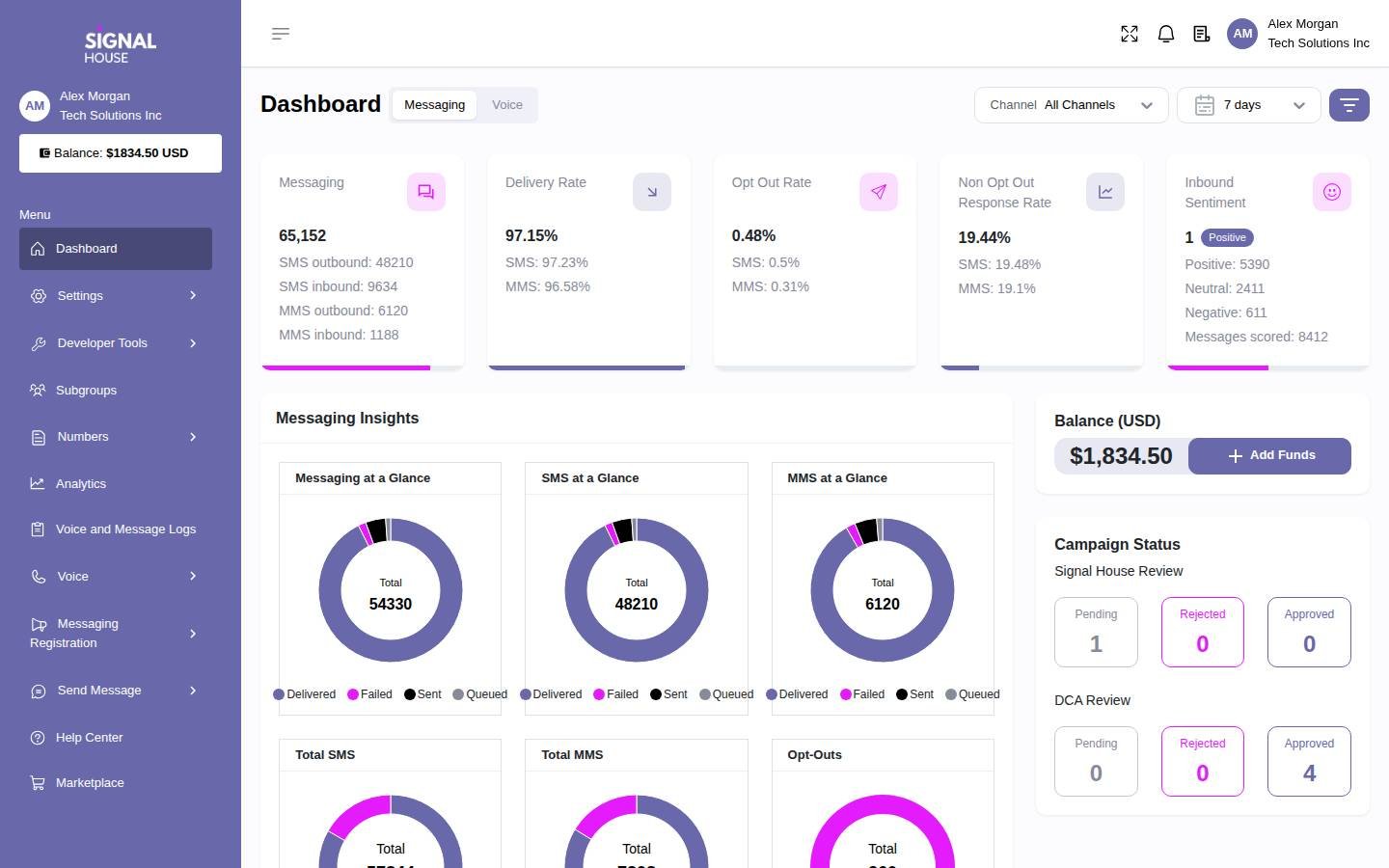
Evaluation: The advertised $25 credit is a limited account offer, not a verified fixed-duration trial. Confirm permitted testing, registration costs and integration-specific entitlements.
See Agency Pricing And Account Credit
2. Mobile Text Alerts: For A Supported GoHighLevel Agency Workflow
Best fit: An agency wanting documented HighLevel integration controls rather than building its own sending layer. Mobile Text Alerts describes an embedded agency view, sub-account volume limits, balance-based funding and verification management. Those details make it a relevant comparison for a team already operating client SMS accounts inside HighLevel.
The HighLevel integration advertises $0.0068 per message plus applicable carrier fees. Confirm the sender route, billable unit and complete account charges. That offer is separate from the general SMS campaign platform, whose Core page shows $36 per month billed annually with 1,000 message credits. Do not apply the subscription allowance to the integration or assume the tariffs are interchangeable.
The general SMS product includes campaign, automation, group, acquisition and reporting tools, with a 50-message free evaluation advertised. Its page places some custom API and branding features under higher plans, so identify which product your team is purchasing. Removal of a provider footer from an opt-in page is narrower than a complete white-label client portal.
Strengths: Specific documented controls for a supported HighLevel agency use case and a separate ready-to-use campaign product. Limitations: Multiple offers can make a casual price comparison misleading. Confirm API access, client permissions and the production verification path rather than assuming every general-plan feature belongs to the integration.
Ask an account manager to demonstrate 2 client workspaces with different SMS usage caps, then show which person can fund or change each one. Evaluate the embedded billing view with your finance process. A demonstration should resolve account responsibilities, not just show that a single test SMS can be sent quickly.
Evaluation: The general platform advertises 50 messages in its free trial. Confirm whether that allocation applies to the product you are evaluating; no fixed duration is assumed for the team integration.
3. SimpleTexting: For Campaign Managers Who Need A Finished Interface
Best fit: A marketing agency whose staff need campaign creation, segmentation, two-way conversations and automation in a usable application. SimpleTexting documents those capabilities alongside opt-in tools and reporting. It is a relevant platform comparison when marketers should perform daily tasks without asking a developer to create the interface.
The selected monthly SMS pricing example is $39: $29 for 500 credits plus $10 for a local number. The page lists additional carrier fees and a one-time registration charge. Toll-free and other number arrangements differ. This example should not be described as a complete multi-client SMS package or multiplied across clients without checking the appropriate SMS commercial structure.
Paid plans list 3 included user seats, with extra seats priced separately. Additional numbers are also available for a fee. Those facts do not establish fully isolated client workspaces. An agency must ask how permissions, audience separation and client access work before putting unrelated businesses into a single shared environment.
Strengths: A finished marketer-facing workflow with documented campaign and conversation tools. Limitations: Subscription, number and extra-user pricing can matter at agency scale. Its partner or affiliate program is not proof of a reseller portal, wholesale pricing or ownership of a white-label application.
Choose SimpleTexting when the daily SMS operating tasks are the primary requirement. Ask an account manager to create a segment, schedule an approved SMS campaign, answer a reply and export a report during evaluation. Then confirm how the proposed arrangement keeps each business's contacts and preferences separate. That matters more than a long pricing and feature checklist.
Evaluation: A 14-day free trial is advertised in official product information. Confirm its current sending limits and registration restrictions before treating it as a live customer-campaign pilot.
4. EZ Texting: For Documented Managed Client Accounts
Best fit: An agency that wants a documented parent-and-client SMS account structure inside a campaign platform. EZ Texting's Managed Accounts page describes multiple client accounts under an agency parent, SMS reporting across accounts and allocation of purchased messaging credits. That is more specific evidence of client administration than a generic multi-user feature.
The standard Launch subscription starts at $25 per month, or $20 per month billed annually, with 500 monthly credits in the monthly offering and 1 included user. Carrier pass-through charges are separate and a telecom fee can apply. Confirm the price and eligibility for Managed Accounts; the ordinary Launch SMS price is not automatically a quote for an agency parent with several client businesses.
The public product covers campaigns, workflows, opt-in tools, two-way texts and reporting. Current pricing guidance says each person should use an individual seat rather than a shared login. Ask for that access model in the team demonstration, especially where older marketing copy describes account sharing less precisely.
Strengths: Explicit documentation of managed client accounts and credit allocation, plus a finished campaign interface. Limitations: Agency entitlements, additional seats, funding rules and pricing terms need confirmation. A subscription allowance does not mean every client can send unlimited campaigns or borrow credits under any arrangement.
Shortlist EZ Texting when the parent-account model is an important requirement. Inspect how an agency user switches between businesses, which SMS reports can be exported and how client access is removed. The official Managed Accounts overview provides the starting point; request a proposal for the actual client count and roles.
Evaluation: A 14-day free trial is advertised. Confirm whether the SMS trial demonstrates Managed Accounts or only the standard workspace, and what approvals are required for production traffic.
5. Twilio: For An Agency Building Its Own SMS Application
Best fit: A software-capable agency that wants to design its own SMS client experience, integrations and reporting. Twilio documents subaccounts for separating customer resources and usage within a hosted service. That is a technical building block, not a finished agency SMS portal, invoicing system or campaign approval process.
The selected standard US local SMS base is $0.0083 per outbound or inbound segment, plus applicable carrier fees. Number rental, registration, optional products and your application pricing remain separate. Compare the complete service you plan to sell rather than treating a per-segment tariff as the price of an operating business.
A Twilio implementation should map every client to the right account resources, senders and registration records. Your team also needs to decide who sees message bodies, how bills are created and how client spending is stopped. Subaccounts do not automatically establish independent payment arrangements, transferable registrations or a ready-to-use customer dashboard.
Strengths: Documented programmable primitives and a subaccount model relevant to a custom service. Limitations: Engineering and ongoing operation belong in the budget. Building a branded front end can create an attractive service while also giving your team responsibility for credentials, permissions, event handling and incident response.
Choose Twilio when that custom application is part of the team's strategy and technical capacity. Prototype client isolation, an SMS reply workflow and an SMS usage export before polishing the branding. If your team only wants to schedule campaigns, compare finished applications as well; owning more software is useful only when it solves a real requirement.
Evaluation: Current trial documentation describes restricted, time-limited product allocations. Confirm recipients, content and production onboarding. A development trial is not permission to upload and contact every client audience.
6. Telnyx: For Developer-Managed Messaging Costs
Best fit: A technical agency managing application events, sender configuration and pricing monitoring. Telnyx publishes a selected US local SMS base of $0.004 per part for outgoing and incoming traffic, with carrier charges separate. It belongs on a shortlist where the team will operate the application rather than purchase a finished marketing workspace.
The useful question is how the proposed design handles separate client businesses. Ask which account and permission structure applies, how sender configurations are organized and how usage can be attributed. Do not assume low pricing proves that the specific SMS reseller, client-login or payment arrangement you want is included.
Evaluate message submission, delivery events, replies and the ability to pause a client's activity without disrupting unrelated work. Build an application-level record connecting each business event to the correct SMS provider identifier. That record becomes important when an account manager needs to explain usage or investigate a customer complaint.
Strengths: A competitive selected base and transparent separation of transmission from carrier charges. Limitations: Your team still owns the SMS campaign interface or integration, billing logic and operational process. A small reduction in transport expense can be outweighed by development work or ongoing support.
Choose Telnyx when its technical model and account terms support your actual service. Request a destination-specific pricing estimate and verify the client-separation design in a pilot. Keep SMS feature and permission claims conditional until the proposed arrangement is confirmed rather than promoting every API provider as a complete agency platform.
Evaluation: Free signup is available. Confirm the account's evaluation allocation and sending restrictions; no credit amount or trial duration is invented here.
7. TextGrid: For A Compatible Low-Cost Sending Layer
Best fit: A cost-focused agency with a compatible integration and confirmed API permissions. TextGrid publishes a selected US outbound SMS base of $0.0035 per segment before carrier fees. That is the lowest starting component in our matched local API subset, although it is not a complete managed-service price.
Documented limitations affect the project. Direct API access can be restricted for accounts connected to GoHighLevel, bulk access can require permission, and future-dated sending belongs in your application. An existing Twilio Messaging Service SID is not a supported sender identifier. Familiar-looking requests should not be treated as complete compatibility.
For an agency, application-managed schedules need particular care. Every pending send should retain the correct business identity, current consent state and client approval. Removing a client or pausing a campaign must stop future SMS submissions, not merely hide the campaign from an account manager's screen.
Strengths: Low published basic usage rates and a clear list of SMS technical boundaries. Limitations: A low sending cost does not establish a white-label portal, client billing, approval workflow or unrestricted account access. Quote the necessary SMS software and permissions separately.
Choose TextGrid when the complete workflow passes those checks and the saving survives implementation and support costs. Test ordinary templates, longer content, incoming replies and opt-outs. Compare actual billable parts, not contact counts, and avoid using older competitor figures from a pricing calculator as current benchmarks.
Evaluation: Free account creation is offered. Confirm credits, direct API permission and the approved sender path for your specific integration.
8. Plivo: For A Conventional Agency API Integration
Best fit: Developers implementing a defined texting workflow where explicit tariffs and integration requirements can be compared. Plivo's selected US long-code SMS base is $0.0077 per segment in either direction; toll-free is $0.0079. Carrier fees and account-level costs are additional.
An agency should quote the same sender type, outgoing parts and reply volume across vendors. A local tariff is not a substitute for a toll-free estimate. Number rental, registration and any separate application subscription can alter the comparison, especially when several low-volume clients each need their own SMS resources.
Before selecting Plivo, implement a representative client SMS workflow and confirm the permitted account structure. Test SMS identifiers, status updates, reply routing and error handling. Determine how the team will create a client report and reconcile it with usage. A send endpoint alone does not produce an accountable managed service.
Strengths: Explicit selected sender rates and a relevant comparison for a conventional programmable SMS application. Limitations: Its local transmission difference against the Twilio example is modest at small volumes. Do not promise a client substantial complete-bill savings when only a small usage component has been compared.
Choose Plivo when the technical and operational fit justifies the arrangement. Separate basic texting from Verify, calling and AI products. A broader product catalog can be useful, but each additional service should have a requirement, an owner and its own pricing estimate.
Evaluation: The messaging page advertises trial credits. Confirm the allocation and approved test destinations for that product rather than borrowing an unrelated promotion.
Essential SMS Features For A Marketing Agency
Separate Client Data, Numbers And Permissions
Each business should have a clear identity in the SMS operating system. Establish which people can view SMS contacts, change campaigns, spend funds and export message history. A second SMS sending number is not proof of a separate client workspace. Test the proposed separation with 2 unrelated businesses before adding a larger client portfolio.
Use individual staff access and a documented removal process when people change roles. Keep client identifiers on imports, exports and integrations so an SMS contact list cannot accidentally be sent from another business's number. An agency should be able to explain the arrangement without relying on everyone remembering which tab is open.
Campaign Creation, Segmentation And Approval
Marketers need to define an audience, preview personalized content and obtain approval before a send. Confirm whether approval happens inside the platform or in your team process. An SMS draft should identify the client, audience, final message, sender, expected SMS units and scheduled time so the reviewer knows exactly what is being approved.
Build SMS segments from relevant, permissioned customer data rather than assuming every imported number belongs in every promotion. Check exclusions and suppressions after the segment is built. Store approval against the final content version; changing a discount, link or audience after approval should trigger a fresh review under your operating procedure.
Client Funding And Usage Limits
Decide whether the client pays the provider directly, prepays the team or receives an invoice afterward. Confirm which vendor controls enforce a limit and which are only reporting alerts. A notification that funds are running low is different from a hard stop that prevents more billable traffic.
Make overage pricing and credit expiry visible in the client pricing agreement. If a holiday campaign uses several times the normal allowance, decide who can approve more spend. Your team should not discover an unapproved campaign after the SMS usage has already been funded from a shared balance.
Replies, Handoffs And Integration Failures
An SMS marketing campaign can generate sales questions, booking changes and requests to stop messages. Assign responsibility for each type of SMS reply and define the out-of-hours behavior. A provider delivering an inbound SMS webhook does not guarantee a person will see it in a monitored SMS inbox.
Test the CRM connection with a duplicate event, a missing customer record and a delayed response. Record enough identifiers to trace the problem without exposing unrelated client data. For a technical agency, our guide to API alternatives and competitors provides broader platform context; a packaged campaign application is a separate purchasing category.
SMS Pricing For Agencies: Compare Complete Costs
Agency cost includes the provider subscription or API usage, carrier charges, numbers, registration, staff seats, connected software, support pricing and campaign-management work. Keep the client's advertising or creative retainer separate from communication usage unless the agreement clearly bundles them. This makes the economics easier to explain and audit.
Compare like-for-like products. Mobile Text Alerts' HighLevel tariff is not the same offer as its Core subscription. EZ Texting's Launch price is not a confirmed Managed Accounts proposal. SimpleTexting's example includes a particular number choice. A mixed table of these headlines cannot establish a universal cheapest agency platform.
Selected US Outbound API Base Costs
| API Provider | 10,000 Parts | 100,000 Parts | Scope |
|---|---|---|---|
| TextGrid | $35 | $350 | $0.0035/segment |
| Telnyx | $40 | $400 | $0.004/part |
| Signal House | $65 | $650 | $0.0065/segment; integration quote may differ |
| Plivo | $77 | $770 | $0.0077/segment |
| Twilio | $83 | $830 | $0.0083/segment |
These figures exclude carrier charges, registration, number rental, incoming traffic, optional services and the application your team runs. They use selected public starting local rates, not negotiated contracts or integration packages. A higher-ranked provider can cost more on the base component while fitting an agency's supported workflow better.
At 10,000 outgoing segments, Signal House is $65, TextGrid $35, Telnyx $40, Plivo $77 and Twilio $83. The largest modeled difference is $48 between TextGrid and Twilio. That is useful information, but it is not enough to pay for unlimited client support or prove the complete managed service is cheaper.
Credit Plans, Segments And Quiet Months
A credit is a product-specific pricing unit. Confirm how long messages, MMS and different destinations consume it. For example, Mobile Text Alerts and SimpleTexting describe US/Canada MMS using 3 credits. Do not tell a client that a 1,000-credit SMS allowance always means 1,000 image messages or 1,000 unlimited-length texts.
Check rollover and whether credits can actually be allocated across separate clients. Suppose 10 hypothetical client subscriptions each include 500 credits but use only 200. The portfolio has 5,000 included credits and uses 2,000, leaving 3,000 unused SMS credits. That does not prove the vendor lets one busy client borrow the unused balance from another.
Carrier Fees And Message Length
Use the actual destination-network mix and vendor schedule for carrier fees. An illustrative $0.0045 surcharge on 100,000 outgoing parts adds $450 before other charges. This is a modeling assumption, not a universal network fee. Replies and MMS can have different additional charges.
Standard GSM-7 texts commonly fit 160 units in a single segment and 153 per concatenated segment; Unicode content has lower limits, commonly 70 and 67. Sender exceptions exist. Test personalized content, punctuation, emojis and links. A campaign to 10,000 people can generate 20,000 billable parts if every send needs 2 segments.
How To Price An Agency SMS Service Without Hiding Costs
There are several defensible commercial models: a management retainer with direct SMS vendor billing, a bundled allowance with defined overages, or a supported resale arrangement. Use a model permitted by the supplier and understandable to the client. Do not assume an affiliate referral agreement grants resale pricing rights or control over the client's provider account.
A SMS Transmission Spread Is Not Net Profit
Consider a hypothetical client sending 10,000 outbound parts. At a $0.0065 base, transmission costs $65. If your team charges $0.012 per part for that same component, usage revenue is $120 and the gross transmission spread is $55. Carrier fees and other items are excluded here and must be handled separately under the agreement.
Now add 2 hours of support at an assumed internal cost of $25 per hour and $10 of allocated software cost. Those add $60, making the contribution negative $5 before other expenses. A $100 management retainer raises the simplified contribution to $95. Every figure in this example is an assumption for explaining the model, not a recommended market price or promised margin.
Price strategy, creative work, audience maintenance and reporting based on their real cost and value. A transparent retainer can be easier to sustain than an unexplained high transmission markup. If an agency chooses a bundled allowance, show what happens when a client pauses, changes volume or leaves the service.
Do Not Assume Volume Discounts Pool Across Clients
A rate card can describe thresholds without establishing how your team's separate workspaces qualify. Confirm whether volume is measured per account, sender, integration or agreement. Obtain the actual calculation method before quoting a lower tier to clients. Do not apply a threshold rate retroactively to every unit unless the contract says that is how billing works.
Also check commitments. A hypothetical $2,000 monthly minimum against only $1,200 of required usage leaves $800 of unused obligation. That can erase the benefit of a discounted unit rate. Model busy, normal and quiet periods, especially if your team serves seasonal businesses.
Client Onboarding, Registration And Consent
Establish The Client's Identity And Permitted Use
Collect the correct business details, SMS campaign purpose and sender ownership before requesting service. Check the supplier's content and industry rules. The team's commercial relationship with a client does not establish the client's permission to contact an audience or override a restricted traffic category.
For US application traffic using local 10-digit numbers, plan for the appropriate brand and campaign registration. Toll-free verification and short-code provisioning are separate paths. The official A2P 10DLC overview explains the basic distinction; use the chosen supplier's specific process for the account you are purchasing.
Preserve Consent And Suppression Records
Record how the customer agreed to receive the relevant messages, which business obtained the permission and what the customer was told. A purchased or shared list is not automatically an approved audience. Check the actual SMS consent evidence and provider terms before uploading contacts into a new client workspace.
Honor requests to stop messages and synchronize preferences across the systems used for that business. Standard reply words are important, but reasonable requests can arrive through staff or another contact channel too. The team process must ensure a suppressed contact is not reintroduced through a fresh import or a separate automation.
Test The Entire Customer Journey
Run a controlled pilot with recipients who have agreed to participate. Include a signup, welcome SMS, promotion, reply and opt-out. Verify that the correct business SMS number is used and the reply reaches the right team. Then confirm that pending campaigns and connected automations respect the changed preference.
Registration and vendor assistance do not create a universal compliance guarantee. Content, timing, audience and jurisdiction still matter. For a multi-country campaign, establish the applicable sender and consent requirements for each destination rather than copying a US operating procedure into every market.
SMS Campaign Workflows An Agency Should Support
Local Services And Appointment Businesses
Separate useful appointment updates from promotional offers in the client's workflow. A salon, repair business or training provider may need reminders, rescheduling replies and occasional campaigns. Define the employee handoff so a customer who asks a question receives an appropriate response rather than another automated promotion.
Signal House and Mobile Text Alerts are worth comparing for supported HighLevel operations. SimpleTexting or EZ Texting may suit a team wanting a dedicated campaign workspace. The right choice depends on where bookings and customer records already live, not just which brand appears highest in a general list.
Ecommerce And Retention Campaigns
Confirm whether the integration supplies the events, consent state and order information needed for the campaign. An SMS checkout recovery workflow must stop when the customer purchases or no longer qualifies. Repeated source events should not produce duplicate texts. Review the final personalized SMS content because URLs and product names can affect billable parts.
Signal House documents a Shopify integration, while SimpleTexting provides campaign and integration tools to evaluate. For a custom stack, Twilio, Telnyx and Plivo merit technical comparison. Request an exact demonstration; an integration name on a website does not prove that every ecommerce SMS trigger is included in your plan.
Client Acquisition And Lead Follow-Up
Design follow-up around the customer's actual request and documented permission. Route SMS replies to the correct salesperson and prevent parallel automations from sending conflicting messages. The team should be able to explain why a contact entered the sequence and how the sequence stops when the customer responds.
Do not confuse a supplier supporting marketing with permission to send any bought lead list. Signal House's restrictions illustrate why eligibility must be checked first. If the intended traffic is not supported, select an appropriate permitted workflow or a different product rather than hiding the purpose during registration.
SMS Reporting That Helps An Agency Keep Clients
A useful client report connects spend and delivery activity with the business outcome the campaign was designed to achieve. Report submitted parts, usable delivery events, replies, opt-outs and attributable actions using clear definitions. API acceptance, handset delivery and a completed purchase are different stages.
Track links consistently, but do not label every click as new revenue. Reconcile booking or order identifiers where possible and explain the attribution window. If email, ads and SMS all touch the same buyer, separate observed attribution from evidence that the text alone caused the sale.
Compare contribution rather than revenue alone. In a hypothetical report, $600 of attributed revenue with a 40% gross margin produces $240 before campaign costs. If sending and management cost $150, the simplified contribution is $90. That is a more useful decision input than advertising a 4-to-1 revenue ratio without showing product and service costs.
Give each client a report for its own business, with an agreed date range and source definitions. Keep cross-client benchmarks aggregated and permissioned. An agency should not expose another business's audience, messages or commercial results merely to make a dashboard look more impressive.
How To Pilot And Switch An Agency SMS Provider
Start With A Representative Client
Choose a client whose workflow represents the service you plan to sell, with its permission. List the required SMS campaign tools, staff roles, sender type and connected systems. Agree on pass-or-fail criteria before increasing traffic. A tiny send test should not stand in for verifying client isolation, invoices and opt-out behavior.
Measure the operating work too. Ask an account manager to build a segment, obtain approval, schedule a send, answer a reply and create a report. A technical team should also test delayed events, ambiguous submission failures and safe retries. These tasks reveal whether the proposed service is practical for your team.
Move Clients In Controlled Groups
Export the required records, confirm number ownership and establish the transfer process with the suppliers. Preserve SMS consent and suppression history. Do not assume campaign registrations, credit balances, scheduled jobs or API identifiers move automatically with a number. Keep the previous SMS service available until the necessary dependencies are validated.
Move a manageable group before repeating the process across the entire client portfolio. Document who can pause the rollout and what triggers that decision. Budget for overlapping subscriptions where necessary. A gradual transition can be commercially sensible if it prevents a problem from affecting every client at once.
Agree On Offboarding Before The First Contract
Specify who owns the number, contact records, consent evidence, creative assets and integration configuration. Explain how a client can obtain an authorized SMS export and what happens to remaining balances or credits. Ownership and export access should be determined by the contract and account structure, not by an improvised decision when the relationship ends.
Remove agency access after the agreed handoff and retain only the records needed under your retention policy and obligations. For API-based services, confirm how closure affects resources before deleting an account. A reversible campaign pause and a permanent account closure can have very different consequences.
Frequently Asked Questions About SMS Providers For Agencies
What Is The Best SMS Provider For A Marketing Agency?
Signal House is our first comparison for eligible agencies that want guided setup and a supported client-pricing workflow. EZ Texting is relevant for documented Managed Accounts, SimpleTexting for marketer-led campaigns, and Mobile Text Alerts for its HighLevel integration. A development-focused agency should also assess Twilio, Telnyx, TextGrid or Plivo against its application requirements.
Which Provider Is Best For White-Label SMS?
Start with the branding and operating model you actually require. Signal House documents agency white-label delivery and client pricing, while other providers offer particular branding or account-management features. Confirm custom domains, client access, invoices, support identity and data ownership separately. Removing a provider label from one page is not proof of a complete white-label platform.
Is Signal House Suitable For GoHighLevel Agencies?
Its documented HighLevel integration and custom sub-account pricing make it a relevant option for an eligible workflow. Review Signal House's agency offer against your client count, message purpose and funding process. Confirm the integration tariff and required features rather than assuming the general API rate is the complete package.
Can An Agency Manage Several Clients In One SMS Account?
Only when the chosen structure provides the separation and permissions required for those businesses. EZ Texting documents managed client accounts, and Twilio documents technical subaccounts. Multiple users or numbers alone do not prove isolated audiences and access. Ask for a demonstration with unrelated clients and confirm the commercial entitlement.
What Is The Cheapest SMS Provider For An Agency?
TextGrid has the lowest selected local outbound API base in our numeric subset at $0.0035 per segment. That does not establish the cheapest complete agency service. Add carrier charges, software, permissions, registration, support and operating work. A finished platform can be the better financial choice when it removes application work your team would otherwise fund.
Can I Resell SMS At My Own Price?
Use a reseller or agency arrangement that permits the intended billing model. Confirm whether you control rates, invoicing, account access and client ownership. A referral or affiliate program does not automatically provide resale rights. Show clients the allowance, overages, fees and exit terms clearly so the service remains understandable.
Does Each Client Need Its Own Registration?
Use the registration structure appropriate to the actual business, sender and message purpose. Do not represent unrelated clients as a single brand simply because the team pays the invoice. Confirm the required brand and campaign relationships with the provider. Registration approval does not replace the client's consent evidence or permit unrelated traffic.
Should An Agency Choose An API Or A Campaign Platform?
Choose a finished platform when campaign managers need an interface, inbox and reports without building them. Choose an API-based arrangement when a custom application is a real requirement and the team can maintain it. A supported integration can sit between those options, but its exact features and commercial scope still need confirmation.
Final Recommendation: Buy The team Workflow, Not Just The Rate
Signal House leads our comparison for eligible agencies seeking guided implementation and client-pricing support. Mobile Text Alerts deserves a HighLevel-specific evaluation, SimpleTexting a marketer-focused platform comparison, and EZ Texting a Managed Accounts demonstration. Twilio, Telnyx, TextGrid and Plivo are relevant when the team is prepared to build and operate the necessary application.
Choose using a client-access demonstration, a complete SMS cost estimate and a controlled pilot. Verify registration, approvals, funding, reporting and offboarding before scaling. The best provider is the one that supports a service your team can deliver consistently and profitably for the client businesses it actually serves.
Customer Feedback On Agency SMS Providers
The current G2 product scores used here are Signal House 4.8/5, Mobile Text Alerts 4.6/5, SimpleTexting 4.7/5, EZ Texting 4.5/5, Twilio 4.1/5, Telnyx CPaaS 4.7/5 and Plivo 4.5/5. A verified numerical TextGrid score was not available for inclusion.
Signal House reviewer Denise B., rating it 5/5 on G2, valued organized account administration while requesting clearer configuration guidance. SimpleTexting reviewer Greg B., also rating it 5/5, praised ease of use and responsive support but wanted more flexible credit purchasing. Those observations suggest practical questions about onboarding work and subscription suitability, not universal performance conclusions.
Use customer feedback to shape the demonstration: can staff administer the proposed account structure, can finance understand usage, and does the billing model fit seasonal clients? Ratings supplement that evaluation. They do not prove measured campaign results, delivery guarantees or the margin your team will earn.
Affiliate Disclosure: We may earn a commission when you purchase through selected links in this guide, at no additional cost to you. Recommendations reflect the workflows, limitations and commercial assumptions explained in the article.