Telnyx is the cheaper option for the selected US outbound SMS and programmable voice components in this comparison. Signal House is worth evaluating for eligible businesses that want supported integrations and guided setup. For incoming calls, complete applications and account-specific fees, compare the exact configuration before choosing a winner.
Signal House vs Telnyx is a decision about how your business will operate calls and messages, as well as what it will pay. Evaluate Signal House's supported workflow alongside a matched Telnyx configuration. A business with a suitable developer-maintained application may prioritize unit pricing, while a small team may place more value on reducing implementation and administration work.
 Ratings use the G2 product profiles for Signal House and Telnyx CPaaS. Customer scores inform this comparison; they do not establish independently measured service quality.
Signal House Vs Telnyx: Voice And Business Messaging Comparison
These are 2 communications providers to evaluate against a defined workflow. The table follows the comparison's name order rather than presenting a universal ranking. We separate verified public components from features requiring a demonstration or quotation. Neither provider's starting usage pricing should be described as the price of a complete employee phone system.
| Provider | Best Fit | Buying Considerations | Pricing & Evaluation |
|---|---|---|---|
|
| SMS From $0.0065/SegmentSelected US local outbound API base; fees extra. Voice: $0.012/min out, $0.005/min in. $25 new-account credit advertised.View Offer And Account Credit | |
|
| SMS From $0.004/PartSelected US local API base; fees extra. Outgoing voice example: $0.002 API + $0.005 network/min. Restricted trial credit available.Review Products And Cost Model |


Before comparing the figures, identify the application your employees will use. Does it supply a shared inbox, dialer, customer history, permission controls and a reliable callback process? An API can enable these functions without supplying your exact staff interface. Buying transmission and buying a complete business workflow are related decisions with different budgets.
Signal House Or Telnyx: Which Provider Wins For Your Business?
Lowest Selected Outbound SMS Base: Telnyx
Telnyx lists a selected US local outbound SMS base of $0.004 per part, compared with Signal House's $0.0065 per segment. Carrier fees and other charges remain additional. For a development team already operating the necessary messaging application, that difference makes Telnyx the first provider to assess for this particular pricing component.
The conclusion is deliberately narrow. It does not establish the lowest invoice for every sender type, integration or contract. If a supported application has separate charges or your account qualifies for negotiated terms, use the applicable schedule. Compare equivalent message direction, sender, destination and billable units before applying the difference to your forecast.
Lowest Selected Programmable Outbound Voice Base: Telnyx
The selected Telnyx outbound example combines a $0.002 per-minute API fee with a network component starting at $0.005, giving $0.007 per minute before optional services and other charges. Signal House's initial published US outgoing voice band is $0.012 per minute. Telnyx therefore has the lower selected outbound component in this comparison.
Destination-specific rates can change the result. Do not advertise the $0.002 API fee alone as a complete PSTN voice pricing, or treat the starting network pricing as universal. A browser connection, recording or another service may create a separate charge. Request the full call path and applicable account pricing.
Lower Selected Incoming Programmable Voice Component: Signal House
Signal House lists incoming US calls at $0.005 per minute. Combining the selected Telnyx local incoming voice network component of $0.0032 with its $0.002 API component gives $0.0052. On that particular programmable configuration, Signal House is lower by $0.0002 per minute, equivalent to $2 across 10,000 billable minutes.
A PBX-only voice trunk is a different comparison. Telnyx's network-only incoming starting rate must not be presented as though it already contains the programmable API component. Equally, do not add an API charge to a trunk arrangement that does not use that product. The correct calculation follows the purchased service.
First Demonstration For Supported HighLevel Workflows: Signal House
Signal House documents a GoHighLevel messaging integration with custom sub-account pricing. That makes it a relevant first demonstration for eligible agencies seeking a supported client workflow. The benefit to verify is how much setup and recurring operating work the integration actually handles, rather than assuming its higher selected transmission base is always offset.
Telnyx remains relevant when an agency has a compatible integration or intends to build its own application. Compare the exact client permissions, registration process, sender ownership and reply handling. Neither a low unit pricing nor a statement about agency pricing proves that every branding or client-billing feature is included.
First Technical Evaluation For Direct Telecom Control: Telnyx
Telnyx is a strong starting point for teams evaluating SIP connectivity, Call Control or TeXML applications. Its documented product separation makes it possible to model the network, programmable layer and optional processing independently. That flexibility is useful when a developer can maintain the application and explain the resulting architecture to operations.
Signal House also offers programmable and SIP options, so it should not be dismissed as messaging-only. Ask both providers to demonstrate the functions your application requires. The winner is the configuration that preserves the necessary behavior at a sustainable operating cost, including the people responsible for maintaining it.
What Signal House And Telnyx Actually Provide
Signal House: Messaging, Programmable Voice And Supported Connections
Signal House publishes SMS, MMS and voice services, with named integrations including GoHighLevel, Shopify, Medusa and Make. Its voice page lists browser softphones, SIP trunks and device endpoints. Those descriptions establish capabilities to evaluate, not proof that every third-party integration exposes every available voice feature.
Ask for a demonstration in the environment you intend to purchase. A business using HighLevel should see where messages, replies and account controls appear there. A team wanting browser voice should see the actual employee workflow. Confirm which portions are standard, which require configuration and which depend on separately commissioned development.
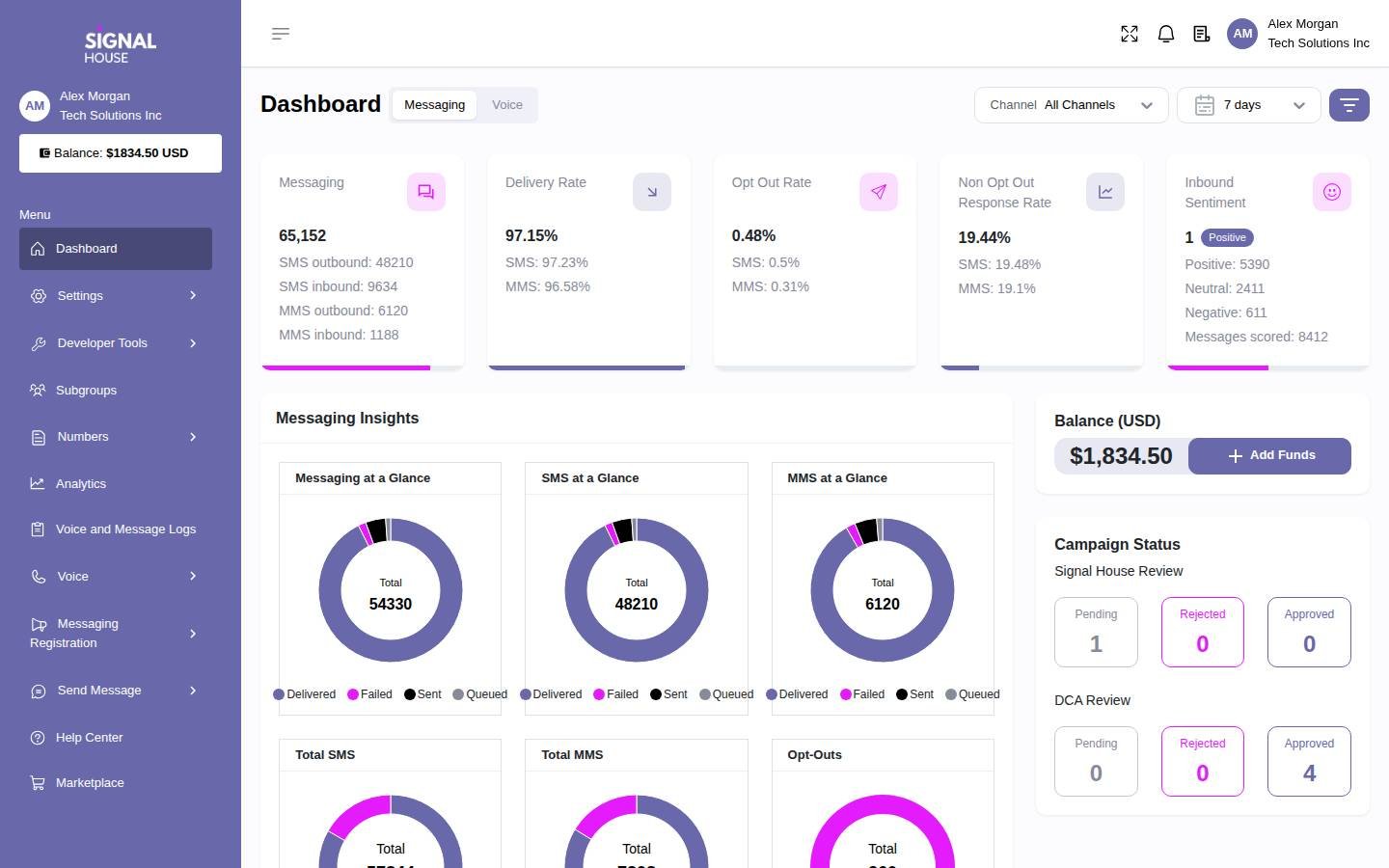
Request A Signal House Workflow Demo
Telnyx: SIP Connectivity And Programmable Communications
Telnyx supplies communications products that can be used directly or through an application. SIP trunking connects compatible voice infrastructure. Its Voice API adds software-controlled voice, while messaging products handle message transmission and events. Buying these services does not automatically supply the exact contact-center or business-phone application your employees expect.
Evaluate Telnyx with someone who understands the intended voice configuration. A technical portal, a PBX management screen and an employee conversation inbox serve different users. Establish who supplies each screen and who will investigate problems after launch. A lower infrastructure bill can be valuable, but the business must still operate a usable service.
Signal House Vs Telnyx Features And Product Boundaries
| Requirement | Signal House | Telnyx | What To Validate |
|---|---|---|---|
| Programmable call logic | SHML webhooks | Call Control or TeXML | Map required commands and callback behavior |
| Existing PBX connectivity | SIP trunks listed | Separate SIP trunking product | Compare network-only and programmable paths separately |
| Employee voice interface | Browser and device options listed | Application and connection options | Identify the actual staff workspace |
| Customer messaging | API and named integrations | Messaging API and profiles | Test sending, replies and suppression |
| HighLevel agency workflow | Documented messaging integration | Confirm your intended connection | Demonstrate client access and commercial scope |
| Additional channels | Confirm specific product support | Additional channel products documented | Verify sender, destination and account eligibility |
| Support access | Human assistance advertised | Continuous NOC availability documented | Confirm escalation and implementation responsibility |
| Numbers and permissions | Messaging price; voice-enabled quote | Base rental plus messaging capability fee | Confirm functions on the actual number |
The most useful feature comparison ends with an employee completing a task. Ask the administrator to route a customer, the sales representative to handle a reply and finance to identify the associated usage. A successful API response is only an intermediate step. It does not establish that the business process is complete.
A Business Voice System Needs More Than A Number
A phone number establishes an identity and a destination. Your organization also needs routing, staff access, working hours, handoff rules and an interface. If a caller reaches voicemail, somebody must receive and own the callback task. If 2 employees answer messages, their work should not produce conflicting responses.
For Signal House and Telnyx, specify the required interface before comparing subscription-style expectations with usage-based products. A 5-person office may want a familiar shared workspace. A software company may prefer its own application. The infrastructure provider can be the same category of supplier while the finished operating experience differs substantially.
Support Is A Real Service; Implementation Is A Separate Scope
Telnyx advertises round-the-clock support, and Signal House advertises human assistance across plans. Neither statement alone defines how much custom integration work is included. Troubleshooting a carrier error, designing a CRM connection and maintaining an employee interface are different responsibilities. Write down who owns each before agreeing to commercial terms.
A practical statement of work should identify configuration, testing, launch assistance and ongoing maintenance. If your team expects a provider to fix a third-party automation, confirm that expectation explicitly. Support availability is useful; a clear responsibility boundary is what prevents a customer issue from passing repeatedly between unrelated suppliers.
Signal House Vs Telnyx Voice: SIP, Call Control And Routing
Separate Telnyx Network Connectivity From The Programmable Layer
The Telnyx Voice API pricing page describes the API and the SIP network component as separate lines. That structure matters when comparing it with another provider's published voice pricing. Add the required components for the actual destination and direction. Then include optional processing and the application through which staff use the service.
A business connecting a compatible PBX might need voice network connectivity without a programmable voice application. A custom receptionist may need the API, speech processing, recordings and application logic. Label those scenarios separately in the budget. Presenting a trunk-only rate beside a more complete programmable configuration creates a misleading cheap-provider conclusion.
SHML Vs Telnyx Call Control And TeXML
Signal House documents SHML instructions returned by a webhook. Telnyx offers Call Control and TeXML approaches. Telnyx's compatibility guidance cautions against mixing TeXML and Call Control commands in the same application flow because they manage state differently. Its guidance also distinguishes form-encoded TeXML callbacks from JSON Voice API events.
This creates a concrete migration requirement. Identify which call model your application uses, then implement the target model consistently. A familiar instruction such as forwarding a caller does not prove that authentication, callback fields, timing or error handling are interchangeable. Test the final outcome for each branch of the voice call flow.
For example, an appointment line may offer booking, existing-customer help and an urgent callback route. Write the expected behavior for an invalid selection, a closed office and an unanswered transfer. These cases reveal missing application logic early. They are more informative than a demonstration containing only a greeting and a successful connection.
Incoming Voice Calls, Transfers And Multiple Call Legs
A transferred conversation may involve incoming and outgoing legs with different durations. Count the billable units of each rather than applying a single rate to the whole conversation. For a hypothetical 4 incoming minutes followed by 3 outgoing minutes, the selected Signal House components total $0.056.
Using the selected Telnyx programmable components, the same illustration is $0.0418: $0.0208 incoming plus $0.021 outgoing. This excludes any separately applicable transfer operation, browser connection, number charge or other feature. Ask whether the chosen transfer method creates additional charges before treating the illustration as a complete price.
Also distinguish reaching a person from reaching an answering machine. A machine answer can create billable activity without a useful customer conversation. Measure the outcome the business values, such as a confirmed booking or completed support request, alongside transport cost. More connected minutes are not automatically better performance.
Billing Increments And Short Conversations
Signal House publishes whole-minute rounding after a 1-minute minimum for answered voice calls. Telnyx's billing guidance describes 60-second increments for its standard examples, with destination-specific qualifications internationally. Do not rely on older assumptions that its calls always receive 6-second billing. Confirm the arrangement that applies to your account.
As a simplified example, 100 separately answered calls lasting 65 seconds each produce 200 billable voice minutes. At the selected outgoing components, that is $2.40 for Signal House and $1.40 for Telnyx, before additional charges. Calculating from the combined voice duration instead would understate this example because rounding occurs per call.
Telnyx Browser Voice, Recording And AI Processing
Check browser voice connectivity separately from the PSTN component. The selected Telnyx optional schedule lists browser/app voice at $0.002 per minute and recording at $0.002 per minute. When applicable, 1,000 browser connection minutes add $2, and 1,000 recording minutes add another $2. Those charges do not replace the underlying voice components.
Signal House's listed browser and recording capabilities require an applicable feature quotation. Do not assign a zero price simply because a capability appears on the product page. For either supplier, confirm access, retention and export behavior for recordings. A storage pricing also does not answer every question about retrieval or long-term retention.
For an AI receptionist, identify speech recognition, speech generation, model use, application hosting and human handoff. Telnyx documents optional AI-related services, but a telephony rate is not a finished appointment-booking service. Evaluate difficult questions, interruptions, incorrect details and failed transfers before deciding the agent can handle real customer calls.
Signal House Vs Telnyx Business Messaging: SMS, Replies And Sender Choice
Choose The Sender Before Comparing SMS Pricing
Start with whether you need a local 10-digit number, toll-free sender or short code. Sender choice affects registration, cost and operating permissions. The selected local SMS figures in this article do not automatically apply to every sender. Confirm incoming capability and where an employee will read and respond to replies.
Telnyx publishes different messaging rows for different senders. Signal House likewise separates its local, toll-free and short-code offers. Use the actual product in a pricing request. A comparison between a local outbound base and an unrelated sender's incoming rate is not a useful basis for choosing a provider.
Two-Way Messaging Needs A Conversation Owner
Two-way transmission means messages can move in both directions. A complete business conversation also requires assignment, context and follow-up. If a customer replies to a reminder with a new time, decide whether the integration updates the booking, creates a task or alerts an employee. Confirm the next action rather than stopping at delivery.
For a Telnyx application, identify the webhook destination and the system that stores conversation history. For a Signal House integration, demonstrate the same information inside the proposed workspace. Include a reply outside office hours and a message intended for the wrong business. These examples expose operational gaps that a sending-only demo misses.
Message Parts, Personalization And Encoding
The selected API comparisons use message parts or segments, not unlimited-length conversations. Content length and encoding can split an apparently single text into several billable units. Preview the final personalized message, including names, links, punctuation and emojis. Do not estimate the bill from the number of contacts alone.
For an illustrative campaign to 10,000 recipients, 1 part per recipient produces 10,000 outgoing parts. If every message requires 2 parts, the transmission workload doubles. Shortening content can help, but preserve identification and a clear action. A confusing text can create more staff work than a modest reduction in transmission cost saves.
Opt-Outs, Registration And Acceptable Use
Telnyx documents messaging profiles, required registration and automatic handling of standard stop requests. Evaluate how your application receives and applies suppression events. Signal House buyers should demonstrate the equivalent end-to-end process in their supported workflow. An employee's manual import should not restart messages to a contact who has already opted out.
US local application messaging requires the appropriate sender registration process; toll-free verification is a separate route. Provider help with registration does not create customer consent or guarantee approval. Maintain permission evidence and describe the business accurately. Check that the intended traffic category is allowed before uploading an audience or promising a campaign launch.
Signal House's terms restrict specified third-party lead-generation categories involving bought, sold or shared consumer information. That is relevant to agencies assessing eligibility. Telnyx also has applicable service and messaging rules. Neither provider should be presented as a way to avoid consent, sender verification or content restrictions.
MMS, WhatsApp And Other Channels
If the business needs images, WhatsApp or another channel, specify that requirement separately. Telnyx documents additional messaging products, while Signal House publishes SMS and MMS capabilities. Do not assume an unverified channel is available because a supplier describes itself as a communications platform. Confirm sender access, destinations, pricing and reply behavior.
For media, test the actual content and the receiving devices. For a customer journey spanning several channels, define which system retains the conversation and preference state. An outgoing API request does not automatically produce a unified inbox. Evaluate the integration that staff will operate, not just a list of channel names.
Signal House Vs Telnyx Pricing: Selected US Rates And Important Fees
The pricing table uses public starting components in US dollars. It separates local messaging, programmable calls and number charges. These are usage components rather than all-inclusive subscriptions. Carrier fees, registration, destination exceptions, optional services, taxes, connected software and negotiated terms can change the complete cost.
| Component | Signal House | Telnyx | Scope |
|---|---|---|---|
| Local outbound SMS | $0.0065/segment | $0.004/part | Entry API bases; carrier fees extra |
| Toll-Free outbound SMS | $0.0079/segment | $0.0055/part | Selected sender bases; verification and fees separate |
| Programmable outbound voice | $0.012/min | From $0.007/min | $0.002 API + network from $0.005; destination dependent |
| Programmable local inbound voice | $0.005/min | From $0.0052/min | $0.002 API + network from $0.0032 |
| Incoming local SMS | Obtain platform base pricing | $0.004/part | Carrier and other fees separate; missing is not zero |
| Local number rental | $1/month messaging; voice-enabled quote | From $1/month + $0.10 messaging capability | Check inventory and exact activation scope |
Check the Telnyx Voice API pricing page for the relationship between API and network charges, and the Telnyx messaging pricing page for sender-specific rows and carrier fees. Obtain Signal House's applicable API or integration offer rather than assuming the public starting schedule covers every arrangement.
Monthly Cost Examples Using Comparable Components
The models below combine outgoing local SMS with selected programmable voice components. They use chargeable minutes after applicable rounding. We exclude incoming SMS because the Signal House incoming platform base was not established for this comparison. Carrier-fee rows alone do not prove that receiving a message has no platform charge.
| Workload | Signal House | Telnyx | Lower Selected Base |
|---|---|---|---|
| 10,000 outgoing local SMS parts + 1,000 outgoing minutes | $77 | $47 | Telnyx by $30 |
| 10,000 outgoing local SMS parts + 10,000 outgoing and 10,000 incoming minutes | $235 | $162 | Telnyx by $73 |
| 1,000 outgoing local SMS parts + 1,000 outgoing and 10,000 incoming minutes | $68.50 | $63 | Telnyx by $5.50 |
| 10,000 incoming local programmable minutes only | $50 | $52 | Signal House by $2 |
Telnyx is lower on 3 modeled mixed workloads, while Signal House is slightly lower on the selected incoming-only programmable example. These are arithmetic comparisons, not performance results. Different destinations, negotiated contracts and the employee application can change the final answer. Retain the exclusions when sharing these examples with a purchasing team.
Carrier Fees Can Change The Size Of The Difference
Use each vendor's applicable carrier schedule and your actual destination mix. A hypothetical common surcharge of $0.0045 applied to 10,000 outgoing parts adds $45 to each supplier's modeled amount. For the light mixed workload, that would produce $122 for Signal House and $92 for Telnyx before remaining expenses.
The $30 base difference remains under that assumption, but it becomes a smaller percentage of the expanded total. This does not mean both suppliers always apply identical fees. Local and toll-free senders, incoming messages and media can receive different treatment. Keep the carrier component separate until the actual schedule is confirmed.
Telnyx Number Rental And Capability Charges
Signal House publishes $1 monthly local messaging numbers at the entry level, while voice-enabled local numbers require a quotation. Do not market the messaging number pricing as a confirmed voice bundle. Ask what enabling both services on the intended number adds and whether the same number can support the required configuration.
Telnyx lists local numbers from $1 monthly and states an additional $0.10 monthly to add SMS and MMS capabilities. A selected $1 number with that capability addition therefore starts at $1.10 before usage and other charges. Inventory, country and number category matter; the headline is not a pricing promise for every number.
Volume Pricing, Commitments And Seasonal Traffic
Signal House describes graduated outgoing call bands. Its published 250,000-minute example totals $2,550 because different portions use different rates. Do not multiply the entire workload by the cheapest band it reaches. Confirm the applicable method for message discounts as well instead of assuming identical rules across products.
Telnyx publishes volume and commitment arrangements alongside pay-as-you-go pricing. A committed minimum can be sensible for steady eligible usage but expensive during a quiet period. Model normal, busy and slow months using the actual contract. Do not apply a promotion or negotiated discount to every product unless the agreement does so.
Operating Work Can Outweigh A Small Transmission Saving
For the light model, the selected Telnyx base advantage is $30 monthly. Suppose a particular supported Signal House workflow demonstrably saves 1 staff hour monthly, valued at an assumed $40. Under those assumptions, that operating benefit exceeds the transmission difference by $10. This is a decision example, not a claim that Signal House saves every customer an hour.
Reverse the conclusion when the work is already automated. A development team with a stable Telnyx application may incur no additional recurring effort and keep the full selected component advantage. Evaluate marginal work caused by the decision. Do not charge an existing employee's entire salary to one option or pretend new maintenance work is free.
Signal House Vs Telnyx Support And Integrations
How To Compare Telnyx Support Fairly
Telnyx's support guidance describes a continuously available NOC, portal chat beginning with an AI agent, escalation to human assistance and phone support. Signal House advertises human support across plans and a dedicated Slack arrangement for qualifying volume. Confirm current access, hours and commitments in your account agreement.
Do not portray Telnyx as offering no help without payment, or portray Signal House as guaranteeing instant resolution. Availability, response and resolution are different measures. Ask how a failed call or message will be investigated, what evidence is required and who coordinates with a connected application vendor.
Prepare a support example containing the event ID, sender, destination, timestamp and observed outcome. Remove unnecessary customer information before sharing it. A clear incident report improves the chance of a useful investigation. It is more actionable than reporting that communications are unreliable without an identifiable example.
GoHighLevel, Make And Ecommerce Workflows
Signal House's named integrations make it relevant to businesses operating inside those environments. Confirm event coverage, conversation ownership, sender mapping and account funding. A Shopify reminder needs to stop when a customer completes the purchase. A HighLevel reply should reach the intended client workspace rather than an unrelated shared account.
For Telnyx, establish whether your chosen connection is a maintained integration, a third-party connector or a custom API implementation. Request the exact product and supported operations. A connection that sends messages may not expose call routing, account verification or detailed reporting. Identify the integration owner and upgrade policy.
Test duplicate source events and failed requests. An order update that is retried should not accidentally create several messages. An appointment change should not leave the old reminder queued. These are business-rule questions for the integration, even when the underlying communications provider successfully accepts every API request.
Agencies, Client Access And Billing Ownership
Signal House's documented custom sub-account pricing is relevant to eligible agency arrangements. It does not establish every permission, branding or export capability. Demonstrate 2 unrelated clients and confirm that staff cannot access the wrong contacts, numbers or conversations. Clarify who funds usage and who owns the number if the relationship ends.
For Telnyx, request the appropriate organization or managed-client arrangement for the proposed service. Do not assume a standard trial account grants advanced client-management access. Confirm permissions, billing attribution and commercial resale terms. A technical ability to create a resource is different from a finished retail billing and support process.
Choose a clear commercial model: client-owned service with management assistance, a permitted managed arrangement or a properly scoped application service. Tell the customer which company invoices usage and which company provides first-line support. An affiliate referral agreement alone does not grant resale rights or ownership of the customer's resources.
Reliability, Security And International Requirements
Run An Equivalent Voice And Messaging Pilot
Evaluate both suppliers with the same relevant destinations, equipment and workflows. For calls, record connection setup, audio, transfer outcome and the final task. For messages, record acceptance, delivery status, replies and completion of the intended action. Avoid comparing a short local test with a different vendor's international production incident.
Telnyx and Signal House customer ratings do not establish measured latency or delivery superiority. Likewise, a provider's marketing percentage is not a guarantee for your audience. Define the sample, conditions and pass criteria before testing. Investigate failures with event identifiers rather than explaining them away because a provider is cheaper or better known.
Protect Credentials And Limit Exposure
Keep API credentials out of public website code, shared screenshots and staff notes. Use the supported account and key model, limit access and document rotation. Verify incoming callbacks using the vendor's supported controls. Your application should handle retries safely and avoid repeating a customer action when it receives the same event again.
Signal House documents calling-region and spend-per-minute controls as well as SIP transport options. Select secure transport deliberately; listing TLS with SRTP alongside other options does not mean every configuration is encrypted. For Telnyx, configure the security and permission controls appropriate to the selected Telnyx products and connected application.
Check what a spending control actually does. An alert may inform staff without stopping traffic, while a limit may affect only certain operations. Name the employee who receives the warning and can pause an automation. Monitoring is useful only when somebody can act before an incident becomes a larger operating problem.
Build A Country And Sender Matrix
For international service, list every country where you need numbers, outgoing calls, incoming calls and messaging. Verify each capability separately. A country listed for telephone inventory does not prove that a specific number supports every channel or that your business qualifies to purchase it.
Telnyx's destination-specific product schedules are useful for this evaluation, and Signal House should provide written confirmation of the required destinations and sender arrangements. The US calculations here do not establish global coverage or international rates. Include documentation requirements, account verification and the local operating workflow in your procurement review.
Voice Call Records, Message History And Sensitive Data
Specify what data each application stores and for how long. Decide who can access recordings, conversation exports and customer identifiers. A convenient shared dashboard can create unnecessary exposure when all employees have unrestricted access. Demonstrate permissions with actual job roles before launching the service.
If the workflow involves regulated information, examine the exact product, contractual coverage and configuration. Encryption alone does not establish compliance. Do not treat a healthcare marketing page as proof that an unrelated integration is suitable. Keep these questions focused on the information your business actually intends to process.
Which Businesses Should Choose Signal House Or Telnyx?
Small Offices And Appointment-Based Businesses
Signal House is a relevant first demonstration when its supported environment fits the office's booking and follow-up process. Confirm the employee inbox, callback ownership and after-hours handling. The business should know who will adjust the workflow when hours change or another staff member joins.
Telnyx can be a better purchase when a compatible application already provides those functions and the lower selected usage components matter. Ask the application supplier to demonstrate the account connection and explain support responsibilities. Do not commission a custom system solely to save a few dollars in monthly transmission unless the wider business case supports it.
Software Companies Building Their Own Product
Telnyx deserves a detailed technical evaluation when the application needs direct programmable control and the team can maintain it. Create a requirements list covering commands, events, authentication, reporting and failure handling. Match those needs to documented behavior rather than assuming the vendor's broad product catalog guarantees your intended implementation.
Signal House should also be piloted when its supported functions and quote fit the application. A software company may value vendor assistance or a particular integration even when another provider has a lower starting base. Measure development effort, feature coverage and recurring maintenance separately so the decision remains understandable.
Agencies Managing Several Client Businesses
Signal House's HighLevel offer is relevant when the required client-pricing and messaging workflow is supported. Confirm that every client and traffic category is eligible. A demonstration should include onboarding, funding, suppression, access and offboarding. Do not sell an assumed feature before the provider has shown it in the proposed arrangement.
Telnyx merits comparison for agencies operating a custom application or a confirmed compatible connection. Lower API components can improve economics, but client support and application ownership remain real work. Estimate the cost per active client, not just the gross transmission spread. A single difficult onboarding can consume several months of a small usage margin.
PBX Operators And Inbound-Heavy Teams
For an existing PBX, start with trunk requirements and destination-specific network charges. Telnyx's SIP product deserves its own quote rather than being evaluated only through the programmable API example. Confirm authentication, emergency voice configuration, routing and operational support for the equipment your business actually uses.
For an inbound-heavy programmable workflow, model the proportions carefully. Signal House has the slightly lower selected incoming component, but the small difference can be outweighed by outgoing activity, software or support needs. Use a representative period of real traffic rather than choosing the single rate that favors the desired result.
How To Set Up Or Switch Between Signal House And Telnyx
1. Inventory The Current Service And Its Owner
List numbers, senders, registrations, application connections, routing rules and data exports. Record the person or supplier responsible for each. Separate the phone service from CRM logic and staff procedures. A migration can fail because ownership was unclear even when the new provider correctly transports calls and messages.
Export representative usage by direction, destination, sender and feature. Reconcile the units against the invoice. Include registration, number rental, optional processing, integration charges and support. Your baseline should describe a real operating month, with unusual incidents identified rather than treated as normal demand.
2. Get Matched Pricing And Written Scope
Give Signal House and Telnyx the same workload and functionality requirements. Ask for all applicable components, minimums, contract terms and exclusions. Confirm whether the quote covers the direct API, a supported integration or a special commercial arrangement. Request a sample invoice layout that finance can understand.
Leave unconfirmed items visibly unresolved. Incoming SMS for Signal House, particular destination rates and custom integration work must not silently become zero in a spreadsheet. A matched quotation is useful because it shows both the potential saving and the questions still preventing a confident decision.
3. Complete Verification And A Controlled Pilot
Follow the required account verification and sender process, then test with appropriate numbers and consenting participants. Include outgoing and incoming calls, a transfer, voicemail, a customer reply and an opt-out. For Telnyx, ensure the selected account level permits the operations being evaluated. Trial restrictions can differ from a production setup.
Ask staff to complete realistic tasks. Can the receptionist assign a callback? Can another employee see that it is already owned? Can a customer correct an appointment without receiving the old reminder? Document failed cases and their owner. A pilot should resolve the business workflow before the number carrying customer traffic is moved.
4. Plan Porting, Activation And Fallback
Confirm portability for the actual numbers and obtain the receiving voice provider's requirements. Keep the current service active until the transfer is confirmed. Voice and messaging activation can involve separate steps. Check both after the change, including the destination for replies and the outgoing caller identity.
Agree on a fallback and a communication plan for employees. Name the person checking outcomes and the person authorized to change routing. Preserve the configuration and necessary records before disabling old resources. Do not promise an interruption-free migration without evidence from the specific transfer and operating arrangement.
5. Calculate Payback And Inspect The First Invoice
If migration costs an assumed $450 and verified net monthly savings are $30, simple payback is 15 months. An assumed $900 migration with $73 net monthly savings pays back in approximately 12.33 months, requiring 13 full months of savings. These examples depend on net savings after added operating expenses, not transmission differences alone.
Check the first production invoice against the quotation and pilot. Look for changed message parts, unexpected destinations, optional feature use and account-level charges. Review whether employees can still complete the agreed workflow. A successful switch improves the business's total operating position; it does more than reduce a selected pricing component.
Signal House Vs Telnyx Pros And Cons
Signal House Pros
- Named supported integrations make it relevant to eligible businesses seeking a guided implementation.
- Published services cover messaging and programmable voice, including SIP options to evaluate.
- The selected incoming programmable voice component is slightly lower in the matched example.
Signal House Cons And Buying Considerations
- Selected local outbound SMS and outgoing programmable voice components cost more than Telnyx in this comparison.
- Incoming messaging base charges, voice-enabled numbers and integration scope need account-specific confirmation.
- Supported setup does not establish every application feature, unrestricted traffic eligibility or guaranteed approval.
Telnyx Pros
- Lower selected local outbound messaging and programmable outgoing components support a cost-focused evaluation.
- Separate network and API components allow a technical team to model the purchased architecture.
- Documented call-control options and round-the-clock support are relevant to development-led operations.
Telnyx Cons And Buying Considerations
- The API headline excludes required network and optional feature components.
- Application ownership, verification and connected software remain part of the operating responsibility.
- Starting rates and trial access do not establish every destination, product entitlement or production capability.
Frequently Asked Questions About Signal House Vs Telnyx
Is Signal House Cheaper Than Telnyx?
No, not on the selected local outbound SMS and outgoing programmable voice components compared here. Telnyx has the lower starting components for those uses. Signal House is slightly lower on the selected incoming programmable voice example. The complete result depends on traffic, number charges, integrations, optional services and operating work.
Is The Telnyx $0.002 Voice API Rate The Total Voice Cost?
No. The published $0.002 per-minute fee is the API component; the applicable SIP network component is additional. Optional services and other charges can also apply. Match the destination and call configuration before calculating a budget, and distinguish programmable voice from a network-only voice trunk arrangement.
Which Is Better For GoHighLevel Business Messaging?
Signal House is a relevant first demonstration because it documents a HighLevel messaging integration and custom sub-account pricing. Check the supported Signal House arrangement against your client permissions, sender ownership and replies. Telnyx remains worth comparing when your proposed connection is confirmed and its complete workflow meets those requirements.
Can Signal House Replace A Telnyx Voice Application?
Conditionally, if the required call functions, destinations and integration behavior are supported. Test the target implementation rather than assuming SHML, TeXML and Call Control are interchangeable. Include callbacks, errors, transfers and reporting in the evaluation, and obtain an estimate of migration and ongoing maintenance work.
Can I Use The Same Number For Calls And Messages?
Yes, where the number's capabilities, account configuration and required approvals permit both. Confirm the actual number rather than relying on a general platform description. Voice activation, messaging capability and sender registration are separate checks. Ask where calls and customer replies will appear before moving an established number.
Does Telnyx Provide Support Without A Paid Support Add-On?
Yes. Telnyx advertises included support, and its NOC guidance describes continuous availability, portal chat and escalation to human assistance. Confirm the channels and commitments applicable to your account. Included support does not mean every custom application task is covered or that every incident receives an immediate resolution.
Do Signal House And Telnyx Offer Free Trials?
Signal House advertises $25 in new-account credit, which should not be described as a verified fixed-duration trial. Telnyx's account guidance describes trial access with $5 testing credit and restrictions, including verified-number limits. Confirm the current account framework and permitted operations before planning the evaluation; neither credit represents unrestricted free production service.
Which Provider Is Better For International Voice And Messaging?
Choose using verified country, number and sender requirements rather than this article's US examples. Telnyx deserves a destination-specific technical evaluation, while Signal House should provide written confirmation of the proposed international workflow. Number availability, outbound permissions and channel support must be checked separately for the account you intend to buy.
Should I Move An Existing Application Just For A Lower Pricing?
Move when verified net benefits justify migration and the replacement meets your requirements. Include development, staff work, application fees and the transition plan. For a broader shortlist, our Telnyx alternatives comparison covers other options. Retaining a working setup can be sensible when savings are small or required behavior would be lost.
Final Verdict: Telnyx For Selected API Economy, Signal House For A Supported Fit
Telnyx wins the selected local outbound SMS and outgoing programmable voice cost comparisons. Signal House is a relevant first demonstration for eligible businesses whose supported integration can reduce setup and administration work. Its slightly lower selected incoming programmable voice component matters only within the full traffic and feature mix.
Choose after obtaining a demonstrated workflow, matched pricing and a named operational owner. Request Signal House's matched offer when the supported arrangement fits your business, and compare it with the equivalent Telnyx service. No universal winner replaces that workload-specific decision.
Customer Feedback On Signal House And Telnyx
The G2 product profiles used here show Signal House at 4.8/5 and Telnyx CPaaS at 4.7/5. These are product-specific customer scores, not our technical test results. The small numerical gap does not prove superior delivery, audio quality, support or financial performance for your business.
Signal House reviewer Ismail A., rating it 5/5, praised onboarding assistance and support. Another reviewer requested clearer voice setup guidance. That comment should not be repeated as proof that US rates are unpublished, because the current official pricing page does publish them. Customer feedback can become outdated as a product changes.
Telnyx reviewer Jon B., also rating it 5/5, valued documented APIs and flexibility. A separate incentivized insurance-sector reviewer appreciated setup but described needing several attempts to get an AI workflow right. Those are individual experiences. They suggest testing configuration and actual customer tasks rather than promising that every deployment will be simple.
Use the comments to prepare better demonstration questions, then rely on your requirements, pilot and written agreement for the purchase. An aggregate rating supplements the decision; it does not replace evidence about the exact service and integration your employees will operate.
Affiliate Disclosure: We may earn a commission from purchases through selected links, at no additional cost to you. Recommendations reflect the use cases, limitations and cost assumptions explained in this article.