Signal House is the stronger starting point for eligible businesses seeking supported messaging integrations and a lower selected US outbound SMS base. Plivo has a slightly lower selected outgoing Voice API rate and separate SIP options. Check messaging eligibility first: Plivo's published onboarding rules can matter more than the per-message price.
A useful Signal House vs Plivo comparison separates 3 decisions: whether your business can buy the service, whether the required workflow is supported and what the complete service costs. Review Signal House's supported arrangement alongside an equivalent Plivo quotation. This guide compares voice, SMS, integrations, pricing boundaries and the work needed to operate either option.
Important Messaging Access Requirement: Plivo's current documentation describes sales-led SMS onboarding for direct brands, with a minimum monthly commitment starting at $1,000, and excludes reseller and multi-brand ISV onboarding. A published SMS unit rate or general account trial does not establish unrestricted self-service messaging access.
 The ratings below use the G2 product profiles for Signal House and Plivo. They reflect customer feedback, not our independent technical test scores.
Signal House Vs Plivo: Voice And Business Messaging At A Glance
The comparison follows the topic's name order, rather than claiming a universal provider ranking. The best fit depends on your customer journey, technical resources and account eligibility. We identify selected base-rate winners while keeping plan commitments, sender charges and application costs visible. Neither provider's transmission rate automatically buys a complete employee phone application.
| Provider | Best Fit | Buying Considerations | Pricing & Evaluation |
|---|---|---|---|
|
| SMS From $0.0065/SegmentSelected US local outbound API base; carrier fees extra. Voice: $0.012/min out, $0.005/min in.$25 new-account credit advertised.View Offer And Account Credit | |
|
| SMS Access From $1,000/MonthPublished minimum spend requirement; sales-led access. Local SMS base $0.0077/segment. Voice API $0.0115/min out, $0.0055/min in.Voice trial credits available; SMS access separate.Review Products And Account Eligibility |

Start the demonstration with an actual task: a customer calls, an employee follows up and a reminder receives a reply. Establish which system owns the conversation, updates the customer record and prevents duplicate work. An API response confirms a technical event; the business still needs a useful result and an employee who can act on it.
Signal House Or Plivo: Which Provider Wins For Your Use Case?
Lower Selected Local Outbound SMS Base: Signal House
Signal House lists a selected US local outbound base of $0.0065 per segment, compared with Plivo's $0.0077. At 10,000 outgoing segments, those components are $65 and $77. Carrier charges, sender requirements, account commitments and connected software remain additional considerations. This is a transmission comparison, not a complete monthly quotation.
Signal House is therefore the first comparison for this selected component when the intended traffic and workflow are eligible. Obtain the actual integration or API offer before assuming the public starting rate applies to a separate package. For Plivo, establish commercial access before treating the unit-rate calculation as an available low-volume purchase.
Slightly Lower Selected Outgoing Voice API Rate: Plivo
Plivo lists selected US local outgoing Voice API calls at $0.0115 per minute, compared with Signal House's initial outgoing band of $0.012. The difference is $0.0005 per minute, or $5 across 10,000 chargeable minutes. A small component advantage can be useful at scale, but it should not obscure application or migration expenses.
Plivo also publishes separate network-level SIP pricing. That product deserves a distinct PBX comparison. Do not substitute its lowest network rate for the Voice API rate, or compare different destinations as though they were equivalent. Account access, call features and billing increments must match the arrangement your business will actually purchase.
Lower Selected Incoming Voice API Component: Signal House
Signal House's selected incoming rate is $0.005 per minute, compared with Plivo's $0.0055 for local Voice API calls. Across 10,000 chargeable incoming minutes, those components are $50 and $55. With equal outgoing and incoming volumes at these selected rates, the opposite directional differences can cancel before other fees.
This is why a single cheapest-provider label is insufficient. A business handling mostly callbacks may reach a different conclusion from an inbound support operation. Export your actual direction mix and destination distribution. Then add message usage, features, sender rental, contract commitments, support and operating work to the model.
First Demonstration For Supported HighLevel Messaging: Signal House
Signal House documents a GoHighLevel messaging integration with custom sub-account pricing. It is a relevant option for eligible agencies and businesses working in that environment. Demonstrate the actual client workspace, replies, sender ownership and funding process. A named integration does not establish every branding or billing function the agency might want.
Plivo's current SMS onboarding policy is a separate commercial constraint for multi-brand platforms. Do not recommend it to a reseller merely because an older review discusses subaccounts or a technical guide demonstrates sending. Existing arrangements may have different terms, but a new buyer needs written confirmation of its own eligibility.
First Evaluation For A Plivo-Based Voice Application: Plivo
A team already operating a suitable Plivo voice application has a reason to evaluate staying with it. Existing Plivo XML logic, callbacks, monitoring and staff familiarity can be valuable. Switching to save a small component difference may require more work than the financial benefit justifies, especially when the current voice workflow already meets requirements.
Signal House remains a legitimate technical alternative when the required functions, routes and commercial scope are supported. Request a pilot rather than assuming compatibility. The right comparison includes the cost of maintaining each application and the outcomes the business would gain or lose during a change.
Plivo SMS Eligibility: Check Access Before Comparing Unit Pricing
Direct Brands And Managed Messaging Are Different Business Models
Plivo's messaging availability page describes SMS for businesses communicating on behalf of their own brand and end users. It excludes onboarding for resellers, multi-brand ISVs and aggregators serving unrelated senders. Review the official Plivo SMS availability requirements before designing a multi-client service or requesting a production account.
A software company notifying its own customers is not automatically the same business model as a software vendor sending for many unrelated brands. Explain the actual arrangement to sales. Likewise, an agency helping a client administer that client's account should obtain confirmation of ownership and permissions rather than using that structure as an assumed workaround.
The Monthly Commitment Is Not Necessarily An Extra Platform Fee
The documented minimum is a monthly spend commitment across Plivo products, excluding pass-through fees such as carrier surcharges. Do not automatically add $1,000 on top of all usage or assume every charge counts toward it. Obtain the order form's eligible-spend, shortfall and overage rules before constructing an invoice forecast.
For a small business, the first question is whether its normal eligible use supports the commitment. For a larger organization already purchasing substantial services, the relevant question may be how those services contribute to the agreement. A component table alone cannot answer either question. Procurement should retain the written calculation rules.
Plan Access And Existing Accounts Need Separate Confirmation
Plivo's published US plan comparison places voice and SIP on Professional, while messaging requires Enterprise. The data region and contract can affect available services. Existing customers should check their order form and console rather than assuming every historical account follows a new buyer's offer or retains every historical entitlement indefinitely.
Signal House also requires eligibility and traffic review. Supported agency features do not mean every client, industry or audience is allowed. Confirm both the technical workflow and the commercial permission to use it. A provider shortlist becomes more useful when ineligible options are removed before development work starts.
What Signal House And Plivo Provide
Signal House: Messaging Integrations And Programmable Voice
Signal House publishes messaging and voice capabilities, with named integrations including GoHighLevel, Shopify, Medusa and Make. Its calling product lists browser softphones, SIP trunks, endpoints and webhook-based call handling. These are capabilities to evaluate; they do not establish that every connected application exposes every feature.
Ask for a demonstration in the environment your employees intend to use. The person answering calls needs a working interface, while the person managing messages needs conversation history and assignments. Confirm what Signal House supplies, what the connected software supplies and what your team or developer must maintain after launch.
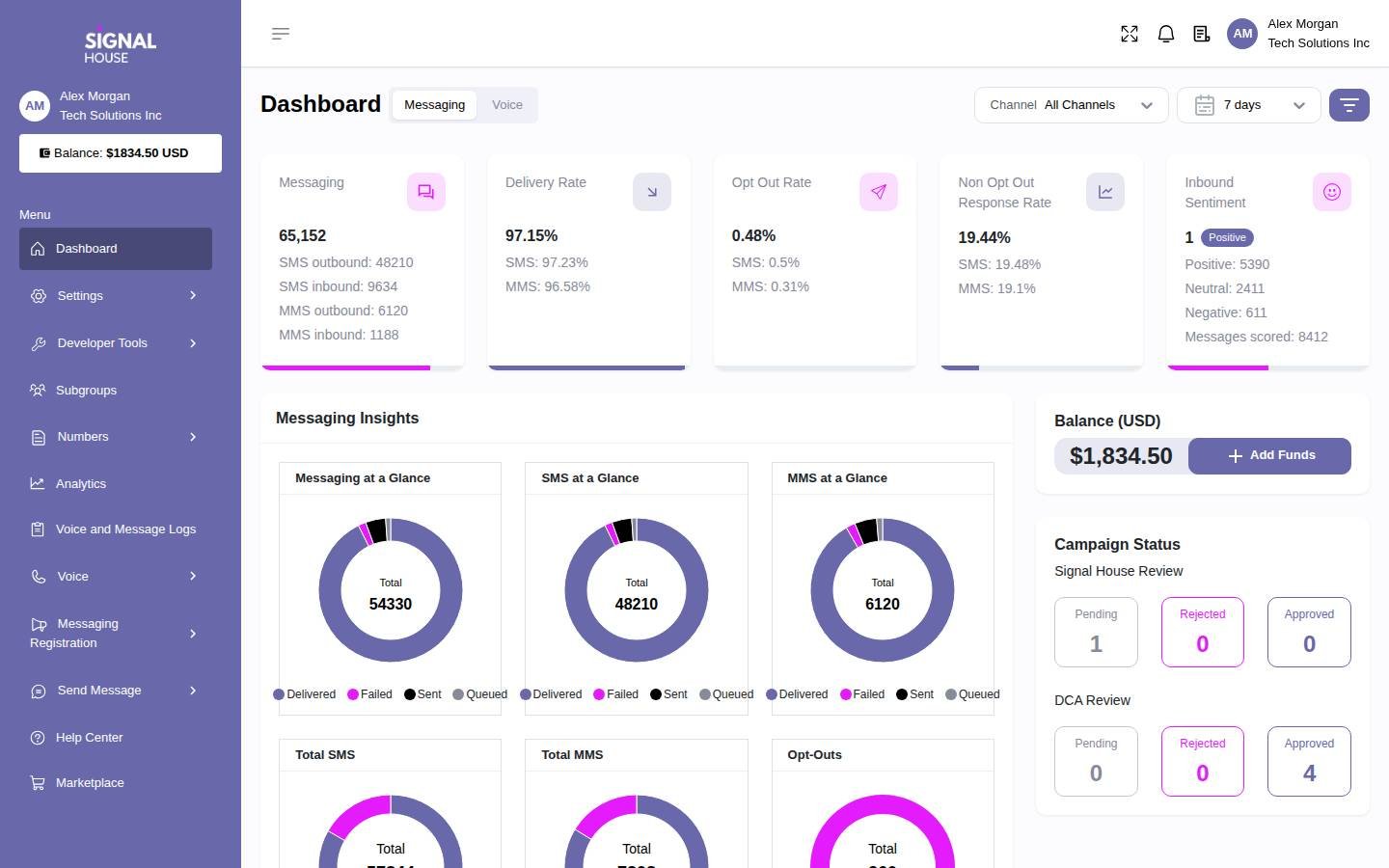
Request A Signal House Workflow Demo
Plivo: Voice Infrastructure, APIs And Account-Specific Messaging Access
Plivo supplies programmable voice, SIP trunking and other communications products. Its XML model lets an application return instructions for handling calls, while callbacks communicate progress and outcomes. Messaging remains a separately qualified commercial requirement. An API reference shows how a feature operates; it does not override current onboarding or plan restrictions.
For a voice-led project, identify whether you need a PBX connection, browser participation, a custom voice application or an AI workflow. Plivo publishes different pricing for those components. A business can purchase useful infrastructure without receiving the exact shared inbox, receptionist console or mobile experience it expected from a finished phone system.
Signal House Vs Plivo Features And Operating Boundaries
| Requirement | Signal House | Plivo | Buying Implication |
|---|---|---|---|
| Programmable voice | SHML webhook instructions | XML and voice callbacks | Test exact routing and fallback behavior |
| PBX connectivity | SIP trunks listed | Separate SIP trunk product | Obtain matched network and increment terms |
| Business messaging | API and supported integrations | Sales-led qualified SMS access | Commercial eligibility comes before development |
| Agency client workflow | Documented HighLevel client-pricing proposition | New multi-brand SMS onboarding restricted | Confirm permitted business model |
| Employee interface | Demonstrate the proposed workspace | Application or connected software required | An API is not every staff-facing screen |
| Recording and retention | Feature quote required | Selected recording/storage terms published | Price retention and employee access separately |
| Evaluation | New-account credit advertised | Voice-led trial and plan-specific access | Do not infer unrestricted production SMS |
| Support | Human assistance advertised | Confirm current account entitlement | Quote channels, escalation and scope |
Use the comparison to prepare a demonstration checklist. A feature should be shown in the proposed account, product and connected application. A vendor's product catalog is not proof that every feature is included together. Confirm the relevant plan boundary and any work needed to turn infrastructure into a usable business process.
Employee Experience And Application Ownership
A 5-person office might need a shared phone identity, an administrator who answers incoming calls and staff who own callbacks. A development team might need programmable routing embedded inside its own service. Those buyers can select similar infrastructure categories while requiring very different interfaces and implementation support.
For Signal House and Plivo, name the owner of the dialer, inbox, customer data and reporting. Ask who handles support, changes working hours or repairs a broken connection. Without that ownership, a low rate can coexist with an expensive manual process. With it, a technical product can support a straightforward daily experience.
Signal House Vs Plivo Pricing: Selected US Components
All figures below are in US dollars and describe selected public components. They are not complete service quotations. Plivo messaging eligibility and commitment rules apply independently of the unit table. Destination exceptions, carrier fees, registration, number rental, optional features, taxes and software can affect the amount payable.
| Component | Signal House | Plivo | Scope |
|---|---|---|---|
| Local outgoing SMS | $0.0065/segment | $0.0077/segment | Selected entry bases; carrier fees extra |
| Toll-Free outgoing SMS | $0.0079/segment | $0.0079/segment | Equal selected base; other fees and access differ |
| Local outgoing Voice API | $0.012/min | $0.0115/min | Selected US routes; chargeable units |
| Local incoming Voice API | $0.005/min | $0.0055/min | Selected local components |
| Incoming local SMS | Obtain platform base quote | $0.0077/segment | Missing platform rate is not zero |
| Local number rental | $1/month messaging; voice-enabled quote | $0.50/month | Usage, capabilities and messaging access separate |
| Local SIP trunking | Obtain matched trunk quote | From $0.0046/min out; $0.0028/min in | Separate product; confirm applicable billing increments |
| Production SMS access | Confirm eligible offer and traffic | Direct-brand sales onboarding; $1,000 monthly minimum | Commitment across eligible products; pass-through excluded |
The Plivo US Voice API pricing page distinguishes local, toll-free and connection components. Request the applicable Signal House schedule and matched Plivo order terms. A sales quotation should state which product and destinations it covers, rather than using a convenient headline rate for every kind of traffic.
Workload Examples: Component Arithmetic Before Commitments
The examples combine selected local outgoing SMS and Voice API components. Minutes mean chargeable units under the relevant rounding arrangement. Incoming SMS is excluded because the Signal House platform base for that direction was not established. Missing information must not silently become a zero in the calculation.
| Monthly Workload | Signal House | Plivo | Selected Component Result |
|---|---|---|---|
| 10,000 outgoing + 10,000 incoming Voice API minutes | $170 | $170 | Equal selected base |
| 10,000 outgoing local SMS + 10,000 outgoing and 10,000 incoming minutes | $235 | $247 | Signal House lower by $12 |
| 10,000 outgoing local SMS + 10,000 outgoing and 1,000 incoming minutes | $190 | $197.50 | Signal House lower by $7.50 |
| 10,000 outgoing local SMS + 30,000 outgoing and 1,000 incoming minutes | $430 | $427.50 | Plivo lower by $2.50 before commitment |
The Plivo column is usage-component arithmetic, not a promise that a new messaging customer can pay that amount as its complete invoice. Apply the actual minimum commitment, eligible usage and pass-through treatment from the agreement. The Signal House column also excludes unquoted integration charges and other expenses.
Why The Voice Direction Mix Changes The Result
At the selected rates, 10,000 outgoing and 10,000 incoming Voice API minutes total $170 for either provider before other charges. Plivo's outgoing advantage offsets Signal House's incoming advantage in that example. Once local SMS is added, Signal House's lower selected outgoing message base changes the combined result.
For a simplified component model, Plivo minus Signal House equals $0.0012 times outgoing local SMS segments, plus $0.0005 times incoming minutes minus outgoing minutes. This formula applies only to the stated entry components, before other fees, commitments and discounts. It is a way to inspect sensitivity, not a universal invoice calculator.
For example, 10,000 outgoing message segments require 24,000 more outgoing than incoming voice minutes to offset that $12 messaging-base difference. At 30,000 outgoing and 1,000 incoming minutes, the combined components are $430 for Signal House and $427.50 for Plivo. Commercial eligibility and commitments still need to be applied.
How To Model A Minimum Spend Without Double Counting
Suppose an illustrative contract uses a $1,000 monthly floor and counts all $600 of your eligible usage against it. Under those assumed terms, the eligible subtotal is $1,000, not $1,600. The unused portion is $400. If eligible usage instead reaches $1,250, that subtotal would be $1,250 before excluded items.
This example explains a common minimum-spend structure; your order form controls the actual arrangement. Pass-through fees can remain additional, and not every service necessarily qualifies in the same way. Ask the provider to walk finance through a quiet month, a normal month and a high-volume month using your proposed contract.
Carrier Fees, Numbers And Quiet Months
Use each vendor's carrier schedule and the actual destination-network mix. An assumed common $0.0045 carrier component on 10,000 outgoing segments adds $45. That example is a modeling assumption, not proof of identical vendor schedules. Replies, toll-free traffic and media can have different fees.
Signal House lists entry local messaging numbers at $1 monthly and quotes voice-enabled local numbers separately. Plivo's selected local number rental is $0.50 monthly. Do not describe either rental as unlimited calls or unrestricted SMS access. The required features, registration and commercial entitlement must also be present.
A smaller rental difference can matter across many numbers, but it should be evaluated within the whole contract. For 20 selected local numbers, the listed rental components are $20 for Signal House messaging numbers and $10 for Plivo numbers. That $10 difference does not settle calling activation, messaging access or the application's operating cost.
Volume Discounts Must Match The Actual Agreement
Signal House describes graduated outgoing voice bands, so the cheapest reached band should not be applied retroactively to every minute. Plivo's plan documentation places volume discounts within Enterprise. Obtain the relevant product schedule rather than assuming that a generic calculator or promotional effective rate is the invoice rate for your account.
Review seasonal use and commitments together. A larger discount may be attractive during a busy month yet poor value when activity falls. Compare expected spend across a representative period. A contract that fits an established direct brand may be unsuitable for a small office testing a new communication channel.
Signal House Vs Plivo Voice: XML, Transfers And SIP
SHML And Plivo XML Need A Voice Compatibility Test
Signal House documents call instructions through SHML returned by a webhook. Plivo uses its own XML instructions and an Answer URL model. Similar capabilities such as speaking a greeting, collecting input or dialing a destination do not establish identical behavior. Check authentication, request fields, callback timing and supported instructions.
Map the current voice flow before implementing a replacement. Include a normal response, invalid keypad input, an unanswered destination and a closed office. A migration is successful when the business outcome remains correct. Returning familiar-looking XML is not enough if the caller reaches the wrong person or loses the expected fallback.
Voice Call Legs, Forwarding And What Counts As An Answer
Plivo's billing documentation states that incoming and outgoing call legs are charged separately. Model the same distinction for the selected Signal House configuration rather than pricing a transferred conversation as a single outgoing minute stream. A human answer, voicemail answer and unsuccessful attempt can have different commercial implications.
For an illustrative flow using 4 incoming and 3 outgoing chargeable minutes, Signal House's selected components total $0.056. Plivo's matching Voice API components total $0.0565. This excludes additional connection types, optional services, numbers and other charges. A tiny difference in this example is not evidence of a meaningful complete-service advantage.
Voice API Rounding And SIP Billing Are Separate Questions
Signal House publishes a 1-minute minimum and whole-minute rounding for answered calls. Plivo's billing concepts describe 60-second rounding for Voice API calls. For 100 separately answered calls lasting 65 seconds, that produces 200 chargeable minutes under those assumptions, rather than pricing from the combined elapsed duration.
At the selected outgoing API components, those 200 minutes cost $2.40 for Signal House and $2.30 for Plivo before additional charges. Do not extend the same rounding assumption to every SIP product. Plivo's SIP page and general billing documentation show different US trunk increments; obtain the applicable account rate sheet before modeling that product's rounding.
Plivo SIP Trunking For Existing PBX Users
Plivo's US SIP page lists local outgoing rates starting at $0.0046 per minute and local incoming at $0.0028. These are separate from the Voice API rates above. The general telephony headline also includes other routes, so a lower toll-free outgoing component should not be relabeled as the rate for every local call.
A company with a compatible PBX should compare trunk quotations for its actual numbers and destinations. Signal House also lists SIP options, but obtain a matched trunk quote rather than using its programmable rate as a substitute. Include the telephone system, emergency configuration, authentication, support and any optional processing in the decision.
Recording, Storage And Additional Voice Services
The selected Plivo Voice API schedule lists recording at no additional per-minute charge, with recording storage free for 90 days and a listed $0.0004 per stored minute per month afterward. At that storage rate, 10,000 chargeable stored minute-months would cost $4. Confirm retention and account terms before budgeting.
Signal House's recording capability also needs its applicable feature quotation. For both providers, decide who can listen, download or delete recordings and when they expire. A low storage price does not establish lawful recording, appropriate consent or secure employee access. Include those requirements in the application design.
Speech recognition, transcription and AI processing are separate services. Plivo's recognition unit is not the same as a per-minute transcription unit, and an AI-agent price can exclude telephony. Quote the actual workflow instead of treating all speech features as included because another recording-related row is free.
Signal House Vs Plivo SMS And Business Messaging Workflows
Sender Choice, Registration And Incoming Replies
Choose local, toll-free or short-code sending before comparing rates and requirements. Signal House and Plivo publish different sender categories. The selected toll-free outgoing SMS bases are equal in our table, while the local outgoing bases differ. Neither result automatically carries over to multimedia, incoming traffic or an account-specific agreement.
Registration and verification do not replace the customer's relevant permission to receive messages. Confirm the identity of the sending business, the message purpose and the process for handling replies. A reminder asking customers to respond creates an operational responsibility. Somebody must see the answer and complete the requested action.
Message Length, Unicode And Campaign Forecasting
Plivo's billing guidance describes common SMS limits of 160 characters for a single GSM-7 segment and 70 for Unicode, with concatenated limits commonly 153 and 67. Preview the exact final text. Personalization, links, punctuation and emojis can affect encoding and billable parts.
A campaign to 10,000 recipients can create 20,000 outgoing segments if every message requires 2 parts. At the selected local bases, those components would be $130 for Signal House and $154 for Plivo before other charges and commitments. The number of recipients alone is therefore not a sufficient cost forecast.
Shorten messages when doing so preserves useful meaning. Do not remove the business identity or necessary instructions simply to fit a target length. A confused customer who calls twice can create more staff work than an additional message segment costs. Optimize for a complete, understandable interaction.
Opt-Out Handling Must Reach Every Connected System
Plivo documents automatic DND handling for standard opt-out keywords, with particular sender rules. It also recommends monitoring ordinary-language requests that may not match those keywords. Do not assume a customer must use an exact command before an employee should act on a clear request to stop messages.
Test the same suppression journey in a Signal House integration. A stopped contact should not be reintroduced by a CRM import, another staff member or a queued automation. Confirm where preference records live and how connected systems synchronize. A transport-level block is useful but does not automatically solve every customer-data process.
MMS, WhatsApp And Verification Need Their Own Scope
Signal House publishes MMS, and Plivo lists multimedia and other communication products. Specify the channel the business needs rather than assuming a generic messaging offer includes it. An image message, WhatsApp conversation and verification code have different operating requirements, sender arrangements and commercial terms.
For Plivo, account plan and region can restrict access independently of a public product page. For Signal House, obtain written confirmation for any channel not established in the proposed offer. Demonstrate the actual customer interaction and staff reply destination. A channel list is not a complete omnichannel application.
Integrations, Support And Business Team Fit
GoHighLevel, Make And Ecommerce Operations
Signal House's named integrations are relevant when your business already operates in those environments. Ask which events, sender controls and reply functions are supported. A Shopify reminder should stop when the customer purchases. A HighLevel conversation should appear in the intended business's workspace, with the correct employee access.
For Plivo, identify whether the proposed connection is a maintained integration, a third-party connector or custom code, and confirm eligibility first. Technical feasibility does not override onboarding policy. Establish the person who will maintain the connection when an API, application or business process changes.
Include repeated and failed source events in testing. An automation retry should not create duplicate messages or calls. A canceled appointment should not leave its original reminder active. These are integration responsibilities, even if the provider correctly delivers every request the application sends.
Support Availability, Escalation And Written Commitments
Signal House advertises human support across plans and a dedicated Slack arrangement for qualifying volume. Confirm hours, escalation and the implementation support tasks included. Do not turn that description into an unverified promise of instant resolution, unlimited customization or a particular response time.
For Plivo, request the current support entitlement in the quote or console. Its older public support-plan articles describe historical packages, while the support-plan URL now directs buyers to sales. We therefore do not present old package prices as current offers. Ask about support channels, priority definitions and production incident coverage.
Prepare an incident example with a call or message identifier, direction, timestamp, destination and observed behavior. Share only necessary customer information. That gives support something to investigate and helps distinguish a carrier issue from an application error. A generic report that the system is unreliable rarely identifies the responsible component.
Which Provider Fits A Small Business?
Signal House is a relevant first demonstration for an eligible small business needing messaging and a supported connection. Confirm the complete employee workflow and quote rather than choosing on the local SMS rate alone. The office should know how to change hours, assign callbacks and remove access when someone leaves.
Plivo remains relevant to a voice-led small business or developer project that fits its available plan. The slightly lower selected outgoing API rate and separate trunk product are worth evaluating. A low-volume messaging business, however, should resolve the published commitment and access requirements before spending time on implementation.
Which Provider Fits A Larger Direct Brand?
A larger business sending on its own behalf can evaluate Plivo through sales using its actual channels, region and expected spend. Its established voice application and broader contract may influence the result more than a selected entry SMS difference. Request a matched quote with clear support and capacity terms.
Signal House should be evaluated against the same requirements. Ask for production references relevant to your workload, a technical pilot and a written service and support scope. Avoid accepting broad savings percentages without a matched calculation. The best supplier is the one that supports the business's actual scale, obligations and operating team.
Which Provider Fits An Agency Or Multi-Client Platform?
Signal House's supported agency proposition makes it a more relevant starting point for eligible multi-client messaging. Demonstrate permissions, client billing scope, sender ownership and offboarding. Its terms restrict specified traffic categories, including certain third-party activity involving bought, sold or shared consumer information, so client eligibility still matters.
Do not assume that Plivo's general APIs or historical subaccount features make a new multi-brand SMS arrangement eligible. The present onboarding document explicitly distinguishes these business models. For a voice-only platform, discuss that scope separately rather than extending the messaging restriction to every service without evidence.
Reliability, Security And International Requirements
Compare Complete Customer Outcomes
A fair voice pilot uses the relevant destinations, networks and staff equipment for both providers. Record connection setup, audio, keypad handling, transfer outcome and the final task. For messaging, distinguish an accepted request, delivery status, customer reply and completed action. These are different stages of the customer journey.
Signal House and Plivo customer ratings do not establish measured delivery or audio superiority. Nor should one successful demo be described as a production reliability test. Define pass criteria, record conditions and investigate failed cases. Use the same workload wherever the proposed products overlap.
Credentials, Callbacks And Fraud Controls
Store credentials securely and restrict access to people who need them. Keep production tokens out of website source, shared documents and screenshots. Configure callback validation using the chosen provider's supported method. The receiving application must handle retries without repeating customer actions or corrupting the conversation record.
Plivo's documentation describes callbacks for call progress and outcomes, including retries. A developer should distinguish an event's identity and type as well as its call identifier, so duplicate handling does not accidentally discard legitimate later events from the same conversation. Apply equivalent care to the target Signal House integration.
Signal House lists calling-region and spend-per-minute controls, alongside SIP transport options. Select secure settings deliberately and confirm what each limit actually blocks. An alert can notify staff without stopping traffic. Name the person who receives it, investigates the issue and can pause an affected automation.
International Coverage Requires A Destination Matrix
List each country where you need number inventory, outgoing calls, incoming calls and messages. Verify these independently. A country appearing in a vendor's general coverage statement does not prove that your account can buy a particular number, send a registered message or enable the required channel.
Plivo's messaging documentation distinguishes destination coverage by commitment tier and registration requirements. Signal House should confirm the requested international arrangement in writing. The US examples in this article do not establish global rates. Include local documentation, account region, sender approval and the intended customer workflow in the evaluation.
Record Retention And Sensitive Customer Information
Decide what each system stores and which employees can access message bodies, recordings and exports. Keep retention connected to a business purpose. A shared portal can create unnecessary exposure when everyone receives unrestricted access or downloads recordings to unmanaged devices.
If communications involve regulated information, examine the exact product, contract and configuration. Do not infer compliance from a general security badge, encryption or a healthcare marketing page. Ask the questions relevant to the information your business actually processes, including any connected software and the employee practices surrounding it.
How To Evaluate And Switch Between Signal House And Plivo
1. Confirm Commercial Eligibility And Required Products
Begin with the business model, account region, senders and destinations. Obtain confirmation that the provider will support the intended arrangement. Then identify the product responsible for each task. A voice-only trial, a SIP quotation and an Enterprise messaging agreement should not be treated as interchangeable purchases.
Write a short requirements document covering customer interactions, staff interfaces, reporting and support. Distinguish essential behavior from optional improvements. This helps both sales and developers identify a genuine fit, and prevents a missing business requirement from appearing only after the numbers have been moved.
2. Export Usage And Request Matched Pricing
Collect representative traffic by direction, destination, sender and feature. Reconcile chargeable units with the invoice and identify unusual incidents separately. Include number rental, optional processing, registration, application fees and support. A matched baseline makes the quotation more useful than an estimate based only on the headline monthly bill.
Give both providers the same workload. Ask how commitments, discounts and excluded charges apply. Leave unresolved components visibly unresolved instead of assigning zero. A comparison should show what is known, what the model assumes and which written answers are still needed before procurement can approve it.
3. Pilot The Workflow Without Moving Production Traffic
Use appropriate test numbers and participants who have agreed to take part. Test an incoming call, outgoing callback, busy destination, voicemail and failed transfer. For approved messaging access, test a reply, an opt-out and a duplicate source event. Include the employees who will actually operate the service.
For a Plivo-to-Signal House migration, document XML, webhook and reporting differences rather than assuming a drop-in replacement. For the opposite direction, validate Plivo plan access before development. A working pilot should demonstrate the business process as well as successful transport.
4. Plan Number Porting, Activation And Fallback
Check portability for the actual numbers and obtain the receiving provider's requirements. Keep the existing service active until the transfer is confirmed. Calling and messaging can involve separate activation or registration steps. Verify incoming routes, outgoing identity and replies after the change.
Preserve configuration, necessary customer records and consent evidence before disabling old resources. Agree on a fallback and name the person authorized to adjust routing. Do not promise an interruption-free migration without evidence from the specific transfer. Staff should know which system to use during the transition.
5. Review Net Benefit And The First Invoice
Suppose a migration costs an illustrative $480 and saves a verified net $12 monthly after other expenses. Simple payback is 40 months. If actual net savings are $60 monthly, the same migration pays back in 8 months. Neither result should be inferred from the component table without including commercial, support and operating differences.
Review the first production invoice against the quotation and pilot. Check message parts, destinations, optional features and commitment treatment. Confirm employees can still complete the required tasks. A successful change improves the complete business service, rather than merely producing an attractive rate comparison.
Signal House Vs Plivo Pros And Cons
Signal House Pros
- Lower selected US local outgoing SMS and incoming Voice API components in this comparison.
- Named integrations and a supported agency proposition are relevant to eligible businesses seeking guided setup support.
- Published programmable voice and SIP options make it relevant beyond messaging alone.
Signal House Cons And Buying Considerations
- Selected outgoing Voice API components are slightly higher than Plivo's local rate.
- Incoming messaging base, voice-enabled number rental and integration scope require confirmation.
- Agency support does not establish unrestricted traffic eligibility or every finished application feature.
Plivo Pros
- Lower selected local outgoing Voice API rate and a distinct trunking product for suitable PBX comparisons.
- Documented XML and callback interfaces support a technical requirements and prototype process.
- Selected number rental and recording terms can be attractive when the required account and product are available.
Plivo Cons And Buying Considerations
- Current SMS onboarding and commitment requirements can exclude or discourage some low-volume and multi-client buyers.
- Voice, SIP, messaging and trial terms must be distinguished rather than combined into one headline offer.
- Application ownership, current support entitlement and trunk billing increments need account-specific review.
Frequently Asked Questions About Signal House Vs Plivo
Is Signal House Cheaper Than Plivo?
Yes for the selected US local outgoing SMS and incoming Voice API components; Plivo is slightly lower for selected outgoing local Voice API minutes. The complete invoice depends on direction mix, sender fees, application costs and contractual commitments. A single rate does not establish a universal cheaper provider.
Can A Small Business Start Plivo SMS On Pay As You Go?
Do not assume unrestricted self-service access. Plivo's current messaging availability document describes sales-led onboarding for direct brands with a minimum spend requirement. Confirm your actual account and contract with sales. A general free account or historical quickstart does not override those published eligibility rules.
Can An Agency Or ISV Use Plivo For Multiple Clients' SMS?
Its current onboarding documentation excludes resellers, multi-brand ISVs and aggregators of unrelated senders. Existing agreements require their own review. Evaluate Signal House's agency arrangement when your traffic is eligible, and confirm ownership, permissions and commercial scope before promising clients a service.
Which Provider Is Better For A Custom Voice Application?
Choose the provider whose supported instructions, routes and commercial terms match the application. Plivo merits evaluation when its XML and callback model fits or is already implemented. Signal House is a relevant alternative when its programmable workflow is supported. Prototype transfers, fallbacks, reporting and staff actions before deciding.
Does Plivo's Lowest SIP Rate Apply To Every API Call?
No. SIP trunking and Voice API are separate products with different selected rates and billing arrangements. The destination and number type also matter. Use the exact product's rate sheet and ask for clarification where published trunk increment descriptions differ. Do not label a route-specific starting figure as universal.
Is Plivo Call Recording Free?
The selected Voice API card lists no additional recording charge and free recording storage for 90 days, followed by a storage rate. Confirm product, retention and account terms before relying on that offer. Connectivity, transcription and other optional services remain separate, and free recording does not resolve consent requirements.
Do Signal House And Plivo Offer A Free Trial?
Signal House advertises $25 in account credit rather than a verified fixed-duration trial. Plivo advertises $10 in credits, while its plan FAQ describes credits for the first 3 weeks. Confirm permitted products and account conditions. Those voice-led evaluation terms do not establish unrestricted production SMS eligibility.
Can I Keep My Existing Number?
Usually only if that specific number is portable to the proposed service and the receiving provider accepts the transfer. Confirm eligibility, documentation, activation and routing before canceling the current service. Calling and messaging access should both be checked. A portable number does not automatically bypass product or sender requirements.
Which Provider Has Better Support?
There is no independently measured support winner in this comparison. Signal House advertises human assistance; Plivo's current entitlement should be confirmed in its quote or console. Compare support coverage, escalation and responsibility for your integration. Customer comments help shape questions but do not establish how a future incident will be resolved.
Should I Compare Other Providers Too?
Yes, if neither option meets your eligibility, destinations, staff workflow or budget. Our communications API alternatives comparison provides a broader starting point. Shortlist by essential requirements first, then compare complete costs. A lower advertised rate cannot compensate for an unavailable or unsuitable service.
Final Verdict: Choose Eligible Messaging And The Right Voice Product
Signal House is our first demonstration for eligible businesses seeking supported messaging and the lower selected local outbound SMS base. Plivo deserves a voice-specific evaluation for its outgoing API component, existing application fit, support terms and separate SIP offering. The best choice depends on actual access, traffic and operational responsibilities.
Obtain a demonstrated workflow, matched pricing and clear ownership before committing. Request Signal House's matched offer if the supported arrangement fits your business, and compare it with the appropriate Plivo products. Preserve the eligibility and commitment qualifications when sharing the comparison with colleagues.
Customer Feedback On Signal House And Plivo
The G2 product profiles used here show Signal House at 4.8/5 and Plivo at 4.5/5. These are customer-source scores, not our measured technical ratings. Differences in reviewer roles, products and commercial arrangements mean the scores should supplement a procurement decision rather than determine it.
Signal House reviewer Ismail A., rating it 5/5, praised onboarding assistance and support. Plivo reviewer Pablo N., also rating it 5/5, valued the API and practical help while requesting a more intuitive administration interface and reporting customization. These are individual experiences, not guarantees of your implementation effort or future service quality.
An incentivized Plivo reviewer in information technology, rating it 4.5/5, appreciated support and account breakdowns but described issues with automatic reloading. Such historical comments suggest questions about billing controls and administration. They do not prove that a new multi-brand messaging buyer is eligible under the current onboarding policy.
Turn the feedback into demonstration questions: can staff find settings, can finance understand charges, and can the application owner investigate a failed event? Combine the answers with a controlled pilot and written terms. That is more useful than treating an aggregate score as a complete technical assessment.
Affiliate Disclosure: We may earn a commission when you purchase through selected links, at no additional cost to you. Recommendations reflect the use cases, limitations and commercial assumptions explained in this article.