The best SMS APIs for US business messaging are Signal House for guided setup, Twilio for a documented developer platform, Telnyx for direct control, and TextGrid for the lowest selected outbound base rate in this comparison. Plivo, Bandwidth, Sinch and Infobip also merit evaluation when their features, sender options and commercial terms match your application.
A business SMS integration needs more than a successful send request. Customers must receive useful updates, replies must reach the right person, and opt-outs must stop future sends. This guide compares US SMS API providers on the practical decisions behind those outcomes: registration, billing units, delivery events, account permissions, API integration work and total operating cost.
 Verified G2 product ratings appear beneath the relevant provider logos.
Best SMS APIs For US Business Messaging Compared
Signal House is our first comparison for eligible small businesses and agencies that value messaging implementation assistance. This is an editorial fit recommendation. TextGrid has the lowest selected published local outbound base rate among the providers with matched numeric examples below. No provider receives a universal delivery, reliability or compliance guarantee.
| Provider | Best Fit | Buying Considerations | Pricing & Evaluation |
|---|---|---|---|
|
| $0.0065/SegmentUS local outbound base; carrier fees extra. $25 new-account credit advertised.See Pricing And Credit | |
|
| $0.0083/SegmentUS local outbound and inbound base; fees extra. Restricted, time-limited trial allocations.View Features And Trial Details | |
|
| $0.004/PartUS local outbound and inbound base; fees extra. Free signup; confirm evaluation allocation.View Features And Evaluation | |
|
| $0.0077/SegmentUS long-code base in either direction; carrier fees extra. Messaging trial credits offered.View Features And Trial Details | |
|
| $0.0035/SegmentUS local outbound base; carrier fees extra. Free signup; confirm account permissions and credits.View Features And Evaluation | |
6. Bandwidth4.4/5 |
|
| $0.004/10DLC MessagePublished US outbound base; fees extra. Confirm multipart billing. Free Build evaluation offered.View Features And Evaluation |
|
| Confirm US Account RatePublic 10DLC rows show $0.0078/message; confirm applicable product and units. Free trial advertised.View Features And Trial Details | |
|
| Destination-Specific QuoteUS sender, direction and application scope determine the estimate. SMS free trial documented.View Features And Trial Details |







The numeric rates above are selected US outbound transmission components in USD. Add carrier charges, registration, number rental, SMS replies, optional services and taxes as applicable. Sinch has published 10DLC rows, but confirm the rate for the current API integration product; Infobip needs a destination-specific estimate. Table detail buttons lead to the relevant provider discussion when no approved affiliate destination is available.
Which US SMS API Should You Choose?
Choose Signal House when guided implementation fits an eligible US workflow, Twilio when its developer platform meets your application requirements, Telnyx when your team wants direct configuration control, or TextGrid when supported basic SMS sending at a low base rate is the priority. Compare Plivo and Bandwidth for specific operating requirements, and Sinch or Infobip for a broader channel strategy.
- Guided setup: Signal House. Its advertised implementation help and integrations can matter to a small team that needs assistance getting the API workflow ready.
- Documented developer workflow: Twilio. Evaluate its sender services, delivery events and related products against the amount of API infrastructure you want to build yourself.
- Low selected outbound base: TextGrid. It leads the matched local transmission-rate comparison, provided account permissions and supported features meet your requirements.
- Developer control: Telnyx. It is a useful option for teams prepared to configure the API application and operate its event handling.
- Infrastructure procurement: Bandwidth. Assess the API, number management and commercial scope together rather than buying a tariff in isolation.
- Broader conversations: Sinch and Infobip. Compare the exact channel, sender and application products required for the intended customer messaging journey.
Our selections are based on documented capabilities, published commercial information and practical fit. We have not run a controlled cross-provider handset delivery test. Customer ratings help frame buying questions; they do not establish which network will perform best for your specific customer base.
What Is An SMS API, And How Does It Work?
An SMS API lets your software send and receive text messages through a communications provider. Your application submits a recipient, a permitted sender and SMS content. The provider processes the request and routes it toward the recipient's mobile network. Delivery updates and incoming replies return through the supported interfaces, often including webhooks.
For example, a scheduling application can trigger an appointment reminder when a booking is confirmed. A customer's SMS reply can update the booking or create a task for an employee. The API supplies communication building blocks; your application still needs to decide when a message is appropriate, what it says and what happens after a reply.
This differs from a business messaging app with an inbox, campaign editor and staff assignments already built. A nontechnical team may prefer that finished interface. Developers embedding notifications inside a product may prefer direct messaging control. Some providers offer both, but an API channel tariff does not automatically include every application feature.
Also distinguish SMS from MMS, RCS, WhatsApp and verification products. They have different capabilities and billing structures. A low SMS API rate does not establish the cost of sending images, authenticating users or managing a conversation across several channels. Start with the customer task and select the product that actually performs it.
8 Best SMS API Providers For US Businesses
1. Signal House: For Guided US Messaging Setup
Best fit: Small teams and agencies that want help connecting an eligible business workflow. Signal House advertises 1:1 implementation support and integrations with GoHighLevel, Shopify and Make. That makes it relevant when the problem is getting a supported API integration running, rather than simply obtaining another set of API credentials.
Its selected US local outbound SMS starting rate is $0.0065 per segment, excluding carrier fees. The messaging rate card lists a local SMS number at $1 per month before applicable volume arrangements. A $25 new-account credit is advertised. Confirm which charges the credit covers and whether an app or agency integration uses a separate package.
The useful questions are operational. Who submits the brand and campaign information? Where do inbound SMS replies appear? Who receives a failed-SMS event? How does the connected application prevent messages after an opt-out? Ask the team to demonstrate those steps using your intended API workflow, not only a generic dashboard tour.
Strengths: Advertised implementation assistance, a published local usage rate, and integrations relevant to businesses already using connected sales or ecommerce tools. Limitations: Account eligibility and commercial scope need confirmation. The terms restrict certain third-party lead-generation and affiliate-marketing traffic; being an agency does not make every campaign permissible.
Choose Signal House when its support arrangement and integration reduce a concrete operating problem for your business. Get a written estimate covering outbound SMS parts, replies, numbers and registration. Do not assume an advertised approval timeframe guarantees carrier acceptance, or that the public API tariff is automatically the complete cost of a specific API integration.
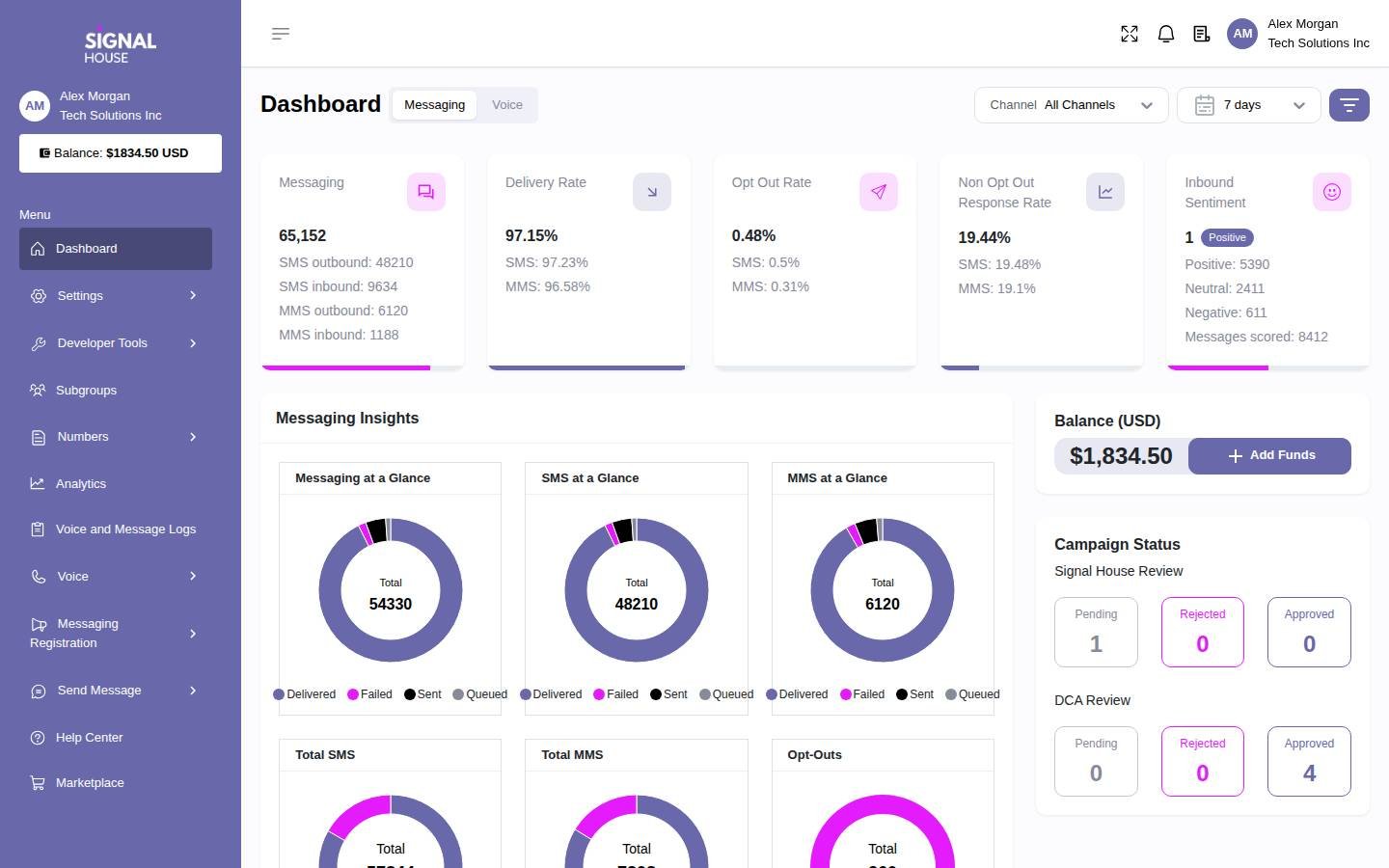
Evaluation: The advertised $25 account credit supports a limited evaluation; it is not a verified fixed-duration free trial. Confirm registration and sending permissions before planning a live pilot.
See Pricing And Account Credit
2. Twilio: For A Documented Developer Platform
Best fit: Development teams building customer notifications, replies and related messaging workflows into their own software. Twilio's documentation covers SMS resources, incoming webhooks, status callbacks and sender services. Its appeal is the set of building blocks you can evaluate together, rather than the lowest selected US transmission rate.
The published standard US long-code SMS base rate is $0.0083 per segment in either direction, with carrier fees additional. Number rental, registration and optional services can add costs. Treat the price of sending a basic SMS segment separately from a managed verification product or a paid engagement feature.
Twilio is worth comparing when your application already uses its resource identifiers, sender configuration or event handling. The API alternative may have a lower rate but require you to rebuild scheduling, routing or operational tools. Estimate that work before deciding that the difference between 2 transmission tariffs is your actual monthly saving.
Strengths: A documented programmable workflow and related products that can be assessed within an existing API development stack. Limitations: The complete bill can grow with usage, optional features and the amount of two-way activity. Developers must understand registration, event processing and application security; having documentation does not remove implementation work.
A useful pilot should send an ordinary SMS, inspect the final delivery event, receive a reply and process an opt-out. Compare application behavior and invoiced units. Twilio is our developer-platform evaluation pick, not a claim that it wins every usability test or delivers every message faster than competitors.
Evaluation: Current trial documentation describes a time-limited account with product-specific allocations and restrictions. Confirm permitted recipients and content. A constrained test is useful for learning the interface but does not replace approved production testing.
3. Telnyx: For Direct Developer Configuration
Best fit: Teams that want to own SMS sender configuration, application events and usage monitoring. Telnyx publishes a US local SMS starting rate of $0.004 per part, with carrier fees separately listed. Its published inbound local component is also $0.004 per part before applicable additional charges.
That lower transmission base can be attractive to a software team sending recurring SMS notifications or receiving replies at scale. The buying decision still includes the interface your staff need, SMS sender registration and the API code that connects messages to customer records. A low SMS API rate is infrastructure pricing, not a finished support inbox.
Ask the developer to validate outbound SMS submission, incoming events, status updates and error recovery. Confirm how the account associates numbers with the required settings and how credentials are separated between environments. The important result is a messaging workflow your team can operate and troubleshoot after the initial API integration is complete.
Strengths: Visible base and carrier components and a useful rate comparison for developer-managed traffic. Limitations: Your team must still implement business logic and monitor the system. Different sender routes and optional services can have their own terms; a local US SMS rate is not a universal tariff for every channel or destination.
Choose Telnyx when the necessary configuration works well with your application and its complete cost is competitive. Compare billed SMS parts and incoming volume, not just recipient counts. A provider with a lower base can lose its advantage if the SMS application repeatedly sends duplicates or requires more operational work than your team expected.
Evaluation: Free signup is offered. Confirm the actual credit, destination access and registration requirements for your account rather than assuming every product can be tested freely in production.
4. Plivo: For A Conventional Programmable Texting Workflow
Best fit: Developers comparing an established send-and-receive application pattern with explicit US tariffs. Plivo lists local long-code SMS at $0.0077 outbound and inbound, with carrier charges additional. Its toll-free SMS row is $0.0079 in either direction, so sender choice affects the comparison.
The US rate card also lists local number rental at $0.50 per month and toll-free rental at $1 per month. These are individual components, not complete plans. Add the appropriate campaign or verification charges and the features your application uses before deciding which provider offers the lower total.
A Plivo SMS evaluation should cover the same operational journey as your current provider: create a send, retain the returned SMS identifier, process delivery information and route replies. Compare the actual API request fields and event formats. Familiar terminology does not guarantee that the old SMS application can move without changes.
Strengths: Explicit route-specific list rates and a straightforward API commercial comparison for conventional application texting. Limitations: Its selected local outbound rate is only modestly below the Twilio baseline. At low volume, that component difference may not repay a migration project quickly, even when the new service meets every technical requirement.
Evaluate Plivo when several required components improve the API operating model together, or when its implementation fits your developers. Separate basic SMS from Verify and any AI or calling products. A useful comparison uses the exact product your application needs rather than a blended headline from a different service.
Evaluation: The messaging page offers signup with trial credits. Confirm the allocation, supported recipients and approval requirements for the SMS account. A voice-specific promotion should not be assumed to cover a messaging deployment.
5. TextGrid: For Low-Cost Supported Outbound Sending
Best fit: Cost-focused teams with a compatible application and confirmed API access. TextGrid publishes a US outbound SMS base rate of $0.0035 per segment before carrier charges, the lowest starting component in our matched subset. The API rate card advertises no monthly minimum and no long-term contract for this usage offering.
Its low rate should be assessed with the documented limitations. The API does not provide future-dated sending fields; scheduling belongs in your application. A Twilio Messaging Service SID is not a supported sender identifier. Connected GoHighLevel accounts can require permission for direct API use, so dashboard access alone does not confirm the intended requests are allowed.
For an SMS reminder application, those distinctions affect the project estimate. Your SMS scheduler must check current consent before submitting a due message and remove opted-out recipients from pending work. Existing resource identifiers and sandbox behavior should not be assumed transferable. Test using the new provider's actual credentials and resources.
Strengths: Low published basic transmission costs and clear documentation of important boundaries. Limitations: Required permissions or unsupported functions can create additional development work. A lower rate becomes useful only when the complete supported workflow meets the business requirement.
Choose TextGrid when the application passes those checks and cost remains the main differentiator. Its public main tariff advertises a free incoming platform base, but that does not erase applicable carrier or other charges. For a reply-heavy deployment, request a complete written breakdown instead of treating the word free as an invoice total.
Evaluation: Free account creation is offered. Confirm trial credits, live-use charges and account permissions. Avoid relying on older competitor rates in a comparison widget; use each provider's own applicable rate card.
6. Bandwidth: For Infrastructure-Level Messaging Procurement
Best fit: Businesses and software platforms evaluating communication APIs and number management as a coordinated purchase. Bandwidth's public US outbound table lists $0.004 per 10DLC message, $0.007 for toll-free and $0.008 for short code, excluding applicable fees. Confirm the SMS billable unit and multipart treatment for the proposed account.
That sender-specific API structure is useful because it shows why 1 number type cannot stand in for another. A large notification deployment may prioritize throughput and number administration, while a support team needs reply handling and continuity. Ask for a proposal based on the real mix rather than selecting a line from the cheapest row.
For an API integration, evaluate sender provisioning, inbound events, delivery information and the tools your team will use to troubleshoot. Confirm whether the required products and support arrangements are included in the same agreement. Telecom procurement and API implementation are related tasks, but completing one does not finish the other.
Strengths: A relevant infrastructure comparison with explicit selected US sender rates. Limitations: A complete account estimate still needs registration, number rental, inbound traffic, support and any contractual commitments. An enterprise arrangement is not automatically the lowest-cost or simplest option for a small business.
Ask Bandwidth to price a normal month and a quiet month using identical requirements. Then compare the effective total with other vendors' appropriate agreements. Do not compare a negotiated rate that requires a large commitment with another provider's unrestricted starter tariff and present the difference as universal savings.
Evaluation: Free testing in Build is advertised. Confirm the supported products and allocated usage. A development account is not proof that every planned production sender or traffic category has already been approved.
7. Sinch: For An SMS Channel Within A Broader Conversation
Best fit: Teams designing a customer journey that may use more than SMS. Sinch's current documentation directs new integrations toward the SMS channel of Conversation API. Its standalone SMS REST API is end of sale for new business, while documentation remains available for existing integrations.
This is an important architecture decision. A new developer should follow the current SMS product path rather than copy an old standalone quickstart from a search result. Define how the application will represent conversations, route replies and distinguish channels. Additional capabilities are useful only if the business needs them and can operate them.
The public pricing page includes specific 10DLC rows showing $0.0078 per outbound or inbound message before carrier fees. Confirm their applicability to your US account and current Conversation API deployment. Unselected calculator fields displaying $0.00 are not evidence of free production service, and the displayed unit needs confirmation for multipart traffic.
Strengths: A relevant option when a common conversation model fits a broader channel strategy. Limitations: Product generation, account terms and application scope require attention. A team needing only a small reminder trigger may not benefit from introducing a more extensive conversation architecture.
Compare Sinch when channel expansion is a concrete requirement, not an abstract future possibility. Test the SMS path first, including a reply and an opt-out, then evaluate the additional channel separately. Shared orchestration does not mean the channels have identical prices, sender identities or consent requirements.
Evaluation: A free trial is advertised. Confirm its current product allocation and restrictions; no fixed trial duration is asserted here.
8. Infobip: For US Messaging With Broader Channel Planning
Best fit: Organizations evaluating US SMS alongside international destinations or additional communication applications. Infobip documents direct API integration and no-code sending options. Its pricing separates usage-based communication channels from applications and other platform capabilities, which should be reflected in the purchase comparison.
A useful estimate specifies the US sender type, outbound segments, inbound replies, registration and the exact application used. The public country calculator requires destination selection. A zero estimate before the necessary selections is not a real production rate, so this guide does not assign an invented US transmission figure.
Infobip can be relevant when the same team needs notifications, customer replies and a broader engagement workflow. Confirm whether the required SMS interface is part of the channel product or a separate application. Paying for a channel does not necessarily provide the complete staff workspace a support team expects.
Strengths: Multiple documented ways to use texting and a useful evaluation path for a broader communication program. Limitations: Country, sender, application and contract scope can complicate a simple rate comparison. Do not assume a global product description establishes US sender availability or every desired inbound capability.
Choose Infobip when a written messaging proposal and practical demonstration show that the required combination works. Keep US and international forecasts separate, and compare the same operational outcome with simpler providers. Additional channels should solve a real customer need rather than justify a larger messaging purchase by themselves.
Evaluation: An SMS free trial is documented. Confirm recipient restrictions, allocation and the production sender setup needed after the trial.
SMS API Pricing: What US Business Messaging Actually Costs
The main cost components are outgoing SMS parts, incoming parts, carrier charges, numbers, registration and optional services. For a platform with separate applications, include the application subscription too. Engineering and support work belong in the operating estimate even when they do not appear on the telecom invoice.
Monthly cost = transmission usage + carrier charges + numbers + recurring registration or platform fees + optional services + applicable taxes. Keep one-time setup and migration costs in a separate first-month messaging calculation. This prevents an evaluation credit from looking like a recurring discount and helps finance compare a normal messaging month with launch expenses.
Outbound Base Costs At 10,000, 50,000 And 100,000 Units
| Provider | 10,000 Units | 50,000 Units | 100,000 Units |
|---|---|---|---|
| TextGrid | $35 | $175 | $350 |
| Telnyx | $40 | $200 | $400 |
| Bandwidth* | $40 | $200 | $400 |
| Signal House | $65 | $325 | $650 |
| Plivo | $77 | $385 | $770 |
| Twilio | $83 | $415 | $830 |
These are selected US local outbound base components, not full invoices. Bandwidth's examples assume single-part SMS messages, matching its displayed message unit to a segment count; confirm multipart billing before using the model for longer content. Sinch and Infobip are excluded from this matched table until the applicable product-specific account quote is established.
At 10,000 outbound segments, Signal House's $65 component is $18 below the Twilio $83 baseline, Telnyx's $40 is $43 below it, TextGrid's $35 is $48 below it, and Plivo's $77 is $6 below it. The single-part Bandwidth example is $40. Those are transmission differences; carrier schedules and fixed charges can change complete-bill savings.
Why A Lower Base Rate Is Not The Same As A Lower Total
Suppose an illustrative common carrier charge of $0.0045 applies to each of 10,000 outbound segments. That adds $45 to every subtotal. The modeled base-plus-carrier amounts become $110 for Signal House, $128 for Twilio, $85 for Telnyx, $122 for Plivo, $80 for TextGrid and $85 for the single-part Bandwidth example.
The common surcharge is a controlled assumption, not a promise that every provider or carrier has that fee. A real SMS forecast uses the actual destination-network mix and each vendor's schedule. Also add number rental, campaign charges and any platform fees before presenting the result as a monthly business budget.
Two-Way Messaging Changes The Forecast
An SMS reminder that asks customers to confirm creates incoming usage as well as outgoing traffic. For 10,000 outgoing and 2,000 incoming local segments, Twilio's selected base components total $99.60, Telnyx's total $48, and Plivo's total $92.40. These calculations exclude carrier fees, number rental, registration and all optional services.
Obtain the complete incoming tariff from each candidate, including any carrier charges. For Signal House, quote the relevant inbound account arrangement rather than guessing it from the outbound page. For TextGrid, distinguish the advertised free incoming platform base from additional charges. One-way and two-way SMS applications should not be compared as if they generate identical traffic.
Long Messages And Unicode Can Multiply Billable Parts
Standard GSM-7 content commonly allows 160 units in a single SMS and 153 per segment when concatenated. UCS-2 content commonly allows 70 and 67 respectively. Sender-specific exceptions exist. Personalization, extended characters, emojis and appended links can change the encoding or number of parts, so inspect the final content against the message encoding and segment limits rather than a short template preview.
If 10,000 sends use 2 segments each, the billed outgoing quantity becomes 20,000 segments. At a $0.0065 base and the hypothetical $0.0045 carrier charge, that is $220 before fixed fees, compared with $110 for single-part content. A template change can therefore matter more than a small difference between provider rates.
US Business SMS Sender Options: 10DLC, Toll-Free And Short Codes
The SMS sender affects customer recognition, reply handling, registration and cost. Choose it before finalizing the API comparison. A local number may suit a service business, while a national team may prefer a toll-free identity. A high-volume SMS program may consider a dedicated short code when its cost and onboarding requirements are justified.
| Sender | Typical Business Fit | Onboarding To Confirm | Buying Consideration |
|---|---|---|---|
| 10DLC Local Number | Local service identity and two-way application texting | Brand and campaign registration for the intended application traffic | Quote number rental, recurring messaging campaign costs and approved capacity |
| Toll-Free Number | National business identity with supported replies | Toll-free verification and supported traffic category | Do not reuse the local-number tariff or assume verification is instant |
| Dedicated Short Code | Programs whose volume and customer recognition justify the arrangement | Dedicated-code provisioning and campaign review | Include leasing, setup, carrier charges and the actual throughput agreement |
Do not assume a branded alphanumeric sender available elsewhere is a substitute for a reply-capable US SMS number. Ask the provider to confirm the permitted sender and message direction for the destination. Also verify whether the number can support both the required messaging workflow and any separate calling service.
Keep a number inventory showing owner, purpose, application, registration status and renewal cost. Remove unnecessary resources only after checking customer-facing uses and dependencies. A number that appears inactive in outgoing logs may still receive replies or be printed on a website, vehicle or customer document.
US SMS Registration, Consent And Opt-Out Requirements
For US application traffic using 10-digit local numbers, plan for A2P 10DLC messaging brand and campaign registration through the relevant provider process. Toll-free verification and short-code onboarding are separate paths. Registration describes the business and intended use; it does not grant permission to contact people or guarantee that all future content will be accepted.
Prepare accurate business information, message examples and a clear explanation of how customers agree to receive the communications. Ensure the website, form and actual sending practice tell the same story. Inconsistent details can create avoidable review work. Ask the vendor which fields and evidence apply to your business type instead of copying another company's application.
Maintain records of consent and honor requests to stop messages. FCC rules recognize reasonable methods of revocation, including standard reply words; a customer preference may also reach your team outside the automated channel. Your API application should have a defined process for recording that request and preventing subsequent sends within its scope.
Provider filtering and suppression are useful, but staff tools and scheduled jobs must respect the current customer state too. An employee should not be able to bypass an opt-out accidentally by switching numbers or importing the same contact again. Test the whole workflow, including queued reminders and connected CRM automations.
Policies can be stricter than a general legal summary. For example, Signal House restricts certain bought or shared lead-generation traffic and other categories. Review the actual provider terms and intended message purpose before purchase. A campaign's registration status is not a blanket authorization for unrelated marketing.
For the operational details, consult the official A2P 10DLC overview and confirm the path your chosen supplier uses. Obtain the applicable registration charges and renewal terms in writing; they can differ by business type, campaign and agreement.
Technical Features That Matter In A Business SMS API
Delivery Events And Honest Status Reporting
An accepted SMS API request is not the same as a delivered SMS. Your application should distinguish submitted, queued, sent, delivered and failed states according to the provider's actual definitions. Retain the provider identifier and timestamps so support can trace an API event. Do not show a success indicator to staff merely because the initial SMS request returned successfully.
Decide how long the business can wait for a useful update. A password code and an appointment reminder have different usefulness windows. If an SMS expires or fails, apply an appropriate recovery process. Sending repeated duplicates without understanding the status can increase costs and frustrate customers while hiding the original problem.
Webhook Handling, Duplicate Events And Retries
Use the supplier's documented authentication or signature-validation method for callbacks. Receive the event, record it durably and acknowledge it within the required behavior. Separate slow business processing from the initial API event receipt so a delayed CRM operation does not make the provider think the callback failed.
Design for duplicate or delayed events and use application-level identifiers to avoid repeating a customer action. Before retrying an outbound send after an ambiguous API timeout, investigate whether the provider accepted the first request. These are engineering acceptance criteria; the exact SMS replay, ordering and retry behavior must be verified for the selected API.
Throughput, Queueing And Message Expiry
Distinguish request limits from the permitted sending throughput of the registered sender and destination. Submitting 10,000 requests quickly does not prove 10,000 texts leave immediately. Ask how SMS traffic is queued, which limits apply, and how the application knows an old message should no longer be sent.
As a simple capacity example, 6,000 message parts at a sustained 10 parts per second take at least 600 seconds, or 10 minutes, before other delays. That is arithmetic, not a promised provider speed. Use the account's approved capacity and the messaging deadline to determine whether the proposed sender arrangement is adequate.
Scheduling, Replies And CRM Integration
Confirm whether scheduling is handled by the provider or your application. TextGrid explicitly requires application-managed future sending. Either design needs a final check of customer preferences and message usefulness before submission. A queued message is not necessarily an editable scheduled appointment reminder.
For two-way SMS, decide who owns an SMS reply, how staff see it and what happens outside working hours. A webhook can deliver content to software without providing an employee inbox. Map the contact record, conversation and any follow-up task so 2 staff members do not independently respond to the same customer.
Security, Access And Data Retention
Keep API credentials in the server-side secret-management process and separate development from production access. Apply the least access needed for each integration and rotate credentials when people or systems change. A customer-facing application should not expose a reusable sending secret to every browser visitor.
Minimize sensitive content in SMS texts and logs, and decide who can view message bodies and export records. Encryption of an API connection does not make ordinary SMS an end-to-end encrypted channel. For a regulated workflow, establish contractual coverage and appropriate safeguards before assuming any provider's general security statement covers your intended data.
Choose An SMS Provider By US Business Use Case
Small Businesses And Agencies
Signal House is our first comparison when supported integrations and guided setup address the business need. TextGrid is a rate-focused candidate for compatible applications, and Telnyx is relevant when a developer owns the workflow. The selection should reflect both the usage bill and who will operate the system.
Agencies should confirm client ownership, account separation, billing responsibility and the treatment of failed payments. Obtain a sample estimate for a normal messaging client and a heavy user. An attractive wholesale transmission rate does not establish the cost or margin of a complete managed service.
Transactional Notifications And Ecommerce
Compare Twilio, Plivo and TextGrid for a defined application notification workflow. Signal House also deserves evaluation where its ecommerce integration fits. Test the event that triggers an SMS send, the final personalized SMS content and the handling of repeated source events so a single order does not create duplicate customer SMS notifications.
Keep transactional updates distinct from promotional campaigns in your internal requirements and provider discussions. Decide what a customer can reply to and where an exception goes. A useful order update should reduce uncertainty; an automated reply that reaches no monitored workflow can create a new customer messaging problem.
Customer Support And Multi-Location Operations
Compare Twilio, Telnyx and Bandwidth when the business needs a developer-managed system with multiple numbers or locations. Infobip and Sinch merit evaluation when a broader conversation platform is required. Confirm SMS staff routing, permissions and history retention rather than choosing solely on a transmission tariff.
Location ownership should be explicit. A reply to a branch number needs a responsible team, an out-of-hours rule and a path for escalation. Review how customers move between locations without losing their preferences or repeating the same conversation. Administrative consistency matters more as the messaging number inventory grows.
Authentication And Verification Codes
Twilio, Plivo and Infobip offer relevant verification products to evaluate separately from raw SMS sending. If you build with a basic API, your own API system may need to manage code generation, expiry, attempt limits and fraud controls. Compare the complete authentication outcome, not only the cost of carrying a text.
Set an explicit policy for failed or delayed codes and avoid sending endlessly to an unverified destination. Confirm any dedicated verification product's country and channel scope. Renting a business number does not guarantee that another website will accept it as an account-verification number.
How To Set Up And Evaluate A US Business SMS API
1. Define The Workflow And Its Owner
Write a short specification: who receives messages, why they receive them, what triggers an SMS send and what an SMS reply should do. Assign an operational owner as well as a developer. Include the expected outgoing parts, incoming volume, sender count and busiest sending window.
Agree on pass-or-fail criteria before choosing the provider. An SMS reminder workflow might require a useful delivery event, a reply attached to the right booking, and prevention of future sends after an opt-out. These concrete outcomes are easier to evaluate than an undefined goal such as better texting.
2. Confirm Commercial And Registration Requirements
Obtain the exact account estimate and confirm the intended message purpose is permitted. Complete the required business, campaign or sender process before scheduling a launch. Ask how registration changes are handled if the use case, website or customer journey changes later.
Use evaluation credits to learn the interface and test the allowed scope. They do not remove production approval requirements. Verify which recipients and content are permitted during the trial so a successful restricted test is not mistaken for readiness to contact an entire customer database.
3. Build A Small Production-Like Pilot
Start with agreed recipients and representative templates. Include a normal SMS send, a long SMS, a reply, an opt-out and an intentionally invalid destination. Observe how the application reports each outcome and how the corresponding API usage appears. Test error handling without creating uncontrolled retries.
Keep a troubleshooting record linking your business event, internal SMS request identifier and provider SMS identifier. Then reconcile the invoice or usage export with actual submitted parts. A small pilot should show how the API system behaves when a customer journey changes, not just demonstrate that a greeting can reach a phone.
4. Launch With Monitoring And A Stop Mechanism
Increase traffic in controlled stages. Monitor unusual volume, failed submissions, missing delivery events, replies awaiting action and spend. Give the messaging operating team a clear way to pause sending without waiting for a deployment. Check that stopping a campaign also prevents pending application-managed jobs from submitting more traffic.
Before moving existing numbers, confirm ownership and the transfer process for both messaging and any calling service. Preserve suppression records and necessary history. Keep the previous account available until the new sender, registration and application behavior have been validated; a number transfer alone does not prove every dependency moved.
How We Compare SMS API Reliability And Value
We compare documented capabilities, applicable rate components, API implementation responsibility and practical suitability. A vendor's published network statistic is not treated as a guaranteed result for your audience. We have not performed a controlled delivery test and do not invent an API latency ranking or measured uptime score.
In your pilot, separate API acceptance, network delivery information and the business result. A delivered SMS reminder that arrives after an appointment is not useful. An undelivered event can still be valuable if it reaches staff in time for an appropriate alternative contact method. Define success in terms of the actual customer task.
For value, include migration and ongoing work. A hypothetical $600 implementation project with $50 in genuine net monthly savings takes 12 months to repay. If the savings are only $10 after added maintenance, the simple payback becomes 60 months. Those examples show why the lowest base rate and the best operating decision can differ.
Ask a support question before buying: request an explanation of a billable unit, an unsupported function or a registration responsibility. Assess whether the answer resolves the actual issue. A friendly sales reply is useful context, but it does not establish incident response or a contracted restoration commitment.
Frequently Asked Questions About US SMS APIs
What Is The Best SMS API For A US Small Business?
We would compare Signal House first when guided setup and a supported integration fit the business. Twilio, Telnyx and Plivo merit evaluation for developer-managed applications, while TextGrid is useful for a compatible low-rate workflow. If staff need a finished campaign interface and inbox, compare that application category as well as the underlying API.
Which SMS API Has The Lowest US Sending Rate?
TextGrid's $0.0035 per outbound local segment is the lowest selected starting base in our matched subset. Telnyx is $0.004 per part, while Bandwidth publishes $0.004 per 10DLC message with unit treatment to confirm. Carrier charges, registration, numbers and operational work can change which option is cheapest overall.
Is Signal House A Good Alternative To Twilio?
It is worth comparing for eligible US businesses that want guided implementation and supported integrations. Its selected $0.0065 local outbound component is below the $0.0083 Twilio baseline. Review Signal House's applicable offer alongside the requirements checklist; the complete outcome depends on account terms, traffic eligibility and application fit.
Do I Need A2P 10DLC Registration For Business Texting?
For application traffic to US recipients using local 10-digit numbers, plan for the relevant brand and campaign registration process. Toll-free numbers use their own verification path, and short codes have separate onboarding. The provider should confirm the route appropriate to your business. Registration does not replace consent or make every message category permissible.
Can Customers Reply To Messages Sent Through An API?
Yes, when the sender and service support inbound SMS and your application is configured to receive it. Confirm number capabilities and message direction for the account. A webhook can pass the reply to software, but your team still needs a monitored SMS inbox or workflow that assigns responsibility and records what happens next.
Can I Send Business SMS For Free?
Trial credits can support a restricted SMS evaluation, but they do not create a permanent free production service. Account, sender, recipient and content limits may apply. Compare the ongoing paid tariff after credits run out, including carrier fees and registration, rather than treating a signup offer as a recurring saving.
Can An SMS API Be Used Without A Developer?
A documented native integration or no-code connector can reduce coding for a supported workflow. It does not guarantee that every custom API use case is covered. Confirm scheduling, replies, opt-outs and errors in the actual tool. Teams wanting staff to create campaigns directly may be better served by a finished messaging application.
Does An API Guarantee That Every Text Is Delivered?
No. Valid requests can encounter destination, registration, content, carrier or recipient problems. Use delivery events and application monitoring to understand the outcome. A published marketing percentage is not a guarantee for an individual send. Test representative approved traffic and define what staff should do when a message is not delivered.
Final Recommendation: Match The SMS API To The Business Workflow
Signal House is our first comparison for eligible US teams that value guided implementation. Twilio suits a documented developer-platform evaluation, Telnyx deserves a direct-control comparison, and TextGrid wins the selected basic outbound base-rate model. Plivo and Bandwidth are useful alternatives for specific operating requirements, while Sinch and Infobip deserve attention when broader conversations or channel planning are necessary.
Choose using a requirements checklist, a complete account estimate and a controlled pilot. The best provider is the one that supports the necessary customer journey at a sustainable total cost. For a wider view of platform replacement, read our guide to Twilio alternatives and competitors, keeping direct APIs separate from packaged employee phone systems.
Customer Feedback On SMS API Providers
Current G2 product ratings used in the comparison are Signal House 4.8/5, Twilio 4.1/5, Telnyx CPaaS 4.7/5, Plivo 4.5/5, Bandwidth 4.4/5, Sinch 3.8/5 and Infobip 4.2/5. A verified numerical TextGrid rating was not available for inclusion.
In a 5/5 G2 review, Ismail A. praised Signal House's onboarding assistance and responsive support. Reviewer Denise B., also rating it 5/5, valued organized account management while requesting clearer in-app configuration guidance. These observations support asking for an account-specific demonstration; they do not prove a universal delivery or support outcome.
Twilio reviewer Midhun N., in an incentivized 5/5 G2 review, valued its developer documentation and integrations while noting that costs and configuration complexity can grow. Use that feedback to ask which services your application needs and who will maintain them. Customer opinions supplement the pilot rather than replace commercial and technical verification.
Affiliate Disclosure: We may earn a commission when you purchase through selected links in this article, at no additional cost to you. Recommendations reflect the requirements, limitations and cost assumptions explained in the guide.