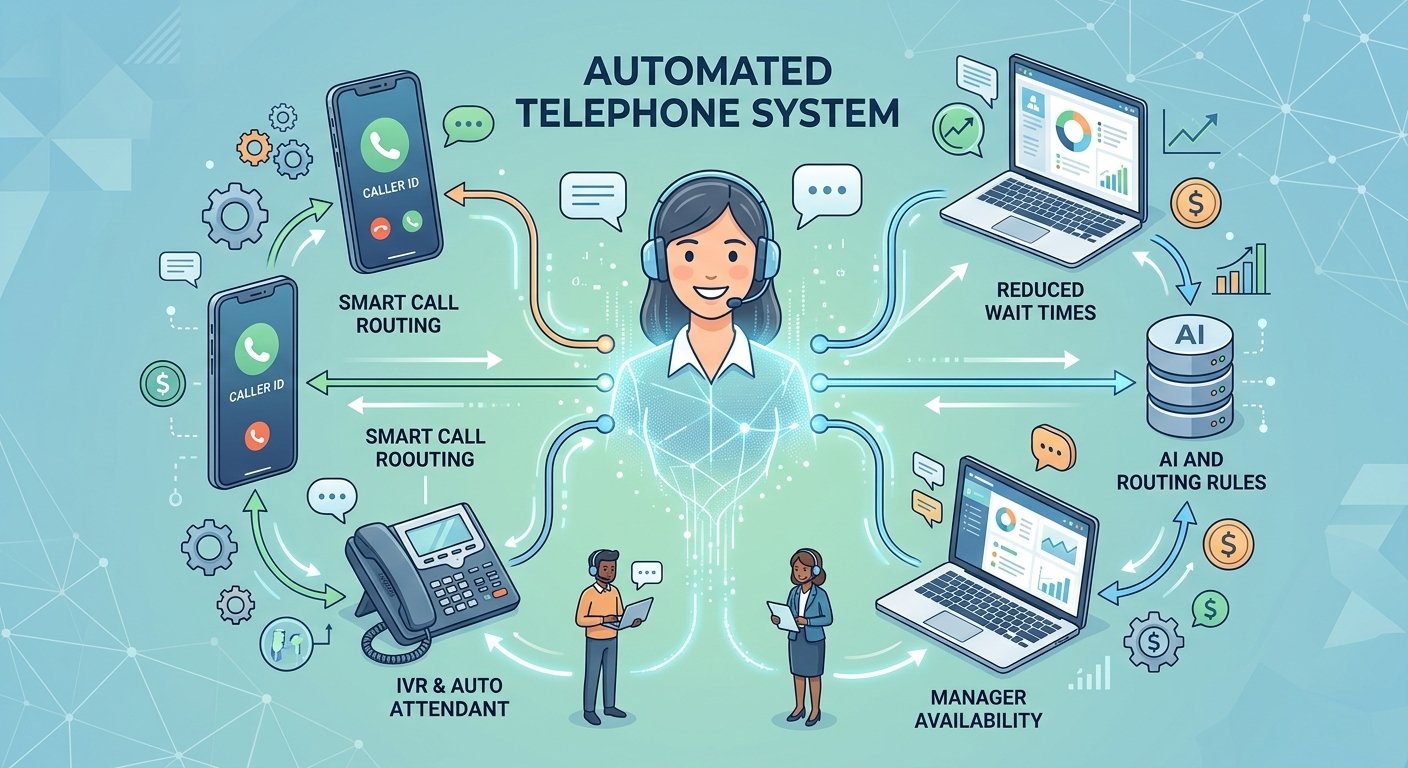
An automated telephone system is a highly advanced digital communications tool that manages inbound and outbound calls seamlessly without human intervention.
By utilizing predefined routing rules, interactive voice response, and artificial intelligence, this setup answers callers, plays pre-recorded messages, and directs individuals to the correct department immediately.
Implementing an automated telephone system helps modern businesses reduce long wait times, lower daily operational costs, and boost overall workforce productivity significantly. Rather than relying heavily on live agents for repetitive administrative tasks, companies use an automatic phone system to ensure continuous, reliable customer support. This technology eliminates common communication bottlenecks and provides meticulously organized call management for organizations of any size.
What Is an Automated Phone System (ATS)?
An automated telephone system serves as an intelligent virtual receptionist capable of processing and directing customer inquiries efficiently. This platform relies on advanced software algorithms, speech recognition, and natural language processing to determine caller intent accurately. Understanding what is an automated system involves recognizing its unique ability to minimize live agent workloads during initial conversational interactions. Many enterprises deploy a cloud-based automated system phone network to maintain stable performance across entirely distributed remote work environments.
According to recent economic studies published by industry researchers, outdated communication infrastructures cause United States businesses to lose up to 1.8 trillion dollars annually in productivity due to repetitive manual tasks.
Outdated legacy technology heavily drains corporate resources and dramatically decreases core employee efficiency.Replacing these obsolete frameworks with a modern automated phone system for business prevents this massive financial waste. A reliable phone automation system allows staff members to focus on complex problem-solving rather than basic call routing.
Key Features of an Automated Telephone System
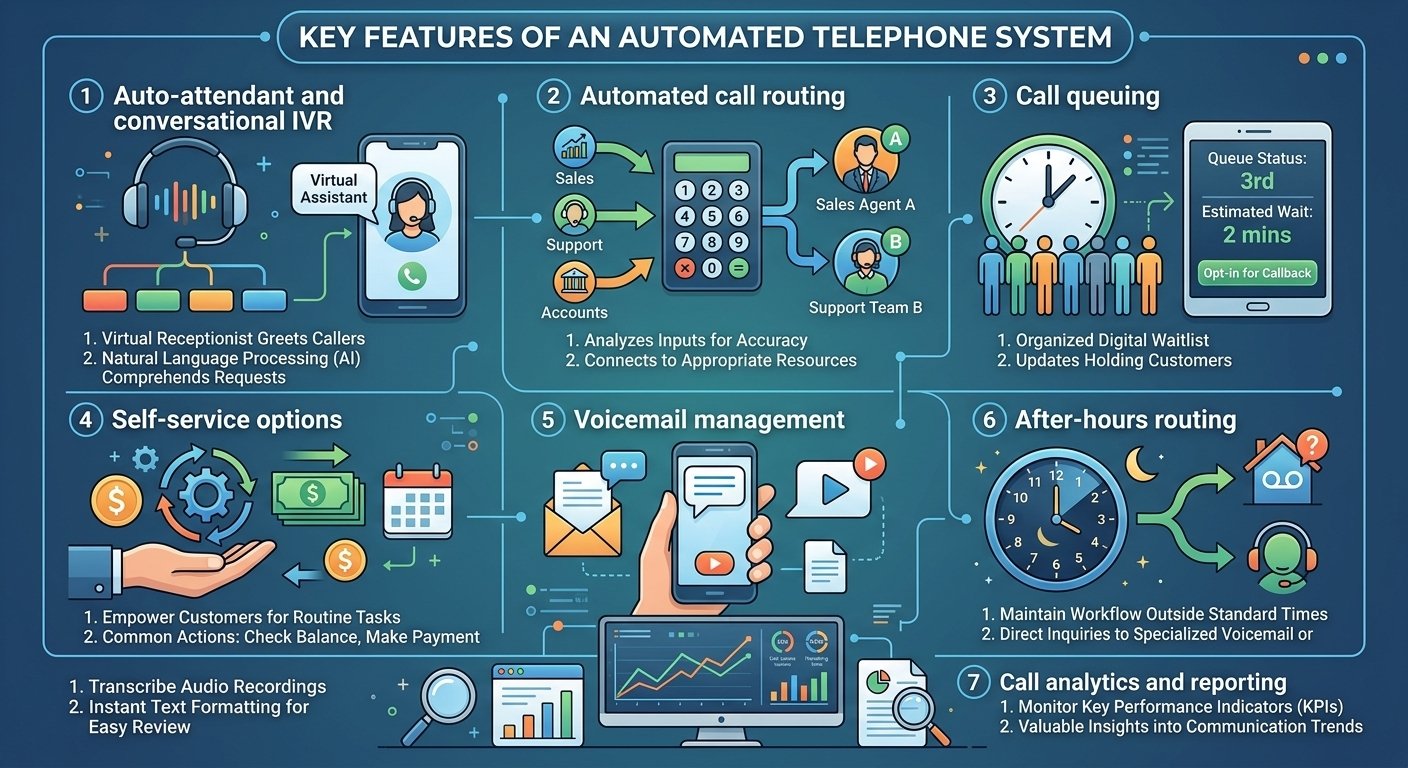
Selecting the best auto attendant phone system requires evaluating several core functionalities designed specifically to streamline daily operations. These built-in tools handle large caller capacities effortlessly and maintain a highly professional auditory image for your growing brand.
1. Auto-attendant and conversational IVR
A virtual receptionist instantly greets incoming callers and provides a structured auditory menu to navigate various internal departments smoothly. Utilizing conversational artificial intelligence enables this voice automated system to comprehend spoken requests naturally and accurately. These advanced software capabilities ensure direct callers connect with appropriate resources quickly without requiring immediate human assistance.
2. Automated call routing
Directing individuals to the exact right destination forms the absolute backbone of any automated phone calling service. The software analyzes touch-tone keypad inputs or speech commands to forward the active connection perfectly. This critical automated call routing system prevents callers from experiencing frustrating transfer loops between incorrect organizational departments.
3. Call queuing
Managing extreme traffic volumes effectively requires an organized digital method to place individuals on a virtual waitlist. A robust automated voice call system updates waiting customers regarding their exact estimated hold times automatically. Many contemporary setups offer intelligent callback features so people can retain their exact queue position without staying actively on the line.
4. Self-service options
Empowering customers to resolve routine daily tasks independently drastically reduces the heavy burden on your dedicated support staff. Callers easily check account balances or process payments through secure encrypted pathways within the automatic call system. These convenient automated telephone service alternatives improve overall resolution speeds across multiple global communication channels.
5. Voicemail management
Capturing detailed messages accurately remains absolutely vital when representatives are temporarily unavailable to accept incoming network connections. Modern business phone systems with auto attendant transcribe audio recordings into readable text formats instantly. This specific functionality guarantees that critical caller details reach the intended recipient seamlessly for rapid outbound follow-up.
6. After-hours routing
Maintaining communication workflows outside of standard operating times prevents missed revenue opportunities and heavily frustrated clients. Custom rules configured within your auto attendant phone systems direct night-time inquiries to specialized voicemails or external answering services. This after-hours feature provides a continuous safety net for global organizations handling diverse international time zones.
7. Call analytics and reporting
Tracking specific operational performance metrics provides invaluable empirical insights into daily communication strengths and hidden weaknesses. Supervisors monitor interaction durations, caller abandonment rates, and menu usage trends through the automated telecom software dashboard. Analyzing this quantitative data highlights exact workflow areas where management teams must improve their overarching communication strategies.
Top 5 Business Benefits of an Automated Telephone System
Integrating these communication platforms transforms exactly how growing organizations interact with their consumer base daily.
-
Improved efficiency: Automating routine administrative duties completely frees your human staff to handle highly complex customer support issues effectively. Deploying an automated phone answering system eliminates the constant tedious need for manual call transfers across different departments.
-
Reduced costs: Lowering the reliance on physical receptionists significantly cuts down on fundamental overhead expenses related to continuous live staffing. Exploring automated outbound calling benefits for businesses allows marketing teams to execute large telemarketing campaigns affordably.
-
24/7 availability: Offering continuous system support ensures that international clients always receive prompt assistance regardless of their specific geographic location. Implementing a reliable automated phone messaging system effortlessly captures urgent leads generated well outside of standard working hours.
-
Improved customer satisfaction: Decreasing initial wait durations thoroughly prevents caller frustration and sets a highly positive tone for the entire conversation. Intelligent automated call services can independently resolve a vast majority of basic inquiries without demanding human intervention.
-
Data-backed customer insights: Evaluating detailed interaction logs helps network administrators identify exactly where callers experience friction within the automated line. Monitoring frequent conversational topics processed by the automated voice system allows product development teams to spot emerging market trends quickly.
Use Cases for an Automated Phone System
-
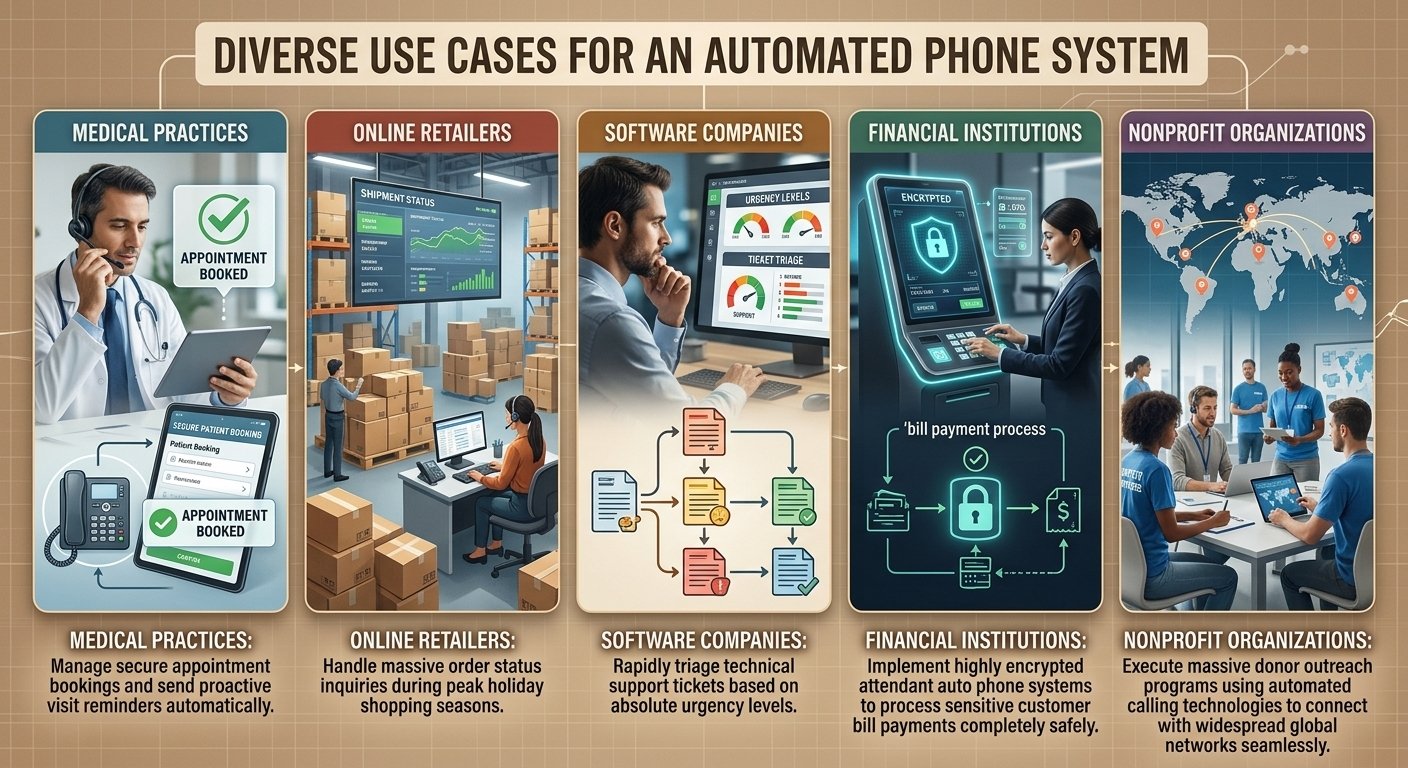
Busy medical practices utilize an automatic telephone answering system to manage secure appointment bookings and send proactive visit reminders automatically.
-
Large online retailers deploy a dedicated automated phone calling system to handle massive order status inquiries during peak holiday shopping seasons.
-
Software development companies rely on a sophisticated automated answering system to rapidly triage technical support tickets based on absolute urgency levels.
-
Financial banking institutions implement highly encrypted attendant auto phone systems to process sensitive customer bill payments completely safely.
-
Charitable nonprofit organizations execute massive donor outreach programs using automated calling technologies to connect with widespread global networks seamlessly.
4 Examples of Automated Phone System Providers
| Provider | Key Features | Best For |
| Nextiva | Multi-level directories, advanced analytics, unified communications | Small to medium enterprises needing a highly reliable automated operator. |
| RingCentral | Video integrations, robust CRM syncing, conversational intelligence | Larger corporations seeking comprehensive automated phone systems for small business expansion. |
| Grasshopper | Custom professional greetings, virtual numbering, straightforward voicemail transcription | Solopreneurs requiring a very simple yet professional auto call system. |
| Aircall | Power dialers, real-time coaching tools, deep helpdesk application connections | Sales teams needing an aggressive auto calling system to heavily boost conversions. |
How To Choose the Right Automated Telephone System
Selecting the perfect telecommunications architecture requires a methodical evaluation of your current operational status and future business objectives.
1. Conduct a communication audit
Calculate your average daily incoming call volume to deeply understand the exact network capacity requirements for automated phone calls for business. Identify specific recurring workflow bottlenecks to determine exactly what do you call the automated phone system features you genuinely need most.
2. Set your must-have capabilities
Document absolutely vital technical requirements like artificial intelligence virtual agents, real-time sentiment tracking, and specialized automated phone answering tools. Prioritize specific functionalities that directly resolve the exact pain points identified during your initial organizational communication review.
3. Review your network infrastructure
Test your existing broadband internet connection thoroughly to ensure it easily supports a cloud-based phone system for call center without noticeable audio latency. Configure your local office routers to prioritize voice traffic, completely preventing dropped connections during unusually busy operational periods.
4. Check integrations and ease of use
Verify that the prospective automated telephone calling system syncs perfectly with your current customer relationship management software database. Request a live software demonstration to completely confirm your staff can easily navigate and modify the automated phone tree independently.
5. Calculate Total Cost of Ownership
Evaluate the complete vendor pricing structure, including monthly licensing fees, hidden software onboarding costs, and premium system feature upgrades. Factor in the potential financial savings generated by massively improved workforce productivity when assessing the overall return on investment.
6. Plan for future scalability
Choose a software provider that readily allows network administrators to add or remove user seats instantly based on fluctuating seasonal staffing demands. Ensure the chosen automated call systems inherently support international virtual numbers to effortlessly accommodate eventual global market expansion.
Read More: Is Google Phone Number Free? How to Get a Free Google Phone Number with Google Voice
Final Words
Transitioning to a sophisticated digital communication platform represents a critically crucial step toward achieving lasting organizational excellence. The strategic deployment of an automated telephone system entirely eliminates traditional communication bottlenecks and guarantees every single caller receives immediate, professional attention. Embracing this massive digital transformation comprehensively empowers your entire workforce to operate efficiently while delivering exceptional consumer service experiences consistently. Companies that thoughtfully upgrade their underlying telecommunications infrastructure inevitably secure a formidable, highly profitable competitive advantage in today’s rapidly evolving corporate landscape.
Automated Telephone Systems FAQs
-
What are the top benefits of an automated telephone system?
The primary advantages include significantly improved operational efficiency, heavily reduced labor costs, and reliable around-the-clock availability for incoming inquiries. Implementing this specific technology ensures customers always receive immediate assistance, which drastically boosts overall brand satisfaction and long-term loyalty.
-
How much does an automated telephone system cost?
Software pricing varies widely depending on specific premium features and active user counts, typically ranging from fifteen to fifty dollars per user monthly. Advanced enterprise packages requiring extensive customized integrations will naturally command significantly higher recurring subscription fees.
-
How do I automate my phone?
You begin by selecting a highly reputable cloud-based telecommunications provider offering built-in intelligent routing and interactive voice response capabilities. Administrators can then map out communication workflows, record professional greetings, and establish specific distribution rules through an intuitive online dashboard.
-
How to get past automated phone systems?
Frustrated callers frequently press the zero key repeatedly or explicitly speak the word representative to bypass digital menus instantly. Certain network configurations also detect prolonged background silence, which automatically triggers a default transfer directly to the primary human support queue.
-
Can you automate phone calls?
Organizations routinely utilize dedicated outbound software to pre-record detailed voice messages and dispatch them to specific contact lists automatically. This highly proactive outreach method proves incredibly effective for delivering urgent global notifications, automated appointment reminders, and promotional updates simultaneously.
-
What is the main difference between an auto attendant and IVR?
An auto attendant functions primarily as a basic digital directory that transfers individuals based strictly on simple touch-tone keypad inputs. Interactive voice response dynamically engages with users by actively accessing external databases to resolve complex queries without needing live staff intervention.
-
Do small businesses genuinely need automated telecom setups?
Small enterprises benefit immensely from these digital setups because the technology clearly projects a highly professional corporate image regardless of actual staff size. The software completely prevents missed revenue opportunities by capturing critical inquiries and directing valuable leads even when business owners are completely unavailable.
-
How secure is a modern automated call routing system?
Leading telecom vendors actively implement rigorous end-to-end encryption protocols and maintain strict legal compliance with global data privacy regulations to protect sensitive information. Regular third-party security audits strictly ensure internal communication channels remain entirely safe from unauthorized external access or malicious hacking attempts.
-
What equipment is required to run automated phone services?
Modern cloud-based solutions require absolutely minimal physical hardware since the core digital processing occurs entirely on the vendor servers via stable internet connections. Employees can securely access the entire network using standard desktop computers, dedicated internet protocol phones, or integrated mobile smartphone applications.