Telnyx is a strong option for developers and businesses that need programmable voice, messaging or SIP connectivity with detailed control over their communications. Its main strengths are flexible APIs, number management and usage-based pricing. The trade-offs are setup responsibility, account verification and a bill that can include several components. Choose it when you can operate the required application or have a compatible software partner.
This Telnyx review explains what the platform provides, how its charges fit together and where buyers should look beyond the headline rate. A team connecting a PBX, a developer adding customer communication and a business deploying an AI agent are making different purchases. We examine those differences so you can judge the complete workflow, budget and support arrangement.
 The rating uses the named Telnyx CPaaS product profile. It summarizes customer feedback, not independently measured delivery, audio quality or support response.
Telnyx Review: Our Verdict And Who It Suits
Telnyx belongs on the shortlist when you need to build communication into a product, connect compatible telephone software or configure a defined AI voice calling workflow. Its value comes from the relationship between the network, programmable services and the application you operate. A low unit rate is useful for pricing, but the right architecture and clear ownership matter just as much.
| Provider | Best Fit | Buying Considerations | Pricing & Evaluation |
|---|---|---|---|
|
| Usage-Based ComponentsUSD; numbers and communication usage are separate. Trial credit has restrictions.Review Costs And Account Access |

For a small development team, the attraction is being able to compose the required service rather than paying for unrelated employee features. For an established telecom team, the attraction may be connection settings, number inventory and operational control. These are practical buying reasons, provided the team understands what it must maintain.
For a nontechnical office seeking a shared voice app, start with the staff experience. Can someone answer, transfer, return a missed call and see who owns the follow-up? Identify the software providing those actions. A carrier account and a set of APIs do not automatically give every employee the complete workspace they expect.
How We Assessed Telnyx
This is a documentation-based review of official product information, pricing, account guidance and support material, with customer feedback considered separately. We do not claim to have measured production voice call quality, messaging delivery, uptime or ticket resolution. Cost examples are calculations using stated components and assumptions.
Use the review to design a useful evaluation. Published features tell you what to investigate; a representative pilot tells you whether your configuration works. Customer accounts can reveal questions worth asking, but they are not proof that your own number, destination or integration will behave identically.
What Is Telnyx And What Does It Do?
Telnyx is a communications platform offering services such as voice connectivity, messaging APIs, telephone numbers and AI voice tools. Businesses configure services through the Mission Control Portal and programmable interfaces, then connect their own application, PBX or supported software. The selected Telnyx product determines the setup, permissions and billing.
A software company might use Telnyx to place calls from its application and attach outcomes to a customer record. A business with an existing PBX might use SIP trunking for telephone connectivity. Another company might configure an AI assistant to answer routine questions and hand a caller to a person when needed.
Those use cases share communications infrastructure but have different operating responsibilities. The PBX needs compatible voice settings and destinations. A custom application needs maintained logic and event handling. An AI assistant needs business instructions, tools and evaluation. Define the desired customer task before selecting the product.
Communications Infrastructure Versus A Finished Phone System
A communications platform gives builders and administrators control over how services behave. A finished business phone system packages many daily employee tasks into an application. Both can be useful purchases, but comparing only their starting pricing can hide differences in software, maintenance and support.
Ask what happens after an incoming voice call arrives. Which voice application rings? Where does voicemail appear? Who follows up, and how do colleagues see that action? If the proposal does not identify those steps, the purchase is not yet defined well enough to compare with an employee-ready service.
Telnyx Features: SIP, Voice APIs, Messaging And AI
The core Telnyx decision is which service path matches the job. SIP trunking connects compatible equipment or software to telephone networks. The Voice API supports application-controlled behavior. TeXML offers an XML instruction model, while AI services introduce additional runtime and model considerations. Messaging and numbers have their own configuration and commercial boundaries.
| Product | Typical Requirement | Important Boundary |
|---|---|---|
| SIP trunking | Connect a compatible PBX or calling platform | Phone software and outbound configuration remain necessary |
| Voice API / Call Control | Build application-controlled customer calls | API and applicable network charges are composed |
| TeXML | Use XML-based call instructions | Validate compatibility and avoid conflicting call-state controls |
| Messaging API | Send supported business texts and handle replies | Account access, profiles, sender approval and fees apply |
| AI voice agents | Configure an assistant with business tools | Engine, model usage and telephony need their own estimate |
| Phone numbers | Obtain the appropriate business number | Country, capabilities, documents and rental affect the purchase |
SIP Trunking For A PBX Or Compatible Calling Platform
Telnyx SIP trunking is relevant when you already have the phone software or equipment and need connectivity. The Telnyx setup guide separates the SIP connection from the outbound voice profile. The Telnyx connection handles settings and authentication; the outbound profile helps determine where and how outgoing calls are permitted.
That separation matters in troubleshooting. A business can receive a call on an assigned number while outgoing voice calls fail because the outbound profile or destination permissions are incomplete. Test both directions, caller presentation, transfers and the destinations you actually need before declaring the setup finished.
Confirm compatibility with the actual PBX, session border controller or softphone. Document who maintains that system and who owns the network configuration. A successful registration or first voice call is useful evidence, but it does not cover every codec, routing rule or recovery condition in the final deployment.
Voice API For Application-Controlled Calls
The Telnyx Voice API lets developers build voice call behavior into software. Relevant applications include IVR, voice call tracking and customer-service flows. Your application decides what should happen when a call starts, when someone answers and when a requested action cannot complete.
Begin with a concrete customer journey: answer the voice call, collect the required information, reach the right destination and preserve a callback request if no person is available. Include the person who presses an invalid key, stays silent or disconnects during a transfer. The complete journey is more informative than a demonstration of a single command.
Ask developers to show how voice events connect to business records. A support employee should be able to identify the relevant interaction without manually comparing unrelated logs. Consistent identifiers and an understandable activity view can reduce the effort of investigating a failed handoff.
TeXML For XML-Based Call Flows
Telnyx TeXML provides an XML-based approach to defining voice instructions. It may be relevant when evaluating an existing XML application, but compatibility should be checked against the actual instructions and behavior you use. A marketing claim about rapid migration is not a delivery schedule for your project.
The Telnyx compatibility guide warns against mixing TeXML and Call Control commands on the same managed call because their state handling can conflict. It also identifies different webhook formats. Choose an intentional model, and separate connections where different application paths require different approaches.
For a buyer, the practical question is whether the team understands the chosen model well enough to maintain it. A workaround that makes one test call succeed can become difficult to diagnose under real traffic. Ask for the recommended architecture and test cases before accepting a migration as complete.
SMS And MMS With Messaging Profiles
Telnyx supports business messaging through APIs and messaging profiles. A profile helps organize settings and the events delivered to your application. Number capability, sender registration and account permission still matter; assigning a Telnyx number to a profile is not the same as approving every intended campaign.
Evaluate a message from submission to business outcome. Capture whether it was accepted, what delivery event followed and where an incoming reply appeared. A delivery status is useful operational evidence, while a confirmed booking or resolved support question is a separate business result.
Profiles also deserve attention when several clients, locations or brands share infrastructure. Decide how permissions, callbacks, funding and suppression should be separated. Do not use a single convenient configuration without understanding whether its behavior matches each business's responsibilities.
AI Voice Agents And Tool-Based Workflows
Telnyx publishes an AI voice-engine offering that includes orchestration and supported speech processing, with LLM usage and telephony considered separately. This is a broader purchase than a raw programmable connection. Identify the exact product and cost model rather than assuming an API minute includes the complete AI workflow.
A useful demonstration should include business actions, not only a natural-sounding greeting. Ask the agent to identify an appointment request, check an approved source, attempt a booking and explain an unavailable time. Then test a caller who interrupts, changes their mind or asks for something outside the supplied information.
Pay particular attention to transfer and exception handling. If a requested voice action fails, the caller should receive an accurate next step. An assistant that sounds confident but leaves an incomplete booking can create more work for staff. Define successful actions and the evidence needed to verify them.
Numbers And Additional Communication Products
Telnyx supplies number inventory and additional communication products, but capabilities depend on country, number type and account eligibility. The presence of several products in the same portal does not establish that every feature is included in your selected rate or available on every number.
For this review, the priority is business voice and messaging. If your project also requires another channel, device connectivity or a specialized service, assess that product independently. A broad vendor portfolio is useful only when the particular configuration and operating terms match the requirement.
Telnyx Pricing: What The Published Rates Actually Include
Telnyx pricing is based on products and consumption rather than a single universal phone subscription. For programmable calls, the API fee is added to the applicable Telnyx network charge. Messaging adds carrier fees to the platform component. Use the official Voice API rates and messaging rates to request the terms relevant to your traffic.
| Item | Published Component | What Else To Include |
|---|---|---|
| Local outgoing SMS | $0.004/part | Carrier fees; registration and other applicable charges |
| Local incoming SMS | $0.004/part | Applicable receiving carrier charges |
| Local outgoing MMS | $0.015/part | Sender, carrier and destination rules |
| Local incoming MMS | $0.005/part | Applicable carrier and account charges |
| Programmable calling API | $0.002/minute | Applicable SIP network rate and optional services |
| Local outgoing SIP network | From $0.005/minute | Add API fee when using programmable calls |
| Local incoming SIP network | From $0.0032/minute | Add API fee when using programmable calls |
| Local number | From $1/month | Additional $0.10/month for SMS/MMS capability |
| Call recording | $0.002/minute | Connectivity and actual processing scope |
| Call transfer command | $0.10/invocation | Applicable call connections and other functions |
| AI voice engine | $0.05/minute | LLM tokens, telephony, rounding and other selected products |
The Voice API Fee And Network Rate Are Separate
The public Telnyx Voice API card lists a $0.002 per-minute API component plus SIP trunking charges. For the selected US local starting examples, adding a $0.005 outgoing network component produces $0.007 per minute. Adding a $0.0032 incoming network component produces $0.0052 per minute.
Those are composed examples for the stated configuration, not universal destination rates. A direct SIP purchase and an API-controlled voice call are different models. Optional services, extra call legs and invocation charges can change the result. Ask the vendor to map each part of your proposed workflow to the applicable invoice lines.
Number Rental And Messaging Capability Need Their Own Pricing Lines
The Telnyx number card advertises local numbers from $1 monthly, with an additional $0.10 monthly to add SMS and MMS capability. At that selected entry basis, a messaging-enabled number contributes $1.10 before communication usage and other fees. Confirm actual inventory, country and enabled services.
A business buying 10 numbers should therefore distinguish rental from message volume. More numbers do not automatically mean more approved sending capacity, and a large unused inventory is not evidence of a scalable campaign. Select numbers for the business purpose and required local identity rather than to evade traffic controls.
Pay-As-You-Go And Committed Pricing Serve Different Buyers
Telnyx currently advertises pay-as-you-go access alongside Growth and Enterprise commercial arrangements. The public pricing cards show monthly minimum spends of $2,000 for Growth and $5,000 for Enterprise. A minimum spend is a pricing commitment, not proof that a fixed amount of every service is included.
Ask how any discount combines with automatic tiers, which products qualify and what remains outside the agreement. Obtain the treatment of unused commitment and cancellation in writing. A small business should compare its realistic usage with that obligation before choosing a plan because the displayed percentage looks attractive.
AI Pricing Requires A Separate Estimate
The published Telnyx AI voice engine is $0.05 per minute, with LLM tokens and telephony charged separately. Its pricing page also warns that voice-engine rounding can increase actual cost for short calls. Do not turn an indicative per-minute calculator result into an all-inclusive guarantee.
At 1,000 eligible billable engine minutes, that component alone is $50. The complete pricing can also involve model usage, number rental, calling, messaging follow-up and optional features. Ask for an itemized pricing estimate based on realistic conversations, including those that end quickly or need an employee.
Telnyx Monthly Cost Examples For Business Calling And Messaging
The following examples use selected US components in dollars. They hold rates constant to explain the arithmetic, not to predict an account-specific discount. Voice quantities are billable minutes after applicable rounding. Carrier fees, registration, taxes, software, support pricing commitments and optional processing are excluded unless expressly added.
| Workload | Selected Components | Partial Subtotal |
|---|---|---|
| 10,000 outgoing + 2,000 incoming local SMS parts | $40 + $8 | $48 |
| 1,000 outgoing + 2,000 incoming programmable billable minutes | $7 + $10.40 | $17.40 |
| Smaller mixed workload above, before numbers | $48 + $17.40 | $65.40 |
| Smaller mixed workload + 10 messaging-enabled entry numbers | $65.40 + $11 | $76.40 |
| 100,000 outgoing + 20,000 incoming SMS parts; 10,000 outgoing + 20,000 incoming programmable minutes; 50 entry numbers | $480 + $174 + $55 | $709 |
| 1,000 billable AI engine minutes only | 1,000 × $0.05; other AI service components excluded | $50 |
A Smaller Application With Calls And Reminders
Suppose you send 10,000 local SMS parts and receive 2,000, while using 1,000 outgoing and 2,000 incoming programmable minutes. The selected Telnyx message components total $48. The composed voice components total $17.40. Together they are $65.40 before numbers and the excluded charges.
Adding 10 messaging-enabled numbers at the selected $1.10 basis brings that partial subtotal to $76.40. It is still not the complete invoice. The example shows why a low API figure should be developed into a pricing estimate instead of promoted as the monthly price of an entire business system.
A Larger Platform With More Numbers
With 100,000 outgoing and 20,000 incoming local SMS parts, the selected base messaging component is $480. Add 10,000 outgoing and 20,000 incoming programmable minutes for $174. Add 50 messaging-enabled numbers at the selected entry basis for $55. The partial subtotal is $709.
A platform at this scale should request its actual Telnyx pricing and capacity proposal. The example intentionally does not assume a number-volume discount or a negotiated rate. Replace each input with the applicable agreement, and keep the excluded charges visible in the pricing forecast.
Carrier Fees Can Materially Change The Messaging Total
Telnyx publishes additional carrier charges by sender, destination network and direction. A carrier-free row for a particular route does not make every message free of carrier charges. Use the actual network mix when estimating this part of the bill.
For arithmetic only, assume a blended additional charge of $0.004 per part across the larger example's 120,000 parts. That hypothetical charge adds $480, bringing the $709 partial subtotal to $1,189 before remaining items. The assumed blend is not a quoted Telnyx fee or a claim that every direction has the same surcharge.
Voice Call Duration And Rounding Matter
The Telnyx billing-increments guide describes 60/60 billing and notes that international rules can vary. It expressly says 6-second increments are no longer offered in that guide. Confirm the rate deck and terms for your service rather than relying on an older comparison.
Under a whole-minute assumption, 100 answered outgoing calls lasting 23 seconds become 100 chargeable minutes. At the selected composed $0.007 rate, that is $0.70. If those 100 calls each last 65 seconds, they become 200 minutes and $1.40. These examples exclude other call components.
Calculate rounding for individual voice calls or legs, not only the combined monthly duration. A short voice-call workload can have a very different effective price per elapsed minute of voice calling from a long-conversation workload. Request records that let you reproduce the invoice using the actual pricing and billing rules.
Voice Recording, Transfers And Multiple Call Legs
The Telnyx rate card lists optional voice processing and invocation-based features separately. A transfer can involve more than one voice connection component, and the selected transfer command also has its own listed invocation charge. Confirm the actual command and routing path before estimating a forwarded or bridged voice call.
For example, 1,000 incoming programmable voice minutes plus 1,000 outgoing programmable voice minutes contribute $5.20 and $7 under the selected rates. The $12.20 sum isolates those connections. It does not include transfer invocations, recording or other features, and should not be described as a complete transfer quotation.
Message Parts And Template Design
A visible text is not necessarily a single billed part. Length, encoding and destination rules can change segmentation. Review the actual templates your team will use, including punctuation inserted by editors and copied customer information.
For a simple sensitivity calculation, 10,000 sends that each consume 2 parts create 20,000 outgoing parts. At the selected $0.004 base, that component becomes $80 rather than $40 for single-part sends. This assumes the 2-part outcome; measure your templates instead of inferring it from appearance alone.
Telnyx Mission Control Portal And Administration
Mission Control is the Telnyx administration environment for configuring services and investigating activity. The official Telnyx screenshot below shows the Voice API Applications area. It is a provider documentation example, not a screenshot of our own account or evidence of production testing.
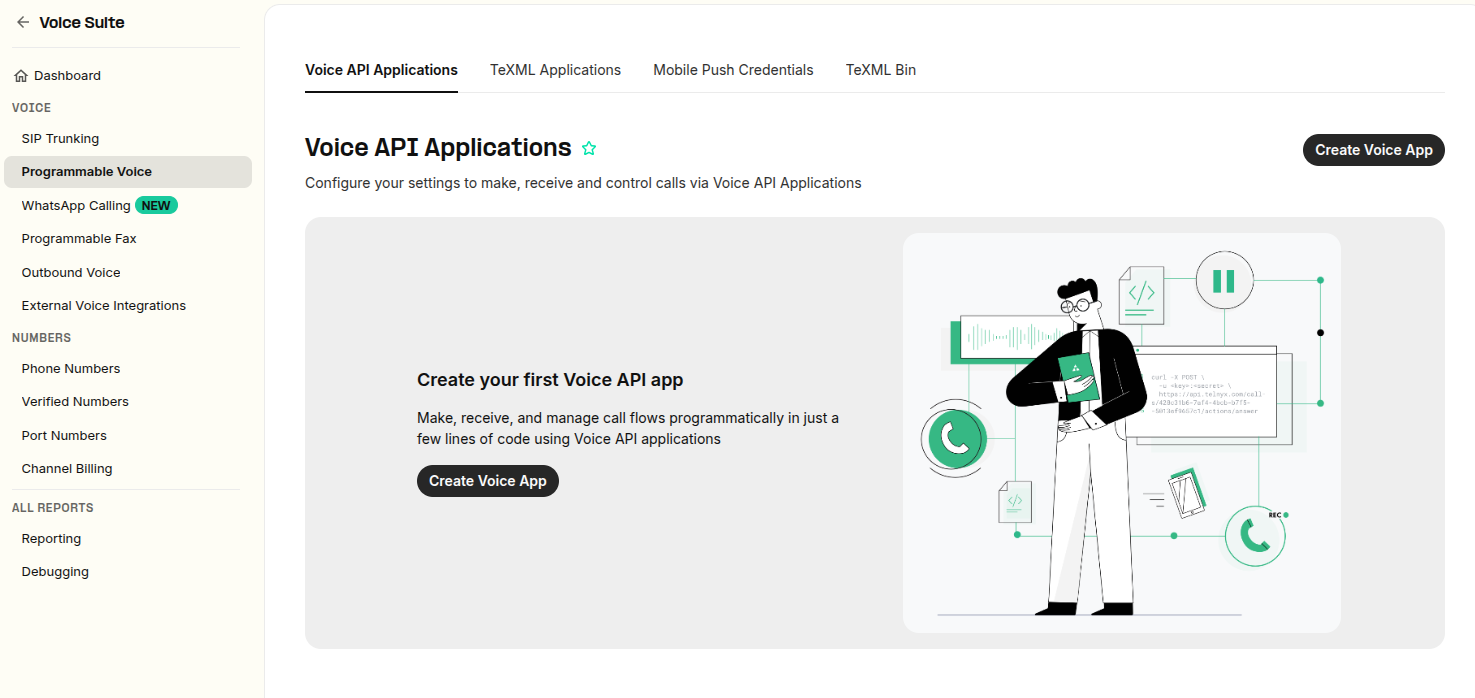
The distinction between administration and employee work is important. A technical administrator may find connection and profile controls useful, while a receptionist needs a straightforward way to manage a customer interaction. Ask to see the actual software assigned to each role.
Voice Applications, Numbers And Outbound Profiles
Telnyx documentation treats the Telnyx application, its assigned numbers and outbound permissions as related configuration objects. Give them clear names and record their purpose. In a multi-location business, a descriptive name is more useful than several indistinguishable test connections.
Document who can change voice destinations, enable a new route or reassign a number. These changes can affect live customers even when no application code changes. A simple approval and rollback process helps prevent an ordinary administration task from becoming an unexplained outage.
Control Spend Without Blocking Essential Calls
Outbound voice profiles document controls for destination permissions, channel limits, maximum destination rates and daily spending. These are useful safeguards when deliberately configured for the traffic you expect. A setting that is too broad can expose cost; a setting that is too restrictive can block legitimate customer work.
Test what happens when a limit is reached and who receives the resulting notification. Assign an owner who understands when a temporary increase is justified. Do not present a spend limit as an exact real-time invoice cap without confirming how your chosen service enforces and reports it.
Reporting Should Connect To A Business Explanation
A useful operational review can explain why a particular communication failed and why a billing category increased. Preserve interaction identifiers and the relevant customer reference in your own system. That makes it easier to compare application activity with provider records.
Separate attempted, accepted, delivered and completed business actions. These can be different counts. If a report labels every accepted message as a successful appointment reminder, staff may miss a customer who never received the information or replied asking for help.
How To Set Up Telnyx For Your Business
Start by defining whether you need SIP voice connectivity, an application-controlled call flow or an AI assistant. Then confirm the account and number permissions required for that product. A repeatable setup process should cover both the successful customer journey and the conditions where it cannot complete.
1. Confirm Account Eligibility And Trial Restrictions
Telnyx documents more than one account-verification framework. The applicable account level affects capabilities, and adding funds does not necessarily remove every restriction. Check the account's displayed framework and required verification before planning customer launch.
The official account knowledge base describes testing credit and restricted trials. Recipient access, number ordering, organization features and calling limits can be constrained. Use the displayed current entitlement; do not interpret a reclaim window for a trial number as a universal free-trial duration.
2. Choose And Configure The Right Voice Connection
For a PBX, Telnyx documents SIP authentication and connection setup. For programmable calling, define the Voice API or TeXML application and the event endpoint. Choose the approach that fits the software you will maintain, rather than combining unrelated examples until the first call works.
Record the intended authentication method, region and fallback behavior. Keep secrets out of public pages and support screenshots. Test access changes in a controlled way so routine credential maintenance does not leave an important business number unreachable.
3. Assign Numbers And Required Capabilities
Assign each Telnyx number to the intended connection or application and confirm enabled services. For business messaging, complete the appropriate sender and use-case process. A number that receives a call successfully may still be unprepared for the intended messaging traffic.
Keep a number inventory with its business owner, purpose and capability. This becomes important when a branch moves, an employee leaves or an agency client changes provider. Operational records should identify what must remain working during the transition.
4. Configure Outgoing Permissions And Webhooks
Connect the intended outbound voice profile and allow the destinations the business actually serves. Configure event endpoints and the relevant fallback settings. Verify authentication and request parsing against the chosen product's documentation.
For Telnyx messaging webhooks, the official guide documents signature and timestamp headers and acknowledgement behavior. Validate incoming events and handle repeated delivery safely in your application. Keep a repeat event from creating a duplicate booking while still accepting legitimate later status updates.
5. Run A Business Acceptance Test
Ask an ordinary staff member to complete the expected customer task. For a voice flow, test answering, transfer, unavailable staff and callback capture. For messaging, test sending, a reply, an opt-out and a failed delivery. For AI, add a tool failure and a request outside the supplied information.
Record the result with identifiers and a clear pass or unresolved issue. A pilot should leave the team knowing how to investigate failures, not only how to repeat the easiest demonstration. Agree who approves voice readiness before moving the main customer number.
Telnyx Trial Credit And Production Access
Telnyx offers testing credit under its account framework, but a restricted evaluation is different from unrestricted production service. The Telnyx knowledge base describes a $5 trial credit and limits around verified-number communication. Actual access can depend on the framework and the current account state.
The important buying question is what remains necessary after testing. Confirm verification, approved traffic, sender registration, destination access and account limits. An upgraded Telnyx balance alone should not be assumed to authorize every feature or campaign.
Check the current credit and restrictions in your Telnyx account, then test the exact product and workflow. Keep production approval separate from the successful trial demonstration.
Review Setup And Account RequirementsTelnyx Messaging: Replies, Registration And Opt-Out Handling
The reliability of a messaging workflow depends on the business process as well as transmission. A reminder system should recognize a reply, update the right record and avoid unnecessary follow-up. An agency should know which customer owns the sender and which staff handle an incoming response.
Sender Approval And Consent Are Separate Requirements
Telnyx's acceptable-use guidance requires an appropriate opt-in and restricts certain traffic. Registration is not a substitute for permission to contact the recipient. A purchased contact list or an unrelated previous transaction should not be treated as an approved audience for a new recurring campaign.
Before onboarding a client, document what they will send, how recipients subscribe and how requests to stop are handled. Check the exact provider and carrier requirements for that traffic. This gives the implementation team useful evidence and reduces the risk of building a workflow the service will not accept.
Opt-Out Behavior Depends On Sender And Configuration
Telnyx documents automatic keyword handling and configurable profile behavior for supported messaging. Its toll-free guidance identifies a different network-handled arrangement, including limits on customization. Do not assume an identical keyword or response configuration applies to every sender type.
Test the actual sender and make sure the connected CRM stops future scheduled messages as intended. Provider-side suppression does not automatically prove every unrelated application or campaign has updated its records. Preserve enough evidence to resolve a customer request without repeatedly contacting them.
Manage Capacity And Time-Sensitive Communication
Telnyx describes queuing according to account limits. Design the application so bulk traffic does not make an urgent transactional response unusably late. Determine the useful lifetime of a reminder and what happens when that time expires.
Monitor outcomes by the sender and destination groups relevant to the business. An aggregate success percentage can hide a recurring problem affecting one branch or carrier. Use the evidence to investigate content, permissions and routing rather than automatically resending failed traffic without a reason.
Telnyx Support: What Buyers Should Verify
The Telnyx support guide describes a continuously available NOC, portal chat with escalation to a human ticket and telephone contact. Commercial pages also distinguish support positioning by plan and product. Confirm the access and escalation your actual agreement provides rather than assuming every advertised channel includes dedicated implementation.
For a useful support request, collect the call or message identifier, direction, timestamp with timezone and the connection or profile involved. Include the expected and observed behavior. Recent examples are especially important when an issue needs escalation beyond the immediate provider team.
During evaluation, submit a real Telnyx configuration question and assess whether the response identifies a clear next step. Also check how colleagues join the case and who owns an application-side issue. Availability is different from acknowledgement, and neither is a promise that every problem is resolved within a fixed time.
Support Responsibilities Across A Connected Stack
A business may have Telnyx, a PBX supplier, a CRM integration and its own developer involved in the same customer journey. Agree which party investigates each layer. Otherwise, a failed voice transfer can circulate between suppliers without anyone assembling the full evidence.
For an AI voice application, extend that ownership map to business tools and model behavior. A working network cannot correct an unavailable calendar or an incorrect permission in an external system. Request a realistic recovery process and assign staff who can complete an interrupted customer task.
Telnyx Reliability, Security And International Coverage
Telnyx describes its privately operated network and communication infrastructure as part of its value proposition. Network ownership is relevant to architecture and accountability, but it is not an independent measurement of your application. Evaluate the service agreement and the dependencies in your actual customer path.
For voice, test the destinations, networks and call-handling actions your business uses. For messaging, review delivery events and reply handling on representative traffic. A single successful test does not establish performance for every number, country or busy period.
Separate Number Availability From Calling Reach
International Telnyx capabilities depend on the product and location. Ask separately whether you can obtain the required number, receive calls, present an approved caller identity and send the intended message type. A broad country count does not answer all of those questions.
For a distributed team, also check staff access and the connected software's regional requirements. Confirm account-level permission before promising a new voice destination to a customer. If a business depends on several countries, request an explicit service matrix rather than a general statement of global coverage.
Assess Security At The Service And Application Layers
Telnyx publishes security and trust information for buyers conducting an assessment. Obtain the relevant documentation for the products and data flows you intend to use. Broad assurance material should not be treated as automatic approval for every application, retention choice or regulated workload.
In your implementation, control administrative access, store credentials appropriately and decide who may retrieve message content or recordings. Check external integrations receiving that information. A provider's security controls and the business's application controls need to work together throughout the operating process.
Telnyx Pros And Cons
Pros: Reasons To Shortlist Telnyx
- Several communication paths: SIP connectivity, programmable applications and AI services can be evaluated against distinct requirements.
- Detailed configuration: connection, profile and destination settings give technical teams control over the proposed deployment.
- Published components: rates provide useful inputs for a workload-based pricing estimate.
- Number and messaging tools: inventory, capability configuration and profile-based organization support broader operations.
- Developer-oriented workflows: programmable events and documented interfaces can fit a maintained custom application.
These advantages matter most when the organization has a clear owner for implementation. A product team may value the flexibility, while an office without technical support may prefer a narrower, packaged service. The benefit depends on the work the business actually wants to own.
Cons: Reasons To Evaluate Carefully
- Composed bills: API, network, numbers, carrier fees and optional functions can require several calculations.
- Account restrictions: signup, funding and production permissions are separate considerations.
- Technical ownership: the application, PBX and connected tools still need configuration and maintenance.
- Migration differences: command models, webhook formats and state behavior should be tested before cutover.
- Operational coordination: support and incident handling must cover all suppliers in the customer journey.
The practical response is to make those items visible before purchase. A complete proposal should explain who does the work and what its pricing covers. If that ownership is unclear, the evaluation needs another step regardless of how attractive the selected per-minute pricing appears.
Telnyx Alternatives And Competitors: Which Type Should You Compare?
The best Telnyx alternative depends on the product being replaced. Compare carrier connectivity with an equivalent connection, programmable features with the required voice APIs and an employee workspace with another complete application. Mixing those categories can create an inaccurate pricing or feature conclusion.
Signal House For An Eligible Supported Integration
Signal House is a relevant competitor when its documented business integration fits the workflow and guided setup is valuable to the team. The CTA box above introduces that option without presenting it as a universal cost winner. Request a demonstration of replies, staff access and the exact account arrangement.
Telnyx's selected outgoing local SMS component is lower than Signal House's starting component shown in the box. A supported integration may still have a different overall business value when software and maintenance are included. Compare complete pricing quotations rather than assuming the lower transmission rate settles the purchase.
Other API Or SIP Providers For Infrastructure Buyers
Technical teams should compare their required destinations, number operations, event model and operating controls. Use the Telnyx alternatives and competitors guide to build a shortlist, then request equivalent workload estimates. Evaluate the specific product instead of assuming a competing brand replaces every Telnyx service.
For migration, inventory what your application actually uses. Similar XML verbs or call features do not establish identical error handling, permissions or billing. Identify the changes before estimating pricing savings, and include the cost of maintaining the replacement.
Complete Phone Software For Employee Calling
If the requirement is a familiar staff application, review complete business VoIP phone services. Compare users, numbers, included destinations and the features your team uses daily. This is a different evaluation from selecting a network or programmable component.
Ask an ordinary employee to manage a call and an administrator to change an opening-hours rule. The right service should make routine work manageable for the people assigned to it. A slightly lower infrastructure bill does not help if the team cannot operate the resulting system.
How To Evaluate Or Migrate To Telnyx
Treat migration as a controlled change to customer communication. Start with a number inventory and a description of the existing flow. Identify the software, registration and permissions attached to each number, then agree the intended replacement before moving traffic.
| Area | Evidence To Collect | Responsible Role |
|---|---|---|
| Account and permitted use | Required verification and sender access | Account owner and operations |
| Number ownership and capability | Approved number list and activation sequence | Telecom or implementation lead |
| Application behavior | Successful and failed customer journeys | Developer and business owner |
| Staff experience | A usable handoff and follow-up process | Customer-service or sales team |
| Pricing and billing | Reproducible component estimate and signed terms | Finance and procurement |
| Incident recovery | Identifiers, escalation contacts and rollback conditions | Operations and relevant suppliers |
Use A Pilot That Includes Exceptions
A useful Telnyx pilot should include the events most likely to cause work for staff. Test an unanswered transfer, a customer changing a booking and a message that fails. If using AI, include a request requiring a human and a tool that cannot complete its action.
Record the evidence and assign unresolved issues to an owner. A launch should not depend on remembering which setting made the demonstration work. Keep the configuration and recovery instructions understandable to the team maintaining the service.
Move Numbers And Capabilities In A Defined Sequence
Confirm number portability, authorization and the sequence for activating calling and messaging. Keep the previous service until the required functions have been tested in the new arrangement. A successful number order or transfer notice does not prove that every connected workflow is ready.
Schedule the cutover when the responsible staff and suppliers can observe real traffic. Agree what would trigger a pause or rollback. After migration, check the first invoice against the signed Telnyx pricing and actual usage while the implementation details are still familiar.
Frequently Asked Questions About Telnyx
Is Telnyx A Good Communications Platform?
Yes, Telnyx is a credible candidate for teams needing programmable communications or compatible SIP connectivity. Its suitability depends on the exact product, complete pricing and the resources available to run it. A representative pilot should decide whether it fits your business workflow.
How Much Does Telnyx Cost?
Selected public US examples include $0.004 per local SMS part before carrier fees and a $0.002 per-minute Voice API component plus network charges. Numbers and optional services can cost extra. Build a quotation from the required components rather than treating a starting rate as a complete phone plan.
Is The $0.002 Voice API Rate The Entire Call Price?
No. The published Telnyx API fee is added to the applicable SIP network charge. The selected US local outgoing example composes to $0.007 per minute before other applicable items. Destination, features and account terms determine the actual bill.
Does Telnyx Offer A Free Trial?
Telnyx documents trial testing credit with account and verified-number restrictions. Confirm the current Telnyx credit, permitted services and production-upgrade requirements in your account. Credit is not an unlimited service allowance or a promise that every feature is immediately available.
Can Small Businesses Use Telnyx?
Yes, when the business has a suitable application, compatible phone software or implementation partner. A small office wanting only a ready-made staff app should compare complete services and setup responsibility before choosing infrastructure directly.
Does Telnyx Provide AI Voice Agents?
Yes. Telnyx publishes AI voice-agent services with an engine charge and separate model and telephony considerations. Evaluate booking, transfer and error handling with your business tools, and request an itemized estimate for the actual configuration.
Can I Mix TeXML And Call Control Commands?
Avoid mixing them on the same managed call. Telnyx's compatibility guidance warns about state conflicts and different webhook formats. Choose a supported architecture and use separate connections where the application genuinely needs separate models.
Are Incoming SMS Messages Free?
No, not under the selected published local pricing shown here. Telnyx lists a $0.004 per-part incoming platform component, with applicable carrier charges separate. Verify sender, destination and account terms rather than assuming every incoming message has the same total charge.
Is Signal House A Telnyx Alternative?
Yes, for an eligible communication workflow that fits its capabilities and supported integrations. Compare the actual application and complete operating cost. The Signal House offer highlighted after pricing is a starting point for that evaluation, not a universal cheaper claim.
Can I Keep My Business Number When Switching?
Potentially, through an approved porting process, subject to the number and service requirements. Confirm portability and the activation sequence for calling and messaging. Keep the current arrangement working until the replacement has been tested.
Final Verdict: Is Telnyx Worth It?
Telnyx is worth evaluating when the business has a defined communication requirement and someone responsible for its implementation. Telnyx offers meaningful choices for SIP connectivity, application-controlled calls, messaging and AI voice workflows. Those choices can be valuable when matched to the right architecture.
Before buying, resolve the complete pricing, account permissions and operational ownership. Then test a real customer journey, including the cases that need a person. A service that works reliably within your team's capabilities is a better purchase than a headline rate without a complete operating plan.
Telnyx Customer Reviews: Reported Strengths And Friction
The named Telnyx CPaaS G2 profile shows a 4.7/5 customer rating. It reflects customer submissions, not our independent performance score. Review context and the product being discussed matter more than treating a small score difference as proof of universal superiority.
Jon B. praised API flexibility and documentation. Naod D. also valued the documentation and calling experience, while finding pricing and number validation harder to navigate. An insurance-sector reviewer appreciated AI and SMS features but described needing several attempts to achieve the intended AI behavior; that review carried an incentive disclosure.
These individual accounts suggest useful evaluation tasks: understand the invoice, validate the actual number and test the assistant's instructions. They do not establish a guaranteed result for another buyer. Use current documentation and your account agreement to confirm features, permissions and support access.
Affiliate Disclosure: We may earn a commission if you purchase through an affiliate link in this article, at no additional cost to you. Evaluate recommendations against your requirements and the provider's current terms.