The best AI voice agents for business depend on the work you need completed. JustCall is our first choice for combined sales and support workflows, RingCentral AIR for adding an AI receptionist to an existing phone system, and Quo Sona for small-team inbound answering. Nextiva XBert, Ringover AIRO, CallHippo and Calilio suit different channel, configuration and budget requirements.
Useful AI voice agents do more than sound natural. They should recognize the caller’s request, use approved information, complete an allowed action and hand the conversation to a person when needed. This guide compares seven business communication providers around those requirements, including their actual AI voice agents, package boundaries and billing units.
Start with JustCall AI Voice Agent if your shortlist needs inbound coverage and consented outbound follow-up. Compare the alternatives before buying: a phone subscription, an AI allowance and a successful appointment are three different things. Our recommendations use official product documentation and published terms, supported by customer feedback where relevant; they do not represent a hands-on call-quality benchmark.
 G2 Customer Ratings: Business phone platforms; RingCentral AI Receptionist (AIR) uses its dedicated product listing.
Best AI Voice Agents For Business Compared
These AI voice agents belong to established phone or customer communication platforms. This is a focused buying guide for business teams evaluating the seven providers below, rather than an exhaustive ranking of developer APIs or enterprise automation vendors. The order of these AI voice agents reflects documented workflow breadth, deployment suitability and buying clarity for general business use.
Selected dollar prices are USD unless a different currency is stated. They do not imply identical included service: some rows price a phone seat, others a standalone agent or a conversation package. Taxes, phone service, destination charges, messages and implementation can change the invoice.
| Provider | Best Fit | Buying Considerations | Pricing & Trial |
|---|---|---|---|
|
| Phone Plan From $29/User/MonthAnnual billing; 2-license minimum. AI add-on quoted separately; $0.15/min is a high-volume rate, not the entry price.Free Trial: First 100 AI Minutes — Shared across created agents; paid phone subscription needed to buy the add-on.Try JustCall AI Voice Agent | |
|
| Standalone From $49/Month100 AI minutes included; $0.50/min overage. RingEX add-on starts at $39/month plus the phone plan.14-Day Free Trial — Available for standalone AIR and the RingEX add-on.Review AIR Pricing And Trial | |
|
| Phone Plan From $15/User/MonthAnnual billing; $19 monthly. 1,000 credits included, equivalent to 10 Sona calls if used only for calls.7-Day Quo Free Trial — Configure and test Sona; confirm the AI allowance in your trial account.Start 7-Day Quo Free Trial | |
|
| Premium: $100/MonthMain pricing page: 100 conversations, then $0.99 each. PAYG: $1.50/interaction after starter allowance.10 Free Starter Conversations — Included with eligible plans. Demo available; confirm any standalone trial terms.Explore Nextiva XBert Plans | |
|
| Starter: $100/Month20 inbound conversations/day; selected US extra-conversation price $0.39. An agent number is listed at $5.Demo Available — Confirm regional currency, number charges and any required connected licenses.Explore Ringover AIRO Options | |
|
| AI Package: Request a QuoteUS package advertises $45/agent/month, but usage rates conflict across public views. Confirm the full written rate card.10-Day Free Trial — AI product page advertises no card required; confirm included AI minutes.Start 10-Day Free Trial | |
|
| Standard: $12/User/MonthAnnual billing; $15 monthly. 10 AI min/user/month, then $0.25/min. Other usage can cost extra.14-Day Money-Back Guarantee — Paid plan with included AI minutes; this is not a free trial.Explore Calilio AI Plans |







Which AI Voice Agents Fit Different Requirements?
- Best overall starting point for sales and support: JustCall. Evaluate its documented inbound and outbound actions together with the required phone licenses and AI-minute quotation.
- Best for keeping an existing phone system: RingCentral AIR. Its standalone option gives an AI receptionist a role without automatically requiring a full RingEX migration.
- Best for a small team already using Quo: Sona. It concentrates on inbound questions, caller details, transfers and follow-up texts within the same workspace.
- Best for voice, text and web-chat coordination: Nextiva XBert. Check the skill level and channel entitlement of the quoted package.
- Best for detailed agent configuration: Ringover AIRO. Its setup documentation exposes knowledge, behavior, tools and guardrails, with daily inbound quotas to examine.
- Best for testing no-code sales automation: CallHippo. Its AI product supports inbound and outbound use, but the final package and usage tariff need explicit confirmation.
- Lowest listed paid phone-seat entry shown here: Calilio Standard. The small AI allowance and Beta label make a controlled inbound pilot more appropriate than an assumed full-service replacement.
The cheapest phone seat does not establish the cheapest AI receptionist. Compare a complete month of your own workload. A business evaluating AI voice agents for short screening calls needs a different cost model from a team handling long service conversations, even when both receive the same number of calls.
What Are AI Voice Agents For Business?
AI voice agents are software systems that hold spoken conversations over a phone connection and carry out configured tasks. They combine speech processing, a conversational model, business knowledge and access to selected tools. Typical jobs include answering common questions, collecting lead details, directing calls and helping a customer arrange the next step.
An AI receptionist is one application of this technology: it handles the front desk, identifies why someone called and helps them reach an answer or a person. More extensive AI voice agents may also initiate approved follow-up calls, retrieve records or create appointments through connected systems. Those actions require specific product support and permissions.
How A Call Moves Through The System
- The phone system routes the call. A schedule, overflow rule or dedicated number sends selected calls to AI voice agents.
- AI voice agents interpret the request. They process speech, gather missing details and check available knowledge.
- An authorized tool performs an action. Examples include sending a link, checking a calendar or passing a call to a teammate.
- The outcome is recorded. A summary or structured record supports follow-up and quality review.
- A fallback handles the exception. The agent transfers, takes a message or stops an action it cannot safely complete.
For example, a caller asks whether an installer serves a certain postcode. AI voice agents can check approved service-area information, collect the address and offer a configured next step. Without an answer, they should arrange human follow-up. The useful result is an accurate request with an accountable owner, rather than merely a fluent exchange.
AI Voice Agents Versus IVR, Copilots And Transcription
Traditional IVR follows defined menus and routing rules. An AI receptionist can accept a spoken request and ask clarifying questions. A copilot assists a human employee, while transcription creates a text record of a conversation. These features can complement one another, but a phone plan with AI summaries does not automatically include autonomous AI voice agents.
When comparing AI voice agents, ask the supplier to demonstrate an action from start to finish. Saying “I can help book that” is a conversation; writing the correct event into the correct calendar is an integration result. Your evaluation of AI voice agents should verify both.
How We Selected And Ranked These AI Voice Agents
We assessed the requested shortlist against five practical criteria: documented call handling, ability to take relevant actions, handoff and phone-system fit, buying transparency, and suitability for a manageable rollout. Public product pages and help documentation establish capabilities; pricing pages establish selected commercial terms. Where those pages conflict, we identify the uncertainty rather than combining incompatible offers.
The ranking of AI voice agents is an editorial recommendation for business buyers. It is not a measured latency league table, a guarantee of answer accuracy or a claim that one supplier performs best in every industry. AI voice agents can behave differently when given different knowledge, phone routes and connected tools, so the final business choice should follow a task-based pilot.
We also distinguish live features from roadmap items and specific AI voice agents from their parent platforms. RingCentral AIR is not RingEX, Nextiva’s AI package is not its entire contact center, and Calilio’s general phone features do not prove that its Beta agent can execute every possible workflow. That distinction affects both the ranking and the buying questions below.
The Seven Best AI Voice Agents To Evaluate
1. JustCall — Best Overall Starting Point For Sales And Support
JustCall leads this shortlist for teams that want AI voice agents within a wider customer-facing calling workflow with an AI receptionist. Its current documentation for AI voice agents covers incoming calls and consented outbound outreach, with actions such as booking appointments, sending texts and transferring callers. That breadth makes it relevant when reception and sales follow-up need to work together.
The attraction of its AI voice agents is continuity between an AI receptionist and the business team. A lead’s initial question, collected information and handoff should remain connected to the team’s phone and CRM process. The documented setup for AI voice agents includes business knowledge, behavior, call flows and action configuration. You can evaluate the automated conversation alongside the human work that follows it, rather than judging voice realism alone.
Where it fits: a service company that receives inquiries during jobs, qualifies new requests and calls back people who have agreed to be contacted. Start with a narrow business intake path for AI voice agents. Ask the agent for the service requested, location and callback details, then pass the record to an employee for anything outside the approved script.
What to verify: demonstrate how AI voice agents use the exact calendar, CRM fields, transfer destination and fallback needed by your business. A broad integration catalog does not prove that AI voice agents can execute every action through every integration. Ask how AI voice agents handle duplicate contacts, unavailable calendar slots and failed transfers, including what appears in the human teammate’s record.
Pricing boundary: Team starts at $29 per user per month on annual billing, with two licenses required. The AI voice agents require a separate add-on. Its help center advertises volume rates down to $0.15 per minute, but that is not a universal starting tariff. A selected bundle’s extra minutes are listed at $0.99 each, and unused minutes do not roll over.
Our verdict: put JustCall first when you need AI voice agents for both intake and follow-up, and can justify the complete phone-plus-AI subscription. For a solo operator needing only occasional inbound answers, compare the two-license floor against smaller entry packages. Read our JustCall review for the surrounding phone platform.
2. RingCentral AIR — Best For An Existing Phone System
RingCentral AI Receptionist, or AIR, is a strong candidate when a business wants AI voice agents for automated front-desk coverage while retaining its current phone arrangement. Its standalone AI voice agents are advertised to work with other phone systems. Existing RingEX customers have a separate add-on route, so compare the two purchasing paths rather than assuming migration is mandatory.
AIR’s documented role includes answering questions, collecting leads, routing requests and appointment-related assistance. It can use website content and uploaded material for setup. For AI voice agents in an established office, the most useful demonstration is a real routing scenario: recognize the department, reach the right destination and preserve enough context for the employee taking over.
Where it fits: a professional-services office whose main number already reaches several staff members. An AI receptionist can handle opening hours, identify new versus existing customers and direct requests according to the approved flow. Confirm how forwarding interacts with your carrier’s fees, caller identification and existing voicemail.
What to verify: inspect the integration’s actual release status. The public pricing page marks selected named integrations as coming soon, even while other sections describe broader calendar and CRM capabilities. Buy the demonstrated connector and action available to your account, rather than treating every displayed logo as an active integration.
Pricing boundary: standalone AIR starts at $49 per month with 100 minutes. The RingEX add-on starts at $39 per month plus the separate RingEX subscription. Overage is $0.50 per minute, with call time rounded in 30-second increments. Both AI purchasing paths advertise a 14-day free trial.
Our verdict: prioritize AIR when phone-system continuity matters more than selecting the lowest listed seat price. Test the complete forwarding and return path before moving the main line. An AI receptionist that answers correctly but cannot reach the intended employee still leaves work unfinished. Use the AIR-specific pricing and trial route below when evaluating the receptionist product.
3. Quo Sona — Best For Small-Team Inbound Answering
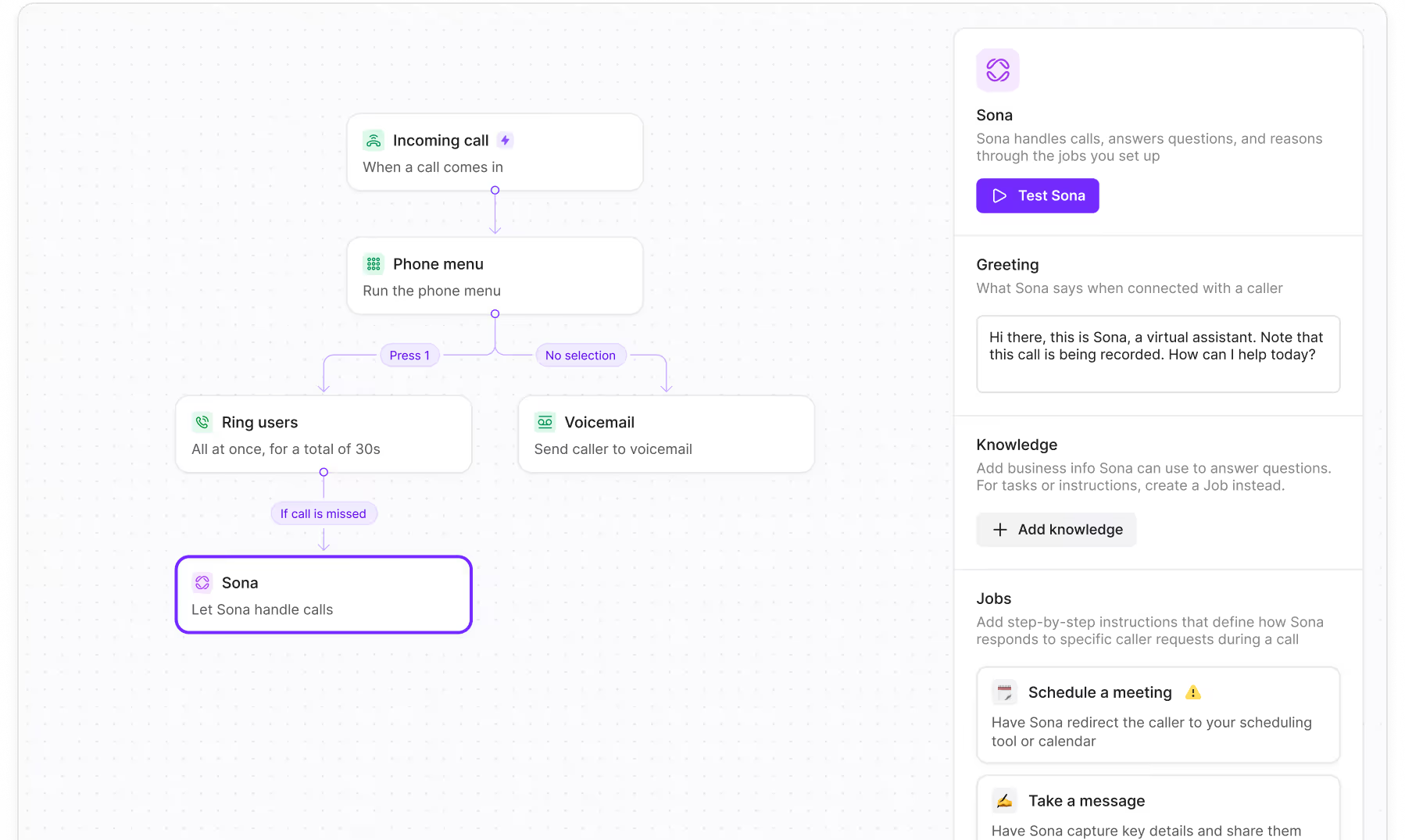
Quo, formerly OpenPhone, offers Sona as an AI receptionist inside its phone workspace. Its AI voice agents focus on inbound answering: taking messages, handling common questions, collecting caller details, transferring calls and sending useful texts. For a small business already working in Quo, this keeps reception and subsequent follow-up close to the same shared conversation history.
Sona’s AI voice agents are particularly relevant when missed business calls are the main problem. A compact AI receptionist can ask for the business service needed and the best contact information, then send an approved scheduling link. That is a useful AI receptionist workflow even if the caller completes the booking themselves. Do not describe sending a booking link as proof of direct calendar reservation.
Where it fits: a local service team that wants callers to receive an answer while staff are on another call or away from the desk. Give AI voice agents different instructions for normal business hours and after-hours reception. Specify what a message must contain and which request deserves an immediate human transfer.
What to verify: Sona’s published FAQ describes inbound voice only, and support for English, Spanish and French without automatic mid-call language detection or switching. It operates in Quo rather than as an independent replacement layer for any phone system. These boundaries matter if your shortlist of AI voice agents must also support outbound campaigns.
Pricing boundary: Starter is $15 per user per month annually or $19 monthly. Every plan advertises 1,000 automation credits, equivalent to 10 Sona calls when used entirely for calls. Selected additional tiers include $49 for 10,000 credits and $99 for 25,000 credits, equivalent to 100 and 250 calls respectively. Text use also draws from the credits available to AI voice agents.
Our verdict: choose Sona as an AI receptionist for straightforward inbound reception within Quo, especially when staff value a shared inbox. Build your cost estimate from the credit allocation actually available after other automation use. A paid phone plan with a small included allowance is different from a standalone, unlimited AI receptionist.
4. Nextiva XBert — Best For Coordinating Voice, Text And Chat
Nextiva positions XBert as an AI employee, with AI voice agents and support for customer conversations, including calls, texts and web chat. This makes it relevant to a business receiving the same kinds of inquiries through several channels. The buying question is whether the selected package covers the channels, skills and tools your team actually needs.
Its main pricing page separates receptionist, FAQ and after-hours skills from lead and reservation capabilities available at higher levels. That is a useful boundary when comparing AI voice agents: answering a question and completing a reservation are different entitlements. Ask for a demonstration in the proposed tier, using your intended calendar and real handoff destination.
Where it fits: a business whose customers telephone, text and ask questions through its website. An AI receptionist can provide front-desk coverage, while a suitable lead or reservation skill supports the next step. Establish a business owner for requests that move between AI voice agents and other channels so a caller does not receive competing answers from separate systems.
What to verify: Nextiva’s public pages show different XBert offers. The main pricing page lists Premium at $100 monthly with 100 conversations and $0.99 overage; another product page advertises $99 and a different overage figure. Match the quotation for AI voice agents to one defined business package. Confirm standalone availability, underlying plan charges and the definition of a billable conversation.
Evaluation boundary: eligible plans include 10 starter conversations. The main page also shows pay-as-you-go pricing at $1.50 per interaction and Premium+ at $2,500 monthly with 1,000 conversations. These options for AI voice agents carry separate business terms, rather than a single interchangeable tariff. A money-back guarantee shown elsewhere should not be substituted for confirmed free-trial terms.
Our verdict: shortlist XBert when cross-channel coordination is central to the project and assisted onboarding has value. Compare its AI voice agents against your exact skill requirements. If all you need is basic phone screening, a wider package of AI voice agents may introduce capabilities and costs your business will not use.
5. Ringover AIRO — Best For Detailed Agent Configuration
Ringover AIRO deserves attention when the team configuring an AI receptionist needs explicit control over its behavior. Its current guide to configuring AI voice agents describes language selection, response length, personality, mandatory questions, knowledge, tools and guardrails. Those controls can help translate an actual reception process into instructions that someone can maintain.
For a business configuring an AI receptionist for several request types, the benefit of AI voice agents is a defined business intake flow. An AI receptionist can ask the required questions, consult a focused knowledge base and follow configured escalation rules. Judge the clarity of those controls by having an administrator change a common instruction during the evaluation, then retest the affected call path.
Where it fits: a business team that wants AI voice agents to structure qualification, appointment-related handling or routing, and can assign an owner to AI receptionist configuration. AIRO also documents outbound workflows separately. Compare inbound coverage by AI voice agents against outbound charging before assuming one allowance pays for both directions.
Pricing boundary: the selected US Starter offer is $100 per month for 20 inbound conversations per day. Calls of 10 seconds to five minutes count as one conversation; longer calls consume further five-minute blocks. Extra conversations are shown at $0.39 in the selected US offer. Each agent also needs a landline number listed at $5.
What to verify: daily quotas do not behave like a shared monthly pool. Outbound usage is listed separately at $0.19 per minute from the first ring. The documentation contains regional currency differences, and WhatsApp needs an appropriate connected license plus its own messaging charges. Obtain one regional order form for AI voice agents covering the business channels and numbers you will use.
Our verdict: evaluate AIRO when configurable AI voice agents and predictable daily traffic fit the operation. Watch prepaid credit behavior: the guide says excess usage requires a positive balance. For business budgets, a quiet week does not automatically compensate for a busy day under a daily allocation, so model the busiest days as well as the average month.
6. CallHippo — Best For Testing No-Code Sales Workflows
CallHippo’s AI voice agents are configured through the dashboard and support inbound and outbound calls. Its AI receptionist help documentation describes building conversation flows without code, assigning a CallHippo number and enabling the relevant feature on the account. This makes it a candidate for teams wanting to test automated qualification alongside their calling operation.
The product page describes AI voice agents with meeting-related handling, transfers to human staff and lead screening. Separate outcome-based offers concentrate on booked demos. Treat those commercial models as distinct products: an AI receptionist for incoming calls, a usage-metered agent and a managed pay-per-demo arrangement do not necessarily carry the same fees or responsibilities.
Where it fits: a business sales team with a clearly defined lead intake or requested-callback process. Before choosing among AI voice agents, ask CallHippo to demonstrate the AI receptionist trigger, caller data, qualifying questions and calendar result. Then check the transferred record in the tool employees use, rather than relying only on the demonstration screen.
Pricing boundary: public US pricing material advertises an AI package at $45 per agent per month, but usage figures differ between public page views. A retrieved localized add-on view also uses a different subscription currency and lists $0.25 per minute. Other views show different minute rates and separate telephony. We therefore recommend a written quote instead of calculating a supposedly definitive all-in price.
Evaluation boundary: the AI product page explicitly advertises a 10-day free trial without a credit card. Confirm the included AI minutes, permitted destinations, concurrent-call entitlement and any required base subscription. A general phone trial is less useful if the agent actions you want remain disabled.
Our verdict: use the evaluation to establish whether CallHippo’s automation matches your sales process, then resolve the business terms for AI voice agents before launch. If considering outcome pricing, define what counts as a qualified booking, how cancellations are treated and who owns consent records. A booked meeting has limited value when it does not match the agreed acceptance criteria.
7. Calilio — Best For A Budget-Conscious Inbound Pilot
Calilio’s feature for AI voice agents is explicitly labeled Beta on its website. The documented AI receptionist use case is incoming-call coverage when staff cannot answer, with caller information, transcripts and summaries. Its AI voice agents are therefore relevant candidates for a small business seeking simple intake, provided the Beta status fits the operational risk.
The homepage describes training from prompts, files and websites, plus handling up to five calls at once. Its FAQ also describes AI voice agents screening and transferring calls or arranging a callback. Those statements support an inbound evaluation; they do not establish a fully featured outbound AI campaign product or every calendar and CRM action a buyer might require.
Where it fits: a small business team wanting an AI receptionist to collect names, numbers and reasons for calling. Start the AI voice agents on a spare or overflow business number and compare the captured information against the original conversation. Ask how the AI receptionist behaves when a requested transfer is unavailable and whether the callback has a visible owner.
Pricing boundary: The business Standard plan is $12 per user per month annually or $15 monthly, with 10 AI minutes per user per month and $0.25 per extra minute. Premium is $28 annually or $35 monthly, with 100 AI minutes per user per month and $0.15 per extra minute. Phone usage and other metered features can add charges.
What to verify: confirm whether allowances pool across seats, which countries and number types support your desired call flow, and whether the required transfer or connected action works in your account. Do not assume the provider’s ordinary calling bundle is also an interchangeable allowance for AI voice agents.
Our verdict: Calilio has the lowest listed paid phone-seat entry shown in our comparison, but that makes it a budget pilot candidate rather than a universal cheapest winner. The advertised 14-day money-back guarantee applies to a paid purchase. Keep a human fallback in place while checking Beta behavior against your real inbound workload.
What Features Matter Most In AI Voice Agents?
Accurate Knowledge And Clear Boundaries
AI voice agents need a maintainable source of truth. Separate public service information from account-specific records, and decide which facts must be repeated exactly. Prices, cancellation policies, service areas and opening hours should come from approved material with a named owner. Uploading an old brochure can create an authoritative-sounding answer that is wrong.
Ask how updates reach AI voice agents and how quickly they take effect across business locations. Then test a recently changed price and a removed service. Your business should also define the response when information is missing: collect details, offer an approved next step or transfer. Guessing should not become the default way to keep a conversation moving.
Booking And CRM Actions That Actually Complete
For AI voice agents, tool access is a larger buying issue than a long feature list. Verify that the selected connector can read the right calendar, use the right timezone and create the intended appointment type. Test an unavailable slot, a duplicate request and a caller who changes their mind during confirmation.
CRM integration needs similar scrutiny. Check which fields are written, whether existing records are updated, and what happens when two customers share a phone number. A helpful AI receptionist should leave a usable business record for the employee receiving the work. An attractive summary alone does not establish that the task reached the right queue.
Human Handoff And After-Hours Fallback
AI voice agents should have defined escalation conditions. These might include an explicit request for a person, repeated misunderstanding, an unsupported transaction or a sensitive situation. Test handoff when someone answers and when nobody does. Specify whether the next step is a queue, another number, a message or an agreed callback.
Review the complete call-routing setup, including business hours and holidays. The receiving teammate needs the caller’s intent and collected details. A transfer is not complete merely because AI voice agents announce it; the destination must ring and the unsuccessful path must be handled.
Language, Conversation Quality And Accessibility
Do not compare AI voice agents using only language counts. Ask whether the product detects a language automatically, switches mid-call or requires a separate route. Test the languages, names and addresses your callers actually use. Numbers and appointment dates deserve explicit read-back because a transcription error can turn a fluent conversation into an unusable record.
Listen for interruptions, pauses, repeated questions and how easily a caller can request a person. Give the AI receptionist enough time to hear a slower speaker’s response. Your business pilot of AI voice agents should include ordinary background noise and imperfect phone connections, with alternatives for callers who cannot comfortably use the automated conversation.
Concurrency, Reporting And Administrative Control
Ask how many simultaneous calls the proposed agent can handle and what happens to the next call at the limit. AI voice agents may have separate limits for concurrent sessions, outbound dialing and tool requests. A calendar connector or receiving human queue can become the bottleneck even when the voice layer accepts more calls.
Choose reporting that lets the business trace an inquiry from AI voice agents to its result. Useful fields include intent, requested action, transfer outcome, booking identifier and follow-up owner. Confirm who can change prompts, view recordings, export records and spend credits. These controls matter as soon as several people manage the same agent.
How Much Do AI Voice Agents Cost?
AI voice agents can combine a base subscription, AI usage, ordinary telephony, messages and implementation. The seven providers use several billing units, so a single “starting from” column cannot establish the cheapest complete solution. Ask for the same business workload to be priced by every supplier of AI voice agents.
Monthly budget = required subscriptions + AI package + usage above allowance + telephony and messages + implementation or support + applicable taxes. Annual prices may require an upfront commitment. Include the business cost of employees reviewing calls and maintaining instructions when you assess the financial case.
A Transparent Example: 100 Calls Of Three Minutes Each
Assume 100 AI-handled calls, each lasting exactly three minutes: 300 AI minutes in total. These illustrations use selected published components and exclude taxes, additional channels and unlisted charges. They compare billing mechanics, not equal capability, voice quality or guaranteed total invoices.
| Selected Configuration | Calculation | Illustrative Subtotal | What Still Matters |
|---|---|---|---|
| RingCentral AIR Standalone | $49 + (300 − 100) × $0.50 | $149 | Exactly three-minute calls; forwarding, extra services and taxes excluded. |
| Quo Starter + Sona 100-Call Tier | $19 monthly phone seat + $49 credit tier | $68 | One seat; credit tier used entirely for the 100 calls. Required plan features and text use may change cost. |
| Calilio Standard, One User | $15 monthly + (300 − 10) × $0.25 | $87.50 | AI component and subscription only; ordinary call, recording and other charges excluded. |
| Calilio Premium, One User | $35 monthly + (300 − 100) × $0.15 | $65 | Same exclusions; Beta functionality and required workflows still need validation. |
This example shows why AI voice agents should be priced at the plan level. For the selected one-user Calilio assumptions, Premium’s larger AI allowance produces a lower component subtotal than Standard. That arithmetic does not make its Beta product interchangeable with a different provider’s complete workflow.
Daily Quotas Can Change The Result
Consider Ringover AIRO Starter and 100 three-minute calls. If those calls are spread across ten days at ten per day, each day remains inside the stated 20-conversation allowance. If all 100 business calls arrive on one day, 80 exceed that daily allowance. At the selected US $0.39 extra-conversation rate, those overages add $31.20 before other charges.
Longer calls can also consume more than one AIRO conversation. A daily allocation for AI voice agents therefore needs a traffic-distribution model, rather than simply multiplying the quota by the number of days in a month. Ask suppliers of AI voice agents how spam, repeat callers, transferred calls and abandoned conversations affect the bill.
Measure Value Through Completed Work
Calculate cost per correctly completed task, not merely cost per connected minute. If a hypothetical $300 pilot produces 60 verified useful outcomes, the software component is $5 per useful outcome. If only 20 outcomes are usable, it becomes $15. Include business follow-up labor and refunds when relevant; do not count every answered call as recovered revenue.
The business case can still be positive when an AI receptionist handles only part of a call. Accurate intake may let an employee respond faster or avoid asking the same questions again. Compare the actual before-and-after process, and distinguish new revenue from administrative time that was simply moved elsewhere.
Where AI Voice Agents Help Different Types Of Business
Local Services And Small Offices
For a local business, the first useful task is often collecting a request while staff are occupied. AI voice agents can ask for the location, service category and preferred callback time. Quo Sona and Calilio are worth evaluating for simpler inbound intake; compare JustCall or RingCentral AIR when you need more connected action or routing.
Keep the promises made by AI voice agents narrow. They may collect a preferred appointment time without guaranteeing availability, or record a business service request without promising dispatch. Make the distinction explicit in both the instructions and the customer confirmation. The employee responsible for follow-up should see the original request and any uncertainty.
Sales Qualification And Requested Callbacks
For sales teams, AI voice agents can support consistent qualifying questions and a defined next step. JustCall and CallHippo document inbound and outbound use, while AIRO separates outbound charging from its inbound quota. Compare the specific campaign workflow, number setup and permissions rather than assuming all reception products can place calls.
Start the business pilot with people who have requested contact and make the acceptance criteria measurable. A useful handoff from AI voice agents might require the correct service, location, company size and an agreed appointment. Avoid rewarding the system only for booking volume: meetings outside the service area or with the wrong contact create work without improving the pipeline.
Support Teams And Multiple Locations
Support operations should use AI voice agents for supported categories such as opening hours, basic product information and request routing. Nextiva XBert is relevant when calls, texts and web chat need coordinated handling; RingCentral AIR and AIRO are worth evaluating for reception and structured routing. Demonstrate account-specific business actions by AI voice agents separately from public FAQs.
A multi-location business needs location-specific facts and escalation destinations. Test the same question on two branch numbers with different opening hours. The agent should not blend policies from separate offices. Assign a business owner for branch changes and verify that the correct location stays attached to the customer’s record after transfer.
Developer-Led And Highly Specialized Projects
This shortlist emphasizes communication-platform AI voice agents. A project that requires control over every model component, custom hosting or extensive bespoke orchestration may need a different category of supplier. Use the seven-provider comparison to decide whether an integrated phone product fits before committing to a build-heavy architecture.
Likewise, a sensitive intake process may be better served by a narrow AI receptionist that collects minimal details and reaches a qualified person. Do not begin with the most complex transaction. Choose the smallest valuable business task whose outcome the team can verify reliably.
How To Set Up AI Voice Agents Without Disrupting Calls
- Choose one business outcome. Examples include complete after-hours messages, correct department transfers or accepted appointment requests. Record the current business process and how you will recognize a useful result from AI voice agents.
- Define the allowed information and actions. Write down what AI voice agents may answer for the business, what requires confirmation and what must go to a person. Give each rule an owner.
- Prepare a focused knowledge base. Start with approved services, hours, locations, contact details and common questions. Remove outdated or contradictory business material before importing it.
- Connect only necessary tools. Give AI voice agents access to the intended business calendar or CRM fields, and verify the permitted actions. Test failed connections as deliberately as successful ones.
- Use a limited call route. Begin with a test business number, one team or an overflow path. Keep the previous route available while the AI receptionist pilot proves useful.
- Write the human fallback. Define transfer destinations, unavailable-staff behavior, callback ownership and what the caller hears when AI voice agents cannot complete an action.
- Run realistic conversations. Include interruptions, changed details, noisy connections, unusual names and requests outside the approved scope.
- Review outcomes before expanding. Correct the knowledge and flow, repeat the affected tests and only then add more traffic or actions.
AI voice agents need ongoing ownership after launch. Name a business owner who can update instructions when the business changes its hours, services or staff. Check the records for incomplete tasks and repeat misunderstandings. The time required for that work belongs in the implementation budget, even when the initial builder requires no code.
Privacy, Consent And Responsible Deployment
Before sending customer information through AI voice agents, establish where recordings, transcripts and extracted fields are stored, who receives them and how long they remain available. Ask whether model providers retain the data and how deletion works across connected systems. Match the signed business agreement to the exact product and intended data, rather than relying on a parent-company badge.
For outbound US calling, the FCC has confirmed that AI-generated voices fall within the TCPA’s artificial-or-prerecorded-voice restrictions. Required consent, identification, opt-out handling and applicable exceptions depend on the actual call and rules. Obtain advice for the intended markets before launching a campaign; ordinary permission to contact someone should not be assumed to cover every automated marketing use.
As an operating choice, introduce the AI receptionist clearly, provide an accessible route to a person and collect only the details required for the task. Avoid putting confidential account information into a general knowledge base. For regulated business work, confirm the relevant contractual coverage and permitted workflow before production use.
A Practical Scorecard For Testing AI Voice Agents
Give every shortlisted provider the same task-based evaluation. The purpose is to find whether AI voice agents can complete your workflow under realistic conditions, including failures. Set business acceptance criteria before the demo, then record what actually happened. Do not turn a polished sales demonstration into an assumed performance guarantee.
| Test | Caller Scenario | Evidence Of Success | Reason To Rework |
|---|---|---|---|
| Knowledge Accuracy | Ask about a changed price and an unsupported service. | Approved answer; uncertainty escalated. | Invented terms or an unsupported promise. |
| Action Completion | Request an available appointment, then change it. | Correct record, timezone and confirmation. | Verbal success without a matching event. |
| Human Handoff | Ask for a person during and outside opening hours. | Right destination and usable fallback. | A loop, dropped call or unowned callback. |
| Conversation Repair | Interrupt, correct a postcode and ask two questions. | Correction retained; both requests handled. | Repeated wrong details or ignored requests. |
| Capacity And Billing | Place permitted simultaneous test calls and inspect the meter. | Observed limit and predictable usage records. | Unexplained charges or silent overflow. |
A useful pilot of AI voice agents should include both easy and difficult calls. For example, create 30 scripted scenarios: ten common requests, ten action-and-transfer situations and ten exceptions. Those numbers are a suggested test design, not a statistical guarantee. Repeat failures after changes and keep a record of which version produced each result.
Track completed tasks, incorrect answers, successful handoffs, abandoned calls and follow-up effort. Separate an accurate message from a completed booking. If the business counts both as successful automation, label them separately so the result stays interpretable. A high answer rate can coexist with poor task completion.
Finally, test the administration of AI voice agents. Have the intended owner change holiday hours, remove a staff member and update a routing destination without supplier help. If maintaining AI voice agents depends on a developer or account manager, include that dependency in the operating plan and support quote.
Frequently Asked Questions
What Are The Best AI Voice Agents For Small Business?
Quo Sona is a useful starting point for small teams already using Quo, while RingCentral AIR suits buyers keeping another phone system. JustCall is stronger to evaluate when inbound handling and consented outbound workflows must work together. Calilio offers a lower phone-seat entry for a limited Beta pilot. Choose by the complete workflow and invoice.
Which AI Voice Agents Are Cheapest?
Calilio has the lowest listed paid phone-seat entry shown here at $12 per user per month, but that is not an unlimited AI service. The cheapest complete option depends on seat requirements, AI allowances, call length and extra charges. Compare the same month of traffic before choosing an AI receptionist on price.
Can AI Voice Agents Make Outbound Calls?
Yes, selected products support outbound calls. JustCall, CallHippo and Ringover AIRO document outbound workflows, while Sona’s published FAQ describes inbound voice only. Confirm the exact agent, destination eligibility and campaign terms. Technical support for dialing does not by itself establish permission to run a campaign.
Can An AI Receptionist Book Appointments?
Yes, an AI receptionist can book appointments when its specific product and connected calendar support the action. Some workflows only send a booking link or capture a preferred time. Ask for a live demonstration that creates the correct event, handles an unavailable slot and confirms the timezone before relying on automatic scheduling.
Do AI Voice Agents Replace A Business Phone System?
Some work alongside an existing phone system, while others require the provider’s own phone service. RingCentral AIR has a standalone route; Sona operates within Quo, and JustCall’s help center requires an active JustCall subscription. Confirm number forwarding, transfers and carrier charges before deciding whether a migration is necessary.
Are AI Voice Agents Included In Ordinary Phone Plans?
Sometimes a limited allowance is included, but full usage can cost extra. Quo advertises starter automation credits, Calilio includes small AI-minute allowances and eligible Nextiva plans include starter conversations. JustCall describes its agent as a separate add-on. Transcription or summaries in a phone plan do not automatically include autonomous reception.
Can AI Voice Agents Handle Several Languages?
Yes, several products support multiple languages, but detection and switching differ. JustCall documents automatic detection for selected languages; Sona lists English, Spanish and French without mid-call switching. Test the exact languages, accents and routing you need. A published language count does not establish accurate handling of your callers’ names or industry vocabulary.
How Should A Business Choose Between These Providers?
Choose AI voice agents by one defined job, the required human fallback and a complete cost model. Shortlist two or three sets of AI voice agents, run identical call scenarios and verify the records in your calendar or CRM. Select the provider that meets your acceptance criteria at a sustainable total cost, then expand gradually.
What Customer Feedback Adds To The Comparison
RingCentral AIR — G2: Gaurav C.’s November 8 review, rated 4/5, praises contextual handoff and practical call handling, while highlighting minute allowances, knowledge maintenance and routing setup. G2 labels the review incentivized and seller-invited. The buying implication is to budget for usage and test the documents and transfer rules your own callers will encounter.
JustCall — G2 platform review: Zaid K.’s March 12 review, rated 4/5, values recording, SMS and HubSpot organization but reports call-quality concerns and dissatisfaction with inbound AI effectiveness. This is an incentivized, G2-invited review of the broader platform, not a standalone agent rating. It supports testing the actual route and intake flow rather than borrowing the parent product’s average score.
These examples provide buying questions, not a comparative performance test of all seven AI voice agents. For your business, the decisive evidence is a correct result on the actual business phone route, followed by a usable handoff and an invoice that matches the agreed package.
Affiliate Disclosure: VoIPCalling.com may earn a commission when you purchase through links on this page. Recommendations reflect the stated business requirements and documented product boundaries.