Twilio SMS pricing starts at $0.0083 per outgoing or incoming US SMS segment for standard long-code, toll-free and short-code traffic, before carrier fees. Your total also depends on message length, phone-number rental, registration, optional services and destination. At that base rate, 10,000 outgoing single-segment texts cost $83 before the additional charges.
This guide explains the US dollar rates first, then shows how to build a realistic monthly budget. International destinations use their own tariffs. The main budgeting mistake is treating 1 customer SMS message as 1 billable unit: long or differently encoded content can create several segments, and replies can add incoming charges.
 Twilio
G2 Customer Rating: 4.1/5
Twilio SMS Pricing: US Base Rates By Sender Type
These are selected US list rates per segment, not complete costs per customer conversation. Standard short codes and FTEU short codes are separate categories. A sender’s rental, registration and carrier components are outside this first table.
| Sender Type | Outgoing Base | Incoming Base | Important Boundary |
|---|---|---|---|
| Local Long Code / 10DLC | $0.0083/segment | $0.0083/segment | Carrier, number and applicable registration charges additional. |
| Toll-Free | $0.0083/segment | $0.0083/segment | Separate number rental and verification requirements. |
| Standard Short Code | $0.0083/segment | $0.0083/segment | Lease, setup and carrier charges are separate. |
| FTEU Short Code | $0.0500/segment | $0.0500/segment | Special free-to-end-user arrangement; not the standard short-code tariff. |
For the latest destination and sender selections, use Twilio’s official US messaging rate card. Compare the product you actually use rather than importing a rate from a different country, channel or sender category.
How Twilio SMS Pricing Builds Into A Monthly Bill
A useful estimate separates variable usage from recurring resources and one-time setup. Start with outgoing and incoming billable parts, apply the relevant base and carrier rates, then add numbers, campaign charges and any purchased services. Keep onboarding expenses separate so a first-month bill is not mistaken for the normal recurring cost.
Monthly estimate = outgoing base usage + incoming base usage + applicable carrier charges + number rental + recurring registration or application charges + optional services + taxes. The first month can also include registration, vetting or setup expenses. Use the account’s actual terms for each line.
Count Twilio Conversations And Billable Units
A business might expect 5,000 SMS appointment confirmations but also send reminders, receive replies and answer follow-up questions. Those actions create different SMS message events. Record the expected SMS volume for each action before estimating the total, rather than using the number of customers as the message count.
Next, apply the template’s actual segment count. A confirmation using 2 billable parts turns 5,000 sends into 10,000 outgoing units. A reminder using 1 part adds another 5,000. The budgeting worksheet needs both the business action and the technical unit to explain the result.
Separate Twilio API Charges From Texting Application Pricing
Twilio provides programmable communications, but the business may also pay for a CRM, inbox, automation tool or custom application. Identify where employees read replies and manage customers. A low transport rate does not establish that the interface, workflow and staff access are included.
If another platform resells usage or adds a markup, compare that platform’s actual invoice with the direct API proposal. Do not use Twilio’s public rate as proof of what every third-party application charges. Ownership of the integration also matters when diagnosing a duplicate send or an unexpected workflow.
Twilio SMS Segments: Why Message Length Changes The Cost
A segment is a billable part of an SMS transmission. A recipient may see a long SMS message assembled into a single conversation bubble even though it was sent in several parts. Twilio charges the relevant usage for those parts, so the visual appearance on the phone is not a reliable cost counter.
Encoding determines the available capacity. Basic GSM-7 text can fit 160 encoded units in a single-part message; longer messages generally have 153 units per part because concatenation uses some capacity. UCS-2 uses a smaller single-part allowance of 70 units and generally 67 per part when concatenated.
| Content Assumption | Length | Billable Parts | Outgoing Base Cost |
|---|---|---|---|
| Basic GSM-7 | 160 encoded units | 1 | $0.0083 |
| Basic GSM-7 | 161 encoded units | 2 | $0.0166 |
| Basic GSM-7 | 306 encoded units | 2 | $0.0166 |
| Basic GSM-7 | 307 encoded units | 3 | $0.0249 |
| UCS-2 | 70 encoded units | 1 | $0.0083 |
| UCS-2 | 71 encoded units | 2 | $0.0166 |
Preview Finished Twilio SMS Templates
Personalization changes length. A short sample customer name may fit comfortably while a longer business name, address or booking reference pushes the finished SMS text into another part. Include the real link and any appended instructions when previewing the message.
Not every visible symbol consumes the same encoded capacity. Extended characters and emoji sequences can behave differently from a plain letter. Use the official message-length and encoding guidance and a segment preview rather than counting only the characters displayed in a text editor.
Twilio Smart Encoding And SMS Cost
Twilio’s Smart Encoding can replace certain non-GSM characters with equivalent GSM characters. A common example is changing a curly quotation mark to a straight quotation mark. That can prevent an avoidable encoding change when the rest of the text fits the simpler character set.
It does not mean every emoji or language can be converted without changing the message. Preserve names, meaning and necessary instructions. The right optimization is a clear, accurate template with a known billable length, not removing information that customers need to understand the request.
Twilio Toll-Free SMS Length Limits
Twilio documents a different concatenated allowance for toll-free traffic sent to the US or Canada: 152 GSM-7 units or 66 UCS-2 units per part. A template close to a boundary can therefore produce a different count from an ordinary long-code example.
For instance, 305 basic GSM-7 units fit into 2 parts under a 153-unit concatenated allowance but require 3 at 152. Test the selected sender type. A general calculator assumption should not override the actual route used by the application.
Twilio Carrier Fees: The Charge Above The Base Rate
Carrier charges are added according to the recipient network, sender type and direction. A published base rate is therefore not the same as the complete variable cost of sending a segment. Keep the carrier component visible in the worksheet rather than hiding it in an unexplained average.
| Recipient Carrier | Outgoing Component | Incoming Component | Outgoing Base + Carrier |
|---|---|---|---|
| AT&T | $0.0035/segment | $0.0035/segment | $0.0118/segment |
| T-Mobile | $0.0045/segment | $0.0025/segment | $0.0128/segment |
| Verizon | $0.0050/segment | Confirm the applicable account schedule | $0.0133/segment |
The final column combines only the selected $0.0083 outgoing base and the displayed carrier component. It still excludes numbers, registration, optional services and tax. The public rate table leaves some incoming entries blank; this guide does not silently convert a blank entry into a verified universal zero.
Use The Actual Carrier Mix In Twilio Pricing
A company sending mostly to 1 network can have a different variable bill from another company with the same number of sends. If the real mix is unknown, use a clearly labeled SMS usage assumption and replace it once account usage provides better evidence. Do not present an arbitrary blended fee as an official Twilio rate.
For an existing account, compare the carrier distribution over a representative period. A single campaign may not represent a full month. Keep destinations and sender types separate when their fee schedules differ, particularly when the business uses both local and toll-free numbers.
Long Twilio SMS Messages Multiply Carrier Components
Segmentation can increase more than the platform base. Where the carrier component is charged per segment, 2 parts incur that component twice. An estimate that doubles the Twilio rate while charging the carrier only once understates the variable cost.
Using the displayed T-Mobile example, 1 outgoing part is $0.0128 before other charges; 2 parts are $0.0256. Across 10,000 sends, the difference between those content assumptions is $128. That is a template-length calculation, not a prediction of every account’s carrier mix.
Twilio Number Rental And A2P Registration Costs
Twilio Phone Number Pricing And Recurring Rental
Twilio’s US messaging rate card lists leased local numbers at $1.15/month and toll-free numbers at $2.15/month. These amounts are separate from message usage. A number’s rental also does not establish permission to send every type of business traffic through it.
Short codes have a different commercial scale. The published leased random and vanity examples are $1,000 and $1,500 per month respectively, with quarterly billing and setup conditions. Treat a short-code proposal as a distinct purchase, rather than assuming the shared standard base rate makes it economically identical to a local number.
For agencies, inventory numbers by client and purpose. A number retained for an inactive workflow can remain a recurring resource. Review ownership and operational need before releasing anything, because removing a customer-facing number can have consequences beyond a small rental saving.
Twilio Brand Registration And Campaign Charges
Twilio’s current brand-registration documentation lists a $4.50 one-time brand registration fee and a separate $41.50 Standard Brand vetting charge where applicable. A simple sum for those 2 Standard Brand items is $46. Other review or appeal charges can apply to specific cases.
Campaign registration is another component. Twilio documents recurring campaign charges, and the applicable onboarding or vetting amount needs confirmation for the chosen registration path. Do not apply a single flat registration total to every sole proprietor, low-volume business, Standard Brand or client agency.
Separate First-Month And Ongoing Twilio Pricing
Show one-time registration and setup in a first-month pricing column. Put number rental, recurring campaign costs and ordinary usage in the monthly pricing column. This makes it clear whether an unusually high initial bill is a setup event or a cost that will repeat.
Some older official summaries and help snippets use different registration figures. Use the current registration flow and account quote for the actual purchase. The worked examples below leave unconfirmed campaign items outside the subtotal rather than inventing a final all-in price.
Toll-Free Verification Is Not A 10DLC Registration Substitute
A toll-free sender follows a different verification process from a local 10DLC sender. Choose the identity and route that fit the business, then confirm the applicable process. A similar outgoing base rate does not mean the administration, rental and permitted traffic are identical.
Budget time for the required setup as well as money. Introductory credit or an API credential does not by itself establish that the intended production route is ready. Confirm the account’s actual sender status before building a launch forecast around it.
How Much Does Twilio SMS Cost Per Month?
The following examples use outgoing single-segment local US texts, the selected $0.0083 base, an assumed $0.0045 carrier component on every part and 1 leased local number at $1.15/month. They exclude replies, registration, recurring campaign charges, optional services and taxes.
| Outgoing Parts | Base Usage | Assumed Carrier | With 1 Local Number |
|---|---|---|---|
| 1,000 | $8.30 | $4.50 | $13.95 |
| 10,000 | $83.00 | $45.00 | $129.15 |
| 50,000 | $415.00 | $225.00 | $641.15 |
| 100,000 | $830.00 | $450.00 | $1,281.15 |
Example: A Simple Outgoing Reminder Workflow
A business sending 10,000 matching reminders would start with the $129.15 selected subtotal under those assumptions. It must then add the actual recurring campaign amount and any applicable extras. The first month can also include registration or setup expenses.
If a particular account only added the documented $4.50 brand-registration item at that stage, the arithmetic would be $133.65 before the remaining exclusions. That is not a claim that $4.50 completes registration or that $133.65 is a launch-ready invoice. The missing lines must still come from the actual account proposal.
Example: A Two-Way Customer Conversation
Now assume 10,000 outgoing parts and 2,000 incoming parts, all using the selected local base. Base usage is 12,000 × $0.0083 = $99.60. If the outgoing carrier assumption is $0.0045 and incoming is $0.0025, those components add $45 and $5 respectively.
Adding 1 local number produces $150.75 before campaign costs, registration, optional services and taxes. This is a clearly defined two-way scenario. It is more useful than assuming that every reply is free or that a 10,000-send campaign stops incurring costs after the outgoing request.
Example: The Same Audience Receives A Longer Template
If each of 10,000 outgoing sends uses 2 billable parts instead of 1, base usage rises from $83 to $166. Under the same per-part carrier assumption, that component rises from $45 to $90. With the same local number, the selected subtotal becomes $257.15 before other exclusions.
The audience has not changed, and neither has the selected rate. The content changed the number of units. This is why a useful forecast stores the finished template’s segment count alongside the planned send volume.
Build A Twilio SMS Budget From Your Real Workload
Use A Weighted Template Mix Instead Of A Perfect Sample
A Twilio forecast should reflect the messages customers actually receive. Suppose a business expects 10,000 outgoing sends: 70% use 1 billable part and 30% use 2. The resulting volume is 7,000 + 6,000 = 13,000 parts, rather than 10,000. At the selected base, that is $107.90 before carrier and other charges.
Using the same illustrative $0.0045 carrier component adds $58.50. With 1 local number, the selected subtotal becomes $167.55 before campaign charges, setup, incoming traffic, optional services and taxes. This is a template-mix example, not another Twilio pricing tier. It shows why averaging the rate without measuring length can understate the budget.
Compare Different Business Workflows Separately
An appointment workflow often includes a confirmation, a later reminder and an update if the booking changes. An SMS campaign may instead create a short burst of outgoing traffic followed by customer replies. A support workflow can generate many exchanges with the same person. Give each process its own volume and content assumptions.
For authentication, identify whether the application buys ordinary Twilio messaging transport or a separate managed verification product. The latter is a different pricing decision. Do not insert its full price into an ordinary SMS comparison, or assume the transport line alone covers the complete verification service.
For client agencies, separate the underlying supplier cost from the amount charged to the client. An agency may provide application access, setup and ongoing management in addition to transmissions. Label those services clearly. A client-facing package is not automatically evidence that Twilio’s published unit rate is inaccurate.
Keep A Quote Worksheet That Another Person Can Recheck
Record the sender category, destination, direction, expected sends, finished-template length, billable parts, base rate, carrier schedule, recurring resources and one-time expenses. Note the pricing basis and which account or product it applies to. The worksheet should explain a total without relying on the memory of its original author.
Keep a low, expected and high case. Use ordinary changes in demand or reply volume to build those scenarios, rather than assuming every month repeats the busiest launch. Compare the Twilio account’s actual records with the assumptions after a representative period and update the next forecast.
Use Alerts As A Signal To Investigate
A budget notification should trigger a review of usage, templates and account activity. Do not assume an alert automatically prevents further SMS charges or stops every connected application. If the business requires a spending control, the implementation owner must confirm what the account and application actually enforce.
Plan an appropriate response for essential communications. A blanket stop could interrupt a necessary customer update, while an unrestricted retry could add duplicate traffic. Define which workflow can pause, who investigates the alert and how staff continue the business process while the issue is reviewed.
Separate Cash Funding From Usage Expense
Moving money into an account and consuming a billable resource are different events. Compare the supplier’s usage and invoice records with payments over the correct period. A top-up alone does not reveal how many outgoing parts were sent or whether a recurring resource remained active.
Likewise, treat introductory credit as a temporary offset with its own eligibility. It can help evaluate an SMS integration, but it does not change the ongoing Twilio pricing model. Base the recurring comparison on normal paid usage so the decision still makes sense after the evaluation ends.
Does Twilio Charge For Incoming SMS And Customer Replies?
Yes. The selected standard US base rate is $0.0083 per incoming segment as well as per outgoing segment. The applicable carrier component depends on the route and network. A reply should therefore be included in a two-way workflow budget rather than treated as cost-free by default.
Automated responses can create another outgoing event. A customer may reply to an SMS reminder and then receive a confirmation or employee response. Map those steps individually, especially when a CRM or automation can send follow-up text without the employee noticing a separate SMS transaction.
For forecasting, estimate a reply rate and a typical number of follow-ups, then compare those assumptions with actual account records. A support conversation can have a different cost profile from a notification-only workflow even when both begin with the same initial message.
Keep customer preferences synchronized across the tools handling these events. A pending reminder should not continue merely because another application has not received a preference update. Avoiding unnecessary sends improves both cost control and the customer experience.
Twilio Bulk SMS Pricing And Volume Discounts
Twilio advertises volume-based discounts and committed-use options. Its published mass-texting example lists $0.0083 for the first 150,000 units and $0.0081 for the next 150,000, followed by additional bands. Confirm the current eligible product, sender and account terms before projecting a high-volume month.
Apply Twilio SMS Pricing To The Correct Volume Band
Under that selected tier example, 200,000 outgoing billable units would produce 150,000 × $0.0083 = $1,245, plus 50,000 × $0.0081 = $405. The base subtotal is $1,650 before carrier fees and other items. It is not $1,620 from applying the second-band rate to all 200,000 units.
The distinction matters when evaluating a competitor’s lowest advertised rate. A volume band is not automatically the rate for every account or every unit. Request an explicit calculation, especially where graduated pricing, committed pricing and account-specific discounts are presented together.
Compare Twilio Commitments With Realistic Usage
A commitment should be assessed against low, expected and high usage, not only the busiest campaign. Identify what happens when the business sends less than expected and which charges sit outside the agreement. A lower transport rate can have limited value when the commitment does not match actual demand.
For an established Twilio account, compare competitors against the negotiated rate actually paid. Using a public list rate on 1 side and a specially negotiated quote on the other can exaggerate the reason to switch. Keep volume, sender, destination and included services consistent.
Twilio International SMS Pricing: Country And Sender Matter
The US rate in this guide is not a worldwide tariff. International pricing depends on the destination, sender route, direction and product. Select the required country and sender category before multiplying a rate by the planned volume.
Do not infer the recipient’s rate from the business’s headquarters or billing address. A US business sending to another country needs the relevant destination proposal. Likewise, local number availability and the ability to deliver outgoing traffic to a country are different questions.
Separate International Destinations In Your Twilio SMS Budget
Create a row for each material country and communication direction. Record the intended sender, whether replies are required, the expected segment count and any registration or recurring resource expense. This avoids an international total built from a domestic starting price.
A sender suitable for one-way notifications may not meet a two-way customer-support requirement. Confirm that distinction before comparing costs. An inexpensive outgoing route has little value if customers cannot use it in the way the application promises.
Compare Twilio SMS Pricing With Other Channels
MMS, WhatsApp, RCS and managed verification have their own commercial models. An ordinary SMS rate should not stand in for those products. If an application uses several channels or fallbacks, model the events that actually occur and the product charges attached to each.
Do not move essential communications to another channel simply because a headline appears smaller. Consider the customer’s access, the required sender arrangement and the application work. The useful comparison is the cost of a supported customer journey, not a mix of unrelated channel rates.
Twilio Failed-Message Charges And Optional Features
Twilio Failed And Undelivered SMS Statuses Differ
Twilio’s published US card lists a $0.001 processing fee for messages that terminate in a Failed status. That should not be applied indiscriminately to every request or confused with every Undelivered outcome. Account rules and the final result matter when reconciling the charge.
If 200 events qualify for that selected fee, the arithmetic is $0.20. More important than the small sample amount is understanding why those events occur. Do not assume an unsuccessful customer outcome automatically means the whole attempt is free or refunded.
Include Optional Services In Twilio Pricing
Twilio lists additional messaging features and services separately. Determine what is enabled, which event triggers a charge and whether an allowance or subscription applies. The plain per-segment figure should not be treated as the complete price of an application using additional products.
The same discipline applies to purchased assistance and third-party tools. Include the cost when it is required or purchased; do not add it to one provider merely to make another look cheaper. Equivalent scope is necessary for a useful budget comparison.
Separate Delivered Events From Useful Business Outcomes
A delivery receipt can help explain transport, but it does not prove that a customer read the text, attended an appointment or completed a purchase. For business reporting, calculate the cost per relevant outcome separately from the invoice’s cost per transmission.
Use an honest denominator. If a campaign produced 40 confirmed appointments, divide the applicable campaign cost by 40 rather than the entire recipient list. Avoid attributing every appointment to texting when other channels or staff actions also contributed.
Is Twilio SMS Free To Test?
Twilio currently documents a free 30-day trial with product-specific units, including 100 SMS messages, rather than a shared dollar balance. Its trial guidance also describes geographic, recipient and content restrictions. A trial allocation is for evaluation, not an unlimited production texting plan.
The documented SMS trial uses predefined content, and verified-recipient restrictions apply. Check the actual account’s allowed destinations and template behavior. A successful trial request does not validate every production message, sender configuration or optional feature.
Plan the post-upgrade resources separately. Trial numbers and production number ownership are not interchangeable, and the recurring costs in this guide should be budgeted independently of introductory allowances. Confirm any applicable post-upgrade allocation in the account instead of subtracting an assumed promotion indefinitely.
For an evaluation, focus on the question the account can actually answer: whether the integration can create a request, process the response and surface an event correctly. A production pilot may require additional setup to test the real sender and customer workflow.
How To Check An Unexpected Twilio SMS Bill
Match Twilio Billing Periods And Account Scope
Start with the exact Twilio invoice period, currency and included accounts or subaccounts. A dashboard view and a finance report can disagree when they cover different dates or resources. Use a consistent scope before deciding that a unit rate is wrong.
Separate outgoing from incoming events, then group by destination and sender type. Include numbers and recurring application resources as their own lines. An unexplained total is easier to investigate once transport, recurring resources and setup costs are no longer mixed together.
Inspect Final Twilio SMS Records And Segment Counts
Twilio’s Message resource includes fields for direction, number of segments, status and currency. Some values may not be final at the instant a message is created; for Messaging Services, the documented segment field can initially be zero before sender assignment. Do not treat a fresh placeholder value as the final billed quantity.
Use representative final records and the account’s billing or usage reports for reconciliation. A message-level field should not be assumed to contain every recurring, carrier, registration or application component. Keep the invoice line items visible and explain any remaining difference.
Check Workflow Changes Before Assuming Twilio Pricing Changed
Compare the latest template, personalization, reminders and automatic responses with the prior period. A second reminder or a longer link can increase usage even when Twilio’s selected rate is unchanged. Also check whether a workflow ran more than once for the same business event.
When asking support to investigate, provide relevant SMS identifiers, timestamps and the expected behavior. Keep unnecessary customer data and secret credentials out of the report. A precise example is more useful than an unexplained screenshot of a total balance.
How To Reduce Twilio SMS Costs Without Weakening The Workflow
1. Optimize The Finished SMS Template
Preview encoding and length after personalization, links and required instructions are added. Remove repetition or unnecessary wording, and use Smart Encoding where an equivalent character preserves meaning. Recheck the result rather than assuming a shorter-looking template always uses fewer parts.
Keep the necessary context: who is contacting the customer, why the message matters and what action is expected. A text that saves a fraction of a cent but creates avoidable replies or confusion can increase the cost of the entire conversation.
2. Remove Duplicate And Obsolete Triggers
Review automations that react to the same event in several tools. An appointment update should not accidentally trigger identical messages from the CRM, booking tool and custom integration. Assign 1 owner for each send and use a consistent event record.
Also check scheduled work before it runs. A canceled appointment or completed customer request may no longer need a reminder. Update pending jobs and preferences in the application that owns them, rather than treating every queued action as permanently necessary.
3. Forecast Replies And Measure Useful Outcomes
Estimate the incoming and follow-up traffic generated by each campaign. A cheaper initial message does not necessarily create a cheaper customer conversation. Compare the completed business outcome and the employee work needed to handle replies.
Use an appropriate baseline before changing the schedule. A notification-only workflow and an interactive support campaign serve different purposes. Judge a change by whether it preserves the intended result at an acceptable cost, not only by whether the first transmission became shorter.
4. Review Resources And Commercial Terms
Inventory numbers, campaign records, applications and optional services that still serve a purpose. Confirm the implications before changing or releasing a resource. A recurring item should have an owner who can explain why it remains necessary.
At higher volume, request a worked pricing proposal using representative traffic. Compare low and expected usage as well as growth. Include any commitment, assistance package or integration expense in the decision rather than negotiating only the smallest visible pricing component.
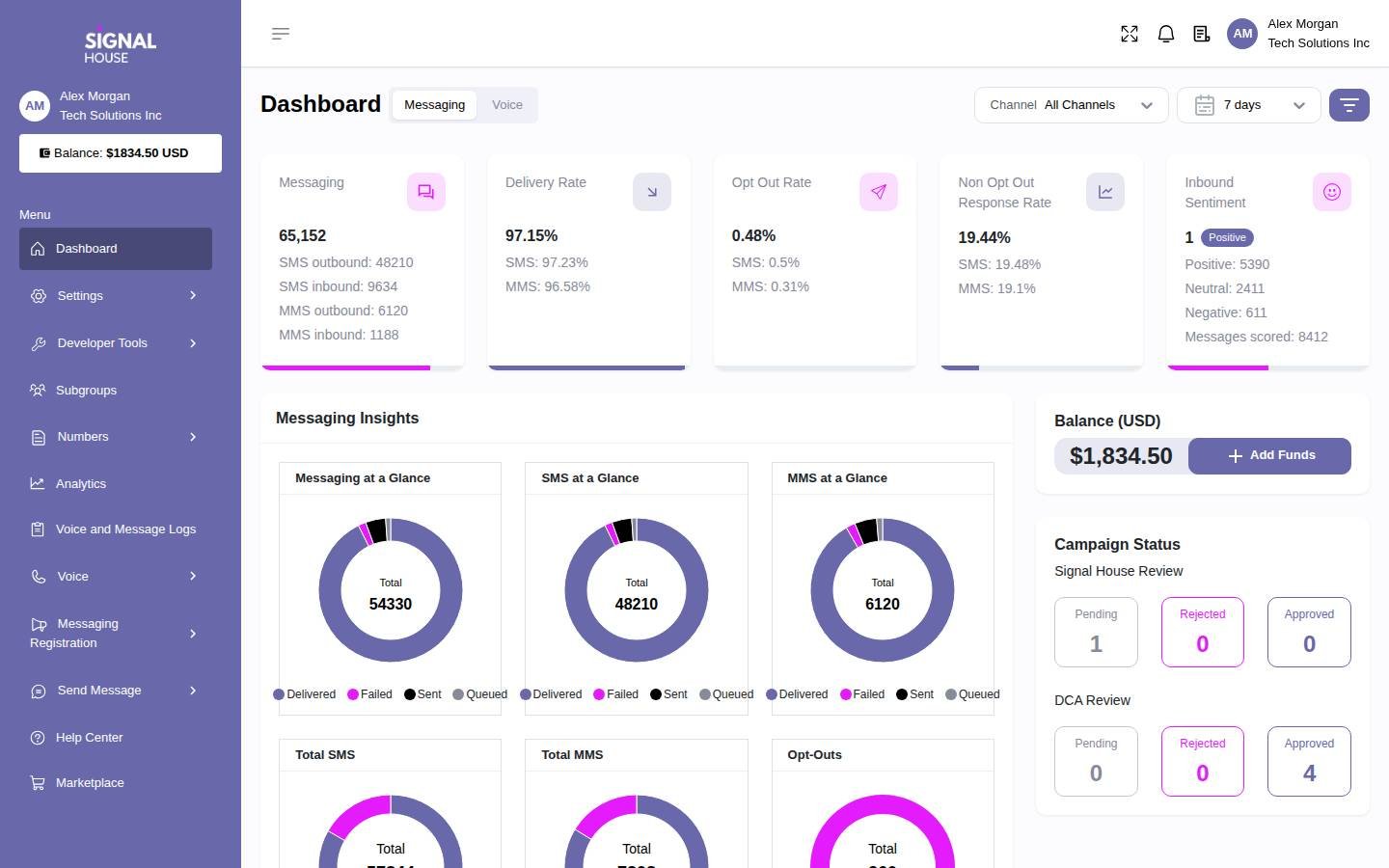
Is Signal House A Cheaper Alternative To Twilio SMS?
For the selected local US outgoing base rates, yes: Signal House’s $0.0065 is below Twilio’s $0.0083 per segment. The difference is $0.0018 per matching outgoing part, or approximately 21.7% of that Twilio base component. It is not a 21.7% reduction in a complete invoice.
At 10,000 matching outgoing parts, the selected base is $65 instead of $83. If both hypothetical accounts incurred an identical $45 carrier component, those usage subtotals would become $110 and $128. Their difference would remain $18 before number rental, registration, applications, taxes and any other exclusions.
Where Signal House Can Be A Better Fit
Consider its guided implementation and supported integrations when those address the business problem. Its catalog includes GoHighLevel, Shopify and Make. Ask the team to demonstrate the actual incoming reply and follow-up workflow, not just the request that sends the first text.
Get the applicable account proposal. A dedicated integration package can have different economics from the general API card. Confirm number rental, registration, incoming rates and any application charges instead of applying an outgoing headline to every part of the customer conversation.
When A Lower Rate Does Not Justify Moving
Keep Twilio when the existing workflow works well and the complete replacement case is weak. A hypothetical $360 migration expense funded by an $18 monthly saving has a simple 20-month payback before additional maintenance. Introductory credit should not be counted as a permanent monthly saving.
Signal House’s vendor terms also restrict specified traffic, including particular third-party lead-generation and affiliate-marketing uses. Confirm the actual business purpose and integration fit. A lower base price does not override service eligibility or establish that every existing Twilio product is supported unchanged.
For a business that fits these requirements, compare Signal House’s account pricing and setup options against the actual Twilio invoice. Keep the decision focused on the complete workflow and recurring cost.
Is Twilio SMS Pricing Worth It For Your Business?
Twilio can be worth the cost when its programmable functions, integration and operating fit support the business. Compare the complete workflow rather than judging value from the smallest selected rate. Existing development knowledge and a working application can have practical value.
It is less compelling when a narrow, supported requirement can move to another provider at a lower total cost without adding disproportionate maintenance. Use a pilot and a worked proposal to test that case. Keeping Twilio is a legitimate result if the cost difference does not justify the change.
Our Twilio alternatives guide explains broader provider choices. This page remains focused on understanding the invoice: measure billable parts, add the relevant components and compare equivalent products before deciding.
Frequently Asked Questions About Twilio SMS Pricing
How Much Does Twilio Charge Per SMS?
The selected standard US base is $0.0083 per outgoing or incoming segment before carrier and other charges. A customer message using 2 parts therefore has $0.0166 of base usage in 1 direction. Destination, sender type and account terms can change the applicable rate.
How Much Does Twilio Cost For 1,000 SMS Messages?
For 1,000 outgoing single-segment US texts at the selected base, usage is $8.30 before carrier and other fees. With the guide’s assumed $4.50 carrier subtotal and 1 local number at $1.15, the selected subtotal is $13.95 before the stated exclusions.
How Much Does Twilio Cost For 10,000 SMS Messages?
The selected base is $83 for 10,000 outgoing single-segment US texts. Under the displayed carrier assumption and local-number rental, the subtotal is $129.15 before campaign charges, registration, optional services and taxes. Longer content or incoming replies increases the required units.
Does Twilio Have A Fixed Monthly SMS Plan?
Its standard programmable messaging model is usage-based, with recurring resources and possible commercial commitments rather than a universal unlimited package. A third-party application can have its own monthly subscription. Compare that package separately from the underlying API charges.
Does Twilio Charge For Receiving SMS?
Yes. The selected standard US incoming base is $0.0083 per segment, with applicable additional components. Budget for replies and automated responses separately. A two-way customer conversation can create more billable events than the initial outgoing campaign.
Why Is My Twilio Bill Higher Than The Per-Message Rate?
The total can include multiple segments, carrier fees, incoming traffic, numbers, registration, optional products and taxes. Check final message records and account usage against the same billing period. A longer template or duplicated workflow can also increase units without a rate change.
Is Signal House Cheaper Than Twilio For SMS?
Its selected local US outgoing base is lower: $0.0065 versus $0.0083 per segment. Compare Signal House for an eligible workflow, using the actual carrier mix, recurring charges and integration costs. The rate difference alone does not establish the lowest complete bill.
Can I Test Twilio SMS For Free?
Yes. The current documented offer is a 30-day trial with product-specific units, including 100 SMS messages, and restrictions on geography, verified recipients and content. Confirm the account’s actual allocation and production setup instead of assuming unrestricted business sending.
Customer Feedback On Twilio And Signal House
The verified G2 product profiles show Twilio at 4.1/5 and Signal House at 4.8/5. These are product/platform customer ratings, not independent tests of SMS invoice accuracy or a promise that either provider produces better results for every workflow.
Twilio reviewer Andres H. described a positive historical developer experience and onboarding, while noting that he had not used it recently. Signal House reviewer Ismail A. praised setup assistance; The T. praised responsiveness and the dashboard but wanted clearer calling guidance. Treat those opinions as questions for the proposed deployment, not current pricing evidence or controlled performance measurements.
Affiliate Disclosure: We may earn a commission through recommendation links, at no additional cost to you. Calculations use stated assumptions and exclusions. No hands-on message delivery, billing audit, migration or support-response testing is claimed.