Signal House is our first Twilio competitor to evaluate for eligible US businesses that want guided setup, business messaging and programmable voice in the same account. Telnyx is our developer-focused alternative, TextGrid has the lowest selected basic outbound cost in our example, and Bandwidth and Infobip deserve enterprise or international evaluations. Choose by the application you need to run, the complete pricing and the work involved in moving.
Twilio competitors solve different problems. Replacing a simple SMS notification is different from moving an interactive phone application, a SIP connection or a customer conversation spanning several channels. This guide compares 8 options for voice and messaging, shows what their published rates actually cover, and explains how to evaluate a replacement without losing the functions your customers already use.
Who Is Twilio’s Biggest Competitor For Voice And Messaging?
There is no single biggest Twilio competitor for every business. Signal House is our leading recommendation for eligible US teams that value guided implementation, supported integrations and combined voice and messaging. Telnyx, Plivo, Bandwidth, Vonage, Sinch and Infobip are relevant alternatives for other requirements. This is a buying recommendation, not a ranking by revenue, market share or customer count.
For a small team, the most useful competitor may be the provider that helps a real workflow launch and remain manageable. For a developer, it may be the API that supports an essential call branch. For an international operation, it may be the platform with the right country and sender arrangements. Those are different decisions, so a useful comparison needs more than 1 overall winner.
Best Twilio Competitors: Category Winners
- Guided US implementation: Signal House. Our first shortlist choice when an available integration and hands-on setup assistance address the business need.
- Developer control and XML evaluation: Telnyx. Compare its programmable voice paths and explicit network-plus-API charges.
- Focused voice and SMS API comparison: Plivo. Useful for evaluating documented telephony features with separate product tariffs.
- Enterprise communications infrastructure: Bandwidth. Evaluate the required combination of numbers, voice, messaging and operational tooling.
- Existing API ecosystem: Vonage Communications APIs. Consider it when related services and development knowledge already exist in the business.
- Conversation-platform design: Sinch. Assess the current messaging path and the API version that meets the project requirements.
- International multichannel planning: Infobip. Request a proposal for the actual countries, senders and application layers.
- Lowest selected basic outbound subtotal: TextGrid. It leads our matched starting-rate model, with important SIP, streaming and speech-input limitations.
Compare Twilio Alternatives For Voice And Messaging
The table compares infrastructure and programmable services, rather than employee phone subscriptions. Rates are selected US starting components. Ratings identify the named G2 product or platform. Detail buttons open the relevant section when no supplied affiliate destination or essential official pricing link is used.
| Provider | Best Fit | Buying Considerations | Pricing & Trial |
|---|---|---|---|
|
| Voice From $0.012/MinSelected US outbound starting tier; local outbound SMS $0.0065/segment. $25 new-account credit advertised.Start With $25 Free Credit | |
|
| Voice From $0.007/MinSelected US outbound component sum: $0.002 API + $0.005 network. Local SMS $0.004/part plus carrier fees. Free account; confirm evaluation scope.Check Voice Pricing | |
|
| Voice From $0.0115/MinSelected US local outbound API rate; SMS $0.0077/segment. Free credits advertised; confirm eligibility.View Pricing & Evaluation Details | |
4. Bandwidth4.4/5 |
|
| Request A Product QuoteConfirm Voice API, messaging and SIP components separately. Build evaluation credits advertised.View Pricing & Evaluation Details |
|
| Account / Destination PricingQuote the required calling, messaging and optional services. Free evaluation credit advertised.View Pricing & Evaluation Details | |
|
| Product / Country PricingSelect the product and destination; unselected $0.00 calculator fields are not a free production offer.View Pricing & Evaluation Details | |
|
| Destination-Specific QuotePAYG channel and application options differ. Free evaluation advertised; confirm its actual allocation.View Pricing & Evaluation Details | |
|
| Voice From $0.0064/MinPublished outbound API rate; SMS $0.0035/segment. Carrier charges and other components additional; trial credits advertised.Check Current Rates |






Which Twilio Products Do You Need To Replace?
Programmable Voice And SIP Trunking Are Different Purchases
Programmable voice allows software to decide what happens when someone calls: play a prompt, collect input, connect an employee or respond to another event. The application contains the business rules. A provider offering a telephone connection does not automatically replace the code controlling that conversation.
SIP trunking usually connects an existing PBX or compatible communications system to telephone destinations. The system may already own menus, queues and employee extensions. Compare trunking with trunking when that is what you use from Twilio. A competitor’s programmable API tariff may include a different service layer and produce a misleading apparent saving.
SMS, MMS And Verification Need Separate Mapping
List the actual messages: appointment confirmations, customer replies, account alerts, media attachments or authentication codes. Twilio messaging products can involve different sender resources, registration and application functions. A replacement that sends a basic SMS does not necessarily reproduce every workflow built around that message.
Do not assume an ordinary messaging API replaces a managed verification product. If verification is part of the application, evaluate that product explicitly. Likewise, WhatsApp, RCS and SMS are distinct channels with their own sender and capability requirements; including 1 does not establish unrestricted access to the others.
Applications And Transport Have Different Owners
Identify where staff read replies, review missed calls and update customer records. That interface could be a CRM, a separate inbox or your own software. Moving transport away from Twilio should not leave employees without the application that makes those events useful.
For example, a 5-person service team may need shared ownership of callbacks, while a developer platform needs reliable event processing across client accounts. Both can buy voice and messaging, yet their acceptance criteria differ. Write the daily task first, then decide which parts belong to the provider, the application vendor and your team.
1. Signal House: Our First Twilio Competitor For Guided US Setup
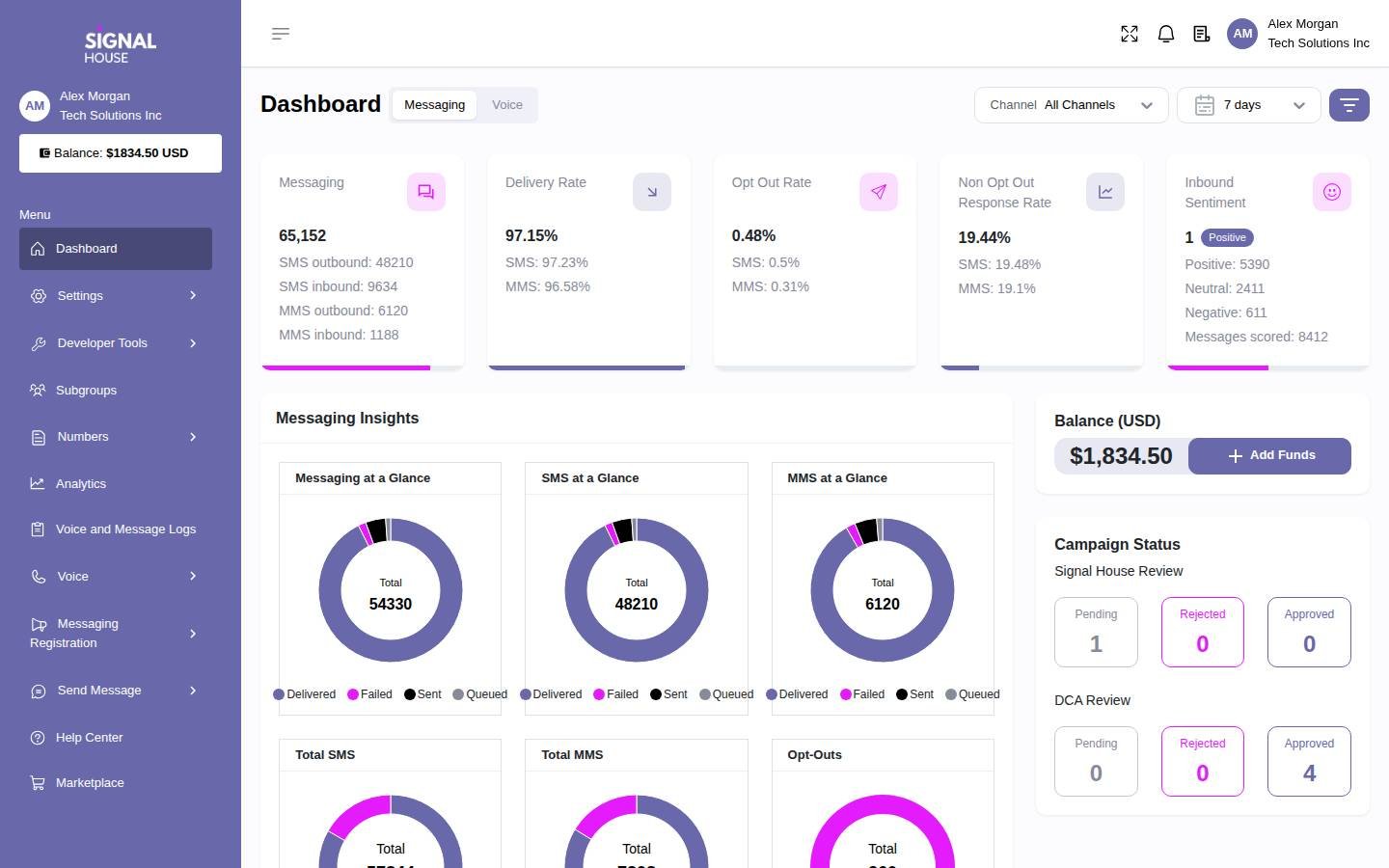
Signal House earns the first position for eligible US businesses that want implementation assistance and a supported business integration alongside voice and messaging. Its integration catalog includes GoHighLevel, Shopify and Make. The reason to shortlist it is the potential operating fit: connect the tools the business actually uses and clarify who helps configure them.
Its voice product describes SIP trunks, registered endpoints, in-browser calling and programmable profiles. That gives a team several connection options to discuss. A profile can direct incoming calls toward forwarding, a registered destination, a trunk or a webhook. These are product capabilities to demonstrate against the required call flow, rather than a promise that every Twilio application moves unchanged.
Why Signal House Can Be A Strong Twilio Alternative
A small agency may value help configuring an eligible client workflow more than another collection of API examples. Ask for a demonstration covering an incoming call, the intended employee destination, a related text and a customer reply. Establish where each action appears in the employee interface and which component owns follow-up.
For an existing PBX, investigate the SIP arrangement directly. For a custom application, investigate its programmable call instructions and callbacks. Similar concepts do not establish TwiML compatibility. Give the implementation team the actual Twilio dependency list and request a written explanation of any changes required.
Signal House Pricing And Limitations
The selected US outbound starting voice rate is $0.012/minute, with inbound at $0.005/minute. Its main pricing page states a 1-minute minimum per answered call and rounding to the next minute afterward. Voicemail counts as answered. Selected local outbound SMS starts at $0.0065/segment before carrier components.
Confirm voice-enabled number rental instead of applying the messaging-number headline automatically. The dedicated GoHighLevel offer also needs its own proposal. Signal House’s terms restrict specified third-party lead-generation and affiliate-marketing traffic, so the actual use case must fit the service terms. The advertised $25 new-account credit is an introductory allowance, not an unlimited or fixed-duration trial.
Best fit: Teams that need guided implementation for an eligible US workflow. Main tradeoff: Product compatibility, voice configuration and the complete account costs still need confirmation. Evaluate Signal House when its assistance and supported integration solve a concrete problem with the existing setup.
2. Telnyx: Twilio Alternative For Programmable Voice And XML Workflows
Telnyx is our developer-focused Twilio competitor when the project needs programmable calling, messaging and an explicit infrastructure comparison. Its product catalog separates Voice API, TeXML and SIP trunking. Start by choosing the intended control model, because that decision determines which application resources and event handlers the team will build.
TeXML provides an XML-based path worth assessing for an existing TwiML application. Telnyx describes reusing compatible XML instructions, but the migration estimate must account for the exact verbs, attributes and surrounding services. The existence of a migration route does not establish support for every Twilio product or every application dependency.
Choose A Clear Voice Control Model
Telnyx’s support documentation advises against mixing TeXML and Call Control commands on the same managed call because their state handling can conflict. It also distinguishes form-encoded TeXML callbacks from JSON Voice API events. Give the developer responsibility for choosing and testing that model before moving production traffic.
This is a useful practical distinction for a Twilio replacement. A working prompt is only the beginning; transfers, recordings and asynchronous actions must remain consistent. Include the application’s less common branches, rather than validating only a successful sample call and assuming the remaining behavior will follow.
Telnyx Pricing Requires Both Calling Components
The published Voice API fee is $0.002/minute plus the applicable SIP calling charge. Combining that with the selected $0.005 outbound starting component produces $0.007/minute before other features and exclusions. The API fee alone is not the complete selected PSTN call price.
Selected local outbound SMS is $0.004 per part plus carrier fees. Destination, sender type, optional functions and account terms can change the total. A free account is useful for evaluation, but confirm the actual testing allocation and restrictions instead of inventing a universal credit amount.
Best fit: Developers prepared to map the Twilio application to the appropriate Telnyx resources. Main tradeoff: The migration still requires technical ownership and feature testing. Its selected base usage is lower than Twilio in our model, but that does not prove a lower complete operating cost for every deployment.
3. Plivo: Focused Twilio Competitor For Voice And SMS APIs
Plivo belongs on the shortlist when a business wants a focused comparison of programmable voice and messaging. Its US pricing pages identify call directions, sender routes and optional functions separately. This makes it possible to discuss specific requirements without treating the entire communications catalog as 1 bundled price.
For a Twilio application, ask the developer to map the actual instructions and events to Plivo’s supported interfaces. Review the call menu, destination connection, input handling, recordings and notifications that the customer journey needs. A shared feature name is a starting point for investigation, rather than proof of identical behavior.
Evaluate The Product And Billing Increment Together
Plivo’s billing documentation distinguishes Voice API 60-second increments from Zentrunk trunking rules, which vary by country. US Zentrunk routes are described separately from the API. A lower interface or trunking amount should not be substituted for the complete programmable PSTN call being compared with Twilio.
Its guidance for external numbers describes forwarding or direct SIP as possible ways to reach an application when a number cannot be ported. That can be worth evaluating during a pilot. Document any additional connection, charge or failure point rather than treating a temporary forwarding arrangement as identical to the final design.
Plivo Pricing And Buying Tradeoffs
The selected US local outbound Voice API rate is $0.0115/minute; inbound is $0.0055/minute. Selected long-code outbound SMS is $0.0077/segment before carrier charges. Those selected outgoing figures are below the Twilio baseline used here, although several other alternatives have lower starting components.
Free credits are advertised. Confirm the eligible products, allocation and destination access, then price the ordinary paid usage after those units are consumed. Include retained recordings or other optional functions where the application requires them, rather than assuming the entry transport rate includes the complete workflow.
Best fit: Developers comparing conventional programmable voice and SMS requirements. Main tradeoff: Product selection, rounding and migration effort need close attention. Plivo is a useful Twilio alternative when the complete proposal fits; it is not automatically the cheapest choice in this shortlist.
4. Bandwidth: Enterprise Twilio Alternative For Communications Infrastructure
Bandwidth is our enterprise evaluation choice for organizations assessing numbers, programmable voice, messaging and related infrastructure together. A larger operation may need a coherent provisioning and administration arrangement across many applications. That is a broader question than the cost of sending 1 text or connecting 1 call.
Its programmable voice documentation uses BXML to describe call-handling instructions. The product covers areas such as menus, forwarding and streaming, while the broader portfolio includes distinct connectivity and messaging offers. Identify the exact combination under consideration instead of assuming that a general network description establishes every regional API capability.
Evaluate Operations Beyond The Initial API Request
For an organization moving from Twilio, ask how numbers are allocated, which team controls configuration and how applications are separated. Include the tasks performed repeatedly: onboarding a client, changing a destination, investigating a failed conversation and reconciling usage. Those tasks can dominate the operating effort after launch.
BXML gives developers a defined instruction model, but it is not TwiML by another name. Map supported verbs and application events deliberately. A migration proposal should explain what changes in the server, what remains in the business system and which behavior needs a separate test.
Bandwidth Pricing And Evaluation
Request a matched product quote for voice, messaging, numbers and any optional functions. The available live pricing material did not establish a sufficiently clear tariff for this article’s numeric ranking, so Bandwidth is outside the lowest-cost calculation. That is an evidence limit, not a claim that a negotiated offer would be expensive.
The voice product advertises Build evaluation credits and discusses 6-second billing. Confirm the actual account minimums, routes and allocation before calculating short-call savings. An increment is commercially useful only when the applicable rate and required service layer are also known.
Best fit: Enterprises or platforms needing a detailed carrier and application proposal. Main tradeoff: The purchase requires commercial and technical scoping. Compare it with the actual Twilio estate rather than treating every product in the portfolio as included in a single tariff.
5. Vonage Communications APIs: Twilio Competitor For An Existing API Ecosystem
Vonage Communications APIs is worth evaluating when a business already has relevant services or development expertise in that ecosystem. Its voice documentation covers interactive menus, speech functions, WebSockets and calling embedded in web or mobile applications. Messaging belongs to the wider programmable portfolio.
The advantage is conditional. Reusing genuine operational knowledge or a related integration can reduce work; merely recognizing the brand does not. Have the implementation owner identify which parts of the proposed Twilio replacement benefit from existing expertise and which still need design, configuration or new testing.
Map NCCO Instructions And Customer Events
The developer documentation identifies NCCO as a voice instruction model. Review it alongside the application’s required call behavior and webhooks. Incoming customer messages, call events and employee actions still need to meet in a usable customer record, even when the channels share a supplier.
For an AI application, separate the telephone connection, live media path, model and business action. A WebSocket capability is not a finished receptionist or scheduling assistant. Demonstrate an actual booking or escalation and confirm what happens when the destination system cannot complete the request.
Quote API Pricing Rather Than Phone-Seat Plans
Request voice and messaging pricing for the required countries, directions and optional functions. Vonage employee-phone subscriptions are different purchases from its Communications APIs. A seat price should not be used to represent a programmable application’s transport bill.
Evaluation access is advertised, but confirm which services and destinations the account can test. No matched fixed combined tariff was established for our calculation, so Vonage receives no numerical cheapest rank here. A clear account proposal can still make it the right business choice.
Best fit: Teams with a concrete existing-stack advantage or a suitable programmable feature requirement. Main tradeoff: Migration and country-specific pricing remain project work. Compare the supported customer journey against Twilio before assigning savings or management benefits.
6. Sinch: Twilio Alternative For A Broader Conversation Platform
Sinch is a relevant Twilio competitor when the project is designing a broader conversation platform and can choose its current APIs deliberately. Its documentation distinguishes voice versions and a Conversation API messaging path. Establish those choices early so the commercial proposal and implementation plan describe the same product.
The voice guides direct new projects toward API v2 while identifying cases where the older version may be required, including particular availability or feature needs. Ask about the deployment status and capabilities that matter to your account. Do not combine features from separate versions into an assumed single offering.
Use The Current Messaging Integration Path
Sinch’s standalone SMS REST documentation directs new integrations to the Conversation API’s SMS channel. Existing legacy examples should therefore not automatically become the blueprint for a new Twilio migration. Confirm the authentication, application resources and event structure the selected route requires.
A wider conversation design can be valuable when several channels serve the same customer. For a narrow domestic notification application, it may introduce unnecessary redesign. Describe the operating need before treating a larger product catalog as a reason to leave a working Twilio deployment.
Sinch Pricing And Version Requirements
Obtain a quote for the required voice, messaging, numbers and application services. Unselected $0.00 fields in a country calculator do not establish free production usage. No matched fixed voice-and-messaging amount is used for Sinch in the numerical comparison.
A free account is a way to begin evaluation. Confirm the actual allocation and deployment scope, and ask the technical owner to identify version-specific limitations. A successful sample request should not stand in for validation of conferencing, in-app calling or another essential function.
Best fit: Businesses intentionally designing a current conversation-platform architecture. Main tradeoff: Product versions and commercial scope need early agreement. Sinch is a useful Twilio alternative when the architecture solves a real requirement, rather than expanding a simple project without a clear benefit.
7. Infobip: International Twilio Competitor For Multichannel Workflows
Infobip is our international multichannel evaluation pick when voice and messaging need coordinated planning across several markets. Its documentation describes low-level APIs alongside broader application layers. This supports a discussion of both the communications route and the interface or orchestration the team actually needs.
Start with the countries your customers use, rather than a large coverage headline. Number availability, outgoing destinations, sender identities and incoming replies are different capabilities. A provider can support an outbound call to a market without offering every local number or two-way text arrangement there.
Design The Cross-Channel Customer Journey
A customer might receive an appointment message, ask a question and request a call from an employee. Establish how those steps share context and who owns the next action. An international design may need different sender arrangements by country while preserving a consistent customer record.
Infobip is worth evaluating for that broader scope. However, a successful domestic demonstration does not validate every proposed destination. Ask for country-specific confirmation and test the difficult part of the application rather than assuming the easiest sample represents the whole deployment.
Separate Channel Pricing From Application Costs
The pricing material distinguishes usage channels and additional application options. Quote the actual call and message traffic separately from any interface, orchestration or contact-center subscription. A competitor’s application package should not be compared directly with Twilio’s bare API rate.
Free evaluation is advertised. Confirm destinations, number access and included units before planning a pilot. No matched fixed combined amount was established for our cost model, so Infobip is a fit-based recommendation rather than an unsupported cheapest claim.
Best fit: International operations that need explicit country and multichannel planning. Main tradeoff: The full proposal can involve several products. Choose it over Twilio when that coordinated scope supports the real customer journey and the commercial terms are acceptable.
8. TextGrid: Lowest Selected Basic Outbound Cost Among These Twilio Competitors
TextGrid has the lowest selected combined base subtotal in the example below. That makes it relevant for a cost-focused Twilio replacement using supported phone-number calls and messaging operations. Its migration documentation describes compatibility with core Twilio-style API paths, fields and response structures, which gives developers specific operations to investigate.
The compatibility scope is limited. Its documentation excludes SIP calling and trunking, live audio streaming, and speech recognition through Gather. A Twilio application depending on those functions cannot treat a low rate as proof of a direct replacement. Eliminate an unsuitable product before spending time on invoice comparisons.
Where A Supported Twilio Migration May Be Practical
A basic application sending customer notifications and handling keypad-based calls may fit the documented functions. Review the required operations and resource identifiers, then test the actual response handling. Changing a hostname alone does not migrate credentials, existing messages, call records or number resources.
TextGrid also requires the application to own future-dated scheduling. It does not support sending through a Twilio Messaging Service SID, and account permissions can affect direct API access. These details matter when an existing integration assumes Twilio resources or handles queued jobs automatically.
TextGrid Pricing And Feature Tradeoffs
The published outbound voice rate is $0.0064/minute and selected outbound SMS is $0.0035/segment. Carrier components and other invoice items remain separate. Trial credits are advertised without a universal allocation established here; confirm the actual account terms and call billing increment.
No G2 customer score was available for TextGrid’s exact profile, so the table omits a numeric rating. That absence does not prove good or bad service. A pilot and a complete proposal are more useful than inventing a score to make every row look identical.
Best fit: Developers with a narrow, compatible workflow and a clear cost objective. Main tradeoff: Essential voice and platform functions may be missing. TextGrid wins our selected basic base-rate example, while a more capable competitor can remain the better Twilio replacement for a complex application.
Twilio Competitor Pricing: Which Alternative Is Cheaper?
TextGrid has the lowest selected subtotal for 10,000 outgoing US local SMS segments and 1,000 billable outgoing local API minutes. Telnyx is next, followed by Signal House, Plivo and the Twilio baseline. This is a matched base-usage example, not a complete-invoice quote or a ranking of every negotiated provider offer.
| Provider | Text Component | Voice Component | Selected Subtotal |
|---|---|---|---|
| TextGrid | 10,000 × $0.0035 = $35.00 | 1,000 × $0.0064 = $6.40 | $41.40 |
| Telnyx | 10,000 × $0.004 = $40.00 | 1,000 × ($0.002 + $0.005) = $7.00 | $47.00 |
| Signal House | 10,000 × $0.0065 = $65.00 | 1,000 × $0.012 = $12.00 | $77.00 |
| Plivo | 10,000 × $0.0077 = $77.00 | 1,000 × $0.0115 = $11.50 | $88.50 |
| Twilio Baseline | 10,000 × $0.0083 = $83.00 | 1,000 × $0.014 = $14.00 | $97.00 |
The selected differences below Twilio are $55.60 for TextGrid, $50.00 for Telnyx, $20.00 for Signal House and $8.50 for Plivo. These differences exclude carrier fees, numbers, registration, incoming traffic, optional functions, taxes, support packages and application costs. Quote-based products are outside this numerical ranking.
Compare Complete Twilio Competitor Pricing Without Inflating Savings
If each account hypothetically incurred the same $0.0045 carrier component on all 10,000 outgoing text parts, it would add $45. Signal House would become $122 and Twilio $142 before the other exclusions. The difference would remain $20; neither subtotal would be a complete invoice.
Replace that assumption with each account’s actual carrier and destination mix. Use the Twilio rate you actually pay, including any discount or commitment. A public list-price comparison is useful for screening competitors, but negotiated pricing can change the result.
How Call Legs And Optional Functions Change A Twilio Comparison
Equal billable minutes are a modeling assumption. Different rounding rules can turn the same elapsed calls into different billed quantities. Include transfers and bridges where they create additional legs, and ask for a worked call trace when several components are involved.
Also list recording, streaming, transcription, speech input and any AI service used by the application. Price each required function on the selected product. Comparing a basic connection with an enriched Twilio call can make a competitor appear cheaper by omitting the very capability the business needs.
Choose The Best Twilio Alternative By Business Requirement
Small Businesses And Agencies Seeking Guided Setup
Start with Signal House when an eligible integration and implementation help address the problem. Compare Telnyx or Plivo when an available developer can own the configuration. Test the interface employees will use after a customer calls or replies, rather than judging only the initial registration experience.
For agencies leaving Twilio, ask how client accounts, balances and ownership are managed. The dedicated integration offer may differ from general API pricing. A client should be able to understand its costs and access arrangements without depending on an undocumented configuration known only to the person who built it.
Developers Replacing A Custom Twilio Application
Compare Telnyx and Plivo against the feature inventory first. Consider TextGrid for supported core operations when the documented limitations are acceptable. Evaluate Bandwidth or Vonage when the project’s broader application or operational requirements justify a more detailed proposal.
The strongest developer shortlist is based on functions that must survive the move. Include callback parsing, authentication, scheduled work and the error path, not just the request that starts a call. A provider supporting the same headline feature can still require substantial changes around it.
AI Voice Applications And Real-Time Media
Shortlist candidates by the actual media and control requirements. Telnyx, Plivo, Bandwidth and Vonage offer relevant programmable paths to investigate. TextGrid’s documented lack of live audio streaming excludes it when that is essential. Signal House requires a demonstration of the exact proposed integration rather than assumed compatibility.
Distinguish the transport from the model and business system. Measure whether the caller reaches a useful outcome, including an escalation when automation cannot finish. A successful audio connection is insufficient if the assistant records an incorrect appointment or cannot transfer to the right employee.
Enterprises And International Customer Communications
Include Bandwidth for coordinated infrastructure planning, Infobip for international multichannel requirements and Sinch for the current conversation architecture. Compare Vonage when related APIs create a practical advantage. Keep Twilio in the evaluation as the working baseline rather than assuming a wider catalog guarantees a better result.
Build a country matrix containing number type, direction, sender identity, replies and optional functions. Obtain a proposal for the real traffic mix. A selected US base-rate winner should not become a worldwide recommendation without evidence for the required destinations.
How To Move From Twilio To A Voice And Messaging Competitor
1. Inventory The Twilio Dependencies
Record the numbers, applications, instruction documents, messaging resources, recordings, callbacks and scheduled jobs in use. Identify the business process each supports. Include dependencies in CRM plugins and automation tools, where a Twilio credential or resource identifier may be hidden from the main application code.
Separate what can stay from what must move. A business may replace 1 notification route while retaining another Twilio product. A narrowly scoped change is easier to estimate and reverse than a broad migration whose owner has not identified the required services.
2. Map The Replacement Resources And Events
Ask the developer to map each required Twilio operation to the competitor’s supported interface. Document credentials, resource identifiers, request fields, callback formats and validation. Familiar XML or endpoint names do not establish identical defaults, authentication or behavior.
Give scheduled and in-progress work an explicit transition rule. If a job was created before the move, decide which provider sends it and how the application prevents a duplicate. Preserve customer preferences across both paths so the migration does not restart messages that should have stopped.
3. Pilot A Complete Customer Conversation
Use controlled numbers and a representative Twilio application journey. Include an incoming voice call, a supported outbound call, an outgoing text and a reply. Add no answer, invalid input and an unavailable employee destination. The useful result is that the application handles each situation correctly.
Record the actual pricing, billed units and optional charges during that pilot. Reconcile them with the proposed pricing before projecting a full month. A test can reveal a rounding rule, an extra call leg or a required service that was absent from the initial spreadsheet.
4. Confirm Number And Sender Transfer Scope
Ask which services move with the number and which require separate configuration or approval. Portability, voice routing and messaging registration are related tasks, but they should not be assumed to complete together. Confirm the customer-facing identity for every required direction.
Keep the existing Twilio arrangement available until the agreed cutover and acceptance checks pass. Assign a person who can pause the move or restore a previous route. Do not delete useful configuration or account access merely because a number-transfer notification has arrived.
5. Calculate Payback And Assign Ongoing Ownership
A hypothetical $800 implementation expense with a genuine $40 monthly net saving has a simple 20-month payback. If extra maintenance absorbs that saving, the financial reason to move disappears. Required functionality or a better operating arrangement can still justify the project, but state that reason clearly.
Assign an owner for billing reconciliation, number administration, application changes and incident handling after launch. The cheapest initial request is not necessarily the lowest operating cost. Compare the replacement’s confirmed pricing with the actual Twilio invoice and the staff effort needed to keep the customer journey working.
Reliability, Support And Number Management When Comparing Twilio Competitors
Test The Whole Application Before Replacing Twilio
For calling, a connected call should also reach the intended destination and produce a usable record. For messaging, an accepted API request should be tracked through the relevant delivery event and incoming reply. These stages can fail separately, so define the business outcome before discussing reliability.
Keep Twilio and competitor identifiers, timestamps and observed behavior for a controlled problem report. The provider may need to investigate a route while the application team investigates processing. A customer rating or marketing availability percentage cannot determine which layer caused a specific failure.
Compare Twilio And Competitor Support Scope
Ask how an urgent incident is submitted, which hours apply and who handles carrier escalation. Distinguish an initial response commitment from a restoration commitment. Request the scope the business needs instead of treating every mention of human support as the same service.
Price a paid assistance tier only when it is part of the proposal. Do not add premium Twilio support to the comparison while assuming a competitor’s included help carries identical obligations. Equally, do not assume that every API-focused competitor lacks live assistance; verify the actual account arrangement.
Keep Number Ownership Clear When Leaving Twilio
For a business or client agency, document who controls numbers, registration records and account permissions. Establish what happens when a client leaves or an administrator changes. These are ordinary operating requirements, not details to discover only after a customer-facing number becomes difficult to manage.
If multiple providers are used, record which one owns each route and how the application avoids duplicate actions. A second account alone is not a working fallback. Test the intended recovery behavior and preserve customer preferences across any alternate path.
When Staying With Twilio Is The Better Decision
Keep Twilio when its application works well, the actual pricing is acceptable and the proposed alternative offers limited benefit after migration and maintenance. A developer’s existing knowledge, a critical integration or a required function can outweigh a small transport-rate difference.
Also keep it when the replacement cannot demonstrate an essential feature or destination. A low basic rate cannot replace missing SIP, streaming or speech input. A useful comparison may end with retaining Twilio for 1 workload while evaluating another provider for a narrower requirement.
Our broader Twilio alternatives guide offers additional context. For another infrastructure comparison, see our Telnyx alternatives guide. Keep the specific product and customer journey consistent when extending the shortlist.
Our Verdict On The Best Twilio Competitors For Voice And Messaging
Signal House is our first recommendation for eligible US businesses prioritizing guided implementation and supported integrations. Telnyx is our developer-focused comparison, while Plivo offers another focused voice and SMS proposal. TextGrid leads the selected basic cost example when its documented limitations fit the application.
For enterprise infrastructure or international multichannel requirements, request scoped proposals from Bandwidth, Vonage, Sinch and Infobip. The best competitor is the one that meets the required workflow at an acceptable complete cost. Keep Twilio when the evidence does not justify changing a working arrangement.
Check Signal House For Your Business
Frequently Asked Questions About Twilio Competitors
Is Signal House A Good Twilio Alternative?
Yes, for eligible US businesses that want guided setup, a supported integration and voice and messaging in the same account. Its selected starting outbound usage is below the Twilio baseline here. Confirm the complete pricing and exact application requirements before treating that comparison as a migration decision.
Which Twilio Competitor Has The Lowest Price?
TextGrid has the lowest selected subtotal in our matched outbound base-usage example. Telnyx is next. This excludes quote-based alternatives and additional invoice components; TextGrid also lacks SIP trunking, live audio streaming and speech recognition through Gather. Lowest selected pricing and best application fit are separate conclusions.
Can I Replace Twilio Without Rewriting My Application?
Sometimes parts can be retained, but a complete rewrite-free migration is not established for every application. Telnyx offers an XML migration path and TextGrid documents supported core compatibility. Check the exact operations, identifiers, authentication and callbacks; unsupported Twilio products still require a separate plan.
Can I Keep My Twilio Phone Number?
Potentially, depending on number eligibility and the services being transferred. Ask Signal House or the chosen competitor to confirm the voice and messaging scope. Keep the existing arrangement active until the agreed transfer and application checks are complete.
Are Twilio Competitors Ready-Made Business Phone Apps?
Not necessarily. These comparisons mainly cover infrastructure and programmable services. Some providers offer additional applications, but an API price does not establish a finished employee phone system. Identify the interface, subscription and administrator that the business will use.
Do These Alternatives Support International Voice And Messaging?
Several provide international products, but availability depends on the country, direction, sender and selected service. Shortlist Infobip for a country-specific multichannel evaluation and compare other providers against the same destinations. Do not infer local-number availability from an outbound calling coverage claim.
Do I Need To Move Twilio Voice And Messaging Together?
No. A staged migration can move a supported workload while retaining other Twilio services. Confirm number capabilities, routing ownership and any registration changes, then document how customer events remain coordinated. Splitting providers adds management work that should be included in the decision.
How Should I Compare Twilio Competitor Evaluation Offers?
Compare the actual products, destinations, account permissions and included units. Signal House advertises a $25 new-account credit; several competitors advertise trial or evaluation access with different terms. A free account is not proof that every proposed feature is available without restrictions or production charges.
Customer Reviews Of These Twilio Competitors
The verified G2 profiles show Signal House at 4.8/5, Telnyx CPaaS at 4.7/5, Plivo at 4.5/5, Bandwidth at 4.4/5, Vonage Communications APIs at 4.2/5, Sinch at 3.8/5 and Infobip at 4.2/5. TextGrid’s profile has no customer score. These samples describe named products or platforms, rather than a controlled comparison of every voice route.
On G2, Signal House reviewer Ismail A. praised onboarding assistance. The T. praised responsiveness and the dashboard while asking for clearer voice setup guidance. That reviewer’s historical comment about missing voice pricing should not replace the published rates used in this guide. Treat individual feedback as useful questions for a proposal, rather than guaranteed outcomes for every customer.
Affiliate Disclosure: We may earn a commission through recommendation links, at no additional cost to you. Category recommendations are editorial judgments; cost examples are illustrative. No hands-on call, message-delivery, migration, uptime or support-response testing is claimed.