Twilio Voice pricing for selected US local Programmable Voice calls is $0.014/minute outbound and $0.0085/minute inbound, before number rental, optional features and taxes. A US local number is listed at $1.15/month. The total depends on the destination, billed duration, number of call legs and services used; 1 customer conversation can generate more than 1 charge.
This guide starts with US dollar rates and explains how to budget for forwarding, browser calling, recordings, conferences and AI workflows. International routes and Elastic SIP Trunking have separate pricing. Use billable minutes for the correct product rather than multiplying a conversation’s elapsed time by the smallest number on the rate card.
 Twilio
G2 Customer Rating: 4.1/5
Twilio Voice Pricing: Selected US Programmable Call Rates
The telephone-network rows describe selected PSTN routes. Browser/app and SIP Interface rows describe connection components, not a complete browser-to-phone or SIP-to-phone conversation. Add the other required legs and features before comparing a finished application.
| Connection Type | Outbound | Inbound | Pricing Boundary |
|---|---|---|---|
| Local PSTN | $0.0140/minute | $0.0085/minute | Selected local routes; number rental and features separate. |
| Toll-Free PSTN | $0.0140/minute | $0.0220/minute | Different incoming tariff and separate toll-free number rental. |
| Browser / App | $0.0040/minute | $0.0040/minute | Client connection component; PSTN and optional features can add charges. |
| SIP Interface | $0.0040/minute | $0.0040/minute | Programmable interface, not Elastic SIP Trunking. Other legs and REFER charges can apply. |
Use Twilio’s official US Voice rate card to check the actual destination and product. Its detailed route list includes exceptions, such as a different Alaska rate, so the selected local figure should not be treated as a universal price for every US number.
How Twilio Voice Pricing Becomes A Monthly Bill
A useful estimate separates connections, optional services, recurring resources and application expenses. Begin with the calls the business needs to handle. Map their routes and features, then apply each billing unit. A single average rate is only useful after those components are understood.
Monthly estimate = billed minutes for every required connection × its applicable rate, plus feature usage, number rental, purchased services and taxes. Add any recurring commitments or setup expenses from the actual proposal. Keep one-time implementation work separate from ordinary recurring usage.
Map Twilio Workflows Before Estimating Minutes
A business might expect 2,000 customer conversations, but some stop at an automated menu, some reach an employee and others enter a conference. Their connection patterns differ. Estimate the number of calls in each category and the time spent in each stage.
For an existing Twilio account, use representative records rather than a short demonstration. A sample call may contain no waiting, transfer or unsuccessful employee destination. The monthly model needs the normal mix and its exceptions, including the features that make the application useful.
Separate Twilio Voice Connectivity From Application Pricing
An API rate does not establish a complete staff phone application, CRM integration or AI assistant. Identify where employees answer calls, change routing and review customer records. The business may purchase that application separately or pay a developer to operate it.
Similarly, a third-party platform can resell Twilio services with its own subscription or markup. Compare that platform’s actual invoice with the direct API proposal. A public transport price alone does not explain the value or total cost of the surrounding software.
Twilio Billing Increments: Elapsed Time Vs Billable Minutes
Twilio’s default billing guidance rounds partial call minutes up to the next full minute. Apply the rule to each billable call leg, rather than adding all elapsed seconds for a month and rounding only once. An account agreement can specify different terms for some items, so confirm the actual pricing model.
| Connected Duration | Billed Minutes | Selected Rate | Base Usage Cost |
|---|---|---|---|
| 30 seconds | 1 | $0.014/minute | $0.014 |
| 60 seconds | 1 | $0.014/minute | $0.014 |
| 61 seconds | 2 | $0.014/minute | $0.028 |
| 120 seconds | 2 | $0.014/minute | $0.028 |
| 121 seconds | 3 | $0.014/minute | $0.042 |
Short Twilio Calls And Rounding Differences
Consider 100 connected single-leg calls lasting 65 seconds each. Their aggregate elapsed time is approximately 108.33 minutes, but whole-minute billing produces 200 billed minutes. At the selected local outbound rate, that is $2.80 of connectivity before other charges.
A quote comparison should apply each provider’s rule to the same call records. Do not multiply total elapsed minutes by a lower rate and call the result a verified invoice saving. Signal House also publishes a 1-minute answered-call minimum and subsequent whole-minute rounding, which belongs in its evaluation.
Twilio Voice Billing For Answered Calls And Voicemail
The customer’s perception of an answer can differ from the application’s connection state. A platform may answer an incoming call to play a menu while it attempts to reach an employee. That initial connection is not waiting for the employee before it begins serving the caller.
Signal House explicitly describes voicemail as answered and unconnected ringing as unbilled. For Twilio, reconcile actual statuses and account usage rather than assuming every unsuccessful business outcome is free. A call that reached voicemail or an automated application is different from a request that failed to connect.
Twilio Call Legs: Why Forwarding Can Cost More Than 1 Rate
A call leg is a separate connection in the application’s call flow. A customer connecting to a Twilio number creates an incoming leg. Connecting that customer to another telephone destination can create an outgoing leg. Both can contribute to the cost of the same conversation.
Example: Twilio Local Call Forwarding Pricing
Using the selected local rates, the combined connectivity component is $0.0085 incoming plus $0.014 outgoing, or $0.0225 per minute while both legs are billable. For 1,000 matching billable minutes on each connection, that is $22.50 before number rental and optional services.
The 2 legs need not have identical durations. If an incoming caller spends 1 minute in a menu and then 3 minutes connected to an employee, the simplified billed-duration example is 4 incoming minutes and 3 outgoing minutes. That produces $0.034 + $0.042 = $0.076 of connectivity, before other components.
Example: Twilio Browser-To-Phone Voice Pricing
A browser/app connection and a PSTN destination are separate components. Under the selected rates, 1,000 matching minutes at $0.004 and $0.014 produce $4 + $14 = $18 of connectivity. The $0.004 browser headline alone does not cover the entire browser-to-phone example.
Confirm the actual topology and how its durations are measured. Transfers, additional destinations or a different application design can change the components. Use a diagram or a written call trace in the commercial discussion so the developer and buyer are costing the same arrangement.
Twilio Voice Menus And Hold Time
Once a caller is connected to an application, time spent hearing prompts or waiting for an employee can remain part of the active connection. Estimate that stage separately from the employee conversation. Otherwise, an apparently accurate average handling time can omit a material portion of the incoming usage.
Improving routing can reduce unnecessary waiting, but do not shorten an interaction merely to chase a lower bill. A clear menu and useful fallback may prevent repeat calls. Measure the customer outcome and the complete handling cost rather than optimizing only the length of 1 connection.
Twilio Voice Feature Pricing: Charges Beyond The Call
Optional services use different billing units. Recording minutes, retained storage, participant minutes and feature invocations should not be mixed into a single unexplained rate. The following selected card entries illustrate the components to ask about when reviewing an application.
| Feature | Selected Rate | Billing Basis | What To Check |
|---|---|---|---|
| Call Recording | $0.0025 | Per recording minute | Recording configuration and actual recorded duration. |
| Recording Storage | $0.0005 | Per stored minute per month at the selected tier | Retention, volume tier and account measurement rules. |
| Conference Mixing | From $0.0018 | Per participant per minute | Participant connectivity and other conference functions. |
| Answering Machine Detection | $0.0075 | Per call using the service | Whether the application enables and uses it. |
| Media Streams | $0.0044 | Per billed service minute | Required media path, directions and billed units. |
| Conversation Relay | $0.07 | Per service minute | Separate connectivity, application and model costs. |
| Gather Speech Recognition | $0.02 | Per use for the selected default option | Different speech models/options have different charges. |
Twilio Recording And Storage Pricing
At the selected recording rate, 1,000 billable recorded minutes add $2.50. If 1,000 stored billable minutes are charged for a month at the displayed storage rate, that component is $0.50. These are separate calculations, not a claim that connectivity or transcription is included.
Retention matters because audio can remain after the conversation ends. Ask how storage usage is measured over the billing period and which tier applies. Do not estimate an exact recurring invoice from a single end-of-month file count without checking those rules.
Twilio Conference Pricing And Participant Charges
A conference with 3 participants for 10 matching billable minutes creates 30 participant minutes. At the selected starting mixing rate, the component is $0.054. If all 3 also require the selected outbound local PSTN connections for those minutes, connectivity adds $0.42, producing $0.474 before other charges.
This is a deliberately specified illustration. Participants joining through different routes, remaining for different durations or using additional functions require their own calculation. Do not multiply a meeting’s wall-clock duration by 1 local rate and assume every participant connection is covered.
Twilio Per-Call And Per-Use Feature Charges
If 1,000 calls use the selected answering-machine detection service, the component is $7.50. If an application invokes the displayed default speech-input option 1,000 times, that selected component is $20. The count of feature uses can differ from the count of conversations or minutes.
Make the developer identify what triggers each service. An application can ask for input more than once or enable a feature only on a subset of calls. The budget should follow those events, with the actual selected model and account terms.
Twilio AI Voice Pricing: Connectivity Is Only Part Of The Stack
An AI calling application can involve telephone connectivity, a speech or media service, an application server, a model and a business-system integration. Identify which supplier provides each layer and what the selected product already includes. Do not add overlapping services simply because they appear on the same rate card.
Example: Twilio Outbound Voice With Conversation Relay
If a design uses the selected $0.014 outbound connection and $0.07 Conversation Relay service for the same 1,000 billed minutes, those 2 components sum to $84. The combined component rate is $0.084/minute. This is not a complete AI-agent subscription or a quote for every model and application cost.
Confirm which durations and functions are billable in the actual design. A model’s usage, a CRM subscription or developer maintenance can remain outside these 2 lines. Conversely, a function included by the selected service should not be added again as a separate hypothetical charge.
Twilio Media Streams Vs A Finished AI Voice Assistant
At the selected rate, 1,000 billable Media Streams service minutes would add $4.40. That figure does not establish that an AI assistant can understand the caller, make a booking or transfer correctly. The speech, model and business-action components still need a defined implementation.
Test the difficult customer journey: an unavailable employee, a failed booking request or a caller who changes the request. A low media connection price is only useful when the surrounding application completes the required task and has a usable fallback.
Compare Twilio AI Voice Pricing On Equivalent Scope
A packaged receptionist can include setup and operating tools that a bare programmable rate does not. A custom Twilio design can offer control the package does not provide. List the required outcomes, included services and maintenance owner before comparing the monthly totals.
Avoid presenting the telephone rate as the whole AI cost, or loading a custom application with optional features it will never use. The useful commercial question is how much the supported voice workflow costs at the expected workload.
How Much Does Twilio Voice Cost Per Month?
These selected examples use billable minutes for a single PSTN leg and 1 paid number of the matching type. They exclude additional legs, recording, conferencing, speech services, AI, purchased assistance and taxes. Introductory credits are not used to make recurring costs appear lower.
| Scenario | Usage Calculation | Number Rental | Selected Monthly Subtotal |
|---|---|---|---|
| 1,000 Local Outbound Minutes | 1,000 × $0.014 = $14.00 | $1.15 | $15.15 |
| 10,000 Local Outbound Minutes | 10,000 × $0.014 = $140.00 | $1.15 | $141.15 |
| 10,000 Local Inbound Minutes | 10,000 × $0.0085 = $85.00 | $1.15 | $86.15 |
| 10,000 Toll-Free Inbound Minutes | 10,000 × $0.022 = $220.00 | $2.15 | $222.15 |
Example: Twilio Local Number With Both Directions
Assume 1,000 local outbound and 3,000 local inbound billable minutes, without an additional forwarding leg. The selected connectivity is $14 + $25.50 = $39.50. Adding 1 local number gives $40.65 before the exclusions above.
Keep direction-specific totals in the worksheet. An inbound-heavy support line and an outbound reminder application can have different costs at the same combined minute count. The number of employees does not determine the mix by itself.
Example: Twilio Forwarding Application Costs
For 1,000 matching billed minutes on a local incoming leg and a local outgoing forwarding leg, selected connectivity is $22.50. With 1 local number, the subtotal is $23.65. Add any extra incoming menu time and optional functions required by the real application.
This example explains a common source of budget differences: the customer experiences 1 conversation, while the application creates 2 billable connections. A proposal should make that topology visible before projecting a monthly total.
Model A Mixed Twilio Voice Workload Before Choosing A Budget
Separate Automated Handling From Employee Connections
Suppose an application produces 10,000 local incoming billable minutes. Of those, 4,000 minutes also involve a separate local outgoing connection to an employee. Assume recording is used for exactly 4,000 billed recording minutes. These are specified billing quantities, not an estimate derived from an untested average conversation length.
At the selected Twilio rates, incoming connectivity is $85, the additional outgoing component is $56 and recording is $10. Adding 1 local number gives $152.15 before storage, additional services, application expenses and taxes. This example shows why an inbound-only estimate can be too low when the workflow also connects an employee.
The opposite mistake is charging the second connection for all incoming time when only part of the workload uses it. Keep the stages separate. A voice application serving a caller entirely through automation can have a different topology from a customer interaction transferred to another telephone number.
Give The Pilot A Commercial Acceptance Checklist
Ask the implementation owner for 3 outputs: a trace of the working customer journey, a mapping from that trace to billable items, and a clear explanation of what employees do when the normal route cannot complete. These address technical behavior, pricing and daily operation together.
Include a representative transfer, voice recording condition and unavailable destination where the application uses them. Reconcile the actual billed units with the quote. The point is to explain the expected recurring invoice, rather than prove that a single successful Twilio request can be made.
For a replacement proposal, use the same acceptance criteria. A lower voice rate does not establish equivalent recording access, event handling or employee workflow. Conversely, an additional product should only be priced when it is part of the supported design the business intends to buy.
Normalize The Quote Before Comparing Suppliers
Check the currency, destinations, number quantity, billing increments and period in every proposal. Separate per-account charges from per-number and per-employee software. A quote for 1 retained number cannot be compared directly with an existing account holding several customer-facing identities.
Keep discounts and promotions visible as separate assumptions. Ask which pricing applies after introductory units are consumed and whether a commitment changes the minimum spend. Compare normal paid Twilio usage with normal paid replacement usage so the decision remains useful after launch.
Distinguish Account Funding From Consumed Usage
Adding funds to an account and consuming a billable resource are different events. Use the invoice and relevant usage categories to explain expense over the chosen period. A deposit alone does not tell the business how many calls connected, which voice features ran or how long recordings remained stored.
Assign someone to review the forecast after the first representative month. Update the worksheet when routing, destination mix or optional services change. A useful budget is a maintained explanation of the application’s pricing, rather than a static total copied from an early demonstration.
Twilio Programmable Voice Vs Elastic SIP Trunking Pricing
Programmable calling and SIP trunking are related services with different roles. An existing PBX may already supply menus and employee handling, with a trunk providing telephone connectivity. An API application may instead use programmable instructions and events to control the customer conversation.
Twilio’s separate US Elastic SIP Trunking rate card lists termination starting at $0.0011/minute, local origination at $0.0034/minute and toll-free origination at $0.013/minute. Those product figures should not be substituted automatically for Programmable Voice.
Why The Lowest SIP Number Is Not The Whole Comparison
A starting termination rate depends on the selected route and product. It does not establish that every call, region or required application feature has that price. Request the detailed network schedule and match the service layer before calculating a saving.
Likewise, the $0.004 SIP Interface entry in the first table is a programmable connection component, not the same tariff as Elastic SIP Trunking. Bring Your Own Carrier arrangements have their own component costs. Identify the product configuration before combining prices.
Do Not Use The Signal House Box As A Universal SIP Ranking
The box compares Signal House’s starting US call rates with selected Twilio Programmable Voice routes. Twilio’s separate trunking card contains different, potentially lower connectivity figures. A PBX buyer should request matched SIP proposals from both providers.
Choose the design that meets the actual requirement. A lower trunking tariff can be useful for an existing system; a programmable application can justify a different arrangement. Price the necessary software and management work along with the network connection.
Twilio International Calling Rates And Destination Differences
The selected US figures are not a global flat rate. A call’s destination, number type and selected route can change the applicable tariff. Use the actual number and country rather than the business’s billing address to identify the proposed connection.
Even a country heading can contain route exceptions. The detailed US card distinguishes Alaska from its standard US and Canada example. A useful international budget separates material destinations and directions instead of assuming all numbers share the selected local rate.
Twilio Number Availability And Voice Coverage
A provider’s ability to connect an outgoing call to a country does not establish that it sells every local number type there. Confirm the customer-facing caller identity, incoming availability and any required resources separately from the outgoing destination price.
Use a country worksheet with the proposed sender or caller identity, direction, destination type and features. When costs depend on the origin as well as destination, include that information in the quote. Do not use a domestic starting price to promise an international monthly total.
Check Twilio Voice Destinations Before A Pilot
Ask the technical owner to confirm that the intended route and features are enabled for the account. A successful domestic call does not validate an unresolved international destination. Use controlled numbers and a clearly scoped evaluation to test the required journey.
For mixed communications, price texting and other channels separately. A telephone rate does not include SMS usage or a managed verification product. The application can share customer context while the underlying events still have distinct charges.
Twilio Calls Per Second, Concurrency And Volume Pricing
Calls per second describes how quickly calls are initiated; concurrency describes how many remain active at once. Monthly billed minutes are another measure. A business can have modest total usage but require a short burst of new calls that needs separate capacity planning.
Twilio’s rate card includes a CPS pricing section and committed-use discussion. Obtain the applicable account configuration and charges rather than assuming an unlimited calling allowance follows from a low per-minute price. No universal high-volume discount is calculated in this guide without a matched proposal.
Price The Actual Twilio Voice Traffic Pattern
Record ordinary demand and expected peaks. An appointment-notification campaign may initiate many short calls together, while a service desk may have fewer but longer incoming conversations. The same monthly total can therefore create different technical requirements.
Ask whether the proposed account can handle the required burst and what happens when it cannot immediately start a call. Capacity, queue behavior and billing should be explained by the implementation owner. A pricing spreadsheet cannot validate the application’s peak-time behavior.
Separate Twilio Published Pricing From Negotiated Commitments
A discount should identify the product, traffic, threshold and commitment it applies to. Do not import a storage tier into telephone connectivity or assume a rate negotiated for 1 route applies everywhere. Use an explicit worked quote for the business’s actual mix.
Signal House’s published outgoing bands are graduated, with the initial rate applying to the first band. Its pricing page gives a 250,000-minute example of $2,550, using the first 100,000 at $0.012 and the next 150,000 at $0.009. Do not apply the second-band figure to all minutes or compare it with an unmatched Twilio list-price workload.
How To Audit An Unexpected Twilio Voice Bill
Match Twilio Voice Billing Periods And Account Scope
Begin with the invoice period, currency and included accounts or subaccounts. Twilio’s reconciliation documentation identifies time-zone differences as a possible source of disagreement. Normalize the scope before deciding that a rate or minute count is wrong.
Separate incoming, outgoing, client and optional-service categories. Include recurring numbers that may no longer appear in a current resource view. An application log is a record of connectivity events, not necessarily a complete historical invoice ledger.
Use Twilio Final Usage Records Alongside Call Logs
The Call resource’s price field reflects connectivity and can be populated after a call completes rather than immediately. It does not include every related feature, such as recording, speech services or other optional operations. Adding that field alone is not a complete account-cost audit.
Twilio recommends the Usage API for reconciling billing categories. Use it with the invoice and the application’s call records. Explain rounding, deleted resources, additional features and the timing of the records before attributing a difference to an unexplained extra charge.
Trace Twilio Parent And Additional Voice Connections
Check whether a customer interaction created another destination, client leg or conference participant. A routing change can add billable units without changing the selected unit rate. Compare a representative call trace with the model used for the original budget.
When asking for help, provide relevant identifiers, timestamps and the expected behavior. Keep unnecessary customer information and credentials out of the report. A clear controlled example is more useful than a total balance with no explanation of the workflow.
How To Reduce Twilio Voice Costs Without Breaking The Call Flow
Remove Unnecessary Voice Connections And Repeated Attempts
Review the actual routing before changing providers. An obsolete destination, accidental duplicate trigger or repeated retry can add usage that the business never intended. Assign ownership of each business event so multiple tools do not independently initiate the same follow-up call.
Preserve a useful fallback for an unavailable employee. Repeatedly dialing the same destination may not improve the outcome. Define when the application should stop, capture a callback request or offer another supported next step.
Use Optional Voice Features Where They Add Value
Check which calls need recording, advanced speech, media services or detection. Do not enable a function on every event merely because the integration offers it. Equally, do not remove a required feature without considering the customer and business consequences.
Give retained audio a defined purpose and owner. Review the appropriate retention and access arrangements with the business rather than keeping every recording indefinitely by accident. The cost decision should reflect the organization’s actual requirements.
Measure The Completed Business Outcome
Track successful customer connections, useful callback requests or completed appointments separately from raw call attempts. A cheaper minute is not necessarily a cheaper result when callers cannot complete the task or employees need to repeat the conversation.
For comparison, use the relevant outcome count and the applicable cost scope. A campaign yielding 30 useful appointments should not be evaluated only by cost per dial. Avoid attributing every result to the calling system when other staff actions or channels also contributed.
Build A Twilio Voice Budget That Another Person Can Recheck
Record The Twilio Topology And Commercial Assumptions
Keep the destination, direction, number type, connection components, billing increments and optional features together. Note whether durations are elapsed or already billable. A colleague should be able to reproduce the total without guessing which rate belongs to which part of the application.
Use low, expected and high scenarios based on ordinary variation in call count, duration, transfers and feature use. A short demo is rarely a useful monthly distribution. Compare the first representative operating period with the worksheet and revise assumptions that proved inaccurate.
Compare The Current Invoice With A Matched Replacement Quote
Use the actual Twilio agreement, including discounts and required services. Ask a competitor to quote the same destinations and functions. Do not compare a bare replacement connection with an existing application that includes recording, an employee interface or paid assistance.
Also include implementation and maintenance. A pricing difference worth $20/month does not fund unlimited migration work. Identify which business benefit justifies moving and how long any genuine recurring saving takes to recover the setup expense.
Use Alerts As An Investigation Trigger
A budget notification should prompt review of usage, routing and account activity. Do not assume an alert automatically prevents all further call charges. If the business requires an enforced limit, the implementation owner must confirm how it works across the account and connected applications.
Plan the response for essential customer communications. A blanket stop can interrupt useful service, while an unrestricted retry can increase duplicate traffic. Decide which workflow can pause, who investigates and how employees continue the business process.
Can You Test Twilio Voice For Free?
Twilio’s current trial documentation describes a free 30-day trial with product-specific units, including 75 voice minutes. This differs from older pricing-page references to a shared dollar credit. Use the current trial instructions and account tracker for the actual evaluation.
Verified-recipient, geographic and feature restrictions apply. Some trial behavior uses templates or restricted instructions. A successful sample does not validate every production destination, number arrangement or optional function in the proposed application.
Plan production resources separately from trial numbers and introductory units. The recurring examples in this guide assume paid usage rather than deducting a promotion indefinitely. Confirm the post-upgrade account terms before treating the evaluation result as a production budget.
Is Signal House A Cheaper Twilio Voice Alternative?
For the selected US Programmable Voice comparison, Signal House’s starting figures are lower: $0.012 outbound versus $0.014, and $0.005 inbound versus $0.0085. At 1,000 matching billable minutes, the selected outbound base difference is $2; the local incoming difference is $3.50.
For the earlier mix of 1,000 outgoing and 3,000 incoming minutes, Signal House’s selected usage would be $12 + $15 = $27, compared with Twilio’s $39.50. The difference is $12.50 before number rental, optional services, taxes and application expenses. No full-invoice saving is established by that arithmetic alone.
Where Signal House Can Be Worth Evaluating
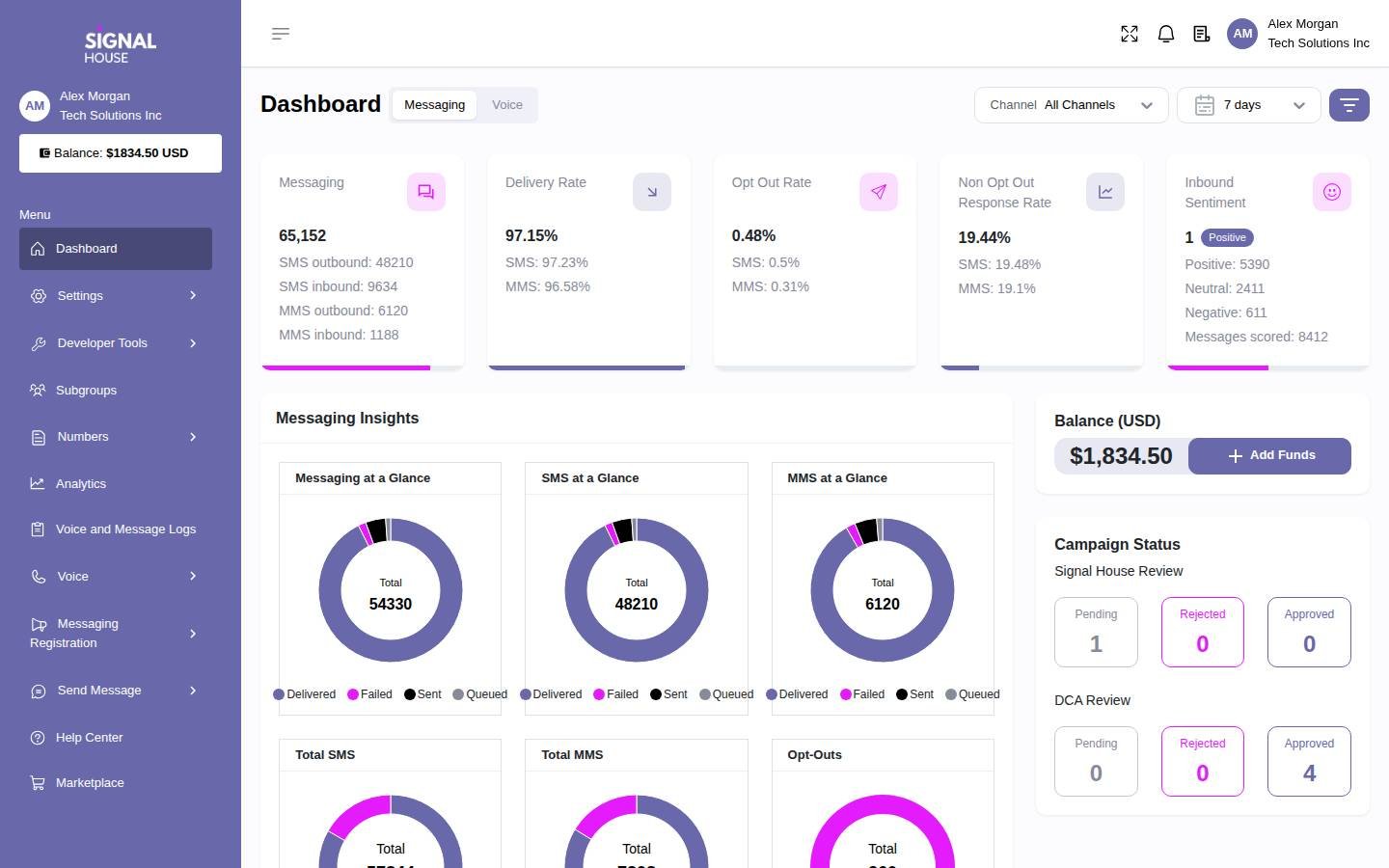
Its product describes SIP trunks, registered endpoints, browser calling and programmable profiles. Investigate the actual voice configuration the business needs. Guided implementation can be valuable when it resolves a real setup problem, but it should not be treated as a guarantee that every existing Twilio instruction works unchanged.
Request voice-enabled number pricing rather than importing the messaging-number headline. Confirm optional functions, billing increments and the employee interface. For a supported integration, have the provider demonstrate the call path and any related message workflow on the proposed account.
When The Rate Difference Is Too Small To Justify A Move
A hypothetical $400 migration funded by $20 of genuine monthly net savings has a simple 20-month payback. Added maintenance can reduce or eliminate the saving. Required functionality or a better operating arrangement can still justify a change, but identify that benefit explicitly.
Review the vendor’s service eligibility for the actual use case and compare matched products. The separate Twilio SIP rate card is not represented by the box’s Programmable Voice baseline. Evaluate Signal House’s calling options and account quote when its supported configuration and full commercial proposal fit the requirement.
Is Twilio Voice Pricing Worth It?
Twilio can be worth its cost when the required programmable functions, existing integration and operating knowledge support the business. Compare the complete customer journey and the staff work needed to maintain it. A functioning application can have value beyond the selected minute rate.
A replacement is more compelling when it demonstrably meets the same requirement at a lower complete cost or solves a concrete limitation. Use a representative pilot and a worked quote to assess that case. Keeping Twilio is a valid outcome when the expected benefit does not justify the change.
For a wider shortlist, our Twilio alternatives guide offers additional context. Keep API calling, trunking and packaged employee applications separate when extending the comparison.
Frequently Asked Questions About Twilio Voice Pricing
How Much Does Twilio Charge Per Minute?
The selected US local Programmable Voice rates are $0.014/minute outbound and $0.0085/minute inbound. Toll-free incoming, client connections, SIP products and international routes have different charges. Include each required connection, number rental and optional service before estimating the complete cost.
How Much Does Twilio Cost For 1,000 Voice Minutes?
Selected single-leg local outbound connectivity is $14 for 1,000 billable minutes, or $15.15 with 1 paid local number. Selected local incoming connectivity is $8.50 before number rental. These examples exclude additional legs, features, application costs and taxes.
Does Twilio Charge For Both Sides Of A Forwarded Call?
Yes, a typical application connecting an incoming caller to another phone can create separately billable incoming and outgoing legs. Under the selected local rates, matching durations sum to $0.0225/minute before other components. The legs can have different durations because of menus or waiting.
Does Twilio Round Calls Up To A Full Minute?
Default billing guidance rounds partial minutes up for each billable connection. For example, a 61-second single leg becomes 2 billed minutes. Check the actual agreement and product rules, because account-specific terms can change the applicable increment for some billable items.
Is Twilio Browser Calling Only $0.004 Per Minute?
That is the selected browser/app connection component, not a complete browser-to-PSTN price. The illustrated local telephone destination adds its own $0.014/minute component. Confirm the actual topology and optional functions before applying the combined amount to a budget.
Is Signal House Cheaper Than Twilio For Voice?
Its selected US starting rates are lower than the local Programmable Voice baseline used here. Compare Signal House using the actual destinations, number rental and required features. This is not a claim that it is cheaper than every Twilio trunking route or complete application.
Does The Twilio Call Price Include Recording And AI?
No. The basic connectivity amount does not automatically include every recording, speech, media or AI function. Identify the selected services, units and included capabilities. Do not add overlapping products blindly or treat a bare telephone connection as a complete AI assistant.
Is Twilio Voice Free To Try?
Yes. The current documented offer is a 30-day trial with product-specific units including 75 voice minutes. Restrictions apply to recipients, geography and features. Use the account’s current trial terms rather than an older universal dollar-credit reference.
Customer Feedback On Twilio And Signal House
The verified G2 product profiles show Twilio at 4.1/5 and Signal House at 4.8/5. These are named product/platform customer samples, not controlled tests of voice routes, invoice accuracy or the performance of a particular application.
Twilio reviewer Andres H. described a positive historical developer and onboarding experience while acknowledging that he had not used it recently. Signal House reviewer Ismail A. praised setup assistance; The T. praised responsiveness and the dashboard but wanted clearer voice guidance. Treat individual opinions as questions for the proposed deployment, not proof of current prices or guaranteed outcomes.
Affiliate Disclosure: We may earn a commission through recommendation links, at no additional cost to you. Calculations use stated products, assumptions and exclusions. No hands-on call testing, billing audit, migration, uptime or support-response testing is claimed.