Signal House is the stronger starting point for a new project needing programmable voice and business messaging together. ClickSend is better suited to teams prioritizing an SMS dashboard, free incoming SMS and pay-as-you-go SMS campaigns. ClickSend no longer offers voice to new customers. Signal House also has lower selected US toll-free outgoing SMS components, although complete costs depend on carrier fees, replies, funding and connected software.
Signal House vs ClickSend is therefore a comparison of different purchasing paths, rather than 2 interchangeable phone systems. This guide separates calling from automated spoken messages, explains the difference between prepaid credit and consumed service, and shows where each provider fits. The most useful choice depends on what employees need to do after a customer calls or replies.
 Ratings below use the named G2 product profiles. They summarize customer feedback across each product, rather than independently measuring every calling route, integration or messaging campaign.
Signal House Vs ClickSend: Quick Comparison
Start with the required channel. A business needing staff calling and customer SMS should evaluate Signal House's proposed voice configuration, or another eligible calling platform, before comparing SMS rates. A business that already has its phones may prefer ClickSend for campaigns, reminders and incoming replies. Neither choice eliminates the need to confirm SMS sender approval, employee access and complete account charges.
| Provider | Best Fit | Buying Considerations | Pricing & Evaluation |
|---|---|---|---|
|
| Toll-Free SMS $0.0079/SegmentSelected US outbound base; fees extra. Local SMS $0.0065/segment. Voice starts $0.012/min out; $0.005/min in.Review Offer And $25 Account Credit | |
|
| SMS $0.0089–$0.0273/UnitSelected US sending bases; qualifying top-ups $20–$2,000. Carrier fees and numbers extra.No card required; restricted US/Canada recipient and content.Start 14-Day Free Trial |


Signal House Vs ClickSend: Which Provider Is Better?
Best Starting Point For New Voice And Messaging Projects: Signal House
Signal House lists programmable calling, SHML instructions, SIP options and messaging within its platform. That makes it the relevant starting point in this comparison when a new customer needs both channels. The recommendation is based on documented service availability, rather than a claim of superior call quality. Ask for a demonstration of the precise calling configuration and employee experience you intend to purchase.
A sales team may need to call from a CRM, while a service desk may need incoming routing and transfers. These requirements can involve different software, numbers and charges. Confirm which functions are supplied directly and which depend on a connected application. An API with calling capabilities does not automatically include every feature of a finished office phone subscription.
Best Starting Point For Dashboard-Led Text Campaigns: ClickSend
ClickSend combines a SMS campaign interface, scheduled messaging, contact management and developer connections. Its free incoming SMS and unlimited user proposition are useful shortlist factors for teams coordinating reminders or permission-based SMS outreach. Ask employees to demonstrate how they read a reply, identify its customer and complete follow-up. A successful bulk SMS send is only the beginning of a usable customer conversation.
This fit is strongest when the business already has an appropriate calling arrangement. ClickSend's SMS tools can complement it without pretending to replace it. Include the cost of the retained phone service when comparing the complete business communications budget. Keeping a working phone system can also reduce migration work if the actual problem is sending and receiving messages.
Lower Selected Toll-Free Outgoing Text Component: Signal House
For the selected US toll-free model, Signal House publishes $0.0079 per outgoing segment. ClickSend's displayed US sending components range from $0.0273 to $0.0089, depending on the qualifying top-up. Signal House is lower on those selected outgoing components. However, ClickSend's free SMS receiving, business account features and funding rules need separate consideration before declaring a complete monthly savings figure.
Comparing the same sender matters. Signal House also lists a local-number rate, but substituting that cheaper local component into a toll-free workflow would blur the actual purchasing decision. The examples below keep the Signal House toll-free rate visible and distinguish ClickSend's deposit thresholds from monthly usage. Actual account pricing and a complete quote should control the final purchase.
Best Documented Free Incoming Text Offer: ClickSend
ClickSend explicitly absorbs inbound carrier charges as well as charging no platform fee for receiving those messages. That can matter for support conversations, surveys and appointment replies. Signal House lists incoming carrier components, but its complete platform receiving base was not established in the reviewed public pricing. Request that missing component instead of assuming incoming traffic is free on both services.
Free receiving does not make every downstream action free. Forwarding an incoming message to an employee by SMS creates a new outgoing SMS message. A connected CRM, workflow service or staff application may also have its own subscription. Price the actual conversation path, including notifications and follow-up, rather than treating a free incoming event as a completely free customer interaction.
Signal House Overview: Programmable Calling And Business Messaging
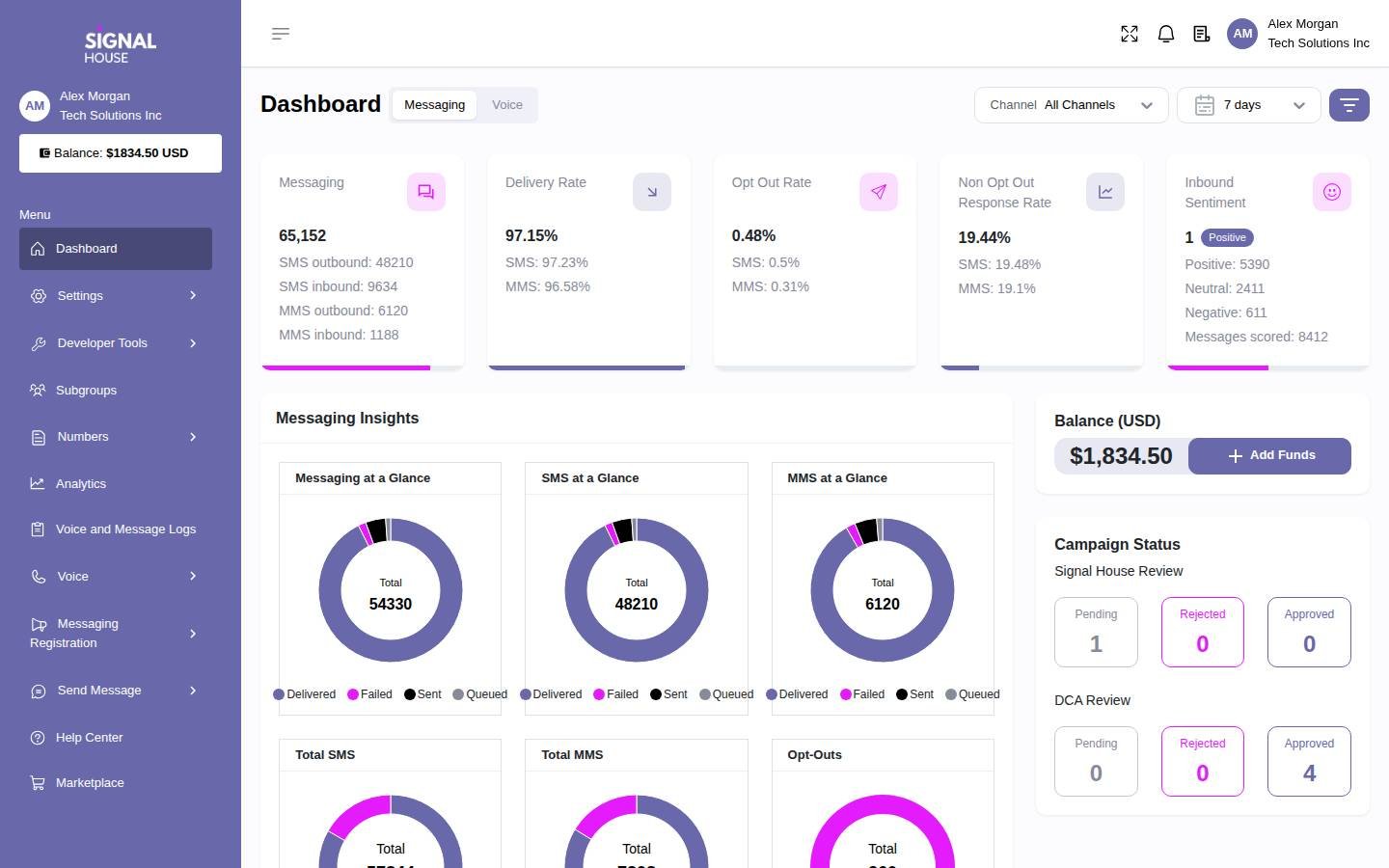
Signal House offers messaging, programmable voice and named integrations for eligible customer workflows. It is especially relevant to buyers who want implementation assistance around existing software. The provider should identify the supplied interface, connected platform responsibilities and remaining development work. This is more useful than assuming that every API capability appears automatically in a single employee dashboard.
Where Signal House Fits A Small Team
A small business team may want a missed call to generate a follow-up task, a staff member to send a confirmation, and a reply to stay attached to the customer record. Signal House is worth evaluating when its supported integration can provide that path. Ask the provider to show a failed notification and an unanswered call as well as the normal successful interaction.
Look closely at operational ownership. Someone needs to maintain credentials, notice failed callbacks and update employee destinations when staffing changes. Setup help is valuable when it leaves the team with a working, documented process. It should not be interpreted as unlimited custom development or a promise that every existing phone feature transfers unchanged.
Signal House Strengths And Limitations
The main strengths in this comparison are the available programmable calling path, named integrations, human assistance and selected outgoing usage components. The main limitations are purchasing details that still require confirmation: the complete incoming SMS rate, voice-enabled number pricing, exact connector functions and any additional application charges. Leaving these items visible makes the recommendation more useful to a buyer.
Traffic eligibility is another early check. Signal House's published terms restrict several categories, including specified third-party lead-generation and marketing activity. An agency should explain its clients, consent collection and intended traffic before building an integration. A HighLevel connection is a technical option, rather than blanket approval of every campaign or industry using that CRM.
Review Signal House And Account Credit
ClickSend Overview: SMS Tools With A Voice Eligibility Boundary
ClickSend is a business messaging option for teams that want to send through a dashboard, API or connected application. Its campaign tools and receiving rules can support reminders, updates and permission-based SMS marketing. For this article, the important boundary is its official notice that voice is unavailable to new customers. Existing voice users have a different position.
What Existing ClickSend Voice Customers Can Use
The documented legacy service sends automated spoken messages using text-to-speech. Eligible existing users can compose an announcement, select relevant options and send or schedule it. Some documented workflows can collect keypad input. This is different from buying a new live calling system for employees, and it should not be described as equivalent to every programmable phone application.
If your organization already uses ClickSend voice, establish the services and commercial terms attached to that account. Check the effect of adding numbers, users or integrations before changing a working process. An existing entitlement is not evidence that a new signup will receive the same feature. Likewise, an older tutorial cannot override the current availability notice.
ClickSend Strengths And Limitations
ClickSend's strengths include a visible SMS campaign workflow, free incoming SMS messages, 24/7 human chat and a range of integration choices. Its pay-as-you-go model can suit irregular sending without a platform subscription. For a new combined voice and messaging project, the major limitation is the absence of new voice enrollment. A separate calling service would have to be purchased and operated.
Another consideration is prepaid funding. The lowest advertised sending component requires a substantially larger top-up than the entry tier. That money remains account credit until consumed under the applicable terms; it is not automatically the cost of 1 month. A buyer should compare both consumed service and the cash that must be committed to obtain the advertised rate.
Signal House Vs ClickSend Feature Comparison
Use a feature comparison to identify the proposed implementation, rather than count checkmarks. Signal House's programmable calling options and ClickSend's SMS dashboard address overlapping messaging needs but different new-customer voice possibilities. Both still require an employee process for replies, permissions and failures. The most relevant question is whether the selected account can complete your actual customer journey.
| Requirement | Signal House | ClickSend | What To Validate |
|---|---|---|---|
| New programmable voice | Calling, SHML, WebRTC and SIP options | Voice unavailable to new customers | Separate calling platform if choosing ClickSend |
| Campaign sending | API or supported connected workflow | Dashboard campaigns, scheduling and API | Templates, audience, preview and staff permissions |
| Incoming SMS | Quote complete platform receiving base | Free, including inbound carrier fees | Reply handling and downstream notifications |
| GoHighLevel connection | Named integration and agency proposition | GoHighLevel listed in integration directory | Exact actions, replies, client access and maintenance |
| Other connections | HighLevel, Shopify, Medusa and Make listed | CRM and automation options listed | Actual product scope and connected subscriptions |
| Evaluation | Promotional account credit | Restricted trial, not production approval | Eligible resources, sender and recipients |
| Support | Human help; qualifying dedicated channel | 24/7 human chat advertised | Escalation, hours and integration responsibility |
| Funding and rental | Confirm funding and resource terms | Latest top-up affects tier; number rental recurs | Cash commitment, inactivity and cancellation |
SMS Campaign Sending And Customer SMS Replies
For a campaign, ClickSend's documented interface supports scheduling, contact lists and personalization. Evaluate how the sender previews SMS recipient selection and estimated charges before launch. Then send a controlled reply and examine the follow-up process. A SMS campaign report can show sending results while still leaving a separate operational question: who owns the customer's response?
For Signal House, demonstrate the same journey in the proposed interface or connected CRM. Establish where templates live, where replies appear and whether employees can distinguish a new lead from an existing support request. Compare the number of manual steps and the responsibility for maintaining the connection. These observations are more meaningful than assuming both platforms provide an identical shared inbox.
Incoming SMS Rules And Staff Notifications
ClickSend's inbound rules can send notifications or pass events to another system. Email notification is distinct from forwarding a message by SMS, which creates billable outgoing usage. The documentation also limits how many matching rules execute for a single incoming message. Complex routing should therefore be tested with overlapping conditions, rather than judged only from the number of rules an account can store.
Choose a predictable order of operations. For example, identify the customer, apply an opt-out instruction if relevant, create the staff task and then notify the responsible employee. Avoid multiple automations responding independently to the same event. The objective is a clear customer outcome, not several duplicate alerts that make the team less certain which action already happened.
Signal House Vs ClickSend Pricing: Rates, Numbers And Funding
All numerical examples use USD and the selected US service components. They exclude taxes, registration, extra software and other unlisted charges unless expressly included. These are planning calculations, not account quotes. Match the destination, sender type, billable segments and applicable account terms before applying them to your own traffic.
| Component | Signal House | ClickSend | Scope |
|---|---|---|---|
| Outgoing toll-free SMS | $0.0079/segment | $0.0273 / $0.0194 / $0.0125 / $0.0089 | ClickSend Boost / Growth / Scale / Enterprise |
| ClickSend tier qualification | No-minimum outgoing component used | $20 / $100 / $1,000 / $2,000 top-ups | Funding thresholds, not monthly send quotas |
| Incoming SMS | Platform base unconfirmed; carrier fees listed | Free, including carrier fees | Ask Signal House for complete receiving total |
| Outgoing MMS | $0.0200/message | $0.0353/message | Selected bases; carrier fees and other charges extra |
| Toll-free messaging number | $1/month | $3.33/month | Confirm availability, setup and exact capabilities |
| New US voice service | $0.012/min out; $0.005/min in | Unavailable to new customers | No new-account per-minute ClickSend comparison |
| Voice-enabled number | Obtain capability and price quote | New voice enrollment unavailable | Messaging rental does not establish calling eligibility |
| Evaluation allowance | $25 new-account credit | 14-day trial; limited US/Canada testing | Different offers; not unlimited production usage |
A Lower Outgoing Component To Evaluate: Signal House
For an eligible business comparing US toll-free sending, Signal House's selected outgoing component is below each displayed ClickSend tier in this model. The gap narrows at ClickSend's larger top-ups. Request a complete Signal House quote covering receiving, carrier charges, number capabilities and the intended integration before treating that component advantage as total savings.
Check Signal House Pricing And FitClickSend Top-Up Thresholds Are Not Monthly Volume Thresholds
ClickSend ties the published rate to a qualifying top-up. Its pricing guidance says the most recent top-up determines the sending tier, including automatic recharges. A business should therefore check both the rate it originally selected and what happens when its balance is replenished. A smaller recharge can alter the rate used for later messages.
This differs from assuming that sending a particular monthly volume automatically unlocks the lowest price. Review the actual SMS account rate before a large send and confirm the recharge amount. If finance changes the funding settings, the operations team should know. Otherwise, identical message content and recipient volume can produce a different usage charge without any change to the SMS campaign itself.
Prepaid Credit Is Different From Consumed Service
A qualifying $2,000 ClickSend top-up is money added to the account. If the selected outgoing component consumes $89, the remaining $1,911 has not become an additional message expense. It remains credit before number rental, carrier fees and other deductions. Counting both the full deposit and the same $89 as consumed service would overstate the communication cost.
However, the deposit remains a real cash commitment. A business sending occasionally might prefer a higher unit rate with a smaller funding requirement, even if a larger deposit offers a lower component. Confirm balance rules, inactivity and refund terms. ClickSend distinguishes paid credit from trial credit, and its guidance provides an inactivity expiration rule for accounts with no sending or top-ups for 12 months.
Carrier Fees Need Their Own Line
ClickSend describes an outbound flat average carrier surcharge for the selected US messaging products. Signal House publishes carrier-specific pass-through components. A business should not assume those 2 charging methods produce identical totals. Use the actual account surcharge and recipient mix, particularly when evaluating a narrow difference between the lowest displayed sending rates.
Incoming treatment is different again: ClickSend absorbs inbound carrier fees. Signal House's displayed incoming carrier schedule should not be mistaken for a complete platform receiving price. Ask for the missing base and model replies separately. A low outgoing rate can be attractive, while a reply-heavy workload still deserves a complete calculation before a purchase decision.
Number Rental And Cancellation Affect The Budget
The selected ClickSend US toll-free rental is $3.33 per month; Signal House lists $1 for its selected toll-free messaging number. Confirm availability, capabilities and any setup or approval charges for the actual order. Messaging number pricing does not establish the complete cost of enabling the same number for every calling function.
ClickSend's cancellation guidance says dedicated numbers must be removed through support, rather than a self-service dashboard action. Stop scheduled activity, identify the exact number and obtain cancellation confirmation. Simply leaving the account unused does not stop rental. This is particularly relevant to seasonal campaigns and short projects that would otherwise keep a recurring resource after sending ends.
Signal House Vs ClickSend: Monthly Cost Examples
The following SMS model uses 10,000 outgoing US toll-free SMS segments. It applies Signal House's selected $0.0079 component and each displayed ClickSend US sending tier. It excludes carrier charges, numbers, incoming usage and other resources. A segment is the billing unit here; the table does not assume that every visible message contains only 1 segment.
| ClickSend Tier And Funding | Signal House Component | ClickSend Component | Component Difference |
|---|---|---|---|
| Boost; top-up from $20 | $79 | $273 | Signal House lower by $194 |
| Growth; top-up from $100 | $79 | $194 | Signal House lower by $115 |
| Scale; top-up from $1,000 | $79 | $125 | Signal House lower by $46 |
| Enterprise; top-up from $2,000 | $79 | $89 | Signal House lower by $10 |
What The 10,000-Segment Example Shows
At the selected components, Signal House is lower by $194 against Boost, $115 against Growth, $46 against Scale and $10 against Enterprise. These differences are arithmetic comparisons of outgoing usage. They do not establish identical business account features or a universal complete invoice. The smallest difference is especially sensitive to receiving, surcharges and implementation costs.
Notice the separate funding column. The $1,000 and $2,000 thresholds are ClickSend deposit qualifications, rather than the consumed cost shown for this workload. Signal House's model uses its stated no-minimum outgoing component, but the actual funding and any agreement requirements should still be confirmed. A comparison is more useful when the cash requirement is visible beside the usage calculation.
A Small Sender With 500 Segments
For 500 outgoing toll-free segments, the selected Signal House component is $3.95. ClickSend Boost's component is $13.65. If a buyer funds ClickSend with $20, that leaves $6.35 before carrier fees, number rental or other deductions. The model illustrates the difference between spending prepaid credit and paying a flat monthly subscription.
For a genuinely occasional sender, operational simplicity may outweigh that component difference. Ask how the team adds contacts, obtains a permitted business sender and reads replies. Also decide whether number rental should continue between campaigns. The best low-volume option should fit both the business communication task and the business's willingness to maintain an active account.
Add A Messaging Number Without Calling It An All-In Bill
Using 1 monthly toll-free messaging number, the 10,000-segment model becomes $80 for Signal House and $197.33 for ClickSend Growth before carrier charges and other extras. Those subtotals combine the selected outgoing usage with the identified rental. They still omit receiving on Signal House, registration, connected tools and any applicable taxes.
Keep the subtotal label intact when sharing the calculation internally. A manager reading only a rounded headline may mistake it for the complete price. Put the excluded items directly beside the estimate and assign someone to collect each missing figure. Once the actual quote arrives, replace the assumptions instead of continuing to compare an old model with a live offer.
Long Messages Can Double The Sending Units
If 10,000 visible messages each require 2 billable segments, the model contains 20,000 segments. The selected Signal House outgoing component becomes $158, while ClickSend Growth becomes $388. This is a content-length effect, rather than a hidden change in the listed rate. Personalization can make the segment count vary across recipients within the same campaign.
For ClickSend and Signal House, check the rendered content after inserting names, links and required identification. Standard GSM and Unicode messages have different limits, and multipart messages have less payload space per segment than single-part messages. An emoji or unsupported character can change the encoding. Preview the actual template rather than estimating costs from an empty editor or a single unusually short sample.
Incoming Replies And Employee Forwarding
A reply received by ClickSend is free, including its inbound carrier component. If the workflow then forwards that reply to an employee by SMS, the forwarding creates outgoing usage. At the Growth sending component, 1,000 single-segment forwards add $19.40 before outgoing carrier fees. Email notification is a different option and does not create that outgoing SMS charge.
This distinction matters when comparing business support workflows. A system can have free incoming SMS messages while a chosen notification design adds costs. For Signal House, request its complete receiving price and demonstrate how staff notifications work in the intended integration. Compare the full interaction, including employee replies, instead of counting only the first promotional message.
Picture Messages Use A Different Meter
For a selected 1,000-message US outgoing MMS example, Signal House's published component produces $20 and ClickSend's displayed component produces $35.30. Additional charges and media requirements still apply. Do not apply SMS segmentation arithmetic mechanically to picture messaging or assume that a lower component guarantees support for every attachment your customers might send.
Ask employees to test an image they would actually use, such as a permitted appointment attachment or product photo. Check rendering, message history and what happens when delivery fails. Media can add useful context, but it can also create storage, privacy and workflow requirements that are absent from a simple SMS notification.
Signal House Vs ClickSend Voice: Live Calls And Spoken Notifications
For a new account, ClickSend voice is unavailable, so a direct per-minute purchasing comparison would be misleading. Signal House offers a programmable calling path to evaluate. Existing ClickSend voice customers should compare their legacy service and account terms separately. The product boundary comes before any rate calculation.
Programmable Calling Is A Different Requirement
A live calling workflow may need an incoming number, routing instructions, staff endpoints and an outgoing connection. Signal House documents SHML, WebRTC and SIP options, but the final design depends on the intended application. Ask who supplies the employee interface, who maintains routing and which optional features add charges. A menu, transfer and recording can involve different responsibilities.
Use an ordinary call scenario to evaluate the design: a customer rings, the preferred employee is unavailable, another employee answers and the conversation ends with a documented task. Then repeat with nobody available. The practical result should be understandable to staff, including what the caller hears and who receives the callback request.
Signal House Voice Costs Depend On Answered Duration
Signal House lists a selected starting outgoing component of $0.012 per minute and incoming US component of $0.005 per minute. Its published billing terms use a 1-minute minimum for answered calls and round later fractions up to the next minute. Voicemail is treated as answered. Model actual call durations rather than multiplying raw connected seconds by a minute rate without rounding.
For example, 100 outgoing answered calls lasting 65 seconds each create 200 billable minutes under that rule. The selected outgoing component is $2.40. A separate exact-whole-minute workload of 1,000 outgoing and 1,000 incoming minutes produces $17 in selected calling components. Neither example includes number charges, optional processing, surcharges or other configured resources.
Legacy ClickSend Text-To-Voice Uses Message Length
ClickSend's legacy text-to-voice documentation meters spoken notifications by text length. That is different from ordinary connected minutes in a live call. Longer content or different character encoding can require more billable message units. A displayed legacy voice figure should therefore not be copied into a per-minute table and treated as a directly comparable calling tariff.
Keypad input is another important distinction. A recipient pressing a digit to confirm an appointment is not the same as having a 2-way conversation with a staff member or an AI receptionist. An existing account may find a spoken notification useful, but the feature should be described according to what it does. New customers need an eligible alternative for that channel.
Signal House Vs ClickSend Integrations: HighLevel, CRM And Automation
Both providers list GoHighLevel-related integration options. Signal House should not be described as the only provider in this comparison that can connect with that ecosystem. ClickSend also lists automation and CRM connections, including Zapier, Make, Power Automate and Salesforce. The correct evaluation compares the actual actions, reply handling and maintenance involved in the proposed connector.
Compare The Workflow Instead Of The Integration Name
A connection might send a SMS after a form submission while leaving replies in another interface. Another implementation may support a broader customer conversation inside the CRM. Ask where incoming SMS messages appear, how staff are alerted and whether opt-outs synchronize. The word integration alone does not answer these operational questions.
For each provider, record the initiating event, sender selection, content template, delivery event and reply destination. Include the responsible owner for the connected platform. The best solution is the one that completes the needed workflow reliably under your conditions, with costs and responsibilities that the team can understand. An unsupported assumption about a connector is not a useful feature advantage.
Agency Client Separation And Margin
An agency should separate clients' credentials, senders, consent records and usage attribution. Signal House's client-pricing proposition may be relevant, but confirm the actual commercial arrangement and permitted traffic. For ClickSend, establish how the intended setup handles client access and billing. Neither an integration directory entry nor an unlimited-user statement proves a complete white-label resale platform.
Calculate margin after all costs the agency absorbs. These may include outgoing SMS segments, carrier charges, numbers, registration, connected automation, support time and unrecovered client balances. A lower headline component helps only if the arrangement also supports the agency's business model. Avoid promising clients unlimited usage from a service that bills communication units individually.
Developer Events And Incoming Payloads
Developers should check event formats against the actual interface they choose. For example, ClickSend's documented URL action for incoming SMS messages uses form-encoded fields; it should not be assumed to send the same JSON payload as another connector. Confirm authentication, field names and retry behavior before attaching a production customer workflow.
Store enough information to distinguish a duplicate event from a new customer reply. Keep API acceptance, delivery status and employee follow-up as separate events. A successful request means the platform accepted work, not that the customer read it or that staff resolved the request. This distinction improves troubleshooting without inventing delivery guarantees for either provider.
Signal House Vs ClickSend Free Trial And Setup
Signal House advertises a $25 new-account credit, which is a promotional allowance rather than a verified fixed-duration unlimited trial. ClickSend advertises a 14-day trial without a credit card, but US and Canadian trial messaging has meaningful restrictions. Choose the evaluation according to what it can actually demonstrate, and reserve production approval checks for the next stage.
What The ClickSend Trial Can Show
ClickSend's US and Canadian trial uses a pre-registered sending number and permits sending to the user's own verified mobile recipient. Messages include a trial watermark. The documented restrictions remove links, inline phone numbers and emojis, and mask numeric strings. Those changes mean the trial is useful for orientation, rather than a full reproduction of a production campaign.
Test navigation, template creation and the available account workflow. Do not use the restricted trial SMS message to claim that a production booking link, branded sender or complete customer list has been validated. After evaluation, the business needs an approved dedicated SMS sender for the intended production traffic. The trial does not grant new voice access.
How To Use Signal House Account Credit
Ask which resources the Signal House allowance can fund, whether any verification is required and what happens after it is consumed. A credit can help evaluate eligible account functions, but it does not eliminate registration or the need to confirm the actual calling setup. Do not assume the promotion covers every integration subscription or optional feature.
Use the evaluation to answer purchase questions. Can the intended employee send and receive? Can the proposed number support the required channel? Is a failed event visible? Does a test call reach the correct destination? Document what was demonstrated and what still depends on approval or paid configuration, so trial activity is not confused with a completed production rollout.
Review Signal House Evaluation Options
Production SMS Sender Approval And Consent
Before live SMS messaging, confirm the approved sender, registered use case and relevant consent records. A trial sender and a production sender have different roles. Neither provider's promotional credit should be treated as permission to send to an imported list. Ask what information is needed from the business and how incomplete applications are handled.
Preserve consent and opt-out history independently of the communication provider. If the account changes, customers who previously opted out should remain suppressed. Identify which system controls that decision when multiple applications can send. Technical connectivity is only useful when the workflow respects the intended recipient permissions and prevents conflicting automations.
Support, Reliability And Security: What To Verify
ClickSend advertises 24/7 human chat, while Signal House advertises human help with a dedicated channel for qualifying committed volume. These are support access descriptions, rather than guaranteed resolution times. Ask who handles account setup, failed messages, carrier escalations and integration problems. The right support arrangement depends on the business's operating hours and internal technical capacity.
Build A Useful Support Request
For a messaging failure, retain the sender, destination, timestamp, message identifier and status. For a calling issue, add the direction, endpoint and observed behavior. Share only the information needed for investigation. A complete request helps distinguish an account limitation, integration error and network issue without assuming every failure belongs to the same provider.
Confirm escalation responsibilities when a CRM or automation vendor is involved. If a customer reply arrives at the communication service but fails to appear in the CRM, the problem may be in the connection. Someone must own the investigation across both systems. Ask for that ownership before launch rather than discovering it during a customer-facing interruption.
Evaluate Reliability Without Inventing A Winner
This comparison does not establish a measured uptime, call-quality or delivery-speed winner. Performance depends on destinations, sender approval, application design and other conditions. Test representative recipients and workflows, then define the evidence the business will monitor. Distinguish platform acceptance from carrier delivery and successful delivery from a completed customer outcome.
For important notifications, plan a permitted fallback and a staff review queue. Avoid retrying repeatedly without checking whether an earlier attempt succeeded. Duplicate messages can confuse customers and increase costs. A useful reliability design makes unresolved work visible and supports careful recovery, rather than relying only on a provider's general marketing description.
Protect Credentials And Customer Information
Restrict credentials and account privileges to the people and applications that need them. Keep access keys out of public pages and customer-facing code. Confirm the available authentication, logging, retention and role controls for the selected account. Connected platforms need the same review because they may hold message content, contact details and communication history.
For regulated or sensitive use cases, obtain the required contractual and product-specific confirmation before sending protected information. A broad security claim or mention of healthcare does not establish that every feature is suitable. This is a purchasing requirement to verify with the provider, rather than a compliance certification inferred from the presence of encryption or a business phone number.
How To Switch Between Signal House And ClickSend
First identify what will move: outgoing SMS, incoming replies, automations, numbers or calling. Moving messaging does not automatically migrate a separate phone service. If the business already uses ClickSend's legacy voice, confirm what would replace that specific workflow before ending access. A new ClickSend signup cannot be treated as a reversible fallback for unavailable new voice enrollment.
Inventory The Existing Workflow
List active senders, templates, scheduled SMS campaigns, incoming SMS rules, credentials and connected applications. Export the records the business must retain and check any retention limits. Identify which application holds consent and opt-outs. Also record employee permissions and the escalation contact for each dependency, so migration does not leave an important business process without an owner.
For ClickSend and Signal House, number continuity deserves a separate discussion. Ask about portability, sender approval and the timing of any change before making a customer-facing promise. A number may have messaging and calling capabilities with different requirements. Do not cancel an existing resource simply because a replacement account has been created or a test message has arrived.
Pilot Before Moving Every Workflow
Choose a small permitted workload and compare results against the existing process. Verify content, replies, suppressions and status events, then reconcile the first usage charges. For a voice migration, test actual routing and unavailable employees. Keep a clear decision point for proceeding, correcting the setup or retaining the existing arrangement while unresolved requirements are addressed.
Prevent duplicate sends during the transition. Decide which system owns each automation and disable the old trigger only when the new route is ready. Keep enough records to explain any overlap. After the pilot, update operating instructions and train the employees who handle customer responses, rather than handing them an unfamiliar interface without a follow-up process.
Reconcile Balances And Remove Unused Resources
Review prepaid balances, recurring numbers, connected subscriptions and the terms for unused credit. ClickSend's most recent top-up rule makes funding settings part of the migration checklist. Removing an automation does not cancel its rented number. Confirm support-assisted number removal where required and retain the confirmation alongside the final account reconciliation.
Compare the first full business operating period with the planning model. Check segment counts, incoming replies, number rental and carrier charges separately. If the estimate differs, identify the cause before increasing volume. This makes the comparison actionable: the business learns whether the selected provider and workflow actually deliver the expected operational and cost benefits.
Signal House Alternatives And ClickSend Competitors
Signal House and ClickSend are not the only options, especially when a project needs a channel outside the selected account's scope. If the requirement is developer-controlled calling plus messaging, compare other communications platforms on actual rates, APIs and support. If the requirement is a finished business phone application, shortlist that product category separately rather than assuming a messaging gateway supplies it.
Our guides to Twilio alternatives and competitors and Telnyx alternatives provide related starting points. Keep the same workload when widening the shortlist. A provider can be a strong ClickSend alternative for programmable calling while another is a closer competitor for dashboard-led SMS campaigns.
The purpose of adding a competitor is to resolve an unmet requirement, not merely create a longer comparison. Record what the current 2-provider shortlist cannot establish, such as an exact destination rate, employee interface or contractual requirement. Then ask the additional vendor to answer that question using the same assumptions and complete cost categories.
Frequently Asked Questions About Signal House Vs ClickSend
Is Signal House Better Than ClickSend?
Signal House is the stronger starting point here for a new project needing programmable calling and messaging together, because ClickSend does not offer voice to new customers. ClickSend is worth considering for its campaign interface, free incoming SMS and pay-as-you-go sending. The better overall option depends on the exact workflow, support arrangement and complete account costs.
Is ClickSend Cheaper Than Signal House?
Not on the selected outgoing US toll-free SMS components shown here: Signal House's component is lower than each displayed ClickSend tier. However, incoming SMS messages are free on ClickSend, including inbound carrier fees, while the complete Signal House receiving base needs confirmation. Compare replies, surcharges, numbers, funding and connected software before declaring the cheapest complete option.
Can New ClickSend Customers Make Voice Calls?
ClickSend says voice is unavailable to new customers. Its legacy text-to-voice documentation remains relevant to eligible existing accounts, but that does not establish access for a new signup. A new business needing calls should evaluate Signal House's proposed calling setup or another eligible voice provider instead of relying on an older feature list.
Does ClickSend Offer A Free Trial?
Yes. ClickSend advertises a 14-day trial without a credit card. US and Canadian trial messaging is restricted to the user's own verified recipient and uses modified content with a trial watermark. That can demonstrate the account workflow, but it does not validate an unrestricted production campaign, approved business sender or new voice service.
Does Signal House Have A Free Trial?
Signal House advertises a $25 new-account credit. Treat that as a promotional account allowance, rather than a verified unlimited trial lasting a fixed number of days. Confirm which eligible resources it covers and what happens after consumption. The business still needs to verify its production sender, calling configuration and connected software charges.
Are Incoming ClickSend Messages Really Free?
ClickSend's published US and Canadian guidance says incoming SMS messages are free and inbound carrier fees are absorbed. Forwarding a received SMS to an employee's mobile number creates a separate outgoing SMS message, however. CRM subscriptions and other connected services can also add costs. Receiving and every action that follows should be considered separately.
Can Both Providers Work With GoHighLevel?
Both list GoHighLevel-related integration options. Compare the actual sending actions, incoming replies, client access and maintenance requirements rather than assuming the connectors are identical. Signal House's agency proposition may be relevant, while ClickSend also has documented integration choices. Neither listing alone proves every phone function, resale feature or staff inbox capability is included.
Does ClickSend's Lowest Rate Require A Monthly Subscription?
The displayed US sending tiers are tied to qualifying top-ups rather than a platform subscription. The lowest listed tier requires a $2,000 top-up in this comparison. That is prepaid account funding, not automatically a monthly charge or consumed expense. Confirm the most recent top-up rule, the actual account rate and balance terms before choosing it.
Can A ClickSend Recharge Change My Sending Rate?
Yes. ClickSend's pricing guidance says the most recent top-up determines the tier, including automatic recharges. A smaller subsequent top-up can change the rate used for later sends. Review ClickSend recharge settings and the account's displayed rate before a large campaign, particularly if finance and operations manage those settings separately.
Is Legacy ClickSend Text-To-Voice The Same As A Phone System?
No. The documented legacy feature turns written content into an automated spoken notification and may collect keypad input. That is different from a complete live employee calling system or conversational AI receptionist. Its character-based billing also differs from ordinary per-minute calling. Eligible existing customers should evaluate their actual service rather than equating these product categories.
Can I Cancel A ClickSend Number In The Dashboard?
ClickSend's cancellation guidance says dedicated numbers must be removed through support. Identify the exact number, request removal and retain confirmation that recurring rental has stopped. Simply stopping SMS messages or leaving credit unused does not cancel the resource. Check number continuity and any replacement registration before ending an active customer-facing sender.
Which Provider Should A Small Agency Try First?
An eligible agency wanting supported calling and messaging around an existing CRM can start with Signal House, provided the proposed integration and traffic are approved. An agency focused on dashboard-led SMS campaigns should also evaluate ClickSend. Compare client separation, incoming handling, funding and actual margin before committing customer accounts.
Final Verdict: Choose The Required Channel Before The Rate
Signal House is our first shortlist choice in this comparison for an eligible new project requiring programmable calling and messaging together. It also has lower selected outgoing US toll-free SMS components in the displayed model. Those advantages still require a complete quote and a demonstrated workflow, particularly for receiving, employee tools and voice-enabled number costs.
ClickSend is a credible choice for teams prioritizing SMS campaigns, free incoming SMS messages and accessible support while retaining a separate business calling arrangement. Its prepaid SMS tiers should be evaluated as funding qualifications, and its legacy voice documentation should not be presented as a new-customer offer. Choose the provider that fits the actual job, then verify the full cost of operating it.
Customer Feedback On Signal House And ClickSend
Signal House's named G2 profile shows 4.8/5, with reviewed comments highlighting implementation help and guidance. ClickSend's named profile shows 4.1/5. Its reviewed feedback includes praise for ease of use and human chat, alongside requests for more features and concerns about price. These are individual customer experiences, rather than proof of a universal performance or support outcome.
Some published reviews are incentivized or reflect older product capabilities. In particular, historical praise for ClickSend voice does not override its current restriction on new customers. Use customer feedback to form practical evaluation questions, then confirm the proposed account and workflow directly. No independent hands-on performance test was conducted for this comparison.
Affiliate Disclosure: VoIPCalling may earn a commission when you use selected recommendation links, at no additional cost to you. Recommendations reflect the stated use cases and documented service information; offers, eligibility and account terms may change.