Signal House is the better starting point when your business needs documented SIP connectivity, browser voice calling or guided integration setup. TextGrid publishes lower selected US starting SMS and voice rates, making it a strong option for supported API workflows. Choose on the complete application and bill: TextGrid's current documentation excludes SIP voice calling, live audio streaming and speech recognition through Gather.
Signal House vs TextGrid is a comparison of communication costs and application fit. An agency sending appointment reminders may prioritize message economics, while a business connecting an existing PBX needs the right voice architecture. This guide explains the practical differences, separates general API prices from integration offers and shows how to evaluate the services without assuming every familiar feature transfers.
 Signal House's named G2 profile shows 4.8/5. TextGrid's named profile has no published customer score. No rating or stars are invented for an unrated product, and customer feedback is separate from technical verification.
Signal House Vs TextGrid: Quick Comparison
Signal House and TextGrid both provide communications infrastructure, but they do not expose identical capabilities. Evaluate the account, sending number, employee interface and required workflow before comparing a rate. The first provider in this table is not automatically the lowest-priced option. TextGrid's lower selected usage components remain visible throughout the comparison.
| Provider | Best Fit | Buying Considerations | Pricing & Evaluation |
|---|---|---|---|
|
| Local SMS $0.0065/SegmentSelected US outbound API base; fees extra. Voice starts $0.012/min out; $0.005/min in. Integration offers differ.Review Offer And $25 Account Credit | |
|
| Local SMS $0.0035/SegmentSelected US outbound API base; fees extra. Voice $0.0064/min out; $0.004/min in. Account terms control.Trial credits advertised; confirm amount, duration and restrictions.Create Account And Review Credits |


Signal House Vs TextGrid: Which Provider Is Better?
Best Fit For SIP Trunks And Endpoints: Signal House
Signal House explicitly describes SIP trunks for an existing PBX and individual endpoints for devices or softphones. TextGrid's technical limitations guide says SIP endpoints and trunking are unavailable. A company that must retain this architecture has a clear reason to investigate Signal House first. The decision rests on a required connection method, rather than a claim of universally better audio.
Document the devices, numbers and routing the business needs. Ask how incoming calls reach employees, how outbound identity is selected and who maintains the configuration. Even a supported connection requires a deployment design. Test the actual endpoint and ordinary employee actions before replacing an established office voice service.
Lower Selected US Starting Usage Rates: TextGrid
TextGrid publishes lower starting components for outgoing local SMS and both selected voice directions. These rates make it attractive when the supported functions meet the application's requirements. The advantage should be calculated openly, including carrier surcharges, numbers, registration and application work. A lower selected component is useful evidence, but it is not a complete communications budget.
For a developer team that already maintains its own customer interface, TextGrid may be a practical competitor. For a small business dependent on a missing capability, the same rate advantage may not solve the problem. Establish the functional fit first, then compare the cost of operating the supported workflow at the expected volume.
Best Fit For A Demonstrated Integration Workflow: Compare Both
Both providers market GoHighLevel integration. Neither should be described as the only HighLevel option in this comparison. Signal House also names Shopify, Medusa and Make connections. TextGrid's suitability depends on the exact connected account and permissions. Ask each vendor to demonstrate the actions your employees need, rather than assume the integration names establish equal functionality.
A useful demonstration includes an outgoing SMS notification, an incoming reply and a staff follow-up. Show where the customer record lives, who owns the conversation and which application reports a failure. The better choice is the arrangement that completes those actions with clear responsibilities and acceptable total cost. A marketing promise about switching quickly cannot establish that result.
No Independently Measured Reliability Winner
This comparison does not establish measured voice quality, uptime or delivery-speed winner. Signal House and TextGrid should be tested against the intended destinations, account permissions and application. Customer ratings and vendor testimonials can suggest questions, but they are not equivalent to controlled performance measurements for your traffic.
For an important workflow, define what success means before testing: the correct employee answers, a reply reaches the correct record, or an unresolved message generates a visible task. Keep transport delivery separate from the customer outcome. A low-priced connection that leaves staff unable to find replies can still be an expensive operating choice.
Signal House Overview: Voice Connectivity And Business Workflows
Signal House combines messaging, programmable voice and named integrations, with human implementation assistance as part of its proposition. It is relevant to eligible businesses that want help connecting their existing tools. Ask what the provider supplies directly, what belongs to another platform and what the business must develop or maintain itself.
Signal House Voice Profiles And Browser Calling
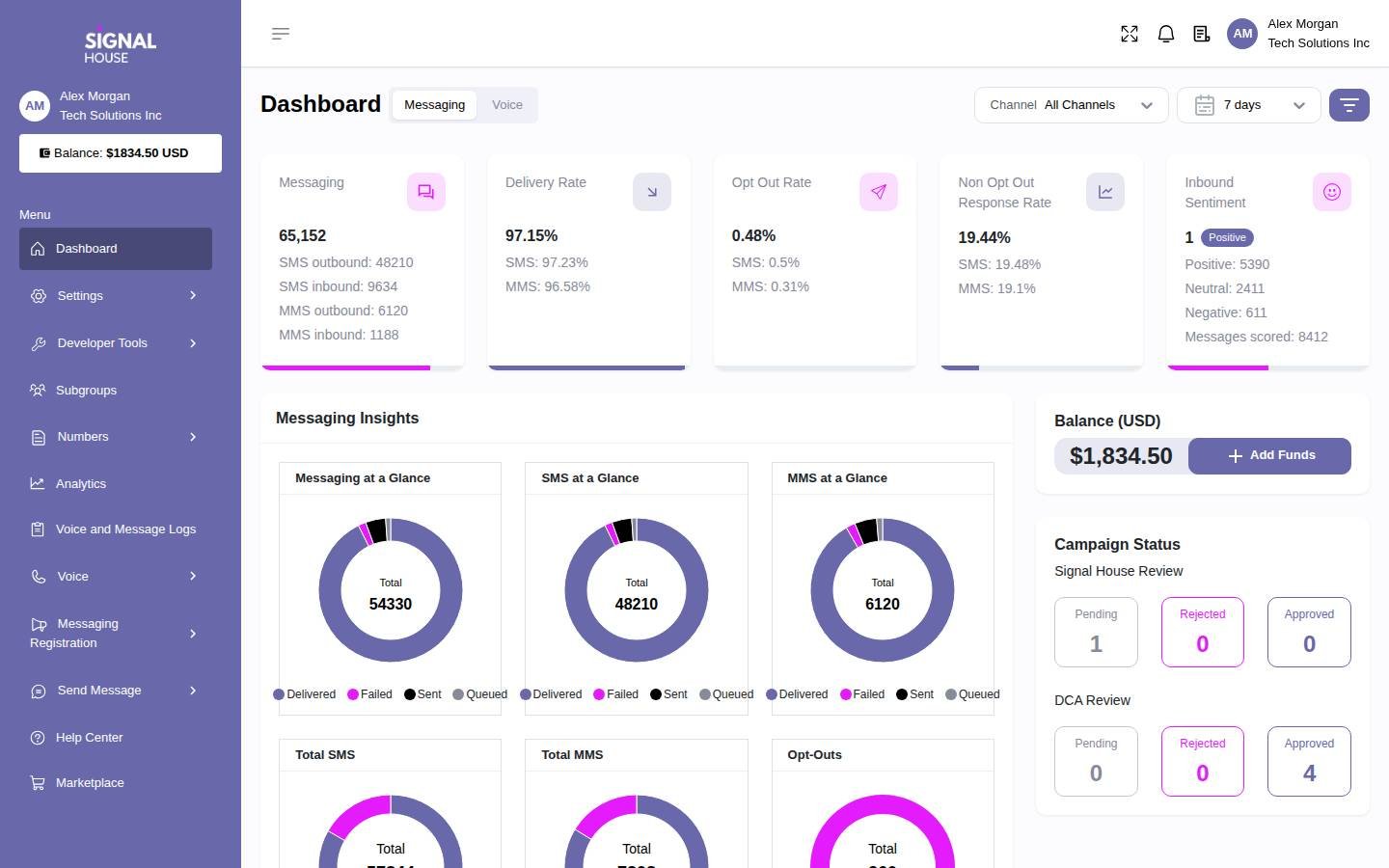
The documented voice options include programmable profiles, WebRTC softphones, SIP trunks and individual endpoints. These provide several deployment paths, rather than a single universal phone application. A voice profile can direct an incoming voice call to supported destinations or application instructions. The company should identify the path that fits its employees and existing equipment.
For example, an office with a PBX may prioritize trunk configuration, while a software company may need a browser-based agent. Each requires different setup and operational checks. Confirm authentication, supported transport, caller identity and the employee interface. Do not assume that every connection is encrypted merely because encrypted options are available.
Signal House Strengths And Limitations
Signal House's strongest distinctions here are documented voice connectivity, named integrations and implementation assistance. Its selected starting usage components are higher than TextGrid's, which matters to price-sensitive applications. Some purchasing details still require a quote, including complete incoming message pricing, voice-enabled number charges and the exact integration offer.
Traffic eligibility also needs early attention. Signal House's terms restrict specified categories and require consent for messaging. An agency should explain its clients and intended traffic before building a connection. The presence of a CRM integration does not automatically approve every campaign or make the agency's complete service model eligible.
Review Signal House And Account Credit
TextGrid Overview: Lower Selected Rates With Defined API Boundaries
TextGrid offers messaging, voice, phone-number management and related APIs. Its current documentation is especially useful because it identifies supported operations and specific limitations. Evaluate those technical boundaries alongside the pricing page. Familiar endpoint paths or a vendor's migration headline do not establish that an existing application will work unchanged.
TextGrid Voice And Messaging For Developers
The provider documents outgoing and incoming phone-number calls, voice call-control instructions, status events and messaging webhooks. Developers can build customer workflows around those supported operations. The purchasing question is whether that set matches the application's real dependencies. An application using only ordinary number-based voice calls may have different requirements from one built around SIP or streamed audio.
The provider also markets registration assistance and a HighLevel connection. Confirm the permissions attached to the actual account, particularly if direct API access is needed alongside the integration. An account can have dashboard access and visible credentials while still requiring additional authorization for a particular API workflow.
TextGrid Strengths And Limitations
The main strengths are lower selected starting rates, documented core API compatibility and a defined path for supported messaging and phone-number voice calls. The important limitations include unavailable SIP, live audio streaming and Gather speech recognition. Future-dated sending is not a scheduling feature of the documented SMS API, and bulk access can require permission.
It is therefore worth evaluating as a narrower technical fit, rather than a universal replacement for every communications product. Ask the vendor to confirm any function the application cannot operate without. If that function is absent, calculate the cost and complexity of a separate service before assuming the lower usage rate produces the better overall result.
Signal House Vs TextGrid Feature Comparison
Use the feature table to identify purchasing questions. Signal House and TextGrid should each be evaluated through the interface and account the business will use. A supported API operation is different from a finished employee workflow, and a named integration does not prove that every call or message feature is exposed inside it.
| Requirement | Signal House | TextGrid | What To Validate |
|---|---|---|---|
| SIP voice connectivity | Trunks and individual endpoints documented | SIP calling unavailable | Required PBX, desk phone and softphone architecture |
| Browser voice application | WebRTC softphones documented | Do not infer from number-based call API | Employee interface, supported connection and licenses |
| Call menus | SHML actions include speaking and digits | Gather supports DTMF, not speech recognition | Required caller interaction and supported options |
| Live audio processing | Verify proposed external integration | Stream unavailable | Do not assume either is a complete AI receptionist |
| Business messaging | API and named integrations | Supported API and HighLevel offer | Sender capability, replies and account permissions |
| Future reminders | Verify selected application scheduling | API has no future-dated scheduling fields | Application job ownership, cancellations and consent |
| CRM and agency account | Integration-specific plans and client pricing | Connected GHL access may restrict direct API | Actual client account, margin and commercial terms |
| Migration | Demonstrate required operations | Supported core compatibility with explicit limits | Credentials, sender resources, webhooks and error handling |
Follow A Customer Interaction From Start To Finish
Choose an ordinary scenario such as a customer calling to change an appointment and receiving a confirmation afterward. Identify the incoming route, employee destination, customer record and final notification. Then repeat the scenario when the employee is unavailable. This reveals gaps that are easy to miss in a feature checklist.
For TextGrid, check the supported instructions and actual number capabilities. For Signal House, check the selected profile, endpoint or connected application. Record which functions were demonstrated and which still depend on configuration. The goal is a usable customer process with a clear owner, not merely a successful request in an API console.
Signal House Vs TextGrid Pricing: Selected US Components
The figures below are selected published US starting components in USD. They are not complete invoices or guaranteed prices for every destination, number and integration. Carrier charges, registration, connected software, taxes and other resources remain additional unless explicitly included. Obtain an account-specific quote before treating a planning model as a purchase commitment.
| Component | Signal House | TextGrid | Scope |
|---|---|---|---|
| Outgoing local SMS | $0.0065/segment | $0.0035/segment | Carrier, registration and account charges extra |
| Incoming SMS | Confirm full platform base; carrier fees listed | Free platform base; applicable carrier fees | Free receiving base is not all-in zero receiving cost |
| Outgoing voice | $0.012/min initial tier | $0.0064/min | Confirm destination, call legs and billing increments |
| Incoming voice | $0.005/min | $0.004/min | Match local number and exact account scope |
| Local messaging number | $1/month headline | $0.50/month headline | Confirm actual capability; voice-enabled quote needed |
| Calling meter | Answered calls; whole-minute rounding | Obtain applicable minimum and increment | Do not assign a competitor footnote as TextGrid terms |
| HighLevel commercial offer | Separate guide: plans from $20/month; PAYG $0.02/segment | Confirm connected-account price and API permissions | General API models are not guaranteed integration invoices |
| Evaluation allowance | $25 new-account credit | Trial credits; exact amount/duration unverified | Confirm eligible resources, approval and funding |
Why TextGrid's Lower Rate Is A Qualified Finding
At the selected starting components, TextGrid costs less for the modeled outgoing local messages and voice minutes. That is a straightforward arithmetic finding, not a reason to ignore missing features or implementation work. Keep the result visible while completing the quote. A transparent comparison can recommend Signal House for a particular architecture and still identify TextGrid as the lower usage-cost option.
Account terms control the final bill. Ask both providers for the same sender type, destination mix and workload. If a rate belongs to a different integration or negotiated volume agreement, label it separately. The lowest number on a website is useful only when the proposed account can actually use the required service at that rate.
Separate API Rates From GoHighLevel Offers
Signal House's dedicated HighLevel plan guide describes its own monthly options and a pay-as-you-go segment rate that differs from the general API starting component. The published plan table includes monthly price, message limit and per-message columns that need a worked invoice to interpret. Do not assume the limit represents an included allowance or invent how those columns combine.
For TextGrid, confirm the exact terms of the connected HighLevel account as well as its direct API permissions. A general pricing page and a CRM promotion can describe different commercial arrangements. Ask each provider to price a representative client account inside the actual integration. This prevents an apparent saving that comes from comparing different purchasing paths.
Incoming TextGrid SMS Messages Have A Free Base, Not Universal Zero Cost
TextGrid advertises free incoming SMS base usage, but its current carrier schedule lists receiving surcharges for applicable networks. That is different from absorbing every incoming carrier fee. A reply-heavy support workload needs those charges modeled separately. Signal House's full platform receiving base also needs confirmation; its carrier table alone does not establish that missing amount.
Keep 3 quantities visible: incoming SMS segments, the platform base and the carrier surcharge. Then add any outgoing staff SMS reply or notification. This avoids describing a whole conversation as free when only 1 component is zero. It also makes the comparison more useful for businesses whose customers respond frequently rather than simply receive announcements.
TextGrid Volume Tiers Need The Current Rate Card
The dedicated SMS pricing page lists $0.0035 below 1 million monthly outgoing SMS segments, then $0.0032 at 1 million, $0.0029 at 3 million, $0.0026 at 5 million and $0.0023 at 7.5 million. Carrier charges and other extras remain separate. Use the actual account terms when crossing a threshold.
Compare those tiers with a Signal House quote at the same volume. Its own public rates also change with volume, so keeping the starting rate on only 1 side would distort a large-volume comparison. For forecasts around a boundary, request an example invoice explaining how the tier is applied and how negotiated terms affect it.
Number And Media Charges Require Matching Capabilities
The selected headline local-number rental is $0.50 per month, while Signal House lists $1 for a selected local messaging number. Confirm the actual location and enabled channels. A messaging rental does not establish the complete cost of a voice-enabled number, and a low headline number price should not be applied automatically to every toll-free or international resource.
Media messaging also needs its own quote. Its public page displays inconsistent incoming MMS figures in different sections, so this guide does not choose an unsupported receiving price. Confirm outgoing and incoming media units, number access and carrier charges directly. An attachment workflow should be evaluated separately from ordinary SMS segmentation.
Signal House Vs TextGrid: Monthly Usage Cost Examples
These models isolate selected outgoing local SMS components and voice components. Both sides use the same billable quantities to show the effect of the listed rates. This does not establish that identical elapsed calls create identical billable minutes; TextGrid's applicable increments still require confirmation. Numbers, carrier fees and other resources are excluded from this table.
| Workload | Signal House | TextGrid | Selected Component Difference |
|---|---|---|---|
| 10,000 outgoing local message segments | $65 | $35 | TextGrid lower by $30 |
| 100,000 outgoing local message segments | $650 | $350 | TextGrid lower by $300 |
| 1,000 outgoing billable voice minutes | $12 | $6.40 | TextGrid lower by $5.60 |
| 1,000 incoming billable voice minutes | $5 | $4 | TextGrid lower by $1 |
| 10,000 outgoing segments + 1,000 voice minutes each direction | $82 | $45.40 | TextGrid lower by $36.60 |
| 10,000 outgoing segments + 10,000 incoming voice minutes | $115 | $75 | TextGrid lower by $40 |
A Messaging-Only Team Sending 10,000 SMS Segments
For 10,000 outgoing local SMS segments, the selected Signal House component is $65 and TextGrid's is $35. The $30 difference is a usage-component comparison. If the company also rents 1 eligible local messaging number at the selected prices, those subtotals become $66 and $35.50. They still exclude carrier charges, registration and other costs.
Use the result to decide how much implementation work is economically reasonable. If a move requires substantial development to replace an unsupported function, a modest component difference may not justify it. If the application already fits TextGrid's supported operations, the same difference may be easier to capture. The operating context determines the value of the rate advantage.
Carrier Charges Can Be Larger Than The Platform Component
For a specific example, assume all 10,000 outgoing local SMS segments reach Verizon subscribers and use the published $0.005 surcharge on both sides. The carrier component adds $50 to each model. With 1 selected local messaging number, the subtotals become $116 for Signal House and $85.50 for TextGrid. This is a specified carrier scenario, not every business's recipient mix.
The difference remains $30.50 in that selected subtotal, but the platform rate alone no longer describes most of the bill. Replace the all-Verizon assumption with the company's actual destinations and account fees. Add incoming traffic, registration and application costs afterward. A useful calculation preserves its assumptions instead of turning an isolated component into a blanket savings claim.
A Mixed Messaging And Voice Workflow
For 10,000 outgoing local SMS segments plus 1,000 outgoing and 1,000 incoming billable minutes, the selected Signal House components total $82. TextGrid's total is $45.40, a $36.60 difference. This model keeps the channel quantities explicit and uses the starting voice tier. It does not include a shared all-in number price or assume additional voice call legs are free.
A company with a different balance should change each input independently. Incoming-heavy routing, short answered calls and forwarding can change the result. The relevant forecast is the one that resembles the actual application. Ask the provider to reconcile a small sample of voice call records with a worked invoice before scaling a voice workflow.
Short Calls Need A Separate Voice Billing Check
Signal House's published terms apply a 1-minute minimum to answered calls and round later fractions up to the next minute. For 100 outgoing answered calls lasting 65 seconds each, that creates 200 billable minutes and a selected component of $2.40. For 100 calls lasting 23 seconds, the corresponding figures are 100 minutes and $1.20.
Do not copy those billable quantities to TextGrid without confirming its own increments and minimums. An ambiguous footnote under a competitor comparison is not enough to establish a contractual billing rule. Ask how voicemail, connected legs and very short calls are metered. The same elapsed duration can produce different charges when the billing rules differ.
Longer Messages And A Million-Segment Forecast
If 10,000 visible messages become 20,000 SMS segments after personalization and encoding, the starting outgoing components become $130 for Signal House and $70 for TextGrid. Count the final rendered SMS content, including required identification and opt-out wording. A short editor preview does not guarantee a single billable SMS segment for every recipient.
At a different scale, TextGrid's listed 1-million-SMS-segment tier produces $3,200 in selected outgoing platform charges. An all-Verizon recipient assumption adds $5,000 in carrier charges, making $8,200 before other costs. This is a separate scale illustration, not a comparison using Signal House's entry rate at a volume where its own discounts may apply.
Signal House Vs TextGrid Voice: Connectivity, Menus And Call Control
Signal House and TextGrid can support programmable voice, but their documented paths differ. Choose the architecture before choosing the rate. A business needing SIP should resolve that requirement first; an application using supported phone-number destinations may have a simpler TextGrid evaluation. Neither an API menu nor a product page automatically supplies a complete receptionist service.
SIP Calling And Existing Office Equipment
Signal House describes SIP trunks and individual endpoints as explicit connection options. This makes it relevant to a company retaining a PBX, desk phone or compatible softphone. Confirm how the selected devices register, how incoming destinations are assigned and which party maintains the office configuration. Include a test of the equipment employees actually use.
TextGrid's current supported-features guide explicitly excludes SIP voice calling. Its phone-number voice API should therefore not be sold internally as a replacement trunk. If another service is needed to retain that architecture, add the extra supplier, integration work and support responsibility to the comparison before choosing on price.
Keypad Menus Are Different From Speech Recognition
TextGrid supports touch-tone digit collection through Gather, while the same guide excludes speech recognition through that operation. A menu asking callers to press 1 can fit a different technical requirement from one asking callers to describe their problem aloud. Write the intended interaction clearly before assuming the word menu proves both are available.
For Signal House, demonstrate the required SHML flow rather than infer speech recognition from its support for speaking text or collecting digits. If the company needs an AI receptionist, establish the additional conversational service, supported connection and complete price. Ordinary voice call control is not evidence that a fully configured AI assistant is included.
Live Audio Streaming And Voice Application Scope
TextGrid's limitations guide says live audio streaming through Stream is unsupported. That matters to applications built around real-time external processing of live voice audio. It does not mean the provider cannot play a recorded voice prompt or handle supported phone-number calls. Keep the absent feature and the supported operations separate when assessing the application.
Signal House's browser and SIP options create other connection paths, but they should not be converted into an unverified claim that every external AI or audio service works. Ask for the intended architecture and supported integration. A successful small pilot should demonstrate the actual conversation path, failure behavior and operating cost before the business depends on it.
Incoming Forwarding Can Change TextGrid Voice Routing
The receiving-call guide says configured forwarding can route an incoming call to the forwarding destination instead of requesting instructions from the number's voice webhook. This is important when an application expects to play a menu or collect digits first. Check number settings as well as application code when the observed call path differs from the intended design.
A practical test should include forwarding enabled, forwarding disabled and the destination unavailable. Record which endpoint receives each event and what the caller hears. For Signal House, test the selected profile and endpoint under equivalent staff conditions. The most useful result is a predictable customer experience with an owner for unresolved calls.
Instruction Webhooks And Final Voice Events Have Different Jobs
In TextGrid's documented voice workflow, an instruction request expects XML telling the platform what to do next. A final status notification reports the result and needs an acknowledgment, rather than another set of call instructions. Combining those endpoints carelessly can create confusing routing or incomplete reporting.
Keep the call's technical status separate from staff disposition. A completed connection does not prove the customer booked an appointment or reached the right person. Record the application outcome independently where the business needs it. Ask Signal House for the corresponding event contract so both proposals can support the same operational reporting.
Signal House Vs TextGrid For Business Messaging
For customer messaging, compare the whole journey: creating a notification, sending it from the permitted number, receiving delivery information and handling the reply. Its lower starting component is useful when the application completes that journey. Signal House's integration assistance is useful when it addresses the actual staff workflow. Neither benefit should be assumed without a relevant demonstration.
TextGrid SMS Scheduling Requires Application Work
The documented SMS endpoints do not offer future-dated scheduling fields. An application needing appointment reminders must maintain the schedule and submit each message when it is due. That design also needs to account for cancellations, changed appointment times and customers who opt out before the scheduled send.
Ask who owns those pending jobs and how staff can stop them. A queued message being processed by the communications platform is different from an appointment reminder scheduled for next week. For Signal House, verify scheduling in the actual connected application rather than assume that its general API supplies a finished calendar or campaign scheduler.
TextGrid Registration Is More Than Creating A Campaign
The registration workflow distinguishes the brand, required verification, the campaign and the attachment of sending numbers. A successful campaign-creation response does not itself enable the number to send. This distinction matters when a launch appears ready in an application but the underlying sender still lacks an approved connection to the campaign.
Keep a visible checklist for the real business identity, intended use and recipient permission. Avoid duplicate registration submissions while a result is pending, since related operations can incur charges. Signal House should demonstrate its corresponding onboarding path and explain who corrects an incomplete application. Assistance does not guarantee approval or authorize every future campaign.
TextGrid Toll-Free Numbers Have A Separate Process
The registration guidance treats toll-free verification separately from local 10DLC brand and campaign registration. Its documented acquisition path involves a request form or support rather than direct purchase through the standard dashboard. Confirm the current order process and business information required before promising a toll-free launch to a client.
Use the sender type that fits customer recognition and the permitted workflow. A toll-free identity, a local identity and an international number solve different needs. Number availability is separate from permitted outbound destinations and employee access locations. An attractive US local rate cannot establish coverage or regulatory eligibility for every other country.
Replies, Opt-Outs And Delivery Status
Configure incoming replies to reach the intended customer record and responsible employee. TextGrid documents incoming-message webhooks, while Signal House should demonstrate replies in the proposed account or integration. Then test an opt-out and inspect pending SMS follow-ups. A suppression recorded in 1 system is insufficient if another connected application continues sending independently.
Distinguish API acceptance from carrier delivery and delivery from customer action. Keep SMS message identifiers and relevant status details for troubleshooting. When a result is uncertain, inspect the saved record before resubmitting. Duplicate sends can increase cost and confuse recipients without resolving the original reporting problem.
Signal House Vs TextGrid For GoHighLevel Agencies
Both providers present HighLevel integration options, so compare the actual connected workflow and commercial arrangement. A native-integration claim should lead to a demonstration of replies, contact records, client access and billing. It should not be interpreted as guaranteed support for every HighLevel phone feature or every direct API operation.
Signal House Integration Plans Need Their Own Invoice
Signal House's dedicated guide lists monthly integration options starting at $20 and a separate pay-as-you-go offer of $0.02 per segment. These are not the same figures as the general local API component used in the earlier cost model. Ask for an invoice example showing the subscription, message units, applicable allowances, carrier fees and any overage.
Do not derive a bundle's effective unit price by dividing a displayed message limit into its monthly fee when the guide also shows a separate per-message column. Confirm what the customer is actually buying. The agency should know how a client is billed, what happens after a limit and whether changing plans affects a current billing period.
TextGrid API Access Can Depend On The Connected Account
The technical guide says direct API access may be restricted on GHL-connected accounts. Dashboard access and credentials do not alone establish permission to send through the API. If the agency needs its own automation alongside HighLevel, obtain explicit confirmation before building a workflow that assumes both paths are available.
The documented access errors 1401 and 1402 are reasons to contact support about account permissions, rather than automatically retry with the same request. Keep permission checks separate from sender registration and balance checks. Each answers a different question, and repeatedly changing credentials will not necessarily resolve a restricted integration account.
Client Separation And Agency Margin
For either provider, document who owns each client's numbers, consent records, account access and remaining funds. Establish how usage maps to the client invoice and what happens when a client leaves. An integration that sends successfully can still create accounting problems if the agency cannot identify which customer generated a charge.
Price agency margin after registration, carrier costs, support time, connected software and any funding the agency supplies. Signal House's client-pricing proposition deserves evaluation, but it does not establish a universal resale contract. TextGrid's subaccount support likewise needs to be matched to the intended commercial and operating arrangement.
Discuss Signal House Integration And Pricing
Signal House Vs TextGrid Migration And Evaluation
Build a pilot around the required functions before moving production traffic. Signal House advertises a $25 new-account credit, while TextGrid advertises trial credits without a verified amount or duration for this API offer. These are evaluation allowances, not unlimited usage promises or automatic approval for a live campaign.
Trial Credits Are Not A Completed Production Setup
Ask TextGrid which resources the credit covers, what recipient restrictions apply and what funding is needed afterward. Do not transfer a trial duration from a different app or a similarly named offer into this API comparison. Signal House should answer the same resource and eligibility questions for its own promotional allowance.
The pilot should establish whether the account can complete the business's actual work. Test the selected number, outgoing SMS message, reply, ordinary voice call and unavailable destination as needed. Document any remaining sender approval or paid configuration. Successful evaluation activity is useful evidence, but it is not permission to skip production requirements.
TextGrid Compatibility Is Broader Than A Hostname Change
The provider markets compatibility with supported Twilio core operations. Its current migration guide also requires attention to credentials, resource identifiers, sending numbers, callback verification and status handling. A familiar API path does not establish every feature of the previous platform. Inventory the exact operations and options your application uses.
A Twilio Messaging Service identifier cannot substitute for TextGrid's required sending number. Webhook verification also uses TextGrid's own secret and signature header. Keep these as explicit migration tasks. The same principle applies when evaluating Signal House: similarity to an instruction language is a starting point for testing, rather than proof of complete drop-in compatibility.
Run A Bounded Pilot And Prevent Duplicate Work
Choose a small permitted set of recipients and representative employee destinations. Keep the existing workflow available while verifying the replacement, but assign only 1 active sender to each automation. Compare customer-visible content, reply routing and status records. Reconcile the pilot's charges against the quoted rates before increasing volume.
For voice, include answered, unanswered, busy and voicemail cases, plus a transfer if the application uses it. Record the duration and billable units shown by the account. Ask for an explanation of any difference before treating the cost model as validated. This is more informative than placing a single successful call and assuming every branch works.
Migration Payback Should Use Net Savings
Estimate development, staff training and overlap costs alongside the monthly component difference. If a hypothetical migration costs $600 and the actual net saving is $30 per month, simple payback is 20 months. This is a planning example, not a forecast that either provider will produce those savings for your company.
Use savings after additional recurring costs, rather than the largest isolated rate difference. A required second service, extra automation subscription or ongoing developer work can change the result. If the real benefit is a needed voice architecture rather than lower cost, describe that benefit directly instead of forcing it into an unsupported savings claim.
Signal House Vs TextGrid Support, Reliability And Data
Signal House advertises human support, with a dedicated channel for qualifying committed usage. TextGrid describes support and escalation practices in its service agreement. Compare access, technical ownership and the distinction between acknowledging a request and resolving it. Neither a customer review nor a general support promise guarantees the time needed to fix a carrier or application issue.
TextGrid Support Targets Are Different From Uptime Guarantees
The published service agreement does not guarantee a particular uptime percentage. It describes response and escalation targets and excludes several external causes. It also describes a 30-day data-retention period, subject to legal exceptions, with customers responsible for critical backups. A buyer needing longer records should plan its own retention and confirm account-specific terms.
Ask both providers which logs employees can export and how long the business needs them. Keep operational records long enough to reconcile invoices and investigate ordinary customer issues, while following the company's retention requirements. A usable export process is more valuable than discovering after an incident that the needed history is no longer available.
Message Failures And Calling Surcharges Need A Billing Review
TextGrid's terms allow charges for specified filtered, rejected or failed SMS events and possible surcharges for certain abandoned or short-call patterns. The headline successful-usage rate therefore does not describe every possible charge. Ask for the definitions, thresholds and applicable rates that affect the intended traffic before approving the account budget.
For Signal House, request the same complete charge schedule instead of assuming that unanswered-call terms resolve every possible resource fee. Use real workload characteristics, including failed attempts and short calls, when requesting a quote. The objective is comparable billing scope, not a favorable model that excludes inconvenient events on only 1 side.
Protect Credentials And Verify Incoming Events
TextGrid separates API authentication from webhook verification, and its guide requires 2-factor authentication to reveal or rotate account tokens. Use the intended account's credentials together and store secrets on the server. A subaccount's access should not be assumed to work with another account's identifiers or authorization.
For both providers, restrict staff access to the functions they need and plan credential rotation. Confirm the signature-verification procedure and preserve incoming event information needed for investigation. A connected CRM or application also holds customer data, so its permissions and maintenance belong in the review alongside the communication service.
Signal House Alternatives And TextGrid Competitors
Signal House can be a relevant TextGrid alternative when the missing requirement is SIP connectivity or a supported implementation path. TextGrid can be a relevant Signal House competitor when its supported API operations fit and selected usage costs are the priority. These are different reasons to shortlist a provider, rather than a universal ranking.
If neither proposal answers the required function or contract question, widen the shortlist with our guides to Twilio alternatives and competitors and Telnyx alternatives. Keep the same workload and feature requirements. Do not compare a finished employee phone subscription with a raw API rate as though they include the same operating software.
Frequently Asked Questions About Signal House Vs TextGrid
Is Signal House Better Than TextGrid?
Signal House is the better starting point for a business needing its documented SIP connectivity or a demonstrated supported integration. TextGrid publishes lower selected starting messaging and voice rates. The better overall choice depends on the required architecture, actual account permissions and complete operating cost, rather than provider order or an isolated rate.
Is TextGrid Cheaper Than Signal House?
Yes, for the selected starting US outgoing local SMS components and voice components shown here. That does not establish a lower complete invoice for every application. Include carrier fees, numbers, registration, integration terms, billing increments and implementation costs. At higher volumes, compare the applicable rates on both sides rather than retaining only 1 provider's entry price.
Does TextGrid Support SIP Trunking?
No. TextGrid's current limitations guide says SIP voice calling, endpoints and trunking are unavailable. Signal House explicitly describes SIP trunks and endpoints, making it a relevant alternative for that requirement. Confirm the actual device, PBX configuration and complete price before replacing an existing office voice service.
Can TextGrid Voice Collect Spoken Answers?
Not through the documented Gather implementation, which supports keypad input rather than speech recognition. Its current guide also excludes live audio streaming through Stream. A workflow requiring spoken interpretation or external real-time audio processing needs a separately verified architecture; ordinary SMS-to-speech prompts do not establish those capabilities.
Are Incoming TextGrid Messages Free?
The incoming platform message base is advertised as free, but applicable inbound carrier surcharges remain listed. That is different from a universal zero charge for every reply. Model the recipient networks and any outgoing response or notification separately. Signal House's complete platform receiving base should also be confirmed before comparing reply-heavy workloads.
Can Both Providers Connect With GoHighLevel?
Yes. Both market HighLevel-related integration options, but the exact functions and prices need confirmation. TextGrid says direct API access can be restricted on connected accounts. Signal House's dedicated integration guide has separate commercial terms. Ask for a demonstration and worked invoice for the actual agency account.
Can TextGrid Schedule Messages Through The API?
No. Its documented message endpoints do not supply future-dated scheduling fields. Maintain the schedule in the application or a verified connected tool, then submit each message when due. Check current consent and cancellation status before sending. A queued message is not the same as an application-managed future reminder.
Is TextGrid A Drop-In Twilio Replacement?
Only for supported operations after the necessary migration work; it is not a universal replacement for every feature. TextGrid's guide requires its own credentials, resources, sending numbers and callback verification. Review account permissions and unsupported functions, then test the actual application instead of relying on a headline about changing 1 line.
Does TextGrid Have A Free Trial?
TextGrid advertises trial credits for its API offer, but the reviewed material does not establish a specific credit amount or duration for that offer. Confirm those terms directly. Do not assume that a separate TextGrid App promotion provides the same evaluation terms for the API account discussed here.
Does Signal House Offer Trial Credit?
Yes. Signal House advertises $25 in new-account credit. Confirm eligible resources and what happens after consumption. Treat it as a promotional allowance rather than an unlimited fixed-duration trial. The business still needs the relevant SMS sender approval, account configuration and connected software for production use.
Which Provider Should A Small Agency Evaluate First?
An eligible agency needing a supported CRM workflow or SIP connectivity can start by discussing its requirements with Signal House. A price-focused agency whose workflow fits TextGrid's supported operations should compare that proposal as well. Obtain actual integration prices and client-access terms before committing.
Final Verdict: Lower Usage Rates Or The Required Voice Architecture?
TextGrid is the selected starting usage-rate winner in this comparison. Signal House is the stronger shortlist choice when its documented SIP, browser voice calling or supported implementation path solves a requirement that the alternative does not meet. Both findings can be true, and neither should be hidden to create a simple promotional winner.
Choose the actual account and workflow, obtain a complete quote and run a representative pilot. Pay attention to integration-specific prices, incoming carrier fees, voice billing and the employee experience. That process turns Signal House vs TextGrid from a comparison of website figures into a purchasing decision the business can operate and maintain.
Customer Feedback On Signal House And TextGrid
Signal House's G2 profile shows 4.8/5. Reviewed comments include Ismail A.'s positive account of onboarding help and The T.'s praise for setup assistance alongside a request for clearer voice guidance. Those are customer opinions. Historical comments about missing voice prices do not override the provider's current published rate page.
TextGrid's named G2 profile has no published customer score, so no numeric rating or stars are assigned here. An unrated profile does not establish poor quality. Evaluate the actual service, references and support arrangement, and keep vendor testimonials distinct from independently collected customer feedback. No hands-on performance test was conducted for this comparison.
Affiliate Disclosure: VoIPCalling may earn a commission when you use selected recommendation links, at no additional cost to you. Recommendations reflect the stated use cases and documented information; offers, eligibility and account terms may change.