
AT&T Business Fiber is our starting recommendation for a permanent commercial office that needs symmetrical uploads and flexible internet-contract terms. Xfinity can be a price-led home-office option when its residential service is suitable and permitted for the intended use. For a commercial Comcast proposal, compare Comcast Business rather than substituting Xfinity home pricing.
This AT&T Internet vs Xfinity guide separates the home-office and commercial-office decisions, then compares the actual business services available at the address. Recommendations assess published offers and service fit; we have not conducted firsthand network tests.
Affiliate notice: VoIPCalling.com may earn a commission through it, at no additional cost to you.
AT&T vs Xfinity: Quick Overview

| Buying factor | AT&T Business Internet | Xfinity / Comcast |
|---|---|---|
| Permanent commercial office | Business Fiber is our starting choice where suitable. | Request Comcast Business for the commercial comparison. |
| Home office | Qualify an appropriate plan and required features. | Xfinity residential can be evaluated for permitted home-office use. |
| Upload-heavy work | Symmetrical Fiber tiers suit outgoing traffic. | Confirm upstream speed; Comcast symmetrical availability varies by area and tier. |
| Internet price predictability | Compare the actual offer and future bill. | Comcast Business has a qualifying five-year price-lock option. |
| Wireless hub instead of a wired installation | Internet Air stays at its approved service address. | Compare the proposed wired service; backup is a separate recovery feature. |
| Portable and temporary-site connectivity | Wireless Broadband is a separate portable product. | Ask for a permitted mobile service; a fixed gateway is not automatically portable. |
The overall commercial-office shortlist starts with AT&T Fiber. Comcast Business can win when the available service, total quote or recovery package better fits the office. These are need-based recommendations, not nationwide network rankings.
AT&T vs Xfinity: Customer Rating Snapshot

Individual AT&T example: 5/5 on G2. Belinda C., Practice Administrator, May 1, 2026, described dependable internet and phone service.
This is an individual customer example, not a Business Fiber aggregate or a matched comparison score against Xfinity. Reviews later in this guide are used to frame practical questions rather than establish local performance.
Xfinity Home-Office Prices: Keep Them Separate
| Xfinity home tier | Published monthly reference | Buying check |
|---|---|---|
| 300 Mbps | $45 with five-year price guarantee. | Confirm address, billing conditions and permitted use. |
| 500 Mbps | $60 with five-year price guarantee. | Check upload capacity and actual working-hour results. |
| 1 Gig | $70 with five-year price guarantee. | Do not assume business support or a static IP is included. |
The cited Xfinity page includes unlimited data and Wi-Fi equipment, advertises no annual contract, and requires applicable offer conditions including bank-account AutoPay and paperless billing. Taxes and fees are extra. See the current residential offer.
Xfinity is a reasonable price-led candidate for a suitable home office. It is not an equivalent commercial-service quote. A home worker with ordinary meetings has a different purchasing problem from an office that needs inbound services, special addressing or managed recovery.
Before buying, ask whether the agreement allows the intended activity and whether the available uploads meet the workload. Residential pricing should not be copied into a commercial-office comparison as if the products had identical support and features.
Business Pricing: AT&T vs Comcast Business
| Service tier | AT&T Business Fiber | Comcast Business: one-year / five-year-lock reference |
|---|---|---|
| 300 Mbps | $60; $40 with eligible Business wireless. | $70 / $110. |
| 500 Mbps | $100; $60 with eligible Business wireless. | $100 / $140. |
| Gigabit-level service | 1 GIG: $140; $90 with eligible Business wireless. | 1.25 Gbps download: $150 / $190. |
| 2 Gig | $185; $135 with eligible Business wireless. | $180 / $220. |
| 5 Gig | $285; $235 with eligible Business wireless. | No matching tier in the cited small-business table. |
References are from AT&T Business Fiber offers and Comcast Business’s current internet page. Comcast’s displayed internet prices include a $10 discount for bank-account AutoPay and paperless billing; qualifying equipment and location conditions apply. Its five-year price lock requires a one-year contract. AT&T online and bundle prices require eligibility; wireless is paid separately.
The columns compare listed charges, not identical upload performance or a complete bill. “+ taxes” is shorthand: confirm equipment, installation and other fees. A 1.25 Gbps download headline is not the same specification as a symmetrical 1 GIG service.
Which listed business price is better?
At 300 Mbps, AT&T has the lower cited standalone reference. At 500 Mbps, the cited one-year internet references are equal before differing extras. At 2 Gig, Comcast’s one-year reference is slightly lower than AT&T’s standalone reference, while its five-year-lock reference is higher.
Do not assume one provider is always cheaper. An eligible existing AT&T mobile bundle can change the comparison; an unnecessary new mobile subscription can increase total spend. Choose adequate capacity and compare the accepted proposal.
The headline promotion is a different offer
Comcast’s separate small-business page currently advertises a $50 first-year 300 Mbps and SecurityEdge reference with a paid qualifying add-on and billing conditions. Its published schedule rises to $100 in months 13–24 and $140 in months 25–36, with extras. It is not the five-year price-lock offer.
The three-year internet-and-foundational-security charges in that schedule total $3,480 before add-ons, equipment, installation, taxes and fees. That is an illustrative calculation, not the full cost. See the promotion and complete conditions.
Request one clear quote identifying the chosen offer, commitment, renewal price and add-ons. Do not combine the cheapest opening rate from one promotion with a price guarantee belonging to another.
Fiber vs Fiber-Powered Cable: Uploads Matter
AT&T Business Fiber advertises equal upload and download speeds. Comcast’s small-business page describes its internet as fiber-powered with a coaxial connection into the premises. Comcast also offers other access products, including dedicated services.
Comcast’s enterprise business-internet page says symmetrical uploads and downloads are available only in selected areas and service tiers. Confirm the actual upstream profile for the order rather than assuming that every fiber-powered connection is symmetrical.
For an upload-heavy office, AT&T Fiber is our starting choice when the alternative has insufficient upstream capacity. When both proposals satisfy the workload, compare total cost, local support and recovery. Neither brand alone establishes actual speed in your building.
Assess simultaneous uploads separately from downloads. Cloud backups, file synchronization and outgoing meeting video can compete with calls. A bigger download number may leave the real bottleneck unchanged.
Published speeds refer to suitable wired equipment and actual results vary. AT&T’s 5 GIG single-device wired maximum is 4.7 Gbps. Check multi-gig router ports, cabling and client hardware before paying for capacity the office cannot use.
AT&T vs Xfinity: Calling, Meetings and Internal Wi-Fi
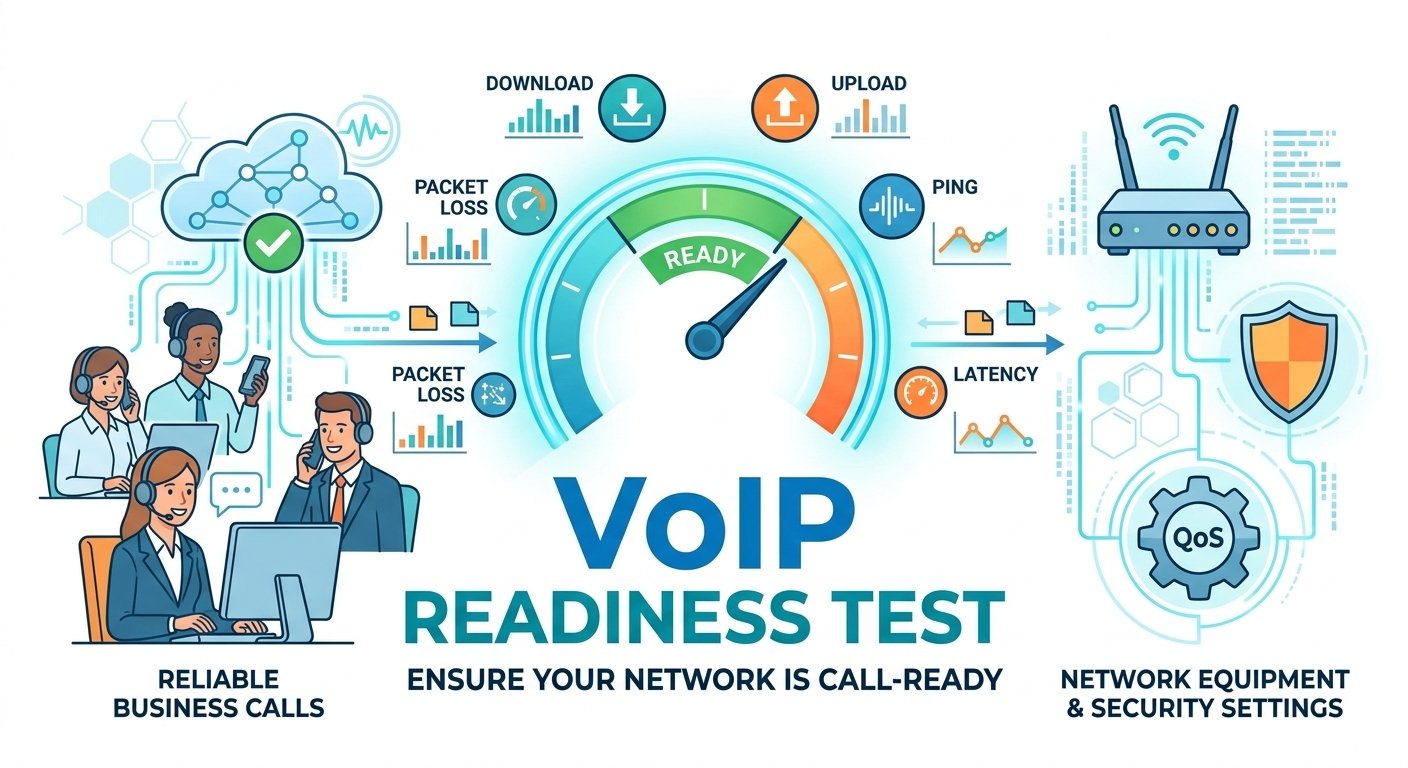
Both suppliers can serve office calling and cloud applications when their actual connection meets the workload. Run calls, a video meeting and a representative upload together during normal hours. Observe latency, jitter, packet loss and interrupted sessions.
Start with an Ethernet-connected device. If it performs well but one room has poor Wi-Fi, review access-point coverage, router placement and interference. Changing the internet provider may not solve an internal coverage problem.
Keep guest traffic separate from essential work. Schedule nonurgent backups where practical and review traffic management with the network administrator. Unlimited data does not remove contention inside the office network.
A business internet subscription also does not automatically include a complete phone system or contact centre. Calling licences, numbers, routing, recording and software integrations need their own comparison. Confirm requirements with the telephony provider before migration.
Fixed Wireless vs Portable Access from AT&T
Internet Air uses a hub receiving tower-fed internet instead of a new physical fiber or cable access line. Use it only at its approved service address; it cannot travel with the business. It is a fixed wireless office option, subject to local reception and performance.
Air can make sense when installing a suitable wired service is impractical. Test uploads, meetings and essential transactions at the intended gateway position. See Internet Air inquiry and our dedicated Internet Air overview.
Which is more reliable: Fiber or Internet Air?
Start with suitable Fiber for a permanent, upload-heavy office. Its access connection avoids dependence on indoor cellular reception and tower capacity. This is an access-type recommendation rather than a guarantee against outages.
Portable connectivity is a separate purchase
AT&T Wireless Broadband is portable. Appropriate hotspot/router use can serve on-the-go work, temporary pop-up sites and emergency needs. It offers unlimited data in up-to-25, 50 or 100 Mbps maximum speed tiers, subject to coverage, congestion and permitted uses.
Published restrictions exclude public or guest Wi-Fi and certain continuous-streaming or hosting activity. Confirm the intended application through the Business Wireless inquiry route. A fixed Xfinity or Comcast gateway, and a backup feature, should not be assumed to permit portable primary use.
Backup: AT&T Gateway Recovery vs Wireless Connect
Eligible AT&T Fiber 1 GIG-and-higher plans advertise integrated wireless backup with the required gateway and coverage. It needs power. Confirm static-IP and calling restrictions rather than assuming every primary connection feature survives.
Comcast Business’s current recovery product is Wireless Connect. It uses multiple backup networks and requires an active business service, compatible leased router and additional monthly charges. Its published battery guidance describes up to 8–16 hours of power to the Wireless Connect device, depending on service and connected-device load.
Comcast Business is worth evaluating when packaged battery-backed recovery is the deciding requirement. The runtime is not guaranteed. Power to that device is not a promise to power every switch, access point, payment terminal or computer in the office.
Do not apply an older Connection Pro description automatically to a new Wireless Connect order. Ask which product, hardware, backup speed and support arrangement you will receive.
Test primary-link failure and restoration with essential applications active. Calls and VPNs can need reconnection after an address change. Establish which tasks should continue and what staff must do during recovery.
A backup connection should be sized for essential activity, not assumed to preserve the entire primary workload. Keep suitable power protection for all equipment needed by the recovery design.
AT&T vs Xfinity: Contracts, Guarantees and Complete Cost
AT&T Fiber advertises no annual internet contract. That flexibility can help with a changing lease or office location, but it is not a promise that every future price remains unchanged.
Comcast Business offers a five-year service-price lock on qualifying packages with a one-year contract. The guarantee concerns the covered monthly service charge, not every tax, fee or separately selected product. A price-lock duration and a minimum commitment are different things.
Xfinity’s residential no-annual-contract offer is also a different agreement. Do not use it to describe Comcast Business contract terms. Retain the exact accepted proposal rather than relying on a promotional screenshot.
For either supplier, request installation, equipment, static IPs, add-ons, cancellation and relocation rules. Ask what changes if a qualifying bundle component ends. A lower internet line can produce a higher total bill if the required extras are unnecessary.
AT&T vs Xfinity: Support, Security and Enterprise Use
Comcast Business’s current internet page lists 24/7 customer service, no data caps and foundational SecurityEdge protection. Higher security tiers and other services can carry additional charges; confirm what is included.
Ask each supplier to define access support, supplied-router support and responsibility for third-party equipment. A 24/7 contact channel is different from a guaranteed onsite repair time.
Use appropriate firewall controls, updates, secure Wi-Fi and guest isolation. Confirm how any included network-security feature behaves with the office VPN, DNS configuration and recovery path. It does not by itself establish compliance.
For enterprise requirements, request equivalent dedicated or managed proposals. Ordinary broadband and dedicated internet have different contractual capabilities. Compare SLA definitions, routing, monitoring, addressing and escalation rather than choosing from entry prices.
Commercial premises need exact address qualification and building permission for any required installation. Keep the existing circuit until the new access, calling and recovery arrangement have passed acceptance checks where overlap is possible.
AT&T vs Xfinity: Pros and Cons Compared
| Product | Strengths | Limitations |
|---|---|---|
| AT&T Business Fiber | Symmetrical uploads; flexible annual commitment; eligible integrated backup. | Address eligibility; offer conditions; backup and power restrictions. |
| Xfinity residential | Price-led home-office candidate; current equipment and unlimited-data proposition. | Home-service agreement; business features and allowed use need verification. |
| Comcast Business | Business support; qualifying price-lock option; packaged recovery and security options. | Offer and contract conditions; upload profile; add-on and equipment costs. |
AT&T vs Xfinity: Clear Winners by Office Requirement
| Requirement | Winner | Reason |
|---|---|---|
| Permanent commercial office with heavy uploads | AT&T Fiber. | Start with a suitable symmetrical connection; qualify alternatives. |
| Price-led home office using permitted residential service | Xfinity to evaluate first. | Its home-service price is relevant to this specific setting. |
| Lower cited standalone 300 Mbps business entry price | AT&T Fiber. | Lower reference than Comcast’s main one-year business offer. |
| Business internet service-price guarantee over five years | Comcast Business. | Compare its qualifying lock offer and contract terms. |
| Packaged battery-backed business recovery | Comcast Wireless Connect to evaluate. | Confirm hardware, runtime and additional charges. |
| Wireless hub instead of new wired access | Internet Air to evaluate. | A fixed-address option, subject to local performance. |
| Portable or temporary-site internet | A permitted portable plan. | AT&T Wireless Broadband is one suitable product to qualify. |
| Medium office with sustained calls and cloud uploads | AT&T Fiber as the first shortlist option. | Assess concurrent traffic and a suitable Comcast proposal. |
| Enterprise with contractual performance needs | A dedicated or managed proposal. | Specify SLA, routing, support and security independently. |
Employee count alone should not choose the connection. The location, simultaneous outgoing traffic and recovery requirements are more useful than arbitrary team-size rules.
Request an AT&T Quote for the Correct Product
Use the inquiry route that matches the connection you need. Give your full service address, essential applications, current service and preferred start date. For mobile internet, explicitly request the appropriate portable broadband service.
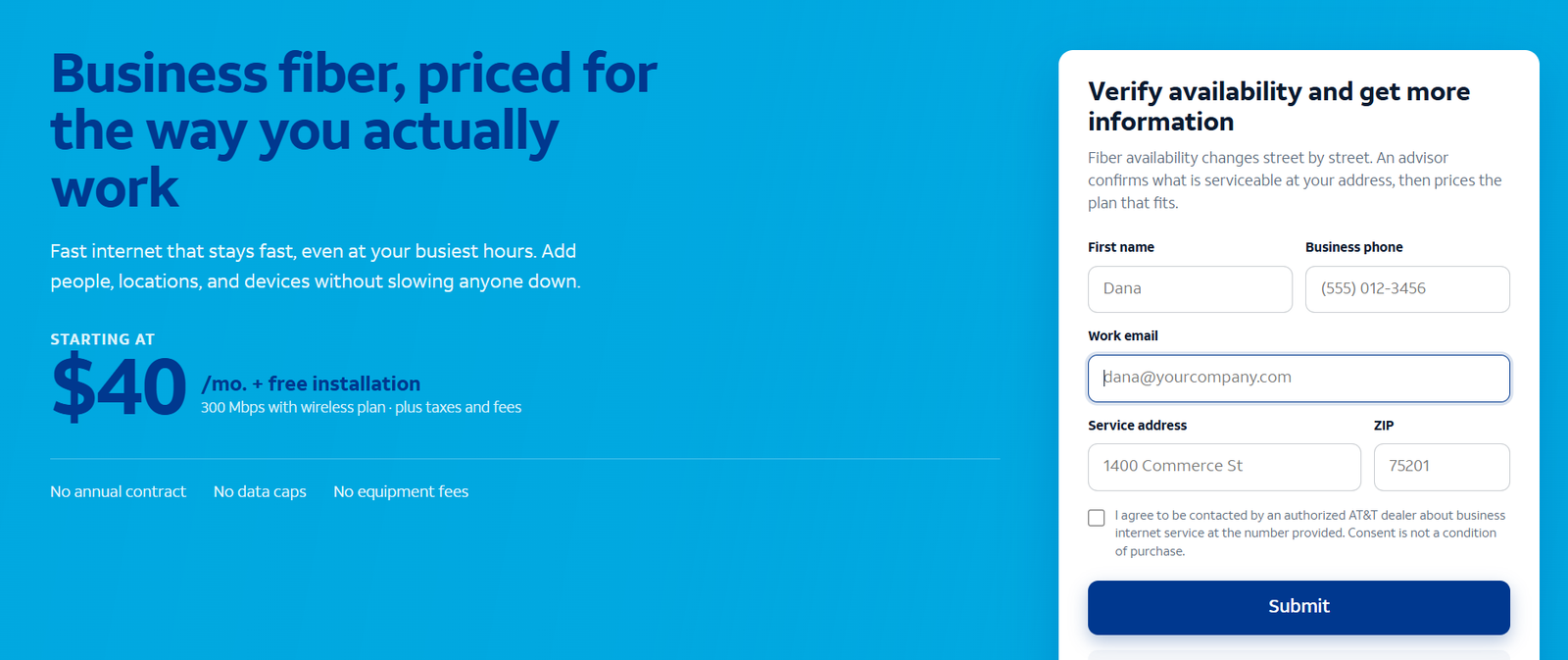
Typical response expectation: 24–48 business hours after submission through the supplied referral route. This is an expectation, not a guaranteed installation or response deadline. The screenshot above is a sample; use the linked product page to submit your inquiry.
Dedicated AT&T Reviews
Read the relevant product page: AT&T Business Fiber review, Internet Air for Business overview and Business Wireless review. Request a comparable Comcast Business quote for a commercial office.
Customer Reviews: What the Evidence Can Tell You
Positive AT&T example: Belinda C., 5/5 on G2, May 1, 2026. She reported dependable internet and phone service and no particular dissatisfaction. The listing does not identify which of the AT&T products discussed here she uses.
The same general G2 listing also contains older critical feedback about customer support. Neither a positive review nor a broad carrier complaint establishes the performance of a new circuit in your building.
For a more useful local assessment, ask nearby businesses using the same access service about installation, busy-hour uploads, outage follow-up and unexpected bill changes. Match the product and location before using a review to make a purchase decision.
Frequently Asked Questions
Is AT&T or Xfinity better for a business office?
Start with AT&T Business Fiber for a suitable commercial office that needs uploads and flexibility. Xfinity home internet can be evaluated for permitted home-office use. Compare Comcast Business for the commercial Comcast offer.
Is Xfinity the same product as Comcast Business?
No. They are separate home and business offers from the same company, with different plans and agreements. A shared brand reference or hotspot does not make the subscriptions equivalent.
Is Comcast Business fiber?
Its small-business page describes fiber-powered internet connected by coax. Other access products exist. Confirm the final connection and upstream profile for the actual order.
Are Comcast uploads symmetrical?
Symmetrical business speeds are available only in selected areas and tiers. Confirm your proposed service rather than assuming symmetry from its download headline.
Does the five-year price lock require a five-year contract?
The cited Comcast Business qualifying offer requires a one-year contract. Read the price-lock scope and accepted agreement; the two durations describe different conditions.
Can I take Internet Air to a temporary site?
No. Keep its hub at the approved address. Request a suitable portable service for changing locations.
Does backup keep everything working automatically?
Do not assume so. Check power, addressing, available recovery capacity and application reconnection. Test failure and restoration before relying on it.
Are U.S. prices valid internationally?
No. These domestic references concern eligible U.S. locations. International business connectivity needs a separate location-specific proposal.
Final Recommendation
Choose AT&T Business Fiber first for a suitable permanent commercial office where uploads and flexible terms matter. Evaluate Xfinity for a home office only under a suitable permitted residential agreement. Compare Comcast Business when buying commercial service from Comcast.
Comcast Business can be the stronger fit for a qualifying price-lock or packaged recovery requirement. Obtain equivalent total quotes and validate the actual connection, internal network and recovery behaviour before migration.
AT&T, Xfinity and Comcast are trademarks of their respective owners. VoIPCalling.com is an independent publisher.
Affiliate disclosure: VoIPCalling.com may earn a commission if you purchase through it, at no additional cost to you.