An omnichannel contact center represents a modern approach to customer service by unifying multiple communication channels into one seamless platform. Consumers expect brands to be available on voice, email, social media, and text without ever losing conversation context. A robust omnichannel contact center solves this communication gap by integrating every touchpoint natively, empowering agents with complete interaction histories.
Implementing such advanced systems elevates customer satisfaction while simultaneously boosting agent productivity. This centralized setup ensures that inbound inquiries route intelligently, saving critical time. Transitioning to an omnichannel cloud contact center transforms disorganized communication into a highly efficient, personalized customer journey.
What Is an Omnichannel Contact Center?
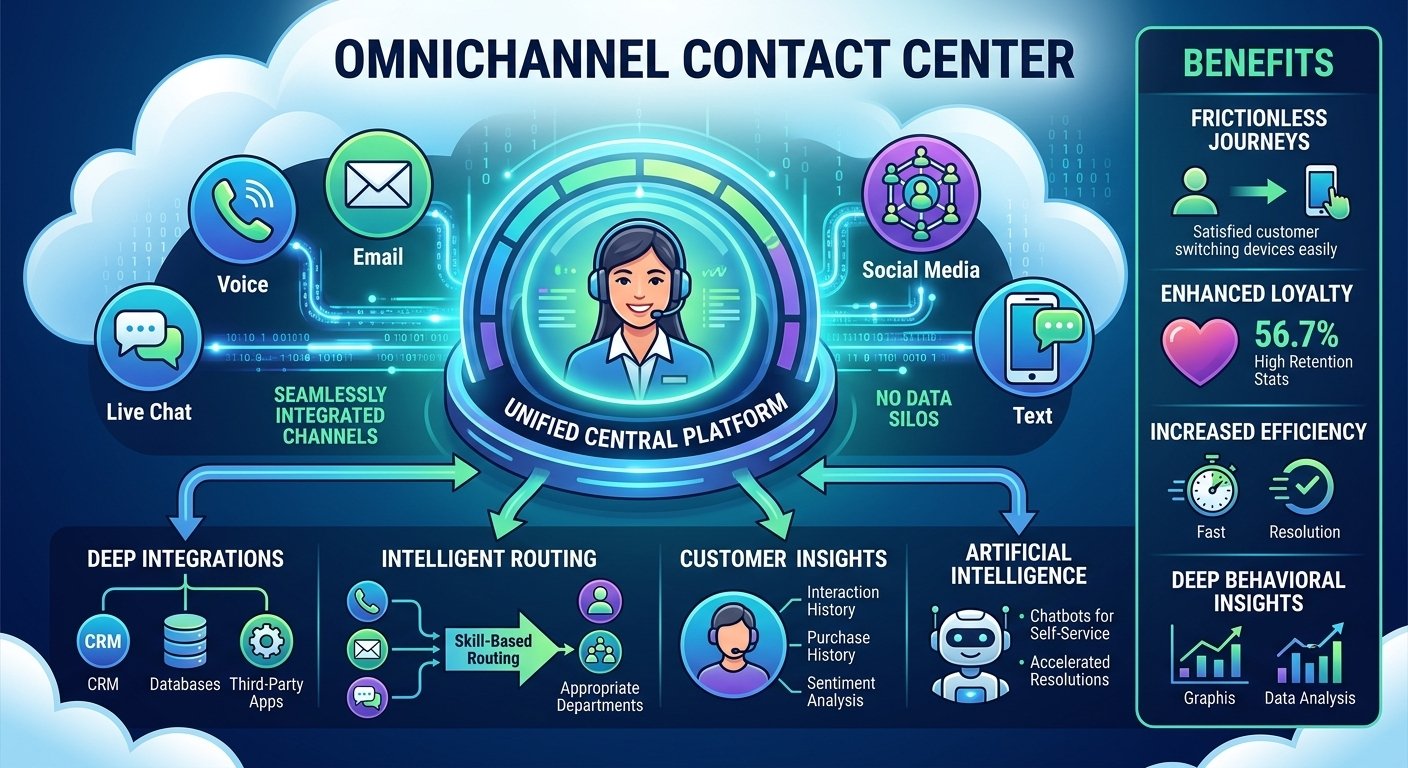
It is a unified customer service solution that integrates various communication platforms like voice, live chat, email, and social networks into a single dashboard. Consumers can smoothly transition between these mediums without having to repeat their issues to different representatives. Unlike separated communication strategies, an omnichannel contact center links every interaction centrally to eliminate isolated data silos.
Consolidating interactions across all mediums grants support representatives a comprehensive view of the buyer journey. Providing this holistic perspective enables staff to deliver highly personalized support effortlessly. Agents access the exact context they need instantly, leading to faster resolution times, improved operational workflows, and stronger brand loyalty.
Omnichannel customer experience example
Imagine a user experiencing a technical glitch who initially attempts self-help but eventually initiates a live web chat. After explaining the situation, they request to transition to a voice call to clarify complex details with a human representative.
The receiving representative instantly accesses the entire chat transcript alongside previous purchase histories. According to research from McKinsey, consumers regularly use three to five different mediums to resolve issues, and the vast majority desire effortless transitions between them. This seamless continuation prevents frustration and resolves the technical glitch swiftly.
Benefits of Omnichannel Contact Centers
Embracing a unified communication strategy yields substantial advantages for both organizations and their clientele. An omnichannel contact center provides the foundation for sustainable business growth.
-
Frictionless journeys: Consumers switch effortlessly between text, email, and voice without reiterating their problems to multiple agents.
-
Enhanced loyalty: Delivering consistent support turns standard interactions into positive experiences. A study by Aberdeen Group reveals that organizations utilizing unified strategies achieve a 91 percent year-over-year increase in client retention.
-
Increased efficiency: Having a comprehensive interaction history readily available allows staff to resolve support tickets rapidly.
-
Deep behavioral insights: Consolidated platforms capture valuable behavioral analytics across every digital medium for better decision-making.
-
Controlled operational costs: Deploying self-help tools deflects routine inquiries, allowing staff to focus on complex tasks and reducing overhead.
Key Features of Omnichannel Contact Center Software
Cloud-powered platforms simplify intricate customer interactions by funneling them into a single centralized hub. Evaluating omnichannel contact center solutions requires looking for highly specific technical capabilities.
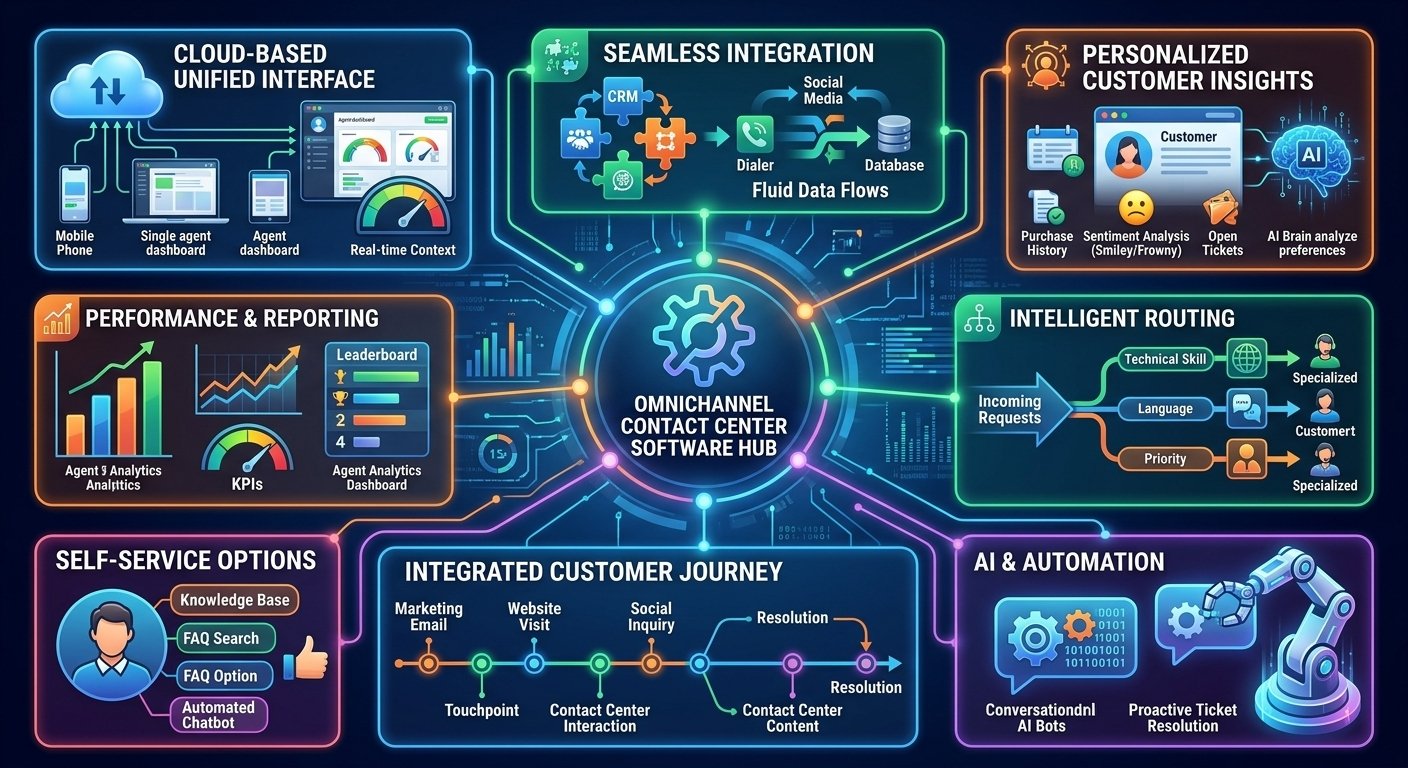
1) Cloud-based with a unified interface
A successful strategy requires staff to move fluidly between mediums while retaining complete conversational context. Your chosen software needs an intuitive dashboard that delivers real-time data directly to the workforce.
Agents should never struggle to locate historical records during a live interaction. Centralizing these records in a cloud-hosted environment facilitates remote work and ensures immediate access to previous interactions without relying on clunky third-party middleware.
2) Seamless integration between channels
Consumer preferences shift rapidly, requiring businesses to adopt new platforms without disrupting daily workflows. Any capable call center omnichannel software must smoothly connect with existing business tools.
This connectivity includes natively linking with existing databases, predictive dialers, and social media platforms. Consolidating reporting metrics across these integrated mediums ensures managers accurately forecast demand and pinpoint critical areas for workflow optimization.
3) Customer insights render personalized experiences
Personalization plays a vital role in cultivating long-term brand loyalty among your consumer base. Providing relevant historical context helps staff tailor their responses to individual needs seamlessly.
Agents require immediate visibility into past purchases, open support tickets, and recent product usage. Leveraging an ai omnichannel contact center solution further enhances this by conducting sentiment analysis during live conversations.
4) Intelligent routing of inbound requests
Managing multiple inbound mediums demands sophisticated routing capabilities to maintain swift response times. Automatic call distribution directs inquiries based on availability, priority, and historical context.
Deep crm omnichannel integration ensures that highly specific requests go straight to the most qualified department. Factoring in language fluency and technical certifications guarantees a precise match between the consumer and the representative.
5) Where does your CX strategy stand with AI?
Artificial intelligence transforms standard support environments into proactive, highly efficient hubs. Assessing your current automation maturity highlights areas where machine learning could accelerate ticket resolution.
Implementing conversational bots handles routine inquiries instantly, reserving human representatives for nuanced situations. This strategic deployment of automation directly improves the overall client experience while optimizing agent workload.
6) Integrated data across the customer journey
Delivering a genuinely cohesive experience requires absolute visibility into every single digital touchpoint. Journey mapping allows managers to trace the exact path a user took before initiating contact.
Tracking the complete pipeline from the initial marketing touchpoint to the final resolution builds a deeper understanding of consumer behavior. Connecting a dedicated data platform aggregates these diverse data points into one highly actionable profile.
7) Self-service options
Empowering consumers to resolve minor issues independently boosts overall satisfaction while significantly reducing inbound ticket volume. A robust self-help portal forms the foundation of any modern support ecosystem.
Providing access to comprehensive knowledge bases, frequently asked questions, and intelligent bots gives users immediate answers. Deflecting these basic requests allows skilled representatives to dedicate their time to high-value interactions.
8) Performance management and reporting
Consolidated analytics supply management teams with actionable insights regarding workforce performance. Tracking historical trends highlights operational bottlenecks and opportunities for targeted coaching.
Customizable dashboards display the exact metrics that align with overarching corporate objectives. Providing staff with access to their own performance data encourages continuous self-improvement and accountability.
Top 5 Omnichannel Contact Center Software
Selecting the ideal omni channel contact center software depends entirely on your specific organizational requirements and budget constraints.
-
Nextiva: A unified communications provider offering an easy-to-use and scalable cloud-based omnichannel contact center solution. It is suitable for businesses of all sizes and provides complete features to manage customer interactions across multiple channels, including phone, email, chat, social media, and SMS.
-
Genesys Cloud CX: A comprehensive and scalable cloud-based contact center platform. It is an excellent option for businesses looking for a wide range of features, including omnichannel routing, self-service options, automation, and analytics.
-
Five9: A powerful, cloud-based contact center platform designed specifically for the enterprise market. Like Genesys, it offers a robust suite of features including omnichannel routing, self-service, automation, and analytics for businesses needing a highly scalable solution.
-
Zendesk Sunshine: A customer relationship management (CRM) platform that seamlessly integrates with various contact center solutions. It helps businesses improve their customer service by providing a unified, single view of all customer interactions.
-
Freshdesk Contact Center: An affordable and user-friendly cloud-based contact center solution tailored for small and medium-sized businesses (SMBs). It provides essential features such as omnichannel routing, self-service, automation, and analytics.
Comparison of top omnichannel contact center software
| Solution | Who It’s Best For | Key Features | Pricing |
| Nextiva | Businesses seeking an easy-to-use, all-in-one solution | • Call recording
• CRM integration • Live chat • Email management • Social media integration • Advanced reporting & analytics |
Starts at $75 per user per month |
| Genesys Cloud CX | Businesses needing a comprehensive and highly scalable contact center with advanced features | • Workforce management
• Skills-based routing • AI-powered self-service • Speech analytics • Customizable dashboards |
Starts at $75 (can be expensive for smaller businesses) |
| Five9 | Large enterprises requiring a powerful, customizable solution | • WFO integrations
• CTI integrations |
Starts at $175 monthly (excludes Voice on the digital-only and includes only Voice on the base plans) |
| Zendesk Sunshine | Businesses prioritizing a unified customer view across channels and leveraging existing CRM integrations | • CRM data integration
• Agent workspace • Multi-channel ticketing • Reporting & analytics |
Starts around $69/user/month (custom integrations may add cost) |
| Freshdesk Contact Center | Small and medium businesses seeking an affordable and user-friendly contact center solution | • Ticketing system
• Live chat • Call routing • Reporting & Analytics |
Starts at around $59/user/month |
Omnichannel vs. Multichannel Contact Centers
Multichannel setups support diverse communication methods, but these platforms operate in isolated data silos. Consumers must repeatedly explain their situations whenever they switch from an email thread to a voice conversation.
Conversely, a unified omnichannel contact center blends all data into one centralized dashboard. This modern structure empowers a single representative to manage inquiries across every available medium effortlessly, creating a vastly superior user experience.
| Functionality | Multichannel contact center | Omnichannel contact center |
| Supports multiple channels | ✔ | ✔ |
| Seamlessly switch between communication channels | ✗ | ✔ |
| CRM integration for relevant customer data | ✗ | ✔ |
| Real-time insights on customer activity | ✗ | ✔ |
| One team can handle requests across all channels | ✗ | ✔ |
Call Center vs. Omnichannel Contact Center
Traditional call centers rely exclusively on an omnichannel phone system to handle consumer inquiries. Support representatives spend their entire shifts answering phones and resolving issues verbally, entirely ignoring digital mediums.
Modernized contact facilities encompass a much broader spectrum of digital communication pathways. A true omnichannel contact center facilitates interactions through text, video, live chat, and social applications, accommodating diverse consumer preferences efficiently.
Implementing an Omnichannel Contact Center
Executing this technological transition involves careful planning and structured deployment strategies to ensure absolute success.
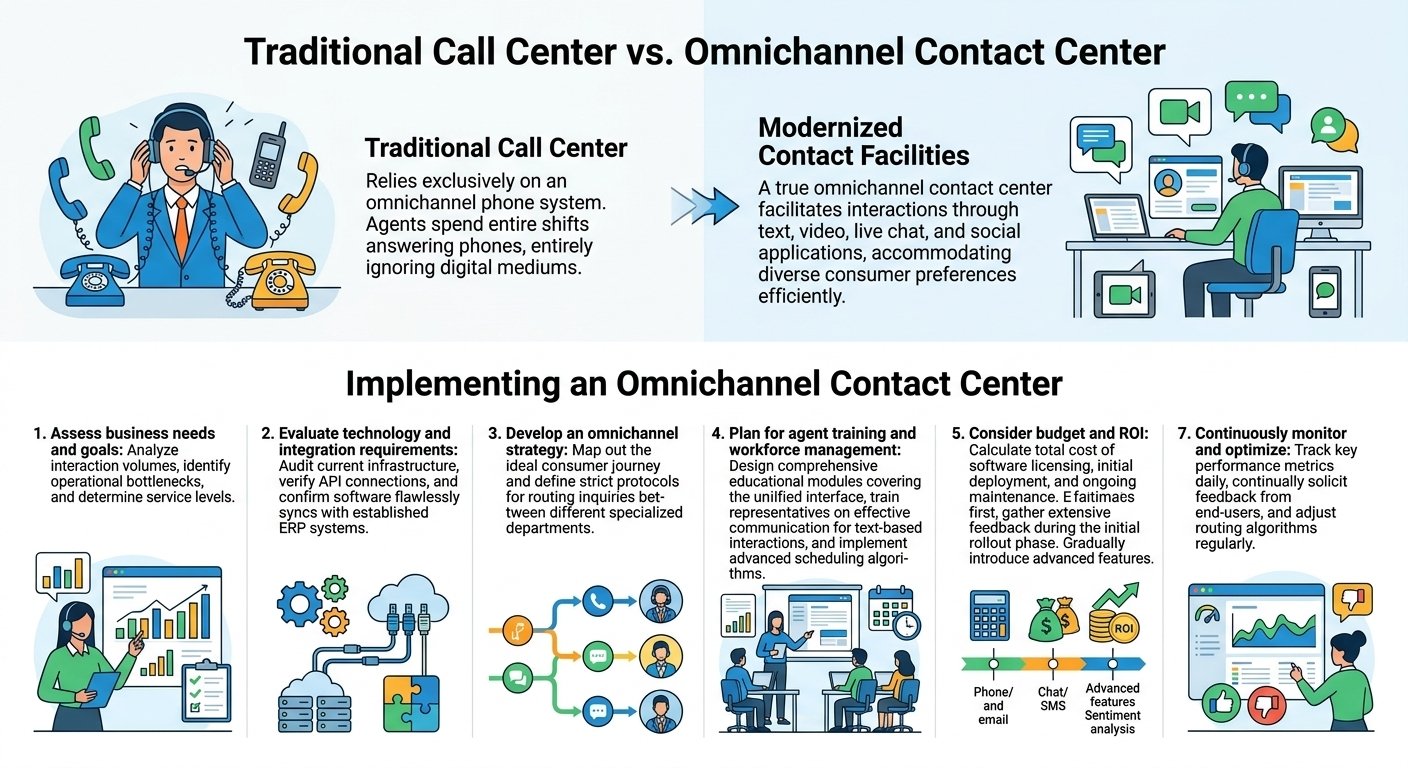
1. Assess business needs and goals
Begin by analyzing current interaction volumes across all existing communication mediums and identifying specific operational bottlenecks that are causing delays in your current support pipeline. Furthermore, determine the exact service levels required to meet your overarching corporate objectives.
2. Evaluate technology and integration requirements
You must audit your current technological infrastructure to identify necessary API connections and verify that prospective software flawlessly syncs with your established ERP systems. Additionally, it is essential to confirm that the platform supports every digital medium your target demographic prefers.
3. Develop an omnichannel strategy
Start by mapping out the ideal consumer journey from initial contact to final resolution, and then define strict protocols for routing inquiries between different specialized departments. Finally, establish clear guidelines to maintain brand voice consistency across all digital platforms.
4. Plan for agent training and workforce management
Be sure to design comprehensive educational modules that thoroughly cover the new unified interface, and train your representatives on effective communication techniques for text-based interactions. Alongside this training, implement advanced scheduling algorithms to ensure adequate staffing during peak traffic hours.
5. Consider budget and ROI
Carefully calculate the total cost of software licensing, initial deployment, and ongoing maintenance. Once these costs are established, estimate the potential financial savings generated by deflecting routine inquiries through automation, and project the revenue increase associated with higher client retention and improved satisfaction scores.
6. Develop a phased implementation plan
To minimize operational disruption, prioritize launching the most critical communication mediums first and gather extensive feedback from both staff and consumers during this initial rollout phase. Once the core system stabilizes, you can gradually introduce advanced features like sentiment analysis.
7. Continuously monitor and optimize
Track key performance metrics on a daily basis to ensure the new system meets expectations, and continually solicit feedback from end-users to rapidly identify any minor usability issues. As conditions change, adjust your routing algorithms regularly to reflect shifting consumer demands and seasonal traffic spikes.
Omnichannel Contact Center Best Practices
Establishing a highly effective omnichannel contact center strategy requires consolidating behavioral data into a singular view. Accessing this holistic profile allows representatives to anticipate needs before the consumer even explains them.
Monitoring shifting consumer preferences ensures your organization adapts rapidly to emerging digital platforms. Maintaining a careful balance between automated bots and empathetic human representatives guarantees consistently high-quality resolutions across your entire support network.
The Future of Customer Support Is Omnichannel
Forcing clientele through a single point of contact limits growth and frustrates active users. Equipping staff with a multi channel call centre alternative that actively syncs data sets a new standard for excellence in service delivery.
Gradually introducing new digital pathways allows your organization to scale operations gracefully without overwhelming your workforce. Adopting this unified philosophy guarantees your brand remains competitive in a rapidly evolving digital landscape.
Read More: Best Free Conference Call Services Compared (2026)
Final words
Upgrading to a sophisticated omnichannel call center solution represents a necessary evolution for modern businesses. Providing frictionless, highly personalized interactions directly boosts long-term revenue and brand advocacy among your core demographic.
Organizations prioritizing seamless communication will inevitably outperform competitors relying on disjointed, legacy systems. Investing in a robust omnichannel contact center today secures operational efficiency, reduces overhead costs, and guarantees elevated customer satisfaction for years to come.
Faqs
-
What makes the best omnichannel contact center essential for mastering customer support?
It is essential because it completely unifies all communication pathways, allowing organizations to deliver personalized, frictionless support that elevates overall user satisfaction.
-
What is omnichannel customer support?
This refers to a unified approach to service where every communication platform integrates seamlessly, allowing consumers to switch mediums without losing conversational context.
-
What does “omnichannel” mean?
It signifies an integrated methodology where all individual platforms, channels, and devices operate collaboratively to provide a singular, consistent user experience.
-
What is an omni channel service?
It is a business strategy that connects disparate communication touchpoints into one cohesive environment, empowering representatives to access complete interaction histories instantly.
-
What is an example of an omnichannel?
A user initiates a support request via social media, later transitions to a web chat, and finally calls a representative who immediately possesses the full history of the previous two interactions.
-
What is an omnichannel call center?
It is an upgraded support facility that handles inbound and outbound communications across voice, email, text, and chat from a single centralized software dashboard.
-
How does omnichannel contact center software improve efficiency?
It improves efficiency by eliminating the need for staff to toggle between different applications, automatically routing tickets, and providing complete contextual data immediately.
-
What is the difference between an omnichannel and a multichannel contact center?
A multichannel setup offers various contact methods that operate entirely independent of one another, whereas a unified setup syncs all data seamlessly across every available medium.
-
How does AI impact an omnichannel cloud contact center?
Artificial intelligence accelerates issue resolution by powering intelligent bots for self-service, conducting real-time sentiment analysis, and automatically routing complex tickets to the most qualified staff.