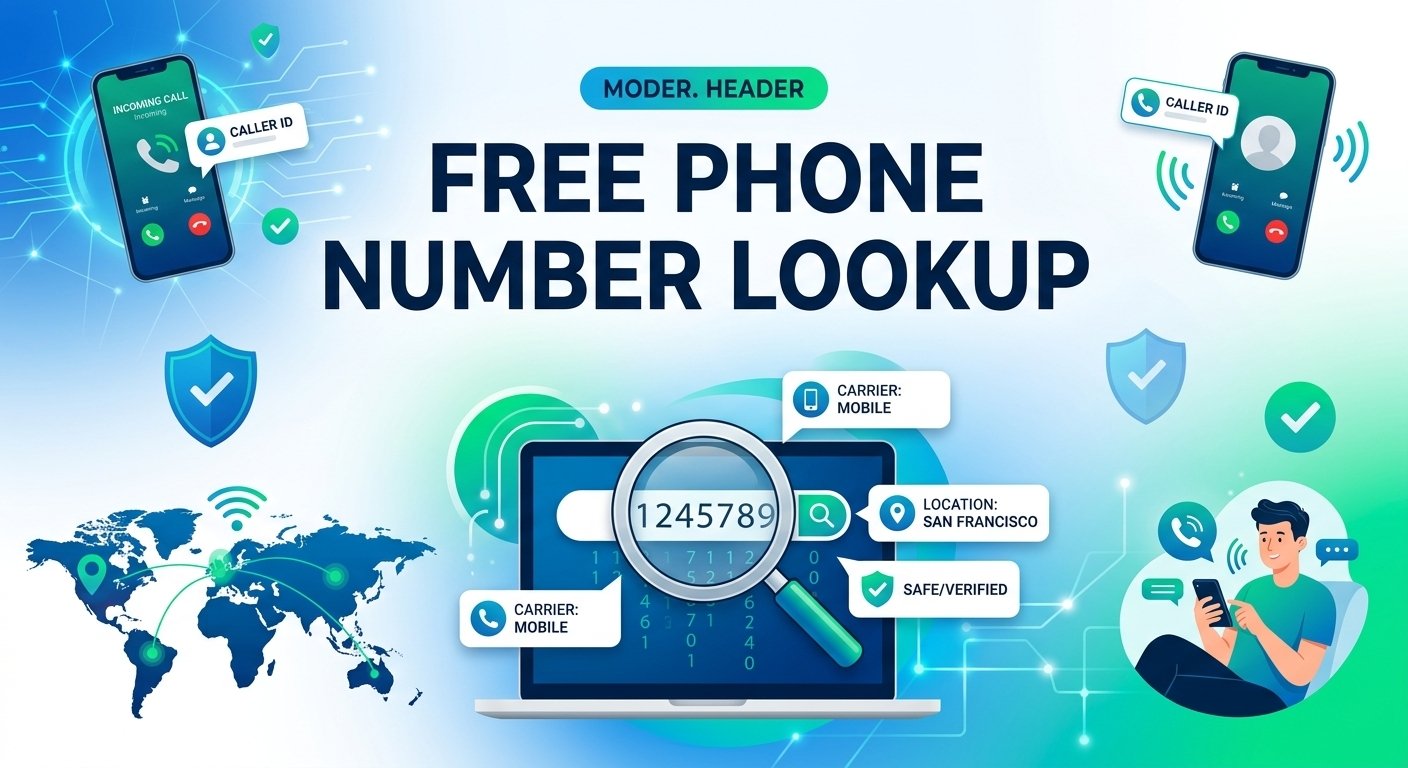
A free phone number lookup lets you search an unknown telephone number for available information such as its country or area code, possible carrier, line type and publicly associated business or spam reports. The information available depends on the lookup service and number. A lookup cannot guarantee the caller’s identity because phone numbers and caller ID information can be spoofed.
A free phone number lookup tool is a powerful digital tool that can help you gain immediate insight into the source and authenticity of incoming calls. With spam and unsolicited calls becoming more prevalent in today’s world, these sites enable users and businesses to determine the carrier, line type and geographical area of a mystery caller.
Users can check if the contact is a real person or a potential security threat by cross-referencing with the global numbering databases and real-time data. By using this technology, you can control your communication, block unwanted distractions and have a safe digital life in your day-to-day life.
What Information Does a Free Phone Number Lookup Show?
The information returned by a phone number lookup depends on the service, country, number type and data sources available. A basic lookup may provide technical information about the number, while reverse-lookup services may also search public or user-contributed records.
Common results can include:
- Country or calling code: Identifies the country associated with the number’s international dialing code.
- Area or numbering region: For some fixed-line and North American numbers, the area code can indicate the numbering region originally associated with the number.
- Carrier information: Some lookup services can identify the carrier or network associated with a number, although number portability can complicate carrier data.
- Line type: A service may classify a number as mobile, landline, VoIP, toll-free or another supported category.
- Number format: Lookup or validation tools can determine whether a number follows the expected numbering format for a particular country.
- Public business information: A reverse search may find a company name when the number appears in public business listings.
- Spam or scam reports: Community-based databases may show whether other users have reported calls from that number.
- Possible caller information: Some reverse-lookup databases may return a person or organization associated with a number, but availability and accuracy vary considerably.
Important: A phone number lookup does not prove who is physically making a call. Caller ID information can be spoofed, reassigned numbers can contain outdated information, and mobile number portability can affect location or carrier assumptions.
How to Look Up a Phone Number for Free?
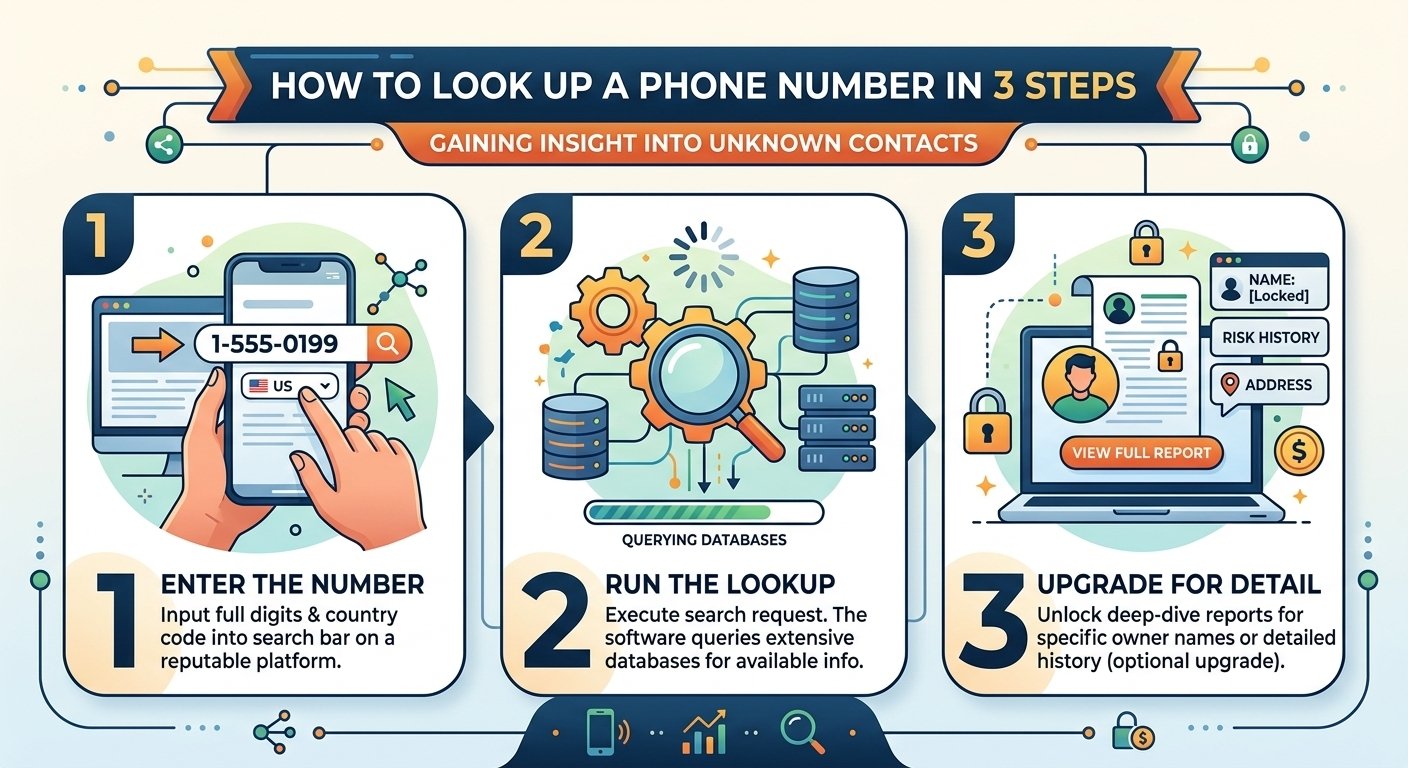
It doesn’t take a lot of technical expertise to gain insight into an unknown contact, most platforms focus on user experience and speed. Follow these steps to get the information you need from any mystery digits.
You can perform a basic phone number search in a few steps:
-
- Enter the complete phone number. Use a reputable phone lookup or reverse-search service and enter the full number. For international numbers, include the country code.
- Run the search. The service checks its available numbering, carrier, public, business, spam-reporting or other databases.
- Review the available information. Depending on the service, you may see the country, region, line type, possible carrier, business listing or community spam reports.
- Cross-check important information. Don’t rely on a single lookup result to determine whether a caller is trustworthy. Search the number separately and check official business contact information when appropriate.
- Block or report suspicious calls. If the call appears unwanted or fraudulent, use your phone’s blocking features or report it through the appropriate carrier or consumer-protection channel.
Best Free Phone Number Lookup Websites
Truecaller for caller/spam identification, NumLookup for reverse lookup, IPQualityScore for number validation/risk information, FreeCarrierLookup for carrier/line-type checks, and Google Search for finding publicly indexed business or directory references.
The key is to distinguish what is actually free. Some services advertise a free lookup but put owner names, addresses, or detailed reports behind payment. Also, different tools solve different problems: a reverse lookup tries to associate a number with public information, a carrier lookup identifies network/line type, and a spam lookup relies on reputation or community reports.
A useful comparison table would be:
| Tool | Best For | Free Lookup | Name Lookup | Carrier/Line Type | Spam Reports |
|---|---|---|---|---|---|
| Truecaller | Unknown caller & spam checks | Yes | Sometimes | Limited/varies | Yes |
| NumLookup | Reverse number searches | Yes/basic | Sometimes | Varies | Varies |
| IPQualityScore | Validation & fraud signals | Limited free use | No/limited | Yes | Risk signals |
| FreeCarrierLookup | Carrier identification | Yes | No | Yes | No |
| Google Search | Public business/number searches | Yes | Only if publicly indexed | No | Search-result dependent |
Can You Find Someone’s Name With a Free Phone Number Lookup?
Sometimes, but not always. A reverse phone lookup may display a name when the number is associated with a publicly available business listing, directory entry or another database accessible to the lookup provider.
Finding the owner of a personal mobile number is generally more difficult. Privacy restrictions, number reassignment, unlisted numbers and incomplete databases can prevent an accurate name from appearing.
Free services also commonly provide less information than paid reverse-lookup reports.
Most importantly, a displayed name should not be treated as proof of the caller’s identity. Caller ID can be spoofed, and numbers can be reassigned to new users.
Why Use a Free Phone Number Lookup?
A dependable verification instrument can be beneficial to your digital way of life in concrete methods for personal boundaries and efficiency. These services make your communication life easier and more secure in the following ways:
-
Screen unknown callers: Avoid answering persistent robocalls or suspicious numbers by identifying them before the device even starts ringing in your hand.
-
Verify a contact is real: Ensure that new business leads, online marketplace buyers, or potential acquaintances are using authentic, traceable mobile numbers.
-
Avoid fraud: Protect yourself from sophisticated phishing attempts by identifying numbers linked to known scam networks or non-geographic virtual lines.
-
Clean your contact lists: Organizations can significantly improve their outreach strategies by removing disconnected, invalid, or obsolete phone numbers from their customer databases.
-
Respect communication boundaries: By checking the caller’s time zone, you ensure that your outbound messages or calls are delivered at reasonable hours, fostering better professional relationships.
How Does a Phone Number Lookup Work?
Phone number lookup services combine different data sources to provide information about a telephone number. The exact sources depend on the provider and the type of lookup being performed.
A basic number-validation service may analyze the country code, area code, numbering format and line type using telecommunications numbering data. More advanced reverse-lookup services may compare the number against public directories, business listings, carrier information, licensed databases and community-generated spam reports.
The lookup result can therefore differ from one service to another. One platform might identify only the country and line type, while another may find a public business name or previous spam reports.
Phone number portability and reassignment can also make some information outdated. For this reason, lookup results should be treated as useful indicators rather than guaranteed real-time information about the person currently using a number.
Why Use a Free Phone Number Lookup?
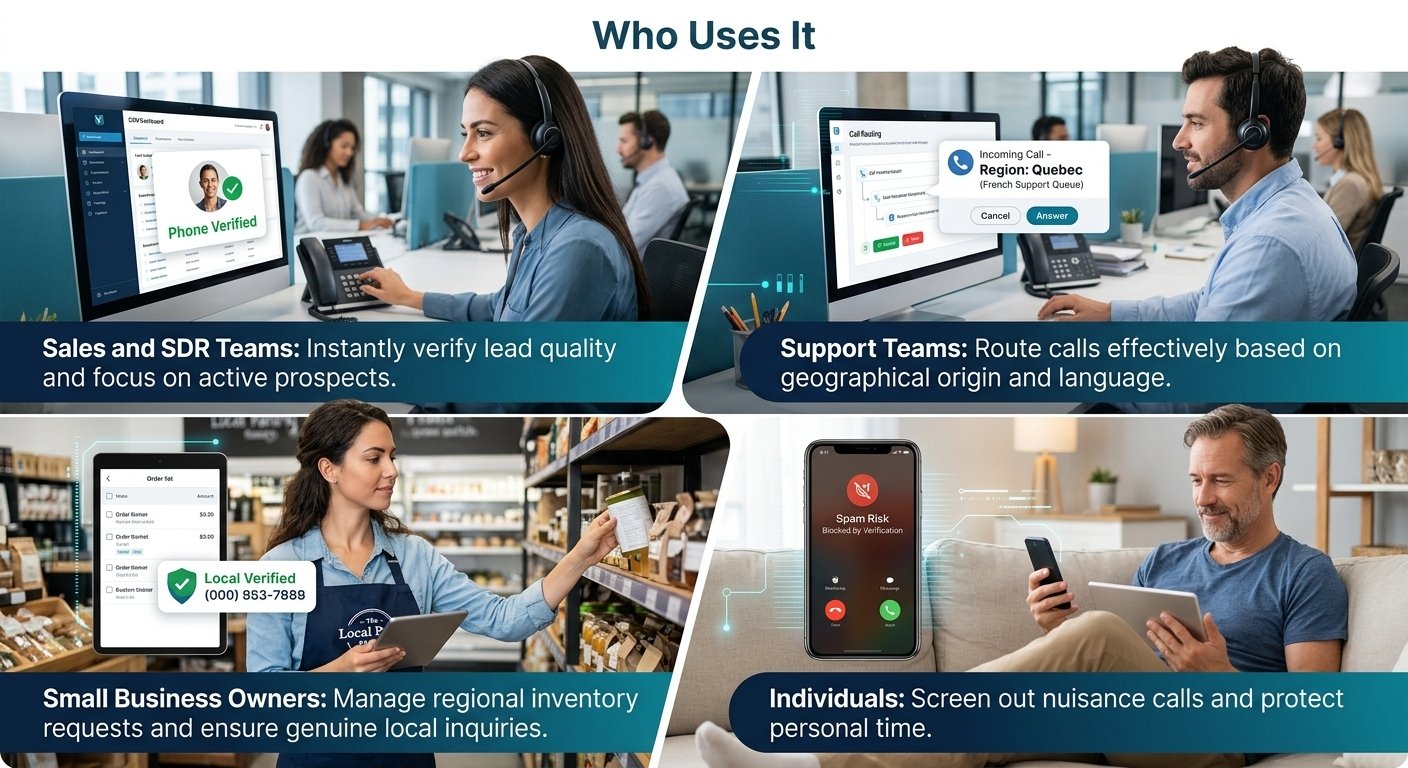
Phone verification technology is a valuable tool in many industries and situations, and its versatility makes it an essential tool for businesses. These tools can be used for various purposes, such as professional workflows or securing home life.
-
Sales and SDR Teams: Sales professionals utilize these tools to verify the quality of their incoming leads instantly, ensuring they focus their energy on prospects with legitimate, active contact details.
-
Support Teams: Customer service departments benefit from identifying the origin of incoming calls, allowing them to route inquiries to the correct language departments or regional teams.
-
Small Business Owners: Local enterprises rely on these services to manage regional inventory requests and verify that incoming inquiries are from genuine local customers.
-
Individuals Screening Calls: Everyday people use these platforms to effectively manage their personal time, filtering out nuisance calls and ensuring they only spend energy on communication that is relevant.
Phone Number Lookup vs Reverse Phone Lookup
Although the terms are often used interchangeably, they can refer to slightly different searches.
A phone number lookup commonly checks technical information about a number, such as its country, format, carrier or line type.
A reverse phone lookup starts with a telephone number and searches for publicly available information that may be associated with it, such as a business name, directory entry or spam reports.
For example, if you want to know whether a number is mobile or VoIP, a number-validation or carrier-lookup tool may be sufficient. If you’re trying to determine what business may have called you, a reverse phone search is more appropriate.
How Accurate Is a Free Phone Number Lookup?
The accuracy of a lookup is highly dependent on the source of the data and the kind of number being looked up. The information on the country, region and carrier is very accurate since it is derived from fixed national numbering-plan rules that are very seldom deviated from the standard registry.
But fields that depend on public records like the exact identity of the owner are subject to privacy laws, and differ from jurisdiction to jurisdiction. For example, it offers strong data for professional and commercial uses. Always make sure you use these results in accordance with legal frameworks like GDPR or CCPA, ensuring ethical data practices.
Can a Phone Number Lookup Detect a VoIP Number?
Some number-validation and carrier-lookup services can classify a telephone number as VoIP, mobile, landline or another line type. This can be useful for businesses validating contact information or investigating unfamiliar numbers.
However, a VoIP classification does not mean a number is fraudulent. Millions of legitimate businesses and individuals use VoIP phone numbers every day.
Similarly, a mobile or landline classification does not prove that a caller is trustworthy. Line type should be considered one piece of information rather than a fraud verdict.
Read More: What’s the Difference Between ACD and IVR? A 2026 Guide
Final Thought
A free phone number lookup can help you learn more about an unfamiliar number before deciding whether to answer or return a call. Depending on the service, you may find its country, numbering region, carrier, line type, public business information or previous spam reports.
However, no lookup result should be treated as proof of a caller’s identity. Numbers can be spoofed, ported or reassigned, and database information can become outdated. If a suspicious caller claims to represent a bank, government agency or business, contact that organization independently using its official contact information.
FAQ’s
-
How do I accurately identify a phone number?
The best way is to use a trusted online verification service that checks your number against the databases of the world’s carriers and live numbering plans, delivering instant, accurate data.
-
Can I discover the owner’s name without paying?
Simple technical information, such as carrier and region, is usually available without charge, but the personal identifying names are usually limited due to privacy laws and may need to be purchased.
-
Are international searches supported?
Most sophisticated lookup services also support international formats, so that you can find out what country the number is from, for nearly any number in the world, by using the correct E.164 syntax.
-
Is the lookup process anonymous?
Yes, the search process is completely private and anonymous, so the owner of the phone number will never be informed that his or her contact information was requested.
-
Does this tool effectively filter spam?
You can recognize the different kinds of lines, including VoIP or known scam-reporting registries, and easily differentiate between the two.
-
Is using this tool legally safe?
Trustworthy providers adhere to international privacy regulations, such as GDPR and CCPA, guaranteeing that data is used in an ethical and legal way for all users.
-
Is this tool designed for commercial use?
Yes, these tools are employed by businesses to verify contact information, stop fraudulent registrations, and maintain a clean and professional outreach.
-
Why would a number appear as invalid?
Numbers that are marked as invalid are probably disconnected, inactive or not yet registered in the numbering plan and are not safe or reliable contacts.