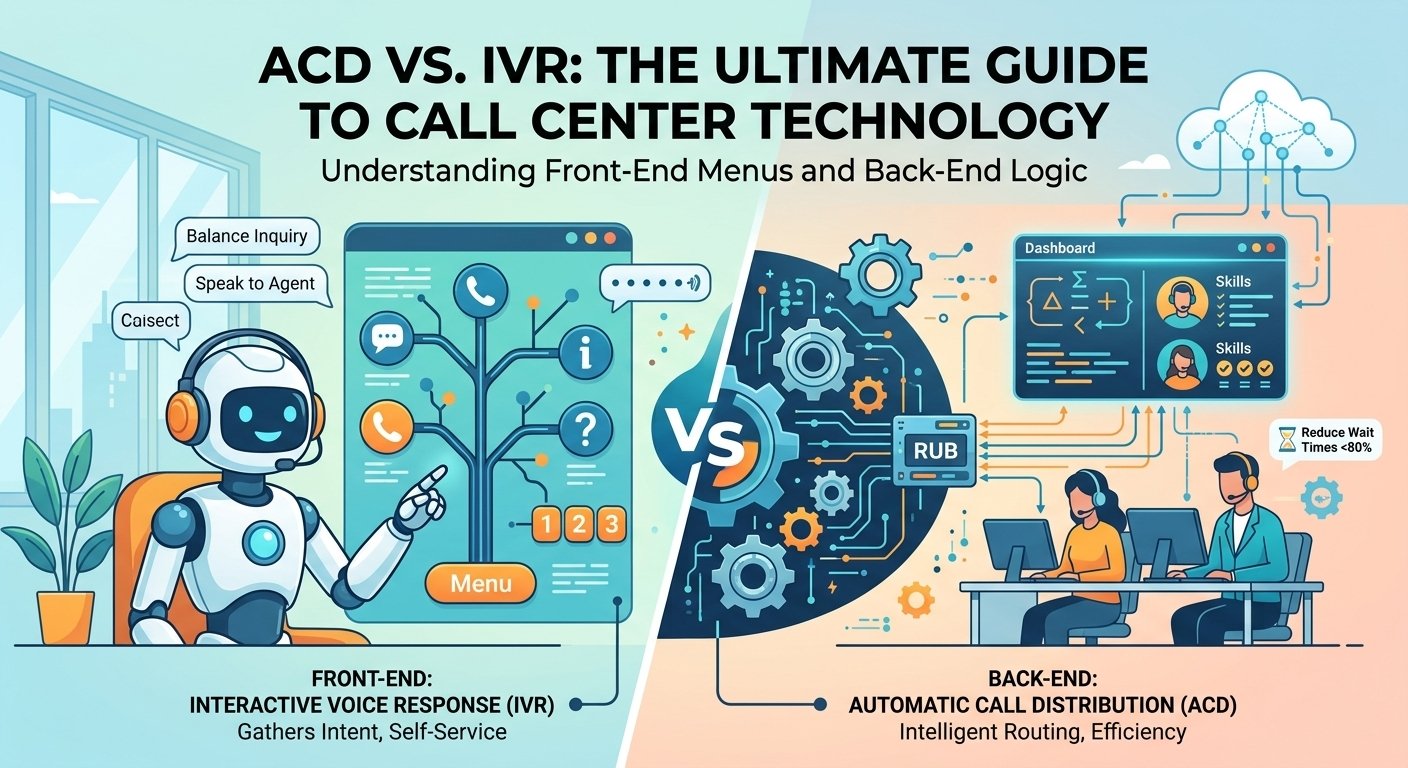
The main difference between ACD and IVR debate is that they are used in different stages of the communication process.
Interactive Voice Response is the front-end interface that welcomes callers and collects preliminary information via menus. Automatic Call Distribution is the back-end engine that intelligently routes those calls to the most qualified available agent. IVR is customer intent and self-service, while ACD is about operational efficiency and logic-based routing.
When combined, these two technologies can cut wait times by almost 80 percent and make sure that every customer’s query gets to the right department without passing through unnecessary manual transfers.
What is Automatic Call Distribution (ACD)?
Automatic Call Distribution (ACD) is a type of telephony system used to process a high volume of incoming calls. It is the call center‘s brain that makes sure that no call is missed and that every call is routed to the most appropriate destination. For companies with multiple departments like sales, technical support, and billing that receive a lot of traffic, this technology is crucial.
This is not a simple call forwarding system, but a more complex one that relies on logic to decide where to forward a call. It takes into account the time of day, the caller’s geographic location and the status of the workforce. Automating the distribution process helps businesses keep a professional image and ensure resources are being used effectively throughout the team.
How Does ACD Work?
The distribution of calls goes through a well-defined sequence for accuracy and speed. The system first recognizes the caller by matching the caller’s information, such as the phone number or by recalling information previously entered into an automated menu. This identification process enables the system to retrieve relevant customer records from a connected database or CRM system.
The system puts the caller into a virtual queue once the caller has been identified. At this point, the software determines the priority of the call using business rules that are preprogrammed. Finally, the system performs the routing phase and routes the caller to an agent. This is accomplished through a number of distribution channels that are best suited for the company.
Some of the most common ways to distribute include:
- Fixed Order: Calls are always placed with the first person on a list, and if they are busy, the call is placed with the second person on the list.
- Simultaneous Ringing: All the available agents’ phones ring at the same time and the first agent to answer takes the call.
- Uniform Distribution: The system distributes the call to the agent with the longest idle time.
- Weighted Logic: Calls are routed according to a percentage or priority of the team members.
Benefits of ACD Systems
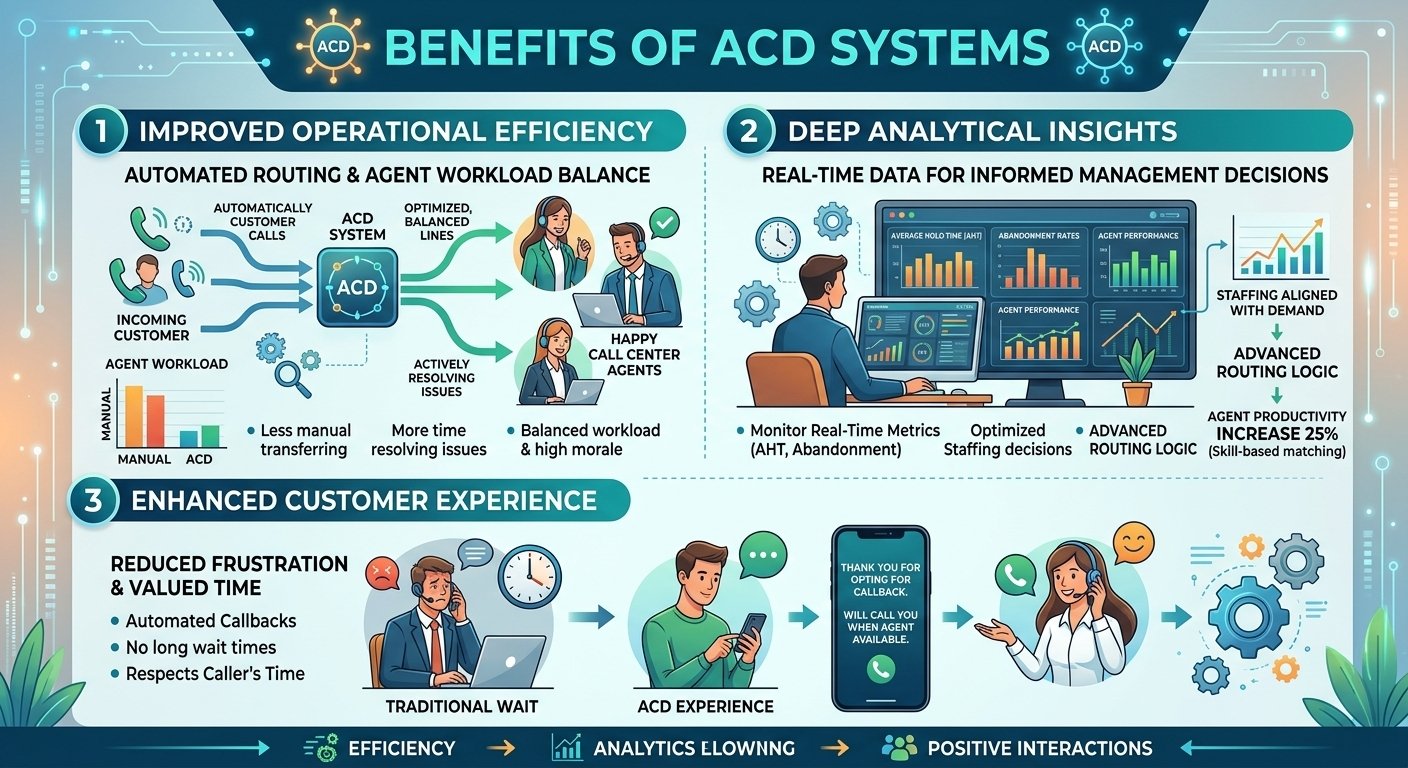
The major benefit of these systems is the dramatic increase in operational efficiency. Automating the routing process saves agents time from manually transferring calls and allows them to focus on resolving customer issues. This results in a more even workload, which is crucial to keeping the contact center environment’s morale high.
Moreover, these systems offer in-depth analysis that is essential for management. Leaders can monitor real-time data, such as average hold times and abandonment rates, to make informed staffing decisions. Industry research shows that companies that use advanced routing logic can boost agent productivity by 25 percent, as agents are only dealing with tasks that align with their skill sets.
Automated callbacks are also a great feature that enhances the customer experience. Customers can choose to be called back when an agent is available, rather than waiting on hold for long periods of time. This feature saves the caller’s time and helps to minimize the frustration that is often experienced on high volume support lines.
What is Interactive Voice Response (IVR)?
Interactive Voice Response (IVR) is an automated technology that enables callers to communicate with a company’s phone system using their voice or keypad. It acts as a virtual receptionist, and it is the first person that the business will interact with when someone contacts them. This system is meant to give instant help and lead the caller through a series of choices.
Today, this technology is used in a more natural way, with the help of natural language processing to interpret speech, making it more of a conversation. The main purpose is to find out the reason for the caller’s call in order to offer a self-service option or collect information for a human agent. It’s a basic instrument for any business that wants to offer round-the-clock support without having to be staffed all the time.
How Does IVR Work?
The workflow starts as soon as the call is connected and the recorded greeting is played. The caller is given a choice of options, such as a language or a particular department. The software follows different branches of a decision tree as the user interacts with the system to reduce the purpose of the interaction.
In many cases, the system can answer the query without any human intervention. For instance, a customer may dial in an account number and receive the balance of the account. If the query is more complex, the system gathers the necessary information and prepares it for the next step in the communication process. This data collection is crucial for a seamless handoff from the automated interface to a real person. The technology relies on two main types of input:
-
Dual-Tone Multi-Frequency (DTMF): This recognizes the specific tones created when a user presses buttons on their telephone keypad.
-
Speech Recognition: Advanced systems use software to interpret spoken language, allowing users to state their needs naturally.
Benefits of IVR Systems
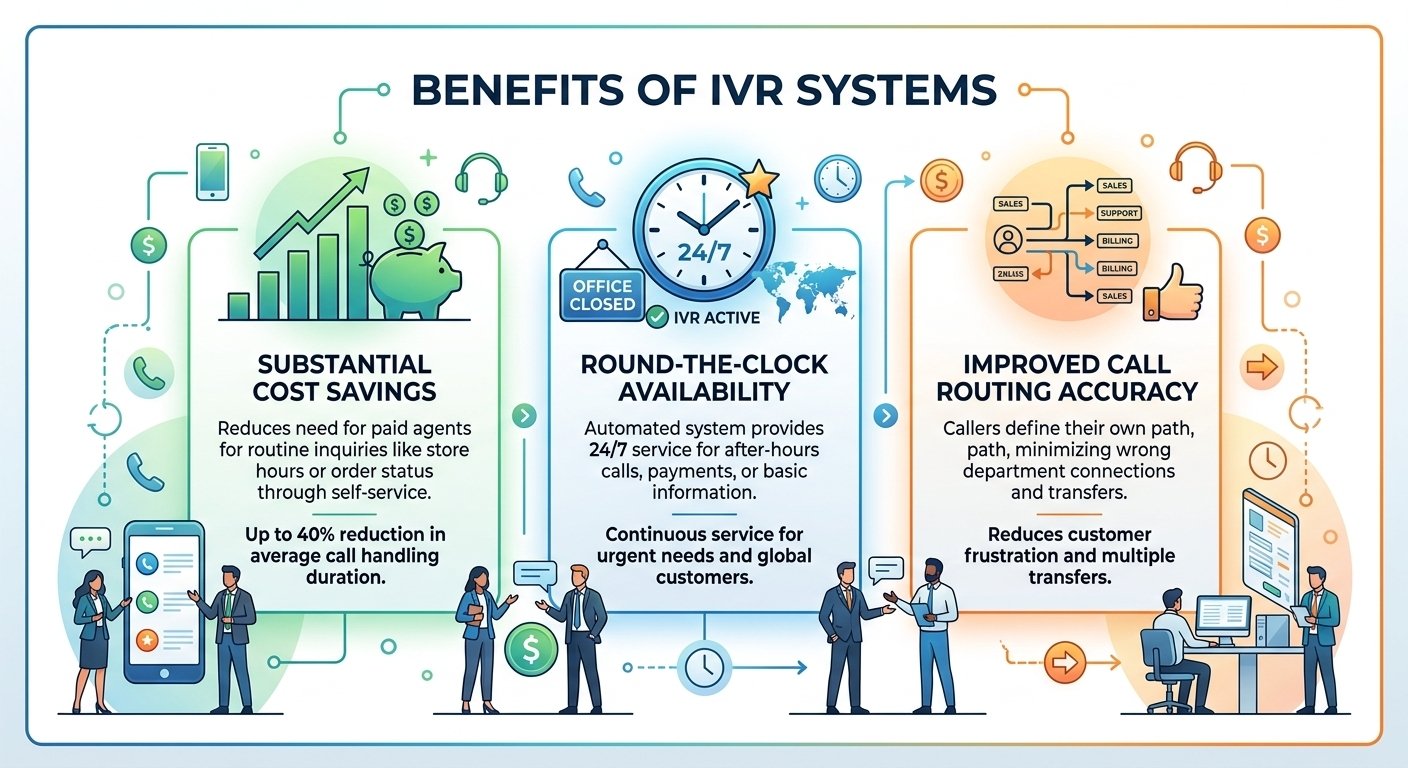
An automated menu system can save businesses of all sizes a lot of money. The company can answer common questions such as store hours or order status without the need for a paid agent, which decreases the overall number of calls that need to be answered. Studies have shown that the average call handling time can be cut by as much as 40 percent by using efficient automated menus, which will enable the team to concentrate on more important matters.
One of the other key advantages is the capacity to be available 24 hours a day. A physical office may be closed at 5pm, but an automated system can be left on to take messages, process payments or give basic information. This way, customers in various time zones or those who need service outside of business hours can still get service.
Also, these systems enhance the accuracy of call routing. This gives the caller the freedom to choose their own department, reducing the chance of a call being routed to the wrong department. This helps to minimize the number of times the product needs to be transferred, one of the most frequent consumer complaints.
Key Differences Between ACD and IVR Systems
While both technologies are essential for modern communication, their functions are distinct. The following table highlights the primary variations between these two systems.
| Feature | ACD (Automatic Call Distribution) | IVR (Interactive Voice Response) |
| Primary Role | Back-end routing engine | Front-end customer interface |
| User Interaction | Invisible to the caller | Direct interaction with the caller |
| Main Objective | Optimize agent efficiency and routing | Provide self-service and determine intent |
| Timing | Occurs after the intent is known | Occurs at the very start of the call |
| Logic Type | Distribution algorithms (Skill, Round-robin) | Menu-driven trees and voice recognition |
| Data Usage | Uses data to find the best agent | Collects data from the caller |
The basic difference is that one system communicates with the customer and the other one communicates with the internal network. The distribution engine would not have the context it needs to make smart decisions if it didn’t have the automated menu. On the other hand, if there was no distribution engine, the menu system would have no place to put the caller when the automated options were used up.
ACD vs IVR for Customer Experience
In assessing the effect of ACD vs IVR on the consumer journey, it’s evident that they are a symbiotic duo. The automated menu eliminates the first hurdle of having to wait for a human to respond. It allows the user to get the answer to a simple problem quickly, something that is very much desired by today’s consumers. If a human is needed, the routing engine makes the transition smooth and the caller doesn’t need to repeat information.
With a well configured setup, the “queue fatigue” that can cause high abandonment rates can be avoided. High value customers can be automatically placed in front of the line if the routing logic is correctly configured. This kind of personalization can only be achieved if the data collected from the front-end menu is immediately acted upon by the back-end distribution rules. They form a professional and responsive environment that fosters long-term brand loyalty.
Use Cases for ACD vs IVR
These technologies are used in the retail sector to control peak traffic. A customer may call and ask if a certain product is available; the automated menu will respond immediately by consulting the database. When the customer requires a complicated return, the distribution system sends them to a specialist who is able to provide a refund, which is resolved quickly.
These systems are used by healthcare providers to handle patient privacy and emergency care. The voice menu can be used to confirm appointment times or to request prescription refills without talking to a nurse. The routing engine can also be used to route calls to a medical professional without going through the normal queue for urgent medical inquiries, using priority logic. This makes sure that life-critical information is treated with the proper urgency.
These tools are crucial for secure transactions in the financial sector. Voice biometrics are employed in the menu system by banks to confirm the identity of a caller before revealing account information. After verification, the routing engine can route the user to a dedicated financial advisor depending on the size of the portfolio or the type of loan that the user is asking about.
Future Trends and Innovations
The most important trend in the telephony world today is the integration of Artificial Intelligence. AI menus can now interpret complex sentences and even analyze the caller’s sentiment using sentiment analysis. The system can detect frustration or anger and immediately escalate the call to a manager, avoiding a small problem from becoming a big PR issue.
Another area of growth is omnichannel integration. Today, modern systems are no longer restricted to voice calls, but can be used to route video calls, SMS messages, and social media inquiries through the same centralized logic. This provides a seamless customer journey, ensuring that the customer’s history is maintained across all channels of interaction with the company. You can find the latest documentation on cloud communication platforms to learn more about how these technologies are developing.
Voice biometrics will also be a common security measure. Callers will be identified by the unique characteristics of their voice, rather than remembering a password or answering security questions. This not only makes the call more secure, but also cuts down on the time spent on the authentication process, making the entire customer interaction smoother.
Final Words
It’s crucial to grasp the function of these two systems if any business wants to deliver the best customer support. They have different technical functions, but the same purpose: to make the experience more efficient and enjoyable for all concerned. Companies can manage large volumes of communication with accuracy and attention to detail by combining the automated self-service of one with the intelligent routing of the other. In today’s competitive landscape, where every second of a customer’s time counts, investing in a comprehensive platform with both features is no longer a luxury but a necessity.
Frequently Asked Questions
-
What’s the main difference between ACD vs IVR?
The main difference between ACD and IVR is that IVR is the menu that the customer sees and interacts with to determine what they need, while ACD is the logic system that routes the call to the best agent for the job. Imagine the menu is the receptionist who asks what you’re doing here and the routing engine is the office manager who knows which expert is available to help you.
-
What does ACD stand for in a call center?
ACD is an acronym for Automatic Call Distributor. It is a system that automatically routes incoming calls to a group of terminals or agents according to programmed routing instructions.
-
Can a business use one without the other?
Yes, but it’s not recommended for high volume environments. An IVR without ACD can give information, but can’t intelligently route calls to agents, and an ACD without an IVR will have no initial data to send callers to the right specialized departments.
-
What are ACD calls exactly?
ACD calls are any incoming communications that are handled and distributed by an automatic call distribution system. These calls are usually queued and then allocated to agents depending on their availability or skills.
-
What does IVR stand for?
IVR is an acronym for Interactive Voice Response. It is a technology that allows humans to interact with a computer-operated phone system through the use of voice and DTMF tones input via a keypad.
-
How do these systems reduce costs?
They cut down on expenses by allowing customers to handle simple tasks on their own, thereby minimizing the need for agents. They also reduce call handling time by routing callers to the appropriate person on the first call, avoiding costly and repetitive transfers.
-
What is the purpose of ACD time?
In a call center, ACD time refers to the duration an agent spends handling calls distributed by the system. Monitoring this helps managers understand agent utilization and the overall efficiency of the routing rules.
-
Does Avaya use these systems?
Yes, ACD in Avaya refers to the software’s ability to manage hunt groups and skill-based routing. It is a core feature of their communication manager platforms used by large enterprises globally.
-
What is the best practice for setting up a menu?
Keep the options limited to three or four per level to avoid confusing the caller. Always provide a clear and easy path to speak with a live human agent if the automated options do not meet the caller’s specific needs.