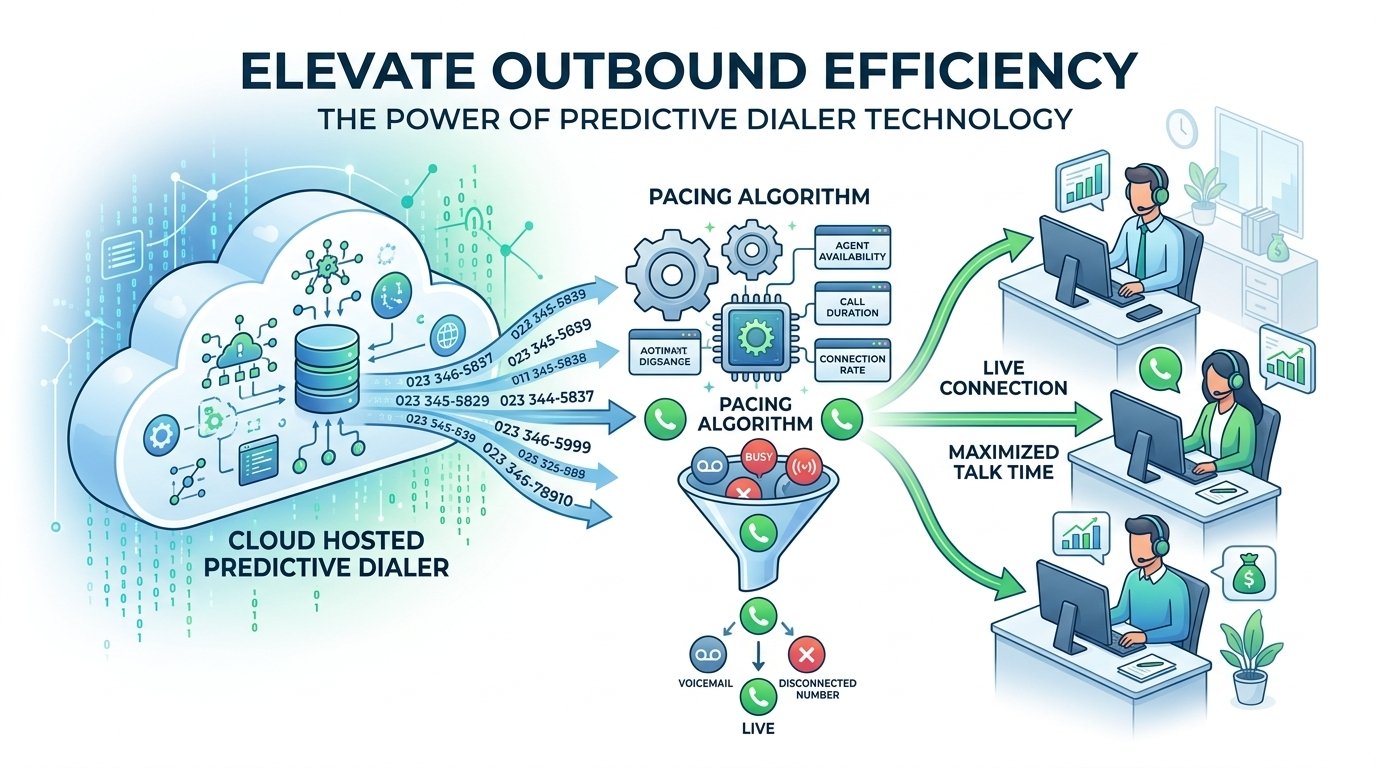
A predictive dialer is an advanced automated dialer that optimizes outbound contact centers. It employs mathematical algorithms to forecast agent availability and dials several phone numbers at once, only making connections with answered calls to available agents.
This technology eliminates busy signals, voicemails and disconnected lines, allowing agents to spend more time talking to live prospects and less time waiting between calls. Today, hosted predictive dialers can help businesses grow rapidly and enhance their connection rates and agent productivity in a competitive sales environment.
What is a predictive dialer?
A predictive dialer is an intelligent automated system that is mainly employed in outbound call centers for making customer calls more efficient. This technology was first developed in the late 1980s by Douglas Samuelson to improve the efficiency of debt collection processes through the use of telemarketing. It has grown from specialized hardware to a wide range of predictive dialer software for different industries over the decades.
This system is mainly used to start calls before an agent is done with their interaction. It determines precisely when a representative is available and makes sure that a live person is on the line when the agent is ready. This proactive method cuts down on the downtime usually involved with manual dialing, and is a standard feature of call center predictive dialer operations.
What is the difference between a predictive dialer and an auto dialer?
| Feature | Auto Dialer (Basic) | Predictive Dialer (Advanced) |
| Complexity | Foundational tool for automated dialing. | Advanced version of the auto dialer. |
| Dialing Logic | Typically dials one number at a time for each available agent. | “Thinks” ahead by placing multiple calls simultaneously. |
| Intelligence | Processes contact lists systematically without manual input. | Analyzes historical data to predict call connection timing. |
| Primary Goal | Removes manual input errors and ensures list systematic processing. | Ensures a live connection occurs exactly when an agent becomes free. |
| Efficiency | Eliminates manual dialing time. | Maximizes agent talk time by minimizing idle gaps. |
| Ideal Environment | General automated dialing needs. | High-volume contact center environments. |
Data-driven power dialer that promotes sales-driven success
By using a predictive dialer system, a business can discover a smooth road to more sales opportunities. This will help companies maximize their revenue potential by routing agents to more live calls and fewer dead ends. Studies have shown that contact centers that implement an outbound predictive dialer can achieve connection rates of up to 200% to 400% on the first day of use.
This success is achieved by the capacity to maintain agents in meaningful conversations at all times. The software can be used for telemarketing, market research, or proactive customer service, ensuring that the workforce is used to its full potential. These systems are data-driven, which means they are continually learning and adapting to the unique cadence of your calling campaigns.
How does a predictive dialer work?
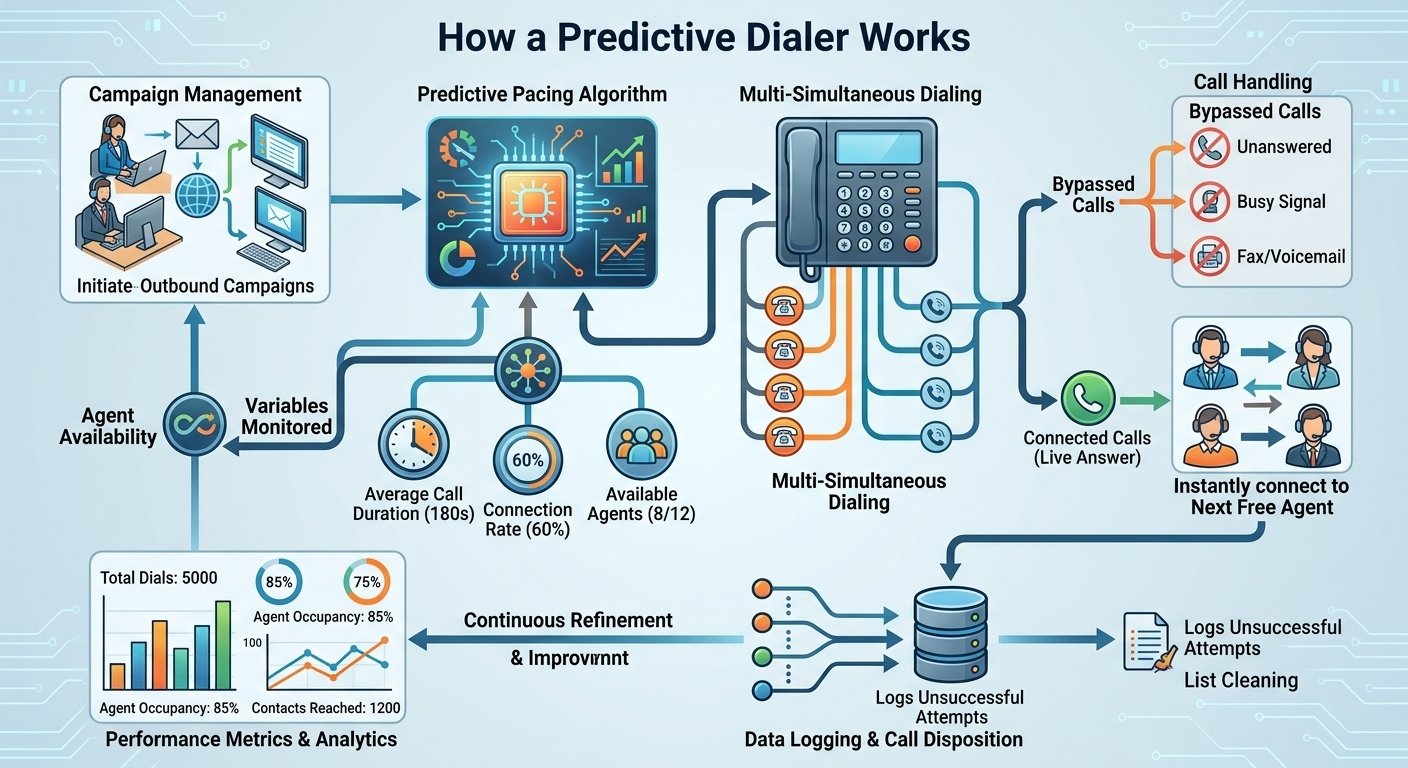
The key to this technology is the complex pacing algorithms that track multiple variables simultaneously. It monitors the average call duration, the percentage of calls that are answered by a human, and the number of agents available. This information is used in real-time to adjust the dialing speed to match the predicted availability of the team.
-
Analyzes call patterns to determine average call duration and connection rates.
-
Modifies dialing speed automatically to align with agent availability.
-
Initiates multiple calls simultaneously to ensure constant workflow.
-
Automatically bypasses unanswered calls, busy signals, and fax machines.
-
Connects live answers to the next free agent instantly.
-
Logs unsuccessful attempts for future follow-up or list cleaning.
-
Aggregates performance metrics to refine campaign strategies.
-
Facilitates multi-campaign management for diverse business goals.
The technology is specifically designed to minimize the awkward silence that occurs when a customer answers and no agent is ready. By balancing the dialing rate with the agent pool size, the system maintains a high level of professionalism while driving maximum output.
Predictive dialers vs other auto-dialers
It’s crucial to grasp the differences between the various dialing modes to select the right approach. The predictive dialer is designed for volume, but other dialer types such as the progressive dialer or preview dialer are geared toward other aspects of the customer interaction. Both serve a specific purpose, depending on whether you’re interested in the number of contacts or the amount of research you did prior to calling.
| Type | How it works | Use cases |
| Progressive dialer | Places one call at a time only when an agent is available. | Quality interactions over quantity. |
| Preview dialer | Allows agents to view customer records before the call is placed. | High-value clients and complex sales. |
| Robo-dialer | Sends pre-recorded messages or SMS to multiple customers. | Reminders, updates, and prospecting. |
The Benefits of Predictive Dialing Software
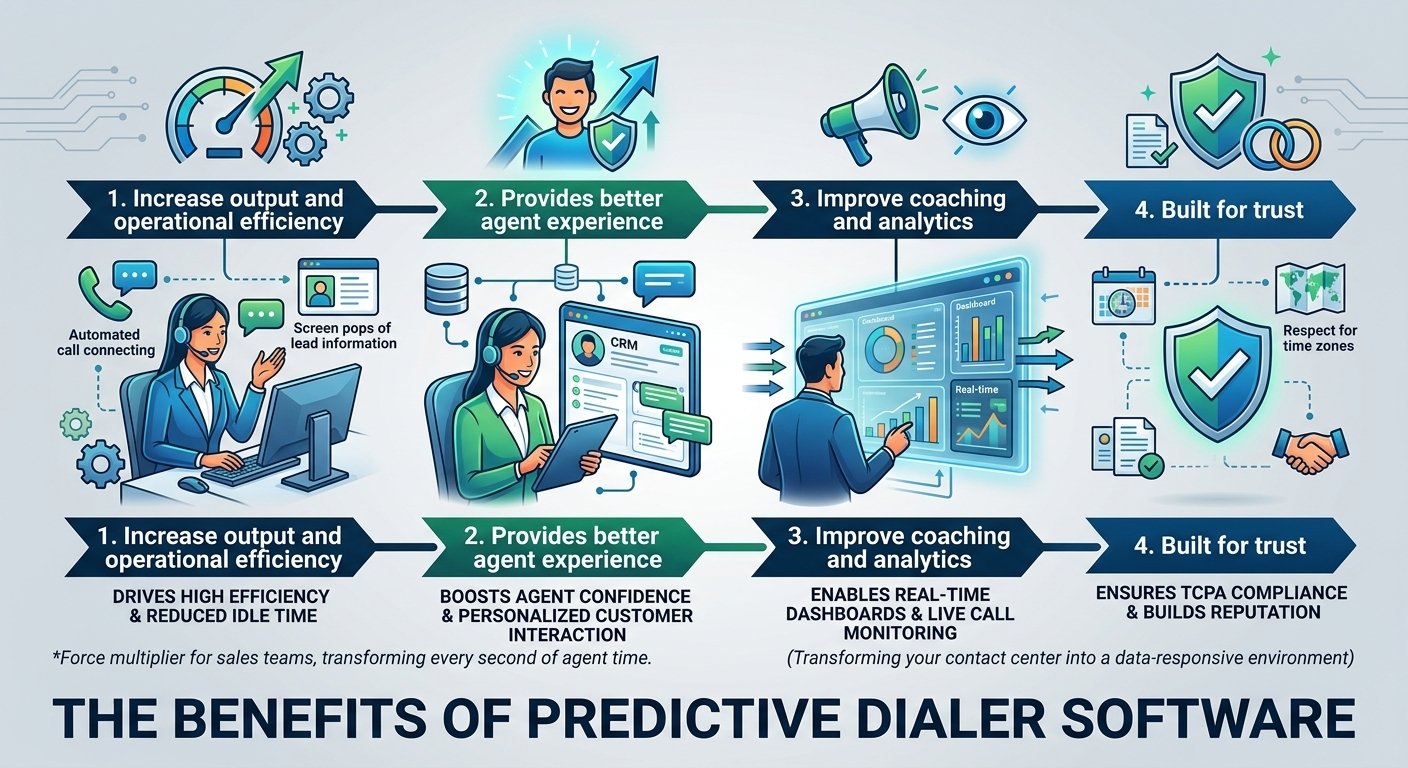
1. Increase output and operational efficiency
The biggest advantage of predictive dialer technology is the significant decrease in idle time. Agents don’t need to dial the next number or wait for the tenth ring and then get an answering machine. The system takes care of the logistics, so the team can concentrate on the conversation and the conversion.
2. Provides better agent experience
If your team has the right tools, they will be more confident and this will result in better sales outcomes. Call center predictive dialers are designed to work with CRM systems to give agents immediate access to customer history. This means they never come as a surprise and can offer a personalised experience from the first second of the call.
The user interface of these systems is usually simple, minimizing the representative’s mental workload. They can follow guided engagement flows, which adjust to the conversation, rather than dealing with complex software. This streamlined approach can help you to win customers and reduce the stress of the job.
3. Improve coaching and analytics
A predictive dialer system is a great source of information for supervisors and managers. Real-time dashboards allow leadership to see exactly how a campaign is doing and where agents may need more assistance. Call monitoring and “barge-in” options enable real-time coaching during key sales interactions.
4. Built for trust
Compliance with the regulations, such as the TCPA, is an essential component of any outbound operation. A good predictive dialer service will have the capability to handle Do Not Call (DNC) lists and time zone restrictions. This will keep your business within legal limits and still achieve your objectives.
Professional interactions also help to establish trust with the customer. The system uses local caller ID and guarantees that there is always a live agent when the call is answered, which decreases the chances of being marked as spam. This respectful approach helps in fostering long-term relationships and protecting the brand’s reputation.
How much does a predictive dialer cost?
The cost of this technology is dependent on the deployment model. Traditionally, on-premises systems have been costly, ranging from $5,000 to $25,000 in hardware and licensing. This limited the technology to large companies with large IT budgets.
Today, predictive dialer pricing is much more accessible with cloud-based models. The price of a hosted predictive dialer varies from $14 to $65 per user per month, depending on the features and size of the business. This change has made the technology accessible to all, including small businesses and startups, giving them a level playing field with the big boys.
How do I choose the right dialer for my business?
When it comes to selecting the right predictive dialer, it’s essential to understand your existing workflow and objectives. You need to assess the amount of time your agents spend on non-voice work versus actual conversation. When your team is small and your lead list is huge, a predictive system is almost always the right solution to effectively penetrate the market.
-
Assess your standard operating procedures for each call interaction.
-
Consider the size of your team and their ability to handle back-to-back calls.
-
Evaluate the volume of your contact list and the duration of your campaigns.
-
Inquire about the level of support and training provided by the vendor.
-
Check for customization options to fit your specific industry needs.
According to a study by the National Association of Sales Professionals, agents who use automated tools like a predictive dialer spend up to 75% more time talking to prospects than those using manual methods. This statistic highlights why choosing a solution that integrates well with your existing CRM is essential for maximizing ROI.
Read More: Latency and Jitter in VoIP Calls: 8 strategies to fix the trouble
Final Thought
For any outbound-oriented business, the decision to implement a predictive dialer is a game-changer. With algorithmic pacing and automated filtering, companies can transform a slow sales floor into a high-performance machine. The secret to success is to combine the technology with the human element of your agents, so that every connected call is a quality call. As technology advances, the ones who embrace these smart dialing solutions will stay ahead of the curve in terms of sales efficiency and customer engagement.
Predictive Dialer FAQs
-
What is a predictive dialer?
A predictive dialer is an automated outbound calling system that uses algorithms to predict agent availability and dial multiple numbers at once. It filters out non-productive results like busy signals and voicemails, only connecting live answers to available agents to maximize talk time.
-
What is the difference between a predictive dialer and an auto dialer?
The main difference is intelligence and pacing. An auto dialer simply dials numbers automatically one by one or in a basic sequence. A predictive dialer uses complex mathematical formulas to dial multiple lines simultaneously based on the predicted time an agent will become free.
-
What is the difference between predictive and progressive dialer?
A predictive dialer calls contacts before an agent is actually free, while a progressive dialer only places a call when an agent has finished their previous interaction. Predictive is better for volume, whereas progressive is often preferred for high-touch B2B sales.
-
Which dialer is best for calling?
The best dialer depends on your lead quality and volume. For large lists of cold leads, a predictive dialer is most efficient. For smaller lists of high-value prospects where research is required before the call, a preview dialer is usually the superior choice.
-
What is predictive dialer in a call center?
In a call center, it is a tool used to automate the outbound process. It manages the dialing rate so that agents are constantly on the phone with live prospects, significantly reducing the idle time that usually occurs between manual dials.
-
Are predictive dialers illegal?
No, they are legal as long as they meet regulations such as the TCPA in the USA or the TPS in the UK. Compliance includes keeping a Do Not Call list up-to-date and keeping the abandoned call rate under a specific percentage.
-
How much is a predictive dialing software?
Cloud-based solutions are generally offered on a monthly subscription model, from $15 to $100 per agent. This is far more cost-effective than the traditional on-premises systems that had thousands of dollars in initial hardware investments.
-
Why get a cloud-hosted predictive dialer software?
Cloud-based systems provide greater scalability, reduced initial investment, and the flexibility to work from anywhere. They also offer automatic updates and seamless integration with other cloud applications such as CRM and helpdesk software.
-
What is a dialer?
A dialer is a software or hardware system that automatically places telephone calls. It can be as simple as a click-to-dial feature or as sophisticated as an algorithmic system that can handle thousands of calls per hour for a large contact center.