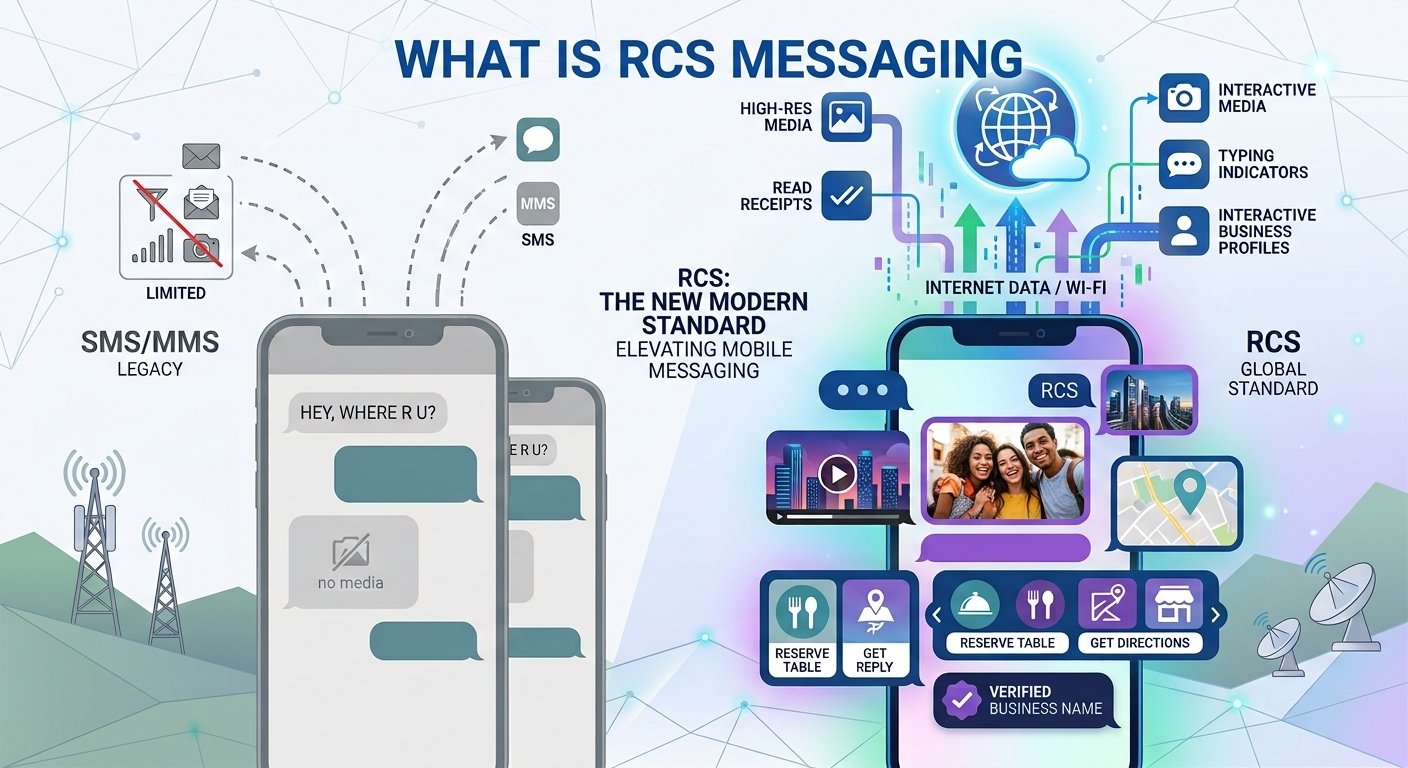
RCS messaging is the modern standard for text communication, upgrading traditional SMS with features typically found in apps like WhatsApp or iMessage. It enables high-resolution media sharing, read receipts, and interactive business profiles directly within native messaging apps.
Supported by the GSMA and adopted by Google and Apple, it uses data connections to deliver a richer experience. If a recipient’s device is incompatible, the system reverts to standard SMS. It brings WhatsApp-style messaging into default texting apps, with SMS fallback if disconnected.
What is RCS messaging?
Rich Communication Services represents a significant leap forward in mobile communication technology. It is an industry standard developed by the GSMA to replace the aging SMS and MMS protocols. Unlike traditional texting, which relies on cellular bandwidth, this system utilizes internet connectivity to transmit data. This transition allows for much larger file sizes and more complex interactions without requiring users to download third-party applications.
The framework is built upon the Universal Profile, which ensures that different mobile operators and device manufacturers can provide a consistent user experience. While Google has been a primary advocate through its Jibe platform, the technology is an open standard available to the entire mobile industry. The global market for this technology was valued at approximately $3 billion in 2025 and is expected to climb to $9 billion by 2030, according to recent industry forecasts.
What does RCS mean on your phone?
An active RCS indicator means your messages are sending via internet data rather than SMS. You will notice that your messages now support real-time features like typing indicators and high-quality image transfers. This change happens automatically when both parties in a conversation have the service enabled on a compatible network.
Businesses appear with their official logo and name rather than an unknown phone number. This evolution provides a more modern texting feel that aligns with contemporary expectations for digital interaction. It essentially turns your default messaging app into a powerful communication hub.
-
What is RCS chat?
Android often labels RCS as ‘RCS chats’ or ‘Chat features’ in app settings. When you see this label, it means you can send messages over Wi-Fi, participate in improved group chats, and see when your messages have been read.
How does RCS messaging work?
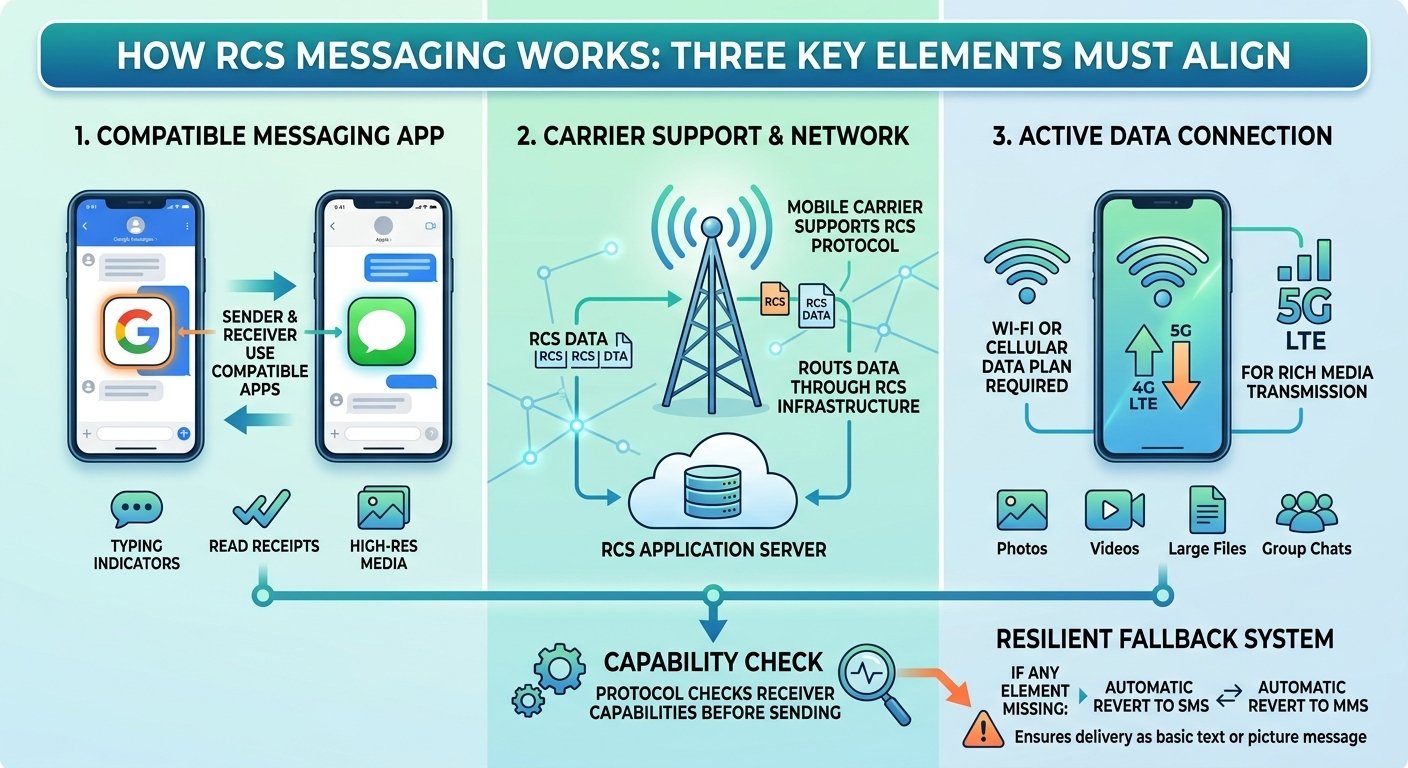
For this communication system to function correctly, three specific elements must align.
-
- First, the sender and receiver must use a compatible application, such as Google Messages or Apple Messages.
- Second, the mobile carrier must support the protocol to route the data through the appropriate infrastructure.
- Finally, an active data connection via Wi-Fi or a cellular data plan is necessary for the transmission of rich media.
If any of these components are missing, the system is designed to be resilient. It will automatically revert to SMS or MMS, ensuring that the message is still delivered even if the rich features are unavailable. Behind the scenes, the protocol performs a capability check to determine if the receiving device can handle the enhanced format before sending the data.
RCS on iPhone and Android
The landscape of mobile communication changed significantly when Apple announced its support for the framework. This move bridged a long-standing gap between the two major mobile operating systems, allowing for a more seamless experience regardless of the hardware being used.
-
RCS on Android
On most Android devices, this is the default mode of operation within the Google Messages app. Since Android controls over 70% of the global mobile market, a vast majority of peer-to-peer conversations already utilize these features. Users typically find the service pre-activated, allowing for immediate access to high-resolution sharing and group management tools.
-
RCS on iPhone
With the release of iOS 18, Apple integrated the standard into its native Messages app. While iMessage remains the primary choice for Apple-to-Apple communication, this new integration replaces SMS as the primary method for texting Android users. This update brings read receipts and high-quality media to green-bubble conversations, significantly improving cross-platform communication for millions of users.
RCS vs SMS, MMS, and other messaging channels
SMS is a universal baseline that works without data but offers no rich features. MMS allows for media but often compresses files to the point of quality loss. This new standard offers the best of both worlds: universal reach with high-end functionality.
| Feature | SMS | MMS | RCS |
| Message length | 160 characters | Text plus media | Up to 3,072 characters |
| Media Quality | No media | Highly compressed | High-resolution up to 100MB |
| Sender ID | Phone number | Phone number | Verified name and logo |
| Interactivity | None | None | Buttons and carousels |
| Read Receipts | No | No | Yes |
| Network | Cellular | Cellular | Internet (Wi-Fi or Data) |
Is RCS messaging secure?
Security in this environment depends on the nature of the conversation. Personal interactions between Android users have featured end-to-end encryption for several years. As the industry moves toward Universal Profile 3.0, this level of security is expanding to include cross-platform conversations between different device types.
| Scenario | Encryption Type | Status |
| Android to Android | End-to-end (E2EE) | Fully active by default |
| iPhone to Android | E2EE via Universal Profile 3.0 | Rolling out in beta stages |
| Business Messaging | Encrypted in transit (TLS) | Standard for branded content |
For business applications, messages are typically encrypted in transit. While this provides a high level of protection against interception, it is different from end-to-end encryption where only the endpoints can see the content. Brands often use this channel for notifications and marketing while keeping sensitive financial data behind secure, authenticated portals.
What is RCS for Business?
This specialized version of the technology allows companies to engage with customers through a professional and branded channel. Unlike texting, businesses must register an agent and undergo a verification process. Once approved, they can send branded messages that include their logo and a verified checkmark, which significantly enhances consumer trust.
The platform allows for highly dynamic experiences, such as product carousels and quick-action buttons. This means a customer could potentially browse a catalog or confirm an appointment with a single tap. Research indicates that during the 2024 holiday season, usage of this channel grew by 111% year-over-year as brands sought higher engagement rates.
Why RCS matters for your business: 5 key benefits
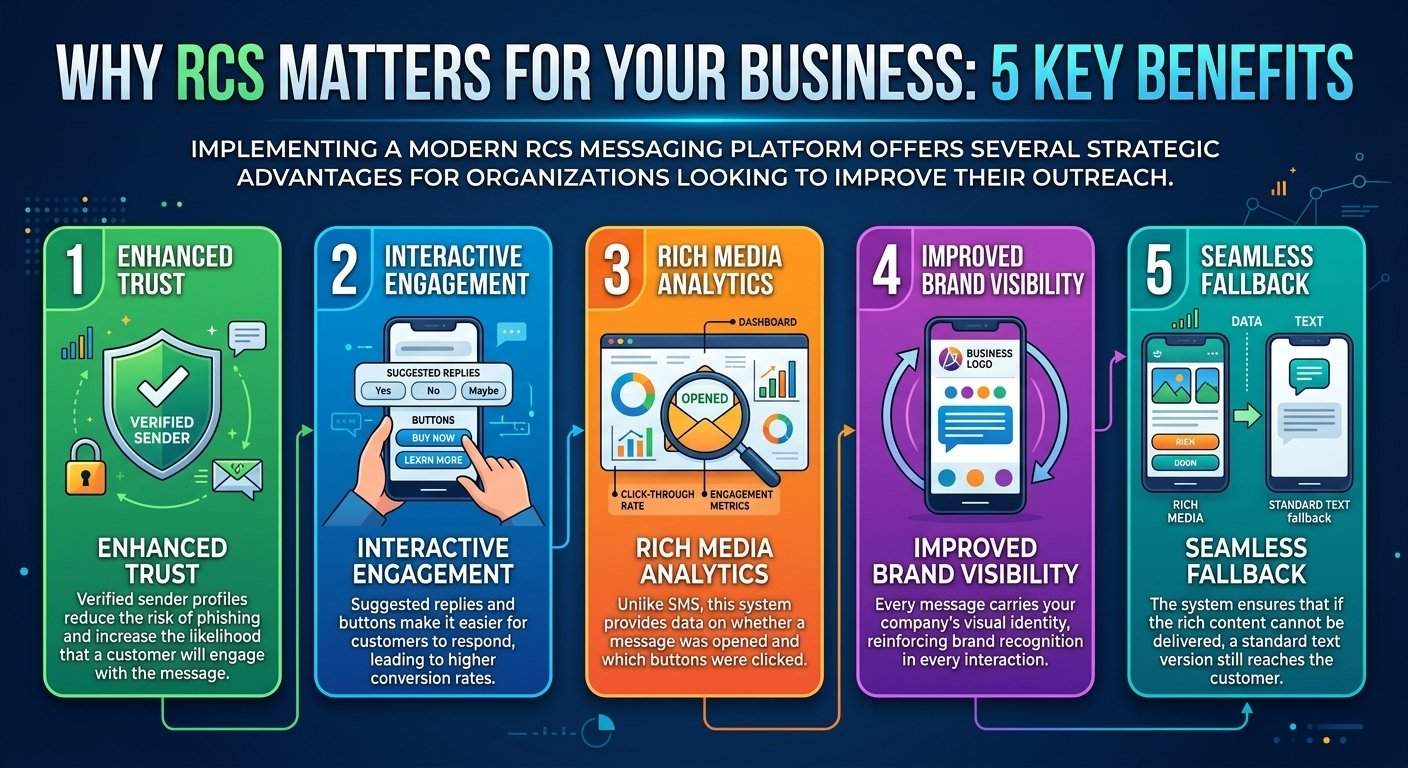
Implementing a modern rcs messaging platform offers several strategic advantages for organizations looking to improve their outreach.
-
-
Enhanced Trust: Confirmed sender profiles reduce the risk of phishing and increase the likelihood that a customer will engage with the message.
-
Interactive Engagement: Suggested replies and buttons make it easier for customers to respond, leading to higher conversion rates.
-
Rich Media Analytics: Unlike SMS, this system provides data on whether a message was opened and which buttons were clicked.
-
Improved Brand Visibility: Every message carries your company’s visual identity, reinforcing brand recognition in every action.
-
Seamless Fallback: The system ensures that if the rich content cannot be delivered, a text version still reaches the customer.
-
RCS messaging examples: What brands are achieving
Real-world applications demonstrate the tangible benefits of moving away from plain text. Several major brands have already seen significant improvements in their communication metrics by adopting this technology.
-
- EasyPark, a global leader in digital parking, uses the service to send real-time alerts. By utilizing authentic profiles, they achieved a delivery rate of 97.4% in Germany. Drivers can immediately see the official logo, which confirms the message is a legitimate parking update rather than a scam.
- Picard, a French retailer, developed a conversational experience to help customers plan holiday meals. This allowed users to navigate dietary options and budgets through a series of clickable prompts. This approach resulted in a 42% increase in customer engagement compared to their previous text-based campaigns.
- The retailer BUT moved its promotional efforts to this rich format and saw a click-through rate of 13.5%. This strategy generated significant additional turnover, effectively tripling the results of their previous year’s SMS-only promotions.
These examples highlight how the rich communication services meaning translates into actual business growth.
Where RCS fits by industry
Different sectors utilize these rich features to solve specific communication challenges. In the banking industry, for example, 49% of organizations are already using the platform for branded fraud alerts and verified one-time passwords. This allows customers to trust the source of sensitive notifications instantly.
The healthcare sector uses the technology for rich appointment reminders that include “Reschedule” or “Confirm” buttons. Retailers find value in product carousels that allow customers to browse new arrivals without leaving their messaging app. Even the travel industry benefits by sending rich boarding passes and real-time gate change notifications as texting cards.
How much does RCS messaging cost?
For the average consumer, this service is typically free, as it uses existing data or Wi-Fi rather than charging per individual text. For businesses, the pricing structure is more complex and varies depending on the region and the specific mobile operator. Many carriers use a session-based or per-message billing model.
Basic messages often cost about the same as an SMS, while more complex actionable sessions may carry a higher price point. However, the increased engagement and conversion rates often provide a much higher return on investment than traditional methods. To get specific details, companies usually work with an aggregator like GSMA or a specialized messaging provider.
How to turn on RCS messaging
Most modern smartphones have this feature enabled by default, but you can manually verify its status in your settings menu.
On an Android device, you should:
-
Open the Messages application.
-
Access your profile settings.
-
Find the section labeled for chat features.
-
Ensure the toggle for rich chats is active.
On an iPhone, the process is similar:
-
Navigate to the main Settings app.
-
Find the Messages section.
-
Look for the toggle labeled for this specific protocol.
-
Switch it on, provided your carrier supports the feature.
Tips for creating a RCS messaging strategy
To get the most out of this channel, businesses should focus on the user experience rather than just broadcasting information. It is vital to understand your audience and what kind of interactive content they find valuable. Creating engaging carousels and clear call-to-action buttons is much more effective than sending long blocks of text.
-
Analyze your existing SMS performance to see which messages would benefit most from a rich upgrade.
-
Use high-quality imagery that aligns with your brand’s visual identity.
-
Ensure your messages are compliant with local privacy laws and offer clear opt-out options.
-
Test different interactive elements to see which ones drive the most clicks.
Why RCS isn’t working (and how to fix it)
If you find that your messages are not sending with rich features, there are a few common causes to investigate. The most frequent issue is a lack of a stable data connection. Since the protocol relies on the internet, being in a dead zone will cause it to fail. Another common reason is that the recipient does not have the feature enabled or is using an older device.
Sometimes, after a software update or a SIM card change, the service might need to re-verify your phone number. Simply toggling the feature off and back on in your settings can often resolve these connectivity hiccups. If the problem persists, checking with your mobile carrier is the best next step to ensure your plan supports the standard.
How to get started with RCS for Business
Starting your journey with branded messaging requires partnering with a verified provider. You will need to submit your brand details, including your logo and official name, to be vetted by the major carriers and Google. This process ensures that your messages will carry the verified checkmark that users trust.
Once your agent is approved, you can begin migrating your existing SMS traffic. Start with simple notifications like order confirmations or appointment reminders to get a feel for the analytics. As you become more comfortable, you can introduce more complex conversational flows that allow customers to interact with your brand in entirely new ways.
Final Thought
RCS messaging is not just a replacement for SMS; it is an entirely new way to think about mobile communication. By combining the universal reach of a phone number with the rich functionality of modern apps, it provides a powerful tool for both personal and professional use. As more carriers and devices adopt the standard, it will continue to redefine how we connect with each other and the brands we value.
Frequently asked questions
-
What is RCS messaging and how does it differ from SMS?
RCS messaging is an advanced version of texting that uses data to send high-resolution media, read receipts, and interactive content. Unlike SMS, which is limited to 160 characters and simple text, it allows for branded business profiles and much larger file transfers.
-
Does it cost money to use these chat features?
For consumers, the service is generally free as it uses Wi-Fi or mobile data. For businesses, there are costs associated with sending branded or interactive messages, which are determined by service providers and mobile operators.
-
Is this service available on both iPhone and Android?
Yes, as of iOS 18, both major platforms support the standard. This allows for a more consistent experience when texting between different types of devices, including features like typing indicators and high-quality photo sharing.
-
Why do my messages sometimes turn back into SMS?
This happens automatically as a fallback measure. If your phone loses its data connection or if the person you are messaging does not have the feature enabled, the system ensures the message still arrives by sending it as a standard text.
-
How does a business get a verified checkmark?
A business must register an agent through a messaging platform and undergo a verification process with Google and mobile carriers. This involves proving the legitimacy of the brand and its logo to ensure consumer safety.
-
What kind of media can I send with this protocol?
You can send high-resolution photos, videos, GIFs, and large files up to 100MB. It also supports interactive elements like scrollable carousels and buttons that can trigger actions like opening a map or calling a number.
-
Can RCS lower operational costs for customer support?
Absolutely. By using interactive buttons and automated replies, businesses can resolve common customer queries faster and without the need for a live agent for every interaction.
-
Is the communication secure and encrypted?
Personal chats between users on compatible apps are typically end-to-end encrypted. Business messages are encrypted in transit, providing a high level of security for standard commercial interactions.
-
Do I need to download a new app to use it?
No, the technology is built into the native messaging app that comes with your phone. As long as your device and carrier support it, you can access these features without any additional software.