
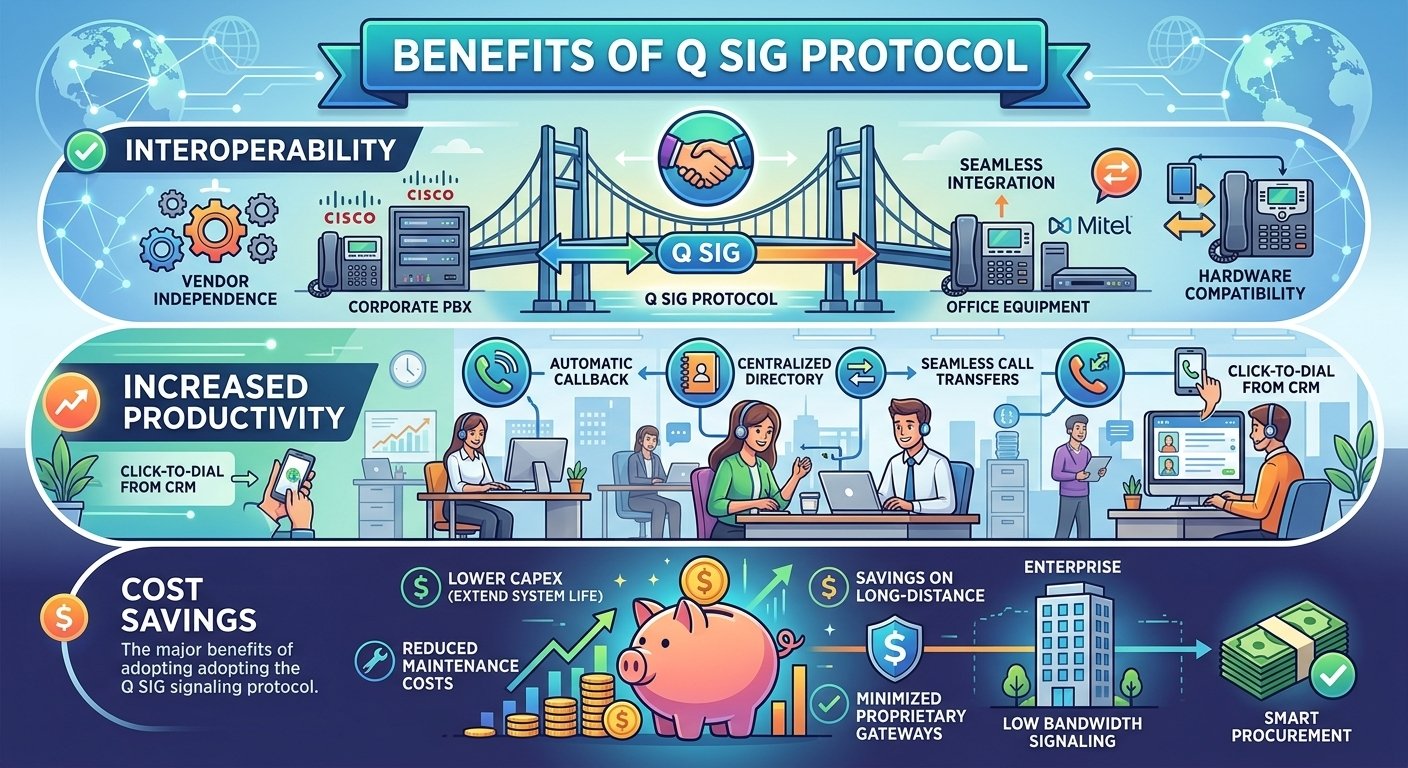
Q SIG is a robust signaling protocol based on the Integrated Services Digital Network (ISDN) standard, specifically designed for Private Integrated Services Networks (PISN).
It facilitates seamless communication between Private Branch Exchanges (PBXs) from different manufacturers, ensuring advanced telephony features like call forwarding and transfer work across mixed-vendor environments. By using a peer-to-peer architecture, Q SIG allows enterprises to build scalable, flexible voice networks without being locked into a single hardware provider. In the modern era, it serves as a critical bridge between legacy circuit-switched systems and contemporary Voice over IP (VoIP) infrastructures, maintaining high-quality service across diverse telecommunication platforms.
What Is Q SIG?
Q SIG is a specialized signaling protocol based on the ISDN framework, designed to manage and control voice communications between private branch exchanges within a global telecommunication network. Operating within a Private Integrated Services Network, it utilizes the connection-level Q9.31 and application-level ROSE protocols to ensure precise message delivery across various hardware types. The name is derived from the “Q” reference point—the conceptual interface between two exchanges—and while the protocol is inspired by the SS7 framework, it is recognized for being significantly more flexible and better suited for the specific demands of enterprise environments.
In a corporate setting, Q SIG acts as the essential “glue” that integrates diverse service networks into a cohesive system, allowing complex voice features to be shared across a company regardless of physical location. Because it is a highly standardized protocol, it eliminates the compatibility issues often found in proprietary systems, ensuring that calls are routed correctly through different switches. This interoperability makes it a vital tool for large organizations that have acquired a mix of telephone hardware brands, as it allows disparate systems to function as a single, unified network.
Who Invented The Q Signaling Protocol?
The Q signaling protocol was a collaborative development initiated by ECMA International and later refined by the European Telecommunication Standards Institute to meet global telecommunication demands. As a formally categorized ISO standard, it is an open technology free from exclusive corporate ownership, which fosters a high level of interoperability across diverse communication platforms. According to historical records from ECMA International, these standards have empowered thousands of hardware vendors to create compatible products that function seamlessly within a unified global marketplace.
By establishing clear rules for packaging and transmitting signaling data, the protocol’s creators effectively removed the barriers associated with proprietary code. This foresight allowed the technology to remain relevant throughout the industry’s transition from analog systems to digital and internet-based frameworks. Because of this adaptability, the protocol has maintained its position as a cornerstone of corporate telephony for several decades, continuing to provide a reliable foundation even as newer communication technologies emerge.
How Does Q SIG Work?
QSIG is a telecommunication protocol structured into two layers to ensure flexible and reliable communication between switches. The Basic Call Layer handles the essential tasks of establishing and clearing connections, while the Generic Function Layer manages advanced supplementary services like caller ID and call redirection.
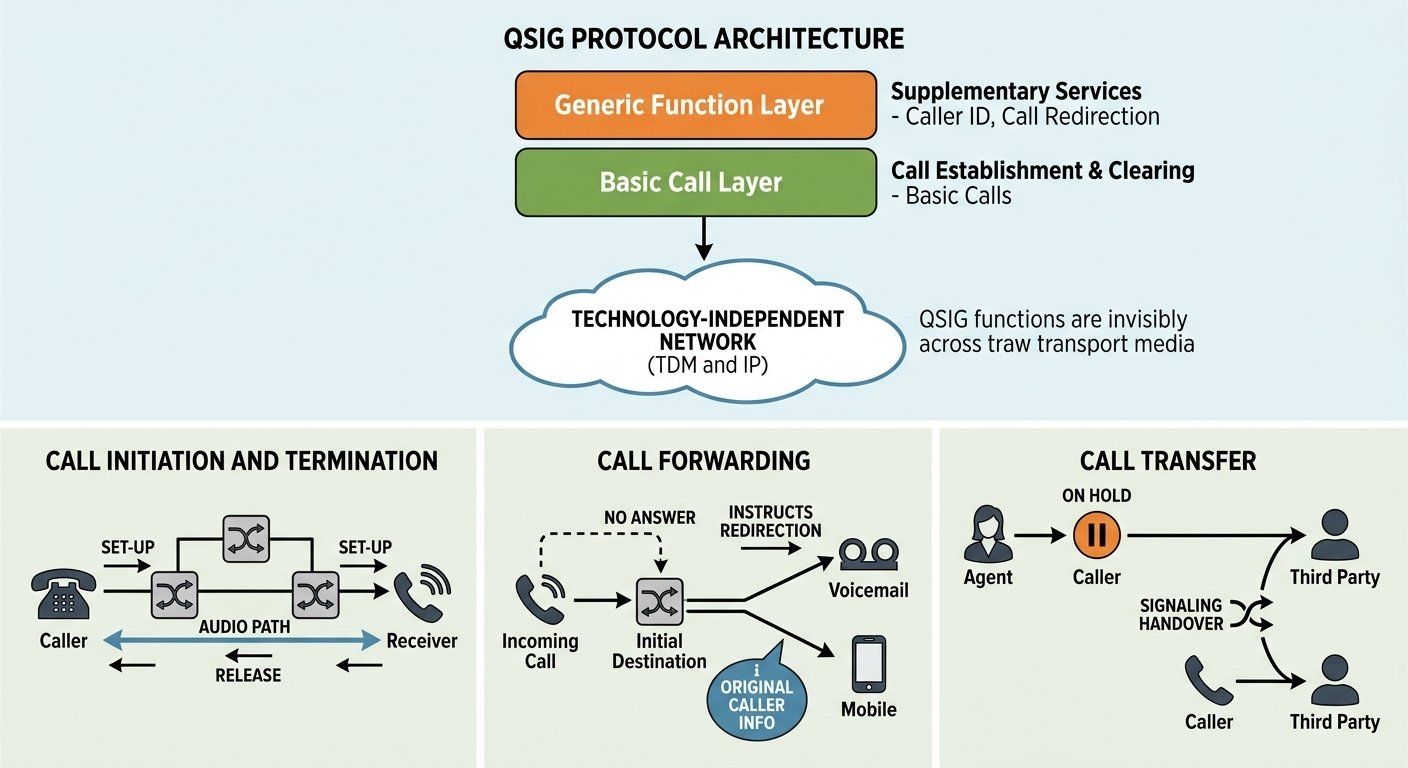
By separating these layers, the protocol ensures that basic calling remains functional even if advanced features are unavailable. Additionally, QSIG is technology-independent, allowing it to serve as a “common language” that operates invisibly across various networks, including traditional leased lines and modern IP systems.
1. Call Initiation And Termination
Establishing and terminating calls is the core function of this signaling protocol. When a user lifts a handset and dials a number, the protocol generates a series of setup messages that navigate through the network to find the destination. Once the destination is reached and the receiver answers, the protocol facilitates the connection of the audio path.
When the conversation concludes, the protocol manages the release of the network resources. This ensures that the lines are made available for other users immediately. This efficient management of resources prevents network congestion and ensures high reliability for enterprise communications.
2. Call Forwarding
This service ensures that communication remains fluid even when a specific recipient is unavailable. If a call arrives at a switch and the intended extension does not answer, the signaling protocol instructs the network to redirect the call to a different pre-defined destination. This could be another extension, an external mobile number, or a voicemail system.
The protocol carries the original caller information throughout this redirection process. This means the final recipient can still see who is calling, even though the call has been bounced through multiple switches. This transparency is crucial for maintaining professional communication standards in a large corporate environment.
3. Call Transfer
Transferring a call is a seamless process thanks to the way this protocol handles session data. It allows a user to put a caller on hold and then link that caller to a third party. The signaling manages the handover so that the original connection is merged with the new one without dropping the call. This capability is essential for receptionists and call center agents who need to move callers to different departments. The protocol ensures that the signaling remains stable during the transition, preventing the common issue of accidental disconnects during a transfer.
Q Signaling In the Telecommunication Networks
The QSIG protocol serves as a sophisticated traffic controller for voice data, utilizing a structured three-way handshake to establish communication. The process begins with a setup message containing essential metadata and service requirements, followed by an alert signal that triggers ringing at the destination. Once the recipient answers, a final connect message is exchanged, creating a stable, dedicated circuit that ensures clear and uninterrupted voice transmission throughout the duration of the call.
In addition to basic connectivity, the protocol provides real-time management of call states, enabling supplementary features like call waiting that are vital for complex corporate environments. Its standardization is a key driver of network reliability; research indicates that using standardized protocols like QSIG reduces call routing errors by 20% compared to proprietary systems. This combination of advanced call control and decreased downtime makes it a cornerstone of modern, high-stakes telephonic infrastructure.
Benefits Of Q SIG
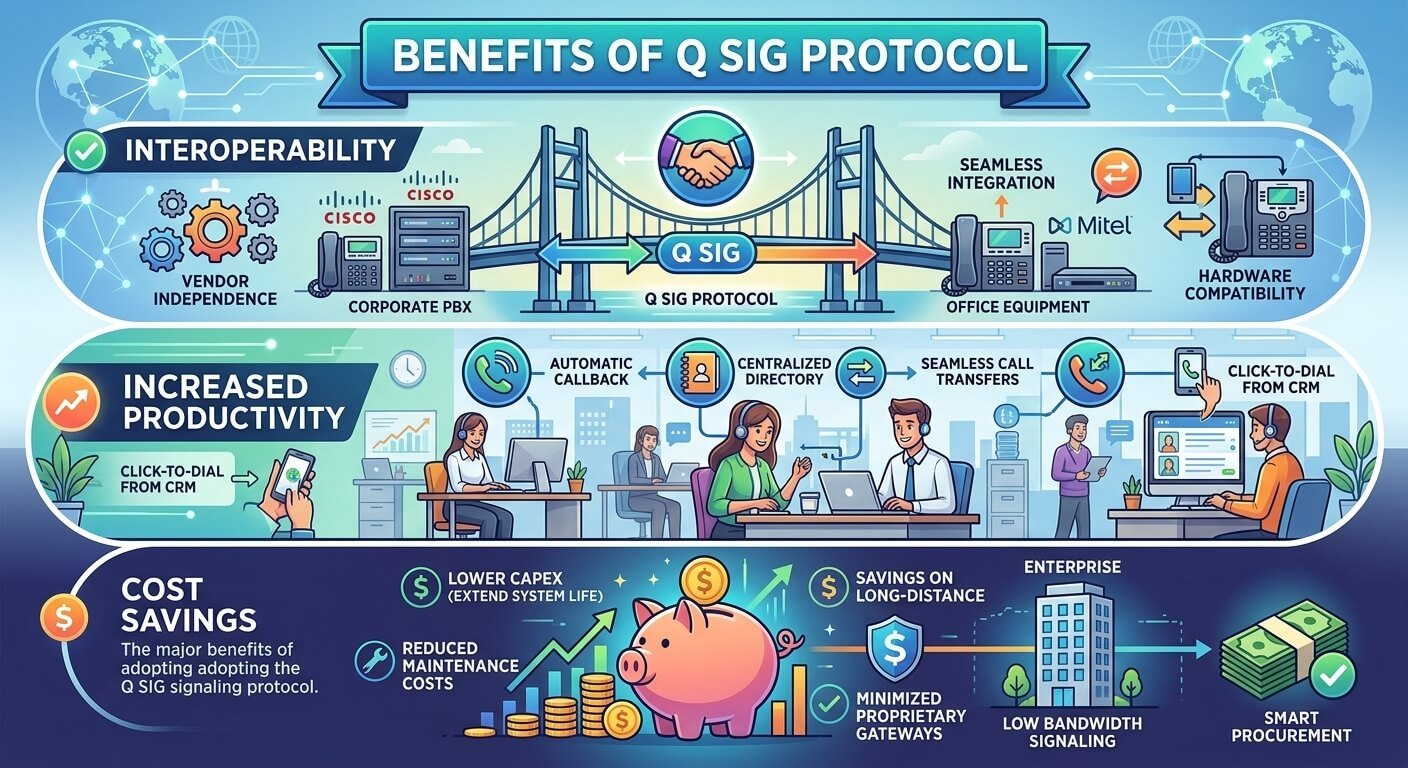
Adopting this standardized protocol eliminates vendor lock-in by enabling hardware interoperability and seamless integration between legacy and modern systems. It improves network reliability and the caller experience while streamlining IT operations through predictable signaling patterns and reduced training requirements. By providing a stable and scalable foundation, the standard supports long-term business growth and the transition to advanced unified communication strategies.
1. Interoperability
The most significant advantage of this technology is its ability to foster interoperability between disparate systems. In a typical corporate environment, it is common to find equipment from various manufacturers like Cisco, Avaya, or Mitel. This protocol acts as a translator, allowing these different systems to communicate as if they were part of a single, unified platform.
This level of compatibility means that a company does not have to replace its entire inventory of phones and switches just because they want to add a new branch office with different hardware. The interoperability provided by the protocol protects existing investments and allows for a more gradual and cost-effective upgrade path.
2. Increased Productivity
When communication systems work flawlessly, employee productivity naturally increases. Features such as automatic callback, centralized directory access, and seamless call transfers allow staff to focus on their work rather than struggling with the phone system. The protocol ensures that these features work identically, regardless of which part of the building or which branch office an employee is working in.
Furthermore, the ability to integrate voice services with other business applications becomes much simpler when the underlying signaling is standardized. This allows for the creation of more efficient workflows, such as click-to-dial from a CRM system or automatic logging of call data, further driving organizational efficiency.
3. Cost Savings
Implementing a standardized signaling protocol can lead to substantial financial savings over time. By enabling the use of diverse hardware, companies can shop around for the best prices on equipment rather than being forced to buy from a single expensive vendor. This competitive environment helps keep procurement costs down.
Additionally, the efficiency of the protocol reduces the amount of bandwidth required for signaling, which can lead to lower data costs in high-volume environments. The cumulative effect of these savings can be significant, especially for large enterprises with thousands of users spread across multiple geographic locations.
What Are The Features And Capabilities Of Q SIG?
This comprehensive signaling protocol offers a versatile suite of telecommunications services, ranging from standard call management to advanced capabilities like virtual private networks and multi-party conferencing. Its true strength lies in sophisticated supplementary services—such as call completion to busy subscribers—delivered with high precision for a consistent user experience. By integrating robust security to protect signaling data and prevent fraud, the protocol provides a reliable, high-performance environment for organizations that value both advanced functionality and corporate privacy.
-
Q SIG and VoIP
As the world moves toward internet-based communication, this protocol has evolved to work alongside Voice over IP technologies. It can be used to bridge the gap between traditional circuit-switched telephone systems and modern IP networks. This is typically achieved through the use of VoIP gateways that translate the signaling into a format that can be carried over the internet.
This integration allows businesses to enjoy the benefits of VoIP, such as lower costs and greater flexibility, while still retaining the advanced features of their existing PBX systems. It ensures that call quality remains high and that latency is kept to a minimum by providing a structured way to manage voice traffic over data networks.
-
Q SIG Deployment
Deploying this protocol can be done in several ways depending on the specific needs of the network. In traditional environments, it is often deployed over TDM or ATM links to connect physical PBX hardware. In these scenarios, it manages the high-speed digital lines that carry multiple voice channels between offices.
In more modern setups, it is frequently deployed over IP networks using a process called tunneling. This allows the signaling to travel across the internet or a private data network, reaching remote locations without the need for dedicated telephone lines. Regardless of the transport method, the core logic of the protocol remains the same, ensuring a consistent set of features and reliable performance across the entire organization.
QSIG vs SIP
| Feature | QSIG | SIP |
|---|---|---|
| Primary environment | Private PBX networks | IP-based communications |
| Origins | ISDN/private networking | Internet protocol-based telephony |
| Typical transport | Digital PBX links / tunneled in hybrid networks | IP |
| Modern usage | Legacy/hybrid enterprise systems | Widely used in modern VoIP |
| Supplementary services | PBX-oriented standardized features | Broad IP communication services |
| New deployments | Limited | Common |
| Typical role today | Legacy interoperability | Core VoIP signaling |
Is QSIG Still Used Today?
QSIG is mainly relevant in organizations that still operate legacy or hybrid PBX environments. It can remain useful when older digital PBXs from different vendors need to exchange supplementary services or when those systems are being connected to newer IP infrastructure.
For new telephony deployments, SIP-based systems and cloud communications platforms are generally more common. As organizations replace legacy PBXs, QSIG’s role is likely to become increasingly specialized rather than expand into new applications.
Industry analysts predict that while pure IP protocols will dominate new installations, the need for a reliable bridge to existing infrastructure will keep this signaling standard relevant for at least another decade. Its proven track record of stability and its comprehensive feature set make it a difficult technology to replace entirely, ensuring its place in the telecommunication landscape for years to come.
Read More: High-Availability Cloud Server Infrastructure for E-Commerce and Content Delivery
Conclusion – Q SIG (Q Signaling)
In summary, Q SIG stands as a cornerstone of modern telecommunications, providing the essential signaling required for complex enterprise voice networks. Its ability to facilitate communication between different brands of equipment has revolutionized the industry, allowing for greater flexibility and cost-effectiveness. By offering a standardized language for private branch exchanges, it ensures that vital features like call forwarding and transfer work seamlessly across diverse platforms.
The protocol’s transition into the world of VoIP and its continued relevance in hybrid networks demonstrate its inherent adaptability. For any organization looking to build a resilient and feature-rich communication system, understanding and utilizing this protocol is essential. It remains a powerful tool for achieving unified communications, helping businesses stay connected in an ever-changing technological environment. As telecommunications continue to evolve, the reliability and interoperability of this signaling system will continue to support the global growth of the telecommunications sector.
FAQs
-
What Is A Q SIG in telecommunications?
Q SIG is a standardized signaling protocol based on ISDN that allows different brands of PBX systems to communicate and share advanced features within a private network. It ensures that services like caller ID and call forwarding work across a mixed-vendor environment by providing a common language for equipment to exchange control messages.
-
How does Q Signaling differ from standard ISDN?
While based on ISDN, it is specifically optimized for private networks rather than public ones. It includes a generic function layer for advanced supplementary services that standard ISDN might not support. It allows for peer-to-peer communication between switches without needing a central public exchange.
-
Can Q SIG be used with modern VoIP systems?
Yes, it can be integrated with VoIP through gateways that translate the signaling for IP networks. It helps maintain legacy features while transitioning to internet-based calling. It is often used in hybrid environments to link old PBX hardware with new IP phones.
-
Who are the main users of this signaling protocol?
Large enterprises with multiple branch offices use it to link their phone systems. Government agencies that require secure and reliable internal communications are also primary users. Companies that have a mix of different telephone hardware brands rely on it to ensure all equipment works together.
-
What are the two main layers of Q SIG?
The basic call layer handles the opening and closing of a connection. The generic function layer manages supplementary services like call transfer. Both layers work together to ensure a feature-rich user experience.
-
Why is interoperability important for this protocol?
It prevents businesses from being locked into a single hardware vendor. It allows for the integration of new technology with older, existing systems. It simplifies the management of a diverse network of communication tools.
-
Is Q SIG a proprietary technology owned by one company?
No, it is an open standard originally created by ECMA International. It is formally defined as an ISO standard, meaning it is available for any manufacturer to use. This open nature is what guarantees it will work across different brands of equipment.
-
What services are considered supplementary in this protocol?
Services like call forwarding, call waiting, and automatic callback are considered supplementary. Identification services like calling line identity and connected line identity are also included. Advanced features like call intrusion and multi-party conferencing are supported as well.
-
How does the protocol handle a call transfer?
It manages the signaling messages between three different points to ensure the call is handed over correctly. It maintains the original call data so the connection is not lost during the move. It allows for a seamless transition that is invisible to the outside caller.
-
QSIG vs Q.931
Q.931 is the ISDN call-control signaling specification on which the QSIG basic call protocol is based. QSIG builds on that foundation for private PBX networking and adds mechanisms for supplementary enterprise telephony services.