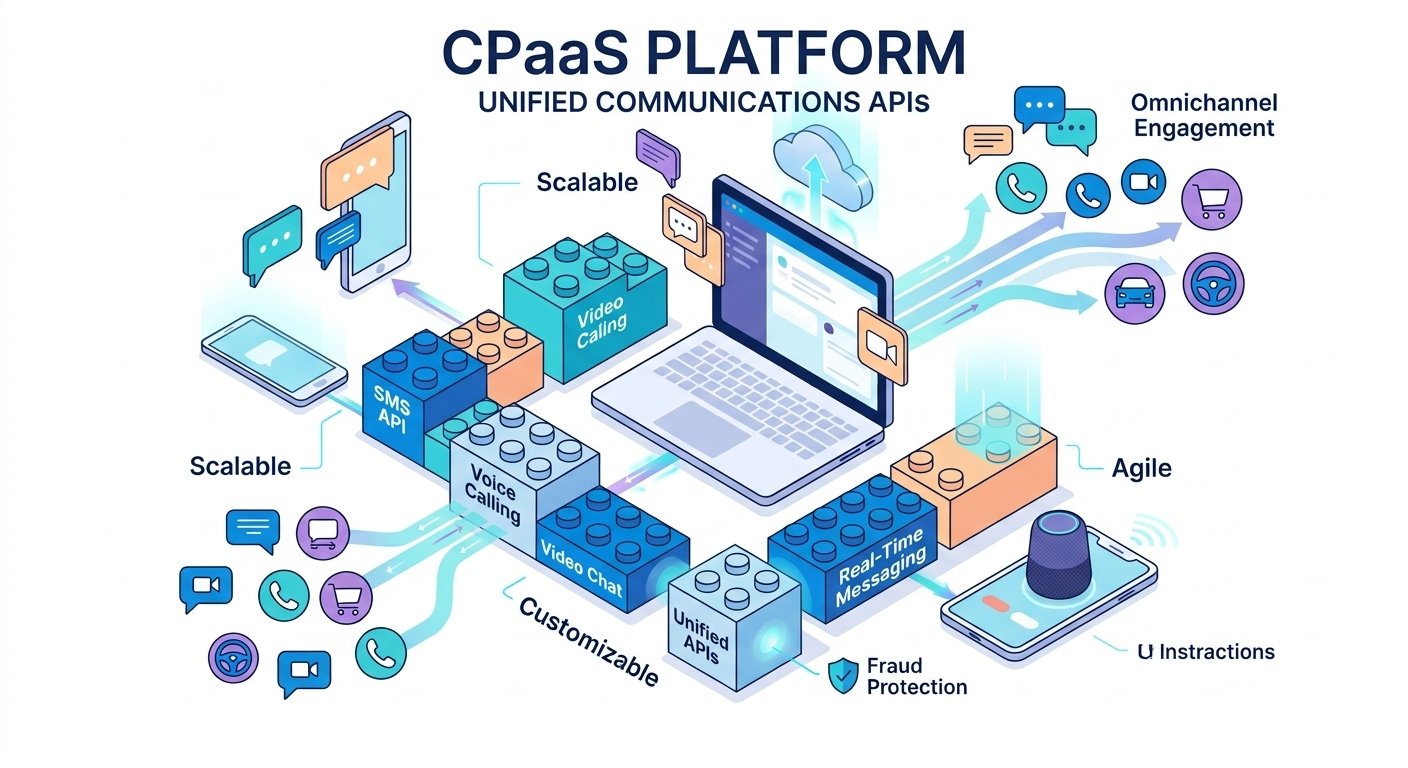
Communications Platform as a Service (CPaaS) is a cloud-based platform that lets businesses add communication features such as voice calls, SMS, messaging, video, and authentication directly to their applications. Developers typically access these features through APIs and SDKs instead of building and maintaining the underlying communications infrastructure themselves. This technology is important for companies wanting to customize their communications infrastructure to meet specific customer needs. While traditional virtual phone systems offer pre-built setups, cpaas provides the building blocks for a completely tailored communication stack, helping brands create a more dynamic and connected customer journey.
What Is CPaaS?
CPaaS stands for Communications Platform as a Service. It gives developers access to communication capabilities through APIs, software development kits (SDKs), and other development tools. Instead of building voice, messaging, video, or authentication infrastructure from scratch, businesses can integrate the capabilities they need into their existing websites, apps, and business systems.. This approach allows a business cpaas to be highly flexible, moving away from rigid, one-size-fits-all software solutions. Instead of purchasing an entire phone system with features you might never use, you can select only the specific cpaas api functions required for your specific workflow.
Unlike a ready-made business phone system, CPaaS provides individual communication capabilities that developers can combine according to the application’s requirements. A company might use one API for SMS notifications, another for voice calls, and an authentication API for one-time passwords.
How Does CPaaS Work?
CPaaS works primarily through APIs and SDKs. A developer integrates the provider’s API into an application and configures specific events to trigger communication actions. For example, an online store could automatically send an SMS when an order ships, while a healthcare application could send an appointment reminder before a scheduled visit.
When a developer uses a cpaas model, they are essentially writing code that tells their application to trigger a specific communication event, such as making a phone call or sending an automated text message, by sending a request to the provider’s server.
For instance, consider how a modern ride-sharing application operates. When you book a ride, the app uses a cpaas provider to facilitate various interactions. It might send an SMS notification to confirm your pickup, enable an in-app voice call between you and the driver without revealing personal phone numbers, and provide real-time updates through push notifications. These actions are triggered by specific events within the app, which then communicate with the backend VoIP networks to transmit data packets between users globally.
CPaaS vs. UCaaS
It is common for business owners to compare cpaas with Unified Communications as a Service (UCaaS). While both offer cloud-based communication, they serve very different purposes. UCaaS provides a ready-to-use, all-in-one platform that includes phone, video, and messaging out of the box. In contrast, a communication platform as a service offers the raw ingredients to build those features into your own existing software. The choice between them depends on whether you need a finished product or a custom-built solution.
| Feature | CPaaS | UCaaS |
| Customization | High | Limited |
| Development effort | More complex (requires coding) | Simpler (ready-made solution) |
| Scalability | Highly scalable | Also highly scalable |
| Ideal for | Businesses with specific communication needs | Businesses seeking a complete communication solution |
Many companies today utilize a hybrid approach. A company might use a UCaaS platform for employee calling and collaboration while using CPaaS APIs to build SMS notifications or authentication into its customer-facing application.
CPaaS vs UCaaS vs CCaaS
| CPaaS | UCaaS | CCaaS | |
|---|---|---|---|
| Purpose | Build communications into apps | Employee communications | Customer contact center |
| Main users | Developers | Employees | Agents/support teams |
| APIs | Core delivery method | Available but not core | Available/integrations |
| Coding | Usually required | Usually not | Usually not |
| Voice | API-based | Built in | Built in |
| Messaging | API/channel based | Team/business messaging | Customer messaging |
| Customization | High | Moderate/provider-defined | Workflow/configuration focused |
| Typical example | OTP, alerts, masked calling | Business phone + meetings | Customer-support queue |
Benefits of CPaaS
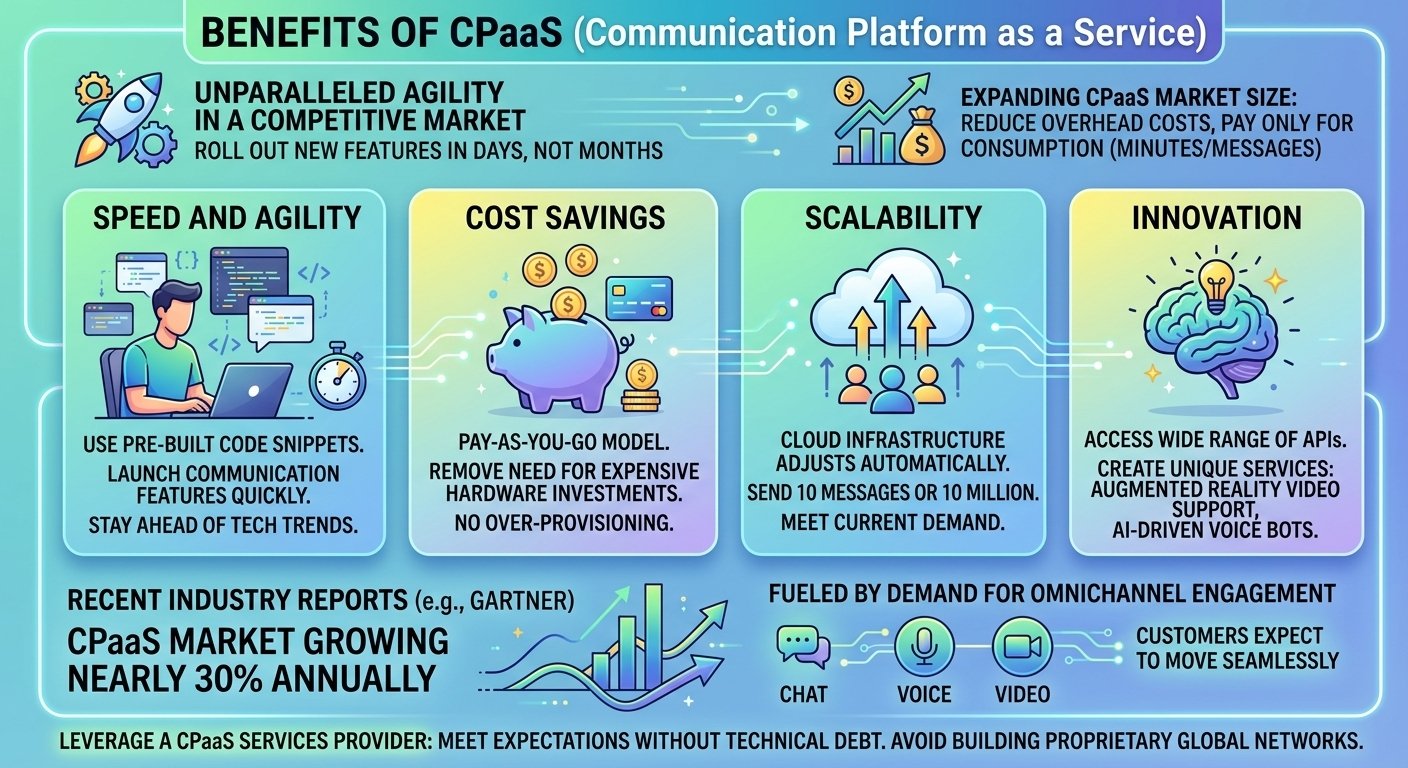
CPaaS allows businesses to add communication capabilities without building the underlying telecom infrastructure themselves. Because developers can integrate individual APIs as needed, companies can customize how voice, messaging, video, and authentication work within their applications.
Recent industry reports from analysts like Gartner suggest that the communication platform as a service market is growing at a rate of nearly 30% annually.
-
Faster Development
Developers can use existing APIs and SDKs instead of creating communications infrastructure from the ground up. This can reduce development work for features such as SMS notifications, voice calling, and user verification.
-
Flexible Pricing
Many CPaaS services use usage-based pricing for calls, messages, phone numbers, or other API activity. Actual costs depend on the provider, destination, traffic volume, and features used.
-
Scalability
Cloud communications infrastructure can support changing message and call volumes without requiring businesses to install additional on-premises telecom hardware.
-
Customization
Developers can combine communication APIs with existing applications, databases, CRM systems, and workflows to create functionality suited to specific business requirements.
Much stronger.
Factors to keep in mind for successful CPaaS integration
While the advantages are significant, successful implementation requires careful planning. First, you must evaluate your development resources. Because these platforms are developer-centric, you will need engineers who understand how to work with RESTful APIs and handle real-time data streams. If your team is small, look for a cpaas provider that offers excellent documentation and SDKs in multiple programming languages to simplify the integration process.
Security is another critical factor to consider when choosing a cpaas vendor. Since your communication data travels over the public internet, you must ensure the provider uses end-to-end encryption and complies with global standards like GDPR or HIPAA. High-quality cpaas fraud protection features are also vital to prevent unauthorized access or toll fraud, which can be costly if left unmonitored.
Key CPaaS Functions
To build a comprehensive communication strategy, you need to understand the various building blocks available. Most cpaas platforms provide a wide array of functions that can be used individually or combined. For example, you might evaluate the cpaas company bird on omnichannel marketing to see how they integrate different messaging streams into a single customer view.
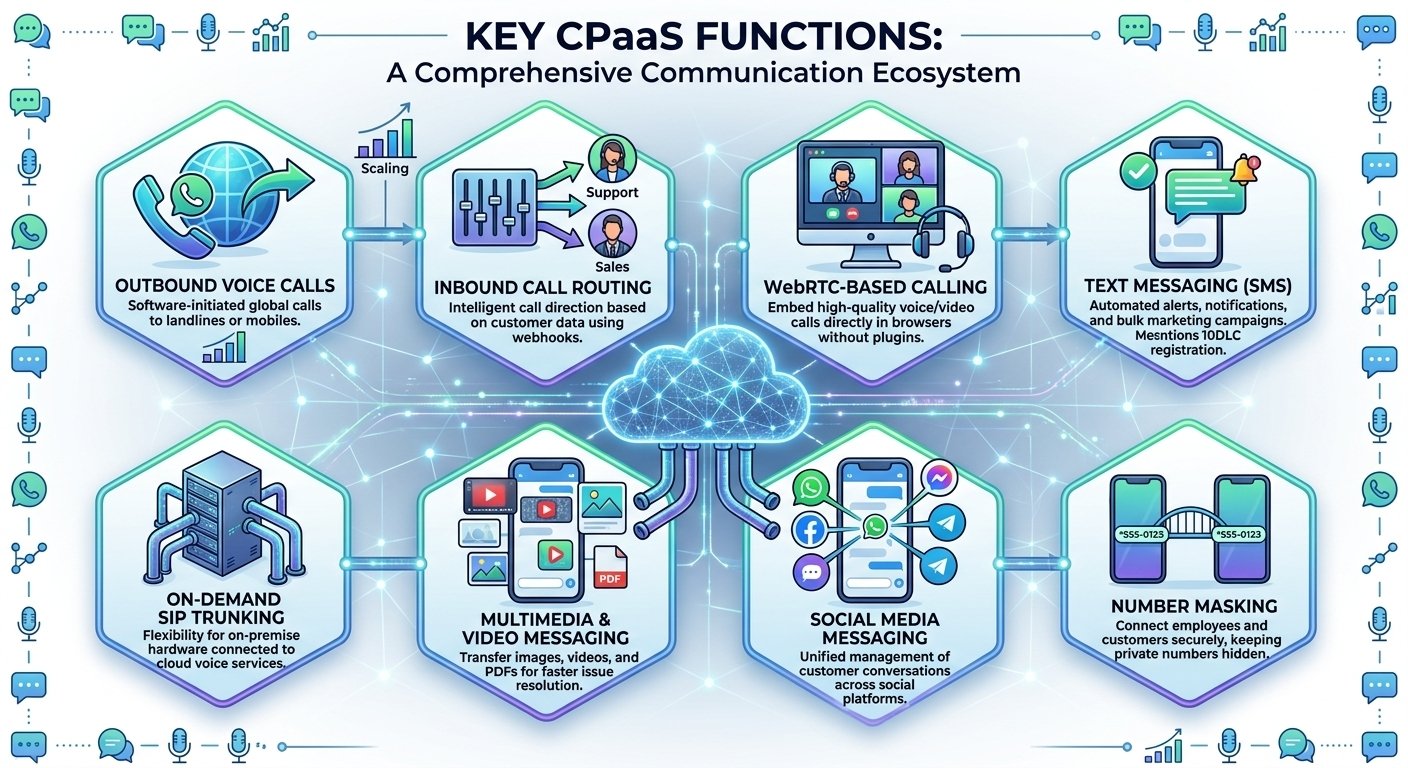
1. Outbound voice calls
A voice API allows your software to initiate calls to landlines or mobile phones globally. This is useful for automated alerts or connecting a sales agent to a lead directly from a CRM. Organizations often use this to scale their calling capacity during peak seasons without adding new physical lines.
2. Inbound call routing
Using webhooks, cpaas solutions can direct incoming calls to the right department or individual based on specific data. When a call arrives, the system checks your database and follows logic to route the caller, which is a key component of building a modern cloud contact center.
3. WebRTC-based calling
Web Real-Time Communication (WebRTC) is a technology that allows voice and video calling directly inside a web browser. This eliminates the need for users to download third-party plugins or apps. Many cpaas vendors offer WebRTC to help businesses embed high-quality video conferencing into their client portals.
4. Text messaging (SMS)
SMS remains one of the most effective ways to reach customers. With an SMS cpaas API, you can automate text notifications, two-way conversations, and bulk marketing campaigns. Modern providers also help manage 10DLC registration to ensure your messages are delivered reliably.
5. On-demand SIP trunking
For businesses that still have on-premise equipment, SIP trunking provides the necessary connectivity to the internet. This allows you to keep your existing hardware while gaining the flexibility and cost benefits of cloud-based voice services.
6. Multimedia and video messaging
Beyond simple text, multimedia messaging allows for the transmission of images, videos, and PDFs. This is particularly useful in industries like insurance or tech support where a visual representation of a problem can speed up the resolution process.
7. Social media messaging
Many cpaas platforms now integrate with popular apps like WhatsApp, Facebook Messenger, and Telegram. This allows you to meet your customers where they already spend their time, managing all these conversations through a unified API.
8. Number masking
This function protects the privacy of both your employees and your customers. When a delivery driver calls a customer through an app, neither party sees the other’s real phone number. The cpaas platform acts as a secure bridge, ensuring safety and data privacy.
CPaaS Use Cases
The versatility of cpaas makes it applicable across various sectors. By looking at a cpaas example in real life, we can see how companies transition from legacy systems to agile, cloud-based workflows. For instance, when we evaluate the cpaas company infobip on conversational experience, we see how they enable businesses to create automated yet personal dialogues with their users.
1. Appointment confirmations and fulfillment updates
Healthcare organizations can use messaging APIs to send appointment reminders, while retailers and e-commerce businesses can use them for order confirmations, delivery notifications, and other status updates.
2. Fraud and abuse mitigation
Security is a major concern for online platforms. By integrating cpaas functions, companies can implement two-factor authentication (2FA) and send one-time passwords (OTP) via text or voice. This adds a robust layer of security for user logins and financial transactions, effectively reducing the risk of account takeovers.
3. Scalable voice and messaging
For industries like travel and finance, communication needs can fluctuate wildly. A cpaas provider allows these companies to scale their voice and messaging capabilities instantly during emergencies or high-traffic events. This ensures that customers can always reach support when they need it most, regardless of the volume.
4. Automated customer interactions
Chatbots powered by AI and integrated via cpaas allow for 24/7 customer service. These bots can handle routine inquiries like balance checks or password resets, freeing up human agents for more complex tasks. When you evaluate the cpaas company clicksend on cloud contact center capabilities, you see how these automated flows can reduce operational costs while maintaining high satisfaction.
Alternatives to CPaaS
While cpaas is powerful, it is not the only option for business communication. Some organizations may find that they do not have the technical expertise to build a custom solution from scratch. In such cases, a ready-made UCaaS platform with robust features might be a better fit. These platforms offer a user-friendly interface that requires zero coding, making them ideal for small to medium-sized businesses.
Another alternative is a Contact Center as a Service (CCaaS) platform. CCaaS is specifically designed for high-volume customer support and sales teams, providing built-in tools for call queuing, recording, and agent management. For those with a significant investment in physical hardware, unmetered SIP trunks can be used to connect existing PBX infrastructure to the cloud, offering a middle ground between old and new technology. Ultimately, the right choice depends on your specific goals and technical maturity.
| Solution | Best For | Development Required |
|---|---|---|
| CPaaS | Embedding communications into apps | Usually yes |
| UCaaS | Employee calling, messaging and meetings | Usually no |
| CCaaS | Customer-service/contact-center operations | Usually no/low |
| SIP Trunking | Connecting existing PBX systems to IP telephony | Technical configuration |
Read More: Work From Home vs Work from Office: Pros and Cons
Final words
CPaaS is most useful when a business needs communication features inside its own applications rather than a ready-made phone or collaboration system. APIs for voice, messaging, video, verification, and other channels allow development teams to build communication workflows around their specific products and processes.
Before choosing a CPaaS provider, compare API documentation, supported channels and countries, pricing, number availability, reliability, security controls, regulatory support, fraud prevention, SDK availability, technical support, and scalability. Businesses without development resources may find that UCaaS or CCaaS provides a simpler alternative.
FAQs About CPaaS
-
What is the primary purpose of a cpaas platform?
The main goal of a cpaas platform is to allow businesses and developers to integrate real-time communication features, such as voice, video, and messaging, into their existing software applications using APIs. This eliminates the need for companies to build their own global telecommunications infrastructure.
-
How is cpaas different from a traditional phone system?
Unlike a traditional phone system that relies on physical hardware and pre-configured software, cpaas is entirely cloud-based and highly customizable. It provides the individual components of a communication system, allowing developers to build only the features they need into their specific business tools.
-
Do I need a developer to use a cpaas solution?
Yes, because cpaas is a developer-centric model, you generally need someone with coding skills to integrate the APIs into your applications. However, some modern providers offer low-code tools and visual builders to help non-technical users create basic communication workflows.
-
Is cpaas secure for sensitive business data?
Most reputable cpaas providers implement high-level security measures, including data encryption, secure API keys, and compliance with international regulations. It is important to choose a provider that offers built-in fraud protection and regular security audits to safeguard your information.
-
What are the cost benefits of using a cpaas model?
CPaaS typically operates on a pay-as-you-go pricing model. This means businesses only pay for the number of minutes, messages, or active users they utilize, which prevents the waste of budget on unused capacity and removes the need for large upfront capital investments.
-
Can cpaas help with omnichannel customer engagement?
Absolutely. CPaaS is designed to support multiple channels, including SMS, voice, email, and social messaging apps like WhatsApp. By using a single platform to manage these channels, businesses can provide a consistent and seamless experience for their customers across all touchpoints.
-
What industries benefit the most from cpaas technology?
While almost any business can benefit, industries such as healthcare, e-commerce, banking, and logistics see the most significant impact. These sectors rely heavily on real-time notifications, secure authentication, and scalable customer support to maintain their operations.
-
What is number masking in cpaas?
Number masking is a feature that allows two people to communicate via voice or text without seeing each other’s actual phone numbers. The cpaas platform uses a temporary or proxy number to facilitate the connection, which is essential for privacy in services like food delivery or ride-sharing.
-
How does SIP trunking relate to cpaas?
SIP trunking is a specific function offered by many cpaas providers that allows an on-premise PBX system to send and receive calls over the internet. It serves as a bridge for businesses that want to modernize their voice communication without completely replacing their existing hardware.