
Google Fiber Business is our price-led choice for an eligible office that wants standalone 1 Gig service. AT&T Business Fiber is our starting choice for a lower-cost entry connection, an eligible wireless bundle or a competitively priced 2 Gig tier. Both belong on the shortlist for office uploads, calls and cloud work.
The best purchase depends on the exact building, complete quote and recovery requirements. This Google Fiber vs AT&T Fiber guide compares business plans for offices, rather than treating residential internet offers as commercial service. Our recommendations assess published features and service fit; we have not conducted firsthand tests of the two networks.
Affiliate notice: VoIPCalling.com may earn a commission through it, at no additional cost to you.
Google Fiber vs AT&T Fiber: Quick Overview

| Buying factor | Google Fiber Business | AT&T Business Fiber |
|---|---|---|
| Published entry tier | 1 Gig at $100/month + taxes. | 300 Mbps at $60/month + taxes. |
| Standalone 1 Gig price | $100/month + taxes: listed price winner. | $140/month + taxes; eligible wireless bundle can reduce the internet charge. |
| Standalone 2 Gig price | $250/month + taxes. | $185/month + taxes: listed price winner. |
| Upload profile | Current business help lists symmetrical 1 and 2 Gig. | Symmetrical tiers, subject to actual wired performance. |
| Contract and usage | No contracts or data caps in the current business help. | No annual internet contract or data caps. |
| Main qualification | Confirm business service for the exact suite. | Confirm the tier, offer and backup eligibility for the suite. |
“+ taxes” is shorthand in the tables. Request fees, equipment conditions and the complete proposal too. Compare Google Fiber Business availability with AT&T Business Fiber availability. Neither provider wins every requirement.
Google Fiber vs AT&T Fiber: Customer Rating Snapshot

Individual AT&T customer example: 5/5 on G2. Belinda C., Practice Administrator, May 1, 2026, described dependable internet and phone service.
The review does not identify Business Fiber. This is an individual customer score, not a Fiber aggregate rating. Google Fiber’s provider-hosted business testimonials appear later as qualitative examples, without an invented star score.
Google Fiber vs AT&T Fiber: Business Pricing Compared
| Speed tier | Google Fiber Business | AT&T Business Fiber |
|---|---|---|
| 300 Mbps | No matching tier listed in the current business help. | $60; $40 with eligible Business wireless. |
| 500 Mbps | No matching tier listed in the current business help. | $100; $60 with eligible Business wireless. |
| 1 Gig | $100. | $140; $90 with eligible Business wireless. |
| 2 Gig | $250. | $185; $135 with eligible Business wireless. |
| 5 Gig | No matching tier listed in the current business help. | $285; $235 with eligible Business wireless. |
References come from GFiber’s business pricing help and AT&T’s Business Fiber offers. AT&T online prices and discounts have eligibility conditions. The mobile subscription is paid separately. Confirm which ordering-channel offer applies before assuming a listed discount is available.
The clear price winners
Standalone 1 Gig: Google Fiber wins the listed internet charge. Its $100 reference is $40 below AT&T’s $140, or $480 over twelve months before extras and changes. If an eligible AT&T wireless bundle reduces the internet line to $90, AT&T instead has the lower internet charge—but the phone bill remains part of the budget.
Standalone 2 Gig: AT&T wins the listed internet charge. Its $185 reference is $65 below Google Fiber’s $250, or $780 across twelve months before extras and changes. Google’s included static IP and service-level guarantee can be relevant to the value comparison.
Lowest listed entry charge: AT&T Fiber wins. An office that needs a suitable 300 Mbps connection does not have to buy gigabit service simply because the competing provider starts there. Choose adequate capacity, then compare cost.
Keep the complete bill in view
Ask for installation, equipment, static-IP, backup and local-fee costs. GFiber’s fee schedule describes a location-dependent local access fee and equipment-return obligations. “Equipment included” should not be read as unconditional ownership.
Compare the expected cost over the period you intend to occupy the office. Keep reward cards separate from recurring charges, and record the price after any promotional conditions change. A bundle is useful when the added service is already needed.
Google Fiber vs AT&T Fiber Uploads and Speed: Both Are Strong Office Candidates
Google’s current business help lists up to 1 Gbps upload and download for Business 1 Gig, and up to 2 Gbps in both directions for Business 2 Gig. Its older March 2022 launch article described 2 Gbps download with 1 Gbps upload. Confirm the current symmetrical specification for the plan and location you are ordering.
AT&T’s tiers also advertise equal upload and download speeds. Published speed claims refer to wired connections, and the 5 GIG single-device wired maximum is 4.7 Gbps. A multi-gig plan requires suitable router ports, cabling and client hardware to realize the extra capacity.
For an office, outgoing traffic deserves its own calculation. Meeting video, design files, backups and cloud synchronization share the upload path. A team using large files may benefit more from improving upstream capacity than from a bigger download headline.
At comparable suitable tiers, this is a service-fit tie rather than a demonstrated nationwide speed winner. Validate actual wired performance, simultaneous applications and working-hour consistency. Neither brand name guarantees the result over your existing Wi-Fi.
Calling, Meetings and Everyday Business Apps
Both connections can support a modern office’s internet-based phone and meeting tools when the actual service and internal network meet the applications’ requirements. Confirm your calling provider’s guidance before a migration.
A single speed test cannot show whether voice traffic remains usable while backups run. Test calls, a video meeting and a normal upload together. Record interruptions, delayed audio and unstable sessions rather than judging only the download number.
An internet plan does not automatically include a complete business phone system. GFiber’s business page links to a separately billed Dialpad offer; AT&T also markets separate calling products. Select numbers, routing, recording and licences as their own requirements.
Cloud access is equally distinct from application integration. Buying either provider does not automatically create a CRM integration, a contact centre or a Microsoft Teams calling setup. Confirm those services with the relevant software and telephony suppliers.
Wi-Fi, Routers and Static IP Addresses
GFiber’s current business help lists a Wi-Fi 6E router for both tiers. Business 2 Gig also lists up to two mesh extenders and a single static-IP assignment. Equipment and feature eligibility may vary; use the actual order as the reference.
AT&T includes a Wi-Fi gateway with Business Fiber. Review the proposed model and any static-IP charge if your office needs inbound access, allowlisting or site-to-site networking.
GFiber’s business guidance says multiple static IPs require your own router. Confirm the supported addressing configuration and who troubleshoots a third-party device. A provider supporting its access circuit does not necessarily support your firewall configuration.
Do not purchase static IPs purely because the office uses internet calls. Many hosted applications work with ordinary dynamic addressing. Have the administrator identify the specific requirement, then verify backup compatibility as well.
For either service, check dead zones, guest separation and wired connections for essential devices. Router placement, walls and client capability can matter more to a troublesome room than upgrading the internet tier.
Reliability and Google Fiber’s Service-Level Guarantee
Google Fiber Business 2 Gig has the clearer published business SLA proposition in this comparison. The current pricing help includes a 99.9% service-level guarantee; verify that the order identifies your connection as covered.
The linked Premium SMB SLA measures monthly availability of the covered service. Below 99.9%, it provides a credit equal to 25% of that service’s monthly recurring charge, subject to its terms. It excludes specified events including scheduled maintenance, customer or third-party equipment and commercial power outages.
See the full GFiber business SLA. A credit mechanism compensates under defined conditions; it does not promise zero downtime or automatically pay for every business loss. The business help specifically associates the guarantee with 2 Gig, so do not assign it to 1 Gig without confirmation.
AT&T’s Business Fiber page promotes its AT&T Guarantee and eligible backup features. Compare the exact remedies and conditions in the proposal. AT&T Dedicated Internet is a separate product: an ordinary Business Fiber tier should not be described as a dedicated circuit.
For a permanent office, both are reasonable fiber candidates. We have not established one provider as universally more reliable. Local installation quality, equipment, support and the complete recovery design determine practical continuity.
Backup: AT&T’s Included Feature vs a Separate Design
Eligible AT&T Fiber tiers of 1 GIG and higher advertise integrated wireless backup with the required gateway and coverage. It needs power. Confirm what happens to static-IP and calling services before relying on it for business continuity.
AT&T is our starting winner when an eligible integrated backup arrangement is part of the purchase. That recommendation concerns the feature fit, not a promise that every application survives a failure.
GFiber’s listed business plan inclusions do not establish an equivalent included cellular failover service. If recovery is essential, request a separately designed second link, failover router and power protection.
For both providers, run a controlled primary-link failure and restoration test. Calls, VPNs and payment sessions can need reconnection after the external address changes. Specify acceptable interruption and recovery steps before installation.
A second connection can help when it avoids shared failure points. Two providers using the same building pathway or the same unprotected power supply may still fail together. Ask how the design addresses that risk.
Google Fiber vs AT&T Fiber: Availability, Installation and Contract Terms
Start with the exact office address and suite. GFiber business service is available in selected locations; an advertised city does not mean every premises qualifies. AT&T also needs address-level qualification for its fiber tiers.
A building described as eligible for GFiber Webpass may involve a different service proposition. Ask for its specific access technology, speed profile and agreement; do not automatically apply the Business 1 Gig and 2 Gig details here to a Webpass quote.
GFiber says leased business premises may require an agreement with the property manager. Obtain permission for the survey, entry path and equipment. AT&T’s installation must likewise fit the building’s practical access arrangements.
GFiber’s business help lists no contracts, no data caps and no construction fees. AT&T advertises no annual internet contract and an online installation waiver subject to conditions. Review both accepted orders for return requirements, add-ons and relocation terms.
Do not cancel the existing circuit based solely on an estimated date. Agree the installation appointment and acceptance checks, then coordinate the transition with the phone provider and network administrator.
Google Fiber vs AT&T Fiber: Customer Support and Security
Ask each provider how to report a total outage, what information the support team needs, and who can authorize escalation. Record responsibility for the access circuit, supplied router, office Wi-Fi and third-party firewall.
GFiber’s business testimonials include positive reports of setup and support; that is useful context rather than proof of a universal response time. Get any repair or onsite commitment in writing when it is material to the business.
Neither fiber subscription by itself establishes security compliance. Use suitable firewall rules, updates, strong Wi-Fi credentials and separate guest access. Review payment, remote-access and data-handling requirements with the responsible administrator.
Enterprise buyers should compare security, routing, monitoring and managed support scope independently from the broadband headline price. A bigger speed tier does not solve every operational requirement.
Google Fiber vs AT&T Fiber: Pros and Cons Compared
| Provider | Strengths | Limitations |
|---|---|---|
| Google Fiber Business | Lower listed standalone 1 Gig charge; current symmetrical tiers; 2 Gig static IP and SLA proposition. | Selected-location availability; higher listed 2 Gig charge; separate recovery design may be needed. |
| AT&T Business Fiber | Lower entry and listed 2 Gig charges; eligible bundle savings; eligible integrated backup. | Offer and address eligibility; bundle bill must be counted; backup restrictions need review. |
Google Fiber vs AT&T Fiber: Clear Winners by Business Need
| Business requirement | Clear winner | Reason |
|---|---|---|
| Standalone 1 Gig office access | Google Fiber Business on listed price. | $100 versus AT&T’s $140 reference. |
| Lower-cost entry office connection | AT&T Fiber. | 300 Mbps starts below GFiber’s listed gigabit entry. |
| Eligible existing AT&T wireless customer seeking 1 Gig | AT&T Fiber on the internet charge. | The cited eligible bundle reference is $90. |
| Standalone 2 Gig office connection | AT&T Fiber on listed price. | $185 versus GFiber’s $250 reference. |
| 2 Gig with a clearly published business SLA and included single static IP | Google Fiber Business. | Its current help lists both for Business 2 Gig. |
| Eligible integrated wireless backup | AT&T Fiber. | Confirm gateway, coverage and application compatibility. |
| Medium office with sustained calls and uploads | GFiber 1 Gig for standalone price; AT&T 2 Gig for higher-capacity price. | Measure the workload before selecting the tier. |
| Enterprise with dedicated or managed requirements | A dedicated or managed proposal. | Compare contractual scope separately from ordinary broadband. |
| Only one provider qualifies for the premises | The suitable available provider. | Availability takes priority over a theoretical price comparison. |
These are need-based winners, not nationwide network-performance rankings. Employee count alone should not determine the speed tier: concurrent uploads and critical applications are more useful measures.
Request an AT&T Business Fiber Proposal
Use the AT&T Business Fiber inquiry page to qualify the address and request a written quote. Include the suite, required uploads, static IPs, backup needs and any existing eligible wireless service.
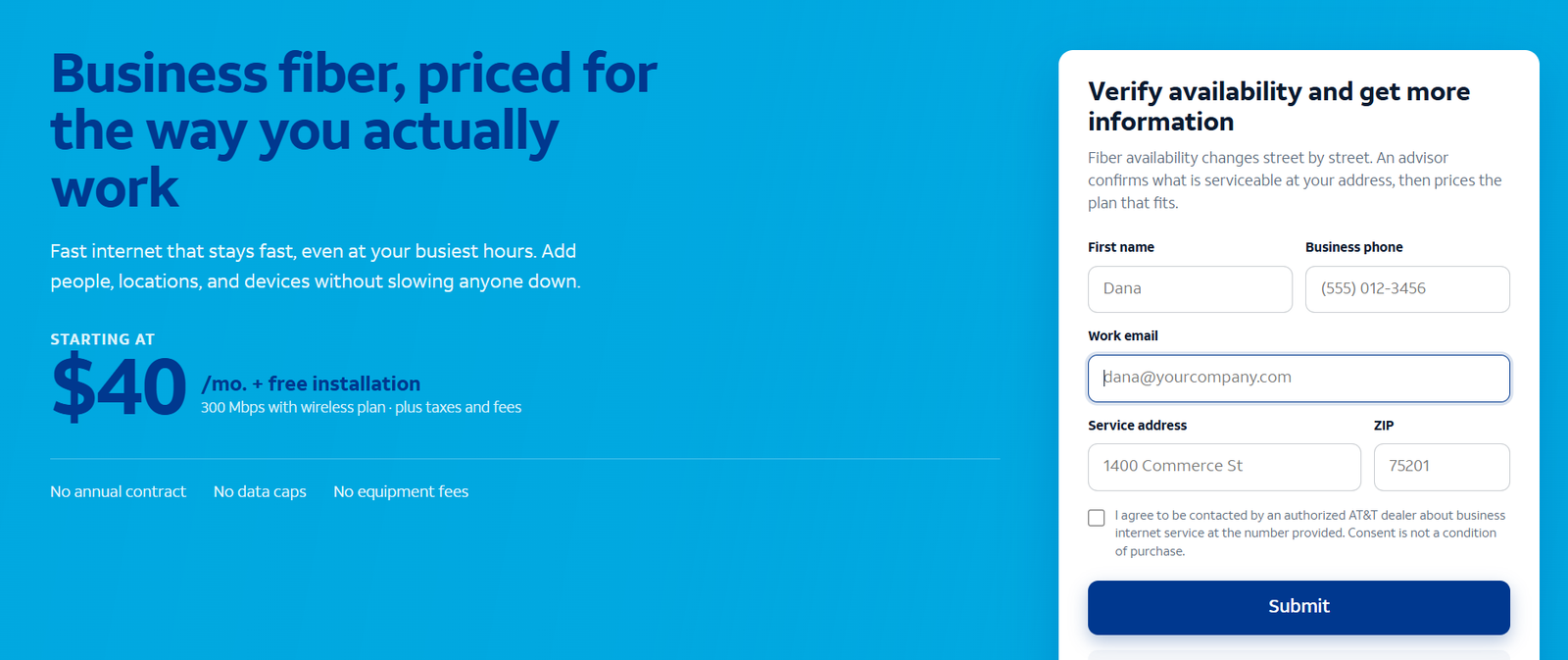
After submitting an inquiry, you can typically expect a response within 24–48 business hours. This is an expected response window, not a guaranteed installation deadline.
For more detail, read our AT&T Business Fiber review. Request a comparable quote through Google Fiber’s dedicated business page before choosing.
Google Fiber vs AT&T Fiber: Customer Reviews and Business Experiences
AT&T: Belinda’s 5/5 G2 example describes positive internet and phone service, but it does not identify Fiber. The general listing mixes services; it should not become a Business Fiber aggregate score.
Google Fiber: On its provider-hosted business page, B. Leach, CEO of Steelray Software, describes straightforward setup and helpful support. A. Tschirner of Lyntec describes satisfactory billing and connectivity. These are selected provider-published testimonials, not an independent review sample or guarantee for your location.
Look for recent evidence from comparable premises and distinguish residential service, Business Fiber and Webpass. Use reported problems to form questions for the provider, then verify the proposed connection and support agreement.
Frequently Asked Questions
Is Google Fiber or AT&T Fiber better for a business office?
Google Fiber Business is our listed-price choice for standalone 1 Gig where available. AT&T is our starting choice for a cheaper entry tier, eligible bundles or competitively priced 2 Gig service. Local access and the complete proposal determine the purchase.
Is Google Fiber Business 2 Gig symmetrical?
The current business help lists up to 2 Gbps upload and download. Older launch information described 1 Gbps upload. Confirm the current profile for your specific order.
Which is cheaper at 1 Gig?
GFiber’s standalone reference is $100/month + taxes, against AT&T’s $140. Eligible AT&T wireless bundles can reduce the internet line to $90, with wireless paid separately.
Which is cheaper at 2 Gig?
AT&T’s standalone reference is $185/month + taxes, versus GFiber’s $250. Compare included features and extras before choosing.
Does Google Fiber Business include an SLA?
The current help lists a 99.9% service-level guarantee with Business 2 Gig. Confirm coverage and read the SLA exclusions and credit terms.
Can I use either connection with my business phone system?
Generally, a suitable connection can support hosted calling. Verify your phone provider’s requirements, concurrent traffic and failover behaviour.
Can I use residential prices for this comparison?
No. Residential plans and business offers have different pricing and features. Compare the service you can actually order for the office.
Are these dedicated internet connections?
Do not assume so. Request a separate dedicated or managed proposal when the business needs those contractual capabilities.
Final Recommendation
Choose Google Fiber Business 1 Gig when its standalone price, availability and complete service fit your office. Choose AT&T Fiber when its entry tier, eligible bundle, 2 Gig price or integrated backup is the better match.
Both are credible fiber candidates for offices. Qualify the premises, compare equivalent total quotes and validate essential applications and recovery before moving the business.
AT&T, Google Fiber and GFiber are trademarks of their respective owners. VoIPCalling.com is an independent publisher.
Affiliate disclosure: VoIPCalling.com may earn a commission if you purchase through it, at no additional cost to you.